TECHNOLOGY EXPLAINER
SAF and e-Fuels
— what "drop-in" means, and the arithmetic of synthetic fuel
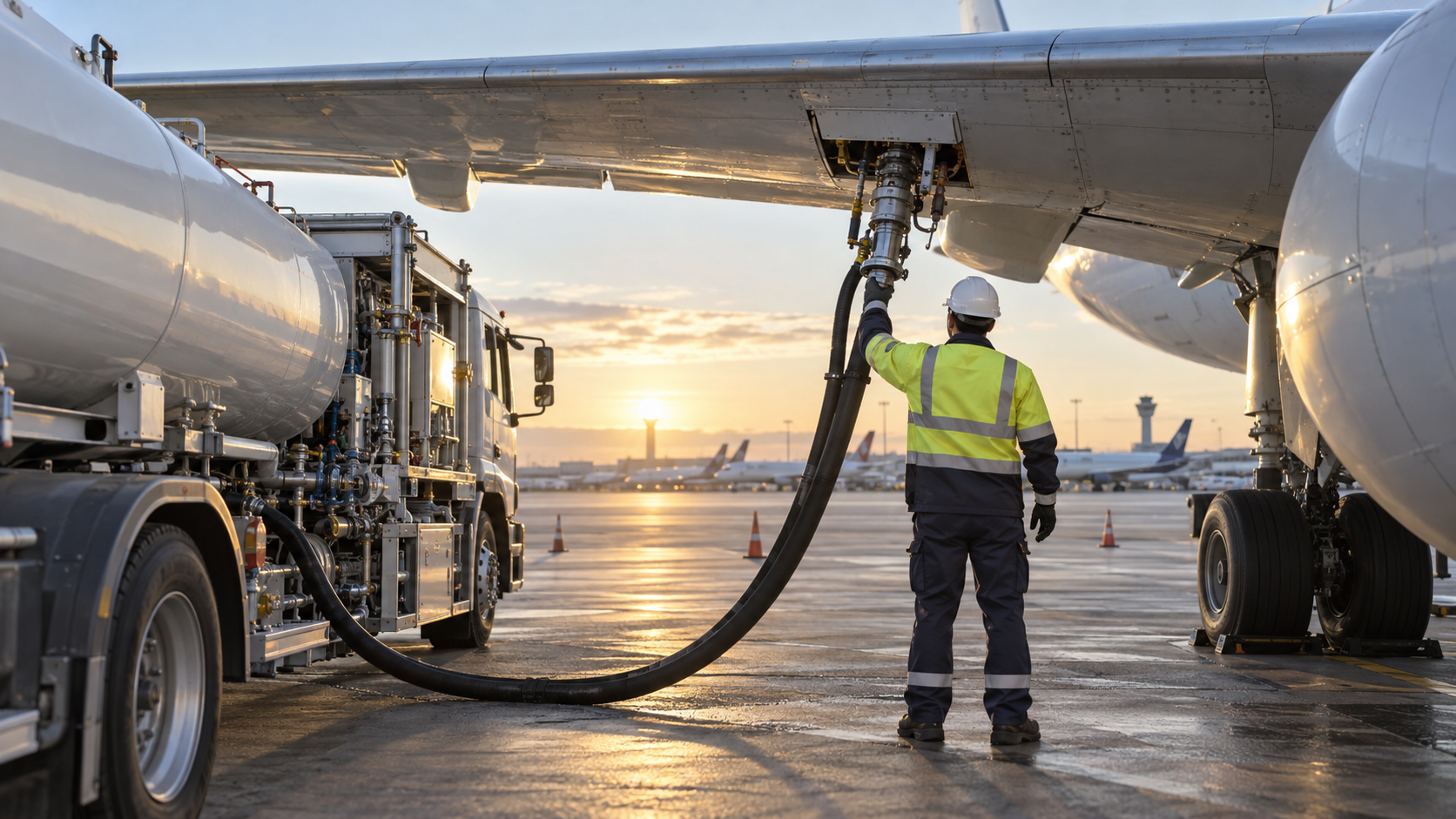
Sustainable aviation fuel (SAF) is fuel admitted into the jet-fuel specification on the condition that it works with today's aircraft and airport equipment as it is. Yet there is a limit on how much can be blended, and part of the reason is a materials one: swelling of rubber seals (O-rings). An e-fuel made from hydrogen and CO2 begins with arithmetic: about 3.1 kg of CO2 and about 0.44 kg of hydrogen for 1 kg of fuel. This article sets out production routes, certification standards, blend limits, materials compatibility and EU rules (distinguishing proposal, adoption and application), using published primary sources.
- What SAF and e-fuels are (the short version)
- How certification works — D7566 and D1655, and what "drop-in" means
- Production routes — HEFA, FT, ATJ, PtL
- Blend limits — why 50%?
- A materials engineer's view (1): O-ring rubber swells with the fuel's aromatics
- e-Fuel — making 1 kg of fuel from hydrogen and CO2
- A materials engineer's view (2): where do the aromatics come from?
- EU rules — ReFuelEU Aviation and RED III (proposal, adoption and application kept apart)
- Challenges, and what we could not confirm
- Glossary / Primary sources / Claim-to-source audit
Sourced = stated in published material (link given)
Our calculation = a figure this article derived, with the assumptions spelled out
Not yet confirmed = a plan, proposal or target with no confirmed outcome or entry into application
Materials-design interpretations are marked as Commentary, and weakly supported ideas as Inference.
This article explains the production routes, standards, materials and rules for SAF and e-fuels. Hydrogen is a flammable gas and aviation fuel a flammable liquid, and their handling is governed by laws and standards. It is not advice on handling, procuring or operating any particular product; actual design, procurement and handling must follow the applicable laws, the standards themselves and expert review.
1. What SAF and e-fuels are (the short version)
- SAF: the EU's ReFuelEU Aviation Regulation defines SAF as synthetic aviation fuels, aviation biofuels or recycled carbon aviation fuelsSourced. The European Commission describes SAF as "drop-in" (fully compatible with current technology) aviation fuel, currently certified for blending up to 50%Sourced.
- e-Fuel: a synthetic fuel made from hydrogen produced with renewable electricity and captured CO2. In the EU, "synthetic aviation fuels" are those renewable fuels of non-biological origin (RFNBO) that meet the lifecycle emissions-saving threshold and are certifiedSourced.
- The materials angle: behind the blend limit is the fact that the aromatics in petroleum jet fuel swell the rubber (O-rings) in the fuel system and so keep seals tightSourced.
In this series' hydrogen-energy articles, e-fuel appears as one use of hydrogen. Hydrogen production is covered in the "PEM Water Electrolysis" and "Alkaline Water Electrolysis" articles, the colour labels in "Hydrogen Colors and Carbon Intensity", and fuels made from CO2 and hydrogen in the "Methanol" article. This article stays with standards, materials and rules for aviation fuel.
2. How certification works — D7566 and D1655, and what "drop-in" means
Two specifications matter for aviation fuel: ASTM D1655 for petroleum-derived fuel, and ASTM D7566 (Standard Specification for Aviation Turbine Fuel Containing Synthesized Hydrocarbons) for fuel containing synthetic hydrocarbons. The key points of D7566's scope, as shown on the ASTM site, are theseSourced.
- D7566 covers the manufacture of aviation turbine fuel consisting of conventional and synthetic blending components.
- Fuel manufactured, certified and released to all the requirements of D7566 Table 1 meets D1655 and is regarded as D1655 fuel. Duplicate testing is not needed, and the same data can serve both. After release, D7566's unique requirements no longer apply, and recertification follows D1655 Table 1.
- Any location where synthetic components are blended with D1655 fuel or conventional components counts as batch origination, to which all of D7566 Table 1 applies. The synthetic components covered are those in Annex A1 (FT SPK), A2 (HEFA SPK), A3 (SIP), A4 (SPK/A), A5 (ATJ), A6 (CHJ), A7 (HC-HEFA SPK) and A8 (ATJ-SKA).
- The synthetic components and their blends are evaluated and approved according to the principles of Practice D4054.
In other words, "drop-in" means that blended SAF certified within D7566 can, once released, be handled like ordinary jet fuel (D1655) (commentary; the European Commission describes blended aviation fuels as "fully compatible with current technology" [Reference 6]).
The ASTM site has pages for D7566-25 (shown as updated 5 December 2025) and D7566-26 (shown as updated 30 July 2026), both carrying a "Historical" label. We could not confirm which edition is current, and we did not see the text of the standard (paid). Blend limits by annex below use ICAO's page [Reference 1].
3. Production routes — HEFA, FT, ATJ, PtL
ICAO lists the approved conversion processes (as of July 2023, 11 conversion processes approved and 11 under evaluation)Sourced. The four routes most often discussed are set out below using ICAO's entries and the ASTM annexes.
| Route | Feedstock (as ICAO states) | ASTM annex and blend limit (as ICAO states) | Relation to hydrogen (commentary) |
|---|---|---|---|
| HEFA (hydroprocessed esters and fatty acids) | Vegetable oils, animal fats, used cooking oil | D7566 Annex A2: 50% | Uses hydrogen in hydroprocessing; limited by the supply of fats and oils |
| FT (Fischer-Tropsch) | Coal, natural gas, biomass | Annex A1: 50%. A4 (FT-SKA, including synthesis of aromatics): 50% | Makes hydrocarbons from syngas (CO and H2); the H2-to-CO ratio matters |
| ATJ (alcohol-to-jet) | Ethanol, isobutanol and isobutene from biomass | Annex A5 (ATJ-SPK): 50%. A8 (ATJ-SKA): limit blank in ICAO's table | Includes a hydrogenation step |
| PtL (Power-to-Liquid, e-fuel) | ICAO's table has no entry for electricity, hydrogen and CO2 | FT route: within A1's frame. MtJ (methanol-to-jet): under evaluation in ICAO's table | Hydrogen is the raw material itself; a CO2 source is needed separately |
The feedstock, annex and blend-limit columns are Sourced (ICAO page [Reference 1]). The "Relation to hydrogen" column is commentary by this article (based on the general chemistry that hydroprocessing uses hydrogen; we did not check the hydrogen quantities at individual plants).
4. Blend limits — why 50%?
We did not see the text of the standard (paid), so we confirm the reason for the 50% limit from a paper. A study funded by the FAA (Faulhaber et al., Energy & Fuels 2023) saysSourced:
- ASTM specifications limit SAF to a maximum of 50 vol% blended with conventional jet fuel. One reason for the limit is to keep O-ring swelling consistent with that of 100% petroleum fuel.
- The 50 vol% cap was set to mitigate the risk introduced by fuel composition variance outside the range of experience with conventional fuels, and it currently happens to align with the 8 vol% minimum aromatics and 775 kg/m³ minimum density requirements.
- Six of the seven currently approved SAF pathways give hydrocarbon mixtures with low aromatic content (under 0.5 vol%) and low density.
5. A materials engineer's view (1): O-ring rubber swells with the fuel's aromatics
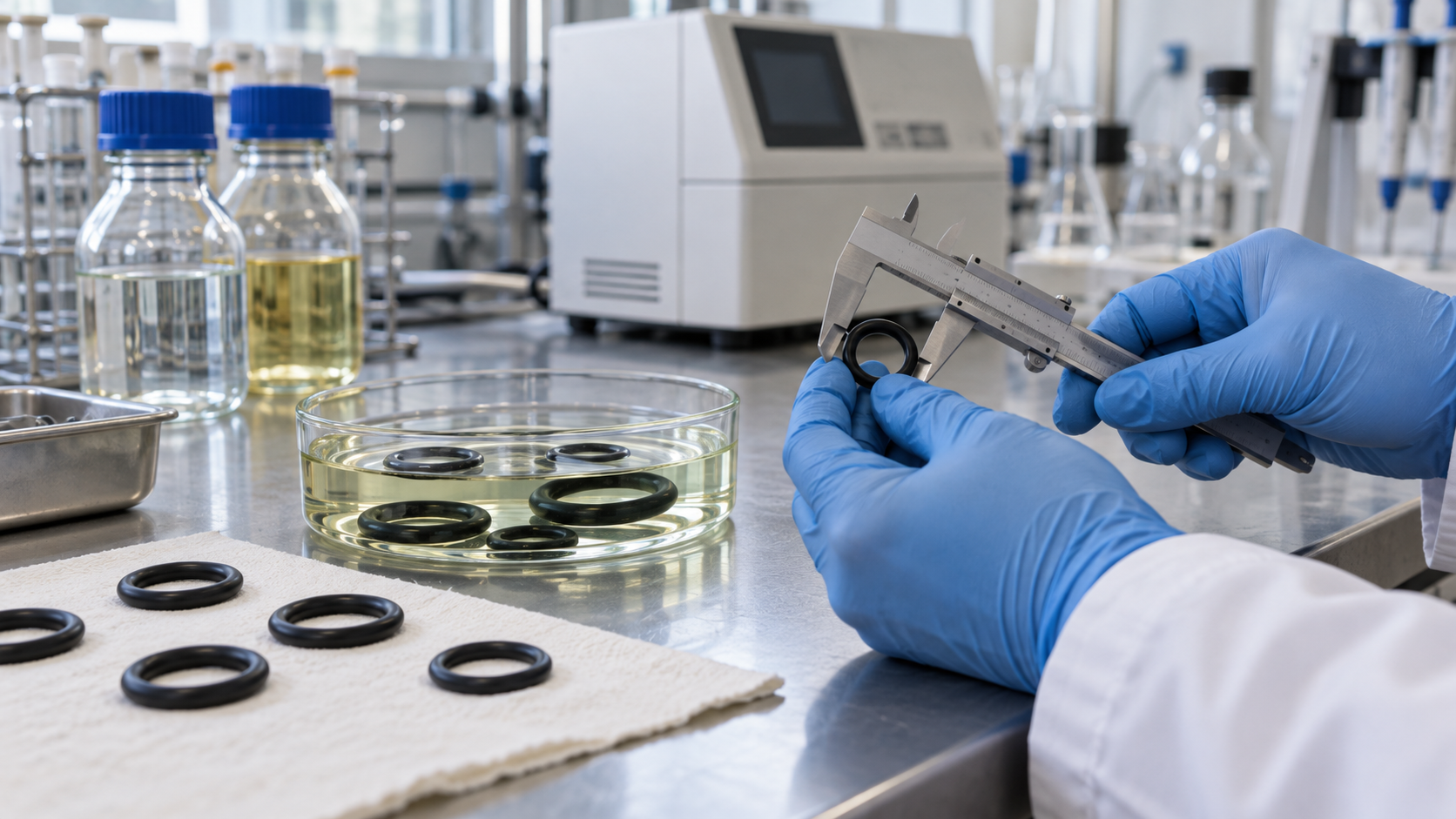
The same paper links aromatics to non-volatile particulate matter (nvPM) emissions and thus contrail effects, while saying that the 8 vol% minimum required in jet fuel exists largely because aromatics are primarily responsible for swelling the elastomer O-rings in fuel systemsSourced. A paraffinic SAF has almost no aromatics, and on its own the seals may not swell enough, which risks leaks.
- What is tested: the O-rings designated in ASTM D4054 for testing new aviation fuels are fluorocarbon (FKM), fluorosilicone (FVMQ) and acrylonitrile-butadiene (NBR, nitrile rubber). NBR is the most sensitive to differences in fuel composition and the most problematic, and this study examines NBR onlySourced.
- Examples: documented operational experience is scarce, but a leak was observed in an early test of an approved SPK (synthetic paraffinic kerosene) during a test campaign at NASA Glenn. A 1983 report from Kelly AFB also says that each time an aircraft is refuelled or its fuel system emptied, an O-ring can swell or shrink depending on its exposure to aromatics, and the paper states that repeated swell and relaxation may adversely affect the elastomer's strength over timeSourced.
- Measurements: by optical dilatometry the paper measured NBR swell in 56 solvents (39 neat molecules doped at 8 vol% in an approved SPK, 14 conventional fuels, 3 SAF blend components and 2 blends of conventional fuel and SAF). Swell showed a more linear relationship with density than with molar volume (except for polycycloalkanes). Swell could be predicted by linear volumetric blending of the active components up to 40 vol%. The study shows potential to keep swelling in the conventional-fuel range even with fuels of under 8 vol% aromaticsSourced.
What can be read from this is that the blend limit is a matter not only of the fuel's properties but of the habits of old rubber on the aircraft side (commentary by this article). The paper positions its data as guidance toward 100% drop-in SAF, by predicting material compatibility from molecular properties and concentration.
6. e-Fuel — making 1 kg of fuel from hydrogen and CO2
The material balance of an e-fuel (PtL) is partly fixed by the chemical equation alone. Here dodecane (C12H26), one typical component of jet fuel, is used as a model compound in place of the real fuel, and the quantities of CO2 and hydrogen needed to make it are calculated. Real jet fuel is a mixture of many components and cannot be represented by dodecane alone.
Assumptions: the model compound is n-dodecane (C12H26, molar mass 170.33), and the equation 12 CO2 + 37 H2 → C12H26 + 24 H2O is taken to go to completion with ideal stoichiometry. Lower heating values come from NIST enthalpies of formation in the gas phase (CO2 −393.51, water −241.826, dodecane −290.9 kJ/mol)Sourced.
- Heating value of the fuel: 12 × 393.51 + 13 × 241.826 − 290.9 = 7,574.96 kJ/mol ÷ 170.33 g/mol = about 44.5 MJ/kg (gas basis)Our calculation
- CO2: 12 × 44.01 ÷ 170.33 = about 3.10 kg per kg of fuel. Hydrogen: 37 × 2.016 ÷ 170.33 = about 0.438 kg per kg of fuel. Water: 24 × 18.015 ÷ 170.33 = about 2.54 kg (mass balances: 3.10 + 0.438 = 3.54 kg = 1 + 2.54 kg)
- Energy of the hydrogen: 0.438 kg × 119.96 MJ/kg = about 52.5 MJ. The share that stays in the fuel is 44.5 ÷ 52.5 = about 85%
- Per tonne: about 3.1 tonnes of CO2 and about 0.44 tonne of hydrogen per tonne of fuel
- Electrolysis power (assumed): at an assumed 50 kWh/kg-H2, 0.438 × 50 = about 21.9 kWh; at 55 kWh/kg-H2, about 24.1 kWh. Against the fuel's heat content of 44.5 MJ = about 12.4 kWh, electrolysis alone takes about 1.8 to 2.0 times as much electricity (fuel heat divided by power: about 51 to 56%)
Limits: everything beyond hydrogen (CO2 capture, compression, synthesis, hydrocracking and distillation, plant utilisation) is excluded. Real yields and power use vary with catalyst and process. This calculation bounds the material and energy quantities; it does not predict cost or real efficiency.
The figure of about 3.1 tonnes of CO2 per tonne of fuel means that procuring CO2 becomes procuring a raw material. Sources include capture from factory exhaust and direct capture from air (commentary; we did not check primary sources on which sources are actually used). Under the EU definition, synthetic aviation fuels are renewable fuels of non-biological origin (RFNBO) that meet a lifecycle emissions-saving threshold and are certifiedSourced, and the European Commission describes this category of SAF as "synthetic fuels from renewable hydrogen and captured carbon"Sourced. Both where the CO2 comes from and where the electricity for hydrogen comes from become conditions in the rules (Chapter 8).
7. A materials engineer's view (2): where do the aromatics come from?
ICAO's list has two annexes for synthetic components that contain aromatics: Annex A4 (synthesised kerosene with aromatics made by alkylation of light aromatics from non-petroleum sources; FT-SKA) and Annex A8 (ATJ-SKA, from C2 to C5 alcohols)Sourced. In the scope of ASTM D7566 too, A4 is listed as "SPK/A" and A8 as "ATJ-SKA"Sourced.
Adding aromatics to a paraffinic SAF brings it closer to both the 8 vol% minimum and the O-ring swelling requirement. The paper in Chapter 5 shows the possibility of keeping swelling in the conventional range even below 8 vol% aromatics, and says that in future fuel quality might be managed not by the amount of aromatics but by the materials performance, swellingSourced. That is the classic question in materials specification: define the requirement by composition or by function (commentary by this article). We could not confirm any information that this has been adopted into a standard.
8. EU rules — ReFuelEU Aviation and RED III (proposal, adoption and application kept apart)
Rules are read by distinguishing proposal, adoption (publication) and application (entry into application). What follows is limited to what we confirmed in the text of EU legal acts. The date of confirmation is October 2026.
| Rule | Stage and date | Content (as far as the text confirms) |
|---|---|---|
| ReFuelEU Aviation Regulation (EU) 2023/2405 | Adopted and in application. Dated 18 October 2023, Official Journal 31 October 2023. In force on the twentieth day after publication. Applies from 1 January 2024; Articles 4, 5, 6, 8 and 10 from 1 January 2025 | Requires aviation fuel suppliers to ensure minimum shares of SAF in the aviation fuel they supply at EU airports (Annex I), including minimum shares of synthetic aviation fuel. SAF from feedstocks such as food and feed crops, intermediate crops, palm fatty acid distillate, palm- and soy-derived materials and soap stock is excluded from the calculation (except feedstock in Annex IX). Aviation biofuels other than advanced biofuels (and other than those from Annex IX Part B feedstock) may count for at most 3%. By 1 January 2027, and every four years thereafter, the Commission reports on the application of the Regulation, assessing the need to revise the SAF definition, minimum shares and so on |
| RED III Directive (EU) 2023/2413 | Adopted. Dated 18 October 2023, Official Journal 31 October 2023 | In transport, the combined share of advanced biofuels and biogas and of RFNBO in energy supplied is at least 1% in 2025 and 5.5% in 2030, of which at least 1 percentage point from RFNBO in 2030. Member States with maritime ports are to endeavour to reach 1.2% RFNBO in maritime transport in 2030 |
| RFNBO production rules Delegated Regulation (EU) 2023/1184 | Adopted. Dated 10 February 2023, Official Journal 20 June 2023. In force on the twentieth day after publication | Conditions for counting electricity used to make RFNBO via electrolysis as fully renewable. Additionality (the renewable installation came into operation no earlier than 36 months before the fuel installation and has received no support), temporal correlation (same calendar month until 31 December 2029; the same one-hour period from 1 January 2030; Member States may apply it from 1 July 2027 after notifying the Commission) and geographical correlation (same bidding zone and so on). Grid electricity may count under conditions such as a bidding zone whose renewable share exceeded 90% in the previous year |
| Switzerland's adoption | Adopted and in application (the Commission page says Switzerland has adopted it as of 1 January 2026) | Fuel suppliers at Zurich and Geneva airports must ensure a minimum 2% SAF blend, rising steadily to 70% by 2050 (as stated on the page) |
All Sourced (EUR-Lex texts [References 5, 7, 8], European Commission page [Reference 6]). We could not confirm whether amendments or reviews are under way, including for the RFNBO production rules (checked October 2026).
ReFuelEU Aviation minimum shares (Annex I)
This is an obligation on aviation fuel supplied at EU airports, placed on fuel suppliers (Article 4)Sourced. It is not an obligation on airlines (airlines have duties such as uplifting only the fuel needed). The European Commission's page also says compliance may be reached through renewable hydrogen or low-carbon synthetic fuels (at least 70% lifecycle emissions saving)Sourced. We could not confirm whether the yearly minimum shares are actually being met, or the 2025 and 2026 record.
9. Challenges, and what we could not confirm
(1) The materials challenge is "100% drop-in"
ICAO's page records that work is under way to allow 100% SAF in aircraft, and that raising the co-processing limit from 5% to 30% is being consideredSourced. Both are under evaluation or in progress, and we could not confirm resultsNot yet confirmed.
(2) At the material-balance stage, e-fuel needs a great deal of hydrogen and CO2
As the calculation in Chapter 6 shows, a tonne of fuel needs about 0.44 tonne of hydrogen and about 3.1 tonnes of CO2. We could not confirm real plant data on the power per kg of hydrogen, CO2 supply or synthesis yield, so these remain assumptions.
(3) What we could not confirm
- The text of ASTM D7566 (paid), the detailed requirements of each annex (aromatics, density and so on), and the current edition
- How the CO2 of PtL is treated as a feedstock in the annexes, and the latest approval status of MtJ
- A technical and economic comparison of the FT and MtJ routes (peer-reviewed papers exist, but we could not check their text)
- Any amendments or reviews of ReFuelEU Aviation, the record of compliance in 2025 and 2026, and any review of the RFNBO production rules
- Rules in Japan, the United States, the United Kingdom and elsewhere (targets, support and tax, obligations)
- Feedstock supply limits for HEFA and the actual production capacity and prices of each route (not stated, since our policy is not to use market-research estimates)
- What "drop-in" means: a blend certified under D7566 is handled as D1655 jet fuel once released. Blend limits are 50%, 10% and so on by annexSourced
- One reason for 50% is the rubber seal: aromatics (8 vol% minimum) are mainly responsible for swelling NBR O-rings, and paraffinic SAF has few of themSourced
- The e-fuel balance: about 3.10 kg of CO2 and about 0.438 kg of hydrogen per kg of fuel; about 85% of the hydrogen's heat stays in the fuel (chemical energy only; dodecane model)Our calculation
- EU rules are adopted and in application: ReFuelEU requires 2% in 2025, 6% in 2030 (synthetic fuel averaging 1.2%) and 70% in 2050 (synthetic fuel 35%)Sourced
- 100% drop-in and a higher co-processing limit are under evaluation: we could not confirm resultsNot yet confirmed
10. Glossary
- SAF (sustainable aviation fuel)
- In the EU definition, the collective term for synthetic aviation fuels, aviation biofuels and recycled carbon aviation fuels.
- Drop-in
- Usable as it is in existing aircraft and fuel equipment.
- ASTM D1655
- The specification for petroleum-derived jet fuel (Jet A, Jet A-1).
- ASTM D7566
- The specification for aviation turbine fuel containing synthesised hydrocarbons; synthetic components are approved annex by annex.
- ASTM D4054
- The evaluation procedure for approving new aviation fuels and additives.
- HEFA
- Hydroprocessed esters and fatty acids: vegetable oils, animal fats and used cooking oil hydrogenated into hydrocarbons.
- FT (Fischer-Tropsch)
- The reaction that makes hydrocarbons from a syngas of CO and H2.
- ATJ
- Alcohol-to-jet: making jet-fuel components from alcohols such as ethanol.
- MtJ
- Methanol-to-jet: making jet-fuel components from methanol.
- PtL / e-fuel
- Liquid fuel made from hydrogen (produced with renewable electricity) and CO2.
- RFNBO
- Renewable fuels of non-biological origin: in the EU's RED, hydrogen made with renewable electricity and fuels derived from it.
- SPK / SKA
- Synthetic paraffinic kerosene / synthetic kerosene with aromatics.
- Aromatics
- Hydrocarbons with a benzene ring. Jet fuel must contain at least 8 vol%, and they bear on O-ring swelling.
- NBR (nitrile rubber)
- Acrylonitrile-butadiene rubber: one of the O-ring materials tested for aviation fuel systems and the most sensitive to fuel composition.
- FKM / FVMQ
- Fluorocarbon rubber / fluorosilicone, designated for O-ring testing in ASTM D4054.
- nvPM
- Non-volatile particulate matter, relevant to contrail formation from aircraft exhaust.
11. Primary sources
- ICAO "SAF Conversion processes" (table of approved and under-evaluation conversion processes) — icao.int
- ASTM International D7566-25 "Standard Specification for Aviation Turbine Fuel Containing Synthesized Hydrocarbons" (scope only checked), DOI 10.1520/D7566-25 — store.astm.org
- ASTM International D7566-26 (as above; shown as updated 30 July 2026) — store.astm.org
- Faulhaber, C., Borland, C., Boehm, R., Heyne, J. "Measurements of Nitrile Rubber Absorption of Hydrocarbons: Trends for Sustainable Aviation Fuel Compatibility", Energy & Fuels 37 (13), 9207–9219 (2023), DOI 10.1021/acs.energyfuels.3c00781 — pubs.acs.org
- European Parliament and Council Regulation (EU) 2023/2405 "ReFuelEU Aviation", 18 October 2023, Official Journal 31 October 2023 — eur-lex.europa.eu
- European Commission (Mobility and Transport) "ReFuelEU aviation" — transport.ec.europa.eu
- European Parliament and Council Directive (EU) 2023/2413 (RED III), 18 October 2023, Official Journal 31 October 2023 — eur-lex.europa.eu
- European Commission Delegated Regulation (EU) 2023/1184, 10 February 2023, Official Journal 20 June 2023 — eur-lex.europa.eu
- NIST Chemistry WebBook, Dodecane (enthalpy of formation, gas) — webbook.nist.gov
- NIST Chemistry WebBook, Water (enthalpy of formation, gas) — webbook.nist.gov
- NIST Chemistry WebBook, Carbon dioxide (enthalpy of formation, gas) — webbook.nist.gov
12. Claim-to-source audit
| Claim in the text | Basis | Label |
|---|---|---|
| The list of approved conversion processes (11 approved and 11 under evaluation as of July 2023); the name, feedstock and blend limit of each annex (A1 FT 50%, A2 HEFA 50%, A3 SIP 10%, A4 FT-SKA 50%, A5 ATJ-SPK 50%, A6 CHJ 50%, A7 HC-HEFA-SPK 10%, A8 ATJ-SKA blank); the D1655 Annex A1 co-processing (esters 5%, FT hydrocarbons 5%, HEFA 10%); MtJ under evaluation; work on 100% SAF; consideration of raising the co-processing limit from 5% to 30% | ICAO page Reference 1 https://www.icao.int/SAF/saf-conversion-processes | Sourced |
| The scope of D7566: manufacture of aviation turbine fuel of conventional and synthetic blending components; that fuel meeting Table 1 is regarded as D1655 fuel; the names of annexes A1 to A8; evaluation under the principles of Practice D4054; D7566-25 (shown as updated 5 December 2025) | ASTM D7566-25 page Reference 2 https://store.astm.org/d7566-25.html | Sourced |
| That a D7566-26 page exists and is shown as updated 30 July 2026 (whether the edition is current is not confirmed) | ASTM D7566-26 page Reference 3 https://store.astm.org/d7566-26.html | Sourced |
| The Faulhaber et al. paper: SAF limited by ASTM specifications to 50 vol% blending; one reason being to keep O-ring swelling consistent with petroleum fuel; the 50% aligning with the 8 vol% minimum aromatics and 775 kg/m³ minimum density; six of seven approved pathways under 0.5 vol% aromatics; aromatics tied to nvPM yet mainly responsible for O-ring swelling; FKM, FVMQ and NBR designated in D4054 and NBR the most sensitive; the NASA Glenn leak; the 1983 Kelly AFB report; swell measurements on 56 solvents; the linearity with density; linear blending up to 40 vol%; the potential to hold swelling with under 8 vol% aromatics; guidance toward 100% drop-in | Faulhaber et al. Reference 4 https://pubs.acs.org/doi/10.1021/acs.energyfuels.3c00781 | Sourced |
| ReFuelEU: the definitions of SAF and synthetic aviation fuel (RFNBO, the Article 29a(1) threshold, the Article 30 certification); Article 4 (minimum shares, the 3% cap on non-advanced biofuels, excluded feedstocks); the minimum shares in Annex I; the Article 17 report (by 1 January 2027, then every four years); Official Journal of 31 October 2023, application from 1 January 2024 and, for Articles 4, 5, 6, 8 and 10, from 1 January 2025 | Regulation (EU) 2023/2405 Reference 5 https://eur-lex.europa.eu/legal-content/EN/TXT/HTML/?uri=CELEX:32023R2405 | Sourced |
| The Commission's explanation: SAF as blended fuel fully compatible with current technology and certified up to 50%; research toward 100%; the definition of SAF; synthetic aviation fuels as synthetic fuels from renewable hydrogen and captured carbon (liquid drop-in only); compliance via renewable hydrogen or low-carbon synthetic fuels (70% saving); Switzerland adopting from 1 January 2026 | European Commission page Reference 6 https://transport.ec.europa.eu/transport-modes/air/environment/refueleu-aviation_en | Sourced |
| RED III: the combined share of advanced biofuels and biogas and of RFNBO in transport energy of 1% in 2025 and 5.5% in 2030, with at least 1 percentage point from RFNBO in 2030; the 1.2% RFNBO endeavour for maritime transport; Official Journal of 31 October 2023 | Directive (EU) 2023/2413 Reference 7 https://eur-lex.europa.eu/legal-content/EN/TXT/HTML/?uri=CELEX:32023L2413 | Sourced |
| Delegated Regulation 2023/1184: conditions for counting electricity for electrolytic RFNBO as fully renewable (the 36-month additionality, no support, temporal correlation of calendar month to 2029 and one hour from 2030 with Member States able to apply it from 1 July 2027, geographical correlation, the 90% grid condition); Official Journal of 20 June 2023; in force twenty days after publication | Delegated Regulation (EU) 2023/1184 Reference 8 https://eur-lex.europa.eu/legal-content/EN/TXT/HTML/?uri=CELEX:32023R1184 | Sourced |
| Enthalpy of formation of dodecane (gas), −290.9 kJ/mol, and molar mass 170.33 | NIST Chemistry WebBook (dodecane) Reference 9 https://webbook.nist.gov/cgi/cbook.cgi?ID=C112403&Units=SI&Mask=1 | Sourced |
| Enthalpy of formation of water (gas), −241.826 kJ/mol | NIST Chemistry WebBook (water) Reference 10 https://webbook.nist.gov/cgi/cbook.cgi?ID=C7732185&Units=SI&Mask=1 | Sourced |
| Enthalpy of formation of carbon dioxide (gas), −393.51 kJ/mol | NIST Chemistry WebBook (carbon dioxide) Reference 11 https://webbook.nist.gov/cgi/cbook.cgi?ID=C124389&Units=SI&Mask=1 | Sourced |
| The lower heating value of dodecane (about 44.5 MJ/kg, gas basis); CO2 of about 3.10 kg, hydrogen of about 0.438 kg and water of about 2.54 kg per kg of fuel; hydrogen energy of about 52.5 MJ; about 85% retained in the fuel; about 3.1 tonnes of CO2 and about 0.44 tonne of hydrogen per tonne; about 21.9 and 24.1 kWh per kg of fuel at an assumed 50 and 55 kWh/kg-H2, and power of about 1.8 to 2.0 times the fuel's heat | Our calculation. Model compound dodecane, ideal stoichiometry, lower heating values from NIST enthalpies of formation (References 9 to 11). The power per kg of hydrogen is an assumption made for this article | Our calculation |
| The text of ASTM D7566, the detailed requirements of each annex, the treatment of PtL's CO2 in the annexes, the latest MtJ approval status, the FT and MtJ comparison, any amendment of ReFuelEU or the RFNBO production rules, compliance in 2025 and 2026, rules in Japan, the United States and the United Kingdom, and production capacity and prices by route | Could not be confirmed in published primary sources within the scope of this article, so they are not stated here | Commentary |
| The relation of each route to hydrogen (hydrogenation in HEFA, syngas in FT); the "Conversion" column; the reading that the aromatics annexes also exist for the seals; the composition-versus-function framing of specifications; the reading that CO2 procurement is raw-material procurement; that Figs. 1, 2, 4 and 5 are schematic drawings and Fig. 3 an AI-generated image | This article's own organisation and commentary on the published content. They are not views expressed by the institutions concerned | Commentary |
Last updated October 2026. Sources are limited to primary material (ICAO and ASTM International pages, EU legal acts and a European Commission page, a peer-reviewed paper, and NIST data). Because the article includes materials-design interpretations, they are marked as Commentary and kept separate from sourced fact. The text of ASTM D7566, the treatment of PtL's CO2 in the annexes, the latest MtJ approval status, amendments to ReFuelEU and compliance records, rules in Japan, the United States and the United Kingdom, and production capacity and prices by route are not stated here because no published primary source could be confirmed. The e-fuel calculation is arithmetic based on a model compound, ideal stoichiometry and an assumed power per kg of hydrogen; it is not a prediction of the yield, power use or cost of a real plant. Rules are described as of the date of confirmation (October 2026). Figs. 1, 2, 4 and 5 are vector drawings; the hero image and Fig. 3 are AI-generated images, and none of them shows a real cross-section, micrograph or physical product.