TECHNOLOGY EXPLAINER
Cell Manufacturing and Cell Banking
— a design for drawing the same cells, in the same state, for years
How you think about the process in making a cell product depends on whether you make the cells afresh each time or make them once, freeze them and keep a stock. The mechanism on the stocking side is the cell bank. ICH Q5D admits that no testing regimen for a bank can detect every contaminant, and says that this is exactly why the principle of preventing contamination at the stage of making the bank matters. In that picture, the main characters are "materials and connections": cryopreservation solutions, containers, tubing, welds, and closed systems.
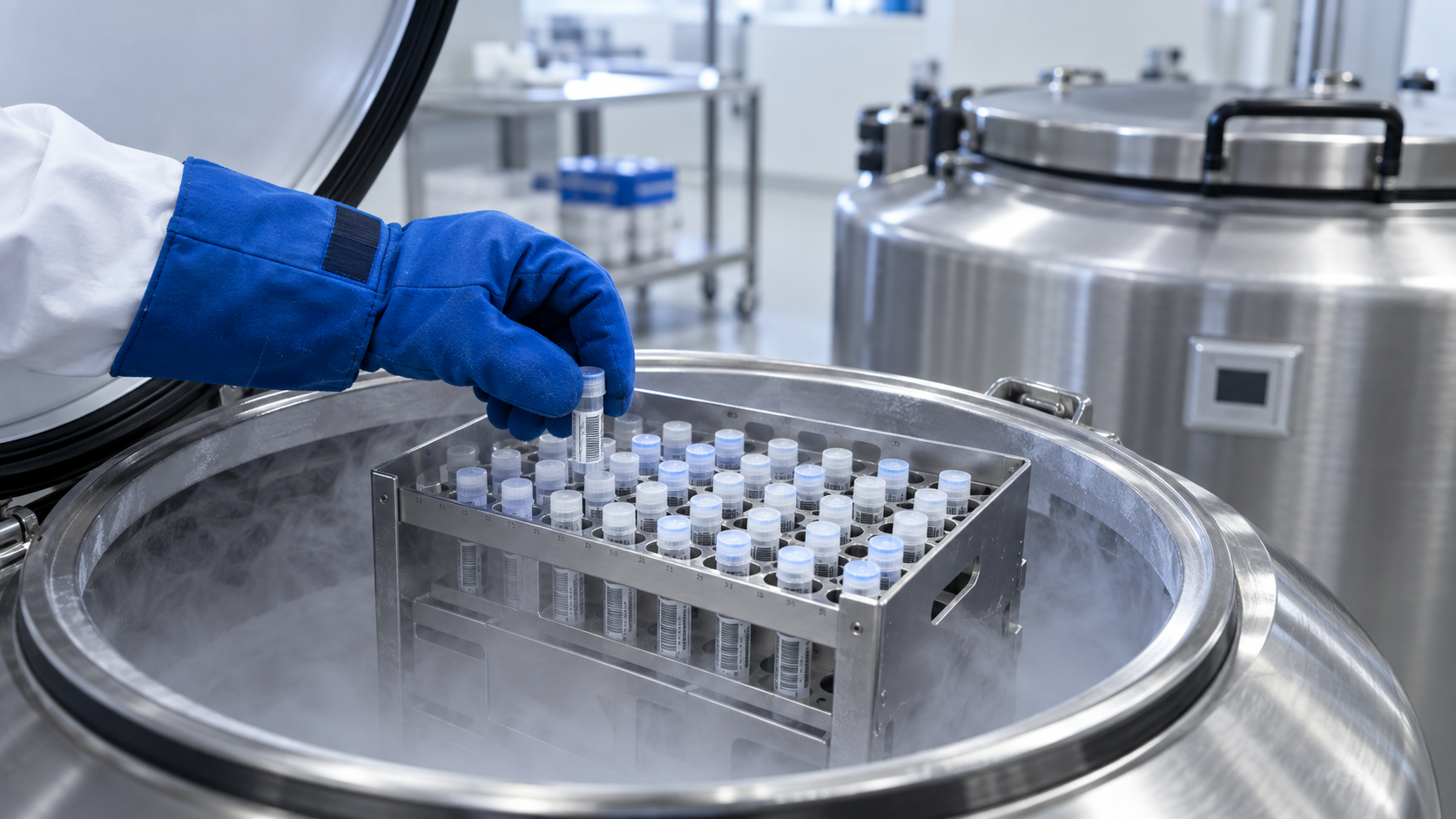
- What a cell bank is (the short version)
- Two-tier banks — master and working, and how they look for cell products
- How a bank is made, and what must be protected
- Bank testing — what is checked, and how much
- Our calculation: vials used for testing, DMSO concentration and wetted area
- A materials engineer's view (1): cryopreservation solutions and cooling — container shape sets the cooling rate
- A materials engineer's view (2): containers and cold storage — "do not crack, do not leak, do not contaminate"
- Closed systems and automation — what counts as "closed"
- A materials engineer's view (3): the weak point of a closed system is the joint
- Validation — what backs trust in the bank and the process
- Open issues, and what is still undecided
- Glossary / References / Claim-to-source audit
Sourced = content stated in guidelines, guidance, peer-reviewed papers or published material (link given)
Our calculation = a figure this article derived from stated assumptions
Not yet confirmed = under revision, planned, or with no confirmed track record
Readings from the materials and process side are marked separately as Commentary.
This article explains mechanisms of manufacture and quality control; it does not discuss the efficacy of individual products or the choice of treatment.
GMP, CDMO, bioreactors, and QbD and CMC are covered in other articles in this series. This one is confined to banking, freezing, and closed systems and automation.
1. What a cell bank is (the short version)
The glossary of ICH Q5D describes a cell bank as a collection of suitable containers with uniform contents, stored under defined conditions, in which each container is an aliquot of one pool of cells Sourced [Source 1].
- Why keep a stock: as an advantage of using passaged cells, Q5D lists that every production lot can start from a common, characterised starting materialSourced [Source 1, section 2.2].
- How far it is needed: Part IV of EU GMP, for ATMPs, "recommends" a bank system for allogeneic products where donor and patient need not match, but says that establishing one is "not mandatory"Sourced [Source 2, 8.10]. For autologous products (made from the patient's own cells), the starting material is that patient's cells, so the idea of a bank applies less readily (see our explainer on autologous and allogeneic).
- What it means for a materials engineer: once made, a bank can be drawn on at every manufacture, but it is also a raw material that cannot be remade. Containers, cryopreservation solution, tubing, cooling, storage units, closed systems: a mistake in choosing any of them reaches every later production lot (commentary).
On bank testing, Q5D says in effect that no cell bank testing regimen can detect all possible contaminants, and so applying the principle of prevention while the bank is being made is important to give reasonable assurance that it is free of contamination Sourced [Source 1, section 2.2.2].
Testing is a means of confirming afterwards, and it is not all-powerful. So the quality of a bank is protected on the side of how it is made: the environment it is made in, the materials used, the seal of the containers, and prevention of mix-ups with other cell lines. That is the starting point of this article (commentary).
2. Two-tier banks — master and working, and how they look for cell products
Q5D calls the two-tier system, in which a working cell bank (WCB) is made from a master cell bank (MCB), "generally accepted as the most practical approach"Sourced [Source 1, section 2.2.1].
The reasons for two tiers: use-up and remaking
Q5D says the MCB is made first and the WCB is made from the MCB "as needed". The WCB is used directly in production, and the MCB is drawn down a little each timeSourced [Source 1, section 2.2.1]. It adds that if only a few containers are needed each year, a one-tier system with an MCB alone could "in principle" be usedSourced [Source 1, section 2.2.1]. For evaluating a bank system, EU Part IV asks for validation beyond the passage number or population doublings reached in routine manufactureSourced [Source 2, glossary].
For cell products, the picture differs a little from document to document
| Document | What it says about banks | This article's reading (commentary) |
|---|---|---|
| ICH Q5D (1997) | Treats the two-tier system as the general case, but having a bank of characterised parent cells before making the MCB is "recommended, not mandatory". For cells such as human diploid cells where cloning is not practical, banking from a clone is not requiredSourced | Written originally for products where the cell is the production device, such as antibody drugs. Some points do not carry over unchanged to cell products |
| EU GMP Part IV (2017) | A seed lot / cell bank system is "recommended" for allogeneic products, and establishing one is "not mandatory". The environment for making a bank must comply with GMP, and other live or infectious material is not handled in the same area at the same time (8.10 to 8.11). It also defines a "cell stock", distinct from a bank: cells obtained over a small number of passages and divided into portions, so that the number of manufactures is limited by the number of portions and the stock does not cover the whole life of the product (8.20)Sourced | That products using a "stock", such as iPS cell-derived products, are treated separately from the bank system matters in practice |
| FDA CMC guidance for gene therapy INDs (2020) | Where allogeneic cells from one donor are expanded and stored, it generally recommends qualifying the MCB and WCB "in the same way as cell banks for making viral vectors". However, where the bank is small, it asks sponsors to consult the quality reviewerSourced | For a small bank, the number of vials consumed by testing becomes the problem (chapter 5) |
| Japan: guideline for human (allogeneic) iPS(-like) cell-processed pharmaceuticals (2012 notification, revised 17 January 2025) | Where cells are banked at any point in manufacture, the reason, method of preparation, characterisation, and the methods of storage, maintenance, control and renewal must be made clear and justified. It refers to the 2000 notification Iyakushin No. 873 (the Japanese implementation of ICH Q5D, "Derivation and Characterisation of Cell Substrates Used for Production of Biotechnological/Biological Products") and others. Parts may be omitted where already evaluated upstreamSourced | The Japanese document does not specify the number of tiers, but asks for the reason and the control |
All Sourced (Sources 1, 2, 4 and 5). The right-hand column is commentary from this article.
A real iPS cell stock: what failed in testing
In presenting its ten-year summary paper on iPS cell stocks for regenerative medicine (Med, dated 16 November 2022), the CiRA Foundation published the followingSourced [Source 6].
- iPS cell lines were established from peripheral blood or cord blood of 7 HLA-homozygous donors, and after quality testing 27 lines were selected and are offered
- Manufacture was changed in two steps: single-cell cloning was introduced when making the SCS from the PCS (Method 2), and colony picking at the PCS stage was reduced to shorten manufacturing time and passage number (Method 3)
- The main reasons lines were not selected were residual episomal vector, mutations in cancer-related genes and copy-number or structural abnormalities found by genome analysis, undifferentiated-marker results (low TRA-1-60 expression), and karyotype abnormalities. In the PCS of one donor, nearly 40% showed karyotype abnormalities
- No line was excluded by specification tests such as contamination testing, sterility testing included
What can be read from this (commentary): the main cause of banks being rejected was not contamination but the nature of the cells themselves. Bank testing brings to mind sterility, mycoplasma and viruses, but for iPS cells genetic quality (genome, karyotype, residual vector) is at the centre of selection. That no line fell to sterility testing can also be read as contamination prevention working on the making side (consistent with the Q5D principle). This is, however, the result of one project and cannot be generalised to other cells or facilities.
3. How a bank is made, and what must be protected
Section 2.2.2 of Q5D sets out concretely how a bank is madeSourced [Source 1].
- Divide from one pool: culture is expanded step by step, the cells from several culture vessels are combined into one pool, then dispensed into sterile containers and sealed. This makes the contents of all containers uniform
- What to record: the size of the bank, the containers (vials, ampoules and so on) and closures, the method of preparation (including the cryoprotectant and medium), and the conditions of freezing and storage. Labels must keep their information through storage, keeping and recovery
- Freezing and storage: animal cells are frozen in medium containing a cryoprotectant, in the sealed container, under defined controlled conditions, and moved to the vapor or liquid phase of liquid nitrogen or an equivalent ultra-low temperature
- Preparing for disasters: so that fire, power failure or human error do not wipe everything out, it gives examples such as spreading across several freezers, emergency power, automatic refilling of liquid nitrogen, keeping part of the bank at a remote site, and the ability to remake the MCB
- Where the cells' "age" starts: the in vitro age of cells in manufacture is counted from the time a container of the MCB is thawed
The EU's Part IV is more concrete about storage and useSourced [Source 2, 8.15 to 8.21].
| Item | What Part IV says (summary) |
|---|---|
| How to store | Store and use so as to reduce the risk of contamination or alteration. For example, sealed containers in the vapor phase of liquid nitrogen (8.15) |
| Containers and records | Containers are sealed, clearly labelled and kept at a suitable temperature. Inventory is controlled. Storage temperature is monitored continuously and records are kept. Alarms are considered according to importance. Where liquid nitrogen is used, its level is also monitored (8.16) |
| Removal and return | A container taken out of storage may be returned only if it can be shown by documents that suitable conditions were maintained (8.18). Access to the bank is limited to authorised persons (8.19) |
| Split storage | It is desirable to divide the stock and keep it at separate locations (8.21) |
| Evidence of stability | Evidence of the stability and recoverability of the bank is documented in a form that allows trend evaluation. At the clinical-trial stage it is built up from interim data (8.17) |
All Sourced (EU GMP Part IV [Source 2]).
The Japanese notification likewise asks that, for storage and transport, appropriate stability tests based on cell viability and potency be run with full regard to the storage and distribution period and the storage form, and the storage method and expiry set accordingly; that where freezing, storage and thawing are used, it be confirmed that freezing and thawing have no effect; and that transport containers and procedures (including temperature control) be defined and justified Sourced [Source 5, chapter 2, part 1, item 4]. It also says that where the cryopreservation period during manufacture or the cell culture period is long, sterility is to be confirmed, for example by sterility testing at regular intervalsSourced [Source 5, chapter 2, part 2, item 6].
4. Bank testing — what is checked, and how much
Q5D states the aim of testing as confirming the identity, purity and suitability of the cell substrate for manufacture. The frequency is organised as identity and purity once per MCB, and stability once per product registered, and for a WCB purity and limited identity once eachSourced [Source 1, section 2.3].
| Aspect tested | What Q5D says (summary) | What FDA (2020) and Japan (revised 2025) say (summary) |
|---|---|---|
| Identity | Confirm by phenotype or genotype that the cells in the bank are the cells they are labelled as. Done on the MCB; limited testing for the WCB (section 2.3.1) | FDA: tests that can distinguish the line from other cell lines. For purchased lines, genetic profiling such as STR analysis is recommended on the MCB. Japan: gives as examples of critical cell characteristic indicators purity, morphology, HLA typing, phenotypic markers, karyotype, DNA fingerprinting, growth characteristics and pluripotency |
| Purity (microbial) | Bacteria and fungi: 1% of individual containers, but at least 2 containers, tested on the MCB and WCB. Mycoplasma: for the MCB and WCB, cells from one container are enough (section 2.3.2.1) | FDA: sterility, mycoplasma, adventitious viruses. For viral-vector-producing cells, retrovirus testing by reverse transcriptase assay and electron microscopy. For the WCB, including sterility, mycoplasma, identity and in vitro adventitious virus testing |
| Purity (other cells) | If other cell lines were handled openly in the same room when the bank was made, test for contamination by those cells (section 2.3.2.1) | Japan: asks that measures to prevent mix-ups and cross-contamination during manufacture be shown in process control (chapter 2, part 2, item 2(8)) |
| Viruses | Wide screening based on the culture history, plus individual tests. Refers to the ICH viral safety guideline | FDA: for human cells, CMV, HIV, HTLV, HHV-6/-7/-8, JCV, BKV, EBV, B19, HBV, HPV, HCV and others as needed. If an adventitious virus is found, re-establishing the bank is also to be considered |
| Stability | (a) Stability in culture: examine cells at the lowest passage and cells at or beyond the limit of cell age used in manufacture, two time points. (b) Stability in storage: viability after freezing and so on. If not used in manufacture for a long time, test viability at the intervals stated in the application (section 2.3.3) | FDA: assessed by post-thaw viability, and a one-off test on end-of-production cells is also recommended. Japan: set storage method and expiry from stability tests |
| Karyotype and tumorigenicity | May be useful in the safety evaluation of diploid cells and the characterisation of new cell lines. For products that contain cells and are little purified, characterisation tends to be needed (section 2.3.4) | FDA: recommended for new cell lines whose tumorigenicity has not been evaluated. Japan: contamination of the final product by undifferentiated cells is a concern, and thorough analysis is asked for as far as possible at the cell bank or intermediate-product stage |
All Sourced (Q5D [Source 1], FDA guidance [Source 4], MHLW notification [Source 5]). The arrangement of the table is this article's and does not cover every item in each document.
From the discussion of the International Stem Cell Banking Initiative (ISCBI)
The report of an ISCBI workshop held in 2017 raised the following points on quality control of pluripotent stem cell banksSourced [Source 7].
- It is known that conventional sterility tests cannot detect every microorganism that can contaminate a cell culture, and new molecular methods for detecting bacteria and fungi are emerging
- The blood-borne viruses tested for in transplantation may not be enough for cell therapy products, and a wider range of viruses needs to be considered based on risk assessment of the donor and raw materials
- The teratoma assay in mice, used to confirm pluripotency, takes 6 to 12 weeks, uses animals, lacks reproducibility and is expensive, so it is not desirable as a quality control test
- There was discussion that, if genome sequencing is done, it should be done on both the cell line and the final product
- On cost, a presenter estimated that testing a research-grade cell bank costs US$80,000 to US$200,000 (depending on the tests), with about US$150,000 more for preparing the bank. Clinical grade needs validated test methods and costs still more
All Sourced (ISCBI workshop report [Source 7]). The costs are a presenter's rough estimate, figures for research-grade cell lines in 2017.
Q5D's wording, "1% of containers, but at least 2 containers" for bacteria and fungi, is no burden on a large bank. But when the bank is small (products with a limited number of patients, donor-specific allogeneic products, early iPS cell stocks and the like), testing alone makes a considerable share of the bank disappear. The next chapter puts numbers on it (commentary).
The FDA's advice to consult the reviewer when a bank is small can be read as reflecting this point (commentary). The effort and materials (vials, closures, cryopreservation solution) of making each vial weigh more per vial the smaller the bank.
5. Our calculation: vials used for testing, DMSO concentration and wetted area
From published figures, we make three conversionsOur calculation.
- (A) Vials that disappear in testing: Q5D's bacteria and fungi test takes 1% of individual containers, but at least 2. For a bank of 20 vials that is 2 (10%); for 100 vials, 2 (2%); for 500, 5 (1%); for 1,000, 10 (1%). This is this one item alone; the vials consumed by identity, mycoplasma and virus tests and so on are needed in addition
- (B) How many mol/L is 10% (v/v) DMSO: with a molecular weight of 78.14 and a density of about 1.10 g/mL [Source 14], 10% (v/v) gives 0.10 × 1.10 g/mL ÷ 78.14 g/mol = 1.41 mol/L (0.70 at 5%, 1.06 at 7.5%). This is the same range as Hunt's review gives, citing other work, of 1 to 1.5 mol/L (about 7.5 to 10%) [Source 8]
- (C) How much container wall the liquid touches: a vial holding 1 mL in a cylinder of 1.0 cm inner diameter (base plus side) has about 4,800 cm² per litre of liquid. A 2,000 L cylindrical tank with H/D = 2 (internals ignored) has about 42 cm² per litre. The ratio is about 115-fold
Premises and limits: (A) simply applies the wording of the Q5D guideline; actual test plans are decided by discussion between the facility and the authority. (B) is a rough estimate that ignores volume change on mixing and does not guarantee the concentration of any actual prepared solution. (C) is a geometric estimate for cylinders. Real vials have rounded bottoms and shoulders, and real tanks have internals such as impellers and baffles that give a larger wetted area. Read it as a guide to the order of magnitude.
6. A materials engineer's view (1): cryopreservation solutions and cooling — container shape sets the cooling rate
What happens to cells when they freeze
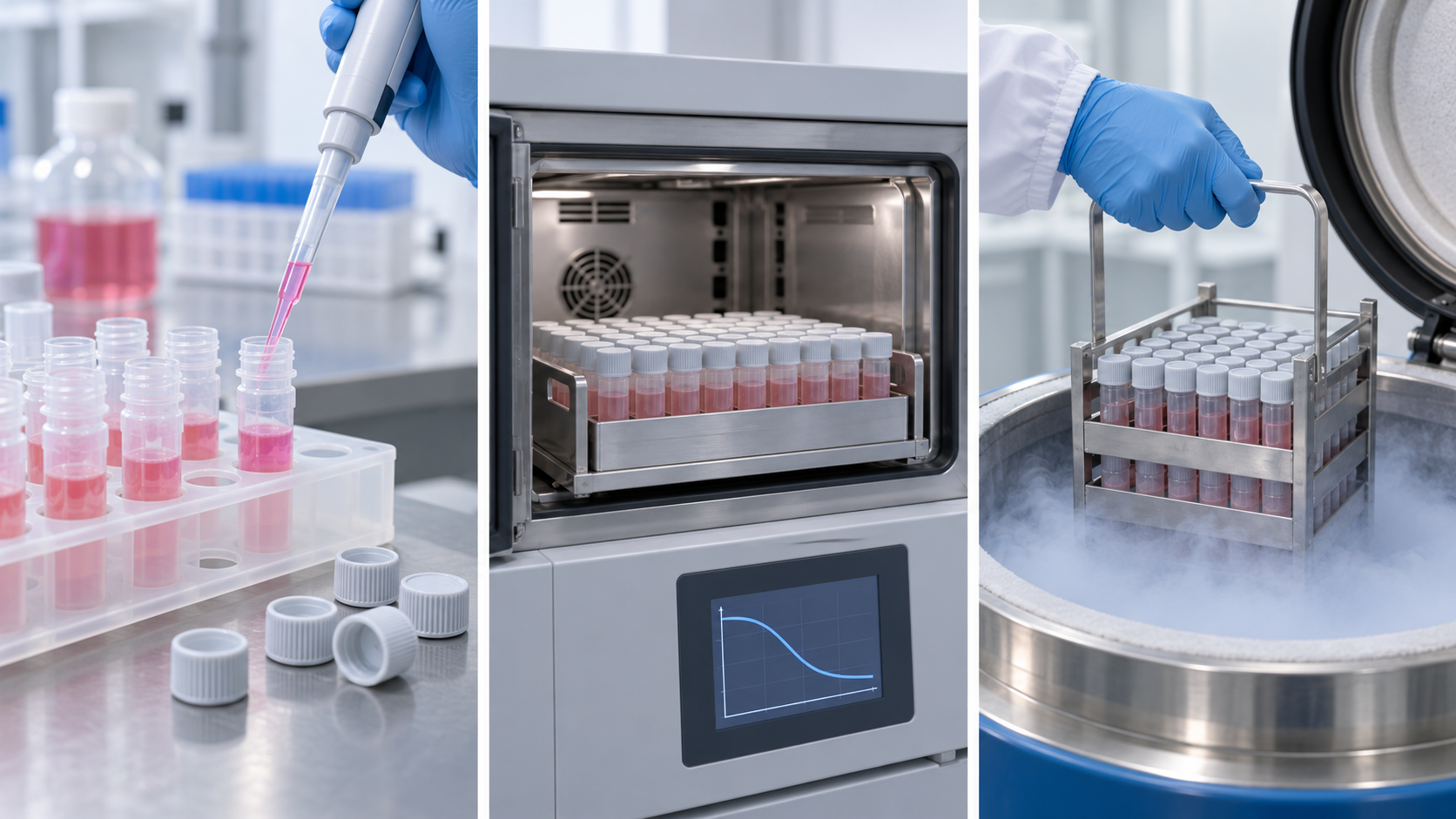
Hunt's review (2011) describes the standard procedure for freezing cells as cooling slowly in the presence of a cryoprotectant to avoid damage from ice inside the cell. Dimethyl sulfoxide (DMSO) is widely used as the cryoprotectant, and controlled-rate freezing at 1 to 2 °C per minute with rapid thawing is the standardSourced [Source 8].
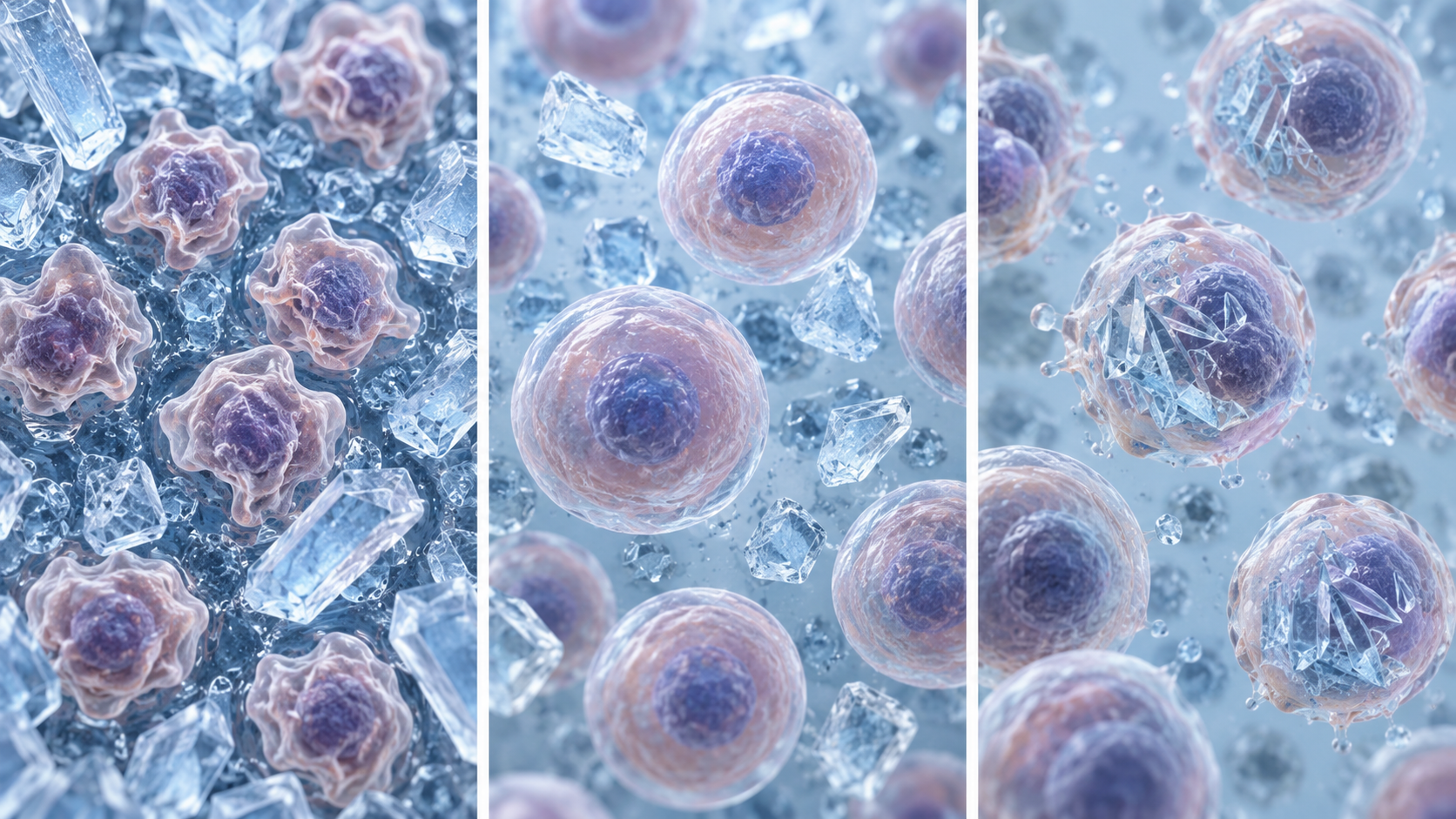
- Cooled slowly: ice forms first outside the cells, and as water turns to ice the solute concentration of the remaining liquid rises. Both ice and high solute concentration harm cells. A protectant eases the damage by reducing the amount of ice formed at a given temperature and limiting the rise in solute concentrationSourced
- Cooled fast: the risk of ice forming inside the cells risesSourced. In clumps of cells (colonies), experiments have shown that intracellular ice may propagate to neighbouring cells, which is discussed (as a hypothesis) as one reason human pluripotent stem cells recover poorly
- Vitrification: a method of making the liquid set into a glass, either with a protectant concentrated enough to prevent ice or with extremely fast cooling. High protectant concentrations raise toxicity problems, and the method of plunging very fine tubes directly into liquid nitrogen is not suited to mass production or GMP, the review saysSourced
Show the detailed vector diagram and its source notes
What is in a cryopreservation solution — from "DMSO plus serum" to defined solutions
The cryoprotective action of DMSO is an old technology, reported in Nature in 1959Sourced [Source 15]. Hunt's review, however, says DMSO toxicity depends on time, temperature and concentration and differs with cell type. For infusion of haematopoietic stem cells, adverse reactions have been reported when DMSO was not removed after thawing, and efforts have been made to wash (using an osmotic buffer containing dextran) and to lower the concentration to 5%, even 2%Sourced [Source 8]. Alternative protectants and additives under study include hydroxyethyl starch, trehalose, polyvinylpyrrolidone (PVP), methylcellulose, polyethylene glycol (PEG), polyampholytes (such as poly-L-lysine) and sericin, but at the time of that review most were at the laboratory stageSourced [Source 8].
| Issue | What the primary sources say |
|---|---|
| Replacing animal serum | Replacing fetal bovine serum with human serum or human serum albumin is costly and still leaves a possibility of transferring human pathogens. In one study PVP plus human serum gave only slightly lower recovery than DMSO plus animal serum (another study introduced in Hunt's review) [Source 8] |
| Commercial solutions with undisclosed formulas | Commercial cryopreservation solutions are sterile and lot-tested, which has GMP advantages. On the other hand, one commercial solution is described as DMSO, glucose and an undisclosed polymer dissolved in PBS [Source 8] |
| DMSO is still the standard | A 2025 review of 57 clinical trials of iPS cells found that only 18 (32%) stated the use of DMSO, 5 (9%) reported washing after thawing, and only 13 (22%) disclosed the freezing procedure. Of the 12 preclinical studies, all used DMSO, 8 described freezing at 1 °C per minute, and all 12 washed after thawing to remove DMSO. Research on DMSO-free solutions is advancing, but "there are not yet clinical trials" [Source 11] |
| DMSO means toxicity and the trouble of removal | The same review points out that removing DMSO after thawing (dilution, centrifugation, removing supernatant, resuspension) is usually a manual, open operation, and that in the US and Europe reconstitution at the administering site falls outside GMP [Source 11]. EU Part IV likewise says reconstitution may take place at the administering site, but compliance there is outside the manufacturer's responsibility and outside the scope of GMP (16.17) [Source 2] |
All Sourced (Hunt 2011 [Source 8], Dobruskin 2025 [Source 11], EU GMP Part IV [Source 2]). Hunt's review dates from 2011, and commercial products and the state of research may have changed.
Pluripotent stem cells were cells that were hard to freeze
Hunt's review introduces early work on human ES cells in which standard slow freezing gave low recovery (colony recovery of roughly 5% to 16% in one case) while vitrification gave over 75%Sourced [Source 8]. But because vitrification plunges a tiny volume of liquid directly into liquid nitrogen, it was said to have problems for mass production and for preventing contamination. The same review also lists later examples in which slow freezing with adjusted conditions raised recovery.
- Seeding: cooling at under 1.8 °C per minute in 10% DMSO with seeding gave about 80% viability (low without seeding)Sourced
- Programmed cooling: 1 °C per minute, seeding at -7 °C and one-step addition of 10% DMSO gave over 50% reattachment and recoverySourced
- ROCK inhibitor: adding Y-27632 to the medium for 24 hours after thawing raised human ES cell viability about 10-fold. A similar effect has been reported for iPS cellsSourced
All Sourced (results of other studies introduced in Hunt 2011 [Source 8]). The cell lines and measurement methods differ, so the numbers cannot be compared with one another.
Hunt's review has a passage where the effect of material and shape appears in numbers. Even with the same volume of protectant solution, a hand-pulled open straw (about 22,000 °C per minute) and a conventional 250 µL plastic straw (about 2,500 °C per minute) differed in cooling rate by about one order of magnitude, according to one studySourced [Source 8, introducing work by Vajta et al.]. It also notes that putting one straw inside another, a contamination measure, may slow cooling and warming further.
Three things can be read from this (commentary).
- Cooling rate is set not by the instrument's set value but by the combination of the thermal conduction of the container wall and its shape. A program of 1 °C per minute is the temperature in the chamber, not the temperature of the liquid in the container. Change the vial maker or material and the course of the liquid can change even with the same program
- A cryopreservation solution is not an additive but a process material that sets cooling, toxicity, osmotic pressure and contamination risk all at once. Lowering DMSO lowers toxicity but increases the amount of ice. For polymers (PVP, methylcellulose, PEG, dextran and others), molecular weight, purity and lot-to-lot difference are quality. If some components of a commercial solution are undisclosed, dependence on the supplier is also part of the conditions
- Handling DMSO itself. DMSO melts at about 18.5 °C [Source 14] and solidifies in a cold laboratory. Using a sterile, endotoxin-tested grade matters, and the review notes that at UK tissue banks a CE-marked sterile DMSO was the minimum requirementSourced [Source 8]. It is a world familiar to materials makers, in which the grade of the solvent is the quality
7. A materials engineer's view (2): containers and cold storage — "do not crack, do not leak, do not contaminate"
Where to store — liquid or vapor phase of liquid nitrogen, or mechanical
Hunt's review explains that long-term bank storage requires keeping below the glass transition temperature to stop molecular motion, and that this has been done in the liquid or vapor phase of liquid nitrogen. It also introduces results that mechanical freezers holding steadily below -135 °C have become reliable and that, in studies on stem cells, no significant difference from liquid nitrogen was found for up to about 5 yearsSourced [Source 8].
What prompted a rethink of liquid-phase storage was hepatitis B in 1990s Britain. In the report by Tedder et al., six patients with blood cancers and the like developed acute hepatitis B over 25 months, and the bone marrow or peripheral blood stem cells of all of them had been stored in the same freezing tank. They concluded that a leak in the freezing bag holding the marrow of the first infected patient contaminated the tank and its contents, and that infection spread through transplantationSourced [Source 10]. The report stressed that the primary container of frozen tissue must be sealed so that nothing is exchanged between specimen and liquid nitrogenSourced [Source 10]. Hunt's review says clinical material then moved to vapor-phase storage in liquid nitrogen [Source 8]. EU Part IV likewise gives, as an example, banks stored as sealed containers in the vapor phase of liquid nitrogen (8.15) [Source 2].
Materials of containers and connections — what the primary sources confirm
| Part | What the primary sources say | Issues that can be read from it (commentary) |
|---|---|---|
| Cryopreservation solution | DMSO, basal solution, serum or albumin, and polymers. Commercial solutions that are sterile and lot-tested are used [Source 8] | The first wetted material. It stays in contact with the container resin for years to decades |
| Screw-cap vials | Easy to handle, but the closure seal has a "clear weakness". As of 2011 most cryovials cannot prevent liquid nitrogen from entering (Hunt). Partial sealing with a heat-sealed film has also been tried [Sources 8 and 9] | The design copes by vapor-phase storage, secondary containers, and closure materials that tighten at low temperature |
| Freezing bags | Mostly ethylene vinyl acetate (EVA) and polyvinyl chloride (PVC). EVA's transition begins around -15 °C, and the bags are brittle at freezing temperatures and, if broken, can contaminate other products [Source 9] | A problem of resin that turns brittle at low temperature, combined with impact, handling and welds |
| Tubing and ports | PVC tubing is brittle at freezing temperatures and plasticiser can leach out (Woods et al.) [Source 9] | Plasticiser migration and low-temperature embrittlement. Replacement with plasticiser-free resin is the point at issue |
| Closed vials | In the one product evaluated, the body is cyclic olefin copolymer (COC; glass transition 70 to 177 °C), the tubing is EVA and the vent filter is PTFE. It is sealed with a blood-bag heat sealer or RF sealer [Source 9] | COC resists cracking at low temperature and repels water. Because it is sealed by welding, weldability of the tubing is a direct requirement |
| Secondary containers and shipping | For haematopoietic stem cells a double bag prevents external contamination. Non-vitrified material is shipped on dry ice and vitrified material in a dry shipper (up to 14 days). Containers need qualification and temperature records [Source 8] | The review points out that shipping containers are reused, so cleaning and decontamination are an issue |
Everything in the "what the primary sources say" column is Sourced (Hunt 2011 [Source 8], Woods et al. 2011 [Source 9]). The paper by Woods et al. is an early validation of one commercial product (a closed cryovial), and we did not confirm whether there is a conflict of interest. The right-hand column is commentary from this article.
Woods et al. compared this closed vial with a standard screw-cap vial in a drop test from a height of 1 m in the frozen state, a dye ingress test, and a microbial ingress test by an outside contract laboratory (immersion in a suspension of the very small bacterium Brevundimonas diminuta under a pressure difference). They report that after freezing to -196 °C, storage, shipping and thawing, no dye ingress was detected and sterility was keptSourced [Source 9]. This is one example of confirming container performance before and after lowering the temperature. It is, however, a result for one container and does not show the performance of containers in general.
Sorting the primary sources through a materials lens, two conditions bear on bank containers at the same time (commentary).
- A wide temperature range: filling and sealing at room temperature, freezing to around -80 °C, storage below -135 °C, and the sudden rise on thawing. Along the way the container passes through a region below the transition temperature of the resin. EU Annex 1 asks that for single-use parts attention be paid to structural integrity under harsh conditions such as freezing and thawing, and that it be verified that aseptic connections made by heat welding or mechanical seals keep their integrity under those conditions (8.137)Sourced [Source 3]
- Long contact time and a large area ratio: a bank is premised on storage for years to decades, and a 1 mL vial has about 115 times the wetted area per litre of a 2,000 L tank (chapter 5 (C))Our calculation. ICH Q3E (the 2025 Step 2 draft) gives shorter contact time and a larger volume-to-area ratio as reasons that leachables risk from manufacturing components is lower than from primary containersSourced [Source 13]. Q3E deals with leachables from the drug (final product) and does not cover bank containers themselves, but the two conditions can be read as pointing the opposite way for bank containers (commentary). Annex 1 also asks for evaluation of extractables and leachables from polymer components (8.136) [Source 3]
In other words, it is not enough for a bank container to "not crack at low temperature"; the requirement is that it release nothing into the liquid and absorb nothing for a long time, through cycles from low temperature to room temperature. The reasons Woods et al. gave for choosing COC for the closed vial body were resistance to cracking at low temperature, low water absorption and water repellence [Source 9]. Together with the same paper's point that PVC tubing is embrittled at low temperature and leaches plasticiser, this shows that container materials are chosen along these two axes (commentary). Note that ICH Q3E is a draft (published August 2025, with comments invited until 18 December 2025); it states that cell and gene therapy products are within its scope, but it is not a settled standardNot yet confirmed [Source 13].
8. Closed systems and automation — what counts as "closed"
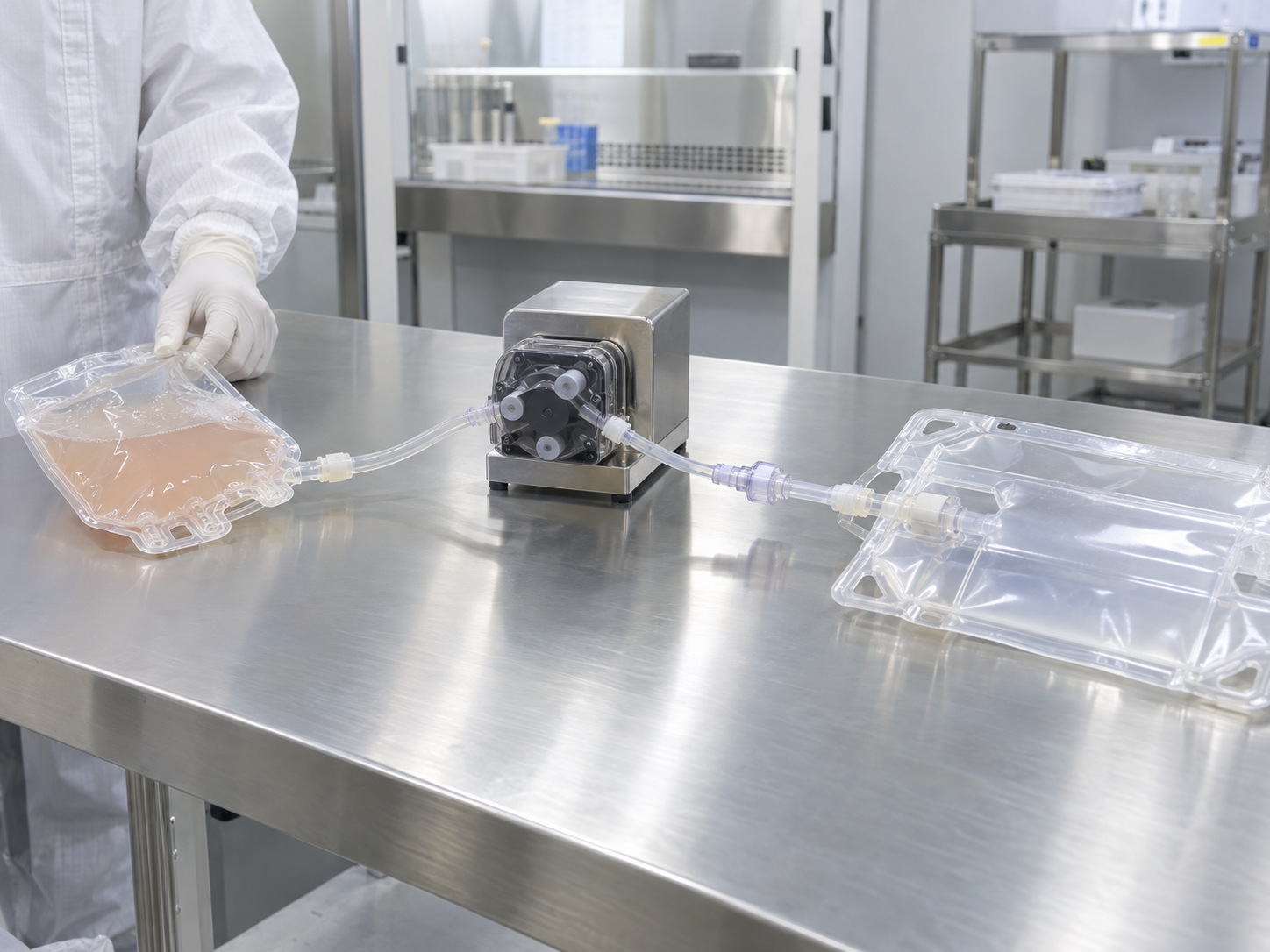
Most cell products cannot be sterilised in their final form. EU Part IV says that since the great majority of ATMPs cannot be terminally sterilised, manufacture is carried out aseptically (under conditions that prevent contamination)Sourced [Source 2, 9.39]. That is why a closed system, which does not expose the product to room air, is a central idea in cell manufacture. We set out its definition and the background environment it requires from the primary sources.
The definition of "closed system" differs a little between documents
| Document | Definition of closed system (summary) | Point of difference |
|---|---|---|
| EU GMP Part IV (2017) | A process system designed and operated so that the product or materials are not exposed to the room environment. Materials can be introduced by sterile connectors, welding and the like. It may be opened to fit or connect a filter, provided it is returned to a closed state, with disinfection or sterilisation, before use [glossary]. Moving items in or out without a sterile connection cannot be regarded as closed (9.44). Isolators are defined under a separate entry (air of Grade A (ISO 5) or better) | Assumes opening once and closing again |
| EU GMP Annex 1 (2022) | A system in which the product is not exposed to the surrounding environment. For sterile products, the whole system is sterilised after connections are made. Includes single-use systems of bags and manifolds. It is not opened until the operation ends. The term does not refer to RABS or isolators [glossary] | Basically "never opened". Isolators are separate |
All Sourced (EU GMP Part IV [Source 2], Annex 1 [Source 3]). In a concept paper dated March 2025, the EMA set out a plan to revise Part IV to align with the current Annex 1, saying that the revision would clarify expectations for qualification and control of cleanrooms and closed systems (isolators and RABS) and accommodate new technologies absent from the current text, such as automation and (closed) single-use systemsSourced [Source 16]. We could not confirm that a revised version has been finalised as of this survey (October 2026)Not yet confirmed.
The Annex 1 view of closed systems
- A closed system is designed to reduce the risk of contamination by microorganisms, particles and chemicals from the surrounding environment, and to "reduce the need for manual intervention" (8.127)
- Sterility of every surface that touches the product is kept. Where equipment tubing and the like are connected to the flow path after sterilising final filtration, the design allows aseptic connection, for example with intrinsically sterile connection devices (8.128)
- The method of ensuring the integrity of components used in aseptic connection is defined, and where there is a risk of losing sterility, system integrity testing is considered. Supplier assessment includes collecting data on failure modes that lose sterility (8.129)
- If integrity could be compromised in aseptic manufacture, the system is placed in Grade A. It may be used in a lower grade if integrity is shown to be kept at each use (by pressure testing or monitoring) (8.130)
All Sourced (EU GMP Annex 1 [Source 3]). Annex 1 is a document for sterile medicinal products in general. Other documents in EudraLex Volume 4 do not apply to ATMPs unless explicitly referenced (see our explainer on GMP).
Automated equipment — Part IV chapter 17
EU Part IV has a chapter on "automated manufacture of ATMPs". Only the key points are given here (for the treatment of the CE mark and the like, see our explainer on CDMOs)Sourced [Source 2].
- Using automated equipment can make some GMP requirements easier to meet and may bring advantages for product quality. But responsibility for quality lies with the ATMP manufacturer (17.11 to 17.12)
- Equipment is used only under conditions that keep aseptic processing. For example: validation of cleaning, sterilisation of reused parts, and confirmation of equipment integrity by pressure-hold tests, leak tests and the like (17.21)
- A room where closed systems are used is at least Grade D, and moving materials in and out of the equipment is a critical step. Validated procedures are needed (17.24)
- Because in-process controls are limited in continuous closed processing, continuous monitoring of critical process parameters is done where technically possible (17.27)
- Media fills (simulation of aseptic processing with culture medium) are run. The text recommends a frequency of "bi-annual" (wording that can be read as twice a year or every two years), adjustable according to risk (17.28)
As a real example, Matsumoto et al. cultured iPS cell-derived retinal pigment epithelium (RPE) cell sheets automatically in equipment with closed culture modules. They report that the machine-cultured sheets were of equivalent quality to hand-made sheets in comparisons of morphology and biological propertiesSourced [Source 12]. The paper lists as problems of manual work variation in quality with operator skill, the labour required and cost. This is, of course, a comparison for one process and does not show the effect of automation in general.
9. A materials engineer's view (3): the weak point of a closed system is the joint
A closed system is a set of joints between bags, tubing, connectors, filters and vials. The way the regulatory documents are written also shows that the weak point lies in connections (commentary).
- The connection components themselves are under review: Annex 1 sets out a method of ensuring the integrity of components used in aseptic connection and says supplier assessment should include data on failure modes that lose sterility (8.129) [Source 3]. What is asked of a component maker is not only the figures on the specification sheet but information on how it fails
- Risks specific to single-use: the same Annex 1 lists as items to evaluate adsorption to and reaction with the product, extractables and leachables, fragility, holes and leaks, complexity of assembly, and damage when the outer packaging is opened (8.132) [Source 3]
- Sterilisation changes the material: for single-use systems, it must be verified that the sterilisation process has no adverse effect on system performance (8.133) [Source 3]. How radiation or steam affects resin properties and extractables is an area that needs the knowledge of component makers
- The way of sealing is itself a material requirement: the closed vial of Woods et al. is sealed with a blood-bag heat sealer or RF sealer and uses EVA tubing [Source 9]. That the resin can be heat-welded, and that the weld does not crack at low temperature, become requirements for tubing and bags
- Labels too must withstand low temperature: Q5D requires that labels on bank containers do not lose information through storage, keeping and recovery [Source 1]. Adhesive, ink and base material must withstand ultra-low temperature, thawing and moisture
Put another way, a closed system for cell manufacture is a materials system in which resin, adhesion, welding, filters and sterilisation all act at once, and if any one of them degrades with low temperature or sterilisation, the assurance of sterility of the whole system collapses (commentary). To the requirements on wetted surfaces touched on in the GMP and bioreactor explainers (no reaction, no leaching, no adsorption), the banks and closed systems add "does not crack even at low temperature", "can be welded" and "performance does not change after sterilisation".
10. Validation — what backs trust in the bank and the process
Trust in banks and closed systems is backed not by a single test but by an accumulation of checks. We sort out, from the primary sources, what is checked.
| Object of the check | What the primary sources say (summary) |
|---|---|
| The bank itself | Tests on a new MCB are the same as on the first MCB unless there is justification (Q5D glossary). The bank system is validated up to a passage or doubling number beyond that reached in routine manufacture (Part IV glossary) |
| Freezing conditions | Freezing is done in the sealed container under defined controlled conditions (Q5D). The specification of the final product must attend to the rate of temperature change during freezing and thawing (Part IV 6.20(viii)). Simple freezing at -80 °C (dump freezing) may give a similar cooling rate but leaves no record of the freeze and is a regulatory problem, the review points out (Hunt) |
| Storage and withdrawal | Continuous monitoring and recording of storage temperature, alarms, monitoring of liquid nitrogen level, recording of deviations (8.16). A withdrawn container may be returned only if maintenance of conditions can be shown by documents (8.18). Split storage (8.21) |
| Container integrity | Structural integrity of components exposed to freezing and thawing, and verification that aseptic connections by heat welding or mechanical seals keep their integrity under those conditions (Annex 1 8.137). Examples of methods: a drop test in the frozen state, a dye ingress test, a microbial challenge test (Woods et al.) |
| Aseptic operation | Simulation of aseptic processing that mimics the manufacturing process (media fill). Where a closed system is used, the focus is on the connection to the closed system (9.55 to 9.57, 17.28). For isolators, validation before introduction and glove / sleeve leak tests (9.42 to 9.43). Where there are several ATMPs, bracketing or matrix approaches are possible (9.58) |
| Sterility during long cryopreservation (Japan) | Where the cryopreservation period or culture period during manufacture is long, sterility is confirmed, for example by sterility testing at regular intervals (notification, chapter 2, part 2, item 6) |
| From thawing on (administering site) | Reconstitution may take place at the administering site, but compliance there is outside the manufacturer's responsibility and outside the scope of GMP (Part IV 16.17) |
All Sourced (Q5D [Source 1], Part IV [Source 2], Annex 1 [Source 3], MHLW notification [Source 5], Hunt [Source 8], Woods et al. [Source 9]). The arrangement of the table is this article's.
Beyond the bank comes the expansion culture, differentiation and formulation that begin with thawing the WCB. Q5D counts the in vitro age of cells in manufacture from the time a container of the MCB is thawedSourced [Source 1]. For culture vessels, stirring and oxygen transfer, see our explainer on bioreactors; for the clauses of GMP, the GMP explainer; for change control, the QbD and CMC explainer; and for the structure of contract manufacturing, the CDMO explainer.
11. Open issues, and what is still undecided
(1) We could not confirm clinical use of DMSO-free freezing
The 2025 review says research on DMSO-free cryopreservation solutions is advancing, but there are not yet clinical trialsSourced [Source 11]. Changing the freezing solution of a bank is a change to the process, so an impact assessment of the change (see the QbD and CMC explainer) would be needed (commentary).
(2) We could not confirm a unified standard for evaluating container integrity at low temperature
Annex 1 asks for attention to the integrity of components exposed to freezing and thawing [Source 3], but within the scope of this survey we could not confirm a unified standard that also sets the test methods. The tests by Woods et al. are an early validation of one container, and we have not confirmed whether there is a conflict of interestNot yet confirmed.
(3) Resin property values (such as the transition temperature of EVA) rest on a statement in a single paper
The EVA transition temperature in Fig. 4 (beginning near -15 °C) is a statement by Woods et al. [Source 9]. It may change with the vinyl acetate content, grade and additives of the EVA, and we have not been able to confirm it against a materials maker's technical data or standard test methodsNot yet confirmed.
(4) EU Part IV is being revised, and ICH Q3E is a draft
Part IV is a document adopted on 22 November 2017, and in 2025 the EMA issued a concept paper for a revision aligned with Annex 1 [Sources 2 and 16]. We could not confirm the revised version as of this survey (October 2026)Not yet confirmed. ICH Q3E is a draft published in August 2025, with comments invited until 18 December 2025 [Source 13]Not yet confirmed.
(5) Some parts rest on an old review
The mechanisms of freezing, the temperature gradient in liquid nitrogen tanks and the state of cryovials at the time, in chapters 6 and 7, rest on a review from 2011 [Sources 8 and 9]. Tank design and the state of containers may have changed since, and this article has not checked current commercial products.
(6) Primary sources giving numbers on the effect of automation and closed systems are limited
The comparison by Matsumoto et al. is for one process [Source 12]. Within the scope of this survey we could not confirm numbers that generally compare contamination rates between closed and open systems, or show changes in failure rate or cost from automation.
(7) Cost figures are limited rough estimates
The costs of preparing and testing a bank (US$80,000 to US$200,000 and so on) are rough estimates for research grade by a presenter at the 2017 ISCBI workshop [Source 7]. We could not confirm primary sources giving costs for clinical grade or commercial use.
- A cell bank is a mechanism that makes cells a raw material you can draw in the same state, again and again. The two tiers of MCB and WCB are general, and for cell products there are forms with a different number of tiers, such as a "stock"Sourced
- Testing cannot detect every contaminant. So the principle is prevention through the environment and materials used in making the bankSourced. In the iPS cell stock, the main reason lines were dropped was not contamination but residual vector, genetic mutations and karyotypeSourced
- A small bank loses vials to testing. For banks of 20 to 200 vials, the bacteria and fungi test alone uses 1% to 10%Our calculation
- Freezing is set not only by rate but by the shape of the container and the protective solution. There is an example where the cooling rate changed by about one order of magnitude with the container at the same volumeSourced
- The requirements on a container are "does not crack at low temperature", "releases nothing for a long time" and "can be welded". The wetted-area ratio of a 1 mL vial is about 115 times that of a 2,000 L tankOur calculation
- The weak point of a closed system is the connection. Component failure modes, welding, performance after sterilisation and the cold resistance of labels are what materials makers are asked about (commentary)
12. Glossary
- Cell bank
- A store of cells in containers of uniform contents kept under defined conditions. Each container is part of one cell pool.
- MCB (master cell bank)
- A bank made as one pool from the selected cells and the source of every WCB.
- WCB (working cell bank)
- A bank made by culturing MCB containers and used directly in manufacture.
- Cell stock
- An inventory of cells obtained over a small number of passages and divided into portions. The number of manufactures is limited by the number of portions, and it does not cover the whole life of the product (Part IV).
- In vitro cell age
- The span from thawing an MCB container to harvest from the production vessel, counted in time, population doublings or passage number (Q5D).
- Cryoprotectant
- A substance that eases the damage caused by ice on freezing. DMSO is widely used.
- Controlled-rate (slow) freezing
- Freezing by cooling at a constant rate, around 1 to 2 °C per minute. Sometimes used together with seeding.
- Seeding
- Deliberately inducing ice nuclei so that freezing starts at the same point.
- Vitrification
- Setting a liquid into a glass without forming ice. Achieved by extremely fast cooling or a highly concentrated protectant.
- Glass transition temperature
- The temperature below which molecular motion stops (the material becomes glassy). Storage is done below it.
- Vapor-phase storage
- Storing in the cold gas above the liquid nitrogen surface. Makes cross-contamination from the liquid phase easier to avoid.
- Closed system
- A process system in which the product is not exposed to the room environment. Connected by sterile connectors or welding.
- Isolator
- A decontaminable device that isolates its interior from the outside with air of Grade A (ISO 5) or better.
- Media fill
- A test that simulates the manufacturing process with culture medium to check that aseptic operation is maintained.
- EVA
- Ethylene vinyl acetate copolymer. A soft resin widely used for freezing bags.
- COC
- Cyclic olefin copolymer. A transparent, low-water-absorption resin used for pharmaceutical containers.
- STR analysis
- Genetic profiling that identifies a cell line by its short tandem repeat types.
13. References
- ICH "Q5D Derivation and Characterisation of Cell Substrates Used for Production of Biotechnological/Biological Products", Step 4, 16 July 1997 https://database.ich.org/sites/default/files/Q5D%20Guideline.pdf
- European Commission "Guidelines on Good Manufacturing Practice specific to Advanced Therapy Medicinal Products" (EudraLex Volume 4 Part IV), 22 November 2017 https://health.ec.europa.eu/system/files/2017-11/2017_11_22_guidelines_gmp_for_atmps_0.pdf
- European Commission "EudraLex Volume 4, Annex 1: Manufacture of Sterile Medicinal Products", 25 August 2022 https://health.ec.europa.eu/system/files/2022-08/20220825_gmp-an1_en_0.pdf
- US FDA (CBER) "Chemistry, Manufacturing, and Control (CMC) Information for Human Gene Therapy Investigational New Drug Applications (INDs)", January 2020 https://www.fda.gov/media/113760/download
- Director-General of the Pharmaceutical Safety Bureau, MHLW Notification Iyaku-hatsu 0117 No. 11 (17 January 2025), partial revision of the notification on ensuring the quality and safety of human (allogeneic) iPS(-like) cell-processed pharmaceuticals (annexed guideline; posted on the PMDA site) (in Japanese) https://www.pmda.go.jp/files/000273143.pdf
- CiRA Foundation (Kyoto University iPS Cell Research Foundation) "iPS cell stock project: ten-year summary paper published" (in Japanese), 17 November 2022 https://www.cira-foundation.or.jp/j/news/2022/11/17-000302.html
- Kim J-H et al. (ISCBI) "A Report from a Workshop of the International Stem Cell Banking Initiative, Held in Collaboration of Global Alliance for iPSC Therapies and the Harvard Stem Cell Institute, Boston, 2017", Stem Cells 37:1130-1135 (2019) https://pmc.ncbi.nlm.nih.gov/articles/PMC7187460/
- Hunt CJ "Cryopreservation of Human Stem Cells for Clinical Application: A Review", Transfusion Medicine and Hemotherapy 38:107-123 (2011) https://pmc.ncbi.nlm.nih.gov/articles/PMC3088734/
- Woods EJ, Thirumala S "Packaging Considerations for Biopreservation", Transfusion Medicine and Hemotherapy 38:149-156 (2011) https://pmc.ncbi.nlm.nih.gov/articles/PMC3088737/
- Tedder RS et al. "Hepatitis B transmission from contaminated cryopreservation tank", The Lancet 346:137-140 (1995) (PubMed abstract) https://pubmed.ncbi.nlm.nih.gov/7603227/
- Dobruskin M, Toner G, Kander R "Cryopreservation practices in clinical and preclinical iPSC-based cell therapies: Current challenges and future directions", Biotechnology Progress 41 (2025) https://pmc.ncbi.nlm.nih.gov/articles/PMC12348306/
- Matsumoto E et al. "Fabricating retinal pigment epithelial cell sheets derived from human induced pluripotent stem cells in an automated closed culture system for regenerative medicine", PLoS ONE 14:e0212369 (2019) https://pmc.ncbi.nlm.nih.gov/articles/PMC6415881/
- ICH (posted by the EMA) "ICH Q3E Guideline for extractables and leachables", Step 2b draft, published 18 August 2025 (EMA/CHMP/ICH/236669/2025) https://www.ema.europa.eu/en/documents/scientific-guideline/ich-q3e-guideline-extractables-leachables_en.pdf
- PubChem (US National Library of Medicine) "Dimethyl Sulfoxide" (CID 679) https://pubchem.ncbi.nlm.nih.gov/compound/679
- Lovelock JE, Bishop MW "Prevention of Freezing Damage to Living Cells by Dimethyl Sulphoxide", Nature 183:1394-1395 (1959) https://doi.org/10.1038/1831394a0
- EMA (GMP/GDP Inspectors Working Group) "Concept paper on the revision of Part IV Guidelines on Good Manufacturing Practice specific to Advanced Therapy Medicinal Products", 11 March 2025 (EMA/INS/GMP/48771/2025) https://www.ema.europa.eu/en/documents/scientific-guideline/concept-paper-revision-part-iv-guidelines-good-manufacturing-practice-specific-advanced-therapy-medicinal-products_en.pdf
14. Claim-to-source audit
| Claim in the text | Basis | Label |
|---|---|---|
| The definition of a cell bank (a collection of containers of uniform contents, each container an aliquot of a single pool). The definitions of MCB, WCB, parent cells and in vitro cell age. That the advantage of using passaged cells is a common, characterised starting material for each production lot. That the two-tier system is generally accepted as most practical, that the MCB is made first and the WCB as needed, that a one-tier system is possible in principle, that a bank of parent cells is recommended but not mandatory, and that cloning is not required for diploid cells and the like. That tests on a new MCB are the same unless justified | ICH Q5D (1.3, 2.1.3, 2.2.1, glossary). Reference 1 https://database.ich.org/sites/default/files/Q5D%20Guideline.pdf | Sourced |
| The procedure for making a bank (pooling and dispensing into sterile containers sealed, recording of containers, closures, cryoprotectant, medium and freezing conditions, labels that survive storage and recovery, freezing under controlled conditions then transfer to the vapor or liquid phase of liquid nitrogen or an equivalent ultra-low temperature). Disaster preparedness (several freezers, emergency power, automatic nitrogen refilling, remote storage, remaking the MCB). That in vitro cell age is counted from thawing an MCB container. The statement that no cell bank testing regimen can detect all contaminants and the principle of prevention during preparation is important | ICH Q5D (2.2.2). Reference 1 https://database.ich.org/sites/default/files/Q5D%20Guideline.pdf | Sourced |
| Frequency of testing (identity and purity once per MCB, stability once per product, purity and limited identity for the WCB). Identity; bacteria and fungi (1% of containers, at least 2, on MCB and WCB); mycoplasma (cells from one container suffice); viruses; cross-contamination with other cell lines; stability (two time points, viability in storage); karyotype and tumorigenicity | ICH Q5D (section 2.3). Reference 1 https://database.ich.org/sites/default/files/Q5D%20Guideline.pdf | Sourced |
| That a seed lot / cell bank system is recommended for allogeneic products and not mandatory (8.10). The environment for making a bank (GMP-compliant, no simultaneous handling of other live material in the same area, 8.11). Safety testing and characterisation of cell banks, storage in sealed containers in the vapor phase (8.15). Sealing, labelling and inventory of containers, continuous monitoring of storage temperature, alarms, level monitoring, recording of deviations (8.16). Quarantine and release, records of stability and recoverability (8.17). Conditions for returning a withdrawn container (8.18), access limits (8.19). The definition of cell stock (8.20) and split storage (8.21). The glossary of MCB, WCB and the cell bank system (validation beyond the passage number or doublings of routine manufacture). Attention to the rate of temperature change on freezing and thawing in the final product specification (6.20(viii)) | EU GMP Part IV (chapters 6 and 8, glossary). Reference 2 https://health.ec.europa.eu/system/files/2017-11/2017_11_22_guidelines_gmp_for_atmps_0.pdf | Sourced |
| That most ATMPs cannot be terminally sterilised and are made aseptically (9.39). Background Grade D for closed systems and isolators; Grade A critical zone with Grade B background for open systems (9.41, 9.46). Validation before introduction and leak tests for isolators (9.42 to 9.43). That moving items in or out without a sterile connection ends the closed status (9.44). The exceptional case of placing a closed system in an unclassified environment such as an operating theatre (9.45). The cases where single-use kits and closed containers can be used in Grade C, and the note that they are regarded as closed if fully isolated (9.49, footnote 16). Simulation of aseptic processing (9.55 to 9.58). The chapter on automated equipment (17.11 to 17.12, 17.21, 17.24, 17.27, 17.28). The glossary definitions of closed system and isolator. That reconstitution may take place at the administering site and that compliance there is outside the manufacturer's responsibility and outside GMP (16.10, 16.17) | EU GMP Part IV (chapters 9, 16 and 17, glossary). Reference 2 https://health.ec.europa.eu/system/files/2017-11/2017_11_22_guidelines_gmp_for_atmps_0.pdf | Sourced |
| Design, sterility, aseptic connection, integrity testing and background environment of closed systems (8.127 to 8.130). Risks of single-use systems, sterilisation, supplier assessment, adsorption, reactivity, extractables and leachables, integrity under freezing and thawing conditions, acceptance criteria (8.131 to 8.139). The definition of closed system (not meaning RABS or isolators). That Annex 1 applies from 25 August 2023 | EU GMP Annex 1. Reference 3 https://health.ec.europa.eu/system/files/2022-08/20220825_gmp-an1_en_0.pdf | Sourced |
| That for allogeneic single-donor cells expanded and stored, qualifying the MCB and WCB in the same way as cell banks for viral vectors is generally recommended, and consulting the reviewer is requested where the bank is small. Bank qualification tests (sterility, mycoplasma, adventitious viruses, examples of species-specific viruses, identity and STR analysis, stability, tumorigenicity). That re-establishing the bank is considered if an adventitious virus is found. WCB test items. That it is dated January 2020 | FDA CMC guidance for gene therapy INDs (V.A.2.c, V.A.2.c.iii). Reference 4 https://www.fda.gov/media/113760/download | Sourced |
| That where cells are banked, the reason, method of preparation, characterisation, and methods of storage, maintenance, control and renewal are shown, that Notification Iyakushin No. 873 is consulted, and that parts may be omitted if evaluated upstream (chapter 2, part 2, item 2(7)). Critical cell characteristic indicators for iPS cell lines (HLA typing, karyotype, DNA fingerprinting and others) and passage number (chapter 2, part 1, item 3). Stability tests for storage and transport, and transport containers and procedures (chapter 2, part 1, item 4). Sterility testing at regular intervals for long cryopreservation periods (chapter 2, part 2, item 6). Prevention of mix-ups and cross-contamination (chapter 2, part 2, item 2(8)). Thorough analysis of undifferentiated cells at the cell bank stage (chapter 4). That the Director-General's notification of 7 September 2012 was partially revised on 17 January 2025 | MHLW notification (Iyaku-hatsu 0117 No. 11) and annexed guideline. Reference 5 https://www.pmda.go.jp/files/000273143.pdf | Sourced |
| That lines were established from the blood of 7 HLA-homozygous donors and, after quality testing, 27 lines were selected and are offered. The two-step changes of making the SCS from the PCS, single-cell cloning (Method 2) and fewer colony-picking steps (Method 3). The main reasons lines were not selected (residual episomal vector, mutations in cancer-related genes, copy-number and structural abnormalities, undifferentiated markers, karyotype abnormalities), that nearly 40% of the PCS of one donor showed karyotype abnormalities, and that no line was excluded by specification tests such as contamination testing including sterility testing | CiRA Foundation announcement (introducing the paper in Med). Reference 6 https://www.cira-foundation.or.jp/j/news/2022/11/17-000302.html | Sourced |
| That sterility tests cannot detect all microorganisms in cell cultures, that molecular methods are emerging, that blood-borne virus testing may not be enough, why the teratoma assay is unsuited to quality control (6 to 12 weeks, animals, reproducibility, cost), the discussion that genome sequencing is desirable on both the cell line and the final product, and a presenter's rough estimate of research-grade bank testing costs (US$80,000 to US$200,000, about US$150,000 for preparation) | ISCBI workshop report. Reference 7 https://pmc.ncbi.nlm.nih.gov/articles/PMC7187460/ | Sourced |
| Controlled-rate freezing at 1 to 2 °C per minute with DMSO, the problem that dump freezing leaves no record, the explanation of protectants and ice and solute concentration, dependence of DMSO toxicity and washing and concentration reduction (5%, 2%), alternative protectants (hydroxyethyl starch, trehalose, PVP, methylcellulose, PEG, polyampholytes, sericin). The challenges of replacing serum, the advantages of commercial solutions (and an example with undisclosed components). Freezing of human ES cells (about 5% to 16% by slow freezing, over 75% reported for vitrification, about 80% with seeding, over 50% with seeding at -7 °C, about 10-fold with Y-27632). Problems of vitrification for mass production and contamination. Straw cooling rates (about 22,000 and about 2,500 °C per minute) and the slowing from doubling. Storage temperature (below the glass transition, mechanical freezers below -135 °C, comparison up to 5 years), the temperature gradient in liquid nitrogen tanks, the move to vapor-phase storage, double bags, the state of cryovials (as of 2011), shipping (dry ice, dry shipper up to 14 days). CE-marked sterile DMSO at UK tissue banks | Hunt (2011) review. Reference 8 https://pmc.ncbi.nlm.nih.gov/articles/PMC3088734/ | Sourced |
| That EVA and PVC are the main materials of freezing bags, the statement that the EVA transition begins near -15 °C, the brittleness at low temperature of bags and PVC tubing and the leaching of plasticiser, and the closure problem of screw-cap vials. The makeup of the closed vial (COC body, EVA tubing, PTFE vent filter, heat or RF welding) and the properties of COC. The methods and results of the drop test (1 m, frozen state), the dye ingress test and the microbial ingress test with Brevundimonas diminuta (no ingress after freezing to -196 °C, storage, shipping and thawing) | Woods et al. (2011). Reference 9 https://pmc.ncbi.nlm.nih.gov/articles/PMC3088737/ | Sourced |
| That six patients developed acute hepatitis B over 25 months and the bone marrow or peripheral blood stem cells of all had been stored in the same freezing tank; that a leak in the freezing bag of the first patient's marrow contaminated the tank and its contents and led to infection after transplant; and the point that the primary container must be sealed so that nothing is exchanged between specimen and liquid nitrogen | Tedder et al. (1995), abstract. Reference 10 https://pubmed.ncbi.nlm.nih.gov/7603227/ | Sourced |
| That of 57 clinical trials of iPS cells, 18 (32%) stated the use of DMSO, 5 (9%) reported washing after thawing and 13 (22%) disclosed the freezing procedure. That all 12 preclinical studies used DMSO, 8 used 1 °C per minute and all 12 washed after thawing. That there are not yet clinical trials of DMSO-free solutions. That removing DMSO after thawing is a manual, open operation and reconstitution falls outside GMP in the US and Europe | Dobruskin et al. (2025). Reference 11 https://pmc.ncbi.nlm.nih.gov/articles/PMC12348306/ | Sourced |
| That iPS cell-derived RPE cell sheets were cultured automatically in equipment with closed culture modules and were equivalent to hand-made sheets in morphology and biological properties. The problems of manual work (variation with operator skill, labour, cost) | Matsumoto et al. (2019). Reference 12 https://pmc.ncbi.nlm.nih.gov/articles/PMC6415881/ | Sourced |
| That ICH Q3E is a Step 2 draft published in August 2025 with comments invited until 18 December 2025, that it covers new medicinal products including cell and gene therapy products, and that the reasons leachables risk from manufacturing components is lower than from packaging and delivery components are the shorter contact time and larger volume-to-area ratio | ICH Q3E draft. Reference 13 https://www.ema.europa.eu/en/documents/scientific-guideline/ich-q3e-guideline-extractables-leachables_en.pdf | Sourced |
| The molecular weight (78.14), density (about 1.10 g/mL) and melting point (about 18.5 °C) of DMSO | PubChem. Reference 14 https://pubchem.ncbi.nlm.nih.gov/compound/679 | Sourced |
| The report on the action of DMSO in preventing freezing damage (1959, by title) | Lovelock and Bishop (1959). Reference 15 https://doi.org/10.1038/1831394a0 | Sourced |
| The EMA concept paper (dated 11 March 2025) setting out a plan to revise Part IV to align with the current Annex 1, including clarifying expectations for closed systems (isolators and RABS) and accommodating automation and (closed) single-use systems | EMA concept paper. Reference 16 https://www.ema.europa.eu/en/documents/scientific-guideline/concept-paper-revision-part-iv-guidelines-good-manufacturing-practice-specific-advanced-therapy-medicinal-products_en.pdf | Sourced |
| That a revised Part IV has been finalised, that ICH Q3E has been finalised, clinical use of DMSO-free freezing, a unified standard for evaluating container integrity at low temperature, and the ability of currently marketed cryovials to prevent liquid nitrogen ingress | None could be confirmed from primary sources in this article's survey (October 2026). Some are under revision, drafts or at the research stage | Not yet confirmed |
| Vials lost to testing (applying 1% of containers, at least 2, to 20 to 500 vials: 10%, 4%, 2%, 1%, 1%). Molarity of DMSO at 5%, 7.5% and 10% (v/v) (0.70, 1.06, 1.41 mol/L). The wetted-area ratio (vial about 4,800 cm²/L, 2,000 L tank about 42 cm²/L, about 115-fold). About 84 minutes to cool from about 4 °C to about -80 °C at 1 °C per minute | Our calculation. Applying the Q5D wording simply, a molecular weight of 78.14 and density of 1.10 g/mL, 1 mL in a cylinder of 1.0 cm inner diameter, and a 2,000 L cylindrical tank with H/D = 2 (internals ignored) are all this article's assumptions. They are not values for an actual test plan or real shapes | Our calculation |
| Placing PCS and SCS alongside MCB and WCB. The reading that the main cause of banks being rejected was the nature of the cells, not contamination. The reading that a small bank is cornered by testing. The view that cooling rate is set by container shape and wall conduction. Treating the cryopreservation solution as a process material. The two-axis view of containers (temperature range, contact time and area ratio). The reading of why COC and PVC were chosen. The grouping of closed systems into four forms. The view that the weak point of a closed system is the connection (component failure modes, welding, sterilisation, labels). Applying the thinking of Q3E to bank containers. The layout, bands and flows of Figs. 1 to 6. The wording of the chapter headings | This article's own arrangement and commentary based on published material; not views expressed by any regulator, company or author | Commentary |
| The US framework specific to cell products, the size and storage conditions of individual products' banks, the performance of a particular company's equipment or containers, and market size | Outside the scope of this article, so not covered. Market-size and share estimates are not used | Commentary |
| That Figs. 1 to 5 are drawings made for explanation, not actual equipment or measured results, and that the hero image and Fig. 6 are AI-generated | A note from this article | Commentary |
Last updated 1 October 2026. Sources are limited to primary material (ICH guidelines, EU Commission GMP guidelines, FDA guidance, MHLW notifications, publications from the CiRA Foundation, and peer-reviewed papers). Because the article includes readings from the materials and process side, those are marked as Commentary and kept separate from sourced fact. Parts on the mechanisms of freezing and the state of containers rest on a 2011 review and may differ from current commercial products and tank designs. A revised EU Part IV and a final ICH Q3E could not be confirmed as of this survey. Market-size and share estimates are not used. This article explains the mechanisms of manufacture and quality control and does not discuss the efficacy or safety of individual products or the choice of treatment. Figs. 1 to 5 are vector drawings; the hero image and Fig. 6 are AI-generated; none of them shows a real facility, product or measured value.