COMPANY PROFILE / NANOTECHNOLOGY
Croda
A UK materials company that offers pharmaceutical lipids from research-grade high-purity products to GMP volumes
Croda is a UK specialty chemicals company with businesses ranging from beauty ingredients and crop-protection aids to pharmaceutical excipients. This article covers only its nanomedicine-related activity, pharmaceutical lipids, not the group as a whole. In 2020 it acquired Avanti Polar Lipids (now Avanti Research), a US maker of high-purity lipids, and says it now has both a research catalogue of more than 2,000 lipids and lipids made under GMP (good manufacturing practice). To produce lipids at volume it expanded capacity with US and UK government support, but in its 2025 results it announced that it would put its large lipid plant in Lamar, Pennsylvania on "standby". Its own explanation is that "projects requiring production at significant scale are expected to take longer to materialise", and it booked non-cash exceptional charges of £60.5 million. Drawing on official results, the annual report, official releases and product pages, this article sets out what could be confirmed and what could not, and explains from a materials engineer's view the molecular design, purity, analysis and scale-up of lipids.
- At a glance: Croda and its place in nanotechnology
- Logo and naming
- Where the company sits in nanotechnology
- Company scale
- Resources committed to nanotechnology
- Track record
- Plans
- What the company is aiming for in nanotechnology
- Partnership map for nanotechnology
- Technologies, products and services
- Risks
- Glossary
- References
- Claim-to-source audit
1. At a glance: Croda and its place in nanotechnology
in Snaith, East Yorkshire)Listed on the London Stock Exchange. The company says it was established in 1925
Nanomedicine (secondary)Primary: synthesis and supply of lipids as materials. Secondary: supply to customers who make LNPs (lipid nanoparticles) and similar medicines. Our classification
(ionizable, PEG, phospholipids, sterols)The research catalogue has more than 2,000 lipids. The GMP range is described as four lipid families
(can start within three months)Decided in FY2025. Impairment £44.6 million plus a £15.9 million provision. Kept in this state for 10 years under an agreement with the US government
Croda's lipid business holds lipids as materials from research grade through GMP volumes. At the same time, the company itself explains in its results that capacity investment ran ahead of demand for large-scale production, leaving surplus capacity. With support from the US and UK governments it expanded lipid production, and it opened the Lamar plant in January 2025. In its February 2026 results, however, it said projects requiring production at scale would take longer to materialise and put Lamar on standby. It says that with Lamar on standby it still has ample capacity for future production across its four GMP lipid sites Sourced. In other words, demand for lipids has not gone away. The company's view is that "lipids for research and clinical use will keep growing, but the large-volume demand assumed during the pandemic has not yet arrived" Not yet confirmed.
2. Logo and naming

The logo is the vector data of the corporate logo embedded in the page of the company's official website (croda.com), a circular mark with the word "CRODA" and "SMART SCIENCE TO IMPROVE LIVES", taken as it is. It has not been recreated with generated images. The color follows the company's dark green (#004438) found in the website's style sheet.
Naming: the company is Croda International Plc. Pharmaceutical lipids belong to its Pharma business (brand: Croda Pharma) in the Life Sciences sector. The site in Alabaster, Alabama, US came with the acquired Avanti Polar Lipids; research lipids are sold as Avanti Research (renamed in September 2024), and the GMP manufacturing division is called Croda Alabaster. The phospholipid site in South Korea is Croda Korea Ltd (formerly Solus Biotech). Other businesses such as beauty, fragrances and agriculture are outside this article.
Official site: https://www.croda.com/en-gb3. Where the company sits in nanotechnology
Croda's primary type is Nanomaterial producers (the party that makes and sells the lipids that are raw materials for LNPs) and its secondary type is Nanomedicine (the party that supplies materials and analysis to customers who make nanomedicines such as LNPs). Unlike Evonik (profiled separately in this series), commercial manufacturing of LNP products themselves does not feature prominently in the official materials we checked. The central materials are the four LNP components, ionizable (cationic) lipids, PEG lipids, phospholipids and sterols, and the processes are lipid synthesis, purification and analysis. For how an LNP works, see our explainer on lipid nanoparticles. The table shows what could be confirmed from the company's materials.
| Material / process | Croda's position | Primary sources confirmed | Status |
|---|---|---|---|
| Ionizable (cationic) lipids | Listed in the research catalogue (Avanti Research). In March 2025 it partnered with Certest Biotec to add new ionizable lipids to the catalogue. The GMP range is also said to include cationic lipids. Individual GMP product names and specifications could not be confirmed | Release on the Certest partnership; product pages | Sourced (company description) / not confirmed (individual products) |
| PEG lipids | DMG-PEG2000 and DSPE-PEG2000 are described on a product page. The company writes that PEG lipids are widely used in LNP formulations | PEG lipids page | Sourced (company description) |
| Phospholipids | DSPC, DOPC, DOPE and others are described. Phospholipids are also made in South Korea (Croda Korea, from Solus Biotech, acquired in 2023), and the annual report says they are used for drug delivery and intravenous nutrition | Phospholipids page; annual report | Sourced (company description) |
| Sterols (cholesterol) | Injectable-grade plant-derived cholesterol. The company says it complies with USP-NF, EP (2397) and JP | Sterols page | Sourced (company description) |
| New lipids (archaeal tetraether lipids) | Partnership with NovoArc in June 2026. Offered in research grade first; GMP grade is described as "ongoing development" | Release on the NovoArc partnership | Sourced / Not yet confirmed |
| Commercial LNP manufacturing and customer names | Could not be confirmed. Customers for lipids are also undisclosed (the company says it was the first to supply lipids for COVID-19 vaccines in clinical and commercial quantities, but no name is given) | US government support release (June 2022) | Not confirmed |
4. Company scale
Croda is a listed company, and group financials are disclosed in its results and annual report. The group is shown briefly, followed by where the Pharma business, which handles lipids, sits in the Life Sciences sector Sourced.
| Item (consolidated, year to December 2025) | Detail |
|---|---|
| Sales | £1,699.4 million (prior year £1,628.1 million; up 4.4%, up 6.6% at constant currency) |
| Adjusted operating profit | £295.3 million (prior year £279.7 million). Margin 17.4% |
| Operating profit (IFRS) | £110.1 million (prior year £227.5 million). Includes impairment charges of £107.3 million and other items |
| R&D expense (charged to income) | £60.2 million (prior year £63.6 million). A group figure; the amount for lipids alone is not disclosed |
| Capital expenditure | £108.2 million (prior year £137.9 million), about 6% of sales. A group figure |
| Employees | 5,954 at the end of 2025. The average for the year was 6,019 |
| Headquarters and listing | Registered office in East Yorkshire, UK (Cowick Hall, Snaith, Goole). Listed on the London Stock Exchange |
| Life Sciences sector (which includes the Pharma business with lipids) | Detail |
|---|---|
| Sales, year to December 2025 | £532.2 million (prior year £504.3 million; up 5.5%). Comprises Pharma, Crop Protection and Seed Enhancement. No amount for Pharma alone appears in the materials we checked (only growth: up 4% at constant currency) |
| Adjusted operating profit | £116.5 million (margin 21.9%). IFRS operating profit £16.3 million |
| Makeup of Pharma | Pharma Ingredients (consumer health ingredients and excipients) is over two thirds of sales (the 2026 half-year materials say "over 70%"). Pharma Solutions (lipid technologies and vaccine adjuvants) is just under one third |
| First half of 2026 (January to June) | Life Sciences sales £257.3 million (same period a year earlier £261.0 million). Pharma overall up 1%, of which Ingredients up 7% and Solutions down 17% (project timing; the company expects improvement in the second half) |
| Sales of lipids (the lipid part of Pharma Solutions) | Not disclosed (the split with adjuvants could not be confirmed either) |
Croda's results materials also give Pharma's market size and share (for example "about 15% of a US$2 billion market"). These are the company's own estimates and are likely to rest on research-firm estimates, so we do not use them. Also, the split into "Pharma Solutions" and "Pharma Ingredients" was introduced in the reorganization of Pharma that the company described in its FY2025 results, so simple comparison with earlier materials is not possible. Pharma Solutions is a business the company itself describes as having large swings from project to project ("lumpy", "project-driven") Not yet confirmed.
5. Resources committed to nanotechnology
What can be confirmed about people and investment in the lipid business from results and the annual report is limited. The table sets out, for four points (people, money, outside deals, universities), what could and could not be confirmed.
| Item | What could be confirmed | Status |
|---|---|---|
| People (R&D sites and headcount) | The global center for lipid development is Alabaster (Alabama, US; the former Avanti site). At the time of the acquisition (2020) Avanti had about 150 employees, over 100 of them scientists. The Lamar plant was expected to create about 50 jobs (January 2025). The group has 5,954 employees. Headcount of the lipid unit alone is not disclosed | Sourced / not disclosed (headcount) |
| Money (R&D and capital expenditure) | Croda's own capital expenditure on large-scale lipid production is about £150 million (over the last five years; about £140 million spent by the end of 2025; scope narrowed from earlier estimates). Lamar: the 2022 plan was up to US$133 million in total (up to US$75 million from the US government, up to US$58 million from Croda). Leek (UK): UK government grant of £15.9 million plus £15.9 million from Croda. Putting Lamar on standby led to an impairment of £44.6 million plus an onerous contract provision of £15.9 million (non-cash, £60.5 million in total). R&D spending for lipids alone is not disclosed | Sourced / not disclosed (R&D spending) |
| Outside investment, acquisitions, joint ventures, divestments | Agreement to acquire Avanti Polar Lipids (US) in 2020. Acquisition of Solus Biotech (South Korea, phospholipids) in 2023. Partnerships with Certest Biotec in 2025 and NovoArc in 2026 (not investments or acquisitions but additions to the catalogue). According to the annual report, the carrying amounts of Avanti-related assets are goodwill of £59 million, technology £13.6 million, customer relationships £34.0 million and brand £12.4 million (Our calculation £119.0 million in total; not the purchase price). No lipid-related joint venture or divestment could be confirmed | Sourced / not confirmed (purchase price, JVs, sales) |
| Universities, research institutes, public funding | The US government (BARDA, with the Department of Defense's joint office and others) for up to US$75 million at Lamar (28 June 2022). The UK government for £15.9 million at the Leek lipid facility (31 March 2022). No named collaboration with a university or research institute could be confirmed in the materials we checked. The NovoArc release names Dr. Oliver Spadiut as founder, but does not mention a university link | Sourced / not confirmed (universities, institutes) |
Status of main products and facilities
Annual production capacity of lipids (kg or tonnes per year) does not appear in the official materials we checked. The company says it has four GMP lipid facilities worldwide (two in the US, one in the UK, one in South Korea).
| Facility | Location | Scale and content | Stage | Date and source |
|---|---|---|---|---|
| Alabaster (the Avanti site) | Alabama, US | Global center for lipid development. FDA-inspected GMP manufacturing division (excipients, active ingredients, adjuvants) and manufacture of research lipids. Five buildings, about 80,000 sq ft (about 7,400 square meters) | Operating | Croda cGMP services page; annual report |
| Lipid facility at Leek | Staffordshire, UK | In 2022 the company announced an expansion of lipid synthesis capacity and analytical and development laboratories, with a UK government grant of £15.9 million and £15.9 million from Croda. Scale not stated | Operating (the annual report lists it as one of the GMP lipid facilities). The completion date of the expansion could not be confirmed | Release of 31 March 2022; annual report |
| Lipid plant at Lamar | Pennsylvania, US | A lipid building of 23,680 sq ft (about 2,200 square meters) within a 37-acre (about 150,000 square meters) multi-purpose cGMP site acquired in 2021. Planned investment of up to US$133 million | Opened 15 January 2025, then standby (decided in FY2025; kept able to start production within three months for 10 years under an agreement with the US government) | Releases of 28 June 2022 and 15 January 2025; full-year results 2025 |
| Croda Korea (phospholipids) | Iksan, South Korea | Phospholipids (for drug delivery and intravenous nutrition). Scale not stated | Operating | Annual report; Lamar release |
6. Track record
| When | Event | Significance |
|---|---|---|
| 1967 | Avanti Polar Lipids (Alabama, US) was founded to meet demand for highly purified lipids in research | A long-established maker of research lipids (history before the acquisition) |
| 6 July 2020 | Croda announced an agreement to acquire Avanti Polar Lipids. It described Avanti at the time as having more than 2,000 lipid and adjuvant products, over 3,000 customers and about 150 employees | Gained research lipids and GMP manufacturing capability |
| 2021 | Acquired a 37-acre multi-purpose cGMP site in Lamar, Pennsylvania | The site of the later large lipid plant |
| 31 March 2022 | Announced an expansion of lipid facilities at Leek, UK, with a UK government grant of £15.9 million (and £15.9 million from Croda itself) | Stronger lipid supply inside the UK |
| 28 June 2022 | Cooperative agreement with the US government to build a new lipid plant at Lamar: up to US$75 million from the government and up to US$58 million from Croda (up to US$133 million in total). "New capacity anticipated in 2025" | A large lipid plant planned with public funds |
| 2023 | Acquired Solus Biotech of South Korea (phospholipids), now Croda Korea | Added a phospholipid manufacturing site |
| 3 September 2024 | Avanti Polar Lipids renamed Avanti Research (a Croda brand) | Tidied the brand for research lipids |
| 15 January 2025 | Announced the opening of the Lamar lipid manufacturing facility (23,680 sq ft, about 50 jobs) | Completion of the large lipid plant |
| 17 March 2025 | Partnership with Certest Biotec to add new ionizable lipids to the Avanti Research catalogue | Brought in outside lipids to widen the range |
| FY2025 (results published 24 February 2026) | Decided to put the Lamar plant on "standby". Impairment of £44.6 million plus a £15.9 million provision. It said projects requiring production at significant scale would take longer to materialise. Pharma was reorganized, with renewed focus on ingredients and excipients (Ingredients) | The company acknowledged a gap between its facility plans and the pace of demand |
| 1 June 2026 | Partnership with NovoArc to offer archaeal tetraether lipids and others through Avanti Research (research grade first) | Exploring new materials such as PEG-free systems |
| 28 July 2026 | Results for the first half of 2026. Sales of Pharma Solutions fell 17% (project timing) and Pharma Ingredients rose 7% | Shows how large the swings in this business can be |
7. Plans
(can start within three months)For 10 years under an agreement with the US government. No income expected during this time (the company's description)
to improve in H2 2026The company's outlook based on its order book. Amounts and numbers of projects are not disclosed
4 to 7% a year, 2026-28The 2026 half-year materials state that it excludes any breakout growth in Pharma. A company target
ongoing developmentOffered in research grade as of June 2026. No timing set
The company plans to hold capital expenditure at about 6% of sales going forward, and the materials we checked contain no new plan for large lipid expansion. Its 2025 results say that sales of lipids for drug research are expected to keep growing while projects requiring large-scale production will take longer, and that it will target other markets such as generics (the 2026 half-year materials say "new originator and generic markets including in Asia") Not yet confirmed.
None of the following appears in the primary sources Not yet confirmed.
Sales and operating profit of the lipid business (including the split between lipids and adjuvants within Pharma Solutions) / production capacity of each lipid facility (kg or tonnes) / customer names and contract volumes or amounts / conditions and timing for restarting Lamar / completion date of the Leek expansion / names and purity specifications of individual GMP lipids / named collaborations with universities or research institutes / the purchase price of Avanti.
8. What the company is aiming for in nanotechnology
This section includes points the company has not stated directly. They are written as inferences that can be read from the primary sources, with the basis given.
| What can be read | Primary-source basis | Status |
|---|---|---|
| For now, it is repositioning lipids as one part of Pharma and giving priority to growth in excipients and consumer health ingredients, which have larger sales | FY2025 results: "rebalancing" Pharma, Ingredients at over two thirds of sales, reallocation of resources. H1 2026: Ingredients up 7%, Solutions down 17% | Sourced (company policy) |
| In lipids, it is building on high-purity research products and custom synthesis and widening the range of new lipids | Catalogue of more than 2,000 lipids; partnerships with Certest (2025) and NovoArc (2026). The FY2025 results say sales of research lipids have grown at a double-digit percentage annual rate for three years | Sourced (company description) |
| For many new lipids, the approach is to bring in outside technology in research grade and decide on GMP according to demand | NovoArc starts in research grade, with GMP as "ongoing development". Certest cites GMP-standard LNP formulations, but the scope of Croda's own manufacturing is not stated | Inference |
| Like Lamar, facilities built with government money are being kept as a hedge against future demand and emergencies, preserving the option to use them when demand arrives | The commitment to keep the plant able to start within three months for 10 years. The results say the investment "positioned us for potential break-out growth" and gives "a significant competitive advantage for future break-out growth" | Inference |
| It is trying to widen its lipid customers beyond originator drugs to generics and new markets in Asia | FY2025 results: targeting further markets for lipids such as generics. H1 2026: targeting new originator and generic markets including in Asia. It also says the US regulatory environment creates uncertainty for customers (especially for vaccine adjuvants) | Inference |
We read "Lamar was not abandoned but kept as a standby capability" from the conditions of the standby. According to the 2025 results, Lamar is kept ready to start and produce within three months, and the company is obliged to maintain this state for 10 years under its agreement with the US government. No income is expected, but because minimum costs must still be borne, the company recognized an onerous contract provision of £15.9 million. The results also say that Lamar is one of four GMP lipid facilities and that capacity for future production is ample, and that demand for lipids for drug research will keep growing but large-scale projects will take time. Together these suggest the plant is kept as an option awaiting demand, and the medium-term growth target (4 to 7% a year, 2026-28) is set on the premise that it does not include such rapid growth. This is our interpretation of the results text, and whether the company has ruled out selling or closing Lamar in the future cannot be confirmed from official materials (the recoverable amount after impairment is nil, and the company notes that it does not currently see a reasonable scenario in which profitable production starts and the impairment reverses) Not yet confirmed.
9. Partnership map for nanotechnology
Two features of Croda's relationships stand out: customer names for lipids are rarely disclosed, and US and UK governments share the cost of the facilities. New lipids are brought in as additions to the research catalogue from outside companies such as Certest and NovoArc, and these are partnerships, not investments or acquisitions. The company's materials give no reason for withholding customer names, and this article does not speculate Not yet confirmed.
10. Technologies, products and services
What follows draws on the company's official product pages, official releases, results and annual report. Figures such as lipid purity (%), endotoxin limits and impurity specifications are almost absent from the public pages we checked, so no performance values are given Not yet confirmed.
| Product / service | Description on the company's pages (company description) |
|---|---|
| Research lipid catalogue (Avanti Research) | "More than 2,000 lipids", with custom synthesis and formulation development. Centered on high-purity lipids for research use only (RUO). Renamed from "Avanti Polar Lipids" in September 2024 |
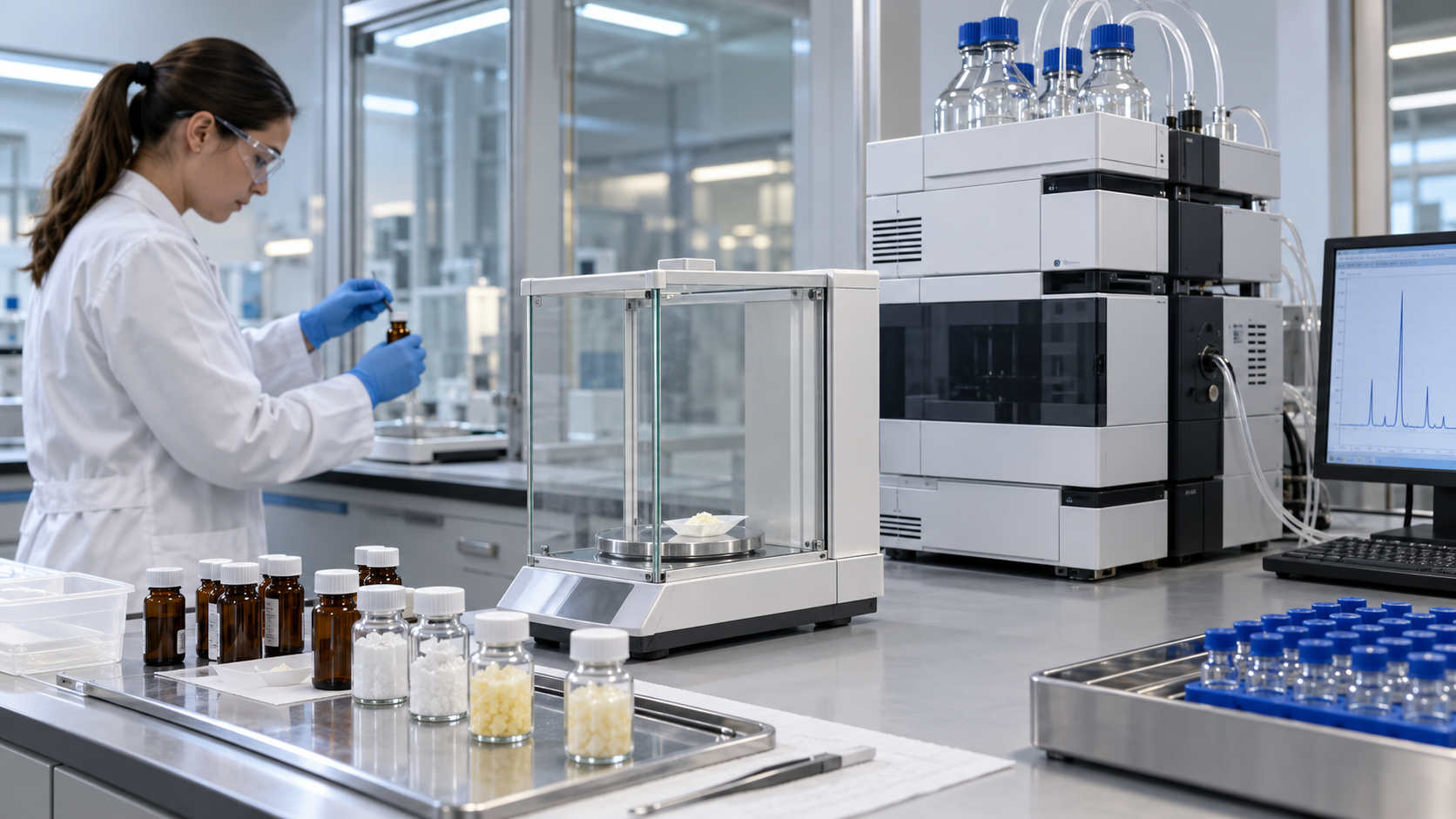
| GMP manufacturing and analysis (Croda Alabaster) | An FDA-inspected GMP manufacturing division. Makes excipients, active ingredients (lipids and hydrophobic small-molecule APIs) and vaccine adjuvants. Five buildings, about 80,000 sq ft. Analysis by NMR, HPLC-ELSD, LC-MS/MS and GC. Method validation said to follow the US regulation 21 CFR 211.194(a)(2). Stability testing in line with ICH |
| Ionizable (cationic) lipids | Said to be involved in binding nucleic acids at the core of an LNP and in delivering them to cells. The page states that "the cationic ionizable lipids in FDA-approved therapeutics all have an apparent pKa between 6 and 7" (the company's description). The range was widened through the partnership with Certest Biotec |
| PEG lipids | In the LNP shell they prevent aggregation and keep particles small. DMG-PEG2000 (a myristoyl type) and DSPE-PEG2000 are described. The page lists challenges: long PEG chains hinder uptake by cells, hinder endosomal escape, and repeated dosing can cause a phenomenon in which the particles clear from blood faster (accelerated blood clearance). As an alternative it presents polysarcosine lipids, under study (research stage) |
| Phospholipids | DSPC has a high transition temperature (55 °C) and is the most common phospholipid in LNPs because it prevents early breakdown of the particle. DOPE is cone-shaped and tends to take an inverted hexagonal phase, which is said to destabilize the endosomal membrane and help escape |
| Sterols | Injectable-grade plant-derived cholesterol (USP-NF, EP 2397, JP compliant). Said to make up roughly 35 to 45% of the formulation (the page gives no unit). The page cites literature in which LNPs with beta-sitosterol substituted kept particle size (about 100 nm) and encapsulation (about 95%) while transfection efficiency improved (conditions and source not detailed) |
| New lipids (NovoArc) | Archaeal glycerol dialkyl glycerol tetraethers (GDGTs) and others, offered first in research grade. Described as "reported to exhibit stability" and as possibly useful for exploring PEG-free particles (no demonstration of the effect could be confirmed) |
| Outside this article | Consumer health ingredients and excipients (Pharma Ingredients), vaccine adjuvants (such as squalene), and the beauty and agriculture businesses |
(1) Molecular properties become function directly. The company's page explains why the apparent pKa of an ionizable lipid is designed to be 6 to 7: the lipid stays uncharged in circulating blood (pH about 7.5) and becomes positively charged in the endosome (pH about 6.5), where it fuses with the membrane. Phospholipids work the same way: DSPC keeps the particle stable through its transition temperature (55 °C), while DOPE disturbs membranes through its molecular shape (cone-shaped), a division of labor between shape and thermal behavior. For how lipids are designed, see our explainer on lipid nanoparticles. From the materials side, every lipid gets its properties by changing chain length, double bonds and head-group shape, and this appears to be why the catalogue runs to more than 2,000 lipids Inference.
(2) Research grade and GMP differ in the "promises" attached to the same molecule. The company separates Avanti Research (research use only) from Croda Alabaster (an FDA-inspected GMP division). Even for the same type of lipid, GMP requires control of raw materials, manufacturing records, method validation and stability testing (the company's page says it follows 21 CFR 211.194(a)(2) and ICH). Taking a lipid found in research to clinical and commercial use therefore needs process chemistry and scale-up, and the company advertises support "from concept to commercialization". Figures such as yield and impurity levels are not disclosed.
(3) Analysis of lipids is harder than for ordinary organic compounds. HPLC-ELSD, one of the methods the company lists, uses an evaporative light scattering detector and is generally used to quantify lipids, which absorb little ultraviolet light (a general explanation in this article). A plausible division of labor is NMR for structure, LC-MS/MS for trace related substances, and GC for residual solvents and the like Inference. The company publishes the names of the methods only, and specification values (purity %, impurity limits) could not be confirmed.
(4) The problem with PEG, and what comes next. The company's page acknowledges that PEG lipids keep particles small and extend circulation, but can hinder cell uptake and endosomal escape, and that repeated dosing can lead to faster clearance from blood. As alternatives it presents polysarcosine lipids (research stage) and NovoArc's archaeal lipids (possibly useful for exploring PEG-free systems). All of these are at the research stage as materials, and the company has not shown a plan for volume or GMP production (for NovoArc, GMP is "ongoing development").
(5) A materials issue on the plant side: "multi-purpose" and "standby". Lamar is described as a multi-purpose cGMP facility able to make several lipids. Multi-purpose plants adapt easily to changing demand, at the price of cleaning and changeover work between products, and they still incur minimum upkeep costs while idle (the onerous contract provision for Lamar reflects this). The company's results show that a large materials plant costs money just by being held until demand arrives. Individual advice on the effectiveness or safety of medicines or vaccines is outside the scope of this article.
11. Risks
| Risk | Detail | Status |
|---|---|---|
| Surplus capacity | The Lamar lipid plant was put on standby in 2025, with an impairment of £44.6 million and a provision of £15.9 million. The company says projects requiring production at significant scale are expected to take longer to materialise. The timing of demand for large-scale lipid production cannot be confirmed | Sourced |
| Swings in sales | Pharma Solutions sees large project-to-project swings in sales, and fell 17% in the first half of 2026 (the company cites project timing). The expected H2 improvement is the company's outlook based on its order book and is not certain | Sourced / Not yet confirmed |
| Government commitments and facility constraints | Lamar must be kept able to start production within three months for 10 years and earns nothing on standby. The company values its market sale value at nil because of restrictions in the contract. The conditions for restarting could not be confirmed | Sourced / not confirmed |
| US regulatory environment | The company says the US regulatory environment creates uncertainty for customers and has affected sales, especially of vaccine adjuvants. The size of the effect on lipids could not be confirmed | Sourced / not confirmed |
| Limits of disclosure | Sales, profit, customers and production volumes of the lipid business are not disclosed. The payback outlook for the investments cannot be checked from outside | Sourced (limit of disclosure) |
| Proving new lipids | NovoArc's lipids are in research grade first, with GMP as ongoing development. That they may help in PEG-free systems is the company's description, and no supporting data could be confirmed | Not yet confirmed |
| Competition and patents | Competitors and the patent situation around LNPs are not described in the company's materials and could not be confirmed. This article does not rank companies against each other | Not confirmed |
| Group-wide transformation | Under its transformation programme the company is reviewing capital projects, rationalizing sites and reviewing headcount (annual report). The effect on the lipid business could not be confirmed | Sourced / not confirmed |
12. Glossary
- Lipid nanoparticle (LNP)
- A nano-sized particle in which four types of lipid enclose a nucleic acid: ionizable lipid, PEG lipid, phospholipid and sterol.
- Ionizable (cationic) lipid
- A lipid that is positively charged in acid and neutral near neutral pH. It sits at the core of an LNP and binds the nucleic acid.
- PEG lipid
- A lipid bound to polyethylene glycol (PEG). It prevents aggregation of particles and affects particle size and circulation time.
- Phospholipid (DSPC, DOPE and others)
- A lipid that is a main component of cell membranes. DSPC keeps structure; DOPE is said to disturb membranes and help escape.
- Transition temperature
- The temperature at which a lipid membrane changes from a rigid gel state to a fluid liquid-crystal state. About 55 °C for DSPC.
- Sterol
- A lipid such as cholesterol. In LNPs it fills gaps between lipids and adds stability.
- GMP / cGMP
- Good Manufacturing Practice (current GMP), the standard for manufacturing and quality control of medicines.
- RUO (research use only)
- A product category limited to research. Not for use in manufacturing medicines.
- HPLC-ELSD
- Liquid chromatography with an evaporative light scattering detector, used to quantify lipids that absorb little ultraviolet light.
- Accelerated blood clearance
- A phenomenon in which PEGylated formulations are cleared from the blood faster when dosed repeatedly.
- Archaeal tetraether lipid (GDGT)
- A lipid with two polar head groups that forms the membranes of archaea. Reported to be stable.
- Standby
- Keeping a facility idle but able to start production within a set time (three months for Lamar).
- BARDA
- The Biomedical Advanced Research and Development Authority of the US Department of Health and Human Services, which supports development of medical countermeasures.
13. References
- Croda Results for the year ended 31 December 2025 (official site, 24 February 2026). Summary of full-year results. https://croda.com/en-gb/media-hub/news/general/2025-full-year-results
- Croda Results for the year ended 31 December 2025 (full regulatory announcement, 24 February 2026). Group and Life Sciences figures, the reorganization of Pharma, Lamar on standby, impairments, total capital expenditure, registered office and listing. https://www.investegate.co.uk/announcement/rns/croda-international--crda/results-for-the-year-ended-31-december-2025/9443342
- Croda Annual Report and Accounts 2025 (March 2026). Employees, R&D expense, assets related to Avanti and Solus Biotech, list of sites. https://www.croda.com/mediaassets/files/corporate/annual-report-2025/croda-annual-report-2025.pdf?la=en-GB&hash=49A5CFC09C17CE953B5D58AF6F8F6F24
- Croda Half Year Results Announcement 2026 (official site, 28 July 2026). Summary of half-year results. https://croda.com/en-gb/media-hub/news/general/2026-half-year-results
- Croda Results for the six months ended 30 June 2026 (full regulatory announcement, 28 July 2026). Life Sciences, Pharma Ingredients and Pharma Solutions results, the NovoArc partnership, medium-term target. https://www.investegate.co.uk/announcement/rns/croda-international--crda/results-for-the-six-months-ended-30-june-2026/9689897
- Croda U.S. Government to support expansion of Croda lipid systems capability (28 June 2022). Government support and total investment for Lamar; supply of lipids for COVID-19 vaccines. https://www.croda.com/en-gb/news/us-government-to-support-expansion-of-croda-lipid-systems-capability
- Croda UK Government to support expansion of Croda's lipid systems manufacturing facility (31 March 2022). Expansion of the Leek lipid facility and the government grant. https://croda.com/en-gb/news/uk-government-to-support-expansion-of-crodas-lipid-systems-manufacturing-facility
- Croda Croda opens advanced lipids manufacturing facility in Pennsylvania (15 January 2025). Opening of the Lamar plant, scale, jobs, other sites. https://www.crodapharma.com/en-gb/news-and-blog/lamar-manufacturing-facility
- Croda Croda strengthens position in life sciences with the acquisition of Avanti Polar Lipids (Avanti's site, 6 July 2020). Agreement to acquire, description of Avanti, year Croda was established. https://avantiresearch.com/news/croda-strengthens-position-in-life-sciences-with-the-acquisition-of-avanti-polar-lipids
- Croda Announcing Avanti Research - a Croda brand (Croda Pharma, 3 September 2024). The renaming to Avanti Research. https://crodapharma.com/en-gb/news-and-blog/avanti-research
- Croda Croda’s Avanti Research expands ionizable lipid offering for LNP drug development through Certest collaboration (17 March 2025). https://avantiresearch.com/news/croda_avanti_research_certest
- Croda Croda’s Avanti Research expands advanced lipid technologies through collaboration with NovoArc (1 June 2026). https://www.avantiresearch.com/en-gb/news/press-releases/avanti-research-novoarc
- Croda Nucleic acid delivery (Croda Pharma product page). More than 2,000 lipids, research and GMP grades, custom synthesis. https://www.crodapharma.com/en-gb/drug-delivery-solutions/explore-by-platform/nucleic-acid-delivery
- Croda Lipids for nucleic acid delivery (Croda Pharma product page). The GMP lipid families (phospholipids, sterols, PEG lipids, cationic lipids). https://www.crodapharma.com/en-gb/drug-delivery-solutions/explore-by-platform/nucleic-acid-delivery/lipids-for-nucleic-acid-delivery
- Croda Cationic lipids (Croda Pharma product page). Apparent pKa and role of ionizable lipids. https://www.crodapharma.com/en-gb/drug-delivery-solutions/explore-by-platform/nucleic-acid-delivery/cationic-lipids
- Croda PEG lipids (Croda Pharma product page). Role, challenges and alternatives for PEG lipids. https://www.crodapharma.com/en-gb/drug-delivery-solutions/explore-by-platform/nucleic-acid-delivery/peg-lipids
- Croda Sterols (Croda Pharma product page). Role of cholesterol, pharmacopoeial compliance, beta-sitosterol. https://www.crodapharma.com/en-gb/drug-delivery-solutions/explore-by-platform/nucleic-acid-delivery/sterols
- Croda Phospholipids (Croda Pharma product page). Descriptions of DSPC, DOPC and DOPE. https://www.crodapharma.com/en-gb/drug-delivery-solutions/explore-by-platform/nucleic-acid-delivery/phospholipids
- Croda cGMP Manufacturing Services (Avanti Research page). Croda Alabaster facilities, analytical methods and validation. https://avantiresearch.com/en-gb/services/cgmp-manufacturing
- Croda Official site (source of the logo image). https://www.croda.com/en-gb
14. Claim-to-source audit
| Claim in the text | Status | Source |
|---|---|---|
| Group figures: sales £1,699.4 million (prior year £1,628.1 million), adjusted operating profit £295.3 million (prior year £279.7 million), IFRS operating profit £110.1 million (prior year £227.5 million), impairment charges £107.3 million, capital expenditure £108.2 million (prior year £137.9 million) | Sourced | Reference 2 https://www.investegate.co.uk/announcement/rns/croda-international--crda/results-for-the-year-ended-31-december-2025/9443342 |
| 5,954 employees at the end of 2025 and an average of 6,019, R&D expense charged to income £60.2 million (prior year £63.6 million), carrying amounts of Avanti-related assets (goodwill £59 million, technology £13.6 million, customer relationships £34.0 million, brand £12.4 million), the Solus Biotech (Croda Korea) acquisition and related assets | Sourced | Reference 3 https://www.croda.com/mediaassets/files/corporate/annual-report-2025/croda-annual-report-2025.pdf?la=en-GB&hash=49A5CFC09C17CE953B5D58AF6F8F6F24 |
| Registered office (Cowick Hall, Snaith, Goole) and listing on the London Stock Exchange | Sourced | Reference 2 https://www.investegate.co.uk/announcement/rns/croda-international--crda/results-for-the-year-ended-31-december-2025/9443342 |
| Life Sciences sales £532.2 million (prior year £504.3 million), adjusted operating profit £116.5 million (margin 21.9%), IFRS operating profit £16.3 million, Pharma up 4% at constant currency | Sourced | Reference 2 https://www.investegate.co.uk/announcement/rns/croda-international--crda/results-for-the-year-ended-31-december-2025/9443342 |
| Pharma Ingredients at over two thirds of sales and Pharma Solutions (lipid technologies and vaccine adjuvants) at just under one third, the reorganization of Pharma, and the company's market size and share estimates (not used) | Sourced (company description) | Reference 2 https://www.investegate.co.uk/announcement/rns/croda-international--crda/results-for-the-year-ended-31-december-2025/9443342 |
| First half of 2026: Life Sciences sales £257.3 million (£261.0 million a year earlier), Pharma up 1%, Pharma Ingredients up 7%, Pharma Solutions down 17%, expected improvement in H2, medium-term target (4 to 7% a year, 2026-28) | Sourced (company description) | Reference 4 and 5 https://croda.com/en-gb/media-hub/news/general/2026-half-year-results https://www.investegate.co.uk/announcement/rns/croda-international--crda/results-for-the-six-months-ended-30-june-2026/9689897 |
| The Lamar standby decision: impairment £44.6 million, onerous contract provision £15.9 million (£60.5 million of non-cash charges in total), ability to start production within three months, maintenance for 10 years under the agreement with the US government, no income while on standby, four GMP lipid facilities (two in the US, one in the UK, one in South Korea) | Sourced | Reference 2 and 3 https://www.investegate.co.uk/announcement/rns/croda-international--crda/results-for-the-year-ended-31-december-2025/9443342 https://www.croda.com/mediaassets/files/corporate/annual-report-2025/croda-annual-report-2025.pdf?la=en-GB&hash=49A5CFC09C17CE953B5D58AF6F8F6F24 |
| Capital expenditure on large-scale lipid production of about £150 million (about £140 million spent by the end of 2025), the statement that projects requiring production at scale will take longer, and US and UK government support | Sourced (company description) | Reference 2 and 3 https://www.investegate.co.uk/announcement/rns/croda-international--crda/results-for-the-year-ended-31-december-2025/9443342 https://www.croda.com/mediaassets/files/corporate/annual-report-2025/croda-annual-report-2025.pdf?la=en-GB&hash=49A5CFC09C17CE953B5D58AF6F8F6F24 |
| The 2022 Lamar plan (up to US$75 million from the US government, up to US$58 million from Croda, up to US$133 million in total; new capacity in 2025), the joint award from BARDA and the Department of Defense's joint office, and the claim to have been first to supply lipids for COVID-19 vaccines | Sourced (2022 plan) | Reference 6 https://www.croda.com/en-gb/news/us-government-to-support-expansion-of-croda-lipid-systems-capability |
| The Leek lipid facility: UK government grant of £15.9 million, Croda's own investment of £15.9 million, expansion of lipid synthesis capacity and analytical and development laboratories (31 March 2022) | Sourced (2022 plan) | Reference 7 https://croda.com/en-gb/news/uk-government-to-support-expansion-of-crodas-lipid-systems-manufacturing-facility |
| Opening of Lamar (15 January 2025), 23,680 sq ft, about 50 jobs, the 37-acre site (acquired in 2021), other sites (Alabaster, Leek, Iksan) | Sourced | Reference 8 https://www.crodapharma.com/en-gb/news-and-blog/lamar-manufacturing-facility |
| The agreement to acquire Avanti (6 July 2020), founded in 1967, about 150 employees and over 100 scientists, more than 2,000 products and over 3,000 customers, and Croda established in 1925 | Sourced (company description) | Reference 9 https://avantiresearch.com/news/croda-strengthens-position-in-life-sciences-with-the-acquisition-of-avanti-polar-lipids |
| Renaming of Avanti Polar Lipids to Avanti Research (3 September 2024) | Sourced | Reference 10 https://crodapharma.com/en-gb/news-and-blog/avanti-research |
| The partnership with Certest Biotec (17 March 2025) | Sourced | Reference 11 https://avantiresearch.com/news/croda_avanti_research_certest |
| The partnership with NovoArc (1 June 2026), archaeal tetraether lipids, research grade first and GMP as ongoing development | Sourced (company description) | Reference 12 https://www.avantiresearch.com/en-gb/news/press-releases/avanti-research-novoarc |
| More than 2,000 research lipids, research and GMP grades, custom synthesis, the four GMP lipid families | Sourced (company description) | Reference 13 and 14 https://www.crodapharma.com/en-gb/drug-delivery-solutions/explore-by-platform/nucleic-acid-delivery https://www.crodapharma.com/en-gb/drug-delivery-solutions/explore-by-platform/nucleic-acid-delivery/lipids-for-nucleic-acid-delivery |
| The apparent pKa of ionizable lipids (6 to 7 for approved therapeutics) and the change of charge in circulation and in the endosome | Sourced (company description) | Reference 15 https://www.crodapharma.com/en-gb/drug-delivery-solutions/explore-by-platform/nucleic-acid-delivery/cationic-lipids |
| The role of PEG lipids (preventing aggregation, particle size), DMG-PEG2000 and DSPE-PEG2000, the challenges (uptake, endosomal escape, accelerated blood clearance) and the polysarcosine lipid alternative | Sourced (company description) | Reference 16 https://www.crodapharma.com/en-gb/drug-delivery-solutions/explore-by-platform/nucleic-acid-delivery/peg-lipids |
| Sterols: injectable-grade plant-derived cholesterol, USP-NF, EP 2397 and JP compliance, roughly 35 to 45% of the formulation, beta-sitosterol | Sourced (company description) | Reference 17 https://www.crodapharma.com/en-gb/drug-delivery-solutions/explore-by-platform/nucleic-acid-delivery/sterols |
| Phospholipids: DSPC (transition temperature 55 °C), DOPC, and DOPE (cone-shaped, inverted hexagonal phase) | Sourced (company description) | Reference 18 https://www.crodapharma.com/en-gb/drug-delivery-solutions/explore-by-platform/nucleic-acid-delivery/phospholipids |
| The Croda Alabaster facilities (five buildings, about 80,000 sq ft), FDA-inspected GMP manufacturing, NMR, HPLC-ELSD, LC-MS/MS and GC, validation following 21 CFR 211.194(a)(2), ICH stability testing | Sourced (company description) | Reference 19 https://avantiresearch.com/en-gb/services/cgmp-manufacturing |
| The logo image is the logo data embedded in the page of the official site (the color was matched to the company color in the site's style sheet) | Sourced | Reference 20 https://www.croda.com/en-gb |
| Sales, profit, headcount and R&D of the lipid business, production capacity of each facility (kg or tonnes), customer names and contract terms, conditions and timing for restarting Lamar, completion date of the Leek expansion, names and specifications of individual GMP lipids, named collaborations with universities or institutes, and the purchase price of Avanti | Not yet confirmed | Not stated in the official materials. This article does not claim they do not exist (this article) |
| The readings that lipids are being repositioned within Pharma, that new lipids are brought in from outside in research grade, that facilities built with government money are kept as a hedge, and that it is widening lipid customers to new markets | Inference | Reference 1 and 2 and 5 and 11 and 12 https://croda.com/en-gb/media-hub/news/general/2025-full-year-results https://www.investegate.co.uk/announcement/rns/croda-international--crda/results-for-the-year-ended-31-december-2025/9443342 https://www.investegate.co.uk/announcement/rns/croda-international--crda/results-for-the-six-months-ended-30-june-2026/9689897 https://avantiresearch.com/news/croda_avanti_research_certest https://www.avantiresearch.com/en-gb/news/press-releases/avanti-research-novoarc |
| The sum of the carrying amounts of Avanti-related assets (59 + 13.6 + 34.0 + 12.4 = 119.0). This is not the purchase price | Our calculation | Our calculation in this article (sum of figures from Reference 3; not the purchase price) |
| The classification of Croda as Nanomaterial producers (primary) and Nanomedicine (secondary), and the four-type framework | Our calculation | Our classification in this article (technical explanations are general commentary, not values for the company's individual products. See our technical explainers) |
| Technical explanations on how pKa, transition temperature and molecular shape are used, the general description of HPLC-ELSD, the difference between research grade and GMP, and the upkeep cost of multi-purpose plants | Our calculation | Our commentary in this article (general technical explanation, not process details published by the company. See our explainer on lipid nanoparticles) |
Last updated: 9 October 2026 / Troy Technical
This article is based on Croda's results, annual report, official releases and official product pages. It does not use market estimates from research firms or press-only figures. Passages marked "Inference" are our interpretation of primary sources and are not company statements. Product features are the company's descriptions, and almost no performance values are published. Company plans and targets are not confirmed and are no guarantee of delivery. This article explains materials and manufacturing technology; it does not evaluate the effectiveness or safety of any medicine or vaccine and is not medical advice.