INSTITUTION PROFILE / NANOTECHNOLOGY
National Institute of Standards and Technology (NIST)
The U.S. measurement laboratory that supplies nanoscale yardsticks and reference materials, with no regulatory power
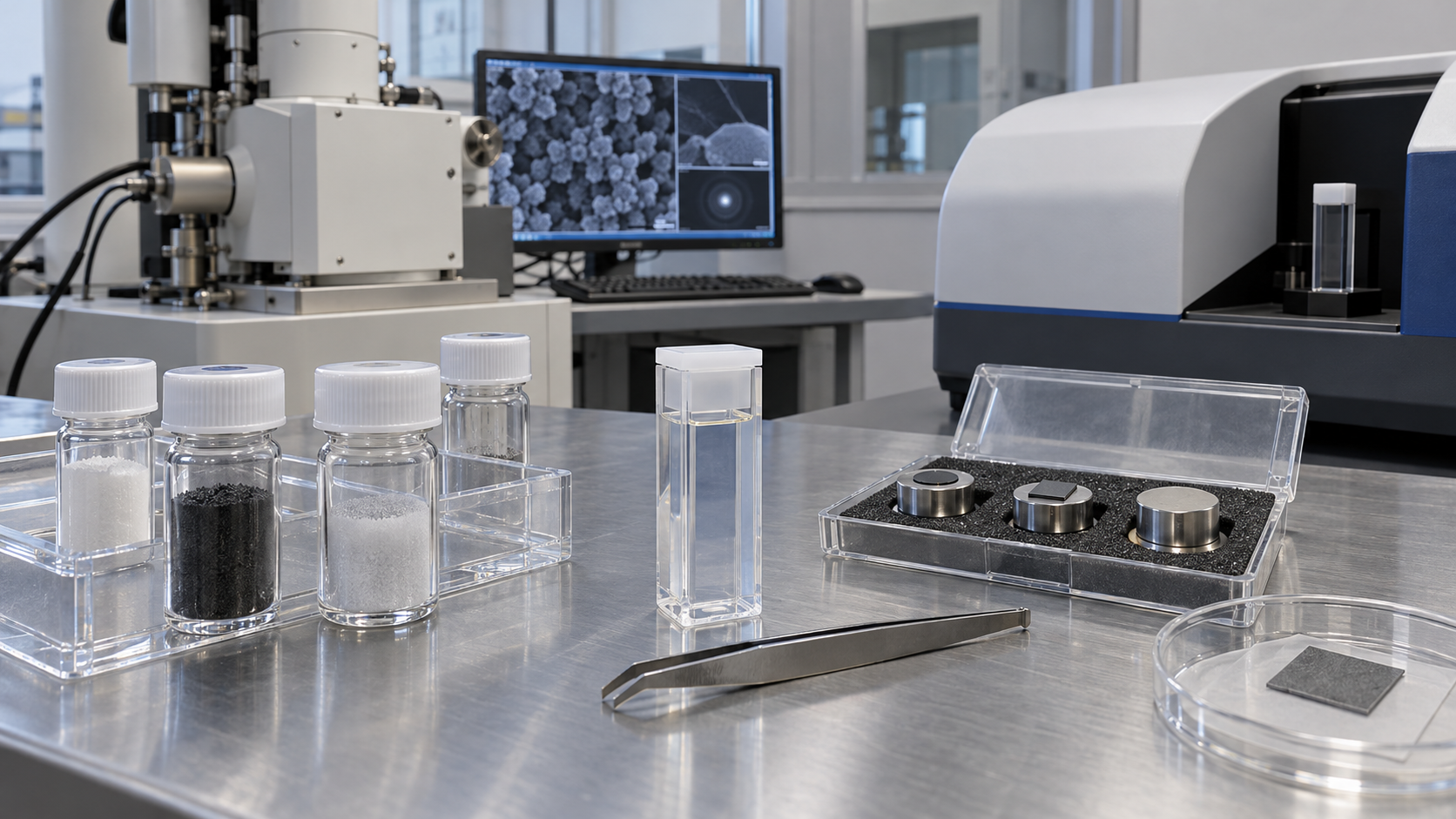
NIST is the measurement and standards laboratory of the U.S. Department of Commerce. It does not write regulations, and it does not make standards in the sense of a standards body. Its job is to build the yardsticks (measurement standards) and the reference materials that let others check that a measurement is right, and to supply them. In nanotechnology that takes concrete forms: polystyrene spheres for calibrating particle-sizing instruments; reference nanoparticles of gold, silver and silicon; and a shared fabrication and measurement facility (the NanoFab) that researchers and companies can use at hourly rates. This profile looks at one question only: how much influence NIST actually has over nanotechnology.
- NIST in 30 seconds
- What kind of body it is: the four types of influence
- What it does for nanotechnology
- How far its influence reaches (powers and geography)
- How reference materials are used, and related organisations
- Outlook
- Glossary, references and claim-to-source audit
1. NIST in 30 seconds
NIST is not a body that decides. It is a body that prepares yardsticks you can measure against. In its April 2025 measurement-services policy letter, NIST itself writes that it is "a non-regulatory agency of the U.S. Department of Commerce" Sourced. Its nanoparticle reference materials come with certificates or reports in which NIST assigns values for size or surface area, but whether those values are used as a benchmark in a regulation, a standard or a contract is decided separately by regulators, standards bodies and companies. NIST's influence lies not in legal force but in serving as a reference point that lines up measurements around the world.
2. What kind of body it is: the four types of influence
Unlike the companies in this series, the institutions that appear in nanotechnology coverage do not make nanomaterials or tools themselves. What separates them is the route by which they influence the field, and that gives four types.
3. What it does for nanotechnology
| Activity | What it involves | Status |
|---|---|---|
| Nanoscale measurement research | NIST's own pages describe advancing nanoscale measurement science, standards and nanotechnology as an important part of its mission. Research topics include nanoelectronics, nanofabrication, nanofluidics, nanomaterials and nanometrology | Sourced |
| Supplying reference materials (SRMs and RMs) | Produces reference materials for particle size (polystyrene spheres, gold nanoparticles and others) as well as for specific surface area and chemical composition (see the next table). NIST says its SRMs are certified reference materials produced under ISO 17034 and ISO 9001 | Sourced |
| Shared facility: the NanoFab | A facility that opens commercial fabrication and measurement tools to researchers at economical hourly rates. The NNI lists it as part of its shared infrastructure | Sourced |
| Taking part in standardisation | NIST representatives lead ASTM International Committee E56 (Nanotechnology). NIST does not write the standards itself; it takes part in the work of standards bodies such as ASTM | Sourced |
| Participating in the NNI | One of the NNI's participating agencies. Its nanotechnology-related amounts in the NNI tally are US$52.8 million in FY2024 (actual), US$44.6 million in FY2025 (estimate) and US$38.3 million in FY2026 (request) | Sourced |
Nanotechnology-related reference materials (those we could confirm in official documents)
NIST issues reference materials under two designations. An SRM (NIST's certified reference material) carries "certified values," those in which NIST has the highest confidence. An RM (a reference material with reference values) carries "reference values" and similar values that do not meet NIST's criteria for certification Sourced.
| Number | Name (nominal) | Type of value and main values | Validity stated in the document |
|---|---|---|---|
| SRM 1963a | Polystyrene spheres (nominal diameter 100 nm) | Certified value. Modal diameter 101.8 nm ± 1.1 nm (as an aerosol, by differential mobility analysis), traceable to the SI unit of length | 31 March 2022 |
| SRM 1964 | Polystyrene spheres (nominal diameter 60 nm) | Certified value. Modal diameter 60.39 nm ± 0.63 nm. Issued 6 April 2022. Target instruments include scanning surface inspection systems | 31 March 2026 |
| SRM 1898 | Titanium dioxide nanomaterial | Certified BET specific surface area. Intended as a benchmark material for assessing environmental, health and safety risks of nanomaterials and for calibrating gas-sorption instruments | Indefinite (if storage and use conditions are met) |
| RM 8011 | Gold nanoparticles (nominal 10 nm) | Reference values (non-certified). The report says the material contains clusters, so its use is limited to methods that measure primary particle size | 25 October 2023 |
| RM 8012 / RM 8013 | Gold nanoparticles (nominal 30 nm / 60 nm) | Reference values (non-certified). Intended mainly to evaluate measurements in pre-clinical biomedical research | 25 October 2018 (archived document) |
| RM 8017 | PVP-coated silver nanoparticles (nominal 75 nm) | Reference values (non-certified). A benchmark material for assessing environmental, health and safety risks of nanomaterials | Indefinite |
| RM 8027 | Silicon nanoparticles (nominal 2 nm) | Non-certified value. Particle size 2.20 nm ± 0.14 nm (by dynamic light scattering). Issued 28 June 2022 | 10 June 2025 |
| RM 8281 | Single-wall carbon nanotube dispersions (three length-resolved populations) | Reference values: ultraviolet-visible absorbance and Raman ratios. For comparing measurements | 31 January 2023 (archived document) |
| SRM 2483 | Single-wall carbon nanotubes (raw soot) | Certified values are element mass fractions. For evaluating methods of analysing nanotubes | 30 June 2021 (archived document) |
"Nominal" is a rough target size, not a certificate value. Types of value, methods and validity dates follow each document. We could not confirm whether the materials in this table can still be bought, because NIST's online shop could not be retrieved Not yet confirmed. One NIST divisional page lists the gold nanoparticles as "SRM 8011 to 8013," but the certificates themselves are titled "RM" (Reference Material).
What makes a reference material valuable is that it states which method produced each value. The certified value for SRM 1963a, for example, is the modal diameter of particles aerosolised and measured by differential mobility analysis. Particles measured in water by dynamic light scattering or by electron microscopy can give different numbers, because the methods differ Sourced. The RM 8011 report also says the material contains clusters, so it should be used only with methods that measure primary particle size. When you compare a particle size from a catalogue or a paper, you have to match "which method, which value." This connects to our explainer on nanometrology.
4. How far its influence reaches (powers and geography)
| Aspect | What NIST has | What NIST does not have |
|---|---|---|
| Powers | Maintaining and distributing U.S. national measurement standards (realisations of the International System of Units, SI); assigning values to reference materials and issuing certificates; nanometrology research; running a shared facility | Regulatory power (it describes itself as non-regulatory); the power to set standards or safety criteria; the power to approve or ban companies or products |
| Geography | The top of the U.S. measurement chain. NIST says that measurement results in the U.S., and indeed the world, are traceable to its realisations of the SI | Legal effect on foreign regulation or standardisation. We could not confirm NIST's terms of supply to buyers abroad |
| Duration | Reference-material values carry a validity date in each document. Within that date, and if storage and use conditions are met, the values hold | Any guarantee for values past their date; any power to make people use them |
| Scale | An enacted FY2025 budget of about US$1.16 billion for NIST as a whole; US$44.6 million of nanotechnology-related spending in the NNI tally (FY2025 estimate) | No nanotechnology-specific headcount could be confirmed in published documents |
NIST's overall budget is an enacted figure of about US$1,157 million for FY2025 and a President's budget request of US$832 million for FY2026 Sourced. A request can change in Congress, so we could not confirm the final FY2026 amount Not yet confirmed. The US$44.6 million in the NNI table comes from the NNI's own method (the amounts each agency reports as nanotechnology-related), so it is not a figure from which a share of NIST's total budget can be calculated directly. The 2025 briefing also says staffing was down by about 420 employees as of May 2025, and that NIST was assessing the effect on its programmes.
5. How reference materials are used, and related organisations
Organisations the official documents link to NIST
| Organisation | Relationship to NIST (as stated in the official documents) |
|---|---|
| National Cancer Institute (NCI) | An NNI document says the gold nanoparticle reference materials issued in January 2008 (RM 8011 to 8013) were produced by NIST researchers working with NCI researchers |
| National Nanotechnology Initiative (NNI) | NIST is a participating agency. In the NNI's standards work, NIST representatives lead ASTM E56 |
| ASTM International | NIST representatives help run Committee E56 on nanotechnology. ASTM writes the standards, not NIST |
| ISO | NIST says it uses ISO/IEC 17025, ISO 17034 and ISO 9001 for the quality management of its measurement services and reference-material production |
We could not confirm from NIST's official documents any relationship with the companies profiled in this series Not yet confirmed. NIST's website lists "CHIPS for America" as a major programme, but semiconductor policy is outside the scope of this article.
6. Outlook
| What can be read | Primary source | Status |
|---|---|---|
| The FY2026 President's budget request for NIST as a whole is far below the FY2025 enacted level. The final amount is unconfirmed | NIST budget briefing, 11 June 2025 (enacted US$1,157 million; request US$832 million) | Not yet confirmed |
| In the NNI tally too, NIST's FY2026 request (US$38.3 million) is below its FY2025 estimate (US$44.6 million). Funding for nanometrology research may shrink | Table 1 of the NNI's FY2026 supplement. These are requests; final amounts are unconfirmed | Inference |
| The certification of SRM 1964 expired on 31 March 2026. We could not confirm whether it has been renewed or replaced | The SRM 1964 certificate (issued 6 April 2022) | Not yet confirmed |
7. Glossary
- SRM
- Standard Reference Material. A certified reference material with certified values assigned by NIST, meaning values in which NIST has the highest confidence after investigating all known or suspected sources of bias.
- RM
- Reference Material. A reference material that carries reference or information values that do not meet the criteria for certification.
- Traceability
- The ability to link a measurement result to SI units through an unbroken chain of comparisons.
- DMA
- Differential mobility analysis. Sorts aerosolised particles by how easily they move in an electric field in order to measure size.
- DLS
- Dynamic light scattering. Measures particle size in a liquid from the fluctuations of scattered light.
- BET specific surface area
- A powder's surface area derived from gas adsorption (BET stands for Brunauer, Emmett and Teller).
- NanoFab
- NIST's shared fabrication and measurement facility, where commercial tools can be used at hourly rates.
8. References
- NIST About NIST: founding in 1901, part of the Department of Commerce, mission, headquarters. https://www.nist.gov/about-nist
- NIST Nanotechnology: topic page with research themes and the mission statement. https://www.nist.gov/nanotechnology
- NIST Center for Nanoscale Science and Technology: description of the NanoFab. https://www.nist.gov/cnst
- NIST Measurement Services Policy Letter, 17 April 2025: non-regulatory status, traceability to the SI, and the ISO standards used for SRM production. https://www.nist.gov/document/measurement-services-policy-letter-fy2517april2025
- NIST NIST Budget Update, 11 June 2025: FY2025 enacted amounts, FY2026 President's budget request and the staffing reduction. https://www.nist.gov/document/budget-updates-and-discussion-0
- NIST (commissioned) Economic Contribution of Operations and Construction FY2014-FY2016 (NIST GCR 25-067): FY2016 employee numbers. https://nvlpubs.nist.gov/nistpubs/gcr/2025/NIST.GCR.25-067.pdf
- NIST SRM 1963a certificate (polystyrene spheres, nominal 100 nm). https://tsapps.nist.gov/srmext/certificates/1963a.pdf
- NIST SRM 1964 certificate (polystyrene spheres, nominal 60 nm; archived). https://tsapps.nist.gov/srmext/certificates/archives/1964.pdf
- NIST SRM 1898 certificate (titanium dioxide nanomaterial). https://tsapps.nist.gov/srmext/certificates/1898.pdf
- NIST RM 8011 report of investigation (gold nanoparticles, nominal 10 nm; archived). https://tsapps.nist.gov/srmext/certificates/archives/8011.pdf
- NIST RM 8012 report of investigation (gold nanoparticles, nominal 30 nm; archived). https://tsapps.nist.gov/srmext/certificates/archives/8012.pdf
- NIST RM 8013 report of investigation (gold nanoparticles, nominal 60 nm; archived). https://tsapps.nist.gov/srmext/certificates/archives/8013.pdf
- NIST RM 8017 report of investigation (PVP-coated silver nanoparticles, nominal 75 nm). https://tsapps.nist.gov/srmext/certificates/8017.pdf
- NIST RM 8027 information sheet (silicon nanoparticles, nominal 2 nm). https://tsapps.nist.gov/srmext/certificates/8027.pdf
- NIST RM 8281 report of investigation (single-wall carbon nanotube dispersions; archived). https://tsapps.nist.gov/srmext/certificates/archives/8281.pdf
- NIST SRM 2483 certificate (single-wall carbon nanotubes, raw soot; archived). https://tsapps.nist.gov/srmext/certificates/archives/2483.pdf
- NIST Standard Reference Materials in Nanoscale Device Characterization Division: a divisional list that labels the gold nanoparticles "SRM." https://www.nist.gov/node/426096
- NNCO NIST Issues First Nanoparticle Reference Materials for Biomedical Research (January 2008; NIST and NCI collaboration). https://www.nano.gov/sites/default/files/nistissuesfirstnanoparticlereferencematerials.pdf
- NNCO Standards for Nanotechnology (NIST representatives lead ASTM E56). https://www.nano.gov/standards/
- NNI National Nanotechnology Initiative Supplement to the President's 2026 Budget (PDF): NIST amounts in Table 1 and NIST's nanotechnology research. https://www.nano.gov/sites/default/files/NNI-FY26-Budget-Supplement.pdf
9. Claim-to-source audit
| Claim in the text | Status | Source |
|---|---|---|
| Founded 1901, part of the Department of Commerce, headquarters location | Sourced | Reference 1 https://www.nist.gov/about-nist |
| Nanoscale measurement science, standards and nanotechnology as an important part of the mission; research themes | Sourced | Reference 2 https://www.nist.gov/nanotechnology |
| Description of the NanoFab (commercial tools, hourly rates) | Sourced | Reference 3 https://www.nist.gov/cnst |
| Non-regulatory status; measurement results worldwide traceable to NIST's realisation of the SI; ISO 17034 and ISO 9001 used for SRM production | Sourced | Reference 4 https://www.nist.gov/document/measurement-services-policy-letter-fy2517april2025 |
| FY2025 enacted amount (about US$1,157 million), FY2026 President's budget request (US$832 million), and the reduction of about 420 staff as of May 2025 | Sourced | Reference 5 https://www.nist.gov/document/budget-updates-and-discussion-0 |
| 3,273 employees in FY2016 | Sourced | Reference 6 https://nvlpubs.nist.gov/nistpubs/gcr/2025/NIST.GCR.25-067.pdf |
| SRM 1963a certified value (modal diameter 101.8 nm ± 1.1 nm) and validity date (31 March 2022) | Sourced | Reference 7 https://tsapps.nist.gov/srmext/certificates/1963a.pdf |
| SRM 1964 certified value (modal diameter 60.39 nm ± 0.63 nm), issue date and validity date (31 March 2026) | Sourced | Reference 8 https://tsapps.nist.gov/srmext/certificates/archives/1964.pdf |
| SRM 1898 certified BET specific surface area and purpose; validity indefinite | Sourced | Reference 9 https://tsapps.nist.gov/srmext/certificates/1898.pdf |
| RM 8011 reference values, restriction on use, and validity date (25 October 2023) | Sourced | Reference 10 https://tsapps.nist.gov/srmext/certificates/archives/8011.pdf |
| RM 8012 purpose and validity date (25 October 2018) | Sourced | Reference 11 https://tsapps.nist.gov/srmext/certificates/archives/8012.pdf |
| RM 8013 purpose and validity date (25 October 2018) | Sourced | Reference 12 https://tsapps.nist.gov/srmext/certificates/archives/8013.pdf |
| RM 8017 reference values, purpose and indefinite validity | Sourced | Reference 13 https://tsapps.nist.gov/srmext/certificates/8017.pdf |
| RM 8027 non-certified value (2.20 nm ± 0.14 nm), issue date and validity date (10 June 2025) | Sourced | Reference 14 https://tsapps.nist.gov/srmext/certificates/8027.pdf |
| RM 8281 content and validity date (31 January 2023) | Sourced | Reference 15 https://tsapps.nist.gov/srmext/certificates/archives/8281.pdf |
| SRM 2483 types of certified value and validity date (30 June 2021) | Sourced | Reference 16 https://tsapps.nist.gov/srmext/certificates/archives/2483.pdf |
| That a NIST divisional page labels the gold nanoparticles "SRM" | Sourced | Reference 17 https://www.nist.gov/node/426096 |
| The January 2008 issue of the gold nanoparticle reference materials and the collaboration with NCI | Sourced | Reference 18 https://www.nano.gov/sites/default/files/nistissuesfirstnanoparticlereferencematerials.pdf |
| NIST representatives leading ASTM E56 | Sourced | Reference 19 https://www.nano.gov/standards/ |
| NIST amounts in the NNI tally (US$52.8, 44.6 and 38.3 million for FY2024, FY2025 and FY2026) | Sourced | Reference 20 https://www.nano.gov/sites/default/files/NNI-FY26-Budget-Supplement.pdf |
| The grouping of reference-material uses (Fig. 2) and the four types of institution | Our calculation | Our own grouping, based on the "purpose" statements in each document |
| Whether these reference materials can still be bought, the final FY2026 budget, any renewal of SRM 1964, and any relationship with companies | Not yet confirmed | Not stated in references 1 to 20 (the online shop could not be retrieved); this article does not estimate them |
| The outlook on nanotechnology-related funding (section 6) | Inference | This article's reading of the request and estimate figures in reference 20 |
Last updated 9 October 2026 / Troy Technical
Figures come from NIST's website, its reference-material certificates and reports, and official NNI documents. Items marked "Inference" are this article's reading of the primary information. The validity dates are those printed in each document and do not show whether a material is currently on sale.