TECHNOLOGY EXPLAINER
Liposomes and Nanocarriers
— how a “bag” made of a lipid bilayer is built, measured, and how far it can be relied on
A liposome is a “bag” about 100 nm across, formed when a lipid bilayer closes on itself; it carries a drug either inside the membrane or in the water inside. Doxil, one of the first nanomedicines, and other liposomal products are already in use as medicines. This article covers liposome structure, manufacturing (formation, sizing, drug loading, sterilization), quality attributes, examples of approved products, the EPR-effect debate and the limits of efficacy, and polymeric micelles and dendrimers, drawing on peer-reviewed papers and official documents from Japan's Ministry of Health, Labour and Welfare (MHLW), the U.S. Food and Drug Administration (FDA) and Japan's Pharmaceuticals and Medical Devices Agency (PMDA), from a materials engineer's point of view. It is not individual medical or treatment advice.

- What a liposome is, in three points
- Structure: bilayer, inner water phase, PEG
- Our calculation: estimating the contents of one particle from Doxil's formulation
- A materials engineer's view (1): Doxil rests on three independent principles
- How it is made: formation, sizing, loading, sterilization
- Quality control: what is measured
- A materials engineer's view (2): lipids are functional components, not excipients
- Examples of approved products, and where their value shows up
- The EPR effect and the limits of efficacy
- Polymeric micelles and dendrimers
- Strengths, weaknesses and open issues
- Glossary / References / Claim-to-source audit
Sourced = stated in published material (link given)
Our calculation = a value this article derived from assumptions it states
Not yet confirmed = a plan or target with no confirmed track record
Structural readings and materials-design interpretations are marked separately as Commentary. An Inference is shown in bold.
Descriptions of approved products rest on public documents of regulators and public bodies; they are not evaluations of efficacy or safety and not advice on treatment choices.
This article does not rank products.
1. What a liposome is, in three points
A liposome is a bag closed from a lipid bilayer. Among nanocarriers it is the type that has been a medicine for the longest time.
- Definition: the MHLW guideline defines a liposome as “a microvesicle made of a bilayer of amphiphilic lipid molecules, normally with an aqueous fraction inside”, and says a liposomal product is made by loading the active ingredient into the bilayer or the inner phase Sourced [Reference 7].
- History: the first closed bilayer phospholipid systems (liposomes) were described in 1965 and soon proposed as drug-delivery systems. A review lists a series of technical advances: remote drug loading, extrusion for homogeneous size, and long-circulating (PEGylated) liposomes Sourced [Reference 1].
- Focus of this article: targeting, the EPR effect and lipid nanoparticles for mRNA are covered in this series' explainers on DDS and targeting and on lipid nanoparticles. Here we concentrate on the physical chemistry, manufacturing and quality control of liposomes, and what approved products show.
The value of a liposome lies less in “how much drug gathers” than in being able to set, through the structure of the formulation, how the drug moves in and out of the body. That structure (membrane phase, internal state, particle size, PEG) is very sensitive to manufacturing conditions. That is why quality control matters as much as the drug itself.
2. Structure: bilayer, inner water phase, PEG
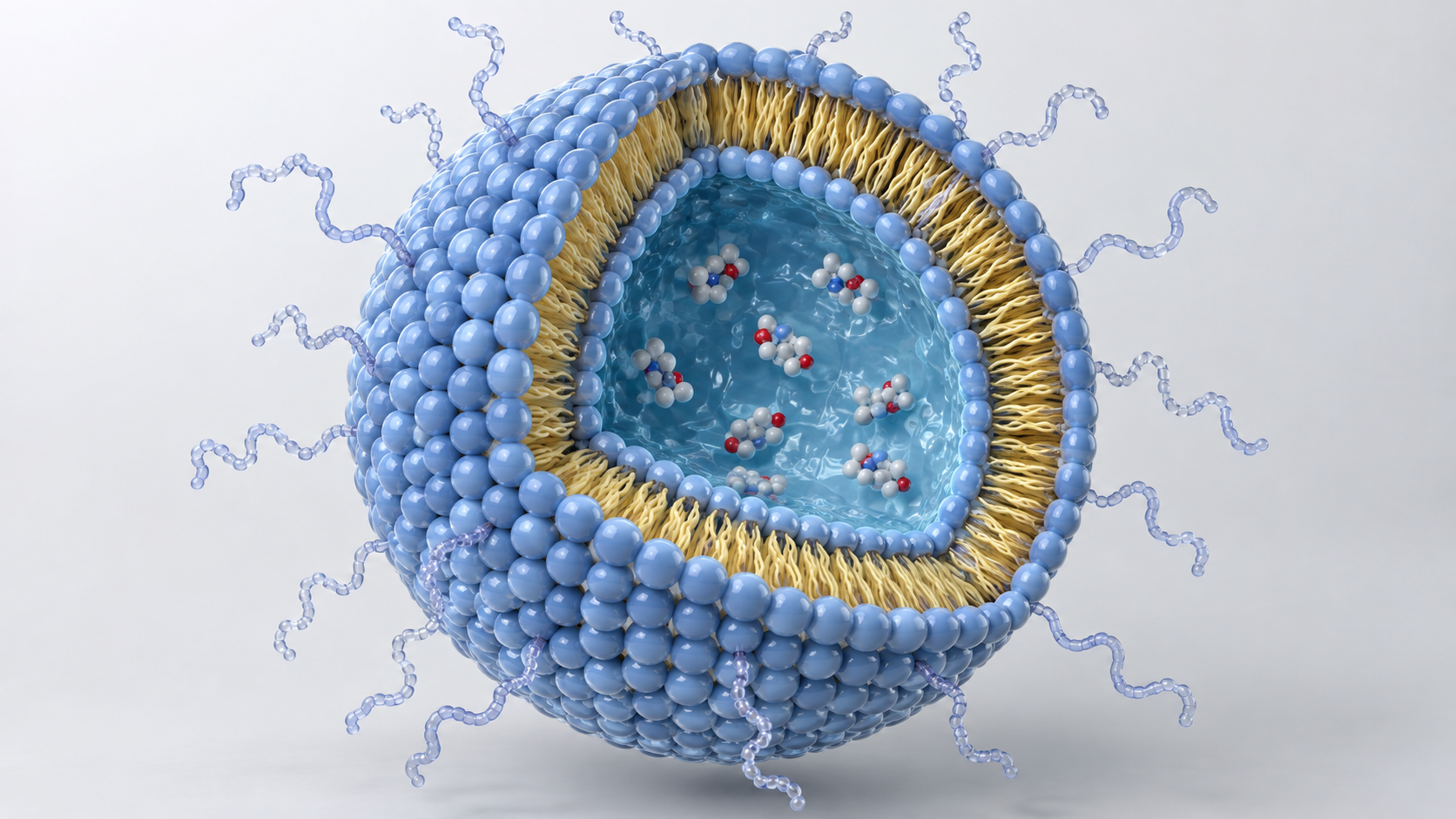
Shapes, colors and dimensions are illustrative. Consult the original schematic below for exact values and label correspondence.
View the original SVG schematic and exact annotations
Reading guide and original schematic labels: Structure of a PEGylated liposome (concept) / Inner water / Cross-section (a spherical bilayer bag) / Close-up of the bilayer / Outside (blood side) / Inner water side / Hydrophobic tails (membrane core) / blue = head; grey = tail; orange = cholesterol; red = PEG
It helps to think of the design in four elements (this article's grouping).
- Membrane (lipid phase): in Doxil, Barenholz states, the bilayer is in a “liquid ordered” phase, made of a high-Tm (53 °C) phosphatidylcholine and cholesterol Sourced [Reference 2].
- Inner water phase: where the drug is dissolved in water and held. As shown below, the composition of the interior governs how easily the drug is loaded and retained.
- Surface (PEG chains): PEGylated nano-liposomes prolong the circulation time of the drug and avoid capture by the reticuloendothelial system (RES) [Reference 2].
- Size: particle size strongly affects pharmacokinetics, so controlling the size distribution is important in manufacturing [Reference 7].
3. Our calculation: estimating the contents of one particle from Doxil's formulation
Doxil's US label gives the composition per mL: doxorubicin hydrochloride 2 mg/mL; carrier components cholesterol 3.19 mg/mL, fully hydrogenated soy phosphatidylcholine (HSPC) 9.58 mg/mL and MPEG-DSPE 3.19 mg/mL; and more than 90% of the drug encapsulated in the liposomes Sourced (FDA / DailyMed label) [Reference 9]. Adding assumptions such as particle size, we estimate the number of molecules per particle.
We assume the following Our calculation: outer diameter 100 nm, bilayer thickness 5 nm (inner diameter 90 nm), 0.5 nm² of membrane area per lipid molecule, and molecular weights of 790 for HSPC, 386.65 for cholesterol, 2,806 for MPEG-DSPE and 579.99 for doxorubicin hydrochloride (particle diameter, thickness, area and the HSPC and MPEG-DSPE molecular weights are our assumptions; the label gives no particle size).
- Molar composition: HSPC 12.1 µmol, cholesterol 8.25 µmol and MPEG-DSPE 1.14 µmol per mL, 21.5 µmol in total. The ratio is about 56 : 38 : 5 (mol%).
- Lipids per particle: membrane area = 4π(50² + 45²) = about 56,900 nm²; ÷ 0.5 nm² = about 1.1×10⁵ molecules.
- Number of liposomes: 21.5 µmol × 6.02×10²³ ÷ 1.14×10⁵ = about 1.1×10¹⁴ per mL.
- Doxorubicin per particle: 3.45 µmol/mL (2 mg/mL ÷ 579.99) divided by the particle number gives about 1.8×10⁴ molecules per particle (assuming all of it is inside; with “over 90%” it is about 1.6×10⁴).
- Inner water volume: (4/3)π × 45³ = about 3.8×10⁵ nm³ = 3.8×10⁻¹⁹ L. The inner water of all particles together is about 4.3% of the dispersion volume.
- Mean internal concentration: 1.8×10⁴ molecules ÷ (6.02×10²³ × 3.8×10−19 L) = about 0.08 mol/L (80 mM), about 23 times the 3.45 mM that would result if the drug were dissolved in the whole dispersion.
- Mass ratio of carrier to drug: (9.58 + 3.19 + 3.19) ÷ 2 = about 8.
Assumptions and limits: a different particle size changes the results greatly (the particle number varies roughly with the cube of the diameter). Real particles have a size distribution, and membrane area and thickness differ from lipid to lipid. Also, the encapsulated drug exists in an aggregated, gelled state, as Haran et al. state [Reference 3], so this does not mean it is “dissolved at 80 mM”. It is an estimate of scale only.
4. A materials engineer's view (1): Doxil rests on three independent principles
In a 2012 review, Barenholz states that Doxil rests on three unrelated principles Sourced [Reference 2].
- Surface: PEGylated nano-liposomes give a long circulation time and avoidance of the RES.
- Interior: high and stable “remote loading” of doxorubicin driven by a transmembrane ammonium sulfate gradient, which also, he writes, allows release of the drug at the tumour.
- Membrane: a “liquid ordered” bilayer made of a high-Tm (53 °C) phosphatidylcholine and cholesterol.
The original paper by Haran et al. reports that ammonium sulfate gradients load anthracyclines with an efficiency of over 90%, that doxorubicin accumulated to up to 100 times its concentration in the loading medium, and that most of the intraliposomal drug was in an aggregated state. The low permeability of the counter-ion, sulfate, is tied to the stability of the gradient, and the aggregation and gelation of the anthracycline sulfate salt kept the accumulation stable for more than 6 months of storage Sourced [Reference 3].
What this suggests is that “putting the drug in” and “keeping it in” are designed together in one structure (gradient + gelation + a low-permeability membrane) (Commentary). The MHLW guideline likewise asks that, when the drug loaded by the ammonium sulfate method is gelled, that state be evaluated because it matters for leakage [Reference 7].
5. How it is made: formation, sizing, loading, sterilization
The MHLW guideline names, as characteristic steps in making a liposomal product, formation, loading of the active ingredient, size adjustment, surface modification with PEG and similar, and sterilization, and gives the key control items for each Sourced [Reference 7]. It also says that liposomal products are easily affected by variation in manufacturing parameters, so the factors of variation must be well understood during development.
(1) Formation and sizing: extrusion and microfluidics
- Extrusion: in 1979 Olson et al. reported sequential extrusion of multilamellar vesicles through polycarbonate membranes. The method is easy and reproducible, produces no detectable degradation of the phospholipids, and can improve encapsulation efficiency; the mean diameter of extruded vesicles approaches the pore diameter of the membrane. Sequential extrusion through a 0.2 µm membrane gave a very homogeneous distribution with a mean diameter of 0.27 µm Sourced [Reference 4].
- Microfluidics: traditional preparation mixes bulk phases, creating inhomogeneous chemical and mechanical conditions during formation, so liposomes are often polydisperse in size and lamellarity, Jahn et al. say. In a continuous two-phase microfluidic network they controlled liposome size precisely between 100 and 300 nm by manipulating flow rates [Reference 5]. Carugo et al. name lipid formulation, lipid concentration, residual solvent, microchannel architecture and drug loading as key factors in microfluidic production, and propose channel layouts for mass production [Reference 6].
- Control items: for extrusion the guideline says lipid concentration, temperature, pressure, filter pore size, the number of passes and the combination and order of filters are important [Reference 7].
(2) Drug loading: passive loading and remote loading
When loading uses a pH gradient or differences in solubility, the guideline says the composition of the aqueous phases inside and outside the liposome, and the temperature and time, are key control items affecting loading efficiency [Reference 7]. Macromolecules such as proteins are encapsulated while the liposome forms, so the solvent type, ionic strength, mixing speed and temperature of the mixing step become important.
(3) Sterilization: heat cannot be used
Liposomes are unstable under the conditions of ordinary dry-heat or steam sterilization, and filter sterilization is widely used, the guideline says. For the filtration step, process capability is to be assessed by, for example, a bacterial challenge test, and the suitability of the filter shown Sourced [Reference 7].

6. Quality control: what is measured
The MHLW guideline names the following as quality attributes to be considered especially for liposomal products Sourced [Reference 7].
- Size distribution: give the mean or median together with the distribution as a figure and as a quantitative index such as the polydispersity index. Dynamic light scattering is mainly used, and it is important to state which distribution (number-based or volume-based) was used in the analysis.
- Zeta potential: because the surface charge cannot be measured directly (it is screened by the electric double layer), it is assessed as zeta potential. It varies with the solvent type, pH and conductivity, so the test conditions must be specified.
- Thermal behaviour of the membrane: even for liposomes that have no clear phase transition temperature because of cholesterol or a highly lipophilic drug, the exotherm/endotherm profile is useful as an index of membrane fluidity and uniformity.
- Aggregation: aggregates and precipitates may raise the frequency of infusion reactions, so they are assessed by, for example, a turbidity test.
- Encapsulation: encapsulated and free drug are separated by solid-phase extraction, size-exclusion chromatography, ultracentrifugation, gel filtration or dialysis and then assayed.
How equivalence of generics is judged: the FDA product-specific guidance
The FDA has issued a product-specific guidance (revised May 2022, draft) for generic doxorubicin hydrochloride liposome injection Sourced [Reference 8].
- The recommended studies are one in vivo human bioequivalence study and one in vitro liposome size-distribution study.
- Conditions for the generic: Q1/Q2 the same as the reference product (the same inactive ingredients, with concentrations within ±5%), manufacture by active loading with an ammonium sulfate gradient, and use of a batch made by the commercial-scale process.
- Characteristics to match: liposome composition, state of the encapsulated drug, internal environment, size distribution, number of lamellae, grafted PEG at the surface, surface potential or charge, and in vitro leakage rate.
- Size distribution: measure D10, D50 and D90, and judge D50 and SPAN [(D90 − D10)/D50] by the population bioequivalence (PBE) approach, using at least three lots.
In other words, the equivalence decision asks not only for the amount of drug but also for the width of the particle distribution (Commentary).
7. A materials engineer's view (2): lipids are functional components, not excipients
The MHLW guideline says the components of a liposome, especially those with a large influence on function, must be evaluated and controlled so that the intended properties are assured, unlike ordinary excipients Sourced [Reference 7]. It specifically says the following.
- Composition of semi-synthetic lipids: for natural mixtures and semi-synthetic lipids such as hydrogenated soy phosphatidylcholine, the lipid composition and fatty-acid composition (percentages) must be established, because variation in composition can change the properties of the product.
- PEG molecular-weight distribution: the molecular-weight distribution of PEG in a modified lipid is important because it may affect not only in vivo stability but also particle size and drug release.
- Chemical degradation: lipids with unsaturated acyl groups are prone to oxidative degradation, which can change properties such as the phase transition temperature; lipids with either saturated or unsaturated acyl groups are prone to hydrolysis, producing lysolipids and free fatty acids.
- Shelf life: because knowledge is limited, a shelf life longer than the period for which stability was confirmed in long-term storage studies cannot in principle be set.
From a materials viewpoint this is the same structure as quality issues in composites: polymer grade control, the particle-size distribution and surface treatment of fillers, and plasticizer migration (Commentary). The difference is that the setting is the human body, and a difference between raw-material lots can show up at once in several indicators: size, loading and leakage.
A single number such as “particle size” also has a trap: the value depends on the measurement method and the basis. That is why the guideline asks that the basis of the distribution (number or volume) be stated; values obtained by different methods cannot be compared side by side.
8. Examples of approved products, and where their value shows up
A list of approved nanocarrier products (Doxil, Onivyde, Vyxeos, Abraxane and others) and the compositions given in their labels is in the table of this series' explainer on DDS and targeting. Here we look at Doxil as it appears in Japanese public documents, and at where its value showed up.
| Item | What the documents state | Source |
|---|---|---|
| Position in the U.S. | Doxil's label gives Initial U.S. Approval as 1995. Composition: doxorubicin hydrochloride 2 mg/mL; carrier cholesterol 3.19 mg/mL, HSPC 9.58 mg/mL, MPEG-DSPE 3.19 mg/mL; also ammonium sulfate about 0.6 mg and sucrose 94 mg; pH 6.0–7.0; over 90% of the drug encapsulated | FDA / DailyMed label [9] |
| Japanese public documents | PMDA's drug information lists “Doxil Injection 20 mg” (ingredient: doxorubicin hydrochloride), with review reports dated 4 January 2007 and 22 April 2009 and re-examination reports (2016 and 2018). The marketing authorization holder is shown as Baxter Japan and the distributor as Fuji Pharma (as of the 2026 page) | PMDA [10] |
| Design intent (application summary) | An intravenous product with doxorubicin hydrochloride encapsulated in STEALTH liposomes. Compared with conventional formulations it was designed to change plasma kinetics and tissue distribution, raising retention time and concentration in tumour tissue to improve efficacy, and to lower the free doxorubicin concentration in plasma to reduce adverse reactions such as myelosuppression, alopecia and cardiotoxicity | PMDA application summary (November 2008 edition) [11] |
| Ovarian cancer comparison (as in the application summary) | In a phase III comparison with topotecan as second-line chemotherapy after platinum failure (study 30-49), long-term follow-up showed a significant extension of survival in the Doxil group (p=0.050); median overall survival was 62.7 weeks (Doxil) and 59.7 weeks (topotecan) | PMDA application summary [11] |
| Breast cancer comparison | In first-line treatment of metastatic breast cancer, 509 women were randomized; progression-free survival was 6.9 months for pegylated liposomal doxorubicin (PLD) and 7.8 months for doxorubicin (hazard ratio 1.00; 95% CI 0.82–1.22). The risk of cardiotoxicity was significantly higher with doxorubicin (hazard ratio 3.16). Alopecia, nausea, vomiting and neutropenia were more frequent with doxorubicin; palmar-plantar erythrodysesthesia, stomatitis and mucositis were more frequent with PLD | O'Brien et al. 2004, Annals of Oncology [12] |
All Sourced (summaries of public documents and peer-reviewed papers). Clinical results do not indicate effectiveness or treatment choice and are not individual medical advice.
The title of the breast-cancer trial is “reduced cardiotoxicity and comparable efficacy”, and its conclusion is that PLD gave efficacy comparable to doxorubicin with significantly reduced cardiotoxicity, myelosuppression, vomiting and alopecia Sourced [Reference 12]. On the other hand, palmar-plantar erythrodysesthesia and similar events were more frequent with PLD.
This can be read as the formulation structure changing the distribution and the time course of exposure to the drug, so that the kinds and proportions of adverse events were exchanged (Commentary; not a medical evaluation). From a materials viewpoint, the essence of liposome design is to make the same active ingredient behave differently through the design of the carrier. The flip side is that if the carrier's quality drifts, the behaviour drifts, which is why the controls of Section 6 are needed.
9. The EPR effect and the limits of efficacy
The debate over whether the EPR effect holds and where it stops, the design of the surface with PEG, and the experimental results on active targeting are covered in detail in this series' explainer on DDS and targeting. Here we check, from public documents and peer-reviewed papers, only the points that matter for liposomes.
- Statistics on how much arrives: Wilhelm et al. analysed the literature of the past 10 years (232 data sets) and report that a median of 0.7% of the injected nanoparticle dose reaches the tumour and that this value has not improved over the decade Sourced [Reference 13]. Trends noted include slightly higher values for particles under 100 nm (0.7% versus 0.6%) and for inorganic over organic materials (0.8% versus 0.6%). This is a pooled analysis of animal studies (mainly mice) and not a figure for liposomes alone.
- The debate on how particles enter: Sindhwani et al. report that the gaps between endothelial cells of tumour vessels (found to be up to 2,000 nm) are not responsible for transporting nanoparticles into tumours; instead up to 97% of nanoparticles enter tumours by an active process through endothelial cells [Reference 14]. The analysis used four mouse models, three types of human tumour and mathematical modelling.
- A note in the regulatory document: the MHLW guideline says that, because the EPR effect and active targeting change tissue and cell uptake compared with the active ingredient alone, tissue concentrations may differ even when blood concentrations are the same, so pharmacokinetic studies must be interpreted with care [Reference 7].
Converting 0.7% to “out of 1,000” gives 7 per 1,000 (the Wilhelm paper itself states the same conversion) Our calculation. The remaining 99.3% or so goes to places other than the tumour.
Assumptions and limits: this is a median of a pooled analysis of animal studies; the data vary widely, and it is not a human value. It is not a value for any individual clinically used product such as Doxil.
Barenholz writes that Doxil is “passively targeted” to tumours by the EPR effect, yet that the means by which the drug is released and becomes available to tumour cells is still unknown Sourced [Reference 2]. Being used as a product and having an explained mechanism for why and how much accumulates in the tumour are different things (Commentary).
10. Polymeric micelles and dendrimers
| Type | How the structure forms | Design and control keys (as stated in public documents and papers) |
|---|---|---|
| Liposome | A bag closed from a lipid bilayer. Water-soluble drugs go in the inner water, lipophilic drugs in the membrane | Size distribution, lamellarity, membrane phase, state of the loaded drug, leakage. Composition of the lipid raw materials and PEG distribution [7] |
| Block-copolymer micelle | Amphiphilic block copolymers associate spontaneously in water. The driving force is mainly hydrophobic interaction; electrostatic interaction, polymer-metal complexation and hydrogen bonding may be used too. The drug is taken into the inner core by chemical bonding or physical loading | Size, morphology, zeta potential, association number, critical association concentration (cac), drug loading, physical state of the drug, stability and release in plasma [15] |
| Dendrimer | A tree-like polymer with regularly repeated branching. Size, shape, branch length and density, and surface functionality can be highly designed. The drug is encapsulated inside or attached/adsorbed on the surface [16] | The many surface groups allow attachment of targeting groups or adjustment of toxicity [16] |
All Sourced (summaries of the MHLW/EMA joint reflection paper [15], the MHLW guideline [7] and the review by Svenson and Tomalia [16]).
(1) Polymeric micelles: designed to dissociate slowly
The joint reflection paper of the MHLW and the European Medicines Agency (published January 2014) stresses that block-copolymer micelle products are carefully designed so that the inner core acts as the container for the drug, surrounded by a hydrophilic outer shell. They are chemically designed, for example with a low critical association concentration (cac), so as to stay stable after dilution in the circulation; the dissociation of micelles so designed is kinetically slow, unlike conventional surfactant micelles Sourced [Reference 15]. The paper also warns that for some block copolymers the cac may be so low that it cannot be measured with current analytical technology.
From a materials viewpoint, this is about designing a polymer assembly to be closer to a “frozen, non-equilibrium structure” than an equilibrium one. That variation in the polymer's molecular-weight distribution or block ratio becomes variation in product performance is the same structure as for the lipids of Section 7 (Commentary).
(2) Dendrimers: precise, but their standing as medicines is a separate discussion
The starting point for dendrimers is the 1985 report by Tomalia et al. of a new class of polymers, the “starburst-dendritic macromolecules” Sourced [Reference 17]. Svenson and Tomalia write that the high degree of control over size, shape, branching length and density and surface functionality makes dendrimers unique and optimum carriers for drug delivery, gene transfection and imaging, and that modified dendrimers have been shown to act as nano-drugs against tumours, bacteria and viruses [Reference 16].
As one example of development, Starpharma describes working on dendrimers as drugs in their own right rather than carriers, and says it submitted an Investigational New Drug application to the US FDA in June 2003 for SPL7013 gel (VivaGel), the first such submission for a dendrimer-based drug Sourced [Reference 18] (a 2005 conference abstract). We could not confirm the current status of approved dendrimer products from the official documents we consulted, so it is not stated.
11. Strengths, weaknesses and open issues
(1) Strengths
- The same active ingredient can have its in-body kinetics and time course of exposure changed through the structure of the formulation (Doxil's design intent; PMDA application summary) Sourced [Reference 11].
- Membrane, interior and surface can be designed separately, and a method that makes loading and retention work together (remote loading) is established Sourced [References 2, 3].
- The approach to manufacturing and quality control is set out in public documents of Japan, the U.S. and Europe Sourced [References 7, 8, 15].
(2) Weaknesses and constraints
- The product is easily affected by variation in manufacturing parameters, so size distribution, loading and leakage must be controlled together Sourced [Reference 7].
- Heat sterilization cannot be used, so filtration is relied on Sourced [Reference 7].
- Lipids are prone to oxidation and hydrolysis, and the shelf life is hard to set beyond the period confirmed in long-term studies Sourced [Reference 7].
- The amount reaching tumours is small (median 0.7%, animal studies), and the mechanism of entry is debated Sourced [References 13, 14].
- Generics must match not only composition but also particle characteristics, down to the width of the size distribution Sourced [Reference 8].
(3) What we could not confirm
- Doxil's particle size: the label does not state it, so our calculation rests on assumptions.
- A full list of products approved in Japan: we confirmed only “Doxil Injection 20 mg” in official documents and did not survey other liposomal, micellar or dendrimer products approved in Japan.
- Approved polymeric-micelle products and results of clinical comparisons: within what we checked, we found no phase III results confirmed as peer-reviewed papers, so none are stated.
- The current status of approved dendrimer products: could not be confirmed.
- Commercial adoption of microfluidic manufacturing: we confirmed the principle and challenges in peer-reviewed papers, but did not check whether approved products use it.
- A liposome is a bag closed from a lipid bilayer, with the drug loaded in the membrane or the inner water Sourced
- From Doxil's formulation, one particle holds about 10⁵ lipid and 10⁴ drug molecules (with assumptions); the lipid mass is about 8 times the drug Our calculation
- Doxil rests on three designs: a PEG surface, an interior driven by an ammonium sulfate gradient, and a high-Tm membrane, a review states Sourced
- Manufacturing has control items for sizing, loading and sterilization, and a size distribution must state its measurement method and basis Sourced
- Generic equivalence extends to the width of the size distribution (SPAN) (FDA draft) Sourced
- The amount reaching tumours is a median of 0.7% (animal studies). Value can show up as “swapping side effects” Sourced
12. Glossary
- Liposome
- A microvesicle made of a bilayer of amphiphilic lipids, with an aqueous fraction inside.
- Bilayer
- A two-layer lipid membrane with hydrophilic heads outward and hydrophobic tails inward.
- PEGylation
- Attaching polyethylene glycol chains to the surface. It prolongs circulation time.
- HSPC
- Hydrogenated soy phosphatidylcholine, a semi-synthetic lipid with a high phase transition temperature.
- Phase transition temperature (Tm)
- The temperature at which a membrane changes from gel-like to liquid-crystalline. It bears on liposome stability and leakage.
- Remote loading
- Loading a drug into pre-formed liposomes using a gradient (pH or salt) across the membrane.
- Dynamic light scattering (DLS)
- A method that finds particle size from Brownian motion. The basis of the distribution must be stated.
- Polydispersity index
- An index of the width of the size distribution.
- Zeta potential
- An index of surface charge; it varies with solvent, pH and conductivity.
- D10 / D50 / D90
- Particle sizes at the 10%, 50% and 90% points of the cumulative distribution. SPAN = (D90 − D10)/D50.
- Q1 / Q2
- The same inactive ingredients (Q1) in the same concentration range (Q2, ±5%).
- Critical association concentration (cac)
- The concentration at which block copolymers begin to form assemblies. A lower value means they resist breaking after dilution.
- EPR effect
- The phenomenon in which polymers and particles are thought to be retained in tumours because vessels are leaky and drainage is poor.
- Dendrimer
- A tree-like polymer with regularly repeated branching.
13. References
- Allen, Cullis"Liposomal drug delivery systems: From concept to clinical applications," Advanced Drug Delivery Reviews 65, 36–48 (2013) — doi.org/10.1016/j.addr.2012.09.037
- Barenholz"Doxil® — The first FDA-approved nano-drug: Lessons learned," Journal of Controlled Release 160, 117–134 (2012) — doi.org/10.1016/j.jconrel.2012.03.020
- Haran, Cohen, Bar, Barenholz"Transmembrane ammonium sulfate gradients in liposomes produce efficient and stable entrapment of amphipathic weak bases," Biochimica et Biophysica Acta 1151, 201–215 (1993) — doi.org/10.1016/0005-2736(93)90105-9
- Olson, Hunt, Szoka, Vail, Papahadjopoulos"Preparation of liposomes of defined size distribution by extrusion through polycarbonate membranes," Biochimica et Biophysica Acta 557, 9–23 (1979) — doi.org/10.1016/0005-2736(79)90085-3
- Jahn, Vreeland, Gaitan, Locascio"Controlled Vesicle Self-Assembly in Microfluidic Channels with Hydrodynamic Focusing," Journal of the American Chemical Society 126, 2674–2675 (2004) — doi.org/10.1021/ja0318030
- Carugo, Bottaro, Owen, Stride"Liposome production by microfluidics: potential and limiting factors," Scientific Reports 6, 25876 (2016) — doi.org/10.1038/srep25876
- Ministry of Health, Labour and Welfare (Japan)"Guideline for the Development of Liposome Products" (notification PSEHB/PED 0328 No. 19, 28 March 2016; PDF, in Japanese; title translated here) — nihs.go.jp
- U.S. Food and Drug Administration (FDA)"Draft Guidance on Doxorubicin Hydrochloride (Injectable, liposomal)," product-specific guidance, revised May 2022 (draft; PDF) — accessdata.fda.gov
- FDA / NLM DailyMed"DOXIL (doxorubicin hydrochloride liposome injection)" prescribing information — dailymed.nlm.nih.gov
- PMDAPrescription drug information, “Doxil Injection 20 mg” (package insert, review reports and related documents; page in Japanese) — pmda.go.jp
- PMDADoxil Injection 20 mg, application summary, “2.2 Introduction” (November 2008 edition; PDF in Japanese; title translated here) — pmda.go.jp
- O'Brien et al."Reduced cardiotoxicity and comparable efficacy in a phase III trial of pegylated liposomal doxorubicin HCl (CAELYX/Doxil) versus conventional doxorubicin for first-line treatment of metastatic breast cancer," Annals of Oncology 15, 440–449 (2004) — doi.org/10.1093/annonc/mdh097
- Wilhelm et al."Analysis of nanoparticle delivery to tumours," Nature Reviews Materials 1, 16014 (2016) — doi.org/10.1038/natrevmats.2016.14
- Sindhwani et al."The entry of nanoparticles into solid tumours," Nature Materials 19, 566–575 (2020) — doi.org/10.1038/s41563-019-0566-2
- Ministry of Health, Labour and Welfare (Japan) / European Medicines AgencyJoint reflection paper on the development of block copolymer micelle medicinal products (notification PFSB/ELD 0110 No. 1, 10 January 2014; PDF with Japanese and English text; title translated here) — pmda.go.jp
- Svenson, Tomalia"Dendrimers in biomedical applications—reflections on the field," Advanced Drug Delivery Reviews 57, 2106–2129 (2005) — doi.org/10.1016/j.addr.2005.09.018
- Tomalia et al."A New Class of Polymers: Starburst-Dendritic Macromolecules," Polymer Journal 17, 117–132 (1985) — doi.org/10.1295/polymj.17.117
- McCarthy et al. (Starpharma)"Dendrimers As Drugs: Discovery, Preclinical and Clinical Development of SPL7013 Gel (VivaGel™), a Dendrimer Based Microbicide for HIV and STI Prevention," Retrovirology 2 (Suppl 1), S88 (2005) — doi.org/10.1186/1742-4690-2-s1-s88
14. Claim-to-source audit
| Claim in the text | Basis | Label |
|---|---|---|
| Liposomes were first described in 1965; advances include remote loading, extrusion and PEGylation, leading to clinical use | Reference 1 (abstract of Allen and Cullis 2013) https://doi.org/10.1016/j.addr.2012.09.037 | Sourced |
| Doxil rests on three independent principles (PEGylated nano-liposomes; remote loading by an ammonium sulfate gradient; a liquid-ordered membrane of high-Tm (53 °C) phosphatidylcholine and cholesterol); it is passively targeted by the EPR effect, but the means of release at the tumour is not fully known | Reference 2 (abstract of Barenholz 2012) https://doi.org/10.1016/j.jconrel.2012.03.020 | Sourced |
| Ammonium sulfate gradients load with over 90% efficiency; doxorubicin accumulates up to 100 times the loading-medium concentration, mostly aggregated; low sulfate permeability and gelation of the anthracycline sulfate keep it stable for more than 6 months | Reference 3 (abstract of Haran et al. 1993, PubMed) https://doi.org/10.1016/0005-2736(93)90105-9 | Sourced |
| Sequential extrusion of multilamellar vesicles through polycarbonate membranes brings the mean diameter close to the pore size without degradation and can improve encapsulation; sequential extrusion through 0.2 µm gives a mean diameter of 0.27 µm | Reference 4 (abstract of Olson et al. 1979, PubMed) https://doi.org/10.1016/0005-2736(79)90085-3 | Sourced |
| Bulk mixing gives polydisperse size and lamellarity; in microfluidic channels, flow rates controlled size between 100 and 300 nm | Reference 5 (abstract of Jahn et al. 2004) https://doi.org/10.1021/ja0318030 | Sourced |
| In microfluidic production, lipid formulation, lipid concentration, residual solvent, channel architecture and drug loading determine liposome characteristics; channel layouts for mass production are proposed | Reference 6 (abstract of Carugo et al. 2016) https://doi.org/10.1038/srep25876 | Sourced |
| The definition of a liposome and where the drug is loaded; the manufacturing control items (hydration time, mixing speed and temperature; inner and outer water composition, temperature and time for loading; lipid concentration, temperature, pressure, pore size and number of passes for extrusion; control of modified lipids; filter sterilization with bacterial challenge); the quality attributes (size distribution and the basis to be stated, morphology and lamellarity, zeta potential and its conditions, thermal behaviour, osmolality of about 280 mOsm/kg, pH, aggregation and infusion reactions, encapsulation, impurities, state of loaded drug, in vitro release); the composition of semi-synthetic lipids and fatty acids, the PEG molecular-weight distribution, oxidation of unsaturated lipids, hydrolysis to lysolipids and free fatty acids, and the principle on shelf life; the caution on interpreting pharmacokinetics with the EPR effect and active targeting; the notification dated 28 March 2016 | Reference 7 (MHLW notification PSEHB/PED 0328 No. 19) https://www.nihs.go.jp/drug/section4/nanomedicine_j/20160328_liposome_0328-19.pdf | Sourced |
| The FDA draft product-specific guidance (revised May 2022): recommended studies (one human bioequivalence study and one in vitro size-distribution study), Q1/Q2 (±5%), active loading with an ammonium sulfate gradient, a commercial-scale batch, the list of characteristics to match, D10/D50/D90 and SPAN judged by PBE, at least three lots | Reference 8 (FDA product-specific guidance, draft) https://www.accessdata.fda.gov/drugsatfda_docs/psg/PSG_050718.pdf | Sourced |
| Doxil's composition (doxorubicin hydrochloride 2 mg/mL; cholesterol 3.19, HSPC 9.58, MPEG-DSPE 3.19 mg/mL; ammonium sulfate about 0.6 mg; sucrose 94 mg; pH 6.0–7.0; over 90% encapsulated) and Initial U.S. Approval 1995; that no particle size was found in the label | Reference 9 (FDA / DailyMed label) https://dailymed.nlm.nih.gov/dailymed/drugInfo.cfm?setid=1c153e9e-4cf2-4ac7-9cf9-16f9b48d7dce | Sourced |
| PMDA publishes Doxil Injection 20 mg's package insert, review reports dated 4 January 2007 and 22 April 2009, and re-examination reports (2016, 2018); the marketing authorization holder and distributor | Reference 10 (PMDA drug information) https://www.pmda.go.jp/PmdaSearch/rdDetail/iyaku/4235402A1025_3?user=1 | Sourced |
| Doxil's design intent (lower free doxorubicin in plasma to reduce myelosuppression, alopecia and cardiotoxicity); the phase III comparison with topotecan (p=0.050; median 62.7 and 59.7 weeks) | Reference 11 (PMDA application summary) https://www.pmda.go.jp/drugs/2009/P200900018/800155000_21900AMX00001000_D100_1.pdf | Sourced |
| The phase III trial in first-line metastatic breast cancer: 509 women, progression-free survival 6.9 and 7.8 months (HR 1.00), cardiotoxicity HR 3.16, comparison of adverse events | Reference 12 (abstract of O'Brien et al. 2004) https://doi.org/10.1093/annonc/mdh097 | Sourced |
| A median of 0.7% of injected nanoparticles reaches the tumour (232 data sets), unchanged over 10 years; 7 per 1,000; under 100 nm 0.7% versus 0.6%; inorganic 0.8% versus organic 0.6% | Reference 13 (Wilhelm et al. 2016, author manuscript text) https://doi.org/10.1038/natrevmats.2016.14 | Sourced |
| Inter-endothelial gaps (up to 2,000 nm) are not responsible for transport; up to 97% of nanoparticles enter by an active process through endothelial cells; four mouse models, three human tumour types | Reference 14 (abstract of Sindhwani et al. 2020) https://doi.org/10.1038/s41563-019-0566-2 | Sourced |
| The driving forces of block-copolymer micelle association, the core/shell design, the low cac and kinetically slow dissociation, that cac may be unmeasurable, the list of key attributes; the notification dated 10 January 2014 | Reference 15 (MHLW/EMA joint reflection paper) https://www.pmda.go.jp/files/000221575.pdf | Sourced |
| Dendrimers allow control of size, shape, branching and surface functionality; the drug can be encapsulated or attached; dendrimers have acted as nano-drugs | Reference 16 (abstract of Svenson and Tomalia 2005) https://doi.org/10.1016/j.addr.2005.09.018 | Sourced |
| Starburst-dendritic macromolecules were reported as a new class of polymers in 1985 (title and bibliographic data) | Reference 17 (Tomalia et al. 1985) https://doi.org/10.1295/polymj.17.117 | Sourced |
| Starpharma develops dendrimers as drugs and submitted an IND for SPL7013 gel to the FDA in June 2003 | Reference 18 (McCarthy et al. 2005 conference abstract) https://doi.org/10.1186/1742-4690-2-s1-s88 | Sourced |
| About 1.1×10⁵ lipids per particle; about 1.1×10¹⁴ particles per mL; about 1.8×10⁴ doxorubicin molecules per particle; inner volume of about 3.8×10⁻¹⁹ L and about 4.3% of the dispersion; a mean internal concentration of about 80 mM (about 23 times); mol ratio 56 : 38 : 5; carrier-to-drug mass ratio of about 8; 0.7% = 7 per 1,000 | Our calculation. A 100 nm outer diameter, a 5 nm bilayer, 0.5 nm² per lipid, the molecular weights of HSPC (790) and MPEG-DSPE (2,806), and all drug being inside are assumptions made in this article. An estimate of scale, not measured values. | Our calculation |
| That Doxil's particle size, the other liposome, micelle and dendrimer products approved in Japan, phase III results for polymeric micelles, the current status of approved dendrimer products and the commercial adoption of microfluidic manufacturing could not be confirmed or were not investigated | Not stated in the documents we opened, or not investigated, so this article does not state them (commentary) | Commentary |
| The reading that the three principles design loading and retention together; the reading of “swapping side effects”; the view of lipid raw-material control as the same structure as polymer and filler quality issues; the reading of micelles as non-equilibrium structures; the grouping of strengths and weaknesses | This article's organization, commentary and inference based on published content; not views stated by the companies or institutions, and not a medical evaluation | Commentary |
| That Figs. 1, 2, 3 and 5 are drawings for explanation; that the hero image and Fig. 4 are AI-generated concepts | Note from this article | Commentary |
Last updated: 9 October 2026. Sources are limited to primary material (abstracts and bibliographic data of peer-reviewed papers, and public documents of MHLW, the FDA and PMDA). Because the article contains structural readings and materials-design interpretations, these are labelled “Commentary” and kept separate from sourced facts. Doxil's particle size, the other nanocarrier products approved in Japan, phase III results for polymeric micelles, the current status of approved dendrimer products and the commercial adoption of microfluidic manufacturing could not be confirmed from public primary sources, or were not investigated, and are therefore not stated. The calculations in Sections 3 and 9 are estimates of scale. Clinical results are summaries of public documents and papers; they are not evaluations of efficacy or safety and not advice on treatment choices. All figures are conceptual illustrations: Figs. 1, 2, 3 and 5 are vector drawings, and the hero image and Fig. 4 are AI-generated concepts. None is an actual cross-section photograph, micrograph or product image.