COMPANY PROFILE / NEXT-GEN ENERGY STORAGE
Eos Energy Enterprises
A U.S. company selling zinc-based (Znyth) batteries for 4 to 16+ hours of storage: revenue is rising fast, gross profit remains negative, and cash comes from loans, convertible notes and equity
Eos Energy Enterprises comes up in any discussion of next-generation storage because it makes the Eos Z3, a zinc-based battery module with an aqueous electrolyte, on automated lines at its own Pennsylvania plants, and sells it as grid-scale and industrial storage systems. Its annual report (Form 10-K) for the year ended 31 December 2025, filed on 26 February 2026, shows revenue of US$114.2 million (US$15.6 million a year earlier), a gross loss of US$143.8 million and a net loss of about US$969.6 million (the net loss includes many non-cash items). The quarterly report (Form 10-Q) and results release for the period to June 2026 put the company's backlog metric at US$807 million, and a third borrowing under its U.S. Department of Energy (DOE) loan guarantee was funded in September 2026. This profile follows the statutory filings as written, setting out what the company has put into next-generation storage, what is progressing, and what cannot be confirmed. It is not an assessment of the company's financial condition or technology.
- Eos Energy Enterprises in 30 seconds, and where it stands in next-generation storage
- The logo and how the name is written
- Where the company sits in the field
- Scale
- Resources committed to next-generation storage
- What it has done so far
- What comes next
- What the company is aiming for in next-generation storage
- Map of partnerships in next-generation storage
- Technologies, products and services
- The risks this company carries
- Glossary, references and claim-to-source audit
1. Eos Energy Enterprises in 30 seconds, and where it stands in next-generation storage
Pennsylvania, U.S.Address on the cover of the September 2026 Form 8-K; the 10-K for 2025 gave Edison, New Jersey
Storage systems & operators (secondary)Reported as a single segment
Eos Energy Enterprises is a company that is trying to mass-produce zinc-based batteries on automated lines in its own plants Sourced. According to the 10-K, revenue for 2025 rose to about 7.3 times the prior year (US$114.2 million, up 632%), and first-half 2026 revenue was US$125.7 million (US$25.7 million a year earlier). On the other hand, cost of goods sold continues to exceed revenue (a gross loss): in April-June 2026 revenue of US$68.8 million came with a gross loss of US$48.8 million. The company cites low utilization while new production lines ramp up, and higher warranty accruals, among other reasons. On funding, the 10-K says the company raised about US$1.5 billion in 2025 through convertible notes, equity and DOE loan funding, and management concluded that "there is no longer substantial doubt" about the company's ability to continue as a going concern for one year Sourced. This profile keeps the rapid revenue growth, the gross loss, the make-up of the capital raised and the related-party dealings separate, as the filings disclose them.
2. The logo and how the name is written

A note on names: the legal entity is Eos Energy Enterprises, Inc., usually shortened to "Eos"; the logo is a green profile figure beside the lower-case word "eos". The storage technology brand is Znyth, the current battery module is the Eos Z3, the previous generation was the Gen 2.3, the container-format system is the Eos Cube, the dense layout is Eos Indensity, and the control software is DawnOS (all company names). The logo image was taken from the one served by the company's official website (eose.com).
Official site: https://www.eose.com/3. Where the company sits in the field
Eos falls mainly under "long-duration & new chemistries", with "storage systems & operators" as a secondary type. The 10-K describes the company as one that designs, manufactures and sells zinc-based battery energy storage systems, and the 10-Q for June 2026 states a strategy "to evolve beyond a traditional battery OEM into a systems-integrated energy company" Sourced. In practice, it bundles the battery module (Z3) into containers (Eos Cube) and a dense layout (Eos Indensity) with control software (DawnOS), and in 2026 it also set up a joint venture (Frontier Power USA) that develops and owns projects. The strengths one would expect in this type are the company's "no thermal runaway mechanism with an aqueous electrolyte" and "widely available materials", and the weakness one would expect is "limited scale and track record" Our calculation (the categories and axes of assessment are our own framing, not the company's self-assessment). Others in the long-duration type include Form Energy (iron-air), ESS Tech (iron flow) and Invinity Energy Systems (vanadium redox flow). The 10-K names ESS Inc., Enervenue, Ambri and Form Energy as longer-duration competitors.
4. Scale
The fiscal year runs January to December. The figures below are from the annual report (10-K) for 2025 and the quarterly report (10-Q) for the first half of 2026 Sourced.
| Indicator (US$ million) | Year to Dec 2024 | Year to Dec 2025 | First half 2026 [prior-year half] |
|---|---|---|---|
| Revenue | 15.6 | 114.2 | 125.7 [25.7] |
| Cost of goods sold | 98.9 | 258.0 | 219.0 [81.2] |
| Gross profit / (loss) | (83.3) | (143.8) | (93.2) [(55.5)] |
| R&D expenses | 22.8 | 28.5 | 21.2 [14.0] |
| Selling, general and administrative | 60.0 | 85.1 | 48.6 [46.5] |
| Net income / (loss) | (685.9) | (969.6) | +233.2 [-] |
| Cash flow from operating activities | (153.9) | (211.2) | (191.8) [(95.0)] |
| Capital expenditure | 33.2 | 54.7 | 70.6 [12.0] |
| Other indicators | Value | As of |
|---|---|---|
| Revenue breakdown (April-June 2026) | Of US$68.8 million, US$55.0 million (about 80%) was from a related party, under a revenue contract signed with a related party in June 2026. The counterparty is not named in the note | 30 June 2026 |
| Backlog (company metric) | US$807 million (3.4 GWh). By the company's account, one existing project plus Frontier Power USA projects were 49% of backlog volume | 30 June 2026 |
| Remaining performance obligations (accounting) | About US$45.8 million (about 83% expected to be recognized within 12 months) | 31 December 2025 |
| Cash | Unrestricted US$568.0 million plus restricted US$56.6 million / unrestricted US$305.5 million plus restricted US$58.6 million | 31 December 2025 / 30 June 2026 |
| Accumulated deficit | US$2,535.8 million / US$2,302.6 million | 31 December 2025 / 30 June 2026 |
| Borrowings (principal) | US$948.3 million, made up of: a related-party delayed draw term loan (DDTL) of US$201.4 million; convertible notes issued May 2025 of US$50.0 million (due 2030); convertible notes issued November 2025 of US$600.0 million (due 2031); and DOE loan guarantee borrowings of US$96.9 million | 30 June 2026 |
| Largest customers | In 2025, two customers accounted for 51.5% and 18.8% of revenue (not named in the 10-K) | Year to Dec 2025 |
| Shares outstanding and potential shares | 339.4 million shares outstanding, plus a further 218.5 million shares issuable on conversion or exercise | 24 February 2026 |
| 2026 revenue outlook | US$300-350 million (company outlook; previously US$300-400 million) | 5 August 2026 (Not yet confirmed) |
The gross loss figures are taken as stated in the filings. The gross margin of about -71% for April-June 2026 that we derive from the 10-Q figures matches the company's announcement Our calculation (-48.8 divided by 68.8).
The figures above are statutory figures set side by side, not an assessment of financial condition. Net income or loss includes large non-cash items, such as gains and losses on liabilities, warrants and convertible securities that move with the share price (non-cash items were US$746.4 million in 2025, and the company says the April-June 2026 net loss was mainly this mark-to-market effect). The first-half 2026 net income (US$233.2 million) combines an operating loss of US$163.1 million with gains of about US$458.3 million from changes in the fair value of warrants and derivatives, among other items; it does not reflect an operating profit. Cash flow from operating activities was -US$191.8 million (income statement from the 5 August 2026 results release) Our calculation. The 10-K says that management concluded "there is no longer substantial doubt" about the company's ability to continue as a going concern within one year of issuing the financial statements, based on the capital raised in 2025 and its expectation of meeting its financial covenants (minimum liquidity). The minimum consolidated revenue and minimum consolidated EBITDA covenants apply from the quarter ending 31 March 2027. The company itself lists its history of losses and the possible need for more capital among its risks.
5. Resources committed to next-generation storage
Eos is wholly a zinc-based storage business, so company-wide figures are almost entirely figures for next-generation storage. However, headcount and R&D spending by product or function are not broken out.
| Type of resource | What primary sources confirm | Status |
|---|---|---|
| People | 787 employees (31 December 2025, all full-time). About 420 production and maintenance employees at Turtle Creek, Pennsylvania and East Pittsburgh are represented by a union (USW). 31 patent families and 202 patents pending, issued or published across 30 countries. In 2026 the Chief Financial Officer changed (Alessandro Lagi, effective 8 June 2026) and on 24 August the Chief Commercial Officer changed | Sourced |
| Money (R&D and capital expenditure) | R&D expense was US$28.5 million in 2025 (US$22.8 million in 2024) and US$21.2 million in the first half of 2026. Capital expenditure was US$54.7 million in 2025 and US$70.6 million in the first half of 2026. The first DOE loan tranche (US$90.9 million) was used for eligible costs of Line 1 (about 1.25 GWh a year) | Sourced |
| Acquisitions, investments, joint ventures and divestments | (1) Frontier Power USA (FPUSA): a joint venture of Eos, an affiliate of Cerberus Capital Management (CCM Frontier) and an affiliate of Hudson Bay Capital Management (HBC). Funding closed on 4 August 2026, with Eos contributing about US$112.6 million in cash plus warrants. The 10-Q says FPUSA will be controlled and managed by a related party. (2) June 2024: a credit and securities purchase transaction with Cerberus affiliates (a delayed draw term loan of up to US$210.5 million, preferred stock and warrants). (3) 2021: a convertible note from Spring Creek Capital, an indirect subsidiary of Koch Industries. (4) No divestment was found | Sourced |
| Universities, research institutes and public funding | DOE loan guarantee: up to US$303.5 million (US$277.5 million of principal plus US$26.0 million of capitalized interest), agreed on 26 November 2024. US$90.9 million had been borrowed by end-2025, and US$87.0 million (the third draw) was funded on 10 September 2026, bringing the cumulative draw to US$178.0 million. The company also issued warrants to the DOE. State grant: a US$8 million order from a naval base in San Diego funded by a California Energy Commission grant (March 2025). Defense: in July 2026 a contract related to "Golden Dome" with the Department of Defense (the company writes "Department of War"). Universities: the 10-K says the company intends to pursue federal funding with a consortium of community organizations, universities and supply-chain partners. Joint research with a specific university could not be confirmed | Sourced / partly not confirmed |
| Investments in start-ups | Investments other than FPUSA could not be confirmed | Not confirmed |
Next come the manufacturing facilities and main projects and orders. Stages are in the wording of the company's announcements, and plans and targets are Not yet confirmed.
| Manufacturing facility | Location | Size (company statements) | Stage | Date | Source |
|---|---|---|---|---|---|
| Line 1 (automated line) | Turtle Creek, Pennsylvania, U.S. | About 1.25 GWh a year (as defined in the DOE loan) | Operating (Z3 shipped since the third quarter of 2023) | 31 December 2025 | Reference 1 |
| Line 2 (Thorn Hill) | Marshall Township, Pennsylvania, U.S. | The company says it aims for 8 GWh a year in Allegheny County (the DOE loan assumes an expansion by 2027) | Commercial production started on 16 June 2026. Partial production now; full production expected in the fourth quarter | June-August 2026 | Reference 2, 3, 13 |
| Consolidation of manufacturing | Thorn Hill | The company says it is evaluating the timing of consolidating its production lines into one site | Plan (Not yet confirmed) | 5 August 2026 | Reference 3 |
| Warrendale | Pennsylvania, U.S. | About 432,000 square feet | The 10-K says "not currently operational; expected to become operational in 2026". The relationship to Thorn Hill could not be confirmed | 31 December 2025 | Reference 1 |
| Project or order | Location | Size | Stage (in the announcements' wording) | Date | Source |
|---|---|---|---|---|---|
| Frontier Power USA capacity reservation agreement | U.S. | 2 GWh | Signed with the formation of the joint venture. A US$100 million purchase order for Phase I of the Blanquilla project (after the second quarter), and transfer of the first order for the Redbird project (100 MW / 400 MWh) on 4 August | August 2026 | Reference 2, 3 |
| MN8 Energy | U.S. | Up to 750 MWh | Supply agreement (company statement) | October 2025 | Reference 1 |
| Frontier Power Ltd (U.K.) | United Kingdom | An order of 228 MWh; separately a memorandum for a 5 GWh framework | Order (October 2025); memorandum (April 2025). Intended for the U.K. long-duration storage cap-and-floor scheme run by Ofgem | April and October 2025 | Reference 1 |
| CAPAC Energy | Germany, Austria and Switzerland | Initial 750 MWh, up to 2 GWh through 2031 | Binding master supply agreement (an exclusive distribution partnership) | April-June 2026 | Reference 3 |
| Talen Energy | Pennsylvania, U.S. | Size not stated | Strategic collaboration announced (storage for AI infrastructure) | October 2025 | Reference 1 |
| Faraday Microgrids | California, U.S. | 3 MW / 15 MWh | Order (company statement) | May 2025 | Reference 1 |
| Dominion Energy, Darbytown | Virginia, U.S. | Size could not be confirmed | Proposed to the state commission in September 2023 (to be tested alongside Form Energy's iron-air batteries). Approval and current status could not be confirmed | 19 September 2023 | Reference 11 |
According to the company's technology page, the Eos Z3 battery module has three parts: an aqueous electrolyte (water, halides, additives and buffering agents), bipolar electrodes made of conductive plastic anodes and carbon-felt cathodes, and an injection-molded polymer casing Sourced. On charge, zinc is deposited (as in plating); on discharge it dissolves. The main raw materials are zinc bromide, titanium, graphite felt, plastic and water (company website). Where materials matter: (1) the electrolyte. One company patent (US 10,892,524 B2, granted 12 January 2021, from the Gen 2.3 generation) describes an aqueous electrolyte for zinc-bromine cells with about 30 to 40 wt% ZnBr2 (this is what the patent says, and not necessarily the Z3's actual composition). The company says its electrolyte blend "enhances zinc solubility and plating and eliminates dendrite and densification issues". (2) The electrodes: titanium, conductive plastic and carbon felt, which the company says degrade little. (3) The casing: a flame-retardant polymer that prevents external leaks. On the other hand, the 10-K lists "our cells and modules have less power density [than Li-ion] and may be considered inferior" as a risk. The "about 25-year life", "less than 4% degradation over 25 years" and "more than 97% of rated capacity retained" are manufacturer's stated values, and no test conditions (temperature, depth of discharge, charge/discharge rate) could be confirmed. See also our explainer on long-duration storage (iron-air and zinc-based).
6. What it has done so far
| When | What happened | Why it matters |
|---|---|---|
| 2020 | Listed through a business combination with B. Riley Principal Merger Corp. II (from the executive biography in the 10-K) | How it became public |
| July 2021 | Spring Creek Capital, an indirect subsidiary of Koch Industries, entered a convertible note investment agreement (a related party) | Related-party funding |
| Third quarter of 2023 | Began shipping Z3 battery modules | Start of shipments of the current generation (company statement) |
| June 2024 | Credit and securities purchase transaction with Cerberus affiliates (delayed draw term loan, preferred stock and warrants) | Large related-party funding |
| 26 November 2024 | Agreed the DOE loan guarantee. The 10-K calls it the first Title XVII battery loan closed. First borrowing of US$68.3 million on 19 December | Funding for expanding production lines |
| January 2025 | Achieved the milestones for the last US$40.5 million of the delayed draw term loan (US$210.5 million in total) | Conditional on manufacturing and raw-material cost targets |
| March-May 2025 | US$8 million naval-base order funded by a California Energy Commission grant (March). Memorandum with Frontier Power Ltd (U.K.) for a 5 GWh framework (April). Faraday Microgrids order for 3 MW / 15 MWh (May). On 28 May, deferred the minimum-revenue and minimum-EBITDA covenants of the DDTL and the DOE loan to 31 March 2027 | Adjusting projects and funding terms |
| May-July 2025 | Public equity offering (net US$81.1 million) and convertible notes (net US$240.0 million, due 2030). Second DOE borrowing of US$22.7 million on 1 July | Fundraising |
| August-October 2025 | Appointed a Chief Operating Officer (John Mahaz, August). Launched the DawnOS control software (September). MN8 Energy (up to 750 MWh), collaboration with Talen Energy, and a 228 MWh order from Frontier Power Ltd (October) | Operating team and orders expand |
| November 2025 | US$600 million of convertible notes (net US$580.5 million, due 2031) and a US$458.2 million registered direct sale of shares (US$12.78 each). Warrants issued to the DOE | About US$1.5 billion raised in 2025 in total |
| 26 February 2026 | Filed the 10-K for 2025. Management concluded that "there is no longer substantial doubt" about continuing as a going concern | As disclosed |
| 2026 | Introduced Eos Indensity, a high-density storage configuration. On 30 April announced a new CFO (Alessandro Lagi, effective 8 June) | Product and team |
| May-June 2026 | Announced the plan to form Frontier Power USA and a rights offering for shareholders and warrant holders (target about US$150 million at first; the company later put the amount raised at about US$37.7 million). Commercial production began on Line 2 at Thorn Hill on 16 June. On 30 June announced a registered direct offering to Hudson Bay Master Fund (about US$75 million) and an extension of Cerberus's lock-up to 21 December 2026. DOE's third limited consent (29 June) | Capacity expansion, and a framework that develops and finances customers' projects together |
| July 2026 | Announced a strategic partnership with the Department of Defense (the company writes "Department of War") and a "Golden Dome"-related contract (15 July). A prototype is to be installed at a critical facility | A defense application |
| August 2026 | 4 August: closed the funding of FPUSA (Eos contributed about US$112.6 million in cash plus warrants) and a third amendment to the DOE loan guarantee. 5 August: reported April-June 2026 results and narrowed the revenue outlook to US$300-350 million. 24 August: announced the change of Chief Commercial Officer (Michelle Buczkowski) | A joint venture launched and the team changed |
| September 2026 | Received the third DOE borrowing of US$87.0 million (10 September) | Loan drawdowns continue |
7. What comes next
These figures are company targets and outlooks, not results Not yet confirmed. The official materials also contain the following plans.
- Projects totaling more than 200 MWh of additional energy are expected to begin operating by the end of 2026 (company announcement)
- The timing of consolidating production lines into one Thorn Hill site is under evaluation, and the company cites it as a reason for narrowing its 2026 revenue outlook
- The DOE loan is for up to US$303.5 million, and further borrowings depend on meeting conditions. If the DOE chooses not to continue funding, the company says in the 10-K and 10-Q that it may need other sources of capital
- Financial covenants (minimum consolidated revenue and minimum consolidated EBITDA) apply from the quarter ending 31 March 2027
- DawnOS upgrades are being rolled out across customers' existing systems (10-Q)
Published energy-density (per kilogram or per litre) or round-trip-efficiency figures for the Z3 module; the test conditions behind the long-life claims (about 25 years, under 4% degradation); the names of the two largest customers (51.5% and 18.8% of revenue); the counterparty to the June 2026 related-party revenue contract; current output at Turtle Creek, Thorn Hill and Warrendale; the relationship between Warrendale and Thorn Hill; joint research with universities; the current status of Dominion Energy's Darbytown project. None of this appears in the 10-K, 10-Q, 8-Ks or website reviewed.
8. What the company is aiming for in next-generation storage
We separate what the company says directly from what we read into it. Inference marks an interpretation of ours drawn from primary information.
| What we read from it | Primary information behind it | Status |
|---|---|---|
| The aim is "to move from battery maker to systems-integrated energy company" | The strategy section of the 10-Q says the company will "evolve beyond a traditional battery OEM into a systems-integrated energy company". It offers battery modules, containers, control software, services and a joint venture (FPUSA) | Sourced (company statement) |
| It sees financing of customers' projects (project finance) as a barrier to orders | The 10-Q says FPUSA will "enhance the Company's ability to convert its existing commercial pipeline into booked orders" by providing an integrated financing solution. The 10-K's risk factors include customers' ability to secure project financing, and the CCO's role includes "bankability" | Sourced / Inference |
| The current focus is expanding production lines and improving unit cost | Line 2 start-up, the 8 GWh target, evaluating consolidation of lines, and the narrowing of the gross margin loss (from -216% to -74%, first half) | Sourced / Inference (priority) |
| Uses are widening into data centers, defense and industry | The 10-K says the company expects AI, high-performance computing and data centers to need 6-12 hour storage. Talen Energy (for AI), the Golden Dome-related contract, and MN8 Energy's large-load projects | Sourced / Inference (a trend) |
The reading that "the company sees financing of customers' projects as a barrier to orders" rests on how FPUSA, set up in 2026, is positioned. The 10-Q describes FPUSA as enhancing Eos's ability to turn its existing commercial pipeline into booked orders and then into systems operating in the field, and lists a combination of sponsor equity, debt targeting investment-grade characteristics, commercial-bank project loans, and performance insurance (a Technology Performance Insurance framework) Sourced. About 80% of April-June 2026 revenue (US$55.0 million) came from one pre-existing project, carried out with financing from a Cerberus affiliate before FPUSA was formed, and it was revenue from a related party Sourced. We therefore read this as the company starting to build its own arrangement to make up for customers' difficulty in raising finance Not yet confirmed. This is our interpretation, not a policy the company has stated. The 10-Q also states that, because FPUSA will be managed by a related party, situations may arise in which interests are not fully aligned with Eos's.
9. Map of partnerships in next-generation storage
What stands out in Eos's partnerships is that some of its providers of capital are also business counterparties (as joint-venture partners or related-party customers) Sourced. Cerberus affiliates provide the term loan, preferred stock and warrants, and in 2026 became co-investors in FPUSA. A Hudson Bay affiliate is both the counterparty to the registered direct offering and an investor in FPUSA. Dealings with these parties are disclosed as related-party transactions in the 10-Q. Also, the names of individual suppliers of the battery raw materials (zinc bromide, titanium, graphite felt and so on) do not appear in the materials reviewed, and we do not speculate on this.
10. Technologies, products and services
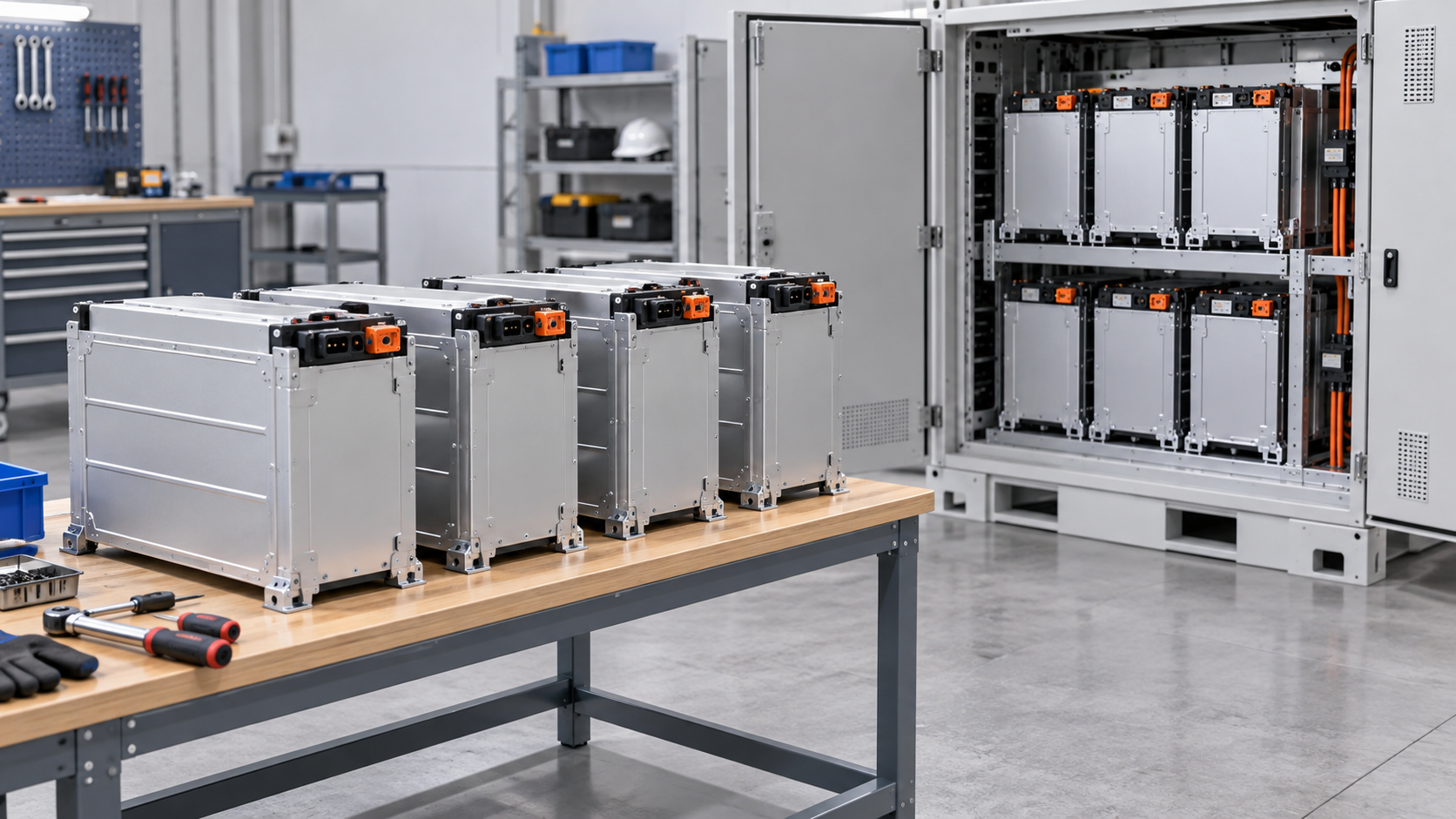
Products are described within the 10-K and the company's website. Performance values are the manufacturer's stated values; where no test conditions are given we say conditions are unknown, and we make no comparison with other companies.
| Area | What the 10-K and website say | Note |
|---|---|---|
| Eos Z3 (battery module) | Aqueous electrolyte, bipolar electrodes and a polymer casing. Compared with the Gen 2.3, a design with about 50% fewer cells and about 98% fewer welds per module. The company expects about twice the energy density per square foot. Twenty electrodes. Stated discharge duration of 4 to 16+ hours (website), and 3 to 12 hours in the 10-K's overview | Energy density (Wh/kg, Wh/L) and system round-trip efficiency figures could not be confirmed |
| Eos Cube | A ready-to-ship system in a standard 8 x 16 ft outdoor-rated shipping container holding 672 battery modules, electrical equipment and the battery management system | The company says it needs no AC system, flow pumps or external tanks |
| Eos Indensity | Built from stackable "Indensity Core" units combining Z3 modules and DawnOS. The company targets up to 1 GWh per acre and says it can be installed indoors | Introduced in 2026; a target, and results could not be confirmed |
| DawnOS, BMS and services | Software that manages large numbers of modules in real time and keeps operating when modules are imbalanced. Also remote monitoring, project management, commissioning and long-term maintenance plans | Announced in September 2025; being rolled out across existing customers' systems |
| Performance the company states (manufacturer's stated values) | Operating temperature range -20 °C to 50 °C (10-K, referring to the Znyth BESS). Modules are manufactured at zero voltage and zero state of charge and can be shipped without a hazmat classification (website). A life of about 25 years, less than 4% degradation over 25 years (more than 97% of rated capacity retained) and the chemistry's durability of more than 3 million cycles (10-K). Round-trip efficiency of up to 90% with the depth of discharge (DoD) reduced (website) | All are manufacturer's stated values; no test conditions (temperature, DoD, rate, cell or system) could be confirmed |
| Standards and certification | The website says the module is "certified to the UL 1973 standard" (batteries in stationary applications). Flammability: the company describes the system as non-flammable | The certificate and test report could not be confirmed. No UL 9540A result is stated |
| Cumulative operating record | Energy discharged by Eos technology to date is more than 6.5 GWh (end of June 2026; company announcement) | A measure of installed and operated volume, not proof of product performance |
The company cites as strengths that an aqueous electrolyte leaves no thermal runaway mechanism and that the operating temperature range is wide Sourced. On the other hand, the risk section of the 10-K says "compared to traditional Li-ion energy storage technologies, our cells and modules have less power density and may be considered inferior to competitors' products". Zinc-based batteries, which deposit zinc on the electrode during charge, are generally said to be prone to degradation from dendrites (needle-like deposits) and shape change Not yet confirmed (a general statement, not a description of Eos's design), and the company says its electrolyte blend addresses these problems. The specific additives and buffering agents could not be confirmed. Of the raw materials, titanium and graphite felt can be read as the parts that provide the electrodes' corrosion resistance and conductivity Inference, but the 10-K gives no detail on price or sourcing, and the company says only that "most materials are widely available". The company stresses that the bipolar structure means fewer parts and connections. See also our explainers on long-duration storage (iron-air and zinc-based) and on cell evaluation and degradation.
11. The risks this company carries
| Risk | Detail | Status |
|---|---|---|
| Gross loss and continuing losses | Gross loss was US$143.8 million in 2025 and US$93.2 million in the first half of 2026. The net loss was about US$969.6 million in 2025. The 10-K names its history of losses, the short time since commercialization and the costs of scaling manufacturing among its risks | Sourced |
| Debt, dilution and related parties | Borrowings (principal) were about US$948.3 million at the end of June 2026. Against 339 million shares outstanding there were 219 million potential shares (February 2026). There are many related-party dealings, including the term loan, preferred stock and warrants with Cerberus affiliates and the joint investment in FPUSA. The 10-Q says FPUSA will be managed by a related party and interests may not always be aligned | Sourced |
| Conditions of the DOE loan | Each borrowing requires meeting conditions, and if the DOE chooses not to continue funding, other capital may be needed. The loan has been the subject of several limited consents and amendments from 2025 to 2026 | Sourced |
| Financial covenants | Minimum liquidity is the covenant now in force. Minimum consolidated revenue and minimum consolidated EBITDA apply from the quarter ending 31 March 2027. For 2025, management judged that it expected to comply | Sourced / Not yet confirmed |
| Manufacturing ramp-up | The 10-K cites limited manufacturing experience and possible difficulties with commercial-scale production, quality and added sites. In April-June 2026 low utilization across two lines (two sites) also weighed on gross profit. Dependence on a single site (Turtle Creek); relations with the union | Sourced |
| Customer concentration and order conversion | In 2025 two customers were 51.5% and 18.8% of revenue. In April-June 2026 about 80% of revenue came from one related-party project, and that project plus FPUSA were 49% of backlog volume. The 10-K says converting backlog and pipeline to revenue depends on customers securing project financing | Sourced |
| Dependence on policy | The 10-K says that tax credits under the IRA and OBBBA (Section 45X, and the investment tax credit for customers) and sourcing restrictions tied to prohibited foreign entities (PFE) affect the business; Section 45X reduced cost of goods sold by US$22.8 million in the first half of 2026. It also notes that changes in policy, or the DOE's December 2025 "must-run" emergency orders for coal plants, could affect demand for renewables-linked storage (we have not checked the current state of the law against the legal text) | Sourced / Not yet confirmed |
| Competing approaches | The 10-K names large lithium-ion suppliers (Fluence Energy, Panasonic, Samsung, LG, Tesla, BYD, Sungrow, CATL) and longer-duration competitors (ESS Inc., Enervenue, Ambri, Form Energy). This profile does not rank them | Sourced |
| Changes in management | In 2026 the CFO (announced April, effective June) and the CCO (August) changed. The COO joined in August 2025. At the time of the 10-K the CFO role was held on an interim basis | Sourced |
| Difficulty of outside verification | Performance values (life, efficiency, degradation) are the manufacturer's stated values, and neither test conditions nor third-party verification appear in the official materials | Not yet confirmed |
This profile summarizes a company and is not advice on the design, installation or safety of batteries or storage facilities. Installing and operating storage equipment is subject to national and local laws, standards and operators' safety rules.
12. Glossary
- Znyth
- Eos's technology brand for zinc-based storage. The current generation of battery module is the Eos Z3.
- Bipolar electrode
- An electrode whose one face acts as the positive and the other as the negative. It simplifies connections and lowers internal resistance.
- 10-K / 10-Q / 8-K
- The annual / quarterly / current reports that U.S. listed companies file with the SEC.
- DOE loan guarantee (Title XVII)
- A program under which the U.S. Department of Energy guarantees repayment of loans from the Federal Financing Bank. Eos agreed up to US$303.5 million.
- DDTL (delayed draw term loan)
- A term loan drawn in stages once conditions are met. At Eos the lender is an affiliate of Cerberus.
- Convertible note
- A bond that can be converted into shares under set conditions. Eos issued them in May and November 2025.
- Section 45X (Advanced Manufacturing Production Credit)
- A U.S. production tax credit for battery components made in the U.S.: 10% of the cost of electrode active materials, US$35 per kWh for cells and US$10 per kWh for modules (as described in the 10-K).
- ITC (investment tax credit)
- A tax credit for buyers of storage systems based on the amount invested, with add-ons such as for domestic content (as described in the 10-K).
- FEOC / PFE
- Foreign entity of concern / prohibited foreign entity. Concepts that restrict sourcing under U.S. tax credits.
- Backlog
- A company-defined metric: revenue expected from existing agreements. It is not an accounting measure. The pipeline includes non-binding quotes and is separate from orders.
- Remaining performance obligations (RPO)
- The revenue the company expects to recognize from contracts not yet fully performed, in accounting terms.
13. References
- Eos Energy Enterprises Form 10-K for the fiscal year ended 31 December 2025 (filed with the U.S. SEC on 26 February 2026). Business overview, revenue and profit, liquidity, DOE loan, employees, patents, customers, risk factors. https://www.sec.gov/Archives/edgar/data/1805077/000162828026011961/eose-20251231.htm
- Eos Energy Enterprises Form 10-Q for the quarterly period ended 30 June 2026 (5 August 2026). First-half results, borrowings, related-party transactions, FPUSA, Line 2 at Thorn Hill, subsequent events. https://www.sec.gov/Archives/edgar/data/1805077/000162828026052906/eose-20260630.htm
- Eos Energy Enterprises Form 8-K of 5 August 2026, Exhibit 99.1 (results for April-June 2026). Backlog, FPUSA, revenue outlook, income statement. https://www.sec.gov/Archives/edgar/data/1805077/000162828026052903/eoseq2fy26earningsreleas.htm
- Eos Energy Enterprises Form 8-K of 14 September 2026. Third borrowing under the DOE loan (FFB promissory note), funded on 10 September 2026 (US$87,018,601). https://www.sec.gov/Archives/edgar/data/1805077/000162828026061689/eose-20260910.htm
- Eos Energy Enterprises Form 8-K of 25 August 2026. Change of Chief Commercial Officer (appointment of Michelle Buczkowski; planned departure of Nathan Kroeker). https://www.sec.gov/Archives/edgar/data/1805077/000162828026058890/eose-20260824.htm
- Eos Energy Enterprises Form 8-K of 30 April 2026. Appointment of the CFO (Alessandro Lagi, effective 8 June 2026). https://www.sec.gov/Archives/edgar/data/1805077/000162828026028611/eose-20260429.htm
- Eos Energy Enterprises Company website, 'Technology'. Eos Z3 make-up, materials and stated performance. https://www.eose.com/technology/
- Eos Energy Enterprises Company website, 'Eos Cube'. The container-format system holding 672 modules. https://www.eose.com/solutions/eos-cube/
- Eos Energy Enterprises Company website, 'Manufacturing'. Five raw materials, production steps, the Turtle Creek site. https://www.eose.com/technology/manufacturing/
- Eos Energy Enterprises Company website home page (source of the logo image). https://www.eose.com/
- Form Energy / Dominion Energy Press release 'Dominion Energy explores pioneering battery storage technologies in Virginia' (19 September 2023; Dominion Energy's release as posted by Form Energy). Darbytown Storage Pilot Project. https://formenergy.com/dominion-energy-explores-pioneering-battery-storage-technologies-in-virginia/
- Eos Energy Enterprises Company website, 'Frontier Power USA'. FPUSA funding and the completed rights offering. https://www.eose.com/frontier-power-usa/
- Eos Energy Enterprises Press release 'Eos Energy Enterprises Selected to Deliver Mission-Ready Power for Golden Dome for America' (15 July 2026). Strategic partnership with the Department of Defense; 8 GWh a year at Thorn Hill. https://www.eose.com/eos-energy-enterprises-selected-to-deliver-mission-ready-power-for-golden-dome-for-america/
- Eos Energy Enterprises Company website, 'Patents'. The company's list of patents. https://www.eose.com/technology/patents/
- U.S. Patent and Trademark Office (via Google Patents) U.S. Patent US 10,892,524 B2, 'Electrolyte for rechargeable electrochemical cell' (filed 29 March 2017; granted 12 January 2021; assignee Eos Energy Storage LLC), as published on Google Patents. https://patents.google.com/patent/US10892524
14. Claim-to-source audit
| Claim in the text | Status | Source |
|---|---|---|
| Legal name, Delaware corporation, the 2020 business combination, headquarters (Edison / Pittsburgh), Nasdaq listing, December year-end, single segment | Sourced | Reference 1 https://www.sec.gov/Archives/edgar/data/1805077/000162828026011961/eose-20251231.htm Reference 4 https://www.sec.gov/Archives/edgar/data/1805077/000162828026061689/eose-20260910.htm |
| Revenue, cost of goods sold, gross loss, R&D, SG&A, net loss, operating cash flow, capital expenditure, cash and accumulated deficit for 2024 and 2025 | Sourced | Reference 1 https://www.sec.gov/Archives/edgar/data/1805077/000162828026011961/eose-20251231.htm |
| Revenue, cost of goods sold, gross loss, R&D, SG&A, net income, operating cash flow, capital expenditure, cash, borrowings and accumulated deficit for April-June and the first half of 2026 | Sourced | Reference 2 https://www.sec.gov/Archives/edgar/data/1805077/000162828026052906/eose-20260630.htm Reference 3 https://www.sec.gov/Archives/edgar/data/1805077/000162828026052903/eoseq2fy26earningsreleas.htm |
| About 80% of April-June 2026 revenue (US$55.0 million) from a related-party project; backlog of US$807 million (3.4 GWh), 49% of it one existing project and FPUSA | Sourced | Reference 2 https://www.sec.gov/Archives/edgar/data/1805077/000162828026052906/eose-20260630.htm Reference 3 https://www.sec.gov/Archives/edgar/data/1805077/000162828026052903/eoseq2fy26earningsreleas.htm |
| First-half 2026 operating loss of US$163.1 million, gains on the fair value of warrants and derivatives, net income of US$233.2 million | Sourced | Reference 3 https://www.sec.gov/Archives/edgar/data/1805077/000162828026052903/eoseq2fy26earningsreleas.htm |
| Reading the net income in light of the operating loss (not an operating profit); the sum of the gains of about US$458.3 million; the gross margin of -71% (-48.8 divided by 68.8) | Our calculation | Our calculation (sums and ratios of figures in the company's results release). |
| Management's conclusion that 'there is no longer substantial doubt'; about US$1.5 billion raised in 2025; financial covenants (minimum liquidity; minimum revenue and EBITDA from 31 March 2027) | Sourced | Reference 1 https://www.sec.gov/Archives/edgar/data/1805077/000162828026011961/eose-20251231.htm Reference 2 https://www.sec.gov/Archives/edgar/data/1805077/000162828026052906/eose-20260630.htm |
| 787 employees, about 420 union members, 31 patent families and 202 patents, the largest customers' share of revenue (51.5% and 18.8%), shares outstanding and potential shares (24 February 2026) | Sourced | Reference 1 https://www.sec.gov/Archives/edgar/data/1805077/000162828026011961/eose-20251231.htm |
| DOE loan guarantee (up to US$303.5 million, 26 November 2024; first and second borrowings; remaining availability). Third borrowing of US$87.0 million (10 September 2026) | Sourced | Reference 1 https://www.sec.gov/Archives/edgar/data/1805077/000162828026011961/eose-20251231.htm Reference 2 https://www.sec.gov/Archives/edgar/data/1805077/000162828026052906/eose-20260630.htm Reference 4 https://www.sec.gov/Archives/edgar/data/1805077/000162828026061689/eose-20260910.htm |
| Cumulative DOE borrowings of US$178.0 million (US$68.3 million + US$22.7 million + US$87.0 million) | Our calculation | Our calculation (simple sum of the three borrowings). |
| Credit and securities purchase transaction with Cerberus affiliates (June 2024), the DDTL, preferred stock, warrants, and the lock-up extended to 21 December 2026 | Sourced | Reference 1 https://www.sec.gov/Archives/edgar/data/1805077/000162828026011961/eose-20251231.htm Reference 2 https://www.sec.gov/Archives/edgar/data/1805077/000162828026052906/eose-20260630.htm |
| Formation of FPUSA (funding closed on 4 August 2026), Eos's contribution (about US$112.6 million in cash plus warrants), Cerberus and Hudson Bay investments, about US$263 million of gross proceeds, the 16 GWh pipeline, and the completed rights offering (about US$37.7 million) | Sourced | Reference 2 https://www.sec.gov/Archives/edgar/data/1805077/000162828026052906/eose-20260630.htm Reference 3 https://www.sec.gov/Archives/edgar/data/1805077/000162828026052903/eoseq2fy26earningsreleas.htm Reference 12 https://www.eose.com/frontier-power-usa/ |
| FPUSA to be managed by a related party and the possibility that interests are not aligned (10-Q risk statement) | Sourced | Reference 2 https://www.sec.gov/Archives/edgar/data/1805077/000162828026052906/eose-20260630.htm |
| Line 1 (about 1.25 GWh a year), Z3 shipments since Q3 2023, Line 2 (Thorn Hill, 16 June 2026, full production expected in Q4), the Warrendale statement, evaluating consolidation of lines | Sourced | Reference 1 https://www.sec.gov/Archives/edgar/data/1805077/000162828026011961/eose-20251231.htm Reference 2 https://www.sec.gov/Archives/edgar/data/1805077/000162828026052906/eose-20260630.htm Reference 3 https://www.sec.gov/Archives/edgar/data/1805077/000162828026052903/eoseq2fy26earningsreleas.htm |
| The 8 GWh a year target in Allegheny County, and the strategic partnership with the Department of Defense (15 July 2026) | Sourced | Reference 13 https://www.eose.com/eos-energy-enterprises-selected-to-deliver-mission-ready-power-for-golden-dome-for-america/ Reference 1 https://www.sec.gov/Archives/edgar/data/1805077/000162828026011961/eose-20251231.htm |
| 2026 revenue outlook (US$300-350 million), more than 200 MWh expected to start operating by end-2026, details of the FPUSA plan | Not yet confirmed | Reference 3 https://www.sec.gov/Archives/edgar/data/1805077/000162828026052903/eoseq2fy26earningsreleas.htm |
| MN8 Energy (up to 750 MWh), Talen Energy collaboration, Frontier Power Ltd's 228 MWh order and 5 GWh memorandum, Faraday Microgrids 3 MW / 15 MWh, the US$8 million San Diego naval-base order, and other orders | Sourced | Reference 1 https://www.sec.gov/Archives/edgar/data/1805077/000162828026011961/eose-20251231.htm |
| The CAPAC Energy master supply agreement (exclusive distribution; initial 750 MWh, up to 2 GWh), and the Blanquilla and Redbird orders and their transfer to FPUSA | Sourced | Reference 3 https://www.sec.gov/Archives/edgar/data/1805077/000162828026052903/eoseq2fy26earningsreleas.htm |
| Dominion Energy's 'Darbytown' proposal (September 2023, alongside Form Energy) | Sourced | Reference 11 https://formenergy.com/dominion-energy-explores-pioneering-battery-storage-technologies-in-virginia/ |
| Eos Z3 make-up (aqueous electrolyte, bipolar electrodes, polymer casing), five raw materials, 20 electrodes, stated performance (25 years, under 4% degradation, over 97%, maximum DoD 100%, round-trip efficiency up to 90%), UL 1973 | Sourced | Reference 7 https://www.eose.com/technology/ Reference 9 https://www.eose.com/technology/manufacturing/ |
| Eos Cube make-up (672 modules, 8 x 16 ft container) | Sourced | Reference 8 https://www.eose.com/solutions/eos-cube/ |
| About 50% fewer cells and 98% fewer welds than the Gen 2.3, Indensity (target of up to 1 GWh per acre), DawnOS, operating temperature range, over 3 million cycles, and the risk statement on lower power density | Sourced | Reference 1 https://www.sec.gov/Archives/edgar/data/1805077/000162828026011961/eose-20251231.htm |
| US 10,892,524 B2: aqueous electrolyte for zinc-bromine cells (about 30 to 40 wt% ZnBr2) | Sourced | Reference 15 https://patents.google.com/patent/US10892524 Reference 14 https://www.eose.com/technology/patents/ |
| More than 6.5 GWh of cumulative energy discharged (end of June 2026) | Sourced | Reference 3 https://www.sec.gov/Archives/edgar/data/1805077/000162828026052903/eoseq2fy26earningsreleas.htm |
| Section 45X (10% of electrode active material cost, US$35 per kWh for cells, US$10 per kWh for modules), US$22.8 million recognized in the first half of 2026, PFE restrictions, and the mention of the DOE emergency orders | Sourced | Reference 1 https://www.sec.gov/Archives/edgar/data/1805077/000162828026011961/eose-20251231.htm Reference 2 https://www.sec.gov/Archives/edgar/data/1805077/000162828026052906/eose-20260630.htm |
| Appointment of the CFO (Alessandro Lagi), the change of CCO, and the COO appointment (August 2025) | Sourced | Reference 6 https://www.sec.gov/Archives/edgar/data/1805077/000162828026028611/eose-20260429.htm Reference 5 https://www.sec.gov/Archives/edgar/data/1805077/000162828026058890/eose-20260824.htm Reference 1 https://www.sec.gov/Archives/edgar/data/1805077/000162828026011961/eose-20251231.htm |
| Events of 2026 (Indensity, the DOE's limited consent of June, the registered direct offering to Hudson Bay Master Fund) | Sourced | Reference 2 https://www.sec.gov/Archives/edgar/data/1805077/000162828026052906/eose-20260630.htm |
| The competitors the 10-K names (large lithium-ion suppliers and longer-duration competitors) | Sourced | Reference 1 https://www.sec.gov/Archives/edgar/data/1805077/000162828026011961/eose-20251231.htm |
| Z3 energy density and round-trip efficiency figures, the test conditions behind the long-life claims, the names of the largest customers, the counterparty to the related-party revenue, current output at each site, the Warrendale-Thorn Hill relationship, joint research with universities, and the current state of Darbytown | Not yet confirmed | Nothing in the materials reviewed. We make no estimate. Could not be confirmed, and we do not assert that none exists (our note). |
| The four-type classification (Cells & materials; Long-duration & new chemistries; Storage systems & operators; Recycling) and the example companies | Our calculation | Our own classification. Company names are examples from those covered in this series. |
| General statement that zinc-based batteries are prone to degradation from dendrites and shape change | Not yet confirmed | General commentary, not a description of Eos's design. |
| The reading that titanium and graphite felt provide the electrodes' corrosion resistance and conductivity | Inference | Our own reading (not an explanation given by the company). Reference 7 https://www.eose.com/technology/ Reference 9 https://www.eose.com/technology/manufacturing/ |
| Revenue of about 7.3 times the prior year (US$114.2 million / US$15.6 million) | Our calculation | Our calculation (consistent with the 632% increase stated in the 10-K). |
| The readings that the company is building arrangements to make up for customers' financing difficulty, that expanding production lines and unit cost are the current focus, and that uses are widening into data centers, defense and industry | Inference | Our own reading (not a policy stated by the company). Reference 2 https://www.sec.gov/Archives/edgar/data/1805077/000162828026052906/eose-20260630.htm Reference 1 https://www.sec.gov/Archives/edgar/data/1805077/000162828026011961/eose-20251231.htm Reference 3 https://www.sec.gov/Archives/edgar/data/1805077/000162828026052903/eoseq2fy26earningsreleas.htm Reference 13 https://www.eose.com/eos-energy-enterprises-selected-to-deliver-mission-ready-power-for-golden-dome-for-america/ |
Last updated: 10 October 2026 / Troy Technical
The figures in this article come from statutory filings (Forms 10-K, 10-Q and 8-K) that Eos Energy Enterprises, Inc. submitted to the U.S. Securities and Exchange Commission, and from the company's website. Market-research estimates and press-report figures are not used. This is not an assessment of the company's financial condition or technology. Passages marked "Inference" are our own reading of primary information and are not statements by the company.