COMPANY PROFILE / NEXT-GEN ENERGY STORAGE
Group14 Technologies
A privately held materials company that makes the silicon-carbon anode material SCC55 in the U.S. and South Korea; the questions are the ramp-up in Korea and when the Moses Lake plant and its own silane supply will be finished
Group14 Technologies is a materials company that makes anode material (a silicon-carbon composite) for lithium-ion batteries and sells it to battery makers. The product is SCC55. It is headquartered in Woodinville, Washington, and is privately held. Its sales, profit and headcount could not be confirmed from official materials. It says it has raised more than US$1 billion in equity in total.
It calls its plants "BAM" (Battery Active Materials) factories: BAM-1 (Woodinville, Washington; now R&D and a pilot line), BAM-2 (Moses Lake, Washington; full production described as 2027) and BAM-3 (Sangju, South Korea; announced in March 2026 as having begun EV-scale production). In August 2025 it bought the remaining 75% of its joint venture with SK Inc. in Korea, making it a wholly owned unit, and closed a US$463 million Series D at the same time. For the raw material silane, it is working toward its own supply, through the German plant acquired with Schmid Silicon in 2023 and a planned U.S. silane plant that the U.S. Department of Energy (DOE) selected for award negotiation of up to US$200 million.
Drawing on the company's website and press releases and on DOE public documents, this article sets out what could be confirmed and what could not. All performance figures are manufacturer's stated values.
- At a glance: Group14 Technologies and its place in next-generation energy storage
- Logo and naming
- Where the company sits in next-generation energy storage
- Company scale
- Resources committed to next-generation energy storage
- Track record
- Plans
- What the company is aiming for in next-generation energy storage
- Partnership map for next-generation energy storage
- Technologies, products and services
- Risks
- Glossary
- References
- Claim-to-source audit
1. At a glance: Group14 Technologies and its place in next-generation energy storage
Washington, U.S.8502 Maltby Rd., Woodinville, WA 98072 (as stated on the website). There is a Korean entity, Group14 Korea
SCC55A composite with silicon and void space built inside a porous carbon scaffold (company and DOE descriptions). The company says "55" is the number of the 55th formulation iteration
South Korea: SangjuBAM-3 in Korea is designed for 2,000 tonnes a year (about 10 GWh by the company's conversion). The company says BAM-2 in Moses Lake reaches full production in 2027
Group14's strength is that it is trying to build a system for shipping silicon anode material at EV scale from several sites: the U.S., South Korea and (for silane) Germany. Official materials confirm facts such as the 100% takeover of the Korean plant (August 2025), DOE's selections for funding (2022 and 2024), and the acquisition of Schmid Silicon (2023) Sourced.
However, actual shipments, sales and customer-by-customer adoption could not be confirmed. The company's timing for BAM-2 has moved: "2024" (2023), "the first 2,000 tonnes in the fourth quarter of 2024" (September 2024), and "full production in 2027" (2026). "More than 160 customers", "more than US$1 billion raised" and "1,500 to 3,000 cycles" are company statements whose test conditions and definitions are not published Not yet confirmed.
2. Logo and naming

The logo is the wordmark published in the footer of the company's official website (group14.technology): white "GROUP14", with the "14" knocked out of a white block. It is taken as it is and placed on a dark background because the lettering is white. It has not been recreated with generated images.
Naming: the company is Group14 Technologies (no space between "Group" and "14"). SCC55 (shown with a registered trademark mark) is the name of the anode material and is separate from the company name. "Scaffold Prime" is the name of the company's manufacturing method for SCC55.
Official site: https://group14.technology/3. Where the company sits in next-generation energy storage
Group14's primary type is cells & materials maker (anode material), with no secondary type. It does not make battery cells; it sells material to its customers' battery makers. Its business, as far as official materials confirm, is as follows.
| Business / use | Where it stands at Group14 | Primary sources confirmed | Status |
|---|---|---|---|
| SCC55 anode material (silicon-carbon) | The core product. Described as able to replace graphite or be blended with it, and to work in pouch, cylindrical and prismatic cells and with LFP, LMFP and high-nickel cathodes (manufacturer's stated value) | Company website; press releases (June 2025, March 2026) | Sourced (company description) |
| Consumer (smartphones and others) | Announced as used in the third-generation silicon battery of the HONOR Magic7 Pro (launched in China in October 2024). It says it is also used in ATL batteries | Press releases (November 2024, August 2025) | Sourced (company description) |
| EVs and electric mobility | Names Molicel, Sionic Energy, InoBat, V4Smart and ATL as partners in adoption programs (March 2026). The carmaker models using it could not be confirmed | Press release (March 2026) | Sourced / models not confirmed |
| Data centers, drones, aviation (eVTOL), defense | Listed as uses. In May 2026 it announced a collaboration with Forge Nano, a U.S. cell maker, for defense, aerospace and storage | Company website; press release (May 2026) | Sourced (company description) / results of the collaboration not confirmed |
| Making silane | In 2023 it acquired a silane plant in Germany (Spreetal). It plans a 7,200-tonne-a-year plant in Moses Lake, U.S. (DOE selected it for award negotiation of up to US$200 million) | Press releases (July and November 2023, September 2024) | Sourced / operation is Not yet confirmed |
| Making cells; storage systems | It does not do these (no such business is described in official materials) | - | Out of scope |
4. Company scale
Group14 is privately held and does not publish financial statements. The scale that official materials confirm is as follows Sourced.
| Item | What was confirmed |
|---|---|
| Sales, profit and debt | Not disclosed. None appears on the website, in press releases or in DOE documents. "More than US$1 billion of equity raised" and "more than 160 customers" are company statements |
| Employees | Not disclosed (company-wide). The draft DOE assessment (2024) assumes 254 full-time staff at Moses Lake and about 270 during construction. The company's 2023 announcement assumed more than 400 people for BAM-2 construction and 200 for operations. It planned to hire 65 in Germany (November 2023) |
| Headquarters and management | Woodinville, Washington. Co-founder and CEO: Rick Luebbe (co-founder of EnerG2, which BASF acquired in 2016). Co-founder and CTO: Rick Costantino (formerly VP of R&D at EnerG2). CFO: Mike Willis. CEO of Group14 Korea: Kiseon Park |
| Founding | The website timeline places the founding, Series A and Series B in a "2015 to 2019" block. A single founding year could not be confirmed |
| Funding | Series A: US$18 million (led by ATL). Series B: US$17 million (led by SK materials). Series C: US$614 million (2022; US$400 million led by Porsche AG plus a further US$214 million). Series D: US$463 million (August 2025, led by SK Inc.). More than US$1 billion in total |
| Sites | U.S.: Woodinville (BAM-1) and Moses Lake (BAM-2). South Korea: Sangju (BAM-3). Germany: Spreetal (silane plant) |
| Patents | "More than 200 issued patents" (the website's patent page). The March 2026 press release says "more than 170 issued patent matters". The reason for the two different wordings could not be confirmed |
| Customers | "Customers representing 95% of the world's rechargeable battery production" (BAM-3 page) and "more than 160 customers" (March 2026). The 2024 statement was "more than 100". What counts as a "customer" (volume, production versus trial) is not stated |
Phrases such as "the only company making silicon battery materials at true global scale" and "the #1 battery materials company" are the company's own description. This article makes no judgment on rankings or superiority against other companies. The March 2026 release says China produces "more than 90% of graphite-based anodes", but the figure is given alongside a reference to the U.S. Geological Survey and its basis was not checked, so this article does not use it.
5. Resources committed to next-generation energy storage
As a private company it discloses few amounts. The four points (people, money, outside deals, and universities or public funding) are set out below, with what could and could not be confirmed.
| Item | What was confirmed | Status |
|---|---|---|
| People (R&D sites and headcount) | R&D is centered on BAM-1 (Woodinville), which it describes as covering material synthesis, cell evaluation (coin to pouch cells) and pilot manufacturing. The number of R&D staff is not disclosed. Its executives include people from EnerG2 (acquired by BASF in 2016) | Sourced / headcount not confirmed |
| Money (R&D, capital expenditure, funding) | Actual R&D and capital spending are not disclosed. Funding: more than US$1 billion in total (Series D of US$463 million, August 2025). The assumed total cost of BAM-2 is US$590.7 million (US$100 million from DOE and US$490.7 million from Group14, per the draft environmental assessment of 2024). DOE's selection document (2022) gives a federal cost share of US$100 million and a recipient share of US$222.9 million | Sourced / actual spending not disclosed |
| Outside stakes, acquisitions, joint ventures, divestments | Acquisition: Schmid Silicon Technology Holding (a German silane maker, July 2023). Joint venture and takeover: it bought the remaining 75% of its joint venture with SK Inc. (SK Materials Group14, formed July 2021) and now owns all of it (August 2025). No divestments or stakes in other companies could be confirmed | Sourced |
| Universities, research institutes and public funding | Public funding: DOE battery materials processing funding (federal cost share US$100 million, selected October 2022; also described as a proposed action in the 2024 environmental assessment), and up to US$200 million for the silane plant (September 2024, selected for award negotiation). Joint research with universities or institutes could not be confirmed in official materials. Joint development with companies: BASF (binder) and Forge Nano (coating) | Sourced / university ties not confirmed / the US$200 million is Not yet confirmed |
Status of main products and facilities
The table covers what the company's and DOE's official materials confirm. Annual capacity is a design or stated figure; actual shipments and utilization are not published. The company announces capacity with the conversion "2,000 tonnes is about 10 GWh", but the basis for the conversion is not given (see the calculation in chapter 10).
| Facility | Location | Scale (stated or designed) | Stage | Date and source |
|---|---|---|---|---|
| BAM-1 | Woodinville, Washington | Stated nameplate of 120 tonnes a year (December 2022 statement). Now described as an R&D center and pilot line | Operating (started as a commercial plant in April 2021) | Press release (December 2022); website |
| BAM-2 | Moses Lake, Washington | 2,000 tonnes a year (about 10 GWh) per module; up to six modules (12,000 tonnes a year in the draft DOE assessment). The September 2024 statement said "initially 4,000 tonnes / 20 GWh" | Under construction (described as nearly complete). Full production is 2027 by the company's account. Not yet confirmed | Website; release of March 2026; DOE documents |
| BAM-3 (SK Materials Group14) | Sangju, South Korea | Designed for 2,000 tonnes a year (about 10 GWh) | Operating, ramping. It said shipments began in September 2024, and in March 2026 announced "EV-scale production has begun" | Releases of August 2025 and March 2026; website |
| Silane plant (Germany) | Spreetal (Schwarze Pumpe) | Scale could not be confirmed | A plant idle since 2016 was acquired in 2023 and preparations to restart began. Completion of the restart could not be confirmed | Press releases (July and November 2023); website |
| Silane plant (U.S.) | Moses Lake, Washington | 7,200 tonnes a year (planned). More than 300 construction jobs and 150 operating jobs assumed | Planned. DOE selected it for award negotiation of up to US$200 million (September 2024). Final award and construction start could not be confirmed | Press release (September 2024) |
6. Track record
| When | What happened | What it means |
|---|---|---|
| 2015 to 2019 | Founding. Series A (US$18 million, led by ATL, with BASF Venture Capital, Cabot, Showa Denko [now Resonac] and others) and Series B (US$17 million, led by SK materials). A pilot plant was started (the company's timeline) | Ties with major battery-materials players from the start |
| 2021 | BAM-1 launched as a commercial plant in April (120 tonnes a year). In July a joint venture with SK Inc. in Korea was formed (SK Materials Group14) | Start of commercial production and an Asian base |
| 2022 | May: Series C of US$400 million (led by Porsche AG). October: DOE selection with a federal cost share of US$100 million. December: a further US$214 million, bringing the total to US$614 million (including Microsoft Climate Innovation Fund) | Funding for a second U.S. plant |
| 2023 | April: construction of BAM-2 began (production planned for 2024). July: acquired Schmid Silicon. November: preparations to restart the German silane plant | Securing raw material, and a European base |
| 2024 | September: shipments from BAM-3 in Korea. 20 September: DOE selected the silane plant for award negotiation of up to US$200 million. November: adoption in the HONOR Magic7 Pro announced. December: Sionic Energy's all-silicon battery | Wider adoption, and U.S. silane production |
| 2025 | May: a combination with BASF's binder announced. June: "more than 1,500 cycles" announced. 20 August: a US$463 million Series D, and the Korean plant became a wholly owned unit | Funding, and full control of the Asian base |
| March to May 2026 | 12 March: announced the start of EV-scale production at the Korean plant. 26 March: more than 170 patents. 28 May: collaboration with Forge Nano | Production ramp, and stronger IP and U.S. supply chain |
| 16 July 2026 | The company's blog says it filed a public interest statement with the ITC ("Investigation No. 3916"; the argument is that protecting U.S. silicon-carbon innovation serves the public interest) | Involvement in a U.S. IP proceeding |
7. Plans
(company statement)Construction is described as nearly complete and commissioning under way (2026). The 2023 and 2024 statements said 2024
(BAM-2, 12,000 t a year)An assumption in the draft DOE assessment. The number of modules operating in 2027 could not be confirmed
(DOE award negotiation)Selected for up to US$200 million (September 2024). Final award and construction start could not be confirmed
(no timing given)A plant idle since 2016. Preparations to restart were announced in November 2023. Completion could not be confirmed
The company says it will spread modular plants across regions to serve customers who want local production in North America, Europe and Asia as silicon becomes mainstream Not yet confirmed.
None of the following is stated in primary materials Not yet confirmed.
Sales, profit, headcount and R&D spending; actual shipments, utilization and yields (BAM-3, BAM-1); confirmation that BAM-2 reaches full production in 2027; the final award of up to US$200 million from DOE; operation of the German silane plant; customer-by-customer adoption (which EV models use it); the silicon content, capacity and first-cycle efficiency of SCC55 (not in the web pages or DOE documents); the test conditions for each performance value (except the BASF test); and the founding year.
8. What the company is aiming for in next-generation energy storage
This chapter includes points the company does not state directly. They are given as inferences, to the extent the primary sources allow, with the basis for each.
| What can be read | Primary basis | Status |
|---|---|---|
| Becoming a multi-site supplier of silicon anode material, close to battery plants in any region | Building sites in the U.S. (BAM-1 and 2), Korea (BAM-3, the joint venture made wholly owned) and Germany (silane). It says modular plants can be added anywhere in the world | Sourced (company description) / the positioning is an inference |
| Securing its own silane to avoid a supply bottleneck | The Schmid Silicon acquisition, the restart preparations in Germany, and the planned U.S. silane plant (DOE award negotiation). The DOE assessment says there is only one supplier of silicon-containing gases in the U.S. | Sourced / the intent is an inference |
| Using patents as its line of defense | The announcement of patent counts (March 2026), the patent page, the statement to the ITC (July 2026). The 2026 releases mention enforcement of its patents | Sourced (company description) / inference |
| Widening uses beyond cars to smartphones, data centers, aviation and defense | HONOR (smartphones), the listing of data centers, eVTOLs and drones, and the collaboration with Forge Nano for defense and aerospace | Sourced (company description) / inference |
The reading that "building sites in several regions is the axis of the business" rests on the way official materials consistently justify each site by the supply chain of its region (self-sufficiency in North America, closeness in Asia, silane in Europe). The BAM-2 page cites Asia's control of more than 90% of battery-grade graphite as the background for securing a U.S. supply chain; the BAM-3 page cites closeness to the world's largest battery makers; the silane factory page cites Europe's energy security.
Still, which customers' mass production these sites actually serve cannot be confirmed because shipments by customer are not disclosed. This is our reading of the company's announcements Not yet confirmed.
9. Partnership map for next-generation energy storage
The company's relationships are marked by major battery-materials and battery players (ATL, SK, Molicel, BASF) acting as both investors and customers. A direct contract with a carmaker could not be confirmed in official materials. A 2024 statement says it signed agreements with eight leading EV and consumer-electronics cell makers worth more than US$750 million in total, but the names and terms are not disclosed Not yet confirmed.
10. Technologies, products and services
The following is based on the company's official materials and DOE documents. All figures are manufacturer's stated values; where the materials give no test conditions, that is noted. They do not rank the company's products against others, and values obtained under different conditions cannot be set side by side. For the general ideas behind silicon anodes, see our explainer on silicon anodes and nanostructured electrodes (chapter 9 mentions this company) Sourced.
| Item | Manufacturer's stated value | Reference and conditions (as in the materials) |
|---|---|---|
| Energy density | "Up to 50% more than conventional lithium-ion batteries" (technology page). "A 43% boost" in a customer's cell (March 2026) | The reference is "conventional lithium-ion batteries"; which cell or format is not given. The 43% is a value in a customer's design, with no conditions given |
| Fast charging | "Under 10 minutes" (technology page). "0 to 100% in 90 seconds" (reported for customers' cells, March 2026) | The 90 seconds is a value in the designs of customers (Molicel and others, and Sionic Energy); no cell capacity, temperature or current is given |
| Cycle life | "1,500 to 3,000 cycles (retaining 80% capacity)" (March 2026). "More than 1,500 in data from over 20 customers" (June 2025) | No use, depth of discharge or temperature is given. It is "customer data", not Group14's own test |
| Test with BASF | Test cells typically exceed 1,000 cycles at room temperature (80% capacity retained) and 500 cycles at 45 degrees C, with nearly four times the capacity of a graphite anode | In combination with BASF's binder (Licity 2698 X F). Cell specification and current are not given |
| Sionic Energy's all-silicon cell | Designed for at least 330 Wh/kg and 842 Wh/L; up to 1,200 cycles in 4 to 10 Ah cells (December 2024) | A design target and a cycle result sit in one sentence. Cell conditions are not given. A 20 Ah cell was due to ship in 2025 (the outcome could not be confirmed) |
| Comparison with graphite | "About five times the capacity of graphite"; "one tonne of SCC55 can replace about five tonnes of graphite" | A comparison of material capacity, not of whole-battery mass or volume |
The company announces capacity with the conversion "1 tonne of SCC55 equals about 10 GWh per 2,000 tonnes". Our calculation: 10 GWh divided by 2,000 tonnes is about 5 kWh of cell energy per kilogram of material Our calculation. This is back-calculated from the company's conversion; it is not a measured property of the material, and it changes with cell design (blend ratio with graphite, voltage, how much capacity is used).
(1) Structure: a porous carbon scaffold, with silicon and void space inside. DOE's selection document (2022) describes SCC55 as a composite of amorphous, nano-sized silicon within a porous carbon scaffold. The website says that in Scaffold Prime (a two-step method) a carbon scaffold is first synthesized, and then silicon and tuned internal void space are created inside it. The void space reads as room to absorb the silicon's expansion (inference; the company does not publish the void volume or pore size). For the ideas of expansion and SEI, see the section on void-containing carbon coatings in our silicon anode explainer.
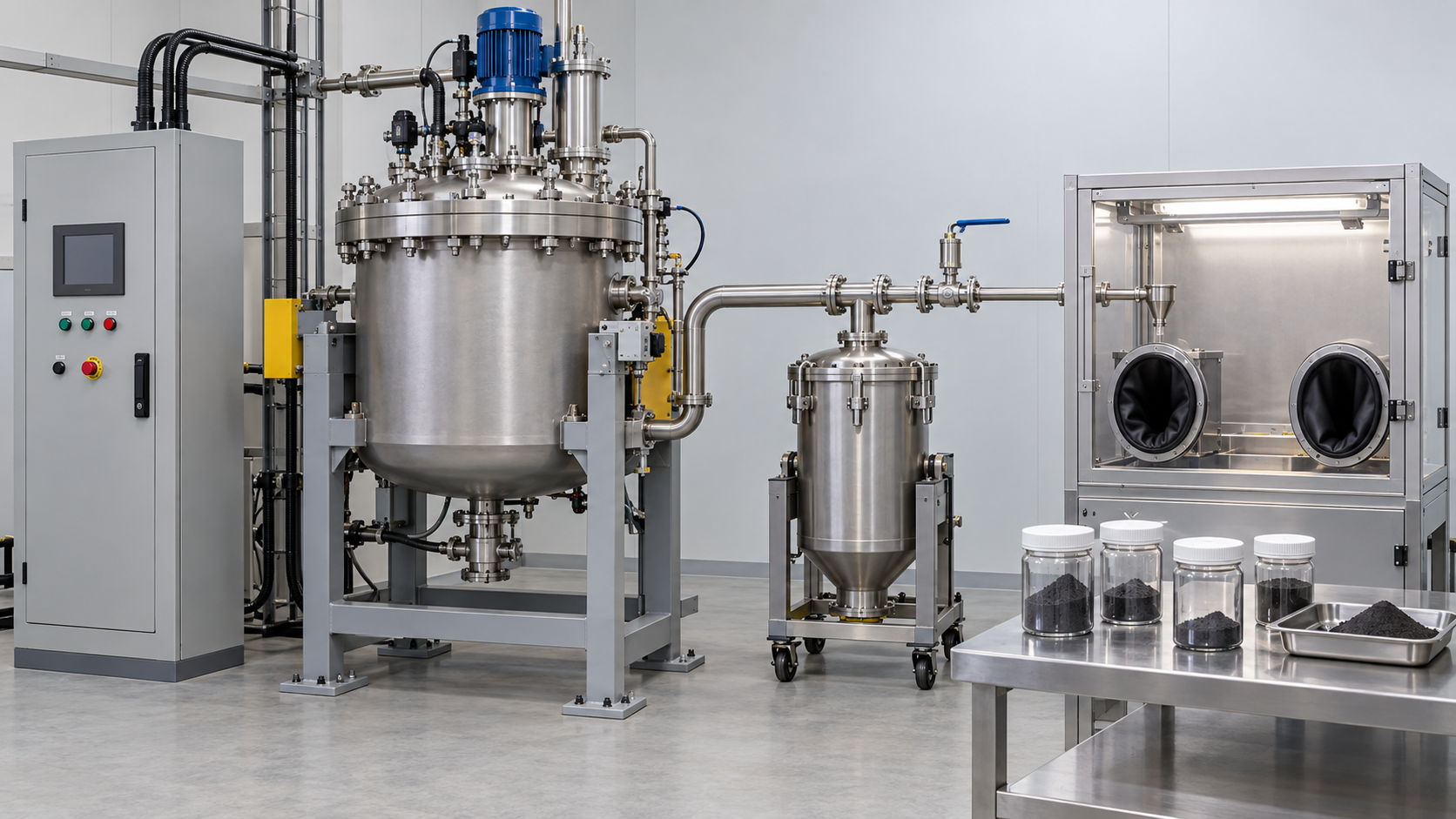
(2) Manufacturing: synthesize the scaffold, mill it, then react it with silane. DOE's draft environmental assessment (2024) describes (a) synthesizing a carbon scaffold from dry chemical raw materials, (b) milling to a target particle size distribution, and (c) compounding in a reactor with silane gas to form the silicon-carbon composite. Silane is the raw gas for silicon, and this reads as a gas-phase step that puts silicon into the scaffold's pores (inference). Milling and particle size are likely to affect coatability and density once made into an electrode, but no particle-size figures are published.
(3) The meaning of "55". The company says the "55" in SCC55 is the number of the 55th formulation iteration, not a content. Do not read a silicon share from the product name. The silicon content, first-cycle efficiency and capacity (mAh/g) appear in neither the web pages nor the DOE documents.
(4) The keys to mass production are raw materials and modularity. The draft DOE assessment assumes BAM-2 would use about 15,000 tonnes a year of carbon and silicon-containing gases and about 50,000 tonnes a year of granular raw materials (at a capacity of 12,000 tonnes a year), and says only one U.S. supplier of silicon-containing gases exists. That is the background to making its own silane. The company also says it adds modules (2,000 tonnes a year each) and can replicate the same design in several regions.
(5) How to read the numbers. "43%", "50%", "90 seconds" and "1,500 to 3,000 cycles" are all manufacturer's stated values or customer reports, and the reference cells, electrodes, rates and temperatures do not line up. Except for the few cases where conditions are given, such as the BASF test, they cannot be used to rank this material against others or against values under other conditions.
11. Risks
| Risk | Details | Status |
|---|---|---|
| Opaque finances | Sales, profit, debt and cash are not in official materials. Funding amounts (more than US$1 billion in total) are announced, but the state of plant construction costs and working capital could not be confirmed. This article cannot assess financial health | Not confirmed |
| Changing plant timelines | For BAM-2, the April 2023 announcement said commercial production would begin in 2024; the September 2024 announcement said the first 2,000 tonnes would start in the fourth quarter of 2024; the 2026 website says full production in 2027. The reason for the delay is not given in official materials. For the Korean plant, the wording moves in steps: shipments in September 2024, and "EV-scale production has begun" in March 2026 | Sourced (company description) / Not yet confirmed |
| Conditions of public support | The DOE amount of up to US$200 million is at the stage of "selected for award negotiation"; a final award could not be confirmed. The US$100 million federal share is the figure at selection; the amount actually paid could not be confirmed | Not confirmed |
| What customers and adoption really are | "More than 160 customers" may not separate trial and small-lot from mass production (the definition is not published). The EV models using it and each customer's volumes could not be confirmed. The company's materials do not discuss whether customers might develop or source materials themselves | Not confirmed / inference |
| Support for performance claims | Figures such as "0 to 100% in 90 seconds" and "43%" are reports from customers' designs, and the test conditions are not published. This article does not judge this material against others | Sourced (company description) |
| Intellectual property | The company stresses defense and enforcement of its patents and mentions moves by others to imitate its approach. Patent counts differ by document (more than 200, more than 170). The outcome of any IP proceeding could not be confirmed | Sourced / Not yet confirmed |
| Raw material silane supply | The restart of the German plant was announced as under preparation in November 2023, and completion could not be confirmed. The U.S. silane plant is at the planning stage. With only one supplier of silicon-containing gases in the U.S. (DOE document), the stability of near-term supply could not be confirmed | Not confirmed |
| Dependence on a region and a partner | The main volume site is BAM-3 in Korea, and in 2025 it bought the stake of its joint-venture partner, SK Inc. SK Inc. remains involved as an investor. The company's materials gave no specific discussion of currency, tariffs or export controls | Sourced / not confirmed |
| Safety and environment | It handles hazardous materials such as silane. The draft DOE assessment describes handling plans. This article does not assess any specific incident or safety record | Sourced |
12. Glossary
- SCC55
- Group14's silicon-carbon composite anode material. The company says "55" is the number of the 55th formulation iteration.
- BAM (Battery Active Materials)
- The company's name for its plants: BAM-1, BAM-2 and BAM-3.
- Scaffold Prime
- The name of the company's manufacturing method for SCC55: synthesize a carbon scaffold, then build silicon and void space inside it.
- Porous carbon scaffold
- A carbon framework with many pores. Silicon is placed in the pores, with free space left for it to expand into.
- Silane
- A compound of silicon and hydrogen (SiH4), a raw gas for making silicon. It needs careful safety management.
- Module
- The unit from which the company builds a plant. One module is described as 2,000 tonnes a year (about 10 GWh).
- GWh conversion
- A way of expressing a quantity of anode material by the battery energy it can supply. The conversion depends on cell design.
- LFP, LMFP, high-nickel
- Types of cathode. LMFP is lithium iron phosphate with manganese added. The company says SCC55 works in cells with these.
- Award negotiation
- A selection by the U.S. DOE before a final grant agreement. It is not a confirmed award.
- ITC
- The U.S. International Trade Commission, which examines imports alleged to infringe patents and similar rights.
- Manufacturer's stated value
- A description or performance figure given by the maker itself. It cannot be compared with another product's unless the test conditions and version match.
13. References
- Group14 Technologies Company website, home page (source of the logo image; headline claims). https://group14.technology/
- Group14 Technologies Company website, Manufacturing. Overview of the BAM factories and the U.S., Korean and German sites. https://group14.technology/manufacturing/
- Group14 Technologies Company website, BAM-1. The R&D center and pilot line in Woodinville, Washington. https://group14.technology/manufacturing/bam-1/
- Group14 Technologies Company website, BAM-2. The plant in Moses Lake, Washington (full production described as 2027). https://group14.technology/manufacturing/bam-2/
- Group14 Technologies Company website, BAM-3. The plant in Sangju, South Korea, and the history of the joint venture with SK Inc. https://group14.technology/manufacturing/bam-3/
- Group14 Technologies Company website, Silane Factory. The silane plant in Germany. https://group14.technology/manufacturing/silane-factory/
- Group14 Technologies Company website, Our Technology. Features of SCC55 (manufacturer's stated values), Scaffold Prime, the origin of the name. https://group14.technology/our-technology/
- Group14 Technologies Company website, About Us. Timeline (2015 to 2025) and management. https://group14.technology/about-us/
- Group14 Technologies Company website, Patent Strategy. Patent policy and count (described as more than 200). https://group14.technology/patent-strategy/
- Group14 Technologies Group14 Closes US$463M Series D Funding Round and Acquires 100% Ownership of BAM Factory in South Korea from SK, Inc. (press release, 20 August 2025). https://group14.technology/resources/press-releases/group14-closes-us463m-series-d-funding-round-and-acquires-100-ownership-of-bam-factory-in-south-korea-from-sk-inc/
- Group14 Technologies Group14 Accelerates EV-Scale Production of Breakthrough Silicon Battery Material in South Korea (press release, 12 March 2026). https://group14.technology/resources/press-releases/group14-accelerates-ev-scale-production-of-breakthrough-silicon-battery-material-in-south-korea/
- Group14 Technologies Group14 Surpasses 170 Issued Patents, Reinforcing Global Protection of SCC55 Silicon Battery Material (press release, 26 March 2026). https://group14.technology/resources/press-releases/group14-surpasses-170-issued-patents-reinforcing-global-protection-of-scc55-silicon-battery-material/
- Group14 Technologies Forge Nano and Group14 Advance U.S.-Made High-Performance Battery Cells with U.S. Material Supply Chain (press release, 28 May 2026). https://group14.technology/resources/press-releases/forge-nano-and-group14-advance-u-s-made-high-performance-battery-cells-with-u-s-material-supply-chain/
- Group14 Technologies SCC55 Resets Benchmark for Silicon Battery Performance (press release, 25 June 2025). https://group14.technology/resources/press-releases/scc55-resets-benchmark-for-silicon-battery-performance/
- Group14 Technologies Group14 and BASF collaborate on market-ready silicon anode solution (press release, 13 May 2025). https://group14.technology/resources/press-releases/group14-and-basf-collaborate-on-market-ready-silicon-anode-solution/
- Group14 Technologies Sionic Energy uses SCC55 to fully displace graphite for 100% silicon battery (press release, 10 December 2024). https://group14.technology/resources/press-releases/sionic-energy-uses-scc55-for-100-silicon-battery/
- Group14 Technologies Group14's SCC55 Powers Groundbreaking AI-Powered HONOR Magic7 Pro Smartphone (press release, 21 November 2024). https://group14.technology/resources/press-releases/group14s-scc55-powers-honor-magic7-pro-smartphone/
- Group14 Technologies U.S. DOE Selects Group14 for Up to $200M Award to Build 7,200 mt Silane Plant (press release, 20 September 2024). https://group14.technology/resources/press-releases/us-doe-selects-group14-for-up-to-200m-award/
- Group14 Technologies Group14 Closes an Additional $214M to Complete $614M Series C Funding Round (press release, 14 December 2022). https://group14.technology/resources/press-releases/group14-closes-214m-from-microsoft-to-complete-614m-series-c-funding-round/
- Group14 Technologies Group14 Acquires Schmid Silicon in Milestone European Expansion (press release, 24 July 2023). https://group14.technology/resources/press-releases/group14-technologies-acquires-schmid-silicon-in-milestone-european-expansion/
- Group14 Technologies Group14 Begins Phase 1 European Expansion with Restart of German Silane Factory (press release, 9 November 2023). https://group14.technology/resources/press-releases/group14-commences-phase-i-expansion-into-europe-with-planned-restart-of-its-silane-factory-in-germany/
- Group14 Technologies Group14 Begins Building World's Largest Factory for Advanced Silicon Battery Materials (press release, 4 April 2023). https://group14.technology/resources/press-releases/group14-begins-building-worlds-largest-factory-for-advanced-silicon-battery-materials/
- Group14 Technologies Defending U.S. Silicon-Carbon Innovation (company blog, 16 July 2026; a public interest statement to the ITC). https://group14.technology/resources/blog/defending-us-silicon-carbon-innovation/
- U.S. Department of Energy Bipartisan Infrastructure Law Battery Materials Processing and Battery Manufacturing Selectee Fact Sheets (DE-FOA-0002678, October 2022). The entry for Group14. https://www.energy.gov/sites/default/files/2022-10/DOE%20BIL%20Battery%20FOA-2678%20Selectee%20Fact%20Sheets%20-%201_2.pdf
- U.S. Department of Energy (NETL) Draft Environmental Assessment, DOE/EA-2220: Group14 Technologies Battery Active Materials Factory (July 2024). Project cost, capacity, manufacturing process, jobs. https://energy.gov/sites/default/files/2024-07/draft-ea-2220-group14-tech-battery-2024-07.pdf
- U.S. Department of Energy DOE/EA-2220: Group14 Technologies - Battery Active Materials Factory (the DOE page for the environmental assessment). https://www.energy.gov/nepa/doeea-2220-group14-technologies-battery-active-materials-factory
14. Claim-to-source audit
| Claim in the text | Status | Source |
|---|---|---|
| The company profile (headquarters, management and founders' backgrounds) and the timeline (Series A, B and C, BAM-1, the SK joint venture, DOE funding, BAM-2, Schmid Silicon, 2024 and 2025) | Sourced (company description) | Reference 8 https://group14.technology/about-us/ |
| Headline claims on the website (10 GWh, more than 25 million devices, more than 200 patents, US$1 billion raised), the home page, the logo | Sourced (company description) | Reference 1 https://group14.technology/ |
| Overview of manufacturing sites (BAM-1 and 2 in the U.S., BAM-3 in Korea, silane in Germany) | Sourced (company description) | Reference 2 https://group14.technology/manufacturing/ |
| BAM-1: R&D center and pilot line, demonstrated as a commercial plant in 2021 | Sourced (company description) | Reference 3 https://group14.technology/manufacturing/bam-1/ |
| BAM-2: 2,000 tonnes a year (about 10 GWh) per module, up to six modules, full production in 2027, the 2024 DOE visit, construction progress | Sourced (company description) / full production not yet confirmed | Reference 4 https://group14.technology/manufacturing/bam-2/ |
| BAM-3: 2,000 tonnes a year (about 10 GWh), more than 100 customers, 100% ownership in August 2025, the joint venture formed in July 2021 | Sourced (company description) | Reference 5 https://group14.technology/manufacturing/bam-3/ |
| The German silane plant: the 2023 acquisition of Schmid Silicon, the approach to securing silane in Europe | Sourced (company description) | Reference 6 https://group14.technology/manufacturing/silane-factory/ |
| Features of SCC55 (under-10-minute charging, up to 50% energy density), Scaffold Prime (two steps), the meaning of "55" | Sourced (manufacturer's stated value) | Reference 7 https://group14.technology/our-technology/ |
| Patent policy and count (more than 200), five jurisdictions | Sourced (company description) | Reference 9 https://group14.technology/patent-strategy/ |
| Series D (US$463 million, 20 August 2025, led by SK Inc.), the purchase of the remaining 75% of the Korean joint venture, the investors, BAM-3 shipments from September 2024, more than US$1 billion in total | Sourced | Reference 10 https://group14.technology/resources/press-releases/group14-closes-us463m-series-d-funding-round-and-acquires-100-ownership-of-bam-factory-in-south-korea-from-sk-inc/ |
| The start of EV-scale production in Sangju, Korea (12 March 2026), more than 160 customers, adoption programs (ATL, Molicel, Sionic, InoBat, V4Smart), the claims of 43%, 0 to 100% in 90 seconds and 1,500 to 3,000 cycles, one tonne replacing five tonnes of graphite | Sourced (company description) | Reference 11 https://group14.technology/resources/press-releases/group14-accelerates-ev-scale-production-of-breakthrough-silicon-battery-material-in-south-korea/ |
| More than 170 patents (26 March 2026), the porous hard-carbon scaffold, five jurisdictions | Sourced (company description) | Reference 12 https://group14.technology/resources/press-releases/group14-surpasses-170-issued-patents-reinforcing-global-protection-of-scc55-silicon-battery-material/ |
| The collaboration with Forge Nano (28 May 2026) | Sourced (company description) | Reference 13 https://group14.technology/resources/press-releases/forge-nano-and-group14-advance-u-s-made-high-performance-battery-cells-with-u-s-material-supply-chain/ |
| More than 1,500 cycles (data from over 20 customers, 25 June 2025) | Sourced (company description) | Reference 14 https://group14.technology/resources/press-releases/scc55-resets-benchmark-for-silicon-battery-performance/ |
| The combination test with BASF (13 May 2025) | Sourced (company description) | Reference 15 https://group14.technology/resources/press-releases/group14-and-basf-collaborate-on-market-ready-silicon-anode-solution/ |
| Sionic Energy's all-silicon battery (10 December 2024) | Sourced (company description) | Reference 16 https://group14.technology/resources/press-releases/sionic-energy-uses-scc55-for-100-silicon-battery/ |
| Adoption in the HONOR Magic7 Pro (21 November 2024) | Sourced (company description) | Reference 17 https://group14.technology/resources/press-releases/group14s-scc55-powers-honor-magic7-pro-smartphone/ |
| DOE's selection of the silane plant (7,200 tonnes a year) for award negotiation of up to US$200 million (20 September 2024), the BAM-2 plan at the time, and the headline listing the CustomCells multi-year supply agreement (8 July 2024) | Sourced / the award is not yet confirmed | Reference 18 https://group14.technology/resources/press-releases/us-doe-selects-group14-for-up-to-200m-award/ |
| Series C totaling US$614 million (14 December 2022), BAM-1 at 120 tonnes a year, modules of 2,000 tonnes | Sourced | Reference 19 https://group14.technology/resources/press-releases/group14-closes-214m-from-microsoft-to-complete-614m-series-c-funding-round/ |
| Acquisition of Schmid Silicon Technology Holding (24 July 2023) | Sourced | Reference 20 https://group14.technology/resources/press-releases/group14-technologies-acquires-schmid-silicon-in-milestone-european-expansion/ |
| Preparations to restart the German silane plant (9 November 2023; idle since 2016; hiring 65) | Sourced (company description) | Reference 21 https://group14.technology/resources/press-releases/group14-commences-phase-i-expansion-into-europe-with-planned-restart-of-its-silane-factory-in-germany/ |
| Start of BAM-2 construction (4 April 2023), the plan then for two modules and production in 2024, jobs of 400 and 200 | Sourced (company description) | Reference 22 https://group14.technology/resources/press-releases/group14-begins-building-worlds-largest-factory-for-advanced-silicon-battery-materials/ |
| The public interest statement to the ITC (company blog, 16 July 2026) | Sourced (company description) | Reference 23 https://group14.technology/resources/blog/defending-us-silicon-carbon-innovation/ |
| DOE selection document: federal cost share US$100 million, recipient share US$222.9 million, the description of SCC55's structure | Sourced | Reference 24 https://www.energy.gov/sites/default/files/2022-10/DOE%20BIL%20Battery%20FOA-2678%20Selectee%20Fact%20Sheets%20-%201_2.pdf |
| Draft DOE environmental assessment: BAM-2 total cost US$590.7 million, 12,000 tonnes a year (six modules), 254 jobs, the three process steps, assumed raw material volumes, a single supplier of silicon-containing gases | Sourced (draft) | Reference 25, 26 https://energy.gov/sites/default/files/2024-07/draft-ea-2220-group14-tech-battery-2024-07.pdf https://www.energy.gov/nepa/doeea-2220-group14-technologies-battery-active-materials-factory |
| Company-wide headcount, sales, profit and R&D spending; BAM-2 operation; the German plant operation; DOE's final award; adopted EV models; silicon content and capacity; test conditions; the founding year | Not yet confirmed | Our own summary and outlook (items not confirmed in primary sources; this article) |
| The readings "multi-region sites as the axis", "securing its own silane", "patents as a line of defense" and "widening uses", the view of a gas-phase step, and the role of the void space | Inference | Reference 2, 4, 5, 6, 12, 18, 25 https://group14.technology/manufacturing/ https://group14.technology/manufacturing/bam-2/ https://group14.technology/manufacturing/bam-3/ https://group14.technology/manufacturing/silane-factory/ https://group14.technology/resources/press-releases/group14-surpasses-170-issued-patents-reinforcing-global-protection-of-scc55-silicon-battery-material/ https://group14.technology/resources/press-releases/us-doe-selects-group14-for-up-to-200m-award/ https://energy.gov/sites/default/files/2024-07/draft-ea-2220-group14-tech-battery-2024-07.pdf |
| Classifying Group14 as "cells & materials"; the conversion of 10 GWh over 2,000 tonnes to about 5 kWh per kg | Our calculation | Our own classification and calculation (this article) |
| The materials engineer's view (the structure, the three steps, the meaning of "55", raw materials and modularity, how to read the figures) | Commentary | Our commentary (company and DOE materials organized from a materials viewpoint; this article) |
Last updated: 10 October 2026 / Troy Technical
This article is based on Group14 Technologies' website, press releases and blog, and DOE public documents. It uses no market-research estimates or press-based figures. Items marked "Inference" are our reading of the primary sources and are not company disclosures. Product performance values are the company's stated values or customer reports and cannot be compared with values obtained under different conditions. Company plans and targets are not yet confirmed and are not guaranteed. This article does not advise individual readers on handling or safety of batteries, or on investment or procurement decisions.