COMPANY PROFILE / NEXT-GEN ENERGY STORAGE
Samsung SDI
A South Korean cell maker built around prismatic cells for EVs, energy storage and UPS; in next-generation storage, the focus is making NCA and LFP storage cells in the United States
Samsung SDI is a South Korean lithium-ion battery maker. Its core product is the prismatic cell, and it also makes cylindrical cells for electric vehicles (EVs), energy storage systems (ESS), uninterruptible power supplies (UPS), data-center battery backup units (BBUs) and power tools. It has a separate electronic materials business for semiconductors and displays. It is listed on the Korea Exchange.
For the year to December 2025, consolidated sales were KRW 13.27 trillion and the operating result was a loss of KRW 1.72 trillion. In 2026 the second quarter (April to June) turned to an operating profit (KRW 203.8 billion), and the first-half operating profit was KRW 48.2 billion, which the company describes as a return to profitability. Its large storage contracts include LFP (lithium iron phosphate) cells for a U.S. customer (three years from 2027, more than KRW 2 trillion) and supply moving from NCA to LFP (2026 to 2029, KRW 1.5 trillion). In the United States it says it is converting part of the StarPlus Energy joint venture with Stellantis from EV cells to storage cells.
Drawing on the business and half-year reports filed on Korea's DART disclosure system and on the company's newsroom, this article sets out what could be confirmed and what could not. All-solid-state batteries are covered in a separate field of this series and are kept out of the main argument here.
- At a glance: Samsung SDI and its place in next-generation energy storage
- Logo and naming
- Where the company sits in next-generation energy storage
- Company scale
- Resources committed to next-generation energy storage
- Track record
- Plans
- What the company is aiming for in next-generation energy storage
- Partnership map for next-generation energy storage
- Technologies, products and services
- Risks
- Glossary
- References
- Claim-to-source audit
1. At a glance: Samsung SDI and its place in next-generation energy storage
South KoreaGiheung site: 150-20 Gongse-ro, Giheung-gu, Yongin. The research institute is in Suwon
since 1979Depositary receipts are also listed on the Luxembourg Stock Exchange. Largest shareholder: Samsung Electronics (19.06% including preferred shares, end of 2025)
Storage systems (secondary)Primary: making prismatic and cylindrical cells. Secondary: supplying the containerized storage system "SBB"
NCA, NCM, LFP, LMOChemistries differ by use (company description): NCA and LFP for storage, LMO for UPS, high-nickel NCM and NCA for EVs
U.S., Hungary, Malaysia and othersIn the U.S., StarPlus Energy (Indiana, a joint venture with Stellantis). Prismatic cell capacity (GWh) is not disclosed
(Korea, non-consolidated, end of 2025)11,026 in batteries and 1,800 in electronic materials (excluding directors). A consolidated headcount could not be confirmed
Operating result -KRW 1.72 trillion (2025)Battery segment sales KRW 12.38 trillion (93%), operating result -KRW 1.85 trillion. First-half 2026 operating profit KRW 48.2 billion
Samsung SDI's place in next-generation storage is that of a battery maker redirecting prismatic-cell technology built for EVs toward energy storage (ESS), UPS and BBUs. It posted an operating loss in 2025, but the company says storage batteries reached their highest quarterly sales on record (no amount is given) Sourced.
However, prismatic cell capacity (GWh), sales of storage cells and the silicon content of its anode could not be confirmed; none is in the filed reports. LFP production in the U.S. (expected from the fourth quarter of 2026) and the contract values (more than KRW 2 trillion, KRW 1.5 trillion) are company plans and announcements; actual shipments remain to be confirmed Not yet confirmed.
2. Logo and naming

The logo is the image used in the header of the company's official website (samsungsdi.com): the Samsung oval with the words "SAMSUNG SDI". It is taken as it is; it has not been recreated with generated images.
Naming: the company is Samsung SDI (SDI in capitals). Press releases sometimes write it fully in capitals, as "SAMSUNG SDI". It is a separate listed company from Samsung Electronics, which is its largest shareholder (19.06% including preferred shares). In this article, "the company" means Samsung SDI.
Official site: https://www.samsungsdi.com/3. Where the company sits in next-generation energy storage
Samsung SDI's primary type is cells & materials maker, and its secondary type is storage systems (the containerized "SBB" under its own brand). Its business report says it has run a closed-loop recycling scheme since 2019, but the scale could not be confirmed. The chemistries, formats and uses confirmed in official materials are as follows.
| Cell chemistry / format | Use and position | Primary sources confirmed | Status |
|---|---|---|---|
| Prismatic: NCA (high-nickel) | Storage (SBB 1.5 and 1.7). At StarPlus Energy in Indiana, NCA supply is planned to come first | Press releases (March 2026, September 2025) | Sourced (company description) |
| Prismatic: LFP | Storage (SBB 2.0). The company starts supplying LFP in the U.S. (it describes its past focus as NCA). Three-year supply contract from 2027 | Press releases (December 2025, March 2026) | Sourced / mass production is Not yet confirmed |
| Prismatic: NCM (high-nickel) and NCA | EVs. Multi-year supply agreement with Mercedes-Benz (April 2026) | Press release (April 2026) | Sourced |
| Prismatic: LMO | UPS (U8A1). The company says it passed UL Solutions' Indoor Large-Scale Fire Test | Press releases (March and July 2026) | Sourced (company description) |
| Cylindrical (NCA with a silicon-carbon anode) | Data-center BBUs, power tools, and the 46-series for EVs. The company describes extending cylindrical cells to BBUs | Press releases (March and August 2026) | Sourced (company description) |
| Sodium-ion batteries | Under development for AI data-center UPS and large storage. The company says it is advancing a mass-production roadmap (no timing or performance given) | Half-year report, press release (July 2026) | Not yet confirmed |
| Lithium-metal batteries | Joint research with Columbia University (Joule, February 2026). A research-stage electrolyte improvement for lifetime and safety | Press release (February 2026) | Research stage |
| All-solid-state batteries | Covered in a separate field of this series (the all-solid-state company profiles). Not discussed here | - | Out of scope |
4. Company scale
Samsung SDI is a large company, so the group as a whole is kept brief and the focus is on the battery segment (Energy Solutions). Figures are from the business and half-year reports on DART Sourced.
| Item | What was confirmed |
|---|---|
| Group (year to December 2025, consolidated) | Sales KRW 13,267 billion (KRW 16,592 billion the year before). Operating result -KRW 1,722 billion (a profit of KRW 363 billion the year before). Net result -KRW 585 billion (including KRW 290 billion of profit from discontinued operations linked to the sale of the polarizing film business). Total assets KRW 42,255 billion; total equity KRW 23,570 billion |
| Battery segment (Energy Solutions) | Sales KRW 12,384 billion (93% of the total); operating result -KRW 1,852 billion. For the U.S. Advanced Manufacturing Production Credit (AMPC), the amount expected to be received was recognized as other operating income of KRW 275 billion (KRW 90 billion the year before) |
| Electronic materials segment | Sales KRW 883 billion (7%), operating profit KRW 130 billion. This is for semiconductors and displays, a business separate from next-generation storage. The polarizing film business was sold, with completion on 1 September 2025 (final price KRW 1,182.5 billion) |
| First half of 2026 (consolidated) | Sales KRW 7,345 billion (up 16% year on year), operating profit KRW 48 billion (a loss in the same period last year). The battery segment had sales of KRW 6,873 billion and an operating result of -KRW 17 billion. The second quarter alone was an operating profit of KRW 203.8 billion (company announcement) |
| Employees | 12,826 (Korea, non-consolidated, 31 December 2025, excluding directors): 11,026 in batteries and 1,800 in electronic materials. A consolidated headcount was not found in the business report |
| Headquarters, listing, shareholders | Yongin, Gyeonggi Province. Listed on KRX (1979), with depositary receipts on the Luxembourg exchange. Largest shareholder Samsung Electronics (19.06% including preferred shares). 22 consolidated subsidiaries |
| Sites | South Korea: Giheung, Ulsan, Cheonan, Gumi, Cheongju, Suwon. Overseas: U.S. (Auburn Hills; StarPlus Energy in Kokomo, Indiana), Hungary (Göd), Austria (Graz), Vietnam (Bac Ninh), Malaysia (Seremban), China (Tianjin, Xi'an), Germany (Dresden) |
| Main customers | The business report names BMW, Volkswagen Group, Samsung Electronics, Stellantis and AES, among others, as main customers. Sales by customer are not disclosed |
| Patents | 21,887 registered (6,220 in Korea, 15,499 overseas), for all businesses combined. A count limited to prismatic batteries could not be confirmed (the company says it has the largest prismatic patent portfolio, but gives no basis for the count) |
The business report gives a market share for small batteries (13%) "according to the research firm TSR". Because it is a research-firm estimate, this article does not use it. Market forecasts in press releases (for example, U.S. ESS demand from the research firm SNE) are not used either. Phrases such as "the only non-Chinese prismatic battery maker" and "the only non-Chinese supplier of prismatic ESS batteries in North America" are the company's own description. This article makes no judgment on rankings or superiority against other companies.
5. Resources committed to next-generation energy storage
The four points (people, money, outside deals, and universities or public funding) are set out below, with what could and could not be confirmed.
| Item | What was confirmed | Status |
|---|---|---|
| People (R&D sites and headcount) | R&D is organized as a research institute, a production technology institute (including an electrode center), and development offices in the mid-to-large, small-battery and electronic materials divisions. The institute has overseas labs; in the U.S. there is SDI R&D America (a participant in the Columbia University work). The number of R&D staff could not be confirmed. Total employees are 12,826 in Korea alone | Sourced / headcount not confirmed |
| Money (R&D spending and capital expenditure) | R&D spending KRW 1,421 billion (2025, 10.7% of sales) and KRW 859 billion in the first half of 2026 (11.7%). Capital expenditure KRW 3,274 billion (2025; battery segment KRW 3,195 billion) and KRW 1,093 billion in the first half of 2026 (battery segment KRW 1,081 billion). In May 2025 it raised KRW 1,654.9 billion in a rights offering (planned uses in the filing: KRW 1,300.8 billion for acquiring other companies' securities and KRW 354.1 billion for facilities; actual use by end of 2025: KRW 638.1 billion on securities and KRW 368.5 billion on working capital, with the unused KRW 648.3 billion held in deposits and similar) | Sourced |
| Outside stakes, acquisitions, joint ventures, divestments | (Stakes) Ecopro EM (cathode materials) 40%, Pill Energy (stacking equipment) 14%, a secondary-battery growth fund 33.3%, StarPlus Energy (joint venture with Stellantis, 51%). (Ended or acquired) it took over GM's 49.99% of their joint venture in August 2026. (Sold) the polarizing film business, in September 2025 (KRW 1,182.5 billion). Its subsidiary STM (Ulsan, 100%) makes cathode active material | Sourced |
| Universities, research institutes and public funding | University: joint research with Columbia University on an electrolyte for lithium-metal batteries (February 2026). Public funding: government R&D grants were nil in 2025 (KRW 74 million in 2024) and KRW 216 million in the first half of 2026. The company recognized KRW 275 billion of U.S. AMPC as other operating income (2025). Grants or loans from bodies such as the U.S. Department of Energy could not be confirmed | Sourced / grants and loans not confirmed |
Status of main products and facilities
The table covers what the company's official materials confirm. Prismatic cell capacity (GWh a year) appears in neither the business report, the half-year report nor any press release, and could not be confirmed. DART gives capacity only for small batteries (cylindrical and similar, combined) and for EMC in electronic materials.
| Product / facility | Location | Scale | Stage | Date and source |
|---|---|---|---|---|
| Small batteries (cylindrical and others; Ulsan, Cheonan, Tianjin and others) | South Korea, China and others | 2,520 million units a year (2025 capacity), 50% utilization. First half of 2026: capacity of 1,178 million units, 73% utilization | Operating | Business report, half-year report |
| StarPlus Energy (joint venture with Stellantis) | Kokomo, Indiana, U.S. | GWh not disclosed. Part of the lines has been converted from EV to storage cells since the fourth quarter of 2025 | Operating (converting). LFP mass production expected from the fourth quarter of 2026 (Not yet confirmed) | Release of 24 March 2026 |
| StarPlus Energy second plant | Indiana, U.S. | A construction contract is listed in the business report. Scale and progress could not be confirmed | Planned / construction (stage not confirmed) | Business report |
| SynergyCells (the former joint-venture plant with GM) | New Carlisle, Indiana, U.S. | Scale not disclosed. The company says it is under construction and will first make storage batteries | Under construction. The company took over GM's 49.99% on 11 August 2026 and now owns all of it | Release of 11 August 2026, half-year report |
| U.S. production of SBB 1.7 and SBB 2.0 | U.S. | SBB 1.7 is 6.14 MWh (20-foot container) | Planned: U.S. production was said to start in 2026 (as of September 2025) | Company website article (RE+ 2025) |
| Cathode active material (STM) | Ulsan, South Korea | Scale not disclosed | Operating | Business report |
6. Track record
| When | What happened | What it means |
|---|---|---|
| 1970 and 1979 | Founded in 1970 and listed on KRX in 1979. It says it began its lithium-ion battery business in 2000 | Over 25 years in batteries |
| 2021 to 2022 | October 2021: opening ceremony for Ecopro EM's cathode plant. October 2021: memorandum with Stellantis on a North American battery joint venture; May 2022: joint venture agreement | Cathode sourcing and a U.S. production base |
| 2023 | First launch of the SBB storage system (NCA prismatic cells). July: memorandum on the second StarPlus Energy plant. October: battery supply agreement with Hyundai Motor (seven years from 2026, for European EVs) | A storage product, and wider supply contracts |
| 28 August 2024 | Definitive agreement with GM to set up a battery joint venture in the U.S. | EV-focused expansion in the U.S. (later changed) |
| March to May 2025 | Supply contract for storage batteries with NextEra Energy (US$301 million, disclosed 14 March). Rights offering resolved on 14 March and KRW 1,654.9 billion raised in May | Storage orders, and funding for investment |
| 1 September 2025 | Sale of the polarizing film business in electronic materials completed (KRW 1,182.5 billion) | A sharper battery focus (this article does not state the company's intent) |
| 10 December 2025 | Contract to supply LFP storage cells to a U.S. customer for three years from 2027 (more than KRW 2 trillion) | The company's first large LFP storage contract |
| 2 February 2026 | Full-year 2025 results. The company says storage battery sales hit a quarterly record | Storage growing amid losses |
| March 2026 | KRW 1.5 trillion U.S. ESS contract (16 March); LFP cathode supply contract with L&F (about KRW 1.6 trillion, 24 March) | Stronger local sourcing in the U.S. (outside China) |
| 20 April 2026 | First EV battery supply agreement with Mercedes-Benz (high-nickel NCM) | Adds to BMW and Audi, giving the three major German premium brands as customers |
| 14 July 2026 | It announced that its UPS batteries met the criteria of UL Solutions' Indoor Large-Scale Fire Test (Indoor LSFT) | A result under the test conditions (UPS use) |
| 30 July 2026 | Operating profit in the second quarter (KRW 203.8 billion) | The company describes it as the first in seven quarters, since the third quarter of 2024 |
| 11 August 2026 | Ended the GM joint venture and took over its 49.99% stake. New joint development agreement for a next-generation prismatic cell | The New Carlisle plant becomes a wholly owned site, starting with storage batteries |
7. Plans
(company expectation)The company says it expects mass production alongside NCA. The start of production and yields could not be confirmed
More than KRW 2 trillionCounterparty not disclosed. Volume, price and delivery terms are not disclosed
KRW 1.5 trillionMade in Indiana. Starting with NCA and later moving to LFP
Storage firstCompletion date and scale not disclosed. It mentions possibly making the jointly developed prismatic cell with GM in future
Other matters the company states about the future are as follows Not yet confirmed.
| Item | Company statement | What could not be confirmed |
|---|---|---|
| High-energy-density prismatic cell | A developer says the 700 Wh/L prismatic cell (third-generation silicon-carbon anode, 91% nickel NCA cathode) is about to enter mass production (March 2026) | Start date, vehicle models and volume |
| Sodium-ion batteries | Being developed with its own technologies for AI data-center UPS and large storage. It plans to advance its commercialization and mass-production roadmap (July 2026) | Performance, production timing and investment |
| More capacity for UPS and BBUs | Plans to expand production capacity for high-power cylindrical cells (July 2026) | Added volume, investment and timing |
| Demand from renewables and data centers | It says storage battery demand will rise with renewable energy growth and investment in AI data centers | Quantification (research-firm forecasts are not used in this article) |
None of the following is stated in primary materials Not yet confirmed.
Prismatic cell capacity (GWh a year) and utilization; sales and shipments (GWh) of storage cells; performance values for its LFP cells (such as Wh/kg); the names of the counterparties to its two large ESS contracts; delivery progress against contract values; the start date of the second StarPlus Energy plant; the silicon content of its silicon-carbon anode (SCN); and a quantified view of future AMPC receipts and the effect of U.S. policy changes on earnings.
8. What the company is aiming for in next-generation energy storage
This chapter includes points the company does not state directly. They are given as inferences, to the extent the primary sources allow, with the basis for each.
| What can be read | Primary basis | Status |
|---|---|---|
| Extending the prismatic-cell technology built for EVs to energy storage (ESS) is its main growth axis for now | The 2026 releases cast U.S. local production of storage cells (SBB 2.0) as the way to maximize capacity and improve profit. Alongside this come the conversion of EV lines to storage, the plan to start the former GM joint-venture plant with storage, the sourcing contract with L&F and two large contracts | Inference |
| Broadening its chemistries (adding LFP, LMO and sodium-ion to high-nickel NCA and NCM) to fit the demands of each use | The company says it uses NCA and NCM for high performance and LFP for stability, by application (May 2026). LMO for UPS, cylindrical NCA for BBUs, NCA and LFP for storage | Sourced (company description) / the link between them is an inference |
| Using non-Chinese sourcing to serve the U.S. storage market as a point of differentiation | A contract to source LFP cathode material from L&F (South Korea). The company says it set up a materials supply chain to address the U.S. "PFE" (prohibited foreign entity) rules (first quarter of 2026) | Sourced (company description) / the positioning is an inference |
| Developing AI data-center power (UPS and BBU) as a new high-power market built on safety | LMO prismatic cells for UPS, cylindrical cells for BBUs, an announced pass in a UL Solutions test (July 2026), and the March and August 2026 announcements | Sourced (company description) / inference |
The reading that "storage is the main axis for now" rests on the way the results and investment announcements pair weak EV demand with strong storage demand. The full-year 2025 release names weak EV demand from strategic U.S. customers as a difficulty, while saying storage batteries had their highest quarterly sales on record. The first- and second-quarter 2026 releases cite demand for storage, UPS, BBUs and power tools, and AMPC benefits from U.S. storage production, as drivers of the improvement. In August 2026 the company gave slower-than-expected EV demand as the reason for ending the GM joint venture, and said the plant would first be used for storage.
Still, sales and shipments of storage cells are not disclosed, so what share of sales storage accounts for cannot be confirmed. This is our reading of the company's announcements Not yet confirmed.
9. Partnership map for next-generation energy storage
The company's relationships combine supply contracts and joint ventures with carmakers (Stellantis, GM) with large storage contracts and sourcing of cathode material from outside China (L&F). Counterparties named publicly are few, such as Mercedes-Benz and NextEra Energy; the customers behind the two large U.S. contracts cannot be confirmed from official materials Not yet confirmed. Joint development of all-solid-state batteries (BMW) and a memorandum on robot batteries (Hyundai Motor and Kia) also exist but are outside the scope of this article and are not shown.
10. Technologies, products and services
The following is based on the company's official materials. All figures are manufacturer's stated values; where the materials give no test conditions, that is noted. They do not rank the company's products against others, and values obtained under different conditions cannot be set side by side Sourced.
| Product (level) | Chemistry / format | Manufacturer's stated value and conditions | Stage |
|---|---|---|---|
| 700 Wh/L prismatic cell (cell) | NCA (91% nickel), third-generation silicon-carbon nanocomposite (SCN) anode, direct-connect current collection | Volumetric energy density 700 Wh/L (described by the company as the best for a prismatic cell). A range of 800 km is stated, with no vehicle, driving mode or test conditions given. Winner of the InterBattery Award 2026 | A developer says mass production is near (Not yet confirmed) |
| SBB 1.5 (system) | High-nickel NCA prismatic cells, 20-foot container | The company says it holds "tens of thousands" of cells. Includes EDI (described as safety technology to limit heat spread; the method could not be confirmed) | Development completed in 2024 (business report) |
| SBB 1.7 (system) | High-nickel NCA prismatic cells | 6.14 MWh. About 17% higher energy density than SBB 1.5 (company statement; test conditions not given) | U.S. production planned from 2026 |
| SBB 2.0 (system) | LFP prismatic cells, 20-foot container | Cell and capacity figures could not be confirmed. The company says its own materials and electrode technology make up for the low energy density of LFP | Mass production planned in the U.S. (Not yet confirmed) |
| U8A1 (UPS cell) | LMO, prismatic | About 33% better space efficiency than the previous solution (the baseline and conditions are not given) | Shown in March 2026 (supply status could not be confirmed) |
| Cylindrical cell for BBUs (cell) | NCA, silicon-carbon anode (SCN), tabless | It says data can be kept for more than 50% longer during an outage (baseline and conditions not given) | Shown in March 2026. The company says it signed BBU supply agreements (first quarter) |
The cell design features the company publishes are as follows (company descriptions).
| Feature | Company description |
|---|---|
| Prismatic cell (PrismStack) | An aluminum can (resistant to external shock), a vent (releases internal gas in one direction), and lower internal resistance from fewer parts. A "direct-connect current collection structure" joins terminals directly to the electrode tabs |
| No TP (No Thermal Propagation) | Thermal insulation is placed between cells, and the temperature rise of a given cell is tracked by a dedicated prediction program, so that heat does not spread to neighboring cells |
| EDI (Enhanced Direct Injection) | A mechanism built into SBB and described as safety technology that limits heat spread (the detailed method and performance figures could not be confirmed) |
| SBI (Samsung Battery Intelligence) | AI diagnosis of the condition of storage batteries. The company says it is trained on data from more than 1,400 storage sites worldwide (first shown in March 2026) |
(1) Cathode: raising nickel makes the particle surface more prone to cracking. The company says the 700 Wh/L cell uses NCA with 91% nickel. A developer says a higher nickel share raises energy density but makes the cathode surface more likely to crack during charge and discharge, and makes manufacturing harder. The company says a new structural design secured stability and life, but the structure is not published. See our explainer on cathode materials. For storage LFP, the company says its own anode material and electrode process overcame the drawback of low energy density (no figures given). The business report says the subsidiary STM (Ulsan) makes cathode active material and that electrode materials are bought from companies including Umicore and Ecopro EM (58% of purchases are electrode materials; the split by supplier is not disclosed).
(2) Anode: silicon blended with graphite, with expansion held down. The company says the third-generation SCN (silicon-carbon nanocomposite) uses less graphite than the second generation and has a denser internal structure that keeps electrolyte from penetrating the material, which holds back anode expansion. The silicon content, capacity and cycle-life figures are not published. For cracking, SEI and prelithiation in silicon anodes, see our explainer on silicon anodes and nanostructured electrodes.
(3) Cell structure: bringing out the materials' performance through the case and wiring. The company says that in a prismatic cell, fewer parts for current collection and terminals leave more room for active material and lower internal resistance. No TP, which stops heat reaching neighboring cells, is a combination of insulating material between cells and temperature-prediction software. The company says the UPS fire-test result comes from a combination of LMO material, the aluminum can, the gas vent and the system structure. See our explainers on cell formats and cell-to-pack, and on thermal runaway and battery safety.
(4) How to read the numbers. "700 Wh/L", "800 km", "33% better space efficiency" and "more than 50% longer data retention" are all manufacturer's stated values, with no baseline or test conditions given. They cannot be set against other companies' cells or values under different conditions to judge which is better. For a comparison of LFP and high-nickel chemistries, see our explainer on next-generation battery chemistries.
The UPS fire test the company announced in July 2026 is a result under the conditions of the Indoor Large-Scale Fire Test (Indoor LSFT) that UL Solutions introduced in 2026. The company says that the module in which a fire was deliberately started was fully consumed, that the fire did not spread to surrounding racks, and that no gas release, explosion or rupture was observed. It does not show safety for other uses, scales or installation conditions (this article does not guarantee the safety of any installation).
11. Risks
| Risk | Details | Status |
|---|---|---|
| Whether the recovery lasts | The 2025 operating result was a loss (-KRW 1,722 billion) with a net loss. In the first half of 2026 operating profit was KRW 48 billion, but the first quarter was an operating loss (-KRW 155.6 billion) and the second a profit (the company says the first since the third quarter of 2024). The company cites AMPC and U.S. tariff refunds among the drivers of improvement; whether these continue could not be confirmed | Sourced / not confirmed (continuity) |
| Capital expenditure burden | Capital expenditure was KRW 3,274 billion in 2025 (about 24.7% of sales, our calculation) and KRW 1,093 billion in the first half of 2026 (about 14.9%) Our calculation. It raised KRW 1,654.9 billion in a rights offering in 2025. The former GM joint-venture plant will continue to be built by the company alone | Sourced / our calculation |
| EV demand and customer shifts | The company named weak EV demand from strategic U.S. customers and U.S. policy changes as difficulties in 2025, and gave slower EV demand as the reason for ending the GM joint venture. Dependence on major customers (BMW, Volkswagen Group, Stellantis and others) cannot be confirmed because sales by customer are not disclosed | Sourced (company description) |
| Reliance on U.S. policy | AMPC, at KRW 275 billion of other operating income in 2025, affects earnings. The company is addressing "PFE" rules through materials sourcing. This article has not confirmed the stage (proposed, adopted, in force) of those rules or how they may change | Sourced (company description) / not confirmed |
| Ramping up LFP | LFP is a new chemistry for the company (it describes its past focus as NCA). The start of mass production in the fourth quarter of 2026 is the company's expectation, and yields, costs and performance cannot be confirmed. A three-year cathode contract with L&F (with an extension option) may concentrate sourcing | Not yet confirmed |
| Scope of its safety evaluations | The company announced a passed fire test, but it is a result under specific conditions and cannot be generalized. Fires and accidents in storage systems should be judged only from published accident investigations; this article does not speculate about causes | Sourced |
| Restructuring | The sale of the polarizing film business, and the end of the GM joint venture with the takeover of the stake, mean the business mix is changing. The 2026 strategy may be updated | Sourced |
| Regulatory compliance burden | To prepare for rules such as the EU Batteries Regulation, the company is building a system to calculate product carbon footprints (June 2026). It says disclosure of the results will come "in the future" | Not yet confirmed |
12. Glossary
- Prismatic cell
- A cell in a rectangular aluminum can holding stacked (or wound) electrodes. Differs in shape from cylindrical and pouch cells.
- PRiMX
- Samsung SDI's brand for prismatic batteries (a main trademark in its business report).
- PrismStack
- The name the company gives to its prismatic cell technology (introduced in March 2026).
- SBB (Samsung Battery Box)
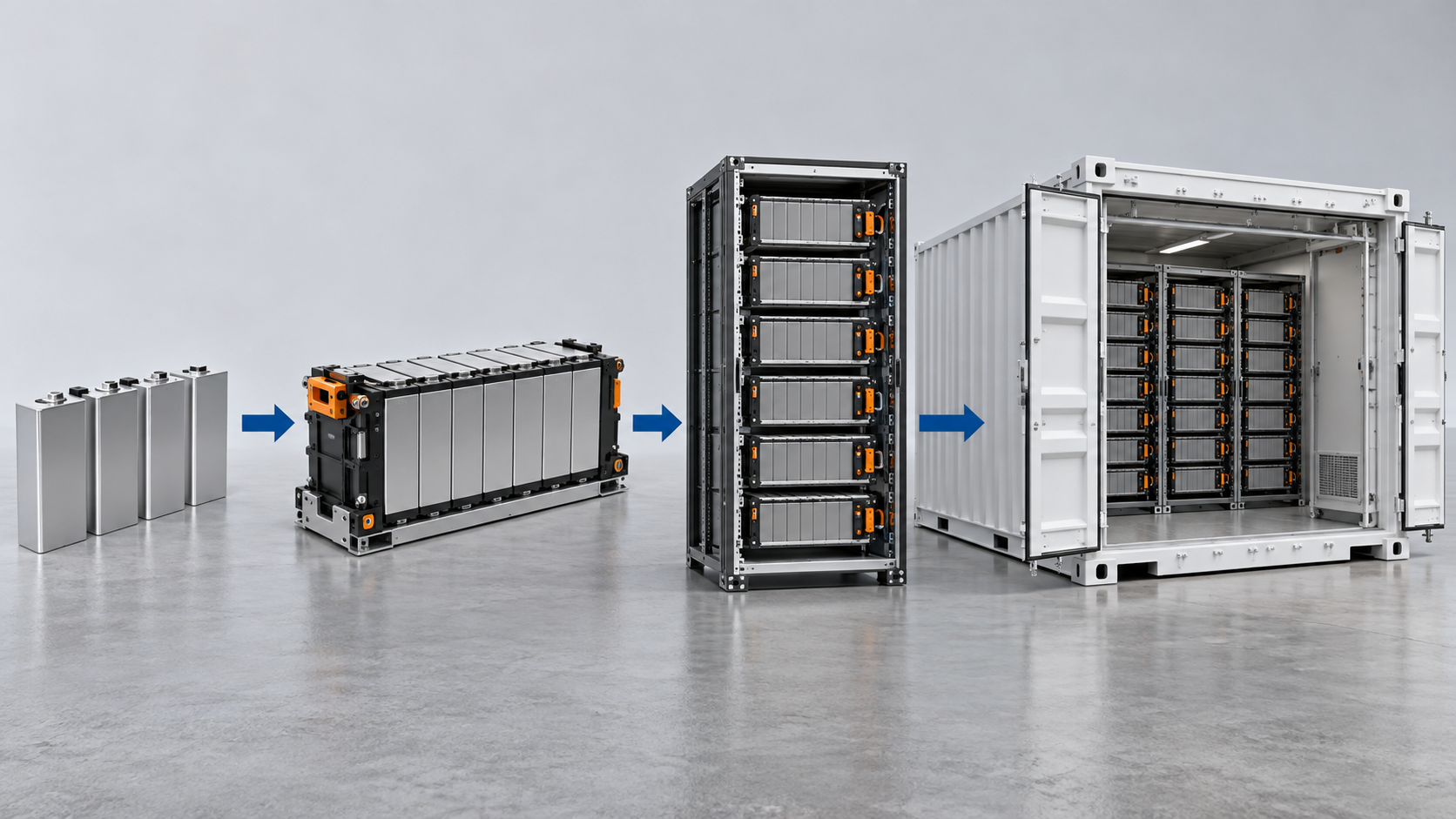
- The company's storage system: cells, modules and racks in a 20-foot container.
- NCA / NCM
- Nickel-rich cathode materials. NCA combines nickel with cobalt and aluminum; NCM with cobalt and manganese.
- LFP
- Lithium iron phosphate. A cathode material without nickel or cobalt, with lower energy density but regarded as stable and low cost.
- LMO
- Lithium manganese oxide. A cathode material regarded as high-power and stable. Used in the company's UPS cell.
- SCN
- Silicon-carbon nanocomposite. The name of the company's anode material.
- No TP
- The company's name for its mechanism to keep heat from spreading to neighboring cells.
- UPS / BBU
- Uninterruptible power supply / battery backup unit placed in a server rack. Used in data centers to cover outages.
- AMPC
- The U.S. Advanced Manufacturing Production Credit (under the Inflation Reduction Act), a tax credit for battery production and sales.
- PFE
- The U.S. "prohibited foreign entity" rules. The company says they bear on its materials sourcing.
- DART
- South Korea's electronic disclosure system, where listed companies publish business reports and similar filings.
- Manufacturer's stated value
- A description or performance figure given by the maker itself. It cannot be compared with another product's unless the test conditions and version match.
13. References
- DART (Financial Supervisory Service) Samsung SDI Business Report, FY2025 (year to December 2025; filed 10 March 2026) (in Korean). Business overview, sales and operating results, production facilities, capital expenditure, R&D spending, major contracts, affiliates, employees, use of rights-offering proceeds. https://dart.fss.or.kr/dsaf001/main.do?rcpNo=20260310002954
- DART (Financial Supervisory Service) Samsung SDI Half-Year Report, first half of 2026 (filed 14 August 2026) (in Korean). First-half sales and operating results, R&D, capital expenditure, production capacity, subsequent events (end of the GM joint venture). https://dart.fss.or.kr/dsaf001/main.do?rcpNo=20260814003578
- Samsung SDI SAMSUNG SDI Announces 2025 Fourth Quarter and Full Year Results (press release, 2 February 2026). https://news.samsungsdi.com/global/press/view?seq=370
- Samsung SDI SAMSUNG SDI Announces First Quarter 2026 Earnings Results (press release, 28 April 2026). https://news.samsungsdi.com/global/press/view?seq=409
- Samsung SDI SAMSUNG SDI Announces Second Quarter 2026 Earnings Results (press release, 30 July 2026). https://news.samsungsdi.com/global/press/view?seq=440
- Samsung SDI SAMSUNG SDI Clinches Over KRW 2 Trillion Deal for ESS LFP Battery Supply in U.S. (press release, 10 December 2025). https://news.samsungsdi.com/global/press/view?seq=345
- Samsung SDI SAMSUNG SDI Wins KRW 1.5 Trillion ESS Prismatic Battery Supply Deal in the U.S. (press release, 16 March 2026). https://news.samsungsdi.com/global/press/view?seq=390
- Samsung SDI SAMSUNG SDI Signs Mid- to Long-term LFP Cathode Material Supply Deal with L&F (press release, 24 March 2026). https://news.samsungsdi.com/global/press/view?seq=395
- Samsung SDI SAMSUNG SDI Signs First EV Battery Supply Deal with Mercedes-Benz (press release, 20 April 2026). https://news.samsungsdi.com/global/press/view?seq=405
- Samsung SDI SAMSUNG SDI, General Motors Sign New Battery Development Agreement, Continuing Their Strategic Partnership (press release, 11 August 2026). https://news.samsungsdi.com/global/press/view?seq=444
- Samsung SDI SAMSUNG SDI’s Highest Energy Density Battery Wins InterBattery Award (3 March 2026). Structure and materials of the 700 Wh/L prismatic cell. https://news.samsungsdi.com/global/press/view?seq=382
- Samsung SDI SAMSUNG SDI Unveils All-Solid-State Battery for Physical AI (press release, 9 March 2026; InterBattery 2026 exhibits. The all-solid-state part is outside the scope of this article). https://news.samsungsdi.com/global/press/view?seq=383
- Samsung SDI SAMSUNG SDI Debuts New SBB Products Featuring High Capacity and Enhanced Safety (RE+ 2025, September 2025; SBB 1.7 and SBB 2.0). https://www.samsungsdi.com/sdi-now/sdi-news/4522.html
- Samsung SDI SAMSUNG SDI UPS Batteries Pass Global Fire Safety Test, First to Meet Indoor LSFT Standard (press release, 14 July 2026). https://news.samsungsdi.com/global/press/view?seq=435
- Samsung SDI SAMSUNG SDI Expands into AI Data Center BBUs with Cylindrical Batteries (3 August 2026). https://news.samsungsdi.com/global/press/view?seq=442
- Samsung SDI SAMSUNG SDI, Columbia University Publish Paper on Enhancing Lithium-Metal Battery Performance in Joule (20 February 2026). https://news.samsungsdi.com/global/press/view?seq=377
- Samsung SDI [SDI Focus] NCA and NCM for High Performance, LFP for Stability (4 May 2026). The company's explanation of how it uses different cathode materials. https://news.samsungsdi.com/global/press/view?seq=411
- Samsung SDI SAMSUNG SDI Publishes Sustainability Report 2026 (1 July 2026). Product carbon footprint system and greenhouse gas reductions. https://news.samsungsdi.com/global/press/view?seq=433
- Samsung SDI [SDI Focus] SAMSUNG SDI’s PrismStack Enhances Energy Density and Power Through Component Innovation (22 April 2026). https://news.samsungsdi.com/global/press/view?seq=407
- Samsung SDI Company website (source of the logo image, as used in the page header). https://www.samsungsdi.com/
14. Claim-to-source audit
| Claim in the text | Status | Source |
|---|---|---|
| Name, founding (1970), headquarters, listing (KRX in 1979; depositary receipts in Luxembourg), largest shareholder Samsung Electronics 19.06%, 22 consolidated subsidiaries, patent counts, the start of its lithium-ion business in 2000 | Sourced | Reference 1 https://dart.fss.or.kr/dsaf001/main.do?rcpNo=20260310002954 |
| Year-to-December 2025 sales, operating and net results, total assets and equity; battery and electronic materials segment sales and results; AMPC other operating income (KRW 275 billion); the sale of the polarizing film business | Sourced | Reference 1 https://dart.fss.or.kr/dsaf001/main.do?rcpNo=20260310002954 |
| Employees (12,826 in Korea; 11,026 in batteries, 1,800 in electronic materials), R&D organization, R&D spending (KRW 1,421 billion, 10.7%), government grants, capital expenditure (KRW 3,274 billion) | Sourced | Reference 1 https://dart.fss.or.kr/dsaf001/main.do?rcpNo=20260310002954 |
| Capacity (small batteries, 2,520 million units, 50% utilization), list of sites, main customers, affiliates (Ecopro EM 40%, Pill Energy 14%, non-controlling interest of 49% in StarPlus Energy, STM), the KRW 1,654.9 billion rights offering and use of proceeds, the StarPlus Energy second-plant construction contract, the NextEra Energy (US$301 million) and Hyundai Motor contracts | Sourced | Reference 1 https://dart.fss.or.kr/dsaf001/main.do?rcpNo=20260310002954 |
| First-half 2026 sales, results, R&D, capital expenditure, small-battery capacity and utilization, subsequent event (taking over GM's 49.99% on 11 August 2026) | Sourced | Reference 2 https://dart.fss.or.kr/dsaf001/main.do?rcpNo=20260814003578 |
| Full-year 2025 results commentary (record quarterly storage sales, weak U.S. EV demand, 2026 strategy) | Sourced (company description) | Reference 3 https://news.samsungsdi.com/global/press/view?seq=370 |
| First-quarter 2026 commentary, supply chain for the PFE rules, the Mercedes-Benz agreement, tabless cylindrical cells, the announced fix for lithium-metal lifetime and safety | Sourced (company description) | Reference 4 https://news.samsungsdi.com/global/press/view?seq=409 |
| Second-quarter 2026 commentary (operating profit KRW 203.8 billion, first profit in seven quarters, sodium-ion development and mass-production roadmap, more cylindrical capacity) | Sourced (company description) / plans not yet confirmed | Reference 5 https://news.samsungsdi.com/global/press/view?seq=440 |
| LFP storage cell supply contract for the U.S. (three years from 2027, more than KRW 2 trillion), SBB 2.0, the description of its LFP design | Sourced (company description) / plans not yet confirmed | Reference 6 https://news.samsungsdi.com/global/press/view?seq=345 |
| KRW 1.5 trillion U.S. ESS contract (2026 to 2029, Indiana, NCA moving to LFP) | Sourced (company description) | Reference 7 https://news.samsungsdi.com/global/press/view?seq=390 |
| LFP cathode supply contract with L&F (about KRW 1.6 trillion, three years, extension option), LFP production at StarPlus Energy (expected from the fourth quarter of 2026), line conversion | Sourced (company description) / plans not yet confirmed | Reference 8 https://news.samsungsdi.com/global/press/view?seq=395 |
| Multi-year supply agreement with Mercedes-Benz (high-nickel NCM) | Sourced | Reference 9 https://news.samsungsdi.com/global/press/view?seq=405 |
| Joint development agreement with GM for a next-generation prismatic cell, taking over the New Carlisle joint-venture plant, the plan to use it for storage first | Sourced (company description) / plans not yet confirmed | Reference 10 https://news.samsungsdi.com/global/press/view?seq=444 |
| Materials and structure of the 700 Wh/L prismatic cell (91% nickel NCA, third-generation SCN, direct-connect collection), the 800 km statement, No TP | Sourced (manufacturer's stated value) | Reference 11 https://news.samsungsdi.com/global/press/view?seq=382 |
| InterBattery 2026 exhibits (U8A1, BBU, SBB, SBI, tabless cylindrical cells; the pouch all-solid-state exhibit is out of scope) | Sourced (manufacturer's stated value) | Reference 12 https://news.samsungsdi.com/global/press/view?seq=383 |
| SBB 1.7 (6.14 MWh, about 17% higher energy density), SBB 2.0 (LFP), planned start of U.S. production, EDI | Sourced (manufacturer's stated value) / plans not yet confirmed | Reference 13 https://www.samsungsdi.com/sdi-now/sdi-news/4522.html |
| Result and conditions of the UPS battery Indoor Large-Scale Fire Test (Indoor LSFT) | Sourced (company description) | Reference 14 https://news.samsungsdi.com/global/press/view?seq=435 |
| Description of the cylindrical BBU cell (tabless, vent, CID) | Sourced (company description) | Reference 15 https://news.samsungsdi.com/global/press/view?seq=442 |
| Joint research with Columbia University (Joule); fluorine-based gel polymer electrolyte | Sourced (company description) | Reference 16 https://news.samsungsdi.com/global/press/view?seq=377 |
| How NCA, NCM and LFP are used by application | Sourced (company description) | Reference 17 https://news.samsungsdi.com/global/press/view?seq=411 |
| Sustainability Report 2026: product carbon footprint system, greenhouse gas reductions, PPAs | Sourced (company description) | Reference 18 https://news.samsungsdi.com/global/press/view?seq=433 |
| PrismStack component design, direct-connect current collection and vent | Sourced (company description) | Reference 19 https://news.samsungsdi.com/global/press/view?seq=407 |
| The logo image is the one published in the header of the company's website | Sourced | Reference 20 https://www.samsungsdi.com/ |
| Prismatic cell capacity (GWh), sales and shipments of storage cells, LFP cell performance values, the counterparties of the two U.S. contracts, the silicon content of SCN, future AMPC and U.S. policy effects, the second StarPlus Energy plant timing | Not yet confirmed | Our own summary and outlook (items not confirmed in primary sources; this article) |
| The readings "storage is the main axis for now", "broadening chemistries", "non-Chinese sourcing as differentiation" and "AI data-center power as a new market" | Inference | Reference 3, 4, 5, 8, 10, 14 https://news.samsungsdi.com/global/press/view?seq=370 https://news.samsungsdi.com/global/press/view?seq=409 https://news.samsungsdi.com/global/press/view?seq=440 https://news.samsungsdi.com/global/press/view?seq=395 https://news.samsungsdi.com/global/press/view?seq=444 https://news.samsungsdi.com/global/press/view?seq=435 |
| Classifying Samsung SDI as "cells & materials (primary), storage systems (secondary)"; the capital-expenditure-to-sales ratios (24.7% and 14.9%) | Our calculation | Our own classification and calculation (this article) |
| The materials engineer's view (why nickel raises cracking, the idea behind SCN, what the cell structure means) | Commentary | Our commentary (the company's statements organized from a materials viewpoint; this article) |
Last updated: 10 October 2026 / Troy Technical
This article is based on the DART business and half-year reports and on Samsung SDI's newsroom and website. It uses no market-research estimates or press-based figures. Items marked "Inference" are our reading of the primary sources and are not company disclosures. Product performance values are the company's stated values and cannot be compared with values obtained under different conditions. Company plans and targets are not yet confirmed and are not guaranteed. This article does not advise individual readers on handling or safety of batteries, or on investment or procurement decisions.