COMPANY PROFILE / NEXT-GEN ENERGY STORAGE
Sumitomo Metal Mining
A company that links its own nickel from mine to cathode, now switching its cathode material from NCA toward high-nickel NMC and all-solid-state battery grades
Sumitomo Metal Mining (SMM) appears in next-generation energy storage because it makes nickel-based cathode materials, the powders that form a battery's positive electrode (lithium nickel cobalt aluminum oxide, NCA, is the mainstay), in a chain that runs from mine and smelter through to battery material. In October 2025 it signed a joint development agreement with Toyota Motor Corporation aimed at mass production of cathode material for all-solid-state batteries. At the same time, its battery materials business booked a large impairment in fiscal 2024 and returned to profit in fiscal 2025, but the company itself expects production capacity to fall temporarily during the changeover to the next grade, high-nickel NMC. In the company's May 2026 forecast, the battery materials segment result for fiscal 2026 is a loss of ¥3.0 billion. This profile covers battery materials (cathode materials) only, not SMM as a whole, and sets out from primary sources what the company has committed, with whom it works and how much it discloses.
- SMM in 30 seconds, and where it stands in next-generation energy storage
- The logo and how the name is written
- Where the company sits in the field
- Scale (kept brief, limited to battery materials)
- Resources committed to next-generation energy storage
- What it has done so far
- What comes next
- What the company is aiming for in energy storage
- Map of partnerships in next-generation energy storage
- Technologies, products and services
- The risks this company carries
- Glossary, references and claim-to-source audit
1. SMM in 30 seconds, and where it stands in next-generation energy storage
securities code 5713Prime Market, moved in April 2022 (Securities Report)
Recycling (secondary)Cathode material is the core; battery recycling is built on the smelting side
NCA (lithium nickel oxide)Also nickel hydroxide (for nickel-metal-hydride batteries) and NMC
FY2025: ¥10.0 billionSegment result. The company's May forecast for FY2026 is -¥3.0 billion
with Toyota (8 Oct 2025)Aimed at mass production of cathode material. Timing is the company's target
on 11 Sep 2026About 10,000 tonnes a year in battery-cell terms. In trial operation
SMM's battery materials are not the group's main earner. They are one part of a model that links its three businesses, resources (mines), smelting and materials. The company names as a strength the ability to make cathode material from its own nickel Sourced. But battery materials are now in a product changeover. The plan is to move from the mainstay NCA cathode to high-nickel NMC, and the Securities Report says a drop in production capacity is expected from the planned grade changeover. In fiscal 2024 the carrying amount of battery materials' tangible fixed assets was written down from ¥75,888 million to ¥19,271 million. What remains is ¥27,628 million (0.8% of consolidated total assets), and the auditor lists, as a key audit matter, that the business plan assumes sales volumes recover after the grade changeover. So this profile is, above all, about whether SMM can move on to its next cathode material.
2. The logo and how the name is written

A note on names: the legal entity is Sumitomo Metal Mining Co., Ltd. (SMM). Toyota Motor Corporation is the fourth-largest shareholder of SMM (4.09%), and also a counterparty that SMM describes as a main delivery destination for automotive batteries using its cathode material, and its partner in the all-solid-state cathode development, yet it is a separate company. SMM, in turn, holds Toyota shares. Part of the cathode manufacturing is entrusted to subsidiaries such as Sumiko Energy Materials Co., Ltd. (Naraha, Fukushima). This profile covers battery materials (cathode materials) only; it does not cover the copper, gold and nickel mines or smelters, or the functional materials business. The logo image was taken from SMM's official website.
Official site: https://www.smm.co.jp/3. Where the company sits in the field
This series sorts companies in next-generation energy storage into four types: cells & materials, long-duration & new chemistries, storage systems & operators, and recycling. SMM is mainly a cells & materials company (battery cathode material), and takes a secondary part in recycling, having completed in September 2026 a plant that recovers nickel, cobalt, lithium and copper from used batteries. It does not make battery cells, so its customers are battery makers and automakers that source batteries for their own vehicles.
4. Scale (kept brief, limited to battery materials)
SMM is a non-ferrous metals company with three businesses: resources (copper and gold mines), smelting and refining (copper, nickel and others) and materials (battery materials and functional materials). Battery materials is one business within the Materials segment, which also holds functional materials such as powders, crystal materials (for example lithium tantalate substrates) and packaging materials. Only the group totals and the figures for the Materials segment and battery materials are shown here (IFRS) Sourced.
| Indicator | Year to March 2025 | Year to March 2026 |
|---|---|---|
| Revenue (consolidated, ¥ million) | 1,593,348 | 1,741,586 |
| Profit before tax (consolidated, ¥ million) | 31,383 | 255,680 |
| Materials segment revenue (¥ million) | 296,513 | 284,509 |
| Materials segment result (¥ million) | -54,231 | 15,290 |
| R&D expenses (consolidated, ¥ billion) | 10.4 | 9.1 (¥9,050 million) |
| Capital expenditure (consolidated, ¥ million) | n/a | 137,490 (of which Materials 27,012) |
| Employees (consolidated) | n/a | 7,507 (of which Materials 2,525) |
Battery materials alone (Integrated Report and results presentation)
| ¥ billion | Fiscal 2024 (actual) | Fiscal 2025 (actual) | Fiscal 2026 (company forecast, May) |
|---|---|---|---|
| Battery materials revenue | 180.3 | 160.7 | Not disclosed (not found in what we reviewed) |
| Battery materials segment result | -58.5 | 10.0 | -3.0 Not yet confirmed |
The company's fiscal 2025 presentation says the -¥58.5 billion for fiscal 2024 includes impairment losses of ¥112.7 billion in nickel smelting and battery materials combined. The revenue figures were read from charts in the Integrated Report; adding battery materials and functional materials revenue gives the Materials segment revenue in the Securities Report. For the first quarter of fiscal 2026 (April to June), the company says demand for battery materials held firm and the segment profit was above the same period a year earlier (we could not find the amount).
The battery materials figures cover the whole business, including nickel hydroxide for nickel-metal-hydride batteries as well as NCA cathode material. In the materials we reviewed, actual revenue, results and capacity for NCA cathode material alone are not disclosed (the sales volume appears only as chart axes, and no numbers could be read) Not yet confirmed. Battery recycling is built in the smelting segment and is not included in the battery materials figures above. Also, the main customers named in the Securities Report (Panasonic Holdings Corporation: 14.2% of consolidated revenue; Sumitomo Electric Industries: 10.4%; Tanaka Kikinzoku Kogyo: 10.1%) are figures for the whole company, including smelting, and not a breakdown of battery materials customers.
5. Resources committed to next-generation energy storage
Most headcount and money figures are not disclosed for cathode materials alone. What we could confirm, and what we could not, is set out below.
| Type of resource | What primary sources confirm | Category |
|---|---|---|
| People | The Materials segment has 2,525 employees (plus 190 temporary staff on annual average, end of March 2026), covering battery materials and functional materials together. Headcount for battery materials alone and R&D staffing are not disclosed. Research is based at the Battery Research Laboratory in Niihama, Ehime | Sourced / not disclosed |
| Money (R&D) | Group R&D expenses were ¥9,050 million in the year to March 2026, and the Materials segment's ¥5,953 million (battery materials and functional materials combined). The battery materials share is not disclosed | Sourced / not disclosed |
| Money (capital expenditure) | Materials segment capex was ¥27,012 million in the year to March 2026 (mainly cathode capacity and a SiC substrate line). In July 2021 the company decided on ¥47 billion in total: ¥40 billion for a new plant in Niihama and ¥7 billion to expand precursor equipment at Harima (final cathode capacity assumed at 2,000 t/month). The fiscal 2026 plan (as of March 2026) is ¥22,400 million for Materials | Sourced (including plans) |
| Money (carrying values and impairment) | Tangible fixed assets of the battery materials business are ¥27,628 million (0.8% of consolidated total assets). In fiscal 2024 they were written down from ¥75,888 million to ¥19,271 million, with an impairment loss of ¥56,617 million in the Materials segment | Sourced |
| Investment, M&A, joint ventures, divestment | In September 2023 SMM invested C$16.9 million in Nano One Materials (Canada) and began collaborating (the company's announcement); its holding in the Securities Report is 5,498,355 shares, ¥543 million. A joint development agreement with Toyota on all-solid-state cathode material (October 2025). Joint development of lithium recycling with Kanto Denka Kogyo. Cathode material is made or bought via subsidiaries Sumiko Energy Materials and SMM Vietnam. No sale of the battery materials business was found | Sourced / not found |
| Public funding and research institutions | The new Niihama plant is eligible under the Ministry of Economy, Trade and Industry's "subsidy for domestic investment to strengthen supply chains" (amount not found). Under the NEDO Green Innovation Fund, SMM was selected for high-performance cathode material development (in the April 2023 plan, total funding need of about ¥9.1 billion, of which about ¥3.3 billion from the state) and for battery recycling. It has an organizational cooperation agreement with Tohoku University. University joint research on all-solid-state cathode material was not found | Sourced / not found |
Status of main products and facilities
| Facility | Location | Scale | Stage | Dates and notes |
|---|---|---|---|---|
| Isoura Plant | Niihama, Ehime | Capacity not found | Operating | The company calls it its own plant producing battery materials. It makes cathode material through crystallization to firing in one line (December 2025 release) |
| Niihama CAM Plant (Besshi area) | Niihama, Ehime | Final cathode capacity assumed at 2,000 t/month (2021 plan) | Operating (line 1), testing (line 2) | Completed in September 2024 (history in the Securities Report); completion ceremony in May 2025. Line 1 makes NCA as planned. Line 2 has run trials for mass production of high-nickel NMC since the second half of fiscal 2025 |
| Harima Refinery (precursor) | Harima, Hyogo | Equipment expansion of ¥7 billion planned (2021) | Completion of the expansion not found | The company says that, with lower output from the changeover to new battery material grades, nickel sulfate output will be reduced in fiscal 2026 |
| Sumiko Energy Materials | Naraha, Fukushima | Capacity not found | Operating (contract manufacturing) | SMM entrusts cathode manufacturing to the company (Securities Report) |
| Battery Research Laboratory, second development building | Niihama, Ehime | Pilot equipment (mid-scale demonstration) | Completed | Completed in December 2025. The pilot equipment to be installed is eligible for NEDO Green Innovation Fund support |
| Battery recycling plant | Saijo, Ehime (Toyo Smelter & Refinery, dry process); Niihama (Nickel Refinery, wet process) | About 10,000 tonnes a year in battery-cell terms | Ceremony held. In trial operation | Completion ceremony on 11 September 2026. The company describes it as the first at commercial scale in Japan (its own survey). Recovered nickel and cobalt go to the Isoura Plant as feedstock for cathode material |
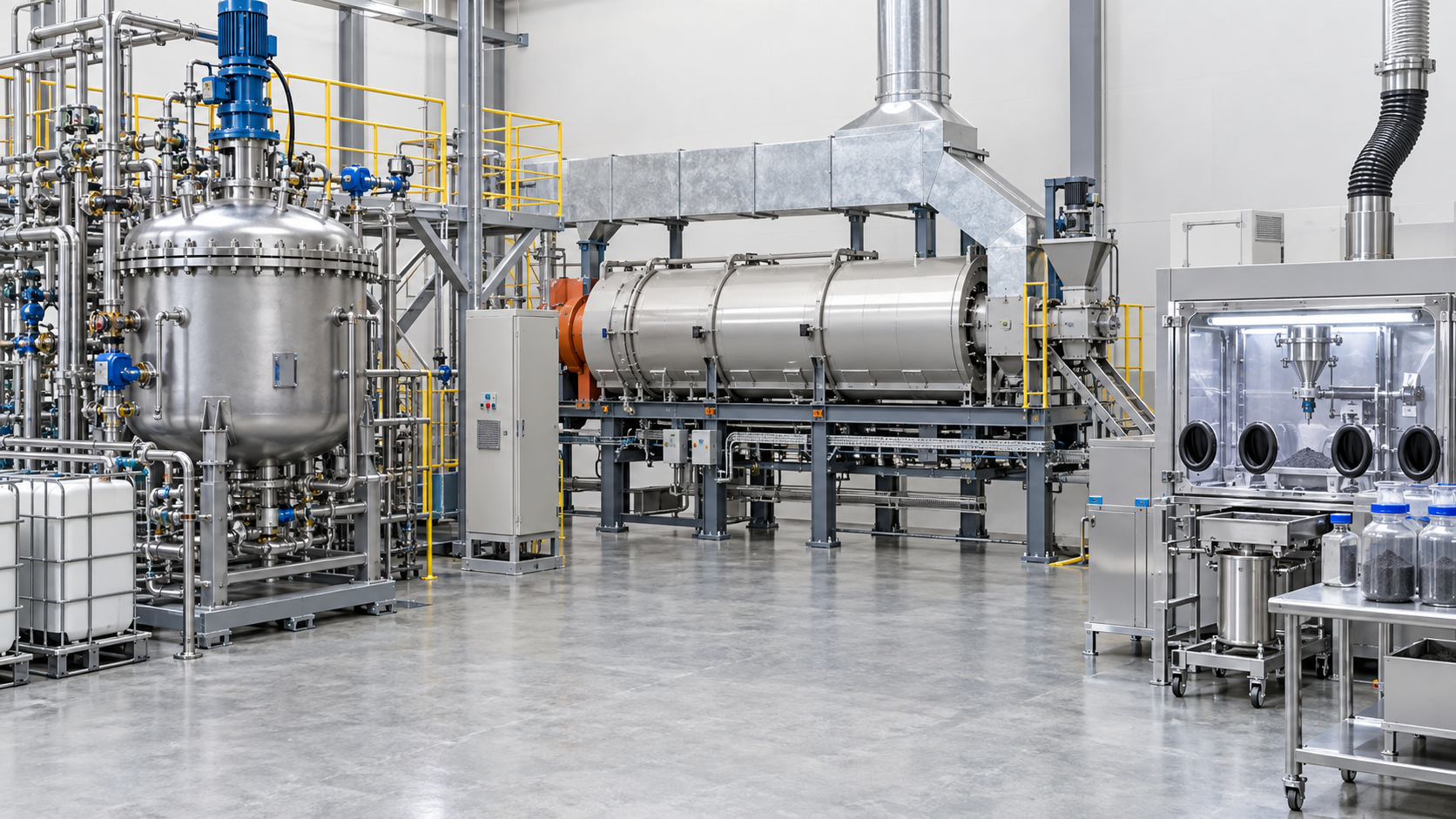
The company describes the Isoura Plant as a site that makes cathode material in one chain from crystallization to firing, and says that placing pilot equipment for the same steps in the Battery Research Laboratory's second development building lets new materials be evaluated through the same steps as mass production Sourced. The performance of a cathode powder depends heavily on the shape and size of the particles formed when precipitate is grown from a metal solution (crystallization), and on how crystals form when lithium is mixed in and fired. A material that performs in the lab is of no use if mass-production crystallization and firing conditions cannot produce the same particles, so being able to make trial batches through the same steps as mass production also matters when testing new cathodes such as those for all-solid-state batteries. The challenge the company names for the grade changeover is likewise "improving crystallization capacity" (chapter 7). This includes general explanation, and is not performance values published by SMM for any individual material.
6. What it has done so far
| When | What happened | Why it matters |
|---|---|---|
| 2018 | The 2018 medium-term plan set a target to raise cathode output to 10,000 t/month by 2027 (as stated in the 2021 release) | The plan was to grow battery materials sharply; conditions later changed |
| About 2021 | Joint research with Toyota on cathode material for all-solid-state batteries begins (October 2025 release) | The starting point for the all-solid-state work |
| July 2021 | Decision to expand cathode output for automotive batteries: a new plant in Niihama (¥40 billion) and equipment at Harima (¥7 billion), ¥47 billion in total | Eligible for a METI subsidy. Completion planned for 2025 |
| 2022 | Selected for the NEDO Green Innovation Fund (development and demonstration of battery recycling; also takes part in high-performance cathode development). Establishes, with Kanto Denka Kogyo, recycling technology for used batteries including lithium | Next-generation materials and recycling developed with public funds |
| June to September 2023 | Cathode active material using recycled nickel and cobalt passes a user demonstration test (June). Invests in Nano One and begins collaboration (September) | Recycled feedstock returned to cathode, and a foothold in LFP |
| March 2024 | Decides to build a battery recycling plant (about 10,000 tonnes a year, completion planned for June 2026). Signs partnership agreements with nine recyclers | Begins building a collection network for used batteries |
| Fiscal 2024 (to March 2025) | Impairment losses of ¥112.7 billion in nickel smelting and battery materials combined. Tangible fixed assets of battery materials written down from ¥75,888 million to ¥19,271 million. Niihama CAM Plant completed in September 2024 | An impairment reflecting the expected fall in production capacity from the grade changeover |
| May 2025 | Medium-Term Management Plan 2027 announced. Completion ceremony of the Niihama CAM Plant | Battery materials positioned as a business to be "rebuilt" |
| October to December 2025 | Joint development agreement with Toyota on cathode material for mass production for all-solid-state batteries (8 October). Second development building of the Battery Research Laboratory completed (4 December) | The company says it aims to supply and mass-produce the newly developed cathode, drawing on 20-plus years of supplying cathode to electrified vehicles |
| March to May 2026 | Wet-process section of the recycling plant starts trial operation (March). Start of sales of high-nickel NMC is "being adjusted according to customer demand" (18 May) | The wording changed from the November 2025 material, which said mass production was being prepared for a fiscal 2026 start of sales |
| September 2026 | Completion ceremony for the battery recycling plant (11 September) | A commercial-scale facility aiming for "battery-to-battery" horizontal recycling |
7. What comes next
fiscal 2027As in the Integrated Report 2026. The May 2026 material says "being adjusted according to customer demand"
around 2027 to 2028Equipment modifications planned for small-volume production, using existing sites
candidate customersEstablishing a new mass-production process (solid-phase method). Working with Nano One
(forecast as of May)The company says it expects to adjust sales volumes ahead of the grade changeover
All four items are the company's plans, targets and outlook, not results achieved Not yet confirmed. Toyota has also said it aims for practical use of all-solid-state batteries in 2027 to 2028 (release of 8 October 2025). The materials we reviewed do not, however, state any agreed supply volume, price or start date for the cathode. In its April 2023 plan to NEDO, the company said it had worked out for itself, from its assumed vehicle numbers and share, a cathode production scale for all-solid-state batteries of 0.45 GWh/year (600 t/year) in the first year, rising to 4.5 GWh/year (6,000 t/year) in year ten (commercialization around 2028 and payback around 2035 assumed) Not yet confirmed.
None of the following appears in the primary sources we reviewed Not yet confirmed.
The timing of the end of NCA sales / the customers, performance values and sales volume of high-nickel NMC / the terms of any supply contract with a customer for all-solid-state cathode, and the actual scale of mass-production equipment / actual capacity figures for NCA and NMC (monthly tonnages appear only as chart axes) / the destination of cathode that contains recycled nickel and cobalt / the amounts of subsidies paid by METI and NEDO. Press-reported figures are not used here.
8. What the company is aiming for in energy storage
This section includes points the company has not stated directly. They are inferences from what the primary sources say, and each is given with its basis.
| What can be read from it | Primary-source basis | Category |
|---|---|---|
| It will switch from NCA to high-nickel NMC and carry existing customers' demand across | The Integrated Report says demand for high-nickel NMC is expected to match that for NCA, and mass production is being prepared for a start of sales in or after fiscal 2027 | Sourced (company plan) |
| An integrated chain that uses its own nickel is its weapon against Chinese and Korean price competition | The Integrated Report says that, with Chinese and Korean competitors carrying excess capacity and cost competition intensifying, it will fight back with its NCA mass-production experience and the strength of its own nickel feedstock | Sourced (company statement) |
| All-solid-state cathode will start small | An initial 600 t/year in the April 2023 plan, and "equipment modifications for small-volume production" in the May 2026 material | Inference |
| It will broaden from EV-only to LFP and data-centre (BBU) uses | The Integrated Report says it seeks customers for consumer-type LFP cathode, such as for data centres, through its link with Nano One, and will follow existing customers in BBU applications | Sourced (company policy) |
| Recycling is meant to circulate the feedstock of cathode material (nickel, cobalt) in-house | The company says recycled nickel and cobalt go to the Isoura Plant as cathode feedstock. The March 2024 release also says the plant was designed with the metal recovery rates and recycled-content requirements of the EU Battery Regulation in view | Sourced |
The battery materials segment result went from -¥58.5 billion in fiscal 2024 to a ¥10.0 billion profit in fiscal 2025 Sourced. But the -¥58.5 billion for fiscal 2024 includes impairment losses of about ¥112.7 billion (with nickel smelting), so the fiscal 2025 profit cannot simply be read as the business's earning power coming back. The Integrated Report says demand was firm in fiscal 2025, and that NCA cathode reached "a record production volume", partly because inventory was deliberately built up for the changeover to high-nickel NMC. For fiscal 2026, the company's May forecast is a return to a ¥3.0 billion loss, which includes "sales volume adjustment ahead of the next grade changeover". From this, we read the fiscal 2025 profit as the product of a lighter charge on assets after the write-down and high-volume NCA sales, and the changeover year of fiscal 2026 as a return to loss Not yet confirmed (the first part of that mechanism is our inference, not a cause the company has given).
9. Map of partnerships in next-generation energy storage
10. Technologies, products and services
SMM's battery materials products are the powders used in a battery's positive electrode (cathode active materials). The product pages on its website and the Securities Report list the following Sourced.
| Product or area | What official materials say | Note |
|---|---|---|
| Lithium nickel oxide (NCA) | A cathode active material for lithium-ion batteries, used mainly in electric vehicles. The company says its high nickel content allows higher battery capacity and contributes to longer driving range per charge. Its stated strength is integrated production from nickel feedstock to battery material | The mainstay product. Production and sales continue according to customer demand. Figures such as capacity are not on the website |
| Ternary cathode (NMC) | Based on nickel, manganese and cobalt, and used mainly in batteries for electrified vehicles such as hybrids. The company says it is highly safe and that optimizing the composition for each use improves battery performance | High-nickel NMC is in preparation as the successor to NCA |
| Nickel hydroxide | The cathode active material of nickel-metal-hydride batteries, used mainly in hybrid vehicles, for which the company says it has a high share | Not for lithium-ion batteries. We could not find the share figure |
| All-solid-state cathode (nickel-based) | With Toyota, a "cathode material with excellent durability" suited to all-solid-state batteries was newly developed using SMM's own powder-synthesis technology (October 2025). Degradation of the cathode material over repeated charging and discharging had been the issue | In development. Mass production is the company's target (around 2027 to 2028) |
| LFP cathode | Product and technology development continues toward a new mass-production process (solid-phase method), and candidate customers are evaluating it | Specifications and mass-production timing could not be confirmed. We also could not confirm the type of cathode bought from subsidiary SMM Vietnam |
| Battery recycling (smelting segment) | Recovers nickel, cobalt, lithium and copper from used automotive batteries and other sources. Recovered nickel and cobalt are sent as a mixed solution to the Isoura Plant and used as cathode feedstock. About 10,000 tonnes a year in battery-cell terms | In trial operation. The company describes it as the first at commercial scale in Japan (its own survey) |
The company describes nickel-based cathode production as integrated from ore to smelting to intermediates such as nickel sulfate to cathode material Sourced. Its 2021 release says that higher nickel content in cathode material is advancing and widening the field in which its technology is useful. As a general point, the higher the nickel share, the more capacity can be drawn from the same cathode material, but the crystal structure tends to become less stable, so surface treatment and control of the particle structure matter all the more. The company's stated development directions, "surface treatment", "crystallinity control" and "particle-structure control", address exactly this (the foregoing is our own general explanation).
In an all-solid-state battery the electrolyte is a solid, so the contact between cathode particles and the solid electrolyte becomes important. The company's 2023 plan to NEDO said smaller cathode particles are preferable to increase contact with the solid electrolyte, and set 80% or more capacity retention at 300 cycles as one of its targets (a development target at that time, not a reported result). The challenge the company names for the grade changeover is improving crystallization capacity Sourced. Conversely, measured capacity, power and life figures for SMM's individual cathode materials could not be confirmed from official materials Not yet confirmed. This article does not compare them with other makers' materials.
11. The risks this company carries
| Risk | What it involves | Category |
|---|---|---|
| Slower EV demand and tougher competition | The Securities Report says the battery materials environment is changing rapidly with slower EV demand and the rise of overseas battery makers, and that price and technology competition has intensified. The Integrated Report says Chinese and Korean competitors hold excess capacity and cost competition is fierce | Sourced |
| Grade changeover (NCA to high-nickel NMC) | A fall in production capacity is expected from the planned grade changeover, and the business plan reflects a recovery in sales volume after it (Securities Report, audit report). The stated start of sales for high-nickel NMC moved from "fiscal 2026" in the November 2025 material, to "fiscal 2027 or later" in the Integrated Report, to "being adjusted according to customer demand" in May 2026 | Sourced |
| Impairment of fixed assets | Fixed assets of battery materials were written down in fiscal 2024. For the remaining ¥27,628 million (0.8% of consolidated total assets) the company sees no sign of impairment, but the auditor lists as a key audit matter that if the business plan has to be revised, operating results and cash flows could be affected | Sourced |
| Limited visibility on customers and trade | The company names Toyota as a main delivery destination, but disclosure of customer-level breakdown, sales volumes and actual capacity for battery materials is limited, so progress cannot be fully verified from outside | Not yet confirmed |
| Changes in trade and policy | The Securities Report cites protectionist policies including additional US tariffs, Chinese export controls and a worsening Middle East situation as possible causes of slower customer sales, price-cut demands and supply disruption. The May 2026 material also says the end of support policies in various countries slows EV market growth. This article has not checked the content and stage of these measures against government sources | Sourced (company statement) |
| Collection of recycling feedstock | Domestic supply of black mass (concentrate from used batteries) was lower than expected, so the company revised its plan toward more overseas black mass and priority processing of battery scrap. The fiscal 2030 KPI is 10,000 tonnes a year; the fiscal 2025 result was zero (under construction) | Sourced |
| Timing of practical use of all-solid-state batteries | Mass production of the cathode depends on practical use of all-solid-state batteries themselves (Toyota aims for 2027 to 2028). A delay there could shift the timing of cathode mass production | Inference |
12. Glossary
- Cathode material (cathode active material)
- The powder that forms a battery's positive electrode. It takes lithium ions in and out, and strongly affects capacity, life and safety.
- NCA
- A nickel cobalt aluminum oxide cathode (lithium nickel oxide). Its high nickel share makes high capacity easier.
- NMC / high-nickel
- A nickel manganese cobalt oxide cathode. Versions with a raised nickel share are called high-nickel.
- LFP
- Lithium iron phosphate. A cathode without nickel or cobalt, used in automotive and data-centre batteries.
- All-solid-state battery
- A battery whose electrolyte is a solid instead of a liquid. Contact between cathode and solid electrolyte becomes important.
- Precursor
- The powder one step before cathode material. It is precipitated from a metal solution, then mixed with lithium and fired.
- Crystallization / firing
- Crystallization grows particles from a solution. Firing mixes in lithium and heats the powder to form the cathode's crystal structure.
- Black mass
- A black powder concentrate obtained by making used lithium-ion batteries safe, shredding and sorting them. It contains nickel, cobalt and other metals.
- Green Innovation Fund
- A fund run by NEDO to support development and demonstration of decarbonization technologies in Japan, including next-generation batteries.
- BBU
- Battery backup unit. A battery unit placed per rack in a data centre to cover momentary power interruptions.
- Segment result
- Profit or loss by business. SMM reports under IFRS and groups battery materials and functional materials together as "Materials".
13. References
- Sumitomo Metal Mining 101st Securities Report (1 April 2025 to 31 March 2026, filed 24 June 2026), in Japanese. Business description, history, capital expenditure, R&D, employees, main customers, impairment of battery materials and key audit matters, shareholdings, and progress of Medium-Term Management Plan 2027. https://www.smm.co.jp/ir/library/quarterly/pdf/2025/no101_yuho.pdf
- Sumitomo Metal Mining Integrated Report 2026 (1 April 2025 to 31 March 2026), in Japanese. Overview of the battery materials business, charts of revenue and segment profit, the changeover to high-nickel NMC, all-solid-state development, LFP and R&D. https://www.smm.co.jp/ir/library/integrated_report/pdf/2026/2026_All.pdf
- Sumitomo Metal Mining Fiscal 2026 business strategy briefing (May) materials (18 May 2026), in Japanese. Results comparison (battery materials segment profit and fiscal 2026 forecast), progress in battery materials, progress of the recycling plant. https://www.smm.co.jp/ir/event/roadshow/pdf/2025/260518_setsumeikai.pdf
- Sumitomo Metal Mining Fiscal 2025 business strategy briefing (November) materials (17 November 2025), in Japanese. Battery materials (response to the new grade, all-solid-state and LFP cathode development). https://www.smm.co.jp/ir/event/roadshow/pdf/2025/251117_setsumeikai.pdf
- Sumitomo Metal Mining Summary of first-quarter results for the year to March 2027 (10 August 2026), in Japanese. Battery materials demand, first-quarter segment profit and full-year forecast. https://www.smm.co.jp/ir/library/results/pdf/2026/20260810.pdf
- Sumitomo Metal Mining Decision to expand cathode material output for automotive batteries: new plant in the Besshi area (6 July 2021), in Japanese. https://www.smm.co.jp/news/release/uploaded_files/20210706_J.pdf
- Sumitomo Metal Mining Decision to build a lithium-ion battery recycling plant and partnership agreements (28 March 2024), in Japanese. https://www.smm.co.jp/news/release/uploaded_files/20240328_JP.pdf
- Sumitomo Metal Mining and Toyota Motor SMM and Toyota collaborate toward mass production of cathode material for all-solid-state batteries (8 October 2025), in Japanese. https://www.smm.co.jp/news/release/uploaded_files/20251008_JP.pdf
- Sumitomo Metal Mining Second development building of the Battery Research Laboratory completed (4 December 2025), in Japanese. https://www.smm.co.jp/news/release/uploaded_files/20251204_JP.pdf
- Sumitomo Metal Mining Completion ceremony for the battery recycling plant (release dated 14 September 2026; ceremony on 11 September), in Japanese. https://www.smm.co.jp/news/release/uploaded_files/20260914_PressRelease.pdf
- Sumitomo Metal Mining (NEDO publication) Business strategy vision, "Development and demonstration of high-performance cathode materials for next-generation batteries" (as of April 2023), in Japanese. Business plan, funding plan and R&D targets. https://green-innovation.nedo.go.jp/resources/pdf/next-generation-storage-batteries-motors/item-001-1/vision-smm-002.pdf
- NEDO Green Innovation Fund project: development of next-generation storage batteries and motors (project overview), in Japanese. List of selected participants and their development topics. https://www.nedo.go.jp/content/100945458.pdf
- Nano One Materials Nano One and Sumitomo Metal Mining Advance Collaboration on LFP Commercialization (17 September 2025). Background to the September 2023 investment of C$16.9 million and the collaboration. https://www.newswire.com/news/nano-one-and-sumitomo-metal-mining-advance-collaboration-on-lfp
- Sumitomo Metal Mining Materials product page: lithium nickel oxide (NCA), in Japanese. https://www.smm.co.jp/business/material/products/nickel_lite/
- Sumitomo Metal Mining Materials product page: ternary cathode (NMC), in Japanese. https://www.smm.co.jp/business/material/products/nmc/
- Sumitomo Metal Mining Materials product page: nickel hydroxide, in Japanese. https://www.smm.co.jp/business/material/products/hydroxide/
- Sumitomo Metal Mining Official website (source of the logo). https://www.smm.co.jp/
14. Claim-to-source audit
| Claim in the article | Category | Source |
|---|---|---|
| Legal name, head office, move to the Tokyo Stock Exchange Prime Market (April 2022), the three segments, and filing on 24 June 2026 | Sourced | Reference 1 https://www.smm.co.jp/ir/library/quarterly/pdf/2025/no101_yuho.pdf |
| Consolidated revenue (¥1,593,348 million and ¥1,741,586 million), profit before tax, and Materials segment revenue (¥296,513 million to ¥284,509 million) and result (-¥54,231 million to ¥15,290 million) | Sourced | Reference 1 https://www.smm.co.jp/ir/library/quarterly/pdf/2025/no101_yuho.pdf |
| R&D expenses of ¥9,050 million (Materials ¥5,953 million), capex of ¥137,490 million (Materials ¥27,012 million), the fiscal 2026 Materials capex plan of ¥22,400 million, and 7,507 employees (Materials 2,525, temporary 190) | Sourced | Reference 1 https://www.smm.co.jp/ir/library/quarterly/pdf/2025/no101_yuho.pdf |
| Battery materials revenue (¥180.3 billion in fiscal 2024, ¥160.7 billion in fiscal 2025) and segment result (-¥58.5 billion, ¥10.0 billion, fiscal 2026 May forecast -¥3.0 billion) | Sourced | Reference 2 and 3 https://www.smm.co.jp/ir/library/integrated_report/pdf/2026/2026_All.pdf https://www.smm.co.jp/ir/event/roadshow/pdf/2025/260518_setsumeikai.pdf |
| Impairment losses of ¥112.7 billion in nickel smelting and battery materials, and the fiscal 2026 forecast for battery materials | Sourced | Reference 3 https://www.smm.co.jp/ir/event/roadshow/pdf/2025/260518_setsumeikai.pdf |
| Write-down of battery materials tangible fixed assets from ¥75,888 million to ¥19,271 million, Materials segment impairment loss of ¥56,617 million, remaining ¥27,628 million (0.8% of total assets), and the key audit matter | Sourced | Reference 1 https://www.smm.co.jp/ir/library/quarterly/pdf/2025/no101_yuho.pdf |
| Main customers (Panasonic Holdings 14.2%, Sumitomo Electric Industries 10.4%, Tanaka Kikinzoku Kogyo 10.1%), the purpose of holding Toyota shares, and Toyota as a major shareholder (4.09%) | Sourced | Reference 1 https://www.smm.co.jp/ir/library/quarterly/pdf/2025/no101_yuho.pdf |
| Battery materials demand held firm and first-quarter segment profit above the prior-year period in fiscal 2026 | Sourced | Reference 5 https://www.smm.co.jp/ir/library/results/pdf/2026/20260810.pdf |
| Completion of the Niihama CAM Plant (September 2024) and ceremony (May 2025), NCA on line 1, high-nickel NMC trials on line 2, preparation for the end of NCA sales, and record NCA output | Sourced | Reference 1 and 2 https://www.smm.co.jp/ir/library/quarterly/pdf/2025/no101_yuho.pdf https://www.smm.co.jp/ir/library/integrated_report/pdf/2026/2026_All.pdf |
| Start of sales of high-nickel NMC (November 2025: preparing for fiscal 2026; Integrated Report: fiscal 2027 or later; May 2026: being adjusted according to customer demand) | Sourced | References 2, 3, 4 https://www.smm.co.jp/ir/library/integrated_report/pdf/2026/2026_All.pdf https://www.smm.co.jp/ir/event/roadshow/pdf/2025/260518_setsumeikai.pdf https://www.smm.co.jp/ir/event/roadshow/pdf/2025/251117_setsumeikai.pdf |
| Investment decision of ¥47 billion in total, final capacity of 2,000 t/month, the 2018 plan target of 10,000 t/month, and eligibility for a subsidy | Sourced | Reference 6 https://www.smm.co.jp/news/release/uploaded_files/20210706_J.pdf |
| Decision to build the recycling plant (about 10,000 tonnes a year, completion planned June 2026, nine partner recyclers, Kanto Denka Kogyo joint development, 2022 NEDO selection, June 2023 user test) | Sourced | Reference 7 https://www.smm.co.jp/news/release/uploaded_files/20240328_JP.pdf |
| Completion ceremony for the recycling plant (11 September 2026), first at commercial scale in Japan (own survey), recovered nickel and cobalt sent to the Isoura Plant, and NEDO support | Sourced | Reference 10 https://www.smm.co.jp/news/release/uploaded_files/20260914_PressRelease.pdf |
| Joint development agreement with Toyota (8 October 2025), joint research since about 2021, Toyota's 2027 to 2028 target, and 20-plus years of supplying cathode | Sourced | Reference 8 https://www.smm.co.jp/news/release/uploaded_files/20251008_JP.pdf |
| Completion of the second development building (4 December 2025), the integrated crystallization-to-firing development line, and NEDO-eligible pilot equipment | Sourced | Reference 9 https://www.smm.co.jp/news/release/uploaded_files/20251204_JP.pdf |
| Mass production of all-solid-state cathode targeted around 2027 to 2028, equipment modifications for small-volume production, nickel sulfate output cut at Harima in fiscal 2026, and the change in black mass collection | Sourced | Reference 3 https://www.smm.co.jp/ir/event/roadshow/pdf/2025/260518_setsumeikai.pdf |
| LFP cathode evaluation by candidate customers, link with Nano One, data-centre and BBU uses, high-nickel NMC demand matching NCA, and competitors' excess capacity | Sourced | Reference 2 https://www.smm.co.jp/ir/library/integrated_report/pdf/2026/2026_All.pdf |
| C$16.9 million investment in Nano One (September 2023) and progress of the collaboration (September 2025) | Sourced | Reference 13 https://www.newswire.com/news/nano-one-and-sumitomo-metal-mining-advance-collaboration-on-lfp |
| NEDO plan for high-performance cathode material (total funding need of about ¥9.1 billion, about ¥3.3 billion state share, about ¥5.8 billion own share, commercialization around 2028, payback around 2035, production scale assumption, 80% retention at 300 cycles) | Not yet confirmed | Reference 11 https://green-innovation.nedo.go.jp/resources/pdf/next-generation-storage-batteries-motors/item-001-1/vision-smm-002.pdf |
| SMM is a participant for high-performance cathode material and for recycling under the Green Innovation Fund | Sourced | Reference 12 https://www.nedo.go.jp/content/100945458.pdf |
| Product descriptions of NCA, NMC and nickel hydroxide (uses, strengths, the company's statement on share) | Sourced | References 14, 15, 16 https://www.smm.co.jp/business/material/products/nickel_lite/ https://www.smm.co.jp/business/material/products/nmc/ https://www.smm.co.jp/business/material/products/hydroxide/ |
| Business risks cited: additional US tariffs, Chinese export controls, the Middle East situation; battery materials conditions (slower EV demand, rise of overseas battery makers) | Sourced | Reference 1 https://www.smm.co.jp/ir/library/quarterly/pdf/2025/no101_yuho.pdf |
| Actual revenue, results and capacity for NCA alone, a customer-level breakdown, performance values (capacity, power, life), subsidy amounts, and customers and volumes for high-nickel NMC | Not yet confirmed | References 1, 2, 3, 14 https://www.smm.co.jp/ir/library/quarterly/pdf/2025/no101_yuho.pdf https://www.smm.co.jp/ir/library/integrated_report/pdf/2026/2026_All.pdf https://www.smm.co.jp/ir/event/roadshow/pdf/2025/260518_setsumeikai.pdf https://www.smm.co.jp/business/material/products/nickel_lite/ |
| University joint research on all-solid-state cathode, any sale or restructuring of the battery materials business, and the type and capacity of cathode from SMM Vietnam | Not yet confirmed | References 1, 2, 3 https://www.smm.co.jp/ir/library/quarterly/pdf/2025/no101_yuho.pdf https://www.smm.co.jp/ir/library/integrated_report/pdf/2026/2026_All.pdf https://www.smm.co.jp/ir/event/roadshow/pdf/2025/260518_setsumeikai.pdf |
| The four-type classification (cells & materials, long-duration & new chemistries, storage systems, recycling) and SMM's position (primary: cells & materials, secondary: recycling) | Our calculation | Our own classification; company names are examples from those covered in this series |
| The reading that the fiscal 2025 profit came from a lighter charge on assets after the write-down together with high-volume NCA sales | Inference | Our own reading of the impairment and sales descriptions; not a cause the company has given |
| The reading that all-solid-state cathode will start in small volumes | Inference | Our own reading of the April 2023 production scale and the "small-volume production" equipment modification |
| The risk that a delay in practical use of all-solid-state batteries shifts cathode mass-production timing | Inference | Our own outlook, because the cathode depends on all-solid-state practical use |
| The relation between nickel share, crystal stability and control of surface and particle structure (general points) | Our calculation | This is our own general commentary and not SMM's performance values |
| Checking of the content and stage of subsidies, tariffs and regulations | Not yet confirmed | This article has not checked these against government or regulatory sources and keeps to the company's own statements |
Last updated 10 October 2026 / Troy Technical
Figures in this article come from SMM's Securities Report, Integrated Report, results materials, official releases and NEDO public documents. No research-firm estimates or press-reported figures have been used. Items marked "Inference" are our reading of the primary sources and are not statements by the company. The company's plans and targets are not yet confirmed and are not results achieved.