INSTITUTION PROFILE / NEXT-GEN ENERGY STORAGE
UL Solutions
The US testing and certification company behind the certification marks on energy storage systems
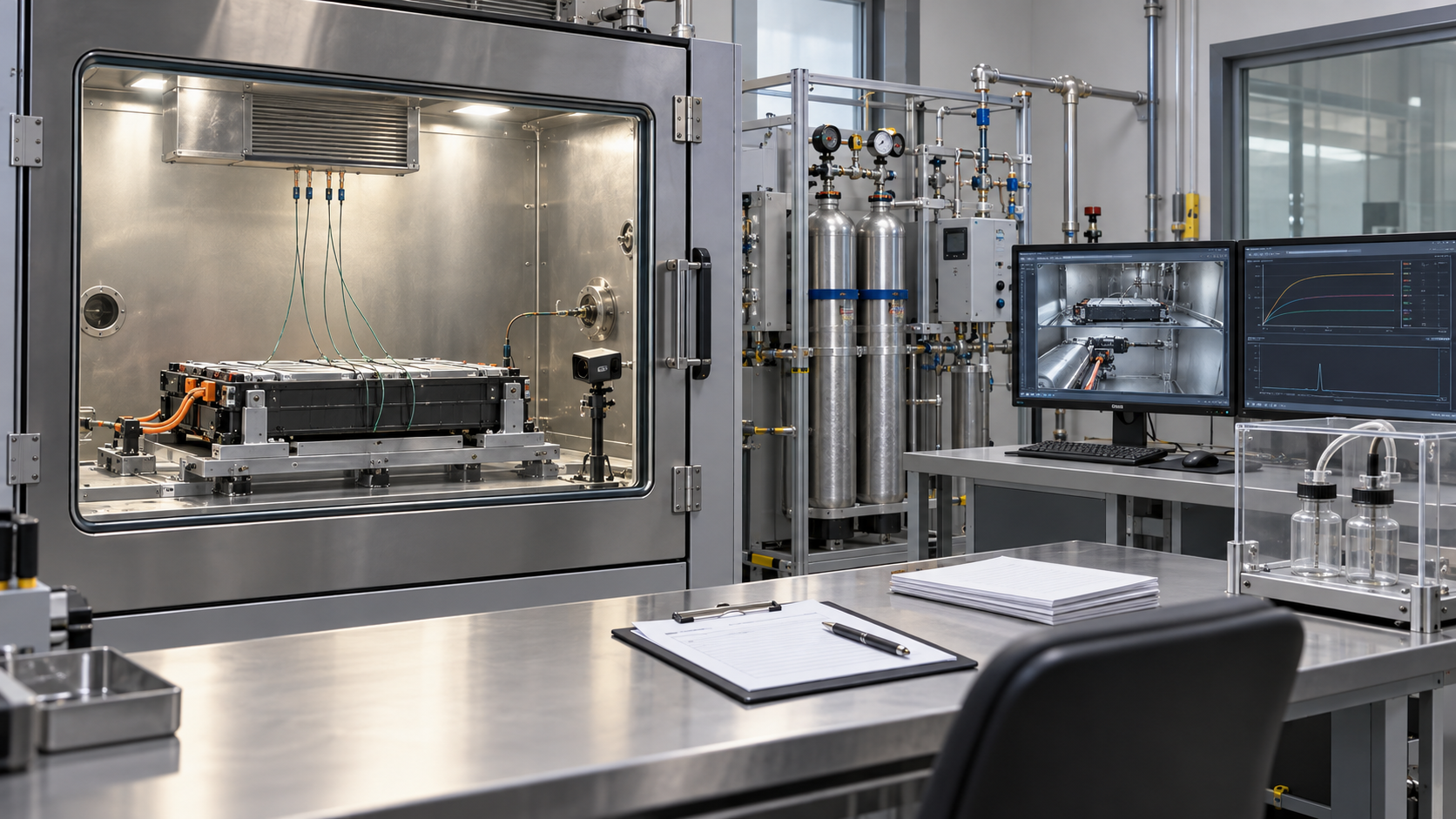
UL Solutions is a US company that does not make batteries. Its business is testing battery cells and storage systems and, where they meet a standard, allowing the certification mark to be used. The standards that come up constantly in energy storage, including UL 9540, UL 9540A and UL 1973, are written by a separate nonprofit, UL Standards & Engagement; UL Solutions tests and certifies against them. Certification is not a law, but when a state fire code requires an energy storage system to be certified to UL 9540, certification becomes a practical condition of putting the system on the market. This profile looks only at energy storage: how that arrangement works and how far its influence reaches.
- UL Solutions in 30 seconds
- What kind of body it is: the four types of influence
- What it does for energy storage
- How far its influence reaches (powers and geography)
- The stack of standards from cell to installation, and who is involved
- Outlook
- Glossary, references and claim-to-source audit
1. UL Solutions in 30 seconds
UL Solutions is neither the writer of the standards nor the party that demands certification. UL Standards & Engagement writes the standards; state and local fire codes and fire officials (AHJs) demand certification; UL Solutions is the company in between that does the testing and certifying. UL Solutions itself says in its annual report that it tests and inspects but does not act as an AHJ or other enforcement body Sourced. Even so, its influence is large, because the 2025 Fire Code of New York State, for example, provides in Section 1207.3.1 that an ESS "shall be listed in accordance with UL 9540". Once a code makes certification a condition, certification becomes a practical condition of market entry Sourced.
2. What kind of body it is: the four types of influence
The institutions that appear in energy storage coverage do not make batteries themselves, unlike companies. They can be grouped into four types by the route through which they influence the industry.
3. What it does for energy storage
UL Solutions' services are testing and certification to published standards. For energy storage the following standards are used Sourced. Numbers and titles follow the UL Standards & Engagement catalog.
| Standard | Title and edition | Scope and role |
|---|---|---|
| UL 9540 | Energy Storage Systems and Equipment. Third edition, issued 28 June 2023, last revised 7 March 2025 | The safety standard for the whole energy storage system (ESS). It covers electrochemical, chemical, mechanical and thermal systems, whether grid-connected or standalone. An ESS is defined as having at least an energy storage function and a protective function. UL Solutions calls it the basis for certifying the complete system |
| UL 9540A | Test Method for Evaluating Thermal Runaway Fire Propagation in Battery Energy Storage Systems. Sixth edition dated 13 March 2026 (the fifth edition came out in 2025) | A test method, not a pass/fail certification standard. It examines how thermal runaway spreads at the cell, module, unit and installation levels, and the data supports decisions on spacing and on the fire and explosion protection an installation needs |
| UL 1973 | Batteries for Use in Stationary and Motive Auxiliary Power Applications. Third edition, issued 25 February 2022 | The safety standard for battery systems. Its stationary applications include storage for solar and wind power and uninterruptible power supplies, and it also covers light electric rail. It does not evaluate performance or lifetime, but whether the system withstands abusive conditions safely |
| UL 1642 | Lithium Batteries. Sixth edition, issued 29 September 2020, last revised 12 October 2022 | A cell-level standard aimed at reducing the risk of fire or explosion; whether a battery is finally acceptable depends on the complete product. UL Solutions says cells have traditionally been certified to it, but that it focused on portable consumer applications and was not tailored to stationary use |
| UL 9540B | Outline of Investigation for Large-Scale Fire Test for Residential Battery Energy Storage Systems | A document listed on UL Solutions' service page. By its name it is an outline of investigation rather than a standard. Its edition and date were not checked for this profile |
What earns UL 9540 or UL 1973 certification is a finished product, a cell or a storage system. Electrolytes, separators and encapsulants are not themselves certified under UL 9540. Materials suppliers are affected because UL 1973 examines whether a system withstands abusive conditions safely, and UL 9540A examines how thermal runaway spreads. A material is judged through the design of the cell or system that passes these tests. UL 1642 likewise aims to reduce the fire and explosion risk of cells, and says that final acceptability is decided at the level of the complete product Sourced. This differs from the role UL Solutions plays in adhesives and encapsulants, where it tests the materials themselves for properties such as flame retardancy Our calculation.
4. How far its influence reaches (powers and geography)
| Dimension | What UL Solutions has | What UL Solutions does not have |
|---|---|---|
| Powers | The power to test and certify to a standard and to allow use of its certification mark, with periodic inspections afterwards. It takes part in the technical committees that write standards on an equal footing with other testing companies. It also sells advice on code compliance | The power to set a standard alone (that belongs to UL Standards & Engagement), to make codes or laws, or to approve and enforce installations as an AHJ. Nor does it have a monopoly on UL 9540 testing and certification: Intertek and other laboratories also advertise services to the same standard |
| Geography | Customers in more than 110 countries. UL 9540A, UL 9540 and UL 1973 operate as US and Canadian national standards, and North American codes cite them | The conformity frameworks that laws outside the US and Canada require (EU and Japanese schemes were not checked for this profile) |
| Basis of force | The requirement for certification sits in the code. The 2025 Fire Code of New York State requires ESS to be listed to UL 9540 (Section 1207.3.1) and large-scale fire testing to be done to UL 9540A (Section 1207.1.7) | Legal force for certification itself, or a requirement in a jurisdiction that has not adopted such a code. There are exceptions (for example, lead-acid battery systems in telecommunications facilities are exempt from Section 1207.3.1) |
| Duration | The standards keep being revised: UL 9540A had its sixth edition in March 2026 and UL 9540 was revised in March 2025 | Authority to decide whether certification to an older edition lapses when a new one appears (that depends on each certifier and jurisdiction) |
| Scale | 14,587 full-time employees and US$3,053 million in revenue (2025, all fields combined). It runs lithium-ion battery test laboratories and bought a German battery testing company in May 2024 (annual report) | Energy-storage-specific revenue or headcount could not be confirmed |
What "UL certified" means depends on which standard (UL 9540, UL 1973 or UL 1642) and which level it was obtained for. UL 1642 concerns the cell, UL 1973 the battery system and UL 9540 the whole storage system, and a certificate at a higher level does not stand in for one at a lower level. UL 9540A is a test method; having a report is not the same as having "passed" Sourced. When a company announces that it has "completed UL 9540A testing at the cell level", that does not mean the whole system holds a UL 9540 certification.
5. The stack of standards from cell to installation, and who is involved
| Organisation | Relationship to UL Solutions (as stated in primary sources) |
|---|---|
| UL Standards & Engagement (ULSE) | The nonprofit that publishes UL 9540, UL 9540A, UL 1973 and UL 1642. It is also UL Solutions' controlling shareholder, with 94.1% of the voting power. The annual report says UL Solutions takes part in ULSE's technical committees on an equal footing with other testing companies, and lists the conflict of interest between writing a standard and certifying to it as a risk factor |
| NFPA | The installation standard NFPA 855 cites UL 9540A as a test method, and the scope of UL 9540 mentions NFPA 855. See our NFPA profile |
| States, cities and fire officials (AHJ) | They adopt, administer and enforce the codes. UL Solutions' annual report notes that AHJs demand certification of certain products, and that UL Solutions is not an AHJ |
| Intertek | Advertises UL 9540 and UL 9540A testing and certification services on its own site. More than one laboratory provides UL 9540 testing |
| Battery and system developers | Our profiles of Form Energy and Alsym Energy contain passages where each company says it has completed UL 9540A testing at the cell level, or mentions it on its technology page. These are company statements; the testing laboratory and the reports could not be confirmed |
6. Outlook
| What can be read | Primary source behind it | Type |
|---|---|---|
| UL 9540A has a sixth edition dated 13 March 2026, which revised the installation-level testing for large-scale fire testing | UL Standards & Engagement catalog | Sourced |
| Revision proposals are posted for UL 9540, UL 9540A, UL 1973 and UL 1642 (the latest: UL 9540 on 29 May 2026, UL 9540A on 31 August 2026, UL 1973 on 18 September 2026). Their content was not checked for this profile | Proposal lists in the catalog (dates only) | Not yet confirmed |
| The fifth edition of UL 9540A includes test methods for non-lithium-ion batteries such as sodium-ion | UL Solutions release (16 April 2025) | Sourced |
| Batteries with new chemistries are likely to be assessed first with the existing test method (UL 9540A) in more cases. Which chemistries must pass which tests will still be decided by each jurisdiction's code | The additions in the fifth edition of UL 9540A, and the way codes cite tests | Inference |
| Large-scale fire testing may run in parallel as work inside UL 9540A and as a separate standard (CSA/ANSI C800) that NFPA 855 would cite | NFPA 855 TIA 1852 (submitted by CSA Group) and the revisions in the sixth edition of UL 9540A. The outcome of TIA 1852 could not be confirmed | Inference |
7. Glossary
- TIC
- Testing, inspection and certification. Services in which a third party confirms that a product meets a standard.
- ESS / BESS
- Energy storage system / battery energy storage system. A BESS is an ESS that uses batteries.
- AHJ
- Authority having jurisdiction. The fire or building authority that approves and inspects an installation.
- Thermal runaway
- A chain reaction in which heat released inside a battery drives its temperature up rapidly. UL 9540A examines how it spreads.
- Listing
- A third party's confirmation that a product meets a standard, with permission to use its certification mark. It is not itself a law.
8. References
- UL Solutions Inc. Annual Report on Form 10-K for the fiscal year ended December 31, 2025 (headcount, revenue, headquarters, history, relationship with ULSE and voting power, relationship with AHJs, battery laboratories and the acquisition). https://www.sec.gov/Archives/edgar/data/1901440/000190144026000005/uls-20251231.htm
- UL Solutions About UL Solutions (more than 110 countries; more than 140 offices and laboratories). https://www.ul.com/about
- UL Solutions Energy Storage System Testing and Certification (services for UL 9540, 9540A, 9540B, 1973 and others, and how each standard is described). https://www.ul.com/services/energy-storage-system-testing-and-certification
- UL Solutions News release (16 April 2025: fifth edition of UL 9540A; relationship to UL 9540 and NFPA 855). https://www.ul.com/news/ul-solutions-enhances-battery-energy-storage-system-safety-test-methods-address-industry
- UL Solutions Battery Certification Services for Cell Manufacturers (how UL 1642 and UL 1973 are positioned). https://www.ul.com/services/battery-certification-services-cell-manufacturers
- UL Standards & Engagement UL 9540 catalog page (title, third edition, issued 28 June 2023, revised 7 March 2025, scope, dates of revision proposals). https://www.shopulstandards.com/ProductDetail.aspx?productId=UL9540
- UL Standards & Engagement UL 9540A catalog page (title, sixth edition dated 13 March 2026, scope, date of revision proposal). https://www.shopulstandards.com/ProductDetail.aspx?productId=UL9540A
- UL Standards & Engagement UL 1973 catalog page (title, third edition, issued 25 February 2022, scope, date of revision proposal). https://www.shopulstandards.com/ProductDetail.aspx?productId=UL1973
- UL Standards & Engagement UL 1642 catalog page (title, sixth edition, issued 29 September 2020, revised 12 October 2022, scope). https://www.shopulstandards.com/ProductDetail.aspx?productId=UL1642_6_S_20200929
- New York State Department of State 2025 Fire Code of New York State (July 2025; Sections 1207.3.1, 1207.1.7 and 1203.1.10). https://dos.ny.gov/system/files/documents/2025/07/2025fcnys_noa_2025-07-24.pdf
- Intertek UL 9540 Testing and Certification Services (UL 9540 testing and certification offered by another laboratory). https://www.intertek.com/batteries/ul-9540/
- NFPA Proposed TIA 1852 (proposal for NFPA 855 to cite CSA/ANSI C800; comment closing date 17 October 2025). https://docinfofiles.nfpa.org/files/AboutTheCodes/855/NFPA_855_Proposed_TIA_1852.pdf
9. Claim-to-source audit
| Claim in the text | Type | Reference |
|---|---|---|
| 14,587 full-time and 264 part-time employees (31 December 2025), about 9,900 technical staff, revenue of US$3,053 million (2025), headquarters, history, ULSE's 94.1% of the voting power, not acting as an AHJ, AHJs demanding certification, battery laboratories and the May 2024 acquisition | Sourced | Reference 1 https://www.sec.gov/Archives/edgar/data/1901440/000190144026000005/uls-20251231.htm |
| Customers in more than 110 countries | Sourced | Reference 2 https://www.ul.com/about |
| Services for UL 9540B and UL 1973, the standards UL 9540 refers to, and how UL Solutions describes each standard | Sourced | Reference 3 https://www.ul.com/services/energy-storage-system-testing-and-certification |
| What the fifth edition of UL 9540A added (non-lithium-ion batteries), its relationship to UL 9540 and NFPA 855, and publication of the fifth edition by ULSE | Sourced | Reference 4 https://www.ul.com/news/ul-solutions-enhances-battery-energy-storage-system-safety-test-methods-address-industry |
| UL 1642 as the traditional cell standard focused on portable use; cells can be certified to UL 1973 | Sourced | Reference 5 https://www.ul.com/services/battery-certification-services-cell-manufacturers |
| Title, edition, dates and scope of UL 9540; revision proposals (latest 29 May 2026) | Sourced | Reference 6 https://www.shopulstandards.com/ProductDetail.aspx?productId=UL9540 |
| Title of UL 9540A, sixth edition (13 March 2026), scope, revision proposal (31 August 2026) | Sourced | Reference 7 https://www.shopulstandards.com/ProductDetail.aspx?productId=UL9540A |
| Title of UL 1973, third edition (issued 25 February 2022), scope, revision proposal (18 September 2026) | Sourced | Reference 8 https://www.shopulstandards.com/ProductDetail.aspx?productId=UL1973 |
| Title of UL 1642, sixth edition, issue and revision dates, scope | Sourced | Reference 9 https://www.shopulstandards.com/ProductDetail.aspx?productId=UL1642_6_S_20200929 |
| The 2025 Fire Code of New York State requires ESS to be listed to UL 9540 and large-scale fire testing to UL 9540A, and its exceptions | Sourced | Reference 10 https://dos.ny.gov/system/files/documents/2025/07/2025fcnys_noa_2025-07-24.pdf |
| Intertek also offers UL 9540 testing and certification | Sourced | Reference 11 https://www.intertek.com/batteries/ul-9540/ |
| TIA 1852 (proposal to cite CSA/ANSI C800) | Sourced | Reference 12 https://docinfofiles.nfpa.org/files/AboutTheCodes/855/NFPA_855_Proposed_TIA_1852.pdf |
| The four-type grouping of institutions, the division of roles in Fig. 2 and the materials engineer's reading | Our calculation | This article's own synthesis |
| The laboratories and reports behind the Form Energy and Alsym Energy tests, energy-storage-specific revenue and headcount, the content of revision proposals, the edition and date of UL 9540B, and any link to EU or Japanese schemes | Not yet confirmed | Not stated in References 1-12, or could not be confirmed. This article does not estimate them |
| The two items in the Outlook marked as inferences (assessment of new chemistries; parallel large-scale fire testing) | Inference | This article's reading of References 4, 7 and 12 |
Last updated October 2026 / Troy Technical
Figures and dates come from UL Solutions' annual report and service pages, the UL Standards & Engagement catalog and the New York State Department of State. Items marked "Inference" are this article's reading of the primary sources. The standards themselves were not consulted.