TECHNOLOGY EXPLAINER
Cell Formats and Cell-to-Pack
— "Wh/kg at the pack" is a number with a denominator
Battery cells come in three main formats: cylindrical, prismatic and pouch. A different format means a different casing, a different way of winding the electrodes and a different way of cooling. More recently, cell-to-pack (CTP) designs drop the module and put cells directly into the pack, and cell-to-body / cell-to-chassis designs make the pack part of the vehicle. Yet a study of real vehicles reports that pack-level volumetric energy density falls in similar ranges whatever the cell format. Between the number for the cell and the number for the pack, something is inserted. That is where materials and structure do their work.
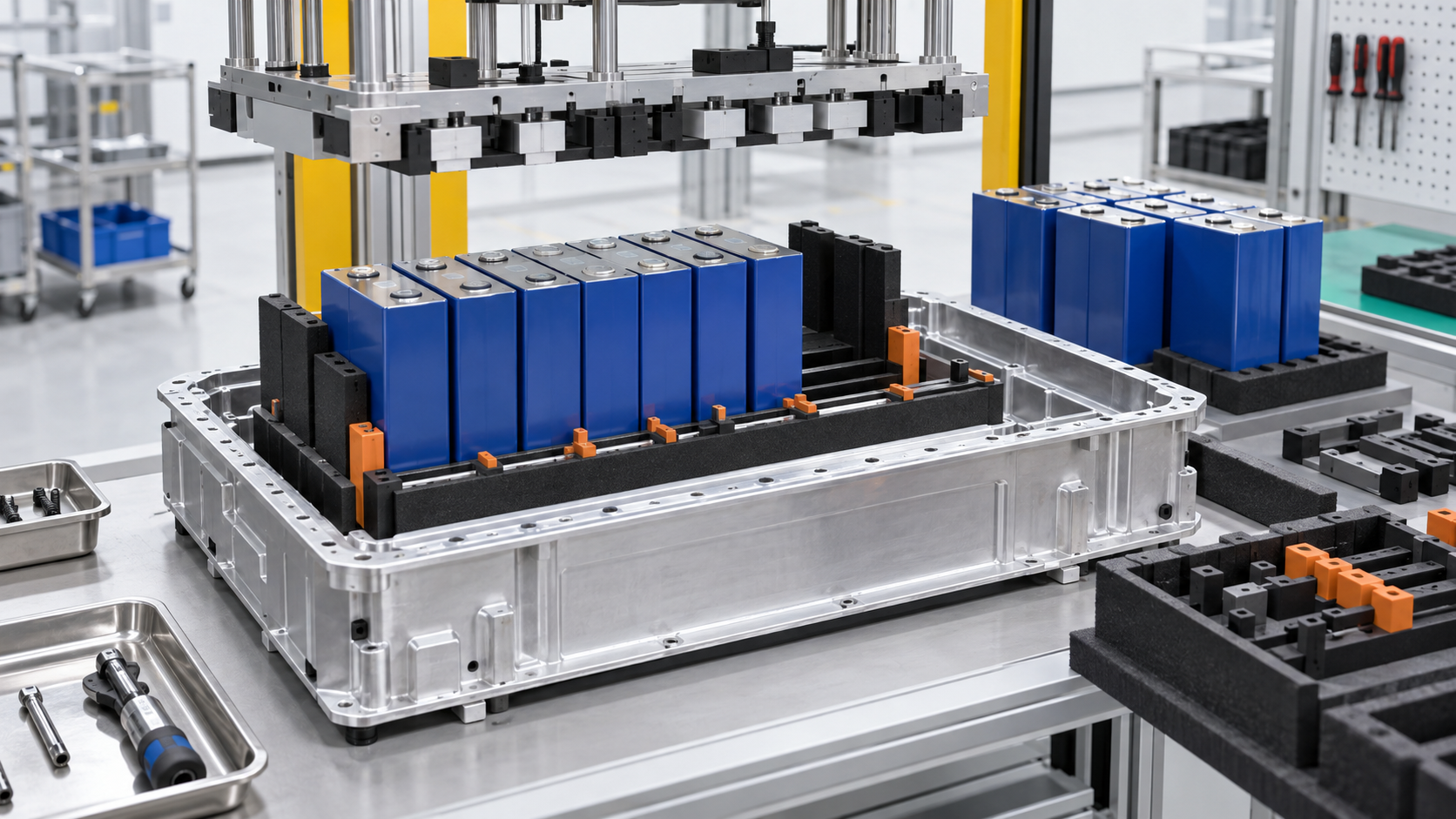
- What cell formats and CTP are (the short version)
- Three formats — cylindrical, prismatic, pouch
- Scaling up cylindrical cells — from 18650 to 4680
- A materials engineer's view (1): bigger means heat from the centre escapes more slowly / Our calculation
- Removing the module — CTP, CTB/CTC, the blade format
- Volume utilisation, and how to read pack-level numbers
- A materials engineer's view (2): every number has a denominator
- A materials engineer's view (3): without modules, the structural and thermal jobs move to materials
- Casing and sealing
- What is still hard, and what could not be confirmed
- How to read evaluations and standards
- Glossary
- Primary sources
- Claim-to-source audit
Sourced = a statement in published material (link given)
Our calculation = a figure this article derived, with the assumptions spelled out
Not yet confirmed = a plan or schedule with no confirmed decision or record
Structural readings and materials-design interpretations are marked separately as Commentary. Manufacturers' figures are called "manufacturer's stated value", with whether they refer to the cell, pack or system.
1. What cell formats and CTP are (the short version)
- Cell formats: the formats used in vehicles are cylindrical, prismatic and pouch. They differ mainly in the casing and in how electrodes and separator are arranged. Prismatic and cylindrical cells go in hard cans (aluminum or stainless steel are common), pouch cells in aluminum composite filmSourced
- CTP: from the conventional layout, where cells are grouped into small boxes (modules) and the modules go into the pack, to one that leaves out the module and puts cells directly in the pack. Fewer parts, and a higher share of the pack volume taken up by cells (volume utilisation)Sourced (CATL states 55% for its first-generation CTP and 72% for the third)
- The key to reading the numbers: "Wh/kg" and "Wh/L" change greatly with whether they were measured for the material, cell, module, pack or system. A study of real vehicles indicates that improving the cell does not raise the pack figure in proportionSourced
When comparing batteries, first check which level a number belongs to, before asking about format or chemistry. Pack-level volumetric energy densities of real vehicles fall in similar ranges whatever the cell formatSourced, and part of the difference between chemistries (LFP versus NMC) can be made up by structure such as CTPSourced. Read whether a gap in numbers comes from the materials or from the structure.
2. Three formats — cylindrical, prismatic, pouch
Baazouzi et al. (Batteries, 2023) [Source 2] summarise the differences among the three formats as followsSourced. Cylindrical cells put a wound electrode roll (a "jelly roll") with separator in a can. Prismatic cells put a flat-wound or stacked electrode in a can. Pouch cells put stacked electrodes in aluminum composite film (the paper states that pouch cells are "stacked only").
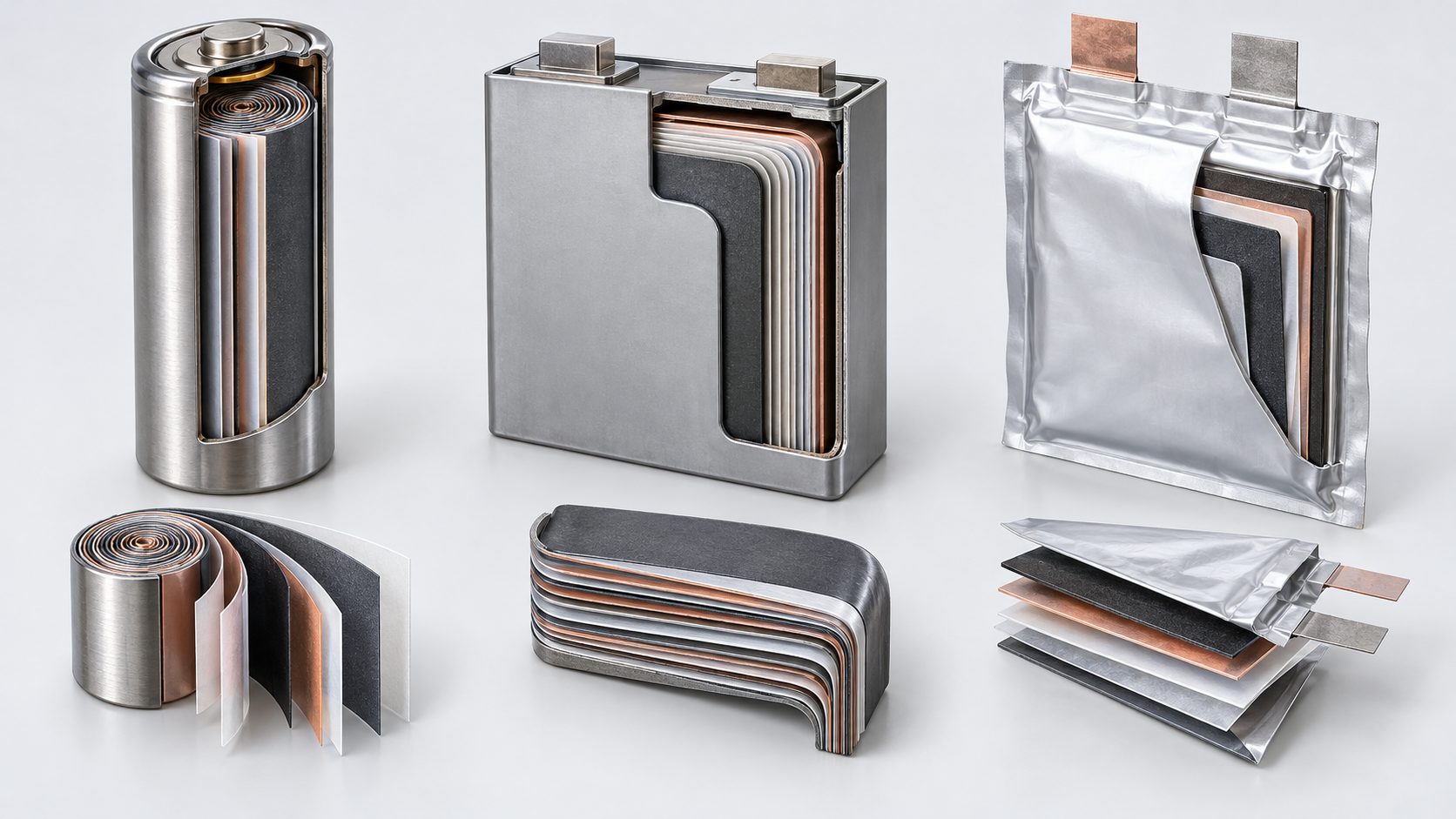
View the original SVG schematic and exact annotations
What differs once cells are built into packs has been sorted out by studies of real vehicles. Koloch et al. (World Electric Vehicle Journal, 2025) [Source 1] analysed statistically benchmark data (from the A2MAC1 platform) for 145 vehicle models launched between 2020 and 2024. The main points on format are as followsSourced.
| Format | Features once built into a pack (Koloch et al.) |
|---|---|
| Cylindrical | Because of geometric constraints, the largest dead volume (unusable space) inside a module. In the data, mostly module-based. Pack heights of 105 to 117 mm, lower than the others |
| Prismatic | A hard case gives structural stability. The best volumetric cell-to-pack factor. However, the volumetric energy density of the cell alone is on the low side because of structural voids. LFP prismatic cells are in the data mostly in CTP |
| Pouch | Better volume use inside a module than cylindrical, but with no hard case, the module needs thicker walls or extra parts to meet mechanical requirements. In the data, mostly module-based. The highest pack-level volumetric energy density is the highest of the three formats |
All Sourced (Koloch et al. [Source 1]). The data are benchmarks of real vehicles and do not settle which design is better.
3. Scaling up cylindrical cells — from 18650 to 4680
The names of cylindrical cells encode their dimensions. 18650 is 18 mm in diameter and 65.0 mm long; 21700 is 21 mm by 70.0 mm. According to Baazouzi et al. [Source 2], the 4680, presented at Tesla's Battery Day in 2020, is 46 mm in diameter and 80 mm high, 5.5 times the volume of the 21700 and eight times that of the 18650Sourced. The same paper took apart and measured 19 cylindrical cells from four manufacturers (18650, 20700, 21700 and 4680) and reports the followingSourced.
- Measured energy densities range from 161 to 254.5 Wh/kg and from 436 to 712.5 Wh/L. The 4680, at 224.8 Wh/kg, is relatively low among the cells examined (even though its electrode coating is much thicker than in the others). The anode of the 4680 is about 258 µm and the cathode about 170 µm (against an average for the other cells of 144 µm for the anode and 128 µm for the cathode)
- The measured values were obtained under unified conditions and differ from datasheet values. For example, the NCR2070C is specified at 569 Wh/L and 214 Wh/kg in its datasheet, against 562.52 Wh/L and 200.72 Wh/kg measured (−1.1% / −6.2%)
- The 4680 is "quasi-tabless": the edges of the current-collector foils are notched and bent over, but 25% of the cathode and 30% of the anode are not notched, so current and heat travel along long paths
By contrast, Lechner et al. (Communications Engineering, 2024) [Source 3] built a cost model for a cylindrical 4680 cell and a prismatic PHEV2 hard-case cell and compared them with the same electrode designSourced. In the model, with NMC811/graphite, the 4680 is 98.8 Wh and 400 g (247 Wh/kg) and the PHEV2 is 196.3 Wh and 892 g (220 Wh/kg), and manufacturing cost differed by less than 1% between the two formatsSourced (these are model settings, not measurements; the authors themselves caution against reading the small difference as one format being superior).
The 224.8 Wh/kg of Baazouzi et al. was measured under unified conditions on commercial 4680 cells that were taken apart. The 247 Wh/kg of Lechner et al. is a model setting in a cost model that fixes certain electrode parameters (NMC811, areal capacity of 5 mAh/cm2 and so on). Measurement and model rest on different premises, so neither settles which is right or where the 4680 stands (Commentary).
4. A materials engineer's view (1): bigger means heat from the centre escapes more slowly / Our calculation
Making a cylindrical cell larger puts more energy in each cell and reduces the number of parts. But the heat-generating volume of a cylinder grows with the square of the diameter, while the side surface that sheds heat grows only in proportion to the diameter. That Baazouzi et al. describe the 4680 as "quasi-tabless", and point out that the parts that are not notched give long electrical and thermal paths, stems from this scalingSourced.
From the materials side, the current-collector foils (aluminum for the cathode, copper for the anode) need thickness and ductility that survive notching, bending and welding to a disc. The model of Lechner et al. assumes 12 µm aluminum and 8 µm copper, notches cut into the foil at the slitting step, tabs folded over during winding to level the end face, and a disc laser-welded to itSourced. Folding and welding a thin foil — the work of the foil material and its processing is tied directly to the choice of cell format (Commentary).
Assumptions Our calculation
- Nominal cylinder dimensions (diameter × height): 18650 = 18 × 65 mm, 21700 = 21 × 70 mm, 4680 = 46 × 80 mm (can wall and terminals ignored)
- Heat generation is uniform in the volume, heat loss is through the side surface only, and thermal properties are constant (a conceptual scaling, not a calculation of real cell temperatures)
Calculation
- Volume: π/4 × d2 × h = about 16.5 mL / 24.2 mL / 133 mL. 4680 / 21700 = about 5.5; 4680 / 18650 = about 8.0 (consistent with Baazouzi et al.)
- Distance from centre to surface (radius): 9 mm / 10.5 mm / 23 mm. The 4680 is about 2.6 times the 18650
- The time for heat to travel from centre to surface scales with the square of the radius, so the 4680 takes about 6.5 times as long as the 18650 ((23 ÷ 9)2 = 6.5) and about 4.8 times as long as the 21700
- For the same heat generated per unit volume, the heat flux through each square metre of side surface is proportional to d ÷ 4: 4.5 mm / 5.25 mm / 11.5 mm. The 4680 is about 2.6 times the 18650
Reading: at the same heat-generation density, the time for heat from the deep interior to reach the surface becomes nearly an order of magnitude longer, and the load on each unit of surface more than doubles. This is why large cylinders are discussed together with tabless designs (shorter electrical and thermal paths) and with cooling design (Commentary). Assumptions and limits: real cells also lose heat through both end faces, and internal conduction differs greatly between the winding and thickness directions. This calculation is not a quantitative prediction.
5. Removing the module — CTP, CTB/CTC, the blade format
In the conventional pack, cells are grouped by a few to a few dozen into modules, and the modules are arranged into the pack (module-to-pack, MtP). The module's outer frame, end plates and wiring are parts that carry no energy (passive components). CTP leaves out the module and fixes cells directly in the pack. Koloch et al. define the cell-to-pack factor as a measure of pack efficiency seen from the cells: by mass, total mass of cells divided by pack mass; by volume, total volume of cells divided by pack volumeSourced.
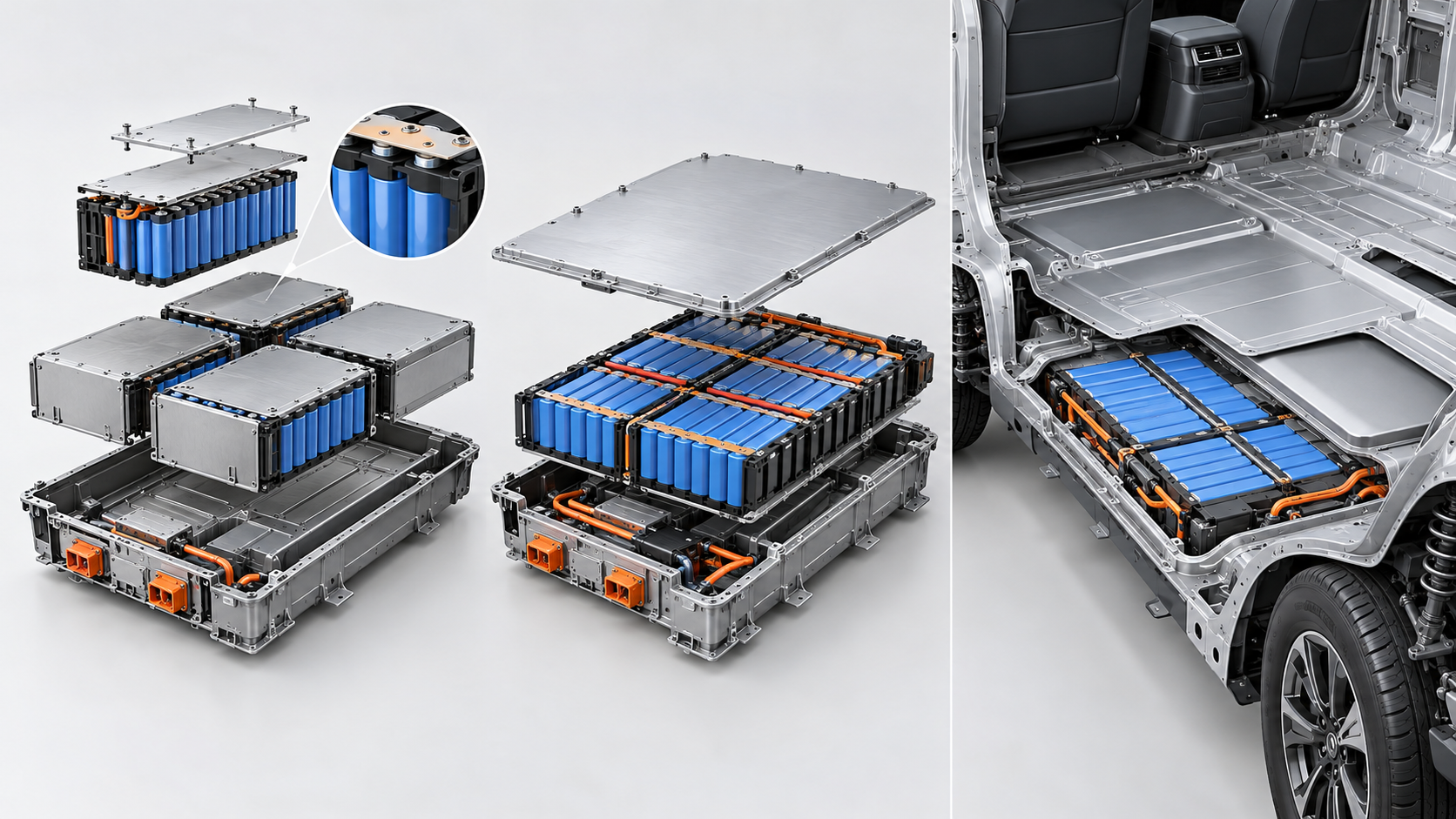
View the original SVG schematic and exact annotations
What manufacturers say (manufacturer's stated values)
| Manufacturer | What it states (the manufacturer's description) | Notes for reading |
|---|---|---|
| CATL | CTP has, through a highly integrated structural design, "significantly increased the volumetric utilization efficiency of the battery pack", from 55% for first-generation CTP to 72% for the third generation (Qilin). CTC (cell-to-chassis) integrates cells with the body, chassis, electric drive, thermal management and electrical control modules, extending driving range to over 1,000 km | The definition (what is the denominator) and test conditions of 55% and 72% are not given on the page. The same page also gives 265 Wh/kg for the NMC Qilin and 205 Wh/kg for LFP, without saying whether these are cell or pack values |
| BYD (European page) | The Blade Battery uses long, flat blade-shaped cells nested in a honeycomb structure without intermediate modules. In cell-to-body versions the battery becomes part of the vehicle frame, optimising interior space and lowering the centre of gravity. A comparison table lists space efficiency as +50% against traditional packs (the original text reads "traditional parcels") | The basis of the +50% (what "traditional" means) and how it was measured are not given. The page's comparison also includes differences in chemistry between LFP and conventional NCM (safety, cycle life), so it is not an effect of structure alone |
All Sourced (manufacturers' stated descriptions: CATL [Source 5], BYD [Source 6]). These are company statements and do not rank performance.
6. Volume utilisation, and how to read pack-level numbers
Pack-level figures for real vehicles are set out by Koloch et al. [Source 1]Sourced.
- Volume: cylindrical 150 to 280 Wh/L, pouch 110 to 305 Wh/L, prismatic 140 to 290 Wh/L. Medians sit near the centre of each range, and the paper concludes that pack-level volumetric energy density is comparable whatever the cell format
- Mass (by chemistry): LFP packs 125 to 145 Wh/kg, NCA 150 to 174 Wh/kg, NMC 140 to 180 Wh/kg. The difference at cell level (NMC and NCA higher than LFP) is narrowed at pack level by LFP's favourable cell-to-pack factor
- Distribution of layouts: in the data, LFP prismatic cells are mostly in CTP, while cylindrical and pouch cells are mostly in module-based packs. Most LFP vehicles are purpose-built electric vehicles (flat underfloor packs). Vehicles with NMC and NCA include conversion designs, with complex pack shapes and more passive components
- Volumetric efficiency: LFP's is the highest, NMC and NCA are below 50%, and some NMC data points are below 25%
- Improving the cell: raising the cell's volumetric or gravimetric energy density, the pack value does not rise in proportion. The paper's discussion is that the higher the cell energy density, the more passive components are needed for safety
The volume utilisation of 55% to 72% that CATL states for CTP is probably the same kind of measure as this "volumetric efficiency", but because its definition is not given, the numbers cannot be set side by side directly (Commentary).
Assumptions Our calculation
- Pack volumetric energy density = cell volumetric energy density × volume utilisation (using the definition of the volumetric cell-to-pack factor of Koloch et al.)
- The cell's volumetric energy density is taken as 400 Wh/L (our example). Measured cylindrical cells (Baazouzi et al.) are 436 to 712.5 Wh/L
- Volume utilisation: CATL's stated 55% and 72% (manufacturer's stated values, definition unconfirmed), and, as an example of BYD's "+50%", 40% and 60% (our assumption)
Calculation
- At 55%: 400 × 0.55 = 220 Wh/L. At 72%: 400 × 0.72 = 288 Wh/L (about 31% more)
- At 40%: 400 × 0.40 = 160 Wh/L. At 60%: 400 × 0.60 = 240 Wh/L (+50%)
Reading: with the same cell, a rise in volume utilisation from 55% to 72% raises pack volumetric energy density by about 30%. The 220 to 288 Wh/L of this example fall inside the real-vehicle range of Koloch et al. (110 to 305 Wh/L). Assumptions and limits: the cell's 400 Wh/L and the efficiencies of 40% and 60% are our assumptions, not values of any actual CATL or BYD product. Because the definitions and conditions of the manufacturers' 55%, 72% and "+50%" could not be confirmed, applying them here is only an "if so" illustration.
7. A materials engineer's view (2): every number has a denominator
When reading battery numbers, the first thing a materials engineer checks is what the value is divided by. Löbberding et al. (World Electric Vehicle Journal, 2020) [Source 4] studied 25 vehicles from 2010 to 2019 and report that energy density and specific energy fall at each level, from cell to module to system, and that systems are improving, but specific energy (per mass) is improving more than energy density (per volume)Sourced. The slower improvement per volume can be read as the volume of passive components remaining (Commentary).
- Material value: mAh/g of an active material and the like. Neither electrode nor can is included
- Cell value: includes can or film, current collectors, separator and electrolyte. Test conditions (rate, temperature, voltage window) also move the number. In the measurements of Baazouzi et al., one cell differed from its datasheet by up to 6.2%
- Pack value: includes module frames, cooling plates, case, electrical wiring, BMS and other passive components. 125 to 180 Wh/kg in real vehicles (Koloch et al.)
- Manufacturers' "battery energy density": sometimes the level is not stated (for example 265 Wh/kg and 205 Wh/kg on CATL's page)
Koloch et al. show that as cell energy density rises, passive components take a larger share of the pack and the benefit of the cell improvement is dilutedSourced. For a materials developer this means that a 10% gain in the cell does not necessarily become 10% in the pack. What is worth developing is an effect that includes how the material changes the pack's passive components (cooling, safety measures), not only the cell number (Commentary).
8. A materials engineer's view (3): without modules, the structural and thermal jobs move to materials
The module frame held cells mechanically, carried heat away and separated each cell from its neighbours. Once CTP leaves out that frame, adhesives hold the cells, gap fillers provide the path for heat, and other materials take over thermal insulation and sealing (Commentary). Dow explains that its thermally conductive adhesives can be used in cell-to-module, cell-to-pack and cell-to-chassis designsSourced (a manufacturer's description [Source 7]).
Details of adhesives, gap fillers, potting and measures against thermal runaway are in our explainers on automotive silicones and encapsulants and on high-thermal-conductivity pastes and gap fillers. What we stress here is the point of Koloch et al. that a pouch cell has no hard can, so the module walls and the like must make up the mechanical requirementsSourced. In the data, what suited CTP was the prismatic cell (LFP) with its structural stability. The choice of format is tied to the choice of casing material and of the adhesive and thermal materials that follow (Commentary).
Moreover, in cell-to-body / chassis designs where cells serve as structural members of the vehicle, replacement and repair matched to cell life, and ease of dismantling for recycling, should depend on how the cells are bonded. However, no primary source on the effect of CTP and CTB on replacement, repair and recycling could be confirmed within the scope of this article.
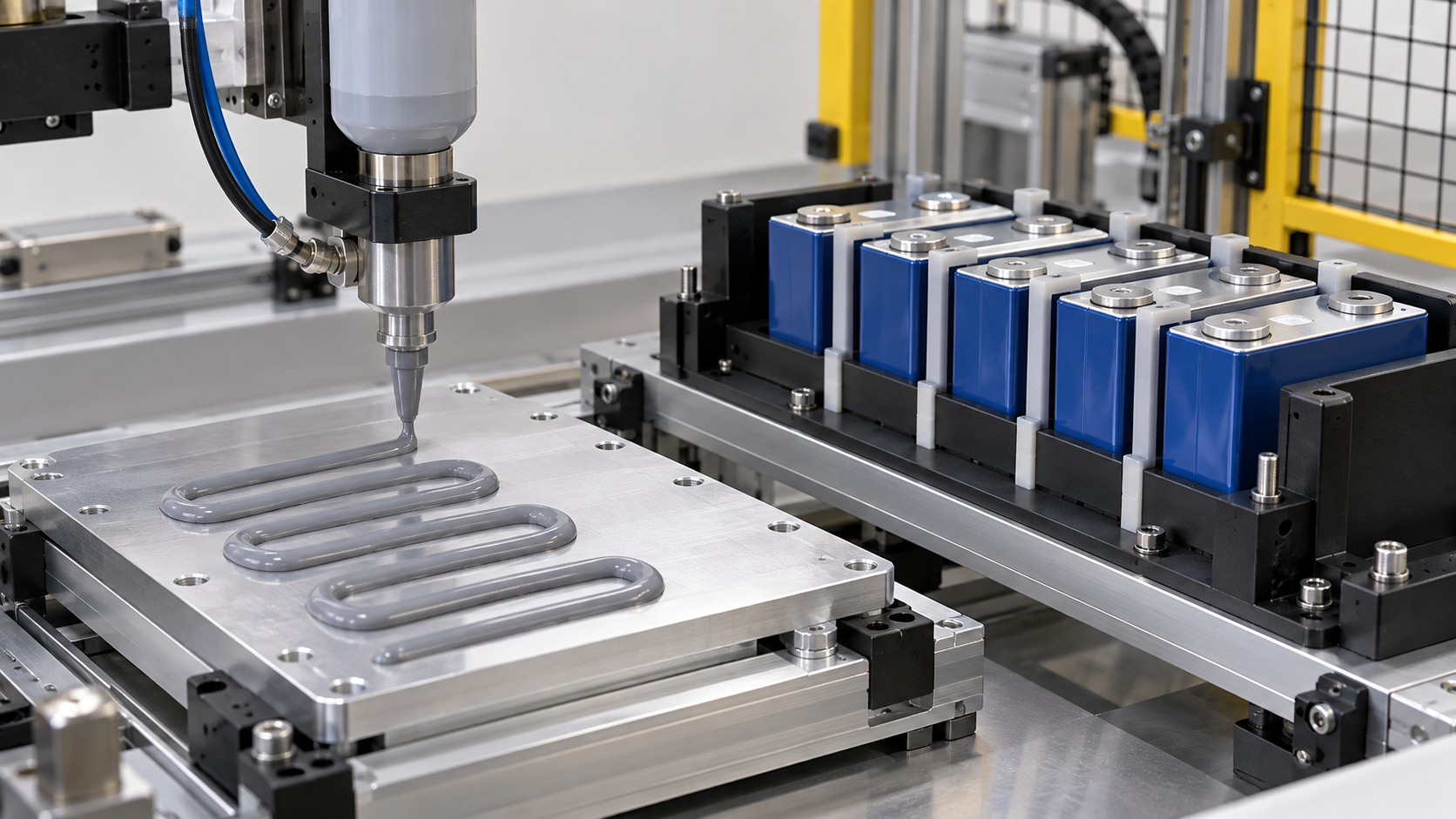
9. Casing and sealing
- Cans (cylindrical and prismatic): aluminum or stainless steel. In the model of Lechner et al., a prismatic cell has its electrodes put in the can and a lid with a filling hole welded on. After filling and formation, which releases gas, the last opening is closed by rivetingSourced
- Pouch: aluminum composite film. The iScience 2025 review [Source 8] says that for sealing, heat sealing, which joins thermoplastic films under 0.5 mm thick, is the most widely used, in two forms: hot-bar welding and impulse weldingSourced. Weak points in sealing are said to arise from variations in electrode coating or separator thickness and from uneven heat or pressure
- Quality of the seal: keeping a consistent airtight seal. If imperfect, moisture and contaminants can enterSourced (same review). Because water reacts with LiPF6 to give HF (see our explainer on electrolytes and separators), sealing is a question of battery chemistry as well as of the container (Commentary)
10. What is still hard, and what could not be confirmed
(1) The definitions behind CATL's 55% and 72% and BYD's +50%
CATL's volume utilisation (55% and 72%) and BYD's space efficiency (+50%) come with no statement on the page of what the denominator is or under what conditions they were measured. Whether they are the same measure as the volumetric cell-to-pack factor of Koloch et al. could not be confirmed in this article.
(2) Pack-level values for production 4680 cells
The mass and volumetric energy density of the pack of a real vehicle using the 4680 could not be confirmed in a primary source within the scope of this article. The measured cell value (224.8 Wh/kg) and the model value (247 Wh/kg) are not pack values.
(3) The effect of CTP and CTB on replacement, repair, recycling and safety
How leaving out modules affects thermal propagation, repairability and recycling could not be confirmed in primary sources here. For thermal runaway see our explainer on thermal runaway and battery safety; for recycling, our explainer on battery recycling and second life.
(4) Bias in the real-vehicle data
The data of Koloch et al. have missing values, so the vehicles usable differ from one analysis to another, and the paper itself states that LFP leans toward prismatic cells and CTP, and NMC and NCA toward cylindrical and pouch cells and module-based packs. Hence the effects of "format", "chemistry" and "layout" are not completely separated.
- The cell formats are cylindrical, prismatic and pouch. They differ in casing (can or film) and in electrode arrangement (wound or stacked)Sourced
- The 4680 is 46 mm in diameter and 80 mm high, 5.5 times the volume of the 21700. It is quasi-tabless: 25% of the cathode and 30% of the anode are not notchedSourced
- Scaling up makes the centre-to-surface distance about 2.6 times that of the 18650 and the time for heat to travel about 6.5 times.Our calculation
- Pack-level volumetric energy density of real vehicles falls in similar ranges whatever the format (cylindrical 150 to 280, pouch 110 to 305, prismatic 140 to 290 Wh/L).Sourced
- CATL states CTP volume utilisation rising from 55% to 72% (third generation) (manufacturer's stated value). The definition is not givenSourced
- Raising cell performance does not raise the pack value in proportion, because passive components take a growing shareSourced
- Without modules, the jobs of fixing, heat transfer and sealing move to adhesives, gap fillers and encapsulants. (Commentary)
11. How to read evaluations and standards
Before comparing which number is larger, align the basis of comparison in the following order. This is an editorial reading checklist, not a set of test conditions or acceptance limits prescribed by a standard.
- 1. What was measured?
- cell and pack Wh/kg, Wh/L and volume utilisation. Check the units and whether the result describes a material, component or complete system.
- 2. Under which conditions?
- whether cooling hardware, wiring, enclosure and crash protection are included. Treat results under different conditions as separate results before comparing them.
- 3. The comparison trap
- Separate a denser cell from more efficient pack integration.
- 4. What does the standard cover?
- Check the identifier, title, edition and scope in the issuing body’s material. Distinguish test methods, safety, interoperability and management requirements. Naming a standard alone does not establish that a test, conformity assessment or certification has been completed.
Keep a comparison note containing the object, units, conditions, sample count and variation, comparator, standard edition and unresolved points. Do not invent numerical conditions or acceptance limits from a public abstract of a standard.
12. Glossary
- Cylindrical cell
- A cell with a wound electrode in a cylindrical can. The 18650 is 18 mm in diameter and 65 mm long.
- Prismatic cell
- A cell with a flat-wound or stacked electrode in a rectangular hard can.
- Pouch cell
- A cell with stacked electrodes in a bag of aluminum composite film.
- Jelly roll
- The electrode body made by winding positive electrode, separator and negative electrode together.
- Tabless
- A design in which the edge of the current-collector foil is notched and bent so that current is drawn from the whole end face. The 4680 is quasi-tabless.
- MtP (module-to-pack)
- The conventional layout in which cells are grouped into modules and modules go into the pack.
- CTP (cell-to-pack)
- A layout that leaves out the modules and fixes cells directly in the pack.
- CTB / CTC
- Cell-to-body / cell-to-chassis. A layout in which the pack doubles as vehicle structure.
- Cell-to-pack factor
- Total mass (or volume) of cells divided by the mass (or volume) of the pack. A measure of packing efficiency (Koloch et al.).
- Volume utilisation
- A measure of the share of pack volume occupied by cells (the definition can differ between manufacturers).
- Passive components
- Parts that store no energy: module frames, cooling plates, case, wiring and so on.
- Dead volume
- Space in a pack or module that cells cannot occupy and that cannot be used.
13. Primary sources
- J. Koloch, M. Heienbrok, M. Kasperek, M. Lienkamp (Technical University of Munich) "From Cell to Pack: Empirical Analysis of the Correlations Between Cell Properties and Battery Pack Characteristics of Electric Vehicles", World Electric Vehicle Journal 16(9), 484 (2025) — mdpi.com
- S. Baazouzi et al. "Design, Properties, and Manufacturing of Cylindrical Li-Ion Battery Cells—A Generic Overview", Batteries 9(6), 309 (2023) — mdpi.com
- M. Lechner et al. (Technical University of Munich) "Cost modeling for the GWh-scale production of modern lithium-ion battery cells", Communications Engineering (2024) — pmc.ncbi.nlm.nih.gov
- H. Löbberding et al. "From Cell to Battery System in BEVs: Analysis of System Packing Efficiency and Cell Types", World Electric Vehicle Journal 11(4), 77 (2020) (abstract checked) — doi.org/10.3390/wevj11040077
- CATL "Innovative Technology" (description of CTP and CTC technology) — catl.com
- BYD (Europe) "BYD Blade Battery" — byd.com
- Dow "EV Battery System Materials & Cell Solutions" — dow.com
- A. Nekahi et al. "Advanced lithium-ion battery process manufacturing equipment for gigafactories: Past, present, and future perspectives", iScience 28, 112691 (2025) (review) — pmc.ncbi.nlm.nih.gov
14. Claim-to-source audit
| Claim in the text | Basis | Type |
|---|---|---|
| That the formats used in vehicles are cylindrical, prismatic and pouch; that prismatic and cylindrical cells are in hard cans (aluminum or stainless steel are common) and pouch cells in aluminum composite film; that cylindrical cells use a jelly roll, prismatic a flat-wound or stacked electrode and pouch cells a stacked arrangement (as stated in the paper) | Baazouzi et al., Batteries 9(6), 309 (2023)[Source 2] https://www.mdpi.com/2313-0105/9/6/309 | Sourced |
| That the analysis covers 145 vehicle models (launched 2020 to 2024, A2MAC1 data); that the cell-to-pack factor is defined by mass (total mass of cells / pack mass) and by volume (total volume of cells / pack volume); that pack volumetric energy density is 150 to 280 Wh/L for cylindrical, 110 to 305 for pouch and 140 to 290 for prismatic, and comparable across formats | Koloch et al., WEVJ 16(9), 484 (2025)[Source 1] https://www.mdpi.com/2032-6653/16/9/484 | Sourced |
| That pack gravimetric energy density is 125 to 145 Wh/kg for LFP, 150 to 174 for NCA and 140 to 180 for NMC; that LFP's favourable cell-to-pack factor narrows the cell-level difference at pack level; that volumetric efficiency is highest for LFP, with NMC and NCA below 50% and some NMC points below 25% | Koloch et al. (2025)[Source 1] https://www.mdpi.com/2032-6653/16/9/484 | Sourced |
| That cylindrical cells have the largest dead volume, prismatic cells the best volumetric cell-to-pack factor with a low cell-level volumetric energy density, and pouch cells need module walls or parts to meet mechanical requirements; that in the data LFP prismatic cells are mostly CTP and cylindrical and pouch cells mostly module-based; pack heights (cylindrical 105 to 117 mm, pouch 113 to 175 mm, prismatic 109 to 190 mm) | Koloch et al. (2025)[Source 1] https://www.mdpi.com/2032-6653/16/9/484 | Sourced |
| That raising cell energy density does not raise pack values in proportion because passive components take a larger share; the missing data, and the leaning of LFP toward prismatic cells and CTP and of NMC and NCA toward cylindrical and pouch cells and module-based packs | Koloch et al. (2025), abstract, discussion and limitations[Source 1] https://www.mdpi.com/2032-6653/16/9/484 | Sourced |
| That the 4680 is 46 mm in diameter and 80 mm high, 5.5 times the volume of the 21700 and 8 times that of the 18650; the measurements of 19 cylindrical cells (161 to 254.5 Wh/kg, 436 to 712.5 Wh/L); the 4680 at 224.8 Wh/kg and its relatively low position, anode of about 258 µm and cathode of about 170 µm (others average 144 µm and 128 µm); the NCR2070C measured against datasheet values (−1.1% / −6.2%); that the 4680 is quasi-tabless with 25% of the cathode and 30% of the anode not notched | Baazouzi et al. (2023)[Source 2] https://www.mdpi.com/2313-0105/9/6/309 | Sourced |
| The cost model for the 4680 cylindrical and the PHEV2 prismatic hard-case cells; for NMC811/graphite the 4680 at 98.83 Wh, 400.25 g and 246.95 Wh/kg and the PHEV2 at 196.29 Wh, 892.41 g and 219.96 Wh/kg (model settings); that the cost difference is under 1%; current-collector foils of 12 µm aluminum and 8 µm copper; tabless notching, folding and laser welding of a disc; welding of the prismatic lid and riveting of the last opening | Lechner et al., Communications Engineering (2024)[Source 3] https://pmc.ncbi.nlm.nih.gov/articles/PMC11532491/ | Sourced |
| That, for 25 vehicles from 2010 to 2019, energy density and specific energy fall at each level from cell to module to system, that specific energy is improving more than energy density, and that there is a trend toward larger, prismatic cells | Löbberding et al., WEVJ 11(4), 77 (2020), abstract[Source 4] https://doi.org/10.3390/wevj11040077 | Sourced |
| That CTP's volume utilisation rose from 55% for the first generation to 72% for the third generation (Qilin); the description of CTC (integrating cells with the body, chassis, drive, thermal management and control modules, extending range to over 1,000 km); that 265 Wh/kg for NMC Qilin and 205 Wh/kg for LFP are given without saying whether they are cell or pack values; that no definition or test conditions are given | CATL official page (manufacturer's stated values)[Source 5] https://www.catl.com/en/research/technology/ | Sourced |
| That the Blade Battery nests long, flat blade-shaped cells in a honeycomb without intermediate modules; that in cell-to-body versions the battery becomes part of the frame; that a comparison table lists space efficiency as +50% against traditional packs, with no basis given | BYD European page (manufacturer's stated values)[Source 6] https://www.byd.com/eu/technology/byd-blade-battery | Sourced |
| That Dow's thermally conductive adhesives can be used in cell-to-module, cell-to-pack and cell-to-chassis designs | Dow official page (manufacturer's description)[Source 7] https://www.dow.com/en-us/market/mkt-mobility/sub-mobility-electronics/app-mobility-elec-battery-systems.html | Sourced |
| That heat sealing, joining thermoplastic films under 0.5 mm thick, is the most widely used sealing method for pouch cells, in hot-bar and impulse forms; that weak points arise from variations in materials and uneven heat or pressure; that a consistent airtight seal is needed | iScience 2025 review (Nekahi et al.)[Source 8] https://pmc.ncbi.nlm.nih.gov/articles/PMC12268664/ | Sourced |
| The volumes of the 18650, 21700 and 4680 (about 16.5, 24.2 and 133 mL), the volume ratios (about 5.5 and 8.0), centre-to-surface distances (9, 10.5 and 23 mm), the heat-travel time scale (about 6.5 times from the square of the radius) and the heat flux per surface area (proportional to d/4, about 2.6 times) | Our calculation. Nominal cylinder dimensions, uniform volumetric heat generation and side-surface-only loss are our assumptions. Not a quantitative prediction | Our calculation |
| That 400 Wh/L (our example) at a volume utilisation of 55% and 72% gives 220 and 288 Wh/L (about 31% more), and at 40% and 60% gives 160 and 240 Wh/L (+50%) | Our calculation. 400 Wh/L and 40%/60% are our assumptions; 55% and 72% are CATL's stated values, with definitions unconfirmed | Our calculation |
| The reading that scaling up a cylinder lengthens paths of heat and current; that foil material and processing tie directly to the choice of format; why measured and modelled 4680 numbers differ; the different denominators from material to cell to pack to system; that the value of a material should be judged including the pack's passive components; that the jobs of the module frame move to adhesives, gap fillers and encapsulants; that the choice of format links to the choice of casing, adhesive and thermal materials; that sealing is a matter of battery chemistry | Commentary by this article | Commentary |
| Pack-level values of real vehicles using the 4680, the definitions of CATL's 55% and 72% and BYD's +50%, and the effect of CTP and CTB on replacement, repair, recycling and thermal propagation | Could not be confirmed in published primary sources within the scope of this article, so not stated | Commentary |
| That Figs. 2 to 5 are explanatory drawings rather than real cell or pack structures or measurements, and that Figs. 1 and 6 are AI-generated images | Our note | Commentary |
Last updated 10 October 2026. Sources are limited to primary material (research papers analysing data on real vehicles, peer-reviewed papers and reviews, and the official pages of manufacturers). Because the article includes structural readings and materials-design interpretations, those are marked as Commentary and kept separate from sourced fact. Pack-level values for the 4680, the definitions behind the figures of CATL and BYD, and the effect of CTP and CTB on replacement, repair and recycling could not be confirmed in published primary sources and are not stated. The manufacturers' figures (55%, 72%, +50%, 265 Wh/kg and so on) are manufacturers' stated values whose definitions and conditions could not be confirmed. The calculations in Chapters 4 and 6 are illustrative examples with assumptions of our own, not measurements. All figures are explanatory concept graphics. Figs. 2 to 5 are vector drawings; Figs. 1 and 6 are AI-generated images, and none of them shows a real cell, pack, factory or measurement result.