TECHNOLOGY EXPLAINER
Conductive Additives and Binders
— two components that are a few percent by mass but one-tenth to one-fifth of an electrode by volume
A lithium-ion battery electrode is not made of active material alone. A conductive additive that builds electron pathways (such as carbon black) and a binder that ties particles to the metal foil (PVDF, CMC/SBR and others) are a few percent by mass but one-tenth to one-fifth by volume. This article covers the types and roles of conductive additives, how binders bind, the differences between PVDF and aqueous binders (CMC/SBR, PAA), the solvent problem of NMP, and the relation to PFAS regulation, from a materials engineer's point of view and built on peer-reviewed papers, a manufacturer's official pages and official documents of ECHA (the European Chemicals Agency) and EUR-Lex. For PFAS regulation in particular, it keeps proposal, evaluation, adoption and application distinct. Carbon nanotubes are left to the “Carbon Nanotubes” article in this series, and binders for silicon anodes to “Silicon Anodes and Nanostructured Electrodes”. Nothing here is investment, procurement or design advice.

- What conductive additives and binders are (the short version)
- An electrode is a four-component composite — the carbon binder domain (CBD)
- Conductive additives — mainly carbon black
- Our calculation: a few percent by mass, how much by volume?
- What binders do, and how they bind
- A materials engineer's view (1): not how much, but where
- PVDF and aqueous binders — from NMP to water
- Relation to PFAS regulation — keeping proposal, evaluation, adoption and application distinct
- A materials engineer's view (2): binder choice is a three-way trade of electrochemistry, process and regulation
- Strengths and weaknesses; how this article divides work with others in the series
- How to read evaluations and standards
- Glossary
- References (primary sources)
- Claim-to-source audit
Sourced = content stated in published material (link given)
Our calculation = a figure this article derived, with the assumptions spelled out
Not yet confirmed = a plan, target or proposal under deliberation that is not settled
Structural readings and materials-design interpretations are marked separately as Commentary. An Inference is shown in bold.
Manufacturer statements are the manufacturer's stated value. For regulation, the stage (proposal, adoption, application) and dates are kept distinct, and the date of checking (10 October 2026) is given.
1. What conductive additives and binders are (the short version)
The Argonne National Laboratory BatPaC report describes an electrode as “active-material particles held together by a polymeric binder”, and says a conductive additive (carbon black and/or graphite) is added to the positive electrode and sometimes to the negativeSourced.
- Conductive additive: many active materials conduct electrons poorly, so a little carbon is mixed in to build electron pathways. Hein and co-authors write that most cathode materials have low electronic conductivity, so a significant amount of conductive graphitic additives are introduced during electrode productionSourced
- Binder: Chen and co-authors' review says PVDF has been the dominant binder in the battery industry for decades, with the drawbacks of limited binding strength from the lack of chemical bonds with electroactive materials, insufficient mechanical properties, and low electronic and lithium-ion conductivitiesSourced
- What is hard: cutting the amount raises energy density, but the electron pathway, the binding and the ion pathway are all judged at once. In addition, PVDF is caught up in the discussion of PFAS (per- and polyfluoroalkyl substances) regulation, and its solvent NMP has its own regulation
Conductive additives and binders work by “where and how they are distributed”, not by amount. The review by Entwistle and co-authors states that higher electronic conductivity does not necessarily lead to higher capacity at high C-rates, because of the complex interrelation between the electronically conducting carbon binder domain (CBD) and ionic diffusion within the electrodeSourced. On PFAS regulation, in Europe a proposal is being evaluated and has been neither adopted nor applied as law (as shown by ECHA on 10 October 2026)Sourced.
2. An electrode is a four-component composite — the carbon binder domain (CBD)
An electrode is a composite of active-material particles, conductive additive, binder and pores filled with electrolyte. The conductive additive and binder mix and form a carbon binder domain (CBD) around particles and at the contacts between them.
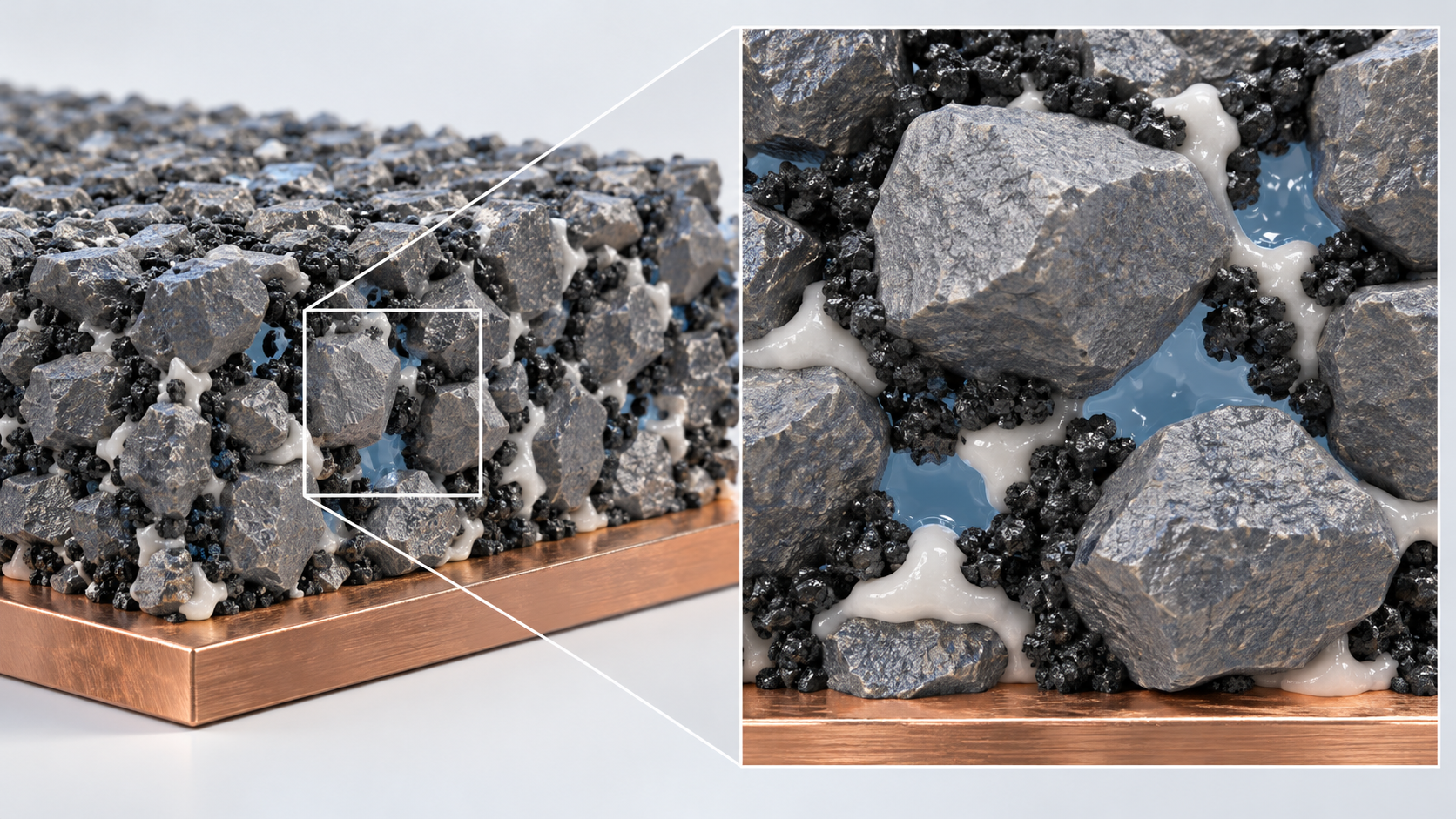
View the original SVG schematic and exact annotations
Hein and co-authors combined microstructures from synchrotron X-ray tomography of NMC622 electrodes with impedance measurements and showed that the CBD, the mixed phase of carbon and binder, enhances the mechanical stability and electronic connection of the electrode, but hinders the transport of lithium ions through the electrolyte pore network, reducing performance at higher currents. Of the CBD distributions considered, accumulation of CBD at contact points between particles is identified as the most likely configuration in the electrodes studiedSourced. The review by Entwistle and co-authors says that, with ever decreasing proportions of conductive additive, electronic conductivity networks need increasingly efficient pathways; that long-range (micron-level percolation network) and short-range (submicron connection of CBD to active material) electrical contacts should be distinguished; and that the optimum arrangement of the CBD is not well understood in the literatureSourced.
3. Conductive additives — mainly carbon black
The main conductive additive is carbon black. The BatPaC report says the conductive additive is more common for the positive electrode and that for its cost calculation it assumes a high-purity, moderate-surface-area carbon blackSourced. Lu and co-authors compared five carbon blacks differing in BET surface area, oil absorption number and ordered graphitic carbon content and noted that carbon black occupies only 5 to 8% of the electrode mass yet affects the conductive network and the CBD. They found that the ratio of disordered amorphous carbon to ordered graphitic carbon strongly influences short- and long-range electrical conduction, and that BET surface area highly affects the pore structure and ionic conductivity in the electrode. The optimum ratio, indicated by Raman ID/IG, was 0.93 to 0.95, and the recommended BET surface area was 130 to 200 m²/g (within that experimental range)Sourced.
| Conductive additive | Form and features | Reports and statements (conditions) | Reference |
|---|---|---|---|
| Carbon black | Fine carbon particles joined in chains. Surface area, structure and graphitic fraction differ by grade | Affects the conductive network and the CBD even at about 5 to 8% of electrode mass. ID/IG of 0.93 to 0.95 and BET of 130 to 200 m²/g were preferable (within that experimental range) | [Ref. 4] |
| Graphitic additives | Fine graphite particles, or combinations with graphite | BatPaC assumes carbon black and/or graphite as the conductive additive. Hein et al. describe graphitic additives being added to cathodes | [Refs. 1, 2] |
| Carbon nanotubes (CNT) | Long tubular carbon. Said to build networks easily at low weight fractions | The review by Landi et al. summarises that using CNT as the conductive additive at a lower weight fraction than conventional carbon black or graphite builds the percolation network more efficiently. Details in the “Carbon Nanotubes” article | [Ref. 5] |
| Carbon coating (on the active material) | Particle surfaces covered with carbon | Manthiram's review says polyanion cathodes (LFP and similar) have low electronic conductivity, so particles are made small and coated with conductive carbon, which increases processing cost and introduces inconsistencies | [Ref. 6] |
All Sourced (statements in each reference). Values and statements under different conditions are placed side by side, so this is not a ranking of conductive additives. The values of Lu et al. are results for the electrodes and carbons of that experiment.
4. Our calculation: a few percent by mass, how much by volume?
Conductive additives and binders are far less dense than active materials, so their share by volume is much larger than their share by mass. We work this out for example formulations.
Assumed densities (this article's assumptions, not values confirmed in primary sources): NMC811 4.7 g/cm³, graphite 2.2, carbon black 1.8, PVDF 1.8, CMC 1.6, SBR 0.95. Solid volume = the sum of each component's mass divided by its density, with no pores includedOur calculation. Example formulations (this article's assumptions): cathode A = active 96 / carbon black 2 / PVDF 2, cathode B = 90 / 5 / 5, anode A = graphite 96 / carbon black 0.5 / CMC 1.5 / SBR 2, anode B = 92 / 2 / 2 / 4 (all mass %). The “5% binder” of cathode B refers to the statement in the review by Cholewinski et al. that 5 to 10 wt% is typical for conventional polymeric bindersSourced.
| Example formulation (mass %) | Non-active mass share | Non-active volume share (solids only) |
|---|---|---|
| Cathode A: 96 / 2 / 2 | 4% | about 9.8% |
| Cathode B: 90 / 5 / 5 | 10% | about 22.5% |
| Anode A: 96 / 0.5 / 1.5 / 2 | 4% | about 7.1% |
| Anode B: 92 / 2 / 2 / 4 | 8% | about 13.6% |
All Our calculation (densities and formulations are our assumptions). These are not formulations or densities of any real product.
Two things can be read from this calculation (Commentary).
- By volume the share is more than twice the share by mass: cathode A is 4% by mass but about 9.8% by volume, and cathode B is 10% by mass and about 22.5% by volume. More non-active material means a thicker coating for the same areal capacity and squeezed pores
- Changing the formulation changes the coating mass: with an active-material capacity of 200 mAh/g, capacity per unit coating mass is 192 mAh/g for cathode A and 180 mAh/g for cathode B (about 6% lower). The coating mass needed for an areal capacity of 3.5 mAh/cm² is about 18.2 mg/cm² against about 19.4 mg/cm² (about 7% more)Our calculation (the 200 mAh/g capacity is an assumption)
5. What binders do, and how they bind
The review by Cholewinski and co-authors sets out the roles of the binder: in manufacturing, to disperse the components in solvent (some also act as a thickener) and distribute them homogeneously; in the cell, to hold the active components, any conductive additive and the current collector in contactSourced. Chen and co-authors' review divides the binding between active materials and binders into two mechanisms: mechanical interlocking and interfacial binding forcesSourced.
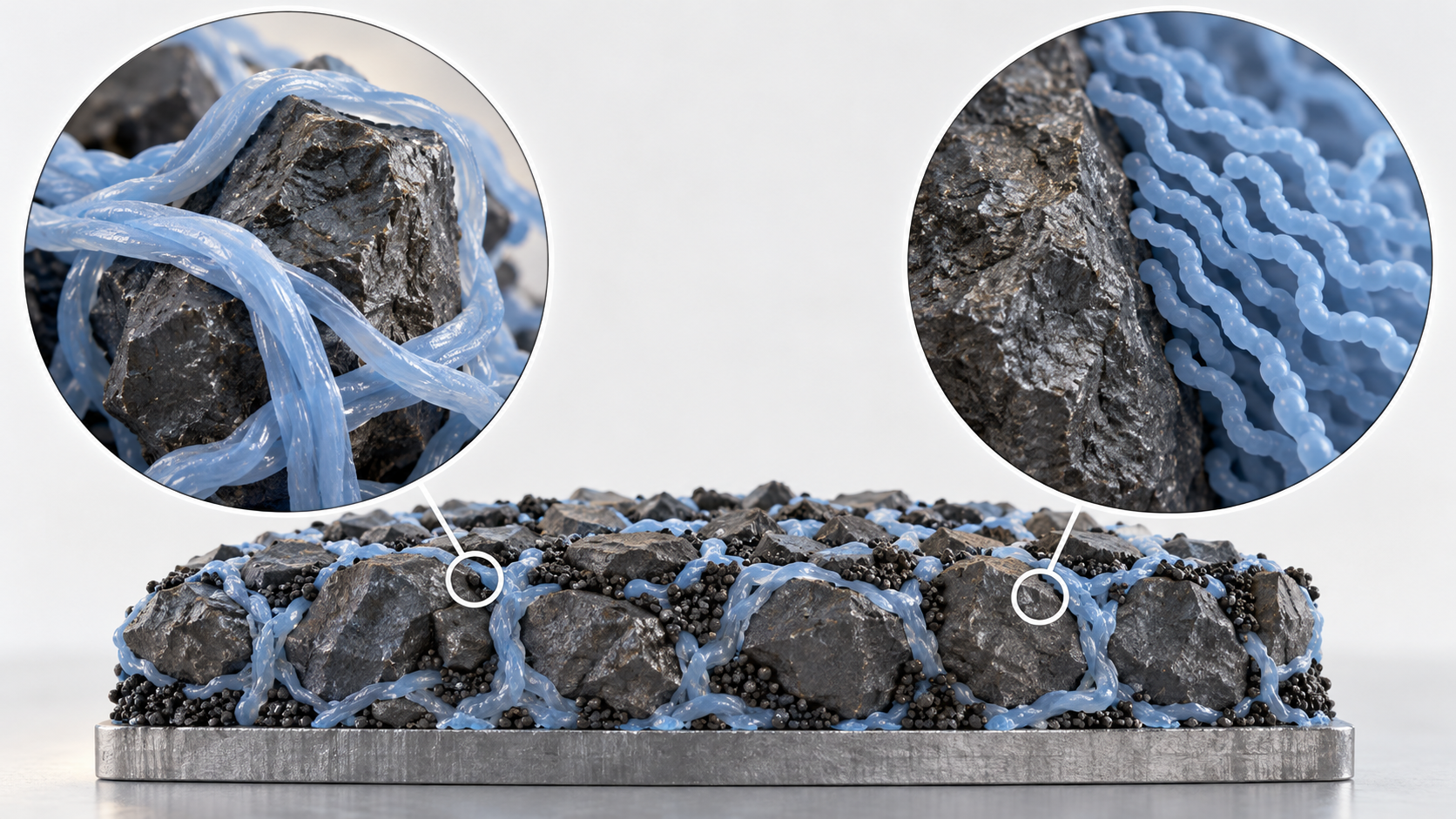
View the original SVG schematic and exact annotations
By type of binder:
| Binder | Solvent | Main use | Reports and statements (conditions) | Reference |
|---|---|---|---|---|
| PVDF | NMP | Cathode (also usable on the anode, it is said) | Dominant for decades. Chemically and electrochemically stable and processable. Binding is mainly by mechanical interlocking and van der Waals forces. Insulating, so it needs a conductive additive. Kureha says it allows both a high active-material concentration and prevention of delamination even at reduced binder content, and that it was selected when lithium-ion batteries were first commercialised in 1991 (manufacturer's stated value) | [Refs. 7, 8, 11] |
| CMC (carboxymethyl cellulose) | Water | Anode (doubles as a thickener) | A water-soluble cellulose derivative that supports dispersion and viscosity control. The review notes that Drofenik et al. proposed it in 2003, that it performed at least as well as PVDF, and that about 2 wt% was enough in an example. Its hydroxyl and carboxyl groups hydrogen-bond with graphite and silicon | [Ref. 7] |
| SBR (styrene butadiene rubber) | Water (emulsion) | Anode (used with CMC) | Gives flexibility and heat resistance and is said to have higher binding force than PVDF. But SBR alone was reported unlikely to interact with hydrophobic graphite, giving unstable suspensions. The review describes combination with CMC as a popular strategy | [Ref. 7] |
| PAA (polyacrylic acid) | Water | Silicon-based anodes | Mechanical properties comparable to CMC but a higher concentration of carboxyl groups. In carbon-coated silicon nanopowder anodes, as little as 15 wt% PAA showed excellent stability over the first hundred cycles (half-cell, 0.01 to 1 V vs Li) | [Ref. 10] |
All Sourced (statements in each reference). Statements under different conditions are placed side by side, so this is not a ranking of binders. Kureha's statements are the manufacturer's stated value, and the PAA values are for the conditions of that study.
The review by Zou and Manthiram says conventional binders such as PVDF are not ideal because of relatively low adhesiveness, weak mechanical strength and poor functionality for high-energy-density batteries with thick and/or high-capacity electrodes [Reference 9]Sourced. In the BatPaC baseline plant, the positive-electrode binder solvent is NMP (recovered by condensation and recycled) and the negative-electrode binder is water (no recovery needed)Sourced. Kureha's FAQ explains that PVDF (suspension-polymerised) can be used for both cathodes and anodes, whereas water-based polymers are generally used for anodesSourced (manufacturer's stated value).
6. A materials engineer's view (1): not how much, but where
Even at the same formulation (mass %), performance changes with how carbon and binder are distributed in the electrode. From primary sources, four things to check can be drawn (Commentary).
- 1. Is the carbon network connected at long and short range? Entwistle and co-authors separate electrical contacts into the micron-scale long-range percolation network and the connection of CBD to active material (short range)Sourced. If carbon does not reach a particle's surface, part of the active material cannot receive electrons
- 2. Is the binder covering pores or particle surfaces too much? As Hein and co-authors showed, the CBD helps the electronic connection but hinders ion transport in the poresSourced. Accumulation at particle contacts is read as a plausible compromise between electronic connection and keeping pores open
- 3. The type of carbon changes even the pore structure: Lu and co-authors showed that the BET surface area of carbon black greatly affects the pore structure and ionic conductivity of the electrodeSourced. Choosing a conductive additive is a question of the ion pathway as well as the electron pathway
- 4. The placement is set by the process: Entwistle and co-authors review the relation between each stage of electrode manufacturing and the formation of electronic conduction pathwaysSourced. Mixing, coating, drying and calendering conditions can make different electrodes from the same formulation (see the “Electrode Manufacturing” article in this series)
Inference: the more the amount is cut (less conductive additive and binder), the larger the relative effect of placement probably becomes. That Entwistle and co-authors write that efficient pathways are needed as the proportion of conductive additive keeps decreasing is consistent with this point. The amounts and distributions of conductive additive and binder in individual products could not be confirmed in public material.
7. PVDF and aqueous binders — from NMP to water
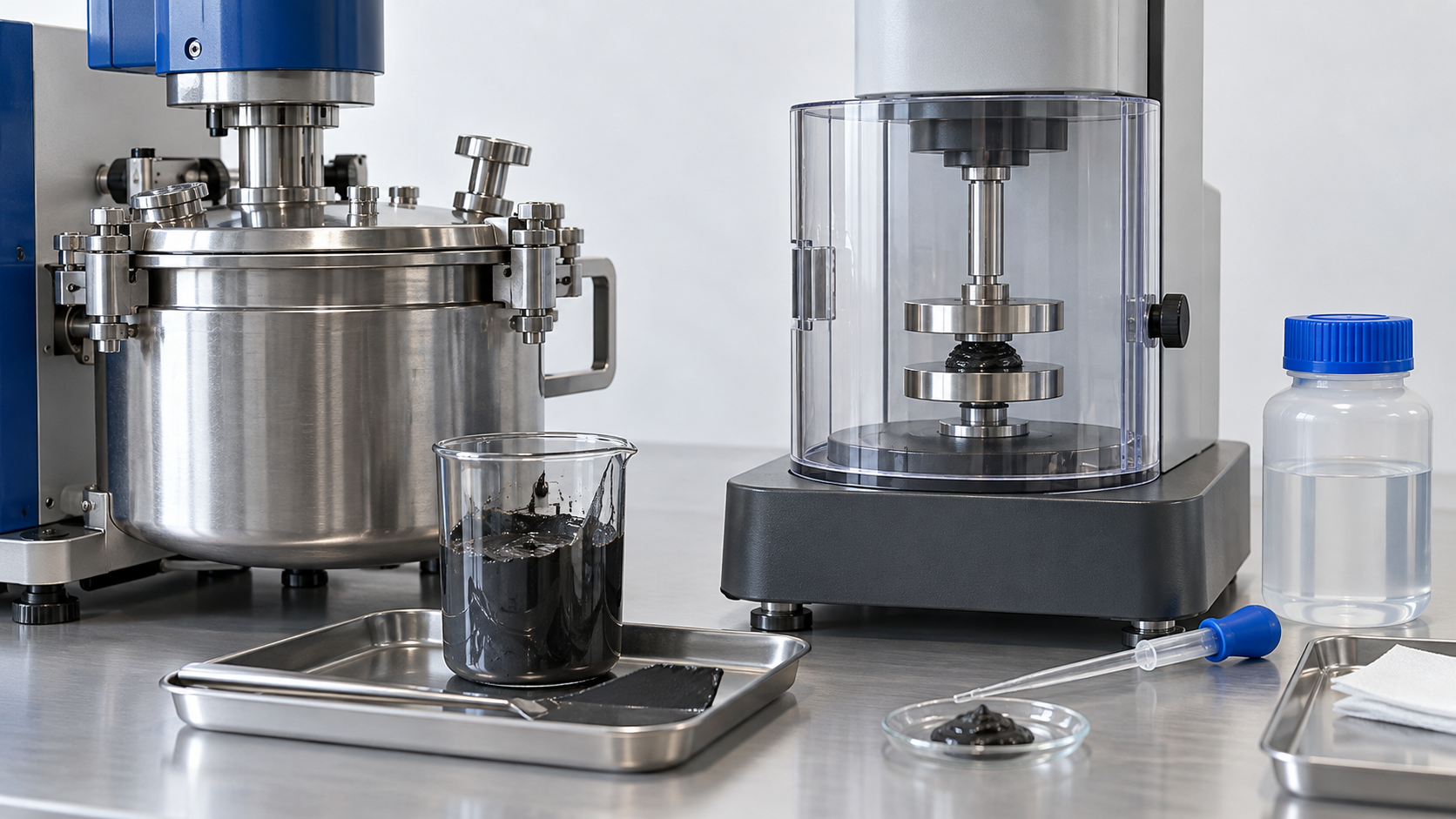
The solvent that dissolves PVDF is NMP (N-methyl-2-pyrrolidone). Kureha's FAQ gives the procedure for dissolving PVDF in NMP (put NMP in a container, add the powder while stirring, 50°C recommended)Sourced (manufacturer's stated value).
- The burden of NMP: the review by Cholewinski and co-authors says PVDF requires the toxic organic solvent NMP, which is expensive (cited values of US$1 to 3/kg against about US$0.015/kg for water) and has a high boiling point of about 203°C, so removal needs more energy and higher temperaturesSourced (cited values). PVDF itself is put at US$8 to 10/kg and aqueous binders at US$2 to 5/kg (cited values)
- Going aqueous: the review by Bresser and co-authors says the choice of binder strongly affects the environmental friendliness of electrochemical energy storage devices, and covers the transition to aqueous electrode processing and bio-derived polymers [Reference 18]Sourced. Wood and co-authors estimate that aqueous electrode processing can cut electrode processing cost and energy consumption by an order of magnitude and list eliminating the toxic, costly NMP dispersion chemistry as one of three pillars, along with doubling electrode thickness and shortening the SEI formation time. Together these could cut pack cost by 26.4%Sourced (baseline: thin electrodes processed with NMP; a 2015 estimate)
- Regulation of NMP: in Europe, Commission Regulation (EU) 2018/588 (18 April 2018; Official Journal 19 April 2018) added entry 71 to Annex XVII of REACH. After 9 May 2020, NMP at 0.3% or more, alone or in mixtures, may be placed on the market only if Derived No-Effect Levels (DNELs) for workers of 14.4 mg/m³ by inhalation and 4.8 mg/kg/day dermal are included in the chemical safety reports and safety data sheets, and it may be manufactured or used only if risk management measures keep worker exposure below those DNELs. For use as a solvent or reactant in coating wires the obligations applied from 9 May 2024. The recitals say mixtures with 0.3% or more NMP are classified under CLP as toxic for reproduction, category 1BSourced (adopted and applicable; a condition requiring exposure to be managed below the DNELs, not a ban on manufacture or use)
Why aqueous cathodes are hard
Aqueous processing is common for anodes, but nickel-based cathodes are sensitive to water and hard to make aqueous, primary sources show. Shkrob and co-authors write that lithiated nickel cobalt manganese oxides stored in humid air or exposed to moisture undergo delithiation, coating by lithium salts such as hydroxides and carbonates, rock-salt formation in the subsurface regions and contraction of the c-axis, which adversely affects electrochemical performance, and that the detrimental effects of water exposure need to be mitigated before aqueous processing of the positive electrode can find widespread adoptionSourced. The perspective by Li and co-authors likewise says water-based coating of high-nickel powder washes off surface Li residues but water exposure promotes surface rock-salt formation and lowers capacity and cyclabilitySourced. Kimura and co-authors, in an attempt to use an aqueous binder with an NCA cathode, treat the alkaline pH of the slurry as a challenge and report a CO2 gas treatment that brings it to neutralSourced. So the present picture readable from primary sources is that NMP with PVDF is the baseline for cathodes, and aqueous cathodes face a separate wall in the water resistance of the cathode active material (Commentary).
8. Relation to PFAS regulation — keeping proposal, evaluation, adoption and application distinct
PFAS regulation differs by country, region and stage. This section covers only the European Union's universal PFAS restriction proposal under REACH, checked against documents published by ECHA and the five authorities that prepared the proposal, and keeps the stages of proposal, evaluation, adoption and application distinct. Developments in the United States, Japan, China and elsewhere were not checked for this article. This section is not advice on the legal compliance of any company or product, nor on procurement or design.
(1) What counts as a “PFAS”
The background document to the proposal defines PFAS as substances containing at least one fully fluorinated methyl (CF3–) or methylene (–CF2–) carbon atom, with no H, Cl, Br or I atom attached to that carbon. This is described as consistent with the OECD definition of 2021, and the scope covers non-polymeric substances and polymeric PFAS such as fluoropolymersSourced. The repeating unit of PVDF is –CH2–CF2–, and that of PTFE is –CF2–CF2–. Both contain –CF2– carbons with no hydrogen or other halogen attached, so they are treated as fluoropolymers that fall within this definition (Commentary; whether an individual substance falls within scope has to be confirmed in official documents).
(2) The course of the European universal PFAS restriction proposal and its current stage
- Proposal (2023): the restriction proposal was prepared by authorities in the Netherlands, Germany, Denmark, Norway and Sweden, submitted to ECHA on 13 January 2023 and published by ECHA on 7 February 2023. The consultation from 22 March to 25 September 2023 drew more than 5,600 repliesSourced
- Updated proposal (August 2025): the proposers published a Background Document incorporating the consultation input on 20 August 2025. It assesses 23 sectors, and among the newly added derogations are “binders and electrolytes in batteries” (5.y): 13.5 years after entry into force and “separator coatings for batteries” (6.l): 6.5 years after entry into forceSourced (the proposers' proposals; absent from the 2023 proposal). A 13.5-year derogation is generally proposed where research and development so far did not identify possible PFAS-free alternatives, or where certification of known alternatives takes more than 6.5 years, and the document says uncertainties are high for some, including batteries (R&D has yet to start in many cases). It adds that a review clause could avoid socio-economic impacts if alternatives are not developed in time, but that implementing it is in the European Commission's remitSourced
- Evaluation (2026): ECHA's Risk Assessment Committee (RAC) adopted its final opinion on 2 March 2026 and the Socio-Economic Analysis Committee (SEAC) agreed its draft opinion on 10 March. Both support an EU-wide restriction with derogations. SEAC says targeted derogations are needed for specific uses where the evidence shows no alternatives and where cost-benefit assessment justifies themSourced. The consultation on SEAC's draft opinion ran until 25 May 2026
- Still to come (unfinished): ECHA says SEAC is expected to adopt its final opinion by the end of 2026, after which the European Commission will propose a restriction on the basis of the two final opinions, for discussion and vote in the REACH Committee of Member StatesNot yet confirmed. As of 10 October 2026 it has been neither adopted nor applied as law
(3) What it means for battery binders — what could and could not be confirmed
- Confirmed: the proposers proposed battery binders and electrolytes as candidates for a 13.5-year derogation (proposal stage). The use of PVDF is itself in a position that a restriction could coverSourced
- Could not be confirmed: how RAC's final opinion and SEAC's draft opinion treated the derogation for battery binders could not be confirmed in the documents checked for this article. The text finally adopted (whether there is a derogation, its length and conditions) is also not yet decided
- Alternatives today: for anodes, aqueous CMC/SBR and PAA are common (sections 5 and 7). The adoption of PFAS-free cathode binders in volume production could not be confirmed from the primary sources checked. PTFE in dry electrodes is also a fluoropolymer within the same framework (see the “Dry Electrode Processing” article)
- Difference from other regulation: the NMP restriction (section 7) is a condition that was adopted and has applied since 2020. The PFAS restriction is a proposal under evaluation. They are at different stages and must not be confused
9. A materials engineer's view (2): binder choice is a three-way trade of electrochemistry, process and regulation
A binder, a few percent by mass, bears at once on electrochemistry (binding, expansion, ion and electron pathways), process (solvent, drying, slurry stability) and regulation (NMP, PFAS). A checklist can be drawn from the primary sources (Commentary).
| What to check | Points to look at | Basis |
|---|---|---|
| Binding mechanism | Mainly mechanical interlocking, or interfacial chemical bonding through functional groups | Review by Chen et al. [Ref. 8] |
| Electrode thickness and expansion | With thick electrodes or expanding active materials, PVDF may not adhere enough | Review by Zou and Manthiram [Ref. 9], Magasinski et al. [Ref. 10] |
| Solvent and drying | NMP (recovery, regulatory compliance, drying energy) or water (no recovery, but the water resistance of the cathode active material) | BatPaC [Ref. 1], Wood et al. [Ref. 12], EUR-Lex [Ref. 14], Shkrob et al. [Ref. 13] |
| Slurry properties | SBR alone interacts poorly with graphite; CMC provides thickening and dispersion; aqueous cathode slurries can turn alkaline | Review by Cholewinski et al. [Ref. 7], Kimura et al. [Ref. 19] |
| Combination with the conductive additive | PVDF is insulating; design the carbon network and the CBD arrangement together | Cholewinski et al. [Ref. 7], Hein et al. [Ref. 2], Entwistle et al. [Ref. 3] |
| Stage of regulation | NMP: adopted and applicable. PFAS: proposal under evaluation (derogation at proposal stage). State the stage and date | EUR-Lex [Ref. 14], ECHA [Refs. 15, 16], summary by the five authorities [Ref. 17] |
The basis for each row is Sourced; the arrangement as a table is Commentary. Judgement on an individual product has to be made against each company's formulation and process and the latest official regulatory documents.
- Going aqueous removes the NMP issue but raises another: it eases the NMP restriction and the drying-energy burden, but nickel-based cathodes are sensitive to water, and slurry pH becomes a problem (section 7)
- Moving away from PFAS changes the binding mechanism: replacing PVDF's interlocking-centred binding with an aqueous binder that bonds through functional groups may raise adhesion, but tolerance of expansion, resistance to the electrolyte and slurry stability need to be checked separately (Commentary)
- Inference: the regulatory discussion probably influences R&D priorities, but how much could not be confirmed in public material. We avoid writing an unsettled proposal as if it were settled regulation
10. Strengths and weaknesses; how this article divides work with others in the series
- Strengths: in small amounts they provide the two functions an electrode cannot do without, an electron pathway and binding. PVDF is chemically and electrochemically stable and has long been used. Aqueous binders (CMC/SBR, PAA) avoid NMP and are common for anodesSourced
- Challenges: cutting the amount raises energy density but increases the importance of placement. The CBD helps electrons but blocks ion paths. PVDF is insulating with limited binding and needs NMP. PFAS regulation is under evaluation. For cathodes, going aqueous is walled by the water resistance of the cathode active materialSourced
- Pitfalls in reading: do not compare by formulation (mass %) alone. Do not write a proposal-stage regulation as settled regulation (section 8)
What this article does not cover
- Carbon nanotubes: the structure and production of CNT and dispersions as conductive additives are left to the “Carbon Nanotubes” article
- Binders for silicon anodes: the detail of designs for expanding silicon, such as PAA and alginate, is left to “Silicon Anodes and Nanostructured Electrodes”
- Electrode manufacturing: mixing, coating, drying and calendering and how distributions arise are left to “Electrode Manufacturing”, and fibrillated-binder dry electrodes to “Dry Electrode Processing”
- Cathode materials and graphite: left to “Cathode Materials” and “Graphite Anodes and Electrode Design”
- PFAS regulation in other countries: developments in the United States, Japan, China and elsewhere were not checked for this article
- What could not be confirmed: the types and amounts of conductive additive and binder in commercial cells; what RAC's and SEAC's opinions say about derogations for battery binders; the volume adoption of PFAS-free cathode binders; and conditioned physical properties of individual PVDF grades. None of these is filled in by guesswork
- Conductive additives and binders are a few percent by mass but one-tenth to one-fifth by volume. In example formulations, 4% by mass (cathode A) is about 9.8% by volume and 10% by mass (cathode B) about 22.5%Our calculation
- Placement matters more than amount. The CBD helps the electronic connection but blocks ion transport in the pores. Higher electronic conductivity does not necessarily mean higher capacity at high C-ratesSourced
- PVDF has been the lead for decades but binds with limited strength and needs NMP. Aqueous binders (CMC/SBR) are common for anodes, and PAA is considered for siliconSourced
- The NMP restriction is adopted and applicable (Regulation (EU) 2018/588, from 9 May 2020). The PFAS restriction is a proposal under evaluation, with a 13.5-year derogation proposed for battery binders (the proposers' 2025 background document)Sourced
- The next steps for the PFAS restriction are SEAC's final opinion (expected by end 2026), the Commission's proposal and the REACH Committee voteNot yet confirmed
11. How to read evaluations and standards
Before comparing which number is larger, align the basis of comparison in the following order. This is an editorial reading checklist, not a set of test conditions or acceptance limits prescribed by a standard.
- 1. What was measured?
- conductivity, peel strength, electrode resistance and capacity retention. Check the units and whether the result describes a material, component or complete system.
- 2. Under which conditions?
- binder and conductive-additive fractions, drying, calendering, thickness and measurement direction. Treat results under different conditions as separate results before comparing them.
- 3. The comparison trap
- The formulation with the strongest adhesion need not give the best battery life.
- 4. What does the standard cover?
- Check the identifier, title, edition and scope in the issuing body’s material. Distinguish test methods, safety, interoperability and management requirements. Naming a standard alone does not establish that a test, conformity assessment or certification has been completed.
Keep a comparison note containing the object, units, conditions, sample count and variation, comparator, standard edition and unresolved points. Do not invent numerical conditions or acceptance limits from a public abstract of a standard.
12. Glossary
- Conductive additive
- Carbon added in small amounts to build electron pathways for the active material. Carbon black is the typical one.
- Carbon black
- A powder of fine carbon particles joined in chains. Surface area and structure differ by grade.
- Binder
- A polymer that ties active material and conductive additive together and to the current collector.
- CBD (carbon binder domain)
- The region where conductive additive and binder mix. It carries electrons and binds, but can narrow the pores.
- Percolation
- Particles connecting to form a continuous path for electricity.
- PVDF
- Polyvinylidene fluoride, a fluoropolymer binder with the repeating unit –CH2–CF2–. Dissolved in NMP for use.
- CMC
- Carboxymethyl cellulose. A water-soluble anode binder that thickens and binds.
- SBR
- Styrene butadiene rubber. An anode binder used as an emulsion in water that adds flexibility.
- PAA
- Polyacrylic acid. A binder rich in carboxyl groups, considered for silicon anodes.
- NMP
- N-methyl-2-pyrrolidone. The organic solvent that dissolves PVDF. Boiling point about 203°C.
- DNEL
- Derived No-Effect Level. A reference value for workers' exposure, which must be kept below.
- PFAS
- A group of organofluorine compounds containing a fully fluorinated methyl or methylene carbon. Fluoropolymers are included.
- REACH / ECHA / RAC / SEAC
- The EU chemicals regulation / the European Chemicals Agency / its Risk Assessment Committee / its Socio-Economic Analysis Committee.
- Derogation
- A provision that exempts a use from a restriction for a set period or under conditions. At proposal stage it is not settled until adoption.
- BET surface area
- The surface area of a powder found by nitrogen adsorption (m²/g).
13. References (primary sources)
- Nelson, Gallagher, Bloom, Dees (Argonne National Laboratory) "Modeling the Performance and Cost of Lithium-Ion Batteries for Electric-Drive Vehicles (Second Edition)," ANL-12/55 (2012) (PDF) — osti.gov
- Hein, Danner, Westhoff, Prifling et al. "Influence of Conductive Additives and Binder on the Impedance of Lithium-Ion Battery Electrodes: Effect of Morphology," Journal of The Electrochemical Society 167, 013546 (2020) — doi.org/10.1149/1945-7111/ab6b1d
- Entwistle, Ge, Pardikar, Smith, Cumming "Carbon binder domain networks and electrical conductivity in lithium-ion battery electrodes: A critical review," Renewable and Sustainable Energy Reviews 166, 112624 (2022) — doi.org/10.1016/j.rser.2022.112624
- Lu, Lian, Parker, Ge, Sadan, Smith, Cumming "Effect of carbon blacks on electrical conduction and conductive binder domain of next-generation lithium-ion batteries," Journal of Power Sources 592, 233916 (2024) — doi.org/10.1016/j.jpowsour.2023.233916
- Landi, Ganter, Cress, DiLeo, Raffaelle "Carbon nanotubes for lithium ion batteries," Energy & Environmental Science 2, 638 (2009) — doi.org/10.1039/b904116h
- Manthiram "A reflection on lithium-ion battery cathode chemistry," Nature Communications 11, 1550 (2020) — doi.org/10.1038/s41467-020-15355-0
- Cholewinski, Si, Uceda, Pope, Zhao "Polymer Binders: Characterization and Development toward Aqueous Electrode Fabrication for Sustainability," Polymers 13, 631 (2021) — doi.org/10.3390/polym13040631
- Chen, Ling, Hencz, Ling et al. "Exploring Chemical, Mechanical, and Electrical Functionalities of Binders for Advanced Energy-Storage Devices," Chemical Reviews 118, 8936–8982 (2018) — doi.org/10.1021/acs.chemrev.8b00241
- Zou, Manthiram "A Review of the Design of Advanced Binders for High-Performance Batteries," Advanced Energy Materials 10, 2002508 (2020) — doi.org/10.1002/aenm.202002508
- Magasinski, Zdyrko, Kovalenko, Hertzberg et al. "Toward Efficient Binders for Li-Ion Battery Si-Based Anodes: Polyacrylic Acid," ACS Applied Materials & Interfaces 2, 3004–3010 (2010) — doi.org/10.1021/am100871y
- Kureha Corporation "KF Polymer (PVDF): Battery Materials" and "FAQ" — kureha.co.jp
- Wood, Li, Daniel "Prospects for reducing the processing cost of lithium ion batteries," Journal of Power Sources 275, 234–242 (2015) — doi.org/10.1016/j.jpowsour.2014.11.019
- Shkrob, Gilbert, Phillips, Klie, Haasch, Bareno, Abraham "Chemical Weathering of Layered Ni-Rich Oxide Electrode Materials: Evidence for Cation Exchange," Journal of The Electrochemical Society 164, A1489–A1498 (2017) — doi.org/10.1149/2.0861707jes
- European Commission Commission Regulation (EU) 2018/588 of 18 April 2018 amending Annex XVII to Regulation (EC) No 1907/2006 (REACH) as regards 1-methyl-2-pyrrolidone, Official Journal of the European Union L 99, 19.4.2018, p. 3 — eur-lex.europa.eu
- European Chemicals Agency (ECHA) "Per- and polyfluoroalkyl substances (PFAS)" (hot topic; checked on 10 October 2026) — echa.europa.eu
- European Chemicals Agency (ECHA) "ECHA supports PFAS restriction with targeted derogations" (news release ECHA/NR/26/17, 26 March 2026) — echa.europa.eu
- Swedish Chemicals Agency, Dutch National Institute for Public Health and the Environment, German Federal Institute for Occupational Safety and Health, Norwegian Environment Agency, Danish Environmental Protection Agency "What you need to know about the updated PFAS restriction dossier" (second edition, updated 23 October 2025, PDF) — kemi.se
- Bresser, Buchholz, Moretti, Varzi, Passerini "Alternative binders for sustainable electrochemical energy storage – the transition to aqueous electrode processing and bio-derived polymers," Energy & Environmental Science 11, 3096–3127 (2018) — doi.org/10.1039/c8ee00640g
- Kimura, Onishi, Sakamoto, Asami, Yanagida "Achievement of the High-Capacity Retention Rate for the Li[Ni0.8Co0.15Al0.05]O2 (NCA) Cathode Containing an Aqueous Binder with CO2 Gas Treatment Using the Cavitation Effect (CTCE)," Journal of The Electrochemical Society 166, A5313–A5317 (2019) — doi.org/10.1149/2.0471903jes
- Li, Erickson, Manthiram "High-nickel layered oxide cathodes for lithium-based automotive batteries," Nature Energy 5, 26–34 (2020) (text checked in the author manuscript posted on OSTI) — doi.org/10.1038/s41560-019-0513-0
14. Claim-to-source audit
| Claim in the text | Basis | Label |
|---|---|---|
| That an electrode is active-material particles held together by a polymeric binder, with a conductive additive (carbon black and/or graphite) added to the positive electrode and sometimes to the negative, and electrolyte in the pores of electrodes and separator; that the conductive additive is more common for the positive electrode and the cost calculation assumes a high-purity, moderate-surface-area carbon black; that in the baseline plant the positive-electrode solvent is NMP, recovered by condensation and recycled (about 0.5% oxidised in a thermal oxidiser and replaced) and the negative-electrode binder is water, not recovered; that the binder is PVDF- or CMC-based; and that it is the 2012 second edition | Argonne National Laboratory BatPaC report ANL-12/55Reference 1 https://www.osti.gov/biblio/1209682 | Sourced |
| That most cathode materials have low electronic conductivity and a significant amount of graphitic conductive additive is used; that the CBD enhances mechanical stability and electronic connection but hinders lithium-ion transport through the pores and lowers performance at higher currents; that NMC622 electrodes were studied with synchrotron X-ray tomography and impedance; and that accumulation of CBD at particle contacts was the most likely configuration | Hein et al. 2020, abstractReference 2 https://doi.org/10.1149/1945-7111/ab6b1d | Sourced |
| That efficient pathways are needed as the proportion of conductive additive falls; that higher electronic conductivity does not necessarily mean higher capacity at high C-rates because the CBD and ionic diffusion interrelate; that the relationship between manufacturing steps and conduction pathways is reviewed; the distinction between long-range (micron-level percolation) and short-range (submicron CBD-to-active-material) contacts; and that the optimum CBD arrangement is not well understood | Entwistle et al. 2022, review abstractReference 3 https://doi.org/10.1016/j.rser.2022.112624 | Sourced |
| That five carbon blacks (differing in BET surface area, oil absorption number and ordered graphitic carbon) were compared; that carbon black occupies only 5 to 8% of the electrode mass; that the ratio of disordered to ordered carbon strongly affects short- and long-range electrical conduction and BET surface area affects pore structure and ionic conductivity; and the optimum Raman ID/IG of 0.93 to 0.95 and recommended BET of 130 to 200 m²/g (within that experimental range) | Lu et al. 2024, abstractReference 4 https://doi.org/10.1016/j.jpowsour.2023.233916 | Sourced |
| That using CNT as the conductive additive at a lower weight fraction than conventional carbon black or graphite builds the percolation network more efficiently (the review's summary) | Landi et al. 2009, review (as cited in this series' “Carbon Nanotubes” article)Reference 5 https://doi.org/10.1039/b904116h | Sourced |
| That polyanion cathodes have low electronic conductivity and need small particles coated with conductive carbon, increasing processing cost and inconsistency | Manthiram 2020 reviewReference 6 https://doi.org/10.1038/s41467-020-15355-0 | Sourced |
| The roles of the binder (dispersion, thickening, keeping components in contact); that PVDF is the most widely used binder, chemically and electrochemically stable and processable, but binds mainly by mechanical interlocking and van der Waals forces, is insulating and needs a conductive additive, and needs the toxic organic solvent NMP; that NMP boils at about 203°C; the cited values of NMP at US$1 to 3/kg, water about US$0.015/kg, PVDF US$8 to 10/kg and aqueous binders US$2 to 5/kg; that CMC is water-soluble and doubles as a thickener, was proposed by Drofenik et al. in 2003, was enough at about 2 wt% where 5 to 10 wt% is typical for conventional polymer binders, and has hydroxyl and carboxyl groups that hydrogen-bond; that SBR gives flexibility, heat resistance and higher binding force, but alone is unlikely to interact with hydrophobic graphite, giving unstable suspensions, with CMC/SBR a popular combination; and PAA and alginate | Cholewinski et al. 2021 reviewReference 7 https://doi.org/10.3390/polym13040631 | Sourced |
| That PVDF has been the dominant binder of the battery industry for decades, with limited binding strength from the lack of chemical bonds, insufficient mechanical properties, and low electronic and lithium-ion conductivities; and that binding is divided into mechanical interlocking and interfacial binding forces | Chen et al. 2018, review abstractReference 8 https://doi.org/10.1021/acs.chemrev.8b00241 | Sourced |
| That conventional binders such as PVDF are not ideal because of relatively low adhesiveness, weak mechanical strength and poor functionality for high-energy-density batteries with thick and/or high-capacity electrodes | Zou and Manthiram 2020, review abstractReference 9 https://doi.org/10.1002/aenm.202002508 | Sourced |
| That PAA has mechanical properties comparable to CMC and a higher concentration of carboxyl groups; that in carbon-coated silicon nanopowder anodes as little as 15 wt% PAA showed excellent stability over the first hundred cycles (0.01 to 1 V vs Li); and that CMC and PVDF were mostly used before | Magasinski et al. 2010, abstractReference 10 https://doi.org/10.1021/am100871y | Sourced |
| That KF Polymer (PVDF) was selected when lithium-ion batteries were first commercialised in 1991 and is the longest-used binder; its adhesive strength, chemical resistance and electrochemical stability; that a high active-material concentration and delamination prevention are both possible at reduced binder content; that suspension-polymerised PVDF can be used for cathodes and anodes while water-based polymers are generally used for anodes; and the procedure for dissolving it in NMP (50°C recommended) | Kureha official pages (manufacturer's stated value)Reference 11 https://www.kureha.co.jp/en/business/material/kfpolymer/battery_material.html | Sourced |
| That eliminating NMP dispersion chemistry, doubling electrode thickness and shortening SEI formation time together cut pack cost from US$502.8 to US$370.3 per kWh-usable (26.4%), and that aqueous electrode processing can cut electrode processing cost and energy by an order of magnitude (baseline: thin electrodes processed with NMP) | Wood et al. 2015, abstractReference 12 https://doi.org/10.1016/j.jpowsour.2014.11.019 | Sourced |
| That nickel cobalt manganese oxides in humid air or moisture undergo delithiation, lithium-salt coating, subsurface rock-salt formation and c-axis contraction that harm performance, and that the detrimental effects of water exposure need to be mitigated before aqueous processing of the positive electrode is widely adopted | Shkrob et al. 2017, abstractReference 13 https://doi.org/10.1149/2.0861707jes | Sourced |
| That Commission Regulation (EU) 2018/588 (18 April 2018; Official Journal 19 April 2018) added entry 71 (NMP) to Annex XVII of REACH; that after 9 May 2020, NMP at 0.3% or more may be placed on the market only if worker DNELs (14.4 mg/m³ inhalation, 4.8 mg/kg/day dermal) are included in the chemical safety reports and safety data sheets, and may be manufactured or used only with risk management keeping exposure below the DNELs; that use as a solvent or reactant in coating wires applies from 9 May 2024; and that mixtures with 0.3% or more NMP are classified toxic for reproduction category 1B under CLP | EUR-Lex, Regulation (EU) 2018/588 (adopted and applicable)Reference 14 https://eur-lex.europa.eu/eli/reg/2018/588/oj | Sourced |
| The course and listing of the universal PFAS restriction proposal (publication of the proposal on 7 February 2023, the consultation from 22 March to 25 September 2023 with over 5,600 replies, publication of the updated proposal on 20 August 2025, RAC's final opinion and SEAC's draft opinion, the consultation on the SEAC draft, the outcome published on 3 June 2026, and the agenda of SEAC's November 2026 meeting). Checked in the listing of 10 October 2026 | ECHA hot topic “PFAS”Reference 15 https://echa.europa.eu/hot-topics/perfluoroalkyl-chemicals-pfas | Sourced |
| That RAC adopted its final opinion on 2 March 2026 and SEAC agreed its draft opinion on 10 March; that both support an EU-wide restriction with derogations; that SEAC says targeted derogations are needed where the evidence shows no alternatives and cost-benefit assessment justifies them; that the consultation on the SEAC draft ran until 25 May 2026; that SEAC is expected to adopt its final opinion by the end of 2026, after which the Commission will propose a restriction for discussion and vote in the REACH Committee; and that the proposal was submitted to ECHA on 13 January 2023 | ECHA news release ECHA/NR/26/17 (26 March 2026)Reference 16 https://echa.europa.eu/-/echa-supports-pfas-restriction-with-targeted-derogations | Sourced |
| That the background document defines PFAS as substances with at least one fully fluorinated methyl or methylene carbon (no H, Cl, Br or I attached), consistent with the OECD's 2021 definition; that the scope includes non-polymeric and polymeric (fluoropolymer) PFAS; that 23 sectors are assessed; that 5.y “binders and electrolytes in batteries” (13.5 years after entry into force) and 6.l “separator coatings for batteries” (6.5 years after entry into force) are derogations newly added in the 2025 background document; that 13.5 years is generally proposed where no PFAS-free alternatives were identified or certification of alternatives takes over 6.5 years, with high uncertainty for some including batteries; and that a review clause is within the Commission's remit | Summary by the five proposing authorities (second edition, updated 23 October 2025)Reference 17 https://www.kemi.se/publikationer/rapporter-fran-samarbetsprojekt/2025/what-you-need-to-know-about-the-updated-pfas-restriction-dossier | Sourced |
| That the choice of binder strongly affects environmental friendliness and that a review covers the transition to aqueous electrode processing and bio-derived polymers | Bresser et al. 2018, review abstractReference 18 https://doi.org/10.1039/c8ee00640g | Sourced |
| That with an aqueous binder in an NCA cathode the slurry pH is in the alkaline region, and a CO2 gas treatment brings it to neutral | Kimura et al. 2019, abstractReference 19 https://doi.org/10.1149/2.0471903jes | Sourced |
| That water-based coating of high-nickel powder washes off surface residual lithium but water exposure promotes surface rock-salt formation and lowers capacity and cyclability | Perspective by Li, Erickson and Manthiram 2020 (author manuscript on OSTI)Reference 20 https://doi.org/10.1038/s41560-019-0513-0 | Sourced |
| The non-active mass and volume shares of the example formulations (cathode A 96/2/2, cathode B 90/5/5, anode A 96/0.5/1.5/2, anode B 92/2/2/4: about 9.8%, about 22.5%, about 7.1%, about 13.6%); and, at 200 mAh/g of active material, 192 and 180 mAh/g per coating mass and coating masses of about 18.2 and about 19.4 mg/cm² for 3.5 mAh/cm² | Our calculation. The densities (NMC811 4.7, graphite 2.2, carbon black 1.8, PVDF 1.8, CMC 1.6, SBR 0.95 g/cm³), the formulations and the 200 mAh/g active-material capacity are all assumptions made in this article, with pores not included. They are not formulations or densities of any real product | Our calculation |
| Whether a derogation for battery binders and electrolytes is finally adopted, and its length and conditions; the content of SEAC's final opinion, the Commission's proposal, the REACH Committee vote, and the date of entry into force (application) of the restriction | Undecided as of 10 October 2026; the sequence is what ECHA gave as its outlook. Not adopted or applied as law | Not yet confirmed |
| How RAC's final opinion and SEAC's draft opinion treated the derogation for battery binders; the volume adoption of PFAS-free cathode binders; the types and amounts of conductive additive and binder in commercial cells; conditioned physical properties of individual PVDF grades; and the PFAS regulatory developments in the United States, Japan, China and elsewhere | Not stated in the primary sources opened for this article, so not given | Commentary |
| The reading of the electrode as a four-component composite; that placement matters more than amount; the four things to check and the Inference; the reading that PVDF falls within the PFAS definition (it contains –CF2–); the checklist for binder choice; and the summary of strengths and challenges | Our summary and commentary based on published content, and an Inference. Not views stated by any company or institution. Whether an individual substance or product is in scope has to be confirmed in official documents | Commentary |
| That Figs. 1, 2, 3, 5 and 6 are explanatory drawings rather than real observations, design drawings or process diagrams, and that Fig. 4 and the hero image are AI-generated images | Our note | Commentary |
Last updated 10 October 2026. Sources are limited to primary material (abstracts and bibliographic records of peer-reviewed papers, the text of open-access reviews, an Argonne National Laboratory report, a manufacturer's official pages, the Official Journal on EUR-Lex, and documents published by ECHA and the five proposing authorities). Because the article includes structural readings and materials-design interpretations, those are marked as Commentary and kept separate from sourced fact. Regulation is presented by stage: proposal, evaluation, adoption and application. As shown by ECHA on 10 October 2026, the PFAS restriction is a proposal under evaluation and has been neither adopted nor applied as law. The derogation for battery binders is at the proposers' proposal stage, and its treatment in RAC's and SEAC's opinions could not be confirmed. The types and amounts of conductive additive and binder in commercial cells, the volume adoption of PFAS-free cathode binders and PFAS regulation in other countries are not stated here because no published primary source could be confirmed. Paper values are from abstracts or reviews, and conditions differ from paper to paper. Kureha's statements are the manufacturer's stated value, and cost values are those cited by a review. The BatPaC processes are the report's assumptions. All figures are explanatory concept graphics. Figs. 1, 2, 3, 5 and 6 are vector drawings; Fig. 4 and the hero image are AI-generated images, and none of them shows a real cross-section, micrograph or physical product.