TECHNOLOGY EXPLAINER
Next-Generation Battery Chemistries Compared
— reading “what is given up, and what is gained,” not “which is best”
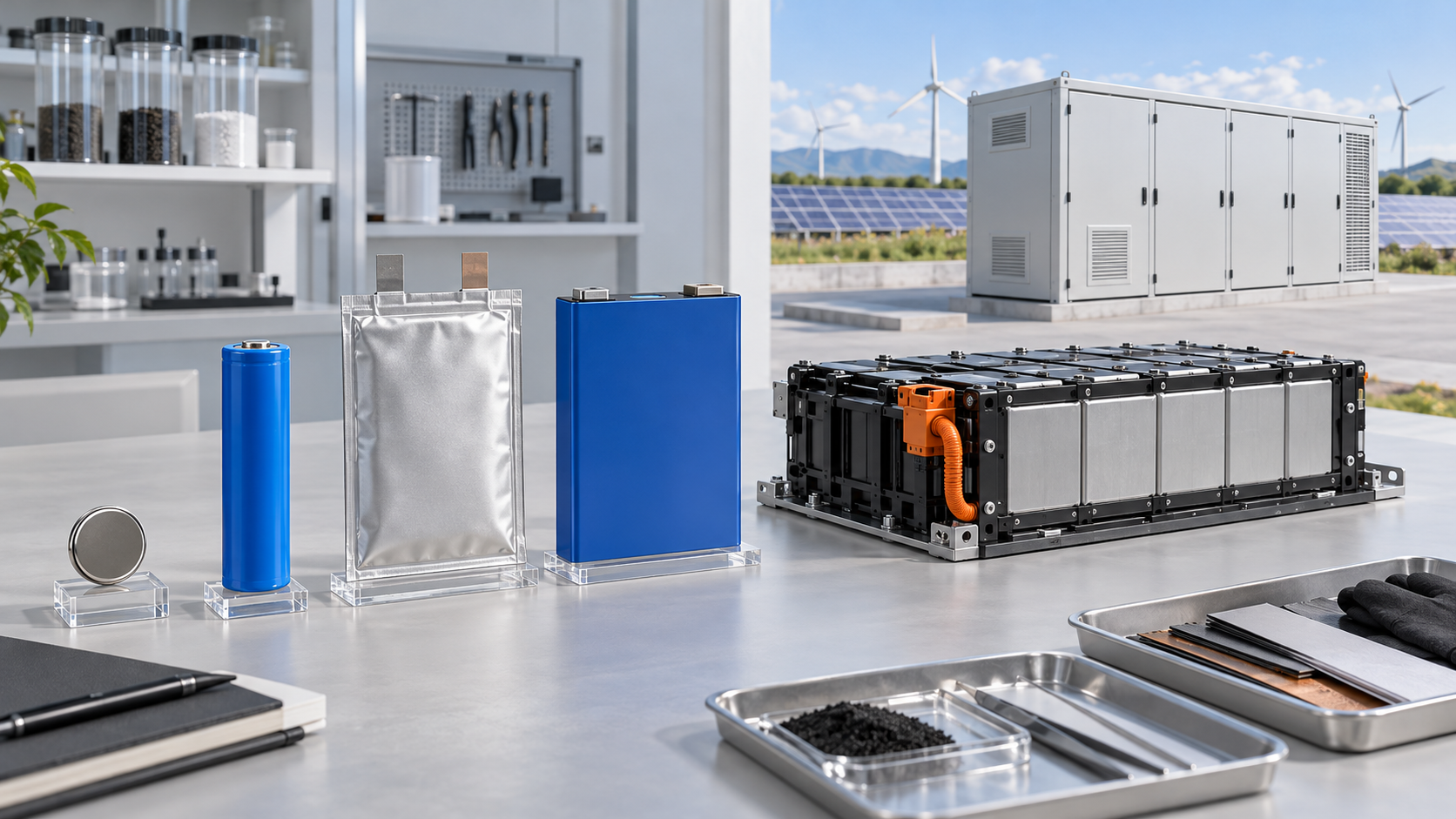
Taking the lithium-ion battery (LFP and NMC) as the baseline, this article lines up more than a dozen batteries in tables and figures of the same form: silicon-anode lithium-ion, lithium metal, sodium-ion, lithium-sulfur, redox flow, iron-air, zinc-based, NAS, multivalent ions and others. It looks at six things: principle and materials, strengths, risks, challenges to overcome, maturity and suitable uses. It is not an article that ranks them. A battery is the product of a design that gives something up to gain something else, and even the same number means different things depending on whether it is a cell value or a system value.
- Before comparing (the short version)
- Ground rules for comparison — axes, definition of maturity, separating the bases
- Battery by battery — principle and materials, strengths, risks, challenges, maturity
- Figure: overview table
- Figure: energy density and round-trip efficiency against cycle life
- A materials engineer's view (1): read numbers on three layers — material, cell, system
- Figure: the ladder of commercialization maturity
- Figure: a map of challenges
- A materials engineer's view (2): the strength is the challenge
- Figure: suitability by use
- The order of questions when choosing
- Limits, and what could not be confirmed
- How to read evaluations and standards
- Glossary
- References
- Claim-to-source audit
Sourced = stated in published material (link given)
Our calculation = a figure this article derived, with the assumptions spelled out
Not yet confirmed = a plan or target with no confirmed track record
Structural readings and interpretations are marked separately as Commentary. Company announcements are company claims, kept apart from independent verification and public-agency estimates.
The double circle, circle and triangle are “this article's grouping”; the axes and the basis are shown in the text and references outside the table. They do not decide which battery is better. Market-research forecasts and price forecasts are not used.
1. Before comparing (the short version)
- What is lined up: the baseline lithium-ion battery (LFP and NMC), silicon-anode lithium-ion, lithium-metal secondary, sodium-ion, lithium-sulfur, lithium-air, potassium-ion, multivalent ions (magnesium, calcium, aluminum), redox flow (vanadium and others), iron-air, zinc-based (zinc hybrid, zinc-air, aqueous zinc-ion), NAS (sodium-sulfur, high-temperature), lead-acid and nickel-metal hydride. All-solid-state batteries are a separate field and are left out of the main text.
- What is examined: each battery's principle and materials, strengths, risks (safety, resources, environment, technology), challenges to overcome, maturity (research, demonstration, commercial) and suitable uses. They are then set side by side in five kinds of figure: an overview table, scatter plots, a maturity ladder, a map of challenges and a table by use.
- How to read it: this article concentrates on comparison and choosing. Detailed explanations of each battery are left to other articles in this series (sodium-ion, lithium-sulfur, redox flow, long-duration storage, lithium-metal anodes, dendrites, silicon anodes and so on), and overlapping explanations are only referred to.
A battery's “performance” is not one number but a combination of what it gains and what it gives up. Lithium-sulfur, for example, gains gravimetric energy density and gives up lifetime and volumetric value; redox flow gains independence of power and capacity and long life, and gives up round-trip efficiency and volumetric value; NAS gains long-duration, large-capacity operation and long life, and gives up a roughly 300 °C operating temperature. So rather than asking “which is better,” the most useful reading for a materials engineer is to start from “what can my application afford to give up” (commentary by this article).
2. Ground rules for comparison — axes, definition of maturity, separating the bases
(1) The axes, and how the ratings were decided
The double circle, circle and triangle in the overview table (Fig. 1) were assigned mechanically from the values in sources this article checked, on four axes. Where no value could be confirmed it is a dash and not filled in by guesswork.
| Axis | Double circle | Circle | Triangle | Values used as the basis (source) |
|---|---|---|---|---|
| Energy density (cell basis) | Above 300 Wh/kg | 150 to 300 | Below 150 | Best conditional published value. LFP 140-175, NMC 240-270, Faradion 160 Wh/kg (company data of mid-2020) [1]. Si-anode cells 315-450 (manufacturer-stated, with packaging) [3]. Li-S 456-498 (10 Ah, company claim) [5]. A star means company claim only |
| Lifetime (cycles) | 5,000 or more, or no design limit | 1,500 to 5,000 | Below 1,500 | PNNL estimates (80% DOD, 2021) take priority: LFP 2,400, NMC 1,520, lead-acid 1,370, zinc-based 1,000-12,500, and vanadium flow with no limit (PNNL's assumption) [2]. NAS 7,300 equivalent cycles (manufacturer) [26]. Si-anode cells 150-1,400 (manufacturer-stated) [3]. Sodium-ion is a triangle because an independent study found retail 18650 cells below 80% at 350 cycles [8] |
| Availability of materials | No Li or Co; no scarce element at the core | Uses Li, or price/purity concerns noted | Sources flag dependence on Li, Co or Ni | Supply risks of Li and Co [27]. Crustal abundance of sodium 2.36% against lithium 0.0065% [33]. Vanadium price swings (PNNL) [2]. Statements on K and Mg [13, 14] |
| Maturity | Commercial / early commercial (limited) / demonstration / research (defined in the next item) | What can be confirmed in official sources and peer-reviewed papers (Chapter 6) | ||
The values in the table are Sourced (statements of each source; company values are claims or stated values). The grouping into the double circle, circle and triangle is this article's.
(2) Definition of maturity
- Commercial: continuing deliveries or operation can be confirmed in official materials (company disclosures, public-agency reports and so on).
- Early commercial (limited): sales or deliveries are confirmed, but scale or independent evaluation is limited.
- Demonstration: trials of prototype cells or pilot installations are confirmed.
- Research: the stage of papers and research reports.
Company statements such as “world first,” “start of mass production” and “shipment plans” are company claims, plans are treated as Not yet confirmed, and in judging maturity independent third-party or public sources were given priority.
(3) Separating the basis of the numbers into three
The following three cannot be compared even if placed in the same table. This article always keeps them apart.
- Material basis: theoretical capacity or theoretical energy of the active material (for example sulfur's theoretical energy of about 2,600 Wh/kg).
- Cell basis: Wh/kg and Wh/L of an actual cell (with packaging) and the cell's life. Fig. 2 of this article.
- System basis: values for a container or whole installation, round-trip efficiency (AC-AC) and installed cost. Fig. 3 of this article.
3. Battery by battery — principle and materials, strengths, risks, challenges, maturity
The three tables below organize the batteries in the same form, grouped as lithium-based, sodium, potassium and multivalent ions, and stationary and long-duration. Company values are described as “company claims”; independent studies and public-agency values give their sources. Suitable uses are collected in Chapter 10.
(1) Lithium-based
| Battery | Principle and materials | Strengths | Risks (safety, resources, environment, technology) | Challenges to overcome | Maturity (basis) |
|---|---|---|---|---|---|
| Lithium-ion (LFP, NMC; baseline) | An insertion-type cell with a cathode of olivine lithium iron phosphate (LFP) or layered nickel-manganese-cobalt oxide (NMC), a graphite anode and an organic electrolyte. For details see our explainers on LIB fundamentals and cathode materials | The best track record. Cell values are LFP 140-175 Wh/kg and 240-360 Wh/L, NMC 240-270 Wh/kg and 670-750 Wh/L [1]. PNNL's 2021 estimate of installed cost at 100 MW and 10 hours is 356 US$/kWh for LFP and 405 for NMC, with an AC-AC round-trip efficiency of 82.59% for both [2] | Flammable organic electrolyte and thermal runaway (our explainer on thermal runaway and battery safety). On resources, supply risks of Li and Co are discussed [27] (LFP uses no Co or Ni) | Energy density is approaching its theoretical limit [4]. At long durations (100 hours) PNNL estimates battery cost per kWh to be “far” above pumped hydro, compressed air and similar [2] | Commercial. The baseline technology of PNNL's cost and performance assessment [2] |
| Silicon-anode lithium-ion | Silicon (or a silicon-carbon composite) is mixed into the anode, with an NMC-type cathode. It alloys with lithium to gain large capacity. See our explainer on silicon anodes and nanostructured electrodes | Amprius's catalog (Q3 2026) lists cells at 315-450 Wh/kg and 680-950 Wh/L (manufacturer-stated; pouch; with packaging; 1 C discharge) [3]. Panasonic Energy explains that silicon's theoretical capacity is about 10 times that of graphite [28] | Expansion on charging causes capacity fade [28]. Some models recommend or require external clamping pressure (15-30 PSI) [3] | Cycle life: 150-1,400 cycles in the same catalog (to 80% SOH; conditions differ by model) [3]. Control of expansion | Early commercial (limited). Panasonic Energy announced in July 2023 that it would buy silicon anode material from Nexeon for batteries made at a new US plant in Kansas from 2025 (operating status not confirmed) [28]. Amprius lists catalog products [3] |
| Lithium-metal secondary (liquid electrolyte) | Lithium metal is used at the anode. See our explainers on lithium-metal anodes and dendrites. All-solid-state batteries are a separate field | A Nagoya University commentary says that with a Li-metal anode 300-500 Wh/kg, beyond lithium-ion, “can be expected” (an expected value; the limit of conventional LIBs is put near 250 Wh/kg) [11] | Lithium grows into branches on charging and short-circuits. The flash point of the organic electrolyte is 60-90 °C, and at high temperature it ignites and decomposes [11] | Suppressing dendrites and inactive lithium. The commentary (2020) says that Li-metal anodes “are used only in primary batteries at present” [11] | Research. Deliveries or mass production as a secondary battery could not be confirmed in this investigation |
| Lithium-sulfur | Sulfur at the cathode and lithium metal at the anode. A conversion cell in which S8 passes through dissolved polysulfides to Li2S. See our explainer on lithium-sulfur batteries | The theoretical energy density on a material basis is about 2,600 Wh/kg, and sulfur is one of the most abundant elements on Earth [4, 30]. Li-S Energy claims 498 Wh/kg on first discharge and 456 after formation for a 10 Ah semi-solid cell [5] | The shuttle effect of polysulfides, a volume change of about 80%, and degradation of lithium metal. Ether electrolytes are volatile and flammable [4] | Lifetime under practical conditions (such as E/S ratio below 5 microlitres per mg). No independent measured values were found [4, 6] | Demonstration. ISI sees no broadly available automotive-grade cell, and expects the first markets to be drones, aviation, space and defense [6] |
| Lithium-air | Uses lithium metal and oxygen from the air (aqueous or non-aqueous). Bruce et al.'s review discusses Li-O2 and Li-S as two options beyond the limits of lithium-ion [12] | The review compares the energy that can be stored with lithium-ion and describes a large potential [12]. No specific cell value could be confirmed here | Significant hurdles remain that need understanding of the reactions and new materials [12] | Fundamental scientific advances and new materials [12] | Research (according to the review) |
The tables scroll sideways. Numbers in brackets are reference numbers. Sourced means a statement of each source; company values are claims or stated values.
(2) Sodium, potassium and multivalent ions
| Battery | Principle and materials | Strengths | Risks (safety, resources, environment, technology) | Challenges to overcome | Maturity (basis) |
|---|---|---|---|---|---|
| Sodium-ion | Na+ moves in and out between the electrodes. Cathodes are layered oxides, Prussian blue analogues or polyanions; the anode is hard carbon. Aluminum foil can be the collector on both sides. See our explainers on sodium-ion batteries and hard-carbon anodes | Crustal abundance is 2.36% for Na against 0.0065% for Li [33]. A design without Co or Li is possible. Faradion's cell: 160 Wh/kg, 290 Wh/L, 3,000 cycles (company data of mid-2020) [1] | In an independent study retail 18650 cells went into thermal runaway even at 30% SOC [7]. On resources, this changes if a cathode containing V or Ni is chosen | Energy density (a retail 18650 is 97.5 Wh/kg against 122 for an LFP of the same format) [7]. In an independent study the life of retail 18650 cells was about one tenth of the datasheet [8]. International standards (IEC 63635, 63591) are at the draft stage | Early commercial. Retail cells are available [7, 8], and CATL announced plans for mass production and storage-system shipments (company claims and plans) [9, 10] |
| Potassium-ion | K+ insertion. A review says the low standard potential of K/K+ gives operating voltages competitive with LIBs [13] | It uses no scarce or toxic elements, and K+ interacts weakly with solvents and anions and diffuses faster than Li+ (an advantage for high power) [13] | The review discusses remaining and emerging issues; specifics could not be confirmed here [13] | As left | Research |
| Magnesium | A prototype system (2000) with an Mg anode, a Mo3S4 cathode and an organohaloaluminate electrolyte, in which Mg2+ is inserted [14] | Mg is inexpensive, environmentally friendly and safe to handle. A higher energy density than lead-acid and nickel-cadmium systems is anticipated, it reports [14] | Only solutions that neither donate nor accept protons can be used, and most form passivating films that block the reaction [14] | Mg2+ is hard to insert into many cathodes [14]. Unambiguous identification of the multivalent cathode mechanism [15] | Research (a 2000 prototype and a 2017 review) |
| Calcium | Ca2+. Plating of Ca had been thought impossible [16] | In 2015 reversible Ca plating was shown at moderate temperature in conventional organic electrolytes [16]. With multivalent ions, fewer ions are needed for the same capacity than with Li+ [16] | - | Confirming reversibility is a first step toward a new battery [16] | Research |
| Aluminum | An Al-metal anode, a three-dimensional graphitic-foam cathode and a non-flammable ionic-liquid electrolyte. Chloroaluminate anions go in and out of the graphite [17] | Low cost, low flammability and a three-electron reaction [17]. A 2015 prototype showed a plateau near 2 V, about 70 mAh/g, Coulombic efficiency of about 98% and a life of over 7,500 cycles [17] | Earlier problems were cathode disintegration, a low voltage of about 0.55 V and lives under 100 cycles [17] | Capacity (about 70 mAh/g on a cathode basis; times 2 V gives about 140 Wh/kg of cathode, Our calculation) | Research (laboratory prototype cells) |
The tables scroll sideways. Parts of the Ca and Al rows are statements within the scope of the abstracts.
(3) Stationary and long-duration
| Battery | Principle and materials | Strengths | Risks (safety, resources, environment, technology) | Challenges to overcome | Maturity (basis) |
|---|---|---|---|---|---|
| Redox flow (vanadium) | Electrolyte containing the active material is kept in external tanks and pumped to the cell. V2+/V3+ and V4+/V5+. Power is set by the cell and capacity by the volume of liquid. See our explainer on redox flow batteries | Sumitomo Electric explains that the electrolyte is non-flammable, with no electrode or electrolyte degradation, a design life of 20 years and unlimited cycles (company claims) [20]. Invinity: 230 kWh per module, over 20,000 cycles, 2-12 hours (manufacturer-stated) [21]. PNNL assumes no cycle limit [2] | Vanadium price swings (V2O5 reached a high of 12.80 US$/lb in 2021) and electrolyte cost [2]. Membranes are often fluorinated (our explainer on fluoropolymers and PFAS) | Low round-trip efficiency (PNNL: AC-AC 65% against 82.59% for LFP). Installed cost at 100 MW and 10 hours is 385 US$/kWh, no lower than LFP's 356 [2]. Low energy density (about 9 Wh/kg on a container basis, Chapter 6) | Commercial. Sumitomo Electric's 15 MW / 60 MWh (operating since December 2015) and 17 MW / 51 MWh (since April 2022) [19] |
| Other flow systems | Organic (quinone), zinc-bromine, iron flow and others | A quinone system uses no metal and showed over 99% capacity retention per cycle (laboratory, 2014) [29]. For zinc-bromine PNNL's composite estimate is 65-75% round-trip efficiency and 3,650-5,000 cycles (80% DOD) [2] | The iron-flow company ESS Tech disclosed 2025 revenue of 1.6 million US dollars, a net loss of 63.4 million, and substantial doubt about going concern [31] | The company says its claim of over 20,000 cycles rests on “lab-scale results” [31] | Research (organic) / demonstration to early commercial (zinc-bromine, iron flow; business unstable) |
| Iron-air | On discharge the battery takes oxygen from the air and iron turns to rust; on charge the rust returns to iron: “reversible rusting.” An aqueous non-flammable electrolyte (the company's description) [22] | Cheap, abundant materials, iron, water and air (company claim). It claims storage of up to 100 hours [22] | A review: predicted open-circuit potential 1.28 V; reported efficiencies of 96% (charge), 40% (voltage) and 35% (energy) (old, laboratory values) [23] | A bifunctional (charge and discharge) oxygen electrode, and an iron electrode that suppresses corrosion and hydrogen evolution [23]. An official round-trip efficiency could not be confirmed | Demonstration. A pilot project with Great River Energy (a US electric cooperative), said to store up to 100 hours, broke ground in 2024 [34]. Xcel Energy announced 300 MW / 30 GWh (a plan awaiting approval) [35] |
| Zinc-based | Zinc hybrid (Eos: zinc halide, felt, resin, titanium, conductive polymer), zinc-air (one developer described by PNNL) and aqueous zinc-ion | Eos describes a static design without pumps or compressors, operation at -20 to 50 °C and manufacture at zero voltage and zero state of charge (company claims) [24]. PNNL composite estimates: Ni-Zn 71-88% and 1,000-3,938 cycles; zinc-air 59% and 12,500 cycles [2] | In aqueous zinc-ion batteries dendrites, hydrogen evolution and corrosion are the main problems of the zinc anode [18] | Zinc-air had no pilot or demonstration at the time of PNNL's 2022 report [2]. Aqueous zinc-ion is “still developing” [18] | Early commercial (Eos Z3 has shipped since the third quarter of 2023, the company's statement [24]) / demonstration (zinc-air) / research (aqueous zinc-ion) |
| NAS (sodium-sulfur, high-temperature) | Sodium at the anode and sulfur at the cathode. The operating temperature inside the module is 305-340 °C [26] | A 20-ft container gives 1,450 kWh-dc of usable energy, 7,300 equivalent cycles, a 20-year design life and 100% depth of discharge (manufacturer-stated) [26]. NGK describes long-duration, large-capacity use with long life and high reliability as its strengths [25] | Operation at high temperature. No accident or safety assessment was found in the sources used here | Business viability: NGK resolved on 31 October 2025 to end manufacture and sales, citing slow emergence of demand, a surge in material costs and competition from lithium-ion [25] | Commercial (ending). The last shipment is scheduled for January 2027 [25] |
| Lead-acid | Lead and lead dioxide with sulfuric acid. One of PNNL's baseline stationary technologies | Recycling is mature: 10-12% of the initial module cost is recoverable. Installed cost is close to LFP (409 US$/kWh at 100 MW and 10 hours) [2] | Storage at a low state of charge for long causes irreversible sulfation [2]. Aurbach et al. contrast Mg as “inexpensive, environmentally friendly and safe to handle” unlike lead and cadmium [14] | A life of 1,370 cycles (80% DOD) and round-trip efficiency of 71-78% [2] | Commercial (a PNNL baseline technology; efficiency and life as left) [2] |
| Nickel-metal hydride | - (primary sources for the principle and values could not be confirmed here) | The review by Choi and Aurbach says lithium-ion batteries now surpass lead-acid and nickel-metal hydride batteries, which they once competed with [32] | - | - | Commercial (existing; no numbers are given here) |
The tables scroll sideways. A dash marks an item that could not be confirmed in the sources used here.
4. Figure: overview table
This overview table sets out the 15 rows (batteries) on four axes, following the ground rules of Chapter 2. The double circle, circle and triangle are “this article's grouping” and not a ranking. The definitions of the axes and the values used are in the table of Chapter 2, and the individual basis for each battery is in the tables of Chapter 3 and the references.
Three ways to read this table (commentary by this article).
- There are many dashes. Cell-basis energy density is often not given at all for batteries sold as systems, such as flow batteries, iron-air and NAS, and could not be confirmed for many others. A dash does not mean “low.”
- Batteries with a double circle also carry a star (company claim). The double circles for energy density are for silicon anodes (manufacturer-stated) and lithium-sulfur (company claim), and both have a triangle for lifetime. High gravimetric energy density and long life are, for now, not found together in the same battery.
- The double circles for lifetime lean toward grid-scale batteries. Redox flow and NAS are stated to have no design limit on cycles or 7,300 equivalent cycles (manufacturer-stated), and have low (or unconfirmable) energy density.
5. Figure: energy density and round-trip efficiency against cycle life
(1) Cell basis: energy density x cycle life
Fig. 2 shows, as ranges, only those batteries for which both cell-basis energy density and cycle life have been published. Boxes rather than points are used because the values change with conditions (discharge rate, depth of discharge, end-of-life criterion).
- LFP and NMC (blue): values from the 2021 roadmap: LFP at 140-175 Wh/kg and 3,500-6,000 cycles, NMC at 240-270 Wh/kg and 600 cycles (cylindrical cell) [1]. The life is under the same conditions: to 20% fade, 80% DOD, +/-1 C.
- Silicon anode (orange dashed): Amprius's five models (manufacturer-stated) scatter over 315-450 Wh/kg and 150-1,400 cycles [3]. The higher the energy density of the model, the shorter the stated life tends to be (300 cycles at 400 Wh/kg and 150 cycles at 450 Wh/kg), but discharge rate, depth of discharge and cathode differ between models, so expansion alone cannot be named as the cause (commentary by this article).
- Sodium-ion (orange dot): Faradion's company data (160 Wh/kg, 3,000 cycles) [1]. Even for a “sodium-ion battery,” independent studies found a retail 18650 cell at 97.5 Wh/kg (datasheet-derived; a different cell) [7] and two other makers' cells below 80% capacity within 350 cycles at 0.5 C [8]. The gap between company data and independent evaluation is large, so these are given in the text rather than plotted.
- Lithium-sulfur (purple band): 456-498 Wh/kg (company claim for 10 Ah cells) can be shown, but no cycle life has been published [5]. No third-party measurement was found in this investigation [6].
(2) System basis: round-trip efficiency x cycle life
In grid storage, “how many cycles can it do” and “what fraction of the energy put in comes back (round-trip efficiency)” set the cost. Fig. 3 arranges, on a system basis, mainly the estimates (2021 values) of the US PNNL's 2022 report [2].
- Lithium-ion (LFP and NMC) has high round-trip efficiency (82.59%), while PNNL's assumed cycle life is 2,400 and 1,520 cycles (80% DOD).
- Vanadium flow batteries have a low round-trip efficiency of 65% and are assumed to have no cycle limit. They take life and give up efficiency.
- Zinc-based systems vary by technology and scale (Zn-Br: 65-75% and 3,650-5,000 cycles; Ni-Zn: 71-88% and 1,000-3,938 cycles; zinc-air: 59% and 12,500 cycles), so they cannot be spoken of as one “zinc.”
- Iron-air: only a review's energy efficiency of 35% (an old laboratory value) could be confirmed, and the efficiency of current products could not be confirmed officially [22, 23].
(3) Our calculation: how round-trip efficiency bears on the cost of charging electricity
The charging energy needed to draw 1 MWh on discharge is 1 ÷ round-trip efficiencyOur calculation. At 82.59% (LFP, PNNL) it is 1.211 MWh; at 71% (lead-acid, 2 hours) 1.408 MWh; at 65% (vanadium flow) 1.538 MWh; at 59% (zinc-air) 1.695 MWh; and at 35% (the iron-air review value) 2.857 MWh.
Assumption: if the price of charging electricity is assumed to be 20 US$/MWh (our assumption, not a market price), the charging cost per MWh discharged becomes 24.2, 28.2, 30.8, 33.9 and 57.1 US$. The efficiencies are PNNL's 2021 estimates and an old value from a 2014 review. If cheap hours (surplus renewable power) can be used for charging, the effect of low efficiency is smaller (commentary by this article; the levelized cost of storage, LCOS, is covered in our explainer on storage economics).
6. A materials engineer's view (1): read numbers on three layers — material, cell, system
The calculation below shows that cell-basis and system-basis values differ by an order of magnitudeOur calculation.
| Item | Basis | Energy | Mass | Per unit mass | Per unit volume (envelope) |
|---|---|---|---|---|---|
| NAS (NGK; BASF-distributed Model L24) | 20-ft container, usable energy (DC, beginning of life) | 1,450 kWh | about 21 t | about 69 Wh/kg | about 37.9 kWh/m³ |
| Vanadium flow (Invinity VS3-022) | One module (container), rated | 230 kWh | 24.6 t (flooded) | about 9.4 Wh/kg | about 6.0 kWh/m³ |
| Silicon-anode cell (Amprius SA02) | Cell, with packaging, 1 C discharge | 39.4 Wh | 111.2 g | 340 Wh/kg (stated) | 770 Wh/L (stated) |
Both containers measure 6,058 x 2,438 x 2,591 mm (38.27 m³). Our calculation: 1,450 ÷ 21,000 kg, 230 ÷ 24,600 kg, and each energy ÷ 38.27 m³. Value sources: BASF's NAS L24 data sheet [26], Invinity's data sheet [21] and Amprius's catalog [3] (all manufacturer-stated).
A container includes everything but the battery itself: electrolyte tanks, piping, pumps, controls and insulation. System-basis values cannot be set beside cell-basis values to argue which is better. From the standpoint of installation, however (“how much weight and floor area does 1 MWh take”), the difference translates directly into differences in foundations, transport and footprint (commentary by this article). The implication for a materials engineer is that how much a material improvement (say a 10% rise in cell value) does at system level differs greatly by type of battery.
The NAS figures also give a duration. Delivering 1,450 kWh at 250 kW-dc (maximum power) takes 5.8 hours (1,450 ÷ 250), consistent with NGK's description of NAS as suited to long-duration, large-capacity use [25]Our calculation.
7. Figure: the ladder of commercialization maturity
Following the definitions of Chapter 2, each battery is placed on four rungs: research, demonstration, early commercial (limited) and commercial. This is a position within what official sources and peer-reviewed papers confirm, not a ranking of performance or promise.
| Battery | Rung | Basis (what could be confirmed in official sources and peer-reviewed papers) |
|---|---|---|
| LFP, NMC, lead-acid | Commercial | PNNL treats them as baseline technologies in its cost and performance estimates [2]. Specific delivery volumes were not checked here |
| Nickel-metal hydride | Commercial (existing) | A review names it as a type that lithium-ion batteries once competed with [32]. No numbers could be confirmed |
| Redox flow (V) | Commercial | Sumitomo Electric's 15 MW / 60 MWh (operating since December 2015) and 17 MW / 51 MWh (since April 2022) [19]. Invinity's product data sheet [21] |
| NAS | Commercial (ending) | Commercialized in 2002 [25]. A product data sheet distributed by BASF [26]. A resolution of 31 October 2025 to end manufacture and sales, with the last shipment in January 2027 (scheduled) [25] |
| Silicon-anode Li-ion | Early commercial (limited) | Amprius's product catalog [3]. Panasonic Energy announced that it would use Nexeon's silicon anode material in batteries from a US plant from 2025 (operating status not confirmed) [28] |
| Sodium-ion | Early commercial | Retail 18650 cells evaluated by independent studies [7, 8]. CATL announced plans for mass production and storage-system shipments (company claims and plans) [9, 10]. International standards are at the draft stage (our explainer on sodium-ion batteries) |
| Zinc hybrid (Eos) | Early commercial | Z3 modules have shipped since the third quarter of 2023 (the company's 10-K) [24]. A DOE-guaranteed loan facility (up to 303.5 million US dollars) and a plan for 8 GWh of annual manufacturing capacity by 2027 (Not yet confirmed) [24] |
| Lithium-sulfur | Demonstration | Prototype 10 Ah cells and communication of deliveries for UAVs (company claims) [5, 6]. ISI summarizes it as “not yet broadly commercialized” [6] |
| Iron-air | Demonstration | A pilot project broke ground in 2024 [34]. A 300 MW / 30 GWh plan was announced (awaiting approval, Not yet confirmed) [35]. Official material showing full operation could not be confirmed |
| Zinc-air | Demonstration (prototype) | PNNL (2022) states that no pilot or demonstration has been done [2] |
| Lithium-metal (liquid), lithium-air, potassium-ion, magnesium, calcium, aluminum, aqueous zinc-ion, organic flow | Research | Statements of papers and reviews [11 to 18, 29]. Lithium-metal anodes are “used only in primary batteries at present” (2020 commentary) [11] |
Company announcements are claims or plans; independent and public sources were given priority in judging the rung.
8. Figure: a map of challenges
The map below marks with a dot, for each battery, the challenges the sources name, divided into six kinds. A blank does not mean “no problem”; it means this article's sources did not cover it.
| Battery | Basis of the dots (challenges written in the sources) |
|---|---|
| NMC//graphite | Resources: supply risks of Li and Co [27] |
| Silicon-anode Li-ion | Active material: capacity fade from expansion on charging [28]. Evaluation: discharge rate, DOD and clamping pressure differ by model and life scatters over 150-1,400 cycles [3] |
| Lithium-metal secondary | Interface: lithium grows into branches and short-circuits [11]. Electrolyte: the flash point of organic electrolyte is 60-90 °C [11]. Business: mass production as a secondary battery is not confirmed (the 2020 commentary says primary only) [11] |
| Sodium-ion | Active material: each of the three cathode families has a different difficulty (phase change, vacancies and water, heavy framework) [1]. Electrolyte: ready dissolution of SEI components, HF from NaPF6 [1]. Efficiency: first-cycle efficiency of hard carbon [33]. Evaluation: life of retail 18650 cells about 1/10 of the datasheet [8]; standards at the draft stage (our explainer on sodium-ion batteries) |
| Lithium-sulfur | Interface: degradation of lithium metal [4]. Active material: volume change of about 80%, insulation and polysulfides [4]. Electrolyte: E/S ratio and flammable ether [4]. Efficiency: lower efficiency from the shuttle effect [4]. Evaluation: the level of “Wh/kg” is not aligned and no independent measurement was confirmed [6] |
| Magnesium, calcium, aluminum | Interface: Ca plating was long thought impossible [16]. Active material: difficulty of inserting Mg2+, disintegration of the Al cathode [14, 17]. Electrolyte: few solutions for Mg do not form passivating films [14] |
| Redox flow (V) | Electrolyte and membrane: balance of membrane and liquid (our explainer on redox flow batteries). Efficiency: round-trip efficiency of 65% [2]. Resources and cost: vanadium price swings and installed cost [2] |
| Iron-air | Active material and electrode: a bifunctional oxygen electrode, corrosion and hydrogen evolution at the iron electrode [23]. Efficiency: energy efficiency of 35% (old laboratory value) [23]. Evaluation: no official round-trip efficiency could be confirmed [22] |
| Zinc-based | Interface: dendrites, hydrogen evolution and corrosion of the zinc anode in aqueous zinc-ion [18]. Efficiency: zinc-air 59%, Zn-Br 65-75% [2]. Evaluation: no pilot for zinc-air (2022), aqueous zinc-ion still developing [2, 18] |
| NAS | Operating conditions: operating temperature of 305-340 °C [26]. Resources and cost: surge in material costs [25]. Business: manufacture and sales ended because of slow demand and competition [25] |
| Lead-acid | Active material: irreversible sulfation when kept at a low state of charge [2]. Efficiency: round-trip efficiency of 71-78% and a life of 1,370 cycles [2] |
9. A materials engineer's view (2): the strength is the challenge
Re-reading the tables and figures so far as pairs of “what was gained and what was given up,” they come out as follows (this article's organization; the basis of each row is in the tables of Chapters 3 and 8).
| Battery | What it gains | What it gives up |
|---|---|---|
| Silicon-anode Li-ion | High capacity (315-450 Wh/kg) | Managing expansion (clamping pressure) and lifetime (150-1,400 cycles) [3, 28] |
| Lithium-metal secondary | An expected 300-500 Wh/kg | Dendrites and short circuits; a track record as a liquid-electrolyte secondary battery [11] |
| Lithium-sulfur | High gravimetric value | Volumetric value and lifetime; migration of polysulfides [4, 6] |
| Sodium-ion | Abundant resources (Na at 2.36%); a design with no Co or Li | Energy density; independently evaluated lifetime [1, 7, 8, 33] |
| Redox flow (V) | Independence of power and capacity, long life by design, a non-flammable liquid (company claims) | Round-trip efficiency (65%), volumetric value, dependence on the vanadium price [2, 20] |
| Iron-air | Cheap, abundant iron, water and air; up to 100 hours (company claims) | Efficiency (35% in an old review), a complex oxygen electrode, track record [22, 23] |
| Zinc-based | A simple build such as aqueous and static designs (company claims); cheap materials | Control of the zinc anode; variation between technologies [2, 18, 24] |
| NAS | Long-duration, large-capacity operation; long life by design (7,300 equivalent cycles) | Operation at 305-340 °C; sustaining the business [25, 26] |
| Multivalent ions such as magnesium | Cheap, abundant elements; a high theoretical capacity | The electrolyte; insertion into the cathode [14, 15, 17] |
This arrangement shows the “hand” of the design. A battery's weakness is usually the flip side of the structure chosen to gain its strength. When a materials engineer looks at a challenge, rather than trying to fix the weakness in isolation, checking first “what is the weakness being accepted for” makes it easier to judge whether an improvement will break other performance (commentary by this article).
10. Figure: suitability by use
| Battery | Reading by use, and the basis |
|---|---|
| LFP | Vehicles: suited (commercial; 140-175 Wh/kg [1]). Stationary, short: suited (a PNNL baseline; round-trip efficiency of 82.59% [2]). Long-duration: conditional (at 100 hours the cost per kWh of batteries is high [2]). Weight-critical: conditional (the 150-175 Wh/kg band). Frequent cycling: suited (2,400 cycles; a calendar life of 16 years [2]) |
| NMC | Vehicles: suited (240-270 Wh/kg [1]). Stationary, short: suited [2]. Long-duration: conditional [2]. Weight-critical: conditional. Frequent cycling: conditional (1,520 cycles; a calendar life of 13 years [2]) |
| Silicon-anode Li-ion | Vehicles: suited (Panasonic Energy's purchase agreement [28]; operating status not confirmed). Weight-critical: suited (315-450 Wh/kg; introduced by the company for aerospace and defense [3]). Frequent cycling: unsuited (150-1,400 cycles [3]) |
| Sodium-ion | Vehicles: conditional (CATL announced a passenger car, with market launch planned for mid-2026 [9]). Stationary, short: conditional (TENER Sodium shipment plans [10]; company claims and plans). Weight-critical: unsuited (97.5 Wh/kg for a retail 18650 [7]). Frequent cycling: conditional (short life in an independent study [8]) |
| Lithium-sulfur | Vehicles: unsuited (no broadly available automotive-grade cell is visible [6]). Stationary, short: unsuited (ISI does not see stationary as the first market [6]). Weight-critical: suited (UAVs, aviation, space, defense [6]). Frequent cycling: unsuited (life shortens under practical conditions [4]) |
| Redox flow (V) | Vehicles: unsuited (about 9 Wh/kg on a container basis, Chapter 6). Stationary, short: suited (17 MW / 51 MWh [19]). Long-duration: suited (2-12 hours [21]). Weight-critical: unsuited. Frequent cycling: suited (an assumed no limit [2]; over 20,000 cycles, manufacturer-stated [21]) |
| Iron-air | Long-duration: conditional (a claim of up to 100 hours [22]; at the pilot and plan stage [34, 35]). Vehicles and weight-critical: unsuited (no energy-density value could be confirmed and a low efficiency is reported [23]) |
| Zinc-based | Stationary, short: conditional (Ni-Zn estimated for 2-6 hours [2]). Long-duration: conditional (zinc-air for 8-100 hours is one developer [2]). Frequent cycling: suited (PNNL-estimated life of 3,650-12,500 cycles [2]). Vehicles and weight-critical: unsuited |
| NAS | Long-duration: suited (1,450 kWh of usable energy at up to 250 kW, about 5.8 hours [26]). Frequent cycling: suited (7,300 equivalent cycles at 100% depth of discharge [26]). Vehicles and weight-critical: unsuited (operation above 300 °C; about 69 Wh/kg [26]). Manufacture and sales are, however, ending [25] |
| Lead-acid | Stationary, short: conditional (round-trip efficiency of 71-78% [2]). Long-duration: conditional (PNNL states that lead-acid, with its low equipment cost, can lower the LCOS at long durations [2]). Frequent cycling: unsuited (1,370 cycles [2]) |
This table is a reading from the values, track records and company claims confirmed here, and does not judge the suitability of any specific product or project.
11. The order of questions when choosing
Checking the following questions in order narrows the candidates. The circles, triangles and crosses in the tables and figures are clues for that (commentary by this article; not a judgment on any individual project).
- Is weight or volume decisive? If weight, the “published values” of silicon anodes and lithium-sulfur are candidates, but always check level and conditions (company claims only; short life). If volume, LFP and NMC are the baseline.
- How many times a day, and for how many years? If once a day or more, a battery whose life is thousands of cycles or has no design limit (LFP and NMC, redox flow, NAS and so on). Each battery's life is conditional, and independent evaluation takes priority.
- How many hours are to be stored? Up to 4 hours lithium-ion is the baseline. At 6 hours and more redox flow, NAS (ending), zinc-based and iron-air (demonstration) are discussed, but cost, efficiency and track record differ battery by battery.
- What is the operating environment? Whether there are cold or hot conditions. NAS operates at 305-340 °C. Sodium-ion's low-temperature performance rests on CATL's claims [9].
- What are the constraints on resources and procurement? Whether dependence on Co or Li is to be avoided, and whether swings in the vanadium price can be tolerated.
- Is there a track record and independent evaluation? Look at company claims separately from the values of public agencies and independent studies.
- What of standards and certification? For batteries whose international standards are not yet in place (sodium-ion's IEC standards are at the draft stage), a check is needed for each use.
12. Limits, and what could not be confirmed
- Batteries for which no cell-basis value could be confirmed: liquid lithium-metal secondary, lithium-air, potassium-ion, multivalent ions, iron-air, zinc-based, lead-acid and nickel-metal hydride. They carry a dash in the overview table.
- Nickel-metal hydride: no numbers are given because primary sources for principle and performance could not be confirmed.
- Company announcements: the cathode type of Naxtra and TENER Sodium, Li-S Energy's cycle life, and Form Energy's and Eos's round-trip efficiency could not be confirmed.
- Independent third-party measurements: none were found for lithium-sulfur cell performance or for the efficiency of current iron-air products.
- Safety: the causes of individual accidents and the safety of products are not assessed here. For battery safety in general, see our explainer on thermal runaway and battery safety.
- Markets and prices: market-research forecasts and actual prices (US$/kWh) are not covered. PNNL's values are 2021 estimates based on developer surveys.
- All-solid-state batteries: a separate field, so they are not in the main text. See the all-solid-state battery articles.
- A battery's performance is a combination of what it gains and what it gives up. Choose by what the application can afford to give up, not by rank (commentary by this article)
- Read numbers on three layers: material, cell and system. Container-basis values (NAS about 69 Wh/kg, vanadium flow about 9.4 Wh/kg) differ by an order of magnitude from cell-basis values (LFP 140-175 and silicon anode 315-450 Wh/kg)Our calculation
- High energy density and long life are, for now, not found together in the same battery. Silicon anodes give 150-1,400 cycles, lithium-sulfur has no published life, and sodium-ion is short in independent evaluationSourced
- In grid use, the lower the round-trip efficiency, the higher the cost of charging electricity. LFP 82.59%, vanadium flow 65%, zinc-air 59% (PNNL)Sourced
- Maturity: LFP, NMC, lead-acid, redox flow and NAS are commercial; sodium-ion, silicon anodes and zinc hybrid are early commercial; lithium-sulfur and iron-air are at demonstration; the rest are research (this article's grouping)
- NGK resolved in October 2025 to end NAS manufacture and sales. A technology being usable and a business continuing are different thingsSourced
13. How to read evaluations and standards
Before comparing which number is larger, align the basis of comparison in the following order. This is an editorial reading checklist, not a set of test conditions or acceptance limits prescribed by a standard.
- 1. What was measured?
- energy density, power, life, cost and safety. Check the units and whether the result describes a material, component or complete system.
- 2. Under which conditions?
- material, cell or system, temperature, load, end-of-life definition and production maturity. Treat results under different conditions as separate results before comparing them.
- 3. The comparison trap
- Do not rank theoretical values, laboratory records, company targets and product specifications together.
- 4. What does the standard cover?
- Check the identifier, title, edition and scope in the issuing body’s material. Distinguish test methods, safety, interoperability and management requirements. Naming a standard alone does not establish that a test, conformity assessment or certification has been completed.
Keep a comparison note containing the object, units, conditions, sample count and variation, comparator, standard edition and unresolved points. Do not invent numerical conditions or acceptance limits from a public abstract of a standard.
14. Glossary
- Insertion type / conversion type
- A scheme in which ions go in and out of a crystal / one in which the substance itself changes chemically.
- Round-trip efficiency (RTE)
- The fraction of the energy used to charge that can be drawn on discharge. AC-AC is the value on the alternating-current side.
- DOD
- Depth of discharge: the percentage of capacity used.
- SOH
- State of health: the present capacity as a fraction of the initial capacity.
- Cycle life
- The number of charge-discharge cycles until capacity falls by a set fraction (such as 20%). The value changes with conditions.
- Material, cell and system basis
- Values of the active material / of a cell including packaging / of a whole container or installation.
- LCOS
- Levelized cost of storage: a calculation under stated assumptions.
- NAS battery
- A high-temperature secondary battery using sodium and sulfur.
- Redox flow battery
- A battery that keeps liquid containing the active material in external tanks and pumps it to the cell.
- Multivalent ion
- An ion with a charge of two or more, such as Mg2+, Ca2+ or Al3+.
- Clamping pressure
- The pressure holding a cell from outside. Recommended for some silicon-anode cells.
- Maturity
- The stage of commercialization. Here divided into research, demonstration, early commercial and commercial.
15. References
- Tapia-Ruiz et al. (NEXGENNA consortium of the Faraday Institution and others) "2021 roadmap for sodium-ion batteries," Journal of Physics: Energy 3, 031503 (2021) (open access) — doi.org/10.1088/2515-7655/ac01ef
- Pacific Northwest National Laboratory (PNNL) "2022 Grid Energy Storage Technology Cost and Performance Assessment" (PNNL-33283, August 2022) — pnnl.gov
- Amprius Technologies "Product Portfolio Q3 2026" (product catalog and data sheets, PDF) — amprius.com
- Chan, Wu and Chung (National Cheng Kung University) "Design principles for practical lithium-sulfur cells: high-loading sulfur cathodes, thin lithium-metal anodes, and lean electrolyte conditions," Energy Materials 6, 600062 (2026) (open-access review) — doi.org/10.20517/energymater.2026.51
- Li-S Energy Limited (ASX: LIS) "Li-S Energy achieves close to 500Wh/kg lithium-sulfur cell performance," ASX Announcement, 28 October 2024 (PDF) — announcements.asx.com.au
- Neef and Rugerri (Fraunhofer ISI) "Where does Europe stand on lithium-sulfur batteries? Research activities and start-ups in this alternative battery technology," 24 June 2026 — isi.fraunhofer.de
- Bottcher et al. (BAM) "Sodium-ion battery research @ BAM (I): investigating the thermal runaway behaviour of commercial sodium-ion battery cells," Sustainable Energy & Fuels 9, 5832-5838 (2025) — doi.org/10.1039/d5se00687b
- Wittman et al. (Sandia National Laboratories, University of Hawaii and others) "Initial characterization and cycling of two batches of commercial hard-carbon/NaxNiyFezMn1-y-zO2 sodium ion 18650 batteries as a potential replacement for lithium-ion batteries," EES Batteries 2, 11-22 (2026) (open access) — doi.org/10.1039/d5eb00161g
- CATL "CATL and CHANGAN Launch World's First Mass-Production Sodium-Ion Passenger Vehicle," 5 February 2026 — catl.com
- CATL "CATL Debuts World's First Field-Validated Sodium-Ion BESS, Bringing Sodium Storage to Commercial Reality," 22 June 2026 — catl.com
- Motoyama, Yamamoto and Iriyama (Nagoya University) "Elucidation of the short-circuit mechanism of solid electrolytes toward high-performance all-solid-state Li batteries" (in Japanese), Oyo Buturi 89(4), 213-217 (2020) (PDF) — jstage.jst.go.jp
- Bruce, Freunberger, Hardwick and Tarascon "Li-O2 and Li-S batteries with high energy storage," Nature Materials 11, 19-29 (2012) (abstract checked) — doi.org/10.1038/nmat3191
- Hosaka, Kubota, Hameed and Komaba "Research Development on K-Ion Batteries," Chemical Reviews 120, 6358-6466 (2020) (abstract checked) — doi.org/10.1021/acs.chemrev.9b00463
- Aurbach, Lu, Schechter, Gofer et al. "Prototype systems for rechargeable magnesium batteries," Nature 407, 724-727 (2000) (abstract checked) — doi.org/10.1038/35037553
- Canepa et al. "Odyssey of Multivalent Cathode Materials: Open Questions and Future Challenges," Chemical Reviews 117, 4287-4341 (2017) (abstract checked) — doi.org/10.1021/acs.chemrev.6b00614
- Ponrouch et al. "Towards a calcium-based rechargeable battery," Nature Materials 15, 169-172 (2016) (abstract checked) — doi.org/10.1038/nmat4462
- Lin et al. (Stanford) "An ultrafast rechargeable aluminium-ion battery," Nature 520, 324-328 (2015) (abstract checked) — doi.org/10.1038/nature14340
- Yang et al. "Zinc Anode for Mild Aqueous Zinc-Ion Batteries: Challenges, Strategies, and Perspectives," Nano-Micro Letters 14, 42 (2022) (review; abstract checked) — doi.org/10.1007/s40820-021-00782-5
- Sumitomo Electric Industries "Redox flow battery installation cases" (in Japanese) — sumitomoelectric.com
- Sumitomo Electric Industries "Features of redox flow batteries" (in Japanese) — sumitomoelectric.com
- Invinity Energy Systems "Invinity VS3-022 Six Pack Vanadium Flow Battery Data Sheet" (MAR00016, January 2023 edition, PDF) — invinity.com
- Form Energy "Battery Technology" (technology page, checked October 2026) — formenergy.com
- McKerracker et al. "A Review of the Iron-Air Secondary Battery for Energy Storage," ChemPlusChem 80, 323-335 (2015) (abstract checked) — doi.org/10.1002/cplu.201402238
- Eos Energy Enterprises, Inc. (SEC filing) Form 10-K for the year ended 31 December 2025 — sec.gov
- NGK INSULATORS, LTD. "Notice Regarding Discontinuation of Manufacturing and Sales Activities of NAS Batteries," 31 October 2025 (PDF, English version) — ssl4.eir-parts.net
- BASF (distributor of NGK-made NAS) "Technical Data Sheet for NAS Battery System, NAS MODEL L24" (PDF) — promo.basf.com
- Vaalma et al. (Passerini and co-authors) "A cost and resource analysis of sodium-ion batteries," Nature Reviews Materials 3, 18013 (2018) (abstract only checked) — doi.org/10.1038/natrevmats.2018.13
- Panasonic Energy "Panasonic Energy to Purchase Silicon Anode Materials from Nexeon, Enabling Production of Higher-energy-density EV Batteries in the U.S.," 25 July 2023 (PDF) — news.panasonic.com
- Huskinson et al. "A metal-free organic-inorganic aqueous flow battery," Nature 505, 195-198 (2014) (abstract checked) — doi.org/10.1038/nature12909
- Manthiram, Fu and Su "Challenges and Prospects of Lithium-Sulfur Batteries," Accounts of Chemical Research 46, 1125-1134 (2013) (abstract checked) — doi.org/10.1021/ar300179v
- ESS Tech, Inc. (SEC filing) Form 10-K for the year ended 31 December 2025 — sec.gov
- Choi and Aurbach "Promise and reality of post-lithium-ion batteries with high energy densities," Nature Reviews Materials 1, 16013 (2016) (abstract only checked) — doi.org/10.1038/natrevmats.2016.13
- Gan et al. (Central South University) "Comprehensive Understanding of Closed Pores in Hard Carbon Anode for High-Energy Sodium-Ion Batteries," Nano-Micro Letters 17, 325 (2025) (open access) — doi.org/10.1007/s40820-025-01833-x
- Great River Energy Press release "Great River Energy, Form Energy break ground on first-of-its-kind multi-day energy storage project," 15 August 2024 — econdev.greatriverenergy.com
- Xcel Energy Press release "Xcel Energy to power new Google data center in Minnesota," 24 February 2026 — newsroom.xcelenergy.com
16. Claim-to-source audit
| Claim in the text | Basis | Label |
|---|---|---|
| LFP at 140-175 Wh/kg, 240-360 Wh/L and 3,500-6,000 cycles; NMC (cylindrical) at 240-270 Wh/kg, 670-750 Wh/L and 600 cycles (to 20% fade, 80% DOD, +/-1 C); Faradion's cell at 160 Wh/kg, 290 Wh/L and 3,000 cycles (company data as of mid-2020). Also that aluminum collectors can be used in sodium-ion batteries, the difficulties of the three cathode families, the ready dissolution of SEI components, and HF formation from NaPF6 | Tapia-Ruiz et al. Reference 1 https://doi.org/10.1088/2515-7655/ac01ef | Sourced |
| PNNL 2021 estimates: AC-AC round-trip efficiency of 82.59% for LFP and NMC, 65% for vanadium flow, 71-78% for lead-acid (2-10 h), 59% for zinc-air, 65-75% for Zn-Br and 71-88% for Ni-Zn. Cycle life at 80% DOD: LFP 2,400, NMC 1,520, lead-acid 1,370, Zn-Br 3,650-5,000, Ni-Zn 1,000-3,938, zinc-air 12,500, and vanadium flow with no limit (PNNL's assumption). Calendar life 16 years for LFP and 13 for NMC. Installed cost (100 MW, 10 h) of 356 (LFP), 405 (NMC), 385 (vanadium flow) and 409 (lead-acid) US$/kWh. No pilot or demonstration of zinc-air (2022). At 1,000 MW and 100 h batteries lag far behind other technologies. Irreversible sulfation of lead-acid, 10-12% of cost recoverable, V2O5 at a high of 12.80 US$/lb (2021), and the statement that low-cost lead-acid could lower the LCOS at long durations | Pacific Northwest National Laboratory Reference 2 https://www.pnnl.gov/sites/default/files/media/file/ESGC%20Cost%20Performance%20Report%202022%20PNNL-33283.pdf | Sourced |
| Amprius catalog Q3 2026: SA04 at 315 Wh/kg, 680 Wh/L and 1,400 cycles (+1C/-1C, 100% DOD, to 80% SOH); SA02 at 340 Wh/kg, 770 Wh/L and 700 cycles; SA03 at 400 Wh/kg, 875 Wh/L and 300 cycles (+0.3C/-1C); SA09 at 395 Wh/kg, 805 Wh/L and 150 cycles; SA102 at 450 Wh/kg, 950 Wh/L and 150 cycles (+0.2C/-0.2C). External clamping of 15 PSI (SA03, SA09) and 30 PSI (SA102). SA02 is 39.38 Wh and 111.2 g. All include packaging and are manufacturer-stated | Amprius TechnologiesReference 3 https://amprius.com/documents/Amprius_Product_Catalog.pdf | Sourced (company claim) |
| Practical conditions for lithium-sulfur (E/S below 5 microlitres per mg and so on), a volume change of about 80%, a theoretical 1,675 mAh/g and about 2,600 Wh/kg, lithium-ion batteries approaching their theoretical limit, and the volatility and flammability of ether electrolytes | Chan, Wu and Chung Reference 4 https://doi.org/10.20517/energymater.2026.51Manthiram, Fu and SuReference 30 https://doi.org/10.1021/ar300179v | Sourced |
| Li-S Energy claims 498 Wh/kg on first discharge and 456 Wh/kg after formation for 10 Ah semi-solid cells (28 October 2024) | Li-S Energy Limited Reference 5 https://announcements.asx.com.au/asxpdf/20241028/pdf/069n1jdcvn96gc.pdf | Sourced (company claim) |
| ISI (June 2026): Li-S is not broadly commercialized, a broadly available automotive-grade cell is not visible, the first markets are UAVs, aviation, space and defense, caution that companies' figures refer to different levels, and the activities of Lyten, Zeta Energy, LGES, SVOLT, Solidion and others | Neef and Rugerri Reference 6 https://www.isi.fraunhofer.de/en/blog/themen/batterie-update/lithium-schwefel-batterien-europa-forschung-start-ups.html | Sourced (company claim) |
| BAM: a retail sodium-ion 18650 (1300 mAh, 3.0 V, 40 g, 97.5 Wh/kg) against an LFP 18650 (122 Wh/kg), and mild thermal runaway even at 30% SOC | Bottcher et al. Reference 7 https://doi.org/10.1039/d5se00687b | Sourced |
| Independent study led by Sandia: retail 18650 cells (Tycorun and Hakadi) fell below 80% within 350 cycles at 0.5 C and 25 °C, about one tenth of the datasheet | Wittman et al. Reference 8 https://doi.org/10.1039/d5eb00161g | Sourced |
| CATL announcements (February 2026): the mass-production car with Changan, market launch planned for mid-2026, and claims of up to 175 Wh/kg and over 90% capacity retention at -40 °C. TENER Sodium (June 2026): shipment plans | CATLReference 9 https://www.catl.com/en/news/6720.htmlCATLReference 10 https://www.catl.com/en/news/6861.html | Sourced (company claim) |
| Nagoya University commentary: lithium-metal anodes could give 300-500 Wh/kg beyond lithium-ion (limit near 250 Wh/kg), lithium grows into branches and short-circuits, organic electrolytes have flash points of 60-90 °C, and lithium-metal anodes are used only in primary batteries at present (2020) | Motoyama, Yamamoto and Iriyama Reference 11 https://www.jstage.jst.go.jp/article/oubutsu/89/4/89_213/_pdf | Sourced |
| Li-O2 and Li-S are discussed as options beyond the limits of lithium-ion, with significant hurdles to overcome (abstract) | Bruce, Freunberger, Hardwick and TarasconReference 12 https://doi.org/10.1038/nmat3191 | Sourced |
| A high operating voltage from the low K/K+ standard potential, absence of scarce or toxic elements, and fast K+ diffusion (abstract) | Hosaka, Kubota, Hameed and KomabaReference 13 https://doi.org/10.1021/acs.chemrev.9b00463 | Sourced |
| A prototype system with a Mg anode, Mo3S4 cathode and organohaloaluminate electrolyte; Mg is inexpensive, environmentally friendly and safe, may give higher density than lead-acid and nickel-cadmium, with passivating films and difficult intercalation as problems (abstract) | Aurbach, Lu, Schechter, Gofer et al.Reference 14 https://doi.org/10.1038/35037553 | Sourced |
| The need for unambiguous characterization of multivalent intercalation mechanisms (abstract) | Canepa et al.Reference 15 https://doi.org/10.1021/acs.chemrev.6b00614 | Sourced |
| Demonstration in 2015 of calcium plating in conventional organic electrolytes at moderate temperature with confirmed reversibility; calcium plating had been thought impossible (abstract) | Ponrouch et al.Reference 16 https://doi.org/10.1038/nmat4462 | Sourced |
| An aluminum-anode, graphitic-foam-cathode, ionic-liquid cell with a plateau near 2 V, about 70 mAh/g, Coulombic efficiency of about 98% and over 7,500 cycles; earlier problems were cathode disintegration, a low voltage of about 0.55 V and lives under 100 cycles (abstract) | Lin et al. Reference 17 https://doi.org/10.1038/nature14340 | Sourced |
| The main problems of the zinc anode in aqueous zinc-ion batteries are dendrites, hydrogen evolution and corrosion, and research is still developing (abstract) | Yang et al.Reference 18 https://doi.org/10.1007/s40820-021-00782-5 | Sourced |
| Sumitomo Electric: 15 MW / 60 MWh (operating since December 2015), 17 MW / 51 MWh (April 2022) and a US SDG&E installation | Sumitomo Electric IndustriesReference 19 https://sumitomoelectric.com/jp/products/redox/cases | Sourced (company claim) |
| Sumitomo Electric: non-flammable electrolyte, no electrode or electrolyte degradation, a system design life of 20 years and unlimited cycle count (company claims) | Sumitomo Electric IndustriesReference 20 https://sumitomoelectric.com/jp/products/redox/features | Sourced (company claim) |
| Invinity VS3-022: 230 kWh per module, 24,600 kg (flooded), 6,058 x 2,438 x 2,591 mm, over 20,000 cycles, maximum DC round-trip efficiency of 75%, 2-12 h and under 0.5% annual capacity degradation (manufacturer-stated) | Invinity Energy SystemsReference 21 https://invinity.com/wp-content/uploads/2023/03/Invinity-VS3-022-Vanadium-Flow-Battery-Data-Sheet-MAR00016-2023-01.pdf | Sourced (company claim) |
| Form Energy: the reversible-rusting principle, an aqueous non-flammable electrolyte, iron, water and air, and storage of up to 100 hours (company claims) | Form EnergyReference 22 https://formenergy.com/technology/battery-technology/ | Sourced (company claim) |
| Iron-air review: a predicted open-circuit potential of 1.28 V, specific charge capacity below 300 Ah/kg, reported efficiencies of 96% (charge), 40% (voltage) and 35% (energy), and challenges in bifunctional oxygen electrodes and iron-electrode corrosion and hydrogen evolution (abstract) | McKerracker et al.Reference 23 https://doi.org/10.1002/cplu.201402238 | Sourced |
| Eos 10-K: the main Z3 raw materials (zinc halide salts, felt, resin, titanium, conductive polymer), a static design without pumps or compressors, -20 to 50 °C, manufacture at zero voltage and zero state of charge, Z3 shipped since the third quarter of 2023, the statement that the chemistry has shown durability over 3 million cycles (company claim), a DOE loan facility of up to 303.5 million US dollars, and 8 GWh by 2027 | Eos Energy Enterprises, Inc. Reference 24 https://www.sec.gov/Archives/edgar/data/1805077/000162828026011961/eose-20251231.htm | Sourced (company claim) |
| NGK resolution (31 October 2025): end of NAS manufacturing and sales; first commercialized in 2002; described as suited to long-duration, large-capacity use with long life and high reliability; the reasons (slow demand, material-cost surge, competition with lithium-ion); last shipment January 2027 (scheduled); extraordinary loss of about 18 billion yen | NGK INSULATORS, LTD.Reference 25 https://ssl4.eir-parts.net/doc/5333/tdnet/2705285/00.pdf | Sourced (company claim) |
| NAS Model L24: a 20-ft container of about 21 t, 1,450 kWh-dc usable energy, 250 kW-dc maximum power, 7,300 equivalent cycles, a 20-year design life, 100% depth of discharge and a module-internal operating temperature of 305-340 °C (manufacturer-stated) | BASF Reference 26 https://promo.basf.com/Documentos/BASF_NAS_Technical_Data_Sheet_Model-L-24%20(1).pdf | Sourced (company claim) |
| An assessment of supply risks of lithium and cobalt (abstract) | Vaalma et al. Reference 27 https://doi.org/10.1038/natrevmats.2018.13 | Sourced |
| Panasonic Energy will buy silicon anode material from Nexeon for batteries made at a new plant in Kansas, USA, from 2025 (announcement of 25 July 2023); silicon's theoretical capacity is about 10 times that of graphite; expansion causes capacity fade | Panasonic EnergyReference 28 https://news.panasonic.com/uploads/tmg_block_page_image/file/17703/en230725-3-1.pdf | Sourced (company claim) |
| A metal-free quinone aqueous flow battery showed over 99% capacity retention per cycle (laboratory, 2014; abstract) | Huskinson et al.Reference 29 https://doi.org/10.1038/nature12909 | Sourced |
| ESS Tech (iron flow): 2025 revenue of 1.6 million US dollars, a net loss of 63.4 million, substantial doubt about going concern, the Energy Warehouse and Energy Center are not offered for sale, and the over-20,000-cycle claim rests on lab-scale results | ESS Tech, Inc. Reference 31 https://www.sec.gov/Archives/edgar/data/1819438/000181943826000012/ghw-20251231.htm | Sourced (company claim) |
| Choi and Aurbach review: lithium-ion batteries now surpass the previously competitive lead-acid and nickel-metal hydride batteries, and post-LIB technologies are divided into near-term and long-term (abstract) | Choi and AurbachReference 32 https://doi.org/10.1038/natrevmats.2016.13 | Sourced |
| Crustal abundance of sodium of 2.36% against 0.0065% for lithium, and first-cycle efficiency as a challenge for hard carbon | Gan et al. Reference 33 https://doi.org/10.1007/s40820-025-01833-x | Sourced |
| Great River Energy broke ground on a pilot project with iron-air batteries said to store energy for up to 100 hours (15 August 2024) | Great River EnergyReference 34 https://econdev.greatriverenergy.com/news/in-the-news/p/item/59190/press-release-great-river-energy-form-energy-break-ground-on-firstofitskind-multiday-energy-storage-project | Sourced (company claim) |
| Xcel Energy announced a plan that includes a 300 MW (30 GWh) Form Energy iron-air battery installation (24 February 2026; a plan requiring approval) | Xcel EnergyReference 35 https://newsroom.xcelenergy.com/news/xcel-energy-to-power-new-google-data-center-in-minnesota | Not yet confirmed |
| Container basis: NAS 1,450 kWh / 21 t = about 69 Wh/kg (about 37.9 kWh/m3); Invinity 230 kWh / 24.6 t = about 9.4 Wh/kg (about 6.0 kWh/m3); envelope 38.27 m3. NAS 1,450 kWh / 250 kW = about 5.8 h | Our calculation. Values from References 21 and 26 (manufacturer-stated). A container includes tanks, piping and controls and cannot be compared with cell-basis values | Our calculation |
| Charging energy from round-trip efficiency (1 / efficiency: 1.211 at 82.59%, 1.408 at 71%, 1.538 at 65%, 1.695 at 59%, 2.857 at 35%) and, assuming 20 US$/MWh, 24.2, 28.2, 30.8, 33.9 and 57.1 US$ per MWh delivered | Our calculation. Efficiencies from References 2 and 23; the charging price of 20 US$/MWh is our assumption, not a market price | Our calculation |
| Cathode-basis energy of the aluminum battery (70 mAh/g x 2 V = about 140 Wh/kg of cathode) | Our calculation from the capacity and voltage in Reference 17; a rough per-cathode-mass value, not a cell value | Our calculation |
| The grouping into the double circle, circle and triangle (energy density, lifetime, materials, maturity), the treatment of the dash, the definition of maturity, the dots of the challenge map, the circle-triangle-cross marks by use, the pairing of what is gained and what is given up, the order of questions for selection, and the positioning of aluminum, Mg and Ca batteries | This article's own organization and commentary based on published material. Not views expressed by any company or institution, and not a ranking | Commentary |
| Cell-basis values for liquid Li-metal secondary, lithium-air, potassium-ion, multivalent ions, iron-air, zinc-based, lead-acid and nickel-metal hydride; the principle and performance of nickel-metal hydride; round-trip efficiency of Form Energy and Eos; independent measurements of lithium-sulfur; individual safety assessments; market prices | Not stated here because no published primary source within this investigation could confirm them | Commentary |
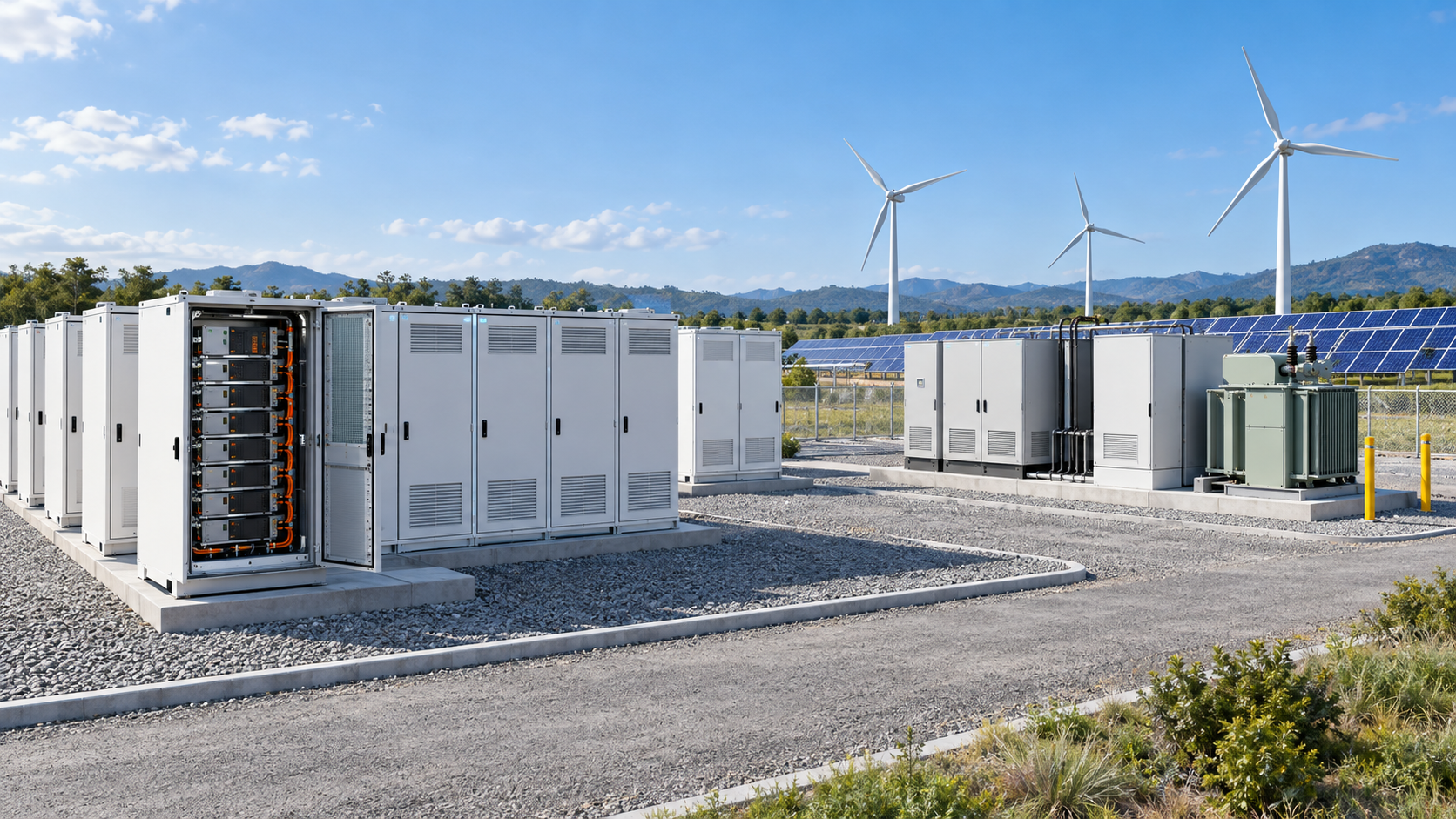
| Figs. 1, 2, 3, 4, 5 and 7 are explanatory drawings, not measurement results or design drawings, and the hero image and Fig. 6 are AI-generated images | A note by this article | Commentary |
Last updated 10 October 2026. Sources are limited to primary material (peer-reviewed papers, a national-laboratory report, public research institutions' surveys, companies' official materials and exchange disclosures, standards-related and manufacturer data sheets). Company announcements are treated as company claims and kept apart from independent evaluations and public-agency estimates. The ratings, the marks by use, the dots and the maturity rungs are this article's grouping and not a ranking. Because the article includes readings and interpretations, those are marked as Commentary and kept separate from sourced fact. Cell-basis values for liquid lithium-metal secondary, lithium-air, potassium-ion and multivalent ions, the performance of nickel-metal hydride, round-trip efficiency of Form Energy and Eos, independent measurements of lithium-sulfur, individual safety assessments of each battery, and market prices are not stated here because no published primary source could confirm them. All figures are explanatory concept graphics. Figs. 1, 2, 3, 4, 5 and 7 are vector drawings; the hero image and Fig. 6 are AI-generated images, and none of them shows measured results, a real cross-section or a physical product.