TECHNOLOGY EXPLAINER
Virtual Power Plants and Distributed Energy Resources
— What "bundling" means: what is controlled, how, and who goes to market
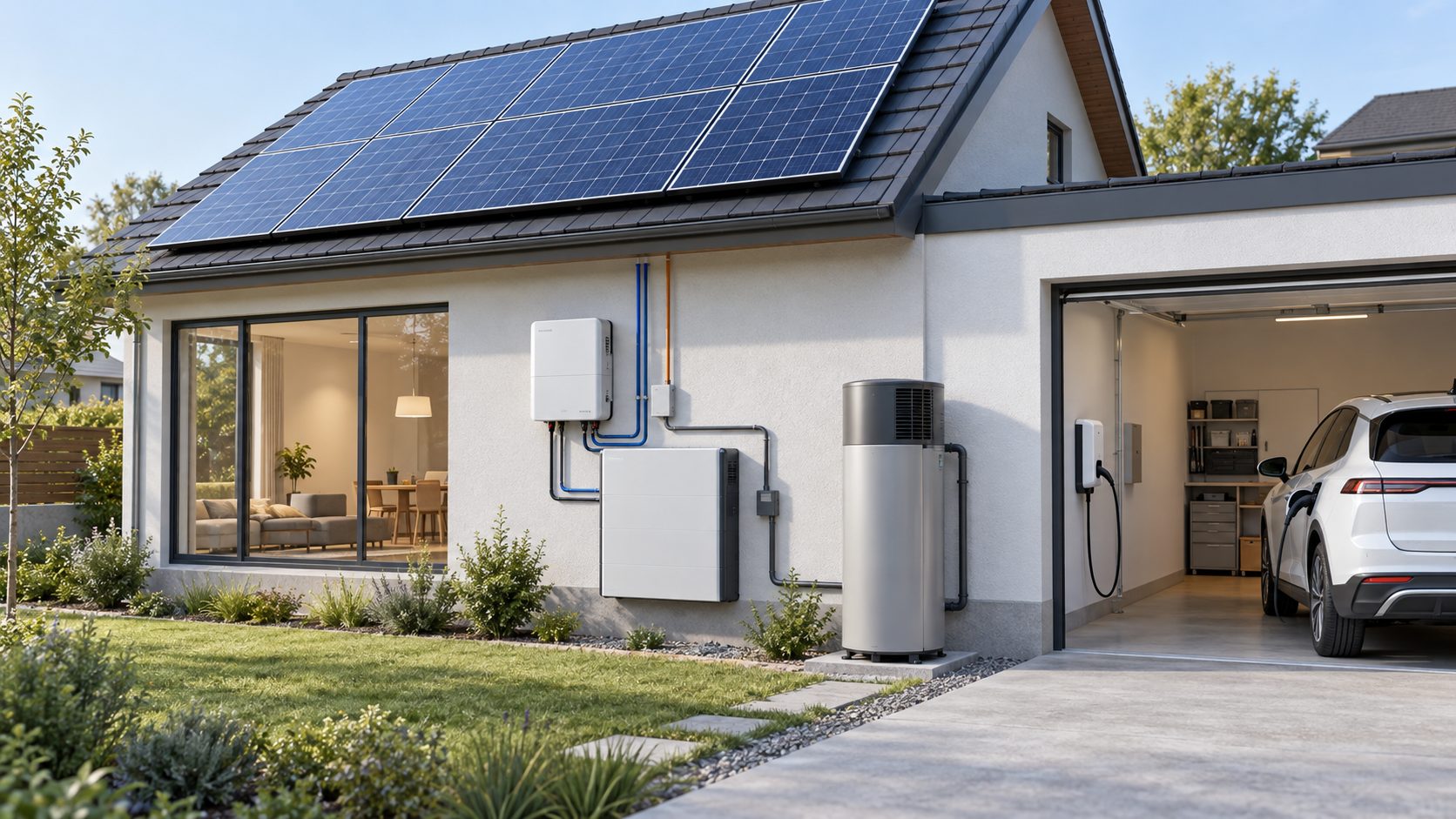
Home batteries, electric vehicles, water heaters, air conditioning. Each is a small distributed energy resource (DER). A virtual power plant (VPP) bundles them over communications and runs them like one power plant. The U.S. Department of Energy (DOE) puts North American VPP capacity at 33 GW (January 2025) and sets a goal of 80 to 160 GW by 2030. California's program had 448,400 participants and 1,145 MW enrolled in the 2025 season, but there were no price- or alert-triggered events. This is a field where policy and operation matter more than battery materials, so this article ties it to what matters to a materials engineer: the relationship between battery life and how it is operated (how cycles are used).
- What DER and VPP mean (the short version)
- What is bundled: batteries, EVs, water heating, air conditioning
- Aggregators and market participation: U.S., Europe, Japan
- A materials engineer's view 1: battery life and operation (how cycles are used)
- Communications and security
- State of demonstration: what official sources confirm
- A materials engineer's view 2: a home battery's three competing uses
- Limits, and what could not be confirmed
- How to read evaluations and standards
- Glossary
- References
- Claim-to-source audit
Sourced = stated in a published source (source linked)
Our calculation = a value this article calculated from stated assumptions
Not yet confirmed = a plan, target, proposal or schedule for which no result or entry into force has been confirmed
Readings about institutions and materials are marked as commentary. Inference marks a reading that was not confirmed in a primary source.
Institutions (laws, rules, programs) distinguish proposal, adoption and entry into force (start of application), with the date checked (October 2026). Scheduled implementation can change.
This article is a technical explainer. It is not advice on joining a program or signing a contract, on operating equipment, or on investment or procurement.
1. What DER and VPP mean (the short version)
- Japan's definition: Japan's Agency for Natural Resources and Energy (ANRE) describes a VPP as the owner of customer-side energy resources, grid-connected generation or storage, or a third party, controlling those resources (including export to the grid from the customer side) to provide the same function as a power plant Sourced. Changing the pattern of demand is demand response (DR) [Ref. 1].
- The U.S. definition: in Order 2222 the Federal Energy Regulatory Commission (FERC) defines a DER as "any resource located on the distribution system, any subsystem thereof or behind a customer meter", which may include electric storage, intermittent generation, distributed generation, demand response, energy efficiency, thermal storage, and electric vehicles and their supply equipment Sourced [Ref. 9].
- Scale: DOE says North American VPPs reached 33 GW in January 2025 and that 80 to 160 GW (10-20% of peak load) is needed by 2030 (an update of its report) Sourced [Ref. 11].
2. What is bundled: batteries, EVs, water heating, air conditioning
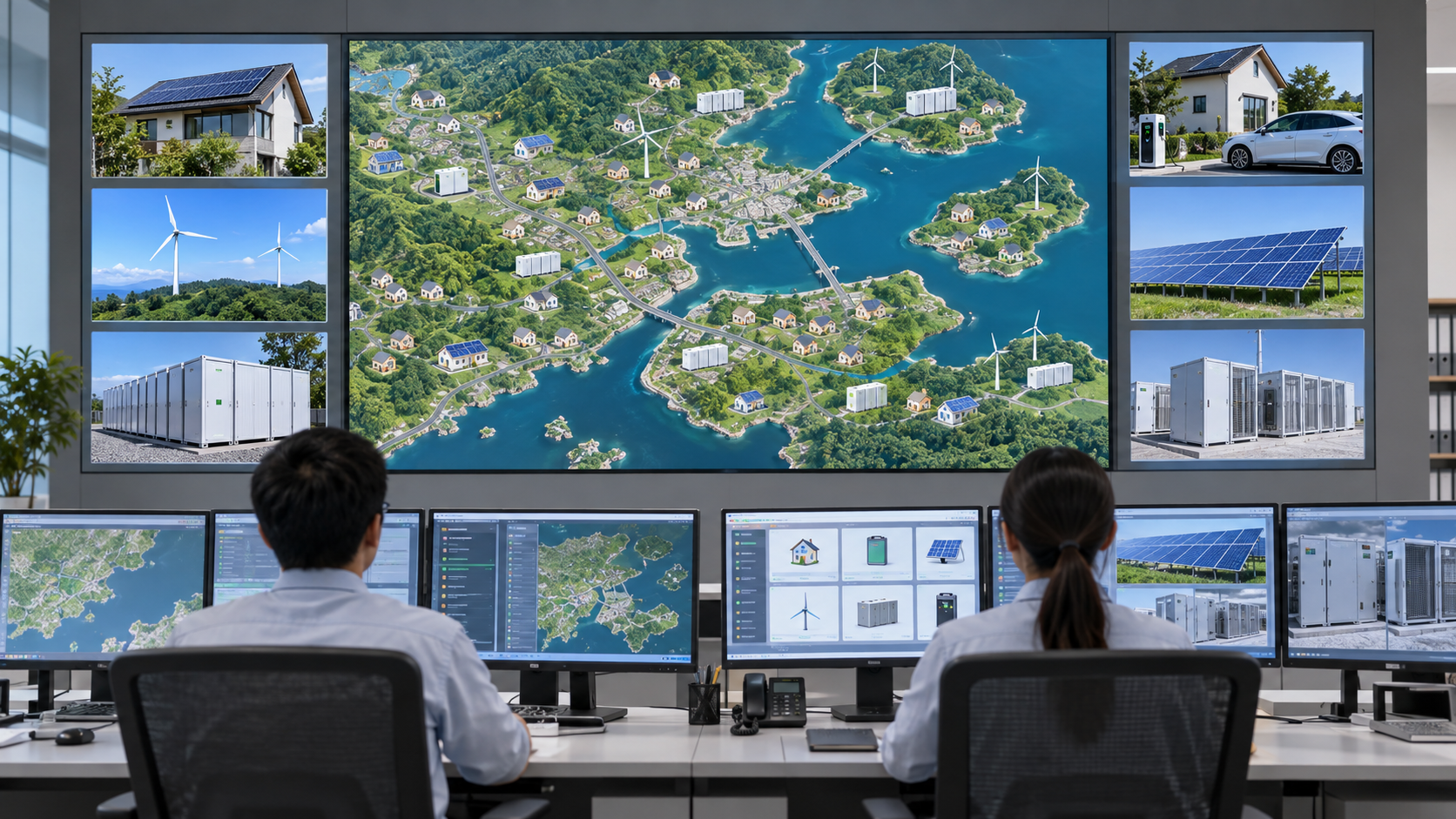
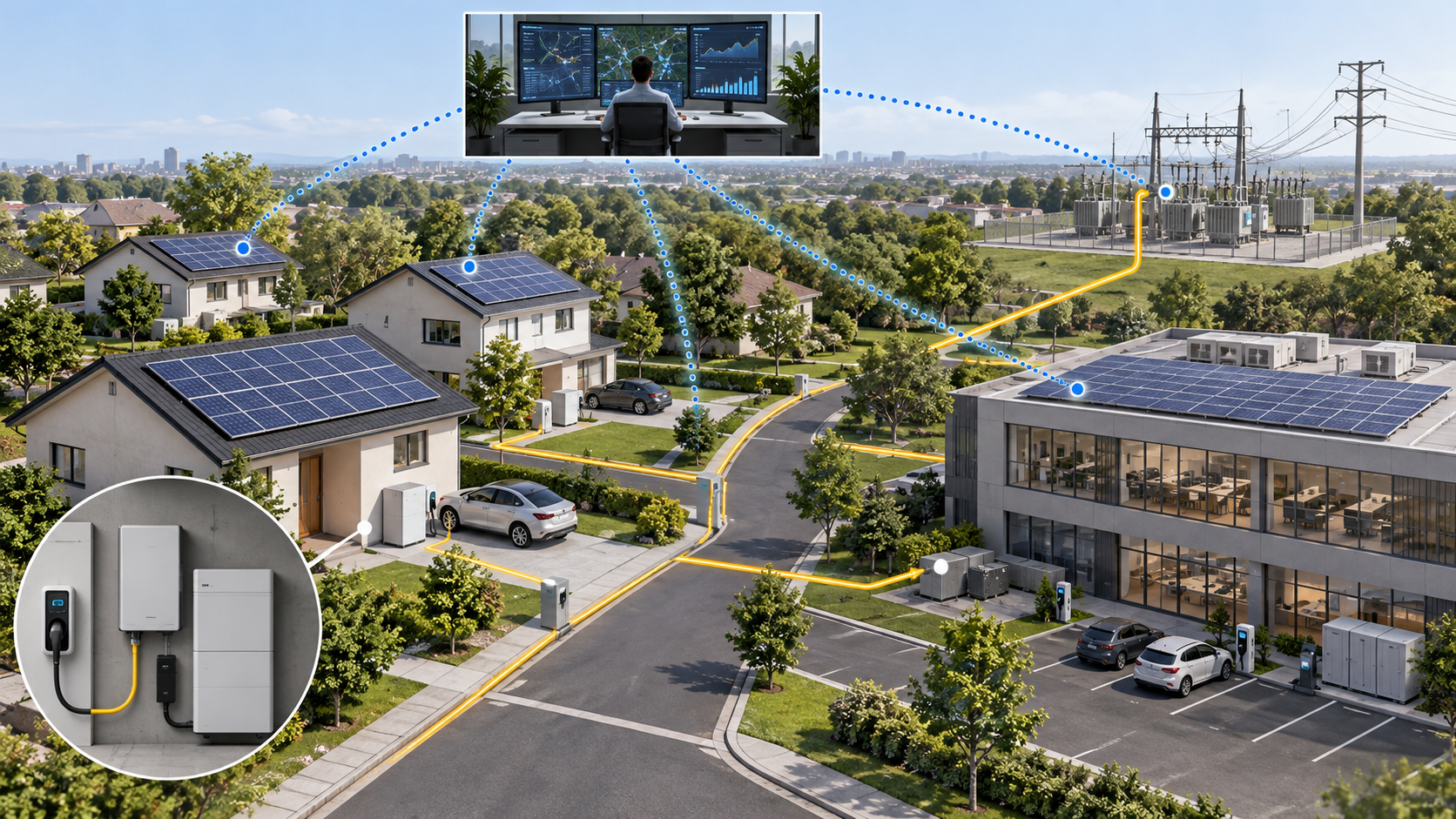
ANRE explains that, as solar, home fuel cells (Ene-Farm), storage batteries and electric vehicles spread through factories and homes, a VPP bundles them with IoT and controls them remotely and as a group Sourced [Ref. 1, 4]. The California Energy Commission (CEC) program lists as examples of what is bundled air conditioning controlled by smart thermostats, electric water heaters, electric vehicle supply equipment (EVSE), stationary batteries and residential "smart electrical panels" Sourced [Ref. 12].
View the original SVG schematic and exact annotations
- Down DR and up DR: reducing demand when supply is tight is down DR; increasing demand when renewable output is in surplus is up DR. An example given of up DR is charging a storage battery to absorb the surplus (ANRE) Sourced [Ref. 1].
- A battery can serve both "up" and "down". Charging is up DR; discharging acts as down DR or as export (generation) (commentary). Water heaters and air conditioners store energy as heat by shifting when they run.
3. Aggregators and market participation: U.S., Europe, Japan
United States: FERC Order 2222
- Adoption and entry into force: FERC issued Order No. 2222 on 17 September 2020 and it was published in the Federal Register on 21 October 2020 (85 FR 67094), taking effect on 21 December 2020. Sourced Under the original terms each RTO/ISO had to file the tariff changes needed by 17 September 2021 [Ref. 9]. Later orders followed on 18 March 2021 (Order 2222-A) and 17 June 2021 (2222-B) (FERC's explainer) [Ref. 10].
- What it required: each RTO/ISO had to (1) let DER aggregations participate directly in its markets and establish DER aggregators as a type of market participant, (2) let them register under participation models that fit their physical and operational characteristics, (3) set a minimum size for aggregations of no more than 100 kW, and (4) to (10) address locational requirements, bidding parameters, information and data, metering and telemetry, coordination among the RTO/ISO, the aggregator, the distribution utility and the retail regulatory authority, changes to the list of resources, and market participation agreements Sourced. It must accept bids from aggregators that include customers of utilities distributing more than 4 million MWh a year, and for smaller utilities only if the retail regulatory authority permits [Ref. 9].
- Jurisdiction: ERCOT in Texas is outside FERC's jurisdiction and has its own pilot program (FERC's explainer) [Ref. 10].
According to FERC's explainer (based on the filings and orders for each RTO/ISO as of August 2024), CAISO completed in November 2024; NYISO is to implement fully by the end of 2026; ISO-NE on 1 November 2026 for energy and ancillary services; PJM on 1 February 2027 for the capacity market and 1 February 2028 for energy and ancillary services; MISO in two phases, on 1 June 2027 and the final one on 1 June 2029; and SPP in the second quarter of 2030 (proposed) Not yet confirmed. The explainer adds that parties are in some cases contesting these timelines and seeking faster implementation Sourced [Ref. 10].
As issues in each RTO/ISO's compliance filings the explainer names (1) how close together the DERs in an aggregation must be, (2) avoiding duplicate compensation for participating in both retail programs (net metering, demand response) and the wholesale market, and (3) metering and communications requirements [Ref. 10].
California: the DSGS program
- Options: the CEC's Demand Side Grid Support (DSGS) program has four participation options. Option 3 is a "market-aware storage VPP" that is dispatched when day-ahead CAISO energy prices exceed a threshold; the VPP's capacity is not actually bid into the market. It receives a capacity payment, with an energy incentive for responding to a day-of emergency. Option 4 is an emergency load-flexibility VPP of smart thermostats, electric water heaters, EVSE, stationary batteries and smart panels, dispatched on energy emergency alerts issued by a California balancing authority Sourced. In the 2026 guidelines (Fifth Edition, approved 27 April 2026), Option 1 is suspended for 2026 for budget reasons and Option 3 participation in the 2026 season is limited [Ref. 12].
- Scale enrolled: the CEC report (December 2025, docketed August 2026) gives, for the 2025 season, 448,400 participants and 1,145.2 MW enrolled (provider estimates), of which Option 3 is 16 providers, 124,771 participants and 768.0 MW. In the 2025 season there were no price- or alert-triggered events; in their absence each Option 3 provider must run at least one test event a month Sourced [Ref. 13]. The guidelines say the program is "reported" to include the world's largest storage VPP, with more than 124,000 customers [Ref. 12].
Europe: Directive (EU) 2019/944
Article 17 requires Member States to allow and foster participation of demand response through aggregation. Their regulatory framework must include, among other things, the right of market participants engaged in aggregation, including independent aggregators, to enter markets without the consent of other market participants, transparent rules for data exchange, financial responsibility for the imbalances caused, protection of customers of independent aggregators from undue payments or penalties by their suppliers, and a conflict-resolution mechanism (Directive of 5 June 2019) Sourced [Ref. 14]. How individual countries have implemented this was not checked here.
Japan: the specific wholesale supply business and the balancing market
- Role names: ANRE distinguishes the resource aggregator (which signs VPP service contracts directly with customers and controls the resources) from the aggregation coordinator (which bundles the energy controlled by resource aggregators and trades directly with transmission/distribution operators and retailers) Sourced [Ref. 1].
- The law: the Electricity Business Act defines "specific wholesale supply" as supplying electricity aggregated from parties who hold supply capacity, by methods such as instructing the operators of generating or discharging facilities to generate or discharge, for use in retail, transmission-distribution or similar businesses. A person running that business must notify the Minister of Economy, Trade and Industry (Article 27-30; the business may not begin until 30 days after the notification is received) Sourced [Ref. 5]. ANRE explains that from April 2022 aggregators meeting certain conditions must notify as "specific wholesale supply operators", and that 38 companies had done so as of 20 October 2022 (the article's wording is "license") [Ref. 4].
- Low-voltage resources in the balancing market: a material of an OCCTO subcommittee (26 September 2025) says the arrangement is aimed at starting from fiscal 2026 for low-voltage resources (at the point of receipt) to enter the balancing market and for device-level metering Not yet confirmed Sourced [Ref. 6]. Actual start and track record could not be confirmed here.
- Subsidies for demonstrations: ANRE has continued subsidies for VPP demonstrations since fiscal 2016 and, from fiscal 2022, for "next-generation technology demonstrations using distributed energy resources such as storage batteries", supporting renewable-aggregation technology and more Sourced [Ref. 3].
4. A materials engineer's view 1: battery life and operation (how cycles are used)
PNNL states LFP cycle life as cycles, at each depth of discharge (DoD), to the point where the remaining energy has fallen to the energy at the average depth of discharge. At 80% DoD it is 2,400 cycles Sourced. As full-discharge equivalents that is 2,400 × 0.8 = 1,920 Our calculation. PNNL writes that the high cycle counts reported are partly because accelerated tests run several cycles a day, which lessens calendar aging, and that most warranties limit use to one full-discharge-equivalent cycle per day [Ref. 16].
Our calculation: suppose each event discharges the battery by 80% (an assumption for a home battery) Our calculation. With 10 events a year that is 8 full-discharge equivalents (10 × 0.8) a year, or 0.4% per year of the 1,920 (it would take about 240 years to use up); 50 events a year is 2.1% a year (about 48 years), 100 events 4.2% a year (about 24 years), and 365 events (daily) 15.2% a year (about 6.6 years) (Fig. 5).
Assumptions and limits: this is a simple division of PNNL's figures and excludes daily self-consumption cycling, calendar aging and the effect of holding charge for backup. Real life is set by the sum of these and by battery temperature. The number of events also differs from year to year (in the 2025 season the CEC's Option 3 had no price- or alert-triggered events, only monthly test events).
Reading: a few to a few dozen emergency events a year are a small burden in cycle life. Use that cycles almost every day (daily arbitrage or frequency regulation) takes a large share. CAISO's market monitoring department explains that batteries at first favored frequency regulation because it avoids deep charge and discharge and so avoids faster cell degradation Sourced [Ref. 17]. From the materials side, the burden of "being used in a VPP" is set by the number, depth and temperature of events and by the state of charge while waiting (commentary).
5. Communications and security
- Standards and forums: ANRE says that under the Energy Resource Aggregation Business Study Group (ERAB, first meeting January 2016) there are four working groups: ECHONET Lite, OpenADR, control-quantity evaluation and cybersecurity Sourced [Ref. 3]. IEC 62746-10-1:2018 (OpenADR) specifies a minimal data model and services for demand response, pricing and DER communications, and can be used to manage load, generation and storage resources through signals from grid or market operators (standard description) [Ref. 15].
- Metering: FERC names metering and communications requirements as an issue for aggregation: capturing DER output as accurately as needed to ensure appropriate compensation and RTO/ISO planning (FERC's explainer) [Ref. 10]. In Japan too, device-level metering is being considered for low-voltage resources entering the balancing market [Ref. 6].
- Security requirements: Japan's long-term decarbonization auction (bid year FY2025) requires storage systems to take adequate measures based on the "Power Control System Security Guidelines", the "Guide to Security Design in IoT Development" and similar, and the conformity label JC-STAR level 1 for the main control-system products (BMS, PCS, EMS and others) Sourced [Ref. 7]. The draft guidelines for bid year FY2024 referred to compliance with the "Cybersecurity Guidelines for the Energy Resource Aggregation Business, Version 2.0 (27 December 2019)" by ANRE and IPA (a draft-stage document) [Ref. 8].
In a VPP that controls many small resources remotely, the institutions are conscious that each device can be an entry point for a cyberattack (commentary). From the battery side, how far an external command can override the BMS settings (upper charge limit, lower discharge limit, temperature limits) bears on both safety and life (inference: the material this article checked gives no specification on this).
6. State of demonstration: what official sources confirm
| Party | Item | What could be confirmed |
|---|---|---|
| U.S. DOE | VPP scale and goal | North American VPPs at 33 GW in January 2025. 80-160 GW (10-20% of peak load) needed by 2030 Not yet confirmed [Ref. 11] |
| California CEC | DSGS (2025 season) | 448,400 participants and 1,145.2 MW enrolled (provider estimates). Option 3 (storage VPP): 768.0 MW and 124,771 participants. No price- or alert-triggered events. Since August 2022, 3,209 MWh of load reduction incentivized over 13 days of energy emergency alerts [Ref. 13] |
| FERC, RTO/ISOs | Implementation of Order 2222 | CAISO completed in November 2024; others scheduled for 2026-2030 (Fig. 3) [Ref. 10] |
| Japan | Specific wholesale supply operators | Notification mandatory from April 2022; 38 companies as of 20 October 2022 (ANRE) [Ref. 4] |
| Japan | Low-voltage resources in the balancing market | Arrangement aimed at introduction from fiscal 2026 (discussion material). No track record could be confirmed [Ref. 6] |
Table 1 State of VPP and DER demonstration and policy (sources in each cell). The actual operating amount (kW) of VPPs in Japan could not be confirmed from the official material this article checked.
7. A materials engineer's view 2: a home battery's three competing uses
A home battery has at least three uses (ANRE names lower electricity bills and preparedness for emergencies as the benefits of customer-side batteries Sourced). (1) Daily self-consumption (store at midday, use at night: a daily cycle), (2) VPP events (extra cycles, a few times a year or more) and (3) holding a backup reserve (keeping some charge in case of an outage). Use (3) means keeping the state of charge high while waiting [Ref. 2].
The three are different loads on the battery (commentary). (1) and (2) bear on cycle aging (depth and number), and (3) on calendar aging (state of charge and temperature while waiting). EPRI records that in the South Korean grid-scale incidents of 2018-2019 a significant fraction occurred at a state of charge above 90% Sourced (the cause of the incidents is not asserted) [Ref. 18]. Operation that keeps the state of charge high is an area where management is needed for both safety and life.
Inference: how a VPP contract treats the backup reserve (say 30%) changes the capacity that can be used. The more reserve is kept, the less can be offered to the VPP and the higher the standing state of charge. This adjustment is where materials (durability of cells at high state of charge) and software (BMS settings) meet (the material this article checked gives no specific contract or setting).
8. Limits, and what could not be confirmed
(1) Operating VPP capacity in Japan
The amount (kW) of VPP and DR actually operating in Japan, and the track record of low-voltage resources entering the balancing market, could not be confirmed from the official material this article checked.
(2) Latest schedule of Order 2222
The dates in Fig. 3 rest on FERC's explainer (as of August 2024). Later changes by individual RTO/ISOs were not checked.
(3) California's "largest storage VPP"
The figure of more than 124,000 homes is something the CEC guidelines say has been "reported"; this article did not check the reports themselves. The numbers in the CEC report (Option 3: 124,771 participants) are treated as fact.
(4) Effect on battery life
The calculation in section 4 is a simple one based on PNNL's figures. No primary source that measured the effect of VPP events on the life of real home batteries could be confirmed.
(5) Division of labour with other explainers
Our series covers battery degradation in "Battery evaluation and degradation", grid-scale operation in "Grid-scale battery energy storage systems", the grid background in "Power grids and renewables" and data centers in "Data centers and storage".
- A VPP bundles resources on the distribution system or behind the meter (batteries, EVs, water heating, air conditioning) and runs them like one power plant. North America was at 33 GW in January 2025, and 80-160 GW is needed by 2030 Sourced
- Institutions for market participation: the U.S. has Order 2222 (in force December 2020; regional implementation scheduled for 2026-2030), Europe has Article 17 of Directive 2019/944, and Japan has the specific wholesale supply business (notification) and low-voltage entry into the balancing market (aimed at fiscal 2026) Sourced
- California's DSGS enrolled 448,400 participants and 1,145 MW in 2025, yet there were no price- or alert-triggered events. Enrolled scale and how often it is used are different things Sourced
- Ten events a year use 0.4% a year of LFP's 1,920 full-discharge equivalents. Daily use takes 15.2% a year. The burden depends on the number, depth and temperature of events and on the state of charge while waiting Our calculation
- The point for a materials engineer is that daily self-consumption, the VPP and the backup reserve compete for the same battery. Both cycle aging and calendar aging matter Sourced
9. How to read evaluations and standards
Before comparing which number is larger, align the basis of comparison in the following order. This is an editorial reading checklist, not a set of test conditions or acceptance limits prescribed by a standard.
- 1. What was measured?
- response time, delivered power, duration and participation rate. Check the units and whether the result describes a material, component or complete system.
- 2. Under which conditions?
- connected devices, simultaneous availability, communication delay, device limits and market rules. Treat results under different conditions as separate results before comparing them.
- 3. The comparison trap
- Separate summed nameplate capacity from power actually delivered on command.
- 4. What does the standard cover?
- Check the identifier, title, edition and scope in the issuing body’s material. Distinguish test methods, safety, interoperability and management requirements. Naming a standard alone does not establish that a test, conformity assessment or certification has been completed.
Keep a comparison note containing the object, units, conditions, sample count and variation, comparator, standard edition and unresolved points. Do not invent numerical conditions or acceptance limits from a public abstract of a standard.
10. Glossary
- DER (distributed energy resource)
- A resource on the distribution system or behind a customer meter. May include batteries, EVs, distributed generation, DR and thermal storage (FERC).
- VPP (virtual power plant)
- A scheme that controls customer-side and other resources to provide the function of a power plant (ANRE).
- DR (demand response)
- Controlling resources to change the pattern of electricity demand. There is down DR and up DR.
- Resource aggregator
- A business that signs VPP service contracts with customers and controls their resources.
- Aggregation coordinator
- A business that bundles the energy that was controlled and trades with transmission/distribution operators and retailers.
- Specific wholesale supply business
- A business type under Japan's Electricity Business Act that supplies aggregated electricity to retail and similar businesses. Notification is required.
- RTO/ISO
- U.S. regional transmission organizations and independent system operators, which run wholesale power markets.
- DER aggregator
- Under Order 2222, a market participant that bundles DERs and takes part directly in RTO/ISO markets.
- ERAB
- Energy resource aggregation business: providing balancing and other services through VPP or DR.
- OpenADR
- A demand-response communications standard, internationalized as IEC 62746-10-1.
- DSGS
- California's Demand Side Grid Support program, which pays for load reduction in emergencies.
- EEA
- Energy emergency alert: issued by a system operator to warn of possible supply shortfall.
- Full-discharge equivalent
- Cycles multiplied by depth of discharge: the count converted to complete discharges from full to empty.
- JC-STAR
- Japan's security-requirements conformity assessment and labelling scheme.
11. References
- Agency for Natural Resources and Energy (ANRE), Japan"What are VPP and DR?" (virtual power plants and demand response; in Japanese) — enecho.meti.go.jp
- Agency for Natural Resources and Energy (ANRE), Japan"The storage battery you think you know: why is deployment spreading, and what role does it play?" (Enekore feature, 8 October 2026, in Japanese) — enecho.meti.go.jp
- Agency for Natural Resources and Energy (ANRE), Japan"Measures to spread VPP and DR" (updated 16 October 2025, in Japanese) — enecho.meti.go.jp
- Agency for Natural Resources and Energy (ANRE), Japan"What is an aggregator, the command center that balances electricity supply and demand?" (Enekore feature, 9 December 2022, in Japanese) — enecho.meti.go.jp
- e-Gov Law Search (Japan)Electricity Business Act (Act No. 170 of 1964), Article 2(1) items 15-2 to 15-4 and Article 27-30 (in Japanese) — laws.e-gov.go.jp
- Organization for Cross-regional Coordination of Transmission Operators, Japan (OCCTO)"Device-level metering and introduction of low-voltage resources in the balancing market", Balancing Market Subcommittee material 3 (in Japanese, 26 September 2025, PDF) — occto.or.jp
- Organization for Cross-regional Coordination of Transmission Operators, Japan (OCCTO)"Long-Term Decarbonization Power Source Auction: Bidding Guidelines (bid year FY2025)" (in Japanese, 3 September 2025, PDF) — occto.or.jp
- Organization for Cross-regional Coordination of Transmission Operators, Japan (OCCTO)"Long-Term Decarbonization Power Source Auction: Bidding Guidelines (draft) (bid year FY2024)" (in Japanese; a draft-stage document, PDF) — occto.or.jp
- U.S. Federal Register / FERCOrder No. 2222, "Participation of Distributed Energy Resource Aggregations in Markets Operated by Regional Transmission Organizations and Independent System Operators" (85 FR 67094, 21 October 2020) — federalregister.gov
- U.S. Federal Energy Regulatory Commission (FERC)"FERC Order No. 2222 Explainer" (updated September 2025; implementation timing as of August 2024) — ferc.gov
- U.S. Department of Energy (DOE)"U.S. Department of Energy Releases New Reports…" (update of the Pathways to Commercial Liftoff report, January 2025) — energy.gov
- California Energy Commission (CEC)"Demand Side Grid Support (DSGS) Program Guidelines, Fifth Edition" (approved 27 April 2026, PDF) — efiling.energy.ca.gov
- California Energy Commission (CEC)"Demand Side Grid Support and Distributed Electricity Backup Assets Status Report – December 2025" (CEC-300-2025-004, docketed 21 August 2026, PDF) — efiling.energy.ca.gov
- European Union (EUR-Lex)Directive (EU) 2019/944 of 5 June 2019 on common rules for the internal market for electricity, Article 17 — eur-lex.europa.eu
- IEC (standard page of AFNOR Editions)"IEC 62746-10-1:2018" (Systems interface between customer energy management system and the power management system — Part 10-1: Open automated demand response) — boutique.afnor.org
- Pacific Northwest National Laboratory (PNNL)"2022 Grid Energy Storage Technology Cost and Performance Assessment" (PNNL-33283, August 2022) — pnnl.gov
- CAISO Department of Market Monitoring"2024 Special Report on Battery Storage" (May 2025, PDF) — caiso.com
- Electric Power Research Institute (EPRI)"Insights from EPRI's BESS Failure Incident Database: Analysis of Failure Root Cause" (May 2024, PDF) — restservice.epri.com
12. Claim-to-source audit
| Claim in the text | Basis | Type |
|---|---|---|
| ANRE: the definitions of VPP and DR, the roles of resource aggregator and aggregation coordinator, up DR and down DR, and charging a battery as up DR | Agency for Natural Resources and Energy (ANRE), Japan Reference 1 https://www.enecho.meti.go.jp/category/saving_and_new/advanced_systems/vpp_dr/about.html | Sourced |
| ANRE: the ERAB study group (first meeting January 2016) and its four working groups (ECHONET Lite, OpenADR, control-quantity evaluation, cybersecurity), VPP demonstration subsidies (from fiscal 2016) and the next-generation technology demonstrations from fiscal 2022 | Agency for Natural Resources and Energy (ANRE), Japan Reference 3 https://www.enecho.meti.go.jp/category/saving_and_new/advanced_systems/vpp_dr/measure.html | Sourced |
| ANRE (9 December 2022): aggregators are also called specific wholesale supply operators, notification became mandatory for aggregators meeting certain conditions from April 2022, and 38 companies had notified as of 20 October 2022 | Agency for Natural Resources and Energy (ANRE), Japan Reference 4 https://www.enecho.meti.go.jp/about/special/johoteikyo/aggregator.html | Sourced |
| ANRE (8 October 2026): the benefits of customer-side batteries (lower electricity bills and emergency preparedness) | Agency for Natural Resources and Energy (ANRE), Japan Reference 2 https://www.enecho.meti.go.jp/about/special/johoteikyo/strage_battery_2026.html | Sourced |
| Electricity Business Act: the definitions of specific wholesale supply, specific wholesale supply business and operator (Article 2(1) items 15-2 to 15-4), and the notification of the business (Article 27-30; start after 30 days from receipt) | e-Gov Law Search (Japan) Reference 5 https://laws.e-gov.go.jp/law/339AC0000000170 | Sourced |
| OCCTO material (26 September 2025): the arrangement aimed at introducing low-voltage resources (at the point of receipt) into the balancing market and device-level metering from fiscal 2026 | Organization for Cross-regional Coordination of Transmission Operators, Japan (OCCTO) Reference 6 https://www.occto.or.jp/iinkai/chouseiryoku/jukyuchousei/2025/files/jukyu_shijyo_57_03.pdf | Sourced Not yet confirmed |
| Long-term decarbonization auction guidelines (bid year FY2025): measures based on the Power Control System Security Guidelines and similar, and JC-STAR level 1 for the main control-system products (BMS, PCS, EMS and others) | Organization for Cross-regional Coordination of Transmission Operators, Japan (OCCTO) Reference 7 https://www.occto.or.jp/assets/market-board/market/jitsujukyukanren/files/250903_boshuyoukou_long_2025.pdf | Sourced |
| Draft guidelines for bid year FY2024: the reference to the Cybersecurity Guidelines for the Energy Resource Aggregation Business, Version 2.0 (27 December 2019) (draft-stage document) | Organization for Cross-regional Coordination of Transmission Operators, Japan (OCCTO) Reference 8 https://www.occto.or.jp/iken/2024/files/2024_tyouki_bosyuuyoukou.pdf | Sourced |
| FERC Order No. 2222: issued 17 September 2020, published 21 October 2020 (85 FR 67094), effective 21 December 2020, the original filing deadline (17 September 2021), the definition of DER (on the distribution system, any subsystem or behind a customer meter; may include storage, distributed generation, DR, energy efficiency, thermal storage, EVs and EVSE), DER aggregators as market participants, a minimum size of 100 kW or less, the items including metering and telemetry, and the treatment of customers of utilities above 4 million MWh a year | U.S. Federal Register / FERC Reference 9 https://www.federalregister.gov/documents/2020/10/21/2020-20973/participation-of-distributed-energy-resource-aggregations-in-markets-operated-by-regional | Sourced |
| FERC's explainer: Orders 2222-A (18 March 2021) and 2222-B (17 June 2021), ERCOT being outside FERC's jurisdiction, the implementation timing by RTO/ISO (CAISO completed November 2024, NYISO end of 2026, ISO-NE 1 November 2026, PJM 1 February 2027 and 1 February 2028, MISO 1 June 2027 and 1 June 2029, SPP Q2 2030 (proposed)), that some timelines are contested, and the issues (geographic proximity, duplicate compensation, metering and communications) | U.S. Federal Energy Regulatory Commission (FERC) Reference 10 https://www.ferc.gov/ferc-order-no-2222-explainer-facilitating-participation-electricity-markets-distributed-energy | Sourced Not yet confirmed |
| DOE's report update (January 2025): North American VPP scale of 33 GW, and 80 to 160 GW (10-20% of peak load) by 2030 | U.S. Department of Energy (DOE) Reference 11 https://www.energy.gov/technologycommercialization/articles/us-department-energy-releases-new-reports-highlighting | Sourced Not yet confirmed |
| CEC DSGS guidelines (Fifth Edition, approved 27 April 2026): the four participation options, the content of Option 3 (market-aware storage VPP) and Option 4 (emergency load-flexibility VPP), the suspension of Option 1 in 2026, and the statement that it is reported to include the world's largest storage VPP | California Energy Commission (CEC) Reference 12 https://efiling.energy.ca.gov/GetDocument.aspx?tn=269649&DocumentContentId=106743 | Sourced |
| CEC status report (December 2025): 448,400 participants and 1,145.2 MW enrolled in the 2025 season, values by option, no price- or alert-triggered events, monthly test events, and 3,209 MWh since August 2022 | California Energy Commission (CEC) Reference 13 https://efiling.energy.ca.gov/GetDocument.aspx?tn=272132&DocumentContentId=109808 | Sourced |
| Directive (EU) 2019/944 Article 17: demand response through aggregation, the right of independent aggregators to enter markets, data exchange, responsibility for imbalances, customer protection and conflict resolution | European Union (EUR-Lex) Reference 14 https://eur-lex.europa.eu/legal-content/EN/TXT/HTML/?uri=CELEX:32019L0944 | Sourced |
| The title and scope of IEC 62746-10-1:2018 (data model and services for demand response, pricing and DER communications) | IEC (standard page of AFNOR Editions) Reference 15 https://www.boutique.afnor.org/en-gb/standard/iec-627461012018/systems-interface-between-customer-energy-management-system-and-the-power-m/xs133603/253252 | Sourced |
| PNNL: LFP cycles at each depth of discharge (2,400 at 80%), reported cycles coming from accelerated tests, and warranties limiting use to one full-discharge-equivalent cycle a day | Pacific Northwest National Laboratory (PNNL) Reference 16 https://www.pnnl.gov/sites/default/files/media/file/ESGC%20Cost%20Performance%20Report%202022%20PNNL-33283.pdf | Sourced |
| CAISO: why batteries first favored frequency regulation (avoids deep cycling and cell degradation) | CAISO Department of Market Monitoring Reference 17 https://www.caiso.com/documents/2024-special-report-on-battery-storage-may-29-2025.pdf | Sourced |
| EPRI: that in the South Korean incidents of 2018-2019 a significant fraction occurred at a state of charge above 90% | Electric Power Research Institute (EPRI) Reference 18 https://restservice.epri.com/publicdownload/000000003002030360/0/Product | Sourced |
| Section 4 calculations (2,400 x 0.8 = 1,920; the share consumed by 10, 50, 100 and 365 events a year of 0.4%, 2.1%, 4.2% and 15.2%, and years to use up of about 240, 48, 24 and 6.6) | Our calculation. A simple division using the assumption that each event discharges 80% and PNNL's 1,920 full-discharge equivalents. Excludes daily self-consumption, calendar aging and holding charge for backup | Our calculation |
| The reading that VPP events use only a small part of life while daily use is large, the organization of the three competing uses of a home battery, the inference about BMS settings and external commands, and the way Figs. 2 and 3 are organized | Our summary and commentary based on published content. Not views expressed by the institutions or companies | Commentary |
| Operating VPP capacity in Japan, the track record of low-voltage entry, the latest schedule of Order 2222, the effect of VPP events on the life of real batteries, and implementation in EU countries | Could not be confirmed in published primary sources within the scope of this article, so not stated | Commentary |
| That Figs. 2 to 5 are explanatory drawings (Fig. 4 shows published values and Fig. 5 includes our calculation) and that the hero image and Fig. 1 are AI-generated images | Our note | Commentary |
Last updated October 2026. Sources are limited to primary material (documents of Japan's Agency for Natural Resources and Energy and OCCTO, the Electricity Business Act, FERC rules (Federal Register) and its explainer, documents of DOE and the CEC, the EU directive, a standard's description, and reports of PNNL, EPRI and CAISO). News reports were not used. No market-research estimates were used. Institutions were checked in October 2026. Readings about institutions and materials are marked as commentary and kept separate from sourced fact. The operating VPP capacity in Japan, the track record of low-voltage entry, the latest schedule of Order 2222 and the effect of VPP events on the life of real batteries could not be confirmed in published primary sources and are therefore not stated. The calculations in this article are derived from the formulas and stated assumptions and are not forecasts for any particular equipment or contract. Figs. 2 to 5 are explanatory vector drawings (Fig. 4 shows published values and Fig. 5 includes our calculation); the hero image and Fig. 1 are AI-generated images, and none of them shows a real facility or system.