COMPANY PROFILE / PEROVSKITE SOLAR CELLS
Aisin
The Toyota group parts maker that brought automotive "spray coating" to solar cells
Aisin is an automotive parts maker in the Toyota group. It began developing dye-sensitised solar cells in 1998 and has spent more than 25 years researching solar cells made by coating. In perovskites it has taken its own route: lightweight modules using thin glass, made by the spray coating it has honed on car parts. In August 2026 it was selected for a volume-production-stage demonstration project (project size about ¥15.6 billion) under the Green Innovation Fund run by NEDO, Japan's state-backed R&D funding agency, and it has set out a plan to move from a 2 MW-class pilot line to mass production. This profile keeps the rest of the company to a minimum and sets out what Aisin is putting into perovskites, who it is working with and how far it has got, using the company's statutory filings, official releases and technical paper, and documents published by NEDO.
- Aisin in 30 seconds, and where it stands in perovskite solar cells
- The logo and how the name is written
- Where the company sits in the perovskite solar cell field
- Scale (the company as a whole, in brief)
- Resources committed to perovskites
- What it has done so far
- What comes next
- What the company is aiming for in perovskite solar cells
- Map of perovskite partnerships
- Technology, products and services
- The risks this company carries
- Glossary, references and claim-to-source audit
1. Aisin in 30 seconds, and where it stands in perovskite solar cells
(entering from another industry)Solar cells not yet commercialised
pilot lineRoadmap in the business strategy vision
Companies working on perovskite solar cells fall into three broad types: established PV makers, perovskite start-ups, and materials & electronics firms. Aisin is an automotive parts maker entering from another industry, which this article places on the materials, chemicals and electronics side. What distinguishes it is how long it has been researching and how it makes its cells Sourced. According to its technical paper, Aisin (then Aisin Seiki) began developing dye-sensitised solar cells in 1998, announced a large module with Toyota Central R&D Labs in 2003, and shifted its focus to perovskites after their efficiency passed 10% in 2012. To deposit the perovskite layer it chose spray coating, a technique it had built up in developing automotive parts. That is a different way of making cells from Sekisui Chemical's roll-to-roll process or Panasonic's inkjet printing.
2. The logo and how the name is written

The Aisin logo is the company's trademark. We have not recreated it with image generation;
the file shown here, img/aisin_logo.svg, is the image taken from the official website.
A note on names: the legal entity is AISIN CORPORATION. The technical paper describes the company's history under its former name, "Aisin Seiki (now Aisin)". IMRA Japan Co., Ltd., to which part of the R&D is contracted, is an Aisin group company. Toyota Central R&D Labs, also in the Toyota group, appears repeatedly as a research partner going back to the dye-sensitised era.
Official site (Japanese): https://www.aisin.com/jp/profile/outline/3. Where the company sits in the perovskite solar cell field
The product is a thin-glass single-junction cell. The company describes its perovskite cells as offering "high durability from a proprietary film structure using thin glass", and NEDO calls the theme selected in 2026 "thin-glass lightweight perovskite solar cells" Sourced. It aims for the middle ground between the lightness of film-type and the durability of glass-type cells, with a weight target of 3 kg or less per m². The documents this article reviewed contain no plan to commercialise tandems with silicon. For the differences between formats, see our explainers on flexible cells and on encapsulation and barrier layers.
4. Scale (the company as a whole, in brief)
The company as a whole is not the subject here, so only its size is noted Sourced. Aisin's fiscal year runs from April to March, so FY2025 is the year to March 2026.
| Measure | FY2024 (year to March 2025) | FY2025 (year to March 2026) |
|---|---|---|
| Revenue (¥ million) | 4,896,104 | 5,117,764 |
| Operating profit (¥ million) | 202,941 | 228,796 |
| R&D expenditure | - | ¥265.4 billion |
| Employees (consolidated) | - | 113,292 |
Revenue and operating profit are from the earnings summary for the year to March 2026 (IFRS), R&D expenditure from the annual securities report (the statutory annual filing that Japanese listed companies must submit) for the same year, and headcount from the company overview (as of 31 March 2026).
The figures above are for the Aisin Group as a whole. The business strategy vision lists as a weakness that the company "has not yet started a solar cell business", so there are no perovskite sales yet Sourced. The annual securities report lists "market launch of perovskite solar cells and securing market share" as one of its climate-related "opportunities", but investment and dedicated headcount are none of them disclosed Not yet confirmed. Nor is it shown how much of the ¥265.4 billion R&D budget goes to perovskites.
5. Resources committed to perovskites
Japanese fiscal years (FY) run from April to March; FY2026 is the year from April 2026 to March 2027.
| Type of resource | What it is | Category |
|---|---|---|
| People (organisation) | Aisin handles technology development for large-area modules, higher durability and low-cost manufacturing, and contracts to group company IMRA Japan the development of underlying technologies for high efficiency and durability and of low-cost hole transport materials. The company says it brings production engineering staff in from the R&D stage | Sourced |
| People (headcount) | Number of dedicated staff | Not disclosed |
| Money (development from 2021) | The business plan in the business strategy vision gives "several billion yen (including support from this project)". No breakdown is given | Sourced |
| Money (volume-production demonstration from 2026) | NEDO's project outline gives the theme newly selected in August 2026 (Aisin) a project size of about ¥15.6 billion and support of about ¥9.8 billion (¥11.3 billion including incentive payments), a period of FY2026 to FY2030, and subsidy rates of two-thirds and one-half | Sourced |
| Facilities | 30 cm-square prototype panels have been made and used in demonstrations (technical paper). The roadmap in the business strategy vision then runs: a pre-demonstration of about 5 kW (in a company building), construction of a 2 MW-class pilot line, construction of a mass-production line, and volume sales | Sourced |
| Investments and acquisitions by Aisin | The documents this article reviewed mention no investment or acquisition in the perovskite field | Not confirmed |
| Public funding | Took part in NEDO's perovskite project begun in 2015. Selected for the GI Fund in December 2021 (with the University of Tokyo) and August 2026 (volume-production stage). The NEDO-subsidised project number given in releases is JPNP21052 | Sourced |
| Universities and research institutes | The University of Tokyo (joint implementer since 2021, with part of the work subcontracted to Kumamoto University) and Toyota Central R&D Labs (joint research since September 2024). The 2026 project also involves Toyota Central R&D Labs, the University of Tokyo, Yamagata University and the National Institute of Advanced Industrial Science and Technology (AIST) | Sourced |
Of the roughly ¥15.6 billion project size from 2026, NEDO's support of about ¥9.8 billion is about 63% (about 72% if the ¥11.3 billion including incentives is used) Our calculation. The three projects selected for the same volume-production-stage demonstration programme in September 2025 (Ricoh, Panasonic and EneCoat) have a combined project size of about ¥33.5 billion, so Aisin's single theme is nearly half that Our calculation. The investment in the 2 MW-class pilot line or a mass-production line itself, however, has not been given Not yet confirmed.
6. What it has done so far
| When | What happened | Why it matters |
|---|---|---|
| 1998 | Aisin Seiki (now Aisin) begins developing dye-sensitised solar cells. Toyota Central R&D Labs later joins as a partner | The start of research on solar cells made by coating |
| 2003 to 2005 | Exhibits a large module at an international conference and presents long-term durability test data (2003). Installs cells on the wall of Toyota's "PAPI" house and confirms eight years of generation (from 2004). Exhibits leaf-shaped solar cells at Expo 2005 Aichi (2005) | A track record in dye-sensitised cells |
| Up to FY2013 | Takes part in the Cabinet Office's Funding Program for World-Leading Innovative R&D on Science and Technology (FIRST). Shifts its focus to perovskites after their efficiency passes 10% in 2012 | The switch to perovskites |
| 2015 | Joins NEDO's perovskite project. Develops scale-up with two candidate methods, screen printing and spray coating. Announces 17% on 10 cm square and 16% on 24 cm square | Adoption of spray coating |
| December 2021 | Selected for the GI Fund "Development of Next-Generation Solar Cells" (development of practical technology for high-efficiency, high-durability modules, with the University of Tokyo) | Development towards practical use |
| April 2024 | Installs 30 cm-square panels on a south-facing wall imitating a factory wall at the Aisin Technical Center (Kariya) and starts an outdoor generation demonstration (ongoing) | Checking durability in a real-use environment |
| December 2024 | The "Perovskite Solar Cell Uptake Expansion Project", proposed jointly with Chubu Electric Power Miraiz and Kansai Electric Power, is chosen for commercialisation support by the Aichi Carbon Neutral Strategy Council (announced January 2025) | Aisin is responsible for manufacturing |
| March 2025 | Starts an in-house demonstration, installing panels in stages on the walls and roofs of facilities at the Anjo Plant. About 30 kW is expected by the end of September 2025, which the company describes as "Japan's first operational evaluation with grid connection" | A large in-house demonstration |
| June 2025 | With Obayashi Corporation, demonstrates at Obayashi's Technical Research Institute an "easily replaceable installation method (removable fasteners)" and an "installation method that maximises generation". Estimates generation per unit area rises by 20% or more | Joint development of installation methods |
| September 2025 | Installs blue-decorated panels on the wall of a new Netz Toyota Koriyama showroom for a demonstration | Testing design appeal |
| December 2025 | Supplies perovskite solar cells and a pure-hydrogen fuel cell (SOFC) to a hydrogen demonstration project at Maizuru Port, Kyoto Prefecture (until February 2026, working with Enoa) | Combination with energy equipment |
| March 2026 | Takes part in demonstrations at nine demonstration sites selected by Aichi Prefecture | Expansion to public facilities |
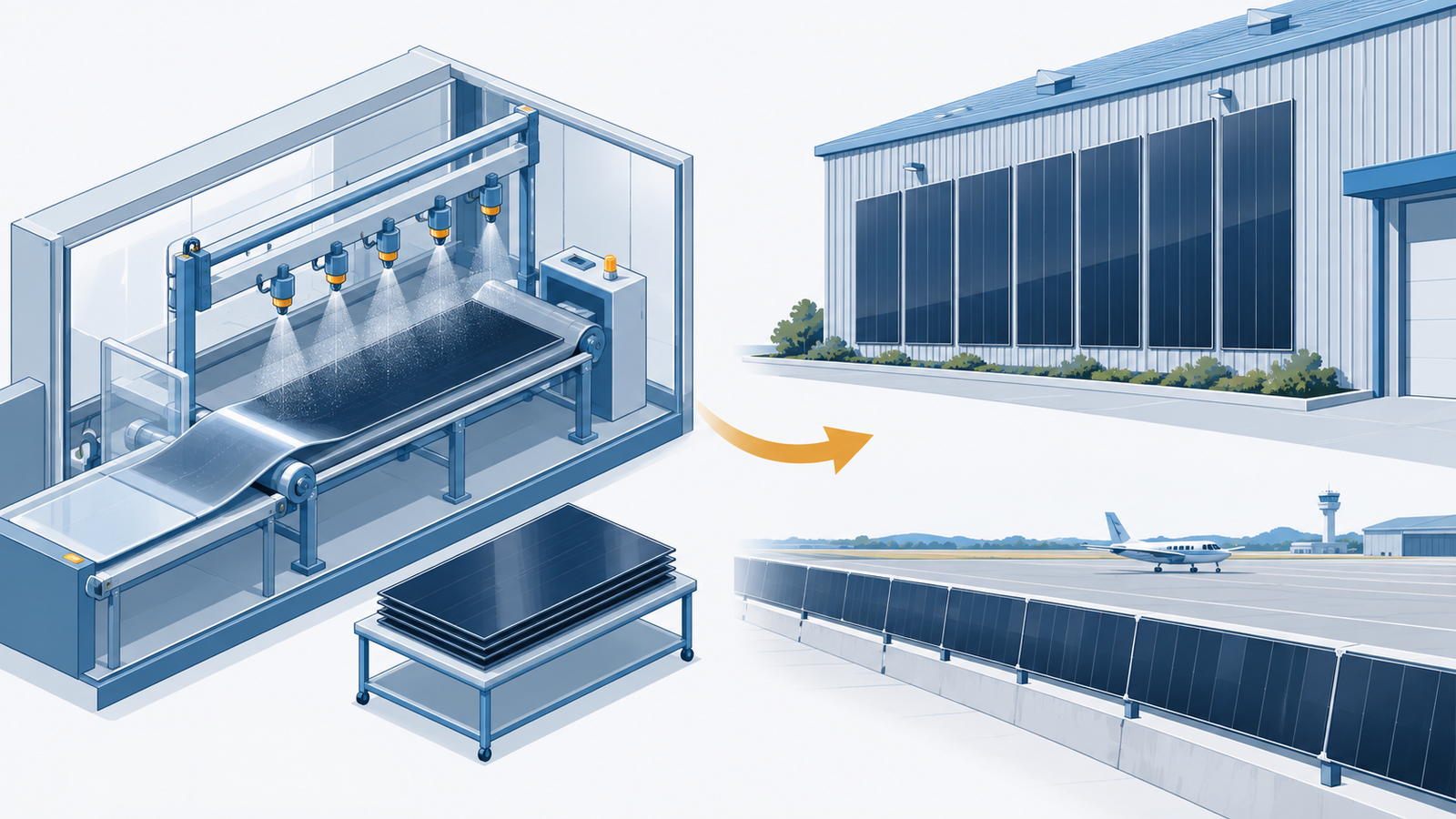
| August 2026 | Selected for the GI Fund "Next-Generation Single-Junction Solar Cell Demonstration Project". Will scale modules up to a maximum of 500 mm square and advance high-speed coating by using multiple nozzles and other means. Plans demonstrations with Cenergy at Chubu Centrair International Airport and at a subsidiary in Indonesia, and also in the United States | Enters the volume-production stage of the national project |
7. What comes next
then mass-production lineNo timing or investment given
| R&D targets (business strategy vision, as of December 2025) | Target | Progress stated |
|---|---|---|
| Conversion efficiency of a 30 cm-square module | 18% (by the end of FY2025) | 16.55% (third-party measurement) for a 30 cm-square thin-glass substrate module; 17.93% for a 10 cm-square module |
| 900 cm² module | 18% efficiency, durability of 25 years or more (annual degradation of 0.8% or less), weight 3 kg/m² | - |
| Longer-term target for 2030 | 20% or more efficiency at 900 cm², cost of electricity of ¥14/kWh or less, average annual degradation within 1% | - |
| Low-cost electrode | Performance equal to a gold electrode at 1/100 or less of the cost of gold | A carbon electrode confirmed at about 96% of the performance of a gold electrode on a 30 cm-square module (third-party measurement by AIST) |
| Hole transport material | Material cost of ¥100/m², with heat and moisture resistance at least equal to conventional materials | ¥91/m² in prospect through a change of supplier and scaled-up synthesis |
| University of Tokyo's role (regular structure on glass substrate) | Small cells of 25% with durability equivalent to 20 years; mini-modules of 22% efficiency at 1 kg/m² or less | Cells of 23.1% (5 mm square) and 24.3% (5 mm diameter); 10 cm-square mini-module 22.2% |
None of the following appears in the primary sources this article reviewed Not yet confirmed.
The location, start date and investment of the 2 MW-class pilot line and the mass-production line; the year sales will start and prices; whether the end-of-FY2025 target of 18% on 30 cm square was met; and the name of the third party that measured 16.55% (the carbon electrode performance is attributed to AIST). The business strategy vision also gives target market shares for 2040 (several tens of percent for factories and buildings, 30% for vehicles, and so on), but these are company targets, not market forecasts or results.
8. What the company is aiming for in perovskite solar cells
This section goes beyond what the company says directly. It sets out inferences that can be drawn from primary sources, each with its basis.
| What can be read | Primary evidence behind it | Category |
|---|---|---|
| To make its own and group factories the first customers | The technical paper calls the technology "extremely important for Aisin, which has many manufacturing plants, in achieving carbon-neutral production in FY2035", and the roadmap includes generation demonstrations at its own and group plants | Inference |
| To sell in combination with energy equipment rather than as standalone solar cells | The technical paper sketches an "energy value chain business" in which perovskites power hydrogen generation, charging stations, large-scale batteries and the like, and the company has in fact run a demonstration combined with a fuel cell (SOFC) and plans system demonstrations that include batteries | Inference |
| To open up transport infrastructure sites for now | The 2026 selected theme names airports, roads, railways and ports, and glare, wind pressure resistance and salt damage resistance will be evaluated at Chubu Centrair International Airport | Sourced |
| To target vehicles in the long run | The technical paper stresses the importance of mounting cells on mobility and presents driving data with its own modules fitted. The vision gives a target share for vehicle applications in 2040 | Inference |
| Overseas, starting with Indonesia and the United States | The August 2026 release explicitly mentions a demonstration at a subsidiary in Indonesia and plans for one in the United States | Sourced |
Aisin's documents talk less about the solar cell itself than about how it will be used. At the Anjo Plant it is evaluating grid-connected operation; with Obayashi it is testing an easily replaced installation method, with Netz Toyota Koriyama coloured panels, and at Maizuru Port a combination with a fuel cell Sourced. The business strategy vision's differentiation policy likewise calls for "high-quality products suited to carbon neutrality that do not become a price contest" and "building customer value that does not fall into price competition". Aisin also makes energy equipment such as ENE-FARM residential fuel cells, and this article reads it as aiming to be chosen not on the price of a panel alone but as a system that includes batteries and fuel cells Not yet confirmed. The business plan's wording, "a small start to gauge the market", is consistent with first working out how the cells will be used within the company, the group and customers close to home.
9. Map of perovskite partnerships
10. Technology, products and services
| Item | What the company has published |
|---|---|
| Products | No products on sale (the business strategy vision says the solar cell business has not yet started). 30 cm-square (300 mm-square) panels have been made for demonstrations |
| Structure | A proprietary film structure using thin glass. On the glass substrate are stacked an n-type semiconductor layer, the perovskite layer, a p-type semiconductor layer (hole transport layer) and a back electrode (technical paper) |
| Manufacturing method | The perovskite layer is deposited by spray coating (a technique built up in developing automotive parts). Screen printing (a technique developed for dye-sensitised modules) was also considered as a candidate. Speed is to be raised in future by using multiple nozzles and other means |
| Electrode | Has developed a coated carbon electrode in place of expensive gold, and confirmed about 96% of the performance of a gold electrode |
| Conversion efficiency | 16.55% (third-party measurement) for a 30 cm-square thin-glass substrate module and 17.93% for a 10 cm-square module (business strategy vision). The technical paper gives 17% on 10 cm square and 16% on 24 cm square |
| Design | Has developed coloured, decorated panels for walls |
Spray coating turns the coating liquid into a mist and sprays it on, a routine technique in painting car parts. Perovskites need films thinner than a micron and uniform in thickness, and controlling droplet size and drying is said to be difficult, but spraying can coat surfaces that are not flat, the equipment is relatively simple, and it is easy to change where the coating goes Not yet confirmed. The technical paper says that by refining the atomisation method and the composition of the precursor solution, the company found deposition conditions for "a perovskite layer with few defects and a uniform surface" Sourced.
The other distinctive feature is the carbon electrode. High-efficiency perovskite research often uses a gold back electrode applied by vacuum evaporation, but according to the company's documents the material cost of a 100 nm gold electrode is ¥100,000 per m², which rules it out for mass production. Carbon is cheap and can also be coated, which opens the way to making every layer by coating. Carbon conducts electricity less well than gold, however, so bringing its performance to 96% of gold's can be read as the achievement of the company's materials development. For a comparison of coating methods, see our explainer on solution-coating deposition.
11. The risks this company carries
| Risk | Substance | Category |
|---|---|---|
| Quality variation over large areas | The business strategy vision names as challenges "further reducing coating unevenness when scaling up area", "reducing manufacturing variation" and "establishing faster production methods" | Sourced |
| Gap to the efficiency target | Against the target of 18% on 30 cm square (by the end of FY2025), the third-party measurement stated is 16.55% | Sourced |
| Criteria for abandoning the business | The vision states that withdrawal will be considered if "the business causes serious harm (losses) to our management with no prospect of improvement" or "no return (profit) commensurate with the business investment can be expected" | Sourced |
| No experience in the solar cell business | The company itself writes that it "has not yet started a solar cell business". Its sales network and warranty arrangements have yet to be built | Sourced |
| Performance evaluation standards not yet in place | The vision lists as problems that "no performance measurement or reliability evaluation methods have been set, so actual generating capacity and lifetime in the market are unknown" and that "there are no rules on waste disposal" | Sourced |
| Mass-production investment decisions may be deferred | The business plan says it will "decide on commercialisation investment after assessing business viability", and gives no timing or amount for a mass-production line | Inference |
12. Glossary
- Thin-glass type
- A perovskite solar cell that uses thinner-than-usual glass for the substrate or encapsulation, aiming to combine the durability of glass with lightness.
- Spray coating
- A method of forming films by turning a solution into a mist and spraying it on. It can coat uneven surfaces.
- Dye-sensitised solar cell
- A solar cell in which a dye absorbs light and releases electrons. One of the forerunners of perovskite solar cells.
- Hole transport material
- The material in the layer that carries the positive charges (holes) created by light to the electrode. The standard material, spiro-OMeTAD, is expensive and sensitive to heat.
- Carbon electrode
- An electrode made of carbon materials. Cheaper than gold or silver, and can be made by coating.
- Regular structure
- A device structure in which the n-type layer, the perovskite layer and the p-type layer are stacked in that order from the glass side.
- Grid connection
- Connecting a solar installation to the power company's transmission and distribution network and using its electricity there.
- SOFC
- Solid oxide fuel cell. It generates power at high efficiency from fuels such as hydrogen.
13. References
- Aisin Company overview (capital, head office address, headcount, number of consolidated subsidiaries and businesses; as of 31 March 2026; in Japanese). https://www.aisin.com/jp/profile/outline/
- Aisin Consolidated financial results (earnings summary, IFRS) for the fiscal year ended March 2026 (28 April 2026, in Japanese). https://www.aisin.com/jp/investors/latest/uploads/fy2026_q4_tanshin-j.pdf
- Aisin Annual securities report for the 103rd fiscal period (1 April 2025 to 31 March 2026, in Japanese). R&D expenditure, and perovskite solar cells as a climate-related opportunity. https://www.aisin.com/jp/investors/securityreport/2026061201_1.pdf
- Aisin Technical paper, "Development of perovskite solar cells at Aisin" (AISIN TECHNICAL REVIEW Vol. 29, 2025, in Japanese). Development history, spray coating, carbon electrode, demonstration at the Technical Center, and vehicle demonstration. https://www.aisin.com/jp/technology/technicalreview/29/pdf/07.pdf
- Aisin (published by NEDO) Business strategy vision, "Development of practical technology for high-efficiency, high-durability perovskite solar cell modules" (as of December 2025, in Japanese). Organisation, strengths and weaknesses, business plan, R&D targets and progress, roadmap and risk factors. https://green-innovation.nedo.go.jp/resources/pdf/next-generation-solar-cells/item-1-2/vision-aisin-004.pdf
- Aisin News, "'Perovskite Solar Cell Uptake Expansion Project' chosen for commercialisation support by the Aichi Carbon Neutral Strategy Council" (15 January 2025, in Japanese). https://www.aisin.com/jp/news/2025/006316.html
- Aisin News, "AISIN Launches In-house Demonstration at Anjo Plant Toward Social Implementation of Perovskite Solar Cells" (31 March 2025; Japanese version cited). https://www.aisin.com/jp/news/2025/008976.html
- Obayashi and Aisin News, "Obayashi and Aisin begin demonstration tests towards practical use of perovskite solar cells" (13 June 2025, in Japanese). https://www.aisin.com/jp/news/2025/009053.html
- Aisin News, "Aisin begins a perovskite solar cell demonstration with Netz Toyota Koriyama" (September 2025, in Japanese). https://www.aisin.com/jp/news/2025/010369.html
- Aisin News, "Aisin joins Kyoto Prefecture's 'Demonstration project for the spread of pure-hydrogen fuel cells using green hydrogen'" (2025, in Japanese). https://www.aisin.com/jp/news/2025/010437.html
- Aisin Topics, "Taking part in lightweight perovskite solar cell demonstrations at nine demonstration sites selected by Aichi Prefecture" (27 March 2026, in Japanese). https://www.aisin.com/jp/news/2026/010560.html
- Aisin News, "Aisin's work towards mass production of perovskite solar cells selected for NEDO's Green Innovation Fund Project" (21 August 2026, in Japanese). https://www.aisin.com/jp/news/2026/010690.html
- NEDO Annex 1, list of planned implementers, for "Development of next-generation solar cells begins under the Green Innovation Fund Project" (28 December 2021, in Japanese). https://www.nedo.go.jp/content/100940817.pdf
- NEDO Annex 2, project outline (project size, support, period and subsidy rates), for the selection of one new project under the "Next-Generation Single-Junction Solar Cell Demonstration Project" (6 August 2026, in Japanese). https://www.nedo.go.jp/content/800059483.pdf
- NEDO Annex 2, project outline (combined project size of the three projects), for the selection of three new projects under the "Next-Generation Solar Cell Demonstration Project" (10 September 2025, in Japanese). https://www.nedo.go.jp/content/800032097.pdf
14. Claim-to-source audit
| Claim in the article | Category | Source |
|---|---|---|
| Capital of ¥45 billion, head office (Kariya), 113,292 employees (consolidated) | Sourced | Reference 1 https://www.aisin.com/jp/profile/outline/ |
| Revenue and operating profit (years to March 2025 and March 2026), listing exchanges (Tokyo and Nagoya) and code 7259 | Sourced | Reference 2 https://www.aisin.com/jp/investors/latest/uploads/fy2026_q4_tanshin-j.pdf |
| R&D expenditure of ¥265.4 billion; "market launch of perovskite solar cells and securing market share" as an opportunity | Sourced | Reference 3 https://www.aisin.com/jp/investors/securityreport/2026061201_1.pdf |
| History from the start of dye-sensitised solar cell development in 1998 to joining NEDO in 2015; spray coating and screen printing; 17% on 10 cm square and 16% on 24 cm square; demonstration at the Technical Center; positioning within carbon-neutral production in FY2035; the energy value chain; vehicle demonstration | Sourced | Reference 4 https://www.aisin.com/jp/technology/technicalreview/29/pdf/07.pdf |
| Organisation (University of Tokyo, Toyota Central R&D Labs, IMRA Japan, Kumamoto University); the weakness of not yet having started a solar cell business; a business plan of several billion yen; commercialisation in the late 2020s with a small start; R&D targets and progress (16.55%, 17.93%, 96%, ¥91/m², University of Tokyo figures); roadmap (5 kW, 2 MW class, mass-production line); target shares for 2040; differentiation policy; risk factors | Sourced | Reference 5 https://green-innovation.nedo.go.jp/resources/pdf/next-generation-solar-cells/item-1-2/vision-aisin-004.pdf |
| The uptake expansion project (proposed jointly with Chubu Electric Power Miraiz and Kansai Electric Power; Aisin responsible for manufacturing) | Sourced | Reference 6 https://www.aisin.com/jp/news/2025/006316.html |
| In-house demonstration at the Anjo Plant (about 30 kW, grid-connected) and the NEDO-subsidised project number | Sourced | Reference 7 https://www.aisin.com/jp/news/2025/008976.html |
| Demonstration with Obayashi (fastener method, estimate of 20% or more higher generation) | Sourced | Reference 8 https://www.aisin.com/jp/news/2025/009053.html |
| Demonstration of decorated panels at Netz Toyota Koriyama | Sourced | Reference 9 https://www.aisin.com/jp/news/2025/010369.html |
| Supply of perovskite cells and an SOFC to the hydrogen demonstration at Maizuru Port | Sourced | Reference 10 https://www.aisin.com/jp/news/2025/010437.html |
| Participation in Aichi Prefecture's nine demonstration sites | Sourced | Reference 11 https://www.aisin.com/jp/news/2026/010560.html |
| Selection in August 2026; 500 mm square and multiple nozzles; industry-academia-government partners; demonstrations with Cenergy at Chubu Centrair International Airport, in Indonesia and in the United States; the thin-glass film structure | Sourced | Reference 12 https://www.aisin.com/jp/news/2026/010690.html |
| Selection for the GI Fund in December 2021 (with the University of Tokyo) | Sourced | Reference 13 https://www.nedo.go.jp/content/100940817.pdf |
| Project size of about ¥15.6 billion and support of about ¥9.8 billion (¥11.3 billion) for the theme newly selected in 2026, FY2026 to FY2030, subsidy rates, and the theme name "thin-glass lightweight" | Sourced | Reference 14 https://www.nedo.go.jp/content/800059483.pdf |
| Combined project size of about ¥33.5 billion for the three projects selected in September 2025 | Sourced | Reference 15 https://www.nedo.go.jp/content/800032097.pdf |
| The three types of perovskite solar cell company | Our calculation | Our own classification. Companies shown are examples from those covered in this series |
| Support share of about 63% (about 72%); comparison as nearly half of the three projects combined | Our calculation | Our own calculation from the amounts in references 14 and 15 |
| Location, timing and investment of the pilot and mass-production lines; year of sales start and prices; whether the end-of-FY2025 target was met; name of the body that measured 16.55%; dedicated headcount | Not yet confirmed | Not in the primary sources this article reviewed. This article makes no estimate |
| The readings that its own and group factories will be the first customers, that it will sell in combination with energy equipment, and that it is also targeting vehicles | Inference | This article's interpretation of references 4, 5, 10 and 12 |
| The views on the advantages and difficulties of spray coating and the significance of the carbon electrode | Inference | This article's commentary based on references 4 and 5 |
| The risk that mass-production investment decisions may be deferred | Inference | This article's interpretation of the wording of the business plan in reference 5 |
Last updated 25 September 2026 / Troy Technical
Every figure in this article comes from Aisin's statutory filings, company overview, official releases and technical paper, the business strategy vision the company submitted to NEDO, and documents published by NEDO. No research-firm estimates or press-based figures have been used. Passages marked "Inference" are this article's interpretation of primary sources, not statements made by the company.