COMPANY PROFILE / PEROVSKITE SOLAR CELLS
Caelux
A U.S. perovskite specialist that makes no cells and sells "cover glass that generates power"
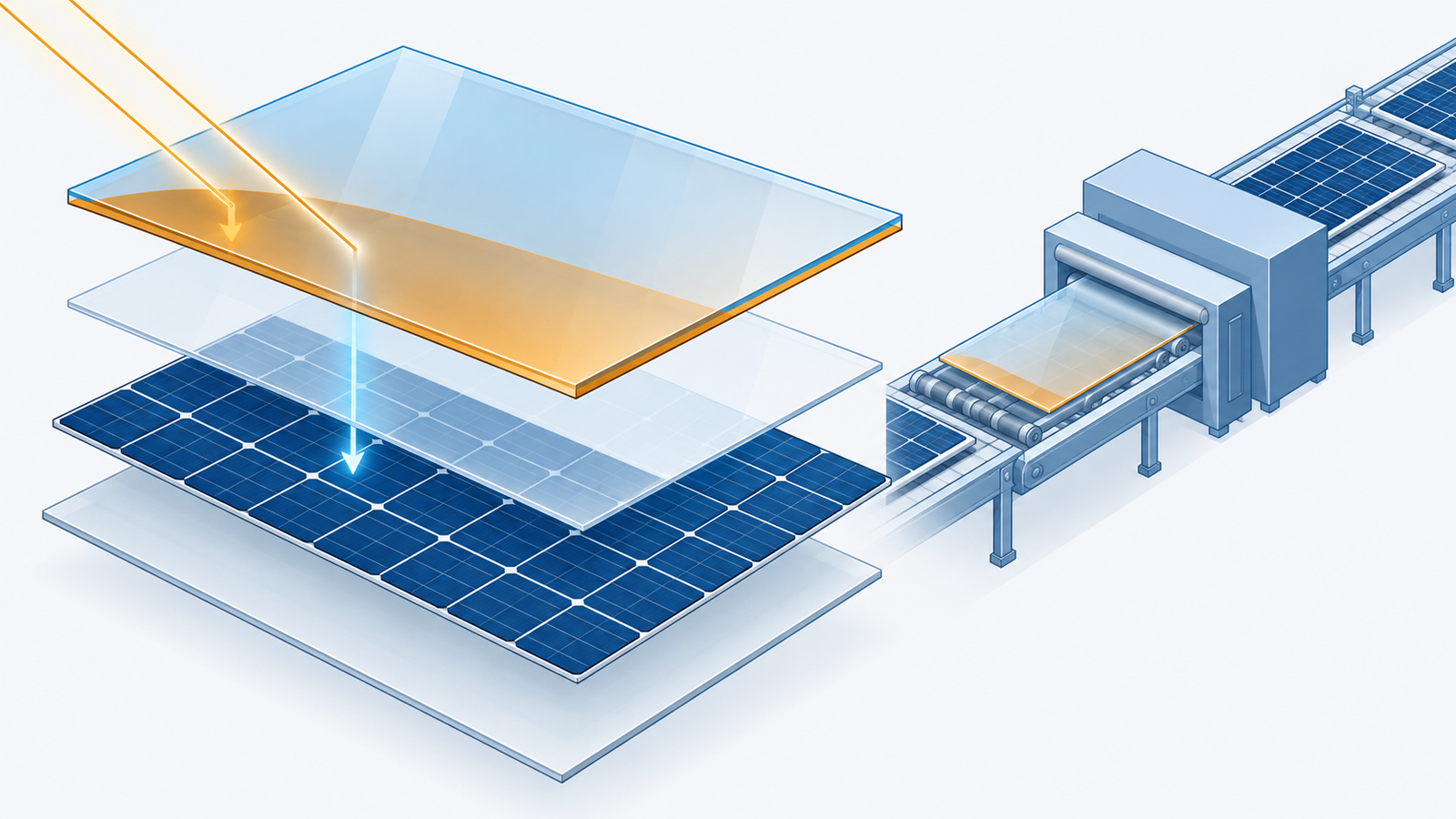
Caelux is a California company that builds a perovskite power-generating layer into the cover glass, the outermost layer of a solar module. It makes neither silicon cells nor modules itself. Instead it supplies this glass to existing module makers, who turn it into "Hybrid-Tandem" modules that generate power in two layers, the glass and the silicon. It completed its first commercial shipment in July 2025, and in 2026 announced a string of five-year supply and production partnerships: Solx in the U.S., and RAYZON Solar, Navitas Solar and GREW Solar in India. As of September 2026 the company says its contracted volume totals 19 GW. Caelux is privately held, so this profile uses only announcements by the company itself, its partners, its investors and public bodies to sort out what is settled and what cannot yet be seen.
- Caelux in 30 seconds, and where it stands in perovskite solar cells
- The logo and how the name is written
- Where the company sits in the perovskite solar landscape
- Scale (revenue is not disclosed, so we look at funding)
- Resources committed to perovskites
- Track record so far
- Plans ahead
- What the company is aiming for in perovskite solar cells
- Partnership map
- Technology, products and services
- The risks this company carries
- Glossary, references and claim-to-source audit
1. Caelux in 30 seconds, and where it stands in perovskite solar cells
California, U.S.Announcements up to 2023 gave Pasadena
Founded 2014No financial statements published
start-upMakes neither silicon cells nor modules
(tandem with silicon)The glass and the silicon cells are connected in parallel
Khosla / Mitsui Fudosan and othersReliance took 20% for US$12 million (2022)
Companies working on perovskite solar cells fall into three broad groups: established PV makers, perovskite start-ups, and newcomers from materials, chemicals and electronics. Caelux is a perovskite start-up, but unlike start-ups that make tandem cells or modules themselves, it has chosen to turn just one module component, the cover glass, into a power-generating layer and sell that Sourced. The company says its approach means "no need for specialty silicon or reinvestment in solar cell manufacturing lines" and that its glass "plugs right into the existing module manufacturing process with minimal process change". In other words, Caelux's customers are not power producers but silicon module makers, and the partnerships with one U.S. and three Indian manufacturers are the result of building that customer base.
2. The logo and how the name is written

The Caelux logo is a trademark of the company. We have not recreated it with generated imagery;
the image was taken from the official website (the version updated in August 2026) and is placed here as img/caelux_logo.png.
A note on names: the legal entity is Caelux Corporation. Releases up to 2025 write the name with a trademark symbol, "Caelux®". Product names vary between releases ("Caelux™ One", "CaeluxOne", "Active Glass", "Energy Producing Glass" and so on), but all refer to cover glass with a built-in perovskite power-generating layer. This series uses the Latin-alphabet name throughout; the company has not published an official rendering of the name in Japanese script.
Official site: https://caelux.com/3. Where the company sits in the perovskite solar landscape
By product format Caelux counts as a tandem with silicon, but it is not a two-terminal (monolithic) device in which top and bottom cells are stacked in series on a single substrate. On its technology page the company compares its approach with two-terminal tandems and describes "a passively connected architecture where our Active Glass is in parallel with the silicon solar cells" Sourced. Because the perovskite and the silicon are made as separate layers and combined inside the module, the approach is close in concept to what is generally called a four-terminal tandem Inference. The difference between two-terminal and four-terminal tandems is covered in our explainer on silicon–perovskite tandems.
4. Scale (revenue is not disclosed, so we look at funding)
Caelux is privately held and does not publish revenue, profit or loss, cash on hand or headcount Not yet confirmed. It completed its first commercial shipment in July 2025, but neither the value nor the volume has been disclosed. Instead we gauge its size from the funding rounds the company and its investors have announced.
| When | What was announced | Amount | Where stated |
|---|---|---|---|
| September 2022 | Reliance New Energy (RNEL), a wholly owned subsidiary of Reliance Industries, signs definitive agreements to invest, taking a 20% stake, together with a strategic partnership on technology collaboration and commercialisation | US$12 million | Reliance Industries announcement |
| August 2023 | Series A3, led by Temasek, with participation from RNEL, Khosla Ventures, Mitsui Fudosan and Fine Structure Ventures | US$12 million | Caelux official release |
| August 2023 | The company says A3 brings the Series A total to this amount | US$24 million | Caelux official release |
| August 2023 | Mitsui Fudosan announces it has invested through its CVC fund "31VENTURES Global Innovation Fund II" | Not disclosed | 31VENTURES announcement |
RNEL announced that it would take 20% for US$12 million Sourced. Grossing that up simply gives a post-money valuation of about US$60 million as of September 2022 Our calculation. The actual valuation could differ, for example because of preferred-share terms, so this is only a rough guide. Neither announcement says how RNEL's US$12 million relates to the "Series A total of US$24 million" the company cited in 2023 (that is, whether RNEL's investment is part of the Series A) Not yet confirmed.
No funding after August 2023 could be confirmed in the company's official releases. The company's website carries an item whose title, for a podcast featuring the CEO, mentions raising US$70 million, but no official release setting out the breakdown or timing could be found, so this article does not use the figure.
5. Resources committed to perovskites
Perovskite glass is Caelux's only business, so almost everything the company spends goes into perovskites. The amounts, however, are not disclosed.
| Resource | Details | Category |
|---|---|---|
| People (leadership) | CEO Scott Graybeal previously led the energy segment at Flex Ltd. CTO Charlie Hasselbrink led quality and reliability R&D at SunPower, heading a team that developed patented methods to accelerate UV testing by a factor of 100,000. Founder John Iannelli came from Khosla Ventures | Sourced |
| People (sales and regions) | Chief Commercial Officer Aaron Thurlow (formerly of SunPower, LONGi Solar and others; joined April 2025). Vish Iyer for India and the Middle East (joined June 2025). A VP and general manager for Asia | Sourced |
| People (headcount) | Number of employees | Not disclosed |
| Money (equity funding) | Series A total of US$24 million (August 2023). RNEL's US$12 million (September 2022) | Sourced |
| Money (factory and R&D) | Ramping up its Baldwin Park manufacturing facility to reach 100MW of perovskite-coated glass (August 2023 announcement). Current capacity and investment not disclosed | Sourced / not disclosed |
| Investments in and acquisitions of other companies | Announcements of investments or acquisitions by Caelux | Could not be confirmed |
| Universities, research institutes and public funding | A partner in an inspection-technology project led by the University of New South Wales (UNSW) and funded by Australia's ARENA (ARENA funding A$2.73 million, total project cost A$8.04 million, November 2022 to January 2028; the ARENA page writes "$"). UNSW receives the funding, and the share allocated to Caelux has not been disclosed | Sourced |
| U.S. public funding | Announcements of awards from DOE or other U.S. government bodies | Could not be confirmed |
| Materials discovery | A founding partner of the "AI Materials Foundry" run by CuspAI of the UK (July 2026; more than 45 organisations taking part) | Sourced |
Caelux's glass sits on the very outside of the module, the first surface sunlight reaches. That puts the perovskite layer where it takes the full brunt of UV and heat before any light reaches the silicon cells. That the CTO is a reliability specialist with patented methods for accelerating UV testing 100,000-fold can be read as a sign that the company itself treats this weakness of the layout as its top priority Inference.
On the other hand, glass is a flat substrate without the surface texture found on silicon cells. On flat glass it is easy to make uniform films by either coating or evaporation, and the perovskite deposition conditions need not be bent to suit the silicon. By making the perovskite and the silicon in separate factories and processes and only then combining them, neither side's yield is dragged down by the other: that is the materials and process advantage of this approach Inference. For encapsulation issues, see our explainer on encapsulation and barrier layers.
6. Track record so far
| When | What happened | What it means |
|---|---|---|
| 2014 | Founded by John Iannelli. The initial goal was to raise the performance of crystalline silicon modules using nanomaterials | The idea of building on top of silicon was there from the start |
| September 2022 | Reliance New Energy takes 20% for US$12 million and signs a strategic partnership on technology and commercialisation. The money is to go towards building a pilot line in the U.S., among other things | A major Indian group becomes the first large investor |
| November 2022 | Start of the UNSW-led, ARENA-funded inspection-technology project (Caelux as a partner) | Preparing quality inspection for volume production through public research |
| August 2023 | US$12 million in Series A3 (led by Temasek); Series A total of US$24 million. Announces it is building a manufacturing facility in Baldwin Park and ramping up to 100MW. Mitsui Fudosan also invests | The scale of the factory is indicated for the first time |
| April 2025 | Aaron Thurlow joins as SVP of Sales and Marketing, to prepare the market launch of the flagship product Caelux One | A sales organisation starts to take shape |
| June 2025 | Vish Iyer joins as head of India and the Middle East | Preparing to enter India |
| July 2025 | First commercial shipment, for a project of a major U.S. developer, assembled into Hybrid-Tandem modules with a silicon module maker | Names of the customer and the module maker not disclosed |
| April 2026 | Five-year, 3 GW partnership with Solx (U.S.): Caelux glass built into Solx's Aurora modules, with cells made by Suniva; efficiency 28%. Described as "a true production deal with volume and purchase commitments" | A supply chain entirely within the U.S. |
| 20 July 2026 | Joins CuspAI's AI Materials Foundry as a founding partner | Using AI for materials discovery |
| 23 July 2026 | Announces on the same day a five-year, 5 GW partnership with RAYZON Solar (India) and a five-year, 5 GW partnership with Navitas Solar (India). Both pair the glass with TOPCon modules, at 28% efficiency ("up to 28%" for Navitas) | A full-scale entry into the Indian market |
| September 2026 | Five-year partnership of up to 4 GW with GREW Solar (India), at 29%+ efficiency. Announces that contracted volume now totals 19 GW | Volume commitments have piled up |
7. Plans ahead
In its September 2026 release with GREW Solar, the company wrote that the partnership "expands Caelux's contracted volume to 19 GW with solar module manufacturers globally" Sourced. Adding up the partnerships announced with named companies gives Solx 3 GW + RAYZON 5 GW + Navitas 5 GW + GREW 4 GW = 17 GW, so the counterparty for the remaining roughly 2 GW cannot be identified from published material Our calculation. All three Indian partnerships aim for commercial production and shipments in 2028, and the Navitas and GREW announcements state explicitly that the modules will meet the requirements of the Indian government's approved list (ALMM).
None of the following appears in the published material of the company or its partners Not yet confirmed.
Where and by whom 19 GW worth of glass will be made (Caelux's U.S. factory, or local production in India) / current production capacity and factory investment / the selling price of the glass / minimum purchase volumes and penalty terms in the partnerships / the volume and customer name for the first shipment in July 2025 / the counterparty for the remaining 2 GW or so. Figures of the "Caelux to build an X GW factory in India" kind exist in press reports, and this article does not use them.
8. What the company is aiming for in perovskite solar cells
This section includes things the company does not say directly. We set them out as inferences within what the primary sources support, with the evidence for each.
| What the evidence suggests | Primary information it rests on | Category |
|---|---|---|
| It aims to be a component supplier to module makers, not a seller of modules under its own brand | The technical description that its glass "plugs right into the existing module manufacturing process", and the fact that all four partnerships are with module makers. In the GREW announcement the CEO said module makers "can significantly extend the useful life of their CAPEX-heavy manufacturing assets" | Sourced |
| It insists on selling a physical product rather than licensing | In the Solx announcement its sales head said: "While licensing has occurred in the industry, our agreement is a true production deal with volume and purchase commitments" | Sourced |
| It treats India as a main battleground alongside the U.S. | It appointed a head for India and the Middle East in 2025, three of its four partnerships in 2026 (14 GW in total) are with Indian makers, and its first large investor was India's Reliance | Inference |
| It will need to widen who manufactures beyond its own factory | The own factory it described in 2023 was on a 100MW scale. 19 GW over five years averages 3.8 GW a year, about 38 times that (our calculation). Production locations have not been disclosed | Inference |
| For now it differentiates on ease of adoption rather than peak efficiency | The official website compares itself with two-terminal tandems on "technical simplicity", low capital expenditure and mainstream adoption | Inference |
In its August 2023 release, Caelux said it was ramping up its Baldwin Park manufacturing facility "to reach 100MW of perovskite-coated glass" Sourced. By September 2026, however, contracted volume stood at 19 GW over five years Sourced. 19 GW ÷ 5 years = 3.8 GW a year on average, about 38 times 100MW Our calculation. If the contracts proceed as promised, Caelux will have to (1) expand its own factory by orders of magnitude, (2) make the glass in the partners' countries (India, for example), or (3) hand part of the manufacturing to others. Because all three Indian releases emphasise "Make in India" and a fully domestic route within India, we read it as likely that the answer will include (2), local production Not yet confirmed. The company has not said where the glass will be made, however, and this remains our interpretation.
9. Partnership map
10. Technology, products and services
| Item | What the company has published |
|---|---|
| Product concept | A perovskite power-generating layer built into the module's cover glass, placed over the silicon cells to make a module that generates power in two layers |
| Connection | A passively connected architecture with the Active Glass in parallel with the silicon cells. Compared with two-terminal tandems, the company claims advantages in technical simplicity, scalability, manufacturing cost, ease of adoption, reliability and low capital expenditure |
| Compatible silicon | "Compatible with all mainstream silicon solar technologies" (release on the first shipment, July 2025). The actual partner combinations are Suniva cells in the U.S. and n-type TOPCon at the three Indian makers |
| CaeluxPrime | Limited supply to initial customers and partners. Raises efficiency by up to 3 percentage points (absolute) over conventional modules |
| CaeluxOne | The flagship product, in dimensions for residential, commercial and industrial, and utility-scale use. Raises efficiency by up to 6 percentage points (absolute) |
| Manufacturing | Made at its headquarters in California. The company says it uses machine learning and AI to manage quality |
| Efficiency and performance claim | Cell or module, and area | Certified? |
|---|---|---|
| Module efficiency of 28% (Solx and RAYZON announcements), up to 28% (Navitas announcement) and 29%+ (GREW announcement) | Module. Area and dimensions not stated | Company-reported. No testing body named |
| Up to 30% more power density, 20% more energy production and up to 20% lower project costs | Module (compared with conventional modules) | Company-reported |
| "Up to 35% more energy than a conventional solar module" (official website text) | Module | Company-reported. Does not match the "20% more energy" in the figures panel on the same page |
| A major step towards the industry goal of commercial tandem modules above 30% efficiency (August 2023) | Module | Phrased as a goal, not an achieved value |
| NREL's Best Research-Cell Efficiency chart and Champion Module Efficiencies chart (both revised 17 July 2026) | - | Caelux's name does not appear |
Cross-checking the company's own figures, CaeluxOne's "up to 6 percentage points" would take a conventional module at around 22% to around 28%, which is consistent with the "28%" in the partnership releases Our calculation. On the other hand, the website text's "up to 35% more energy" and the "20% more energy" in the figures panel on the same page do not agree, and we cannot tell which is the company's current view Not yet confirmed. How to read efficiency figures is covered in our explainer on conversion efficiency and evaluation metrics.
A two-terminal tandem connects the top and bottom cells in series, so the currents in the two must be matched, which means tightly tuning the perovskite's thickness and bandgap. Connecting in parallel, as Caelux does, removes the need to match currents but instead requires matching voltages (for example by choosing how many cells are connected in series on each side); that is a general property of circuits Inference. The company has not disclosed how it matches voltages Not yet confirmed.
The advantage of a parallel design is that even if the perovskite layer degrades and its output falls, the silicon side's output is little affected. In a series two-terminal tandem, degradation in one cell drags down the current of the whole device; in parallel, degradation of the glass only erodes the extra output it adds. That is the structural difference Inference. At a stage when the long-term durability of perovskites has not been fully proven, a design that "at worst still works as a silicon module" helps lower the psychological barrier to adoption for conservative module makers.
11. The risks this company carries
| Risk | Details | Category |
|---|---|---|
| Gap between capacity and contracted volume | The own factory described in 2023 was on a 100MW scale. Contracted volume is 19 GW over five years (3.8 GW a year on average). Where it will be made has not been disclosed | Our calculation |
| Finances cannot be seen | Privately held, with no published revenue, profit or loss, or cash. No funding after August 2023 can be confirmed in official releases either | Sourced |
| Efficiency not certified by third parties | Not listed in NREL's efficiency charts; figures such as 28% and 29%+ are all company-reported with no testing body named | Sourced |
| Partnerships include forward-looking statements | Each release carries a forward-looking statements disclaimer stating that results could differ materially depending on technology development, regulatory approvals, markets, supply chains and policy. The GREW volume is "up to 4 GW" | Sourced |
| Dependence on India's approval system | All three Indian partnerships target commercial production and shipments in 2028, and two state explicitly that the modules will meet ALMM requirements. If approval is delayed, shipments will be too | Inference |
| Durability of a layer on the front surface | The perovskite layer sits where it receives UV and heat first. No long-term outdoor track record has been published | Inference |
| Inconsistencies in published information | Wording varies with time and page, including the headquarters (Pasadena, then Baldwin Park), product names and the claimed increase in energy output (20% versus 35%) | Sourced |
12. Glossary
- Perovskite solar cell
- A solar cell whose light-absorbing layer is a metal halide material with the perovskite crystal structure. It can be made thin and absorbs light strongly.
- Hybrid-Tandem
- Caelux's term for a module that generates power in two layers: power-generating cover glass and silicon cells.
- Cover glass
- The toughened glass covering the light-receiving face of a module. Normally it does not generate power and serves to protect the cells.
- Two-terminal / four-terminal
- A two-terminal tandem connects the top and bottom cells in series as a single device; a four-terminal tandem makes them as separate circuits and combines them externally.
- TOPCon
- A silicon cell with an ultra-thin oxide layer and a polycrystalline silicon layer on the rear; today's mainstream mass-produced cell.
- ALMM
- The Indian government's Approved List of Models and Manufacturers. Listed products are required for government procurement and similar projects.
- ARENA
- The Australian Renewable Energy Agency, a government body that provides public funding for renewable energy R&D and demonstration.
- CVC
- Corporate venture capital: an organisation or fund through which an operating company invests in start-ups.
13. References
- Caelux Corporation Official website, home page. Description of the business, the claim of up to 35% more energy, the figures panel (30%, 20% and 20%), manufacturing at the California headquarters, and source of the logo image. https://caelux.com/
- Caelux Corporation Official website, "Our Vision". Founding in 2014 and the original purpose. https://caelux.com/company/
- Caelux Corporation Official website, "Leadership Team". Backgrounds of the leadership (CEO, founder, CTO, CFO, Chief Commercial Officer, Chief Legal Officer, head of Asia, head of India and the Middle East). https://caelux.com/company/leadership-team/
- Caelux Corporation Official website, "Our Technology". Turning cover glass into a power-generating layer, the parallel connection with silicon cells, the comparison with two-terminal tandems, and the statement that no specialty silicon or reinvestment in cell lines is needed. https://caelux.com/technology/
- Caelux Corporation Official website, "Products". CaeluxPrime (up to 3 percentage points, limited to initial customers) and CaeluxOne (up to 6 percentage points). https://caelux.com/products/
- Reliance Industries Limited Media Release, "Reliance New Energy Limited to invest in Caelux Corporation" (23 September 2022). RNEL taking 20% for US$12 million, building a pilot line, the strategic partnership on technology and commercialisation, and the then headquarters in Pasadena. https://www.ril.com/sites/default/files/2022-12/Media-Release-RIL-23092022%20(1).pdf
- Caelux Press release, "Caelux Announces $12M to Fund Next-Generation Solar Innovation with Perovskite Technology" (14 August 2023). US$12 million Series A3, led by Temasek, and the participants; Series A total of US$24 million; the Baldwin Park manufacturing facility and 100MW; Caelux One. https://www.prnewswire.com/news-releases/caelux-announces-12m-to-fund-next-generation-solar-innovation-with-perovskite-technology-301899211.html
- 31VENTURES (Mitsui Fudosan) "31VENTURES Global Innovation Fund II has invested in Caelux Corporation" (15 August 2023). Mitsui Fudosan's investment in Caelux through its CVC fund. https://www.31ventures.jp/en/news/?p=392
- Australian Renewable Energy Agency (ARENA) Project page, "High-Throughput Inspection Methods for High-Efficiency Multijunction Solar Cells". Led by UNSW; ARENA funding A$2.73 million; total project cost A$8.04 million; 30 November 2022 to 31 January 2028; Caelux Corporation as a partner (with ANU, RayGen and Greatcell also involved). We read the "$" on this Australian government page as Australian dollars. https://arena.gov.au/projects/high-throughput-inspection-methods-for-high-efficiency-multijunction-solar-cells/
- Caelux Press release, "Aaron Thurlow Joins Caelux® as Senior Vice President of Sales & Marketing" (29 April 2025). Appointment of its sales head, and preparation for the market launch of the flagship product Caelux One. https://caelux.com/aaron-thurlow-joins-caelux-as-senior-vice-president-of-sales-marketing-to-lead-global-product-commercialization-and-accelerate-revenue-growth/
- Caelux Press release, "Vish Iyer Joins Caelux® as Managing Director, India and Middle East" (dated 18 June 2025). Appointment of the head of India and the Middle East, and the plan to enter India. https://caelux.com/vish-iyer-joins-caelux-as-managing-director-india-and-middle-east-to-spearhead-strategic-growth-and-market-expansion-in-two-of-the-worlds-fastest-growing-solar-markets/
- Caelux Press release, "Caelux® Completes First Commercial Shipment of its Proprietary Active Glass Technology" (8 July 2025). First commercial shipment, for a project of a major U.S. developer, assembly with a silicon module maker, and up to 30% more power density, 20% more energy production and up to 20% lower costs. https://caelux.com/caelux-completes-first-commercial-shipment-of-its-proprietary-active-glass-technology-marking-major-company-milestone/
- Solx / Caelux Joint press release, "In Major US Manufacturing Milestone, Solx and Caelux Partner to Scale Next-Gen Energy Technology" (21 April 2026). Five-year, 3 GW partnership, Aurora modules, Suniva cells, 28% efficiency, a production deal with volume and purchase commitments, commercial volumes by 2027, and the forward-looking statements disclaimer. https://caelux.com/solx-caelux-partnership/
- Caelux (reposting CuspAI's announcement) "Caelux Joins CuspAI's AI Materials Foundry as a Founding Partner" (20 July 2026). The founding partners of the AI Materials Foundry (more than 45) and comments from Caelux's CEO. https://caelux.com/ai-materials-foundry/
- RAYZON Solar / Caelux Joint press release, "RAYZON Solar and Caelux Partner to Scale Next-Generation Solar Tech for “Make in India” Initiative" (23 July 2026). Five years and 5 GW, pairing with TOPCon, 28% efficiency, commercial volumes in 2028, and the forward-looking statements disclaimer. https://caelux.com/rayzon/
- Navitas Solar / Caelux Joint press release, "Navitas Solar and Caelux Join Forces to Accelerate India's Renewable Energy Goals" (23 July 2026). Five years and 5 GW, pairing with n-type TOPCon, up to 28%, commercial production in 2028, and ALMM requirements. https://caelux.com/navitas/
- GREW Solar / Caelux Joint press release, "Caelux Expands its Global Presence with GREW Solar Partnership" (16 September 2026). Five years and up to 4 GW, 29%+ efficiency, contracted volume totalling 19 GW, commercial production in 2028, and the CEO's comments. https://caelux.com/caelux-expands-its-global-presence-with-grew-solar-partnership/
- Caelux Corporation Official website, "News" listing. Used to check the title of the podcast featuring the CEO (mentioning US$70 million raised). https://caelux.com/news/
- NREL (now the National Laboratory of the Rockies) Best Research-Cell Efficiency Chart (revised 17 July 2026). Used to confirm that no Caelux record is listed. https://www.nlr.gov/docs/libraries/pv/best-research-cell-efficiencies.pdf
- NREL (now the National Laboratory of the Rockies) Champion Module Efficiencies chart (revised 17 July 2026). Used to confirm that no Caelux record is listed. https://www.nlr.gov/docs/libraries/pv/champion-module-chart.pdf
14. Claim-to-source audit
| Claim in the article | Category | Source |
|---|---|---|
| The legal name is Caelux Corporation, and the headquarters is in Baldwin Park | Sourced | References 15 and 17 https://caelux.com/rayzon/ |
| Founding in 2014, the original purpose, and the founder's background | Sourced | References 2 and 3 https://caelux.com/company/ |
| Backgrounds of the leadership (CEO, CTO, Chief Commercial Officer, head of India and the Middle East and others) and the CTO's patented accelerated UV testing methods | Sourced | Reference 3 https://caelux.com/company/leadership-team/ |
| Turning cover glass into a power-generating layer, the parallel connection, the comparison with two-terminal tandems, and no reinvestment in cell lines | Sourced | Reference 4 https://caelux.com/technology/ |
| CaeluxPrime (up to 3 points) and CaeluxOne (up to 6 points) | Sourced | Reference 5 https://caelux.com/products/ |
| Up to 35% more energy, the 30%, 20% and 20% figures, manufacturing at the California headquarters, and the logo | Sourced | Reference 1 https://caelux.com/ |
| RNEL taking 20% for US$12 million, the strategic partnership, building a pilot line, and the then headquarters in Pasadena (September 2022) | Sourced | Reference 6 https://www.ril.com/sites/default/files/2022-12/Media-Release-RIL-23092022%20(1).pdf |
| A rough post-money valuation of about US$60 million | Our calculation | This article's calculation of US$12 million ÷ 20% from reference 6. Preferred-share terms and the like are not taken into account |
| US$12 million Series A3, led by Temasek, and the participants; Series A total of US$24 million; the 100MW manufacturing facility | Sourced | Reference 7 https://www.prnewswire.com/news-releases/caelux-announces-12m-to-fund-next-generation-solar-innovation-with-perovskite-technology-301899211.html |
| Mitsui Fudosan's investment through 31VENTURES | Sourced | Reference 8 https://www.31ventures.jp/en/news/?p=392 |
| Caelux's participation as a partner in the ARENA-funded, UNSW-led project (A$2.73 million / A$8.04 million in total, November 2022 to January 2028) | Sourced | Reference 9 https://arena.gov.au/projects/high-throughput-inspection-methods-for-high-efficiency-multijunction-solar-cells/ |
| Appointment of the sales head (April 2025) and preparation for the launch of Caelux One | Sourced | Reference 10 https://caelux.com/aaron-thurlow-joins-caelux-as-senior-vice-president-of-sales-marketing-to-lead-global-product-commercialization-and-accelerate-revenue-growth/ |
| Appointment of the head of India and the Middle East (June 2025) | Sourced | Reference 11 https://caelux.com/vish-iyer-joins-caelux-as-managing-director-india-and-middle-east-to-spearhead-strategic-growth-and-market-expansion-in-two-of-the-worlds-fastest-growing-solar-markets/ |
| First commercial shipment (July 2025), the undisclosed names of the customer and module maker, and the statement of compatibility with all mainstream silicon technologies | Sourced | Reference 12 https://caelux.com/caelux-completes-first-commercial-shipment-of-its-proprietary-active-glass-technology-marking-major-company-milestone/ |
| Five years and 3 GW with Solx, Suniva cells, 28% efficiency, the remark about a production deal, and commercial volumes by 2027 | Sourced | Reference 13 https://caelux.com/solx-caelux-partnership/ |
| Joining CuspAI's AI Materials Foundry as a founding partner | Sourced | Reference 14 https://caelux.com/ai-materials-foundry/ |
| Five years and 5 GW with RAYZON Solar, TOPCon, 28% efficiency, 2028 | Sourced | Reference 15 https://caelux.com/rayzon/ |
| Five years and 5 GW with Navitas Solar, up to 28%, 2028, ALMM | Sourced | Reference 16 https://caelux.com/navitas/ |
| Five years and up to 4 GW with GREW Solar, 29%+, contracted volume of 19 GW, 2028 | Sourced | Reference 17 https://caelux.com/caelux-expands-its-global-presence-with-grew-solar-partnership/ |
| Partnerships with named companies total 17 GW, leaving about 2 GW with unidentified counterparties | Our calculation | This article's sum of the volumes in references 13, 15, 16 and 17 |
| 19 GW ÷ 5 years = 3.8 GW a year on average, about 38 times 100MW | Our calculation | This article's calculation from the figures in references 7 and 17 |
| Consistency check that CaeluxOne's 6-point gain corresponds to "around 22% to around 28%" | Our calculation | This article's comparison of the figures in references 5 and 13. The 22% is our own assumption |
| "US$70 million raised" appears only in a podcast title and cannot be confirmed in official releases | Not yet confirmed | Title checked in the news listing of reference 18. This article does not use the amount https://caelux.com/news/ |
| Caelux's name does not appear in NREL's research-cell or champion module efficiency charts | Sourced | References 19 and 20 https://www.nlr.gov/docs/libraries/pv/best-research-cell-efficiencies.pdf |
| The three types of perovskite solar company | Our calculation | This article's own classification. Examples drawn from the companies covered in this series |
| Revenue, profit or loss, cash and headcount; current capacity and factory investment | Not yet confirmed | Not published, as the company is private. This article does not estimate them |
| Where 19 GW of glass will be made, selling price, minimum purchase volumes, volume and customer of the first shipment, and the counterparty for the remaining 2 GW or so | Not yet confirmed | None stated in the published material of the company or its partners. This article does not use press-based figures |
| Whether RNEL's investment is part of the Series A; funding after August 2023 | Not yet confirmed | Not stated in references 6 and 7. This article does not estimate them https://www.prnewswire.com/news-releases/caelux-announces-12m-to-fund-next-generation-solar-innovation-with-perovskite-technology-301899211.html |
| How voltages are matched; which of "35%" and "20%" is the company's current view | Not yet confirmed | Not stated, or stated inconsistently, in references 1 and 4. This article does not decide https://caelux.com/technology/ |
| Classifying the approach as close in concept to a four-terminal tandem | Inference | This article's interpretation of the "in parallel" description in reference 4 |
| The reading that India is a main battleground alongside the U.S. | Inference | This article's interpretation of references 6, 11, 15, 16 and 17 |
| The readings that manufacturing will have to extend beyond its own factory, and that it may include local production | Inference | This article's interpretation of statements in references 7, 15, 16 and 17 and of our own calculation. The company has not given production locations |
| The reading that it differentiates for now on ease of adoption | Inference | This article's interpretation of the comparison table in reference 4 |
| The readings that the CTO's background addresses the weakness of the front-side layout, the deposition advantage of flat glass, and the advantages and challenges of parallel connection | Inference | This article's commentary based on statements in references 3 and 4 and general understanding of deposition and circuits |
| Dependence on India's approval system, and the durability risk of sitting on the front surface | Inference | This article's interpretation of references 15, 16 and 17 and reference 4 |
Last updated 25 September 2026 / Troy Technical
Every figure in this article comes from Caelux's official press releases and website, and from publications by its investors (Reliance Industries, Mitsui Fudosan) and public bodies (ARENA, NREL). No research-firm estimates or press-based figures have been used. Efficiency figures not confirmed by a testing body are labelled "company-reported". Passages marked "Inference" are this article's interpretation of the primary sources, not statements made by the company.