COMPANY PROFILE / PEROVSKITE SOLAR CELLS
EneCoat Technologies
A spin-out built on Kyoto University materials science, and Japan's only start-up aiming to make modules
EneCoat Technologies is a perovskite start-up founded in 2018 to commercialise research from the Wakamiya Laboratory at Kyoto University's Institute for Chemical Research. As an unlisted company it does not publish its sales, but it has raised about ¥8.7 billion in total, is co-developing vehicle-mounted cells with Toyota Motor, and has been selected for both the 2021 development phase and the 2025 demonstration phase of the Green Innovation Fund run by NEDO, Japan's state-backed R&D funding agency. The company describes itself as "the only start-up in Japan aiming to be a module manufacturer". This profile sets out what EneCoat competes on, who is funding it and where it plans to get over the mass-production hurdle, drawing only on the company's releases and the business strategy visions it submitted to NEDO.
- EneCoat in 30 seconds, and where it stands in perovskite solar cells
- The logo and how the name is written
- Where the company sits in the perovskite solar cell field
- Scale (sales are not disclosed, so we look at funding)
- Resources committed to perovskites
- What it has done so far
- What comes next
- What the company is aiming for in perovskite solar cells
- Map of perovskite partnerships
- Technology, products and services
- The risks this company carries
- Glossary, references and claim-to-source audit
1. EneCoat in 30 seconds, and where it stands in perovskite solar cells
Co., Ltd.The company's official English name
Companies working on perovskite solar cells fall into three broad types: established PV makers, perovskite start-ups, and materials & electronics firms. EneCoat is a perovskite start-up. Its business strategy vision submitted to NEDO describes it as "a dedicated start-up established with the sole purpose of commercialising Kyoto University's knowledge", and states plainly that all of its management resources go into perovskite solar cells Sourced. That is the decisive difference from large companies such as Sekisui Chemical or Toshiba: if perovskites do not take off, the company itself cannot survive. The same vision gives its criterion for abandoning the business as "the point at which raising funds from investors becomes hopeless", so the company itself acknowledges that money is its biggest constraint.
2. The logo and how the name is written

The EneCoat Technologies logo is the company's trademark. We have not recreated it with image generation;
the file shown here, img/enecoat_logo.png, is the image taken from the official website.
A note on names: the legal entity is EneCoat Technologies Co., Ltd. Releases and press coverage often shorten it to "EneCoat", and this article does the same from here on. Atsushi Wakamiya, one of the founders, is a professor at Kyoto University and serves the company as Chief Technology Advisor (he is not a director or officer).
Official site (Japanese): https://enecoat.com/3. Where the company sits in the perovskite solar cell field
The product is mainly a film-type (flexible), single-junction cell. In its co-development with Toyota Motor, EneCoat has also made four-terminal tandem cells that stack a film-type cell on silicon, but these are cell-level research results and no date for commercialisation has been given Sourced. The business strategy vision sets out a "product version-up strategy": sell lead (Pb)-based single-junction cells first, while continuing R&D on tandems in parallel. For the difference between film-type and tandem cells, see our explainers on flexible cells and on tandem cells.
4. Scale (sales are not disclosed, so we look at funding)
EneCoat is unlisted and does not publish its sales, profit or cash flow Not yet confirmed. The business strategy vision also says that "as a private company, our business strategy and business plans are in principle not disclosed". Instead, we show its scale through the funds raised and headcount the company has published.
| When | What happened | Amount | Main investors |
|---|---|---|---|
| July 2024 | Series C round (third-party allotment of new shares) | ¥5.5 billion in total | Lead investor Woven Capital (Toyota's growth-stage fund). New investors INPEX and Mitsubishi HC Capital; existing investors SPARX Asset Management's Mirai Creation Fund III and Kyoto University Innovation Capital. Also Mitsubishi UFJ Capital, JGC Mirai Fund, Kyoto Capital Partners, ShinMaywa Industries, Nishimatsu Construction, Chugoku Electric Power, Hakuto and Chushin Venture Investment Fund No. 6 |
| February 2025 | Final additional closing of Series C | - | Aioi Nissay Dowa Insurance, Resona Capital No. 8 Investment Partnership, SG Incubate No. 3 Investment LPS and JIA No. 2 Investment LPS |
| Total | Series C total / cumulative since founding | About ¥6.3 billion / about ¥8.7 billion | Release of 20 February 2025 |
| Item | Details |
|---|---|
| Employees | 116 (company overview, updated July 2026) |
| Capital | ¥90 million |
| Sites | Kyoto PSCs Innovation Center (registered office and laboratory, Kumiyama). Construction of a new plant began in May 2025 (its location is not given in the documents this article reviewed) |
| Outside directors | The business strategy vision says the company has an outside director from each of its three largest shareholders. The company overview lists three outside directors currently affiliated with Kyoto University Innovation Capital, SPARX Asset Management and Woven Capital |
The July 2024 Series C release mentions "a forecast that the solar power market will reach US$508 billion", but according to its footnote the source is a report by a research firm (Precedence Research). The business strategy vision as of December 2025 also quotes a growth rate for Japan's solar market from a research firm (REPORTOCEAN). Both are research-firm estimates, not the company's own results, so this article does not use them.
5. Resources committed to perovskites
Because EneCoat does nothing but perovskite solar cells, all of the company's spending and staff count as commitment to this field. The table groups them by people, money, facilities, outside capital, public funding and research partners.
| Type of resource | What it is | Category |
|---|---|---|
| People | 116 employees (updated July 2026). The organisation chart shows an element development department, product development department, production engineering department and manufacturing department under a development division and a production division, plus quality assurance, sales and an administration division. A sales department and an overseas business department were set up in FY2025. Six new hires each are planned in FY2025 and FY2026 in production engineering, quality assurance and manufacturing, with a headcount of 270 planned for 2030 | Sourced |
| Money (raised) | Cumulative funds raised since founding: about ¥8.7 billion (as of February 2025) | Sourced |
| Money (planned) | For the GI Fund project begun in 2021: "about ¥6.4 billion to introduce R&D spending and a pilot line, of which around ¥2.8 billion borne by the company". For the demonstration project selected in 2025: "in addition to state support, the company plans to bear around ¥15.3 billion itself (R2R development)". The company's own share is to be covered by cash on hand and development contributions from partner companies | Sourced |
| Facilities | A pilot line built in FY2023 and an R2R prototype machine introduced in 2025. Construction of a new plant began in May 2025 (a base for developing and producing sheet-to-sheet products and for developing R2R mass-production technology). A 10 MW R2R production line is due to be installed in the new plant in 2027 | Sourced |
| Outside investment in EneCoat | Woven Capital (lead), INPEX, and funds linked to operating companies and financial institutions (see the table in section 4) | Sourced |
| Investments and acquisitions by EneCoat | The documents this article reviewed mention no investment in, or acquisition of, other companies by EneCoat | Not confirmed |
| Public funding (NEDO) | Selected in December 2021 for the Green Innovation Fund's "Development of Next-Generation Solar Cells" (with Kyoto University). Selected in September 2025 for the same fund's demonstration project (final phase), with the grant decision made in January 2026 (the notified grant period runs from 22 December 2025 to 31 March 2027). Joint research with Mitsubishi Materials is a result of a NEDO-subsidised project (JPNP21016) | Sourced |
| Public funding (space) | Research theme selected by the JAXA Space Exploration Innovation Hub (October 2022). Selected on 13 March 2026 for the technology development theme "SX-ARK (heat and devices)" of Japan's Space Strategy Fund, a government fund for space technology | Sourced |
| Universities and research institutes | Kyoto University (contracted partner under the GI Fund; Professor Wakamiya is Chief Technology Advisor), Aoyama Gakuin University (joint research on power generation simulation), Institute of Science Tokyo and JAXA (space demonstration on a small satellite). Takes part in an AIST-led committee on international standardisation; has begun sample evaluation with JET towards standardised safety testing | Sourced |
The final-phase business strategy vision plans for the company to bear around ¥15.3 billion itself, separately from state support. That is about 1.8 times the cumulative funds raised since founding (about ¥8.7 billion) Our calculation. The company says its own share will come from "cash on hand and development contributions from partner companies", so the plan can be read as assuming continued capital increases and money from partners Not yet confirmed. The vision's charts do not show precisely by when the ¥15.3 billion is needed, so we do not calculate an annual amount.
6. What it has done so far
| When | What happened | Why it matters |
|---|---|---|
| January 2018 | Founded as a Kyoto University spin-out | A company created to commercialise the Wakamiya Laboratory's results |
| December 2021 | Selected for NEDO's Green Innovation Fund (theme: "Social implementation of perovskite solar cells with high installation flexibility", with Kyoto University) | Selected as a start-up alongside large companies |
| October 2022 | Selected by the JAXA Space Exploration Innovation Hub for the research theme "R&D of ultra-lightweight thin perovskite solar cells" | Research on space applications begins |
| June 2023 | Starts co-developing vehicle-mounted perovskite solar cells with Toyota Motor. At this point it cited "module conversion efficiency of 19.4%" (as of April 2023, company-reported) | First co-development with an automaker |
| October 2023 | Agrees to demonstrations at a logistics facility with JGC Holdings and Tomakomai Futo. Starts joint research on residential use with Mitsui Fudosan Residential and Kyoto University | Outdoor demonstrations get under way in earnest |
| December 2023 | Partnership agreement on wider adoption with Kanagawa Prefecture and JGC | Collaboration with a local government |
| March 2024 | KDDI begins a demonstration running a commercial mobile base station on EneCoat's perovskite solar cells (KDDI received the Minister of Internal Affairs and Communications Award of the Global Environment Awards in 2025) | A demonstration in telecoms infrastructure |
| July 2024 | Raises ¥5.5 billion in Series C, led by Toyota-affiliated Woven Capital | Cumulative funding passes ¥8 billion |
| January 2025 | Announces, from the Toyota co-development, a four-terminal tandem cell with 30.4% conversion efficiency, and a see-through film-type cell with 22.4% efficiency and 81% infrared transmittance | Both are company-reported, at cell level over limited areas |
| February 2025 | Final additional closing of Series C (Series C total about ¥6.3 billion; cumulative about ¥8.7 billion). Starts a demonstration on a station platform roof with Kyushu Railway Company (JR Kyushu) and JGC | Series C completed |
| March 2025 | Develops a coatable ink for the electron transport layer with Mitsubishi Materials (described as giving about 1.5 times the power generation efficiency of conventional ink) | Co-development with a materials maker |
| May 2025 | Construction of a new plant begins (completion planned for 2026, according to the business strategy vision) | Building its own production base |
| September 2025 | Selected for the GI Fund demonstration project (final phase). Announces plans for the full-scale introduction of the R2R process, a first for the company | A policy of entering outdoor stationary applications in earnest |
| October 2025 | Starts a power generation demonstration on the roof of platform 2 at Hakata Station with JR Kyushu and JGC | The company describes demonstrations on station platform roofs as a first in Japan |
| January 2026 | Ceremony at NEDO to hand over the GI Fund grant decision notice | Funding for the final phase is confirmed |
| March 2026 | Selected for the Space Strategy Fund theme "SX-ARK (heat and devices)" | Development towards practical space-use perovskites |
| June 2026 | Film-type cells mounted on the small satellite OrigamiSat-2 generate power in space (IV characteristics measured) (with Institute of Science Tokyo and JAXA) | First demonstration data from space |
| August 2026 | Provides technical cooperation for a demonstration project in Niigata City led by Mitsubishi Gas Chemical | A self-powered IoT unit integrated with polycarbonate |
7. What comes next
| Final-phase R&D targets (business strategy vision) | Target | Current status stated in the vision |
|---|---|---|
| R2R coating speed (line equivalent to 10 MW) | 30 mm/s | 3.3 mm/s |
| R2R yield of good products | 90% | 50% |
| Conversion efficiency of a 30 cm-square film module | 16% (da), stretch target 18% | R2R production not yet examined |
| Panel cost / system price | ¥64/W / ¥140/W | Plans to cut power conditioner, mounting and installation costs by 20% each |
| Damp-heat durability (85°C, 85% RH) | 90% or more retention after 2,700 hours | 2,000 hours |
| Heat resistance (storage at 120°C) | 90% or more retention after 1,000 hours | 500 hours |
| Flame retardancy | 16% on a substrate with a limiting oxygen index of 30 or more; passes MST 22 to 24 of IEC 61730 | Passes UL 94 |
| Cost of electricity | ¥14/kWh (stretch target ¥11/kWh) | - |
None of the following appears in the primary sources this article reviewed Not yet confirmed.
Sales and profit; the selling price of products; the construction cost and location of the new plant; the month the 10 MW line will start; the vehicle models, timing and supply contract for the Toyota co-development; the names of licensees (the vision says only that "several types will be licensed to materials manufacturers"); and the timing of any stock market listing (the vision says only that it has put arrangements in place "in anticipation of an IPO"). The vision also says it aims "to secure 10 GW or more a year with partners by 2035", but note that this is not a production target for EneCoat alone.
8. What the company is aiming for in perovskite solar cells
This section goes beyond what the company says directly. It sets out inferences that can be drawn from primary sources, each with its basis.
| What can be read | Primary evidence behind it | Category |
|---|---|---|
| To grow on two tracks: in-house production and licensing | The business strategy vision sets "licensing to companies that own buildings and clean rooms and are good at production" alongside "installing an R2R line in the new plant" | Sourced |
| To sell into less demanding applications first | The vision says it will "carve out and commercialise early the items with lower hurdles, such as years of operation, to achieve early monetisation". Projects in indoor IoT, base stations and space are ahead of the rest | Sourced |
| Volume production assumes help from partner companies | The vision names "production technology" as the company's weakness and says partners' mass-production know-how will make up for it. The gap between the current R2R values (3.3 mm/s, 50% yield) and the targets (30 mm/s, 90%) is also large | Inference |
| The relationship with Toyota matters most, for both technology and money | Besides the vehicle co-development (since 2023), Toyota's fund Woven Capital led Series C, and a person from Woven Capital sits on the board as an outside director | Inference |
| Space is being developed as a high-value outlet | Space applications have been built up step by step with public money: the JAXA hub (2022), the Space Strategy Fund (2026) and successful power generation on OrigamiSat-2 (2026) | Inference |
| Funding in future is expected to come from a stock market listing | The vision says "three corporate auditors plus an internal audit office are in place in anticipation of an IPO" | Inference |
EneCoat's strengths and weaknesses sit side by side on the same page of the business strategy vision. The strengths it lists are high efficiencies over small areas: 24.5% for a mini-cell and 20.6% for a mini-module (both described by the company as JET-certified). The weakness it lists is "production technology" Sourced. The same document gives 13.7% for a large-area product of 1,078 cm². With the area about 19 times larger, efficiency falls by about 7 percentage points Our calculation. This is exactly the wall a lab-born company hits first: high efficiency when made small, lower efficiency when made large and fast. This article reads EneCoat's decision to build its own plant while also offering licences as a judgement that it can win on materials and recipes, but it would be dangerous for one company to carry the whole battle over equipment and yield alone Not yet confirmed.
9. Map of perovskite partnerships
10. Technology, products and services
| Item | What the company has published |
|---|---|
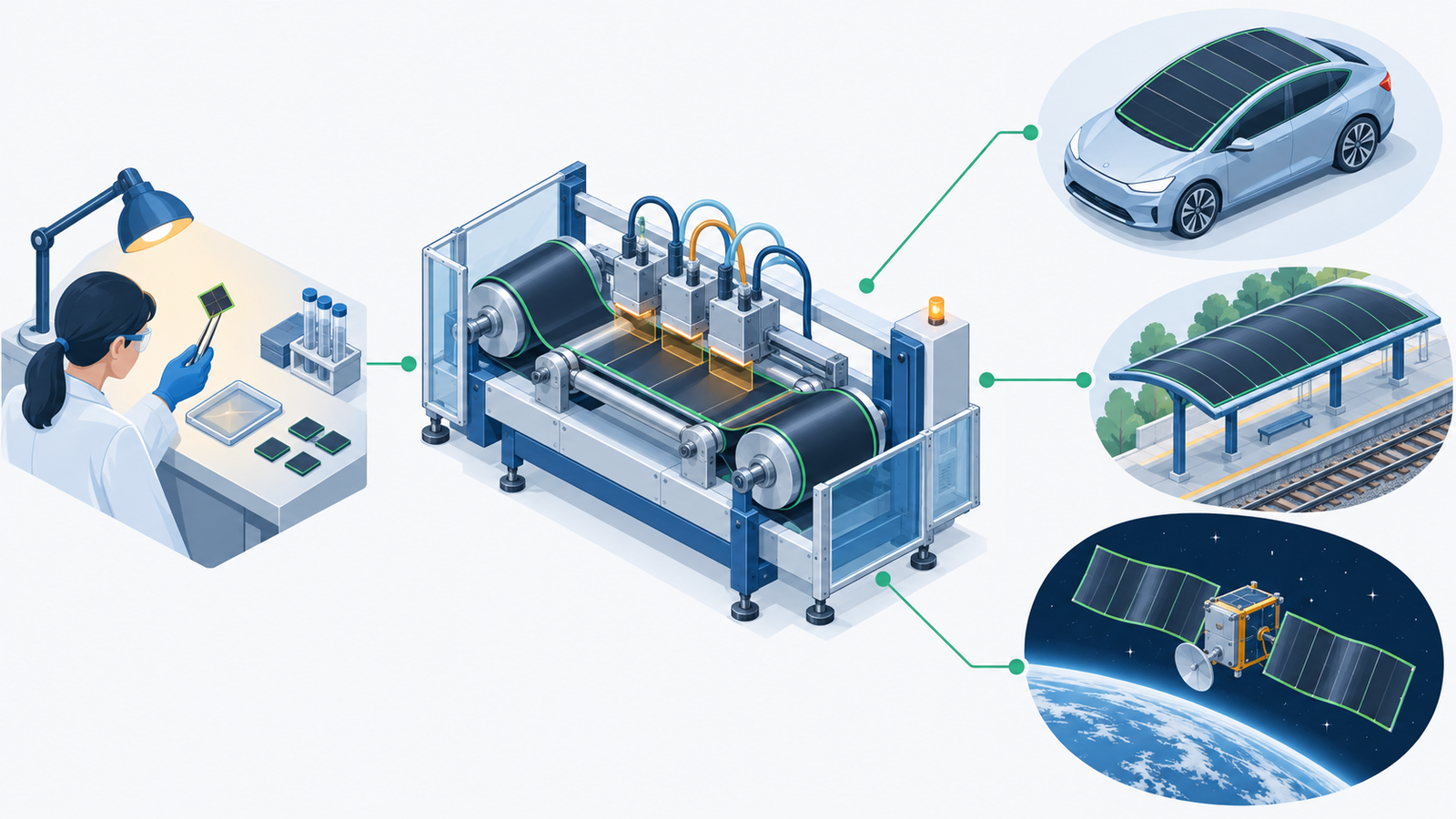
| Products and applications | Film-type perovskite solar cells. The company lists applications including watches and wearables, disaster-relief tents, rooftop generation, solar cars, ZEH/ZEB (net-zero-energy homes and buildings), space development and solar planes. It describes two pillars for the business: IoT applications for low light (indoors) and lightweight thin film for strong light (outdoors) |
| Conversion efficiency (small area) | Mini-cell 24.5% (0.1 cm²), mini-module 20.6% (56 cm², da). The company describes both as "JET-certified" in the business strategy vision. This article has not checked JET's own published records |
| Conversion efficiency (large area) | 13.7% (1,078 cm², da). No certification stated (company-reported) |
| Tandem | From the co-development with Toyota: a see-through film-type cell of 22.4% (81% infrared transmittance), and 30.4% as a four-terminal tandem with crystalline silicon. Cell-level, limited-area, company-reported figures |
| Weight and bending | 600 g/m²; radius of curvature 15 cm (business strategy vision) |
| Durability | Film module passed 2,000 hours at 85°C and 85% RH (company-reported) |
| Manufacturing | Owns a sheet-to-sheet (S2S) pilot line and is moving to R2R. Owns automated coating equipment operating in an inert gas atmosphere. Says it has know-how in three areas, ink, manufacturing process and equipment, and keeps its proprietary mass-production method secret |
From the materials side, the most interesting point in the business strategy vision is how it proposes to improve heat resistance: "suppressing ion migration by going C60-free and switching the charge transport layers and back electrode to metal oxides" Sourced. Perovskite solar cells often use fullerene (C60) in the electron transport layer, but C60 is sensitive to heat, and ions such as iodide moving through the active layer are known to reach the electrode and cause degradation. Replacing the charge transport layers and electrode with inorganic metal oxides is a way of building a "wall" that stops the ions from moving. The targets also list high-temperature conditions with vehicles in mind, such as "1,000 hours of storage at 120°C" and "150 hours at 110°C under 1-sun illumination", which suggests that the heat resistance demanded by the Toyota co-development is driving the materials design Not yet confirmed. Against moisture, the vision puts forward a "composite barrier technology" that forms a barrier layer directly on the device and adds a barrier film on top. For more on encapsulation, see our explainer on encapsulation and barrier layers.
11. The risks this company carries
| Risk | Substance | Category |
|---|---|---|
| If the money runs out, the business stops | The business strategy vision states that "if cash flow runs out, the company will move to dissolution or bankruptcy proceedings and the business will inevitably end", and that "until commercialisation, most funding depends on equity raised from investors" | Sourced |
| Mass-production technology | The company itself names "production technology" as its weakness, and there are large gaps in R2R coating speed (3.3 mm/s to 30 mm/s) and yield (50% to 90%) | Sourced |
| Finances invisible from outside | As an unlisted company it does not publish sales, profit or cash balance. How fast it is spending money cannot be checked from outside | Not yet confirmed |
| Avoidance of certain materials | The vision lists "avoidance of specific materials" as a risk, to be addressed by developing alternative materials (the wording can be read as referring to lead) | Sourced |
| Falling prices and competition | The vision lists "falling selling prices" and "product obsolescence" as risks. In Japan, Sekisui Chemical is building a 100 MW line, so there is a competitor that will reach volume scale first | Inference |
| Dependence on one large partner | The Toyota group looms large in both technology (the Toyota co-development) and money (Woven Capital). Who owns the results of the co-development, and on what terms cells might be adopted in vehicles, have not been disclosed | Inference |
12. Glossary
- Perovskite start-up
- A young company whose only business is perovskite solar cells. Its success or failure decides whether the company survives.
- JET
- Japan Electrical Safety & Environment Technology Laboratories. An independent Japanese body that tests and certifies the performance and safety of solar cells.
- da (designated illumination area)
- Efficiency measured over a defined illuminated area. The figure changes depending on whether inactive areas around the edges are included.
- Four-terminal tandem
- A design in which perovskite and silicon cells are stacked and electricity is drawn from each through separate terminals. The currents do not need to be matched.
- R2R / S2S
- Roll-to-roll processes film continuously from a roll; sheet-to-sheet processes it one sheet at a time.
- C60 (fullerene)
- A spherical molecule made of 60 carbon atoms. Often used in the electron transport layer of perovskite solar cells, but sensitive to heat.
- Ion migration
- The movement of ions within the active layer under voltage or heat. One of the main causes of degradation.
- Series C
- A name for a stage of start-up fundraising. It generally refers to funding aimed at commercialisation and mass production.
13. References
- EneCoat Technologies Company overview (updated July 2026, in Japanese). Date of establishment, capital, headcount, registered office and laboratory, and directors. https://enecoat.com/company/index.html
- EneCoat Technologies Access (sites), in Japanese. https://enecoat.com/access/index.html
- EneCoat Technologies (published by NEDO) Business strategy vision, "Development of mass-production technology and demonstration towards social implementation of perovskite solar cells with high installation flexibility" (as of the start of the project, in Japanese). Strengths and weaknesses, efficiency and durability values, R&D targets and current status, funding plan, R2R line plan, organisation, new plant and risk factors. https://green-innovation.nedo.go.jp/resources/pdf/next-generation-solar-cells/item-1-3/vision-enecoat-001.pdf
- EneCoat Technologies (published by NEDO) Business strategy vision (theme selected in 2021, as of December 2025, in Japanese). Pilot line, R2R prototype machine, funding plan (about ¥6.4 billion, with around ¥2.8 billion borne by the company), and establishment of the sales and overseas business departments. https://green-innovation.nedo.go.jp/resources/pdf/next-generation-solar-cells/item-1-2/vision-enecoat-004.pdf
- EneCoat Technologies Release, "Joint development of vehicle-mounted perovskite solar cells begins with Toyota" (27 June 2023, in Japanese). https://enecoat.com/wordpress/wp-content/uploads/2023/06/%E3%82%A8%E3%83%8D%E3%82%B3%E3%83%BC%E3%83%88%E3%83%86%E3%82%AF%E3%83%8E%E3%83%AD%E3%82%B8%E3%83%BC%E3%82%BA_20230627%E3%83%97%E3%83%AC%E3%82%B9%E3%83%AA%E3%83%AA%E3%83%BC%E3%82%B9.pdf
- EneCoat Technologies Release, "EneCoat Technologies completes ¥5.5 billion Series C funding round" (18 July 2024, in Japanese). https://enecoat.com/wordpress/wp-content/uploads/2024/07/%E3%82%A8%E3%83%8D%E3%82%B3%E3%83%BC%E3%83%88%E3%83%86%E3%82%AF%E3%83%8E%E3%83%AD%E3%82%B8%E3%83%BC%E3%82%BA_20240718%E3%83%97%E3%83%AC%E3%82%B9%E3%83%AA%E3%83%AA%E3%83%BC%E3%82%B91.pdf
- EneCoat Technologies Release, "Conversion efficiency above 30% achieved with a perovskite/silicon four-terminal tandem solar cell" (17 January 2025, in Japanese). https://enecoat.com/wordpress/wp-content/uploads/2025/01/%E3%82%A8%E3%83%8D%E3%82%B3%E3%83%BC%E3%83%88%E3%83%86%E3%82%AF%E3%83%8E%E3%83%AD%E3%82%B8%E3%83%BC%E3%82%BA_20250117%E3%83%97%E3%83%AC%E3%82%B9%E3%83%AA%E3%83%AA%E3%83%BC%E3%82%B9.pdf
- EneCoat Technologies Release, "EneCoat Technologies raises additional funds in its Series C round" (20 February 2025, in Japanese). https://enecoat.com/wordpress/wp-content/uploads/2025/02/%E3%83%97%E3%83%AC%E3%82%B9%E3%83%AA%E3%83%AA%E3%83%BC%E3%82%B9%E3%80%80%E3%82%B7%E3%83%AA%E3%83%BC%E3%82%BAC%E3%83%A9%E3%82%A6%E3%83%B3%E3%83%89%E8%BF%BD%E5%8A%A0%E8%B3%87%E9%87%91%E8%AA%BF%E9%81%94%E3%82%92%E5%AE%9F%E6%96%BD250220_final.pdf
- EneCoat Technologies Release, "Selected for the final phase of NEDO's Green Innovation Fund" (10 September 2025, published on PR TIMES, in Japanese). https://prtimes.jp/main/html/rd/p/000000004.000155707.html
- EneCoat Technologies News, "Handover ceremony held for NEDO's Green Innovation Fund Project" (16 February 2026, in Japanese). https://enecoat.com/news/20260216/
- EneCoat Technologies Release, "Selected for a research topic under the Space Strategy Fund technology development theme 'SX core area development research: SX-ARK (heat and devices)'" (1 April 2026, in Japanese). https://enecoat.com/wordpress/wp-content/uploads/2026/04/%E3%83%97%E3%83%AC%E3%82%B9%E3%83%AA%E3%83%AA%E3%83%BC%E3%82%B9%E6%A1%88_%E5%AE%87%E5%AE%99%E6%88%A6%E7%95%A5%E5%9F%BA%E9%87%91_EneCoat_%E4%BF%AE%E6%AD%A3.pdf
- EneCoat Technologies News, "Film-type perovskite solar cells successfully demonstrated in space" (2 July 2026, in Japanese). https://enecoat.com/news/%e3%83%95%e3%82%a3%e3%83%ab%e3%83%a0%e5%9e%8b%e3%83%9a%e3%83%ad%e3%83%96%e3%82%b9%e3%82%ab%e3%82%a4%e3%83%88%e5%a4%aa%e9%99%bd%e9%9b%bb%e6%b1%a0%e3%81%ae%e5%ae%87%e5%ae%99%e5%ae%9f%e8%a8%bc%e3%81%ab/
- EneCoat Technologies News, "Selected for a research topic of the JAXA Space Exploration Innovation Hub" (21 October 2022, in Japanese). https://enecoat.com/news/jaxa%e5%ae%87%e5%ae%99%e6%8e%a2%e6%9f%bb%e3%82%a4%e3%83%8e%e3%83%99%e3%83%bc%e3%82%b7%e3%83%a7%e3%83%b3%e3%83%8f%e3%83%96%e3%81%ae%e7%a0%94%e7%a9%b6%e8%aa%b2%e9%a1%8c%e3%81%ab%e6%8e%a1%e6%8a%9e/
- EneCoat Technologies News, "Coatable film-forming ink for the electron transport layer developed with Mitsubishi Materials Corporation" (24 March 2025, in Japanese). https://enecoat.com/news/20250324/
- EneCoat Technologies News, "KDDI begins Japan's first base station demonstration using our perovskite solar cells" (13 March 2024, in Japanese). https://enecoat.com/news/kddi%e6%a7%98%e3%81%8c%e5%9b%bd%e5%86%85%e5%88%9d%e3%80%81%e5%bc%8a%e7%a4%be%e3%83%9a%e3%83%ad%e3%83%96%e3%82%b9%e3%82%ab%e3%82%a4%e3%83%88%e5%a4%aa%e9%99%bd%e9%9b%bb%e6%b1%a0%e3%82%92%e6%b4%bb/
- EneCoat Technologies News, "KDDI's base station demonstration using our perovskite solar cells wins the Minister of Internal Affairs and Communications Award of the Global Environment Awards" (6 March 2025, in Japanese). https://enecoat.com/news/20250306/
- EneCoat Technologies News, "Decision to begin demonstration tests with JGC Holdings Corporation and Tomakomai Futo Co., Ltd." (23 October 2023, in Japanese). https://enecoat.com/news/%e6%97%a5%e6%8f%ae%e3%83%9b%e3%83%bc%e3%83%ab%e3%83%87%e3%82%a3%e3%83%b3%e3%82%b0%e3%82%b9%e6%a0%aa%e5%bc%8f%e4%bc%9a%e7%a4%be%e3%80%81%e8%8b%ab%e5%b0%8f%e7%89%a7%e5%9f%a0%e9%a0%ad%e6%a0%aa%e5%bc%8f/
- EneCoat Technologies News, "Joint research on residential perovskite solar cells begins with Mitsui Fudosan Residential Co., Ltd. and Kyoto University" (17 October 2023, in Japanese). https://enecoat.com/news/%e4%b8%89%e4%ba%95%e4%b8%8d%e5%8b%95%e7%94%a3%e3%83%ac%e3%82%b8%e3%83%87%e3%83%b3%e3%82%b7%e3%83%a3%e3%83%ab%e6%a0%aa%e5%bc%8f%e4%bc%9a%e7%a4%be%e3%81%a8%e4%ba%ac%e9%83%bd%e5%a4%a7%e5%ad%a6%e3%81%a8/
- EneCoat Technologies News, "Partnership agreement on the adoption of perovskite solar cells to promote decarbonisation signed with Kanagawa Prefecture and JGC Corporation" (21 December 2023, in Japanese). https://enecoat.com/news/%e7%a5%9e%e5%a5%88%e5%b7%9d%e7%9c%8c%e3%80%81%e6%97%a5%e6%8f%ae%e6%a0%aa%e5%bc%8f%e4%bc%9a%e7%a4%be%e3%81%a8%e3%80%8c%e8%84%b1%e7%82%ad%e7%b4%a0%e5%8c%96%e4%bf%83%e9%80%b2%e3%81%ae%e3%81%9f%e3%82%81/
- EneCoat Technologies News, "A first in Japan: demonstration of film-type perovskite solar cells on a station platform roof begins" (28 February 2025, in Japanese). https://enecoat.com/news/%e5%9b%bd%e5%86%85%e5%88%9d%ef%bc%81%e9%a7%85%e3%83%9b%e3%83%bc%e3%83%a0%e5%b1%8b%e6%a0%b9%e3%81%b8%e3%81%ae%e3%83%95%e3%82%a3%e3%83%ab%e3%83%a0%e5%9e%8b%e3%83%9a%e3%83%ad%e3%83%96%e3%82%b9%e3%82%ab/
- EneCoat Technologies News, "Power generation demonstration begins on a platform roof at Hakata Station" (21 October 2025, in Japanese). https://enecoat.com/news/20251021/
- EneCoat Technologies News, "Technical cooperation on Mitsubishi Gas Chemical's perovskite solar cell demonstration project in Niigata City" (26 August 2026, in Japanese). https://enecoat.com/news/%e4%b8%89%e8%8f%b1%e3%82%ac%e3%82%b9%e5%8c%96%e5%ad%a6%e3%81%ab%e3%82%88%e3%82%8b%e6%96%b0%e6%bd%9f%e5%b8%82%e3%81%ae%e3%83%9a%e3%83%ad%e3%83%96%e3%82%b9%e3%82%ab%e3%82%a4%e3%83%88%e5%a4%aa%e9%99%bd/
- NEDO Annex 1, list of planned implementers, for "Development of next-generation solar cells begins under the Green Innovation Fund Project" (28 December 2021, in Japanese). The theme selected for EneCoat (lead) and Kyoto University. https://www.nedo.go.jp/content/100940817.pdf
- NEDO Annex 1, list of planned implementers, for the selection of three new projects under the "Next-Generation Solar Cell Demonstration Project" (10 September 2025, in Japanese). https://www.nedo.go.jp/content/800032096.pdf
- EneCoat Technologies Industrial fields (list of applications), in Japanese. https://enecoat.com/application/index.html
14. Claim-to-source audit
| Claim in the article | Category | Source |
|---|---|---|
| Legal name, date of establishment, capital, 116 employees, registered office, directors | Sourced | Reference 1 https://enecoat.com/company/index.html |
| Site (Kyoto PSCs Innovation Center) | Sourced | Reference 2 https://enecoat.com/access/index.html |
| A dedicated start-up putting in all its management resources; criterion for abandoning the business; production technology as its weakness | Sourced | Reference 3 https://green-innovation.nedo.go.jp/resources/pdf/next-generation-solar-cells/item-1-3/vision-enecoat-001.pdf |
| Efficiencies of 24.5% and 20.6% (described by the company as JET-certified) and 13.7%; weight 600 g/m²; radius of curvature 15 cm; 2,000 hours at 85°C and 85% RH | Sourced | Reference 3 https://green-innovation.nedo.go.jp/resources/pdf/next-generation-solar-cells/item-1-3/vision-enecoat-001.pdf |
| R&D targets and current status (30 mm/s and 3.3 mm/s, yield, 16%, ¥64/W, ¥140/W, damp-heat, heat and flame-retardancy targets) | Sourced | Reference 3 https://green-innovation.nedo.go.jp/resources/pdf/next-generation-solar-cells/item-1-3/vision-enecoat-001.pdf |
| Around ¥15.3 billion borne by the company; 10 MW R2R line due in 2027; 270 staff in 2030; 300 MW production; licensing; start of new plant construction; arrangements in anticipation of an IPO; the C60-free statement | Sourced | Reference 3 https://green-innovation.nedo.go.jp/resources/pdf/next-generation-solar-cells/item-1-3/vision-enecoat-001.pdf |
| About ¥6.4 billion with around ¥2.8 billion borne by the company; introduction of the R2R prototype machine; establishment of the sales and overseas business departments; commercialisation of outdoor applications around 2028 | Sourced | Reference 4 https://green-innovation.nedo.go.jp/resources/pdf/next-generation-solar-cells/item-1-2/vision-enecoat-004.pdf |
| Start of vehicle co-development with Toyota, and module conversion efficiency of 19.4% (company-reported) | Sourced | Reference 5 https://enecoat.com/wordpress/wp-content/uploads/2023/06/%E3%82%A8%E3%83%8D%E3%82%B3%E3%83%BC%E3%83%88%E3%83%86%E3%82%AF%E3%83%8E%E3%83%AD%E3%82%B8%E3%83%BC%E3%82%BA_20230627%E3%83%97%E3%83%AC%E3%82%B9%E3%83%AA%E3%83%AA%E3%83%BC%E3%82%B9.pdf |
| Series C of ¥5.5 billion, lead investor Woven Capital, participating investors | Sourced | Reference 6 https://enecoat.com/wordpress/wp-content/uploads/2024/07/%E3%82%A8%E3%83%8D%E3%82%B3%E3%83%BC%E3%83%88%E3%83%86%E3%82%AF%E3%83%8E%E3%83%AD%E3%82%B8%E3%83%BC%E3%82%BA_20240718%E3%83%97%E3%83%AC%E3%82%B9%E3%83%AA%E3%83%AA%E3%83%BC%E3%82%B91.pdf |
| Four-terminal tandem 30.4%; see-through cell 22.4% with 81% infrared transmittance (cell-level, company-reported) | Sourced | Reference 7 https://enecoat.com/wordpress/wp-content/uploads/2025/01/%E3%82%A8%E3%83%8D%E3%82%B3%E3%83%BC%E3%83%88%E3%83%86%E3%82%AF%E3%83%8E%E3%83%AD%E3%82%B8%E3%83%BC%E3%82%BA_20250117%E3%83%97%E3%83%AC%E3%82%B9%E3%83%AA%E3%83%AA%E3%83%BC%E3%82%B9.pdf |
| Series C total of about ¥6.3 billion, cumulative about ¥8.7 billion, investors in the additional closing | Sourced | Reference 8 https://enecoat.com/wordpress/wp-content/uploads/2025/02/%E3%83%97%E3%83%AC%E3%82%B9%E3%83%AA%E3%83%AA%E3%83%BC%E3%82%B9%E3%80%80%E3%82%B7%E3%83%AA%E3%83%BC%E3%82%BAC%E3%83%A9%E3%82%A6%E3%83%B3%E3%83%89%E8%BF%BD%E5%8A%A0%E8%B3%87%E9%87%91%E8%AA%BF%E9%81%94%E3%82%92%E5%AE%9F%E6%96%BD250220_final.pdf |
| Selection for the final phase of the GI Fund; planned full-scale introduction of the R2R process; the company's description of itself as "the only start-up in Japan aiming to be a module manufacturer" | Sourced | Reference 9 https://prtimes.jp/main/html/rd/p/000000004.000155707.html |
| Ceremony handing over the grant decision (21 January 2026) and the grant period | Sourced | Reference 10 https://enecoat.com/news/20260216/ |
| Selection for the Space Strategy Fund's SX-ARK (13 March 2026) | Sourced | Reference 11 https://enecoat.com/wordpress/wp-content/uploads/2026/04/%E3%83%97%E3%83%AC%E3%82%B9%E3%83%AA%E3%83%AA%E3%83%BC%E3%82%B9%E6%A1%88_%E5%AE%87%E5%AE%99%E6%88%A6%E7%95%A5%E5%9F%BA%E9%87%91_EneCoat_%E4%BF%AE%E6%AD%A3.pdf |
| Successful power generation in space on OrigamiSat-2 (IV characteristics measured) | Sourced | Reference 12 https://enecoat.com/news/%e3%83%95%e3%82%a3%e3%83%ab%e3%83%a0%e5%9e%8b%e3%83%9a%e3%83%ad%e3%83%96%e3%82%b9%e3%82%ab%e3%82%a4%e3%83%88%e5%a4%aa%e9%99%bd%e9%9b%bb%e6%b1%a0%e3%81%ae%e5%ae%87%e5%ae%99%e5%ae%9f%e8%a8%bc%e3%81%ab/ |
| Selection by the JAXA Space Exploration Innovation Hub (October 2022) | Sourced | Reference 13 https://enecoat.com/news/jaxa%e5%ae%87%e5%ae%99%e6%8e%a2%e6%9f%bb%e3%82%a4%e3%83%8e%e3%83%99%e3%83%bc%e3%82%b7%e3%83%a7%e3%83%b3%e3%83%8f%e3%83%96%e3%81%ae%e7%a0%94%e7%a9%b6%e8%aa%b2%e9%a1%8c%e3%81%ab%e6%8e%a1%e6%8a%9e/ |
| Electron transport layer ink with Mitsubishi Materials (about 1.5 times) and NEDO-subsidised project JPNP21016 | Sourced | Reference 14 https://enecoat.com/news/20250324/ |
| KDDI's base station demonstration and the Minister of Internal Affairs and Communications Award of the Global Environment Awards | Sourced | References 15 and 16 https://enecoat.com/news/20250306/ |
| Demonstration with JGC Holdings and Tomakomai Futo; joint research with Mitsui Fudosan Residential and Kyoto University; partnership agreement with Kanagawa Prefecture and JGC | Sourced | References 17, 18 and 19 https://enecoat.com/news/%e7%a5%9e%e5%a5%88%e5%b7%9d%e7%9c%8c%e3%80%81%e6%97%a5%e6%8f%ae%e6%a0%aa%e5%bc%8f%e4%bc%9a%e7%a4%be%e3%81%a8%e3%80%8c%e8%84%b1%e7%82%ad%e7%b4%a0%e5%8c%96%e4%bf%83%e9%80%b2%e3%81%ae%e3%81%9f%e3%82%81/ |
| Station platform roof demonstration with JR Kyushu and JGC (February 2025); power generation demonstration on platform 2 at Hakata Station (October 2025) | Sourced | References 20 and 21 https://enecoat.com/news/20251021/ |
| Technical cooperation on Mitsubishi Gas Chemical's Niigata City demonstration | Sourced | Reference 22 https://enecoat.com/news/%e4%b8%89%e8%8f%b1%e3%82%ac%e3%82%b9%e5%8c%96%e5%ad%a6%e3%81%ab%e3%82%88%e3%82%8b%e6%96%b0%e6%bd%9f%e5%b8%82%e3%81%ae%e3%83%9a%e3%83%ad%e3%83%96%e3%82%b9%e3%82%ab%e3%82%a4%e3%83%88%e5%a4%aa%e9%99%bd/ |
| Selection for NEDO's GI Fund in December 2021 (with Kyoto University) | Sourced | Reference 23 https://www.nedo.go.jp/content/100940817.pdf |
| Selection for NEDO's demonstration project in September 2025 | Sourced | Reference 24 https://www.nedo.go.jp/content/800032096.pdf |
| The list of applications the company gives | Sourced | Reference 25 https://enecoat.com/application/index.html |
| The three types of perovskite solar cell company | Our calculation | Our own classification. Companies shown are examples from those covered in this series |
| The ¥15.3 billion own share is about 1.8 times the cumulative funds raised | Our calculation | Our own division of the amounts in references 3 and 8 |
| With the area about 19 times larger, efficiency falls by about 7 percentage points | Our calculation | Our own calculation from 20.6% (56 cm²) and 13.7% (1,078 cm²) in reference 3 |
| Sales and profit, selling price, construction cost and location of the new plant, start month of the 10 MW line, vehicle models, timing and supply contract with Toyota, licensees, and listing date | Not yet confirmed | Not in the primary sources this article reviewed. This article makes no estimate |
| Research-firm market forecasts (Precedence Research, REPORTOCEAN) | Not yet confirmed | Quoted in references 6 and 4, but not used by this article because they are research-firm estimates https://green-innovation.nedo.go.jp/resources/pdf/next-generation-solar-cells/item-1-2/vision-enecoat-004.pdf |
| The reading that volume production assumes help from partner companies | Inference | This article's interpretation of the strengths, weaknesses and current values in reference 3 |
| The reading that the relationship with Toyota matters most, for both technology and money | Inference | This article's interpretation of references 1, 5 and 6 |
| The reading that space is being developed as a high-value outlet | Inference | This article's interpretation of references 11 to 13 |
| The reading that future funding is expected to come from a stock market listing | Inference | This article's interpretation of the statement on governance arrangements in reference 3 |
| The reading that the company will not carry the battle over equipment and yield alone, and the view that heat-resistance requirements for vehicles are driving materials design | Inference | This article's commentary based on reference 3 |
| The risks of falling prices and competition, and of dependence on a particular partner | Inference | This article's interpretation of references 3, 5 and 6 |
Last updated 25 September 2026 / Troy Technical
Every figure in this article comes from EneCoat Technologies' official releases and company overview, the business strategy visions the company submitted to NEDO, and documents published by NEDO. No research-firm estimates or press-based figures have been used. Passages marked "Inference" are this article's interpretation of primary sources, not statements made by the company.