COMPANY PROFILE / PEROVSKITE SOLAR CELLS
GCL Optoelectronic
The specialist that moved first into mass-producing large modules, with revenue still under CNY 10 million
GCL Optoelectronic is a perovskite solar specialist in which GCL Technology, the major Chinese polysilicon producer, holds a stake of about 40%. In June 2025 it started up a production base in Kunshan, Jiangsu Province, that it bills as "the world's first GW-scale" plant, and it keeps announcing efficiency records on large modules of about 2 m². Yet according to the audited financial statements on the parent's side, its revenue in 2025 was CNY 7.28 million and its net loss CNY 332.83 million, and by the end of the year its liabilities exceeded its assets. This profile covers "GCL's perovskite business" in a single article. The reason is explained in section 2: GCL Technology's perovskite business is, in effect, GCL Optoelectronic itself.
- GCL Optoelectronic in 30 seconds, and where it stands in perovskite solar cells
- The logo and how the name is written (and the link to GCL Technology)
- Where the company sits in the perovskite solar cell field
- Scale (small revenue, so read the losses and fundraising)
- Resources committed to perovskites
- What it has done so far
- What comes next
- What the company is aiming for in perovskite solar cells
- Map of perovskite partnerships
- Technology, products and services
- The risks this company carries
- Glossary, references and claim-to-source audit
1. GCL Optoelectronic in 30 seconds, and where it stands in perovskite solar cells
(part of a major group)Makes perovskite modules only
plus tandem with siliconFor tandems it proposes bonding "perovskite glass" onto silicon
Net loss CNY 332.83 millionFrom the notes to GCL Technology's annual report
(2,042 cm²)A pilot-line module. Stated in the 2026 interim report
Companies working on perovskite solar cells fall into three broad types: established PV makers, perovskite start-ups, and materials and electronics firms coming in from other industries. GCL Optoelectronic is a perovskite start-up, but not an ordinary one: it was born inside the GCL polysilicon group and has drawn more than CNY 1 billion in cumulative strategic investment from backers including CATL, TCL, Tencent and Temasek Sourced. What it is chasing is not a record on a small research cell but the production of large modules of about 2 m² on a volume line. Almost all its efficiency announcements concern modules (2,000 cm² or more), in sharp contrast with the established makers that pile up cell records.
2. The logo and how the name is written

The logo is the company's trademark. Rather than recreate it with an image generator, this article uses the logo image from the company's official website, saved as img/gcl_optoelectronic_logo.png. The lettering in the logo reads "GCL PEROVSKITE".
A note on names: the legal name is registered in Chinese and corresponds to Kunshan GCL Optoelectronic Co., Ltd. According to GCL Technology's 2026 interim report, the former name was Kunshan GCL Optoelectronic Material Co., Ltd. The parent's documents also call it "Kunshan GCL" or "GCL Optoelectronics", and its own website uses "GCL Perovskite". This article's headings use GCL Optoelectronic, a short form of the current English name.
The link to GCL Technology: GCL Technology's results presentation and product page describe GCL Optoelectronic as a "subsidiary", but in the audited annual report it has been an associate, accounted for by the equity method, since 16 November 2024. The stake was 42.11% at the end of 2025 and 39.75% at the end of June 2026 Sourced. Because GCL Technology's own perovskite business runs through this company, this article does not treat the two separately but writes a single profile with GCL Optoelectronic as its subject. The founding year is also inconsistent: the company's English website gives 24 December 2019, while GCL Technology's product page gives 2010. This article follows the company's own website.
Official site: https://www.gcl-perovskite.com/3. Where the company sits in the perovskite solar cell field
The company has two product lines Sourced. One is single-junction modules on glass substrates (about 1 m × 2 m), which have been delivered to demonstration power plants in Qinghai Province and elsewhere. The other is tandems with silicon: GCL Technology's results presentation sets out a division of labour in which GCL Optoelectronic makes "perovskite glass" (P-Glass) and silicon module makers bond it to their own cells. In the primary sources checked for this article, there is no announcement of a film-type (flexible) product.
4. Scale (small revenue, so read the losses and fundraising)
GCL Optoelectronic is unlisted and does not publish its own financial statements. However, its main shareholder, GCL Technology, discloses summarised financial information for it as a "material associate" in the notes to its audited annual report Sourced. Those are the figures used here, in thousands of Chinese yuan (CNY).
| CNY thousand | 16 Nov to 31 Dec 2024 | Year to Dec 2025 |
|---|---|---|
| Revenue | 149 | 7,282 |
| Net loss (comprehensive loss) | 101,329 | 332,826 |
| Non-current assets (end of period) | 470,261 | 1,207,617 |
| Current assets (end of period) | 492,064 | 497,596 |
| Current liabilities (end of period) | 798,067 | 296,288 |
| Non-current liabilities (end of period) | 34,195 | 1,605,144 |
| Net assets (end of period) | 130,063 | −196,219 (liabilities exceed assets) |
The 2024 figures cover only the roughly six weeks after the company became an associate (16 November), not a full year.
| GCL Optoelectronic as seen by GCL Technology | End of Dec 2024 | End of Dec 2025 | End of June 2026 |
|---|---|---|---|
| Shareholding | 44.23% | 42.11% | 39.75% |
| Carrying amount of the investment | CNY 1,881,633 thousand | CNY 1,741,479 thousand | About CNY 1,664 million |
| Of which goodwill | CNY 1,824,107 thousand | CNY 1,824,107 thousand | – |
Against 2025 revenue of CNY 7.28 million, the net loss was CNY 332.83 million: a loss about 46 times revenue Our calculation. The company's account is that the GW-scale base started operating in June 2025 and that the first full-size module (2400 × 1150 mm) came off the line in October that year, but as of 2025, products from the volume line barely show up in revenue. Non-current assets also rose from about CNY 470 million to about CNY 1.21 billion in a year, and non-current liabilities from about CNY 30 million to about CNY 1.61 billion. That reads like a factory built with borrowed money or similar funding, but the notes do not say what the liabilities consist of Not yet confirmed.
For reference, GCL Technology as a whole, the main shareholder, had revenue of CNY 14.425 billion in 2025, a loss attributable to owners of the parent of CNY 2.868 billion, and about 8,120 employees at the end of 2025 Sourced. GCL Optoelectronic's own headcount does not appear in any primary source checked for this article.
5. Resources committed to perovskites
Because GCL Optoelectronic is a specialist, everything the company spends is, in effect, spent on perovskites. The table separates what could be confirmed from what could not.
| Type of resource | What it is | Category |
|---|---|---|
| People | The company's website says its "core R&D team has worked on large-area perovskites for more than ten years". The chairman is Fan Bin. Numbers of employees and researchers are not disclosed | Sourced (headcount not disclosed) |
| Money (losses as a proxy for spending) | Net loss of CNY 332.83 million in 2025. No breakdown of R&D spending is disclosed | Sourced |
| Money (the factory) | The GW-scale base in Kunshan involves total investment of CNY 5 billion, a target capacity of 2 GW and an initial 1 GW commercial module line (published by the Suzhou municipal government). How much has actually been spent is not disclosed | Sourced (planned amount) |
| Outside investment | Company website: backed by the GCL group, Tencent, Temasek, Sequoia, IDG and others, with a Series C round of about CNY 700 million completed in July 2025. GCL group announcement: about CNY 200 million in a Series C2 round (China Cinda Asset Management and SAIF Partners). 2026 interim report: more than CNY 100 million in a Series D1 round in August 2026, bringing cumulative strategic investment from CATL, TCL, Tencent, Temasek and others to more than CNY 1 billion | Sourced |
| Outbound investments and acquisitions | No investment by GCL Optoelectronic in, or acquisition of, other companies has been found | Not confirmed |
| Universities and research institutes | An AI high-throughput joint R&D centre set up with Suzhou Laboratory and Soochow University on 24 June 2025 (Suzhou government article, results presentation) | Sourced |
| Space partnerships | Sample testing with Institute 811 of the Eighth Academy of China Aerospace Science and Technology Corporation (CASC), near-space material verification by high-altitude balloon, and a plan to work with Shanghai Shangxing on solar array applications (results presentation). The 2026 interim report mentions partnerships with AZSPACE, CASC and phenosolar | Sourced |
| Public funding | No selection for a national perovskite project, and no subsidy amount, appears in the primary sources checked for this article | Not confirmed |
According to GCL Technology's 2026 interim report, investors who came into GCL Optoelectronic under a 2024 shareholders' agreement hold a put option Sourced. If, among other triggers, GCL Optoelectronic does not file for a qualifying IPO by 31 December 2028 or does not complete a listing by 30 June 2029, the investors can demand that their shares be bought back at their investment plus 8 to 10% a year. In other words, GCL Optoelectronic is contractually bound to a listing target with a deadline.
6. What it has done so far
Almost everything GCL Optoelectronic announces is module efficiency (2,000 cm² or more). The table keeps area and certification separate.
| When | What happened | Area and certification |
|---|---|---|
| December 2019 | Founded as Kunshan GCL Optoelectronic Material Co., Ltd. (company website) | – |
| 27 December 2023 | Construction of the GW-scale base begins in the Kunshan High-tech Zone | GCL group announcement |
| 2023 onwards | Supplied 3 MW of 1 m × 2 m single-junction modules to a 5 MW demonstration base built by China Huaneng in Qinghai Province | Company website |
| March 2024 | 19.04% on a 1 m × 2 m single-junction module | 2 m² / company-reported as certified by a Chinese metrology body |
| April 2024 | 26.36% on a tandem. Strategic partnership with Towngas Energy to demonstrate 2 m² tandems | 1.71 m² / company-reported |
| May 2024 | The 1 m × 2 m single-junction module obtains IEC 61215 and IEC 61730 certification from TÜV Rheinland | Reliability and safety certification |
| June 2024 | 27.34% on a tandem | 2,050 cm² / National Institute of Metrology, China (company-reported) |
| 16 November 2024 | New shareholders invest, cutting GCL Technology's stake from 47.65% to 44.23%. The company goes from subsidiary to associate | Audited annual report |
| 30 May 2025 | 29.51% on a tandem (stabilised efficiency) | 2,048 cm² / a Chinese metrology body (the English release calls it the China Institute of Metrology). Announced by GCL Technology |
| 24 June 2025 | The GW-scale base starts operating. AI joint R&D centre set up with Suzhou Laboratory and Soochow University | Suzhou government article |
| July 2025 | Series C round of about CNY 700 million completed | Company website |
| October 2025 | The first full-size module (2400 × 1150 mm) comes off the volume line. A 500 MW tandem line is completed, with production efficiency above 27% on the 2.76 m² full size | Annual report and product page (company-reported) |
| 2025 | In-orbit testing carried out on a ZhuQue-2 Y3 rocket | Annual report (company-reported) |
| 2025 | The company says a large tandem module obtained IEC 61730 certification from TÜV Rheinland and passed accelerated ageing tests at three times the IEC requirement | Annual report and results presentation (company-reported) |
| December 2025 | Stabilised efficiency of 27.06% on a tandem of about 2 m² | 2 m² / company website (company-reported) |
| First half of 2026 | The GW-scale tandem line runs stably. 30.23% on a pilot-line tandem and stabilised efficiency of 23.70% on a rigid single-junction module. Several MW-scale commercial orders won | 2,042 cm² (no area given for the single-junction module) / interim report (company-reported) |
| August 2026 | More than CNY 100 million raised in a Series D1 round. Cumulative strategic investment exceeds CNY 1 billion | Interim report |
GCL Optoelectronic's efficiencies are mostly figures the company says were measured by a Chinese metrology institute (which it calls the National Institute of Metrology, China, or similar). When this article checked, NLR's (formerly NREL's) champion module efficiency chart did not include GCL Optoelectronic Sourced. For 30.23%, 23.70% and 27.06%, the primary sources do not name the measuring body, so this article treats them as company-reported Not yet confirmed. The areas behind "27.06% at about 2 m²" and "30.23% on 2,042 cm²" differ by a factor of about ten, so the two numbers cannot be compared on equal terms. The link between area and efficiency is covered in our explainer on conversion efficiency and performance metrics.
7. What comes next
The Suzhou municipal government reports that the base will in future become GCL Optoelectronic's "global R&D headquarters, future listing entity and global headquarters" Sourced. In its 2025 annual report, the parent, GCL Technology, also describes perovskites as its "second growth curve" and sets out the goal of running the GW-scale line at full capacity Not yet confirmed.
None of the following appears in the primary sources checked for this article Not yet confirmed.
Actual shipments (MW) and order values; the utilisation rate of the GW-scale line; product prices; the amount actually invested in the factory; headcount; and the names of silicon module makers partnering on the P-Glass model (the results presentation says only that talks are under way with major players). Numbers such as shipment targets mostly come from press reports or research firms, and this article does not use them.
8. What the company is aiming for in perovskite solar cells
This section goes beyond what the company says directly. It sets out inferences that can be drawn from primary sources, each with its basis.
| What can be read | Primary evidence behind it | Category |
|---|---|---|
| Rather than compete with silicon, it wants to sell a "component" to silicon makers | The P-Glass model in the results presentation: GCL Optoelectronic makes perovskite glass, and silicon module makers sell the tandems through their own channels | Inference |
| Until ground-based volumes arrive, it will build a track record first in space, a high-price market | The "three-stage space strategy", the plan to fly on satellites, and tests with a CASC research institute | Inference |
| Filing for a listing by the end of 2028 is a strong constraint on management | The put option terms in the 2024 shareholders' agreement (buy-back at a premium of 8 to 10% a year) | Sourced (that the constraint exists) |
| It differentiates itself by setting records at module size | Almost every published efficiency is for 2,000 cm² or more. The company's website names "high efficiency, large size and strong stability" as its three pillars | Inference |
| The GCL group's approach is to nurture the company with outside money while its own stake falls | The stake has fallen from 47.65% to 44.23%, 42.11% and 39.75% with each capital increase or share award. GCL Technology says it has lost control but retains significant influence | Inference |
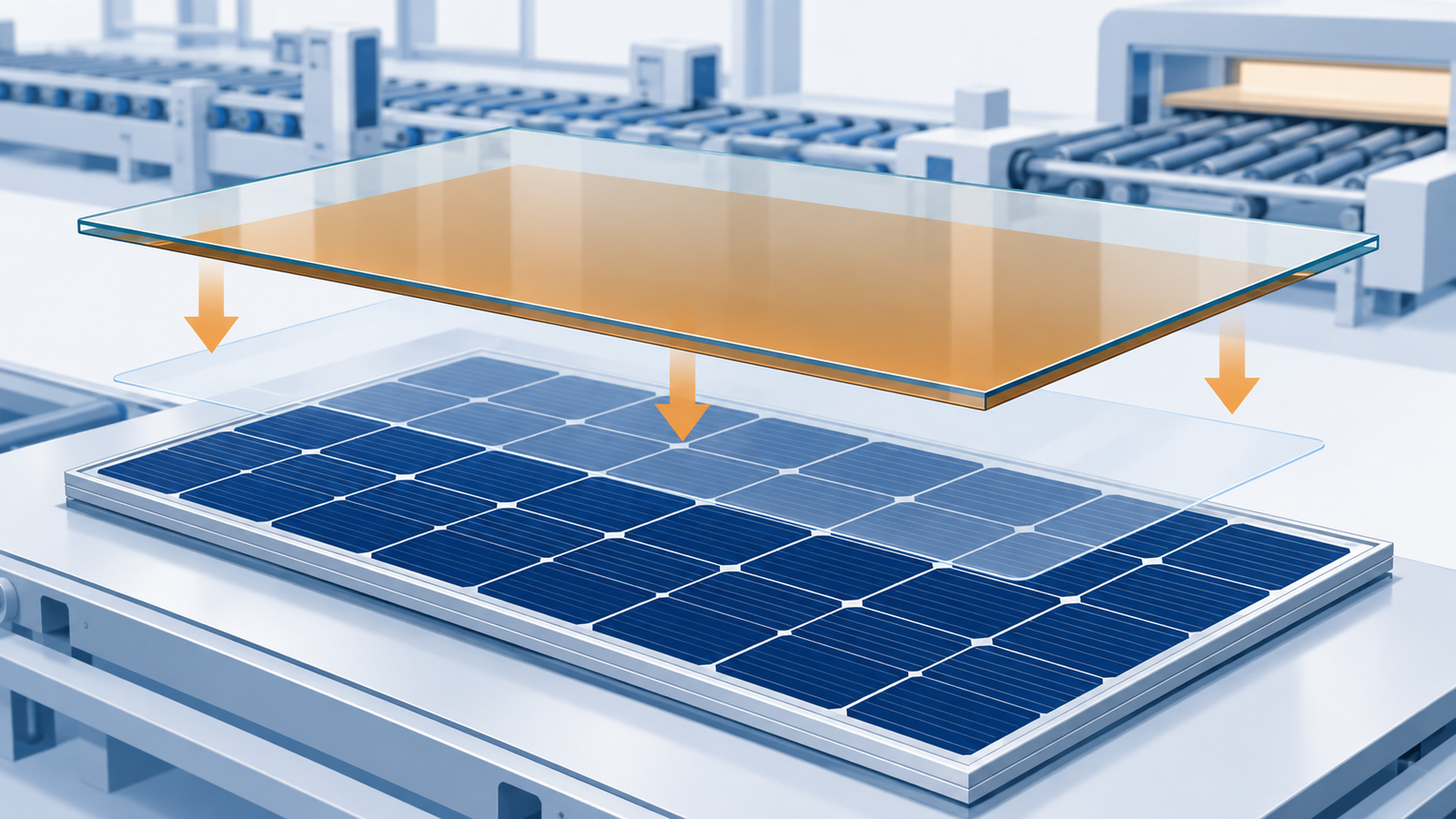
The P-Glass diagram in the results presentation shows a stack of glass, perovskite, encapsulant, silicon cell, encapsulant and glass, and describes GCL Optoelectronic's role as "R&D of core perovskite technology and production of P-Glass" and the silicon side's role as "selling tandems through existing global sales channels" Sourced. This is a design that hands a start-up's biggest weakness, its lack of sales channels, to the big silicon players. And because the silicon cell and the perovskite are made separately and only bonded at the end, there is less interference between the two manufacturing processes than in the monolithic two-terminal tandems that LONGi and others are researching. This article reads GCL Optoelectronic as leaning less towards "selling large volumes of its own-brand tandem modules" and more towards "becoming a component supplier to the silicon industry" Not yet confirmed. The presentation, however, says only that talks with major players are under way, and no signed agreement could be confirmed.
9. Map of perovskite partnerships
10. Technology, products and services
| Product or technology | What the primary sources say |
|---|---|
| Single-junction modules (glass-type) | About 1 m × 2 m. 20.17% on 2 m² and 22.97% on 2,048 cm² (product page). The company says they hold TÜV Rheinland IEC 61215 and 61730 certification and passed ageing tests accelerated threefold |
| Tandem modules | 27.06% on 2 m² and 29.51% on 2,048 cm² (product page). The full size is 2400 × 1150 mm (about 2.76 m²), with production efficiency above 27% (annual report) |
| P-Glass (perovskite glass) | A business model in which glass carrying a finished perovskite layer is sold as a component to silicon module makers (results presentation) |
| Space | Single-junction modules have been sent into orbit for in-orbit testing. Mass production of dedicated space modules is planned for 2027 to 2028 |
| R&D equipment | AI-driven, high-throughput automated fabrication and testing equipment. The company says it can make and measure thousands of cells a day, about 100 times the manual rate (results presentation) |
| Low-carbon and low-cost claims | Carbon emissions from the perovskite layer cut by more than 90%, and manufacturing cost expected to fall to about 50% of crystalline silicon (product page). These are the company's claims; this article could not confirm any third-party verification |
One of the strengths of perovskite film formation is that it needs no high-temperature steps like silicon does, and the layers can be coated or evaporated onto flat glass. Build a monolithic two-terminal tandem on silicon, however, and the perovskite has to sit on the textured silicon surface while the top electrode must be made at low temperature, which sharply narrows the freedom on the perovskite side. With an approach like P-Glass, where the perovskite is completed on glass and then bonded to the silicon cell with an encapsulant, the perovskite side can reuse the same deposition line as the single-junction modules Not yet confirmed.
The price is one more set of glass and encapsulant interfaces, which brings new challenges: reflection losses, and resistance to moisture entering through the encapsulant. Because perovskites are sensitive to moisture and heat, the choice of encapsulant used for bonding (its glass transition, crosslinking conditions and whether it releases acid) is likely to govern long-term reliability. For the principles of encapsulation, see our explainer on encapsulation and barrier layers.
11. The risks this company carries
| Risk | Substance | Category |
|---|---|---|
| Negative equity and heavy losses | Net assets of CNY −196.22 million at the end of 2025. The 2025 net loss was about 46 times revenue | Sourced (the multiple is Our calculation) |
| A listing deadline | If it does not file for an IPO by the end of 2028 and list by the end of June 2029, investors can demand a buy-back at a premium of 8 to 10% a year | Sourced |
| No sign yet of production turning into revenue | The base started in June 2025, but 2025 revenue was CNY 7.28 million. Shipments and utilisation are not disclosed | Sourced |
| Limited third-party verification of efficiency | The latest figures, such as 30.23%, name no measuring body, and the company does not appear in NLR's chart | Not yet confirmed |
| Dependence on big silicon makers for sales | The P-Glass model assumes partnerships with silicon module makers, but no partner has been named | Inference |
| Inconsistencies with the parent's materials | "Subsidiary" versus "associate", and a founding year of "2010" versus "2019": the group's own documents do not agree | Sourced |
12. Glossary
- Single-junction
- A solar cell with only one kind of light-absorbing layer. GCL Optoelectronic's single-junction modules have one perovskite layer, built on glass.
- Tandem
- Two cells that absorb different parts of the light spectrum, stacked on top of each other. GCL Optoelectronic makes perovskite-on-silicon combinations.
- P-Glass
- GCL Optoelectronic's proposed "glass with a perovskite layer formed on it": a component bonded onto a silicon module to make a tandem.
- Stabilised efficiency
- The steady value reached after operating at the maximum power point for a set time. It tends to be lower than an instantaneous measurement.
- Associate (equity method)
- An investee over which the investor has significant influence but not control. Its revenue is not consolidated; only the investor's share of its profit or loss is recognised.
- Put option
- A right for investors to demand that their shares be bought back under set conditions. Here it is tied to an IPO deadline.
- IEC 61215 / 61730
- International standards for the reliability (61215) and safety (61730) of photovoltaic modules.
- Dilution
- A fall in existing shareholders' percentage holdings when new shares are issued, for example through a capital increase by third parties or share-based awards.
13. References
- GCL Technology Holdings Limited Annual Report 2025 (annual report of a company listed in Hong Kong, posted 29 April 2026). How GCL Optoelectronic (Kunshan GCL) became an associate, the shareholding, summarised financial information (revenue, loss, assets and liabilities), carrying amount and goodwill, the GW-scale base, the 500 MW tandem line, production efficiency, in-orbit testing, the three-stage space strategy, and GCL Technology's group revenue, loss and headcount. https://media-gclpoly.todayir.com/20260429230801393112135054_en.pdf
- GCL Technology Holdings Limited Interim Report 2026 (posted 24 September 2026). GCL Optoelectronic's change of name, stable operation of the GW-scale tandem line, 30.23% and 23.70%, MW-scale orders, demonstrations with China Huaneng, the Series D1 round and more than CNY 1 billion in cumulative strategic investment, partnerships with AZSPACE, CASC and phenosolar, plans for satellites, the 39.75% stake and the put option terms. https://media-gclpoly.todayir.com/20260924174801470512345019_en.pdf
- GCL Technology Holdings Limited 2025 Annual Results Presentation. The P-Glass business model, efficiency history, demonstration projects, AI high-throughput equipment, and space test plans and partners. https://media-gclpoly.todayir.com/202604010957471709718743_en.pdf
- GCL Technology Holdings Limited News, "29.51%! GCL's Perovskite Tandem Module Smashes Global Record Again" (June 2025). Stabilised efficiency of 29.51% on a 2,048 cm² tandem (30 May 2025, stated as certified by the China Institute of Metrology), progress from 27.34%, and the AI high-throughput prototyping platform. https://gcltech.com/en/about/newsinfo/978.html
- GCL Technology Holdings Limited Product page, "Perovskite PV Module". Single-junction and tandem efficiencies, first shipment of full-size modules, the company's claims on carbon emissions and manufacturing cost, and the founding year given as "2010". https://www.gcltech.com/en/goods/produce1/73.html
- Kunshan GCL Optoelectronic Co., Ltd. Official website, home page (in Chinese). Company name, founding in 2019, main investors, the Series C round of about CNY 700 million in July 2025, 27.06% on a 2 m² tandem and 20.17% single-junction, the 3 MW supplied to China Huaneng's demonstration base in Qinghai, and source of the logo image. https://www.gcl-perovskite.com/
- Kunshan GCL Optoelectronic Co., Ltd. Official website, English home page. Founding on 24 December 2019, joint investment by GCL, Tencent, Temasek, Sequoia and IDG, the R&D team's background, and 2024 efficiencies. https://www.gcl-perovskite.com/en/
- Kunshan GCL Optoelectronic Co., Ltd. News, "GCL Optoelectronic and Towngas Energy to jointly build the world's first perovskite tandem module demonstration" (in Chinese; 9 April 2024). The strategic partnership with Towngas Energy, 26.36% on 1.71 m², and chairman Fan Bin. https://www.gcl-perovskite.com/xw/289.html
- Kunshan GCL Optoelectronic Co., Ltd. News, "Another breakthrough! 27.34% on 2,050 cm²" (in Chinese; 27 June 2024). 27.34% on a 2,050 cm² tandem (which the company says was certified by the National Institute of Metrology, China). https://www.gcl-perovskite.com/xw/292.html
- Kunshan GCL Optoelectronic Co., Ltd. News, "Perovskites enter the 'three-dimensional' era: GCL Optoelectronic obtains TÜV Rheinland IEC 61215 and IEC 61730 certification" (in Chinese; 30 May 2024). Certification of the 1 m × 2 m single-junction module. https://www.gcl-perovskite.com/xw/290.html
- GCL (GCL Group) News, "GCL Optoelectronics has completed nearly 200 million yuan in Series C2 financing". Investors in the C1 and C2 rounds, use of funds, start of construction on 27 December 2023, start of operation on 24 June 2025, and the initial 1 GW line. https://www.gcl-power.com/en/about/newdetail/6012.html
- Suzhou Municipal People's Government Article, "World's first GW-scale tandem module production base starts operation in Kunshan" (in Chinese; 25 June 2025). Total investment of CNY 5 billion, a 2 GW target and an initial 1 GW, the future listing entity, and the joint R&D centre with Suzhou Laboratory and Soochow University. https://www.suzhou.gov.cn/szsrmzf/szyw/202506/f2dcf2633f79451892845ed9d718f0cd.shtml
- NLR (U.S. national laboratory, formerly NREL) Champion Module Efficiencies chart. Used to confirm that GCL Optoelectronic was not listed when this article checked. https://www.nlr.gov/docs/libraries/pv/champion-module-chart.pdf
14. Claim-to-source audit
| Claim in the article | Category | Source |
|---|---|---|
| Current legal name, former name and English name | Sourced | References 2 and 6 https://media-gclpoly.todayir.com/20260924174801470512345019_en.pdf |
| Founded on 24 December 2019; main investors (GCL, Tencent, Temasek, Sequoia and IDG) | Sourced | Reference 7 https://www.gcl-perovskite.com/en/ |
| GCL Technology's product page gives the founding year as "2010" and calls GCL Optoelectronic a "subsidiary" | Sourced | Reference 5 https://www.gcltech.com/en/goods/produce1/73.html |
| Change from subsidiary to associate on 16 November 2024 (47.65% to 44.23%), 42.11% at the end of 2025, carrying amount and goodwill | Sourced | Reference 1 https://media-gclpoly.todayir.com/20260429230801393112135054_en.pdf |
| GCL Optoelectronic's revenue, net loss, assets and liabilities (16 November to 31 December 2024, and 2025) | Sourced | Reference 1 https://media-gclpoly.todayir.com/20260429230801393112135054_en.pdf |
| GCL Technology group revenue of CNY 14.425 billion, loss of CNY 2.868 billion and about 8,120 employees in 2025 | Sourced | Reference 1 https://media-gclpoly.todayir.com/20260429230801393112135054_en.pdf |
| The 39.75% stake and carrying amount of about CNY 1,664 million at the end of June 2026, and dilution from share-based awards | Sourced | Reference 2 https://media-gclpoly.todayir.com/20260924174801470512345019_en.pdf |
| Put option terms (IPO filing by the end of 2028, listing by the end of June 2029, 8 to 10% a year) | Sourced | Reference 2 https://media-gclpoly.todayir.com/20260924174801470512345019_en.pdf |
| Stable operation of the GW-scale line in the first half of 2026, 30.23% (2,042 cm²), 23.70%, MW-scale orders, demonstrations with China Huaneng, the Series D1 round, more than CNY 1 billion cumulative, space partners and satellite plans | Sourced | Reference 2 https://media-gclpoly.todayir.com/20260924174801470512345019_en.pdf |
| Completion of the 500 MW tandem line in October 2025 and production efficiency above 27% on 2.76 m², in-orbit testing on ZhuQue-2 Y3, the three-stage space strategy, and the "second growth curve" | Sourced | Reference 1 https://media-gclpoly.todayir.com/20260429230801393112135054_en.pdf |
| The P-Glass business model and "talks with major players", AI high-throughput equipment, space tests and partners, demonstration projects | Sourced | Reference 3 https://media-gclpoly.todayir.com/202604010957471709718743_en.pdf |
| 29.51% (2,048 cm², 30 May 2025, stated as certified by the China Institute of Metrology) | Sourced | Reference 4 https://gcltech.com/en/about/newsinfo/978.html |
| Efficiency list on the product page, and the company's claims on carbon emissions and manufacturing cost | Sourced | Reference 5 https://www.gcltech.com/en/goods/produce1/73.html |
| Series C round of about CNY 700 million (July 2025), 27.06% and 20.17%, and 3 MW supplied to China Huaneng's Qinghai demonstration base | Sourced | Reference 6 https://www.gcl-perovskite.com/ |
| Strategic partnership with Towngas Energy, 26.36% on 1.71 m², and chairman Fan Bin | Sourced | Reference 8 https://www.gcl-perovskite.com/xw/289.html |
| 27.34% on 2,050 cm² | Sourced | Reference 9 https://www.gcl-perovskite.com/xw/292.html |
| IEC 61215 and 61730 certification of the 1 m × 2 m single-junction module | Sourced | Reference 10 https://www.gcl-perovskite.com/xw/290.html |
| Investors in the C1 and C2 rounds, dates of construction start and start of operation, and the initial 1 GW line | Sourced | Reference 11 https://www.gcl-power.com/en/about/newdetail/6012.html |
| Total investment of CNY 5 billion and a 2 GW target, the future listing entity, and the joint R&D centre with Suzhou Laboratory and Soochow University | Sourced | Reference 12 https://www.suzhou.gov.cn/szsrmzf/szyw/202506/f2dcf2633f79451892845ed9d718f0cd.shtml |
| GCL Optoelectronic does not appear in NLR's champion module efficiency chart | Sourced | Reference 13 https://www.nlr.gov/docs/libraries/pv/champion-module-chart.pdf |
| The three types of perovskite solar cell company | Our calculation | Our own classification. Companies shown are examples from those covered in this series |
| The calculation that the net loss was about 46 times revenue | Our calculation | Our own division of the figures in reference 1 (332,826 ÷ 7,282) |
| Shipments, order values, utilisation, product prices, actual investment, headcount and P-Glass partners | Not yet confirmed | Not in references 1 to 12. Figures from press reports and research firms are not used https://media-gclpoly.todayir.com/20260924174801470512345019_en.pdf |
| The measuring body for 30.23%, 23.70% and 27.06% | Not yet confirmed | Not in references 2 and 6. Treated as company-reported https://www.gcl-perovskite.com/ |
| What the non-current liabilities consist of (borrowings or otherwise) | Not yet confirmed | No breakdown in the notes to reference 1. This article makes no estimate https://media-gclpoly.todayir.com/20260429230801393112135054_en.pdf |
| The reading that it wants to sell a component to silicon makers | Inference | This article's interpretation of the P-Glass model in reference 3 |
| The reading that it will build a track record first in space | Inference | This article's interpretation of the space strategy described in references 1, 2 and 3 |
| The reading that it differentiates itself through module-size records | Inference | This article's interpretation of the areas behind published efficiencies and the three pillars in reference 6 |
| The reading that the GCL group is nurturing the company with outside money while its stake falls | Inference | This article's interpretation of the shareholding history in references 1 and 2 |
| The manufacturing advantages of the P-Glass approach, and the interface and encapsulant challenges | Inference | This article's commentary on the structure diagram in reference 3 |
| The risk of depending on big silicon makers for sales | Inference | This article's interpretation of the description in reference 3 |
Last updated 25 September 2026 / Troy Technical
Every figure in this article comes from the annual report, interim report and results presentation published by GCL Technology Holdings as a company listed in Hong Kong, the official websites of GCL Optoelectronic and the GCL group, and an article published by the Suzhou municipal government. No research-firm estimates or press-based figures have been used. Passages marked "Inference" are this article's interpretation of primary sources, not statements made by the company.