COMPANY PROFILE / PEROVSKITE SOLAR CELLS
JinkoSolar
The TOPCon leader stacking perovskite on top, with a disclosed research budget of about CNY 211 million
JinkoSolar is one of the leading makers of N-type TOPCon, the technology that has become the mainstream in silicon solar cells. In perovskites it keeps announcing efficiencies for tandem cells that use its own TOPCon cell as the bottom cell, and in June 2026 it reported reaching 34.82%. What sets the company apart is that the annual report of its listed subsidiary shows the budget and spending for its perovskite research project as line items. It is one of the few established makers whose commitment can be checked in money terms. This profile sets out those amounts and what the company has not yet disclosed.
- JinkoSolar in 30 seconds, and where it stands in perovskite solar cells
- The logo and how the name is written
- Where the company sits in the perovskite solar cell field
- Scale (the silicon business in brief)
- Resources committed to perovskites
- What it has done so far
- What comes next
- What the company is aiming for in perovskite solar cells
- Map of perovskite partnerships
- Technology, products and services
- The risks this company carries
- Glossary, references and claim-to-source audit
1. JinkoSolar in 30 seconds, and where it stands in perovskite solar cells
Parent: NYSE: JKSThe parent holds about 54.16% (20-F)
(entering from silicon mass production)Not a perovskite specialist
TOPConIts own N-type TOPCon cell serves as the bottom cell
Companies working on perovskite solar cells fall into three broad types: established PV makers, perovskite start-ups, and materials and electronics firms coming in from other industries. JinkoSolar is an established PV maker, and what stands out is that the silicon bottom cell it uses is its own mainstay, the mass-produced N-type TOPCon cell Sourced. In release after release the company says it has "demonstrated the compatibility of TOPCon with perovskite tandems". For JinkoSolar, in other words, perovskite is the next add-on to TOPCon, a technology in which it already has enormous capacity, not a technology to switch to by abandoning TOPCon.
2. The logo and how the name is written

The JinkoSolar logo is the company's trademark. Rather than recreate it with an image generator, this article uses the logo image from the official website, saved as img/jinkosolar_logo.png (the image on the website is small, at 146 × 59 pixels, so it may look coarse).
A note on names: there are two listed companies. One is the holding company listed on the New York Stock Exchange, JinkoSolar Holding Co., Ltd. (incorporated in the Cayman Islands); the other is its subsidiary, the operating company listed on Shanghai's STAR Market, Jinko Solar Co., Ltd., whose legal name is registered in Chinese. The 20-F calls the latter "Jiangxi Jinko" and puts the parent's stake at about 54.16%. Perovskite R&D is described in most detail in the operating company's annual report, so the figures in this article come mainly from its disclosures.
Official site: https://www.jinkosolar.com/en3. Where the company sits in the perovskite solar cell field
The product format is a tandem with silicon (TOPCon) Sourced. The releases describe an N-type TOPCon bottom cell with perovskite stacked on top, and they also mention work on an intermediate recombination layer, so the device can be read as a monolithic two-terminal tandem (the number of terminals is not stated explicitly). The company has not announced any plan to commercialise a film-type or glass-type single-junction perovskite product.
4. Scale (the silicon business in brief)
Figures are from the disclosures of the Shanghai-listed operating company, Jinko Solar Co., Ltd., in CNY million Sourced.
| CNY million (years to December) | 2023 | 2024 | 2025 |
|---|---|---|---|
| Operating revenue | 118,682 | 92,471 | 65,492 |
| Net profit attributable to shareholders of the parent | 7,440 | 99 | −6,882 |
| R&D input (company definition, including pilot-scale costs) | – | 4,407 | 2,535 (3.87% of revenue) |
Figures rounded to the nearest CNY million Our calculation. In the first half of 2026, operating revenue was CNY 24,727 million and the net loss CNY 3,076 million.
| Item | Figure | As of, and source |
|---|---|---|
| Employees (parent company and main subsidiaries) | 26,388 | End of December 2025 (Jinko Solar Co., Ltd. annual report) |
| R&D staff | 2,158 (8.18%) | Same source. A year earlier: 1,981 (5.86%) |
| R&D staff (group) | 2,184 | End of December 2025 (20-F). Based in Haining, Shangrao and Xining, and in Vietnam |
| Module shipment target for 2026 | 60 to 70 GW | Cut from 75 to 85 GW in the 2026 interim report |
The figures above are for the company as a whole, almost all of which is silicon wafers, cells and modules, plus energy storage. The company swung to a net loss in 2025, and its R&D input fell 42.49% from the year before (the company cites lower prices for research materials) Sourced. To gauge the scale of the perovskite effort, you need the project-level figures in the next section.
5. Resources committed to perovskites
Jinko Solar Co., Ltd.'s annual report includes a table of "research projects in progress", and fifth on the list is "Research on key technologies for high-efficiency, stable, large-area perovskite solar cells". Few established makers disclose their perovskite research spending project by project.
| Item (CNY) | 2025 annual report | 2026 interim report |
|---|---|---|
| Planned total investment | 231,031,924.15 | 210,961,124.15 |
| Spending in the period | 76,776,889.17 (2025) | 54,462,832.41 (first half of 2026) |
| Cumulative spending | 125,668,742.58 | 146,859,354.44 |
| Progress as described | Developed a set of technologies including high-quality fabrication of large-area perovskite layers. Best laboratory tandem: 34.76% | As before. Best laboratory result: 34.82% |
| Goal | To take perovskite cell technology from laboratory research to the development of process plans for future volume production | |
The CNY 76.78 million spent on this project in 2025 is about 3.0% of that year's total R&D input of CNY 2,535 million Our calculation. In the same table, the "all back-contact (BC)" project received CNY 325 million in 2025 and the "high-efficiency N-type bifacial module" project CNY 540 million, so perovskites run at about a quarter of the BC project and about a seventh of the bifacial module project. That is small next to TOPCon, the mainstay, and its surrounding technologies, yet it is still a single in-house project measured in hundreds of millions of yuan.
In the 2026 interim report, the planned total investment fell by about CNY 20.07 million, and the rise in cumulative spending (about CNY 21.19 million) does not match the first-half spending (about CNY 54.46 million). The annual report notes that "adjustments to sub-projects mean investment amounts differ from earlier disclosures", which suggests the scope was reorganised Not yet confirmed. This article does not adjust the numbers and shows them as disclosed.
| Type of resource | What it is | Category |
|---|---|---|
| People (dedicated organisation) | The size of any dedicated perovskite team is not disclosed. R&D staff total 2,158, and in 2025 the company says it "added experienced engineers to support the upgrade of the pilot-line platform" | Sourced (dedicated headcount not disclosed) |
| People (leadership) | The person quoted in releases is the CTO, Dr Jin Hao | Sourced |
| Money (research) | The project above has a planned total investment of about CNY 211 million, with about CNY 147 million spent cumulatively (end of June 2026) | Sourced |
| Money (production line) | No investment in a perovskite tandem production line has been disclosed | Not confirmed |
| Joint ventures | A strategic cooperation agreement with XtalPi and a joint venture for AI- and robot-driven high-throughput research (January 2026; 20-F and the partner's announcement) | Sourced |
| Universities and research institutes | Efficiencies were certified by the Shanghai Institute of Microsystem and Information Technology, Chinese Academy of Sciences, and by the National Photovoltaic Industry Metrology and Testing Center (NPVM). No joint research agreement has been disclosed | Sourced (joint research not confirmed) |
| Public funding | No government project funding for perovskites is disclosed. "High-efficiency perovskite/TOPCon tandem solar cells" was included in the Chinese Renewable Energy Society's list of major scientific and technological advances in photovoltaics for 2024 (a recognition, not funding) | Sourced (funding not confirmed) |
6. What it has done so far
None of JinkoSolar's releases gives the cell area. The cells are most likely small research devices of around 1 cm², but this article treats the area as "not disclosed".
| When | What happened | Certification and area |
|---|---|---|
| Before May 2024 | 32.33% on a TOPCon-based tandem | Recapped in the May 2024 release (company-reported) |
| 31 May 2024 | 33.24%, using ultra-thin polysilicon passivating contacts, light trapping, and an intermediate recombination layer with high transmittance and high mobility, among other features | Measured by the Shanghai Institute of Microsystem and Information Technology, CAS (company-reported) / area not disclosed |
| 6 January 2025 | 33.84%, with full-area passivating contacts and passivation of interface and bulk defects | Same body (company-reported) / area not disclosed |
| 2025 | Reached 34.22% (cited as the "previous record" in the November 2025 release) | Company-reported |
| 27 November 2025 | 34.76%. The CTO said tandems are "the next disruptive direction after TOPCon" and that "the next stage is moving from the laboratory to large-scale application" | NPVM (company-reported) / area not disclosed |
| January 2026 | Strategic cooperation with XtalPi, and a joint venture for AI high-throughput research | 20-F and the partner's announcement |
| June 2026 | 34.82%, with double-layer composite passivating contacts, multi-dimensional interface passivation, control of gradient crystallisation and stronger optical coupling | Shanghai Institute of Microsystem and Information Technology, CAS (company-reported) / area not disclosed |
When this article checked, JinkoSolar's perovskite tandems did not appear in NLR's (formerly NREL's) cell efficiency data table or its champion module efficiency chart Sourced. The same table does list LONGi's perovskite/silicon tandem at 35.2% (JRC-ESTI, about 1 cm²). JinkoSolar's 34.82% is a value the company says was measured by a Chinese research institute, with no area given, so it is best read within the scope of the company's own claim: a record for tandems built on TOPCon Not yet confirmed.
7. What comes next
For 2026, Jinko Solar Co., Ltd.'s 2025 annual report says it will "use its AI research platform to advance the R&D and industrialisation process of perovskite tandem cells and seek further breakthroughs in conversion efficiency" Sourced. The business plan section likewise speaks of "accelerating perovskite tandem R&D and laying the foundation for future industrial application", which shows the company itself placing the work before mass production rather than at it.
None of the following appears in Jinko Solar Co., Ltd.'s reports, the 20-F or the official releases Not yet confirmed.
When tandem mass production will start ("within about three years" appears only in the announcement by its partner, XtalPi); the location, capacity and investment of a production line; the area of the record cells; efficiencies of large-area cells or modules; the ownership split and registered capital of the joint venture with XtalPi; and outdoor reliability data.
8. What the company is aiming for in perovskite solar cells
This section goes beyond what the company says directly. It sets out inferences that can be drawn from primary sources, each with its basis.
| What can be read | Primary evidence behind it | Category |
|---|---|---|
| The real target is a tandem that makes use of the existing TOPCon lines | Every release stresses the "compatibility of TOPCon with perovskite tandems". The 20-F also discusses its TOPCon patent count and tandems side by side | Inference |
| It is trying to move from research to designing production processes | The research project's goal is "from laboratory research to the development of process plans for volume production". In 2025 it added engineers to support the upgrade of the pilot-line platform | Sourced (the stated goal) |
| It is buying speed in materials discovery with AI and robots | The joint venture with XtalPi, the 1,000-samples-a-day experimental line, and the "AI research platform" in the 2026 research policy | Inference |
| Space applications are in view as well as ground-based ones | XtalPi's announcement mentions reducing the area of satellite solar wings. Jinko Solar Co., Ltd.'s annual report also refers to commercial space expanding the range of uses | Inference |
| For now, the money-maker remains TOPCon | The 2026 R&D and production plans centre on raising TOPCon efficiency, cutting costs and mass-producing new modules | Sourced |
This article reads the insistence on a TOPCon bottom cell as a consequence of most of JinkoSolar's equipment and patents being in TOPCon. The 20-F says the company held 1,484 registered TOPCon-related patents at the end of 2025, and Jinko Solar Co., Ltd.'s annual report says it has "the largest number of N-type TOPCon patents in the world" Sourced. Whereas LONGi's tandems use HJT (heterojunction) as the bottom cell, JinkoSolar appears to be seeking a path in which the TOPCon cells it already mass-produces become the bottom cell as they are, so that its existing cell factories can carry on as the front end of tandem production Not yet confirmed. TOPCon cells, however, involve high-temperature steps, so their surface condition and compatibility with the layers stacked on top differ from HJT. That the company keeps citing work on "double-layer composite passivating contacts" and an "intermediate recombination layer" shows that this junction is where the difficulty lies.
9. Map of perovskite partnerships
10. Technology, products and services
As of September 2026, JinkoSolar does not sell any product that uses perovskites Not yet confirmed. The technical elements it has published are as follows.
| Element | What the primary sources say |
|---|---|
| Bottom cell | A high-efficiency N-type TOPCon (passivating contact) cell developed in house, improved step by step with ultra-thin polysilicon, full-area passivating contacts and double-layer composite passivating contacts |
| Middle layer | An intermediate recombination layer with high optical transmittance and carrier mobility, and new intermediate composite-layer materials |
| Perovskite layer | Passivation of defects at the bottom interface and in the bulk, a new crystallisation method (kinetic control of gradient crystallisation) and optimised vertical charge transport |
| Optics | New light-trapping technology, and stronger optical coupling and light management |
| Scaling up | A set of technologies, including high-quality fabrication of large-area perovskite layers, already developed (from the progress column of the research project table). No large-area efficiency has been published |
| Research method | A closed-loop experimental line using AI and robots with XtalPi (formulations, processes and test results are turned into data and fed back into the model) |
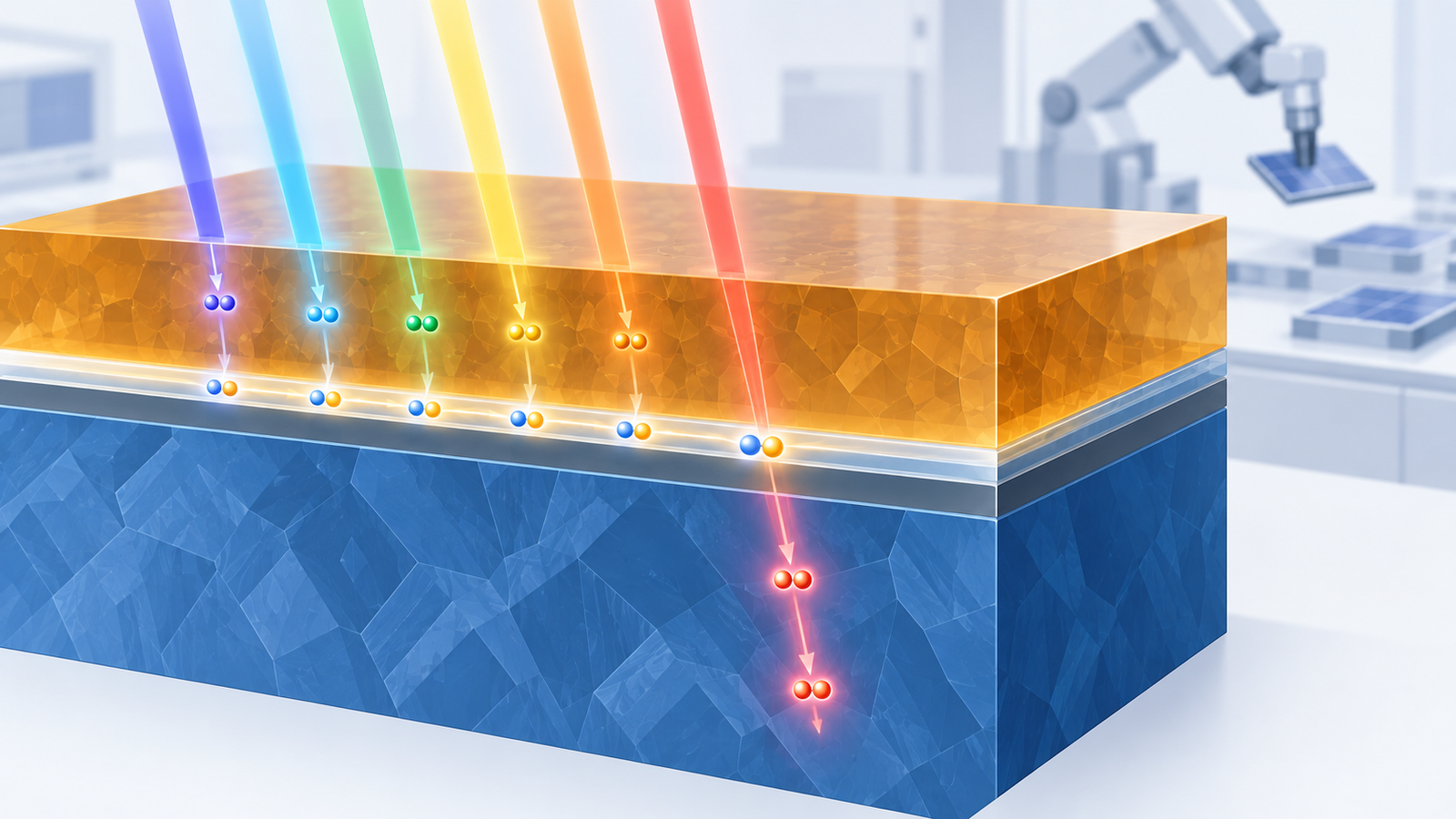
In a two-terminal tandem, current flows because electrons generated in the lower silicon cell and holes generated in the upper perovskite cell meet and annihilate in the intermediate recombination layer. That layer has to meet conflicting demands: let light through to the cell below with as little absorption as possible, while connecting the two cells electrically with no resistance. This is why JinkoSolar's 2024 release highlighted "an intermediate recombination layer with high transmittance and high mobility" Sourced.
A TOPCon cell carries a thin polysilicon film on its surface; unlike HJT, it does not come with a transparent conductive layer already in place. To put perovskite on top, the polysilicon contact has to be made thin and transparent, and a new recombination layer built on top of it. The repeated references to "ultra-thin polysilicon" and "double-layer composite passivating contacts" can be read as the process of re-engineering TOPCon for tandem use Not yet confirmed. For charge transport layers and cell structure, see also our explainer on perovskite-silicon tandems.
11. The risks this company carries
| Risk | Substance | Category |
|---|---|---|
| Losses in the core business and shrinking R&D | A net loss of CNY 6.88 billion in 2025 and another of CNY 3.08 billion in the first half of 2026. R&D input fell 42.49% year on year in 2025 | Sourced |
| Shipment target cut | The 2026 module shipment target was lowered from 75 to 85 GW to 60 to 70 GW | Sourced |
| Limited verification of the records | Cell areas are not disclosed, and the records are not in NLR's table. No large-area or module efficiency has been published | Sourced |
| Unclear production timing | "Within about three years" appears only in the partner's announcement; Jinko's own disclosures give no timing | Not yet confirmed |
| Tug of war with TOPCon investment | While the company is losing money, improvements to existing TOPCon (new modules, cost cuts) and investment in tandem production compete for the same funds | Inference |
| Opaque joint venture | The ownership split, registered capital and allocation of intellectual property in the joint venture with XtalPi have not been disclosed (XtalPi says only that commercialisation will be joint and led by Jinko) | Not yet confirmed |
12. Glossary
- TOPCon
- Tunnel oxide passivated contact. An N-type silicon cell that uses a thin oxide film and a polysilicon film to suppress surface recombination. Today's mainstream in volume production.
- Tandem solar cell
- Two cells that absorb different parts of the light spectrum, stacked on top of each other. JinkoSolar places perovskite on top of TOPCon.
- Intermediate recombination layer
- The layer that joins the upper and lower cells in a two-terminal tandem. It lets light through while electrons and holes recombine there so that current can flow.
- Passivation
- Neutralising defects at surfaces and interfaces so that charge carriers are not needlessly lost.
- NPVM
- The National Photovoltaic Industry Metrology and Testing Center, one of China's bodies for measuring solar cell efficiency.
- Research projects in progress
- A table of ongoing R&D projects that Chinese listed companies disclose in their annual reports, showing each project's planned total investment and spending.
- High-throughput experimentation
- A research method in which robots automatically make and test large numbers of samples. Combined with AI, it speeds up materials discovery.
- Form 20-F
- The annual report a foreign company listed in the United States files with the SEC.
13. References
- Jinko Solar Co., Ltd. Jinko Solar 2025 Annual Report (in Chinese; disclosed on the Shanghai Stock Exchange, 30 April 2026). Corporate information, operating revenue, net profit and R&D input, employees and R&D staff, budget and spending for the research project on high-efficiency, stable, large-area perovskite solar cells, description of perovskite/TOPCon tandem technology, and the 2026 development strategy and business plan. http://static.cninfo.com.cn/finalpage/2026-04-30/1225261496.PDF
- Jinko Solar Co., Ltd. Jinko Solar 2026 Interim Report (in Chinese; disclosed on the Shanghai Stock Exchange, 27 August 2026). First-half 2026 results, the revised shipment target, 34.82% (Shanghai Institute of Microsystem and Information Technology, CAS), and updated budget and spending for the research project. http://static.cninfo.com.cn/finalpage/2026-08-27/1225513196.PDF
- JinkoSolar Holding Co., Ltd. Form 20-F for the fiscal year ended December 31, 2025 (filed with the U.S. SEC on 29 April 2026). The stake of about 54.16% in Jiangxi Jinko, 2,184 R&D staff and their locations, 1,484 TOPCon patents, 34.76%, and the strategic partnership with XtalPi (January 2026). https://www.sec.gov/Archives/edgar/data/1481513/000110465926050737/jks-20251231x20f.htm
- JinkoSolar Press release, "33rd World Record! JinkoSolar Sets New Efficiency Benchmark for Perovskite/TOPCon Tandem Cells at 34.82%" (16 June 2026). 34.82% (Shanghai Institute of Microsystem and Information Technology, CAS) and the technical elements. https://www.jinkosolar.com/en/site/newsdetail/2952
- JinkoSolar Press release, "JinkoSolar Breaks World Record Again with 34.76% Efficiency for Perovskite/TOPCon Tandem Cell" (27 November 2025). 34.76% (NPVM), the previous record of 34.22%, and comments from CTO Jin Hao. https://www.jinkosolar.com/en/site/newsdetail/2789
- JinkoSolar Press release, "JinkoSolar's Perovskite Tandem Solar Cell Based on N-type TOPCon Sets New Record with Conversion Efficiency of 33.84%" (6 January 2025). 33.84% (Shanghai Institute of Microsystem and Information Technology, CAS) and the technical elements. https://www.jinkosolar.com/en/site/newsdetail/2502
- JinkoSolar Holding Co., Ltd. Press release, "JinkoSolar's Perovskite Tandem Solar Cell Based on N-type TOPCon Sets New Record with Conversion Efficiency of 33.24%" (31 May 2024). 33.24%, the previous record of 32.33%, and technical elements including the intermediate recombination layer. https://ir.jinkosolar.com/news-releases/news-release-details/jinkosolars-perovskite-tandem-solar-cell-based-n-type-topcon
- XtalPi Announcement, "Powerhouse Collaboration: XtalPi and JinkoSolar Form Joint Venture to Push Photovoltaic Efficiency Limits with AI" (January 2026). The strategic cooperation agreement with a subsidiary of Jinko Solar, the joint venture, the 1,000 m² experimental line handling 1,000 samples a day, the approach to commercialising intellectual property, and the statement that "Jinko expects mass production within about three years". https://en.xtalpi.com/powerhouse-collaboration-xtalpi-and-jinkosolar-form-joint-venture-to-push-photovoltaic-efficiency-limits-with-ai/
- NLR (U.S. national laboratory, formerly NREL) Cell efficiency data table. Absence of any JinkoSolar perovskite tandem entry when this article checked, and the entry for LONGi's 35.2%. https://www.nlr.gov/docs/libraries/pv/cell-efficiency-data-table.xlsx
- NLR (U.S. national laboratory, formerly NREL) Champion Module Efficiencies chart. Absence of any JinkoSolar perovskite-based module when this article checked. https://www.nlr.gov/docs/libraries/pv/champion-module-chart.pdf
- JinkoSolar Official website (source of the company name style and the logo image). https://www.jinkosolar.com/en
14. Claim-to-source audit
| Claim in the article | Category | Source |
|---|---|---|
| Legal name, registered address and offices, STAR Market code 688223 | Sourced | Reference 1 http://static.cninfo.com.cn/finalpage/2026-04-30/1225261496.PDF |
| The parent, JinkoSolar Holding (NYSE: JKS), holds about 54.16% | Sourced | Reference 3 https://www.sec.gov/Archives/edgar/data/1481513/000110465926050737/jks-20251231x20f.htm |
| Operating revenue and net profit (2023 to 2025), R&D input and its 42.49% fall, 26,388 employees and 2,158 R&D staff | Sourced | Reference 1 http://static.cninfo.com.cn/finalpage/2026-04-30/1225261496.PDF |
| First-half 2026 operating revenue and net loss, and the shipment target cut to 60 to 70 GW | Sourced | Reference 2 http://static.cninfo.com.cn/finalpage/2026-08-27/1225513196.PDF |
| Planned total investment, spending in the period and cumulative spending (2025) and the goal of the research project on high-efficiency, stable, large-area perovskite solar cells | Sourced | Reference 1 http://static.cninfo.com.cn/finalpage/2026-04-30/1225261496.PDF |
| The same project's planned total investment and spending as of the first half of 2026 | Sourced | Reference 2 http://static.cninfo.com.cn/finalpage/2026-08-27/1225513196.PDF |
| CNY 325 million on the BC project and CNY 540 million on the bifacial module project (2025 spending) | Sourced | Reference 1 http://static.cninfo.com.cn/finalpage/2026-04-30/1225261496.PDF |
| Perovskite spending at about 3.0% of R&D input, about a quarter of the BC project and about a seventh of the bifacial module project | Our calculation | Our own division of the figures in reference 1 |
| The 2026 policy (advancing R&D and industrialisation with an AI research platform) and the business plan wording, the engineers added to support the pilot-line upgrade, and inclusion among the major advances of 2024 | Sourced | Reference 1 http://static.cninfo.com.cn/finalpage/2026-04-30/1225261496.PDF |
| 2,184 R&D staff (group), 1,484 TOPCon patents, and the partnership with XtalPi (January 2026) | Sourced | Reference 3 https://www.sec.gov/Archives/edgar/data/1481513/000110465926050737/jks-20251231x20f.htm |
| 34.82% (Shanghai Institute of Microsystem and Information Technology, CAS) and the technical elements | Sourced | References 4 and 2 https://www.jinkosolar.com/en/site/newsdetail/2952 |
| 34.76% (NPVM), the previous record of 34.22%, and the CTO's comments | Sourced | Reference 5 https://www.jinkosolar.com/en/site/newsdetail/2789 |
| 33.84% (Shanghai Institute of Microsystem and Information Technology, CAS) and the technical elements | Sourced | Reference 6 https://www.jinkosolar.com/en/site/newsdetail/2502 |
| 33.24%, the previous record of 32.33%, and technical elements including the intermediate recombination layer | Sourced | Reference 7 https://ir.jinkosolar.com/news-releases/news-release-details/jinkosolars-perovskite-tandem-solar-cell-based-n-type-topcon |
| The joint venture with XtalPi, the size of the experimental line, the approach to commercialising intellectual property, and the "mass production within about three years" outlook (as stated by the partner) | Sourced | Reference 8 https://en.xtalpi.com/powerhouse-collaboration-xtalpi-and-jinkosolar-form-joint-venture-to-push-photovoltaic-efficiency-limits-with-ai/ |
| No JinkoSolar perovskite entry in NLR's cell efficiency data table or module chart | Sourced | References 9 and 10 https://www.nlr.gov/docs/libraries/pv/cell-efficiency-data-table.xlsx |
| The three types of perovskite solar cell company | Our calculation | Our own classification. Companies shown are examples from those covered in this series |
| The inconsistency in the research project figures for the first half of 2026 (a possible change of scope) | Not yet confirmed | This article's observation from comparing the figures in references 1 and 2. The company has given no specific explanation http://static.cninfo.com.cn/finalpage/2026-08-27/1225513196.PDF |
| Area of the record cells, large-area and module efficiencies, production timing, lines and investment, the joint venture's ownership split, and outdoor reliability data | Not yet confirmed | Not in references 1 to 7. Figures from press reports and research firms are not used http://static.cninfo.com.cn/finalpage/2026-04-30/1225261496.PDF |
| That the device can be read as two-terminal (the number of terminals is not stated) | Not yet confirmed | This article's commentary based on the description of the intermediate recombination layer in reference 7 |
| The reading that the real target is a tandem that makes use of existing TOPCon lines | Inference | This article's interpretation of references 3 to 7 |
| The reading that it is buying speed in materials discovery with AI and robots | Inference | This article's interpretation of references 1 and 8 |
| The reading that space applications are also in view | Inference | This article's interpretation of reference 8 and the industry trends described in reference 1 |
| The reading that TOPCon is being re-engineered for tandems, and the risk of a tug of war with TOPCon investment | Inference | This article's interpretation of the technical elements and results in references 1, 4 and 7 |
Last updated 25 September 2026 / Troy Technical
Every figure in this article comes from statutory filings Jinko Solar Co., Ltd. has made with the Shanghai Stock Exchange, the Form 20-F JinkoSolar Holding has filed with the U.S. SEC, the company's official press releases, the announcement by its partner XtalPi and material published by NLR (formerly NREL). No research-firm estimates or press-based figures have been used. Passages marked "Inference" are this article's interpretation of primary sources, not statements made by the company.