COMPANY PROFILE / PEROVSKITE SOLAR CELLS
Kaneka
A chemicals maker's tandem, stacked on silicon cells it mass-produces itself
Kaneka is a chemicals company, but it has made solar cells for power generation since 1999 and still mass-produces heterojunction crystalline silicon solar cells at its subsidiary Kaneka Solartech in Toyooka, Hyogo Prefecture. In perovskites it has zeroed in on tandems that stack perovskite on top of its own silicon cells. In February 2026 it was selected for the "Next-Generation Tandem Solar Cell Mass-Production Technology Demonstration Project" under the Green Innovation Fund run by NEDO, Japan's state-backed R&D funding agency, and it is aiming to start selling products in FY2028. The efficiency of its tandem cell as measured by a third-party body is 32.6% (1 cm²). This profile keeps the rest of the company to a minimum and sets out what Kaneka is putting into tandems and how far it has got, using the company's statutory filings, management plans and official releases, and the business strategy visions it submitted to NEDO.
- Kaneka in 30 seconds, and where it stands in perovskite solar cells
- The logo and how the name is written
- Where the company sits in the perovskite solar cell field
- Scale (the company as a whole, in brief)
- Resources committed to perovskites
- What it has done so far
- What comes next
- What the company is aiming for in perovskite solar cells
- Map of perovskite relationships
- Technology, products and services
- The risks this company carries
- Glossary, references and claim-to-source audit
1. Kaneka in 30 seconds, and where it stands in perovskite solar cells
(also mass-produces silicon cells)Began making solar cells for power generation in 1999
Companies working on perovskite solar cells fall into three broad types: established PV makers, perovskite start-ups, and materials & electronics firms. Kaneka is a chemicals maker, but what sets it decisively apart from other chemicals and electronics firms is that its own group mass-produces silicon solar cells Sourced. A tandem needs both "the perovskite on top" and "the silicon underneath", and Kaneka does not have to buy the silicon cells from anyone. Its business strategy vision submitted to NEDO likewise lists its strengths as "integrated domestic production from cells to modules" and "because we produce crystalline Si solar cells, we can mass-produce high-efficiency bottom cells suited to the top cell". At the same time it names "a single cell manufacturing site" as a weakness, acknowledging that in scale it is nowhere near the big silicon makers.
2. The logo and how the name is written

The Kaneka logo is the company's trademark. We have not recreated it with image generation;
the file shown here, img/kaneka_logo.png, is the image taken from the official website (the Japanese line beneath the logo is the company's tagline, roughly "a company that makes wishes come true through chemistry").
A note on names: the legal entity is KANEKA CORPORATION. Solar cells are manufactured by its wholly owned subsidiary Kaneka Solartech Corporation (Toyooka, Hyogo Prefecture) as a contract processor, and sold by the sales subsidiary Kaneka Solar Sales. Within the company, the business unit is the "PV & Energy management" (PV&Em) Solutions Vehicle.
Official site (Japanese): https://www.kaneka.co.jp/corporate/outline/3. Where the company sits in the perovskite solar cell field
The product is a tandem with silicon. In 2021 Kaneka was also selected for a GI Fund development theme on single-junction cells (perovskite on polyimide film or glass), and in its business strategy vision as of December 2025 it was still reporting results from that theme (such as 19.4% on a 30 cm-square module) Sourced. However, in the releases and management plans from 2026 onwards, only the tandem is named as the subject of "product sales". For how tandems work, see our explainer on tandem cells.
4. Scale (the company as a whole, in brief)
The company as a whole is not the subject here, so only its size is noted Sourced. Kaneka's fiscal year runs from April to March, so FY2025 is the year to March 2026.
| Measure | FY2024 (year to March 2025) | FY2025 (year to March 2026) |
|---|---|---|
| Net sales (¥ million) | 807,200 | 811,638 |
| Operating profit (¥ million) | 40,050 | 32,894 |
| R&D expenditure (¥ million) | - | 39,891 |
| Employees (consolidated) | - | 11,762 |
Net sales and operating profit are from the earnings summary for the year to March 2026, R&D expenditure from the annual securities report (the statutory annual filing that Japanese listed companies must submit) for the same year, and headcount from the company overview (as of 31 March 2026).
The figures above are for the Kaneka Group as a whole. In the annual securities report, PV & Energy management, which includes solar cells, is one business within a segment such as the Material Solutions Unit, and sales and profit for the solar cell business alone are not disclosed. For perovskites, too, sales, capital expenditure and dedicated headcount are none of them disclosed Not yet confirmed. Nor is it shown how much of the ¥39.9 billion R&D budget goes to perovskites. The only amounts that indicate the scale of the effort in this field are the GI Fund R&D budgets in section 5.
5. Resources committed to perovskites
| Type of resource | What it is | Category |
|---|---|---|
| People (organisation) | The head of R&D is the director of the Thin-Film Process Development Laboratory. A project set-up links the Solar Cell & Thin-Film Laboratory (technology development), the Thin-Film Process Development Laboratory (process development), PV&Em SV (commercialisation and productisation) and Kaneka Solartech (production). The Executive Vice President (in charge of research) and the President are committed to it | Sourced |
| People (headcount) | Number of dedicated staff. The company says it sends young researchers to universities in Japan and research institutes abroad, and also uses its own research unit in Europe | Not disclosed |
| Money (single-junction, from 2021) | R&D budget of about ¥3.0 billion under the GI Fund project for practical application of next-generation solar cells (about ¥2.0 billion from state funds, about ¥1.0 billion borne by the company) | Sourced |
| Money (tandem, from 2026) | R&D budget of about ¥6.0 billion under the GI Fund's "Next-Generation Tandem Solar Cell Mass-Production Technology Demonstration Project" (about ¥4.0 billion from state funds, about ¥2.0 billion borne by the company) | Sourced |
| Money (internal priority) | The business strategy vision says 85% of R&D investment (R2B spending) in FY2025 is concentrated on priority areas, and that solar cells are one of the top three themes | Sourced |
| Facilities | Uses the parts it shares with existing production equipment for heterojunction cells, residential building-integrated modules and vehicle modules. Plans to build prototype equipment equivalent to a dozen or so kW (thousands of units). The 2026 management plan includes "introduction of pilot equipment for perovskite solar cells and start of trial sales" | Sourced |
| Investments and acquisitions by Kaneka | The documents this article reviewed mention no investment or acquisition in the perovskite field | Not confirmed |
| Public funding | Selected twice for NEDO's GI Fund: December 2021 (single-junction; grant decision March 2022) and February 2026 (tandem). The business strategy vision says the company has "made use of NEDO funding over many years" | Sourced |
| Universities and research institutes | The tandem demonstration project is carried out by Kaneka alone (no co-applicants). Kaneka takes part in the preparatory committee on standardising (single-junction) perovskite solar cells, whose secretariat is the National Institute of Advanced Industrial Science and Technology (AIST) | Sourced |
Adding the single-junction project (about ¥3.0 billion) and the tandem project (about ¥6.0 billion) gives GI Fund-related R&D of about ¥9.0 billion, of which about ¥6.0 billion (about 67%) is state money Our calculation. The tandem project is twice the size of the single-junction one, and the amounts reflect Kaneka shifting its resources towards tandems. These are R&D budgets, however; capital expenditure on a mass-production line has not been given Not yet confirmed.
6. What it has done so far
| When | What happened | Why it matters |
|---|---|---|
| October 1999 | Starts manufacturing solar cells for power generation (history section of the annual securities report). Has experience producing thin-film silicon solar cells at a scale of 120 MW a year, and now produces heterojunction crystalline silicon | The foundation for owning the "lower half" of a tandem |
| December 2021 | Selected for the GI Fund "Development of Next-Generation Solar Cells" (development of high-performance perovskite solar cell technology, on its own) | Single-junction development |
| March 2022 | Announces the GI Fund grant decision. Reports cell conversion efficiency of 19.8% (0.1 cm², measured by JET in accordance with IEC 60904) for an ultra-thin perovskite cell about 10 μm thick on an in-house-designed polyimide substrate | The high point for film-type |
| May 2025 | At its management plan briefing, announces 32.6% (1 cm², measured by ESTI) for a perovskite/heterojunction silicon tandem cell. Also develops roof-tile-integrated and 3D-curved vehicle modules | Demonstrates tandem efficiency through third-party measurement |
| As of December 2025 | Reported for the single-junction theme: 8 cm-square mini-module on glass 22.2%, bifacial type 20.8%, 30 cm-square module 19.4% (all measured by a third party), small cell 25% (in-house measurement) | High values in single-junction too |
| February 2026 | Selected for the GI Fund "Next-Generation Tandem Solar Cell Mass-Production Technology Demonstration Project" (theme: "Development and demonstration of mass-production technology for high-efficiency, high-reliability tandem perovskite solar cells"). The other project selected under the same programme is Choshu Industry's | Enters a national project aimed at mass production |
| March 2026 | Signs a partnership agreement with the City of Saitama and starts an outdoor demonstration of two tandem modules (about 995 mm × about 1,085 mm) on the grounds of the city's main government building (until March 2027). The electricity is stored in batteries for use in emergencies | The company says it is "the first at a public facility in Japan" |
| May 2026 | "Plan: The Three-Year Initiatives 2026" lists "introduction of pilot equipment for perovskite solar cells and start of trial sales" among PV&Em measures, and "product sales scheduled to start in FY2028" as a priority theme | The sales start enters the management plan |
7. What comes next
| Tandem R&D (business strategy vision, as of the start of the project) | Current status (as stated by the company) | Target |
|---|---|---|
| Cell conversion efficiency | 32.6% (1 cm², measured by a third party), 33.9% (1 cm², in-house measurement) | 32% (practical size of 100 cm² or more) |
| Module output | A 100 cm-wide module confirmed to deliver 1.2 times the output of the company's silicon | Module efficiency 30% (metre size) |
| Durability | Damp-heat test (85°C / 85% RH, 1,000 hours) and thermal cycling test (−45°C / 85°C, 200 cycles) confirmed on mini-modules | Pass reliability tests equivalent to 20 years |
| Prototyping | Prototypes of several to a dozen or so cells a day | Build prototype equipment equivalent to a dozen or so kW (thousands of units) |
| Commercialisation and payback | - | Commercialisation around 2029, with payback on the investment expected in the late 2030s |
None of the following appears in the primary sources this article reviewed Not yet confirmed.
The location, capacity and investment of a mass-production line for tandems; selling prices; the timing and location of the pilot equipment; the start date of trial sales; and third-party confirmation of the 33.9% figure. Note also that the releases say "product sales start in FY2028" while the business strategy vision says "commercialisation around 2029", and the relationship between the two (perhaps the difference between trial sales and full commercialisation) is not explained.
8. What the company is aiming for in perovskite solar cells
This section goes beyond what the company says directly. It sets out inferences that can be drawn from primary sources, each with its basis.
| What can be read | Primary evidence behind it | Category |
|---|---|---|
| To make perovskites a premium product on top of its own silicon business | Releases consistently say the perovskite cell is "stacked on the heterojunction crystalline silicon solar cells the company produces", and the business strategy vision says it will use the parts it shares with existing equipment | Inference |
| First, homes and cars, where it already has customers | The vision's targets are "PV for buildings (residential and non-residential) and vehicle-mounted PV". Its prototypes are likewise roof-tile-integrated, lightweight and 3D-curved vehicle modules. Its existing silicon business already supplies homes and has a track record of vehicle-mounted solar cells adopted on Toyota's Prius PHEV | Sourced |
| To sell the efficiency gap where space is limited | The vision frames the problem for homes as "installed capacity cannot be secured on small plots" and for cars as "limited installation area (high efficiency needed)" | Inference |
| To reuse single-junction technology for the top half of the tandem | Improvements to perovskite layer quality and passivation developed under the single-junction theme overlap with the development items for the tandem's "top cell" | Inference |
| Triple-junction cells in view beyond that | Among its risk responses the vision says it will "carry out triple-junction solar cell technology development and the like in parallel with this fund project" | Sourced |
Kaneka's tandem target is "module efficiency of 30%", which the vision describes as "a high level that greatly exceeds the module efficiency of the perovskite/Si tandems currently being offered to the market on a trial basis" Sourced. What it gives as its current achievement, on the other hand, is 32.6% for a 1 cm² cell and, for modules, "1.2 times the output of our Si in a 100 cm-wide module"; the module efficiency at metre size itself is not given Sourced. The cell target, "32% at 100 cm² or more", also means scaling up the area 100-fold from the current 1 cm². From this, this article reads the FY2028 sales start as likely to take the form of entering the market with products that fall short of the 30% target, then raising efficiency afterwards Not yet confirmed. The fact that two different dates, "sales start in FY2028" and "commercialisation around 2029", sit side by side is consistent with that step-by-step approach.
9. Map of perovskite relationships
10. Technology, products and services
| Item | What the company has published |
|---|---|
| Products | No perovskite products on sale yet (sales due to start in FY2028). Existing products are heterojunction crystalline silicon solar cells, residential roof-tile-integrated and building-integrated (BIPV) modules, and vehicle modules |
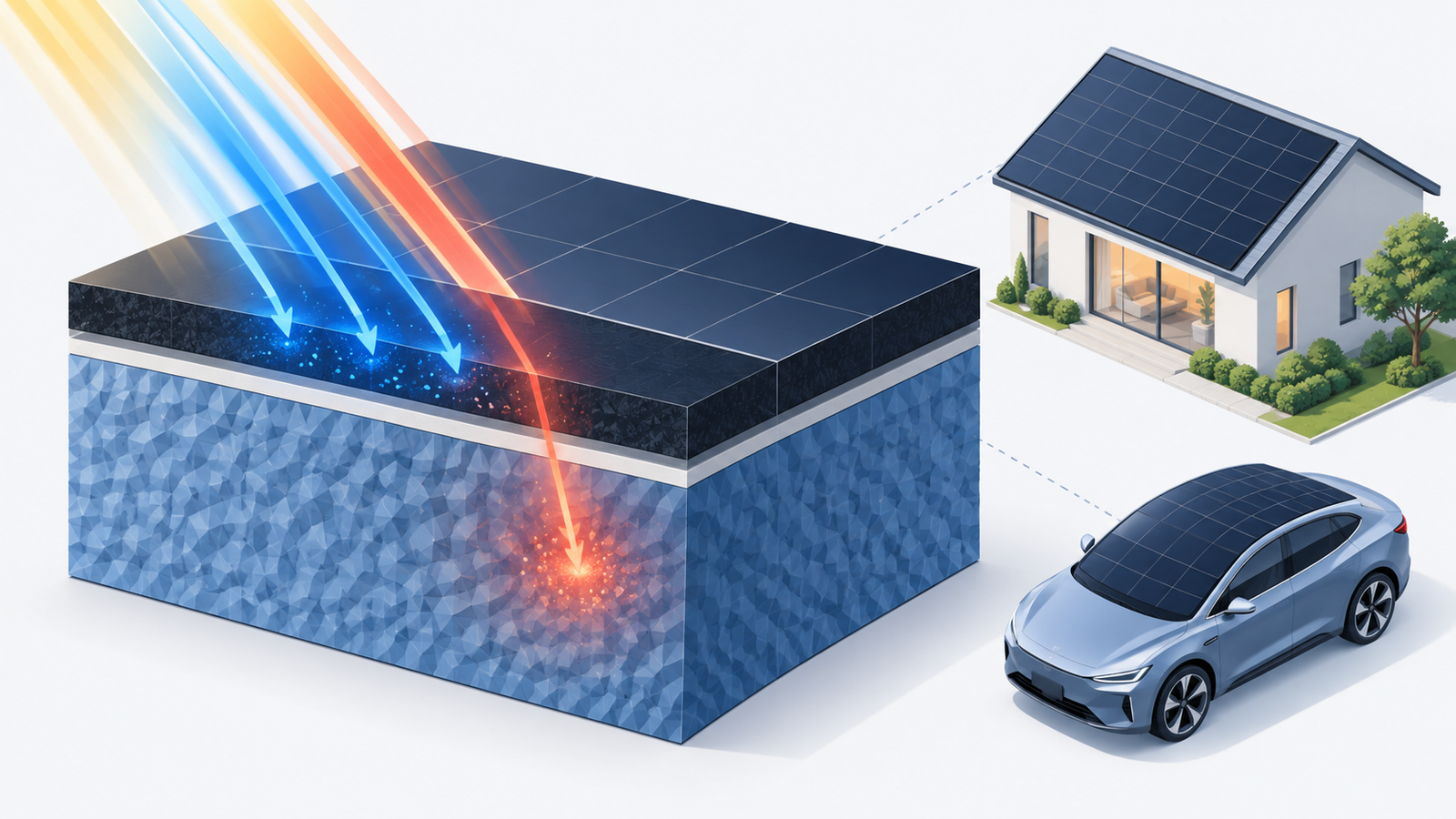
| Tandem structure | A perovskite solar cell stacked on the heterojunction crystalline silicon solar cells the company produces itself. Each absorbs light of different wavelengths |
| Tandem efficiency | Cell 32.6% (1 cm², measured by ESTI, i.e. third-party measurement) and 33.9% (1 cm², in-house measurement) |
| Tandem prototypes | A 3D-curved module (about 80 cm × 65 cm, mock-up), a lightweight module (about 148 cm × 98 cm, lightweight glass) and a roof-tile-integrated module (about 100 cm × 30 cm). The demonstration module measures about 995 mm × about 1,085 mm |
| Single-junction efficiency | Cell on polyimide film 19.8% (0.1 cm², measured by JET, 2022); 20.7% on film (under 1 cm²); 8 cm-square mini-module on glass 22.2% and 30 cm-square module 19.4% (measured by a third party) |
| Technology built up in house | Light trapping, fine texturing and film quality control from thin-film silicon; optical simulation; energy yield prediction based on indoor and outdoor generation data; materials design and synthesis (as a chemicals maker); module designs that allow lower bonding and encapsulation temperatures; and large-area transparent electrode and interlayer formation |
In a tandem, the perovskite layer is built on top of a finished silicon cell. What matters here is temperature. Perovskites contain organic components and break down at high temperatures. The silicon cell underneath, depending on its type, can also lose performance if heated afterwards. A heterojunction silicon cell is, by design, made by depositing thin films at low temperature, and its surface carries layers of amorphous silicon and transparent electrode. Kaneka lists "module designs that allow lower bonding and encapsulation temperatures" and "large-area transparent electrode and interlayer formation technology" as strengths in its business strategy vision because connecting the upper and lower layers without heat-damaging either is the crux of a tandem Not yet confirmed. The know-how from mass-producing thin-film silicon, "laying thin films evenly over large areas", applies directly here. For interlayers and current matching, see our explainer on tandem cells.
11. The risks this company carries
| Risk | Substance | Category |
|---|---|---|
| Long-term reliability | The business strategy vision lists as risks "failing to achieve the targeted long-term reliability" and "taking time to achieve the long-term reliability the market demands", and says it also envisages applications with relatively short service lives | Sourced |
| No advantage over silicon | It lists "failing to deliver benefits over existing solar cells (no market)" as a risk, and sets as its criterion for abandoning the business "no market exists for the technology developed" | Sourced |
| A single manufacturing site | It names as weaknesses "a single cell manufacturing site (BCP)" and "expanding scale, including modules" | Sourced |
| Supply of scarce materials | It lists "risks relating to material supply", and says it will develop technology that does not use scarce materials such as rare metals in parallel | Sourced |
| The scale gap with big overseas players | The big silicon makers are also developing tandems, and Kaneka is far behind them in production scale. The vision gives as one example of a competitor a silicon maker that sources raw materials overseas and produces cells and modules overseas | Inference |
| Timing slippage | The relationship between "product sales start in FY2028" and "commercialisation around 2029" is not explained, making the actual pace of the ramp-up hard to read | Inference |
12. Glossary
- Tandem
- Two kinds of solar cell that absorb different wavelengths of light, stacked together. It can reach higher efficiency than either kind alone.
- Heterojunction silicon
- A cell made by adding thin amorphous silicon layers to the surfaces of crystalline silicon. It can be made at relatively low temperatures and is highly efficient.
- Top cell / bottom cell
- In a tandem, the upper cell that light reaches first, and the lower cell that receives the remaining light. At Kaneka the perovskite is on top and the silicon underneath.
- ESTI
- A European testing and measurement centre for solar cells. It measures solar cell efficiency as an independent third party.
- JET
- Japan Electrical Safety & Environment Technology Laboratories. An independent Japanese body that tests the performance and safety of solar cells.
- Triple-junction
- A structure stacking three kinds of solar cell. It aims at even higher efficiency than a tandem (double-junction).
- R2B spending
- Spending on the path from research to commercialisation, which Kaneka calls "Research to Business".
- BCP
- Business continuity plan. Preparations to keep the business going if a site is shut down by a disaster or similar event.
13. References
- Kaneka Company overview (name, incorporation, head offices, capital, headcount and businesses; as of 31 March 2026; in Japanese). https://www.kaneka.co.jp/corporate/outline/
- Kaneka Consolidated financial results (earnings summary, Japanese GAAP) for the fiscal year ended March 2026 (14 May 2026, in Japanese). https://contents.xj-storage.jp/xcontents/AS01278/e93002fd/2455/4b4f/94c1/c21ae616a7df/140120260513528864.pdf
- Kaneka Annual securities report for the 102nd fiscal period (1 April 2025 to 31 March 2026, in Japanese). History (start of solar cell manufacturing for power generation), affiliated companies (Kaneka Solartech), R&D expenditure, and the status of PV & Energy management. https://contents.xj-storage.jp/xcontents/AS01278/afcb1ed0/716f/4212/b7df/b59ceee7db07/20260624181605285s.pdf
- Kaneka Briefing materials for "Plan: The Three-Year Initiatives 2025" (27 May 2025; Japanese version cited). Tandem cell 32.6% (measured by ESTI), roof-tile-integrated and vehicle modules. https://www.kaneka.co.jp/topics/ir_news/2025/rhmcfr0000000bnd-att/ir2505271.pdf
- Kaneka Notice on the formulation of "Plan: The Three-Year Initiatives 2026" (28 May 2026, in Japanese). Introduction of pilot equipment and start of trial sales; product sales scheduled to start in FY2028. https://contents.xj-storage.jp/xcontents/AS01278/eb732fdb/e276/4ee9/ad00/3e47e53599aa/140120260528553614.pdf
- Kaneka News release, "Kaneka to Accelerate Development to Social Implementation of High-Performance Perovskite Solar Cells via the NEDO Green Innovation Fund" (16 March 2022; Japanese version cited). https://www.kaneka.co.jp/topics/news/2022/nr2203161.html
- Kaneka News release, "Kaneka Selected for NEDO Green Innovation Fund Project for Manufacturing Technology and Demonstration of Next-Generation Tandem Solar Cells" (6 February 2026; Japanese version cited). https://www.kaneka.co.jp/topics/news/2026/nr2602061.html
- Kaneka News release, "Kaneka and Saitama City to Launch Outdoor Demonstration Project of Perovskite Tandem Solar Modules" (18 March 2026; Japanese version cited). https://www.kaneka.co.jp/topics/news/2026/nr2603181.html
- Kaneka (published by NEDO) Business strategy vision, "Development and demonstration of mass-production technology for high-efficiency, high-reliability tandem perovskite solar cells" (as of the start of the project, in Japanese). Targets, strengths and weaknesses, business plan, funding plan, R&D targets and current status, organisation, prototypes and risk factors. https://green-innovation.nedo.go.jp/resources/pdf/next-generation-solar-cells/item-1-4/vision-kaneka-001.pdf
- Kaneka (published by NEDO) Business strategy vision, "Development of high-performance perovskite solar cell technology making use of size-free, ultra-thin features" (as of December 2025, in Japanese). Funding plan and R&D progress for single-junction cells. https://green-innovation.nedo.go.jp/resources/pdf/next-generation-solar-cells/item-1-2/vision-kaneka-004.pdf
- NEDO Annex 1, list of planned implementers, for "Development of next-generation solar cells begins under the Green Innovation Fund Project" (28 December 2021, in Japanese). https://www.nedo.go.jp/content/100940817.pdf
- NEDO "Decision on the implementation structure for the 'Next-Generation Tandem Solar Cell Mass-Production Technology Demonstration Project'" (6 February 2026) and Annex 1, list of planned implementers (Choshu Industry and Kaneka), in Japanese. https://www.nedo.go.jp/content/800048185.pdf
- Kaneka Solartech About us (production base in Toyooka; development by Kaneka and sales by Kaneka Solar Sales), in Japanese. https://www.kst.kaneka.co.jp/about/
14. Claim-to-source audit
| Claim in the article | Category | Source |
|---|---|---|
| Legal name, incorporation, Tokyo and Osaka head offices, capital, 11,762 employees | Sourced | Reference 1 https://www.kaneka.co.jp/corporate/outline/ |
| Net sales and operating profit (years to March 2025 and March 2026), securities code 4118 | Sourced | Reference 2 https://contents.xj-storage.jp/xcontents/AS01278/e93002fd/2455/4b4f/94c1/c21ae616a7df/140120260513528864.pdf |
| Start of solar cell manufacturing for power generation in October 1999; Kaneka Solartech (Toyooka, 100%, contract processor); R&D expenditure of ¥39,891 million; PV&Em's GI Fund selection | Sourced | Reference 3 https://contents.xj-storage.jp/xcontents/AS01278/afcb1ed0/716f/4212/b7df/b59ceee7db07/20260624181605285s.pdf |
| Tandem cell 32.6% (1 cm², measured by ESTI), roof-tile-integrated and 3D-curved vehicle modules, adoption on the Prius PHEV | Sourced | Reference 4 https://www.kaneka.co.jp/topics/ir_news/2025/rhmcfr0000000bnd-att/ir2505271.pdf |
| Introduction of pilot equipment and start of trial sales; product sales scheduled to start in FY2028 (2026 management plan) | Sourced | Reference 5 https://contents.xj-storage.jp/xcontents/AS01278/eb732fdb/e276/4ee9/ad00/3e47e53599aa/140120260528553614.pdf |
| The 2022 grant decision, ultra-thin cell of about 10 μm, cell efficiency of 19.8% (measured by JET), experience producing thin-film silicon at a 120 MW scale | Sourced | Reference 6 https://www.kaneka.co.jp/topics/news/2022/nr2203161.html |
| Selection for the tandem GI Fund project, the future aim of exceeding 40%, and the plan to start sales in FY2028 | Sourced | Reference 7 https://www.kaneka.co.jp/topics/news/2026/nr2602061.html |
| Partnership agreement with the City of Saitama and the demonstration at the main government building (two modules, until March 2027) | Sourced | Reference 8 https://www.kaneka.co.jp/topics/news/2026/nr2603181.html |
| Tandem project R&D budget of about ¥6.0 billion (about ¥4.0 billion state, about ¥2.0 billion own); targets (32%, 30%, 20 years, ¥12); current status (32.6%, 33.9%, 1.2 times, durability tests); prototype equipment; commercialisation around 2029; strengths and weaknesses; sole implementation; organisation; R2B spending; standardisation committee; triple-junction; risk factors | Sourced | Reference 9 https://green-innovation.nedo.go.jp/resources/pdf/next-generation-solar-cells/item-1-4/vision-kaneka-001.pdf |
| Single-junction R&D budget of about ¥3.0 billion (about ¥2.0 billion state, about ¥1.0 billion own) and progress (22.2%, 20.8%, 19.4%, 25%, 20.7%) | Sourced | Reference 10 https://green-innovation.nedo.go.jp/resources/pdf/next-generation-solar-cells/item-1-2/vision-kaneka-004.pdf |
| Selection for the GI Fund in December 2021 (on its own) | Sourced | Reference 11 https://www.nedo.go.jp/content/100940817.pdf |
| Planned implementers of the tandem mass-production technology demonstration project (Choshu Industry and Kaneka) | Sourced | Reference 12 https://www.nedo.go.jp/content/800048185.pdf |
| Production base in Toyooka, development by Kaneka, sales by Kaneka Solar Sales | Sourced | Reference 13 https://www.kst.kaneka.co.jp/about/ |
| The three types of perovskite solar cell company | Our calculation | Our own classification. Companies shown are examples from those covered in this series |
| GI Fund R&D totalling about ¥9.0 billion, state share of about 67%, tandem twice the single-junction project | Our calculation | Our own sum of the amounts in references 9 and 10 |
| Sales of the solar cell business alone; perovskite sales, capital expenditure and dedicated headcount; location and capacity of a mass-production line; selling price; timing of pilot equipment; third-party confirmation of 33.9% | Not yet confirmed | Not in the primary sources this article reviewed. This article makes no estimate |
| The readings that perovskites will become a premium product on top of the silicon business, that the efficiency gap will be sold where space is limited, and that single-junction technology will be reused for the top cell | Inference | This article's interpretation of references 7 to 10 |
| The reading that the company will enter the market with products below the 30% target and raise efficiency step by step | Inference | This article's interpretation of the targets and dates in references 5, 7 and 9 |
| The view that connecting the upper and lower layers without heat damage is the crux of a tandem | Inference | This article's commentary based on the description of technical advantages in reference 9 |
| The risks of the scale gap with big overseas players and of timing slippage | Inference | This article's interpretation of references 7 and 9 |
Last updated 25 September 2026 / Troy Technical
Every figure in this article comes from Kaneka's statutory filings, management plans and official releases, the business strategy visions the company submitted to NEDO, documents published by NEDO, and Kaneka Solartech's company introduction. No research-firm estimates or press-based figures have been used. Passages marked "Inference" are this article's interpretation of primary sources, not statements made by the company.