COMPANY PROFILE / PEROVSKITE SOLAR CELLS
Panasonic Holdings
The electronics giant that quit silicon solar cells is coming back with "power-generating glass"
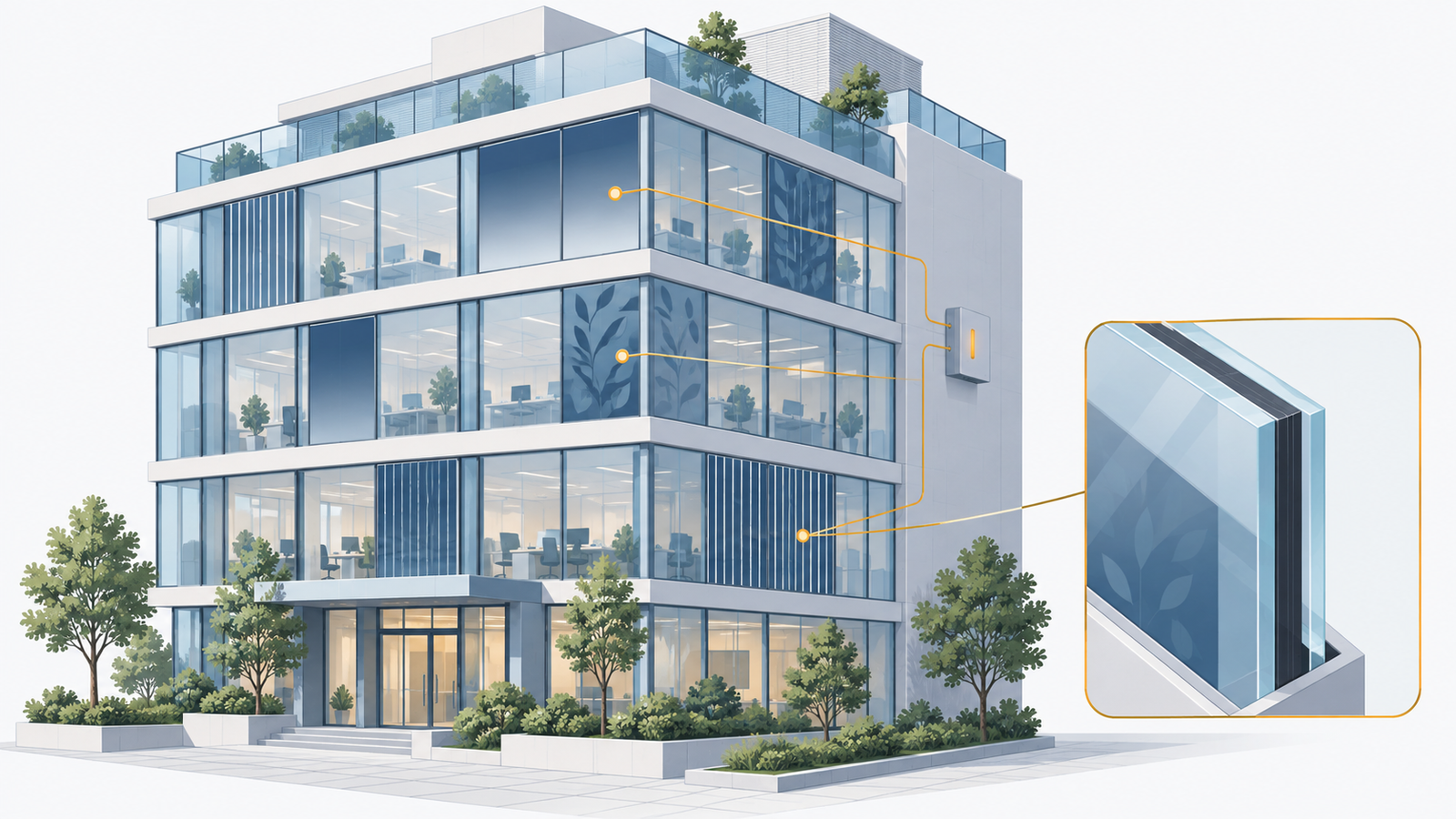
In FY2021 Panasonic stopped producing silicon solar cells for homes and businesses. In perovskites, the same company has narrowed its focus to the glass-type: coating the perovskite directly onto glass and making it into laminated glass, and is developing products that turn building materials themselves, such as windows, railings and exterior walls, into generators. In November 2025 it began a demonstration project under the Green Innovation Fund run by NEDO, Japan's state-backed R&D funding agency, and the business strategy vision it submitted to NEDO plans to start selling prototype models from FY2026. This profile keeps the rest of the company to a minimum and sets out what Panasonic is putting into glass-type perovskites, who it is working with and how far it has got, using the company's official releases and its business strategy vision.
- Panasonic in 30 seconds, and where it stands in perovskite solar cells
- The logo and how the name is written
- Where the company sits in the perovskite solar cell field
- Scale (the company as a whole, in brief)
- Resources committed to perovskites
- What it has done so far
- What comes next
- What the company is aiming for in perovskite solar cells
- Map of perovskite partnerships
- Technology, products and services
- The risks this company carries
- Glossary, references and claim-to-source audit
1. Panasonic in 30 seconds, and where it stands in perovskite solar cells
CorporationThe company's official English name
(entering from another industry)Withdrew from silicon solar cell production in FY2021
Promotion OfficeA specialist unit reporting directly to top management
from FY2026Business strategy vision submitted to NEDO
Companies working on perovskite solar cells fall into three broad types: established PV makers, perovskite start-ups, and materials & electronics firms. Panasonic belongs to the third group as an electronics maker, but it has a history: it once mass-produced silicon solar cells (HIT) in Malaysia and Shimane, and withdrew from that production in FY2021 Sourced. In perovskites it has chosen not to mass-produce standard products and compete on price, but, in the words of its business strategy vision, to build "a manufacturing line specialising in made-to-order production", making glass to match the dimensions, transparency and patterns of each window or railing. Among electronics and chemicals firms, Sekisui Chemical and Toshiba are targeting "lightweight roofs" with film-type cells, whereas Panasonic is going after "windows and facades of buildings where weight is not a concern". That is the decisive difference.
2. The logo and how the name is written

The Panasonic logo is the company's trademark. We have not recreated it with image generation;
the file shown here, img/panasonic_holdings_logo.svg, is the "Panasonic Group" logo image taken from Panasonic's official newsroom.
A note on names: perovskite solar cells are being developed by the holding company itself, Panasonic Holdings Corporation, not by the battery business Panasonic Energy or the housing equipment operating company. At the time of the 2020 efficiency announcement the company was still called Panasonic Corporation. In demonstrations, the group company Panasonic Environmental Engineering Co., Ltd. sometimes handles design and installation.
Official site (Japanese): https://holdings.panasonic/jp/corporate/phd/profile.html3. Where the company sits in the perovskite solar cell field
The product is a glass-type, single-junction cell. The business strategy vision sets the company's glass-type cells against other companies' film-type cells, describing film-type cells as "featuring lightness, thinness and flexibility, but with issues in efficiency and durability" and "not yet able to offer transparency or customisation". Of overseas manufacturers it says they are "focusing on developing tandem products with silicon PV (for existing applications) rather than on building materials" Sourced. In other words, Panasonic has deliberately chosen ground where it does not compete head-on with either film-type or tandem cells. For the advantages of sandwiching cells between glass, see our explainer on encapsulation and barrier layers.
4. Scale (the company as a whole, in brief)
The company as a whole is not the subject here, so only its size is noted Sourced.
| Measure (as of 31 March 2026, company overview) | Value |
|---|---|
| Net sales (consolidated) | ¥8.0487 trillion |
| Employees (consolidated) | 183,685 |
| Capital | ¥259.6 billion |
| Number of group companies (parent and consolidated subsidiaries) | 447 |
The figures above are for the Panasonic Group as a whole. As of September 2026 its perovskite solar cells are still under development, and the dedicated website says so explicitly. Sales, profit and dedicated headcount are none of them disclosed Not yet confirmed. The size of the company and the size of its perovskite effort are entirely different things; the only amount that indicates the latter is the R&D investment of about ¥15.1 billion (FY2025 to FY2029) in section 5. We also tried to check the PDFs of the earnings release and the annual securities report (the statutory annual filing that Japanese listed companies must submit), but could not retrieve them, so the figures here are from the company overview page.
5. Resources committed to perovskites
Japanese fiscal years (FY) run from April to March; FY2025 is the year from April 2025 to March 2026.
| Type of resource | What it is | Category |
|---|---|---|
| People (dedicated organisation) | Perovskite PV Business Promotion Office (a specialist unit reporting directly to top management; its leader is also the head of R&D). It has three teams: development (cells, modules, building integration, materials and processes), business planning, and mass-production technology. The President and the Group CTO are committed to the effort, and the office works with the GX Division and the Advanced Materials Development Center | Sourced |
| People (headcount) | Number of staff dedicated to perovskites | Not disclosed |
| Money (R&D) | R&D investment of about ¥15.1 billion for FY2025 to FY2029 related to the GI Fund project (about ¥9.9 billion from state funds, about ¥5.2 billion borne by the company) | Sourced |
| Money (equipment) | States that mass-production equipment will be "decided on the basis of market conditions and other factors", with additional investment in stages. The amount is not disclosed. Both internal funds and external financing are being considered for large-scale investment | Sourced |
| Facilities (current) | A prototype line for 1.0 m × 1.8 m modules (takt time 100 minutes) has been built | Sourced |
| Investments and acquisitions by Panasonic | The documents this article reviewed mention no investment or acquisition in the perovskite field | Not confirmed |
| Public funding (NEDO) | NEDO's "Development of Technologies to Reduce Power Generation Costs for High-Performance and High-Reliability Photovoltaic Power Generation" (FY2015 to FY2019); a second phase from FY2020 (building-integrated); and selected in September 2025 for the GI Fund's "Next-Generation Solar Cell Demonstration Project" (FY2025 to FY2029, as lead applicant) | Sourced |
| Universities and research institutes | The 16.09% figure in 2020 was measured by the National Institute of Advanced Industrial Science and Technology (AIST). The documents this article reviewed mention no joint research with universities | Sourced / Not confirmed |
| Technology built up in house | Industrial inkjet technology developed for manufacturing OLED displays, laser processing technology and materials technology. The group's electrical systems and energy management businesses, and its business relationships with the construction and real estate industries | Sourced |
Of the roughly ¥15.1 billion, about ¥9.9 billion comes from state funds, or about 66% Our calculation. NEDO's selection announcement gives the subsidy rates for this demonstration project as "two-thirds and one-half", which suggests that much of the R&D is covered at two-thirds. The amount to be invested in mass-production equipment, on the other hand, has not been given; the picture is one in which state support is generous up to R&D, while investment in a factory is left to the company's judgement Not yet confirmed. Compared with Sekisui Chemical, which has announced ¥90 billion of capital investment in its first line, Panasonic is at a stage where it has not yet shown the outside world a decision on capital investment.
6. What it has done so far
| When | What happened | Why it matters |
|---|---|---|
| 2014 | Begins developing perovskite solar cells | Stated in a company feature article |
| FY2015 to FY2019 | Takes part in NEDO's "Development of Technologies to Reduce Power Generation Costs for High-Performance and High-Reliability Photovoltaic Power Generation" | Development of lighter glass substrates and inkjet coating |
| January 2020 | Announces 16.09% conversion efficiency on a module with an aperture area of 802 cm² (30 cm square, 2 mm thick), jointly with NEDO. Measured by AIST using the MPPT method | The first result showing efficiency on a large-area module |
| FY2020 onwards | Handles building-integrated development in NEDO's second phase | Positioned as the participant responsible for "walls and windows" |
| February 2021 | Decides to end production of silicon solar cells (HIT) at its Malaysian and Shimane plants. Withdraws from production for residential and public/industrial use during FY2021 (sales continue) | Exit from conventional solar cell manufacturing |
| January 2023 | Exhibits a "Perovskite Tree" made from 982 cell mock-ups at CES 2023 | Showcases design freedom |
| August 2023 | Starts a long-term demonstration of a building-integrated glass prototype on the balcony (W 3,876 mm × H 950 mm) of a model house in Fujisawa SST (with Mitsui Fudosan Residential as partner). At this point it cited "17.9% at practical size (>800 cm²), certified efficiency by a third-party measurement organisation" | The company calls it "the world's first" for building-integrated glass |
| 2023 | Achieves 18.1% on an 804 cm² module (the dedicated website describes it as certified efficiency by a third-party organisation) | The company's highest figure at practical size |
| February 2025 | Exhibits a W 1,000 mm × H 1,800 mm prototype bearing an artwork at its Expo 2025 Osaka, Kansai pavilion (co-created with HERALBONY) | Demonstrates the freedom to print designs |
| November 2025 | Starts the GI Fund demonstration project. Panasonic Holdings is lead applicant; AGC and Panasonic Environmental Engineering are contracted partners | Mass-production technology and field demonstration in parallel |
| November 2025 | With YKK AP, starts verifying installation of BIPV built into inner windows at the Tanimachi YF Building in Osaka (four windows; power generation performance is not tested) | Retrofitting existing buildings |
| March 2026 | Installs five panels (6 mm + 6 mm laminated glass) in the windows of the "Nishi-Kadoma new building" of its technology division and starts a long-term demonstration | Technical verification at the installation stage |
| March 2026 | Hankyu Corporation and Hankyu Hanshin Properties announce the installation of glass-type cells in the 10th-floor balcony railings of their new head office building under construction (completion planned for December 2027) | The partners describe it as "the first use in Japan on the exterior of a new office building" |
| September 2026 | Eight panels (H 900 × W 1,300 mm) installed at Kamomeria, a sightseeing boat terminal in Kobe, and connected to the power grid in operation (until March 2029) | Part of the GI Fund demonstration |
7. What comes next
| Targets as a building material (business strategy vision) | Target |
|---|---|
| Glass thickness | Comparable module quality at 3 to 6 mm |
| Transparent type | Comparable module quality at 5% transmittance or more |
| Insulation and solar shading | Solar heat gain coefficient of 0.4 or less; thermal transmittance of 2.9 or less |
| Demonstrations | At least three external demonstration projects by FY2029 |
| Cost of electricity | Establish mass-production technology that contributes to achieving ¥14/kWh in FY2030 |
| Markets | Enter overseas markets with high BIPV potential as well as Japan |
330 W from a 1.2 m × 1.8 m = 2.16 m² module corresponds to about 15.3% under 1-sun illumination (1,000 W/m²) Our calculation. That this is lower than the 18.1% of the 30 cm-square module is probably because the area is about 27 times larger (804 cm² to 21,600 cm²) and there are more inactive areas for wiring and edges. The roadmap also gives "large module, 200 W output" as a benchmark for the start-up stage of the mass-production development line, which corresponds to about 9.3% Our calculation. How much efficiency can be kept as modules get bigger looks like the biggest technical challenge ahead.
None of the following appears in the primary sources this article reviewed Not yet confirmed.
The location, capacity, investment and start date of a mass-production plant; product prices; whether prototype sales in FY2026 have actually begun; the name of the organisation that certified the 18.1% (the company says only "a third-party organisation"); and measured durability data (the vision says only that it has "confirmed the potential for output retention equivalent to 80% after 20 years", with the supporting material in an annex that is not public).
8. What the company is aiming for in perovskite solar cells
This section goes beyond what the company says directly. It sets out inferences that can be drawn from primary sources, each with its basis.
| What can be read | Primary evidence behind it | Category |
|---|---|---|
| To sell as a building materials maker, not a solar cell maker | Releases and the dedicated website consistently call the product "power-generating glass" and "building-integrated (BIPV)", and the company is working with a glass maker (AGC), a window-frame maker (YKK AP) and developers | Inference |
| To make money on made-to-order products, not volume | The business strategy vision states "a manufacturing line specialising in made-to-order production, not mass production of standard products" | Sourced |
| To avoid the price competition it lost in silicon | Straight after withdrawing from silicon production in 2021, it has focused on building-material applications, which its own analysis says overseas manufacturers are neglecting | Inference |
| To decide on mass-production investment only after confirming demand | The vision says mass-production equipment will be "decided on the basis of market conditions and other factors" and added in stages, and the plan begins with sales of prototype models | Inference |
| Eventually, overseas building-material markets | The vision says it will "also enter overseas markets where BIPV potential is high and decarbonisation is accelerating" and "establish the capability to respond locally overseas" | Sourced |
List Panasonic's demonstration partners and the company's aim becomes clear. Mitsui Fudosan Residential (a house balcony), YKK AP (inner windows), Hankyu Hanshin Properties (office building railings) and the City of Kobe (the entrance to a public facility): all are "visible places" on buildings, and in the releases this article reviewed, not one demonstration puts panels on a roof Sourced. The releases also put "freedom of size, transparency and printed design" first every time, and at the Expo the company printed an artwork on a panel. Glass-type cells are heavy and ill-suited to "lightweight roofs" in the way film-type cells are. Instead, this article reads Panasonic as aiming to be chosen as a design element for the parts of a building that form its face Not yet confirmed. In this market the price per panel can be high, but architects and contractors take a long time to adopt new products, so sales may take a while to build.
9. Map of perovskite partnerships
10. Technology, products and services
| Item | What the company has published |
|---|---|
| Product | Glass-type perovskite solar cells (under development). Intended as building-integrated photovoltaics (BIPV) for windows, spandrels, railings, canopies, skylights, facades and similar |
| Structure | A perovskite film of about 0.5 μm is formed directly on glass whose strength and thickness meet building standards, and sandwiched with a second sheet of glass in a laminated glass structure (6 mm + 6 mm in installed examples) |
| Manufacturing method | Industrial inkjet coating developed for OLED display manufacturing, plus laser processing. Lasers create areas that let light through, changing the transparency |
| Customisation | Size, glass thickness, transparency and graphic pattern can be set freely (specifications under development). Rated module capacity is not disclosed |
| Conversion efficiency | 2020: 16.09% at 802 cm² (measured by AIST using the MPPT method). As of August 2023: 17.9% at practical size (>800 cm²) (described as certified efficiency by a third-party measurement organisation). 18.1% at 804 cm² (30 cm square) (described as certified efficiency by a third-party organisation; no organisation named) |
| Third-party efficiency chart | NLR's (formerly NREL's) "Champion Module Efficiencies" chart (Rev. 07-17-2026) lists Panasonic as one of the records for small perovskite modules (800 to 6,500 cm²). The chart does not label that point with an efficiency value, so this article does not read a figure from it |
| Other functions | The company says a heat-shielding effect can be expected because part of the light is converted into electricity |
A major cause of perovskite degradation is moisture and oxygen getting in from outside. Panasonic's approach sandwiches the active film between two sheets of glass, so moisture entering through the faces can be brought almost to zero Sourced. Compared with film-type cells, which have to stop water with expensive barrier film, the encapsulation concept is much simpler. The remaining weak point is the edges, where water can enter through the material sealing the gap between the two sheets. Architectural glass stays in use for decades, so the lifetime of the edge seal will set the lifetime of the product.
The other issue is inkjet printing. Inkjet can put exactly the amount needed exactly where it is needed, which suits made-to-order products whose pattern and transparency change from panel to panel. On the other hand, it tends to take longer than continuous coating methods such as slot-die to cover the same area, and the company's mass-production target of a "takt time of 5 minutes" (currently 100) can be read as reflecting the need to get past this speed barrier Not yet confirmed. For the differences between coating methods, see our explainer on solution-coating deposition.
11. The risks this company carries
| Risk | Substance | Category |
|---|---|---|
| Missing targets on large modules | The business strategy vision lists as a risk that "output, reliability and processes fall short of targets in manufacturing large modules". The roadmap benchmark is 200 W at the start-up stage and 330 W as the final target | Sourced |
| Early launch of cheap competing products | It likewise lists "early market launch of cheap products by competitors" and "acquisition of intellectual property on adopted technologies by competitors" | Sourced |
| Slow uptake of BIPV | Its criteria for abandoning or scaling back the business explicitly include "an unexpectedly large delay in the spread of BIPV or insufficient market growth". It also lists the risk that rising construction costs lower BIPV adoption rates | Sourced |
| Development costs overrunning | It lists "development costs higher than expected due to inflation, exchange rates, rising labour costs and other conditions" | Sourced |
| No decision yet on mass-production investment | The amount and timing of investment in mass-production equipment have not been given, so the pace of commercialisation cannot be judged from outside | Not yet confirmed |
| Past experience of withdrawal | The company withdrew from silicon solar cell production in FY2021. For perovskites, too, the vision sets out criteria for scaling back or stopping if the business case is not in sight, so decisions could be made quickly | Inference |
12. Glossary
- BIPV
- Building Integrated Photovoltaics. Building materials such as windows and exterior walls that also work as solar cells.
- Glass-type
- A format in which the active layers are built on a glass substrate. Heavy, but sandwiching between glass makes it easier to keep moisture out.
- Laminated glass
- Two sheets of glass bonded together with an interlayer. Fragments are less likely to scatter if it breaks, so it is widely used in buildings.
- Inkjet coating
- A method of forming films by firing tiny droplets at targeted positions. Patterns can be changed freely.
- MPPT method
- A way of measuring output while tracking the maximum power point. It gives efficiency under conditions close to actual use.
- Takt time
- The process time needed to make one product. The shorter it is, the more a single line can produce.
- Solar heat gain coefficient, thermal transmittance
- Performance measures for windows. The first shows how much of the sun's heat enters the room, the second how much heat passes through.
- NLR (formerly NREL)
- A national laboratory of the U.S. Department of Energy. It publishes charts of world-record efficiencies for solar cells and modules.
13. References
- Panasonic Holdings Company overview (as of 31 March 2026, in Japanese). Head office, incorporation, capital, headcount, number of group companies and net sales. https://holdings.panasonic/jp/corporate/phd/profile.html
- Panasonic Holdings (published by NEDO) Business strategy vision, "Development of mass-production technology for glass-type perovskite solar cells and field demonstration" (as of the start of the project, in Japanese). Competitive analysis, business plan, funding plan, R&D targets and current status, organisation and risk factors. https://green-innovation.nedo.go.jp/resources/pdf/next-generation-solar-cells/item-1-3/vision-panasonic-001.pdf
- NEDO and Panasonic Release, "Japan's NEDO and Panasonic Achieve the World's Highest Conversion Efficiency of 16.09% for Largest-area Perovskite Solar Cell Module" (20 January 2020; Japanese version cited). https://news.panasonic.com/jp/press/jn200120-1
- Panasonic Release, "On the withdrawal from solar cell production" (1 February 2021, in Japanese). https://news.panasonic.com/jp/press/data/2021/02/jn210201-1/jn210201-1-1.pdf
- Panasonic Feature article, "Solar power merges with office windows: perovskite solar cells, a leading candidate for next-generation energy" (28 February 2023, in Japanese). Start of development, NEDO's second phase, and the CES 2023 exhibit. https://news.panasonic.com/jp/stories/13905
- Panasonic Holdings Release, "Panasonic Holdings Corporation to Start the World's First Long-term Implementation Demonstration Project for the Building Integrated Perovskite Photovoltaics Glass in the Fujisawa Sustainable Smart Town" (31 August 2023; Japanese version cited). https://news.panasonic.com/jp/press/jn230831-1
- Panasonic Holdings Feature article, "Turning every window, wall and building into a source of renewable energy" (20 November 2024, in Japanese). Achievement of 18.1% at 804 cm² in 2023. https://news.panasonic.com/jp/stories/17151
- Panasonic Holdings Release, "Prototype exploring the potential of glass-type perovskite solar cells exhibited at the Panasonic Group Pavilion, Expo 2025 Osaka, Kansai" (14 February 2025, in Japanese). https://news.panasonic.com/jp/press/jn250214-1
- Panasonic Holdings, AGC and Panasonic Environmental Engineering Release, "'Development of mass-production technology for glass-type perovskite solar cells and field demonstration' begins under the Green Innovation Fund Project" (14 November 2025, in Japanese). https://news.panasonic.com/jp/press/jn251114-1
- YKK AP and Panasonic Holdings Release, "Verification of building-integrated photovoltaics using glass-type perovskite solar cells in inner windows begins at the Tanimachi YF Building" (20 November 2025, in Japanese). https://news.panasonic.com/jp/press/jn251120-3
- Panasonic Holdings Release, "Glass-type perovskite solar cells installed in the windows of the Panasonic HD technology division's 'Nishi-Kadoma new building'; long-term demonstration begins" (2 March 2026, in Japanese). https://news.panasonic.com/jp/press/jn260302-1
- Hankyu Corporation and Hankyu Hanshin Properties Release, "Glass-type perovskite solar cells to be installed in the (provisionally named) Higashi-Hankyu Building reconstruction project (new head office of Hankyu Hanshin Properties)" (4 March 2026, in Japanese). https://www.hhp.co.jp/news/2026/03/000879.html
- City of Kobe, Panasonic Holdings and others Release, "Glass-type perovskite solar cells installed at the sightseeing boat terminal Kamomeria" (24 September 2026, in Japanese). https://news.panasonic.com/jp/press/jn260924-1
- Panasonic Holdings Dedicated website for glass-type perovskite solar cells (specifications under development, 18.1%, application images) and its "Our value" page (laminated glass structure, film thickness, origin of the inkjet technology), in Japanese. https://perovskite-pv.panasonic.com/value
- NEDO Annex 1, list of planned implementers, and Annex 2, project outline (subsidy rates), for the selection of three new projects under the "Next-Generation Solar Cell Demonstration Project" (10 September 2025, in Japanese). https://www.nedo.go.jp/content/800032097.pdf
- National Laboratory of the Rockies (NLR, formerly NREL) Champion Module Efficiencies (Rev. 07-17-2026). https://www.nlr.gov/docs/libraries/pv/champion-module-chart.pdf
14. Claim-to-source audit
| Claim in the article | Category | Source |
|---|---|---|
| Legal name, head office, incorporation and founding, net sales of ¥8.0487 trillion, 183,685 employees, capital, number of group companies | Sourced | Reference 1 https://holdings.panasonic/jp/corporate/phd/profile.html |
| Made-to-order production, the competitive analysis of film-type cells and overseas manufacturers, and the policy of entering overseas markets | Sourced | Reference 2 https://green-innovation.nedo.go.jp/resources/pdf/next-generation-solar-cells/item-1-3/vision-panasonic-001.pdf |
| Prototype sales from FY2026, staged investment in mass-production equipment, R&D investment of about ¥15.1 billion (about ¥9.9 billion state, about ¥5.2 billion own) | Sourced | Reference 2 https://green-innovation.nedo.go.jp/resources/pdf/next-generation-solar-cells/item-1-3/vision-panasonic-001.pdf |
| The Perovskite PV Business Promotion Office and organisation, prototype line (1.0 m × 1.8 m, takt 100 minutes), R&D targets (330 W, takt 5 minutes, 90% yield, 80% after 20 years, IEC, building-material targets, three demonstrations), 200 W at start-up, risk factors and criteria for stopping | Sourced | Reference 2 https://green-innovation.nedo.go.jp/resources/pdf/next-generation-solar-cells/item-1-3/vision-panasonic-001.pdf |
| 16.09% at 802 cm² in 2020 (AIST measurement by the MPPT method); NEDO project (FY2015 to FY2019) | Sourced | Reference 3 https://news.panasonic.com/jp/press/jn200120-1 |
| Withdrawal from silicon solar cell production in FY2021 (sales continue) | Sourced | Reference 4 https://news.panasonic.com/jp/press/data/2021/02/jn210201-1/jn210201-1-1.pdf |
| Start of development in 2014, NEDO's second phase from FY2020, the CES 2023 exhibit | Sourced | Reference 5 https://news.panasonic.com/jp/stories/13905 |
| Demonstration in Fujisawa SST and 17.9% (described as certified efficiency by a third-party measurement organisation) | Sourced | Reference 6 https://news.panasonic.com/jp/press/jn230831-1 |
| 18.1% at 804 cm² in 2023, its description as certified efficiency, and the laminated glass structure, film thickness and origin of the inkjet technology | Sourced | References 7 and 14 https://perovskite-pv.panasonic.com/value |
| The Expo prototype (co-created with HERALBONY) | Sourced | Reference 8 https://news.panasonic.com/jp/press/jn250214-1 |
| Start of the GI Fund demonstration project; roles of AGC and Panasonic Environmental Engineering | Sourced | Reference 9 https://news.panasonic.com/jp/press/jn251114-1 |
| Inner-window installation verification with YKK AP (four windows; power generation performance not tested) | Sourced | Reference 10 https://news.panasonic.com/jp/press/jn251120-3 |
| Demonstration at the Nishi-Kadoma new building (five panels, 6 mm + 6 mm) | Sourced | Reference 11 https://news.panasonic.com/jp/press/jn260302-1 |
| Installation in Hankyu Hanshin Properties' new head office building (10th-floor railings, completion planned for December 2027) | Sourced | Reference 12 https://www.hhp.co.jp/news/2026/03/000879.html |
| Grid-connected operation at Kamomeria (eight panels, until March 2029) | Sourced | Reference 13 https://news.panasonic.com/jp/press/jn260924-1 |
| Subsidy rates for the demonstration project (two-thirds and one-half) | Sourced | Reference 15 https://www.nedo.go.jp/content/800032097.pdf |
| Panasonic appears in NLR's chart as a record holder for small perovskite modules | Sourced | Reference 16 https://www.nlr.gov/docs/libraries/pv/champion-module-chart.pdf |
| The three types of perovskite solar cell company | Our calculation | Our own classification. Companies shown are examples from those covered in this series |
| State share of about 66%; 330 W is about 15.3%; the 200 W start-up benchmark is about 9.3% | Our calculation | Our own calculation from the figures in reference 2 |
| Location, capacity, investment and start date of a mass-production plant; price; whether prototype sales have begun; name of the body that certified 18.1%; measured durability; dedicated headcount | Not yet confirmed | Not in the primary sources this article reviewed. This article makes no estimate |
| The readings that it sells as building materials rather than as a solar cell maker, that it is avoiding price competition, and that mass-production investment will follow confirmation of demand | Inference | This article's interpretation of references 2, 4 and 9 to 13 |
| The reading that it aims to be chosen as a design element in "visible places" on buildings | Inference | This article's interpretation of the list of demonstration sites |
| The view that edge sealing will decide lifetime, and the view that inkjet faces a speed barrier | Inference | This article's commentary based on references 2 and 14 |
| The risk that past withdrawal experience could make decisions quick | Inference | This article's interpretation of references 2 and 4 |
Last updated 25 September 2026 / Troy Technical
Every figure in this article comes from Panasonic (Holdings)' official releases, company overview and dedicated website, the business strategy vision the company submitted to NEDO, documents published by NEDO and NLR, and partners' official releases. No research-firm estimates or press-based figures have been used. Passages marked "Inference" are this article's interpretation of primary sources, not statements made by the company.