COMPANY PROFILE / PEROVSKITE SOLAR CELLS
Sekisui Chemical
The chemicals maker whose film and sealing know-how made it the first in Japan to commit to a perovskite mass-production plant
Sekisui Chemical is not a solar cell manufacturer. It is a chemicals company whose main businesses are housing and plastic products. Yet no company name comes up more often in Japanese coverage of perovskite solar cells, and the reason is concrete: in December 2024 its board approved a 100 MW production line with a total investment of ¥90 billion, it set up a dedicated subsidiary, Sekisui Solar Film, and in March 2026 it announced the launch of the business for its film-type product, SOLAFIL. This profile keeps the rest of the company to a minimum and sets out what Sekisui is putting into perovskites, who it is working with and how far it has got, drawing only on the company's timely disclosures, results presentations and official releases, and on documents published by NEDO, Japan's state-backed R&D funding agency.
- Sekisui Chemical in 30 seconds, and where it stands in perovskite solar cells
- The logo and how the name is written
- Where the company sits in the perovskite solar cell field
- Scale (the company as a whole, in brief)
- Resources committed to perovskites
- What it has done so far
- What comes next
- What the company is aiming for in perovskite solar cells
- Map of perovskite partnerships
- Technology, products and services
- The risks this company carries
- Glossary, references and claim-to-source audit
1. Sekisui Chemical in 30 seconds, and where it stands in perovskite solar cells
(entering from another industry)No track record in mass-producing silicon solar cells
Companies working on perovskite solar cells fall into three broad types: established PV makers, perovskite start-ups, and materials & electronics firms. Sekisui Chemical belongs to the third group, the materials and chemicals makers. What gave it a foothold was not the light-absorbing layer itself but know-how it already had in coating onto film and keeping moisture out Sourced. The company's business briefing names four in-house technologies as the source of its edge: encapsulation, film deposition, materials and processing. What sets it decisively apart from other materials and electronics firms is that its board has approved investment in a dedicated mass-production plant, not just R&D or field trials. A mass-production plan that combines ¥90 billion of investment with a state subsidy covering half the cost is, as of September 2026, the most concrete one this article found in the primary sources of any Japanese company.
2. The logo and how the name is written

The Sekisui Chemical logo is the company's trademark. We have not recreated it with image generation;
the file shown here, img/sekisui_chemical_logo.svg, is the image taken from the official website.
A note on names: the legal entity is SEKISUI CHEMICAL CO., LTD. The design, manufacture and sale of perovskite solar cells is handled by its subsidiary SEKISUI SOLAR FILM CO., LTD. (established on 6 January 2025), and most releases are issued jointly by the two. This article calls the parent "Sekisui Chemical" and the subsidiary "Sekisui Solar Film".
Official site (Japanese): https://www.sekisui.co.jp/3. Where the company sits in the perovskite solar cell field
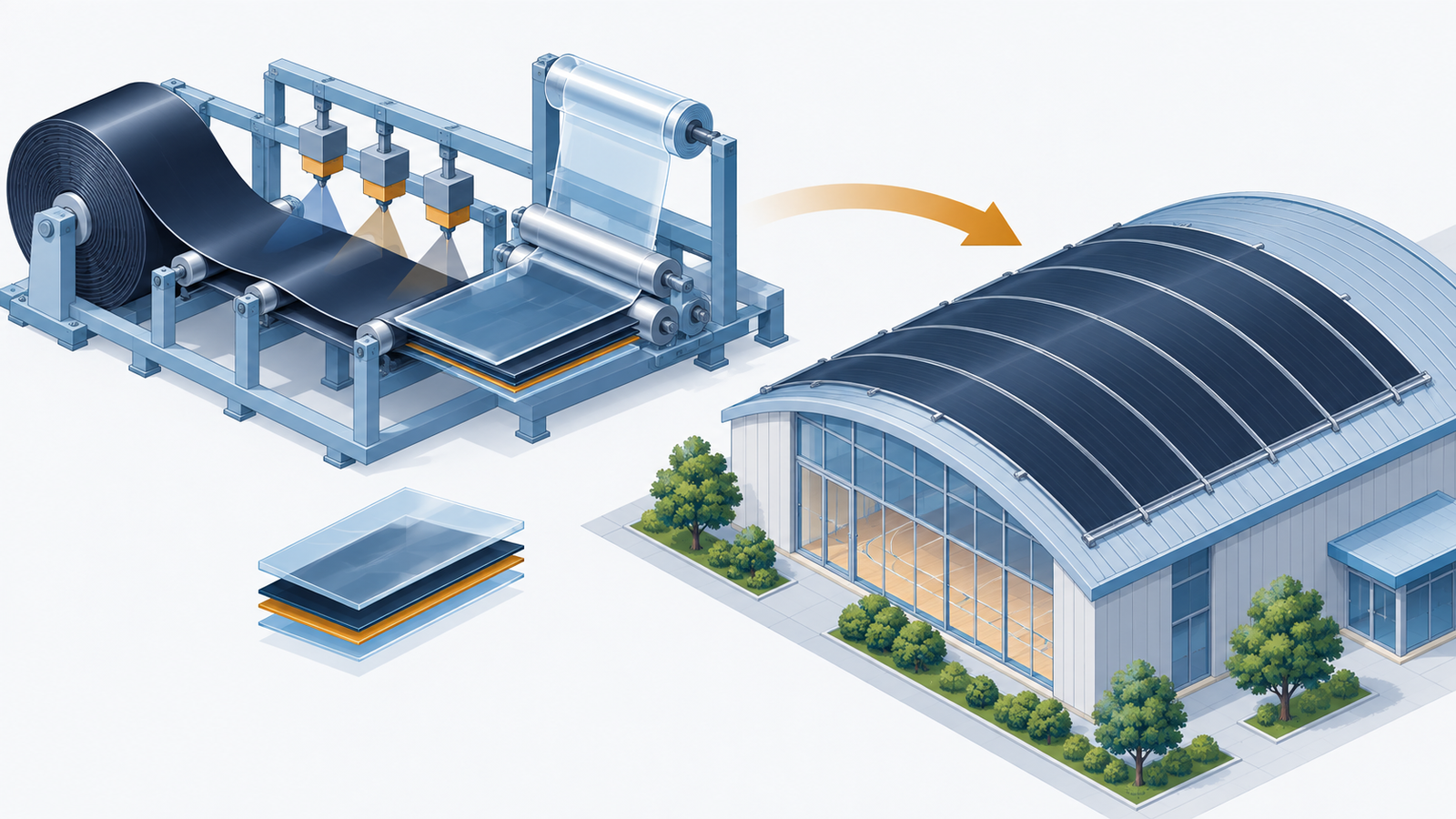
The product is a film-type (flexible), single-junction cell. The business briefing divides perovskite solar cells into three kinds, film-type, glass-type and tandem, but Sekisui Chemical commercialises only the film-type. None of the documents this article reviewed mentions any plan to commercialise glass-type cells or tandems with silicon Sourced. For the overall picture of what film-type cells offer and where they struggle, see our explainers on flexible cells and on encapsulation and barrier layers.
4. Scale (the company as a whole, in brief)
The company as a whole is not the subject here, so only its size is noted Sourced. Sekisui Chemical's fiscal year runs from April to March, so FY2025 is the year to March 2026.
| Measure | FY2024 (year to March 2025) | FY2025 (year to March 2026) | FY2026 plan (year to March 2027) |
|---|---|---|---|
| Net sales (¥ million) | 1,297,754 | 1,309,281 | - |
| Operating profit (¥ million) | 107,951 | 106,477 | - |
| R&D expenditure (¥ billion) | 44.2 | 45.6 | 47.0 |
| of which: operating profit/loss of the perovskite solar cell business (¥ billion) | - | −4.3 | −5.4 |
Net sales and operating profit are from the earnings summary; R&D expenditure and the operating result of the perovskite solar cell business (abbreviated "PV" in the company's documents) are from the results presentation. The R&D "year" covers the same period as the fiscal year. Consolidated headcount is 26,752, as listed on the company overview page.
Unusually for a large company, Sekisui Chemical discloses the operating result of its perovskite solar cell business as a separate figure within its "Other" segment Sourced. It posted an operating loss of ¥4.3 billion for FY2025 (year to March 2026) and plans a loss of ¥5.4 billion for FY2026 (year to March 2027); the actual loss for the first quarter (April to June 2026) was ¥1.3 billion. The plan for losses to widen in the year the business was launched can be read as costs running ahead of the start-up of the mass-production line, but the company has not broken them down Not yet confirmed. Sales of perovskite solar cells, on the other hand, are not disclosed.
5. Resources committed to perovskites
Apart from headcount, Sekisui Chemical is one of the companies that discloses the most, amounts included. The table groups what it has published by people, money, outside capital, public funding and research partners.
| Type of resource | What it is | Category |
|---|---|---|
| People (dedicated organisation) | A dedicated subsidiary, Sekisui Solar Film, was established on 6 January 2025 (capital ¥100 million). It has four departments: business planning, development, production engineering and manufacturing. As of the end of December 2024 the company described development as taking place "at four sites in Japan" | Sourced |
| People (headcount) | Number of staff dedicated to perovskite solar cells | Not disclosed |
| Money (line investment) | A total investment of ¥90 billion in the first production line (100 MW), including subsidies and covering the purchase of buildings and manufacturing equipment. A second line is envisaged at ¥43 billion or more and a third line (600 to 800 MW) at ¥180 billion or more (January 2025 briefing) | Sourced |
| Money (own share) | The funding plan in the business strategy vision submitted to NEDO states that, "in addition to state support", the company plans to bear around ¥60 billion itself | Sourced |
| Money (profit and loss) | Operating result of the perovskite solar cell business: −¥4.3 billion in FY2025 (year to March 2026), −¥5.4 billion planned for FY2026 (year to March 2027) | Sourced |
| Outside investment in the business | The Development Bank of Japan, a state-owned policy lender, holds 14% of Sekisui Solar Film (shareholders' agreement signed on 26 December 2024) | Sourced |
| Investments and acquisitions by Sekisui | The documents this article reviewed mention no investment in, or acquisition of, other perovskite companies by Sekisui Chemical. A basic agreement was reached (26 December 2024) to take over the buildings, power supply and cooling facilities of Sharp's main plant in Sakai | Sourced |
| Public funding (METI) | Selected for METI's GX Supply Chain Support Program, a subsidy scheme for building domestic production capacity for green-transformation (GX) products (decided 25 December 2024). Subsidy rate one half; eligible expenditure ¥314.5 billion in total (subsidy total ¥157.25 billion); production capacity of about 1 GW; period November 2024 to the end of February 2029 | Sourced |
| Public funding (NEDO) | Selected in December 2021 for the Green Innovation Fund's "Development of Next-Generation Solar Cells" (roll-to-roll manufacturing technology for ultra-lightweight solar cells). In September 2024, selected as lead applicant with TEPCO Holdings for the same fund's "Next-Generation Solar Cell Demonstration Project" | Sourced |
| Universities and research institutes | The joint implementers of the theme selected by NEDO in 2021 are the University of Tokyo and Ritsumeikan University. Agrivoltaic trials with Chiba University since March 2026 | Sourced |
The timely disclosure gives two amounts side by side: the ¥90 billion total investment in the first line (100 MW) and the ¥314.5 billion of eligible expenditure under the GX Supply Chain Support Program. The latter is a frame for production capacity of "about 1 GW", and the subsidy period runs to the end of February 2029 Sourced. Adding up the investment figures for the first to third lines in the briefing gives ¥90 billion + ¥43 billion + ¥180 billion = ¥313 billion or more, almost exactly ¥314.5 billion Our calculation. In other words, the state subsidy frame appears to have been set against the full picture of an expansion to 1 GW, and how much of it is actually used will depend on the investment decisions for the second and third lines. For those lines the company writes "investment decision based on demand trends" and "investment decision based on the results of the first production line"; neither has been decided Not yet confirmed.
6. What it has done so far
| When | What happened | Why it matters |
|---|---|---|
| December 2021 | Selected for NEDO's Green Innovation Fund project "Development of Next-Generation Solar Cells". The theme is roll-to-roll (R2R) manufacturing technology for ultra-lightweight solar cells (with the University of Tokyo and Ritsumeikan University) | Establishing a 1 m-wide manufacturing process becomes the development goal from here on |
| August 2022 | Installation at JR West's Umekita (Osaka) Station agreed. At this point the company announced "outdoor durability equivalent to 10 years" and "15.0% power generation efficiency on a 30 cm-wide R2R process" | The company's first installation in a facility open to the general public |
| December 2022 | Joint research with the Tokyo Metropolitan Government (Morigasaki Water Reclamation Center) | Tests resistance to corrosion at a sewage facility |
| March 2023 | Joint demonstration with JERA at thermal power stations (Yokosuka and Kashima) | Tests resistance to salt damage in coastal locations |
| November 2023 | Plan announced to install more than 1,000 kW rated capacity on the spandrels of a redevelopment building in Uchisaiwaicho, Tokyo (the South Tower) | The company says it is set to become "the world's first high-rise building with mega-solar power generation using PSCs" |
| February 2024 | Memorandum of understanding with the Slovak Republic for a joint study | An input to considering expansion into the European market |
| September 2024 | Selected with TEPCO Holdings for NEDO's "Next-Generation Solar Cell Demonstration Project" | Demonstrates how to install and replace cells on high-rise building walls |
| December 2024 | Board approves mass production: a 100 MW line with a total investment of ¥90 billion, establishment of Sekisui Solar Film, takeover of buildings and other assets at Sharp's Sakai plant, and selection for the GX Supply Chain Support Program | The turning point from R&D to capital investment |
| January 2025 | Sekisui Solar Film established. The business briefing presents plans for second and third lines and a sales plan | Sets out in numbers the path to about 1 GW |
| October 2025 | Starts developing an improved method for wall installation with NTT DATA and Nikkei Engineering (through March 2029) | Eliminating the wrinkles and warping peculiar to film is the challenge |
| March 2026 | Launch of the SOLAFIL business announced. Manufacturing technology for 1 m width on existing equipment, and installation specifications for metal roofs, established. Supply to the municipalities and operators selected for a Ministry of the Environment subsidy programme (Saitama City, Shiga Prefecture, West Nippon Expressway Company, Fukuoka Prefecture and Fukuoka City) and to a Tokyo Metropolitan Government programme | The move from R&D sample to product |
| March 2026 | Agrivoltaic trials over rice paddies begin with Chiba University and others, five parties in all (three years) | Farmland as a new place to install |
| April to June 2026 | Product supply begins, with two projects now operational (Shiga Prefecture and Fukuoka City) | The first deliveries |
| July 2026 | 28 panels installed on the flat roof of the Japan Maritime Self-Defense Force's Okinawa Base for a demonstration (about nine months) | Carried out as a NEDO-subsidised project |
| September 2026 | Demonstration of a lighter, cheaper "sheet specification" and a "continuous installation specification" begins in Shibushi, Kagoshima Prefecture (about three years) | The next product specification after the metal-roof model |
The official page listing the company's perovskite solar cell announcements shows more than 40 releases between 2022 and September 2026 Sourced. Most of them concern installation trials with local governments and infrastructure companies, which shows how much weight the company places on establishing installation and construction methods for each application.
7. What comes next
existing equipmentThe company says 1 m-wide manufacturing technology is established
on 1 April 2027The "operation start date" in the timely disclosure
production lineThe company says it is "aiming" for this
FY2030: ¥150 to 200 billionJanuary 2025 briefing. The latter assumes about 1 GW of capacity
| Targets of the NEDO demonstration project (business strategy vision, as of December 2025) | Target | Progress as of December 2025 (as stated by the company) |
|---|---|---|
| Mass-production capacity | 30 MW or more a year | A 1 m-wide R2R line being installed; yield being improved |
| Conversion efficiency (30 cm-wide module from R2R production) | 18% | 14.8% achieved |
| Conversion efficiency (metre-wide) | 15% | Not stated |
| Durability (product module) | Performance equivalent to 20 years confirmed | 20-year equivalence confirmed in accelerated heat and damp-heat tests |
| Barrier film | R2R production with a water vapour transmission rate of 1×10⁻² g/m²/day or less | Not stated |
| Panel cost / cost of electricity | ¥120/W / ¥14/kWh | Not stated |
| System price at mass production | ¥194/W (mounting ¥20/W, installation ¥45/W, O&M ¥2,400/kW per year) | Current installation cost calculated (amount not stated) |
None of the following appears in the primary sources this article reviewed Not yet confirmed.
Actual sales of perovskite solar cells; the selling price of the product; production volume in FY2026; investment decisions on the second and third lines (still at the concept stage); certified efficiency values from a testing body (such as AIST or JET); and any concrete plan for mass production or sales outside Japan. The briefing also cites a figure of "¥3.6 trillion for the domestic market in 2040", but this is the company's own estimate, obtained by multiplying the government's deployment target (20 GW by FY2040) by a system cost per kW. It is not an actual market figure, so this article does not use it as evidence of the company's scale.
8. What the company is aiming for in perovskite solar cells
This section goes beyond what the company says directly. It sets out inferences that can be drawn from primary sources, each with its basis.
| What can be read | Primary evidence behind it | Category |
|---|---|---|
| To become the first company in Japan with a GW-scale supply capability | The timely disclosure states that the company would like to play a central role in realising the government's goal of a GW-level supply system by 2030. The production capacity covered by the subsidy is also about 1 GW | Sourced |
| To build a track record first on lightweight public-sector roofs, then expand to private factories and warehouses | The timely disclosure and briefing say the business will initially focus on low load-bearing roofs and the public sector (such as gymnasiums that serve as evacuation centres in disasters). The first customers are also local governments | Sourced |
| To keep R&D and intellectual property in the parent, and give manufacturing and sales to the subsidiary | The business model diagram in the briefing shows Sekisui Chemical (PV Project) handling basic technology development and "licensing" it to Sekisui Solar Film. The business strategy vision says that from FY2026 the subsidiary will commission work on efficiency, durability and barrier film from Sekisui Chemical | Inference |
| To concentrate for now on film-type single-junction cells alone | No plan to commercialise glass-type or tandem cells appears in the documents reviewed | Inference |
| To compete on installation cost and lifetime rather than efficiency | The KPIs in the business strategy vision quantify mounting, installation, O&M and even power conditioner costs alongside conversion efficiency. Most releases concern installation trials | Inference |
| To decide on the second and third lines only after seeing demand | The briefing says "investment decision based on demand trends" and "investment decision based on the results of the first production line". The roadmap in the April 2026 results presentation shows only the first line | Inference |
The way the company presents its efficiency figures says something about its thinking. From 2022 to 2024 its releases consistently cited "15.0% power generation efficiency" on a 30 cm-wide R2R process, yet the business strategy vision as of December 2025 gives progress on the same 30 cm width as 14.8%, against a target of 18% Sourced. Neither document says whether the samples or conditions were the same, so this cannot be read as a decline. But rather than chasing and updating a headline number, the company sets out detailed targets for 1 m-wide manufacturing, yield and installation cost. This article reads that as a sign that Sekisui Chemical is aiming to be not "the company with the highest efficiency" but "the company that can stick consistent-quality panels onto roofs cheaply" Not yet confirmed. The fact that the "sheet specification" trial begun in September 2026 aims to make the product lighter and cheaper fits this reading.
9. Map of perovskite partnerships
10. Technology, products and services
| Item | What the company has published |
|---|---|
| Product | Film-type perovskite solar cell SOLAFIL (short for Solar Film). The first product is a specification for installation on metal roofs |
| Manufacturing method | Roll-to-roll (R2R). Moving from 30 cm width to 1 m width; the company says it has established 1 m-wide manufacturing technology on existing equipment |
| Weight and thickness | 1.0 to 1.5 kg/m², 1 to 3 mm thick, can be bent to a radius of curvature of 15 cm (comparison table in the briefing; silicon panels are 10 to 15 kg/m² and 10 to 22 mm) |
| Conversion efficiency | 15.0% for the 30 cm-wide R2R product (releases from 2022 to 2024) and 14.8% for the same (business strategy vision, as of December 2025). Both are company-reported; no testing body is named |
| Durability | Outdoor durability equivalent to 10 years confirmed (releases). 20-year equivalence confirmed in accelerated heat and damp-heat tests (business strategy vision). Both are company-reported |
| Differentiating technology | An encapsulant layer and barrier material (the proprietary material composition is patented), precision reactive coating of four active layers (at nanometre level), and microfabrication at 50 to 100 μm. The company says it identified "migration of organic components within the active layers" as a cause of degradation and solved it with proprietary materials |
| Mounting and installation | Besides metal roofs, trials are under way on combination with waterproofing materials (flat roofs), fixings made from extruded aluminium sections for walls, a light and cheap "sheet specification" and a "continuous installation specification" |
What limits the lifetime of a film-type perovskite cell is, in many cases, not the active layer itself but moisture getting in from outside. Glass on both sides lets almost no water through; film does. The target Sekisui Chemical set in its business strategy vision is R2R production of barrier film with a water vapour transmission rate of 1×10⁻² g/m²/day or less, which the company describes as "the value needed for outdoor durability equivalent to 20 years" Sourced. That is a far stricter level than ordinary packaging barrier film, and it requires both the ability to lay inorganic layers on film without defects and an encapsulant that stops water entering at the edges.
The briefing lists "film processing technology" and "encapsulation, deposition and process technologies" among the company's core technologies. Universities and other companies can catch up on coating the active layers, but this article's view is that being able to engineer the barrier and encapsulation in house is the biggest advantage a chemicals maker brings to this field Not yet confirmed. For more on encapsulation, see our explainer on encapsulation and barrier layers.
11. The risks this company carries
| Risk | Substance | Category |
|---|---|---|
| Losses come first | The perovskite solar cell business lost ¥4.3 billion at the operating level in FY2025 (year to March 2026), with a loss of ¥5.4 billion planned for FY2026 (year to March 2027). Losses are planned to widen before the 100 MW line starts up | Sourced |
| Shorter life than silicon | The comparison table in the briefing gives durability of 10 years for perovskite against 20 to 30 years for silicon. The 20-year equivalence is a company-reported result from accelerated tests | Sourced |
| Ramping up mass production | The company itself names "improving production yield" and "developing installation and construction methods" as challenges. Volume production at 1 m width begins in earnest only with the line due to start in April 2027 | Sourced |
| Certification and standards | The business strategy vision lists "failure to pass quality certification (IEC, etc.)" as a risk | Sourced |
| Lead regulation | It likewise lists "the risk of tighter regulation of lead as a raw material", and names study of lead-free products as its response | Sourced |
| Cheap imports | It likewise lists "the risk of cheaper products with the same performance coming in from overseas and from competitors" | Sourced |
| The company itself names the possibility of withdrawal | The business strategy vision states that "if quality targets are not met, withdrawal from the business will also be considered", and sets out decisions to scale back or exit if the cost-of-electricity target is missed | Sourced |
| Dependence on subsidies | The ¥90 billion total investment in the first line includes subsidies, at a rate of one half. The second and third lines also appear to be planned on the assumption of state support | Inference |
| Dependence on public-sector demand | All the first customers are subsidised projects of local governments or public programmes. When private demand will take off has not been indicated | Inference |
12. Glossary
- Perovskite solar cell
- A solar cell whose active layer is a compound with the crystal structure known as perovskite. It can be made by coating, and can be thin and light.
- Film-type (flexible)
- A format in which the active layers are built on a plastic film. Light and bendable, but encapsulation against moisture is difficult.
- Single-junction
- A solar cell with only one active layer. The term distinguishes it from tandem cells stacked on silicon.
- Roll-to-roll (R2R)
- A continuous manufacturing method in which film is unwound from a roll, coated and processed, and wound up again.
- Water vapour transmission rate
- The amount of water vapour that passes through 1 m² of film in a day. The smaller it is, the less water gets through.
- Spandrel
- The opaque part of a high-rise building's facade between the windows of one floor and the next.
- GI Fund
- The Green Innovation Fund. A fund of about ¥2 trillion that METI (Japan's Ministry of Economy, Trade and Industry) set up at NEDO to support decarbonisation technologies from development through to deployment.
- Timely disclosure
- Immediate public announcement, under stock exchange rules, of facts that could affect investment decisions in a listed company.
13. References
- Sekisui Chemical Timely disclosure, "Notice regarding the mass production of Perovskite Solar Cells" (26 December 2024; Japanese version cited, English version published under this title). The 100 MW line, total investment of ¥90 billion, outline and ownership of Sekisui Solar Film, basic agreement with Sharp, shareholders' agreement with the Development Bank of Japan, details of the GX Supply Chain Support Program selection, and schedule. https://www.sekisui.co.jp/news/2024/__icsFiles/afieldfile/2024/12/26/241226.pdf
- Sekisui Chemical "Briefing about Perovskite Solar Cell Business" (7 January 2025; Japanese version cited). Development status, differentiating technologies, product comparison table, plans and investment amounts for the second and third lines, sales plan and business model. https://www.sekisui.co.jp/ir/event/other/__icsFiles/afieldfile/2025/01/07/20250107PVK.pdf
- Sekisui Chemical and Sekisui Solar Film Release, "Launch of the SOLAFIL film-type perovskite solar cell business" (27 March 2026, in Japanese). https://www.sekisui.co.jp/news/2026/1450530_42699.html
- Sekisui Chemical "Presentation of Financial Results and the FY2026 Management Plan" for FY2025, ended 31 March 2026 (28 April 2026; Japanese version cited). Explanation of the business launch, operating result of the perovskite solar cell business (FY2025 actual and FY2026 plan) and trend in R&D expenditure. https://www.sekisui.co.jp/ir/pdf/event/20260428kg.pdf
- Sekisui Chemical "Consolidated Financial Results for the Fiscal Year Ended March 31, 2026 (Japanese GAAP)" (28 April 2026; Japanese version cited). Net sales and operating profit, and remarks on commercialising perovskite solar cells. https://www.sekisui.co.jp/ir/pdf/summary/20260428kc.pdf
- Sekisui Chemical "Presentation of Financial Results for 1Q FY2026, ending March 31, 2027" (31 July 2026; Japanese version cited). Start of product supply, two projects operational, and first-quarter operating result of the perovskite solar cell business. https://www.sekisui.co.jp/ir/pdf/event/20260731kg.pdf
- Sekisui Solar Film (published by NEDO) Business strategy vision, "Establishing mass-production technology for lightweight flexible perovskite solar cells, and field demonstration" (as of December 2025, in Japanese). R&D targets and progress, funding plan, organisation, risk factors and responses. https://green-innovation.nedo.go.jp/resources/pdf/next-generation-solar-cells/item-1-3/vision-sekisuisolafil-perovskite-002.pdf
- NEDO "Development of next-generation solar cells begins under the Green Innovation Fund Project" (28 December 2021) and Annex 1, list of planned implementers (in Japanese). The theme selected for Sekisui Chemical (lead), the University of Tokyo and Ritsumeikan University. https://www.nedo.go.jp/content/100940817.pdf
- NEDO "New 'Next-Generation Solar Cell Demonstration Project' launched under the Green Innovation Fund Project" (20 September 2024, in Japanese). https://www.nedo.go.jp/news/press/AA5_101779.html
- NEDO List of planned implementers for the "Next-Generation Single-Junction Solar Cell Demonstration Project" (Annex 1, published 6 August 2026, in Japanese). Lists Sekisui Chemical (lead) and TEPCO Holdings (selected September 2024) as an existing theme. https://www.nedo.go.jp/content/800059482.pdf
- Sekisui Chemical Release, "Film-type Perovskite Solar Cells Installed in Umekita (Osaka) Station" (3 August 2022; Japanese version cited). Outdoor durability equivalent to 10 years; 15.0% power generation efficiency on a 30 cm-wide R2R process. https://www.sekisui.co.jp/news/2022/1377721_39136.html
- Sekisui Chemical Release, "Joint research on film-type perovskite solar cells begins with the Tokyo Metropolitan Government" (2 December 2022, in Japanese). https://www.sekisui.co.jp/news/2022/1382290_40074.html
- Sekisui Chemical Release, "Commencement of Joint Demonstration Test of Perovskite Solar Cells with JERA" (27 March 2023; Japanese version cited). https://www.sekisui.co.jp/news/2023/1385520_40075.html
- Sekisui Chemical Release, "Plan for the World's First Mega Solar Power Generation in a High-Rise Building Using Film-type Perovskite Solar Cells" (15 November 2023; Japanese version cited). https://www.sekisui.co.jp/news/2023/1395109_40075.html
- Sekisui Chemical Release, "Memorandum of Understanding Signed with the Slovak Republic for Joint Study of Perovskite Solar Cells" (13 February 2024; Japanese version cited). https://www.sekisui.co.jp/news/2024/1399372_41090.html
- Sekisui Chemical and three other companies Release, "Development begins on an improved method for installing film-type perovskite solar cells on walls" (20 October 2025, in Japanese). https://www.sekisui.co.jp/news/2025/1441896_41954.html
- Sekisui Chemical and Sekisui Solar Film Release, "A first in Japan: agrivoltaic installation using film-type perovskite solar cells begins over rice paddies" (24 March 2026, in Japanese). https://www.sekisui.co.jp/news/2026/1450384_42699.html
- Sekisui Chemical and Sekisui Solar Film Release, "Demonstration test of film-type perovskite solar cells begins at a Ministry of Defense facility" (7 September 2026, in Japanese). https://www.sekisui.co.jp/news/2026/1460574_42699.html
- Sekisui Chemical and three other companies Release, "Demonstration test of new specifications for film-type perovskite solar cells begins" (14 September 2026, in Japanese). https://www.sekisui.co.jp/news/2026/1460941_42699.html
- Sekisui Chemical Corporate information: company overview (in Japanese). Year of founding, capital, headcount, and net sales and operating profit for the year to March 2026. https://www.sekisui.co.jp/company/outline/
- Sekisui Chemical "Announcements on perovskite solar cells" (list of releases, in Japanese). https://www.sekisui.co.jp/news/PSC/
14. Claim-to-source audit
| Claim in the article | Category | Source |
|---|---|---|
| Legal name, listing venue, year of founding, capital, headcount of 26,752 | Sourced | Reference 20 https://www.sekisui.co.jp/company/outline/ |
| Net sales and operating profit (years to March 2025 and March 2026) | Sourced | Reference 5 https://www.sekisui.co.jp/ir/pdf/summary/20260428kc.pdf |
| R&D expenditure (¥44.2 billion, ¥45.6 billion, ¥47.0 billion planned); operating loss of the perovskite solar cell business of ¥4.3 billion, with ¥5.4 billion planned | Sourced | Reference 4 https://www.sekisui.co.jp/ir/pdf/event/20260428kg.pdf |
| First-quarter operating loss of ¥1.3 billion; start of product supply and two projects operational (Shiga Prefecture and Fukuoka City) | Sourced | Reference 6 https://www.sekisui.co.jp/ir/pdf/event/20260731kg.pdf |
| 100 MW line, total investment of ¥90 billion (including subsidies), planned start on 1 April 2027, and the aim of GW scale by 2030 | Sourced | Reference 1 https://www.sekisui.co.jp/news/2024/__icsFiles/afieldfile/2024/12/26/241226.pdf |
| Sekisui Solar Film's date of establishment, capital and ownership (86% and 14%); basic agreement with Sharp; shareholders' agreement with the Development Bank of Japan | Sourced | Reference 1 https://www.sekisui.co.jp/news/2024/__icsFiles/afieldfile/2024/12/26/241226.pdf |
| GX Supply Chain Support Program: subsidy rate of one half, eligible expenditure of ¥314.5 billion, subsidy total of ¥157.25 billion, about 1 GW, period | Sourced | Reference 1 https://www.sekisui.co.jp/news/2024/__icsFiles/afieldfile/2024/12/26/241226.pdf |
| Second line envisaged at ¥43 billion or more, third line at ¥180 billion or more; sales plan (¥25 billion or more in FY2028, ¥150 to 200 billion in FY2030) | Sourced | Reference 2 https://www.sekisui.co.jp/ir/event/other/__icsFiles/afieldfile/2025/01/07/20250107PVK.pdf |
| Differentiating technologies (encapsulation, deposition, materials and processing); weight, thickness, radius of curvature and durability in the product comparison table; development at four sites in Japan; challenges (yield and installation) | Sourced | Reference 2 https://www.sekisui.co.jp/ir/event/other/__icsFiles/afieldfile/2025/01/07/20250107PVK.pdf |
| The investment in the first to third lines adds up to ¥313 billion or more, almost exactly the ¥314.5 billion of eligible expenditure | Our calculation | Our own sum of the amounts in references 1 and 2 |
| Launch of the SOLAFIL business; 1 m-wide manufacturing technology and metal-roof installation specifications established; the municipalities and operators to be supplied; limited production volume in FY2026 | Sourced | Reference 3 https://www.sekisui.co.jp/news/2026/1450530_42699.html |
| Targets in the business strategy vision (30 MW a year, 18%, 15%, 20-year equivalence, water vapour transmission rate, ¥120/W, ¥14/kWh, ¥194/W) and progress (14.8%, 20-year equivalence in accelerated tests) | Sourced | Reference 7 https://green-innovation.nedo.go.jp/resources/pdf/next-generation-solar-cells/item-1-3/vision-sekisuisolafil-perovskite-002.pdf |
| Around ¥60 billion borne by the company; Sekisui Solar Film's four departments; commissioning of development from FY2026; risk factors (IEC certification, lead regulation, cheap imports, possible withdrawal) | Sourced | Reference 7 https://green-innovation.nedo.go.jp/resources/pdf/next-generation-solar-cells/item-1-3/vision-sekisuisolafil-perovskite-002.pdf |
| Selection for NEDO's GI Fund in December 2021, with the University of Tokyo and Ritsumeikan University as joint implementers | Sourced | Reference 8 https://www.nedo.go.jp/content/100940817.pdf |
| Launch of NEDO's "Next-Generation Solar Cell Demonstration Project" in September 2024, and selection of Sekisui Chemical and TEPCO Holdings | Sourced | References 9 and 10 https://www.nedo.go.jp/content/800059482.pdf |
| 15.0% power generation efficiency on 30 cm-wide R2R and outdoor durability equivalent to 10 years (company-reported); installation at Umekita Station | Sourced | Reference 11 https://www.sekisui.co.jp/news/2022/1377721_39136.html |
| Joint research with the Tokyo Metropolitan Government; joint demonstration with JERA | Sourced | References 12 and 13 https://www.sekisui.co.jp/news/2023/1385520_40075.html |
| Plan to install more than 1,000 kW rated capacity on the Uchisaiwaicho South Tower | Sourced | Reference 14 https://www.sekisui.co.jp/news/2023/1395109_40075.html |
| Memorandum of understanding with the Slovak Republic | Sourced | Reference 15 https://www.sekisui.co.jp/news/2024/1399372_41090.html |
| Development of a wall installation method with NTT DATA and Nikkei Engineering | Sourced | Reference 16 https://www.sekisui.co.jp/news/2025/1441896_41954.html |
| Agrivoltaic trials with Chiba University and four other parties | Sourced | Reference 17 https://www.sekisui.co.jp/news/2026/1450384_42699.html |
| Demonstration at the Maritime Self-Defense Force's Okinawa Base (28 panels, about nine months, NEDO-subsidised) | Sourced | Reference 18 https://www.sekisui.co.jp/news/2026/1460574_42699.html |
| Demonstration of the "sheet specification" and "continuous installation specification" in Shibushi, Kagoshima Prefecture | Sourced | Reference 19 https://www.sekisui.co.jp/news/2026/1460941_42699.html |
| More than 40 releases since 2022 | Sourced | Reference 21 https://www.sekisui.co.jp/news/PSC/ |
| The three types of perovskite solar cell company | Our calculation | Our own classification. Companies shown are examples from those covered in this series |
| Perovskite solar cell sales, selling price, production volume, dedicated headcount, investment decisions on the second and third lines, and plans for mass production outside Japan | Not yet confirmed | Not in references 1 to 7. This article makes no estimate |
| Certified conversion efficiency from a testing body | Not yet confirmed | Not in the primary sources this article reviewed. The 15.0% and 14.8% figures are treated as company-reported |
| The figure of ¥3.6 trillion for the domestic market in 2040 | Not yet confirmed | The company's own estimate in reference 2: a government target multiplied by a cost. This article does not use it as evidence of scale https://www.sekisui.co.jp/ir/event/other/__icsFiles/afieldfile/2025/01/07/20250107PVK.pdf |
| The reading that R&D and intellectual property stay with the parent while manufacturing and sales go to the subsidiary | Inference | This article's interpretation of the business model diagram in reference 2 and the commissioning arrangement in reference 7 |
| The reading that the company will concentrate on film-type single-junction cells for now | Inference | This article's interpretation of the absence of any glass-type or tandem plan |
| The reading that the company competes on installation cost and lifetime rather than efficiency | Inference | This article's interpretation of how the KPIs in reference 7 are set and of the content of the demonstration releases |
| The reading that the second and third lines will be decided after seeing demand | Inference | This article's interpretation of the wording in reference 2 and the roadmap in reference 4 |
| The view that engineering the barrier and encapsulation in house is the biggest advantage | Inference | This article's commentary based on the barrier film target in reference 7 |
| The risks of dependence on subsidies and on public-sector demand | Inference | This article's interpretation of the content of references 1 and 3 |
Last updated 25 September 2026 / Troy Technical
Every figure in this article comes from Sekisui Chemical's timely disclosures, results materials and official releases, the business strategy vision Sekisui Solar Film submitted to NEDO, and documents published by NEDO. No research-firm estimates or press-based figures have been used. Passages marked "Inference" are this article's interpretation of primary sources, not statements made by the company.