COMPANY PROFILE / PEROVSKITE SOLAR CELLS
Swift Solar
A U.S. perovskite start-up that got hold of a silicon factory first
Swift Solar is a U.S. start-up founded in 2017 by researchers from MIT, Stanford University and NREL (the U.S. National Renewable Energy Laboratory), working on tandem solar cells that stack perovskite on silicon. In March 2026 it announced that it had acquired the manufacturing assets and intellectual property of Meyer Burger, the struggling Swiss solar manufacturer. The sequence is: first mass-produce proven silicon heterojunction (HJT) cells in the U.S., then add perovskite in the same factory and move on to tandems. Swift Solar is privately held and publishes no financial statements, so this profile uses only the company's own announcements and U.S. government publications to separate what is settled from what cannot yet be seen.
- Swift Solar in 30 seconds, and where it stands in perovskite solar cells
- The logo and how the name is written
- Where the company sits in the perovskite solar landscape
- Scale (revenue is not disclosed, so we look at funding)
- Resources committed to perovskites
- Track record so far
- Plans ahead
- What the company is aiming for in perovskite solar cells
- Partnership map
- Technology, products and services
- The risks this company carries
- Glossary, references and claim-to-source audit
1. Swift Solar in 30 seconds, and where it stands in perovskite solar cells
California, U.S.Dateline of its press releases and the address registered with SBIR
start-upSince 2026 it also owns silicon HJT volume-production assets
(two-terminal)Bottom cell is heterojunction (HJT) silicon
through Series AAnnounced June 2024. Described in 2025 as "over $60M"
assets and IPAnnounced March 2026. Price not disclosed
Companies working on perovskite solar cells fall into three broad groups: established PV makers, perovskite start-ups, and newcomers from materials, chemicals and electronics. Swift Solar was founded as a perovskite start-up, but in March 2026 it acquired Meyer Burger's gigawatt-scale HJT manufacturing equipment, patent portfolio and manufacturing team Sourced, and it is now trying to follow, in reverse and from the start-up side, the incumbents' route of building on silicon volume production. In the company blog, CEO Joel Jean set out the plan in order: "Step 1: Build a GW-scale HJT cell and module factory in the US" and "Step 2: Add perovskite tandems to that same factory" Sourced. So the company's first volume product is planned to be a silicon HJT cell, not a perovskite.
2. The logo and how the name is written

The Swift Solar logo is a trademark of the company. We have not recreated it with generated imagery;
the image was taken from the official website and is placed here as img/swift_solar_logo.png.
Because the lettering in the logo is white, it is shown on a dark background.
A note on names: the legal entity is Swift Solar Inc. (the copyright notice on the official website, and the issuer name on press releases from October 2025 onwards). Japanese-language coverage writes the name phonetically in katakana; this series uses the Latin-alphabet name throughout. Meyer Burger, whose assets it acquired, is a Swiss solar manufacturer and a separate company from Swift Solar.
Official site: https://www.swiftsolar.com/3. Where the company sits in the perovskite solar landscape
In terms of product format, Swift Solar's main focus is a tandem on silicon (two-terminal, monolithic). In an August 2025 technical blog post, the company states plainly that "Two-terminal (2T) perovskite-silicon tandems outperform 4T tandems", and explains why it concentrates on 2T Sourced. In its early years it championed lightweight, flexible all-perovskite tandems (the 2019 introductory blog post, the subject of its Navy SBIR award, and the title of its joint research report with NREL), but from 2024 onwards its published material has shifted its weight to tandems on silicon. The final report of the joint research with NREL (submitted in 2024) also records that Swift's business focus shifted during the project Sourced.
4. Scale (revenue is not disclosed, so we look at funding)
Swift Solar is privately held and does not publish revenue, profit or loss, or cash on hand. It has no obligation to file financial reports with the U.S. SEC either, so a revenue history cannot be compiled Not yet confirmed. Instead we gauge its size from the cumulative funding the company itself has announced in press releases and the public funding awards recorded in U.S. government databases.
| When | What the company announced | Amount | Where stated |
|---|---|---|---|
| December 2020 | Series Seed 2 (more than US$8 million, with a further US$1.5 million expected, for a total of US$9.6 million). Cumulative equity funding at that point: more than US$16 million | US$9.6 million (expected) | Official release |
| June 2024 | Series A closed, co-led by Eni Next and Fontinalis Partners | US$27 million | Official release |
| June 2024 | Cumulative funding including the Series A | US$44 million | Official release |
| June 2024 | Federal and state grants (DOE, Department of Defense, NSF, California Energy Commission) | Over US$16 million | Official release |
| June to November 2025 | Total funding from VCs, strategic investors and government agencies | Over US$60 million | Official releases (same wording in three) |
Subtracting the US$27 million Series A from the "US$44 million in total" of June 2024 leaves about US$17 million raised before it Our calculation. That is broadly consistent with the "more than US$16 million" of cumulative equity funding the company cited in December 2020. The "over $60M" figure used from 2025 onwards, on the other hand, is stated explicitly to include money from government agencies, so it is not a figure for equity funding alone Sourced. Whether any new equity has been raised since June 2024 cannot be confirmed from the company's published material Not yet confirmed.
On headcount, the U.S. Small Business Administration's SBIR database records 38 employees Sourced. But this is a value the company entered when applying to SBIR, and no date is shown for it. Headcount after the Meyer Burger manufacturing team joined in March 2026 has not been disclosed Not yet confirmed.
5. Resources committed to perovskites
Since its founding Swift Solar has done nothing but perovskite tandems, so most of what the company spends can be taken as spending on perovskites. From March 2026, however, it has taken on a large area of spending that is not perovskite: starting up volume production of silicon HJT.
| Resource | Details | Category |
|---|---|---|
| People (R&D) | The founders are perovskite researchers. CTO Tomas Leijtens and Chief Scientific Officer Giles Eperon are former NREL staff scientists. The website says Leijtens "co-developed first perovskite-silicon and all-perovskite tandem solar cells" and Eperon "co-developed first all-perovskite tandem cells" | Sourced |
| People (manufacturing) | Former Meyer Burger CEO Gunter Erfurt (Silicon Manufacturing Lead) and former Head of Global R&D Marcel König (Silicon Technical Lead) have joined. The VP Manufacturing was VP Manufacturing at Bloom Energy, and the VP Hardware Engineering was Director of Equipment Development at First Solar | Sourced |
| People (headcount) | 38 in the SBIR database (date unknown). The number who moved from Meyer Burger has not been disclosed | Sourced / not disclosed |
| Money (equity funding) | US$44 million in total through the Series A (June 2024). No later equity funding can be confirmed from published material | Sourced |
| Money (R&D and line investment) | R&D spending, investment in the prototype line, and investment in the planned factory | Not disclosed |
| Assets acquired from outside | Acquired Meyer Burger's manufacturing assets and intellectual property (GW-scale HJT manufacturing equipment, a global patent portfolio and the manufacturing team) in March 2026. Price and location of the equipment not disclosed | Sourced |
| Public funding (DOE) | US$7 million for the project PIPPIN under the DOE Solar Energy Technologies Office's "Advancing U.S. Thin-Film Solar Photovoltaics" programme (with US$1.8 million of cost share; selected May 2024). Separately, DOE funding for work on reverse bias in perovskite modules (award number DE-EE0009517) | Sourced |
| Public funding (SBIR / STTR) | Five awards from the NSF, the Navy and the Army, totalling US$2,925,920 (2019 to 2025) | Sourced |
| Universities and research institutes | The company says its technology is backed by exclusive IP from MIT, Stanford and NREL. Joint research with NREL from October 2019 to January 2024 (DOE Technology Commercialization Fund). Works with the University of California San Diego (UCSD) on the Army STTR. Stanford University is also an investor in the Series A | Sourced |
Line up the research topics the U.S. government has funded at Swift Solar and it is clear they are weighted towards durability rather than efficiency Sourced. The DOE reverse-bias project tackles shaded cells being damaged; the Army STTR, impurities in the raw materials (precursors) that govern lifetime; and PIPPIN, the durability and reproducibility of vapour-deposited tandems. The Army STTR award summary in particular reports a first-phase result: stability fell sharply between small unencapsulated cells and glass-encapsulated mini-modules. This shows the company itself running into a classic wall in this field, where the lifetime achieved in cells does not carry over to modules Sourced.
The issues covered in our explainer on encapsulation and barrier layers appear here concretely, in a public document: a U.S. Army award summary. The company's website claims a "30 years equivalent lifetime", but this is a company claim based on a conference presentation, not a third-party certification.
6. Track record so far
| When | What happened | What it means |
|---|---|---|
| 2017 | Founded as a spin-out of MIT, Stanford University and NREL | Starts as a researcher-led perovskite start-up |
| 2019 | Introductory blog post describes "efficient, lightweight, and flexible solar products". Wins an NSF SBIR Phase I award (US$225,000) | The original target was lightweight, flexible applications |
| October 2019 to January 2024 | Joint research with NREL (wide-bandgap perovskite absorbers and recombination layers for tandems) | The final report records that the business focus shifted along the way |
| 2020 | Navy SBIR (lightweight tandems by vapour deposition). Raises more than US$8 million in Series Seed 2 in December | The choice of vapour deposition as a process is visible from around this time |
| 2021 | NSF SBIR Phase II (US$1 million). DOE funding for work on reverse bias | Research widens to reliability at module level |
| May 2024 | DOE selects PIPPIN (perovskite-silicon tandem solar cells from prototype to production) for US$7 million | The shift towards tandems on silicon is backed by public funding |
| June 2024 | Raises US$27 million in a Series A (US$44 million in total). Says it "prepares to break ground on its first factory" | A factory plan is announced for the first time |
| 2024 to 2025 | Army STTR (managing precursor impurities), Phases I and II | Goes into the purity of raw materials that governs lifetime |
| June 2025 | Partnership with American Tower to evaluate deployment on U.S. telecom towers | Distributed uses beyond the grid |
| August 2025 | At the Department of Defense's Cyber Fortress exercise (Virginia), U.S.-made perovskite tandem panels are integrated into a mobile microgrid and demonstrated (announced in October) | The company calls it "one of the first operational deployments of perovskite solar technology in the United States" |
| August 2025 | Technical blog post explains why it concentrates on two-terminal tandems | The product structure is made clear |
| November 2025 | Partnership with Plenitude, part of Eni: utility-scale pilot testing at U.S. power plants and evaluation of long-term supply arrangements | The first concrete prospective customer in utility-scale power |
| March 2026 | Acquires Meyer Burger's manufacturing assets and intellectual property. Former CEO Erfurt and former head of global R&D König among those joining | A switch to mass-producing silicon HJT before perovskites |
| September 2026 | Announces a new product management department. The next milestone is "securing certifications for our foundational HJT products" | Entering the stage of reliability testing and certification for a volume product |
7. Plans ahead
cells and modulesNot perovskite
in the same factoryStep 2 of the CEO's three steps
In the October 2025 release on the demonstration with the Department of Defense, the company wrote that it is ready to scale its U.S. manufacturing, "with commercial production ramping up within 24 months" Sourced. Counting simply from the announcement date, that points to around October 2027 Our calculation. The blog post on the Plenitude partnership in November 2025 likewise speaks of bringing its U.S. manufacturing facility online "over the next 24 months". Then in July 2026 the VP of Finance said on the company blog that by the end of his first year he would "love to land the financing we need to build that first factory", which shows that funding for the factory had not yet been secured Sourced.
None of the following appears in the company's published material Not yet confirmed.
The factory's location / production capacity (GW) / investment / dates for groundbreaking and start-up / the number, location and purchase price of the equipment acquired from Meyer Burger / the launch date and price of tandem products / the value and volumes of the agreements with Plenitude and American Tower. Figures of the "Swift Solar to build an X GW factory in state Y" kind exist in press reports, and this article does not use them.
8. What the company is aiming for in perovskite solar cells
This section includes things the company does not say directly. We set them out as inferences within what the primary sources support, with the evidence for each.
| What the evidence suggests | Primary information it rests on | Category |
|---|---|---|
| It has secured a way to generate revenue before perovskite volume production | The VP of Commercial Strategy explained on the company blog that HJT cells can be offered to early customers very quickly, "while generating revenues to support the long-term commercialization of tandems" | Sourced |
| Its way in is demand for U.S.-made cells | The CEO writes that the HJT factory will serve "customers eager to buy American-made cells today", and cites tax credits, tariffs and supply-chain reshoring as tailwinds | Inference |
| It has narrowed the tandem structure to two-terminal with an HJT bottom cell | The August 2025 post on 2T's superiority, and the March 2026 post calling HJT the ideal foundation for tandems. The company estimates up to 3% (absolute) higher efficiency than with TOPCon | Sourced |
| Its first target customers are utility-scale developers, and space and defence | The utility pilot with Plenitude and the demonstration with the Department of Defense. Posts by the VP of Finance and the head of product management return repeatedly to space, and the HJT technical post mentions the radiation tolerance of p-type HJT | Inference |
| The original lightweight, flexible route has receded into the background | The SBIR awards of 2019 to 2021 centred on flexible all-perovskite tandems, while published material from 2024 onwards centres on tandems with silicon. The NREL report also records the shift in focus | Inference |
The Series A release of June 2024 said the company "prepares to break ground on its first factory" Sourced. Two years later, in July 2026, the VP of Finance named as his first-year goal to "land the financing we need to build that first factory" Sourced. In between came the acquisition of Meyer Burger's assets in March 2026. We read this sequence as follows: unable to raise enough for a perovskite-only factory, the company recast the plan to make proven HJT first, so that it can present the plant to investors and customers as "a factory that will generate revenue" Not yet confirmed. The company has not explained the change of plan in these terms, however, and it has not disclosed its funding position. This remains our interpretation.
9. Partnership map
10. Technology, products and services
As of September 2026, no product on sale from Swift Solar could be confirmed Not yet confirmed. Below are the technology the company has described, and its claims on efficiency and durability.
| Item | What the company has published |
|---|---|
| Cell structure | A perovskite-silicon two-terminal (monolithic) tandem. The company says losses from reflection and parasitic absorption in the electrodes are smaller than in four-terminal tandems, giving 7% relative (2% absolute) higher module efficiency and annual energy production |
| Bottom cell | Heterojunction (HJT) silicon. Reasons given include amorphous silicon passivation, texturing on both sides, a low temperature coefficient and fewer process steps |
| Perovskite deposition | Vapour deposition (according to the DOE description of PIPPIN), with in-process measurements to improve reproducibility |
| Module reliability | A patented technology that builds bypass diodes into the cell stack (a result of the DOE-funded work), to prevent cells being damaged by shading |
| Future structure | The company says a perovskite-perovskite-silicon triple junction raises the practical limit from 39% to 44% |
| Near-term product | HJT cells and modules from the Meyer Burger assets (not tandems). Certification is the next milestone |
| Efficiency and durability claim | Cell or module, and area | Certified? |
|---|---|---|
| "Exceeding silicon world record" efficiency (official website) | Neither cell/module nor area stated | Company-reported. No testing body named |
| Module efficiency "expected to achieve module efficiencies of 28% or higher" (November 2025 release). A blog post the same day says efficiencies are "reaching 28% and higher" | Module. Area not stated | Company-reported. The release says "expected" and the blog "reaching": the wording differs |
| "Up to 30% more power than today's solar panels" (October 2025 release). The blog says 30% to 50% | Not stated | Company-reported |
| "30 years equivalent lifetime" (official website) | Not stated | Company-reported. Footnoted to a 2024 conference presentation |
| "Full-size cell efficiency within 10% of lab record" (official website) | Full-size cell. The figure itself is not disclosed | Company-reported |
| NREL's Best Research-Cell Efficiency chart and Champion Module Efficiencies chart (both revised 17 July 2026) | - | Swift Solar's name does not appear |
Checking the claim of "up to 40% more power from the same footprint" against the company's own "28% or higher" and "conventional solar panels at 20–24%": 28 ÷ 20 = 1.40, the value you get only when the comparison is taken at the low end, 20%. Against 24%, 28 ÷ 24 ≈ 1.17, an increase of only about 17% Our calculation. How to read efficiency figures is covered in our explainer on conversion efficiency and evaluation metrics.
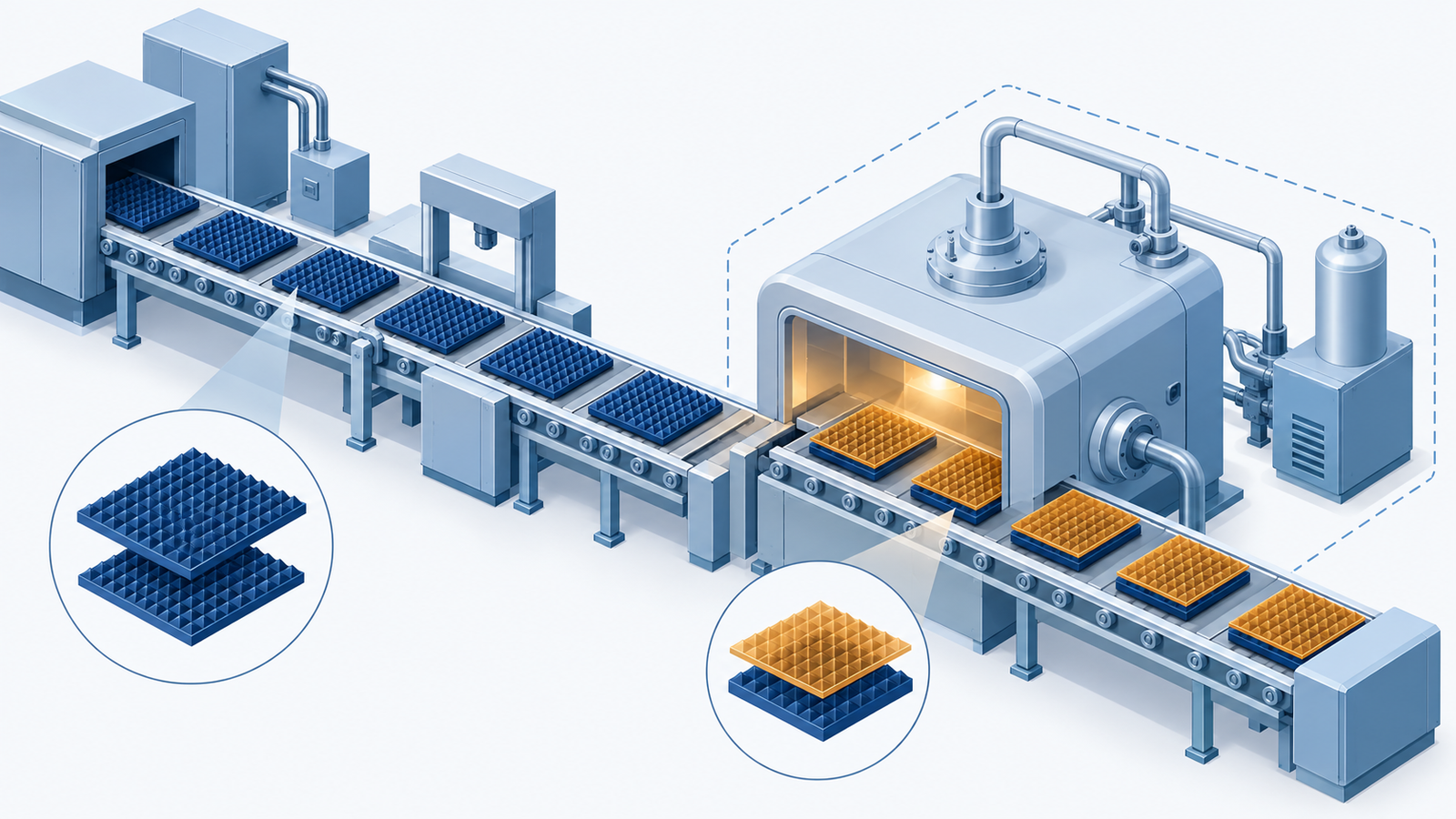
Mass-produced silicon cells have pyramid-shaped surface texture a few micrometres high to trap light. As the company explains, HJT is textured on both sides, so when a perovskite layer about one micrometre thick is laid on top, a coated solution tends to pool in the valleys and leave the peaks thin. Vapour deposition follows the texture more readily, which is why it is generally regarded as a good match for making tandems without flattening the texture Inference.
The company also explains that HJT's amorphous silicon layers electrically isolate the top and bottom cells, improving tolerance to small defects in the thin perovskite layer Sourced. In the early stage of a volume ramp, what decides profitability is less the peak efficiency than whether a defect turns into a reject (yield). From a materials and process standpoint, it makes sense that one reason for choosing HJT is this "insurance for yield". For the difference between coating and evaporation, see also our explainer on solution coating.
11. The risks this company carries
| Risk | Details | Category |
|---|---|---|
| Finances cannot be seen | Privately held, with no published revenue, profit or loss, or cash. The sustainability of its funding cannot be checked from outside | Not yet confirmed |
| Factory funding not secured | In 2024 it announced that it was preparing to break ground on its first factory, yet as of July 2026 the VP of Finance still named landing the financing for the first factory as his goal | Sourced |
| Efficiency and lifetime not certified by third parties | Not listed in NREL's efficiency charts; the efficiency and lifetime figures on the website and in releases are all company-reported | Sourced |
| Where the inherited technology comes from | The website says König "carried the core team through insolvency into Swift". Equipment and technology from a company that failed have to be brought back into volume production in the U.S. | Sourced |
| A silicon technology that differs from the mainstream | The company itself notes that "most silicon cell manufacturing today uses TOPCon technology", and chose HJT anyway. Sources of equipment and materials may be more limited than for the mainstream | Inference |
| Customer relationships at the evaluation stage | Plenitude: pilot testing and evaluation of long-term supply arrangements. American Tower: evaluation of deployment. No purchase agreement has been announced | Sourced |
| Schedule slipping | Whether "commercial production ramping up within 24 months" (October 2025) refers to HJT or tandems is not stated. No start date for tandem volume production has been given | Not yet confirmed |
12. Glossary
- Perovskite solar cell
- A solar cell whose light-absorbing layer is a metal halide material with the perovskite crystal structure. It can be made thin and absorbs light strongly.
- Tandem
- A structure that stacks two kinds of cell absorbing different wavelengths, using more of the sunlight. It can exceed the limit of silicon alone.
- Two-terminal (2T) / four-terminal (4T)
- 2T integrates the top and bottom cells in series as one device; 4T takes power from the top and bottom cells as separate circuits.
- HJT (heterojunction)
- A cell whose crystalline silicon is covered on both sides with thin amorphous silicon. High voltage and little loss of output with temperature.
- TOPCon
- A cell with an ultra-thin oxide layer and a polycrystalline silicon layer on the rear; today's mainstream mass-produced silicon cell.
- Vapour deposition
- A way of heating material in a vacuum so that it evaporates and builds up as a thin film on a substrate; the counterpart to coating from solution.
- Bypass diode
- A component that routes current around a shaded cell, preventing the shaded cell from being damaged by reverse voltage.
- SBIR / STTR
- U.S. government R&D funding programmes for small businesses. Phase I supports feasibility and Phase II prototyping. STTR requires collaboration with a research institution.
13. References
- Swift Solar Inc. Official website, home page. Description of the company, claims on efficiency, lifetime and full-size cells, the company name (copyright notice), and source of the logo image. https://www.swiftsolar.com/
- Swift Solar Inc. Official website, About page. What the company does (from HJT bottom cells to perovskite top cells) and the backgrounds of its leadership (Erfurt, König, the VP Manufacturing, the VP Hardware Engineering and the co-founders). https://www.swiftsolar.com/about
- Swift Solar Press release, "Swift Solar Announces $27 Million Series A Funding Round" (12 June 2024). US$27 million Series A co-led by Eni Next and Fontinalis Partners, participating investors (including Stanford University), US$44 million in total, preparation to break ground on its first factory, more than US$16 million in federal and state grants, and founding in 2017 as a spin-out. https://www.prnewswire.com/news-releases/swift-solar-announces-27-million-series-a-funding-round-302170435.html
- Swift Solar Press release, "Swift Solar Secures Over $8M in Series Seed 2 Funding with Climate Tech and Deep Tech Investors" (15 December 2020). Amount of the Seed 2 round, more than US$16 million in cumulative equity funding, and support from the NSF, DOE and Office of Naval Research. https://www.prnewswire.com/news-releases/swift-solar-secures-over-8m-in-series-seed-2-funding-with-climate-tech-and-deep-tech-investors-301192925.html
- Swift Solar Press release, "Swift Solar Partners with American Tower Corporation to Evaluate Advanced Perovskite Solar Technology for Critical Infrastructure" (16 June 2025). The partnership with American Tower, more than 40 patents and over US$60 million in funding. https://www.prnewswire.com/news-releases/swift-solar-partners-with-american-tower-corporation-to-evaluate-advanced-perovskite-solar-technology-for-critical-infrastructure-302481979.html
- Swift Solar Inc Press release, "Swift Solar and DoD Showcase First US Perovskite Solar Deployment for Defense" (24 October 2025). The demonstration at the Cyber Fortress exercise in August 2025, REI's mobile microgrid, up to 30% more power, and commercial production ramping up within 24 months. https://www.prnewswire.com/news-releases/swift-solar-and-dod-showcase-first-us-perovskite-solar-deployment-for-defense-302594253.html
- Swift Solar Inc. Press release, "Swift Solar Announces Cooperation with Plenitude for Next-Generation Solar Technology" (24 November 2025). Pilot testing with Plenitude and evaluation of long-term supply arrangements, Eni Next as a strategic investor, and module efficiency expected to reach 28% or higher. https://www.prnewswire.com/news-releases/swift-solar-announces-cooperation-with-plenitude-for-next-generation-solar-technology-302623705.html
- Swift Solar Inc. Official blog, "Silicon Today, Tandems Tomorrow" (Joel Jean, 12 March 2026). Acquisition of Meyer Burger's manufacturing assets and intellectual property, the GW-scale HJT equipment, patent portfolio and manufacturing team, and the three-step plan. https://www.swiftsolar.com/news/silicon-today-tandems-tomorrow
- Swift Solar Inc. Official blog, "HJT: The Ideal Foundation for Tandem Solar" (31 March 2026). Six reasons for choosing HJT as the bottom cell, an estimated efficiency gain of up to 3% (absolute) over TOPCon, defect tolerance, and the fact that most manufacturing today uses TOPCon. https://www.swiftsolar.com/news/hjt-the-ideal-foundation-for-tandem-solar
- Swift Solar Inc. Official blog, "2T is the True T(andem)" (26 August 2025). Comparison of two-terminal and four-terminal tandems, why it concentrates on 2T, and a practical limit rising from 39% to 44% with triple junctions. https://www.swiftsolar.com/news/2t-is-the-true-t-andem
- Swift Solar Inc. Official blog, "Swift Solar tackles reverse bias stability of perovskite solar cells, with DOE funding" (7 December 2022). DOE funding for reverse-bias work (DE-EE0009517), collaboration with NREL and Energy Materials Corporation, and the patented technology that builds bypass diodes into the cell stack. http://swiftsolar.com/news/swift-solar-tackles-reverse-bias-stability-of-perovskite-solar-cells-with-doe-funding
- U.S. Department of Energy (DOE) Advancing U.S. Thin-Film Solar Photovoltaics Funding Program (selections announced 16 May 2024). Swift Solar's project "PIPPIN: Perovskite-Silicon Tandem Solar Cells from Prototype to Production", DOE award of US$7 million, cost share of US$1.8 million, and the description of tandems made by vapour deposition. https://www.energy.gov/cmei/systems/advancing-us-thin-film-solar-photovoltaics-funding-program
- U.S. Small Business Administration, SBIR.gov Company Portfolio, "SWIFT SOLAR INC". Registered address, 38 employees, five SBIR/STTR awards and their amounts (US$2,925,920 in total), and the Army STTR award summary. https://www.sbir.gov/portfolio/1405915
- NREL (via OSTI.GOV) Final technical report, "Flexible Perovskite-Perovskite PV for Mobile Power Applications". Joint research with Swift Solar (October 2019 to January 2024) and the shift in Swift's business focus during the project. https://www.osti.gov/biblio/2481051
- Swift Solar Inc. Official blog, "Meet the Team: Sebastian Neelamkavil, VP of Finance" (10 July 2026). The three agreements with Meyer Burger, the goal of financing the first gigawatt-scale factory, and space applications. https://www.swiftsolar.com/news/meet-the-team-sebastian-neelamkavil-vp-of-finance
- Swift Solar Inc. Official blog, "Meet the Team: Geoff Dunican, VP of Commercial Strategy" (13 May 2026). The explanation that revenue from HJT cells will support the commercialisation of tandems. https://www.swiftsolar.com/news/meet-the-team-geoff-dunican-vp-of-commercial-strategy
- Swift Solar Inc. Official blog, "Meet the Team: Nasim Sahraei, Head of Strategic Programs & Product Management" (16 September 2026). The new product management department, and certification of HJT products as the next milestone. https://www.swiftsolar.com/news/meet-the-team-nasim-sahraei-pm-department-lead
- Swift Solar Inc. Official blog, "Partnering with Eni Plenitude to Unlock US Utility-Scale Perovskite Solar Deployment" (24 November 2025). Eni Next as a strategic investor since 2023, the wording "reaching 28% and higher" for module efficiency, and the plan to bring its U.S. manufacturing facility online over the next 24 months. https://www.swiftsolar.com/news/partnering-with-eni-plenitude-to-unlock-us-utility-scale-perovskite-solar-deployment
- Swift Solar Inc. Official blog, "Swift Solar and the DoD: Powering US Leadership in Next-Generation Solar" (27 October 2025). What happened at the Cyber Fortress exercise, and the claim of a 30% to 50% power increase. https://www.swiftsolar.com/news/swift-solar-and-the-dod-powering-us-leadership-in-next-generation-solar
- Swift Solar Inc. Official blog, "Introducing Swift Solar" (11 April 2019). The founding business goal (efficient, lightweight and flexible solar products). http://swiftsolar.com/news/introducing-swift-solar
- NREL (now the National Laboratory of the Rockies) Best Research-Cell Efficiency Chart (revised 17 July 2026). Used to confirm that no Swift Solar record is listed. https://www.nlr.gov/docs/libraries/pv/best-research-cell-efficiencies.pdf
- NREL (now the National Laboratory of the Rockies) Champion Module Efficiencies chart (revised 17 July 2026). Used to confirm that no Swift Solar record is listed. https://www.nlr.gov/docs/libraries/pv/champion-module-chart.pdf
14. Claim-to-source audit
| Claim in the article | Category | Source |
|---|---|---|
| The legal name is Swift Solar Inc.; the official logo | Sourced | Reference 1 https://www.swiftsolar.com/ |
| Founded in 2017 as a spin-out of MIT, Stanford University and NREL; headquartered in San Carlos | Sourced | References 3 and 13 https://www.prnewswire.com/news-releases/swift-solar-announces-27-million-series-a-funding-round-302170435.html |
| US$27 million Series A, co-led, US$44 million in total, preparation to break ground on the first factory, more than US$16 million in grants | Sourced | Reference 3 https://www.prnewswire.com/news-releases/swift-solar-announces-27-million-series-a-funding-round-302170435.html |
| Size of the Seed 2 round (more than US$8 million; US$9.6 million expected in total) and more than US$16 million in cumulative equity funding (2020) | Sourced | Reference 4 https://www.prnewswire.com/news-releases/swift-solar-secures-over-8m-in-series-seed-2-funding-with-climate-tech-and-deep-tech-investors-301192925.html |
| About US$17 million raised before the Series A, by subtraction | Our calculation | This article's calculation: US$44 million minus US$27 million, from reference 3 |
| Over US$60 million in funding (including government agencies) and more than 40 patents | Sourced | References 5, 6 and 7 https://www.prnewswire.com/news-releases/swift-solar-partners-with-american-tower-corporation-to-evaluate-advanced-perovskite-solar-technology-for-critical-infrastructure-302481979.html |
| Partnership with American Tower (June 2025), and that it is an evaluation | Sourced | Reference 5 https://www.prnewswire.com/news-releases/swift-solar-partners-with-american-tower-corporation-to-evaluate-advanced-perovskite-solar-technology-for-critical-infrastructure-302481979.html |
| Demonstration at the Department of Defense's Cyber Fortress exercise (August 2025), REI, up to 30% more power, commercial production within 24 months | Sourced | Reference 6 https://www.prnewswire.com/news-releases/swift-solar-and-dod-showcase-first-us-perovskite-solar-deployment-for-defense-302594253.html |
| The claim of a 30% to 50% power increase | Sourced | Reference 19 https://www.swiftsolar.com/news/swift-solar-and-the-dod-powering-us-leadership-in-next-generation-solar |
| "Within 24 months" counted from the announcement comes to around October 2027 | Our calculation | This article's calculation: 24 months added to the announcement date of reference 6 (24 October 2025) |
| Pilot testing with Plenitude and evaluation of long-term supply, Eni Next as a strategic investor, module efficiency expected at 28% or higher | Sourced | Reference 7 https://www.prnewswire.com/news-releases/swift-solar-announces-cooperation-with-plenitude-for-next-generation-solar-technology-302623705.html |
| The blog's wording "reaching 28% and higher", Eni Next as an investor since 2023, and bringing the manufacturing facility online over the next 24 months | Sourced | Reference 18 https://www.swiftsolar.com/news/partnering-with-eni-plenitude-to-unlock-us-utility-scale-perovskite-solar-deployment |
| "Up to 40% more power" is the ratio 28 ÷ 20, and only about 17% more against 24% | Our calculation | This article's division using the 28% and 20–24% in reference 7 |
| Acquisition of Meyer Burger's manufacturing assets and intellectual property (March 2026), the GW-scale HJT equipment, patent portfolio and manufacturing team, and the three-step plan | Sourced | Reference 8 https://www.swiftsolar.com/news/silicon-today-tandems-tomorrow |
| Roles and backgrounds of Erfurt and König, the description of König carrying the core team through insolvency, backgrounds of the VPs for manufacturing and hardware, and of the co-founders | Sourced | Reference 2 https://www.swiftsolar.com/about |
| Reasons for choosing HJT as the bottom cell, estimated efficiency gain of up to 3% over TOPCon, defect tolerance, and most manufacturing using TOPCon | Sourced | Reference 9 https://www.swiftsolar.com/news/hjt-the-ideal-foundation-for-tandem-solar |
| Why it concentrates on two-terminal tandems, the 7% relative (2% absolute) difference, and the 44% limit for triple junctions | Sourced | Reference 10 https://www.swiftsolar.com/news/2t-is-the-true-t-andem |
| DOE funding for reverse-bias work (DE-EE0009517) and the patented technology that builds in bypass diodes | Sourced | Reference 11 http://swiftsolar.com/news/swift-solar-tackles-reverse-bias-stability-of-perovskite-solar-cells-with-doe-funding |
| DOE's PIPPIN (US$7 million, US$1.8 million cost share, vapour deposition, selected 16 May 2024) | Sourced | Reference 12 https://www.energy.gov/cmei/systems/advancing-us-thin-film-solar-photovoltaics-funding-program |
| Five SBIR/STTR awards totalling US$2,925,920, 38 registered employees, the registered address, and the Army STTR summary (stability falling in encapsulated mini-modules) | Sourced | Reference 13 https://www.sbir.gov/portfolio/1405915 |
| Joint research with NREL (October 2019 to January 2024) and the shift in business focus during it | Sourced | Reference 14 https://www.osti.gov/biblio/2481051 |
| The founding goal was lightweight, flexible products | Sourced | Reference 20 http://swiftsolar.com/news/introducing-swift-solar |
| Landing the financing for the first GW-scale factory as the VP of Finance's goal; the three agreements with Meyer Burger | Sourced | Reference 15 https://www.swiftsolar.com/news/meet-the-team-sebastian-neelamkavil-vp-of-finance |
| The explanation that revenue from HJT cells will support the commercialisation of tandems | Sourced | Reference 16 https://www.swiftsolar.com/news/meet-the-team-geoff-dunican-vp-of-commercial-strategy |
| The new product management department, and certification of HJT products as the next milestone | Sourced | Reference 17 https://www.swiftsolar.com/news/meet-the-team-nasim-sahraei-pm-department-lead |
| The claims "Exceeding silicon world record", "30 years equivalent lifetime" and "Full-size cell efficiency within 10% of lab record" | Sourced | Reference 1 (all company-reported) https://www.swiftsolar.com/ |
| Swift Solar's name does not appear in NREL's research-cell or champion module efficiency charts | Sourced | References 21 and 22 https://www.nlr.gov/docs/libraries/pv/best-research-cell-efficiencies.pdf |
| The three types of perovskite solar company | Our calculation | This article's own classification. Examples drawn from the companies covered in this series |
| Revenue, profit or loss, cash, R&D spending and line investment | Not yet confirmed | Not published, as the company is private. This article does not estimate them |
| Factory location, capacity, investment and dates; price and location of the Meyer Burger assets; launch date and price of tandems; value and volumes of customer agreements | Not yet confirmed | None stated in the company's published material. This article does not use press-based figures |
| Number of people who moved from Meyer Burger; total headcount after the acquisition | Not yet confirmed | Not stated in references 8 and 15. This article does not estimate them https://www.swiftsolar.com/news/silicon-today-tandems-tomorrow |
| The reading that demand for U.S.-made cells is its way in | Inference | This article's interpretation of the CEO's statements in reference 8 |
| The reading that its first customers are utility-scale developers and space and defence | Inference | This article's interpretation of statements in references 6, 7, 9, 15 and 17 |
| The reading that the lightweight, flexible route has receded | Inference | This article's interpretation from comparing references 13, 14 and 20 with published material from 2024 onwards |
| The reading that funding was the reason for recasting the plan to make HJT first | Inference | This article's interpretation from comparing references 3 and 15. The company has not given this reason |
| The explanation that vapour deposition suits textured HJT | Inference | This article's commentary based on general understanding of film deposition |
| Supply risk from choosing a silicon technology that differs from the mainstream | Inference | This article's interpretation of statements in reference 9 |
Last updated 25 September 2026 / Troy Technical
Every figure in this article comes from Swift Solar's official press releases, blog and website, and from publications of the U.S. Department of Energy, the U.S. Small Business Administration and NREL. No research-firm estimates or press-based figures have been used. Efficiency and lifetime figures not confirmed by a testing body are labelled "company-reported". Passages marked "Inference" are this article's interpretation of the primary sources, not statements made by the company.