COMPANY PROFILE / PEROVSKITE SOLAR CELLS
Toshiba
The electronics maker that made its name with large-area film-type cells, and is now widening its focus to tandems with silicon
In 2018 Toshiba unveiled a 703 cm² film-type perovskite solar module, and has since raised the efficiency of modules of the same size to 15.1% and then 16.6%. It has also been responsible for film-type development under the Green Innovation Fund run by NEDO, Japan's state-backed R&D funding agency. Since 2025, however, its most prominent announcements have concerned two-terminal tandems that stack perovskite on top of a silicon solar cell: a conversion efficiency of 31.3% (in-house measurement), a demonstration on an expressway, and selection with Kyocera for a NEDO project. This profile keeps the rest of the company to a minimum and sets out what Toshiba is putting into its two lines of development, film-type and tandem, who it is working with and how far it has got, using the company's official announcements and the business strategy vision it submitted to NEDO.
- Toshiba in 30 seconds, and where it stands in perovskite solar cells
- The logo and how the name is written
- Where the company sits in the perovskite solar cell field
- Scale (the company as a whole, in brief)
- Resources committed to perovskites
- What it has done so far
- What comes next
- What the company is aiming for in perovskite solar cells
- Map of perovskite partnerships
- Technology, products and services
- The risks this company carries
- Glossary, references and claim-to-source audit
1. Toshiba in 30 seconds, and where it stands in perovskite solar cells
(entering from another industry)Also builds and maintains solar power plants
+ two-terminal tandemBoth at the development stage. No products on sale
around 2029Business strategy vision submitted to NEDO
Companies working on perovskite solar cells fall into three broad types: established PV makers, perovskite start-ups, and materials & electronics firms. Toshiba is an electronics maker. It does not mass-produce solar cells, but its group builds, maintains and operates solar power plants, and according to the company it has installed solar modules at more than 3,000 sites in Japan and abroad, totalling over 2.5 GW Sourced. What sets the company apart is that it is developing two forms of perovskite cell in parallel: film-type cells, under development since 2018 (for lightweight roofs and walls), and two-terminal tandems with silicon, under development since 2020 (to replace existing silicon solar cells). As of September 2026 neither is on sale, and no investment in a mass-production line has been announced.
2. The logo and how the name is written

The Toshiba logo is the company's trademark. We have not recreated it with image generation;
the file shown here, img/toshiba_logo.png, is the image taken from the official website (the original GIF saved in PNG format).
A note on names: the legal entity is TOSHIBA CORPORATION. Perovskite announcements have come both from Toshiba itself, which handles R&D (its Corporate Research & Development Center), and from Toshiba Energy Systems & Solutions Corporation, which runs the business side. Toshiba Energy Systems & Solutions was merged into Toshiba on 1 April 2026. This article refers to the announcements of both companies together as "Toshiba".
Official site (Japanese): https://www.global.toshiba/jp/outline/corporate/profile.html3. Where the company sits in the perovskite solar cell field
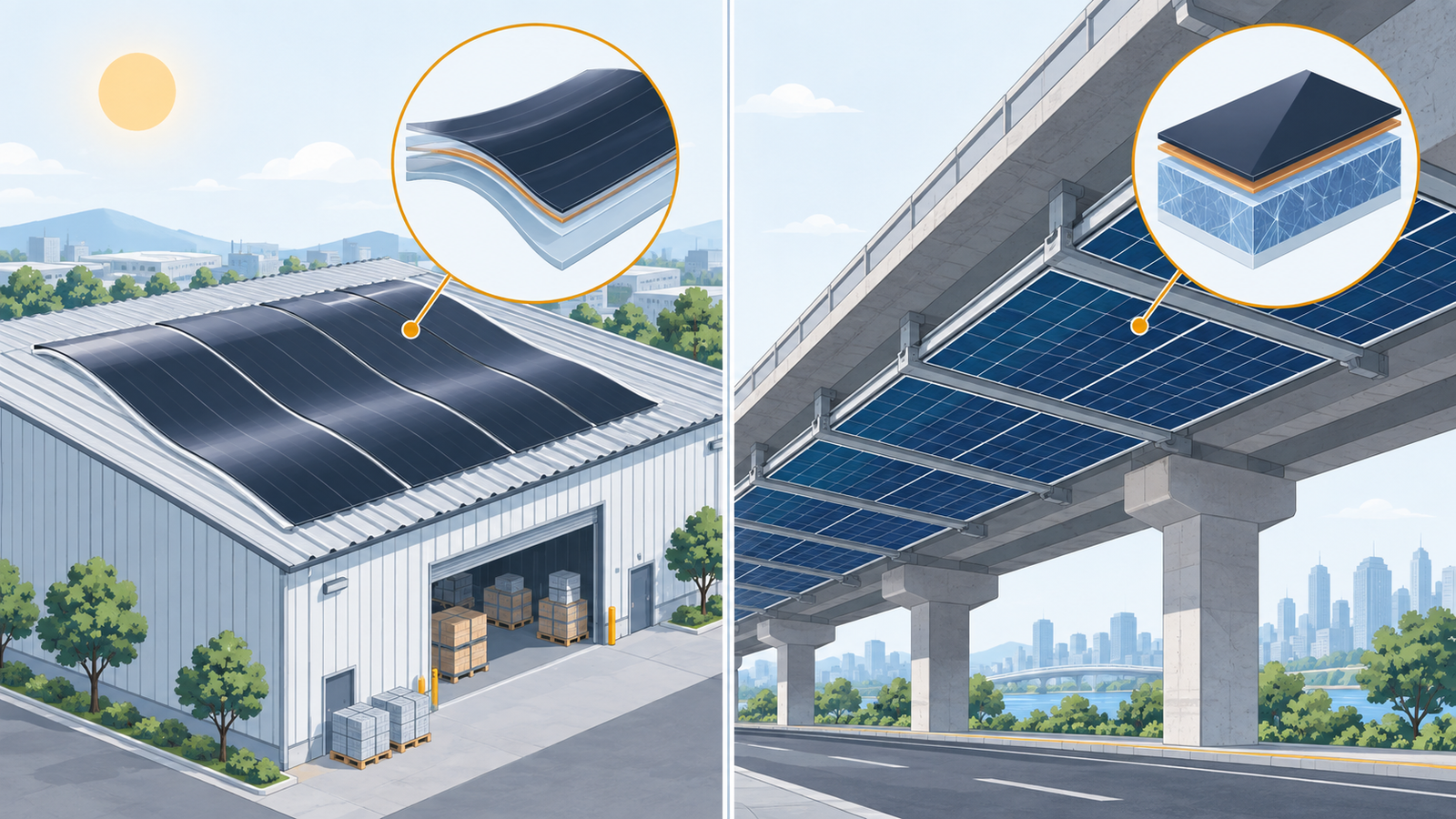
There are two product forms. The film-type single-junction cell is a lightweight solar cell made by coating onto a plastic substrate, aimed at roofs with low load-bearing capacity, walls and windows. The two-terminal tandem stacks a perovskite layer on a silicon cell to make a single cell; the company says it "can generate power with the same system as conventional silicon solar cells" and is "for replacing existing silicon cells" Sourced. With the former Toshiba competes on the same ground as Sekisui Chemical and EneCoat; with the latter, on the same ground as LONGi and the other big Chinese solar makers. For the difference between the two forms, see our explainers on flexible cells and on tandem cells.
4. Scale (the company as a whole, in brief)
The company as a whole is not the subject here, so only its size is noted Sourced.
| Measure (as of 31 March 2026, corporate data) | Value |
|---|---|
| Annual net sales (consolidated) | ¥3.7091 trillion |
| Employees (consolidated) | 94,051 |
| Capital | ¥201.449 billion |
The figures above are for the Toshiba Group as a whole. Toshiba was delisted on 20 December 2023, so detailed statutory disclosures such as the annual securities report (the statutory annual filing that Japanese listed companies must submit) are no longer published. Sales, investment and dedicated headcount for perovskite solar cells are none of them disclosed Not yet confirmed. The results presentation for FY2025 (year to March 2026), published in May 2026, did not mention perovskites either. The only amount that indicates the scale of the effort in this field is the GI Fund R&D budget (about ¥4.4 billion) in section 5.
5. Resources committed to perovskites
Japanese fiscal years (FY) run from April to March; FY2025 is the year from April 2025 to March 2026.
| Type of resource | What it is | Category |
|---|---|---|
| People (organisation) | A project set-up linking the Corporate Research & Development Center (including its technology planning and Next Business Development departments) with the Energy Aggregation Division of Toshiba Energy Systems & Solutions. A specialist team covering business strategy, development, demonstration, sales and intellectual property has been set up (business strategy vision, as of December 2025). Toshiba Energy Systems & Solutions was merged into Toshiba in April 2026 | Sourced |
| People (headcount) | Number of dedicated staff | Not disclosed |
| Money (film-type) | R&D investment of about ¥4.4 billion under the GI Fund project (FY2021 to FY2025), of which about ¥2.9 billion from state funds and about ¥1.5 billion borne by the company. After the project ends, the company says it plans to keep investing in R&D and manufacturing equipment at its own expense (no amount given) | Sourced |
| Money (tandem) | NEDO's "Next-Generation Solar Cell Technology Development" (selected September 2025) and a Ministry of the Environment commissioned project (lead stabilisation technology, with Choshu Industry). The company's announcements give no amounts for either | Sourced / Not disclosed |
| Investments and acquisitions by Toshiba | The documents this article reviewed mention no investment or acquisition in the perovskite field | Not confirmed |
| Public funding | NEDO's "Development of Technologies to Reduce Power Generation Costs for High-Performance and High-Reliability Photovoltaic Power Generation" (results in 2018); NEDO's "Development of Technologies to Promote Photovoltaics as a Main Power Source" (results in 2021 to 2022); the GI Fund (selected December 2021, film-type); NEDO's Next-Generation Solar Cell Technology Development (selected September 2025, tandem); and a Ministry of the Environment commissioned project (lead stabilisation for tandems) | Sourced |
| Universities and research institutes (film-type) | The GI Fund joint implementers are the University of Tokyo and Ritsumeikan University. The University of Electro-Communications and Toin University of Yokohama take part through the University of Tokyo, and Yamagata University under contract to Toshiba | Sourced |
| Universities and research institutes (tandem) | Niigata University and the University of Electro-Communications (contracted by Toshiba); Meiji University, Nagoya University and Toyota Technological Institute (contracted by Kyocera); Kanazawa University (film deposition); and the National Institute of Advanced Industrial Science and Technology, AIST (electrode formation) | Sourced |
R&D investment in the film-type GI Fund project is about ¥4.4 billion, of which about ¥2.9 billion, or about 66%, is state money Our calculation. Sekisui Chemical, which has moved to mass production under the same fund, has approved ¥90 billion of capital investment for its first line alone. Toshiba's film-type work centres on developing the underlying technologies, and its business strategy vision goes no further than saying that "after completing development of the underlying technologies for practical use during this project period, we plan to carry out, at our own expense, R&D towards establishing mass-production technology and capital investment in manufacturing equipment" Sourced.
6. What it has done so far
| When | What happened | Why it matters |
|---|---|---|
| June 2018 | Under a NEDO project, announces 11.7% conversion efficiency for a film-type module with a module area of 703 cm², using its proprietary meniscus coating technology | The company describes it as "the world's largest in area" |
| Date not given | 14.1% achieved on the same 703 cm² (mentioned as a past result in the 2021 announcement) | - |
| September 2021 | Develops a one-step meniscus coating method that deposits the perovskite layer in a single pass, and announces 15.1% on 703 cm² (the world's highest for a plastic-substrate device of 100 cm² or more, according to the company) | Combines faster coating with higher efficiency |
| October 2021 | The film-type cell wins the Minister of Economy, Trade and Industry Award and the Grand Prix in the carbon neutral category at CEATEC AWARD 2021 | - |
| December 2021 | Selected for the GI Fund "Development of Next-Generation Solar Cells" (film-type, with the University of Tokyo and Ritsumeikan University) | R&D from FY2021 to FY2025 |
| 2022 | Records 16.6% on 703 cm² (the world's highest for a plastic-substrate device of 400 cm² or more, according to the company). Partnership agreement with the town of Okuma, Fukushima Prefecture (July) | The high point for film-type |
| 2023 | Supplies film-type cells to a demonstration at Aobadai Station (with Toin Gakuen, Tokyu, Tokyu Railways and the City of Yokohama), a hands-on class at Toin University of Yokohama and a City of Yokohama event | Supplied for demonstrations |
| May 2024 | Installs four film-type modules of about 30 cm × 100 cm at the Okuma town hall and starts a power generation demonstration | Described as the first in Fukushima Prefecture |
| July 2024 | Starts joint research with Hanshin Expressway on "using tandem perovskite solar cells on expressways" | Finding uses for tandems |
| August 2024 | With the Tokyo Metropolitan Government's Bureau of Port and Harbor, verifies the indoor effectiveness of film-type cells inside buildings in the Tokyo waterfront subcentre (until March 2027) | Tests generation under indoor light |
| 2024 | Selected with Choshu Industry for a Ministry of the Environment commissioned project, "Development and demonstration of lead stabilisation technology for tandem perovskite solar cells" | Guarding against lead escaping if panels break |
| 2025 | Announces 31.3% conversion efficiency for a two-terminal tandem (in-house measurement). Kyocera, Meiji University, Toyota Technological Institute and Nagoya University helped on the silicon side, AIST and the University of Electro-Communications on electrode formation, and Niigata University on measurement | The company says it has passed the 30% milestone (the page carries no date, but the text refers to a plan approved by the Cabinet in February 2025) |
| March 2025 | Starts Japan's first demonstration of tandem cells, under Hanshin Expressway viaducts and on building walls (until December 2025). Kyocera (bottom cell), Choshu Industry (manufacturing technology), Kanazawa University (deposition) and Niigata University (encapsulation) cooperate | Compares output with silicon |
| August 2025 | Starts verifying installation of film-type cells in inner windows at the Telecom Center Building (with the Tokyo Metropolitan Government's Bureau of Port and Harbor, YKK AP, Kandenko and Tokyo Teleport Center). Starts field testing of lead-stabilised tandems at Kanazawa University (until December 2026) | Demonstrations for each of the two forms |
| September 2025 | Selected for NEDO's "Next-Generation Solar Cell Technology Development" as part of a consortium led by Toshiba Energy Systems & Solutions with Kyocera. The target is module conversion efficiency of 30% or more and durability of 20 years or more by FY2029 | Tandems become a national project |
| April 2026 | Toshiba Energy Systems & Solutions merged into Toshiba | - |
7. What comes next
¥20/kWh or lessSystem price ¥256,000/kW or less
durability 20+ yearsBy FY2029 (NEDO project)
| Film-type R&D (business strategy vision, as of December 2025) | Target or progress |
|---|---|
| Total energy yield | 3,600 kWh/m² or more (target) |
| Durability (progress) | 30 cm-square modules confirmed at 2,000 hours or more of damp-heat testing with degradation within 10%. No efficiency loss in outdoor exposure up to cumulative irradiation of 60 kWh/m² |
| University of Tokyo's role | Combining 21% mini-cell efficiency with durability in an inverted structure on film substrate (mini-cell 18% to 21%) |
| Yamagata University's role | Coated high barrier with a water vapour transmission rate of 3×10⁻⁵ g/m²/day, at a barrier cost below ¥1,500/m² |
| Business model | A total solution from installation through maintenance to collection, using group companies' sales channels |
None of the following appears in the primary sources this article reviewed Not yet confirmed.
Mass-production plant, capacity, investment or sales start date for either film-type or tandem cells; who will mass-produce the tandems (Choshu Industry is described as cooperating on "manufacturing technology"); the cell area behind the 31.3% figure and whether it has third-party certification; the amount of the NEDO tandem project; and why Toshiba's name does not appear in the lists of planned implementers for the GI Fund demonstration projects (the volume-production stage) selected by NEDO from 2024 to 2026.
8. What the company is aiming for in perovskite solar cells
This section goes beyond what the company says directly. It sets out inferences that can be drawn from primary sources, each with its basis.
| What can be read | Primary evidence behind it | Category |
|---|---|---|
| It is widening its focus to tandems | Most announcements since 2025 (31.3%, the Hanshin Expressway demonstration, the Ministry of the Environment project, the NEDO selection) concern tandems. Meanwhile, Toshiba's name is absent from the lists of planned implementers for the GI Fund demonstration projects (volume-production stage) from 2024 to 2026 | Inference |
| It will sell in combination with its power plant business rather than mass-produce on its own | The vision describes the film-type business model as "a total solution from installation through maintenance to collection", and the company has a record of over 2.5 GW in building and maintaining solar power plants | Inference |
| Tandem manufacturing will be shared with partners | It is stated that Kyocera handles the silicon side and Choshu Industry manufacturing technology. Toshiba is responsible for the perovskite technology and lead stabilisation technology | Sourced |
| It aims to stand out by solving the lead problem ahead of time | Under a Ministry of the Environment project, it is field-testing tandems treated with lead stabilisation technology to deal with lead if a panel breaks | Inference |
The 703 cm² film-type module improved from 11.7% in 2018 to 16.6% in 2022, about 5 percentage points in four years Our calculation. Since 2022, however, this article found no new film-type efficiency announcement. The business strategy vision as of December 2025 still gives the company's current status as "16.6% power generation efficiency (area 703 cm², in-house measurement)" Sourced. Over the same period, announcements concentrated on two-terminal tandems with silicon. In film-type cells, Sekisui Chemical is building a mass-production line, Panasonic has gone for glass-type, and EneCoat has moved into the volume-production stage of the national project. This article reads Toshiba as staying out of a head-on race to mass-produce film-type cells and positioning "silicon replacement", which it can offer directly to its power plant customers, as its next main bet Not yet confirmed. That said, the company has never written that it is giving up film-type cells, and commercialisation around 2029 remains in the vision.
9. Map of perovskite partnerships
10. Technology, products and services
| Item | What the company has published |
|---|---|
| Products | No products on sale. Film-type cells have been supplied for demonstrations and events (in one case the company noted that the demonstration units were not made in the same way as the record-efficiency module) |
| Film-type manufacturing method | Proprietary meniscus coating. In 2021 the company developed a one-step method that deposits the perovskite layer in a single pass (previously a two-step method coated it in two stages). It also says it has scribing technology for film and transparent electrode technology for low-temperature processes |
| Film-type efficiency | On 703 cm² (active area 24.15 cm × 29.10 cm): 11.7% (2018), 15.1% (2021), 16.6% (2022). All company data. The vision as of December 2025 describes the 16.6% figure as an "in-house measurement" |
| Tandem efficiency | 31.3% for a two-terminal cell (in-house measurement; measured at Niigata University). Cell area not stated |
| Third-party efficiency chart | NLR's (formerly NREL's) "Champion Module Efficiencies" chart (Rev. 07-17-2026) lists Toshiba as one of the records for perovskite sub-modules (200 to 800 cm²). The chart does not label that point with an efficiency value, so this article does not read a figure from it |
| Lead measures for tandems | Developing "lead stabilisation technology" under a Ministry of the Environment commissioned project. The company explains that because tandems are encapsulated with glass sheets like silicon solar cells, measures are needed for when they break, for example in a major earthquake |
Meniscus coating draws out the liquid surface (the meniscus) that forms in the gap between the coating head and the substrate, leaving a thin, even film. Toshiba originally used a two-step method: coat a film of lead iodide (PbI2) first, then coat methylammonium iodide (MAI) ink over it so that the two react. According to the company, this made the reaction hard to control and left unreacted material behind, needed many process steps, and coated slowly. In 2021 it switched to coating, in a single pass, an ink that already has the perovskite composition, and reached 15.1% Sourced. With two coats, the composition is adjusted after the fact, which makes it hard to keep large areas uniform; with one coat, the way the crystals grow is set by the ink and the drying conditions alone, so drying control becomes everything for quality. That the company kept raising efficiency at 703 cm² can be read as the result of engineering that drying control into the equipment itself Not yet confirmed. For a comparison of coating methods, see our explainer on solution-coating deposition.
11. The risks this company carries
| Risk | Substance | Category |
|---|---|---|
| No visible path to mass production | For neither film-type nor tandem cells have the location, capacity or investment of a mass-production line been announced. Film-type commercialisation is expected around 2029 | Not yet confirmed |
| Balancing efficiency, durability and cost | The business strategy vision lists as risks "the possibility that measures to raise efficiency are hard to reconcile with improving durability" and "the possibility that measures for higher efficiency and durability are hard to reconcile with lower cost" | Sourced |
| Panels blown away in strong winds or heavy rain | For film-type cells it lists "the risk of solar cells being blown away in strong winds, heavy rain and the like", to be addressed by studying fixing methods | Sourced |
| Difficulty sourcing foreign materials | It lists the risk that "procuring overseas materials and devices becomes difficult because of the international situation", and says it will consider development and mass production with materials that can be sourced in Japan | Sourced |
| Giant rivals in tandems | Because two-terminal tandems aim to replace existing silicon solar cells, Toshiba will compete in the same market as the big solar makers with silicon mass-production scale | Inference |
| Little disclosure | As an unlisted company, its perovskite investment and staffing are hard to track from outside | Inference |
12. Glossary
- Film-type (flexible)
- A format in which the active layers are built on a plastic film. Light and bendable, but encapsulation against moisture is difficult.
- Two-terminal tandem
- A design in which perovskite and silicon are stacked as a single cell and electricity is drawn from two terminals at either end. Existing equipment for silicon can be used as is.
- Meniscus coating
- A method of coating thin, even films using the liquid surface that forms in the gap between the head and the substrate.
- One-step / two-step
- Whether the perovskite layer is made in a single coating, or by coating the raw materials in two stages and letting them react.
- Inverted structure
- A device structure in which the layers that carry electrons and holes are stacked in the reverse order from the usual design. It is said to have advantages for durability and manufacturing.
- Bottom cell
- In a tandem, the cell placed underneath (the one light reaches second). In Toshiba's tandem this is the silicon cell.
- Lead stabilisation
- Technology that makes it harder for the lead contained in perovskites to escape, for example when a panel is damaged.
- In-house measurement
- A value measured on the company's own equipment. It indicates that the value was not measured by an independent certification body.
13. References
- Toshiba "Corporate Data" (as of 31 March 2026; Japanese version cited). Trade name, registered office, founding, capital, annual net sales and headcount. https://www.global.toshiba/jp/outline/corporate/profile.html
- Toshiba Investor information (statement on delisting), in Japanese. https://www.global.toshiba/jp/ir/corporate/private/fin-top/fin-sales.html
- Toshiba (published by NEDO) Business strategy vision, "Development of materials and device design and manufacturing process technology for the practical application of film-type perovskite solar cells" (as of December 2025, in Japanese). Organisation, business plan, funding plan, R&D targets and progress, current status (16.6%, in-house measurement) and risk factors. https://green-innovation.nedo.go.jp/resources/pdf/next-generation-solar-cells/item-1-2/vision-toshiba-004.pdf
- NEDO and Toshiba "NEDO and Toshiba Develops World's Largest Film-based Perovskite Photovoltaic Module: 703 cm² module achieves 11.7% power conversion efficiency" (18 June 2018; Japanese version cited). https://www.global.toshiba/jp/technology/corporate/rdc/rd/topics/18/1806-03.html
- Toshiba "Toshiba's Polymer Film-Based Perovskite Large-Area Photovoltaic Module Reaches Record Power Conversion Efficiency of 15.1%" (10 September 2021; Japanese version cited). https://www.global.toshiba/jp/technology/corporate/rdc/rd/topics/21/2109-01.html
- Toshiba News, "Film-type perovskite solar cell wins the Minister of Economy, Trade and Industry Award and the Grand Prix in the carbon neutral category at CEATEC AWARD 2021" (18 October 2021, in Japanese). https://www.global.toshiba/jp/news/corporate/2021/10/news-20211018-01.html
- Toshiba Sustainability case study, "Film-type Perovskite Solar Cell" (achievement of 16.6%; Japanese version cited). https://www.global.toshiba/jp/sustainability/corporate/related-information/case/e06.html
- Toshiba Energy Systems & Solutions News release, "On the supply of large-area film-type perovskite solar cells" (9 February 2023, in Japanese). https://www.global.toshiba/jp/news/energy/2023/02/news-20230209-01.html
- Town of Okuma, Fukushima Prefecture, and Toshiba Energy Systems & Solutions News release, "Start of a perovskite solar cell demonstration in Okuma, Fukushima Prefecture" (31 May 2024, in Japanese). https://www.global.toshiba/jp/news/energy/2024/05/news-20240531-01.html
- Tokyo Metropolitan Government Bureau of Port and Harbor, and Toshiba Energy Systems & Solutions News release, "Start of a project to verify the effectiveness of next-generation solar cells" (28 June 2024, in Japanese). https://www.global.toshiba/jp/news/energy/2024/06/news-20240628-01.html
- Toshiba Energy Systems & Solutions Topics, "31.3% energy conversion efficiency achieved with a two-terminal perovskite/silicon tandem solar cell" (no date on the page, in Japanese). https://www.global.toshiba/jp/products-solutions/renewable-energy/topics/energy-aggregation/smartgrid20242.html
- Toshiba Energy Systems & Solutions Topics, "Japan's first demonstration of tandem perovskite solar cells begins" (March 2025, in Japanese). Installation record of over 2.5 GW at more than 3,000 sites, tandem development since 2020, and joint research with Hanshin Expressway. https://www.global.toshiba/jp/products-solutions/renewable-energy/topics/energy-aggregation/smartgrid202421.html
- Tokyo Metropolitan Government Bureau of Port and Harbor, Toshiba Energy Systems & Solutions, YKK AP, Kandenko and Tokyo Teleport Center News release, "Start of installation verification of building-integrated photovoltaics using next-generation solar cells" (18 July 2025, in Japanese). https://www.global.toshiba/jp/news/energy/2025/07/news-20250718-01.html
- Toshiba Energy Systems & Solutions and Kyocera Topics, "Selection for NEDO's 'Photovoltaic Deployment Expansion Technology Development / Next-Generation Solar Cell Technology Development'" (16 September 2025, in Japanese). https://www.global.toshiba/jp/products-solutions/renewable-energy/topics/energy-aggregation/perosili.html
- Toshiba Topics, "Field testing of tandem perovskite solar cells begins under a Ministry of the Environment commissioned project" (9 October 2025, in Japanese). https://www.global.toshiba/jp/products-solutions/renewable-energy/topics/energy-aggregation/perosili11.html
- NEDO Annex 1, list of planned implementers, for "Development of next-generation solar cells begins under the Green Innovation Fund Project" (28 December 2021, in Japanese). https://www.nedo.go.jp/content/100940817.pdf
- NEDO List of planned implementers for the "Next-Generation Single-Junction Solar Cell Demonstration Project" (Annex 1, published 6 August 2026, including themes and implementers already selected; in Japanese). https://www.nedo.go.jp/content/800059482.pdf
- Toshiba Results presentation for FY2025 (May 2026, in Japanese). Used to confirm that perovskites are not mentioned. https://www.global.toshiba/content/dam/toshiba/jp/ir/corporate/finance/pdf/tpr2025q4.pdf
- National Laboratory of the Rockies (NLR, formerly NREL) Champion Module Efficiencies (Rev. 07-17-2026). https://www.nlr.gov/docs/libraries/pv/champion-module-chart.pdf
14. Claim-to-source audit
| Claim in the article | Category | Source |
|---|---|---|
| Trade name, registered office, founding, capital, annual net sales of ¥3.7091 trillion, 94,051 employees | Sourced | Reference 1 https://www.global.toshiba/jp/outline/corporate/profile.html |
| Delisting on 20 December 2023 | Sourced | Reference 2 https://www.global.toshiba/jp/ir/corporate/private/fin-top/fin-sales.html |
| Organisation; GI Fund R&D investment of about ¥4.4 billion (about ¥2.9 billion state, about ¥1.5 billion own); expected commercialisation around 2029; business model; R&D targets and progress; 16.6% as an in-house measurement; risk factors | Sourced | Reference 3 https://green-innovation.nedo.go.jp/resources/pdf/next-generation-solar-cells/item-1-2/vision-toshiba-004.pdf |
| 703 cm² and 11.7% in 2018, and meniscus coating | Sourced | Reference 4 https://www.global.toshiba/jp/technology/corporate/rdc/rd/topics/18/1806-03.html |
| 15.1% in 2021, the one-step method, the earlier 14.1%, and the problems of the two-step method | Sourced | Reference 5 https://www.global.toshiba/jp/technology/corporate/rdc/rd/topics/21/2109-01.html |
| CEATEC AWARD 2021 | Sourced | Reference 6 https://www.global.toshiba/jp/news/corporate/2021/10/news-20211018-01.html |
| Achievement of 16.6% (company data) | Sourced | References 7 and 8 https://www.global.toshiba/jp/sustainability/corporate/related-information/case/e06.html |
| Supply of demonstration units for the Aobadai Station trial | Sourced | Reference 8 https://www.global.toshiba/jp/news/energy/2023/02/news-20230209-01.html |
| Partnership agreement with Okuma and demonstration at the town hall | Sourced | Reference 9 https://www.global.toshiba/jp/news/energy/2024/05/news-20240531-01.html |
| Verification of indoor effectiveness in the waterfront subcentre (until March 2027) | Sourced | Reference 10 https://www.global.toshiba/jp/news/energy/2024/06/news-20240628-01.html |
| Two-terminal tandem at 31.3% (in-house measurement) and the cooperating institutions | Sourced | Reference 11 https://www.global.toshiba/jp/products-solutions/renewable-energy/topics/energy-aggregation/smartgrid20242.html |
| Japan's first tandem demonstration, installation record of over 2.5 GW, development since 2020, joint research with Hanshin Expressway, and the roles of cooperating companies | Sourced | Reference 12 https://www.global.toshiba/jp/products-solutions/renewable-energy/topics/energy-aggregation/smartgrid202421.html |
| Inner-window installation verification at the Telecom Center Building | Sourced | Reference 13 https://www.global.toshiba/jp/news/energy/2025/07/news-20250718-01.html |
| Selection for NEDO's Next-Generation Solar Cell Technology Development, the consortium's make-up, and the targets for FY2029 | Sourced | Reference 14 https://www.global.toshiba/jp/products-solutions/renewable-energy/topics/energy-aggregation/perosili.html |
| The Ministry of the Environment project, field testing at Kanazawa University, and the purpose of lead stabilisation | Sourced | Reference 15 https://www.global.toshiba/jp/products-solutions/renewable-energy/topics/energy-aggregation/perosili11.html |
| Selection for the GI Fund in December 2021 (with the University of Tokyo and Ritsumeikan University) | Sourced | Reference 16 https://www.nedo.go.jp/content/100940817.pdf |
| Toshiba's name is absent from the list of planned implementers for the GI Fund demonstration projects (volume-production stage) | Sourced | Reference 17 https://www.nedo.go.jp/content/800059482.pdf |
| The FY2025 results presentation does not mention perovskites | Sourced | Reference 18 https://www.global.toshiba/content/dam/toshiba/jp/ir/corporate/finance/pdf/tpr2025q4.pdf |
| Toshiba appears in NLR's chart as a record holder for perovskite sub-modules | Sourced | Reference 19 https://www.nlr.gov/docs/libraries/pv/champion-module-chart.pdf |
| The three types of perovskite solar cell company | Our calculation | Our own classification. Companies shown are examples from those covered in this series |
| State share of about 66%; an improvement of about 5 percentage points in four years | Our calculation | Our own calculation from the figures in references 3 to 7 |
| Mass-production plant, capacity, investment and sales start date; who will mass-produce tandems; cell area and certification behind 31.3%; amount of the NEDO tandem project; dedicated headcount | Not yet confirmed | Not in the primary sources this article reviewed. This article makes no estimate |
| The readings that Toshiba is widening its focus to tandems, will sell in combination with its power plant business, and aims to solve the lead problem ahead of time | Inference | This article's interpretation of references 3 and 11 to 17 |
| The view that, with the one-step method, drying control decides quality | Inference | This article's commentary based on reference 5 |
| The risks of giant rivals in tandems and of little disclosure | Inference | This article's interpretation of references 2 and 12 |
Last updated 25 September 2026 / Troy Technical
Every figure in this article comes from official announcements and corporate data of Toshiba and Toshiba Energy Systems & Solutions, the business strategy vision the company submitted to NEDO, and documents published by NEDO and NLR. No research-firm estimates or press-based figures have been used. Passages marked "Inference" are this article's interpretation of primary sources, not statements made by the company.