COMPANY PROFILE / OPTICAL COMMUNICATIONS & PHOTONICS
Credo Technology Group
A SerDes company that boomed on copper cables, now buying silicon photonics to step into optics
Credo is a fabless semiconductor company (it owns no fabs) whose strengths are SerDes, the circuit technology for sending and receiving high-speed electrical signals, and DSPs. Revenue for fiscal 2026 (the year ended 2 May 2026) was US$1,335.12 million, roughly three times the year before, but more than 99% of that growth came from copper active electrical cables (AECs). At the same time, the company has shipped optical DSPs for optical transceivers through seven generations, and it also sells optical transceivers under its own brand. Then in May 2026 it acquired DustPhotonics, an Israeli silicon photonics company, for about US$1.25 billion in total, and said it expects more than US$500 million in optical revenue in fiscal 2027. This profile sets out what the company is putting into optical communications and photonics, who it works with and where it is heading, using only its statutory filings with the U.S. SEC and its official releases.
- Credo in 30 seconds, and where it stands in optical communications and photonics
- The logo and how the name is written
- Where the company sits in optical communications and photonics
- Scale
- Resources committed to optical communications and photonics
- Track record so far
- Plans ahead
- What the company is aiming for in optical communications and photonics
- Partnership map
- Technologies, products and services
- The risks this company carries
- Glossary, references and claim-to-source audit
1. Credo in 30 seconds, and where it stands in optical communications and photonics
Holding LtdA Cayman Islands holding company. Operations based in San Jose
(fabless)All wafers made by TSMC
Companies in optical communications and photonics fall into three broad groups: optical components & modules, chips & foundries, and network systems & carriers. Credo belongs to the chips group, and is a fabless company with no fabs of its own Sourced. According to the 10-K, all of its wafers in fiscal 2026 were made by TSMC, and assembly and testing are also outsourced. Its original role in optical communications was selling optical DSPs to optical module makers. In recent years, though, it has been moving down vertically into the optical parts themselves: its own-brand optical transceivers (ZeroFlap Optics), the acquisition of micro-LED optical interconnect (Hyperlume), and the acquisition of silicon photonics optical chips, or PICs (DustPhotonics). The company describes this as "a vertically integrated connectivity stack spanning SerDes, Digital Signal Processing (DSP), Silicon Photonics and system integration".
2. The logo and how the name is written

The Credo logo is a trademark of the company. We have not recreated it with generated imagery;
the image is the one shown in the header of the official website and is placed here as img/credo_logo.svg.
A note on names: the name in the statutory filings is Credo Technology Group Holding Ltd (a Cayman Islands exempted company); the business itself is run by its subsidiaries. Its releases are datelined San Jose, California. Japanese-language coverage writes the name phonetically in katakana; this series uses the Latin-alphabet name throughout. The official website's domain is credosemi.com.
Official site: https://credosemi.com/3. Where the company sits in optical communications and photonics
Credo is not an optics-only company. We set out where it operates in optics, separately from its copper products Sourced.
| Area | Main products (as described in the 10-K) | Optical or copper |
|---|---|---|
| Optical interconnect inside the data centre | Optical DSPs (50G to 200G per lane, seventh generation), ZeroFlap optical transceivers, silicon photonics PICs (DustPhotonics), micro-LED active LED cables (in development) | Optical |
| Electrical connections inside the data centre | ZeroFlap AECs (copper cables up to 7 m), PCIe retimers, SerDes chiplets, OmniConnect memory connectivity | Copper (electrical). Most of revenue |
| Telecom networks | PHYs for line cards, industrial-temperature PAM4 DSPs for 5G | Both electrical and optical |
4. Scale
| Item (US$ million) | Fiscal 2024 | Fiscal 2025 | Fiscal 2026 | May to July 2026 (Q1 FY2027) |
|---|---|---|---|---|
| Revenue | 193.0 | 436.8 | 1,335.1 | 479.0 |
| Gross profit | 119.4 | 282.9 | 908.3 | - |
| R&D expense | 96.3 | 146.9 | 279.4 | 114.5 |
| Net income (loss) | -28.4 | 52.2 | 472.3 | 129.4 |
| Purchases of property and equipment | 15.7 | 36.1 | 57.3 | 7.3 |
The 10-K says that AECs (copper active electrical cables) "contributed over 99% of the increase in revenue" in fiscal 2026 (an increase of US$898.3 million) Sourced. In May to July 2026, too, more than 90% of the revenue increase came from AECs. Credo does not disclose optical revenue on its own Not yet confirmed. The only clue is the company forecast in the DustPhotonics acquisition release that its combined portfolio of ZeroFlap optical transceivers, optical DSPs and silicon photonics products will generate "greater than $500 million in optical revenue in fiscal 2027". With revenue guidance for the second quarter of fiscal 2027 at US$525 million to US$535 million, optical revenue above US$500 million would work out to roughly a quarter of annual revenue Our calculation (a rough guide that assumes full-year revenue of about four times the quarterly guidance).
| People and customers (fiscal 2026) | Details |
|---|---|
| Employees | 807 (of whom 616 engineers). 330 in North America, 477 in Asia |
| Customer concentration | The top ten customers accounted for about 90% of revenue, and two customers each accounted for 10% or more. The notes to the 10-K put the largest at 49% and the next at 32%. Names not disclosed |
| Patents | 86 granted and 39 pending in the United States, and 52 granted and 41 pending in mainland China (including 16 U.S. and 13 Chinese applications held by Hyperlume) |
| Cash | US$764.3 million in cash and short-term investments (1 August 2026, after the cash payment for DustPhotonics) |
5. Resources committed to optical communications and photonics
For the four angles this series uses (people; money; outside investments, acquisitions and joint ventures; universities, research institutes and public funding), we separate what could be confirmed from what could not.
| Angle | Details | Category |
|---|---|---|
| People | 616 engineers (whole company). Headcount dedicated to optics is not disclosed. The DustPhotonics acquisition brought in that company's staff (unvested stock options were replaced at acquisition with RSUs covering 254,000 shares) | Company-wide sourced / optics-only not disclosed |
| Money (R&D) | R&D expense of US$279.38 million (fiscal 2026). No breakdown for optics. The company says most capital expenditure goes on mask sets for new products | Total sourced / optics breakdown not disclosed |
| Acquisitions (optical) | DustPhotonics (Israel, silicon photonics PICs): completed 28 May 2026. Total purchase consideration of US$1,251.11 million (US$769.59 million in cash, US$169.07 million in shares, US$310 million in contingent consideration and other items). Hyperlume (micro-LED chip-to-chip optical interconnect): completed 29 September 2025 for US$92.02 million | Sourced |
| Acquisitions (non-optical) | CoMira Solutions (IP for communications error correction, link layer and security): 25 February 2026, US$35.1 million | Sourced |
| Manufacturing | No fabs of its own. All wafers from TSMC, packaging by Amkor and ASE, testing by KYEC and Sigurd, and AEC manufacturing by BizLink | Sourced |
| Co-development with customers | The 10-K says it partnered with Oracle to develop ZeroFlap Optics, which addresses the momentary link drops known as "link flap" | Sourced |
| Universities, research institutes and public funding | The only thing the 10-K mentions is hiring interns and new university graduates. No joint research or public funding awards are mentioned | Could not be confirmed |
Inside an optical transceiver there are, broadly, electrical chips (DSP, driver, TIA) and optical chips (laser, modulator and photodetector, or a PIC that integrates them). Until now Credo has had only the former. A silicon photonics PIC is a chip with optical waveguides, modulators and photodetectors built into silicon, used together with a laser that is either attached externally or bonded on (a general explanation).
The DustPhotonics acquisition release says that bringing the PIC capability in-house "mitigates external supply dependencies, accelerates product development cycles, and creates a pathway to substantial cost structure improvement at volume" Sourced. When the DSP and PIC are designed in the same company, co-design becomes possible, for example designing the optical chip on the assumption that the DSP will correct the modulator's nonlinearity or limited bandwidth (a general explanation). We think that designs which shift the division of labour between electronics and optics, such as the LRO approach (omitting the DSP on the receive side) that Credo was early to promote, are easier to optimise for a company that owns both Not yet confirmed.
6. Track record so far
| When | What happened | What it means |
|---|---|---|
| 2008 | Credo founded | Started out as a SerDes technology company |
| Date not stated | Pioneered the 100G to 800G AEC market (the company says it established "a new product category"). Introduced what it calls the "World's First 800G DSP for Linear Receive Optics" (the company's claim) | Has launched power-cutting products in both copper and optics |
| Date not stated | Created ZeroFlap Optics with Oracle (optical transceivers that suppress link flap) | Owns optical transceivers as its own products |
| September 2025 | Announced "Bluebird", a 3 nm 200G-per-lane optical DSP (for 1.6T transceivers) | A new generation of optical DSP |
| 29 September 2025 | Acquired Hyperlume (US$92.02 million): micro-LED chip-to-chip optical interconnect technology | A separate route to optical links that does not use lasers |
| November 2025 | Announced OmniConnect memory connectivity and "Weaver" | Broadening the electrical side |
| 25 February 2026 | Acquired CoMira Solutions (US$35.1 million) | Bringing in communications IP |
| 13 April 2026 | Announced a definitive agreement to acquire DustPhotonics, and said it expects more than US$500 million in optical revenue in fiscal 2027 | The company said it believes it "has reached an inflection point in its optical business" |
| Full fiscal 2026 | Revenue of US$1,335.12 million (up 205.7%) and net income of US$472.28 million | Driven by AECs |
| 28 May 2026 | Completed the DustPhotonics acquisition (total purchase consideration US$1,251.11 million) | Now owns optical chips in house |
| 1 September 2026 | Revenue of US$479.0 million in the first quarter of fiscal 2027 (up 114.7% year on year). The CEO said "Our portfolio now spans connectivity from millimeters to kilometers, with solutions across optics and copper" | Emphasis on covering both optics and copper |
7. Plans ahead
to 3.2TAlso stated to be in design for NPO and CPO
(up to 30 m)In development. Launch date not disclosed
According to the release, DustPhotonics' PICs come in a 400G, 800G and 1.6T line-up with a roadmap to 3.2T, in both integrated-laser and external-laser configurations. They are said to be already in transceivers used in major hyperscalers' AI clusters, with designs under way for NPO and CPO applications as well Sourced.
None of the following appears in the 10-K, the 10-Q or the official releases Not yet confirmed.
Actual revenue, R&D spending and headcount for optics alone / the names of customers using DustPhotonics' PICs / which foundry makes DustPhotonics' PICs / the launch date of the active LED cables / the specific targets that trigger the contingent consideration (up to about 2.8 million shares and US$31.6 million). The DustPhotonics acquisition release also gives a market-size forecast for silicon photonics PICs, but since it is an estimate by a research firm (LightCounting) and the company, this article does not use it.
8. What the company is aiming for in optical communications and photonics
This section includes things the company does not say directly. We set them out as inferences within what the primary sources support, with the evidence for each.
| What the evidence suggests | Primary information it rests on | Category |
|---|---|---|
| From an electrical chip company to a connectivity company with both electrical and optical products | The company describes the aim of the DustPhotonics acquisition as a vertically integrated connectivity stack spanning SerDes, DSP, silicon photonics and system integration | Sourced (the company's description) |
| It wants to extend the direct relationships with hyperscalers it built through AECs into optics | The 10-K describes a "two-pronged sales strategy" of engaging directly with end users, who in turn may require their suppliers to use Credo's products. DustPhotonics' side also cites "the hyperscaler relationships" Credo brings as a benefit of the combination | Inference |
| In optical transceivers it differentiates on reliability (countering link flap) | The description of ZeroFlap Optics centres on remote monitoring, event logging and early detection of link flap through in-band communication | Sourced (product description) |
| It is keeping several optical approaches in parallel rather than relying on lasers alone | It acquired both silicon photonics (DustPhotonics) and micro-LED (Hyperlume) | Inference |
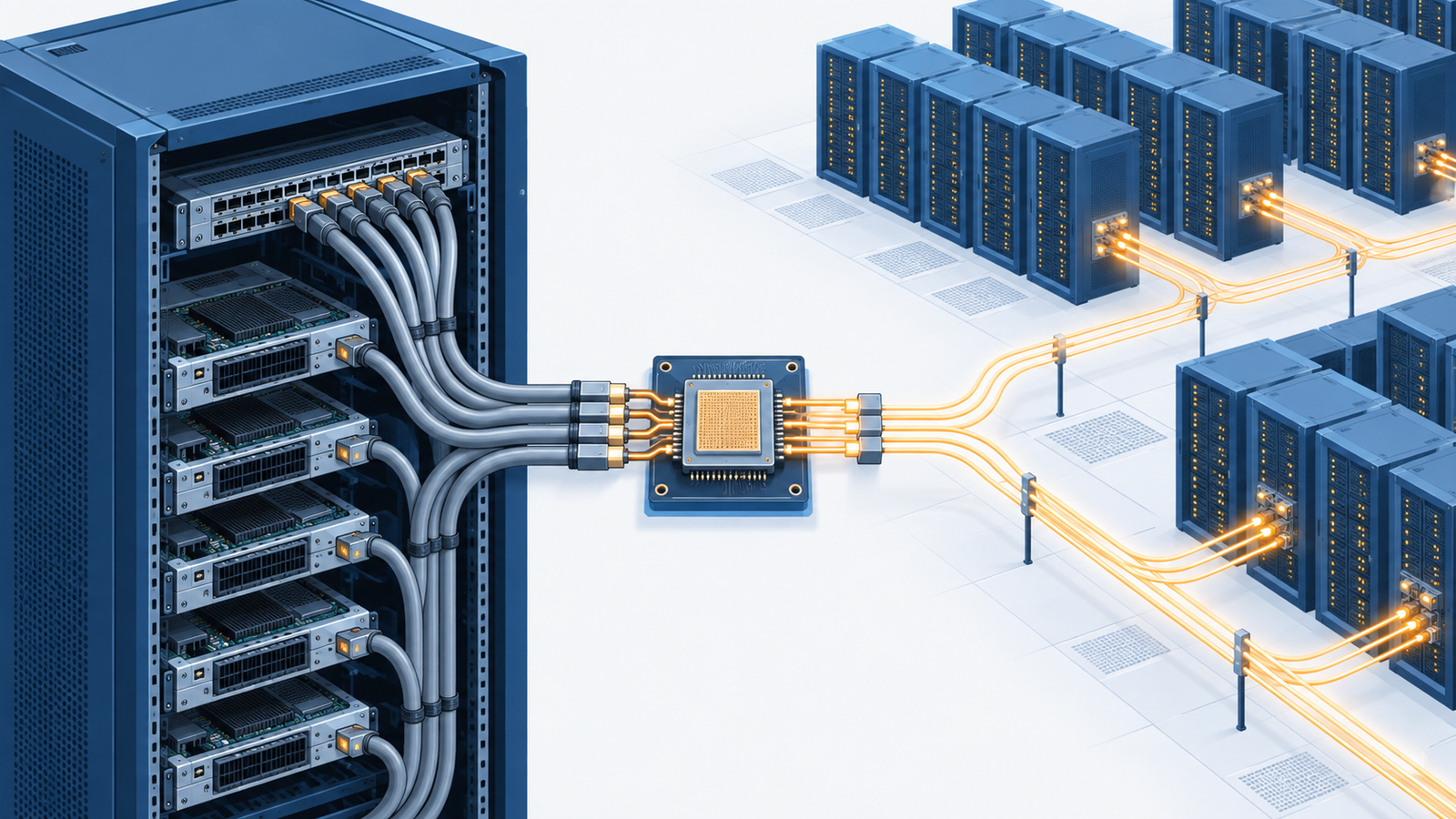
Credo's growth has been carried by demand for connecting AI servers within and between racks with copper AECs. AECs reach up to 7 m; beyond that is optical territory. The 10-K explains that micro-LED active LED cables extend "the interconnect reach up to 30m", so that architects are no longer "forced to cram GPUs into one or two racks" Sourced. In other words, the larger AI clusters grow and the longer the distances between racks become, the less copper AECs alone can reach. We read the CEO's remark about spanning connectivity "from millimeters to kilometers, with solutions across optics and copper" as a line-up designed not to lose the customers it has won with copper once the distances grow Not yet confirmed. See also our explainers on optical interconnect and SerDes and on silicon photonics.
9. Partnership map
10. Technologies, products and services
From the product descriptions in the 10-K, we focus on those relevant to optics. For performance figures, we state whether the product is in volume production or in development.
| Product | What it is (as the company describes it) | Status |
|---|---|---|
| Optical DSPs (50G per lane) | Seagull family. 1×50G to 8×50G, for 50G to 400G transceivers and AOCs. Also a version for 64G Fibre Channel | In volume production |
| Optical DSPs (100G per lane) | Three generations: Dove, Lark and Robin. 4×100G and 8×100G. Versions with integrated laser drivers matched to silicon photonics, EMLs and VCSELs. Each generation includes a unidirectional 8×100G part for LRO | In volume production. Described as the "seventh generation" |
| Optical DSPs (200G per lane) | Bluebird. 3 nm process. For full-retimed and LRO 1.6T transceivers | Announced September 2025 |
| ZeroFlap optical transceivers | 200GBASE-DR2, 400GBASE-DR4 and 800G 2xDR4. Stated to feature "optical performance compliant with IEEE 802.3-2022 Clause 124.7", with reaches up to 500 m over parallel single-mode fibre with MPO-12 connections. Continuous link-quality monitoring, non-volatile event logging and remote management of both ends through in-band communication | Offered as products |
| Silicon photonics PICs | From DustPhotonics. A 400G, 800G and 1.6T line-up, with a roadmap to 3.2T. Integrated-laser and external-laser versions | The release says they are already in transceivers for major AI clusters. Designs for NPO and CPO under way |
| Micro-LED (ALC) | From Hyperlume. Active LED cables reaching up to 30 m, in the same pluggable form factors as AECs | In development |
| (For reference) AEC | Copper active electrical cables. 100G to 1.6T, up to 7 m. The company claims up to 50% lower power than optics | In volume production. Most of revenue |
Almost all optical communication in data centres uses lasers (VCSELs, DFB lasers, EMLs and so on) as the light source. The technology from Hyperlume, which Credo acquired, uses micro-LEDs instead: light-emitting diodes smaller than a human hair, arranged in large numbers so that even if each channel is relatively slow, the number of channels delivers the bandwidth (a general explanation). The 10-K describes it as delivering multi-terabit throughput "by leveraging fast micron-scale LEDs and ultra-low power circuitry" Sourced.
LEDs are easier to make than lasers, more tolerant of temperature and have no lasing threshold, but their light spreads out, which makes it harder to send data fast and far (a general explanation). That is why their use is confined to short distances between racks, up to about 30 m. From the materials side, we think the key is whether gallium nitride micro-LED mass-production technology, developed mainly for displays, can be brought up to the reliability demands of communications (lifetime and temperature cycling) Not yet confirmed. Note that the 10-K does not state the material system of Hyperlume's micro-LEDs, so we have not been able to confirm whether they are gallium nitride based.
11. The risks this company carries
| Risk | Details | Category |
|---|---|---|
| Extreme customer concentration | The top ten customers account for about 90% of revenue. The notes to the 10-K put the largest alone at 49% | Sourced |
| Concentration of contract manufacturers | All wafers come from TSMC. Supply of optical DSPs depends on TSMC's capacity and on the geopolitics of Taiwan | Sourced |
| Optical results cannot be seen | Optical revenue is not disclosed on its own, so outsiders will find it hard to check progress against the forecast of more than US$500 million | Inference |
| Integrating acquisitions | The 10-K explicitly lists integrating Hyperlume and CoMira as a risk. DustPhotonics, at a purchase price of about US$1.25 billion, carries the risk of goodwill and intangible asset impairment | Sourced / impairment is an Inference |
| Competition | The 10-K names Broadcom, Marvell and Astera Labs as main competitors, along with various cable and optical transceiver suppliers | Sourced |
| Export controls | The 10-K notes that some companies in Asian markets are subject to export controls. It has patents and sites in China | Sourced |
| Competing with optical module makers | With its own-brand optical transceivers, it may end up competing with the optical module makers that buy its optical DSPs | Inference |
12. Glossary
- SerDes
- Serialiser/deserialiser. A circuit that packs parallel data into a single high-speed signal for transmission and unpacks it at the receiving end.
- Optical DSP
- A digital signal processing chip inside an optical transceiver that cleans up the waveform of electrical signals and corrects errors.
- LRO
- Linear receive optics. An approach that cuts power by omitting the DSP on the receive side and keeping it only on the transmit side.
- AEC
- Active electrical cable. A copper cable with signal-conditioning chips at both ends, used for links of a few metres.
- PIC
- Photonic integrated circuit. A single chip combining optical functions such as modulators, photodetectors and waveguides.
- Silicon photonics
- Technology for building optical circuits on silicon chips. They can be made with semiconductor fab equipment.
- Micro-LED
- A tiny light-emitting diode a few to a few tens of micrometres across, used in large arrays.
- Fabless
- A business model in which a company owns no semiconductor fabs and concentrates on design and sales, outsourcing manufacturing.
13. References
- Credo Technology Group Holding Ltd Form 10-K for the fiscal year ended May 2, 2026 (filed with the U.S. SEC on 15 June 2026). Business description, products (optical DSPs, ZeroFlap optical transceivers, micro-LED, AECs), contract manufacturers, employees, customer concentration, patents, revenue and expenses, the Hyperlume and CoMira acquisitions, the DustPhotonics acquisition (subsequent event) and risk factors. https://www.sec.gov/Archives/edgar/data/1807794/000162828026043303/crdo-20260502.htm
- Credo Technology Group Holding Ltd Form 10-Q for the quarterly period ended August 1, 2026 (filed with the U.S. SEC on 2 September 2026). Breakdown of the DustPhotonics purchase consideration (US$1,251.11 million in total) and its purpose, and quarterly revenue, R&D expense and investing cash flow. https://www.sec.gov/Archives/edgar/data/1807794/000162828026060111/crdo-20260801.htm
- Credo Technology Group Holding Ltd Press release, "Credo Agrees to Acquire DustPhotonics, Accelerating Expansion into Silicon Photonics and Next Generation Optical Connectivity" (13 April 2026; Exhibit 99.1 to Form 8-K). Purpose of the acquisition, DustPhotonics' product line-up, the forecast of more than US$500 million in optical revenue in fiscal 2027, and the CEO's comments. https://www.sec.gov/Archives/edgar/data/1807794/000162828026024892/april20268-kex991.htm
- Credo Technology Group Holding Ltd Results release, "Credo Technology Group Holding Ltd Reports First Quarter of Fiscal Year 2027" (1 September 2026; Exhibit 99.1 to Form 8-K). Quarterly revenue, cash, second-quarter guidance and the CEO's comments. https://www.sec.gov/Archives/edgar/data/1807794/000162828026059795/credoq12027ex-991.htm
- Credo Technology Group Holding Ltd Official website (source of the company name style and the logo image). https://credosemi.com/
14. Claim-to-source audit
| Claim in the article | Category | Source |
|---|---|---|
| Legal name (Cayman Islands holding company), founded in 2008, listing venue and official website | Sourced | Reference 1 https://www.sec.gov/Archives/edgar/data/1807794/000162828026043303/crdo-20260502.htm |
| Fabless, with all wafers from TSMC, back-end work by Amkor, ASE, KYEC and Sigurd, and AECs made by BizLink | Sourced | Reference 1 https://www.sec.gov/Archives/edgar/data/1807794/000162828026043303/crdo-20260502.htm |
| Revenue, gross profit, R&D expense, net income (loss) and capital expenditure (fiscal 2024 to 2026), and AECs accounting for over 99% of the revenue increase | Sourced | Reference 1 https://www.sec.gov/Archives/edgar/data/1807794/000162828026043303/crdo-20260502.htm |
| 807 employees (616 engineers), customer concentration (top ten about 90%, largest 49% in the notes) and patent counts | Sourced | Reference 1 https://www.sec.gov/Archives/edgar/data/1807794/000162828026043303/crdo-20260502.htm |
| Optical DSP families, Bluebird, ZeroFlap optical transceiver specifications and the IEEE compliance statement, micro-LED (ALC, 30 m), co-development with Oracle, and the "world's first" claim for the LRO DSP | Sourced | Reference 1 https://www.sec.gov/Archives/edgar/data/1807794/000162828026043303/crdo-20260502.htm |
| Acquisitions of Hyperlume (29 September 2025, US$92.02 million) and CoMira (25 February 2026, US$35.1 million) | Sourced | Reference 1 https://www.sec.gov/Archives/edgar/data/1807794/000162828026043303/crdo-20260502.htm |
| Completion of the DustPhotonics acquisition (28 May 2026), breakdown of the purchase consideration and purpose of the acquisition | Sourced | Reference 2 https://www.sec.gov/Archives/edgar/data/1807794/000162828026060111/crdo-20260801.htm |
| Revenue, R&D expense, net income and capital expenditure for May to July 2026, and AECs accounting for over 90% of the revenue increase | Sourced | References 2 and 4 https://www.sec.gov/Archives/edgar/data/1807794/000162828026060111/crdo-20260801.htm |
| DustPhotonics' line-up (400G to 1.6T, roadmap to 3.2T, designs for NPO and CPO), the aim of reducing external supply dependence, and the forecast of more than US$500 million in optical revenue | Sourced | Reference 3 https://www.sec.gov/Archives/edgar/data/1807794/000162828026024892/april20268-kex991.htm |
| Cash of US$764.3 million, second-quarter revenue guidance and the CEO's "from millimeters to kilometers" remark | Sourced | Reference 4 https://www.sec.gov/Archives/edgar/data/1807794/000162828026059795/credoq12027ex-991.htm |
| The rough guide that optical revenue would be around a quarter of annual revenue | Our calculation | Estimated in this article from the forecast in reference 3 and the quarterly guidance in reference 4, assuming full-year revenue of about four times the quarterly guidance |
| The three types of company in optical communications and photonics | Our calculation | This article's own classification. Example companies drawn from those covered in this series |
| Revenue, R&D and headcount for optics alone, PIC customer names and foundry, ALC launch date, and the targets for the contingent consideration | Not yet confirmed | Not stated in references 1 to 4. Press-based information is not used https://www.sec.gov/Archives/edgar/data/1807794/000162828026060111/crdo-20260801.htm |
| Market-size forecast for silicon photonics PICs | Not yet confirmed | Given in reference 3, but not used because it is an estimate by a research firm and the company https://www.sec.gov/Archives/edgar/data/1807794/000162828026024892/april20268-kex991.htm |
| The readings that it will extend customer relationships won with AECs into optics, that it keeps several optical approaches in parallel, and that it aims not to lose customers as distances grow | Inference | This article's interpretation of references 1, 3 and 4 |
| The benefits of co-designing DSPs and PICs, and the materials questions for micro-LEDs | Inference | This article's explanation based on general technical knowledge |
| The risks that optical results cannot be seen, of impairment, and of competing with optical module makers | Inference | This article's interpretation of references 1 to 3 |
Last updated 26 September 2026 / Troy Technical
Every figure in this article comes from the statutory filings Credo Technology Group Holding Ltd has made with the U.S. Securities and Exchange Commission (SEC) and the official releases attached to them. No research-firm estimates or press-based figures have been used. Passages marked "Inference" are this article's interpretation of the primary sources, not statements made by the company.