COMPANY PROFILE / OPTICAL COMMUNICATIONS & PHOTONICS
Eoptolink
A high-speed optical module maker that runs mainly on its Thai plant and earns 96% of revenue outside China
Eoptolink is a pure-play optical module (optical transceiver) company headquartered in Chengdu, Sichuan Province, China. Revenue for 2025 was CNY 24.84 billion (Chinese yuan), almost three times the year before, and 96.16% of it came from outside China. Its main production base is its Thai subsidiary, which alone had revenue of CNY 21.9 billion. At the OFC 2026 trade show in March 2026 it unveiled a 12.8T liquid-cooled pluggable, "XPO", and an optical circuit switch (OCS) built around MEMS mirrors it developed itself, signalling a move beyond optical modules. Using only the annual and interim reports filed with the Shenzhen Stock Exchange and the company's official releases, this profile sets out what the company is putting into optical communications and photonics, who it works with and where it is heading.
- Eoptolink in 30 seconds, and where it stands in optical communications and photonics
- The logo and how the name is written
- Where the company sits in optical communications and photonics
- Scale
- Resources committed to optical communications and photonics
- Track record so far
- Plans ahead
- What the company is aiming for in optical communications and photonics
- Partnership map
- Technologies, products and services
- The risks this company carries
- Glossary, references and claim-to-source audit
1. Eoptolink in 30 seconds, and where it stands in optical communications and photonics
Companies in optical communications and photonics fall into three broad groups: optical components & modules, chips & foundries, and network systems & carriers. Eoptolink belongs to the first, optical components & modules, and 99.72% of its revenue comes from "optical interconnect products" (optical modules and the like) Sourced. The annual report divides the supply chain into "upstream" (suppliers of optical chips, electrical chips, PCBs and structural parts) and "midstream" (providers of optical interconnect solutions), and places the company in the midstream. Its core business is building optical engines and optical modules from chips bought upstream, through precision assembly and packaging. What deserves attention is that the future strategy in the annual report calls for vertical integration covering the whole process, from optical chip R&D and optical component packaging to optical module manufacturing. Today it is a buyer of chips, but it has stated plainly that it intends to reach down into chips.
2. The logo and how the name is written

The Eoptolink logo is a trademark of the company. We have not recreated it with generated imagery;
the image was taken from the official website given in the company's annual report and is placed here as img/eoptolink_logo.png (the original image is small, so it is shown small).
A note on names: the company's registered English name is Eoptolink Technology Inc., Ltd, and its English short name is "Eoptolink". Japanese-language coverage writes the name with the Japanese reading of its Chinese characters, which are also the company's short name on the stock market; this English edition uses Eoptolink throughout.
Official site: https://www.eoptolink.com/3. Where the company sits in optical communications and photonics
Looked at by where in the optical landscape it operates, most of Eoptolink's products go into optical interconnect inside the data centre (AI computing clusters and cloud data centres). It also has medium- and low-speed products for telecom networks (transport networks, 5G wireless and FTTx fixed access) and coherent products for linking data centres Sourced.
| Area | Main products (as described in the annual and interim reports) | Position |
|---|---|---|
| Optical interconnect inside the data centre | 1.6T, 800G, 400G and 200G optical modules (OSFP, QSFP-DD and others), LPO/LRO, XPO and NPO | The centre of growth. The annual report calls products of 400G and above its core products and the engine of its growth |
| Optical switching inside the data centre | NX200 and NX300 optical circuit switches (OCS) | A new area, announced in March 2026 |
| Data centre interconnect (DCI) | Coherent 800G OSFP and 400G QSFP-DD products (stated to comply with OIF 800ZR and 400ZR) | Stated to support longer reaches too, such as 120 km and 480 km |
| Telecom networks | 200G and 100G optical modules (5G midhaul and backhaul, fixed access and others) | Medium- and low-speed products |
4. Scale
More than 99% of Eoptolink's revenue comes from optical communications products, so the company-wide figures are effectively the size of its optical communications business Sourced.
| Item (CNY billion) | 2023 | 2024 | 2025 | January to June 2026 |
|---|---|---|---|---|
| Revenue | 3.098 | 8.647 | 24.842 | 20.910 |
| of which optical interconnect products | - | 8.599 | 24.771 | 20.883 |
| Net profit attributable to shareholders of the listed company | 0.688 | 2.838 | 9.532 | 7.529 |
| R&D investment | 0.134 | 0.403 | 0.702 | - |
| Purchases of fixed and other long-term assets (capital expenditure) | - | 1.476 | 1.320 | - |
| Optical interconnect product volumes (million units) | Capacity | Output | Sales | Gross margin |
|---|---|---|---|---|
| 2024 | 10.95 | 9.84 | 8.77 | 44.85% |
| 2025 | 17.47 | 16.34 | 16.03 | 47.81% |
| January to June 2026 | 28.36 | 10.91 | 11.19 | 48.46% |
Dividing revenue from optical interconnect products by units sold gives average revenue per unit that has risen from about CNY 980 in 2024 to about CNY 1,545 in 2025 and about CNY 1,866 in the first half of 2026 Our calculation. This can be read as a sign of a rising share of high-speed products, but it is not a price for any particular product.
The "capacity of 28.36 million units" for the first half of 2026 is the figure given as-is in the interim report's table Sourced. Output for the same period was 10.91 million units, which on paper looks like less than 40% of capacity in use. The report does not explain, however, whether this capacity is annualised or for the half-year, or which products it counts, so it should not be read as a utilisation rate Not yet confirmed.
| Employees (end of 2025) | Headcount | R&D staff by qualification | Headcount |
|---|---|---|---|
| Production | 7,400 | Doctorate | 11 |
| Technical (R&D) | 805 | Master's degree | 119 |
| Sales | 57 | Bachelor's degree | 427 |
| Total (in service) | 8,537 | R&D staff as a share of all employees | 9.43% |
5. Resources committed to optical communications and photonics
For the four angles this series uses (people; money; outside investments, acquisitions and joint ventures; universities, research institutes and public funding), we separate what could be confirmed from what could not.
| Angle | Details | Category |
|---|---|---|
| People | 805 R&D staff (up 33.06% from 605 a year earlier). The company says its R&D covers electronic circuit design, integrated optics design, thermal analysis, high-density packaging, silicon photonics chip design and integration, and coupling and testing of optical components | Sourced |
| Money (R&D) | R&D investment of CNY 702.14 million (2025, 2.83% of revenue, down from 4.66% the year before). None capitalised. The ratio fell because revenue grew so fast | Sourced |
| Money (capital expenditure) | Purchases of fixed and other long-term assets of CNY 1,319.7 million (2025; CNY 1,476.34 million the year before). Phase II of the Thai plant started operation in early 2025, and capacity is being raised step by step | Sourced |
| Overseas base | The Thai subsidiary (registered capital THB 4,661 million) had 2025 revenue of CNY 21,909.49 million and net profit of CNY 1,409.25 million. The group's stake is 92.22% | Sourced |
| Acquisitions | Consolidates Alpine Optoelectronics Inc. of the United States (R&D) and its wholly owned manufacturing subsidiary in Chengdu as a business combination not under common control (an acquisition). The date and amount of the acquisition are not given in the relevant section of this annual report | Subsidiary status sourced / acquisition details could not be confirmed |
| Outside investment (in a subsidiary) | In March 2025 the Singapore subsidiary issued 14.4 million Class A shares for US$14.4 million to an unnamed investor SPV. The group's stake fell from 100% to 92.22% | Sourced (investor name not disclosed) |
| Public funding | Government grants recognised in profit or loss were CNY 30.22 million (2025). No breakdown by business or technology is given | Amount sourced / breakdown could not be confirmed |
| Universities and research institutes | The annual report says it will strengthen technical exchange and cooperation with universities and research institutes, and industry-academia-research cooperation, but names no partners and gives no contract details | Could not be confirmed |
| Industry groups | Joined as a founding member of the XPO MSA. Also participates in the Open Compute Project (OCP) OCS project | Sourced (official releases) |
R&D investment as a share of revenue went from 4.32% in 2023 to 4.66% in 2024 and 2.83% in 2025 Sourced. The amount, however, rose about 5.2-fold, from CNY 133.77 million to CNY 702.14 million Our calculation. In reality the ratio fell because revenue grew almost threefold.
Unlike companies that make the chips themselves, optical module companies focus their R&D on optical design, thermal design, high-frequency board design and packaging process development. They do not carry the heavy equipment spending of a company with wafer fabs in their R&D budgets, so the ratio tends to look low (a general explanation). Eoptolink, though, lists silicon photonics chip design and integration among its R&D capabilities in the annual report, and its future strategy calls for vertical integration that extends to optical chip R&D. If it moves into chips, the ratio ought to rise, and we think the trend in R&D spending will be a gauge of how serious it is Not yet confirmed.
6. Track record so far
The annual report describes the company as having launched a new generation of industry-leading optical interconnect products every year since 2019. Claims of being "the industry's first" or "the world's first" are the company's own wording.
| When | What happened | What it means |
|---|---|---|
| Date not stated | The company claims it was the first in the world to launch and mass-produce LPO optical modules, and one of the first to mass-produce and ship 1.6T optical modules | An early entry into low-power designs and the 1.6T generation (the company's claim) |
| Early 2025 | Phase II of the Thai plant formally started operation | Expanded volume production outside China |
| March 2025 | The Singapore subsidiary issued Class A shares to an investor SPV (US$14.4 million) | A change in the capital structure of the overseas business |
| 2025 | Revenue of CNY 24.84 billion (up 187.29%) and net profit of CNY 9.53 billion (up 235.89%). Share from outside China rose to 96.16% | Domestic revenue fell 48.19%; the business concentrated overseas |
| 11 March 2026 | In Broadcom's release announcing its 3 nm, 400G-per-lane optical DSP "Taurus BCM83640", Eoptolink's CEO referred to "delivering the industry's first fully functional 448G/ln transceivers" using the DSP (also posted on Eoptolink's website) | Early access to parts for the 400G-per-lane generation |
| 12 March 2026 | Unveiled a 12.8T XPO module and joined the XPO MSA as a founding member. The same day, demonstrated a 1.6T DR4 at 400G per wavelength | Promoting a new form, the liquid-cooled pluggable, from the standards side |
| 13 March 2026 | Unveiled a 6.4T NPO module based on silicon photonics | A product in the CPO/NPO direction |
| 16 March 2026 | Unveiled the NX200 (140-port) and NX300 (320-port) optical circuit switches using MEMS mirrors it developed itself | Into product areas beyond optical modules |
| January to June 2026 | Revenue of CNY 20.91 billion (up 100.34% year on year) and net profit of CNY 7.53 billion (up 90.98%) | Growth slowed but scale kept increasing |
7. Plans ahead
capacity2026 business plan in the annual report
CPO, OCSPushing R&D and commercialisation. Timing not disclosed
China and ThailandContinued investment in automated and high-precision equipment
down to optical chipsThe whole process: optical chip R&D, component packaging and module manufacturing
The future strategy in the annual report has six elements: (1) technology aimed at the mainstream of AI computing; (2) growth through large-scale supply capacity; (3) global supply through a sales network in North America, Europe and South-East Asia and manufacturing bases in China and Thailand; (4) cooperation with major customers and key upstream suppliers; (5) people; and (6) vertical integration Sourced. Individual R&D projects include the 12.8T XPO (targeting an integrated two-board, liquid-cooled structure), a 6.4T module with separate transmit and receive, a silicon photonics 1.6T LPO, a 1.6T 4xDR4 and a 1.6T AEC (active electrical cable).
None of the following appears in the annual report, the interim report or the official releases Not yet confirmed.
The names of major customers and suppliers / a revenue breakdown by product (800G, 1.6T and so on) / when volume production starts and what orders exist for XPO, NPO and OCS / specific plans, investment and timing for making optical chips in house / the date and price of the Alpine Optoelectronics acquisition / who is behind the investor SPV. The annual and interim reports quote market forecasts by research firms (LightCounting and ICC), but since these are not the company's own figures, this article does not use them.
8. What the company is aiming for in optical communications and photonics
This section includes things the company does not say directly. We set them out as inferences within what the primary sources support, with the evidence for each.
| What the evidence suggests | Primary information it rests on | Category |
|---|---|---|
| It wants eventually to own optical chip capability too | The future strategy in the annual report explicitly calls for vertical integration covering optical chip R&D, optical component packaging and optical module manufacturing. Its R&D capabilities include silicon photonics chip design and integration | Sourced (the company's strategy) / prospects of achieving it are an Inference |
| It is using standards to promote a form that extends the life of pluggables (XPO) | It describes the 12.8T XPO as raising density with liquid cooling while keeping front-panel pluggability, and joined the XPO MSA as a founding member | Inference |
| It wants to expand beyond optical modules into network equipment (OCS) | It announced an OCS built on MEMS mirrors it developed itself, running a SONiC-compliant operating system, and joined the OCP OCS project | Inference |
| It gives priority to a supply set-up optimised for the U.S. market | 96.16% of revenue comes from outside China, and the Thai subsidiary's revenue is on the scale of about 90% of the company total. North America heads the list of its sales regions | Inference |
In AI computing clusters, how much bandwidth can be packed onto the front of a switch (front-panel density) is becoming the limit. CPO solves this by putting the optics next to the chip, but it gives up the serviceability of pluggables, the ability to pull out and replace a single failed optical part. Eoptolink's XPO release says that a 12.8T module (64 lanes at 200G) achieves 204.8 Tbps in a 4-RU rack, four times the density of today's 1.6T OSFP, and that it integrates a cold plate capable of supporting up to 400 W of cooling per module Sourced. The company's Vice President of Sales said that "front-panel pluggability preserves the serviceability and deployment flexibility that operators rely on". For a company whose core business is optical modules, making "keep it pluggable, raise density with liquid cooling" an industry standard before CPO takes the market amounts, in our reading, to defending its own territory Not yet confirmed. At the same time, it announced NPO and OCS products in the same period, so it is not betting on a single approach.
9. Partnership map
10. Technologies, products and services
We draw on the product lists in the annual and interim reports and on the official OFC 2026 releases. For performance figures, we state whether the product is in volume production or on show as a demonstration. Compliance with standards is as stated by the company.
| Product | What it is (as the company describes it) | Status |
|---|---|---|
| 1.6T OSFP | Supports DR8, DR8-2, 2xFR4 and DR4. Stated to comply with the latest OSFP MSA standard and to support CMIS 5.0 and above. FRO, LRO and LPO products at 200G per wavelength were also shown at OFC 2026 | In volume production (the company claims to have been "one of the first" to mass-produce and ship) |
| 1.6T DR4 (400G per wavelength) | An 8:4 PAM4 DSP converts an 8×200G electrical interface to a 4×400G optical interface. Uses 50% fewer fibres than the previous-generation 1.6T DR8. Works with today's 102.4T switches | Demonstration at OFC 2026. An engineer said it "successfully validates the feasibility of 400G-per-lane optical interfaces" |
| 800G and 400G | OSFP and QSFP-DD (AOC, VR8, DR4, DR8, FR4, 2LR4 and others). Coherent 800G OSFP products stated to comply with OIF-800ZR, and 400G QSFP-DD with OIF-400ZR | In volume production |
| LPO / LRO | Low-power pluggables that omit the DSP (LPO) or keep it only on the transmit side (LRO). The company claims it was the first in the world to launch and mass-produce LPO | In volume production (claim cannot be verified) |
| 12.8T XPO | 64 lanes at 200G, 204.8 Tbps in 4 RU (four times the front-panel density of 1.6T OSFP). Integrates a cold plate supporting up to 400 W. Supports linear, half-retimed and fully retimed interfaces | Announced and exhibited. The annual report says testing and evaluation of early samples has been completed |
| 6.4T NPO | 32 lanes at 200G using silicon photonics | Announced and exhibited |
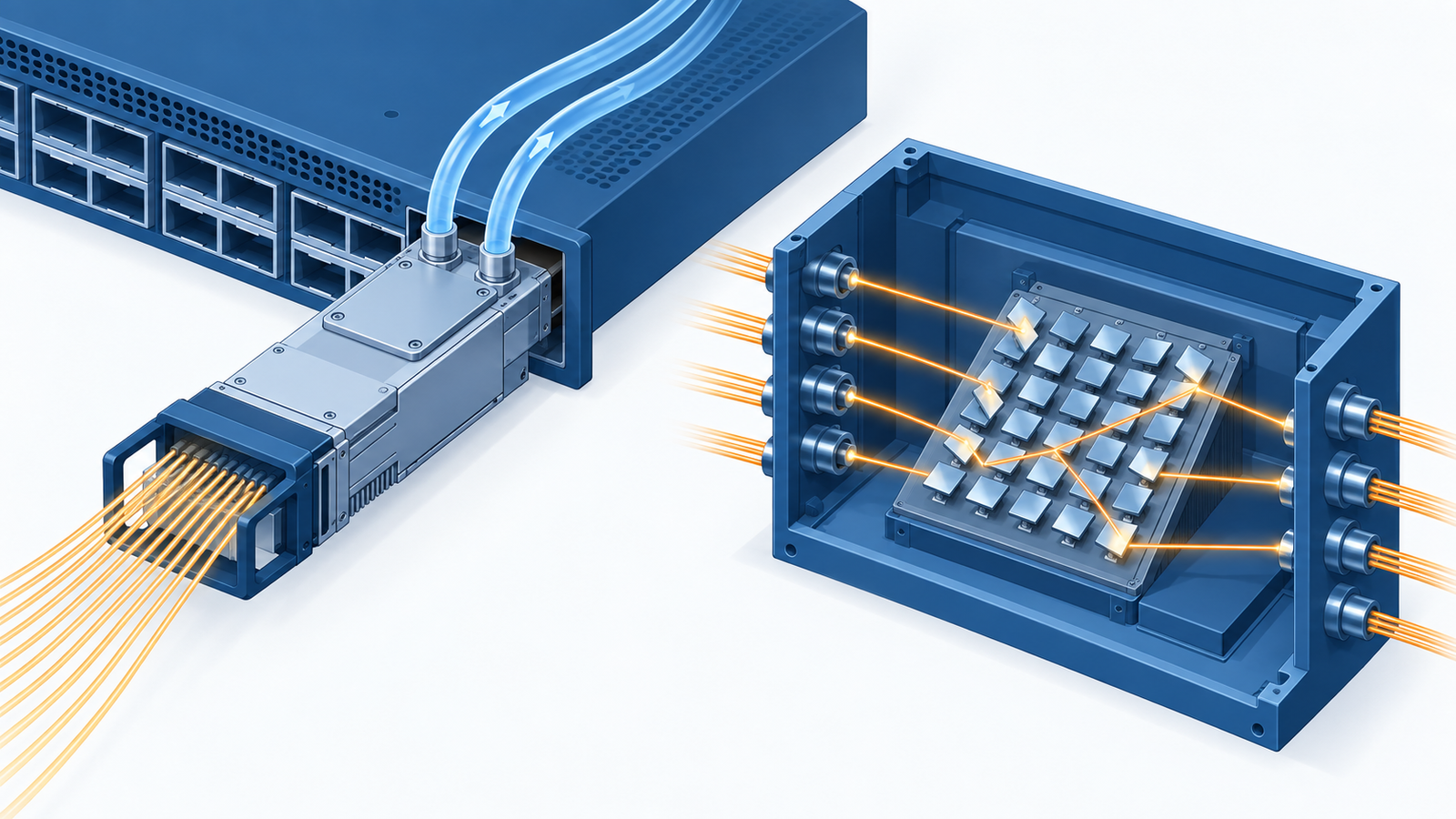
| Optical circuit switch (OCS) | NX200 (140 ports) and NX300 (320 ports). MEMS mirrors developed in house physically redirect the light. Its own SONiC-compliant operating system | Announced and exhibited. Shipping date not disclosed |
| Telecom networks | 200G (QSFP56, QSFP28-DD, CFP2) and 100G (QSFP28, SFP-DD). For 5G midhaul and backhaul and fixed access | In volume production |
The OCS and XPO that Eoptolink has just announced are both products in which mechanics and heat matter more than optics. The OCS uses tiny mirrors etched from silicon (MEMS mirrors), tilted electrically to physically redirect the light Sourced. Performance and lifetime depend on the mirrors' reflectivity, the repeatability of the tilt angle, the materials design of the hinges (springs) so that they do not fatigue after hundreds of millions of tilts, and vacuum or hermetic sealing (a general explanation). This is an entirely different body of technology from optical module packaging, and the company's explicit statement that it developed it in house shows how its technical range is widening.
The XPO integrates a cold plate that can remove up to 400 W per module Sourced. That is tens of times the power consumption of a single 800G optical module today, far beyond what air cooling can handle (a general explanation). Connecting coolant lines to a part that has to be plugged and unplugged makes leak-free quick-disconnect couplings and the reliability of the thermal interface material between module and cold plate the key issues. The annual report lists among its R&D goals a breakthrough in the integrated two-board, liquid-cooled structure and its packaging technology, so the company itself acknowledges that this is the crux of the development. See also our explainers on optical circuit switches and on optical transceivers.
11. The risks this company carries
| Risk | Details | Category |
|---|---|---|
| Customer concentration | The top five customers accounted for 72.34% of revenue and the largest for 22.97% (2025). Names not disclosed | Sourced |
| Supplier concentration | The largest single supplier accounted for 23.87% of annual purchases, and the top five for 41.88% | Sourced |
| Dependence on particular regions | 96.16% of revenue comes from outside China, and domestic revenue fell 48.19% year on year. The company itself lists international trade friction as a risk | Sourced |
| Tight raw materials and inventory | The interim report says core raw materials across the supply chain remain tight overall. The annual report states that because long-lead materials are ordered ahead on forecasts, missed orders could leave inventory stranded and lead to write-downs | Sourced |
| Technology substitution | The annual report states the risk that, as micro-optics and integrated photonics come into practical use, optical modules could be replaced by more highly integrated optical devices | Sourced |
| Acquisitions and expansion | The company plans to acquire and integrate peers and upstream companies, and itself lists the risk of failure through lack of experience in doing so | Sourced |
| Execution risk in vertical integration | For an assembly-focused company, making optical chips in house is a different business in both equipment and people. R&D spending is only 2.83% of revenue | Inference |
12. Glossary
- Optical module (optical transceiver)
- A part that converts electrical signals to light to send them, and turns received light back into electrical signals. It plugs into switches and servers.
- LPO / LRO
- LPO is a pluggable optical module that omits the signal-processing DSP. LRO is an intermediate approach that keeps a DSP only on the transmit side.
- XPO
- A new form of high-density pluggable optical module designed for liquid cooling. Its specifications are set by the XPO MSA industry group.
- NPO
- Near-packaged optics. The optical engine is placed near the switch chip.
- Optical circuit switch (OCS)
- Equipment that switches the path of optical signals without converting them back to electricity.
- MEMS mirror
- A tiny movable mirror made with semiconductor processing techniques. It is tilted electrically to redirect light.
- 400G per wavelength (400G per lane)
- Sending 400 Gb/s over each optical channel (wavelength), so that 1.6T can be carried on four channels.
- SONiC
- An open-source operating system for data centre network equipment.
13. References
- Eoptolink Technology Inc., Ltd 2025 Annual Report (in Chinese; published on 24 April 2026 on CNINFO, the disclosure website designated by the Shenzhen Stock Exchange). Company information, revenue and profit (2023 to 2025), product list and standards, capacity, output and sales volumes, revenue by region, top five customers and suppliers, R&D investment, staff and projects, headcount, patent count, the Thai subsidiary, Alpine, investment in the Singapore subsidiary, capital expenditure, government grants, and future strategy, 2026 plan and risks. https://static.cninfo.com.cn/finalpage/2026-04-24/1225172598.PDF
- Eoptolink Technology Inc., Ltd 2026 Interim Report (in Chinese; published 25 August 2026). Revenue, profit and cash flow for the first half of 2026, capacity, output and sales volumes, product list, the OCS NX200/300 and 3D MEMS, and remarks on tight raw material supply. https://static.cninfo.com.cn/finalpage/2026-08-25/1225499406.PDF
- Broadcom Inc. (posted on Eoptolink's official website) "Eoptolink is using Broadcom's Industry First 400G/lane Optical DSP for Next-Generation 1.6T transceivers" (originally a Broadcom release, 11 March 2026). Overview of the Taurus BCM83640 and comments from Eoptolink's CEO. https://www.eoptolink.com/news/13-new-products/363-eoptolink-is-using-broadcom-s-industry-first-400g-lane-optical-dsp-for-next-generation-1-6t-transceivers
- Eoptolink Technology Inc., Ltd Press release, "Eoptolink Joins XPO MSA and Unveils Industry-First 12.8 Tbps Liquid-Cooled Pluggable Optics for AI Data Centers" (12 March 2026). XPO specifications and membership of the XPO MSA as a founding member. https://www.eoptolink.com/news/13-new-products/364-eoptolink-joins-xpo-msa-and-unveils-industry-first-12-8-tbps-liquid-cooled-pluggable-optics-for-ai-data-centers
- Eoptolink Technology Inc., Ltd Press release, "Eoptolink Demos IMDD 400G per Lambda Based 1.6T DR4 Optical Transceiver Solution at OFC 2026" (12 March 2026). https://www.eoptolink.com/news/13-new-products/365-eoptolink-demos-imdd-400g-per-lambda-based-1-6t-dr4-optical-transceiver-solution-at-ofc-2026
- Eoptolink Technology Inc., Ltd Press release, "Eoptolink Unveils High-Density 6.4T NPO Solution at OFC 2026" (13 March 2026). https://www.eoptolink.com/news/13-new-products/366-eoptolink-unveils-high-density-6-4t-npo-solution-at-ofc-2026
- Eoptolink Technology Inc., Ltd Press release, "Eoptolink Demos its NX200 and NX300 Series Optical Circuit Switching (OCS) Solution at OFC 2026" (16 March 2026). Port counts, in-house MEMS mirrors, SONiC-compliant operating system and participation in the OCP OCS project. https://www.eoptolink.com/news/13-new-products/367-eoptolink-demos-its-nx200-and-nx300-series-optical-circuit-switching-ocs-solution-at-ofc-2026
- Eoptolink Technology Inc., Ltd Official website (the company website given in the annual report; source of the company name style and the logo image). https://www.eoptolink.com/
14. Claim-to-source audit
| Claim in the article | Category | Source |
|---|---|---|
| Legal name, English name, headquarters, stock code and official website | Sourced | Reference 1 https://static.cninfo.com.cn/finalpage/2026-04-24/1225172598.PDF |
| Main business, position in the supply chain (midstream), main raw materials and the vertical integration strategy | Sourced | Reference 1 https://static.cninfo.com.cn/finalpage/2026-04-24/1225172598.PDF |
| Revenue, net profit and R&D investment (2023 to 2025), optical interconnect product revenue and gross margin, and revenue by region (96.16% from outside China, domestic down 48.19%) | Sourced | Reference 1 https://static.cninfo.com.cn/finalpage/2026-04-24/1225172598.PDF |
| Capacity, output and sales volumes (2024 and 2025), top five customers and suppliers, R&D staff and headcount, capital expenditure and government grants | Sourced | Reference 1 https://static.cninfo.com.cn/finalpage/2026-04-24/1225172598.PDF |
| Start of Thai plant phase II, Thai subsidiary revenue and net profit, consolidation of Alpine and its Chengdu subsidiary, and the Singapore subsidiary's Class A share issue and 92.22% stake | Sourced | Reference 1 https://static.cninfo.com.cn/finalpage/2026-04-24/1225172598.PDF |
| R&D projects (XPO, 6.4T with separate transmit and receive, 1.6T LPO, 1.6T 4xDR4, 1.6T AEC) and the company's claims about LPO and 1.6T | Sourced | Reference 1 https://static.cninfo.com.cn/finalpage/2026-04-24/1225172598.PDF |
| The 2026 business plan, the six elements of the future strategy, and risk factors (technology substitution, inventory, competition, acquisitions, trade friction) | Sourced | Reference 1 https://static.cninfo.com.cn/finalpage/2026-04-24/1225172598.PDF |
| First-half 2026 revenue and net profit, capacity, output, sales volumes and gross margin, tight raw materials, and reach of coherent products | Sourced | Reference 2 https://static.cninfo.com.cn/finalpage/2026-08-25/1225499406.PDF |
| Average revenue per unit (about CNY 980, CNY 1,545 and CNY 1,866), the roughly 5.2-fold increase in R&D investment, and the Thai subsidiary's revenue being on the scale of about 90% of the company total | Our calculation | Calculated in this article from the figures in references 1 and 2. Not product prices or a consolidated breakdown |
| Overview of Broadcom's Taurus BCM83640 and comments from Eoptolink's CEO | Sourced | Reference 3 https://www.eoptolink.com/news/13-new-products/363-eoptolink-is-using-broadcom-s-industry-first-400g-lane-optical-dsp-for-next-generation-1-6t-transceivers |
| 12.8T XPO specifications (64 lanes, 204.8 Tbps in 4 RU, 400 W cold plate), XPO MSA membership, and comments from the Vice President of Sales | Sourced | Reference 4 https://www.eoptolink.com/news/13-new-products/364-eoptolink-joins-xpo-msa-and-unveils-industry-first-12-8-tbps-liquid-cooled-pluggable-optics-for-ai-data-centers |
| 1.6T DR4 at 400G per wavelength (8:4 DSP, 50% fewer fibres) | Sourced | Reference 5 https://www.eoptolink.com/news/13-new-products/365-eoptolink-demos-imdd-400g-per-lambda-based-1-6t-dr4-optical-transceiver-solution-at-ofc-2026 |
| 6.4T NPO (silicon photonics, 32 lanes at 200G) | Sourced | Reference 6 https://www.eoptolink.com/news/13-new-products/366-eoptolink-unveils-high-density-6-4t-npo-solution-at-ofc-2026 |
| OCS NX200 and NX300 (140 and 320 ports, in-house MEMS mirrors, SONiC-compliant operating system, participation in the OCP OCS project) | Sourced | Reference 7 https://www.eoptolink.com/news/13-new-products/367-eoptolink-demos-its-nx200-and-nx300-series-optical-circuit-switching-ocs-solution-at-ofc-2026 |
| The three types of company in optical communications and photonics | Our calculation | This article's own classification. Example companies drawn from those covered in this series |
| Names of customers, suppliers and the investor SPV, revenue by product, timing of volume production and orders for new products, specific plans for in-house optical chips, and the date and price of the Alpine acquisition | Not yet confirmed | Not stated in references 1 to 7. Press-based information is not used https://static.cninfo.com.cn/finalpage/2026-04-24/1225172598.PDF |
| The first-half 2026 capacity figure cannot be read as a utilisation rate | Not yet confirmed | Reference 2 does not define the capacity figure, so this article does not interpret it https://static.cninfo.com.cn/finalpage/2026-08-25/1225499406.PDF |
| Market forecasts by research firms (LightCounting, ICC) | Not yet confirmed | Quoted in references 1 and 2, but not used because they are not the company's own figures https://static.cninfo.com.cn/finalpage/2026-08-25/1225499406.PDF |
| The readings that XPO is meant to defend its territory, that OCS extends it into network equipment, and that its supply set-up is optimised for the U.S. market | Inference | This article's interpretation of references 1, 4 and 7 |
| The reading that the R&D ratio will gauge how serious it is about in-house chips, and the execution risk of vertical integration | Inference | This article's interpretation of the strategy and the R&D trend in reference 1 |
| General technical issues around MEMS mirrors, liquid cooling and thermal interface materials | Inference | This article's explanation based on general technical knowledge. Not company-specific figures |
Last updated 26 September 2026 / Troy Technical
Every figure in this article comes from the annual and interim reports Eoptolink Technology Inc., Ltd has published on the Shenzhen Stock Exchange's designated disclosure website (both in Chinese) and from the company's official releases. "CNY" means Chinese yuan (renminbi). No research-firm estimates or press-based figures have been used. Passages marked "Inference" are this article's interpretation of the primary sources, not statements made by the company.