COMPANY PROFILE / OPTICAL COMMUNICATIONS & PHOTONICS
Furukawa Electric
From optical fibre to laser chips and LN modulators: a long-established maker widening its "box of optical parts" through acquisitions
Furukawa Electric makes not only optical fibre and cable but also DFB laser chips for data centres, pump light sources for Raman amplifiers and external light sources for CPO, which makes it an unusually broad optical component maker by Japanese standards. In 2025 it brought in two subsidiaries in quick succession: Hakusan, a maker of multi-fibre optical connector components, and Fujitsu Optical Components (LN modulators), formerly a Fujitsu subsidiary. From FY2026 it has regrouped its businesses, putting data-centre-related products front and centre in two segments, "Optical Solutions" and "Digital Infrastructure Components". This profile keeps the power cable, automotive parts and other businesses to a minimum and concentrates on what the company is putting into optical communications, who it is working with and where it is heading.
- Furukawa Electric in 30 seconds, and where it stands in optical communications and photonics
- The logo and how the name is written
- Where the company sits in the optical communications landscape
- Scale (the group in brief)
- Resources committed to optical communications and photonics
- What it has done so far
- What comes next
- What the company is aiming for in optical communications and photonics
- Map of partnerships in optical communications and photonics
- Technologies, products and services
- The risks this company carries
- Glossary, references and claim-to-source audit
1. Furukawa Electric in 30 seconds, and where it stands in optical communications and photonics
(from fibre to lasers)Has both optical fibre and cable and optical semiconductors
Fujitsu Optical ComponentsMade subsidiaries in January and April 2025
Submarine fibreAlso develops external light sources for CPO and connectors for PICs
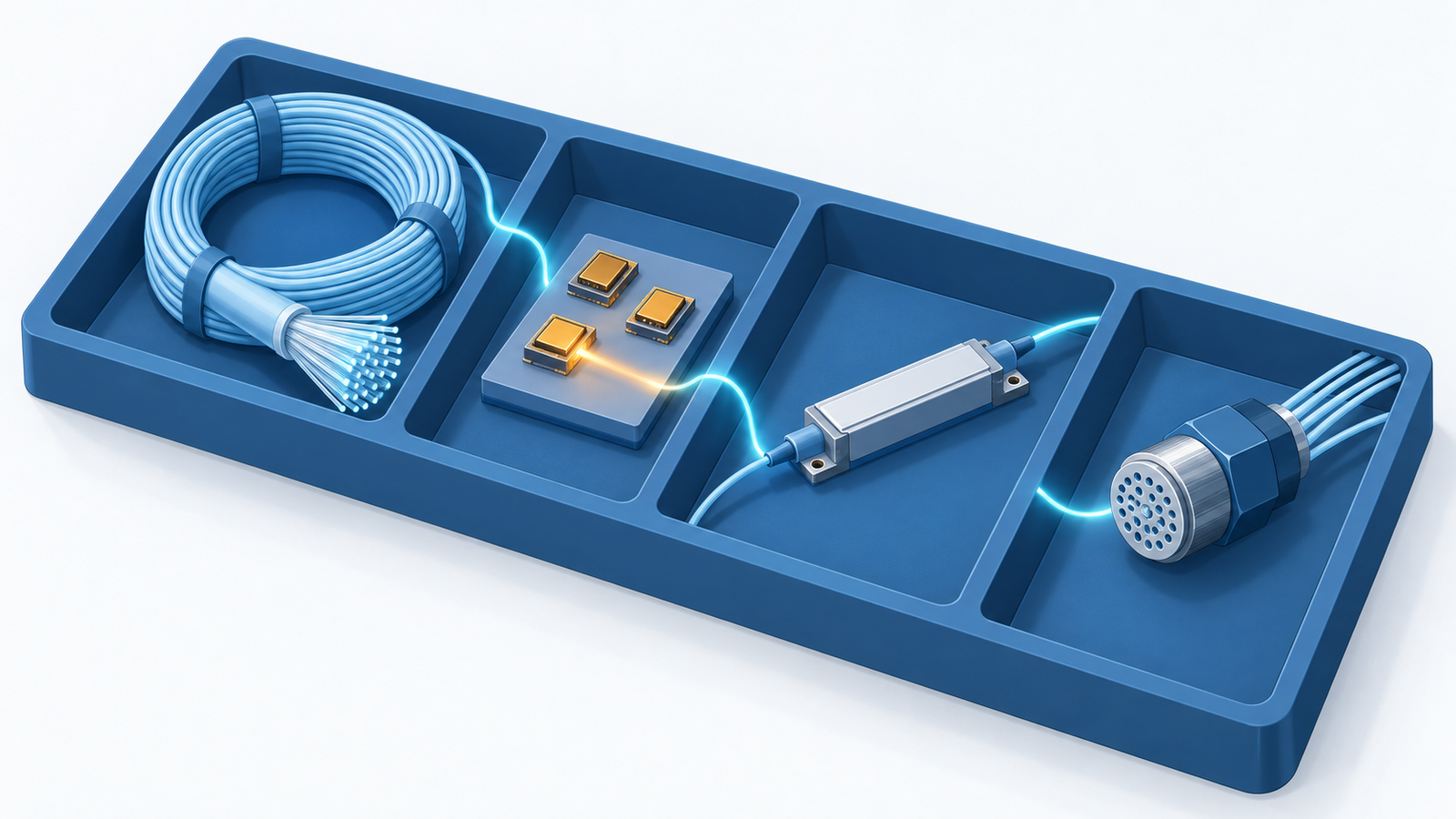
Companies involved in optical communications fall into three broad types: optical components & modules, chips & foundries, and network systems & carriers. Furukawa Electric is on the optical components side, and what stands out is how wide its coverage is even there Sourced. The Annual Securities Report lists products of the former "Infrastructure" segment including optical fibre, optical fibre cable, optical connectivity products, optical semiconductor devices, optical fibre fusion splicers, optical transceivers and network equipment. In other words, the same company has both the wiring that carries light (fibre, cable and connectors) and the parts that emit, amplify and modulate light (laser chips, pump sources and LN modulators). Even compared with Fujikura and Sumitomo Electric, with which it is often grouped as a cable maker, bringing in Fujitsu's LN modulator business in 2025 has made it a company weighted more towards emitting and shaping light.
2. The logo and how the name is written

The Furukawa Electric logo is a trademark of the company. We have not recreated it with generated imagery;
the image was taken from the official website and is placed here as img/furukawa_electric_logo.svg.
A note on names: the legal entity is Furukawa Electric Co., Ltd. Since April 2025 the optical fibre and cable business has been run under the brand Lightera, made up of three companies: Lightera Japan, Lightera, LLC in the U.S. (formerly OFS) and Lightera LatAm in Brazil. The former Fujitsu Optical Components, acquired in April 2025, is now called Furukawa FITEL Optical Components (FFOC). Note that it is now a separate company from Fujitsu.
Official site: https://www.furukawaelectric.com/3. Where the company sits in the optical communications landscape
In terms of where in the optical chain it operates, the company spans the inside of data centres (DFB laser chips, external light sources for CPO, MT ferrules and pre-connectorised cable), links between data centres (DCI) (rollable ribbon cable, SOAs and tunable light sources for coherent transmission) and long-haul and submarine links (pump sources for Raman amplifiers, LN modulators and submarine optical fibre) Sourced. That means a single company holds many of the components covered in our explainers on semiconductor lasers, optical transceivers and co-packaged optics.
4. Scale (the group in brief)
The size of the group as a whole is covered in a single table Sourced.
| Measure (¥ million) | Year to March 2024 | Year to March 2025 | Year to March 2026 |
|---|---|---|---|
| Consolidated net sales | 1,056,528 | 1,201,762 | 1,307,560 |
| Consolidated operating profit | - | 47,032 | 63,856 |
| Consolidated R&D expenses | - | - | 28,423 |
| Consolidated employees (people, 31 March 2026) | - | - | 49,112 |
Up to the year to March 2026, optical communications figures were disclosed as the Telecommunications Solutions business within the "Infrastructure" segment. From FY2026 the grouping has changed: optical fibre and cable (Lightera) and broadband networks now sit in Optical Solutions, while FITEL products such as laser chips, and photonic-electronic convergence devices, sit in Digital Infrastructure Components (the same segment as thermal management products and copper foil) Sourced.
| Optical communications figures (¥ million) | Year to March 2025 | Year to March 2026 |
|---|---|---|
| Telecommunications Solutions sales to external customers (prior year restated) | 164,269 | 227,597 |
| Infrastructure segment profit (telecommunications and energy combined) | 5,700 | 21,439 |
| Infrastructure segment R&D expenses | - | 15,808 |
| Infrastructure segment capital expenditure | - | 25,432 |
| Infrastructure segment employees (people) | - | 9,319 |
| New segments (April to June 2026) | Net sales | Operating profit | Change year on year |
|---|---|---|---|
| Optical Solutions | ¥60.0 billion | ¥9.2 billion | Sales up 45.6%; operating profit improved by ¥9.9 billion |
| Digital Infrastructure Components (includes non-optical products) | ¥59.6 billion | ¥7.4 billion | Sales up 32.8%; operating profit up 105.2% |
For the year to March 2026, the profit of the Telecommunications Solutions business is not disclosed separately. The Infrastructure segment's profit of ¥21.4 billion also includes the energy infrastructure business, such as power cables Not yet confirmed. The R&D, capital expenditure and headcount figures likewise cover the whole Infrastructure segment. The new Digital Infrastructure Components segment also includes products unrelated to light, such as thermal management and cooling products, tape for semiconductor manufacturing and copper foil, so its figures cannot be read as "optical profit". Telecommunications Solutions sales amount to only 17.4% of consolidated net sales Our calculation.
5. Resources committed to optical communications and photonics
| Type of resource | What it is | Category |
|---|---|---|
| People (dedicated organisation and staff) | A photonics research laboratory in Japan and Lightera Laboratories, LLC in the U.S. On the business side, from FY2026 there is an Optical Solutions division plus a FITEL products division and a photonic-electronic convergence device division. The Infrastructure segment has 9,319 employees (the number working on optical products alone is not disclosed) | Sourced |
| Money (R&D) | R&D expenses in the Infrastructure segment of ¥15,808 million (year to March 2026), 55.6% of consolidated R&D of ¥28.4 billion (the percentage is our calculation). The amount for optical products alone is not disclosed | Sourced |
| Money (capital expenditure decisions) | Optical fibre and rollable ribbon cable, about ¥100 billion (U.S., Brazil, Japan and India; decided August 2026); DFB laser chips, ¥38 billion (a new plant in Iwate and Thailand; decided December 2025); a new TMT ferrule plant at Hakusan, about ¥5 billion (decided June 2026) | Sourced |
| Acquisitions | Acquired about 67% of the shares of Hakusan (30 January 2025, for ¥3,603 million). Acquired all shares of Fujitsu Optical Components from Fujitsu (1 April 2025, for ¥5,959 million) | Sourced |
| Joint ventures and investments | Plans to invest in optical fibre through Birla Furukawa Fibre Optics in India (a joint venture with Universal Cables Limited, accounted for by the equity method), subject to reaching agreement with UCL | Sourced |
| Public funding (NEDO) | Under NEDO's Research and Development Project of the Enhanced Infrastructures for Post-5G Information and Communication Systems / Development of manufacturing technologies for advanced semiconductors (NEDO is Japan's state R&D funding agency), jointly awarded the theme of optical chiplet packaging technology with NTT, NTT Innovative Devices, NTT Device Cross Technologies and Shinko Electric Industries (January 2024; five years to FY2028). The 12-fibre connector for CPO is one result of this work | Sourced |
| Public funding (NICT) | Under the Beyond 5G (6G) fund programme of NICT (Japan's national institute for information and communications technology), responsible for packaging technology for tunable laser assemblies and optical amplifiers for 1.6 Tbps-class pluggable coherent transceivers (selected July 2025, to FY2028). In separate research commissioned by NICT, demonstrated a 1,000 km-class space-division multiplexed optical network with Kagawa University, KDDI Research, NEC and santec | Sourced |
| University collaboration | Kagawa University is the lead researcher in the NICT-commissioned research above. No individual joint research agreements with universities on optical communications appear in the primary sources we checked | Partly not confirmed |
6. What it has done so far
| When | What happened | Why it matters |
|---|---|---|
| June 1896 | Founded as Yokohama Electric Wire Manufacturing Co., Ltd. (present name from 1920) | The starting point as a wire and cable maker |
| 2000 | Begins manufacturing DFB laser diode chips (according to the December 2025 release) | Its optical semiconductor expertise dates from around here |
| November 2001 | Acquires the optical fibre and cable division of Lucent Technologies in the U.S. (later OFS, now Lightera, LLC) | Gains a U.S. optical fibre base |
| January 2024 | Jointly awarded, with NTT group companies and others, the optical chiplet packaging theme in NEDO's post-5G project | Joins a national project on photonic-electronic convergence |
| March 2024 | Develops a 16-channel external light source for CPO based on the OIF ELSFP specification (at least 100 mW on every channel at 55 °C), described by the company as a world first | Announced sample shipments from April 2024 and mass production from FY2025 onwards |
| January 2025 | Makes Hakusan a subsidiary (about 67%) | Gains multi-fibre optical connector components centred on MT ferrules |
| March 2025 | Develops a compact 12-fibre optical connector for CPO (connection loss of 0.5 dB or less, compatible with 260 °C reflow). Demonstrates a 1,000 km-class space-division multiplexed optical network in NICT-commissioned research | A component role at CPO's "optical entry and exit points" |
| April 2025 | Brings the optical fibre and cable business together under the Lightera brand. Makes Fujitsu Optical Components a subsidiary and renames it FFOC | LN modulators and optical transceivers are added |
| July 2025 | Selected for NICT's Beyond 5G fund programme (1.6 Tbps-class coherent transceivers) | A national project on coherent optics for DCI |
| December 2025 | Decides to invest a total of ¥38 billion to expand production of DFB laser chips: a new plant in Iwate (on the Japan Semiconductor site) and equipment at the Thailand plant | Capacity in 2028 to be more than five times the FY2025 level |
| February 2026 | A second plant dedicated to ultra-high-fibre-count cable starts full operation at Mie Works. Hakusan signs a multi-sourcing agreement for MMC/TMT ferrules with US Conec and SANWA Technologies | Ultra-high-fibre-count cable capacity more than twice the FY2023 level |
| March 2026 | Lightera starts mass production of a 13,824-fibre ultra-high-fibre-count optical fibre cable (ribbons of 16 fibres of 200 µm diameter bonded intermittently, outer diameter 40 mm or less) | Described by the company as among the world's highest |
| June 2026 | Decides to build Hakusan's Ishikawa No. 2 plant (TMT ferrules, about ¥5 billion) | Aims to start mass production around April 2028 |
| August 2026 | Decides to invest about ¥100 billion to expand production of optical fibre and rollable ribbon cable, disclosing that it has confirmed customers' purchase commitments | Cable capacity to roughly double from the end of FY2025 |
| September 2026 | Lightera announces it will expand submarine optical fibre capacity in Denmark and the U.S., to about three times the current level by FY2029 | A response to demand for submarine cables |
7. What comes next
The management policy briefing materials define the data-centre-related businesses as "Lightera, thermal, FITEL, AT (tape for semiconductor manufacturing), MD (memory disks), copper foil and photonic-electronic convergence devices", and assume that this group of businesses will earn ¥200 billion in operating profit in FY2030 Sourced. Of these, the ones involving light are Lightera, FITEL and photonic-electronic convergence devices; the rest are thermal and materials businesses. The photonic-electronic convergence device division says that towards 2030 it will develop and expand sales of thin-film LN modulators and 1.6T transceivers and aims to commercialise next-generation photonic-electronic convergence devices.
| Optical investments already decided | Amount | Planned start of volume production or operation | Capacity |
|---|---|---|---|
| Optical fibre and rollable ribbon cable | About ¥100 billion | In stages from the second half of FY2028 | Cable production capacity roughly double the end-FY2025 level |
| DFB laser chips | ¥38 billion | Iwate plant: volume production from April 2028 | More than five times the FY2025 level in 2028 |
| TMT ferrules (Hakusan) | About ¥5 billion | Around April 2028 | At least about 1.5 times the current number of machines |
| Submarine optical fibre (Lightera) | Not disclosed | By FY2029 | About three times the current level |
None of the following appears in the primary sources Not yet confirmed.
FY2030 sales and profit amounts for Optical Solutions, FITEL products and photonic-electronic convergence devices individually (the briefing materials give only multiples and trend charts); whether volume production of the external light source for CPO has actually started, and its customers (the March 2024 announcement said volume production was planned from FY2025 onwards); shipment volumes of DFB laser chips; and the sales scale of FFOC's LN modulators (the only disclosure is that, before the acquisition, it had net sales of ¥13.6 billion and an operating loss of ¥10.2 billion in the year to March 2024). Hakusan's "second-largest global share in MT ferrules" and FOC's "world-leading share" are both the companies' own descriptions; no market data is cited for them, so this article does not treat them as figures.
8. What the company is aiming for in optical communications and photonics
This section goes beyond what the company says directly. It sets out inferences that can be drawn from primary sources, each with its basis.
| What can be read | Primary evidence behind it | Category |
|---|---|---|
| It wants to secure data-centre optics in both "wiring" and "light sources" | Within half a year it decided on about ¥100 billion to expand rollable ribbon cable and ¥38 billion to expand DFB laser chips | Inference |
| In CPO it is going after the external light source and the optical entry and exit points (connectors) | It lists a 16-channel external light source compliant with ELSFP, a compact connector for PICs (Snap-Beam Connector™) and polarisation-maintaining fibre among the "product groups it will grow" | Inference |
| A policy of filling gaps in its component range through acquisitions | It acquired Hakusan (MT ferrules) and FOC (LN modulators, receivers and transceivers) in quick succession in 2025. The Annual Securities Report says the aim is to establish an advantage in growth markets by realising synergies | Inference |
| The LN modulator business is still being turned around | FOC had net sales of ¥13.6 billion and an operating loss of ¥10.2 billion in the year to March 2024, before the acquisition. The company has disclosed that it will absorb FFOC into the parent in April 2027 to speed up decision-making | Inference |
| It is to be the light-source provider in Japan's photonic-electronic convergence project | In NEDO's post-5G project, working with the NTT group, it is responsible for optical semiconductor devices to realise the convergence of photonics and electronics | Sourced |
The December 2025 release on expanding DFB laser chip production gives as background that intensity-modulation optical transceivers are widely used and that silicon photonics technology has been attracting attention in recent years, and goes on to say that DFB laser chips are expected to be adopted in ELSFP, the external light source for CPO Sourced. A silicon photonics chip cannot emit light on its own, so it needs a light source that feeds continuous light in from outside. The more silicon photonics and CPO spread, then, the further a division of labour goes: silicon does the modulating, and compound semiconductor lasers do the emitting. Our reading is that Furukawa Electric is not making silicon photonics chips itself but has placed a big bet on the "light-emitting" side of that division of labour Not yet confirmed. This picture is covered in our explainers on silicon photonics and semiconductor lasers.
9. Map of partnerships in optical communications and photonics
10. Technologies, products and services
| Product | What the primary sources say | Stage |
|---|---|---|
| Rollable ribbon cable | Ultra-high-fibre-count cable using intermittently bonded fibre ribbons (rollable ribbons). The 13,824-fibre version uses ribbons of 16 thin 200 µm fibres, has an outer diameter of 40 mm or less, is for both outdoor and indoor use and supports VSFF connectors | In volume production (since March 2026) |
| MT and TMT ferrules | Made by Hakusan. TMT ferrules come in 12- and 16-fibre versions for MMC connectors, and the company says they are also used for wiring inside equipment such as CPO | MT in volume production; TMT due for volume production at a new plant around 2028 |
| DFB laser chips | Made since 2000. A 100 mW high-power version, which the company calls industry-leading, is supplied to optical transceiver makers and others. Versions for 800G and 1.6T are being developed and marketed | In volume production |
| External light source for CPO (ELS) | A 16-channel product compliant with the OIF ELSFP IA. Carries two 8-channel TOSAs (22.5 × 13.0 × 3.3 mm), with at least 100 mW on every channel at 25 to 55 °C and a polarisation extinction ratio of at least 20 dB | Samples from April 2024. Volume production record not disclosed |
| Optical connectors for CPO | The 12-fibre version has one-sixth the connection area of an MPO, connection loss of 0.5 dB or less, compatibility with 260 °C reflow and lens coupling. The company has also developed the Snap-Beam Connector™ to connect PICs to fibre, confirmed low loss on products such as a 40-channel version, and is running customer evaluations | Development and evaluation |
| SOAs and pump sources for Raman amplifiers | Light sources for amplification used to extend the reach and speed of links between data centres. Described at the business briefing as targets of investment to expand production | In volume production |
| LN modulators and optical transceivers | Products of the former FOC. The photonic-electronic convergence device division handles thin-film LN modulators, CDMs, Nano ITLAs and coherent transceivers | Existing products in volume production; thin-film LN and 1.6T in development |
| Next-generation fibre | Multi-core fibre, hollow-core fibre and submarine fibre. A two-core submarine fibre has been prototyped at pre-mass-production scale | Submarine fibre in volume production; MCF and HCF in development and demonstration |
"World first" (the 16-channel external light source for CPO and the 1,000 km-class space-division multiplexed network), "among the world's highest" (the 13,824-fibre cable) and "industry-leading" (the 100 mW DFB) are all the company's own wording. ELSFP is an implementation agreement (IA) published by the OIF (Optical Internetworking Forum) in August 2023, and Furukawa Electric says it developed its product based on that specification Sourced.
The 12-fibre connector for CPO announced in March 2025 lists as a feature that it withstands 260 °C reflow Sourced. In CPO, the optical connector sits on the same substrate as the switch ASIC or GPU. In the reflow process that solders components onto the board, the whole assembly is heated to around 260 °C, so structures that fix the fibre with a resin ferrule and adhesive, as conventional optical connectors do, cannot be used as they are. If heat deforms the resin or degrades the adhesive, alignment at the micron level is lost and light no longer passes. Our reading is that Furukawa Electric chose lens coupling not only because it is resistant to dust but also to widen the tolerance for misalignment and reduce the effect of thermal deformation Not yet confirmed.
Put another way, what decides how widely CPO spreads is not only the optical chips but also optical resins, adhesives and ferrule materials that survive soldering heat. The fact that the company lines up connectors, external light sources and polarisation-maintaining fibre for CPO can be seen as solving, component by component, the problem of making optical parts cope with the temperatures of electronics assembly.
11. The risks this company carries
| Risk | Substance | Category |
|---|---|---|
| Optical earnings are hard to see | Up to the year to March 2026, the profit of the Telecommunications Solutions business was not disclosed separately, and the new Digital Infrastructure Components segment includes much that is not optical | Sourced |
| Large investments bunched together | About ¥100 billion for optical fibre and cable, ¥38 billion for DFB chips and investment in thermal products and more all come on stream around 2028. The company itself writes that its fundraising will expand temporarily in FY2026 and FY2027 | Sourced |
| Turning round an acquired business | FOC made an operating loss of ¥10.2 billion in the year to March 2024, before the acquisition. Whether the LN modulator business will turn profitable has not been disclosed | Not yet confirmed |
| Weakness in some regions | The business briefing materials say "structural problems persist" in Latin America (currency and interest rate rises, customers holding back investment) and Europe (slow market recovery, price competition) | Sourced |
| Swings in data-centre demand | The plan relies on data-centre-related businesses for ¥200 billion of the ¥250 billion FY2030 operating profit. A slowdown in data-centre investment would undermine the whole plan | Inference |
| Timing of the CPO ramp | In 2024 the company announced volume production of the external light source from FY2025 onwards, but no volume production record has been disclosed. If CPO adoption slips, recovering the light-source investment will also be delayed | Inference |
| Shortage of people | The Annual Securities Report lists as a risk the loss of business opportunities due to a shortage of specialist staff in focus areas (such as data-centre-related businesses) | Sourced |
12. Glossary
- DFB laser
- Distributed Feedback laser. A semiconductor laser that oscillates stably at a single wavelength. Used as the light source in optical transceivers.
- ELS / ELSFP
- External Light Source. In CPO, a light source placed outside the optical chip. ELSFP is the specification for its pluggable form, defined by the OIF.
- LN modulator
- A component that modulates light at high speed using the electro-optic effect of lithium niobate (LiNbO₃). Used in long-haul and coherent communications.
- Rollable ribbon
- A fibre ribbon in which the fibres are bonded intermittently. It can be rolled up to pack into a thin cable and can still be mass-fusion spliced.
- MT / TMT ferrule
- A precision part that positions many optical fibres at once. The TMT is a smaller version for MMC connectors.
- SOA
- Semiconductor Optical Amplifier. A semiconductor device that amplifies light using an electric current.
- Raman amplification
- A method in which strong pump light is launched into the transmission fibre so that the fibre itself amplifies the signal light. Used in long-haul transmission.
- Space-division multiplexing (SDM)
- Raising capacity by physically adding more paths for light, for example with multi-core fibre.
13. References
- Furukawa Electric Co., Ltd. Annual Securities Report for the 204th fiscal period (1 April 2025 to 31 March 2026), filed 24 June 2026 (in Japanese). Company history, management policy, business risks, segment results, R&D activities, capital expenditure, headcount, business combinations (Hakusan and FOC), material contracts (absorption of FFOC) and segment information. https://www.furukawaelectric.com/ir/library/sr/pdf/204.pdf
- Furukawa Electric Co., Ltd. Summary of consolidated financial results for Q1 of the fiscal year ending March 2027 (kessan tanshin, the standard Japanese earnings release; 6 August 2026, in Japanese). Net sales and operating profit of the new segments (Optical Solutions and Digital Infrastructure Components). https://www.furukawaelectric.com/ir/library/finalreport/pdf/2027/20260806.pdf
- Furukawa Electric Co., Ltd. Management policy briefing materials (19 May 2026, in Japanese). Financial target levels for FY2030, the definition of data-centre-related businesses and their ¥200 billion operating profit, the reorganisation into new segments and the expected profit growth by business. https://www.furukawaelectric.com/ir/library/mid_briefing/pdf/2026/20260519_management_pre.pdf
- Furukawa Electric Co., Ltd. Business briefing materials: Optical Solutions (5 June 2026, in Japanese). Lightera's 2030 vision, the data-centre share of sales and regional challenges. https://www.furukawaelectric.com/ir/library/briefing/pdf/2026/20260604_optosol.pdf
- Furukawa Electric Co., Ltd. Business briefing materials: Digital Infrastructure Components (5 June 2026, in Japanese). Policies of the FITEL products and photonic-electronic convergence device businesses, total investment and profit growth targets, and product introductions. https://www.furukawaelectric.com/ir/library/briefing/pdf/2026/20260604_digicomp.pdf
- Furukawa Electric Co., Ltd. Timely disclosure: Notice Regarding the Acquisition of Fixed Assets for the Production of Optical Fibers and Optical Fiber Cables (4 August 2026; title of the English version, link to the Japanese disclosure). https://www.furukawaelectric.com/release/2026/kei_20260804.pdf
- Furukawa Electric Co., Ltd. News release: New manufacturing plant for high output DFB laser diode chips for signal light sources (17 December 2025; title of the English version, link to the Japanese release). https://www.furukawaelectric.com/release/2025/comm_20251217.html
- Furukawa Electric Co., Ltd. Timely disclosure: Notice regarding the acquisition of shares accompanying the transfer of a subsidiary (12 December 2024; title of the English version, link to the Japanese disclosure). Reasons for acquiring Fujitsu Optical Components and its results for the three most recent years. https://www.furukawaelectric.com/release/2024/kei_20241212.pdf
- Furukawa Electric Co., Ltd. News release: Acquisition of Shares of Hakusan Inc. (7 November 2024; title of the English version, link to the Japanese release). https://www.furukawaelectric.com/release/2024/kei_20241107.html
- Furukawa Electric Co., Ltd. News release: Hakusan constructs a new plant toward mass production of TMT Ferrules for VSFF multi-fiber optical connectors (2 June 2026; title of the English version, link to the Japanese release). https://www.furukawaelectric.com/release/2026/opt_20260602.html
- Furukawa Electric Co., Ltd. Notice: Hakusan Inc. Concludes Agreement with SANWA Technologies and US Conec on Multi-Sourcing of Very Small Form Factor and Related Components (18 February 2026; title of the English version, link to the Japanese notice). https://www.furukawaelectric.com/news/2026/update_20260218.html
- Furukawa Electric Co., Ltd. News release: Start of mass production of 13824 count optical fiber cable featuring one of the world's highest fiber densities (12 March 2026; title of the English version, link to the Japanese release). https://www.furukawaelectric.com/release/2026/comm_20260312.html
- Furukawa Electric Co., Ltd. News release: The operational structure of the Furukawa Electric optical fiber cable business has been integrated under a new brand, Lightera, which will be launched April 1, 2025 (6 March 2025; title of the English version, link to the Japanese release). https://www.furukawaelectric.com/release/2025/comm_20250306.html
- Furukawa Electric Co., Ltd. News release: The world's first 100 mW optical power x 16-channel blind mate ELS for co-packaged optics (27 March 2024; title of the English version, link to the Japanese release). https://www.furukawaelectric.com/release/2024/comm_20240327.html
- Furukawa Electric Co., Ltd. News release: An epoch compact multi-fiber optical connector suitable for CPO (27 March 2025; title of the English version, link to the Japanese release). https://www.furukawaelectric.com/release/2025/comm_20250327.html
- Furukawa Electric Co., Ltd. News release: Selected to Participate in NEDO's "Research and Development Project of the Enhanced Infrastructures for Post 5G Information and Communications Systems / Development of manufacturing technologies for advanced semiconductors" (30 January 2024; title of the English version, link to the Japanese release). https://www.furukawaelectric.com/release/2024/comm_20240130.html
- Furukawa Electric Co., Ltd. News release: Selected for NICT's 2025 Function Realization and International Joint R&D Program "Innovative ICT Fund Projects for Beyond 5G/6G" (9 July 2025; title of the English version, link to the Japanese release). https://www.furukawaelectric.com/release/2025/comm_20250709.html
- NEC, santec AOC and Furukawa Electric Joint announcement: First successful demonstration of a large-scale space-division multiplexed optical network consisting of spatial cross-connect equipment and multi-core fibre optical amplifiers (28 March 2025, in Japanese). https://www.furukawaelectric.com/release/2025/kenkai_20250328.html
- Furukawa Electric Co., Ltd. Notice: Lightera Announces Major Capital Investment to Expand Submarine Optical Fiber Manufacturing (25 September 2026; title of the English version, link to the Japanese notice). https://www.furukawaelectric.com/news/2026/update_20260925.html
- Furukawa Electric Co., Ltd. News release: Furukawa Electric and Nokia Collaborate on Ultra-High-Speed Broadband Technology (2 June 2025; title of the English version, link to the Japanese release). https://www.furukawaelectric.com/release/2025/comm_20250602.html
- Furukawa Electric Co., Ltd. Official website (source of the company name and logo image). https://www.furukawaelectric.com/
14. Claim-to-source audit
| Claim in the article | Category | Source |
|---|---|---|
| Legal name, English name, head office address, founding in 1896, acquisition of Lucent's optical fibre division in 2001 | Sourced | Reference 1 https://www.furukawaelectric.com/ir/library/sr/pdf/204.pdf |
| Consolidated net sales, operating profit, R&D expenses and headcount | Sourced | Reference 1 https://www.furukawaelectric.com/ir/library/sr/pdf/204.pdf |
| Telecommunications Solutions sales to external customers; Infrastructure segment profit, R&D expenses, capital expenditure and headcount | Sourced | Reference 1 https://www.furukawaelectric.com/ir/library/sr/pdf/204.pdf |
| Acquisition dates and prices for Hakusan and FOC, the absorption of FFOC in April 2027, and the research set-up including the photonics research laboratory | Sourced | Reference 1 https://www.furukawaelectric.com/ir/library/sr/pdf/204.pdf |
| The Snap-Beam Connector™ for CPO (low loss confirmed on products such as a 40-channel version), two-core submarine fibre, the risk disclosure on staff shortages | Sourced | Reference 1 https://www.furukawaelectric.com/ir/library/sr/pdf/204.pdf |
| Net sales and operating profit of the new segments for April to June 2026 | Sourced | Reference 2 https://www.furukawaelectric.com/ir/library/finalreport/pdf/2027/20260806.pdf |
| FY2030 operating profit of ¥250 billion with ¥200 billion from data-centre-related businesses, investment of ¥650 billion, the reorganisation into new segments, Lightera four times and FITEL ten times | Sourced | Reference 3 https://www.furukawaelectric.com/ir/library/mid_briefing/pdf/2026/20260519_management_pre.pdf |
| Lightera's data-centre share of sales (from 37% to over 60%), structural problems in Latin America and Europe | Sourced | Reference 4 https://www.furukawaelectric.com/ir/library/briefing/pdf/2026/20260604_optosol.pdf |
| FITEL products investment of ¥38 billion and tenfold profit, products and policy of the photonic-electronic convergence device business | Sourced | Reference 5 https://www.furukawaelectric.com/ir/library/briefing/pdf/2026/20260604_digicomp.pdf |
| About ¥100 billion for optical fibre and cable, four countries, from the second half of FY2028, roughly double capacity, purchase commitments, the position of BFFO | Sourced | Reference 6 https://www.furukawaelectric.com/release/2026/kei_20260804.pdf |
| ¥38 billion for DFB laser chips, the new Iwate plant (volume production April 2028), Thailand, more than five times, production since 2000, expected adoption in ELSFP | Sourced | Reference 7 https://www.furukawaelectric.com/release/2025/comm_20251217.html |
| FOC's lines of business, the reasons for the acquisition, net sales of ¥13.6 billion and operating loss of ¥10.2 billion in the year to March 2024, continued cooperation with Fujitsu | Sourced | Reference 8 https://www.furukawaelectric.com/release/2024/kei_20241212.pdf |
| Acquisition of about 67% of Hakusan's shares | Sourced | Reference 9 https://www.furukawaelectric.com/release/2024/kei_20241107.html |
| Hakusan's Ishikawa No. 2 plant (about ¥5 billion, around April 2028, at least about 1.5 times) | Sourced | Reference 10 https://www.furukawaelectric.com/release/2026/opt_20260602.html |
| The MMC/TMT multi-sourcing agreement between Hakusan, SANWA Technologies and US Conec; 12- and 16-fibre TMT | Sourced | Reference 11 https://www.furukawaelectric.com/news/2026/update_20260218.html |
| Start of volume production and specifications of the 13,824-fibre cable, the second plant at Mie, capacity more than twice the FY2023 level | Sourced | Reference 12 https://www.furukawaelectric.com/release/2026/comm_20260312.html |
| Lightera's make-up (Lightera Japan, Lightera, LLC and Lightera LatAm) and its launch in April 2025 | Sourced | Reference 13 https://www.furukawaelectric.com/release/2025/comm_20250306.html |
| Specifications of the 16-channel external light source for CPO, and its sample and volume production plans | Sourced | Reference 14 https://www.furukawaelectric.com/release/2024/comm_20240327.html |
| Specifications of the 12-fibre connector for CPO (one-sixth, 0.5 dB or less, 260 °C reflow, lens coupling) and that it is a result of the NEDO project | Sourced | Reference 15 https://www.furukawaelectric.com/release/2025/comm_20250327.html |
| Co-contractors, responsibilities and term of the NEDO post-5G project | Sourced | Reference 16 https://www.furukawaelectric.com/release/2024/comm_20240130.html |
| Selection for NICT's Beyond 5G fund programme, the scope of responsibility and the term | Sourced | Reference 17 https://www.furukawaelectric.com/release/2025/comm_20250709.html |
| The 1,000 km-class space-division multiplexed optical network demonstration and the research team (Kagawa University, KDDI Research, NEC, santec) | Sourced | Reference 18 https://www.furukawaelectric.com/release/2025/kenkai_20250328.html |
| Submarine optical fibre capacity to be about three times by FY2029 | Sourced | Reference 19 https://www.furukawaelectric.com/news/2026/update_20260925.html |
| The strategic sales partnership with Nokia for PON products in Japan | Sourced | Reference 20 https://www.furukawaelectric.com/release/2025/comm_20250602.html |
| Up 38.6% year on year, 17.4% of consolidated net sales, 55.6% of R&D expenses | Our calculation | This article's division of figures from reference 1 |
| The three types of optical communications company | Our calculation | Our own classification. Companies shown are examples from those in this series |
| The profit of the Telecommunications Solutions business alone, and R&D and headcount for optical products alone | Not yet confirmed | Not in reference 1. This article makes no estimate https://www.furukawaelectric.com/ir/library/sr/pdf/204.pdf |
| FY2030 amount targets by business, volume production record and customers of the external light source for CPO, DFB shipment volumes, sales scale of LN modulators | Not yet confirmed | Not in references 3 to 5 or 14. Figures from press reports are not used https://www.furukawaelectric.com/ir/library/briefing/pdf/2026/20260604_digicomp.pdf |
| The companies' own descriptions of Hakusan's and FOC's market shares | Not yet confirmed | Not used as figures because no underlying market data is given https://www.furukawaelectric.com/release/2024/kei_20241107.html |
| The reading that it wants to secure both "wiring" and "light sources", and that it is going after the external light source and entry and exit points in CPO | Inference | This article's interpretation of references 3, 6, 7, 14 and 15 |
| The reading that it fills gaps in its component range through acquisitions, and that the LN modulator business is still being turned around | Inference | This article's interpretation of references 1 and 8 |
| The reading that it has bet on the "light-emitting" side of the silicon photonics division of labour | Inference | This article's interpretation of the wording in reference 7 |
| The explanation that lens coupling widens the tolerance for thermal deformation | Not yet confirmed | This article's explanation, based on general knowledge of optical packaging. The company has not given this reason |
| The risks of swings in data-centre demand and of the timing of the CPO ramp | Inference | This article's interpretation of references 3 and 14 |
Last updated 25 September 2026 / Troy Technical
Every figure in this article comes from the Annual Securities Report, summary of financial results, briefing materials, timely disclosures and news releases published by Furukawa Electric Co., Ltd., and from its joint announcement with NEC and santec. No research-firm estimates or press-based figures have been used. Passages marked "Inference" are this article's interpretation of primary sources, not statements made by the company.