COMPANY PROFILE / OPTICAL COMMUNICATIONS & PHOTONICS
Lightmatter
The 3D-stacked optical I/O start-up that wants to free chips from the limits of their edges
Lightmatter is a privately held U.S. company that develops optical interconnects, the links that carry data between GPUs and switches inside AI data centres. It was founded in 2017 by researchers from MIT, and according to its website it has raised US$850 million and is valued at US$4.4 billion. It does not publish its revenue. The reason its name keeps coming up in this field is its distinctive approach of stacking electronic chips vertically on top of a photonic integrated circuit (PIC), together with a rapid run of product and partnership announcements through 2025 and 2026. Using only the company's official releases and website, this profile separates what is in volume production, what is sampling and what is a demonstration.
- Lightmatter in 30 seconds, and where it stands in optical communications and photonics
- The logo and how the name is written
- Where the company sits in optical communications and photonics
- Scale (revenue is not disclosed, so we look at funding)
- Resources committed to optical communications and photonics
- What it has done so far
- What comes next
- What the company is aiming for in optical communications and photonics
- Map of partnerships in optical communications and photonics
- Technologies, products and services
- The risks this company carries
- Glossary, references and claim-to-source audit
1. Lightmatter in 30 seconds, and where it stands in optical communications and photonics
California, U.S.Also Boston, Hsinchu (Taiwan) and Toronto
(optical I/O start-up)Owns no fab; manufacturing is outsourced to foundries and OSATs
inside the data centreScale-up and scale-out links between GPUs and switches
Guide (laser light source)Plus vClick, a detachable fibre connection
and samplesNo volume shipments announced
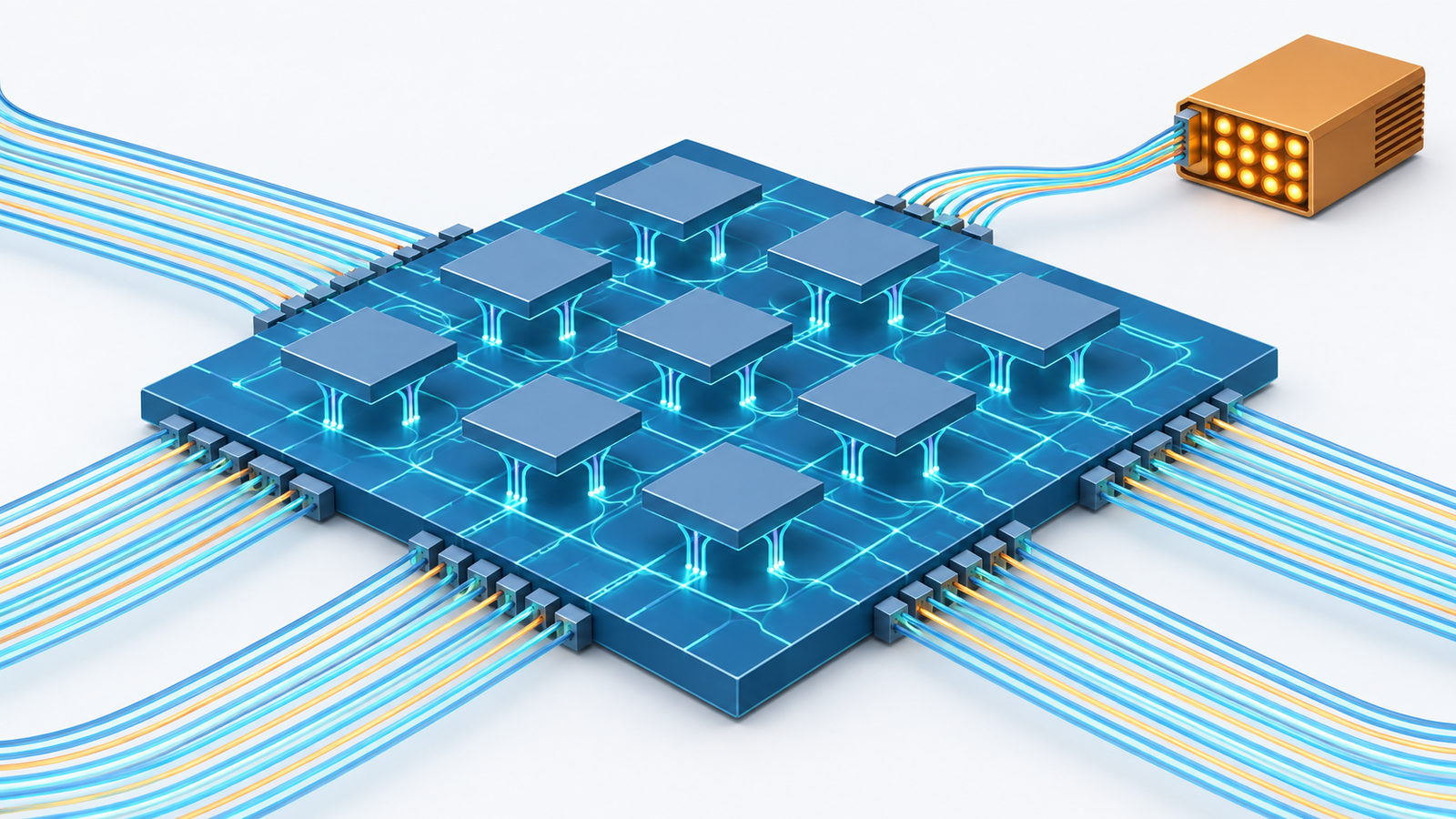
This series sorts companies in optical communications and photonics into three types: optical components & modules, chips & foundries, and network systems & carriers. Lightmatter belongs on the optical components & modules side, as an optical I/O start-up. What it makes, though, is quite different from what a conventional optical transceiver maker sells. Its core product, Passage, stacks an electronic IC (EIC) on top of a photonic IC (PIC) in 3D using chip-on-wafer techniques, and the company describes Passage as "the world's first 3D-stacked silicon photonics engine" Sourced. The aim is to remove the constraint that a chip's input/output (I/O) can only be placed along its edge, or shoreline. Because the edge grows more slowly than the area, the bigger a chip gets, the more it runs short of I/O. Lightmatter's answer is to stack vertically and bring I/O out across the whole face of the chip.
2. The logo and how the name is written

The Lightmatter logo is a trademark of the company. We have not recreated it with generated imagery;
the logo image (SVG) used in the header of the official website is placed here as img/lightmatter_logo.svg.
The design is a monogram of the letters "LM" drawn in line.
A note on names: the legal entity is Lightmatter, Inc. Its official releases write Lightmatter®, and the product names Passage® and Guide®, with registered trademark symbols. Japanese-language coverage writes the name phonetically in katakana; this series uses the Latin-alphabet name throughout. Passage is the brand for the optical engines as a whole, and model names such as L200, L20 and M1000 sit beneath it.
Official site: https://lightmatter.co/about/3. Where the company sits in optical communications and photonics
In terms of where it works with light, Lightmatter covers short distances inside the data centre, from within a rack to between racks Sourced. The reach given on its product pages is "10 m to 2 km (DR/FR)" for the L200, and more than 500 m over single-mode fibre for the Passage L20 CPX. It does not work on long-haul transmission such as intercity or submarine links, nor on sensing such as LiDAR. It sits squarely in the territory covered by our explainers on co-packaged optics and on optical interconnects and SerDes.
| Aspect | Where Lightmatter stands | Category |
|---|---|---|
| Type | Optical components & modules (optical I/O start-up). Has no fab of its own | Sourced |
| Where it works with light | Optical interconnect inside the data centre (XPU to XPU, and XPU to switch), plus the light source (lasers) for it and the fibre connection hardware | Sourced |
| Where its products sit | It has products for every position: inside the same package as the chip (CPO), on the board right next to the chip (NPO), at the board edge (OBO), as a pluggable module (XPO), and as a socketed module mounted on the board (CPX) | Sourced |
| Long-haul and carrier networks | Not covered | Sourced |
4. Scale (revenue is not disclosed, so we look at funding)
Lightmatter is privately held and does not publish revenue, profit or headcount Not yet confirmed. That makes a revenue trend table impossible. Instead, we show its scale through the funding, valuation, locations and leadership it describes on its website and in its releases.
| Item | Detail | Category |
|---|---|---|
| Founded | 2017, by researchers from MIT | Sourced |
| Total funding raised | US$850 million | Sourced |
| Valuation | US$4.4 billion | Sourced |
| Latest funding round | On 16 October 2024 it announced a US$400 million Series D that quadrupled its valuation to US$4.4 billion (as stated in the release title) | Sourced |
| Locations | Mountain View (headquarters), Boston, Hsinchu (Taiwan) and Toronto | Sourced |
| Leadership | Nicholas Harris, founder and CEO; Darius Bunandar, founder and chief scientist; and others. CFO Simona Jankowski joined from NVIDIA in July 2024 | Sourced |
| Revenue and profit | Not published | Not disclosed |
| Headcount | Not published | Not disclosed |
One detail worth noticing is that Hsinchu in Taiwan is among its locations. GUC, with which it announced a partnership in January 2026, is based in Hsinchu, and the GUC company description in that release says TSMC is "GUC's single largest shareholder" and its "sole foundry supplier" Sourced. In other words, Lightmatter has put people close to the partners it relies on for manufacturing.
5. Resources committed to optical communications and photonics
Lightmatter does nothing but optical interconnects and their light sources, so all of the company's resources point at this field. The question is how much of the detail has been made public.
| Type of resource | What it is | Category |
|---|---|---|
| People (dedicated organisation and staff) | The whole company is dedicated to this field. The website lists among its leadership an SVP of engineering and operations, a VP of photonics and silicon design, a VP of supply chain and a VP of product engineering, among others. Headcount is not published | Sourced / headcount not disclosed |
| Money (investment and R&D spending) | US$850 million raised in total. R&D spending and capital expenditure are not published | Sourced / breakdown not disclosed |
| Outside investments, acquisitions and joint ventures | No investment, acquisition or joint venture by Lightmatter in another company appears in the official releases we checked | Not confirmed |
| Outsourced manufacturing | The website names TSMC, GlobalFoundries and Tower as partners for high-volume capability. The M1000 uses GF Fotonix, GlobalFoundries' silicon photonics platform, and is being readied for volume production with GlobalFoundries and Amkor. The L200 is to be manufactured in volume with GlobalFoundries, ASE and Amkor | Sourced |
| Universities and research institutes | The founders are MIT researchers. However, no joint research agreement with a university has been announced that we could find | Sourced / no agreement confirmed |
| Public funding (CHIPS Act, AIM Photonics and the like) | No award of public funding appears in the official releases or on the website we checked | Not confirmed |
Lightmatter publishes its total funding and its valuation, but how much cash it still has and how much it spends each year are unknown Not yet confirmed. For a listed start-up, statutory filings let you work out how many years the cash will last; for a private company like Lightmatter, that cannot be done. "A US$4.4 billion company" is a valuation set by investors, and says nothing about the size of its revenue or profit.
6. What it has done so far
| When | What happened | Why it matters |
|---|---|---|
| 2017 | Founded by researchers from MIT | As stated on the website |
| July 2024 | Simona Jankowski, formerly of NVIDIA, becomes CFO | Brought in its finance chief from a major chip company |
| October 2024 | US$400 million Series D, valuation US$4.4 billion | The most recent funding round announced to date |
| December 2024 | Joins the UALink Consortium as a Contributor member | Takes part in setting the interconnect standard between AI accelerators |
| March 2025 | Announces Passage M1000 (3D photonic interposer, 114 Tbps total) and Passage L200 (3D CPO, 32 Tbps / 64 Tbps) | The product line took shape. The M1000 was announced for summer 2025 and the L200 for 2026 |
| August 2025 | Demonstrates a 16-wavelength bidirectional DWDM link over a single strand of single-mode fibre (800 Gbps per fibre, transmit and receive combined) | A technology demonstration, not a production product |
| January 2026 | Announces the Guide laser light source (VLSP technology). On the same day announces partnerships with GUC, Synopsys and Cadence | Brought the light source in house and lined up partners on the chip design side |
| March 2026 | Sampling of a Passage CPO chiplet built with Qualcomm (1.6 Tbps per fibre). Announces Passage L20 for NPO/OBO and vClick, a detachable fibre connection. Joins the XPO MSA as a founding member. Proposes a reference architecture initiative for CPO within OCP | Widened its offer from 3D CPO alone to products that fit into existing chassis |
| May 2026 | Announces Guide DR, a liquid-cooled laser light source card (OCP NIC 3.0 form factor) | Proposes moving the light source from the front panel into the chassis |
| June 2026 | Joins the NVIDIA NVLink Fusion ecosystem | Commits to CPO/NPO products compatible with NVIDIA's optical and SerDes technology |
| August 2026 | A formal OCP workstream, Open Silicon Photonics for AI Systems, is launched by 19 companies, with a 300-page white paper | A move to make the rack-level CPO architecture an industry standard |
| September 2026 | Joins the Open CPX MSA and announces the bidirectional Passage L20 CPX | Evaluation kits expected to ship in January to March 2027 |
7. What comes next
October to December 2026The schedule the company has announced
in late 2026Specifications are preliminary
January to March 2027Specifications are preliminary
October to December 2026By the 19-company workstream
For Guide, the company has set out a laser roadmap that scales "from 1 to 64 wavelengths and beyond", and it says the Passage L-Series engines are "on track to deliver 100 Tbps and beyond" Not yet confirmed. Neither statement comes with a date.
None of the following appears in the official releases or on the website Not yet confirmed.
When volume shipments will start; the names of customers that have adopted its products (the releases say only "hyperscalers" or "lead customers"); revenue; production capacity; product prices; and the current shipping status of the L200, which was announced in March 2025 as available in 2026. Stories of the form "Lightmatter wins company X" are mostly based on press reports, and this article does not use them.
8. What the company is aiming for in optical communications and photonics
This section goes beyond what the company says directly. It sets out inferences that can be drawn from primary sources, each with its basis.
| What can be read | Primary evidence behind it | Category |
|---|---|---|
| The goal is to make bringing optical I/O out across the whole face of the chip, not just its edge, the industry norm | The L200, M1000 and GUC releases all take removing the "shoreline" constraint as their central theme | Sourced |
| It wants to own not just the optical engine but the light source (lasers) as well | The Guide release discusses the limits of conventional external lasers (ELSFP) at length, and positions Guide as a product that can also be paired with other companies' NPO/CPO | Inference |
| 2026 is a year for widening the ways customers can adopt it | Beyond 3D CPO, its range now covers NPO/OBO that fits existing chassis as is (L20), pluggable XPO and socketed CPX. The L20 release says partners can "accelerate their time-to-market using existing chassis architectures" | Inference |
| It wants to lead the CPO supply chain and standards-setting itself | It announced that it proposed the OCP workstream and brought the 19 companies together. It is a founding member of the XPO MSA and has also joined the Open CPX MSA | Inference |
| In the long run it has not given up on computing with light itself | The website says it builds "interconnects, lasers, and eventually compute itself". No timing is given | Sourced |
In March 2025, what Lightmatter put front and centre were 3D CPO (L200) and the 3D photonic interposer (M1000). Both assume that the customer's GPU or switch chip is stacked on top of Lightmatter's photonic chip, which means the customer has to make substantial changes to its chip design and packaging. The L20, released in March 2026, is different: it mounts on the board through an IEEE 802.3dj-compliant electrical interface, and an analyst quoted in the release praises it for enabling integration "into existing rack systems without requiring changes to XPU or switch chip designs" Sourced. This was followed by joining NVIDIA's NVLink Fusion in June and the Open CPX MSA in September. We read this sequence as the company keeping its leading-edge 3D approach as the flagship while first building a shipping track record in forms customers find easier to adopt Not yet confirmed. The company has not explained the reason for this shift, however, and this remains our interpretation.
9. Map of partnerships in optical communications and photonics
10. Technologies, products and services
A performance figure means something entirely different depending on whether it comes from a product in volume production, a sample or a demonstration. The table below always states the stage. Claims of "world's first" or "industry first" are all the company's own.
| Product or technology | What it does | Main figures the company gives | Stage (as announced by the company) |
|---|---|---|---|
| Passage M1000 | 3D photonic interposer. A reference platform that stacks 32 I/O chiplets on a photonic chip of more than 4,000 mm² | 114 Tbps in total (114.6 Tbps on the product page), 256 fibres × 448 Gbps, 8 wavelengths, 2.3 pJ/bit including the laser | Announced for summer 2025. Now offered as an evaluation kit (EVK) |
| Passage L200 / L200X | 3D CPO. An optical engine with an electronic chip (EIC) stacked on a photonic chip (PIC). The company calls it "the world's first 3D co-packaged optics (CPO) product" | 32 Tbps / 64 Tbps (transmit and receive combined), over 200 Tbps per package, 800 Gbps / 1.6 Tbps per fibre with 16 wavelengths, under 5 pJ/bit for the optics | Announced in March 2025 as available in 2026. Shipping status not disclosed |
| Passage CPO chiplet (with Qualcomm SerDes) | CPO combining Qualcomm's SerDes chiplet with Passage | 1.6 Tbps per fibre (16-wavelength DWDM, 112G per lane). The company claims up to 8× existing NPO/CPO | Sampling from March 2026. Evaluation kits for lead customers |
| Passage EVK100 | An evaluation platform in a 2D multi-chip package | 3.2 Tbps, target link efficiency 3.2 pJ/bit (112G PAM4), 1.6 Tbps per fibre (separate transmit and receive fibres) | Product page says "sampling" |
| Passage L20 | Optical engine for NPO/OBO. Mounted on the board | 6.4 Tbps each direction, 212.5G PAM4, 32 ports × 200G, two-wavelength bidirectional (1311 / 1331 nm), 30 W maximum, 2,000-pin BGA | Sampling due to start in late 2026 (preliminary specifications) |
| Passage L20 CPX | A module version of the L20 conforming to the Open CPX MSA | 12.8 Tbps transmit and receive combined, over 500 m on SMF, IEEE 802.3dj DR link architecture, OIF-CMIS | Evaluation kits expected to ship in January to March 2027 (preliminary specifications) |
| Guide (VLSP) | A light source integrating a large number of lasers | Up to 51.2 Tbps per laser module, at least 100 mW per fibre, 16 wavelengths | The validation platform is sampling. Evaluation kits offered on a priority basis to selected partners |
| Guide DR | A liquid-cooled light source card (OCP NIC 3.0 form factor) that moves the light source from the front panel into the chassis | Up to 64 fibres × 200 mW, enough for 256 lanes of 200G, up to 51.2 Tbps. Four cards in 1RU give 204.8 Tbps | Sampling due to start in October to December 2026 |
| vClick / eClick | Technology that makes the connection between the photonic chip and the fibre (the FAU) detachable | Insertion and re-insertion loss under 1.5 dB. Supports a wavelength band of more than 80 nm | Announced as demonstrated in ASE's packaging process. Product timing not disclosed |
| 16-wavelength bidirectional link | Carries 16 wavelengths in both directions over one single-mode fibre | 800 Gbps per fibre, transmit and receive combined, over several hundred metres or more | A technology demonstration in August 2025 |
The L20's preliminary specifications are "30 W maximum" and "6.4 Tbps each direction". Dividing by the combined 12.8 Tbps gives about 2.3 pJ/bit Our calculation. Note, however, that this is based on maximum power (TDP), not an actual average. And since the L20 is designed to work with an external laser (such as Guide DR), it is reasonable to assume that the laser power is not included Not yet confirmed. The only figure the company explicitly states "including the laser" is the M1000's 2.3 pJ/bit, so the same number can mean different things.
The Guide release contains a passage that is interesting from a materials standpoint. Conventional CPO and NPO use discrete indium phosphide (InP) lasers housed in pluggable modules (ELSFP), and the company explains their limit this way: "Connector end faces and epoxy-bonded assemblies are vulnerable to thermal damage, where contamination absorbs light and can cause fiber damage at power levels as low as hundreds of milliwatts" Sourced. In other words, the claim is that when you raise laser power to gain bandwidth, the light resistance of the adhesive and glass end faces that the light passes through hits its limit first.
Lightmatter has two answers. One is Guide, which integrates many lasers so as to gain capacity from the number of fibres and wavelengths rather than from more power per fibre. The other is vClick, which makes the connection between the photonic chip and the fibre detachable, and which the company describes as "mold-and-grind compatible" with the packaging flow Sourced. Keeping the optical path intact after moulding compound encapsulation and grinding means controlling encapsulant ingress, grinding debris and misalignment from thermal history, and this is an area where the choice of optical adhesives, encapsulants and connector materials feeds straight into yield Not yet confirmed. For more, see our explainers on optical connectors and fibre attachment and on semiconductor lasers.
11. The risks this company carries
| Risk | Substance | Category |
|---|---|---|
| Finances not visible | As a private company it discloses none of its revenue, profit, cash or annual spending. The sustainability of its funding cannot be checked from outside | Not yet confirmed |
| No volume shipments announced | As of September 2026, official announcements go no further than "sampling", "evaluation kits" and "sampling due to start". No volume shipments or customer names have been announced | Sourced |
| Dependence on others for manufacturing | Photonic chips are made by foundries and packaged by OSATs. The company cannot fix the processes itself | Inference |
| Many product lines | It has announced many product lines: 3D CPO, NPO/OBO, XPO, CPX, two light sources and connection hardware. Whether it can bring them all to volume production in parallel cannot be judged from outside, because headcount is not disclosed | Inference |
| Standards may fragment | Lightmatter itself is involved in the XPO MSA, the Open CPX MSA, OCP, UALink and NVLink Fusion at the same time. Which form will become mainstream is not settled | Inference |
| Deep field of competitors | Optical component makers, large chip companies and other optical I/O start-ups are all working on CPO (the types in Fig. 1). Lightmatter's differentiator is 3D stacking, but customers may manage with 2D approaches or NPO | Inference |
12. Glossary
- Optical I/O (optical interconnect)
- Moving data between chips over optical fibre rather than electrical wiring. Losses stay low even as distance grows.
- CPO
- Co-Packaged Optics. Placing the optical engine inside the same package as the GPU or switch chip.
- NPO / OBO
- Near-Package Optics / On-Board Optics. Placing the optical engine right next to the chip, or at the edge of the board. Requires fewer changes to existing designs than CPO.
- Shoreline
- The edge of a chip. Electrical I/O can only be lined up along the edge, so making a chip bigger does not increase its I/O in proportion to its area.
- PIC / EIC
- Photonic integrated circuit and electronic integrated circuit. Lightmatter stacks the latter on top of the former.
- DWDM
- Dense wavelength division multiplexing. Sending many beams of slightly different colours down one fibre to increase bandwidth.
- SerDes
- A circuit that converts parallel data inside a chip into a high-speed serial signal for transmission and back again. The electrical entry point to an optical engine.
- pJ/bit
- The energy used to send one bit. Lower means more power-efficient. The value changes depending on whether laser power is included.
- ELSFP
- External Laser Small Form Factor Pluggable. A laser light source for CPO packaged as a pluggable module.
- MSA
- Multi-Source Agreement. An industry agreement that lets several companies make parts of the same shape and specification.
13. References
- Lightmatter, Inc. Official website, "About". Founded in 2017 by MIT researchers, US$850 million raised, US$4.4 billion valuation, locations (Mountain View headquarters, Boston, Hsinchu, Toronto), leadership, partnerships with TSMC, GlobalFoundries and Tower, and the phrase "eventually compute itself". https://lightmatter.co/about/
- Lightmatter, Inc. Press release, "Lightmatter Raises $400M Series D; Quadruples Valuation to $4.4B as Photonics Leader for Next-Gen AI Data Centers" (16 October 2024). Title and date checked. https://lightmatter.co/press-release/lightmatter-raises-400m-series-d-quadruples-valuation-to-4-4b-as-photonics-leader-for-next-gen-ai-data-centers/
- Lightmatter, Inc. Press release listing. Titles and dates of each release, including "Lightmatter Announces NVIDIA Executive Simona Jankowski as Chief Financial Officer" (1 July 2024). https://lightmatter.co/press-releases/
- Lightmatter, Inc. Press release, "Lightmatter Joins UALink Consortium to Propel AI Interconnect into the Photonic Era" (18 December 2024). https://lightmatter.co/press-release/lightmatter-joins-ualink-consortium-to-propel-ai-interconnect-into-the-photonic-era/
- Lightmatter, Inc. Press release, "Lightmatter Unveils Passage M1000 Photonic Superchip, World's Fastest AI Interconnect" (31 March 2025). M1000 specifications, GF Fotonix, preparation for volume production with GlobalFoundries and Amkor, availability in summer 2025. https://lightmatter.co/press-release/lightmatter-unveils-passage-m1000-photonic-superchip-worlds-fastest-ai-interconnect/
- Lightmatter, Inc. Press release, "Lightmatter Announces Passage L200, the Fastest Co-Packaged Optics for AI" (31 March 2025). L200/L200X specifications, Alphawave Semi's EIC, volume manufacturing with GlobalFoundries, ASE and Amkor, availability in 2026. https://lightmatter.co/press-release/lightmatter-announces-passage-l200-the-fastest-co-packaged-optics-for-ai/
- Lightmatter, Inc. Press release, "Lightmatter Achieves World-First 16-Wavelength Bidirectional Link on Single-Mode Optical Fiber" (18 August 2025). https://lightmatter.co/press-release/lightmatter-achieves-world-first-16-wavelength-bidirectional-link-on-single-mode-optical-fiber/
- Lightmatter, Inc. Press release, "Lightmatter Introduces Guide Light Engine for AI, Featuring VLSP Technology" (26 January 2026). Guide specifications, the explanation of ELSFP limits, sampling status. https://lightmatter.co/press-release/lightmatter-introduces-guide-light-engine-for-ai-featuring-vlsp-technology/
- Lightmatter, Inc. Press release, "Lightmatter and GUC Partner to Produce Co-Packaged Optics (CPO) Solutions for AI Hyperscalers" (26 January 2026). The GUC partnership and GUC's shareholding (TSMC holds 35%). https://lightmatter.co/press-release/lightmatter-and-guc-partner-to-produce-co-packaged-optics-cpo-solutions-for-ai-hyperscalers/
- Lightmatter, Inc. Press release, "Lightmatter Collaborates with Synopsys to Integrate Advanced Interface IP with Its Passage Co-Packaged Optics Platform" (26 January 2026). Integration of 224G SerDes and UCIe IP for 3 nm. https://lightmatter.co/press-release/lightmatter-collaborates-with-synopsys-to-integrate-advanced-interface-ip-with-its-passage-co-packaged-optics-platform/
- Lightmatter, Inc. Press release, "Lightmatter and Cadence Collaborate to Accelerate Optical Interconnect for AI Infrastructure" (26 January 2026). https://lightmatter.co/press-release/lightmatter-and-cadence-collaborate-to-accelerate-optical-interconnect-for-ai-infrastructure/
- Lightmatter, Inc. Press release, "Lightmatter Achieves Record 1.6 Tbps Per Fiber to Accelerate AI Optical Interconnect" (11 March 2026). Collaboration with Qualcomm, sampling, evaluation kits. https://lightmatter.co/press-release/lightmatter-achieves-record-1-6-tbps-per-fiber-to-accelerate-ai-optical-interconnect/
- Lightmatter, Inc. Press release, "Lightmatter Expands Photonic Interconnect Roadmap with Passage L20 Unified Optical Engine for NPO and OBO Applications" (11 March 2026). L20 preliminary specifications and sampling timing. https://lightmatter.co/press-release/lightmatter-expands-photonic-interconnect-roadmap-with-passage-l20-unified-optical-engine-for-npo-and-obo-applications/
- Lightmatter, Inc. Press release, "Lightmatter Unveils vClick Optics, Industry-First Detachable Fiber Array Unit for CPO Advanced Packaging and High-Volume Production" (11 March 2026). https://lightmatter.co/press-release/lightmatter-unveils-vclick-optics-industry-first-detachable-fiber-array-unit-for-cpo-advanced-packaging-and-high-volume-production/
- Lightmatter, Inc. Press release, "Lightmatter Joins XPO MSA as Founding Member to Accelerate High-Density Optical Interconnects for AI Data Centers" (12 March 2026). https://lightmatter.co/press-release/lightmatter-joins-xpo-msa-as-founding-member-to-accelerate-high-density-optical-interconnects-for-ai-data-centers/
- Lightmatter, Inc. Press release, "Lightmatter Announces Reference Architecture Initiative with Industry Leaders in the Open Compute Project for Co-Packaged Optics" (16 March 2026). https://lightmatter.co/press-release/lightmatter-announces-reference-architecture-initiative-with-industry-leaders-in-the-open-compute-project-for-co-packaged-optics/
- Lightmatter, Inc. Press release, "Lightmatter Unveils Guide DR: Industry First Liquid-Cooled Laser NIC that Quadruples Rack Density" (21 May 2026). https://lightmatter.co/press-release/lightmatter-unveils-guide-dr-industry-first-liquid-cooled-laser-nic-that-quadruples-rack-density/
- Lightmatter, Inc. Press release, "Lightmatter Joins NVIDIA NVLink Fusion and Powers Next-Generation AI Infrastructure with Photonic Interconnects" (June 2026). https://lightmatter.co/press-release/lightmatter-joins-nvidia-nvlink-fusion/
- Lightmatter, Inc. Press release, "Industry Leaders Formally Launch CPO System Architecture Initiative Within the Open Compute Project" (13 August 2026). https://lightmatter.co/press-release/industry-leaders-formally-launch-cpo-system-architecture-initiative-within-the-open-compute-project/
- Lightmatter, Inc. Press release, "Lightmatter Joins Open CPX MSA, Introduces the Industry's First Bidirectional CPX Optical Engine" (17 September 2026). https://lightmatter.co/press-release/lightmatter-joins-open-cpx-msa-introduces-the-industrys-first-bidirectional-cpx-optical-engine/
- Lightmatter, Inc. Product page, "Passage L200". 32 to 64 Tbps, under 5 pJ/bit for the optics, reach of 10 m to 2 km. https://lightmatter.co/products/l200/
- Lightmatter, Inc. Product page, "Passage M1000 EVK". 114.6 Tbps, 2.3 pJ/bit including the laser, 32 I/O chiplets. https://lightmatter.co/products/passage-m1000-evk/
- Lightmatter, Inc. Product page, "Passage EVK100". 3.2 Tbps, 3.2 pJ/bit target, sampling. https://lightmatter.co/products/passage-evk100/
14. Claim-to-source audit
| Claim in the article | Category | Source |
|---|---|---|
| Founded in 2017, US$850 million raised, US$4.4 billion valuation, locations, leadership | Sourced | Reference 1 https://lightmatter.co/about/ |
| Partnerships with TSMC, GlobalFoundries and Tower for high-volume capability | Sourced | Reference 1 https://lightmatter.co/about/ |
| The phrase "interconnects, lasers, and eventually compute itself" | Sourced | Reference 1 https://lightmatter.co/about/ |
| US$400 million Series D in October 2024, US$4.4 billion valuation | Sourced | Reference 2 https://lightmatter.co/press-release/lightmatter-raises-400m-series-d-quadruples-valuation-to-4-4b-as-photonics-leader-for-next-gen-ai-data-centers/ |
| Simona Jankowski, formerly of NVIDIA, became CFO in July 2024 | Sourced | Reference 3 https://lightmatter.co/press-releases/ |
| Joined the UALink Consortium (December 2024) | Sourced | Reference 4 https://lightmatter.co/press-release/lightmatter-joins-ualink-consortium-to-propel-ai-interconnect-into-the-photonic-era/ |
| M1000 specifications (114 Tbps, over 4,000 mm², 256 fibres, 8 wavelengths and others), GF Fotonix, preparation for volume production with GF and Amkor | Sourced | References 5 and 22 https://lightmatter.co/press-release/lightmatter-unveils-passage-m1000-photonic-superchip-worlds-fastest-ai-interconnect/ |
| M1000 EVK: 2.3 pJ/bit including the laser, 114.6 Tbps | Sourced | Reference 22 https://lightmatter.co/products/passage-m1000-evk/ |
| L200/L200X specifications, the company's claim of "the world's first 3D co-packaged optics (CPO) product", Alphawave Semi's EIC, volume manufacturing with GF, ASE and Amkor, planned availability in 2026 | Sourced | Reference 6 https://lightmatter.co/press-release/lightmatter-announces-passage-l200-the-fastest-co-packaged-optics-for-ai/ |
| L200: under 5 pJ/bit for the optics, reach of 10 m to 2 km | Sourced | Reference 21 https://lightmatter.co/products/l200/ |
| Technology demonstration of a 16-wavelength bidirectional link (August 2025) | Sourced | Reference 7 https://lightmatter.co/press-release/lightmatter-achieves-world-first-16-wavelength-bidirectional-link-on-single-mode-optical-fiber/ |
| Guide specifications and sampling, and the company's explanation of ELSFP limits (thermal damage at end faces and epoxy) | Sourced | Reference 8 https://lightmatter.co/press-release/lightmatter-introduces-guide-light-engine-for-ai-featuring-vlsp-technology/ |
| Partnership with GUC; TSMC is GUC's largest shareholder (35%) | Sourced | Reference 9 https://lightmatter.co/press-release/lightmatter-and-guc-partner-to-produce-co-packaged-optics-cpo-solutions-for-ai-hyperscalers/ |
| Collaboration with Synopsys (224G SerDes and UCIe IP for 3 nm) | Sourced | Reference 10 https://lightmatter.co/press-release/lightmatter-collaborates-with-synopsys-to-integrate-advanced-interface-ip-with-its-passage-co-packaged-optics-platform/ |
| Collaboration with Cadence (SerDes and UCIe IP) | Sourced | Reference 11 https://lightmatter.co/press-release/lightmatter-and-cadence-collaborate-to-accelerate-optical-interconnect-for-ai-infrastructure/ |
| Sampling of the CPO chiplet built with Qualcomm, 1.6 Tbps per fibre, the company's claim of up to 8× | Sourced | Reference 12 https://lightmatter.co/press-release/lightmatter-achieves-record-1-6-tbps-per-fiber-to-accelerate-ai-optical-interconnect/ |
| EVK100: 3.2 Tbps, 3.2 pJ/bit target, sampling | Sourced | Reference 23 https://lightmatter.co/products/passage-evk100/ |
| L20 preliminary specifications (6.4 Tbps each direction, 30 W maximum and others), sampling planned for late 2026, the analyst's comment | Sourced | Reference 13 https://lightmatter.co/press-release/lightmatter-expands-photonic-interconnect-roadmap-with-passage-l20-unified-optical-engine-for-npo-and-obo-applications/ |
| Conversion of the L20's power to about 2.3 pJ/bit | Our calculation | Calculated in this article as 30 W ÷ 12.8 Tbps from reference 13. Based on the maximum, excluding the laser https://lightmatter.co/press-release/lightmatter-expands-photonic-interconnect-roadmap-with-passage-l20-unified-optical-engine-for-npo-and-obo-applications/ |
| vClick (under 1.5 dB, SENKO, demonstrated in ASE's process) and eClick | Sourced | Reference 14 https://lightmatter.co/press-release/lightmatter-unveils-vclick-optics-industry-first-detachable-fiber-array-unit-for-cpo-advanced-packaging-and-high-volume-production/ |
| Joined the XPO MSA as a founding member (led by Arista) | Sourced | Reference 15 https://lightmatter.co/press-release/lightmatter-joins-xpo-msa-as-founding-member-to-accelerate-high-density-optical-interconnects-for-ai-data-centers/ |
| Proposal of a reference architecture initiative in OCP (March 2026) | Sourced | Reference 16 https://lightmatter.co/press-release/lightmatter-announces-reference-architecture-initiative-with-industry-leaders-in-the-open-compute-project-for-co-packaged-optics/ |
| Guide DR specifications and sampling planned for October to December 2026 | Sourced | Reference 17 https://lightmatter.co/press-release/lightmatter-unveils-guide-dr-industry-first-liquid-cooled-laser-nic-that-quadruples-rack-density/ |
| Joined the NVIDIA NVLink Fusion ecosystem | Sourced | Reference 18 https://lightmatter.co/press-release/lightmatter-joins-nvidia-nvlink-fusion/ |
| Formal launch of the OCP workstream (19 companies), the 300-page white paper, first specification expected in October to December 2026 | Sourced | Reference 19 https://lightmatter.co/press-release/industry-leaders-formally-launch-cpo-system-architecture-initiative-within-the-open-compute-project/ |
| Joined the Open CPX MSA, L20 CPX specifications, evaluation kits expected to ship in January to March 2027 | Sourced | Reference 20 https://lightmatter.co/press-release/lightmatter-joins-open-cpx-msa-introduces-the-industrys-first-bidirectional-cpx-optical-engine/ |
| The three types of company in optical communications and photonics | Our calculation | Our own classification. Companies shown are examples from those covered in this series |
| Revenue, profit, headcount, cash and R&D spending | Not yet confirmed | None is disclosed, and this article makes no estimate https://lightmatter.co/about/ |
| Start of volume shipments, customer names, production capacity, prices, current shipping status of the L200 | Not yet confirmed | Not in references 1 to 23. Information from press reports is not used https://lightmatter.co/press-releases/ |
| Outside investments, acquisitions and joint ventures, joint research agreements with universities, public funding awards | Not yet confirmed | Not in the primary sources we checked. This article does not conclude that none exists https://lightmatter.co/press-releases/ |
| Names of the Series D investors | Not yet confirmed | The body of reference 2 is available only as a PDF, and this article could not confirm individual investor names from primary sources, so none are given |
| The reading that it wants to own the light source as well as the optical engine | Inference | This article's interpretation of reference 8 |
| The reading that 2026 is a year for widening the ways customers can adopt it | Inference | This article's interpretation of the sequence in references 13, 18 and 20 |
| The reading that it wants to lead the CPO supply chain and standards-setting | Inference | This article's interpretation of references 15, 16, 19 and 20 |
| The view that connection materials (optical adhesives, encapsulants) affect yield | Inference | This article's commentary based on references 8 and 14 |
| Risks of dependence on others for manufacturing, many product lines, fragmented standards and competition | Inference | This article's interpretation of the partnership structure and product announcements |
Last updated 25 September 2026 / Troy Technical
Every figure in this article comes from the official website and official press releases of Lightmatter, Inc. No research-firm estimates or press-based figures have been used (nor have the research-firm market forecasts quoted in the releases). Passages marked "Inference" are this article's interpretation of primary sources, not statements made by the company.