COMPANY PROFILE / OPTICAL COMMUNICATIONS & PHOTONICS
NVIDIA
A company that makes no optical parts, pulling the whole optical supply chain into its own switches
NVIDIA is known as a GPU company, but in optical communications its name comes up as the company that has taken CPO (co-packaged optics) switches into volume production. In an announcement on 31 May 2026 it described Spectrum-X Ethernet Photonics as "now in production". Yet NVIDIA makes neither lasers nor optical fibre itself. Its photonic chips are made by TSMC, its lasers come from suppliers such as Lumentum and Sumitomo Electric Industries, and its fibre from companies such as Corning. In 2026 it invested US$2 billion in each of two optical component makers and signed multi-year purchase agreements with both. This profile keeps the GPU business to a minimum and sets out what NVIDIA builds in optical communications, whom it relies on for what, and where it is heading, using only the company's official releases, technical blogs and SEC filings.
- NVIDIA in 30 seconds, and where it stands in optical communications and photonics
- The logo and how the name is written
- Where the company sits in optical communications and photonics
- Scale (the GPU business in brief)
- Resources committed to optical communications and photonics
- Track record so far
- Plans ahead
- What the company is aiming for in optical communications and photonics
- Partnership map
- Technologies, products and services
- The risks this company carries
- Glossary, references and claim-to-source audit
1. NVIDIA in 30 seconds, and where it stands in optical communications and photonics
California, U.S.2788 San Tomas Expressway
(fabless designer)Its optical activity is optical interconnect inside the data centre
"now in production"Official announcement of 31 May 2026. Shipments to ramp in the second half of 2026
Lumentum and Coherent2 March 2026, with multi-year purchase agreements
Companies involved in optical communications fall into three broad types: optical components & modules, chips & foundries, and network systems & carriers. NVIDIA belongs to chips, and within that it is a fabless designer with no factories of its own Sourced. What it designs itself for its CPO switches is the switch chip and the silicon photonics engine built around micro-ring modulators, which turns electrical signals into light. According to its technical blog, TSMC manufactures those chips, SPIL packages them, Lumentum, Sumitomo Electric and Coherent supply the lasers, Corning and SENKO among others provide fibre and connectors, and Foxconn and Fabrinet handle assembly. NVIDIA's strength, in other words, is not optical components as such. It is that it owns the switches and GPUs where the light ends up, and can pull the entire supply chain together around their specifications. Its run of investments in optical component makers in 2026 can be read as using capital to shore up that weak spot, its reliance on outside suppliers for optics (section 8).
2. The logo and how the name is written
The NVIDIA logo is a registered trademark of the company. We have not recreated it with generated imagery;
the image is the one NVIDIA publishes as a brand asset on its official website, placed here as img/nvidia_logo.png.
A note on names: the company name is written NVIDIA, in capitals throughout; Japanese-language coverage renders it phonetically in katakana. The optical product was called "Spectrum-X Photonics" when it was announced in March 2025, but 2026 materials call it "Spectrum-X Ethernet Photonics". The InfiniBand counterpart is "Quantum-X Photonics". This article follows whichever form the cited source uses.
Official site: https://www.nvidia.com/en-us/3. Where the company sits in optical communications and photonics
In terms of which part of optics it touches, NVIDIA's work is concentrated on optical interconnect inside the data centre Sourced. The May 2026 announcement positions its CPO switches for "scale-out and scale-across" deployments, that is, links between racks and links spanning data centres. Products for long-haul networks, optical fibre itself or LiDAR do not appear in the primary sources reviewed for this article.
4. Scale (the GPU business in brief)
The GPU business itself is not the subject here, so we note only the company's size and the revenue of its "networking" products, the category closest to optics Sourced.
| Measure (US$ million) | FY2024 (year to Jan 2024) | FY2025 (year to Jan 2025) | FY2026 (year to Jan 2026) |
|---|---|---|---|
| Revenue (company-wide) | 60,922 | 130,497 | 215,938 |
| of which data centre networking | 8,575 | 12,990 | 31,376 |
| R&D expense (company-wide) | 8,675 | 12,914 | 18,497 |
Networking accounted for about 14.5% of total revenue in FY2026 Our calculation. At the end of FY2026 the company had about 42,000 employees in 38 countries, of whom about 31,000 worked in research and development. The 10-K also says that about 6,000 employees in Israel mainly support the research, development, manufacturing and sale of networking products Sourced.
The "networking" line above is not optical product revenue. According to the 10-K it bundles together NVLink (the electrical interconnect inside a rack), InfiniBand and Ethernet switches, network adapters (including DPUs) and cable products, including optical modules. The main driver the 10-K cites for the 142% year-on-year growth in FY2026 is the ramp of NVLink for GB200 and GB300 Sourced. Revenue from CPO switches or optical modules, and optics-related R&D spending, are not disclosed Not yet confirmed.
5. Resources committed to optical communications and photonics
Amounts and headcounts are almost entirely undisclosed, but what the company is putting in can be read quite concretely from its official releases and technical blogs.
| Resource | Details | Status |
|---|---|---|
| People (dedicated teams and staff) | The name and size of any dedicated CPO organisation are not disclosed. The 10-K confirms only about 31,000 R&D staff company-wide and about 6,000 staff in Israel who mainly support networking. The technical blog says CPO development was "four years in the making" with contributions from "hundreds of patents" | Partly confirmed |
| Money (investment and R&D) | Company-wide R&D expense was US$18.497 billion in FY2026. Optics-related R&D and capital spending are not disclosed, and the company has no optical factory of its own | Not disclosed |
| Equity investments | US$2 billion in Lumentum and US$2 billion in Coherent (both announced 2 March 2026). US$2 billion in Marvell (announced 31 March 2026, as part of a partnership that includes silicon photonics) | Confirmed |
| Purchase agreements and capacity | With Lumentum, a "multibillion purchase commitment" and future capacity access rights for advanced laser components; with Coherent, a purchase commitment of similar scale plus future supply and capacity access rights for advanced laser and optical networking products. Both are non-exclusive | Confirmed (amounts not disclosed in detail) |
| Manufacturing partners (ecosystem) | Eleven companies listed on the product page: TSMC, SPIL, Lumentum, Sumitomo Electric, Coherent, Browave, Corning, SENKO, TFC Communication, Foxconn and Fabrinet | Confirmed |
| Long-term fibre partnership | A multi-year commercial and technology partnership with Corning (6 May 2026). Corning says it will increase its U.S. optical connectivity capacity tenfold and its optical fibre capacity by more than 50%. The release says nothing about whether NVIDIA is investing, or how much | Partnership confirmed; investment could not be confirmed |
| Acquisitions | No acquisition of an optical component company was found in the primary sources reviewed for this article. The foundation of the networking business was the 2020 acquisition of Mellanox | Could not be confirmed |
| Universities, research institutes, public funding | The 10-K and releases say nothing about optics-related joint research with universities or awards of public funding such as the CHIPS Act | Could not be confirmed |
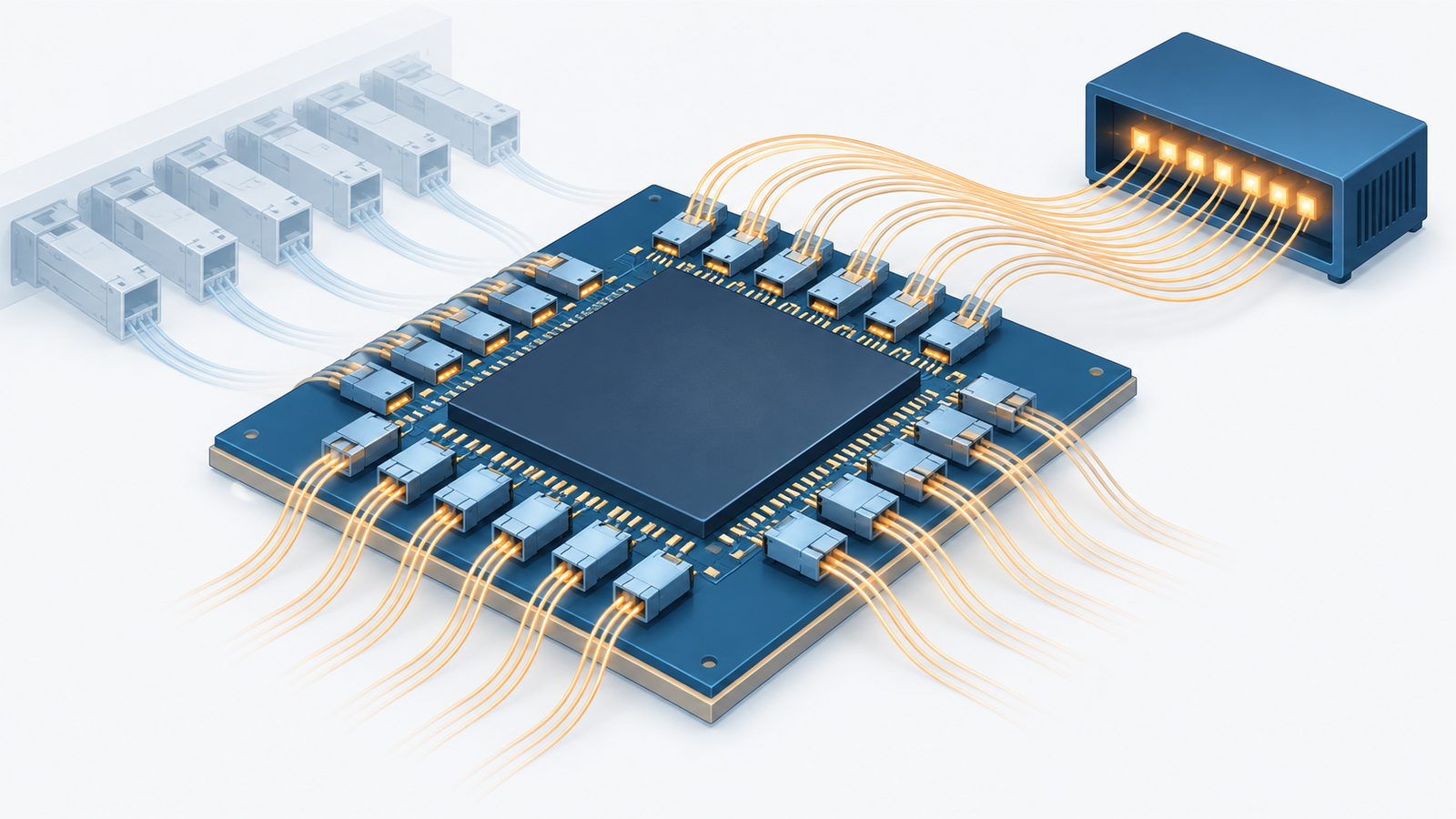
In NVIDIA's CPO switches, the part that creates the optical signal (the silicon photonics engine) and the laser that supplies the light itself are physically separated. The lasers are grouped into an "external laser source" (ELS) module that plugs into the front of the switch and sits in a temperature-controlled location apart from the switch body Sourced. The technical blog says each ELS holds eight lasers, that one module serves 32 of the 576 transmit lanes of a Quantum-X switch, and that the number of lasers across a data centre falls to a quarter of that in conventional designs.
Seen through the lens of materials and reliability, this is a design that moves the most fragile, most heat-sensitive part away from the hottest place. Compound-semiconductor lasers degrade faster under repeated temperature cycling, and their wavelength drifts. The silicon engine sitting right beside the switch chip, meanwhile, relies on micro-ring modulators whose properties shift easily with heat, so temperature control is critical. That is exactly why NVIDIA's technical blog cites "precise control of the manufacturing process" and reduced thermal sensitivity as outcomes of its collaboration with TSMC. Taking the laser out and making it replaceable is an example of solving a reliability problem through placement rather than through better materials Not yet confirmed.
6. Track record so far
| When | What happened | What it means |
|---|---|---|
| 2016 onward | Joint development with ecosystem partners begins (according to the technical blog) | CPO did not appear out of nowhere |
| 2020 | Acquires Mellanox and enters networking | Owning InfiniBand and Ethernet switches became the precondition for CPO later |
| 18 March 2025 | Announces the Spectrum-X Photonics and Quantum-X Photonics CPO switches at GTC 2025, naming eleven partners including TSMC. Quantum-X was expected "later this year" (2025) and Spectrum-X in 2026 | Enters optical communications head-on, as a switch company |
| 27 March 2025 | Technical blog explains that development took four years and hundreds of patents, and that TSMC's COUPE (a process that stacks electronic and photonic chips) is used | The manufacturer becomes clear |
| August 2025 | Technical blogs explain that the micro-ring modulator runs at 200 Gb/s per wavelength (PAM4) and that the ELS cuts laser count to a quarter. Availability is given as "early 2026" for Quantum-X and "the second half of 2026" for Spectrum-X | Timing slips later than in the March announcement |
| 6 January 2026 | Technical blog says Spectrum-X Ethernet Photonics will be paired with the Rubin-generation platform. The SN6800 offers 409.6 Tb/s | Next-generation GPUs and optical switches are to be offered as a set |
| 2 March 2026 | Invests US$2 billion each in Lumentum and Coherent, gaining multi-year, non-exclusive purchase agreements and future capacity access rights | Uses capital to secure its laser supply |
| 31 March 2026 | Invests US$2 billion in Marvell, announcing collaboration on silicon photonics in addition to the NVLink Fusion partnership | Teams up with a chip company that has optical DSPs and silicon photonics |
| 6 May 2026 | Multi-year partnership with Corning. Corning says it will build three new plants in North Carolina and Texas and hire more than 3,000 people | Secures fibre and optical connectivity capacity |
| 31 May 2026 | Announces that Spectrum-X Ethernet Photonics is "now in production" (as part of the Vera Rubin full-production announcement), with CoreWeave, Lambda and Oracle Cloud Infrastructure as early adopters | CPO moves from announcement to volume production |
| 1 June 2026 | Official blog sets out the division of labour in volume production: TSMC (photonic chip fabrication), SPIL (packaging and test), TFC (turning laser chips into modules), Foxconn (system assembly) | Makes explicit that the product is built by a Taiwanese supply chain |
7. Plans ahead
In its March 2025 announcement NVIDIA wrote that its photonics would drive the growth of AI factories "alongside pluggable optical transceiver technologies" Sourced. The same announcement named Coherent, Eoptolink, Fabrinet and InnoLight as the industry leaders supporting the pluggable side. The company's plan, in other words, reads as using CPO and pluggables side by side, not replacing everything with CPO.
None of the following appears in the primary sources reviewed for this article Not yet confirmed.
The selling price of the CPO switches / unit shipments / revenue / the shipment start date of Quantum-X Photonics (expected "later this year" in March 2025 and "early 2026" in the August blog, but we found no primary source stating that shipments had begun) / whether and when there is a plan to move NVLink, the GPU-to-GPU interconnect, to optics / whether NVIDIA has invested in Corning, and how much (NVIDIA's release does not say) / the specific value of the purchase agreements with Lumentum and Coherent. Figures of the "NVIDIA will ship X units of CPO in year Y" kind mostly come from press reports or research-firm estimates, and this article does not use them.
8. What the company is aiming for in optical communications and photonics
This section includes things the company does not say directly. We set them out as inferences within what the primary sources support, with the evidence for each.
| What the evidence suggests | Primary information it rests on | Category |
|---|---|---|
| The goal is not to become an optical component maker but to secure optical supply to its own specifications and in the volumes it needs | The investments in Lumentum and Coherent both come bundled with a purchase commitment and future capacity access rights, and both are non-exclusive. There is no mention of building an optical factory of its own | Inference |
| CPO enters first in links between racks and between data centres | The May 2026 announcement explicitly positions the CPO switches for scale-out and scale-across | Sourced |
| CPO and pluggables will be used side by side for now | The March 2025 announcement says pluggable optical transceivers will drive growth alongside the CPO switches, and names the companies supplying them | Sourced |
| It sees the number and reliability of lasers as the biggest constraint | It repeatedly stresses that the ELS "cuts lasers to a quarter", and the first companies it invested in during 2026 were two laser makers | Inference |
| It wants part of the optical supply chain located in the United States | All three releases, on Lumentum, Coherent and Corning, cite U.S. manufacturing as a purpose of the investment or partnership. The actual volume production, meanwhile, is carried out by four Taiwanese companies | Inference |
| It has not disclosed any timing for moving the GPU-to-GPU interconnect (NVLink) to optics | The primary sources reviewed for this article contain no plan or timing for optical NVLink | Sourced |
The two releases of 2 March 2026 involve different companies but have almost identical structures: (1) a multi-year, non-exclusive agreement; (2) a multibillion-dollar purchase commitment from NVIDIA; (3) future capacity access rights; (4) a US$2 billion investment; and (5) proceeds earmarked for R&D, future capacity and operations, and expanded U.S. manufacturing Sourced. An investment on its own could be read as simply backing a growth company, but the capacity access rights always come as part of the package, and that is the key point. The natural reading is a reservation: making sure no one else takes the advanced laser production lines if demand suddenly surges. On 31 March came silicon photonics collaboration with Marvell, and on 6 May a fibre partnership with Corning. Lasers, then photonic chips, then optical fibre: our reading is that NVIDIA appears to be locking up the optical supply chain in order, working upstream first Not yet confirmed. The company itself has not explained any such intention, however, so this remains our interpretation.
9. Partnership map
10. Technologies, products and services
| Product or technology | Published specifications | Stage |
|---|---|---|
| Quantum-X Photonics (Q3450) | InfiniBand CPO switch. 144 ports of 800 Gb/s, 115.2 Tb/s in total (full duplex). Four Quantum-X chips, liquid-cooled. 200 Gb/s SerDes | Announced. Shipment start date could not be confirmed |
| Spectrum-X Ethernet Photonics (SN6810) | Ethernet CPO switch. 102.4 Tb/s, 128 ports of 800 Gb/s. Liquid-cooled | Announced as "now in production" in May 2026 |
| Spectrum-X Ethernet Photonics (SN6800) | 409.6 Tb/s. 512 ports of 800 Gb/s or 2,048 ports of 200 Gb/s. Four chips tied together with internal fibre routing (a "fiber shuffle") | As above. Available in the second half of 2026 (product page) |
| Silicon photonics engine | Micro-ring modulators at 200 Gb/s per wavelength (PAM4). For Spectrum-X, each engine has 16 transmit and 16 receive lanes for 3.2 Tb/s, with 32 engines per package. Mounted on the board by solder reflow; fibre is attached last with detachable connectors | Made with TSMC's COUPE |
| External laser source (ELS) | Eight lasers per module, replaceable from the front of the switch. The company says it cuts the number of lasers across a data centre to a quarter of conventional designs | Component of the volume-production product |
| Cables and optical modules (pluggable) | The 10-K says networking includes cable products, including optical modules | On sale (revenue not disclosed) |
As benefits of CPO, the March 2025 announcement and the 2025 technical blogs cited "3.5x more power efficiency", "63x greater signal integrity" (64x in another blog post), "10x better network resiliency" and "1.3x faster deployment". In 2026 materials on Spectrum-X Ethernet Photonics these became "5x power efficiency", "5x AI uptime" and "1.3x faster deployment" Sourced. The comparison in each case is "networks using conventional pluggable optical transceivers", but the measurement conditions have not been published. The numbers may have improved with a new generation, or the basis of comparison may have changed; this article cannot tell which Not yet confirmed. The breakdown given in the technical blogs (a conventional 1.6 Tb/s transceiver draws about 30 W, more than half of it in the DSP, falling to as little as 9 W with CPO; electrical loss for a 200 Gb/s signal drops from up to about 22 dB to about 4 dB) should also be read as the company's own account. We could not find a clear statement in the company's primary sources about which standards (IEEE 802.3 or OIF specifications) the CPO switches comply with.
The January 2026 technical blog stresses that the Spectrum-X Ethernet Photonics optical engine survives solder reflow (passing the board through an oven to solder everything in one go), so every engine can be tested before attachment and, because only known-good engines are used, the company can achieve "a guaranteed 100% yield" Sourced. Attaching the fibre last, with a detachable connector, follows the same logic.
From the materials side, this means putting optical parts through the same thermal history as electronic components. If the optical adhesives, lenses or the polymers around the waveguides yellow or shift position at reflow temperatures, optical coupling efficiency drops at once. Attaching the fibre after reflow can also be read as a way of keeping the materials around the fibre out of the oven altogether Not yet confirmed. Whether optical components can ride on a semiconductor assembly line decides whether CPO can be mass-produced, and that is where adhesives and encapsulants that combine optical performance with heat resistance come into their own.
11. The risks this company carries
| Risk | Details | Category |
|---|---|---|
| Dependence on outside optical suppliers | Photonic chip fabrication (TSMC), packaging (SPIL), lasers (Lumentum, Sumitomo Electric, Coherent, TFC) and fibre (Corning and others) all rely on other companies. The 10-K describes a "fabless and contracting manufacturing strategy" and lists as a risk that it may be unable to meet demand if foundries and contract manufacturers cannot increase output | Sourced |
| Slipping availability dates | In the company's own materials, Quantum-X Photonics moved from later in 2025 to "early 2026", and Spectrum-X Photonics from 2026 to "the second half of 2026" | Sourced |
| Price swings in investee companies | The 10-Q says investments in publicly traded companies are exposed to share-price volatility that could materially affect results. It also states that the company added investments in public and private companies in the first half of 2026 | Sourced |
| Many competitors | The 10-K names AMD, Arista Networks, Broadcom, Cisco, HPE, Huawei, Intel, Lumentum and Marvell as networking competitors. Lumentum and Marvell, both investees, are among them | Sourced |
| Regulation in China | The 10-K records that China's antitrust regulator published a preliminary finding in September 2025 that NVIDIA had breached conditions attached to its approval of the Mellanox acquisition, and mentions possible restrictions on the networking business | Sourced |
| Whether CPO becomes mainstream is not settled | The company itself assumes CPO will coexist with pluggables. How customers view replacement after failures, or losing the freedom to choose optical modules, cannot be told from the primary sources | Inference |
12. Glossary
- CPO (co-packaged optics)
- Placing the optical transmit and receive functions in the same package as the switch chip, which shortens the electrical path to a few millimetres.
- Pluggable optical transceiver
- An optical module inserted into the front of a switch. Easy to replace, but far from the chip and power-hungry.
- Silicon photonics
- Making optical waveguides and modulators with the process technology of silicon chip fabs.
- Micro-ring modulator
- A device that switches light on and off using a tiny ring-shaped waveguide. Compact but sensitive to temperature.
- External laser source (ELS)
- Lasers separated from the optical engine and grouped into their own replaceable module.
- PAM4
- A modulation scheme that uses four signal levels per symbol to send two bits.
- SerDes
- A circuit that converts parallel data into fast serial signals, and back, on and off a chip.
- COUPE
- TSMC's silicon photonics technology, which stacks an electronic chip and a photonic chip in three dimensions to integrate them.
- Scale-out / scale-across
- Links between racks / links that span separate data centres.
- InfiniBand
- A low-latency networking standard used in supercomputers and AI systems.
13. References
- NVIDIA Corporation Form 10-K for the fiscal year ended January 25, 2026 (filed with the U.S. SEC on 25 February 2026). Headquarters and incorporation, revenue and revenue by end market (networking), R&D expense, headcount, employees in Israel, the Mellanox acquisition, the make-up of networking products and competitors, regulation in China, and the fabless and contract manufacturing strategy. https://www.sec.gov/Archives/edgar/data/1045810/000104581026000021/nvda-20260125.htm
- NVIDIA Corporation Form 10-Q for the quarterly period ended July 26, 2026 (filed with the U.S. SEC on 26 August 2026). Investments in public and private companies and the associated price risk. https://www.sec.gov/Archives/edgar/data/1045810/000104581026000075/nvda-20260726.htm
- NVIDIA Corporation Press release, "NVIDIA Announces Spectrum-X Photonics, Co-Packaged Optics Networking Switches to Scale AI Factories to Millions of GPUs" (18 March 2025). Announcement of the CPO switches, their configuration, claimed benefits, the eleven partners, comments from TSMC's chairman, coexistence with pluggables and expected availability. https://nvidianews.nvidia.com/news/nvidia-spectrum-x-co-packaged-optics-networking-switches-ai-factories
- NVIDIA Corporation Technical blog, "A New Era in Data Center Networking with NVIDIA Silicon Photonics-based Network Switching" (27 March 2025). Four years of development and hundreds of patents, collaboration since 2016, TSMC's COUPE, partners' roles and the power draw of a 1.6 Tb/s transceiver. https://developer.nvidia.com/blog/a-new-era-in-data-center-networking-with-nvidia-silicon-photonics-based-network-switching/
- NVIDIA Corporation Technical blog, "Scaling AI Factories with Co-Packaged Optics for Better Power Efficiency" (18 August 2025). SN6810 and SN6800 specifications, electrical loss (about 22 dB to about 4 dB) and availability (early 2026 for Quantum-X, second half of 2026 for Spectrum-X). https://developer.nvidia.com/blog/scaling-ai-factories-with-co-packaged-optics-for-better-power-efficiency/
- NVIDIA Corporation Technical blog, "How Industry Collaboration Fosters NVIDIA Co-Packaged Optics" (26 August 2025). Micro-ring modulators (200 Gb/s PAM4), manufacturing challenges solved with TSMC, the optical subassembly and engine configuration, the ELS (eight lasers, a quarter of the laser count) and Q3450 specifications. https://developer.nvidia.com/blog/how-industry-collaboration-fosters-nvidia-co-packaged-optics/
- NVIDIA Corporation Technical blog, "Scaling Power-Efficient AI Factories with NVIDIA Spectrum-X Ethernet Photonics" (6 January 2026). Pairing with the Rubin generation, one-fifth the power per 1.6 Tb/s port, detachable fibre connectors, the solder-reflow-compatible optical engine with full pre-assembly testing, and SN6800 specifications. https://developer.nvidia.com/blog/scaling-power-efficient-ai-factories-with-nvidia-spectrum-x-ethernet-photonics/
- NVIDIA Corporation Press release, "NVIDIA Announces Strategic Partnership With Lumentum to Develop State-of-the-Art Optics Technology" (2 March 2026). The US$2 billion investment, the multi-year non-exclusive purchase commitment, future capacity access rights for advanced laser components and a new U.S. fab. https://nvidianews.nvidia.com/news/nvidia-announces-strategic-partnership-with-lumentum-to-develop-state-of-the-art-optics-technology
- NVIDIA Corporation Press release, "NVIDIA and Coherent Announce Strategic Partnership to Develop Optics Technology to Scale Next-Generation Data Center Architecture" (2 March 2026). The US$2 billion investment, the multi-year non-exclusive purchase commitment, future supply and capacity access rights for advanced laser and optical networking products, and a relationship going back 20 years. https://nvidianews.nvidia.com/news/nvidia-and-coherent-announce-strategic-partnership-to-develop-optics-technology-to-scale-next-generation-data-center-architecture
- NVIDIA Corporation Press release, "NVIDIA AI Ecosystem Expands as Marvell Joins Forces Through NVLink Fusion" (31 March 2026). The US$2 billion investment in Marvell, the NVLink Fusion partnership, and collaboration on silicon photonics and optical interconnect. https://nvidianews.nvidia.com/news/nvidia-ai-ecosystem-expands-as-marvell-joins-forces-through-nvlink-fusion
- NVIDIA Corporation Press release, "NVIDIA and Corning Announce Long-Term Partnership to Strengthen U.S. Manufacturing for AI Infrastructure" (6 May 2026). The multi-year commercial and technology partnership, Corning's capacity expansion (optical connectivity tenfold, fibre by more than 50%), three new plants and more than 3,000 jobs. https://nvidianews.nvidia.com/news/nvidia-and-corning-announce-long-term-partnership-to-strengthen-us-manufacturing-for-ai-infrastructure
- NVIDIA Corporation Press release, "NVIDIA Vera Rubin Ramps Into Full Production to Power Agentic AI Factories Worldwide" (31 May 2026). Volume production of Spectrum-X Ethernet Photonics, target uses (scale-out and scale-across), claimed benefits (5x power efficiency and others), early adopters and Vera Rubin shipment timing. https://nvidianews.nvidia.com/news/vera-rubin-full-production-agentic-ai-factory
- NVIDIA Corporation Official blog, "NVIDIA GTC Taipei at COMPUTEX 2026" (entry of 1 June 2026, "NVIDIA Spectrum-X Ethernet Photonics Ramps to Production"). Division of labour in volume production (TSMC, SPIL, TFC, Foxconn). https://blogs.nvidia.com/blog/nvidia-gtc-taipei-computex-2026-news/
- NVIDIA Corporation Product page, "NVIDIA Silicon Photonics" (accessed September 2026). CPO switch line-up, Q3450, Spectrum-X Ethernet Photonics bandwidth and availability (second half of 2026), the eleven partners and early adopters. https://www.nvidia.com/en-us/networking/products/silicon-photonics/
- NVIDIA Corporation Official website (source of the company name style and the logo image). https://www.nvidia.com/en-us/
14. Claim-to-source audit
| Claim in the article | Category | Source |
|---|---|---|
| Legal name, headquarters address, incorporation history, Mellanox acquisition (2020) | Sourced | Reference 1 https://www.sec.gov/Archives/edgar/data/1045810/000104581026000021/nvda-20260125.htm |
| Revenue, networking revenue and R&D expense (FY2024 to FY2026); about 42,000 employees, about 31,000 in R&D and about 6,000 in Israel | Sourced | Reference 1 https://www.sec.gov/Archives/edgar/data/1045810/000104581026000021/nvda-20260125.htm |
| Make-up of networking products (including cable products with optical modules) and NVLink as the main growth driver | Sourced | Reference 1 https://www.sec.gov/Archives/edgar/data/1045810/000104581026000021/nvda-20260125.htm |
| Networking at about 14.5% of total revenue | Our calculation | Calculated by this article as 31,376 / 215,938 https://www.sec.gov/Archives/edgar/data/1045810/000104581026000021/nvda-20260125.htm |
| Announcement of the two CPO switch lines, the eleven partners, coexistence with pluggables and the original availability dates | Sourced | Reference 3 https://nvidianews.nvidia.com/news/nvidia-spectrum-x-co-packaged-optics-networking-switches-ai-factories |
| Four years of development and hundreds of patents, collaboration since 2016, TSMC's COUPE, partners' roles | Sourced | Reference 4 https://developer.nvidia.com/blog/a-new-era-in-data-center-networking-with-nvidia-silicon-photonics-based-network-switching/ |
| SN6810 and SN6800 specifications, the electrical loss comparison, availability dates as of August 2025 | Sourced | Reference 5 https://developer.nvidia.com/blog/scaling-ai-factories-with-co-packaged-optics-for-better-power-efficiency/ |
| Micro-ring modulators (200 Gb/s PAM4), problems solved with TSMC, engine configuration, the ELS (eight lasers, a quarter of the count), Q3450 specifications | Sourced | Reference 6 https://developer.nvidia.com/blog/how-industry-collaboration-fosters-nvidia-co-packaged-optics/ |
| Pairing with the Rubin generation, the solder-reflow-compatible optical engine, full pre-assembly testing, detachable fibre connectors | Sourced | Reference 7 https://developer.nvidia.com/blog/scaling-power-efficient-ai-factories-with-nvidia-spectrum-x-ethernet-photonics/ |
| US$2 billion investment in Lumentum, purchase commitment, future capacity access rights, new U.S. fab | Sourced | Reference 8 https://nvidianews.nvidia.com/news/nvidia-announces-strategic-partnership-with-lumentum-to-develop-state-of-the-art-optics-technology |
| US$2 billion investment in Coherent, purchase commitment, supply and capacity access rights | Sourced | Reference 9 https://nvidianews.nvidia.com/news/nvidia-and-coherent-announce-strategic-partnership-to-develop-optics-technology-to-scale-next-generation-data-center-architecture |
| US$2 billion investment in Marvell and collaboration on silicon photonics | Sourced | Reference 10 https://nvidianews.nvidia.com/news/nvidia-ai-ecosystem-expands-as-marvell-joins-forces-through-nvlink-fusion |
| Long-term partnership with Corning, and Corning's capacity expansion, three new plants and more than 3,000 jobs | Sourced | Reference 11 https://nvidianews.nvidia.com/news/nvidia-and-corning-announce-long-term-partnership-to-strengthen-us-manufacturing-for-ai-infrastructure |
| Volume production of Spectrum-X Ethernet Photonics, target uses, the 2026 claimed benefits, early adopters, Vera Rubin shipment timing | Sourced | Reference 12 https://nvidianews.nvidia.com/news/vera-rubin-full-production-agentic-ai-factory |
| Division of labour in volume production (TSMC, SPIL, TFC, Foxconn) | Sourced | Reference 13 https://blogs.nvidia.com/blog/nvidia-gtc-taipei-computex-2026-news/ |
| Product line-up on the product page, availability (second half of 2026), the eleven partners, listing of Browave and SENKO | Sourced | Reference 14 https://www.nvidia.com/en-us/networking/products/silicon-photonics/ |
| Price risk on investee companies and additional investments in the first half of 2026 | Sourced | Reference 2 https://www.sec.gov/Archives/edgar/data/1045810/000104581026000075/nvda-20260726.htm |
| Networking competitors (including Lumentum and Marvell), regulation in China, the fabless and contract manufacturing strategy and supply risk | Sourced | Reference 1 https://www.sec.gov/Archives/edgar/data/1045810/000104581026000021/nvda-20260125.htm |
| The three types of optical communications company (optical components & modules / chips & foundries / network systems & carriers) | Our calculation | Our own classification. Example companies drawn from those covered in this series |
| CPO switch prices, unit shipments and revenue; optics-related R&D spending and dedicated staff | Not yet confirmed | None of these is disclosed. This article does not estimate them either https://www.sec.gov/Archives/edgar/data/1045810/000104581026000021/nvda-20260125.htm |
| Quantum-X Photonics shipment start date, plans for optical NVLink, whether NVIDIA has invested in Corning, value of the purchase agreements | Not yet confirmed | Not stated in references 3 to 14. Figures from press reports are not used https://www.nvidia.com/en-us/networking/products/silicon-photonics/ |
| Optics-related joint research with universities, public funding, acquisitions of optical component companies | Not yet confirmed | Not stated in references 1 to 14. This article does not conclude that they do not exist either https://www.sec.gov/Archives/edgar/data/1045810/000104581026000021/nvda-20260125.htm |
| Standards compliance of the CPO switches (IEEE 802.3, OIF and others) | Not yet confirmed | No clear statement found in the company's primary sources. This article does not guess |
| The reading that the aim is to secure optical supply to its own specifications and volumes | Inference | This article's interpretation of the deal structure in references 8 and 9 (investment, purchase commitment and capacity access rights as a package) |
| The reading that it sees lasers as the biggest constraint | Inference | This article's interpretation of the ELS description in reference 6 and the choice of investees in references 8 and 9 |
| The reading that it wants part of the optical supply chain in the United States | Inference | This article's interpretation of the "U.S. manufacturing" wording in references 8, 9 and 11 |
| The reading that it is locking up the optical supply chain in order, working upstream first | Inference | This article's interpretation of the sequence of references 8 to 11. The company has not explained its intention |
| Reading the external laser as "solving reliability through placement", and the link between solder reflow and optical materials | Inference | This article's interpretation of the configurations described in references 6 and 7 |
| The risk that CPO may not become mainstream | Inference | This article's interpretation of the statement on coexistence with pluggables in reference 3 |
Last updated 25 September 2026 / Troy Technical
Every figure in this article comes from the statutory filings NVIDIA Corporation has made with the U.S. Securities and Exchange Commission (SEC) and from the company's official press releases, blogs and product pages. No research-firm estimates or press-based figures have been used. Performance figures are the company's claims and have not been independently verified. Passages marked "Inference" are this article's interpretation of the primary sources, not statements made by the company.