TECHNOLOGY EXPLAINER
CFRP and Composite Materials
— the fibre carries the load; the resin binds and joins the fibres
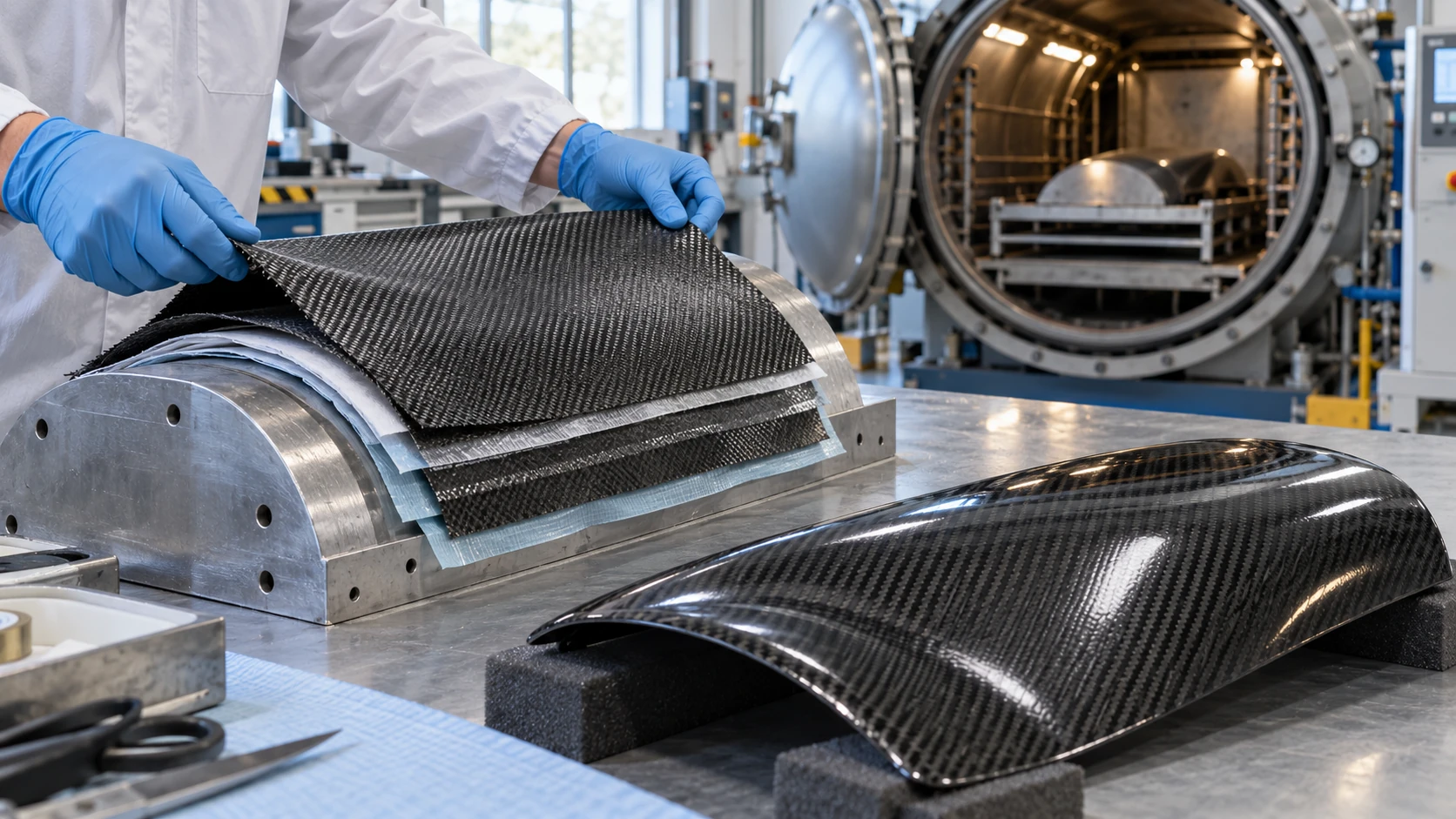
Carbon fibre reinforced plastic (CFRP) and glass fibre reinforced plastic (GFRP) are materials built on a division of labour between fibre and resin. Along the fibre their stiffness far exceeds that of aluminium alloy, yet they are also highly anisotropic: across the fibre and between the layers, it is the resin and the interface that carry the load. This article walks through how carbon fibre is made, the rule of mixtures, thermoset and thermoplastic matrices, prepreg, RTM and the autoclave, sizing, recycling, and uses in aerospace, automotive and wind power, from a materials engineer's point of view.
- What CFRP and GFRP are (the short version)
- Who carries the load — fibre, resin and interface
- How carbon fibre is made
- Our calculation: the rule of mixtures links fibre stiffness to composite stiffness
- A materials engineer's view (1): anisotropy — where metal intuition fails
- The matrix — thermoset and thermoplastic
- Moulding methods — prepreg plus autoclave, RTM, thermoplastic CFRP
- Our calculation: how long a cure cycle takes, and how gel time depends on temperature
- A materials engineer's view (2): curing is thermal design
- The interface and sizing
- A materials engineer's view (3): tests that probe the interface do not measure fibre strength
- Uses — aerospace, automotive and wind power
- Recycling
- What is still hard, and what we could not confirm
- Glossary / References / Claim-to-source audit
Sourced = content stated in published material from a standards body, a company's public datasheet, a paper or a public agency (link given)
Our calculation = a figure this article derived, with the assumptions spelled out
Not yet confirmed = a plan, target or outlook with no confirmed track record
Structural readings and materials-design interpretations are marked separately as Commentary.
Property values are manufacturers' stated values, always shown together with the test method, temperature, fibre volume fraction and grade. Values for different grades are not lined up to rank them.
1. What CFRP and GFRP are (the short version)
- What they are made of: a composite in which strong fibres (carbon or glass) are bound by a polymer matrix. Hexcel's HexPly® M21 is a prepreg that supplies a toughened epoxy resin combined with carbon or glass fibreSourced
- What is impressive about them: stiffness and strength along the fibre are extremely high. Hexcel's unidirectional M21/IMA carbon fibre material has a tensile modulus along the fibre of 178 GPa, a tensile strength of 3,050 MPa and a laminate density of 1.58 g/cm³ (ASTM D3039, 23 °C, manufacturer's stated values normalised to a fibre volume fraction of 59%)Sourced
- What is hard about them: properties change greatly with direction (anisotropy), and the between-layer direction (interlaminar) and the direction across the fibre are carried by resin and interface. The same material has an in-plane shear modulus of 5.2 GPa, about 1/34 of the modulus along the fibreSourcedOur calculation (178 / 5.2 = 34)
Designing with CFRP is not about choosing a material but about deciding which load goes to which phase. For the unidirectional M21/IMA material, against a tensile strength along the fibre of 3,050 MPa, the interlaminar shear strength (ILSS) is 97 MPa, a ratio of about 3%SourcedOur calculation (97 / 3,050 = 3.2%). The loads fibres can carry and the loads resin and interface carry differ by an order of magnitude (our commentary).
The basics of thermosets and thermoplastics are in our explainer on thermoplastics and thermosets, epoxy resins are in our explainer on epoxy resins, and thermoplastic matrices such as PEEK are in our explainer on PEEK and super engineering plastics. This article keeps to the view of a material made by combining fibre and resin.
2. Who carries the load — fibre, resin and interface
For the same unidirectional M21/IMA material, lining up the types of load shows the values changing by an order of magnitudeSourced.
- Tension along the fibre: strength 3,050 MPa, modulus 178 GPa
- Compression along the fibre: strength 1,500 MPa, modulus 146 GPa (ASTM D695)
- Interlaminar shear (ILSS): 97 MPa (ASTM D2344)
- In-plane shear (±45° tension): strength 94 MPa, modulus 5.2 GPa (ASTM D3039)
Compressive strength is about half of tensile strength (1,500 / 3,050 = 0.49)Our calculation. In compression the resin has to stop the fibres from buckling, so it can be read that the stiffness of the resin and the interface matter (our commentary).
3. How carbon fibre is made
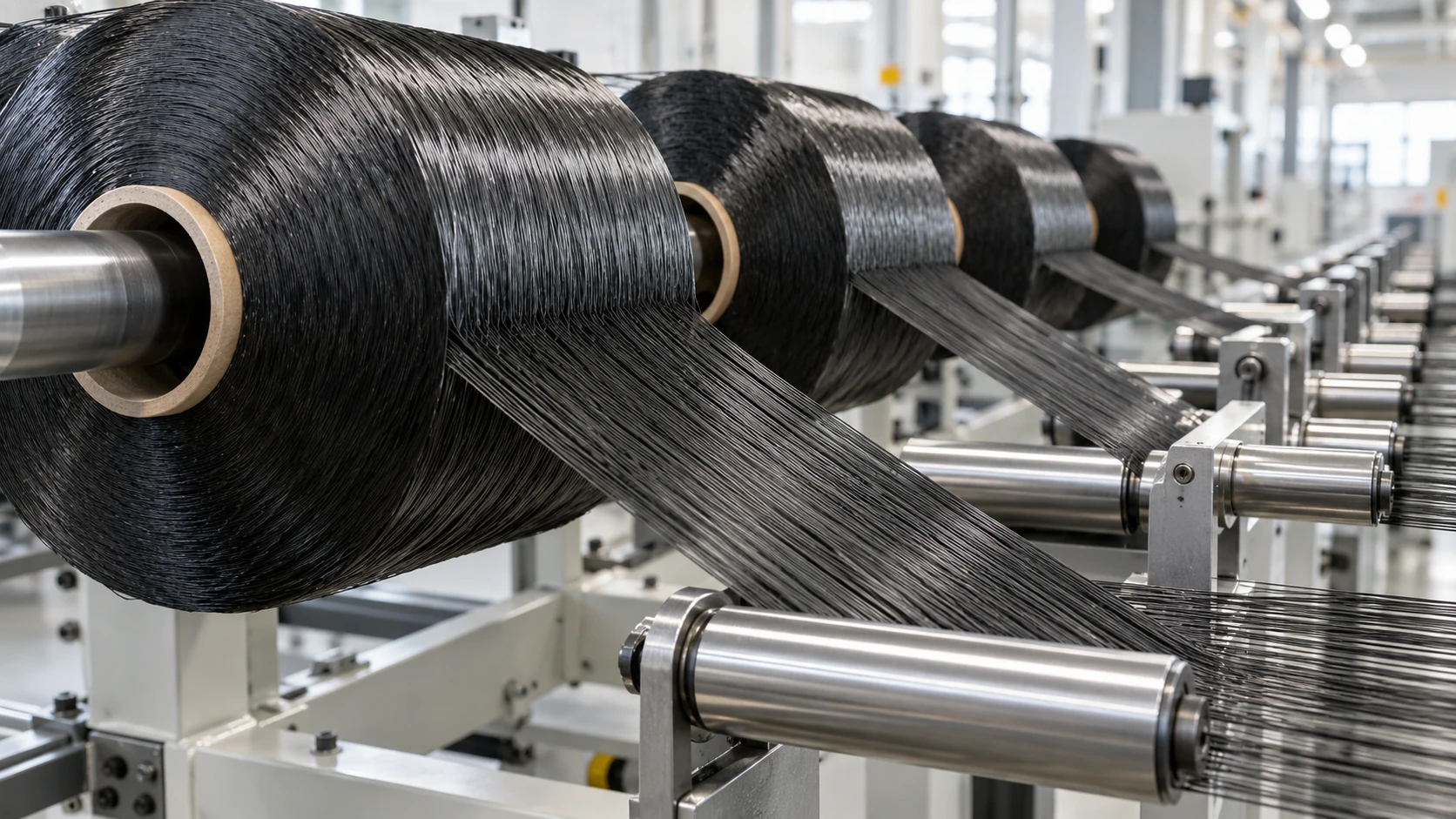
Hexcel's HexTow® IMA is a continuous PAN (polyacrylonitrile)-based carbon fibre supplied as a bundle (tow) of 12,000 (12K) or 24,000 (24K) filaments. The filament diameter is 5.1 µm and the carbon content is 95.0%. It is surface treated, and sizing can be applied to improve properties such as interlaminar shearSourced.
The review by Mishnaevsky (Materials, 2017) sorts carbon fibre manufacture into polymerisation of the precursor, stabilisation and carbonisation, followed by surface treatment and the application of sizing. It says surface treatment roughens the fibre surface to improve adhesion, and that the sizing amount is in the range of 0.5 to 5 wt%Sourced. The review by Frank et al. (Angewandte Chemie, 2014) lists as precursor systems PAN-based copolymers, pitch, cellulose, lignin, polyethylene and new synthetic polymersSourced.
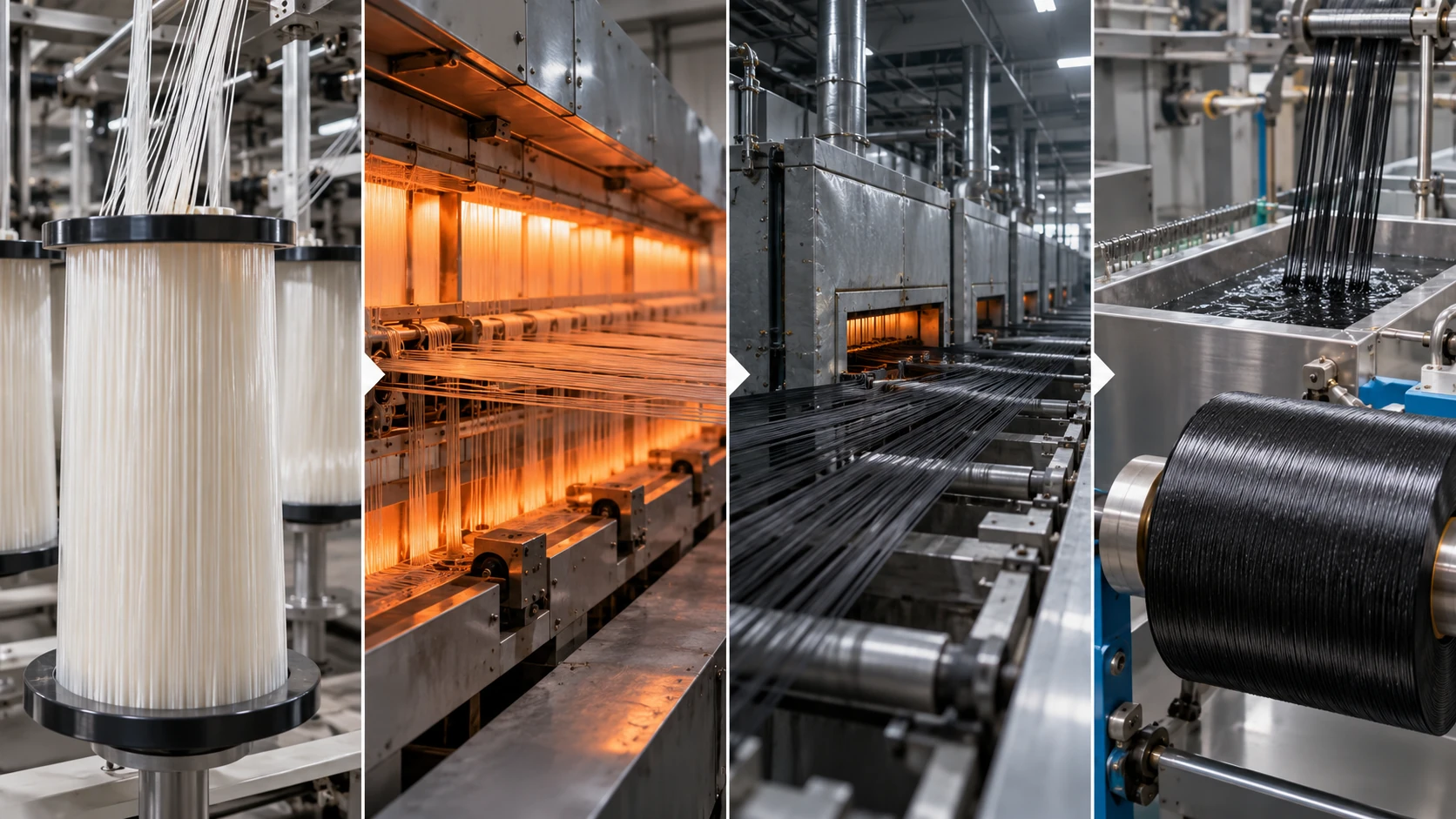
ImageGen conceptual illustration (not a real photograph or measurement). See the original diagram for exact values, names and structure.
Show original diagram with exact annotations and values
A report from ORNL (Oak Ridge National Laboratory), in discussing how to cut the manufacturing cost of carbon fibre, introduces a survey (Kline & Company) which found that less than 50% of the precursor's mass becomes carbon fibre and that the cost of the manufacturing process accounts for more than 50% of the total cost of commercial carbon fibreSourced. It also notes that in conventional heat treatment low-temperature and high-temperature carbonisation are normally carried out step by step in entirely separate furnacesSourced.
4. Our calculation: the rule of mixtures links fibre stiffness to composite stiffness
AssumptionsOur calculation
- Modulus along the fibre E1 = Vf × Ef + (1 − Vf) × Em (the simple rule of mixtures, with homogeneous fibre and matrix arranged in parallel)
- Fibre modulus Ef = 298 GPa (HexTow® IMA, chord 6000–1000, Hexcel stated value)
- Matrix modulus Em = 3.1 GPa (HexFlow® RTM6, ASTM D638, 23 °C, dry, Hexcel stated value. This is not the value for the M21 matrix itself; the value for an epoxy resin of the same class is used as a stand-in)
| Material | Fibre volume fraction Vf | Rule-of-mixtures value | Manufacturer's stated value (0° tensile modulus) | Stated value as a share of the calculated value |
|---|---|---|---|---|
| M21/IMA unidirectional | 59.2% (theoretical value from the calculation) | 177.7 GPa | 178 GPa (ASTM D3039, normalised to Vf 59%) | 100.2% |
| HexPly® 8552/IMA unidirectional | 60% | 180.0 GPa | 176 GPa (ASTM D3039) | 97.8% |
The formula gives 0.592 × 298 + 0.408 × 3.1 = 176.4 + 1.3 = 177.7 GPa. The resin contributes less than 1% of the total (1.3 / 177.7 = 0.7%), so modulus along the fibre is set almost entirely by the fibre and its volume fraction. Doing the same calculation for strength, the fibre tensile strength of 6,067 MPa (HexTow® IMA) times Vf gives 3,592 MPa for M21, and the stated value of 3,050 MPa is about 85% of that (for 8552, 2,935 MPa against 3,640 MPa, about 81%).
Assumptions and limits: the fibre values come from strand tests (the datasheet does not name the test method) while the composite values are from ASTM D3039, so the test methods differ. Also the matrices of 8552 and M21 differ, and the matrix modulus is not the same (the contribution is small, so the conclusion barely changes). The "about 81 to 85%" for strength is an apparent ratio that includes scatter in fibre strength and the difference in test methods, and does not mean strength is set by the rule of mixtures (modulus and strength are separate problems).
5. A materials engineer's view (1): anisotropy — where metal intuition fails
For a metal (an isotropic plate), a single number such as "Young's modulus" or "tensile strength" can stand for the material. In CFRP there is a separate number for each direction and each type of load. Here are the unidirectional M21/IMA values side by side (Hexcel stated values, 23 °C)Sourced.
- Tensile modulus along the fibre: 178 GPa; in-plane shear modulus: 5.2 GPa → a ratio of about 34 timesOur calculation
- Tensile strength along the fibre: 3,050 MPa; interlaminar shear strength: 97 MPa → about 3%Our calculation
- Compressive strength along the fibre: 1,500 MPa (about 0.49 times the tensile strength)Our calculation
In real structures a unidirectional material is seldom used as it is; it is made into a laminate with fibres stacked at different angles to build the stiffness and strength needed in each direction (our commentary). The same datasheet also gives examples with woven fabric. With the same M21 matrix, the 0° tensile modulus is 67.6 GPa for a 2×2 twill of AS4C carbon fibre (Vf about 56%) and 25.5 GPa for E-glass fabric (7581, Vf 50%), both lower than the 178 GPa of the unidirectional materialSourced. This is because part of the fibre in a fabric lies in the transverse direction (commentary).
Specific stiffness and specific strength — what dividing by density shows
In aerospace and automotive use what counts is stiffness and strength per unit density. We calculate them from the same M21 datasheet values and the laminate densitiesOur calculation.
| Material (M21 matrix, 0° tension as given in the datasheet) | Modulus | Strength | Density | Modulus / density | Strength / density |
|---|---|---|---|---|---|
| IMA carbon fibre, unidirectional (Vf 59%) | 178 GPa | 3,050 MPa | 1.58 g/cm³ | 112.7 | 1,930 |
| AS4C carbon fibre, 2×2 twill (Vf 56%) | 67.6 GPa | 885 MPa | 1.56 g/cm³ | 43.3 | 567 |
| E-glass fabric 7581 8HS (Vf 50%) | 25.5 GPa | 444 MPa | 1.92 g/cm³ | 13.3 | 231 |
Modulus, strength and density are Sourced (Hexcel HexPly® M21 datasheet [Reference 1]. UD per ASTM D3039 / EN 2561 B; fabrics per EN 2597 B / EN 2747). The divisions are Our calculation (units GPa·cm³/g and MPa·cm³/g). Because fibre volume fraction and test standard differ from row to row, this is a table for seeing differences of order of magnitude between materials, not a like-for-like comparison.
6. The matrix — thermoset and thermoplastic
The matrix has the jobs of binding the fibres, passing load to them, and protecting them from the environment. Matrices divide broadly into thermosets and thermoplastics.
| Aspect | Thermoset (epoxy as the example) | Thermoplastic |
|---|---|---|
| Moulding principle | Liquid or semi-cured resin is heated so that a chemical reaction crosslinks and cures it (irreversible) | The polymer is heated to melt and soften, then cooled to solidify (reversible) |
| Typical forms | Prepreg; low-viscosity injection resin (RTM, infusion) | Pre-impregnated material forms and various moulding methods using long fibre |
| Published characteristics | M21: toughened epoxy, Tg 195 °C (DMA, EN 6032 extrapolated onset of E′), designed for use in environments up to 121 °C. Shelf life: 12 months at −18 °C; out-life at room temperature 30 days RTM6: dry Tg above 200 °C, wet Tg above 160 °C, moisture uptake 2.0 to 3.0% | The review by Vaidya and Chawla: advantages over thermoset matrices are cited in recyclability, high specific strength and stiffness, corrosion resistance, impact toughness, cost effectiveness and design freedom |
All Sourced (M21 [Reference 1] and RTM6 [Reference 2] are Hexcel manufacturer's stated values. Tg "dry" is 24 h at 105 °C and "wet" is 14 days in 70 °C water. Thermoplastics: the review by Vaidya and Chawla [Reference 11]). We do not cover values for individual thermoplastic materials.
The review by Vaidya and Chawla (International Materials Reviews, 2008) says that the arrival of high-performance thermoplastic polymers brought a rapid increase in structural uses of thermoplastic composites, that since the 1990s the material forms and combinations of fibre-reinforced thermoplastic polymers have grown exponentially, and that applications have spread across transport, automotive, rail, marine, aerospace, military and constructionSourced. The review sorts out the types of thermoplastic polymer, material forms and impregnation methods, moulding methods using long fibre, and new moulding methods. The properties of individual thermoplastic matrices (PEEK, PPS and so on) are covered in our explainer on PEEK and super engineering plastics.
Compression tests (ASTM D695) on cured neat resin of RTM6 give values at 23 °C dry, and at 120 °C after 14 days in 70 °C waterSourced.
| Item (compression, ASTM D695) | 23 °C, dry | 120 °C, wet | Change |
|---|---|---|---|
| Yield strength | 140 MPa | 65 MPa | −54% |
| Modulus | 3.4 GPa | 2.4 GPa | −29% |
The calculations are 65 / 140 = 0.46 and 2.4 / 3.4 = 0.71Our calculation. Because the resin contributes less than 1% of the modulus along the fibre (Section 4), it can be read that properties governed by the fibre are insensitive to temperature and humidity, while properties governed by resin and interface (compression, interlaminar shear and so on) are sensitive to them (our commentary).
Assumptions and limits: these are neat-resin values and do not show how much the compressive strength of a laminate falls. We have not confirmed laminate values under hot-wet conditions.
7. Moulding methods — prepreg plus autoclave, RTM, thermoplastic CFRP
(1) Prepreg plus autoclave
Prepreg is a semi-cured sheet in which fibre has been impregnated with resin in advance. For M21, curing in a press or an autoclave is said to give the best mechanical properties after cure, and Hexcel gives the following procedure as the standard cure for parts under 15 mm thickSourced.
- Pull a vacuum (1 bar) and apply an autoclave pressure of 7 bar (gauge)
- Heat to 180 °C ±5 °C so that the part's heating rate is 1 to 2 °C/min
- Hold at 180 °C ±5 °C for 120 min ±5 min
- Cool the part at 2 to 5 °C/min, and release the pressure at 60 °C or below
For parts 15 to 48 mm thick, a two-stage cure with an intermediate hold of 180 min at 150 °C is given, and M21 is described as allowing thick structures up to 48 mm to be made with a simple cure thanks to its low exotherm behaviourSourced. For sandwich structures with honeycomb or foam cores, the pressure is low at 2 to 3 bar (depending on core density), and the cure is held at 135 °C for 60 min before pressurising and then at 180 °C for 120 minSourced.
AssumptionsOur calculation
- The standard M21 procedure for parts under 15 mm. Heating from 23 °C to 180 °C (157 °C of rise) at 1 to 2 °C/min, a 120 min hold, and cooling from 180 °C to 60 °C (120 °C of fall) at 2 to 5 °C/min
- Time for lay-up, vacuum bagging, tool preparation and demoulding is not included
| Case | Heating | Hold | Cooling | Total |
|---|---|---|---|---|
| Fast case (2 °C/min, 5 °C/min) | 78.5 min | 120 min | 24 min | about 223 min (3.7 h) |
| Slow case (1 °C/min, 2 °C/min) | 157 min | 120 min | 60 min | about 337 min (5.6 h) |
One cure takes about two to three times the hold time (120 min) (223 / 120 = 1.9, 337 / 120 = 2.8). It can be read that, because an autoclave is a large pressure vessel and cannot ramp quickly (to limit temperature differences within the part), the heating and cooling rates become the constraint that sets the pace of production (our commentary).
Assumptions and limits: the same datasheet says that actual ramp rates depend on the autoclave's size, the mass of the tooling and the size of the part. This calculation is meant to give a feel for the length of the cycle.
(2) RTM and infusion
In RTM (resin transfer moulding) and infusion, a stack of dry fibre (a preform) is placed in a mould, low-viscosity liquid resin is injected to impregnate it, and it is cured as it stands (our commentary). Hexcel's HexFlow® RTM6 is a one-component, aerospace-qualified epoxy for this use, with a viscosity below 100 mPa·s at process temperatureSourced. The recommended conditions are as followsSourced.
- Preheat the resin to 80 °C. Mould temperature a constant 120 to 180 °C, injection and infusion lines at 90 to 110 °C
- Vacuum infusion below 5 mbar; RTM piston pressure from atmospheric to 5 bar
- Cure for at least 90 min at 180 °C; no post-cure is needed (degree of cure α above 90%)
What matters is that the act of heating the resin to lower its viscosity is also the act of advancing the reaction. Hexcel's safety and handling guidelines point to the risk that a heated reactive resin that is not properly managed can lead to an uncontrolled exotherm, and set limits such as preheating the resin in an oven at 50 to 70 °C for at most 12 hoursSourced [Reference 7].
The RTM6 datasheet gives gel times (the time at which G′ and G″ cross) by temperatureSourced.
| Temperature | Gel time (G′/G″ crossover) | Time for viscosity to reach 1,000 mPa·s |
|---|---|---|
| 100 °C | 11 h 30 min | 8 h |
| 120 °C | 4 h | 3 h |
| 140 °C | 1 h 40 min | 1 h 20 min |
| 160 °C | 45 min | 40 min |
| 180 °C | 20 min | 20 min |
Assumption (set by this article)Our calculation: treat gel time t as varying in the Arrhenius form t ∝ exp(Ea / RT).
From the two points at 100 °C and 180 °C, Ea / R = ln(690 / 20) / (1/373.15 − 1/453.15) = 3.54 / 0.000473 = about 7,480 K, so Ea ≈ 62 kJ/mol. From 120 °C and 180 °C it is about 61 kJ/mol, and from 150 °C and 180 °C (the datasheet has a row for 150 °C with a gel time of 1 hour) about 58 kJ/mol. Raising the temperature by just 60 °C (120 °C to 180 °C) cuts the gel time to one twelfth (240 min to 20 min).
Assumptions and limits: a real cure involves several reactions and cannot always be described by a single activation energy. This is an apparent value from one indicator, gel time, and does not show the reaction mechanism.
(3) Thermoplastic CFRP
CFRP with a thermoplastic matrix is melted and shaped by heating and solidified by cooling, so there is no waiting for a cure reaction, and there is room for joining or reshaping by reheating (our commentary). The review by Vaidya and Chawla lists as advantages of thermoplastic composites recyclability, high specific strength and stiffness, corrosion resistance, impact toughness, cost effectiveness and design freedomSourced. On the other hand, high-performance thermoplastic matrices melt at high temperatures, so the moulding temperature and equipment differ from those for thermosets (our commentary; we do not cover specific temperatures).
8. A materials engineer's view (2): curing is thermal design
Reading the moulding conditions for CFRP, you notice that temperature is moving three things at once (our commentary).
- Viscosity: raising the temperature makes the resin flow and impregnate the fibre. RTM6 is below 100 mPa·s at process temperature
- Reaction: raising the temperature advances crosslinking until the resin gels and stops flowing. Gel time falls to one twelfth for a 60 °C rise (our calculation (2))
- Stress: as the part cools from the cure temperature (180 °C) to room temperature, the differences in resin shrinkage and thermal expansion remain as residual stress. The coefficient of thermal expansion of RTM6 is 55 for −50 to 20 °C, 65 for 20 to 100 °C and 80 for 100 to 180 °C (×10-6 K-1)Sourced. Along the fibre the fibre largely restrains it, but across the fibre and through the thickness the resin's value matters (commentary). The design of thermal expansion is covered in our explainer on the coefficient of thermal expansion
In terms of metal heat treatment, it is the work of matching the windows of flow (impregnation) and reaction (cure) through the ramp rate and the hold. The two-stage cure for thick parts with M21 (hold at 150 °C, then go to 180 °C) can be read as a design that lets the heat of reaction escape while the cure proceeds (commentary. The datasheet says only that the low exotherm behaviour allows a simple cure of thick parts). That the RTM6 handling guidelines set even the maximum preheating time and the emergency response is the flip side of the danger of heating a large quantity of a reactive liquid.
9. The interface and sizing
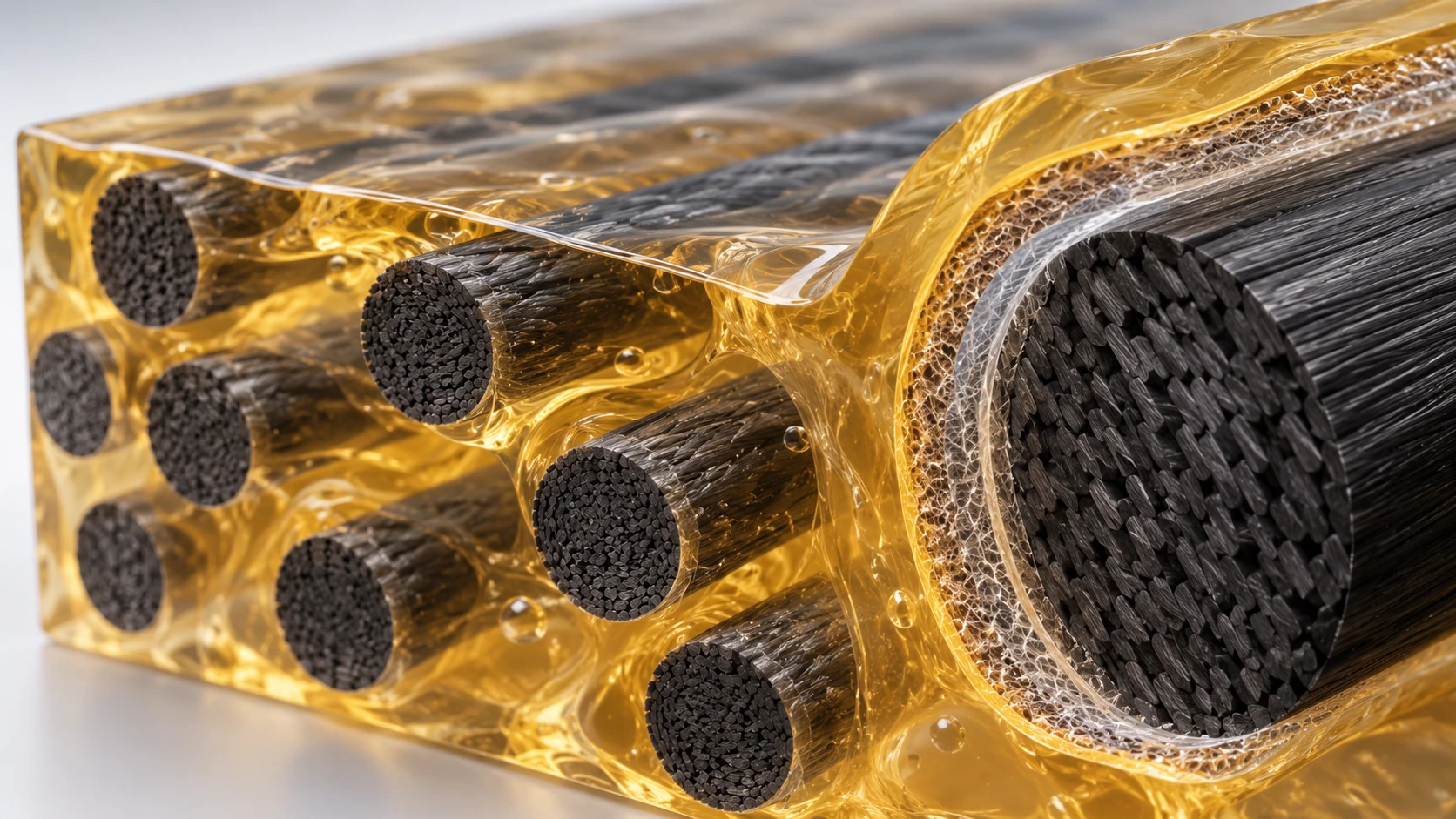
ImageGen conceptual illustration (not a real photograph or measurement). See the original diagram for exact values, names and structure.
Show original diagram with exact annotations and values
The review by Mishnaevsky sorts out the role and makeup of sizing as followsSourced.
- Sizing for glass fibre: an aqueous suspension (3 to 10 wt% solids) is applied with rollers and dried for several hours above 100 °C to cure the sizing. It contains at least a film former and a coupling agent; a large survey found the film former at about 80 wt% of the dry sizing and the coupling agent at about 10 wt%
- The film former protects fibres from damaging one another, and is mostly a polymer close to the matrix of the final product (polyester, polyurethane, epoxy and so on). The coupling agent is mostly an organosilane, which bonds covalently to the glass fibre surface through a sol-gel reaction and, if it carries a functional group that reacts with the matrix, links fibre and matrix. The most widely used silanes carry amine or epoxy functional groups
- Sizing for carbon fibre: carbon fibre is organic and has no compatibility problem of the kind glass fibre has, but its surface is often smooth and inert, so sizing is needed. Surface treatment roughens the surface and increases surface area, improving adhesion. The sizing amount is in the range of 0.5 to 5 wt%, and plays the roles of forming the strand, reducing fuzz, improving processability and improving adhesion between fibre and matrix. It is often an emulsion of polymer components
10. A materials engineer's view (3): tests that probe the interface do not measure fibre strength
ASTM D2344 (short beam), which measures interlaminar shear strength (ILSS), is a test that looks not at fibre strength but at the shear carried by the resin and the fibre interface (our commentary). Hexcel's M21 datasheet lists the ILSS of three fibres with the same M21 matrix (fibre areal weight 194 g/m², Vf about 59%)Sourced.
| Fibre in M21/UD194 | ILSS (23 °C, ASTM D2344) | 0° tensile modulus |
|---|---|---|
| IM7-12K | 110 MPa | 160 GPa |
| AS7-12K | 114 MPa | 148 GPa |
| IMA-12K | 97 MPa | 178 GPa |
ILSS runs from 97 to 114 MPa, and the lowest, IMA, is about 15% below the highest, AS7 ((114 − 97) / 114 = 14.9%)Our calculation. Tensile modulus follows the order of fibre modulus (IMA is the highest), yet ILSS does not follow that order. Whether the ILSS differences come from the fibre surface condition, the sizing or compatibility with the resin cannot be told from the datasheet, and we have not confirmed it. In Hexcel's HexTow® IMA datasheet, the ILSS with a HexPly® 8552 matrix is 119 MPa (ASTM D2344), which shows that a different matrix changes ILSS even for the same fibreSourced (specimen dimensions and fibre volume fraction differ, so be careful in comparing directly with M21).
In other words a test that evaluates the combination of fibre and resin is needed; the interlaminar properties of the composite are not set by the value of the fibre alone or the resin alone. When fibre makers say "sizing can be applied", it is probably for tuning this combination (our commentary).
11. Uses — aerospace, automotive and wind power
(1) Aerospace
Boeing explains of the 787 that about 50% of the airframe by mass is made of composites, and that, in contrast with aluminium, composites resist corrosion and do not fatigue, which reduces the need for inspection and the time out of serviceSourced (the manufacturer's own description). In its datasheet Hexcel positions M21 as a very tough epoxy matrix for primary aerospace structures, with outstanding damage tolerance particularly against high-energy impactSourced. In primary aircraft structure, compressive strength after impact is emphasised, and the M21 datasheet gives compression after impact (CAI) of 298 MPa (IM7) at a 30.5 J impact, and 238 MPa (AS7) and 219 MPa (IMA) at 30.0 J (ASTM D7136 and D7137)Sourced.
(2) Automotive
According to BMW Group, the BMW i3 is the company's first car with a passenger cell made of carbon fibre reinforced plastic (CFRP). This Life module is formed in Leipzig from carbon fibre fabric (scrim) and joined to an aluminium chassis (the Drive module). The company says that body manufacturing and assembly in Leipzig take about half the time of conventional vehiclesSourced (the manufacturer's own description). In automotive use, cycle time and material cost are constraints of a different kind from aerospace (our commentary; we have not confirmed specific figures).
(3) Wind power
The review by Mishnaevsky (Materials, 2017) says the following of wind turbine blade materialsSourced.
- From the materials point of view, specific stiffness (stiffness / mass) matters. Turbines are expected to run for 20 to 25 years, so high-cycle fatigue of over 100 million cycles and the behaviour of bond lines and sandwich interfaces are important
- The main reinforcement is E-glass fibre, and glass/epoxy for blades contains up to 75 wt% glass. In UD composites, raising fibre volume content raises stiffness, tensile and compressive strength proportionally, but above 65% dry regions without resin appear, which can reduce fatigue strength
- Carbon fibre, with high stiffness and low density, allows thinner, stiffer, lighter blades, but has low damage tolerance, compressive strength and strain to failure, and is much more expensive than E-glass. It is sensitive to fibre waviness and misalignment, and slight disorder greatly reduces compressive and fatigue strength. Vestas and Siemens Gamesa use carbon fibre composites in the structural spar caps of large blades
- As for manufacturing, with blades growing larger vacuum-assisted resin transfer moulding (VARTM) is the most common, and prepreg (used by Vestas) is also used
Assumptions (set by this article)Our calculation
- Glass fibre density 2.56 g/cm³ (the E-glass value in Hexcel's M21 datasheet); resin density 1.14 g/cm³ (the cured-resin value for HexFlow® RTM6, not the resin actually used in blades)
- No voids. Volume % = (0.75 / 2.56) / {(0.75 / 2.56) + (0.25 / 1.14)}
The calculation gives 0.293 / (0.293 + 0.219) = about 57%. This falls short of the limit of 65% above which Mishnaevsky says dry regions appear, and gives the idea that a blade is a material that is a little under 60% fibre by volume.
Assumptions and limits: the densities are assumptions. We have not confirmed the formulation of real blades. "Up to 75 wt%" is a statement from the review, and not every blade has this value.
12. Recycling
For a materials engineer, CFRP recycling is a question of separating fibre from resin, and deciding which value to recover.
- The review by Pimenta and Pinho (Waste Management, 2011), against the background of growing CFRP waste, sorts out the state of fibre reclamation and remanufacturing processes. It says that several recovery and remanufacturing processes are approaching maturity, with commercial-scale implementations, recycled CFRP with competitive performance for structural use, and demonstration parts already in existence, while challenges remain in establishing a recycling industry and developing a market for recycled materialSourced
- The review by Oliveux et al. (Progress in Materials Science, 2015) says that recycled glass fibre can replace a small amount of new fibre, but pyrolysis (thermolysis) and solvolysis cannot use it at concentrations high enough to be economically and environmentally viable, that carbon fibre recovered from high-tech applications cannot be returned to the same use and new uses must be developed, and that standards suited to the properties of materials using recycled fibre are neededSourced
- The review by Mishnaevsky et al. (Materials, 2021) deals with end-of-life management of wind turbine blades and argues that repair, reuse and life extension of blades are, at present, more advantageous than other approaches. It says that new-generation blades using thermoplastic or recyclable thermoset matrices have been tried in the laboratory and in small and medium blades, but technical challenges remain for use in large bladesSourced
The valuable part of CFRP is the fibre (carbon fibre above all). As in Section 3, a survey is cited that says less than 50% of the precursor's mass becomes carbon fibre and the manufacturing process accounts for more than half of the total costSourced (ORNL report). Even so, Oliveux et al. say that recovered carbon fibre cannot be returned to its original use. A likely background is that the fibre loses its length, its sizing and its surface condition in the course of recovery (our commentary; we have not confirmed the individual mechanisms).
Thermoplastic matrices, which leave room for remelting and reshaping, are described as advantageous from the recycling point of view (Vaidya and Chawla). But the thermoplastic advantage comes at the price of other challenges: keeping fibre length and orientation on reshaping, and separating dissimilar materials (commentary). The relation to chemical recycling is covered in our explainers on plastic recycling and chemical recycling.
13. What is still hard, and what we could not confirm
(1) We do not cover the conditions of each carbon fibre step
We could not confirm in the public primary sources we were able to consult the stabilisation and carbonisation temperatures, atmospheres, ramp rates, tensions and so on, so no numbers are given. The statements in the ORNL report (a heating rate above 100 °C/min in continuous carbonisation, and a two-stage furnace) come from the context of research on polyolefin precursors and are not necessarily the conditions for general PAN-based fibre.
(2) We give no comparison with metals
We could not confirm primary sources that match conditions (test method, heat treatment, shape) for comparing specific stiffness and strength with aluminium alloy, titanium and steel, so none is given. Fig. 6 stays with comparisons among materials in the same datasheet.
(3) We do not cover laminate properties (fatigue, impact, hot-wet)
Calculation of modulus and strength from the stacking sequence (classical laminate theory), fatigue, and loss of laminate strength under hot-wet conditions are not covered here. The hot-wet calculation in Section 6 is for neat resin.
(4) We do not cover specific moulding conditions or numbers for thermoplastic CFRP
Numbers such as the melting temperature of thermoplastic matrices, moulding times and the strength of joints (welding) are outside the scope of this research. We stay with introducing the statements in the review by Vaidya and Chawla.
(5) We have not used production scale or market size for automotive and aerospace
We have not used market-size or share estimates from research firms. The statements from Boeing and BMW Group are limited to each company's own description. We could not check official material for the composite share of other aircraft such as the Airbus A350.
- CFRP is a material in which the fibre carries the load and the resin and interface bind and join. For the unidirectional M21/IMA material, against a tensile strength of 3,050 MPa the ILSS is 97 MPa (about 3%)SourcedOur calculation
- Modulus along the fibre can be predicted almost exactly by the rule of mixtures. From HexTow® IMA (298 GPa), Vf 59.2% and resin at 3.1 GPa we get 177.7 GPa, in near agreement with the stated 178 GPaOur calculation
- Anisotropy is central to design, with modulus differing by up to about 34 times between directions (178 / 5.2)Our calculation
- Moulding is thermal design. M21 is cured at 180 °C for 120 min at 7 bar, about 223 to 337 min including heating and cooling, and the gel time of RTM6 falls to one twelfth for a 60 °C riseOur calculation
- Sizing and surface treatment create the interface between fibre and resin. Sizing is 0.5 to 5 wt%, and ILSS runs from 97 to 114 MPa depending on the fibre even with the same M21 matrixSourced
- Uses are aerospace (the 787 is about 50% composite by mass), automotive (the passenger cell of the BMW i3) and wind power (E-glass, up to 75 wt%). Recovered carbon fibre is said not to be returnable to its original useSourced
14. Glossary
- CFRP / GFRP
- Plastic reinforced with carbon fibre / glass fibre.
- Matrix
- The resin that binds the fibres and passes load to them. Thermoset or thermoplastic.
- Unidirectional material (UD)
- A sheet with the fibres aligned in one direction. Properties along the fibre stand out.
- Prepreg
- A semi-cured sheet with resin impregnated into the fibre in advance. Some products need frozen storage.
- Autoclave
- A large pressure vessel that heats and pressurises. Used to cure prepreg.
- RTM / infusion
- Moulding methods in which low-viscosity resin is injected or drawn into dry fibre to impregnate it, and then cured.
- Fibre volume fraction (Vf)
- The share of the composite's volume taken by fibre. Determined by ASTM D3171, ISO 1172 and others.
- Rule of mixtures
- A simple equation that gives the modulus along the fibre as the volume-fraction-weighted average of fibre and matrix moduli.
- ILSS
- Interlaminar shear strength. Found by the short-beam test (ASTM D2344), and governed by the properties of resin and interface.
- Sizing
- A thin polymer coating applied to the fibre surface. Bears on handling, adhesion and reduction of fuzz.
- Tg (glass transition temperature)
- The temperature range in which the resin changes from a hard state to a soft one. Lower when wet.
- CAI
- Compression after impact. The compressive strength of a laminate that has taken an impact, an indicator of damage tolerance in aircraft structure.
15. References (primary sources)
- Hexcel HexPly® M21 180°C (350°F) curing epoxy matrix — Product Data Sheet — hexcel.com
- Hexcel HexFlow® RTM6/RTM6-2 180°C Epoxy System for Resin Transfer Molding and Infusion Technologies — Product Data Sheet — hexcel.com
- Hexcel HexTow® IMA Carbon Fiber — Product Data Sheet — hexcel.com
- ASTM International ASTM D3039/D3039M Standard Test Method for Tensile Properties of Polymer Matrix Composite Materials — store.astm.org
- ASTM International ASTM D2344/D2344M Standard Test Method for Short-Beam Strength of Polymer Matrix Composite Materials and Their Laminates — store.astm.org
- ASTM International ASTM D3171 Standard Test Methods for Constituent Content of Composite Materials — store.astm.org
- Hexcel HexFlow® RTM6/RTM6-2 Safety & Processing Recommendations for Injection & Infusion — hexcel.com
- Mishnaevsky et al. Materials for Wind Turbine Blades: An Overview, Materials 10, 1285 (2017) — doi.org/10.3390/ma10111285
- Frank et al. Carbon Fibers: Precursor Systems, Processing, Structure, and Properties, Angew. Chem. Int. Ed. 53, 5262–5298 (2014) — doi.org/10.1002/anie.201306129
- Oak Ridge National Laboratory Norris, Development and Commercialization of Alternative Carbon Fiber Precursors and Conversion Technologies, ORNL/TM-2014/239 (2014) — info.ornl.gov
- Vaidya and Chawla Processing of fibre reinforced thermoplastic composites, Int. Mater. Rev. 53, 185–218 (2008) — doi.org/10.1179/174328008x325223
- Boeing 787 Dreamliner — By Design — boeing.com
- BMW Group First of its kind and innovation driver for sustainable mobility: 200 000 BMW i3 produced to date (16 October 2020) — press.bmwgroup.com
- Pimenta and Pinho Recycling carbon fibre reinforced polymers for structural applications: Technology review and market outlook, Waste Manag. 31, 378–392 (2011) — doi.org/10.1016/j.wasman.2010.09.019
- Oliveux et al. Current status of recycling of fibre reinforced polymers: Review of technologies, reuse and resulting properties, Prog. Mater. Sci. 72, 61–99 (2015) — doi.org/10.1016/j.pmatsci.2015.01.004
- Mishnaevsky Sustainable End-of-Life Management of Wind Turbine Blades: Overview of Current and Coming Solutions, Materials 14, 1124 (2021) — doi.org/10.3390/ma14051124
- ISO ISO 1172:2023 Textile-glass-reinforced plastics — Prepregs, moulding compounds and laminates — Determination of the textile-glass and mineral-filler content using calcination methods — iso.org
16. Claim-to-source audit
| Claim in the text | Basis | Label |
|---|---|---|
| That M21 is supplied as a toughened epoxy with carbon or glass fibre, is for primary aerospace structure, and is designed for environments up to 121 °C. The properties of M21/IMA, IM7 and AS7 unidirectional material (density 1.58, fibre volume fraction 59.2%, Tg 195 °C, tensile strength and modulus, compressive strength and modulus, ILSS, in-plane shear, open-hole tension, CAI), properties of the fabrics, and the test standards (ASTM D3039, D695, D2344, D5766, D6484, D7136). The autoclave cure procedure (7 bar, 180 °C for 120 min, heating at 1 to 2 °C/min, cooling at 2 to 5 °C/min), the two-stage cure for thick parts, the sandwich-structure procedure, shelf life and out-life | Hexcel HexPly® M21 datasheet (manufacturer's stated values)[Reference 1] https://www.hexcel.com/wp-content/uploads/2025/12/HexPly_M21_global_DataSheet.pdf | Sourced |
| The characteristics of RTM6 (viscosity below 100 mPa·s at process temperature, dry Tg above 200 °C and wet Tg above 160 °C, moisture uptake 2.0 to 3.0%), the recommended conditions (preheat 80 °C, mould 120 to 180 °C, lines 90 to 110 °C, vacuum below 5 mbar, RTM pressure from atmospheric to 5 bar, at least 90 min at 180 °C), the table of gel times and times to reach a given viscosity, and the properties of the cured resin (density 1.14, CTE 55, 65 and 80, compression and tension yield strength and modulus, ASTM D638 and D695) | Hexcel HexFlow® RTM6 datasheet (manufacturer's stated values)[Reference 2] https://www.hexcel.com/wp-content/uploads/2025/12/RTM6_RTM62_HexFlow_DataSheet.pdf | Sourced |
| The specification of HexTow® IMA (PAN-based, 12K and 24K, tensile strength 6,067 MPa, modulus 298 GPa, density 1.79, filament diameter 5.1 µm, carbon content 95%, surface treated, sizing available), and the 0° tension, ILSS (119 MPa) and Vf 60% of the HexPly® 8552 composite | Hexcel HexTow® IMA datasheet (manufacturer's stated values)[Reference 3] https://www.hexcel.com/wp-content/uploads/2025/12/IMA_HexTow_DataSheet.pdf | Sourced |
| The titles of ASTM D3039 (tension), D2344 (short beam) and D3171 (constituent content) | ASTM official pages[Reference 4] https://store.astm.org/d3039_d3039m-17.html[Reference 5] https://store.astm.org/d2344_d2344m-22.html[Reference 6] https://store.astm.org/d3171-22.html | Sourced |
| That heated RTM6 reactive resin can lead to an uncontrolled exotherm if not managed, and that preheating is up to 12 hours in an oven at 50 to 70 °C | Hexcel RTM6 safety and handling guidelines[Reference 7] https://www.hexcel.com/wp-content/uploads/2026/01/HexFlowRTM6RTM62Guidelines.pdf | Sourced |
| The sorting of carbon fibre manufacture (polymerisation of the precursor, stabilisation, carbonisation, surface treatment, sizing), the action of surface treatment, sizing at 0.5 to 5 wt%, glass fibre sizing (3 to 10 wt% solids, film former about 80 wt% and coupling agent about 10 wt%, organosilane), and wind turbine blade materials (E-glass, up to 75 wt%, dry regions above 65%, advantages and drawbacks of carbon fibre, spar caps, VARTM, 20 to 25 years and over 100 million cycles of fatigue) | Mishnaevsky et al. (2017)[Reference 8] https://doi.org/10.3390/ma10111285 | Sourced |
| The precursor systems for carbon fibre (PAN-based copolymers, pitch, cellulose, lignin, polyethylene, new synthetic polymers) | Abstract of Frank et al. (2014)[Reference 9] https://doi.org/10.1002/anie.201306129 | Sourced |
| That less than 50% of the precursor's mass becomes carbon fibre; the introduction of a survey (Kline & Company) finding that manufacturing process cost is more than 50% of total cost; and that in conventional heat treatment low- and high-temperature carbonisation are done in separate furnaces | ORNL/TM-2014/239[Reference 10] https://info.ornl.gov/sites/publications/files/Pub50248.pdf | Sourced |
| The advantages of thermoplastic composites (recyclability, high specific strength and stiffness, corrosion resistance, impact toughness, cost effectiveness, design freedom), and the growth in material forms and uses since the 1990s | Abstract of Vaidya and Chawla (2008)[Reference 11] https://doi.org/10.1179/174328008x325223 | Sourced |
| That about 50% of the 787 airframe by mass is composite, and Boeing's statement that composites resist corrosion and do not fatigue | Boeing official page (the manufacturer's own description)[Reference 12] https://www.boeing.com/commercial/787/by-design/ | Sourced |
| BMW Group's statements that the BMW i3 has the company's first CFRP passenger cell (Life module), formed in Leipzig from carbon fibre scrim, and that body manufacturing and assembly take about half the time of conventional vehicles | BMW Group press release (16 October 2020)[Reference 13] https://www.press.bmwgroup.com/global/article/detail/T0318827EN/first-of-its-kind-and-innovation-driver-for-sustainable-mobility:-200-000-bmw-i3-produced-to-date?language=en | Sourced |
| The state of CFRP recycling (several processes approaching maturity, commercial-scale implementations, challenges remaining in market development) | Abstract of Pimenta and Pinho (2011)[Reference 14] https://doi.org/10.1016/j.wasman.2010.09.019 | Sourced |
| That recycled glass fibre is limited to replacing small amounts, that recovered carbon fibre cannot return to its original use and needs new uses, and the need for standards for materials with recycled fibre | Abstract of Oliveux et al. (2015)[Reference 15] https://doi.org/10.1016/j.pmatsci.2015.01.004 | Sourced |
| That in end-of-life management of wind turbine blades repair, reuse and life extension are currently advantageous, and that thermoplastic and recyclable thermoset matrices still face challenges for large blades | Abstract of Mishnaevsky (2021)[Reference 16] https://doi.org/10.3390/ma14051124 | Sourced |
| That ISO 1172:2023 is a method of determining glass fibre and mineral filler content by calcination | ISO official page[Reference 17] https://www.iso.org/standard/84260.html | Sourced |
| Modulus by the rule of mixtures (M21: 177.7 GPa, 8552: 180.0 GPa, stated-to-calculated ratios of 100.2% and 97.8%), the strength ratios (about 85% and 81%), 178 / 5.2 = 34, 97 / 3,050 = 3.2%, 1,500 / 3,050 = 0.49, specific stiffness and strength, the changes in resin under heat and water (−54%, −29%), the cure cycle time (about 223 to 337 min), the apparent activation energy estimated from gel time (about 58 to 62 kJ/mol), the spread of ILSS (about 15%), and 75 wt% glass = about 57 vol% | Our calculation. Divisions and weighted averages of Hexcel stated values [References 1, 2, 3]; because fibre volume fraction, test method and matrix differ from value to value, these are not like-for-like comparisons. The matrix modulus of 3.1 GPa (RTM6), glass at 2.56 and resin at 1.14 g/cm³, and Arrhenius-type gelation are assumptions set by this article | Our calculation |
| Which phase carries which load, the bracing role of resin in compression, the reason fabrics have a lower modulus than the unidirectional material, the qualitative description of stabilisation and carbonisation, the contrast between thermosets and thermoplastics, the sorting of thermoplastic CFRP moulding, the framing that temperature moves viscosity, reaction and stress, the reading of the two-stage cure for thick parts, the framing of ILSS as a test of the interface, and the framing of fibre value in recycling | This article's organisation and commentary based on published content. Not views expressed by any company or agency | Commentary |
| Temperatures and atmospheres of each carbon fibre step, a comparison of specific stiffness and strength with metals, laminate fatigue and hot-wet behaviour, thermoplastic CFRP moulding conditions, the composite share of other aircraft such as the Airbus A350, and the origin of the differences in ILSS | Not stated, because they could not be confirmed in published primary sources within the scope of this article | Commentary |
| That Figs. 1 and 3 to 8 are explanatory drawings rather than real observations or design drawings, and that the hero image and Fig. 2 are AI-generated images | Our note | Commentary |
Last updated 2 October 2026. Sources are limited to primary material (Hexcel's public datasheets, ASTM and ISO standards pages, peer-reviewed papers, a report from a U.S. Department of Energy laboratory, and official descriptions from Boeing and BMW Group). Because the article includes structural readings and materials-design interpretations, those are marked as Commentary and kept separate from sourced fact. The conditions of each carbon fibre step, comparison with metals, laminate fatigue and hot-wet behaviour, and thermoplastic CFRP moulding conditions are not stated here because they could not be confirmed in published primary sources. Property values are manufacturers' stated values; test method, temperature and fibre volume fraction differ from value to value, and values for different grades are not lined up to rank them. We have not used market-size or share estimates from research firms. All figures are explanatory concept graphics. Figs. 1 and 3 to 8 are vector drawings; the hero image and Fig. 2 are AI-generated images, and none of them shows a real product, micrograph or equipment.