TECHNOLOGY EXPLAINER
Microplastics and Life Cycle Assessment
— thinking about "which material is better for the environment" from the rules of measurement
"Is a paper bag or a plastic bag better for the environment?" "Is biodegradable safe?" Questions like these get different answers depending on what is measured and how far the accounting extends. This article sets out the definition and sources of the small particles that reach the environment (microplastics) and the direction of EU regulation, then reads LCA (ISO 14040 / 14044), the standard method of comparing the environmental performance of materials, using real comparative studies of carrier bags. The conclusion is not to recommend one material but the ability to read the premises of a comparison.
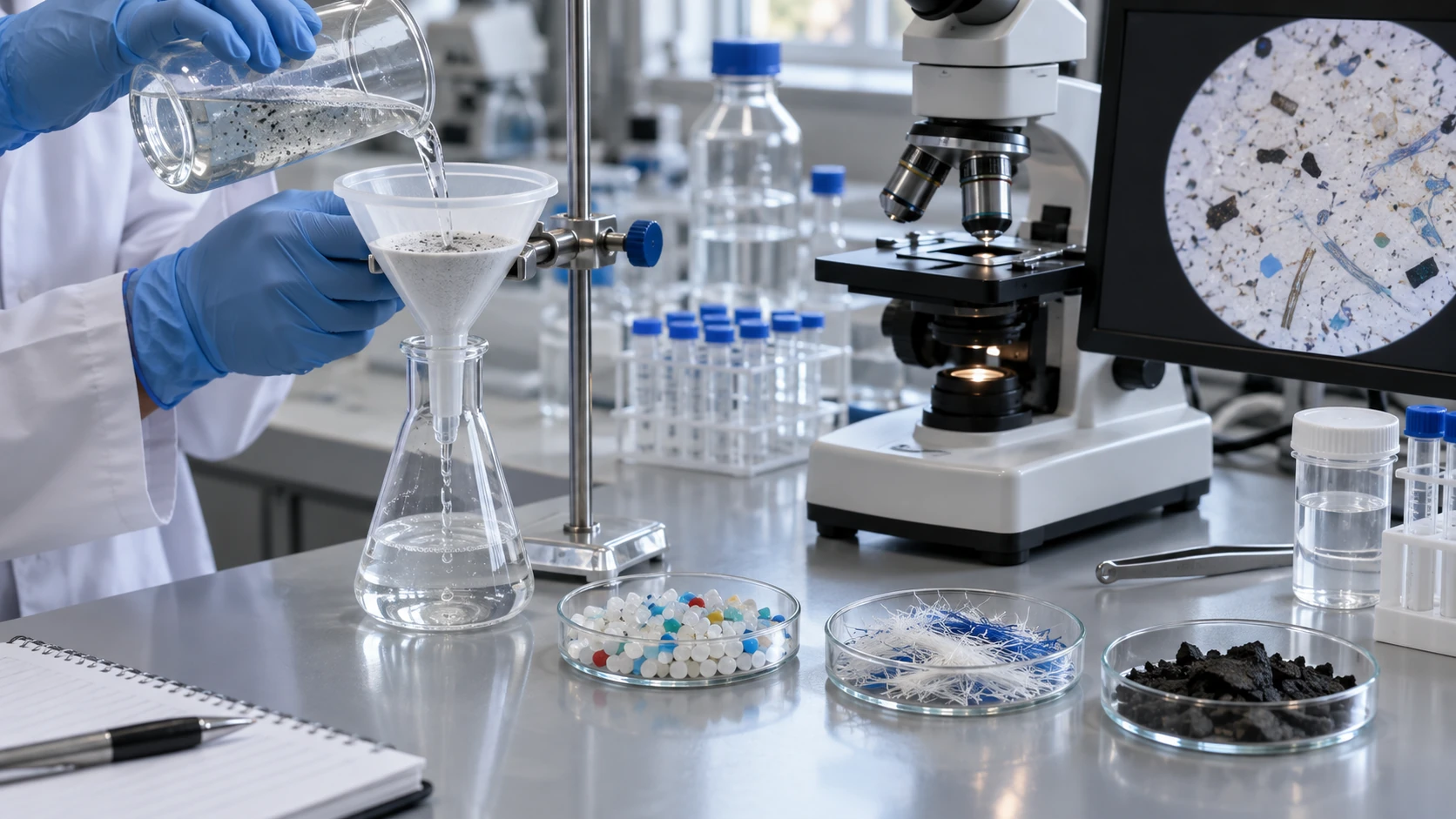
- Why read microplastics and LCA together (the short version)
- What microplastics are — the definitions are not aligned
- Where they come from — estimates of sources
- A materials engineer's view (1): how particles are released, and where material design comes in
- EU regulation — intentional addition, pellets, tyres
- Effects on health and the environment — what is established and what is debated
- Life cycle assessment — the thinking behind ISO 14040 / 14044
- A materials engineer's view (2): cautions on "how to compare", seen in carrier bag LCAs
- Green chemistry — narrowing at the design stage
- Waste management — the order of priority, and how to think about exceptions
- Open problems, and what we could not confirm
- Glossary / References / Claim-to-source audit
Sourced = content stated by a public body, statute, standards body, peer-reviewed paper or publicly funded research report (link given)
Our calculation = a figure this article derived from stated assumptions
Not yet confirmed = a statutory schedule or target with no confirmed outcome yet
General explanations of materials and assessment methods are marked separately as Commentary. Statements on environmental and health effects are limited to what regulators and peer-reviewed papers say, and we separate established knowledge from points under debate. We neither recommend nor criticise any particular material, product or company. No market estimates from research firms are used.
1. Why read microplastics and LCA together (the short version)
- Microplastics are not only what is formed when large litter breaks up. Estimates put the main sources as particles released while products are used or transported: tyre wear, the washing of synthetic textiles, and the loss of industrial pellets (resin granules).
- It is not as simple as "change the material and the problem is solved". A material can increase some other environmental burden, and the standard way of taking in the whole picture is life cycle assessment (LCA).
- LCA is not a "machine that produces the right answer" but a procedure for comparing on premises you have set (functional unit, scope, impact categories). Even for the same materials, changing the premises changes the ranking.
Our explainers on plastic recycling, chemical recycling and bioplastics each dealt with how to read the figures and certifications behind a claim to be "environmentally better". This article, as a wrap-up to the series, links the problem of particles reaching the environment with the methods of comparing materials.
2. What microplastics are — the definitions are not aligned
"Microplastic" has definitions that differ slightly from one body to another.
| Source | Definition / scope | Use and character |
|---|---|---|
| OECD Global Plastics Outlook (2022) | Synthetic polymers smaller than 5 mm (our paraphrase) | For assessing releases to the environment (leakage). Lists industrial pellets, synthetic textiles, road markings and tyre wear as sources |
| EU REACH, Regulation (EU) 2023/2055 "Synthetic polymer microparticles" | A solid polymer that is contained in particles (at 1% by weight or more of the particle, or forming a continuous coating on the particle's surface), where at least 1% by weight of those particles meets either "all dimensions 5 mm or less" or "length 15 mm or less with a length-to-diameter ratio over 3". Excluded: naturally polymerised polymers (not chemically modified), polymers shown by the test in the Annex to degrade, polymers with a water solubility over 2 g/L, and polymers containing no carbon atoms | A restriction on placing on the market intentionally added microparticles (a legal definition). Applies to them as a substance on their own, or where contained in a mixture at 0.01% by weight or more to give desired properties, and so on |
| Hartmann et al. (2019) | Size categories are not consistent, and which materials to include is also debated. They propose a framework that defines by physicochemical properties (polymer composition, solid state, solubility) and classifies by size, shape, colour and origin | A proposal to unify terminology for researchers |
All Sourced (OECD [1], Regulation (EU) 2023/2055 [6], Hartmann et al. [5]). The REACH exclusions are a summary of the body of the definition.
It matters to materials developers that the REACH definition excludes "polymers shown by the test in the Annex to degrade"Sourced. As we saw in our explainer on bioplastics, the European Commission treats biodegradability in the environment as a "system property" (material, environment, time). In other words, in microplastics regulation whether you can show by test that a polymer degrades decides whether it is restricted (our reading). Conversely, proof of in which environment and over what time it degrades takes on regulatory meaning.
The preamble of the regulation also says that tiny fragments of synthetic or chemically modified natural polymers that do not dissolve in water, degrade only very slowly and can be readily taken up by organisms give rise to concern about effects on the environment as a whole and, in some cases, on human healthSourced (the gist of recital 1; our paraphrase).
3. Where they come from — estimates of sources
In 2017, Boucher and Friot of the IUCN (International Union for Conservation of Nature) estimated the releases to the sea of primary microplastics (those released as small particles from the start), by source. They put the total at about 1.5 million tonnes a year (0.8 Mt in the optimistic scenario to 2.5 Mt in the pessimistic scenario), or about 212 g per person, and the breakdown in the central scenario is as followsSourced.
- Washing of synthetic textiles: 34.8%. Tyre wear: 28.3% (counting synthetic rubber only; the report says that if natural rubber is also counted, tyres come to about 46.2% in the central scenario)Sourced.
- City dust (spillage, weathering and abrasion): 24.2% (the report notes it was calculated by a simple method). Personal care products: 2%. The remaining road markings, marine coatings and pellets together come to about 11% (the report's figures are 7%, 3.7% and 0.3%).
- The report says washing and tyres account for about two-thirds (63.1%) of the total. Pellets are a small category in terms of release to the sea, but the EU regulates them from another angle (control of handling and transport; Section 5).
Individual studies bear this out. Napper and Thompson (2016) measured the synthetic fibres released by washing machines and estimated that washing 6 kg of acrylic fabric can release more than 700,000 fibresSourced. Kole and co-authors (2017) estimated tyre wear releases of 0.23 to 4.7 kg per person per year (global average 0.81 kg), accounting for 5 to 10% of all plastics entering the oceans and 3 to 7% of airborne PM2.5Sourced. The OECD (2022) names industrial pellets, synthetic textiles, road markings and tyre wear as sources of microplastic release and says that OECD member countries account for 35% of global microplastic releasesSourced.
Our calculation For tyre wear, we set the figures from two studies side by side to check the order of magnitude.
- IUCN: 212 g per person a year x 28.3% for tyres = about 60 g a year (released to the sea)
- Kole et al.: 0.81 kg a year = 810 g a year per person (global average, released to the environment)
Premises and limits: these are separate studies that differ in what they count (reaching the sea or release to the environment), in year and in estimation method, so it cannot be read as "about 7% reaches the sea". What the calculation shows is that "the amount generated" and "the amount reaching the sea" are different indicators that differ by an order of magnitude, and when quoting a figure you must check which quantity it is.
4. A materials engineer's view (1): how particles are released, and where material design comes in
We set out what is known for each source from the materials side.
- Tyres (wear): Kole and co-authors say the release varies with local conditions such as road type and wastewater treatment, and conclude that for passenger cars tyre wear is larger than other sourcesSourced. In IUCN's estimate, the tyre contribution changes depending on whether only synthetic rubber is counted or natural rubber too (28.3%, versus 46.2% in the central scenario)Sourced. In other words, the definitional question of whether rubber particles count as "microplastics" affects the size of the figure.
- Synthetic fibres (washing): Napper and Thompson report a mean fibre diameter of 11.9 to 17.7 µm and a length of 5.0 to 7.8 mm, and that a polyester-cotton blend fabric released significantly fewer fibres than polyester or acrylic. Release varied with wash temperature, detergent and softenerSourced.
- Pellets (spillage): the EU pellet regulation defines pellets as masses of polymer-containing material made for moulding, of any shape or size (our paraphrase), says the size is usually 2 to 5 mm, and says it includes bio-based pellets and those intended to biodegradeSourced.
The "levers" on the material-design side can be set out as follows (what follows is Commentary by this article; we do not give the size of the effect of each).
- Parts that wear: a trade-off between wear resistance and other performance such as grip. Rubber formulation (polymer, filler) bears on the amount and nature of wear particles.
- Fibres and fabrics: yarn form (filament or staple), fabric structure, blending of materials. The result of Napper and Thompson above shows that the combination of materials can change the release.
- Pellets: the design of handling processes (preventing spills and leaks, packaging, management of wash water). What the regulation asks for is not a change of material but control of processes and logistics (Section 5).
- Claims about degradability: it cannot be said that "switching to a degradable material means no particles". REACH excludes only polymers shown by test to degrade, and the pellet regulation includes biodegradable pellets (above).
5. EU regulation — intentional addition, pellets, tyres
The EU has a target in its Zero Pollution Action Plan of cutting microplastic releases by 30% by 2030Not yet confirmed, and under it is putting in place separate legislation for each source.
| Law | Scope and content (as stated in articles and recitals) | Dates |
|---|---|---|
| Regulation (EU) 2023/2055 REACH Annex XVII (synthetic polymer microparticles) | A restriction on placing on the market intentionally added synthetic polymer microparticles. The recitals mention the ban on microbeads for abrasion and consideration of granular infill for sports surfaces. Uses such as moulding pellets, where particles do not keep their form in use or are encapsulated in a solid matrix, are excluded from the restriction | Dated 25 September 2023, Official Journal 27 September 2023 |
| Regulation (EU) 2025/2365 Preventing plastic pellet losses | A duty aiming at "zero pellet loss" at every stage of pellet handling. It covers operators handling 5 t or more of pellets in the previous year, container and tank cleaning facilities, transport operators, and shippers and operators of sea transport. Operators must draw up a risk management plan including a risk assessment, and notify or register their facilities and make a self-declaration or obtain certification. The recitals say that pellet losses are the third largest source of unintentionally released microplastics in the EU and that uptake of the international voluntary programme (Operation Clean Sweep) is low | Dated 12 November 2025, Official Journal 26 November 2025. Applies in general from 17 December 2027, in part from 16 December 2025, and for sea transport from 17 December 2028 |
| Regulation (EU) 2024/1257 (Euro 7) Type approval of motor vehicles | The recitals say that tyre emissions are estimated to be the largest source of microplastics released to the environment and that non-exhaust emissions (from tyres and brakes) should be measured and limited. If the UN WP.29 does not adopt tyre-wear limits by 1 July 2026 (C1), 1 April 2028 (C2) and 1 April 2030 (C3), the European Commission should set them by delegated act | Dated 24 April 2024, Official Journal 8 May 2024 |
All Sourced (the articles and recitals of each regulation). Euro 7's tyre-wear limits are a statement in the recitals, and we have not confirmed the status of adoption at UN WP.29 Not yet confirmed.
Looking at these three laws from the materials side, the following stands out (our reading).
- REACH: a restriction on particles intentionally put into products, with degradability shown by test as an exclusion. For materials developers, degradability test data takes on regulatory meaning.
- The pellet regulation: irrespective of material composition, it asks for risk management in the handling processes of operators handling 5 t or more. Material makers, compounders, moulders, recyclers and logistics are all covered, so it is a matter of control across the whole supply chain.
- Euro 7: tyre-wear limits are at the stage of being left to work at UN WP.29 (recitals), but in future a material's wear performance may come to be assessed as a regulatory value.
6. Effects on health and the environment — what is established and what is debated
What is established (as stated in regulators' documents):
- Microplastics are ubiquitous, persistent and cross borders. They have been found in soil, lakes, rivers, the sea and remote places (recital 1 of Regulation (EU) 2025/2365)Sourced (our paraphrase).
- They have also been found in water and food (recital 1 of Regulation (EU) 2023/2055). Pellets can persist in the aquatic environment for decades, and seabirds and turtles that ingest them can suffer physical harm or death (recital 1 of 2025/2365)Sourced (our paraphrase).
What is not yet known or is under debate:
- Effects on human health: in 2019 the European Commission's Group of Chief Scientific Advisors took the view that there are serious grounds for concern and that precautionary measures should be taken (recital 2 of 2025/2365)Sourced (our paraphrase). The WHO says that in 2022 it assessed the human health risk by collating published data up to December 2021 on exposure to nano- and microplastics from the environment through diet and inhalation, and identified the research needed to address current uncertaintiesSourced (the statement on its overview page; our paraphrase). Kole and co-authors also say that tyre particles enter the food chain too, but that further research is needed to assess the risk to human healthSourced.
- Definition and measurement: size categories and the materials included are not consistent (Hartmann et al., Section 2). Even under the same name "microplastic", the range of particles examined differs from study to study, so comparing results needs care (Commentary by this article).
This article makes no definitive statements about effects on human health. Nor does it assess the contribution of any particular product or company.
7. Life cycle assessment — the thinking behind ISO 14040 / 14044
ISO sets out LCA in two standards. ISO 14040:2006, "Environmental management — Life cycle assessment — Principles and framework", gives the principles and framework of LCA, and ISO 14044:2006, "Environmental management — Life cycle assessment — Requirements and guidelines", gives the requirements and guidelines. According to ISO's catalogue entries, both cover the phases of goal and scope definition, life cycle inventory analysis (LCI), life cycle impact assessment (LCIA) and life cycle interpretation, together with reporting, critical review, the limitations of LCA and the conditions for value choices. ISO 14040 states clearly that it does not describe the LCA technique in detail, nor specify methodologies for the individual phasesSourced.
When reading an LCA conclusion, always check what the following premises are (the framing is this article's).
- Functional unit: what is compared as "doing the same job" (for example, carrying 22 L of shopping). If a bag is smaller, more bags are needed.
- System boundary: from raw material extraction to disposal (cradle-to-grave), or part of it. The choice of end-of-life treatment (incineration, recycling, reuse), and how credit for avoided production from recycling or heat recovery is handled.
- Impact categories: climate change only, or an aggregation of 15 categories. The ranking can swap by category (Section 8).
- Data: generic data, or measurements from a specific plant. Whether a sensitivity analysis was done.
- What is not in the assessment: whether litter, the behaviour of plastics in the environment, and microplastic releases are included.
The European Commission says the methods of LCA for comparing bio-based and fossil-based plastics are "under development", names as the most harmonised the Joint Research Centre's "Plastics LCA method" (based on the Product Environmental Footprint (PEF) approach), and says the accounting of biogenic carbon uptake and release needs further scientific progressSourced (our paraphrase; see our explainer on bioplastics).
8. A materials engineer's view (2): cautions on "how to compare", seen in carrier bag LCAs
Commissioned by the Danish Environmental Protection Agency, the DTU (Technical University of Denmark) Department of Environmental Engineering carried out an LCA of grocery carrier bags that could be bought in Danish supermarkets in 2017 (February 2018, Environmental Project no. 1985). The bags covered were LDPE (4 types), PP (non-woven and woven), recycled PET, polyester, starch-based biodegradable, paper (unbleached and bleached), cotton (organic and conventional) and a composite (jute, PP, cotton)Sourced.
| Item | Settings and statements in the report |
|---|---|
| Functional unit | To carry one grocery shopping trip (average volume 22 L, average weight 12 kg) from a Danish supermarket home, using a new bag that is collected after use into Danish waste management (our paraphrase) |
| Reference bag | The LDPE carrier bag (average properties) that can always be bought in all supermarkets was taken as the reference |
| Number of bags needed | To meet the function, the simple LDPE bag, recycled LDPE bag, starch-based bag, paper bag and organic cotton bag need 2 bags (because capacity or load-bearing is insufficient). The others need 1 |
| Scope | Production to disposal. Three end-of-life routes: incineration, recycling, and incineration after reuse as a bin bag. Impact categories: 15, including climate change, ozone depletion, human toxicity, photochemical ozone formation, ionising radiation, particulate matter, acidification, eutrophication, ecotoxicity, resource depletion and water resource depletion |
| What was left out | Litter (judged negligible in Denmark). Taxes and changes in customer attitudes or behaviour were also not considered |
| Treatment of reuse | If a bag is reused X times, it is deemed to have avoided X times the production, use and disposal of the reference LDPE bag, from which the minimum number of reuses needed to reach the same environmental performance as the reference was calculated |
All Sourced (summary of the Danish Environmental Protection Agency / DTU report [Reference 12]). The 15 categories are the number of categories listed in Table III of the report.
Our calculation We find the multiples from the values in Table IV of the report.
- PP (non-woven): 52 / 6 = about 8.7 times; recycled PET: 84 / 8 = 10.5 times; polyester: 35 / 2 = 17.5 times
- Organic cotton: 20,000 / 149 = about 134 times; conventional cotton: 7,100 / 52 = about 137 times; composite bag: 870 / 23 = about 38 times
- Starch-based and unbleached paper: 0 reuses on climate change (assessed as lower than the reference bag), but 42 and 43 on all indicators
Premises and limits: the multiples show, under the settings the report chose, how much the number of reuses needed changes between taking climate change alone and taking all categories. The report states that the very large counts for cotton and the composite bag are mainly due to the ozone depletion category, and that the choice of reference flow (how many bags are needed) largely determines the count, especially for organic cotton.
The report's findings and recommendations double as teaching material on how to read LCA figuresSourced (our paraphrase).
- The ranking changes by category: on climate change, unbleached paper, starch-based biodegradable and LDPE come out low, whereas in most of the other categories LDPE is the lowest.
- Heavy bags presuppose reuse: PP, PET, polyester, bleached paper and cotton must make up for their production burden through reuse. The number of reuses needed can exceed the bag's lifetime (bleached paper, composite, cotton).
- End-of-life matters too: after as much reuse as possible, reuse as a bin bag is better than discarding at once, and recycling can be advantageous for the heavy plastic bags (PP, PET, polyester).
- Outside the scope of the assessment: the impact of litter is left out as "negligible in Denmark". It cannot be applied as it is to regions and uses where release and littering are an issue.
What a materials engineer should take away from this is not an answer to "which material is better" but the recognition that "the framework of comparison (functional unit, scope, impact categories, way of use) decides the conclusion" (Commentary by this article). This article neither recommends nor criticises any particular material.
9. Green chemistry — narrowing at the design stage
The U.S. Environmental Protection Agency (EPA) describes green chemistry as the design of chemical products and processes that reduce or eliminate the use or generation of hazardous substances, and says it applies across the whole life cycle of a chemical product, including its design, manufacture, use and ultimate disposal. Its characteristic is that it prevents pollution "at the molecular level", which the agency distinguishes from remediation, the treatment or removal of pollution that has already occurredSourced (our paraphrase). The agency lists 12 principles. We pick out those most relevant to plasticsSourced.
| Principle (as the EPA describes it) | Where it meets plastics (Commentary by this article) |
|---|---|
| 1. Prevent waste (design syntheses so that no treatment or clean-up is needed) | Reduce by-products and rejects at the manufacturing stage. Preventing pellet loss is also a kind of "not releasing it" |
| 2. Atom economy (incorporate as much of the starting material as possible into the product) | Polymerisation generally has high atom economy. It also bears on the yield when returning material to feedstock in chemical recycling |
| 4. Design safer chemicals and products (full function, lower toxicity) | The choice of additives. Design that avoids additives that cause problems in recycling or in the environment |
| 7. Use renewable feedstocks (feedstocks that do not deplete; often agricultural products or the wastes of other processes) | Biomass feedstock. The European Commission attaches sustainability conditions (land use, priority for waste and by-products) (see our explainer on bioplastics) |
| 10. Design for degradation (so that products break down into harmless substances and do not persist in the environment) | Design for biodegradability. But degradation is a system property of material, environment and time, and is no reason it is acceptable to reach the environment (see our explainer on bioplastics) |
| 12. Minimise the potential for accidents (choose chemicals and their physical forms so that accidents are unlikely) | Dust and particle shape, and handling. Pellets are an example of a form that spills easily |
The wording of the principles is a summary of the U.S. EPA's description [Reference 13] and is Sourced. The right-hand column is Commentary by this article.
Green chemistry (principles of design) and LCA (a procedure of assessment) have different roles (the framing is this article's).
- Green chemistry: principles for thinking, at the stage of designing molecules and processes, about how to make something with less hazard and waste. Individual principles can conflict with one another (for example principle 7, renewable feedstocks, against limits on land use).
- LCA: a procedure for measuring and comparing the result of a design across the whole life cycle and in several impact categories.
It is the same thinking when the design guidelines under Japan's Plastic Resource Circulation Act call for noting that each item can trade off against the others and for assessing the environmental burden of the whole life cycleSourced (see our explainer on plastic recycling).
10. Waste management — the order of priority, and how to think about exceptions
The EU Waste Framework Directive (2008/98/EC) sets the order of priority for waste as (a) prevention, (b) preparing for re-use, (c) recycling, (d) other recovery (such as energy recovery), (e) disposal. It also provides that measures are to promote the options that deliver the best overall environmental outcome, and that this may require specific waste streams to depart from the hierarchy where justified by life-cycle thinkingSourced (our paraphrase).
According to the OECD, of the world's 353 Mt of plastic waste in 2019, 9% was recycled, 19% incinerated, 50% landfilled and 22% mismanagedSourced. The recitals of the REACH regulation say that a large part of microplastic pollution arises unintentionally, from the breakdown of larger plastic waste, the wear of tyres and road markings, the washing of synthetic clothing and so onSourced (our paraphrase). So the particle problem splits into different pathways: what escapes waste management (mismanaged), what is released during use (wear, washing), and what leaks from processes and logistics (pellets). Each has its countermeasures in a different place (Commentary by this article).
- What escapes waste management: building collection and treatment systems (including international cooperation). The OECD estimates that improving waste management infrastructure in low- and middle-income countries needs EUR 25 billion a yearSourced.
- What is released during use: design of materials and products (resistance to wear and shedding), and measures such as filters.
- What leaks from processes: control of handling processes, and regulation (Section 5).
In Japan's 2023 material flow, of 7.69 Mt of waste plastic, unused waste (simple incineration and landfill) was 0.81 Mt (11%), and landfill was 0.24 MtSourced (Plastic Waste Management Institute; the definitions of the figures are in our explainer on plastic recycling). That concerns the treatment of waste; the particles released during use (tyres, fibres) take a different pathway and are not included in these statistics (Commentary by this article).
11. Open problems, and what we could not confirm
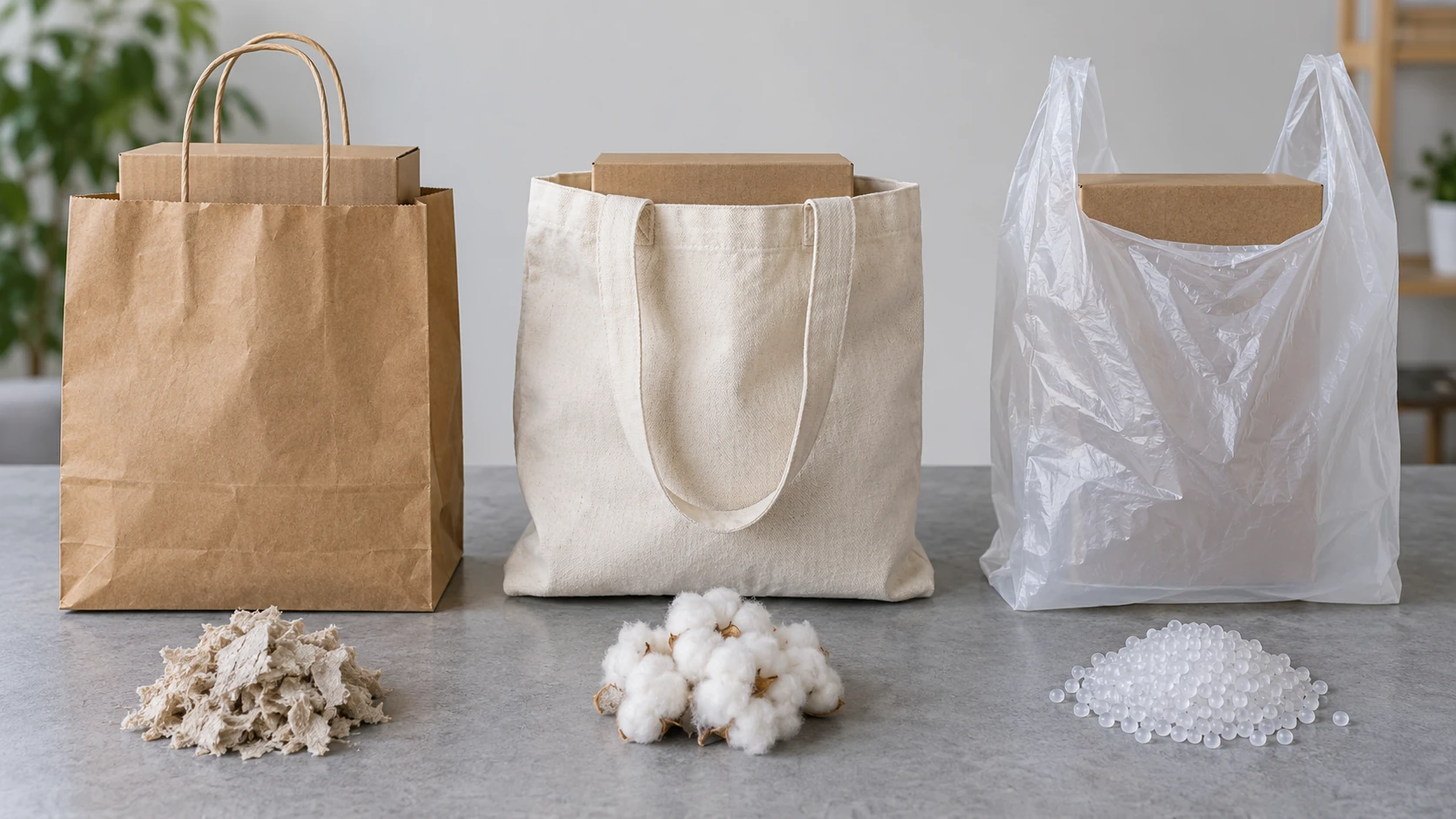
(1) How to bring the particle problem into a comparison of materials
The carrier bag LCA in Section 8 does not include the impact of litter in its assessment. The European Commission says that the methodology for comparing bio-based and fossil-based plastics is "under development"Sourced. We could not confirm how far microplastic releases are incorporated into the impact categories of standard LCA. It is important not to apply the conclusion of an LCA as it stands to the problem of release into the environment.
(2) Inconsistent definitions and measurement
Size categories, the materials included (rubber particles, fibres, paint particles) and what an estimate covers (release to the environment, or reaching the sea) differ between bodies (Sections 2 and 3). When setting figures of the same name side by side, you need to give source, year, target and scope together.
(3) What we could not confirm
- Regulation and voluntary action in Japan: we have not confirmed primary sources on Japanese systems and industry initiatives concerning microbeads, pellets, tyre wear and so on.
- The latest estimates of sources: we have not confirmed any updated estimate since IUCN (2017). The figures carry large uncertainty and may have been updated.
- The adoption status of Euro 7 tyre-wear limits: we have not confirmed adoption at UN WP.29 or the status of any delegated act by the European Commission.
- Quantitative assessment of effects on human health: we say no more than the WHO overview page does.
- The text of the JRC "Plastics LCA method": we confirmed only the mention in the European Commission's document.
- The UK Environment Agency's (2011) carrier bag LCA: not covered, because we could not open and confirm its text.
- There is no single definition of microplastics. The OECD describes synthetic polymers under 5 mm; EU REACH has a detailed legal definition covering solid polymers that excludes, among others, polymers shown by test to degradeSourced.
- The main sources are particles released during use and transport. IUCN (2017) estimates that about two-thirds of releases to the sea come from the washing of synthetic textiles and tyre wear, and the EU calls pellet loss the third largest unintentional sourceSourced.
- The EU is putting legislation in place source by source: REACH (intentional addition), the pellet regulation (applying in general from 17 December 2027) and Euro 7 (leaving tyre-wear limits to the UN's work)Sourced.
- An LCA conclusion changes with its premises. In the Danish carrier bag LCA, the number of reuses at which an organic cotton bag matches the reference LDPE bag was 149 on climate change alone, and 20,000 across all indicatorsSourced.
- Uncertainty remains over effects on human health. The European Commission's scientific advisers called for precautionary measures, and the WHO identified the research neededSourced.
12. Glossary
- Microplastics
- Small plastic particles. The OECD describes synthetic polymers under 5 mm. Definitions differ between bodies.
- Primary / secondary microplastics
- Those released as small particles from the start / those formed when larger litter breaks up.
- Synthetic polymer microparticles
- A legal term in EU REACH. Solid polymer particles that meet certain dimension conditions.
- Pellets
- Resin granules made for moulding and processing. In the EU regulation usually 2 to 5 mm.
- LCA
- Life cycle assessment. A method of assessing the environmental impact of a product consistently from raw material to disposal.
- Functional unit
- The unit of "the same job" that serves as the basis of comparison. Example: carrying 22 L of shopping.
- LCI / LCIA
- Inventory analysis (tallying inputs and outputs) / impact assessment (converting into environmental impacts).
- Cradle-to-grave
- A system boundary covering everything from raw material extraction to disposal.
- Green chemistry
- The idea of reducing the use and generation of hazardous substances at the design stage. It has 12 principles.
- Waste hierarchy
- The EU directive's order of priority: prevention, preparing for re-use, recycling, other recovery, disposal.
- Mismanaged
- Waste that ends up outside waste management systems. The OECD puts it at 22% of the world's plastic waste.
- Operation Clean Sweep
- An industry voluntary programme aiming for zero pellet loss.
13. References
- OECD "Plastic pollution is growing relentlessly as waste management and recycling fall short, says OECD", 22 February 2022 — oecd.org
- Boucher, Friot (IUCN) “Primary Microplastics in the Oceans: a Global Evaluation of Sources” (2017) (PDF) — portals.iucn.org
- Kole et al. “Wear and Tear of Tyres: A Stealthy Source of Microplastics in the Environment”, International Journal of Environmental Research and Public Health 14, 1265 (2017). DOI 10.3390/ijerph14101265 — doi.org
- Napper, Thompson “Release of synthetic microplastic plastic fibres from domestic washing machines: Effects of fabric type and washing conditions”, Marine Pollution Bulletin 112, 39–45 (2016). DOI 10.1016/j.marpolbul.2016.09.025 — doi.org
- Hartmann et al. “Are We Speaking the Same Language? Recommendations for a Definition and Categorization Framework for Plastic Debris”, Environmental Science & Technology 53, 1039–1047 (2019). DOI 10.1021/acs.est.8b05297 — doi.org
- European Commission Regulation (EU) 2023/2055 amending Annex XVII to REACH as regards synthetic polymer microparticles, 25 September 2023 — eur-lex.europa.eu
- European Parliament and Council Regulation (EU) 2025/2365 on preventing plastic pellet losses to reduce microplastic pollution, 12 November 2025 — eur-lex.europa.eu
- European Parliament and Council Regulation (EU) 2024/1257 (Euro 7) on type-approval of motor vehicles and engines, 24 April 2024 — eur-lex.europa.eu
- WHO "Dietary and inhalation exposure to nano- and microplastic particles and potential implications for human health", 2022 — who.int
- ISO ISO 14040:2006 “Environmental management — Life cycle assessment — Principles and framework” — iso.org
- ISO ISO 14044:2006 “Environmental management — Life cycle assessment — Requirements and guidelines” — iso.org
- Danish Environmental Protection Agency / DTU Department of Environmental Engineering "Life Cycle Assessment of grocery carrier bags", Environmental Project no. 1985, February 2018 (PDF) — mst.dk
- U.S. Environmental Protection Agency (EPA) "Basics of Green Chemistry" — epa.gov
- European Parliament and Council Directive 2008/98/EC (Waste Framework Directive) — eur-lex.europa.eu
- European Commission "EU policy framework on biobased, biodegradable and compostable plastics", COM(2022) 682 final — eur-lex.europa.eu
- Plastic Waste Management Institute (PWMI) "Material Flow Diagram 2023", published December 2024 (PDF, in Japanese) — pwmi.or.jp
14. Claim-to-source audit
| Claim in the text | Basis | Label |
|---|---|---|
| The description of microplastics as synthetic polymers under 5 mm. Naming industrial pellets, synthetic textiles, road markings and tyre wear as sources of release. OECD countries accounting for 35% of global microplastic releases. 353 Mt of plastic waste in 2019 (recycled 9%, incinerated 19%, landfilled 50%, mismanaged 22%; 40% of the 15% collected is residue). The estimate that EUR 25 billion a year is needed to improve waste management infrastructure in low- and middle-income countries. Plastics at 3.4% of global greenhouse gas emissions | OECD press release (22 February 2022), Reference 1https://www.oecd.org/en/about/news/press-releases/2022/02/plastic-pollution-is-growing-relentlessly-as-waste-management-and-recycling-fall-short.html | Sourced |
| Releases of primary microplastics to the sea of about 1.5 Mt a year (0.8 to 2.5 Mt), about 212 g per person. In the central scenario: washing of synthetic textiles 34.8%, tyres 28.3%, city dust 24.2%, personal care 2%, washing and tyres together 63.1%. Tyres at 46.2% in the central scenario if natural rubber is counted. City dust calculated by a simple method. Values in the figure: 35, 28, 24, 7, 3.7, 2 and 0.3% | Boucher and Friot (IUCN, 2017), Reference 2https://portals.iucn.org/library/sites/library/files/documents/2017-002-En.pdf | Sourced |
| Tyre wear releases of 0.23 to 4.7 kg per person per year (global average 0.81 kg), 5 to 10% of all plastics entering the oceans, 3 to 7% of airborne PM2.5. Passenger car tyres being larger than other sources (aircraft tyres 2%, artificial turf 12 to 50%, brakes 8%, road markings 5%). Release and pathways depending on local conditions such as road type. That further research is needed to assess the risk to human health | Kole et al. (2017), abstract, Reference 3https://doi.org/10.3390/ijerph14101265 | Sourced |
| The estimate that washing 6 kg of acrylic fabric can release more than 700,000 fibres. Mean fibre diameter 11.9 to 17.7 µm, length 5.0 to 7.8 mm. That a polyester-cotton blend released significantly fewer fibres. Variation with wash temperature, detergent and softener | Napper and Thompson (2016), abstract, Reference 4https://doi.org/10.1016/j.marpolbul.2016.09.025 | Sourced |
| That size categories are not consistent and which materials to include is debated. The proposed framework of defining by physicochemical properties (polymer composition, solid state, solubility) and classifying by size, shape, colour and origin | Hartmann et al. (2019), abstract, Reference 5https://doi.org/10.1021/acs.est.8b05297 | Sourced |
| Regulation (EU) 2023/2055 (dated 25 September 2023, Official Journal 27 September 2023). The definition of "synthetic polymer microparticles" (solid polymer; at least 1% by weight of the particle; all dimensions 5 mm or less, or length 15 mm or less with length-to-diameter ratio over 3. Excluded: naturally polymerised polymers, polymers shown by the Annex test to degrade, solubility over 2 g/L, no carbon atoms). The restriction on placing on the market alone or in a mixture at 0.01% by weight or more to give desired properties. Statements in the recitals (concern about fragments that do not dissolve in water, degrade very slowly and can be taken up by organisms; that most microplastics arise unintentionally; the Zero Pollution Action Plan target of a 30% cut; exclusion of uses such as moulding pellets encapsulated in a solid matrix) | Regulation (EU) 2023/2055, Reference 6https://eur-lex.europa.eu/eli/reg/2023/2055/oj/eng | Sourced |
| The dates of Regulation (EU) 2025/2365 (dated 12 November 2025, Official Journal 26 November 2025), its aim (zero pellet loss), its scope (operators handling 5 t or more in the previous year, cleaning facilities, transport operators, shippers and operators of sea transport), the definition and size of pellets (usually 2 to 5 mm; including bio-based and pellets intended to biodegrade), a risk management plan and self-declaration or certification, and application dates (17 December 2027; in part 16 December 2025; sea transport 17 December 2028). Statements in the recitals (pellet loss as the third largest unintentional source of microplastics released in the EU; low uptake of Operation Clean Sweep; the 2019 opinion of the Chief Scientific Advisors; persistence of pellets in the aquatic environment and harm to seabirds and turtles; the Toconao accident) | Regulation (EU) 2025/2365, Reference 7https://eur-lex.europa.eu/eli/reg/2025/2365/oj/eng | Sourced |
| The dates of Regulation (EU) 2024/1257 (dated 24 April 2024, Official Journal 8 May 2024). Recital 20 (tyre emissions estimated to be the largest source of microplastics released to the environment; measuring and limiting non-exhaust emissions; a delegated act if UN WP.29 does not adopt tyre-wear limits by 1 July 2026 (C1), 1 April 2028 (C2) and 1 April 2030 (C3); the target of a 30% cut by 2030) | Regulation (EU) 2024/1257, Reference 8https://eur-lex.europa.eu/eli/reg/2024/1257/oj/eng | Sourced |
| That the WHO collated published data up to December 2021, assessed the human health risk of microplastic particles entering through diet and inhalation from the environment, and identified the research needs to address current uncertainties | Overview page of the WHO report, Reference 9https://www.who.int/publications/i/item/9789240054608 | Sourced |
| The title and scope of ISO 14040:2006 (principles and framework; goal and scope, LCI, LCIA, interpretation, reporting and critical review, limitations, value choices; it does not describe the LCA technique in detail or specify methodologies for the phases) | ISO 14040:2006 catalogue page, Reference 10https://www.iso.org/standard/37456.html | Sourced |
| The title and scope of ISO 14044:2006 (requirements and guidelines, covering the same phases) | ISO 14044:2006 catalogue page, Reference 11https://www.iso.org/standard/38498.html | Sourced |
| The subjects of the Danish carrier bag LCA (4 types of LDPE, 2 of PP, recycled PET, polyester, starch-based, 2 of paper, 2 of cotton, composite), the functional unit (22 L, 12 kg), the reference bag, the number of bags needed (Table I), three end-of-life routes, impact categories (15), the exclusion of litter, the calculation of reuse counts, the three lowest on climate change (unbleached paper, biodegradable, LDPE) and LDPE in the other categories, the reuse counts in Table IV (PP non-woven 6/52, PP woven 5/45, recycled PET 8/84, polyester 2/35, starch-based 0/42, unbleached paper 0/43, composite 23/870, conventional cotton 52/7,100, organic cotton 149/20,000), the large counts for cotton and composite being mainly due to ozone depletion, the importance of the choice of reference flow, and the recommendations on end-of-life | Danish Environmental Protection Agency / DTU carrier bag LCA (2018), Reference 12https://www2.mst.dk/Udgiv/publications/2018/02/978-87-93614-73-4.pdf | Sourced |
| The definition of green chemistry, its application across the life cycle, the difference from remediation, and the 12 principles (the wording of principles 1, 2, 4, 7, 10 and 12 used in the text) | U.S. EPA, "Basics of Green Chemistry", Reference 13https://www.epa.gov/greenchemistry/basics-green-chemistry | Sourced |
| The order of priority for waste (prevention, preparing for re-use, recycling, other recovery, disposal) and the provision that specific waste streams may depart from the hierarchy where justified by life-cycle thinking (Article 4) | Waste Framework Directive 2008/98/EC, Reference 14https://eur-lex.europa.eu/eli/dir/2008/98/oj/eng | Sourced |
| That the methodology of LCA comparing bio-based and fossil-based plastics is under development, the JRC's Plastics LCA method (based on PEF), and that the accounting of biogenic carbon needs further scientific progress. The thinking on labelling bio-based content | European Commission COM(2022) 682 final, Reference 15https://eur-lex.europa.eu/legal-content/EN/TXT/HTML/?uri=CELEX:52022DC0682 | Sourced |
| Japan's 2023 waste plastic of 7.69 Mt, unused 0.81 Mt (11%), landfill 0.24 Mt | PWMI Material Flow Diagram 2023, Reference 16https://www.pwmi.or.jp/flow_pdf/flow2023.pdf | Sourced |
| The Zero Pollution Action Plan target of "a 30% cut in microplastic releases by 2030". The application of the pellet regulation from 17 December 2027, and the deadlines for Euro 7 tyre-wear limits in the recitals (1 July 2026 and others) | Targets and deadlines in the recitals and articles of the laws, not resultshttps://eur-lex.europa.eu/eli/reg/2025/2365/oj/eng (Reference 7) | Not yet confirmed |
| IUCN's 212 g x 28.3% = about 60 g a year set beside Kole's 810 g a year (to confirm they are different indicators). road markings + marine coatings + pellets: 7 + 3.7 + 0.3 = 11.0% (the sum of the values in the report's figure). The 0.3-point gap from 100 - (34.8 + 28.3 + 24.2 + 2) = 10.7% is thought to be rounding, because the report gives the figure with rounded values (35, 28, 24, 7, 3.7, 2 and 0.3%) and gives personal care products only as "2%" (our inference). The multiples from Table IV (52 / 6 = about 8.7, 84 / 8 = 10.5, 35 / 2 = 17.5, 20,000 / 149 = about 134, 7,100 / 52 = about 137, 870 / 23 = about 38) | Our calculation. All are simple calculations from published values. IUCN and Kole differ in target, year and method and are not to be read as a ratio. The multiples are values under the report's settings | Our calculation |
| The "levers" of material design for wear, fibres and pellets (the trade-off between wear resistance and grip, yarn and fabric structure, control of processes and logistics). The reading that degradability test data takes on regulatory meaning. The framing that regulation reaches processes, logistics and testing rather than materials. The framing that an LCA figure is a function of its premises. The division of roles between green chemistry and LCA. The framing of where countermeasures sit for each pathway of the particle problem | This article's framing and commentary based on published content. Not views stated by the bodies concerned | Commentary |
| Regulation and voluntary action in Japan, the latest source estimates after IUCN, the adoption status of Euro 7 tyre-wear limits, a quantitative assessment of effects on human health, the text of the JRC "Plastics LCA method", the UK Environment Agency's carrier bag LCA, and whether microplastic releases are included in standard LCIA | Not given because they could not be confirmed from published primary sources within the scope of this article, or are out of scope | Commentary |
| That Figs. 1 to 6 are explanatory drawings rather than original statistical charts or measurement drawings, and that the hero image and Fig. 7 are AI-generated images | Our note | Commentary |
Last updated 2 October 2026. Sources are limited to primary material (international organisations and an international conservation body, EU legislation, catalogue pages of a standards body, research reports commissioned by a public body, and peer-reviewed papers). No market estimates from research firms are used. Statements on environmental and health effects are limited to what regulators, international organisations and peer-reviewed papers say, with established points kept apart from points under debate. This article neither recommends nor criticises any particular material, product or company. Japanese regulation, estimates more recent than IUCN (2017), the adoption status of Euro 7 tyre-wear limits, a quantitative assessment of effects on human health, and the treatment of microplastics in standard LCIA are not stated here because they could not be confirmed. Figs. 1 to 6 are vector drawings; the hero image and Fig. 7 are AI-generated images. None of them shows a real sample, analytical data or product.