TECHNOLOGY EXPLAINER
Polycarbonate and ABS Resin
— a clear, impact-resistant resin, a rubber-toughened resin, and the alloy of the two
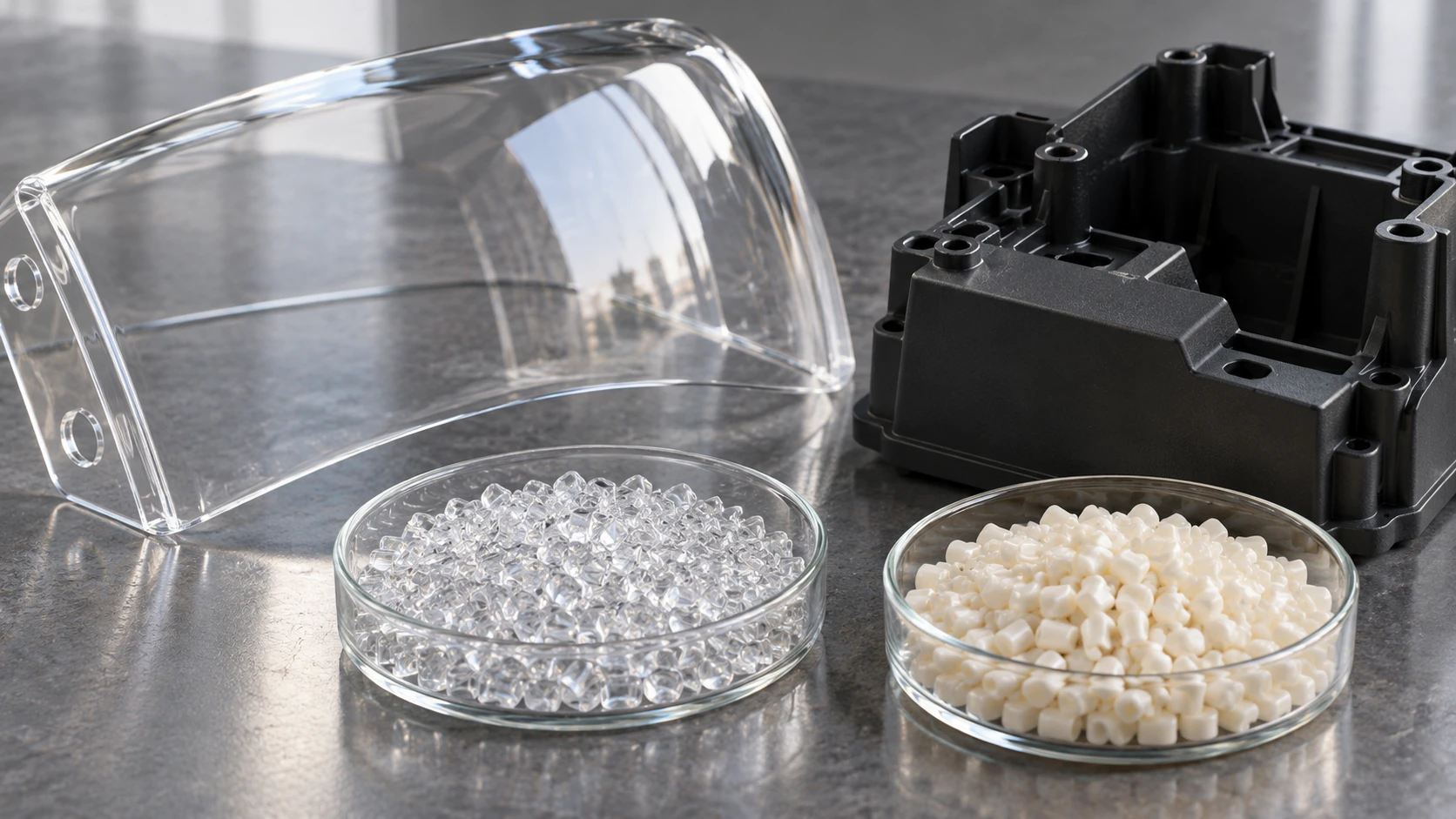
They are the most familiar pair of engineering plastics in appliance and IT housings and in vehicle interiors and exteriors. Polycarbonate (PC) carries a debate about its raw material bisphenol A (BPA) and a story about routes that avoid phosgene. ABS resin owes its properties to three components and a two-phase structure. In PC/ABS, which blends the two, heat resistance, toughness, flame retardancy and recycling become a single design problem. We lay out the figures from published sources, with their origins and conditions.
- What polycarbonate and ABS resin are (the short version)
- How polycarbonate is made — the phosgene and non-phosgene routes
- Polycarbonate properties in numbers
- A materials engineer's view (1): the BPA question is separate from the non-phosgene route
- ABS resin — three components and a two-phase structure
- PC/ABS alloys — what is mixed, and what changes
- A materials engineer's view (2): the cost of flame retardancy, and how to read UL 94
- How they are used in electronics and vehicles
- A materials engineer's view (3): processing starts with drying and the temperature window
- Recycling — three routes
- What is still uncertain, and what this article leaves out
- Glossary / References / Claim-to-source audit
Sourced = content stated in published material, a standard, a regulation or a paper (link given)
Our calculation = a value this article derived from stated assumptions
Not yet confirmed = a plan or outlook with no confirmed track record
Structural readings and materials-design interpretations are marked separately as Commentary.
Property values are manufacturers' stated typical values. Values for different grades, test methods and conditions are not lined up to rank one against another.
Statements on health and the environment report the content of regulators' assessments; they do not recommend or blame any particular product or company.
1. What polycarbonate and ABS resin are (the short version)
- Polycarbonate (PC) is a clear, impact-resistant engineering plastic with good heat resistance. Covestro describes its PC, Makrolon, as having glass-like transparency, impact resistance even at low temperature and a glass transition temperature of up to 148 °CSourced [Ref. 17].
- ABS resin is a thermoplastic made of three components, acrylonitrile, butadiene and styrene, with a two-phase structure in which rubber particles are dispersed in a styrene-acrylonitrile copolymer (SAN)Sourced [Refs. 5, 7].
- PC/ABS is an alloy of the two. Covestro lists as its features a balance of toughness even at low temperature, stiffness, dimensional stability, creep resistance, low water absorption, heat resistance and high flame retardancySourced [Ref. 18]. Flame-retardant grades are widely used in electrical and electronic housings (our organisation).
We treat the three materials together because their design problems are linked. Raise heat resistance and flow and toughness fall; add flame retardancy and heat resistance and low-temperature impact fall. We look at that whole set of trade-offs in the order PC, ABS, PC/ABS.
Our explainer on polymer blends and fillers covers the thinking behind alloys in general. BPA is also a raw material of epoxy resins, so it helps to read this alongside our explainer on epoxy resins. For water absorption and hydrolysis, see our explainer on polyamides; for recycling in general, our explainers on plastic recycling and chemical recycling.
2. How polycarbonate is made — the phosgene and non-phosgene routes
An introduction to PC manufacture appears in the profile material of the GSCN (Green & Sustainable Chemistry Network), which explains Asahi Kasei's non-phosgene process (winner of a GSC award in 2002). According to that material, polycarbonate was developed at almost the same time in 1959 by Bayer in Germany and GE in the United States, and came into wide use in the 1970s. The mainstream method at the time used highly toxic phosgene and BPA, and the material records that roughly 80% was produced by the phosgene processSourced [Ref. 1] (a statement from the time of the award, not the current share).
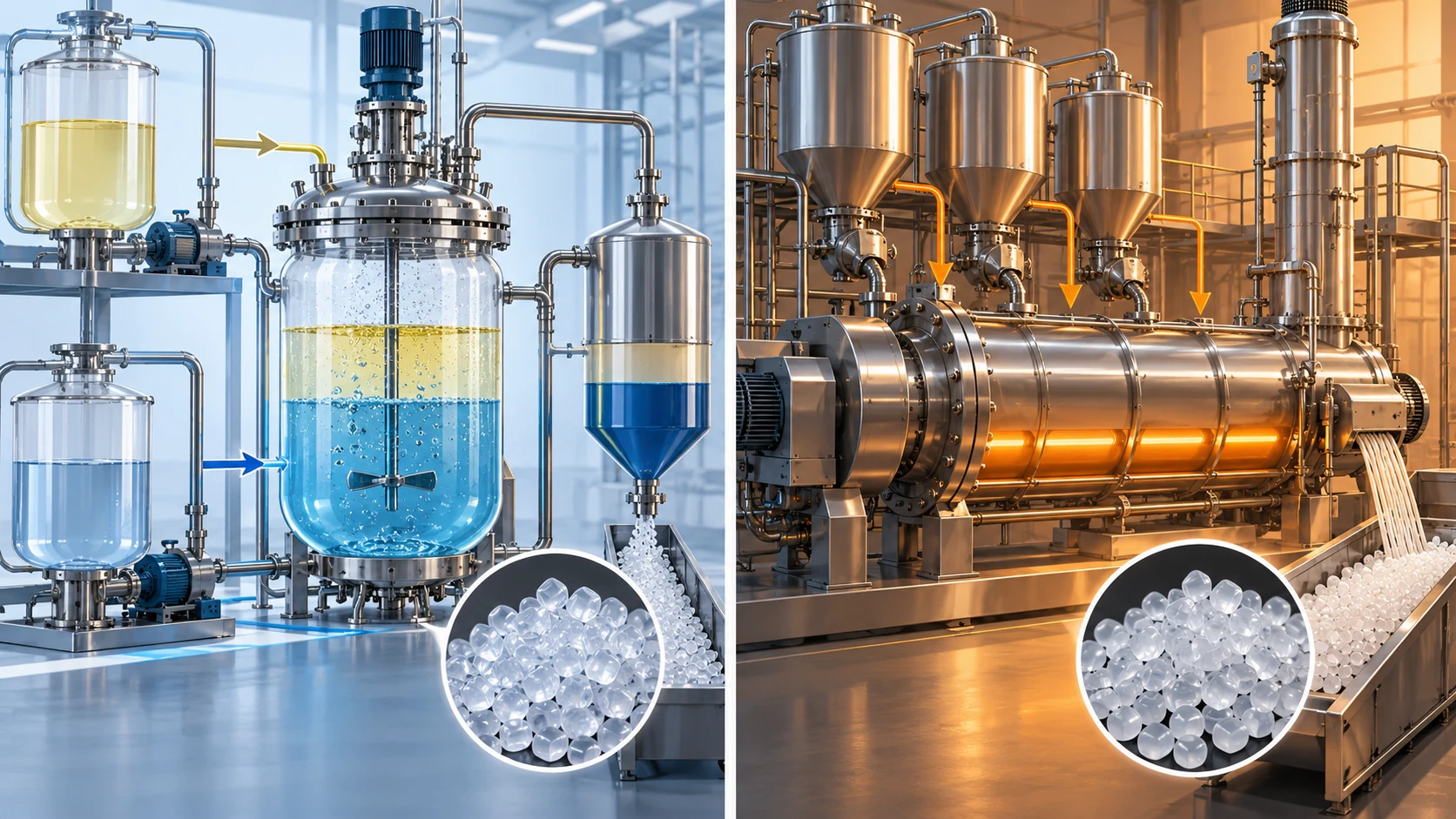
ImageGen conceptual illustration (not a real photograph or measurement). See the original diagram for exact values, names and structure.
Show original diagram with exact annotations and values
The challenges of the phosgene process listed in that material are as followsSourced [Ref. 1].
- It uses highly toxic phosgene as a raw material.
- It uses methylene chloride, a suspected carcinogen, as the solvent. With a boiling point of 40 °C it evaporates easily and is hard to recover, and because it dissolves readily in water it is also hard to recover from wastewater.
- Large amounts of sodium chloride are formed as a by-product.
- Chlorine-containing impurities remain in the resin, so optical applications need thorough washing, and the load on wastewater treatment is large.
Asahi Kasei's non-phosgene process makes ethylene carbonate from carbon dioxide and ethylene oxide, converts it to diphenyl carbonate (DPC) and polymerises that with BPA. Ethylene glycol forms as a by-product. The material explains that the process uses neither phosgene nor methylene chloride and can use as a raw material the carbon dioxide released in ethylene oxide productionSourced [Ref. 1]. It adds that the transesterification of DPC and BPA to give PC and phenol is an equilibrium reaction, so a high degree of polymerisation requires high temperature, reduced pressure and continuous removal of the phenol [Ref. 1].
About nine-tenths of the mass of PC comes from BPA
Let us break the PC repeat unit down by mass.
The PC repeat unit is C16H14O3. From the atomic weights (C 12.011, H 1.008, O 15.999) its formula weight is 254.29. The formula weight of BPA (C15H16O2) is 228.29. The repeat unit divides into "the BPA residue minus two hydrogens (226.28)" and "the carbonyl group (28.01)", in a mass ratio of 89.0% : 11.0%Our calculation. The BPA needed to make 1 kg of PC is, at a theoretical 100% yield, about 0.90 kg (228.29 ÷ 254.29)Our calculation.
Assumptions and limits: this is an ideal-chain calculation that ignores end groups, copolymer components, by-products and yield. It does not describe the composition or raw-material consumption of any real resin.
Asahi Kasei's non-phosgene process changes how the carbonate group is introduced. As the calculation above shows, about nine-tenths of the mass of PC comes from BPA, and that does not change with the process. So a "non-phosgene PC" solves the problems of phosgene and its by-products, but does not, as it stands, escape the debate over BPA regulation and assessment (our commentary). The next section sets out what regulators' assessments of BPA actually say.
3. Polycarbonate properties in numbers
Here are the typical values published on the product page for Covestro's general-purpose PC, Makrolon 2405, with test methods and conditions.
| Item | Value | Test method and conditions |
|---|---|---|
| Glass transition temperature | 144 °C | ISO 11357-1, -2, 10 °C/min |
| Vicat softening temperature | 145 °C (B/50) / 146 °C (B/120) | ISO 306, 50 N, 50 °C/h and 120 °C/h |
| Deflection temperature under load | 124 °C (1.80 MPa) / 137 °C (0.45 MPa) | ISO 75-1, -2 |
| Tensile modulus | 2,400 MPa | ISO 527-1, -2, 1 mm/min |
| Yield stress and yield strain | 65 MPa, 6% | ISO 527-1, -2, 50 mm/min |
| Notched Izod impact | 23 °C: 65P kJ/m² / −30 °C: 15C kJ/m² | ISO 180/A, 3 mm (P = partial break, C = complete break) |
| Coefficient of linear thermal expansion | 0.65×10⁻⁴/K (= 65 ppm/K) | ISO 11359-1, -2, 23 to 55 °C |
| Water absorption | Equilibrium 0.12% / saturation 0.3% | ISO 62, 23 °C and 50% RH / in water at 23 °C |
| Density | 1,200 kg/m³ | ISO 1183-1 |
| Burning behaviour | V-2 (0.36 mm, 0.75 mm) / HB (2.7 mm) | UL 94 |
| Comparative tracking index (CTI) | 250 V | IEC 60112, solution A |
| Melt volume rate | 19 cm³/10 min | ISO 1133-1, 300 °C / 1.2 kg |
All are Covestro's published values (Sourced) [Ref. 8]. They are typical values, not guaranteed values, and differ by grade. Vicat softening temperature follows ISO 306 [Ref. 20], deflection temperature under load ISO 75-1 [Ref. 21], water absorption ISO 62 [Ref. 28] and tensile properties ISO 527-1 [Ref. 29]. The designation system for PC moulding and extrusion materials is set by ISO 21305-1 [Ref. 25].
- No melting point is given: PC is typically amorphous, and softening starts at the glass transition (our commentary). So the guides to heat resistance are three: Tg (144 °C), Vicat and deflection temperature under load. This is a different way of thinking from the "melting point" of a crystalline polyamide (see our explainer on polyamides).
- Water absorption is small: the equilibrium absorption of 0.12% is about one-twentieth of the 2% range for polyamides (see our explainer on polyamides)Our calculation (the ratio to the 2.2% that BASF gives for unreinforced PA6 at 23 °C / 50% rh [Ref. 30] is 2.2 ÷ 0.12 ≈ 18; note the differences in grade and conditions). That favours dimensional stability, but drying before melting is still needed separately (Section 9).
- Notch sensitivity at low temperature: notched Izod impact is a partial break (65P) at 23 °C but a complete break (15C) at −30 °CSourced [Ref. 8]. That drop matters in designs where a notched part is used in the cold.
- Read burning behaviour by thickness: this general-purpose grade is V-2 at 0.36 to 0.75 mm and HB at 2.7 mm. UL 94 is not a single number attached to a material but a test result for each thickness (Section 7).
4. A materials engineer's view (1): the BPA question is separate from the non-phosgene route
The conclusions on BPA are worded differently by each assessing body. Here we simply set out what each body has published. This article does not itself reach a conclusion on the safety of BPA.
(1) ECHA (European Chemicals Agency)
ECHA lists BPA on the Candidate List of substances of very high concern (SVHC), stating that BPA has been identified as an endocrine disruptor for both the environment and human health, and also as toxic to reproduction. BPA's harmonised classification in the EU includes toxic to reproduction (category 1B), serious eye damage, respiratory irritation and skin sensitisationSourced [Ref. 4]. Producers and importers of articles must notify ECHA when an article contains an SVHC [Ref. 4].
(2) EFSA (European Food Safety Authority)
In April 2023 EFSA published a re-evaluation of BPA that cut the tolerable daily intake (TDI) sharplySourced [Ref. 3]. According to the recitals of Regulation (EU) 2024/3190, the new TDI is 0.2 ng per kg of body weight, one twenty-thousandth of the provisional TDI of 2015 (4 µg/kg body weight). EFSA took effects on the immune system as the most sensitive, and concluded that dietary exposure to BPA is a health concern for all age groups. Compared with the 2015 exposure estimates, exposure is also said to exceed the TDI by two to three orders of magnitudeSourced [Ref. 2].
From the figures in the recitals, the change in the TDI is 4 µg = 4,000 ng divided by 0.2 ng, a 20,000-fold reductionOur calculation.
(3) EU Regulation (EU) 2024/3190
Commission Regulation (EU) 2024/3190 of 19 December 2024 prohibits the use of BPA and certain other hazardous bisphenols in food contact materials and articles (adhesives, rubber, ion-exchange resins, plastics, printing inks, silicones, varnishes and coatings)Sourced [Ref. 2]. The exceptions are specific uses allowed under Annex II, and for BPA there are only two: liquid epoxy resins for self-standing containers with a capacity above 1,000 L, and filtration membranes made of polysulfone [Ref. 2]. Polycarbonate is not among these exceptions.
As transitional measures, single-use finished products (food contact articles) may be placed on the market until 20 July 2026, and some of them (for storing fruit, vegetables and seafood, for example) until 20 January 2028. Reusable products may stay on the market until 20 January 2029, but only those first placed on the market by 20 July 2026 (by 20 January 2028 for professional food-processing equipment)Sourced [Ref. 2]. Note that this article is based on the original text of 19 December 2024; EUR-Lex also carries a consolidated version dated 23 February 2026. Please check the latest wording on EUR-Lex.
(4) US FDA
The US FDA's "BPA" page states, as the FDA's current view, that BPA is safe at the levels currently present in food, and that the available information continues to support the safety of its currently authorised uses in food containers and packaging. The same page lists BPA as a structural component of polycarbonate beverage bottles, and also records that the use of BPA-based materials in baby bottles, infant cups and infant formula packaging was removed from the food additive regulations after a petition stating that the uses had been abandonedSourced [Ref. 22]. The last entry in that page's update history is shown as November 2014.
(5) An example of polycarbonate without BPA
Mitsubishi Chemical's DURABIO is a bio-based engineering plastic made mainly from plant-derived isosorbide. The company explains that, compared with conventional PC made from BPA, it offers better transparency, optical properties and scratch resistance, and impact resistance comparable to PC. It also says that it is not biodegradable and is highly durableSourced [Ref. 19] (the company's own account; this article has not verified performance comparisons with other materials).
Regulation (EU) 2024/3190 applies to materials and articles that come into contact with food. PC used in electronic housings or car parts is not directly within its scope. Separately, however, BPA's place on the SVHC Candidate List and the framework for notification and information about SVHCs in articles do exist [Ref. 4].
The wording of the regulation also turns on "prohibition of using BPA in manufacture" and on "migration of BPA". PC as a polymer and the BPA that can dissolve out of it (migrate) are treated separately in assessment (in the recitals, the possibility that BPA can migrate from a material into food is the starting point of the concern [Ref. 2]). What is asked of PC resin makers and processors is to check which framework applies to each use (our commentary).
That the bodies assess differently (EFSA and the FDA) offers a way to separate what is established (BPA has a harmonised classification in the EU as an endocrine disruptor and as toxic to reproduction) from what remains under discussion (which effects, at low exposure levels, should be assessed and how).
5. ABS resin — three components and a two-phase structure
Techno-UMG describes ABS resin as a thermoplastic made from three organic compounds: acrylonitrile (A), butadiene (B) and styrene (S)Sourced [Ref. 7]. INEOS describes the roles of the three monomers as follows: acrylonitrile brings thermal and chemical resistance, butadiene brings rubbery ductility and impact resistance, and styrene brings stiffness, ease of processing and low cost. ABS typically contains more than 50% styrene, with the proportions of acrylonitrile and butadiene varying by productSourced [Ref. 6].
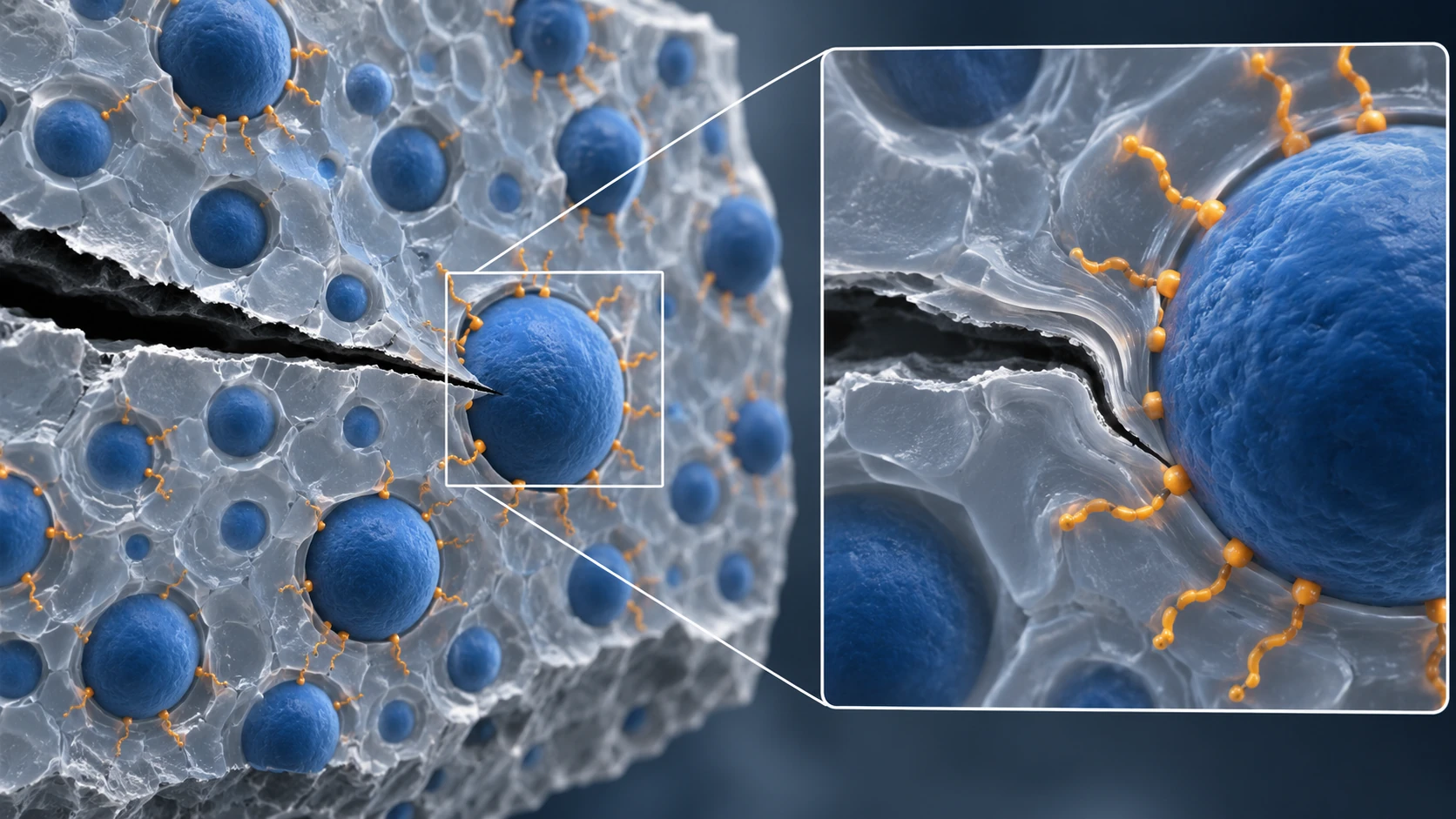
ImageGen conceptual illustration (not a real photograph or measurement). See the original diagram for exact values, names and structure.
Show original diagram with exact annotations and values
On structure, the polymer encyclopedia entry on ABS (Li et al., 2024) describes ABS as a thermoplastic SAN matrix in which a grafted, particulate elastomer phase is dispersed. The elastomer is usually polybutadiene or a butadiene copolymer, and the SAN grafted onto it gives compatibility between the rubber and the SAN matrix. This ternary graft polymer is described as having excellent toughness, good dimensional stability, processability and chemical resistance, with water absorption below 1%Sourced [Ref. 5]. According to INEOS there are two main manufacturing routes: the mass process, in which styrene and acrylonitrile are polymerised in bulk in the presence of a rubber base, and the emulsion process, in which butadiene is emulsion-polymerised to a polybutadiene latex and styrene and acrylonitrile are then emulsion-graft-polymerised onto it [Ref. 6].
Strengths and weaknesses of ABS (as Techno-UMG describes them)
| Category | Content |
|---|---|
| Strengths | Good surface gloss and colourability, hence good appearance / excellent processability and dimensional stability / a wide range of moulding methods, including extrusion, injection, blow, vacuum forming and calendering / excellent chemical resistance / can be painted and plated / can be machined and welded in post-processing |
| Weaknesses | Poor weather resistance / dissolves in organic solvents / flammable |
| Directions for improvement | Using acrylic rubber (ASA) or EP rubber (AES) as the rubber component improves weather resistance. Some products add antistatic or flame-retardant properties through polymer alloying |
All are statements in Techno-UMG's published material (Sourced) [Ref. 7].
Here are figures for a representative general-purpose grade, from INEOS Styrolution's brochure of standard ABS products.
| Item | Terluran GP-22 (emulsion ABS) | Test method and conditions |
|---|---|---|
| Density | 1,040 kg/m³ | ISO 1183 |
| Water absorption (equilibrium) | 0.22% | ISO 62, 23 °C and 50% r.h. |
| Melt volume rate | 19 cm³/10 min | ISO 1133, 220 °C / 10 kg |
| Melt temperature range / mould temperature range | 220 to 260 °C / 30 to 80 °C | ISO 294 |
| Moulding shrinkage | 0.4 to 0.7% | ISO 294-4 |
| Tensile modulus | 2,300 MPa | ISO 527 |
| Yield stress, yield strain, strain at break | 45 MPa, 2.6%, 10% | ISO 527, 23 °C |
| Charpy impact (notched / unnotched) | 22 kJ/m² / 180 kJ/m² | ISO 179/1eA and 1eU, 23 °C |
| Deflection temperature under load | 94 °C (1.8 MPa) / 99 °C (0.45 MPa) | ISO 75-1/-2, annealed at 80 °C for 4 hours |
| Vicat softening temperature | 96 °C | ISO 306, VST/B/50 |
All are INEOS Styrolution's published values (Sourced) [Ref. 13]. They are typical values and differ by grade. The designation system for ABS moulding and extrusion materials is set by ISO 19062-1 [Ref. 26]. Set beside PC (Makrolon 2405: Vicat B/50 of 145 °C, water absorption 0.12%), ABS shows lower heat resistance and higher water absorption (these are values from different manufacturers and conditions, so read them as a tendency only).
6. PC/ABS alloys — what is mixed, and what changes
Covestro describes its PC/ABS blend Bayblend as combining toughness even at low temperature, stiffness, dimensional stability, excellent creep resistance, low water absorption, heat resistance and high flame retardancy, and says it is used in household appliances, automotive and transport, electrical, consumer goods, medical, electronics and IT and telecommunications. As well as general-purpose, flame-retardant, reinforced and unreinforced grades, there are dedicated grades for surface finishing such as electroplating and metallisationSourced [Ref. 18].
Here are three grades from the same manufacturer side by side. The mixing ratios and the types of flame retardant are not published, however, and the three grades are separate products for different uses.
| Item (test method) | PC Makrolon 2405 | PC+ABS Bayblend T65 XF | PC+ABS, flame retardant Bayblend FR3010 |
|---|---|---|---|
| Vicat B/120 (ISO 306) | 146 °C | 120 °C | 110 °C |
| Deflection temperature, 1.80 MPa (ISO 75-1, -2) | 124 °C | 102 °C | 90 °C |
| Tensile modulus (ISO 527-1, -2) | 2,400 MPa | 2,350 MPa | 2,700 MPa |
| Yield stress (ISO 527-1, -2) | 65 MPa | 54 MPa | 60 MPa |
| Notched Izod, 23 °C (ISO 180/A) | 65P kJ/m² | 48 kJ/m² | 35 kJ/m² |
| Notched Izod, −30 °C (ISO 180/A) | 15C kJ/m² | 35 kJ/m² | 10 kJ/m² |
| Water absorption, equilibrium / saturation (ISO 62) | 0.12% / 0.3% | 0.2% / 0.7% | 0.2% / 0.5% |
| Density (ISO 1183-1) | 1,200 kg/m³ | 1,130 kg/m³ | 1,180 kg/m³ |
| Linear thermal expansion, 23 to 55 °C (ISO 11359-1, -2) | 0.65×10⁻⁴/K | 0.80 to 0.85×10⁻⁴/K | 0.76 to 0.80×10⁻⁴/K |
| UL 94 | V-2 (0.36, 0.75 mm) HB (2.7 mm) | HB (0.85 mm) | V-0 (1.5 mm) 5VB (2.0 mm) / 5VA (3.0 mm) |
| Limiting oxygen index (ISO 4589-2, method A) | 27% | 24% | 32% |
| CTI (IEC 60112, solution A) | 250 V | 250 V | 350 V |
All are Covestro's published values (Sourced) [Refs. 8, 9, 10]. P = partial break, C = complete break (the source's symbols). The limiting oxygen index follows the method of ISO 4589-2 [Ref. 27]. The melt volume rate is not compared in this table because the measurement conditions differ (PC: 300 °C / 1.2 kg; T65 XF: 260 °C / 5 kg; FR3010: 240 °C / 5 kg). The moulding temperatures of the test specimens also differ.
- Vicat B/120: 146 → 120 °C (−26 K) → 110 °C (a further −10 K from flame retarding, −36 K against PC)
- Deflection temperature at 1.80 MPa: 124 → 102 °C (−22 K) → 90 °C (−34 K against PC)
- Density: 1,200 → 1,130 kg/m³ (about 6% lower)
- Notched Izod at −30 °C: 15C → 35 kJ/m² (about 2.3 times) → 10 kJ/m² (35 → 10 on flame retarding, about 0.29 times)
Our calculation Assumptions and limits: these are simply differences and ratios of the published values in the table. The moulding conditions (melt temperature) of the specimens differ among the three grades, and PC at −30 °C is a complete break (C). Comparing values with different failure modes is only a guide to relative size.
What the table shows is an exchange: compared with PC, some tens of kelvin of heat resistance (Vicat, HDT) are given up, in return for higher notched impact at −30 °C (for this combination of grades). The natural reading is that the rubber phase of the ABS supports low-temperature impact, but the sources we used do not explain the mechanism, so this stays as our commentary.
Another advantage is processing. In Covestro's recommended conditions, the standard melt temperature is 300 °C (280 to 320 °C) for PC but 260 °C (barrel temperatures of roughly 220 to 265 °C) for PC+ABS, so the melt temperature is about 40 K lowerSourced [Refs. 8, 9]. The product description for Bayblend FR3010 also says that introducing ABS improved chemical resistance and resistance to stress crackingSourced [Ref. 10]. One can read in this a design intent for the ABS component to make up for the weak chemical resistance known as a drawback of PC (our commentary).
The mixing ratio, phase structure and compatibilisation mechanism are not disclosed, however, and an alloy is not an "average of properties" but the product of a designed phase structure. For blends in general, see our explainer on polymer blends and fillers.
7. A materials engineer's view (2): the cost of flame retardancy, and how to read UL 94
PC/ABS is a material often flame-retarded for use in housings of electrical and electronic equipment. Here is the thinking behind flame retarding, as seen in the peer-reviewed literature.
- PC is a char-forming resin: a review by Levchik and Weil (Polym. Int., 2005) states that PC is inherently a polymer that readily forms char, so phosphorus flame retardants acting in the condensed phase are widely used in PC-based alloys. It also says that plain PC can pass demanding flammability tests with only very small amounts of sulfur-based or silicone-based flame retardantsSourced [Ref. 23].
- How three phosphate esters differ: Pawlowski and Schartel (Polym. Int., 2007) compared the flame-retardancy mechanisms of triphenyl phosphate (TPP), resorcinol bis(diphenyl phosphate) (RDP) and bisphenol A bis(diphenyl phosphate) (BDP) in PC/ABS blends. TPP acts only in the gas phase; RDP acts mainly in the gas phase and partly in the condensed phase; BDP acts decisively in the condensed phase as well as in the gas phase. TPP and RDP are somewhat better in limiting oxygen index (LOI), and BDP is better under forced burning (cone calorimeter). A synergy is seen between PTFE (anti-dripping) and BDPSourced [Ref. 11].
The UL 94 rating of Makrolon 2405 is V-2 at 0.36 mm and 0.75 mm, and HB at 2.7 mmSourced [Ref. 8]. The thinner specimens get the better rating and the thicker one the lower rating. That is because UL 94 is not a single number attached to a material but a result for each specimen thickness (our commentary; the criteria for dripping and persistence of flame during burning change with thickness). For the flame-retardant grade Bayblend FR3010, it is stated explicitly that a greater thickness gives a higher rating: V-0 at 1.5 mm, 5VB at 2.0 mm and 5VA at 3.0 mm [Ref. 10]. This leads to a practical rule: always check what is guaranteed at the wall thickness of your application.
The cost of flame retarding can also be read from the table. In the flame-retardant PC/ABS, Vicat B/120 is 10 K lower and deflection temperature 12 K lower than in the PC/ABS, and notched Izod at −30 °C drops from 35 to 10 kJ/m² (a guide only, because the grades are separate products)Our calculation. The CTI (tracking index), on the other hand, rises from 250 to 350 VSourced [Refs. 9, 10]. It is a trade-off: flame retardancy and tracking resistance are gained at the expense of heat resistance and low-temperature impact.
The EU's RoHS Directive (2011/65/EU) sets the maximum concentration of polybrominated biphenyls (PBB) and polybrominated diphenyl ethers (PBDE) in homogeneous materials of electrical and electronic equipment at 0.1% for eachSourced [Ref. 24]. Plastics from waste electrical and electronic equipment (WEEE) in which brominated flame retardants were used in the past, however, still contain them. A survey at a Swiss recycling plant (Morf et al., 2005) showed that WEEE is a main carrier of brominated flame retardants (PBDE, TBBPA, HBCD)Sourced [Ref. 14], and a study that extracted WEEE-derived ABS with supercritical carbon dioxide (Gripon et al., 2021) reported that the bromine and BFR content of the ABS studied was about four times the regulatory value of 2019, and that TBBPA could be removed efficiently while PBDE could not be removed enough to meet the regulation [Ref. 15]. It is important to bear in mind that the choice of flame retardant affects not only performance in use but also whether the material can be recovered and recycled decades later (our commentary).
8. How they are used in electronics and vehicles
| Material | Applications named | Source |
|---|---|---|
| PC (Makrolon) | Medical devices, automotive headlamps, sports goods, electronics, eyewear, architectural glazing, LED lighting and more. Grades are available for general purpose, lighting, medical and food contact, flame retardancy, impact modification and glass-fibre reinforcement | Covestro [17] |
| PC/ABS (Bayblend) | Household appliances, automotive and transport, electrical, consumer goods, medical, electronics, IT and telecommunications. Flame-retardant grades have high flow so they can be used in thin-wall applications, and many are said to pass the glow-wire test (IEC 60695-2) | Covestro [18] |
| ABS (Terluran and others) | Household goods, electronic housings, automotive parts, sanitary goods, toys, garden products. The main uses are automotive parts, household appliances and household goods | INEOS [13, 6] |
| ABS (Techno-UMG) | Automobiles, building materials, household appliances, IT equipment. ASA and AES, with a different rubber component, improve weather resistance | Techno-UMG [7] |
| BPA-free PC (DURABIO) | Optical and energy-related components, replacement for high-performance glass, housings and interior and exterior parts for electronics and automobiles. Includes uses the company says it plans to develop | Mitsubishi Chemical [19] |
All are statements in the companies' published material (Sourced). The applications are what each company says about its own materials and do not show which material is better.
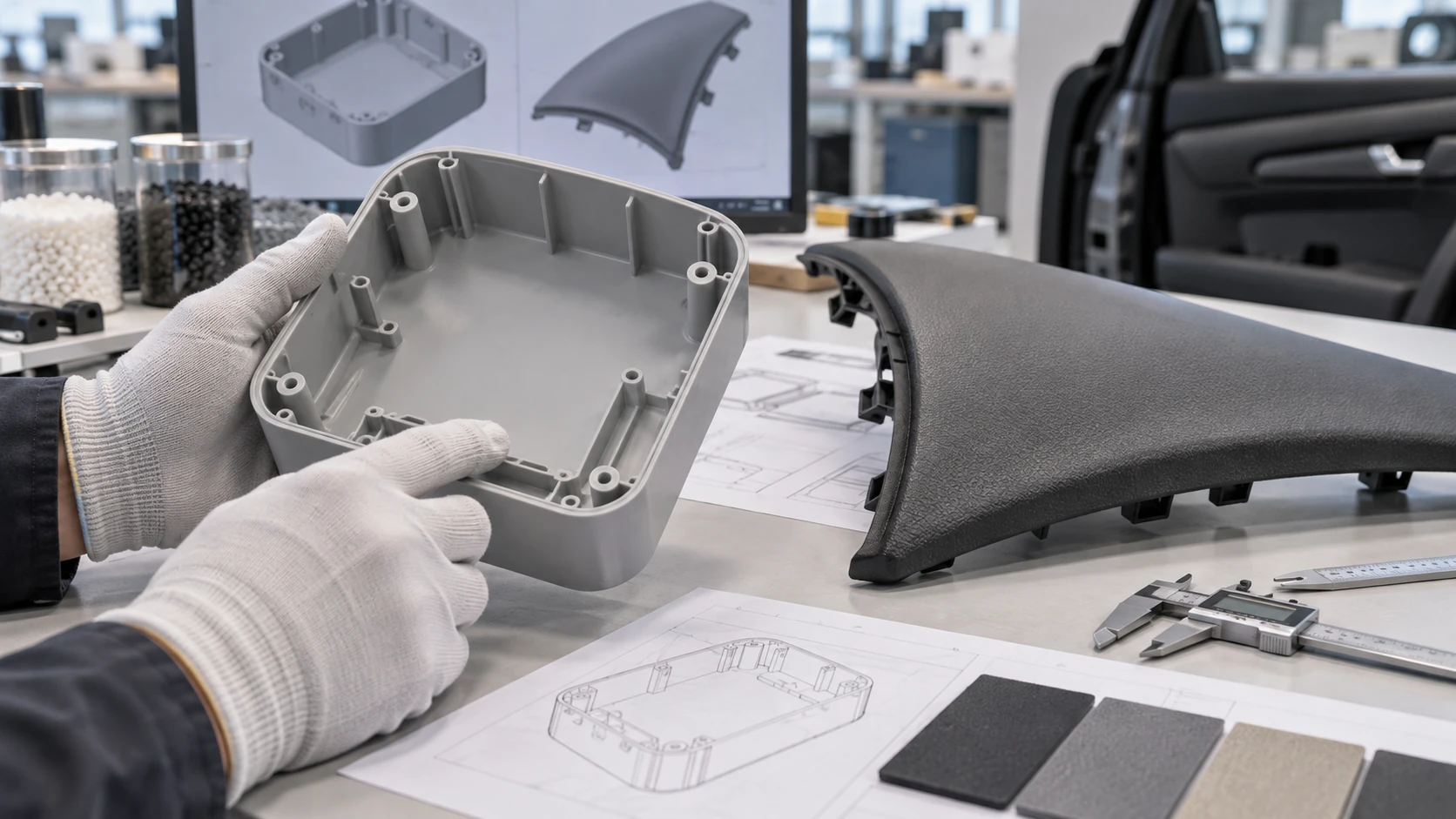
9. A materials engineer's view (3): processing starts with drying and the temperature window
Here are the recommended conditions from Covestro's product pages and INEOS's brochure side by side.
| Item | PC Makrolon 2405 | PC+ABS Bayblend T65 XF | PC+ABS, flame retardant Bayblend FR3010 | ABS Terluran GP-22 |
|---|---|---|---|---|
| Drying (dehumidified air) | 120 °C, 2 to 3 hours | 95 to 110 °C, 4 hours | 80 °C, 4 hours | Not stated |
| Upper limit of moisture content before moulding | 0.02% or less | 0.02% or less | 0.02% or less | Not stated |
| Melt temperature | Standard 300 °C (280 to 320 °C) | Standard 260 °C | Standard 260 °C | 220 to 260 °C |
| Mould temperature | 80 to 120 °C | 70 to 90 °C | 60 to 90 °C | 30 to 80 °C |
| Moulding shrinkage (flow / transverse) | 0.65% / 0.70% | 0.50 to 0.70% (both directions) | 0.50 to 0.70% (both directions) | 0.4 to 0.7% |
All are manufacturers' stated values (Sourced) [Refs. 8, 9, 10, 13]. The specimens for moulding shrinkage differ by grade (PC and T65 XF: 60×60×2 mm at 500 bar per ISO 294-4; FR3010: 150×105×3 mm per ISO 2577).
PC-based materials absorb little water (0.12 to 0.2% at equilibrium), yet the upper limit of moisture content before moulding is set strictly at 0.02% or lessSourced [Refs. 8, 9, 10]. The allowable moisture content for BASF's PA66-GF33 (A 218G V33), seen in our explainer on polyamides, is at most 0.15% [Ref. 31]. That is a gap of 0.15 ÷ 0.02 = 7.5 timesOur calculation (a guide only, since the types of grade differ).
PC is strict about drying less because of how much water it takes up than because at melt temperatures of 260 to 300 °C water can act on the carbonate ester linkage and lower the molecular weight (our commentary; the specific mechanism and the size of the molecular weight loss are not covered in the sources we used). That water becomes a "reactant" in the melt is common with polyamide. Even among materials that "absorb little water", the moisture allowed in processing is set by the molecular design of the material.
The temperature windows also differ. PC is moulded at a standard 300 °C, PC/ABS at 260 °C and ABS alone at 220 to 260 °C. Whether PC/ABS may be moulded above its standard temperature has to be checked in the documentation for each grade, including the temperature at which the rubber phase degrades thermally (the sources we used give no specific degradation temperature).
10. Recycling — three routes
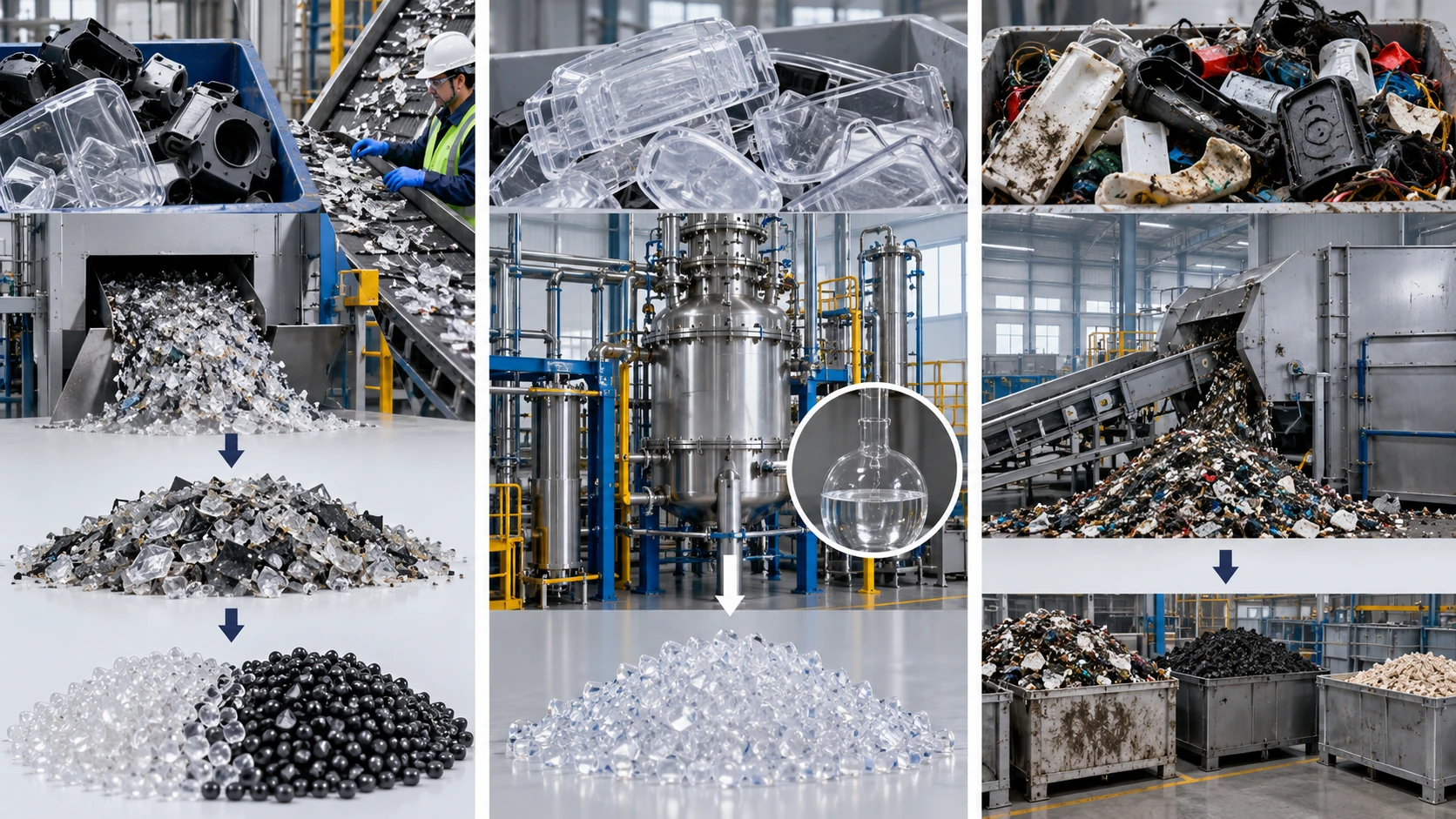
ImageGen conceptual illustration (not a real photograph or measurement). See the original diagram for exact values, names and structure.
Show original diagram with exact annotations and values
(1) Mechanical recycling — grades containing recycled content
Covestro publishes a grade of Bayblend FR3010 containing 75% post-consumer PC recyclate (natural colour), FR3010 R75. Its flame retardancy is V-0 (1.5 mm) and 5VB (2.0 mm) under UL 94, with a deflection temperature of 88 °C (1.80 MPa) and a Vicat B/120 of 110 °C, values close to those of the regular FR3010 (90 °C and 110 °C respectively)Sourced [Refs. 12, 10] (these are separate products and separate specimens, so this is not a comparison that shows the effect of the recycled content).
INEOS Styrolution offers Terluran ECO, a mechanically recycled ABS, as a drop-in product based on post-consumer recyclate, in two grades with recycled content of 50% (MR50) and 70% (MR70)Sourced [Ref. 13].
| Item (test method) | Terluran GP-22 (virgin) | Terluran ECO GP-22 MR50 (50% recycled) | Terluran ECO GP-22 MR70 (70% recycled) |
|---|---|---|---|
| Tensile modulus (ISO 527) | 2,300 MPa | 2,000 MPa | 2,000 MPa |
| Yield stress (ISO 527, 23 °C) | 45 MPa | 35 MPa | 36 MPa |
| Strain at break (ISO 527, 23 °C) | 10% | 8% | 9% |
| Charpy impact, notched (ISO 179/1eA, 23 °C) | 22 kJ/m² | 22 kJ/m² | 19 kJ/m² |
| Vicat softening temperature (ISO 306, VST/B/50) | 96 °C | 90 °C | Not stated |
All are INEOS Styrolution's published values (Sourced) [Ref. 13].
Taking ratios of virgin to recycled-content grades, the tensile modulus is 87% (2,000 ÷ 2,300), the yield stress is 78% (35 ÷ 45, MR50) and 80% (36 ÷ 45, MR70), and the Vicat temperature falls by 6 K (96 → 90 °C, MR50)Our calculation. Notched Charpy impact is the same for MR50 (22 kJ/m²) and slightly lower for MR70 (19 kJ/m²).
(2) Chemical recycling — recovering BPA is at the research stage
For chemical recycling of PC, there is research on recovering BPA by methanolysis and similar processes. For example, Parida et al. (Chem. Eng. J., 2024) deal with boosting methanolysis to recover BPA from end-of-life PC and PC/ABS blendsSourced [Ref. 16] (confirmed from the title; the full text was not checked, so figures such as yields are not quoted).
(3) Mass balance — allocating recycled and bio-based feedstock
Covestro's Bayblend FR3010 RE is described as a partially bio-circular grade, allocated by mass balance according to the ISCC PLUS standard. The page refers readers to the company's sustainability declaration for detailed content figuresSourced [Ref. 32]. As in the polyamide article (BASF Ccycled), note that mass balance is an allocation on paper, not physical content (our commentary).
In mechanically recycled ABS alone, Vicat falls by 6 K and the modulus and yield stress fall by 10 to 20% (the table above). The loss of properties looks manageable through the recycled fraction and the application. What is harder is the additives, especially brominated flame retardants, in plastics from collected waste electrical and electronic equipment (Section 7). Meeting the regulatory limits needs separate sorting and removal steps [Refs. 14, 15]. With recovered PC/ABS, the mixing ratio of PC to ABS also varies from lot to lot, so variation in properties can be an issue too (our commentary).
When evaluating a product that advertises recycled content, therefore, check three things: the origin of the recycled material (end-of-life products or in-process offcuts), the type of flame retardant and regulatory compliance, and retention of properties. A grade such as Covestro's R75, which states plainly that it uses post-consumer PC, is an example that gives more information because the origin can be traced.
11. What is still uncertain, and what this article leaves out
- PC/ABS mixing ratios and flame retardant types: not published for any of Covestro's grades.
- The temperature at which the rubber phase of ABS degrades: no specific figure appears in the sources we opened.
- The mechanism of low-temperature impact: the sources do not explain why the −30 °C Izod value rises in PC/ABS.
- Commercial scale of chemical recycling of PC: we confirmed only the title of the paper by Parida et al. and do not quote yields or scale.
- Japanese rules such as the Food Sanitation Act: we kept to what the EU and FDA have published. We have not checked Japanese standards.
- The consolidated version of Regulation (EU) 2024/3190 dated 23 February 2026: this article is based on the original text of 19 December 2024. We have not checked the content of any amendments.
- Production volumes, market size and recycling rates: not covered, because our policy is not to use estimates from market research firms. The "roughly 80%" in the GSCN material is a statement from the time of the award, not the current share.
- About nine-tenths of the mass of PC comes from BPA, and 1 kg of PC theoretically requires about 0.90 kg of BPAOur calculation. The non-phosgene route solves the phosgene problem, which is separate from the BPA question.
- In 2023 EFSA cut the TDI for BPA to one twenty-thousandth, and the EU banned BPA in food contactSourced. That regulation, however, applies to food contact materials.
- ABS has a two-phase structure of rubber particles dispersed in SAN. Its strengths are gloss, processability and chemical resistance, and its weaknesses are weather resistance, organic solvents and flammabilitySourced.
- PC/ABS is an alloy that gives up some tens of kelvin of heat resistance for toughness and a lower processing temperature, and flame retarding lowers heat resistance and low-temperature impact further (a comparison of three grades from one manufacturer; a guide only because they are separate products)Our calculation.
- UL 94 is a test result for each thickness, and the moisture content before moulding must be 0.02% or lessSourced.
- The hurdle in recycling is additives more than properties. Recycled ABS has about 87% of the modulus, about 78 to 80% of the yield stress and a Vicat temperature 6 K lowerOur calculation.
12. Glossary
- Polycarbonate (PC)
- An engineering plastic with carbonate ester linkages in the backbone. Clear and impact-resistant, and typically amorphous.
- Bisphenol A (BPA)
- The main raw material of PC and epoxy resins. Subject in the EU to a harmonised classification and a ban on use in food contact.
- Phosgene
- COCl2. A toxic gas. Used as the source of the carbonate group in the conventional PC process.
- DPC (diphenyl carbonate)
- The source of the carbonate group in the non-phosgene process, polymerised by transesterification with BPA.
- ABS resin
- A thermoplastic made of acrylonitrile, butadiene and styrene. Rubber particles are dispersed in a SAN matrix.
- SAN
- Styrene-acrylonitrile copolymer. The continuous phase of ABS.
- ASA, AES
- ABS-type resins whose rubber component is acrylic rubber (ASA) or EP rubber (AES) to improve weather resistance.
- PC/ABS alloy
- A material mixing PC and ABS, balancing heat resistance, processability and low-temperature impact.
- Vicat softening temperature
- The temperature at which a needle under a set load penetrates 1 mm into the specimen (ISO 306).
- Deflection temperature under load (HDT)
- The temperature at which a specimen under a set load deflects by a set amount (ISO 75-1).
- UL 94
- A flammability test for plastics. The rating (HB, V-2, V-0, 5VB, 5VA) is set for each specimen thickness.
- Limiting oxygen index (LOI)
- The minimum oxygen concentration (volume %) needed for a material to keep burning (ISO 4589-2).
- CTI
- Comparative tracking index. A guide to resistance to electrical breakdown of the surface (IEC 60112).
- Tolerable daily intake (TDI)
- The amount estimated to be safe to ingest every day over a lifetime without adverse health effects.
- SVHC
- Substance of very high concern. Placed on the REACH Candidate List, which can trigger a notification obligation for its presence in articles.
13. References
- GSCN (Green & Sustainable Chemistry Network) Introduction to GSC No. 2, "Novel Non-phosgene Polycarbonate Production Process Using By-product CO2 as Starting Material" (Asahi Kasei) — www.jaci.or.jp
- European Commission Commission Regulation (EU) 2024/3190 of 19 December 2024 (BPA and others in food contact materials) — eur-lex.europa.eu
- EFSA "Bisphenol A and other bisphenols" topic page — www.efsa.europa.eu
- ECHA "Bisphenols" hot topic — echa.europa.eu
- Li, Wang, Mahmoodi "Acrylonitrile–Butadiene–Styrene (ABS) Polymers", Encyclopedia of Polymer Science and Technology 2024 — doi.org
- INEOS "ABS" (Acrylonitrile Butadiene Styrene) — www.ineos.com
- Techno-UMG "What is ABS resin?" (in Japanese) — www.t-umg.com
- Covestro "Makrolon® 2405" product page (Typical Values) — solutions.covestro.com
- Covestro "Bayblend® T65 XF" product page (Typical Values) — solutions.covestro.com
- Covestro "Bayblend® FR3010" product page (Typical Values) — solutions.covestro.com
- Pawlowski, Schartel "Flame retardancy mechanisms of triphenyl phosphate, resorcinol bis(diphenyl phosphate) and bisphenol A bis(diphenyl phosphate) in polycarbonate/acrylonitrile–butadiene–styrene blends", Polymer International 2007 — doi.org
- Covestro "Bayblend® FR3010 R75" product page — solutions.covestro.com
- INEOS Styrolution "Standard ABS Products" brochure 2020 (PDF) — www.albis.com
- Morf et al. "Brominated Flame Retardants in Waste Electrical and Electronic Equipment: Substance Flows in a Recycling Plant", Environ. Sci. Technol. 2005 — doi.org
- Gripon et al. "Brominated flame retardants extraction from waste electrical and electronic equipment-derived ABS using supercritical carbon dioxide", Waste Management 2021 — doi.org
- Parida et al. "Boosting methanolysis of polycarbonate (PC) for bisphenol A recovery from end-of-life PC and PC/ABS blend", Chemical Engineering Journal 2024 — doi.org
- Covestro "Makrolon®" brand page — solutions.covestro.com
- Covestro "Bayblend®" brand page — solutions.covestro.com
- Mitsubishi Chemical Bio-based engineering plastic "DURABIO™" product information (in Japanese) — www.m-chemical.co.jp
- ISO ISO 306:2022 Plastics — Thermoplastic materials — Determination of Vicat softening temperature (VST) — www.iso.org
- ISO ISO 75-1:2020 Plastics — Determination of temperature of deflection under load — Part 1: General test method — www.iso.org
- US FDA "Bisphenol A (BPA): Use in Food Contact Application" — www.fda.gov
- Levchik, Weil "Overview of recent developments in the flame retardancy of polycarbonates", Polymer International 2005 — doi.org
- European Parliament and Council Directive 2011/65/EU (RoHS), Annex II — eur-lex.europa.eu
- ISO ISO 21305-1:2019 Plastics — Polycarbonate (PC) moulding and extrusion materials — Part 1: Designation system and basis for specification — www.iso.org
- ISO ISO 19062-1:2015 Plastics — Acrylonitrile-butadiene-styrene (ABS) moulding and extrusion materials — Part 1: Designation system and basis for specifications — www.iso.org
- ISO ISO 4589-2:2017 Plastics — Determination of burning behaviour by oxygen index — Part 2: Ambient-temperature test — www.iso.org
- ISO ISO 62:2008 Plastics — Determination of water absorption — www.iso.org
- ISO ISO 527-1:2019 Plastics — Determination of tensile properties — Part 1: General principles — www.iso.org
- BASF Product Information, "Ultramid® B27 E", March 2024 (PDF) — chemicals.basf.com
- BASF Product Information, "Ultramid® A 218G V33 BLACK 41N", October 2023 (PDF) — download.basf.com
- Covestro "Bayblend® FR3010 RE" product page — solutions.covestro.com
14. Claim-to-source audit
| Claim in the text | Basis | Label |
|---|---|---|
| That polycarbonate was developed at almost the same time in 1959 by Bayer (Germany) and GE (US), and the statement from the time of the award that roughly 80% was produced by the phosgene process; the challenges of the phosgene process (phosgene; methylene chloride with a boiling point of 40 °C and the difficulty of recovering it; by-product sodium chloride; chlorine-containing impurities and washing); Asahi Kasei's non-phosgene process (ethylene carbonate from carbon dioxide and ethylene oxide, then DPC, then polymerisation with BPA, with ethylene glycol as by-product); and that the transesterification of DPC and BPA is an equilibrium reaction with phenol removed at high temperature and reduced pressure | GSCN profile materialReference 1 https://www.jaci.or.jp/english/gscn/GSCgs/e02/gsc_e02.php (a GSC award profile; statements as of the award) | Sourced |
| Regulation (EU) 2024/3190: the ban on BPA and certain hazardous bisphenols in food contact materials; the exceptions in Annex II (liquid epoxy resins in containers over 1,000 L; polysulfone filtration membranes); the transitional measures (20 July 2026, 20 January 2028, 20 January 2029); the recitals on EFSA's 2023 opinion (TDI of 0.2 ng/kg body weight, one twenty-thousandth of the provisional TDI of 4 µg/kg body weight in 2015; the immune system; exposure two to three orders of magnitude above the TDI); the 2011 ban on PC baby bottles; and the 2018 SML of 0.05 mg/kg | European Commission regulationReference 2 https://eur-lex.europa.eu/eli/reg/2024/3190/oj/eng (based on the original text of 19 December 2024; the consolidated version of 23 February 2026 was not checked) | Sourced |
| That EFSA published a re-evaluation of BPA in April 2023 and cut the 2015 TDI sharply; and that the European Commission adopted a ban on BPA in food contact materials on 19 December 2024 | EFSA topic pageReference 3 https://www.efsa.europa.eu/en/topics/topic/bisphenol | Sourced |
| That BPA is on the SVHC Candidate List and is identified as an endocrine disruptor for the environment and human health and as toxic to reproduction; BPA's harmonised classification in the EU (Repr. 1B, Eye Dam. 1, STOT SE 3, Skin Sens. 1, aquatic toxicity); the obligation to notify SVHCs in articles; and the reference to the 2011 EU baby-bottle regulation | ECHA hot topicReference 4 https://echa.europa.eu/en-GB/hot-topics/bisphenols | Sourced |
| That ABS is a thermoplastic SAN matrix in which a grafted particulate elastomer phase is dispersed; that the elastomer is usually polybutadiene or a butadiene copolymer and the SAN graft contributes to compatibilisation; toughness, dimensional stability, processability, chemical resistance and water absorption below 1% | Encyclopedia entry (Li et al.)Reference 5 https://doi.org/10.1002/0471440264.pst011.pub2 | Sourced |
| The roles of the three ABS monomers (A: thermal and chemical resistance; B: rubbery ductility and impact resistance; S: stiffness, processability and low cost), typically more than 50% styrene, the mass and emulsion manufacturing processes, and main applications (automotive parts, household and consumer electronics) | INEOS ABS pageReference 6 https://www.ineos.com/industry/products/polymers/abs/ | Sourced |
| The definition of ABS resin; its strengths (gloss and colourability, processability and dimensional stability, a wide range of moulding methods, chemical resistance, painting and plating, post-processing) and weaknesses (weather resistance, dissolving in organic solvents, flammability); improved weather resistance with ASA and AES; and applications (vehicles, building materials, appliances, IT equipment) | Techno-UMG ABS pageReference 7 https://www.t-umg.com/technology/about-abs/ | Sourced |
| Typical values for Makrolon 2405: Tg 144 °C; Vicat B/50 145 °C and B/120 146 °C; HDT 124 °C (1.80 MPa) and 137 °C (0.45 MPa); tensile modulus 2,400 MPa; yield stress 65 MPa and yield strain 6%; notched Izod 65P (23 °C) and 15C (−30 °C) kJ/m²; linear thermal expansion 0.65×10⁻⁴/K; water absorption 0.12% (equilibrium) and 0.3% (saturation); density 1,200 kg/m³; UL 94 (V-2: 0.36 and 0.75 mm; HB: 2.7 mm); LOI 27%; CTI 250 V; MVR 19; drying 120 °C for 2 to 3 hours with moisture content of 0.02% or less; melt 280 to 320 °C (standard 300 °C); mould 80 to 120 °C; moulding shrinkage 0.65% and 0.70% | Covestro Makrolon 2405 pageReference 8 https://solutions.covestro.com/en/products/makrolon/makrolon-2405_000000000000945088 | Sourced |
| Typical values for Bayblend T65 XF: Vicat B/50 118 °C and B/120 120 °C; HDT 102 °C and 122 °C; tensile modulus 2,350 MPa; yield stress 54 MPa; notched Izod 48 (23 °C) and 35 (−30 °C) kJ/m²; linear thermal expansion 0.8 and 0.85×10⁻⁴/K; water absorption 0.2% and 0.7%; density 1,130 kg/m³; UL 94 HB (0.85 mm); LOI 24%; CTI 250 V; drying 95 to 110 °C for 4 hours with moisture content of 0.02% or less; standard melt temperature 260 °C; mould 70 to 90 °C | Covestro Bayblend T65 XF pageReference 9 https://solutions.covestro.com/en/products/bayblend/bayblend-t65-xf_000000000006563805 | Sourced |
| Typical values for Bayblend FR3010: Vicat B/120 110 °C; HDT 90 °C and 100 °C; tensile modulus 2,700 MPa; yield stress 60 MPa; notched Izod 35 (23 °C) and 10 (−30 °C) kJ/m²; UL 94 (V-0: 1.5 mm; 5VB: 2.0 mm; 5VA: 3.0 mm); LOI 32%; CTI 350 V; GWFI 960 °C (2.0 mm); improved chemical resistance and resistance to stress cracking; water absorption 0.2% and 0.5%; density 1,180 kg/m³; drying 80 °C for 4 hours with moisture content of 0.02% or less; standard melt temperature 260 °C; mould 60 to 90 °C | Covestro Bayblend FR3010 pageReference 10 https://solutions.covestro.com/en/products/bayblend/bayblend-fr3010_000000000000800632 | Sourced |
| The abstract of Pawlowski and Schartel: the flame-retardancy mechanisms of TPP (gas phase only), RDP (mainly gas phase, partly condensed phase) and BDP (decisive in the condensed phase as well as the gas phase) in PC/ABS; TPP and RDP better in LOI and BDP better in the cone calorimeter; and the synergy between PTFE and BDP | Pawlowski and Schartel paperReference 11 https://doi.org/10.1002/pi.2290 | Sourced |
| Bayblend FR3010 R75: 75% post-consumer PC recyclate (natural colour); V-0 (1.5 mm) and 5VB (2.0 mm); HDT 88 °C and 100 °C; Vicat B/120 110 °C | Covestro Bayblend FR3010 R75 pageReference 12 https://solutions.covestro.com/en/products/bayblend/bayblend-fr3010-r75_000000000086550741 | Sourced |
| INEOS's standard ABS brochure: values for Terluran GP-22 (density, water absorption, MVR, melt and mould temperatures, shrinkage, tensile modulus, yield stress and strain, strain at break, Charpy impact, HDT, Vicat), the recycled content and properties of the mechanically recycled ABS Terluran ECO GP-22 MR50 and MR70, and main applications | INEOS Styrolution brochureReference 13 https://www.albis.com/dam/jcr:b0fbd2c6-4cbc-4837-b6b0-809f877184cc/Standard%20ABS%20Products_2020_final.pdf | Sourced |
| That WEEE is a main carrier of brominated flame retardants (PBDE, TBBPA, HBCD) (a survey of a Swiss recycling plant) | Morf et al. paperReference 14 https://doi.org/10.1021/es051170k | Sourced |
| That the bromine and BFR content of WEEE-derived ABS was about four times the regulatory value of 2019, and that supercritical carbon dioxide extraction removed TBBPA but not PBDE enough to meet the regulation | Gripon et al. paperReference 15 https://doi.org/10.1016/j.wasman.2021.06.020 | Sourced |
| That research exists on methanolysis to recover BPA from end-of-life PC and PC/ABS (only the title was confirmed; the full text was not checked) | Parida et al. paperReference 16 https://doi.org/10.1016/j.cej.2024.154390 | Sourced |
| The features of Makrolon (transparency, low-temperature impact resistance, Tg of up to 148 °C), its applications (medical devices, headlamps, sports goods, electronics, eyewear, architectural glazing, LED lighting) and the types of grade | Covestro Makrolon brand pageReference 17 https://solutions.covestro.com/en/brands/makrolon | Sourced |
| The features of Bayblend (toughness at low temperature, stiffness, dimensional stability, creep resistance, low water absorption, heat resistance, high flame retardancy), its applications (household appliances, automotive and transport, electrical, consumer goods, medical, electronics, IT and telecommunications), the glow-wire test for flame-retardant grades, and dedicated grades for electroplating | Covestro Bayblend brand pageReference 18 https://solutions.covestro.com/en/brands/bayblend | Sourced |
| The company's statement that DURABIO is made mainly from plant-derived isosorbide and, compared with PC made from BPA, has better transparency, optical properties and scratch resistance and impact resistance comparable to PC; that it is not biodegradable; and its applications | Mitsubishi Chemical DURABIO pageReference 19 https://www.m-chemical.co.jp/products/departments/mcc/pc/product/1200363_9344.html (the company's own account) | Sourced |
| The FDA's "BPA" page: the FDA's current view (safe at current levels), that BPA is a component of PC beverage bottles, that use of BPA-based materials in baby bottles and the like was removed from the food additive regulations, and that the update history runs to November 2014 | US FDA pageReference 22 https://www.fda.gov/food/food-packaging-other-substances-come-contact-food-information-consumers/bisphenol-bpa-use-food-contact-application | Sourced |
| The review by Levchik and Weil: that PC readily forms char, that phosphorus flame retardants acting in the condensed phase are widely used in PC-based alloys, and that plain PC can pass demanding tests with small amounts of sulfur-based or silicone-based flame retardants | Levchik and Weil reviewReference 23 https://doi.org/10.1002/pi.1806 | Sourced |
| Annex II of the RoHS Directive: the maximum concentration of PBB and PBDE in homogeneous materials of 0.1% each | RoHS DirectiveReference 24 https://eur-lex.europa.eu/eli/dir/2011/65/oj/eng | Sourced |
| That ISO 306 specifies the Vicat softening temperature, ISO 75-1 the deflection temperature under load, ISO 62 water absorption, ISO 527-1 tensile properties, ISO 4589-2 the oxygen index, and ISO 21305-1 and ISO 19062-1 the designation systems for PC and ABS moulding and extrusion materials (limited to titles and descriptions of scope; the full texts are paid) | ISO standards, catalogue pagesReference 20 https://www.iso.org/standard/82176.htmlReference 21 https://www.iso.org/standard/77576.htmlReference 28 https://www.iso.org/standard/41672.htmlReference 29 https://www.iso.org/standard/75824.htmlReference 27 https://www.iso.org/standard/60786.htmlReference 25 https://www.iso.org/standard/70507.htmlReference 26 https://www.iso.org/standard/63846.html | Sourced |
| BASF's PA6 (B27 E, unreinforced) water absorption of 2.2% (23 °C / 50% rh) and the upper limit of 0.15% on allowable moisture content for PA66-GF33 (A 218G V33) at moulding | BASF product informationReference 30 https://chemicals.basf.com/dam/jcr:0716d34e-f456-45ca-80d2-0b6beb8ffc2d/TI%20Ultramid%20B27%20E_30644930.pdfReference 31 https://download.basf.com/p1/8a80828a8b13e68c018b3c4455e14216/en/Ultramid%25C2%25AE_A_218G_V33_BLACK_41N | Sourced |
| That Bayblend FR3010 RE is described as a partially bio-circular grade allocated by mass balance according to the ISCC PLUS standard | Covestro Bayblend FR3010 RE pageReference 32 https://solutions.covestro.com/en/products/bayblend/bayblend-fr3010-re_000000000086611449 | Sourced |
| The formula weight of the PC repeat unit C16H14O3 of 254.29, that of BPA (C15H16O2) of 228.29, the BPA residue at 89.0% and the carbonyl group at 11.0%, and about 0.90 kg of BPA per kg of PC | Our calculation. Ideal-chain values from atomic weights (C 12.011, H 1.008, O 15.999), ignoring end groups, copolymer components, yield and by-products | Our calculation |
| The 20,000-fold change in the EFSA TDI (4,000 ng ÷ 0.2 ng); the differences between PC 2405 and PC/ABS and flame-retardant PC/ABS (Vicat −26 K and −36 K, HDT −22 K and −34 K, density about 6% lower, −30 °C Izod about 2.3 times and about 0.29 times); the ratio of the water absorption of PC to PA6 (about 18) and of moisture limits (0.15 ÷ 0.02 = 7.5); and the retention of recycled ABS (modulus 87%, yield stress 78% and 80%, Vicat −6 K) | Our calculation. Differences and ratios of published values. The three grades are separate products with different specimen conditions, so these are guides only. Includes comparisons of values with different failure modes | Our calculation |
| The framing that PC is typically amorphous and that heat resistance is judged by Tg, Vicat and HDT; that the non-phosgene route does not escape the BPA debate; the reading of the reach of regulation (food contact materials against other uses); the interpretation that the rubber phase of ABS supports low-temperature impact; the reading that the ABS component makes up for chemical resistance; the account that UL 94 ratings are results for each thickness; the view that the choice of flame retardant affects whether recycling is possible; the account of hydrolysis of PC in the melt; and the three points for evaluating recycled content | This article's own organisation and commentary based on published content. Not views expressed by any company or institution | Commentary |
| PC/ABS mixing ratios and flame retardant types, the degradation temperature of the ABS rubber phase, the mechanism of low-temperature impact, the commercial scale of chemical recycling of PC, Japanese rules such as the Food Sanitation Act, and the content of the consolidated version of Regulation (EU) 2024/3190 | Not given, because primary sources could not be confirmed within the scope of this article (this article's own note) | Commentary |
| That Figs. 1, 2, 3, 4, 5, 6 and 8 are explanatory drawings, and that the hero image and Fig. 7 are AI-generated images | Note by this article (our own) | Commentary |
Last updated 2 October 2026. Sources are limited to primary material (manufacturers' official product pages and technical documents, the official pages of regulators and standards bodies, EU regulations and peer-reviewed papers). Property values are manufacturers' stated typical values; grades, test methods and measurement conditions differ, so they are not a ranking of the figures. Statements on health and the environment report the content of regulators' assessments; this article does not reach a conclusion on the safety of BPA or on any particular product or company. Because the article includes structural readings and materials-design interpretations, those are marked as Commentary and kept separate from sourced fact. PC/ABS mixing ratios and flame retardants, the degradation temperature of the ABS rubber phase, the mechanism of low-temperature impact, the commercial scale of chemical recycling of PC, Japanese rules such as the Food Sanitation Act, the content of the consolidated version of Regulation (EU) 2024/3190, and production volumes, market size and recycling rates are not stated here, either because no published primary source could confirm them or because we chose not to cover them. Figs. 1, 2, 3, 4, 5, 6 and 8 are vector drawings, and the hero image and Fig. 7 are AI-generated images; none of them shows a real molecular arrangement or a physical product.