TECHNOLOGY EXPLAINER
PEEK and Super Engineering Plastics
— reading "usable at high temperature" through crystallinity, Tg and fillers
PEEK, PEI, PPS, PES and PSU, and liquid crystal polymers (LCP). Super engineering plastics is the collective name for high-performance resins with high heat resistance that are used in place of metal. Yet the number called "heat-resistance temperature" can differ by more than 100 K depending on whether it is the glass transition temperature, the melting point, the deflection temperature under load or the continuous-use temperature. This article sets the numbers from manufacturers' technical data sheets side by side with their test methods, and goes through crystalline versus amorphous types, the effect of fillers, high-temperature processing conditions, applications and the concentration of supply. Polyimides are left to a separate explainer.
- What super engineering plastics are (the short version)
- Three structural types — crystalline, amorphous and liquid-crystalline
- A materials engineer's view (1): PEEK has no single "heat-resistance temperature"
- A materials engineer's view (2): fillers work above the Tg
- High-temperature processing conditions
- Amorphous super engineering plastics — PEI, PSU and PES
- Liquid crystal polymers (LCP) — ease of flow and dimensional precision
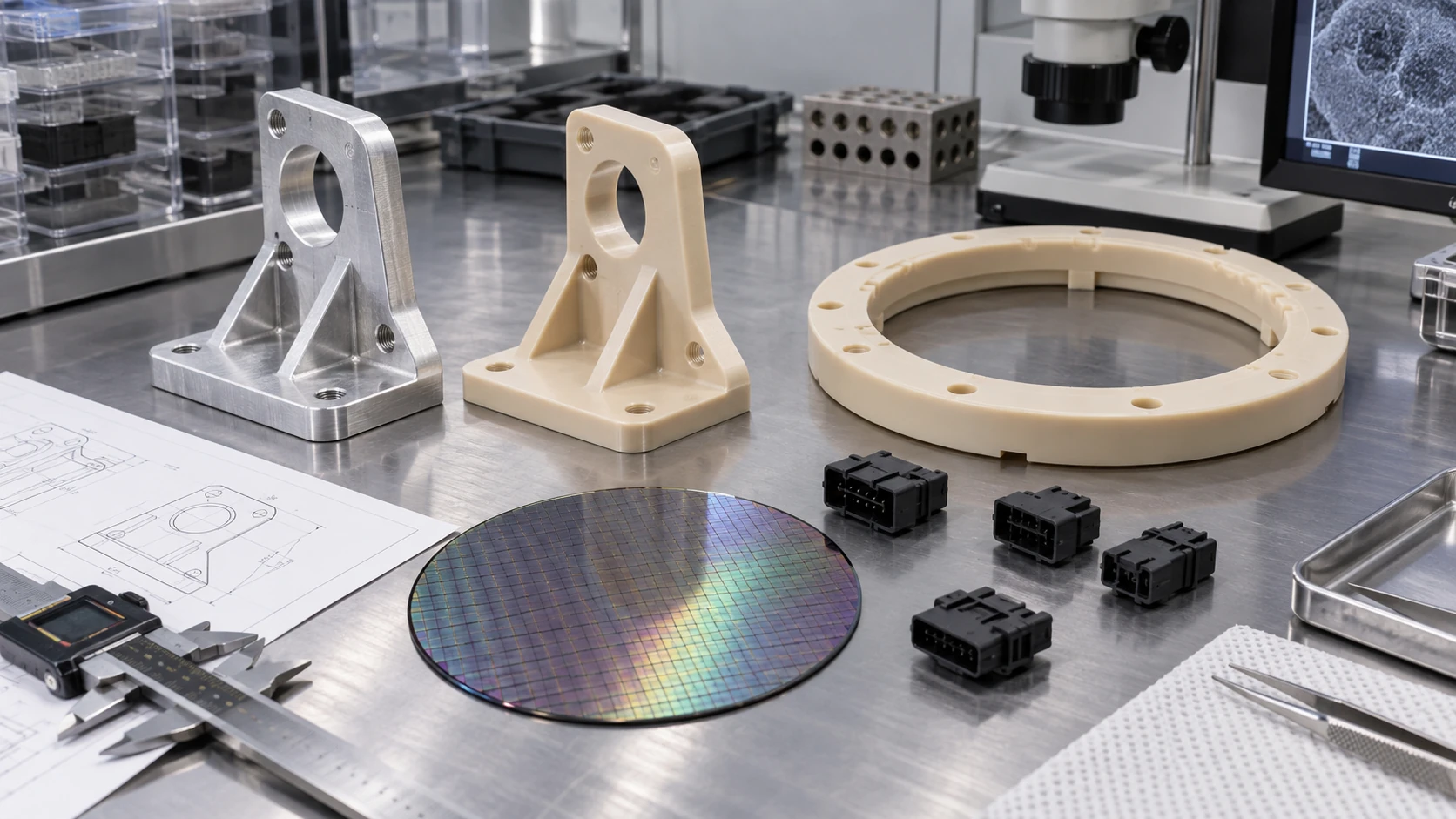
- Applications — metal replacement, medical, aerospace, semiconductors and electronics
- A materials engineer's view (3): how to read the concentration of supply
- What is still uncertain, and what this article leaves out
- Glossary / References / Claim-to-source audit
Sourced = content stated in published material, a standard, an annual report or a paper (link given)
Our calculation = a value this article derived from stated assumptions
Not yet confirmed = a plan or outlook with no confirmed track record
Structural readings and materials-design interpretations are marked separately as Commentary.
Property values are manufacturers' stated typical values. Values for different grades, test methods and conditions are not lined up to rank one against another.
We use no estimates of market size or share; figures a company has given in its own disclosures are used only with the fiscal year and currency stated.
1. What super engineering plastics are (the short version)
- "Super engineering plastic" is a name for resins with higher heat resistance, mechanical strength and chemical resistance than general-purpose engineering plastics (polyamides, polycarbonate and the like), and no definition is fixed by law or standard (our organisation). This article covers PEEK, PEI, PPS, PES and PSU, and LCP.
- Heat resistance is supported by three kinds of mechanism. Crystalline types (PEEK, PPS) hold up until the crystals melt; amorphous types (PEI, PSU, PES) hold up to the glass transition; and liquid-crystalline types (LCP) keep their molecules aligned even when molten (our organisation).
- "Up to what temperature can it be used?" has a different answer for each index. For Victrex PEEK 450G the published figures are a glass transition (onset) of 143 °C, a melting point of 343 °C, and UL 746B relative thermal indices of 240 °C for strength and 260 °C for electrical useSourced [Ref. 2].
Polyimides are a separate family of polymers with even higher heat resistance than PEEK and its relatives, and are covered in our explainer on polyimides. Fluoropolymers are covered in our explainer on fluoropolymers and PFAS, composites reinforced with carbon fibre in our explainer on CFRP and composites, and the basics of glass transition and creep in our explainer on glass transition and creep. For comparison with general-purpose engineering plastics, our explainers on polyamides and on polycarbonate and ABS resin will help.
2. Three structural types — crystalline, amorphous and liquid-crystalline
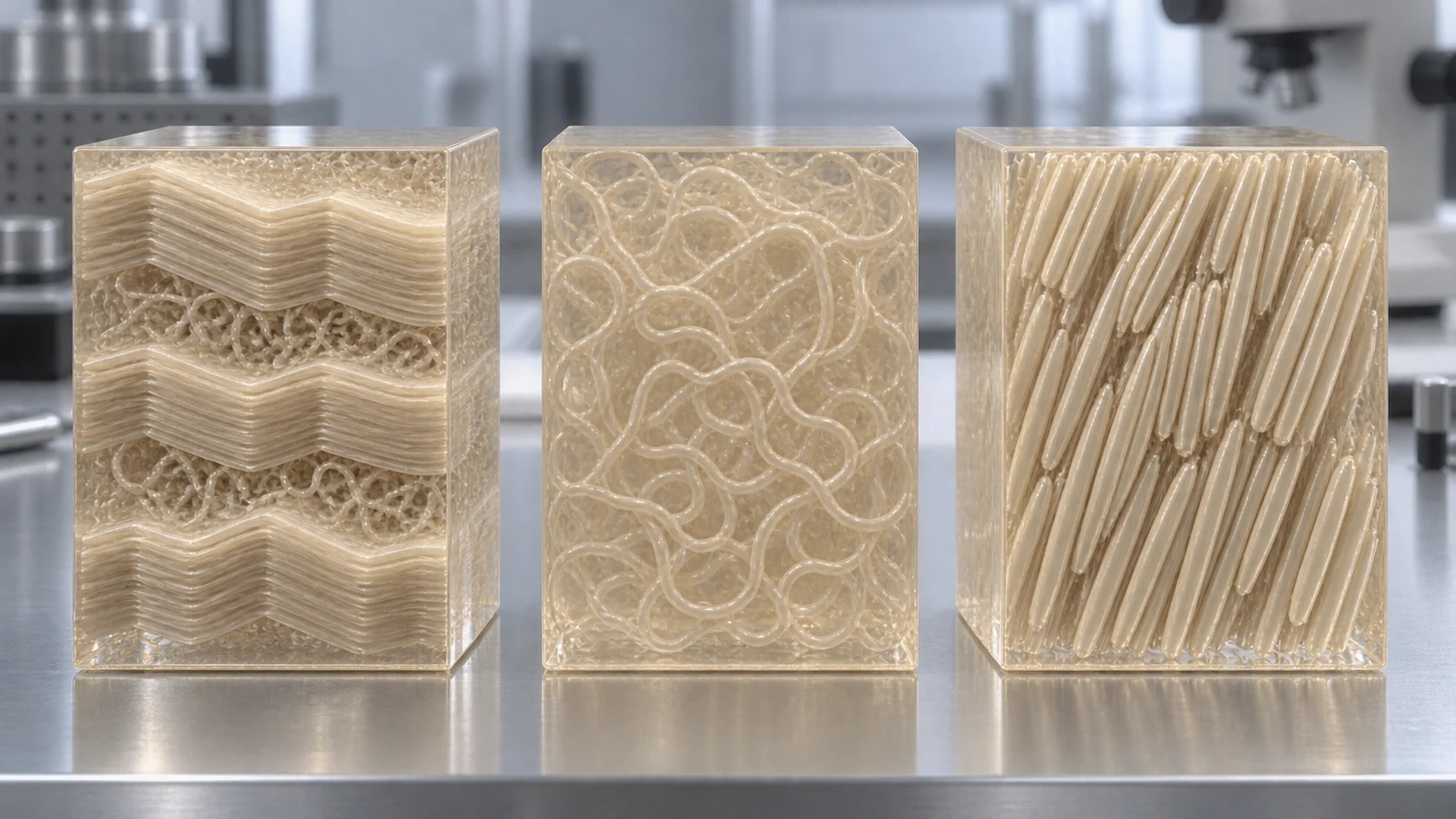
ImageGen conceptual illustration (not a real photograph or measurement). See the original diagram for exact values, names and structure.
Show original diagram with exact annotations and values
(1) Crystalline — PEEK and PPS
ASTM F2026 (PEEK for surgical implants) defines PEEK as a pure semi-crystalline homopolymer in which phenylene rings are linked by ether (E) and carbonyl (ketone, K) groups, with the repeat unit EEKSourced [Ref. 5]. For PPS, Toray explains that the melting point is about 278 °C and the glass transition temperature about 93 °C (about 90 °C on the product page), and that the crystallinity of a fully crystallised moulding is about 40 to 60%, depending on grade and measurement methodSourced [Refs. 6, 7]. The weight-average molecular weight of injection-moulding grades is about 20,000 to 60,000 [Ref. 6].
The width from Tg to Tm works out at 343 − 143 = 200 K for PEEK and 278 − 93 = 185 K for PPSOur calculation. In this range the crystals remain as a skeleton while the amorphous parts have softened (our commentary; how much stiffness is lost is shown in Section 3).
(2) Amorphous — PEI, PSU and PES
SABIC describes ULTEM 1000 as an amorphous polyetherimide (PEI) resin with a glass transition temperature of 217 °CSourced [Ref. 8]. Syensqo lists Veradel A-301 as an amorphous polyethersulfone (PESU) and Udel P-1700 as a polysulfone (PSU) [Refs. 14, 15]. Amorphous resins have no melting point, and the basic way to think about them is that the upper limit of service temperature is set by the glass transition temperature (our commentary; more in Section 6).
(3) Liquid-crystalline — LCP
Daicel (the business formerly run as Polyplastics) explains that the basic structure of LCP is a wholly aromatic polyester and that the key monomer is para-hydroxybenzoic acid (p-HBA). A polymer made from p-HBA alone does not melt and so cannot be processed, which is why it is copolymerised with other monomers to balance melting point and liquid-crystalline behaviourSourced [Ref. 13]. Section 7 goes into this.
3. A materials engineer's view (1): PEEK has no single "heat-resistance temperature"
Here are the temperature-related indices taken from the technical data sheet for Victrex PEEK 450G (the unfilled standard grade).
| Index | Value | Test method and conditions |
|---|---|---|
| Glass transition temperature (Tg) | onset 143 °C / midpoint 150 °C | ISO 11357-2 |
| Deflection temperature under load (1.8 MPa, unannealed) | 152 °C | ISO 75-2/Af |
| Melting point (Tm) | 343 °C | ISO 11357-3 |
| Relative thermal index RTI (impact / strength / electrical) | 180 °C / 240 °C / 260 °C | UL 746B |
| Flexural stress (23 °C / 125 °C / 175 °C / 275 °C) | 165 / 85 / 19 / 12.5 MPa | ISO 178 |
| Coefficient of linear thermal expansion (flow direction) below / above Tg | 45 / 120 ppm/K | ISO 11359-2 |
All are published values for Victrex PEEK 450G (Sourced) [Ref. 2]. The test methods are ISO 11357-2 [Ref. 18], ISO 11357-3 [Ref. 19], ISO 11359-2 [Ref. 20], ISO 75-2 [Ref. 21], ISO 178 and UL 746B.
The most important point in the table above is that the deflection temperature under load (152 °C) is almost the same as the glass transition temperature (143 °C). Unfilled PEEK deforms suddenly under load once it passes a little beyond the Tg. Flexural stress falls from 165 MPa at 23 °C to 19 MPa at 175 °C, a retention of 19 ÷ 165 = about 12%Our calculation. The melting point of 343 °C, on the other hand, is the temperature at which the crystals melt and the shape is lost; it is not a temperature at which the material carries load.
RTI (UL 746B) is a guide to the temperature at which properties fall to about half in long-term thermal ageing, and it differs for impact (180 °C), strength (240 °C) and electrical use (260 °C) because each property degrades at its own rate (our commentary). To say "PEEK can be used up to 260 °C" holds as an index of electrical insulation, but as the design temperature of a load-bearing part it is a different discussion. When fixing a design temperature, you need to check whether there is a load, the duration and the property required (strength, impact, electrical).
4. A materials engineer's view (2): fillers work above the Tg
Victrex also publishes data sheets for 450GL30, PEEK with 30% glass fibre, and 450CA30, with 30% carbon fibre. Here are the three grades side by side.
| Item (test method) | 450G (unfilled) | 450GL30 (GF 30%) | 450CA30 (CF 30%) |
|---|---|---|---|
| Density (ISO 1183) | 1.30 g/cm³ | 1.51 g/cm³ | 1.40 g/cm³ |
| Tensile modulus at 23 °C (ISO 527-1) | 4,000 MPa | 11,500 MPa | 28,000 MPa |
| Tensile strain at break at 23 °C (ISO 527-2) | 25% | 3.0% | 1.7% |
| Flexural stress at 23 °C / 175 °C (ISO 178) | 165 / 19 MPa | 275 / 80 MPa | 380 / 130 MPa |
| Deflection temperature under load, 1.8 MPa (ISO 75-2/Af) | 152 °C | 328 °C | 336 °C |
| Linear thermal expansion, flow direction, below / above Tg (ISO 11359-2) | 45 / 120 ppm/K | 18 / 18 ppm/K | 5 / 6 ppm/K |
| Linear thermal expansion, average, below / above Tg (ISO 11359-2) | 55 / 140 ppm/K | 45 / 110 ppm/K | 40 / 100 ppm/K |
| Moulding shrinkage, transverse / flow direction (ISO 294-4) | 1.3 / 0.90% | 0.90 / 0.30% | 0.50 / 0.10% |
| Thermal conductivity at 23 °C (ISO 22007-4) | 0.29 / 0.32 W/m/K | 0.30 / 0.35 W/m/K | 0.95 / 2.0 W/m/K |
All are Victrex's published values (Sourced) [Refs. 2, 3, 4]. The documents give two values for thermal conductivity (notes on measurement direction and so on are in the documents' footnotes). The volume resistivity of 450CA30 is stated as 1.0×10⁵ Ω·cm, so it is not an electrical insulator. The tensile test method is ISO 527-1 [Ref. 22].
- Tensile modulus: 11,500 ÷ 4,000 = about 2.9 times (GL30); 28,000 ÷ 4,000 = 7.0 times (CA30)
- Specific modulus (modulus ÷ density): 4,000 ÷ 1.30 = about 3.1; 11,500 ÷ 1.51 = about 7.6; 28,000 ÷ 1.40 = 20.0 (all in GPa ÷ g/cm³)
- Difference between deflection temperature and Tg: unfilled 152 − 143 = +9 K; GL30 328 − 143 = +185 K; CA30 336 − 143 = +193 K
- Anisotropy of linear thermal expansion: for GL30, "average 45" ÷ "flow direction 18" = about 2.5 times; for CA30, 40 ÷ 5 = 8 times
- Flexural stress retention at 175 °C (against 23 °C): 12% / 29% / 34%
- Flexural stress retention at 125 °C: 85 ÷ 165 = 52%, 190 ÷ 275 = 69%, 275 ÷ 380 = 72%
Our calculation Assumptions: ratios and differences of published values. The documents give no definition note for the "average" linear thermal expansion, and we have read it as an average of the flow and transverse directions.
The room-temperature modulus rises about 2.9 times with glass fibre and 7 times with carbon fibre. The real difference, however, appears above the Tg. Where the unfilled grade's deflection temperature stays only a little above its Tg (+9 K), GL30 and CA30 reach 185 to 193 K above the Tg (328 °C and 336 °C). The reading is that the fibres become a skeleton that carries the load and keeps the shape in place of the softened amorphous parts (our commentary).
There is a price, though. Tensile strain at break falls sharply, from 25% to 3.0% to 1.7%, and directional differences (anisotropy) appear in moulding shrinkage and thermal expansion. The linear expansion of CA30 is extremely small at 5 ppm/K in the flow direction, yet the average is 40 ppm/K, so it behaves like a different material depending on direction. As our explainer on the thermal expansion coefficient discusses, this anisotropy makes thermal stress hard to predict when the part is combined with a dissimilar material. CA30 is also electrically conductive (volume resistivity 1.0×10⁵ Ω·cm) and cannot be used as an insulating material [Ref. 4].
5. High-temperature processing conditions
Super engineering plastics are another world in processing too. Here are the recommended conditions from the manufacturers' data sheets side by side.
| Item | PEEK 450G | PEEK 450GL30 | PEEK 450CA30 | PEI ULTEM 1000 |
|---|---|---|---|---|
| Drying | 120 to 150 °C, 3 to 5 hours | Same | Same | 150 °C, 4 to 6 hours |
| Upper limit of moisture content before moulding | 0.020% | 0.020% | 0.020% | 0.02% |
| Barrel temperature (rear → front, nozzle) | 355 → 370 °C, 375 °C | 360 → 380 °C, 385 °C | 375 → 390 °C, 395 °C | 330 to 400 → 345 to 415 °C, 345 to 405 °C |
| Mould temperature | 170 to 200 °C | 180 to 200 °C | 180 to 210 °C | 135 to 180 °C |
| Melt viscosity at 400 °C (ISO 11443) | 350 Pa·s | 550 Pa·s | 675 Pa·s | — |
All are manufacturers' stated values (Sourced) [Refs. 2, 3, 4, 8]. Victrex notes that the processing conditions in its data sheets are typical values from its own laboratory. The melt temperature of ULTEM 1000 is 350 to 410 °C. For PEEK 90P (a powder grade), melt viscosity at 400 °C is 90 Pa·s and the melt temperature for extrusion is 380 to 400 °C [Ref. 1].
The mould temperature for PEEK is 170 to 200 °C, set above the Tg (143 °C). Holding in the temperature range where crystallisation proceeds decides the crystallinity, and with it stiffness and chemical resistance (our commentary). The same is true of PPS. Toray explains that, because crystals can survive up to about 290 °C, a moulding temperature of 300 °C or above is desirable, and that moulding in a cold mould lowers crystallinity and produces a cold-crystallisation peak at around 120 to 130 °CSourced [Ref. 6]. Amorphous PEI, by contrast, has a mould temperature of 135 to 180 °C, below its Tg (217 °C) [Ref. 8]. No crystallisation is needed, and it only has to be solidified at a temperature under the Tg (our commentary).
The gap between melt temperature and melting point is also visible. The nozzle temperature of 375 °C for PEEK 450G is 32 K above the melting point of 343 °C, and the 400 °C used in extrusion is 57 K above itOur calculation. Because processing happens just above the melting point, the temperature window is narrow and thermal degradation during residence is easy (our commentary). The melt temperature of PEI (350 to 410 °C) is 133 to 193 K above its Tg, so its window is comparatively wideOur calculation.
On moisture, both PEEK and PEI have an upper limit of 0.02% or less before moulding [Refs. 2, 8]. The absolute water absorption is small (PEEK 450G takes up 0.45% at saturation in water at 23 °C and 0.55% at 100 °C, by the ISO 62 method [Ref. 23] [Ref. 2]), and as with polyamide and polycarbonate the reason drying is needed is thought to be that water can act on the main chain at melt temperature (our commentary). The ULTEM 1000 document also notes that cumulative drying time should not exceed 24 hours [Ref. 8].
6. Amorphous super engineering plastics — PEI, PSU and PES
| Item (test method) | PEI SABIC ULTEM 1000 |
|---|---|
| Glass transition temperature | 217 °C |
| Deflection temperature under load, 1.8 MPa (ISO 75/Af) / 0.45 MPa (ISO 75/Bf) | 192 °C / 209 °C |
| Vicat softening temperature B/50 (ISO 306) | 211 °C |
| Tensile modulus (ISO 527, 1 mm/min) | 3,200 MPa |
| Yield stress and strain at break (ISO 527, 50 mm/min) | 110 MPa, 50% |
| Linear thermal expansion, −40 to 150 °C (ISO 11359-2) | 52 ppm/K (5.2×10⁻⁵/°C) |
| Density (ISO 1183) | 1.27 g/cm³ |
| Water absorption, equilibrium at 23 °C / 50% RH (ISO 62-4) / saturation in water (ISO 62-1) | 0.7% / 1.25% |
| UL 94 | V-0 (0.75 mm and above), V-2 (0.4 mm and above), 5VA (3 mm and above) |
| Limiting oxygen index | 47% (ISO 4589) |
| UL 746B RTI (electrical / mechanical, with and without impact) | 170 °C |
All are SABIC's published values (Sourced) [Ref. 8]. SABIC describes ULTEM 1000 as an unfilled amorphous PEI resin with very good chemical resistance for an amorphous resin, inherently flame retardant (UL 94 V0 and 5V, meeting FAR 25.853 for aircraft interiors) and halogen-free.
PSU and PES are Udel (PSU) and Veradel (PESU), supplied by Syensqo. The company's descriptions are as followsSourced.
- Udel P-1700 (PSU): tough and stiff, and suited to continuous use at up to 149 °C (300 °F). It resists oxidation and hydrolysis and withstands repeated sterilisation (steam, electron beam, ethylene oxide and so on). It resists mineral acids, alkalis and salt solutions but can be attacked by polar solvents such as ketones, chlorinated solvents and aromatic hydrocarbons. It complies with FDA 21 CFR 177.1655 for repeated contact with food [Ref. 14].
- Veradel A-301 (PESU): a transparent, amorphous PESU with a high deflection temperature, toughness, dimensional stability and resistance to mineral acids. It has thermal stability, creep resistance and inherent flame retardancy, and is FDA-compliant for direct food contact. It was formerly sold as Radel A [Ref. 15].
In PEEK the crystals hinder the entry of solvents, which gives high chemical resistance, and Syensqo describes the chemical resistance of PEEK as comparable to that of PPS [Ref. 11]. For amorphous PSU, the company itself states that polar solvents (ketones, chlorinated solvents, aromatic hydrocarbons) can attack it [Ref. 14]. That SABIC qualifies the chemical resistance of PEI as very good only for an amorphous resin can be read as reflecting the same circumstances [Ref. 8] (our commentary).
The deflection temperature of PEI (192 °C) is also higher than that of unfilled PEEK (152 °C). This corresponds to the difference in Tg (217 °C against 143 °C)Our calculation (192 − 152 = 40 K and 217 − 143 = 74 K; a guide only, because these are values from different manufacturers with different specimens and conditions). In the unfilled state, the temperature at which the material carries load can be higher for an amorphous resin. The advantage of crystalline types can be summarised as lying in retention after the Tg, and in chemical resistance and fatigue (our commentary; fatigue is a point Syensqo names as a strength of KetaSpire [Ref. 11], and this article gives no figures for it).
7. Liquid crystal polymers (LCP) — ease of flow and dimensional precision
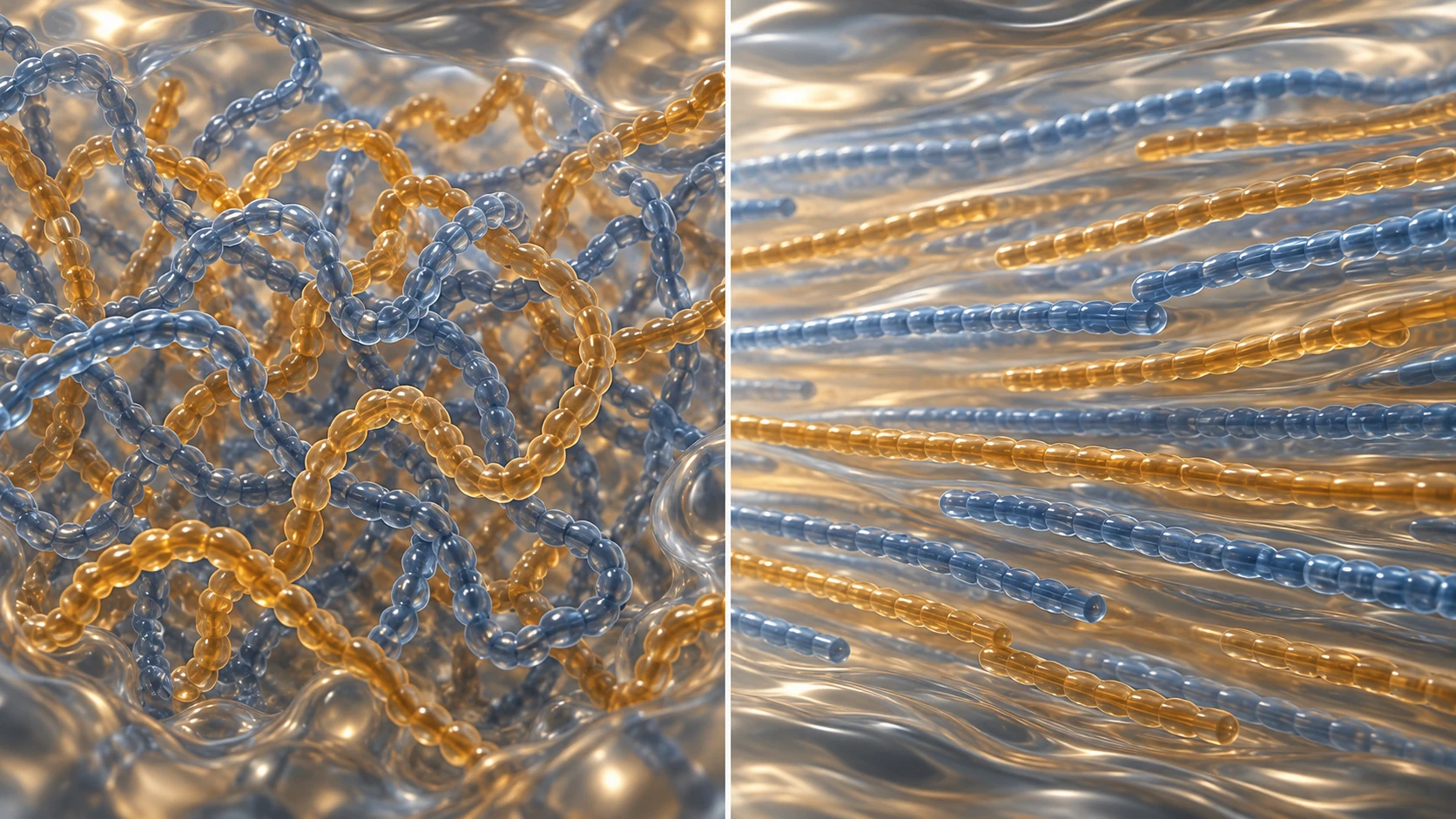
ImageGen conceptual illustration (not a real photograph or measurement). See the original diagram for exact values, names and structure.
Show original diagram with exact annotations and values
Celanese describes LCP as a highly crystalline, inherently flame-retardant, thermotropic (melt-orienting) thermoplastic. A general semicrystalline polymer becomes random when it melts and forms ordered crystalline regions surrounded by an amorphous matrix as it cools, whereas in LCP the molecules stay aligned even in the melt and slide past one another easily under shear. As a result melt viscosity is very low, and very thin walls and complex shapes can be filled. There is almost no shrinkage in the flow direction, and the material solidifies quickly, so cycles are shortSourced [Ref. 12].
Daicel describes its LAPEROS LCP as combining thinness with flowability, with the property that the thinner the wall, the higher the mechanical strength per unit of cross-sectional area, a coefficient of linear thermal expansion close to that of metal, high modulus, vibration damping, and solder heat resistance for surface mounting (SMT)Sourced [Ref. 13].
| Item | Published content | Source |
|---|---|---|
| Applications named | Connectors, antennas, CPU sockets, small camera modules, sensors, small motors, medical devices, dental and surgical instruments, servers, mobile devices, lidar, wearables, cookware | Celanese [12] |
| Uses in extrusion | Unfilled grades can be used for film and sheet extrusion, co-extrusion of barrier packaging, and melt spinning of high-performance fibres and yarns | Celanese [12] |
| Dielectric properties | Vectra and Zenite have added grades with adjusted dielectric constant (Dk) and dissipation factor (Df), grades with Dk/Df constant over a wide frequency range, and platable grades | Celanese [12] |
| Zenite 350 LDS | For miniaturising antennas, sensors and connectors. Compatible with LDS (laser direct structuring) and SMT soldering, V-0, low warpage | Celanese [12] |
| Features of the main grades | A130 (glass-fibre-reinforced, high strength and toughness); E130i / E463i / E471i / E473i (standard, for SMT, low warpage, low anisotropy, high flow and so on); S135 / S471 / S475 (high heat resistance, high-temperature stiffness) | Daicel [13] |
All are statements in the companies' published material (Sourced). The statements are mostly non-numerical and do not rank one grade or company against another.
LCP molecules line up easily in the flow direction, so properties in the flow direction (shrinkage, expansion, strength) differ greatly from those across it (our commentary). As we saw with carbon-fibre-reinforced PEEK (Section 4), anisotropy is a source of precision in thin walls and fine features, and also a source of warpage and weak weld lines. That Daicel lists "low warpage" and "low anisotropy" separately as grade features [Ref. 13] is the flip side of this.
LCP also does not melt from p-HBA alone, so the melting point is adjusted by copolymerisation [Ref. 13]. Even under the one name "LCP", then, it is a family of materials whose melting point and heat resistance depend on composition, and the type of heat resistance has to be checked in each manufacturer's grade system (Daicel separates standard grades from high-heat-resistance grades [Ref. 13]).
8. Applications — metal replacement, medical, aerospace, semiconductors and electronics
| Field | What the published material says | Source |
|---|---|---|
| Metal replacement (general) | Syensqo says KetaSpire PEEK keeps excellent mechanical properties at continuous-use temperatures up to 240 °C and can replace metal in harsh service environments. Uses are additive manufacturing, aerospace, automotive, healthcare, oil and gas, and semiconductors | Syensqo [11] |
| Aerospace | Victrex says PEEK and PAEK-family polymers replace metals, thermosets and other materials, giving weight reduction, a better buy-to-fly ratio and design freedom through part consolidation. Its blog is cited as saying injection moulding can give a buy-to-fly ratio up to 85% better than aluminium. SABIC states that ULTEM 1000 meets FAR 25.853 for aircraft | Victrex [16] SABIC [8] |
| Medical | ASTM F2026 specifies requirements and test methods for PEEK polymers used in surgical implants and dental devices. Victrex's medical revenue for FY2025 (year to September) was £58.8m (down 5%); in spine, a shift to expandable and porous titanium cages, mainly in the US, had an effect, while the non-spine business grew 7% (non-implant medical 12%) | ASTM [5] Victrex [10] |
| Semiconductors and electronics | Victrex says PEEK CMP retaining rings last 50% longer than PPS ones and can raise fab productivity by up to 3% (the company's claim). It says APTIV film has been used in more than 4 billion mobile devices, and that PEEK parts have a record at rotation above 100,000 rpm | Victrex [9] |
| Electronics (LCP) | Connectors, antennas, camera modules and more (Section 7) | Celanese [12] Daicel [13] |
| Automotive and industrial (PPS) | Toray says PPS (Torelina) suits automotive engine-bay parts, industrial machinery parts and high-temperature electronic parts, with continuous-use temperature of 200 to 240 °C, a melting point of 278 °C and chemical resistance second only to fluoropolymers | Toray [7] |
All are statements in the companies' and organisations' published material (Sourced). The "85% better buy-to-fly ratio", "50% longer life" and "3% productivity" are claims Victrex makes about its own products, and this article has not verified them.
- It does not say that "PEEK is biocompatible". ASTM F2026 specifies the requirements and test methods for the material, PEEK polymer used to make surgical implants and dental devices, and states explicitly that because processing (moulding, machining, assembly, sterilisation) can change properties, the properties of the manufactured form must be evaluated separatelySourced [Ref. 5].
- The evaluation of PEEK as a spinal and orthopaedic implant is summarised in the review by Kurtz and Devine (Biomaterials, 2007)Sourced [Ref. 24] (confirmed from the title; the full text was not checked, so its content is not quoted).
- Victrex's annual report names the continuing shift in spine, mainly in the US, from PEEK to expandable and porous titanium cages as a factor in lower medical revenue [Ref. 10]. A material's advantage is not fixed: demand moves with changes in device design (our commentary).
9. A materials engineer's view (3): how to read the concentration of supply
What comes up in sourcing PEEK is how few suppliers there are. Here we use no estimates of market size or share and keep to what one supplier has written in its own annual report.
| Item | What the Victrex plc annual report (FY2025, year to September) says |
|---|---|
| Sales volume | 4,164 tonnes for the group (3,731 tonnes in the prior year, up 12%). The drivers were VARs (value-added resellers) and energy and industrial |
| Revenue and average selling price | Revenue £292.7m (prior year £291.0m); average selling price £70/kg (prior year £78/kg). About 80% of the change comes from product mix and currency |
| Approach to supply | The company says it has the largest PEEK production capacity, with an integrated supply chain and world-class quality. The current five-year plan includes no investment in capacity expansion |
| Monomer production | There is a monomer plant in Rotherham, UK. The annual report cites the use of UK-made monomer as a basis for PEEK having a lower climate impact than the industry average |
| Plant in China | Ramp-up has been delayed; the annualised operating loss is £8m, £4m worse than the prior year |
| Supply risk | Names the supply network as a principal risk: insufficient production capacity, quality failures, and constraints on raw material supply or transport could impair stable supply to customers worldwide |
| Large projects | Composite pipe: 8 tonnes of PEEK per km (linked to TechnipFMC's project for Petrobras) |
All are statements in the Victrex plc Annual Report 2025 (Sourced) [Ref. 10]. The figures are for the company as a whole (including polymers other than PEEK, film, composites, medical parts and so on) and are not the price of the polymer alone.
- Revenue £292.7m ÷ 4,164 t = about £70.3/kg (consistent with the published £70/kg)
- Composite pipe uses 8 t of PEEK per km, so if 100 km were made it would take 800 t. That is about 19% of the company's FY2025 sales volume of 4,164 t (800 ÷ 4,164)
- The increase in FY2025 (4,164 − 3,731 = 433 t) is equivalent to about 54 km of pipe at 8 t/km
Our calculation Assumptions and limits: the pipe consumption is the per-kilometre figure the company gives; the 100 km distance is an assumption made to get a sense of scale. It does not show actual order volumes or expected orders.
A volume in the 4,000-tonne range is orders of magnitude smaller than for general-purpose resins (our commentary). The calculation above shows how a single project such as composite pipe can generate several to more than ten per cent of demand. At the same time, the main driver of demand depends on structural change in applications. The same report states that a shift away from PEEK to other materials in spine reduced revenue in medical [Ref. 10].
From a sourcing viewpoint, the following checks are realistic (our commentary).
- Number of suppliers: there is more than one supplier of PEEK. In this article we were able to confirm Victrex and Syensqo, which supplies KetaSpire PEEK [Ref. 11]. Daicel lists SARPEK, a PEK rather than a PEEK, in its range [Ref. 13]. We have not checked whether other suppliers exist or their scale.
- Ease of switching grade: ASTM D8033 sets a classification system for PEEK injection-moulding and extrusion materials and allows the use of recycled material that meets its requirements [Ref. 17]. For medical use, however, manufacturer-specific change control is needed on top of the requirements of ASTM F2026 [Ref. 5], so it is natural to assume that switching suppliers is not easy.
- Where the raw material (monomer) is made: Victrex makes its monomer in the UK [Ref. 10]. Geographic concentration is worth checking from the viewpoint of business continuity planning (BCP).
Companies publish statements about PFAS (per- and polyfluoroalkyl substances) for their own grades. SABIC lists among the features of ULTEM 1000 that PFAS are not intentionally addedSourced [Ref. 8], Victrex has a "PFAS-Free PEEK Polymers" section on its website, and Daicel has a dedicated page stating that all its grades are PFAS-free [Ref. 13]. These are the companies' own declarations, and the definitions and the range of substances covered may differ from one source to another. Regulatory trends on PFAS, and the question of substitution for fluoropolymers, are covered in our explainer on fluoropolymers and PFAS.
10. What is still uncertain, and what this article leaves out
- Market size, share and production capacity: not covered, because our policy is not to use estimates from market research firms. Victrex's statement of the largest PEEK production capacity is also the company's own claim, and we have not had it confirmed by a third party.
- Other PEEK suppliers (Evonik, Chinese companies and others): not stated, because we could not confirm them in the primary sources we opened.
- Property values for PSU and PES: Syensqo's pages concentrate on describing function, and we could not open numerical technical data within the scope of this article, so values such as Tg are not given.
- Melting point and heat resistance figures for LCP: the Celanese and Daicel pages were mainly qualitative. Figures by grade need to be checked in each company's data sheets.
- The detailed definition of RTI (UL 746B): we have not checked the text of the UL standard. The explanation in the text is commentary based on general understanding.
- The content of the review by Kurtz and Devine: we confirmed only its existence from the title and have not checked the full text.
- Victrex's claims (buy-to-fly ratio, life, productivity): the company's own claims, which this article has not verified.
- Recycling and bio-based material: we could not confirm primary sources on the reality of recycling PEEK or PEI within the scope of this article (we limit ourselves to the fact that ASTM D8033 allows the use of recycled material).
- "Heat-resistance temperature" changes with the index. PEEK 450G has a Tg of 143 °C, a deflection temperature of 152 °C, RTI of 240 °C for strength and 260 °C for electrical use, and a Tm of 343 °CSourced.
- Unfilled PEEK softens sharply above the Tg. Flexural stress at 175 °C is about 12% of that at 23 °COur calculation.
- Fillers work above the Tg. Deflection temperature rises from 152 °C to 328 to 336 °C, at the price of lower strain at break (25% down to 1.7 to 3.0%) and anisotropySourced.
- The relation between mould temperature and Tg separates crystalline types (above the Tg) from amorphous types (below the Tg).
- Read supply through one company's figures. Victrex's FY2025 (year to September) sales volume was 4,164 tonnes and its average selling price £70/kgSourced.
11. Glossary
- Super engineering plastic
- A name for resins with higher heat resistance, strength and chemical resistance than general-purpose engineering plastics. There is no clear definition.
- PEEK
- Polyetheretherketone. A semicrystalline resin with the repeat unit ether-ether-ketone.
- PEI, PSU, PES
- Polyetherimide, polysulfone and polyethersulfone. All are amorphous.
- PPS
- Polyphenylene sulfide. Crystalline, with high chemical resistance.
- LCP
- Liquid crystal polymer. The molecules stay aligned even when molten, giving easy flow and high dimensional precision.
- Tg (glass transition temperature)
- The temperature at which amorphous parts change from glassy to rubbery. Even in crystalline resins it is a guide to where stiffness starts to fall.
- Tm (melting point)
- The temperature at which crystals melt. A guide to the lower limit of moulding temperature for crystalline resins.
- HDT (deflection temperature under load)
- The temperature at which a specimen under a set load deflects by a set amount (ISO 75).
- RTI (relative thermal index)
- A temperature index for long-term thermal ageing in UL 746B. It is set for each property (impact, strength, electrical).
- GF / CF
- Glass fibre / carbon fibre. As fillers they raise stiffness and heat resistance (HDT).
- Anisotropy
- A difference in properties with direction, arising from fibre orientation or molecular alignment.
- PAEK, LMPAEK
- Polyaryletherketone. LMPAEK is a PAEK-family polymer with a lowered melting point.
- CMP ring
- A ring that holds the wafer in chemical mechanical polishing (CMP). Used in semiconductor manufacturing.
- Cold crystallisation
- Crystallisation on reheating of a moulding that was quenched in a cold mould and so did not crystallise.
- Buy-to-fly ratio
- The ratio of the mass of material purchased to the mass of the finished part. The smaller it is, the less material is wasted.
12. References
- Victrex Technical Data Sheet, "VICTREX™ PEEK POLYMER 90P", revised March 2026 (PDF) — cdn.victrex.com
- Victrex Technical Data Sheet, "VICTREX™ PEEK POLYMER 450G" (PDF) — cdn.victrex.com
- Victrex Technical Data Sheet, "VICTREX™ PEEK POLYMER 450GL30" (PDF) — cdn.victrex.com
- Victrex Technical Data Sheet, "VICTREX™ PEEK POLYMER 450CA30" (PDF) — cdn.victrex.com
- ASTM ASTM F2026-23 Standard Specification for Polyetheretherketone (PEEK) Polymers for Surgical Implant Applications — store.astm.org
- Toray TORELINA™ technical data, "Basic Properties of TORELINA™" — www.plastics.toray
- Toray "TORELINA™ PPS resin" product page — www.plastics.toray
- SABIC Technical Data Sheet, "ULTEM™ Resin 1000", revision of 25 June 2026 (PDF) — materialfinder.sabic-specialties.com
- Victrex "PEEK polymers for Electronics" — www.victrex.com
- Victrex plc Annual Report 2025 (year ended September 2025) (PDF) — wp-victrexplc-2020.s3.eu-west-2.amazonaws.com
- Syensqo "KetaSpire® PEEK Polyether Ether Ketone" — www.syensqo.com
- Celanese "Liquid Crystal Polymer (LCP) | Vectra® & Zenite®" — www.celanese.com
- Daicel "LAPEROS® LCP" product page (High Performance Polymers SBU) — hpps.daicel.com
- Syensqo "Udel® P-1700 CL 2611 CMP" product page (polysulfone) — www.syensqo.com
- Syensqo "Veradel® A-301 NT" product page (polyethersulfone) — www.syensqo.com
- Victrex "PEEK for Aerospace Applications" — www.victrex.com
- ASTM ASTM D8033-22 Standard Classification System for Poly(Ether Ether Ketone) (PEEK) Molding and Extrusion Materials — store.astm.org
- ISO ISO 11357-2:2020 Plastics — Differential scanning calorimetry (DSC) — Part 2: Determination of glass transition temperature and step height — www.iso.org
- ISO ISO 11357-3:2025 Plastics — Differential scanning calorimetry (DSC) — Part 3: Determination of temperature and enthalpy of melting and crystallization — www.iso.org
- ISO ISO 11359-2:2021 Plastics — Thermomechanical analysis (TMA) — Part 2: Determination of coefficient of linear thermal expansion and glass transition temperature — www.iso.org
- ISO ISO 75-2:2013 Plastics — Determination of temperature of deflection under load — Part 2: Plastics and ebonite — www.iso.org
- ISO ISO 527-1:2019 Plastics — Determination of tensile properties — Part 1: General principles — www.iso.org
- ISO ISO 62:2008 Plastics — Determination of water absorption — www.iso.org
- Kurtz, Devine "PEEK biomaterials in trauma, orthopedic, and spinal implants", Biomaterials 2007, 28, 4845 — doi.org
13. Claim-to-source audit
| Claim in the text | Basis | Label |
|---|---|---|
| PEEK 90P (powder grade): melting point 343 °C, Tg (onset) 143 °C, melt viscosity (400 °C) 90 Pa·s, melt temperature for extrusion 380 to 400 °C, drying 120 to 150 °C for 3 to 5 hours with moisture content of 0.020% or less | Victrex PEEK 90P data sheetReference 1 https://cdn.victrex.com/-/media/downloads/datasheets/victrex_tds_90p.pdf | Sourced |
| Values for PEEK 450G: Tg 143 °C (onset) and 150 °C (midpoint), melting point 343 °C, deflection temperature 152 °C (1.8 MPa, unannealed), RTI 180/240/260 °C, flexural stress 165/85/19/12.5 MPa (23/125/175/275 °C), linear thermal expansion (flow direction 45/120, average 55/140 ppm/K), density 1.30, tensile modulus 4,000 MPa and strain at break 25%, moulding shrinkage 1.3% and 0.90%, water absorption (saturation) 0.45% (23 °C) and 0.55% (100 °C), thermal conductivity 0.29 and 0.32 W/m/K, melt viscosity (400 °C) 350 Pa·s, barrel temperature 355 to 375 °C, mould temperature 170 to 200 °C | Victrex PEEK 450G data sheetReference 2 https://cdn.victrex.com/-/media/downloads/datasheets/victrex_tds_450g.pdf | Sourced |
| Values for PEEK 450GL30: density 1.51, tensile modulus 11,500 MPa, strain at break 3.0%, flexural stress 275/190/80/50 MPa, deflection temperature 328 °C, linear thermal expansion (flow direction 18/18, average 45/110 ppm/K), moulding shrinkage 0.90 and 0.30%, melt viscosity 550 Pa·s, barrel 360 to 385 °C, mould 180 to 200 °C | Victrex PEEK 450GL30 data sheetReference 3 https://cdn.victrex.com/-/media/downloads/datasheets/victrex_tds_450gl30.pdf | Sourced |
| Values for PEEK 450CA30: density 1.40, tensile modulus 28,000 MPa, strain at break 1.7%, flexural stress 380/275/130/65 MPa, deflection temperature 336 °C, linear thermal expansion (flow direction 5/6, average 40/100 ppm/K), moulding shrinkage 0.50 and 0.10%, thermal conductivity 0.95 and 2.0 W/m/K, volume resistivity 1.0×10⁵ Ω·cm, melt viscosity 675 Pa·s, barrel 375 to 395 °C, mould 180 to 210 °C | Victrex PEEK 450CA30 data sheetReference 4 https://cdn.victrex.com/-/media/downloads/datasheets/victrex_tds_450ca30.pdf | Sourced |
| That ASTM F2026 specifies the requirements and test methods for PEEK polymers used in surgical implants and dental devices, defines PEEK as a pure semicrystalline homopolymer (repeat unit EEK), and requires the manufactured form to be evaluated separately because processing can change properties | ASTM F2026Reference 5 https://store.astm.org/f2026-23.html | Sourced |
| PPS (Torelina): melting point about 278 °C, Tg about 93 °C (about 90 °C on the product page), crystallinity about 40 to 60%, Mw of injection-moulding grades about 20,000 to 60,000, that crystals can survive to about 290 °C so a moulding temperature of 300 °C or above is desirable, and that a cold mould gives a cold-crystallisation peak at around 120 to 130 °C | Toray Torelina technical dataReference 6 https://www.plastics.toray/technical/torelina/tec_029.html | Sourced |
| Torelina continuous-use temperature of 200 to 240 °C (upper limit defined as keeping 50% or more of strength), deflection temperature of 260 to 270 °C, chemical resistance second only to fluoropolymers, and applications (automotive engine-bay parts, industrial machinery parts, electronic parts) | Toray Torelina product pageReference 7 https://www.plastics.toray/products/torelina/ | Sourced |
| ULTEM 1000: Tg 217 °C; HDT 192 °C (1.8 MPa) and 209 °C (0.45 MPa); Vicat 211 °C; tensile modulus 3,200 MPa; yield stress 110 MPa and strain at break 50%; linear thermal expansion 52 ppm/K; density 1.27; water absorption 0.7% (equilibrium) and 1.25% (saturation); UL 94 (V-0 at 0.75 mm and above, V-2 at 0.4 mm and above, 5VA at 3 mm and above); LOI 47%; RTI 170 °C; moulding conditions (drying 150 °C for 4 to 6 hours to 0.02%, melt 350 to 410 °C, mould 135 to 180 °C); compliance with FAR 25.853; and that PFAS are not intentionally added | SABIC ULTEM 1000 data sheetReference 8 https://materialfinder.sabic-specialties.com/document-download/69d81a01-36d8-eb11-810a-005056857ef3 | Sourced |
| Victrex's electronics page: that APTIV film has been used in more than 4 billion mobile devices, that PEEK CMP rings last 50% longer than PPS and can raise productivity by up to 3%, a record at above 100,000 rpm, and that it withstands continuous high temperatures up to 260 °C | Victrex electronics pageReference 9 https://www.victrex.com/en/industries/electronics (the company's claim) | Sourced |
| Victrex Annual Report 2025: sales volume of 4,164 tonnes (3,731 tonnes in the prior year), revenue of £292.7m, average selling price of £70/kg (prior year £78/kg), medical revenue of £58.8m (down 5%) and the shift to other materials in spine, the monomer plant in Rotherham, the use of UK monomer, the delayed ramp-up of the plant in China with an annualised operating loss of £8m, no investment in capacity expansion, the statement on supply network risk, and composite pipe at 8 tonnes of PEEK per km | Victrex plc Annual Report 2025Reference 10 https://wp-victrexplc-2020.s3.eu-west-2.amazonaws.com/media/2025/12/Victrex-plc-Annual-Report-2025.pdf | Sourced |
| That KetaSpire PEEK keeps mechanical properties at continuous-use temperatures up to 240 °C and can replace metal in harsh environments, its fatigue and chemical resistance, and applications (additive manufacturing, aerospace, automotive, healthcare, oil and gas, semiconductors) | Syensqo KetaSpire pageReference 11 https://www.syensqo.com/en/brands/ketaspire-peek (the company's own account) | Sourced |
| That LCP is highly crystalline, inherently flame retardant and thermotropic; that the molecules stay aligned in the melt, giving very low melt viscosity and filling of very thin walls; that there is almost no shrinkage in the flow direction; the applications; grades with adjusted Dk/Df; and the features of Zenite 350 LDS | Celanese LCP pageReference 12 https://www.celanese.com/products/lcp-vectra-zenite | Sourced |
| LAPEROS LCP: a wholly aromatic polyester; that a homopolymer of p-HBA does not melt, so copolymerisation is needed; that the thinner the wall the higher the strength per unit cross-section; that linear thermal expansion is close to that of metal; the grades (A130, E130i, E463i, E471i, E473i, S135, S471, S475); that DURAFIDE PPS and SARPEK PEK are in the range; and the dedicated page on all grades being PFAS-free | Daicel LAPEROS pageReference 13 https://hpps.daicel.com/global/s/ProductInfo/laperoslcp?language=en_US (the company's own account) | Sourced |
| Udel P-1700: PSU; continuous use at up to 149 °C (300 °F); resistant to oxidation and hydrolysis; withstands repeated sterilisation; can be attacked by polar solvents (ketones, chlorinated solvents, aromatic hydrocarbons); compliance with FDA 21 CFR 177.1655 | Syensqo Udel pageReference 14 https://www.syensqo.com/en/product/udel-p-1700-cl-2611-cmp | Sourced |
| Veradel A-301: a transparent amorphous PESU, high deflection temperature, toughness and dimensional stability, inherent flame retardancy, FDA compliance and direct food contact, formerly Radel A | Syensqo Veradel pageReference 15 https://www.syensqo.com/en/product/veradel-301-nt | Sourced |
| Victrex's aerospace page: replacement of metals and thermosets, weight reduction, a better buy-to-fly ratio (a company blog saying up to 85% better than aluminium), PEEK 450G and LMPAEK | Victrex aerospace pageReference 16 https://www.victrex.com/en/industries/aerospace (the company's claim) | Sourced |
| That ASTM D8033 is a classification system for PEEK injection-moulding and extrusion materials and permits the use of recycled material that meets its requirements | ASTM D8033Reference 17 https://store.astm.org/d8033-22.html | Sourced |
| That ISO 11357-2 specifies the glass transition temperature, ISO 11357-3 the melting temperature and enthalpy, ISO 11359-2 the coefficient of linear thermal expansion, ISO 75-2 the deflection temperature under load, ISO 527-1 tensile properties and ISO 62 water absorption (limited to titles and descriptions of scope; the full texts are paid) | ISO standards, catalogue pagesReference 18 https://www.iso.org/standard/77310.htmlReference 19 https://www.iso.org/standard/88106.htmlReference 20 https://www.iso.org/standard/81835.htmlReference 21 https://www.iso.org/standard/55653.htmlReference 22 https://www.iso.org/standard/75824.htmlReference 23 https://www.iso.org/standard/41672.html | Sourced |
| That a review exists evaluating PEEK in spinal and orthopaedic implants (only the title was confirmed; the full text was not checked) | Kurtz and Devine reviewReference 24 https://doi.org/10.1016/j.biomaterials.2007.07.013 | Sourced |
| Tm − Tg (PEEK 200 K, PPS 185 K); flexural stress retention for PEEK 450G (12% at 175 °C, 52% at 125 °C), GL30 (29%, 69%) and CA30 (34%, 72%); modulus ratios (2.9 times and 7.0 times); specific modulus (about 3.1, 7.6 and 20.0 GPa ÷ g/cm³); HDT − Tg (+9, +185 and +193 K); and anisotropy of linear thermal expansion (about 2.5 times and 8 times) | Our calculation. Ratios and differences of published values. The documents give no definition for the "average" linear thermal expansion, which we read as an average over directions. Values for the three grades and for different companies are for separate products under different conditions, so they are guides only | Our calculation |
| The excess of the nozzle temperature of 375 °C and the extrusion temperature of 400 °C for PEEK 450G over the melting point (+32 K, +57 K); the gap between the melt temperature and Tg of PEI (+133 to 193 K); and the HDT difference (40 K) and Tg difference (74 K) between PEI and PEEK | Our calculation. Differences of published values. PEI and PEEK values are from different manufacturers and conditions, so they are guides only | Our calculation |
| Revenue ÷ sales volume = about £70.3/kg; 800 t of PEEK for 100 km of composite pipe is about 19% of FY2025 sales volume; and the FY2025 increase of 433 t is equivalent to about 54 km of composite pipe | Our calculation. The 8 t/km for composite pipe is from the Victrex annual report; 100 km is an assumption to get a sense of scale. It is not an actual order volume | Our calculation |
| The framing that super engineering plastics have no clear definition; the three-way classification into crystalline, amorphous and liquid-crystalline; the explanation of RTI; the relation of mould temperature to Tg (whether crystallisation is needed); the interpretation that fillers work in the region above the Tg; the reading of the processing temperature window; the division of roles between amorphous and crystalline types; the anisotropy of LCP; the checks on switching suppliers and the geographic concentration of raw materials; and the sense of scale of PEEK in the range of 4,000 tonnes | This article's own organisation and commentary based on published content. Not views expressed by any company or institution | Commentary |
| Market size, share and production capacity; other PEEK suppliers; figures for PSU and PES; figures for the melting point and heat resistance of LCP; the text of the RTI standard; and the reality of recycling PEEK and PEI | Not given, because primary sources could not be confirmed or because we chose not to cover them (this article's own note) | Commentary |
| That Figs. 1, 2, 3, 4, 5 and 7 are explanatory drawings, and that the hero image and Fig. 6 are AI-generated images | Note by this article (our own) | Commentary |
Last updated 2 October 2026. Sources are limited to primary material (manufacturers' technical data sheets and product pages, the Victrex plc annual report, ASTM and ISO standards and peer-reviewed papers). Property values are manufacturers' stated typical values; grades, test methods and measurement conditions differ, so they are not a ranking of the figures. Company figures are limited to what the company has written in its own disclosures, with the fiscal year and currency stated. No estimates of market size or share are used. Because the article includes structural readings and materials-design interpretations, those are marked as Commentary and kept separate from sourced fact. Market size, share and production capacity, other PEEK suppliers, figures for PSU and PES, figures for the melting point and heat resistance of LCP, the text of the RTI standard, the content of the review by Kurtz and Devine, and the reality of recycling PEEK and PEI are not stated here, either because no published primary source could confirm them or because we chose not to cover them. Figs. 1, 2, 3, 4, 5 and 7 are vector drawings, and the hero image and Fig. 6 are AI-generated images; none of them shows a real molecular arrangement or a physical product.