TECHNOLOGY EXPLAINER
Polyamides (Nylons)
— the resins that turn water uptake into a design variable
Nylon is a crystalline resin with a high melting point, good strength and good oil resistance. It also absorbs water, and when it does it turns softer, almost like a different material, and a little larger. Both traits come from the same amide group. This article follows, from published sources, the molecular structure, the effect of carbon-chain length, semi-aromatic polyamides and aramids, how water uptake changes properties, how polyamides are used in vehicles and electronics, drying and moulding, and recycling.
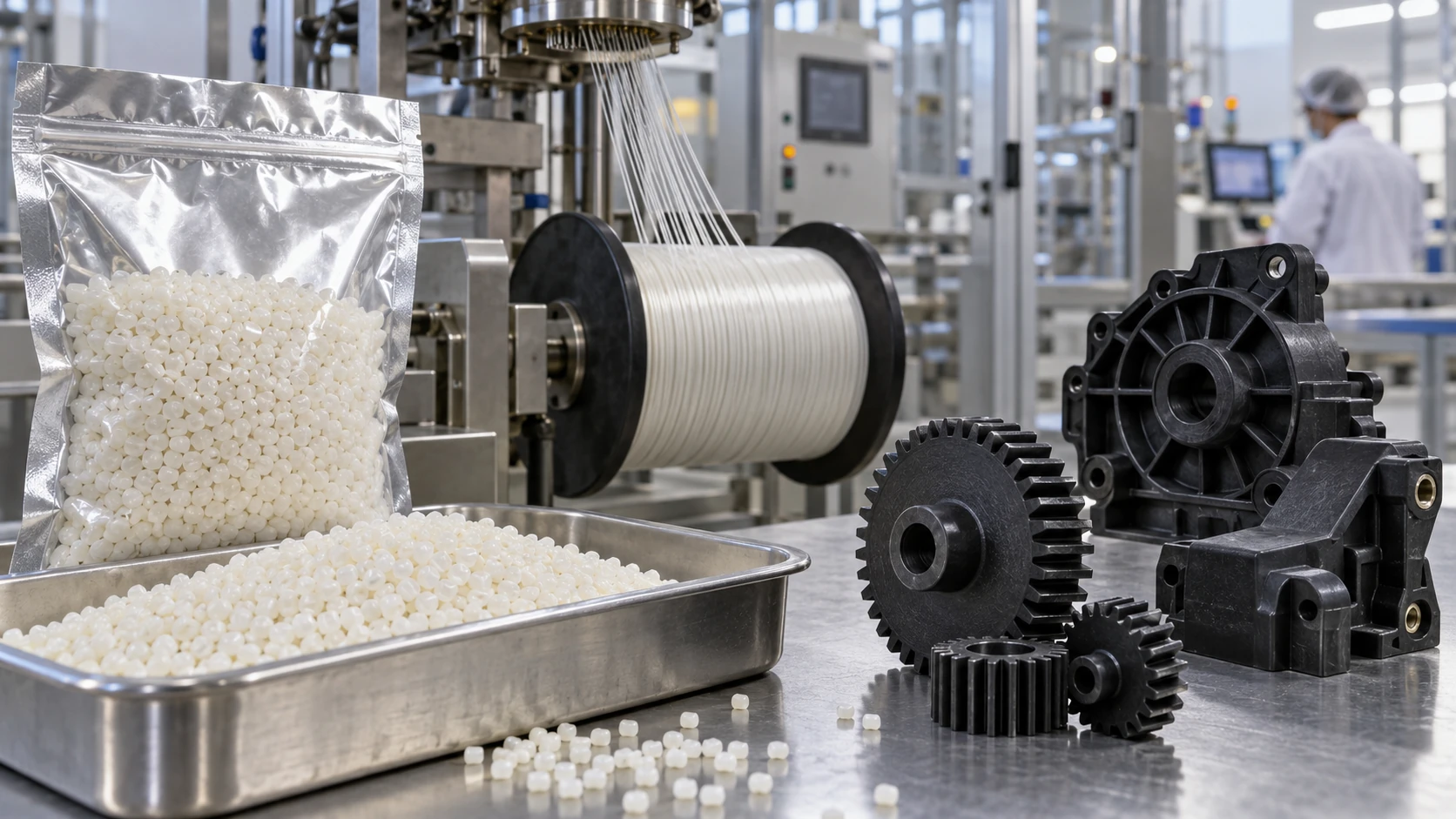
- What a polyamide is (the short version)
- Molecular structure — the amide group and hydrogen bonding
- What carbon-chain length decides — amide group concentration and water uptake
- A map of the family — from aliphatic to semi-aromatic and fully aromatic
- A materials engineer's view (1): what changes when nylon absorbs water
- A materials engineer's view (2): how long does water take to get inside?
- Long-chain and bio-based nylons
- Semi-aromatic polyamides and aramids
- How polyamides are used in vehicles and electronics
- A materials engineer's view (3): processing starts with drying
- Recycling — three routes
- What is still uncertain, and what this article leaves out
- Glossary / References / Claim-to-source audit
Sourced = content stated in published material, a standard or a paper (link given)
Our calculation = a value this article derived from stated assumptions
Not yet confirmed = a plan or outlook with no confirmed track record
Structural readings and materials-design interpretations are marked separately as Commentary.
Property values are manufacturers' stated values. Values for different grades, test methods and conditions are not lined up to rank one against another.
1. What a polyamide is (the short version)
- A thermoplastic whose backbone repeats the amide group (–CONH–). Toray positions its Amilan nylon resins as thermoplastic engineering plastics with amide linkages, and offers nylon 6, 66 and 610 together with various copolymer nylonsSourced [Ref. 1].
- The strength and the weakness come from the same amide group. Amide groups hydrogen-bond to neighbouring chains, which gives a high melting point and strength, but they also pull in water, so absorbed water changes dimensions and stiffnessSourced [Refs. 1, 2] (tying this to the structure is our commentary).
- There are three design axes: the length of the carbon chain (amide group concentration), the introduction of aromatic rings into the backbone, and moisture control (drying and conditioning). This article is organised around those three axes (our commentary).
Toray describes nylon 6 and nylon 66 as crystalline resins whose melting point is exceptionally high even among general-purpose engineering plasticsSourced [Ref. 1]. Yet Toray's technical documentation opens by explaining that nylon changes dimensions as it absorbs water, treating this as a premise of designSourced [Ref. 2]. In other words, this is a material you have to select on the understanding that numbers for the dry state are not enough on their own.
Our explainers on polymer fundamentals, thermoplastics versus thermosets, and glass transition and creep cover the basics of crystallinity, glass transition and creep. Polyimides, ultra-high-temperature resins such as PEEK, recycling in general (plastic recycling and chemical recycling) and bio-based plastics each have their own explainer. This article stays with the subject those pieces build on: polyamide itself.
2. Molecular structure — the amide group and hydrogen bonding
The numbers in a polyamide's name count carbon atoms in the raw materials (our commentary). A single number marks a type made from one amino acid or one lactam, and it is that molecule's carbon count. Two numbers mark a type made from a diamine and a dicarboxylic (dibasic) acid; the first is the carbon count of the diamine and the second that of the diacid. Here are real examples, checked against manufacturers' descriptions.
- PA11: Arkema's Rilsan is a polymer of 11-carbon aminoundecanoic acid, made by cleaving the 18-carbon chain of castor oilSourced [Ref. 13].
- PA610: Evonik's VESTAMID Terra HS is a polycondensate of hexamethylenediamine and sebacic acid (a 10-carbon diacid)Sourced [Ref. 14].
- PA1010: VESTAMID Terra DS is a polycondensate of decamethylenediamine and sebacic acid, with both raw materials derived from castor oilSourced [Ref. 14].
- PA6: Aquafil regenerates nylon 6 waste by breaking it down to its original monomer, caprolactamSourced [Ref. 18]. Nylon 6 is made by ring-opening polymerisation of ε-caprolactam (commentary).
Nylon 66 is made from hexamethylenediamine and adipic acid (a 6-carbon diacid) (commentary). The naming of polyamides for moulding and extrusion (PA 6, PA 66, PA 610, PA 11, PA 12 and so on) and the basis for specifying them are set out in ISO 16396-1, which defines the designation system and basis for specifications for polyamide moulding and extrusion materialsSourced [Ref. 28].
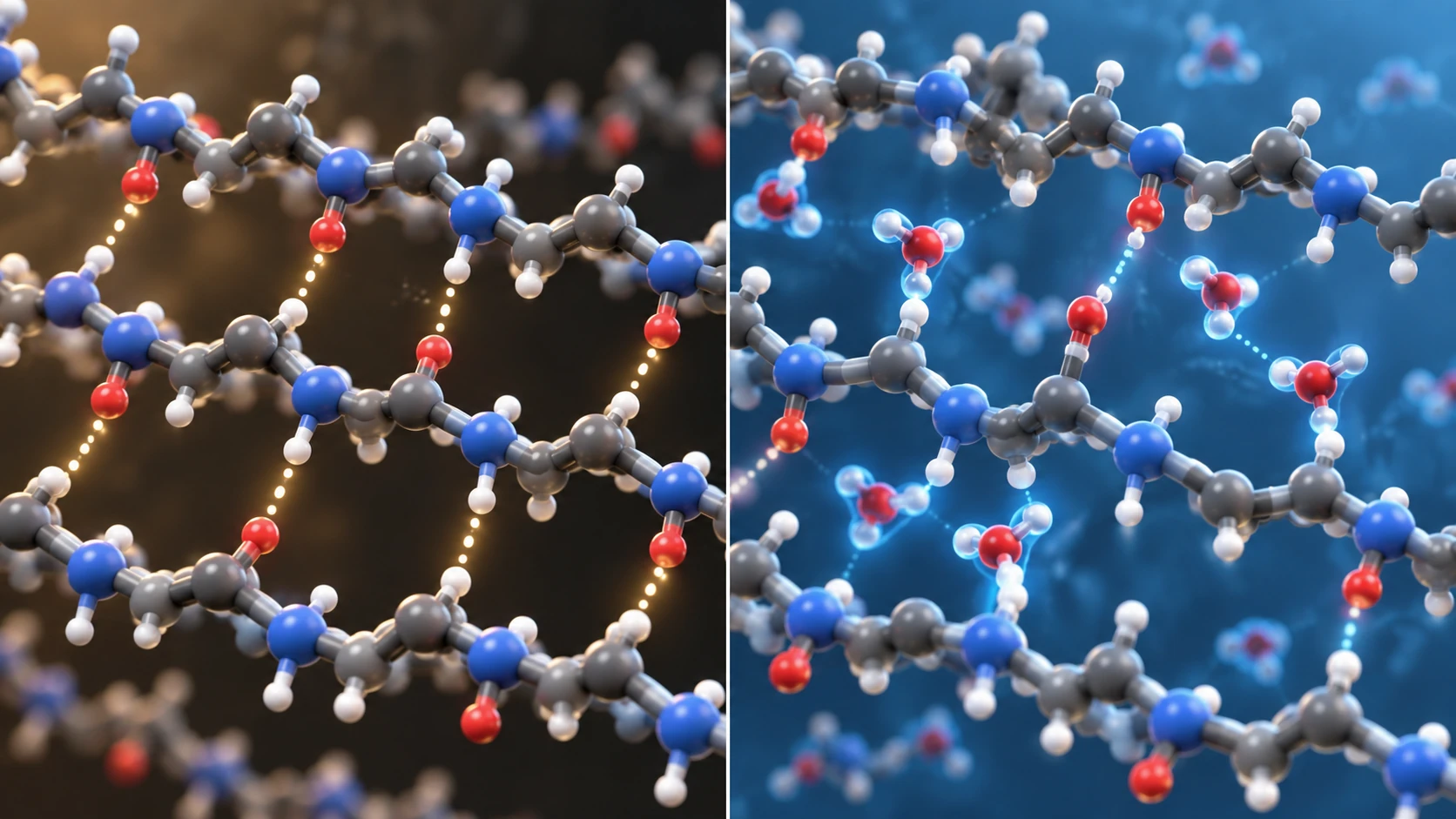
ImageGen conceptual illustration (not a real photograph or measurement). See the original diagram for exact values, names and structure.
Show original diagram with exact annotations and values
The N–H of an amide group donates a hydrogen and the C=O accepts one. That is why neighbouring chains attract each other strongly, why the melting point is high and why the resin resists oilSourced [Refs. 1, 3] (Toray explains that the amide groups strengthen the bonds between molecules and give resistance to many chemicals and to water including seawater). And water molecules can hydrogen-bond to exactly the same N–H and C=O. The source of the strength and the door for water are the same property at the same place (our commentary).
Turn that around and you have the three moves of polyamide design: reduce the number of amide groups, lock them inside crystals, or stiffen the chain with aromatic rings. The sections that follow trace how each of the three is used.
The same number of amide groups does not mean the same melting point, however. BASF's published figures for unreinforced grades are a melting point of 220 °C for nylon 6 and 260 °C for nylon 66 (ISO 3146, product information)Sourced [Refs. 4, 5]. Both have the same number of amide groups per repeat unit (8.84 mmol/g in the calculation below), so the difference in melting point reads as a difference in how the chains pack (the crystal structure) (our commentary).
3. What carbon-chain length decides — amide group concentration and water uptake
Kuraray explains that the water absorption of a polyamide is governed by its amide group concentration, and that PA9T, with its long-chain diamine structure, has a low concentration and so absorbs little waterSourced [Ref. 11]. Let us calculate that "amide group concentration" from the formula weight of the repeat unit.
We take the formula weight of each repeat unit from atomic weights (C 12.011, H 1.008, N 14.007, O 15.999) and work out the millimoles of amide linkage per gramOur calculation.
- PA6: repeat unit C6H11NO (113.16) with one amide linkage → 1000 ÷ 113.16 = 8.84
- PA66: C12H22N2O2 (226.32) with two amide linkages → 2000 ÷ 226.32 = 8.84
- PA610: C16H30N2O2 (282.43) → 7.08 / PA1010: C20H38N2O2 (338.54) → 5.91
- PA11: C11H21NO (183.29) → 5.46 / PA12: C12H23NO (197.32) → 5.07
- PA9T: the ideal chain of a 9-carbon diamine and terephthalic acid, C17H24N2O2 (288.39) → 6.94
Assumptions and limits: these are ideal-chain calculations that ignore end groups, copolymer components, additives and plasticisers. For PA9T we assumed a composition of a 9-carbon diamine and terephthalic acid; this does not describe Kuraray's actual raw-material makeup (Kuraray says only "long-chain diamine structure", and the detailed composition could not be confirmed within the scope of this article).
As the carbon chain gets longer, the amide group concentration falls from 8.84 (PA6, PA66) to 7.08 (PA610), 5.91 (PA1010), 5.46 (PA11) and 5.07 (PA12)Our calculation. Toray's technical documentation gives the equilibrium water absorption under normal atmospheric conditions (23 °C, 60% RH) as 3.5% for nylon 6, 2.5% for nylon 66 and 1.5% for nylon 610Sourced [Ref. 2]. Toray's product page likewise puts the water absorption of its nylon 610 CM2000 series at about half that of nylon 6 and 66Sourced [Ref. 1].
| Material (source grade) | Water absorption | Conditions and notes | Source |
|---|---|---|---|
| Nylon 6 (Toray Amilan CM1017) | 3.5% | Equilibrium absorption, 23 °C / 60% RH | Toray [2] |
| Nylon 66 (Toray Amilan CM3001-N) | 2.5% | Same | Toray [2] |
| Nylon 610 (Toray Amilan CM2001) | 1.5% | Same | Toray [2] |
| PA6 (BASF Ultramid B27 E, unreinforced) | 2.2% | 23 °C / 50% rh. Saturation in water (23 °C) is 8.5% | BASF [4] |
| PA66 (BASF Ultramid A27 E, unreinforced) | 2.2% | 23 °C / 50% rh. Saturation in water (23 °C) is 8.5% | BASF [5] |
| PA610 (Evonik VESTAMID Terra HS16) | 3.3% | "Water absorption at RT" (Evonik in-house method; detailed conditions not given) | Evonik [14] |
| PA1010 (Evonik VESTAMID Terra DS16) | 1.8% | Same | Evonik [14] |
All are the companies' published values (Sourced). Humidity, test method, specimen shape and grade all differ, so the figures in this table cannot be compared directly with one another. Even for the same "PA610", for example, Toray gives 1.5% (equilibrium at 23 °C / 60% RH) and Evonik 3.3% (RT, in-house method).
PA6 and PA66 have the same calculated amide group concentration (8.84)Our calculation. Yet Toray's published values are 3.5% and 2.5%, while BASF's are 2.2% for both (at 23 °C / 50% rh)Sourced [Refs. 2, 4, 5]. That the same material gives different figures depending on the source shows that water absorption is not a number set by the type of resin alone.
A classic 1967 study (Puffr and Šebenda), working from sorption and desorption isotherms of water in crystalline polyamides (nylons 2, 3, 6, 7, 8 and 11), in amorphous polyamides and in model amides, proposed that in nylon 6 three water molecules bind to every pair of neighbouring amide groups, and in nylons 8 to 12 one water molecule binds to every pairSourced [Ref. 23]. The water goes to amide groups in the "accessible region", which reads as meaning that amide groups locked inside crystals are hard for water to use (our commentary). If moulding conditions change the crystallinity, the same resin can take up a different amount of water.
The practical lesson is simple. Always read a catalogue water absorption figure together with the temperature, the relative humidity, the specimen, and whether it is saturation or equilibrium. Anything else is not a comparison.
4. A map of the family — from aliphatic to semi-aromatic and fully aromatic
Here is everything so far on one map. The horizontal axis is amide group concentration; the vertical axis is whether the backbone contains aromatic rings.
Below are the melting points and similar data published by each company, kept separate by source. Even for the same "nylon 6", BASF gives 220 °C and Toray 225 °C, which shows that figures shift with grade and measurement method.
| Material | Melting point, Tg, etc. | Conditions and notes | Source |
|---|---|---|---|
| PA6 (Ultramid B27 E) | Melting point 220 °C | ISO 3146, manufacturer's stated value (product information) | BASF [4] |
| PA6 (Amilan) | Melting point 225 °C | As given on the product page. The deflection temperature under load (1.80 MPa) of the glass-fibre-reinforced grade is 215 °C | Toray [1] |
| PA6 (Amilan) | Melting point 225 °C | As given in the technical documentation. The maximum continuous-use temperature under load is normally said not to exceed 70 °C | Toray [2] |
| PA66 (Ultramid A27 E) | Melting point 260 °C | ISO 3146, manufacturer's stated value | BASF [5] |
| PA66 (Amilan) | Melting point 265 °C / 255 °C | The product page gives 265 °C (deflection temperature of the glass-fibre-reinforced grade 255 °C); the technical documentation gives 255 °C. Continuous use under load is normally said not to exceed 100 °C | Toray [1, 2] |
| PA610 (VESTAMID Terra HS16) | Melting point 223 °C, Tg 48 °C | ISO 11357 | Evonik [14] |
| PA1010 (VESTAMID Terra DS16) | Melting point 200 °C, Tg 37 °C | ISO 11357 | Evonik [14] |
| PA11 (Rilsan BMNO TLD) | Melting point 189 °C | DSC, 10 °C/min. Operating temperature range −40 °C to +130 °C (stated for PA11 in general) | Arkema [13, 34] |
| PA9T (Genestar) | Melting point 306 °C, Tg 125 °C | Manufacturer's stated value | Kuraray [10] |
| Modified PA6T (ARLEN) | Melting point 310 to 330 °C | Manufacturer's stated value. A semi-aromatic polyamide using terephthalic acid | Mitsui Chemicals [12] |
All are the companies' published values (Sourced). Test methods, grades and measurement conditions differ, so this is not a table for ranking the figures. As for test-method standards, melting temperature by DSC is specified in ISO 11357-3 [Ref. 31] and deflection temperature under load in ISO 75-1 [Ref. 30].
- Left to right (amide group concentration falling): water uptake gets smaller and the melting point and Tg tend to fall (260 °C for PA66 against 200 °C for PA1010 and 189 °C for PA11). Heat resistance goes down in exchange for dimensional stability and low-temperature flexibility.
- Top to bottom (more aromatic rings): the melting point and Tg rise sharply (PA9T has a melting point of 306 °C and a Tg of 125 °C). Kuraray explains that with a Tg of 125 °C the material stands up well even inside a hot engine compartmentSourced [Ref. 11].
- Continuous-use temperature is far below the melting point: Toray says that for continuous use under load, even nylon 66 normally should not exceed 100 °C, and nylon 6 and 610 should not exceed 70 °CSourced [Ref. 2]. Even for resins that melt at 220 to 260 °C, the usable temperature is less than half the melting point (our commentary; for the link to creep, see our explainer on glass transition and creep).
5. A materials engineer's view (1): what changes when nylon absorbs water
Toray's technical documentation begins by saying that nylon absorbs water because of its hydrophilic amide groups, and that this absorption causes dimensional changeSourced [Ref. 2]. The size of the change is given as an expansion of about 0.2 to 0.3% for every 1% of water absorbedSourced [Ref. 2].
So what happens to strength and stiffness? First, for glass-fibre-reinforced (30%) grades, here are the "dry" and "conditioned (cond.)" values from BASF's product information. BASF states that tensile properties were measured by ISO 527-1/-2 [Ref. 29], deflection temperature under load by ISO 75-1/-2, and water absorption by a method "similar to" ISO 62 [Ref. 26] [Ref. 6].
| Item (ISO, 23 °C) | PA6-GF30 Ultramid B3EG6 dry / cond. | PA66-GF30 Ultramid A3WG6 LT dry / cond. |
|---|---|---|
| Tensile modulus (ISO 527-1/-2), MPa | 9,500 / 6,200 | 10,000 / 6,800 |
| Stress at break (ISO 527-1/-2), MPa | 185 / 115 | 190 / 127 |
| Strain at break (ISO 527-1/-2), % | 3.5 / 8 | 3.6 / 6.5 |
| Flexural modulus (ISO 178), MPa | 8,600 / 5,000 | 9,270 / 6,500 |
| Charpy impact, notched, 23 °C (ISO 179/1eA), kJ/m² | 15 / 30 | 10 / 13 |
All are BASF's published values (Sourced) [Refs. 6, 7].
In both grades, once conditioned the modulus falls to about two-thirds of the dry value and so does the stress at break, while strain at break lengthens and notched impact risesOur calculation (retention for PA6-GF30: 65% of modulus and 62% of stress at break; for PA66-GF30: 68% and 67%). So it is not only that "strength falls": the character of the material swaps at the same time, from brittle towards tough.
Without glass fibre, the change looks larger still. Here are the values for nylon 6 (CM1017) and nylon 66 (CM3001-N) from Toray's technical documentation.
| Item | Nylon 6 (CM1017) dry → equilibrium water uptake | Nylon 66 (CM3001-N) dry → equilibrium water uptake |
|---|---|---|
| Tensile strength, MPa | 85 → 40 | 80 → 50 |
| Tensile elongation at break, % | 150 → over 200 | 100 → over 200 |
| Flexural modulus, GPa | 3.0 → 1.0 | 2.8 → 1.4 |
| Izod impact, J/m | 50 → 400 | 50 → 300 |
| Rockwell hardness (R scale) | 119 → 90 | 119 → 100 |
All are Toray's published values (Sourced) [Ref. 2]. They are taken from the initial (0 years) column of the outdoor-exposure table, and the document does not state the test methods or specimen shapes.
In unreinforced nylon 6 the flexural modulus drops from 3.0 GPa to 1.0 GPa, to about a thirdSourced [Ref. 2]. A change of that size is better understood not as simply "weakened by water" but as water acting as a plasticiser and lowering the glass transition temperature (Tg) (our commentary). The way the Tg of nylon 6 varies with water content has been measured for a long time (Kettle, 1977, Polymer; confirmed from the title)Sourced [Ref. 24]. Toray gives the same explanation: on absorbing water, water molecules coordinate to the amide groups, molecular motion becomes more active, flexibility increases and toughness improvesSourced [Ref. 1].
Evonik publishes a Tg of 48 °C for PA610 and 37 °C for PA1010 (ISO 11357)Sourced [Ref. 14]. These are probably dry-state values, though the document does not state the conditioning. If the Tg sits a little above room temperature, then whether absorbed water pushes the Tg below room temperature is the line between a "hard plastic" and a "supple resin" (our commentary; specific figures of water content against Tg are not given here, because the original source could not be checked within the scope of this article).
There are three implications for design.
- Evaluate in both "dry" and "conditioned" states: this is why BASF's datasheets list dry and cond. side by side. If you design on stiffness, use the cond. values; if you design on impact or brittle fracture, check the dry values as well.
- Dimensions move with water uptake: at 0.2 to 0.3% expansion per 1% absorbed, an equilibrium uptake of 3% means an expected dimensional change of 0.6 to 0.9%Our calculation (a simple multiplication of Toray's coefficient; it will be smaller for glass-fibre-reinforced grades or depending on shape).
- Dimensions straight after moulding combine "dry state plus residual stress": Toray explains that a dry moulded part shrinks as moulding residual stress relaxes while water uptake makes it swell, so the real dimensional change is the net of the twoSourced [Ref. 2].
6. A materials engineer's view (2): how long does water take to get inside?
There is one more point that is easy to miss: water does not get in quickly. Toray's documentation includes a worked example in which a nylon 6 (CM1017) disc, 60 mm in diameter and 3 mm thick, takes about 4,110 hours in air at 20 °C / 60% RH to reach 80% of its equilibrium water uptakeSourced [Ref. 2]. Full equilibrium, it says, takes about 2.5 times as long (about 10,275 hours).
Using the diffusion coefficient in Toray's document (6.31×10⁻¹⁴ m²/s for an injection-moulded part at 20 °C / 60% RH), let us calculate how the time changes with wall thickness.
Assumptions: a one-dimensional diffusion plate absorbing from both faces, with the diffusion coefficient D held constant at Toray's published value (20 °C / 60% RH)Our calculation. With wall thickness h, the time to 80% is t = π × 0.8² × h² ÷ (16 × D).
Cross-check: for Toray's disc (60 mm diameter × 3 mm, surface-to-volume ratio ω = 733 m−1), the equivalent formula t = π × 0.8² ÷ (4 × ω² × D) with D = 6.31×10⁻¹⁴ gives about 4,118 hours, matching Toray's published figure (about 4,110 hours). In water (20 °C, D = 7.84×10⁻¹³) it also gives about 331 hours, matching Toray's roughly 330 hours.
- 1 mm wall: about 553 hours (about 23 days)
- 3 mm wall: about 4,979 hours (about 207 days). This is longer than for the disc because the disc also absorbs through its edge faces.
- 6 mm wall: about 19,915 hours (about 830 days, a little over two years)
Limits: real parts vary greatly with shape, crystallinity, temperature, humidity and surface finish. And the assumption that the diffusion coefficient is independent of concentration is an approximation.
The time grows with the square of the wall thickness (double the thickness and it takes four times as long)Our calculation. Even a 3 mm part needs more than half a year in air to approach equilibrium. So a part that has just shipped is in a halfway state, neither dry nor conditioned: the surface has taken up water while the interior is still dry (our commentary).
Two practical cautions follow.
- Test specimens are thin: a state reached by conditioning specimens quickly is not the state a real part reaches in the field. ISO 1110 defines a method for accelerated conditioning of polyamide specimens, and the equilibrium water content obtained is said to be close to that in the standard atmosphere of 23 °C / 50% RHSourced [Ref. 27]. The standard also states, however, that mechanical properties obtained this way may differ slightly from those of specimens conditioned in the standard atmosphere.
- The progress of water uptake itself moves dimensions: a design dimension changes depending on whether it is measured dry, conditioned or somewhere in between. For precision parts you need an operating decision, either to allow for dimensions that drift over months in the service environment or to condition the part beforehand (our commentary).
7. Long-chain and bio-based nylons
Long-chain nylons such as PA11, PA12, PA610 and PA1010 lengthen the carbon chain to lower the amide group concentration. Because they absorb little water and hold their dimensions, they are used in tubing for fuel and other fluids, among other applications.
- PA11 (Arkema Rilsan): the 11-carbon amino acid unit forms crystals with a high density of hydrogen bonds. Compared with PA12 it is described as having a higher melting point, lower permeation of fuels and gases, and better impact properties. The operating temperature range is −40 °C to +130 °C. Production is stated to be in three countries: France, the US and ChinaSourced [Ref. 13].
- PA12 (Evonik VESTAMID L): Evonik describes it as absorbing very little water, with excellent dimensional stability and low-temperature impact resistance, and used in automotive fluid and air lines, large-diameter gas and oil pipes, cable sheathing, catheters and moreSourced [Ref. 15].
- PA610 and PA1010 (Evonik VESTAMID Terra): PA610 melts at 223 °C, and Evonik describes it as sitting between PA612 and the standard polyamides (PA6, PA66). PA1010 is made from a 10-carbon diamine and diacid, and Evonik places it between long-chain nylons such as PA12 and the standard polyamidesSourced [Ref. 14].
The castor-oil angle
Of the above, PA11, PA610 and PA1010 use castor oil as one raw material. According to Evonik, the bio-based content is 63% for VESTAMID Terra HS (PA610) and 100% for Terra DS (PA1010) (the document states carbon-based values according to ASTM 6866)Sourced [Ref. 14]. Toray describes its nylon 610 CM2000 series as a bio-based nylon in which sebacic acid extracted from castor oil accounts for about 60% of the raw materials, with water absorption about 50% lower than nylon 6 and 66 and excellent low-temperature flexibilitySourced [Ref. 1]. Environmental-impact figures from production, such as greenhouse gas emissions, are the manufacturers' own claims and are not covered here.
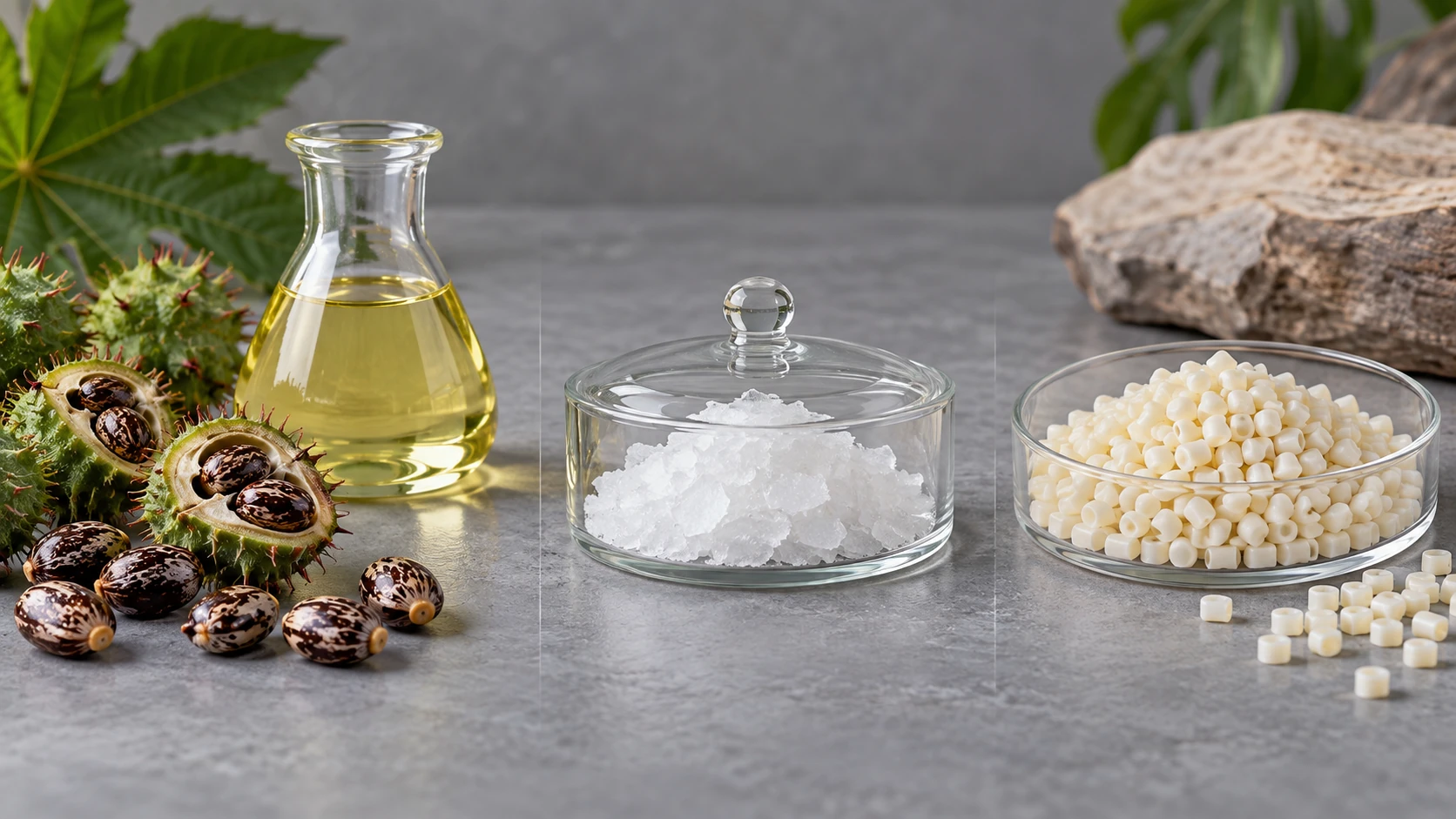
- "Bio-based" is a statement about where the carbon came from, not about performance. The gap between PA610 at 3.3% water absorption and PA1010 at 1.8% is explained not by the bio-based share but by the difference in amide group concentration (the calculation behind Fig. 2).
- Check how the content is defined: Evonik gives carbon-based values according to ASTM 6866 [Ref. 14]. They are not the same thing as mass-based or raw-material-based figures.
- Bio-based plastics in general are covered in our explainer on bioplastics.
8. Semi-aromatic polyamides and aramids
(1) Semi-aromatic — aromatic rings lift the Tg
Using terephthalic acid (which has an aromatic ring) as the dicarboxylic acid stiffens the backbone and raises the melting point and Tg. Kuraray's PA9T, Genestar, is described as having a melting point of 306 °C, a glass transition temperature of 125 °C, low water absorption, high heat resistance, high chemical resistance and dimensional accuracySourced [Ref. 10]. The company also cites resistance to blistering during reflow in board mounting, and high tracking resistance that suits it to high-voltage connectors such as USB Type-C and power semiconductor modulesSourced [Ref. 11].
Mitsui Chemicals' ARLEN is a modified polyamide 6T that uses terephthalic acid, which the company says it was the first in the world to develop, in the 1980s. Its melting point is 310 to 330 °C, and introducing aromatic rings is said to have cut water absorption to less than half that of PA66. The company says that modification with a third component gave it heat resistance sufficient for surface mounting with lead-free solder (reflow) while suppressing blistersSourced [Ref. 12].
Semi-aromatic polyamides push heat resistance higher within the polyamide toolkit. The amide groups are still there, though, so the water absorption problem has not disappeared; it has only become smaller. Both Kuraray and Mitsui Chemicals name post-reflow blistering as the issue and describe their designs as suppressing it [Refs. 11, 12]. Blistering is a phenomenon in which absorbed moisture suddenly turns to steam at high temperature (our commentary). So even with semi-aromatics, "drying" and "low water absorption" remain at the heart of the design.
Where still higher heat resistance or chemical resistance is needed, materials with no amide group, such as PPS, LCP and PEEK, take over. That is the subject of our explainer on PEEK and super engineering plastics.
(2) Aramids — how the law tells them from "nylon"
Aramids are polyamides in which nearly all the amide linkages are attached directly to aromatic rings. The US federal regulation 16 CFR 303.7 (generic names and definitions for textile fibres) defines nylon as a long-chain synthetic polyamide in which less than 85% of the amide linkages are attached directly to two aromatic rings, and aramid as the same kind of polyamide in which at least 85% of the amide linkages are attached directly to two aromatic ringsSourced [Ref. 17]. So in law the line between "nylon" and "aramid" is drawn at whether 85% of the backbone's amide linkages are bonded directly to aromatic rings.
Teijin Aramid explains that its para-aramid Twaron is made in three stages: polymerisation, spinning and finishing. In polymerisation it makes a fine particulate para-aramid polymer with high heat and chemical resistance; in spinning it dissolves that polymer in sulfuric acid to form a liquid-crystalline solution and spins it into yarn. The filaments are about 12 µm in diameter, with the molecular chains aligned parallel to the fibre axisSourced [Ref. 16].
What this tells us is that aramid is a material that is dissolved and spun (solution spinning), processed differently from the nylons used for moulded parts (our commentary). Teijin Aramid makes yarn from a liquid-crystalline solution in sulfuric acid, which is a different route from nylon 66 (melting point 260 °C, BASF), which is melted and moulded. The company explains that the alignment of the chains parallel to the fibre axis is the key to the fibre's properties. For composites using aramid fibre, see our explainer on CFRP and composites.
9. How polyamides are used in vehicles and electronics
This section sorts the applications named in the companies' published material, together with the properties given as the reasons the materials are chosen. The reasons column records what each company says about its own material; it is not a comparison with other materials.
| Field | Example applications (as stated) | Properties given as the reason for choosing it | Source |
|---|---|---|---|
| Automotive (engine bay and drivetrain) | Clips, fasteners, oil strainers, baffle plates, cooling parts such as radiator tanks | Oil and chemical resistance, long-term heat resistance, weldability. For cooling parts, glass-fibre-reinforced PA66 and PA610 are said to be used | Toray [1] |
| Automotive (fuel and fluid systems) | Fuel management systems, hydrogen fuel systems, tubing and hoses (PA11) / fluid and air lines (PA12) | Operating temperature −40 °C to +130 °C (PA11), low water absorption, dimensional stability, low-temperature impact resistance | Arkema [13] Evonik [15] |
| Automotive (electrical and mechanisms) | Connectors, relays, insulators, wire harnesses, sliding parts (gears, bearing retainers), fuel parts, intercooler tanks, thermostat housings (PA9T) | Low water absorption, high heat resistance, chemical resistance, dimensional accuracy, tracking resistance | Kuraray [10] |
| Electrical (power distribution) | Housings for circuit breakers (moulded-case breakers) | Flame retardancy (most grades said to meet UL94 V-0), thermal stability | Toray [1] |
| Electronics (board mounting) | Connectors, jacks, camera modules, switches, LED reflectors (PA9T) / connectors and jacks (modified PA6T) | Reflow heat resistance, suppression of blistering, low water absorption, high tracking resistance | Kuraray [10, 11] Mitsui Chemicals [12] |
| Electrical and electronics (general-purpose polyamides) | BASF offers PA6, PA66, copolymers, polyamide blends and high-temperature semi-aromatics and PPA, and describes applications from automotive to electrical and household appliances. It states that its high-flow, fast-crystallising HPP grades can shorten the moulding cycle by about 30%, and gives a CTI of 600 | High strength and stiffness, ease of moulding, chemical resistance, sliding properties, dimensional stability, low creep tendency | BASF [32] |
All are statements in the companies' published material (Sourced). The figures (about 30% shorter cycles for HPP, CTI 600) are BASF's statements about its own specific grades and are not properties of polyamides in general.
Let us also check some specific figures for chemical resistance. In Toray's technical documentation, the tensile strength of nylon 6 (CM1017) is 85 MPa unimmersed, 72 MPa after 1,000 hours in engine oil at 80 °C, and 66 MPa after 1,000 hours in gasoline at 80 °CSourced [Ref. 3] (no test method is given). The same document warns that nylon dissolves in concentrated sulfuric, nitric and hydrochloric acids (with some hydrolysis), and that 5% sulfuric acid and 5% sodium hydroxide solution cause stress cracking (solvent cracking)Sourced [Ref. 3].
10. A materials engineer's view (3): processing starts with drying
Polyamides must be dried before they are melted and moulded. Here are the actual numbers from BASF's product information.
| Item | Published content | Grade and source |
|---|---|---|
| Supply form | Supplied pre-dried in moisture-proof containers. Storage should not exceed 12 months. An opened bag should be used up at once to avoid moisture pick-up | PA6 B27 E, PA66 A27 E (unreinforced) [4, 5] |
| Pellet moisture content (shipping specification) | Maximum 0.10% (B27 E), maximum 0.20% (A27 E). Measured to ISO 15512 [33] | BASF [4, 5] |
| Drying after moisture pick-up | Dehumidifying dryer, dew point −20 °C or lower, recommended time 2 to 4 hours | PA66-GF33 A 218G V33 and others [8] |
| Pre-drying conditions | Temperature 80 °C. Allowable moisture content at moulding is at most 0.15% (A 218G V33) / 0.2% (B3WG6 RC). B3EG6: 80 °C for 4 hours | BASF [6, 8, 9] |
| Example melt and mould temperatures | PA6-GF30 (B3EG6): melt 270 to 290 °C, mould 80 to 90 °C | BASF [6] |
All are BASF's manufacturer's stated values (Sourced). They differ by grade and cannot be applied as they are to other grades.
Drying is needed because water can react with the amide linkages in the melt. Polyamide is synthesised by a condensation reaction that releases water, and the reverse reaction (hydrolysis) can occur where there is water at high temperature (our commentary). That hydrolysis of polyamide changes the molecular weight distribution has long been studied (Chaupart and Serpe, 1998, Polymer; confirmed from the title)Sourced [Ref. 25]. Lower molecular weight means lower strength and toughness. The moisture content before melting is therefore part of the molecular weight, and so of the final properties, of the moulded part (our commentary).
BASF's product information for PA6-GF30 (Ultramid B3EG6) gives a coefficient of linear thermal expansion of 22×10−6/K in the flow direction and 106×10−6/K in the transverse direction (ISO 11359-1/-2, 23 to 55 °C). Moulding shrinkage is 0.25% in the flow direction and 0.70% in the transverse direction (ISO 294-4)Sourced [Ref. 6]. Taking ratios, the anisotropy is about 4.8 times for linear expansion and about 2.8 times for moulding shrinkageOur calculation (106 ÷ 22 and 0.70 ÷ 0.25).
Lay the dimensional change from water uptake over this anisotropy and warpage becomes hard to predict. Directions restrained by the glass fibre barely stretch, while unrestrained directions show the resin's own value (our commentary). The idea of CTE is covered in our explainer on the thermal expansion coefficient, and shrinkage and orientation in moulding in our explainer on moulding.
11. Recycling — three routes
Three routes to recycling polyamide currently appear in the published material.
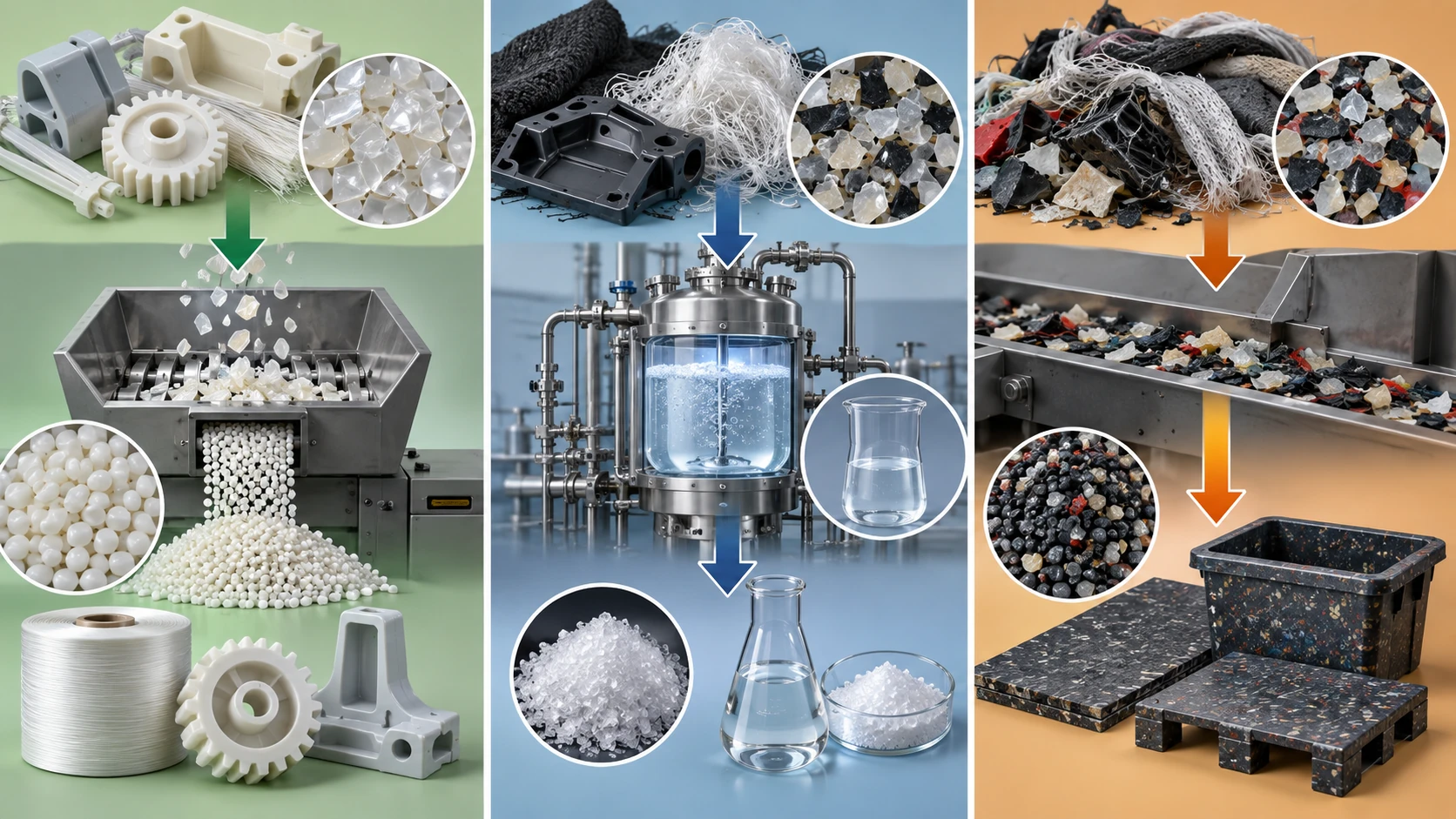
ImageGen conceptual illustration (not a real photograph or measurement). See the original diagram for exact values, names and structure.
Show original diagram with exact annotations and values
(1) Mechanical recycling — the fibres get shorter
One study took in-process scrap of PA66-GF30 (30% glass fibre), common in automotive parts, put it through three cycles of grinding, re-pelletising and re-moulding, and blended it into virgin material at 15 to 30 wt% (e-Polymers, 2023). Thermal analysis showed no large change in thermal stability or crystallinity with the number of cycles or the recycled fraction. The mean fibre length, however, fell from 300–350 µm to 150–250 µm, and changes in mechanical properties and melt flow stood out where the recycled fraction exceeded 25 wt% and three cycles had been completed. Tensile strength, modulus and impact energy dropped slightly, while elongation at break and melt flow index roseSourced [Ref. 20].
(2) Chemical recycling — back to the monomer
Aquafil explains that it chemically recycles nylon 6 waste (fishing nets, fabric offcuts, carpet and industrial plastics) by depolymerising it back to the original monomer. The company states that, unlike mechanical recycling, this gives nylon of the same quality as newSourced [Ref. 18] (the company's own account).
In the academic literature, a review compares chemical recycling methods that return nylon 6 to ε-caprolactam (alcoholysis, and neutral, acidic and alkaline hydrolysis) and points out that only a small fraction of nylon 6 waste is actually returned chemically to caprolactam. In its simulations alkaline hydrolysis is the most energy-efficient, and at a scale of 12,000 tonnes of caprolactam a year, alkaline and acidic hydrolysis and alcoholysis all pay back within five yearsSourced [Ref. 22] (an estimate under the review's own assumptions, not a measure of the profitability of any real business).
Another study (Gama et al., 2024) reports that when polyamide waste is decomposed with hydrochloric acid at 100 °C for 4 hours and the products are blended into new polyamide at up to 10 wt%, stiffness rises, and so do the glass transition temperature and melt flow indexSourced [Ref. 21].
(3) Feedstock recycling and mass balance
BASF's Ultramid Ccycled uses pyrolysis oil, obtained by pyrolysing plastic waste and end-of-life tyres, in place of fossil feedstock at the start of production. The recycled share is allocated to products by a mass-balance approach audited by a third partySourced [Ref. 19]. BASF says that for this reason the properties are the same as those of the fossil-based product and the material processes like a standard grade [Refs. 6, 19]. BASF's product information for PA6-GF30 likewise notes that, because it is a mass-balance product, the product properties do not changeSourced [Ref. 6].
The three routes above affect properties in entirely different ways (our organisation).
- Mechanical: properties fall as molecular weight and glass fibre length fall. They can be managed through how it is used (blend ratio, number of cycles).
- Chemical (depolymerisation): because it returns to the monomer, properties should in principle recover, but sorting the waste, purification and cost are the problems (the gist of the review [22]).
- Feedstock (mass balance): properties do not change. In exchange, the recycled raw material is not necessarily physically present in the product's pellets. The recycled quantity is allocated on paper (BASF's description uses the word allocate). When reading an environmental claim you need to check in which sense "recycled" is meant.
BASF's preliminary datasheet for a glass-fibre-reinforced PA6 (B3WG6 RC) labels it a grade containing recycled raw materialSourced [Ref. 9], but which route the recycled material came from, and how the content is defined, cannot be confirmed from that document.
12. What is still uncertain, and what this article leaves out
- Specific figures linking water content and Tg: Tg values by water content could not be confirmed in the material we were able to open. We do not quote figures from the paper [24], whose existence we confirmed from its title.
- The conditioning conditions behind BASF's "cond.": they are not stated in the two datasheets we cited.
- The reality of chemical recycling of PA66: Aquafil's explanation is limited to nylon 6, and we could not confirm primary sources for a comparable business in PA66.
- The actual raw-material composition of PA9T: Kuraray describes a long-chain diamine structure, but the calculation here (Fig. 2) assumes an ideal chain.
- Production volumes, recycling rates and market size: not covered, because our policy is not to use estimates from market research firms. Figures from public statistics or industry bodies are left to a separate article once their definitions and years have been checked.
- Companies' environmental-impact figures (CO₂ reduction rates and the like): not given, because they are the manufacturers' own claims and we have not confirmed any third-party assessment.
- Both the strength and the water uptake come from the amide group. PA6 and PA66 have the same calculated amide group concentration (8.84 mmol/g), and it falls as the carbon chain lengthensOur calculation.
- Water uptake is a design variable. Even with 30% glass fibre, the modulus and stress at break after conditioning are about two-thirds of the dry values, and strain at break lengthensSourced.
- Water takes time to get in. We estimate about 207 days to reach 80% of equilibrium in a 3 mm flat plateOur calculation.
- Continuous-use temperature is well below the melting point. Toray says that under load PA66 normally should not exceed 100 °C, and PA6 and PA610 should not exceed 70 °CSourced.
- Recycling has three routes, with different effects on properties. Mechanical recycling shortens the fibres, chemical recycling returns the monomer, and mass balance is an allocation concept.
13. Glossary
- Polyamide (PA)
- A polymer whose backbone repeats the amide linkage (–CONH–). The aliphatic ones are generally called nylons.
- Amide group
- –CONH–. Its N–H donates hydrogen and its C=O accepts it, so it hydrogen-bonds to other chains and to water molecules.
- Hydrogen bond
- A comparatively strong attraction between molecules, acting between N–H and C=O and similar groups. The source of polyamide's melting point and strength, and of its water uptake.
- Amide group concentration
- The amount of amide linkage per gram of resin (mmol/g in this article). The lower it is, the less the resin tends to absorb water.
- PA6 and PA66
- Nylon 6 and nylon 66. The first is made from a 6-carbon lactam (or amino acid); the second from a 6-carbon diamine and a 6-carbon diacid.
- Long-chain nylon
- PA11, PA12, PA610, PA1010 and the like. Long carbon chains and a low amide group concentration. They absorb little water and melt at lower temperatures.
- Semi-aromatic polyamide
- A polyamide with aromatic rings (from terephthalic acid, for example) in the backbone, such as PA9T and modified PA6T. High melting point and Tg.
- Aramid
- A polyamide in which at least 85% of the amide linkages are attached directly to two aromatic rings (the fibre definition in 16 CFR 303.7).
- Conditioning (cond.)
- The state in which a specimen has taken up water at a set humidity. ISO 1110 defines a method of accelerated conditioning.
- Equilibrium water absorption
- The water absorption once uptake stops increasing at a constant temperature and humidity. A different value from saturation in water.
- Glass transition temperature (Tg)
- The temperature at which the amorphous parts change from a hard glassy state to a soft rubbery one. It falls as the resin absorbs water.
- Blister
- A bulge caused when absorbed water turns to steam at high temperature, such as during reflow.
- Depolymerisation
- A reaction that breaks a polymer down to its monomer. For nylon 6 it returns caprolactam.
- Mass balance
- A method of allocating a quantity of recycled raw material to products on paper. The material is not necessarily physically present in the product.
14. References
- Toray "Nylon Resin AMILAN™" product introduction page (in Japanese) — www.plastics.toray
- Toray AMILAN™ technical data, "Physical properties" — www.plastics.toray
- Toray AMILAN™ technical data, "Chemical properties" — www.plastics.toray
- BASF Product Information, "Ultramid® B27 E", March 2024 (PDF) — chemicals.basf.com
- BASF Product Information, "Ultramid® A27 E", March 2024 (PDF) — chemicals.basf.com
- BASF Product Information, "Ultramid® B3EG6", February 2026 (PDF) — download.basf.com
- BASF Product Information, "Ultramid® A3WG6 LT BK", February 2026 (PDF) — download.basf.com
- BASF Product Information, "Ultramid® A 218G V33 BLACK 41N", October 2023 (PDF) — download.basf.com
- BASF Preliminary Datasheet, "Ultramid® B3WG6 RC BK23379", February 2024 (PDF) — download.basf.com
- Kuraray "GENESTAR™" product page (global) — www.kuraray.com
- Kuraray "What is GENESTAR®?" (Genestar business unit site; in Japanese) — genestar.kuraray.com
- Mitsui Chemicals "About ARLEN™", high-heat-resistant polyamide resin ARLEN™ — jp.mitsuichemicals.com
- Arkema "Rilsan® Polyamide 11 Resins" — hpp.arkema.com
- Evonik "VESTAMID® Terra Technical Biobased Polyamides" (PDF) — products.evonik.com
- Evonik "VESTAMID®" product page (PA12, PA612, PEBA) — www.evonik.com
- Teijin Aramid "How is Twaron® produced?" Twaron® brochure — product.teijinaramid.com
- US eCFR 16 CFR 303.7 "Generic names and definitions for manufactured fibers" — www.ecfr.gov
- Aquafil "Sustainability in Business with ECONYL® Regenerated Nylon" — econyl.aquafil.com
- BASF "Ultramid® Ccycled®" — chemicals.basf.com
- Gültürk, Berber "Effects of mechanical recycling on the properties of glass fiber–reinforced polyamide 66 composites in automotive components", e-Polymers 2023 — doi.org
- Gama et al. "Solvolysis of Nylon: A Pathway to Sustainable Recycling and Circular Economy", Sustainability 2024, 16, 9725 — doi.org
- Minor et al. "Chemical Recycling Processes of Nylon 6 to Caprolactam: Review and Techno-Economic Assessment", Chemical Engineering Journal 2023, 474, 145333 — doi.org
- Puffr, Šebenda "On the Structure and Properties of Polyamides. XXVII. The Mechanism of Water Sorption in Polyamides", J. Polym. Sci. C 1967, 16, 79 — doi.org
- Kettle "Variation of the glass transition temperature of nylon-6 with changing water content", Polymer 1977 — doi.org
- Chaupart, Serpe "Molecular weight distribution and mass changes during polyamide hydrolysis", Polymer 1998 — doi.org
- ISO ISO 62:2008 Plastics — Determination of water absorption — www.iso.org
- ISO ISO 1110:2019 Plastics — Polyamides — Accelerated conditioning of test specimens — www.iso.org
- ISO ISO 16396-1:2022 Plastics — Polyamide (PA) moulding and extrusion materials — Part 1: Designation system and basis for specifications — www.iso.org
- ISO ISO 527-1:2019 Plastics — Determination of tensile properties — Part 1: General principles — www.iso.org
- ISO ISO 75-1:2020 Plastics — Determination of temperature of deflection under load — Part 1: General test method — www.iso.org
- ISO ISO 11357-3:2025 Plastics — Differential scanning calorimetry (DSC) — Part 3: Determination of temperature and enthalpy of melting and crystallization — www.iso.org
- BASF "Ultramid® (PA)" product page (Engineering Plastics Finder) — plastics-rubber.basf.com
- ISO ISO 15512:2019 Plastics — Determination of water content — www.iso.org
- Arkema "Rilsan® BMNO TLD" grade page — hpp.arkema.com
15. Claim-to-source audit
| Claim in the text | Basis | Label |
|---|---|---|
| That Toray positions Amilan™ as a thermoplastic engineering plastic with amide linkages and offers nylon 6, 66 and 610 with copolymer nylons; that nylon 6 and 66 are crystalline resins with an exceptionally high melting point among general-purpose engineering plastics; that on absorbing water, water molecules coordinate to the amide groups, molecular motion becomes more active and flexibility and toughness increase; that the melting points of nylon 6, 66 and 610 are 225, 265 and 225 °C and the deflection temperatures under load (1.80 MPa) of the glass-fibre-reinforced grades are 215, 255 and 205 °C; that the nylon 610 CM2000 series is a bio-based grade with about 60% of its raw material from sebacic acid and has about 50% lower water absorption than nylon 6 and 66; the applications (clips, fasteners, powertrain parts, cooling parts, circuit breakers); and that most grades are said to meet UL94 V-0 | Toray product pageReference 1 https://www.plastics.toray/ja/products/amilan/ | Sourced |
| Equilibrium water absorption at 23 °C / 60% RH of 3.5% for nylon 6, 2.5% for nylon 66 and 1.5% for nylon 610; a dimensional expansion of about 0.2 to 0.3% per 1% of water absorbed; a diffusion coefficient (injection-moulded part, 20 °C / 60% RH) of 6.31×10⁻¹⁴ m²/s and in water (20 °C) of 7.84×10⁻¹³ m²/s; about 4,110 hours (in air) and about 330 hours (in water) to reach 80% of equilibrium for a 60 mm diameter × 3 mm disc, with full equilibrium taking about 2.5 times as long; melting points of 255 °C for nylon 66, 225 °C for nylon 6 and 220 °C for nylon 610; continuous use under load normally not exceeding 100 °C for PA66 and 70 °C for PA6 and PA610; the dry and equilibrium-water values for CM1017 and CM3001-N of tensile strength (85→40 and 80→50 MPa), flexural modulus (3.0→1.0 and 2.8→1.4 GPa), elongation at break, Izod impact (50→400 and 50→300 J/m) and Rockwell hardness (119→90 and 119→100) | Toray technical data, physical propertiesReference 2 https://www.plastics.toray/technical/amilan/tec_003.html | Sourced |
| Nylon 6 (CM1017) tensile strength of 85 MPa unimmersed, 72 MPa after 1,000 hours in engine oil at 80 °C and 66 MPa after 1,000 hours in gasoline at 80 °C; that it dissolves in concentrated sulfuric, nitric and hydrochloric acids, and that 5% sulfuric acid and 5% sodium hydroxide solution cause solvent cracking | Toray technical data, chemical propertiesReference 3 https://www.plastics.toray/technical/amilan/tec_004.html | Sourced |
| Ultramid B27 E (PA6, unreinforced): melting point 220 °C (ISO 3146); water absorption 2.2% at 23 °C / 50% rh and 8.5% at saturation in water at 23 °C; a pellet moisture specification of at most 0.10% (ISO 15512); storage within 12 months; an opened bag to be used up at once | BASF product information, Ultramid B27 EReference 4 https://chemicals.basf.com/dam/jcr:0716d34e-f456-45ca-80d2-0b6beb8ffc2d/TI%20Ultramid%20B27%20E_30644930.pdf | Sourced |
| Ultramid A27 E (PA66, unreinforced): melting point 260 °C (ISO 3146); water absorption 2.2% (23 °C / 50% rh) and 8.5% (saturation in water at 23 °C); a moisture specification of at most 0.20% | BASF product information, Ultramid A27 EReference 5 https://chemicals.basf.com/dam/jcr:3900add4-5175-4e68-832a-4590a3a3c131/TI%20Ultramid%20A27%20E%200324.pdf | Sourced |
| Ultramid B3EG6 (PA6-GF30): tensile modulus 9,500 / 6,200 MPa, stress at break 185 / 115 MPa, strain at break 3.5 / 8%, flexural modulus 8,600 / 5,000 MPa, notched Charpy 15 / 30 kJ/m² (dry / cond.); saturation in water 6.3 to 6.9%, equilibrium at 23 °C / 50% r.h. 1.9 to 2.3% (similar to ISO 62); coefficient of linear thermal expansion 22 (flow) and 106 (transverse) ×10−6/K (ISO 11359-1/-2, 23 to 55 °C); moulding shrinkage 0.25% (parallel) and 0.70% (transverse) (ISO 294-4); pre-drying 80 °C for 4 hours, melt 270 to 290 °C, mould 80 to 90 °C; that because of the mass-balance approach the product properties do not change | BASF product information, Ultramid B3EG6Reference 6 https://download.basf.com/p1/8a8081c57fd4b609017fd640cfa907fa/en/ULTRAMID%25C2%25AE_B3EG6 | Sourced |
| Ultramid A3WG6 LT BK (PA66-GF30): tensile modulus 10,000 / 6,800 MPa, stress at break 190 / 127 MPa, strain at break 3.6 / 6.5%, flexural modulus 9,270 / 6,500 MPa, notched Charpy 10 / 13 kJ/m² (dry / cond.) | BASF product information, Ultramid A3WG6 LT BKReference 7 https://download.basf.com/p1/8a8082587fd4b608017fd65c882559b5/en/ULTRAMID%253Csup%253E%25C2%25AE%253Csup%253E_A3WG6_LT_BLACK | Sourced |
| Ultramid A 218G V33 (PA66-GF33): drying after moisture pick-up (dehumidifying dryer, dew point −20 °C or lower, 2 to 4 hours), pre-drying temperature 80 °C, and an upper limit on allowable moisture content at moulding of 0.15% | BASF product information, Ultramid A 218G V33Reference 8 https://download.basf.com/p1/8a80828a8b13e68c018b3c4455e14216/en/Ultramid%25C2%25AE_A_218G_V33_BLACK_41N | Sourced |
| That Ultramid B3WG6 RC BK23379 (preliminary datasheet) is a grade containing recycled raw material, with pre-drying at 80 °C and an upper limit on allowable moisture content of 0.2% | BASF preliminary datasheet, Ultramid B3WG6 RCReference 9 https://download.basf.com/p1/8a80823b8dab6121018dcaa07ae55bc9/en/Ultramid%253Csup%253E%25C2%25AE%253Csup%253E_B3WG6_RC_BLACK_23379 | Sourced |
| PA9T Genestar: melting point 306 °C and glass transition temperature 125 °C; low water absorption, high heat resistance, high chemical resistance, dimensional accuracy; applications (connectors, jacks, camera modules, switches, LED reflectors, relays, insulators, wire harnesses, gears, fuel parts, intercooler tanks, thermostat housings and others) | Kuraray Genestar product pageReference 10 https://www.kuraray.com/global-en/products/genestar/ | Sourced |
| That the water absorption of polyamide is governed by amide group concentration and PA9T, with its long-chain diamine structure, has a low concentration and absorbs little water; that a Tg of 125 °C lets it withstand a hot engine compartment; that blistering is suppressed after reflow; and that high tracking resistance suits it to high-voltage connectors such as USB Type-C and power semiconductor modules | Kuraray Genestar business unit siteReference 11 https://genestar.kuraray.com/ja/about/ | Sourced |
| That ARLEN™ is a modified polyamide 6T using terephthalic acid, first developed in the world by Mitsui Chemicals in the 1980s; a melting point of 310 to 330 °C; water absorption cut to less than half that of PA66; and that modification with a third component lets it withstand lead-free solder reflow and suppresses blistering | Mitsui Chemicals ARLEN pageReference 12 https://jp.mitsuichemicals.com/en/special/arlen/about/ | Sourced |
| That Rilsan PA11 is derived from castor oil and that the 11-carbon aminoundecanoic acid is made from the 18-carbon chain; that compared with PA12 it has a higher melting point, lower fuel and gas permeation and better impact properties; an operating temperature range of −40 °C to +130 °C; production sites in France, the US and China; and that applications include fuel management systems, hydrogen fuel systems and tubing and hoses | Arkema Rilsan PA11 pageReference 13 https://hpp.arkema.com/en/product-families/rilsan-polyamide-11-resins/ | Sourced |
| Rilsan BMNO TLD (a PA11-based grade): melting point 189 °C (DSC, 10 °C/min) | Arkema grade pageReference 34 https://hpp.arkema.com/en/products/product/f/spa_hpp_RilsanPellets/p/rilsan-bmno-tld/ | Sourced |
| VESTAMID Terra HS16 (PA610): melting point 223 °C, Tg 48 °C, water absorption 3.3% (Evonik method, RT), bio-based content 63%. DS16 (PA1010): melting point 200 °C, Tg 37 °C, water absorption 1.8%, bio-based content 100%. That PA610 is a polycondensate of hexamethylenediamine and sebacic acid and PA1010 of decamethylenediamine and sebacic acid, with raw materials derived from castor oil; and the positioning statements (HS between PA612 and PA6/PA66; DS between PA12 and similar and PA6/PA66) | Evonik VESTAMID Terra brochureReference 14 https://products.evonik.com/assets/32/47/VESTAMID_Terra_EN_EN_243247.pdf | Sourced |
| That VESTAMID L is PA12, with very low water absorption and excellent dimensional stability and low-temperature impact resistance; applications (automotive fluid and air lines, large-diameter pipes, cable sheathing, catheters, precision injection-moulded parts); and that the VESTAMID range includes PA12, PA612 and PEBA | Evonik VESTAMID product pageReference 15 https://www.evonik.com/en/company/businesslines/hp/polyamides/vestamid.html | Sourced |
| That Twaron is made in three stages: polymerisation, spinning and finishing; that the polymer is spun from a liquid-crystalline solution in sulfuric acid; and that the yarn is about 12 µm in diameter with the molecular chains aligned parallel to the fibre axis | Teijin Aramid Twaron brochureReference 16 https://product.teijinaramid.com/twaron-brochure/how-is-twaron-produced | Sourced |
| That 16 CFR 303.7 defines nylon as a synthetic long-chain polyamide in which less than 85% of the amide linkages are attached directly to two aromatic rings, and aramid as one in which 85% or more are | US eCFR, 16 CFR 303.7Reference 17 https://www.ecfr.gov/current/title-16/chapter-I/subchapter-C/part-303/section-303.7 | Sourced |
| That Aquafil's ECONYL is a chemical recycling process that depolymerises nylon 6 waste (fishing nets, fabric offcuts, carpet, industrial plastics) back to the original monomer, and that the company states it keeps the same quality as new | Aquafil ECONYL pageReference 18 https://econyl.aquafil.com/sustainability/ (the company's own account; this article has not independently verified the claims of quality or environmental impact) | Sourced |
| That Ultramid Ccycled uses pyrolysis oil from plastic waste and end-of-life tyres at the start of production, and allocates the recycled share to products by a mass balance audited by a third party; that the product properties are stated to be the same as the fossil-based product | BASF Ultramid Ccycled pageReference 19 https://chemicals.basf.com/global/en/Monomers/polyamides-and-precursors/ultramid--ccycled- | Sourced |
| Results of blending PA66-GF30 in-process scrap at 15 to 30 wt% through three mechanical recycling cycles: mean fibre length shortened from 300–350 µm to 150–250 µm; tensile strength, modulus and impact energy dropped slightly; elongation at break and melt flow index rose; changes were marked above 25 wt% recycled content with three cycles | e-Polymers paperReference 20 https://doi.org/10.1515/epoly-2023-0129 | Sourced |
| Solvolysis of polyamide with hydrochloric acid (100 °C, 4 hours, HCl/PA = 11:1), and that blending the product into new polyamide at up to 10 wt% raises stiffness, Tg and melt flow index | Gama et al. paperReference 21 https://doi.org/10.3390/su16229725 | Sourced |
| A review of chemical recycling of nylon 6 to ε-caprolactam: that only a small fraction of nylon 6 waste is chemically returned; a comparison of alcoholysis and neutral, acidic and alkaline hydrolysis; that alkaline hydrolysis is the most energy-efficient; and an estimate of payback within five years at a scale of 12,000 tonnes of caprolactam a year | Minor et al. reviewReference 22 https://doi.org/10.1016/j.cej.2023.145333 (an estimate under the review's assumptions) | Sourced |
| Puffr and Šebenda (1967): the proposal that three water molecules bind to every two amide groups in nylon 6 and one water molecule to every two amide groups in nylons 8 to 12 | Puffr and Šebenda paperReference 23 https://doi.org/10.1002/polc.5070160109 | Sourced |
| That a paper exists measuring how the Tg of nylon 6 varies with water content (only the title was confirmed; the full text was not checked, so no figures are quoted) | Kettle paperReference 24 https://doi.org/10.1016/0032-3861(77)90244-0 | Sourced |
| That a paper exists dealing with changes in molecular weight distribution during polyamide hydrolysis (only the title was confirmed; the full text was not checked) | Chaupart and Serpe paperReference 25 https://doi.org/10.1016/s0032-3861(97)00414-x | Sourced |
| That ISO 62 specifies the measurement of water absorption; ISO 1110 the accelerated conditioning of polyamide specimens (the equilibrium water content is close to that at 23 °C / 50% RH, but mechanical properties may differ slightly from specimens conditioned in the standard atmosphere); ISO 16396-1 the designation system for polyamide moulding and extrusion materials; ISO 527-1 tensile properties; ISO 75-1 deflection temperature under load; ISO 11357-3 melting temperature and enthalpy by DSC; and ISO 15512 water content (limited to titles and descriptions of scope; the full texts are paid) | ISO standards, catalogue pagesReference 26 https://www.iso.org/standard/41672.htmlReference 27 https://www.iso.org/standard/76395.htmlReference 28 https://www.iso.org/standard/81940.htmlReference 29 https://www.iso.org/standard/75824.htmlReference 30 https://www.iso.org/standard/77576.htmlReference 31 https://www.iso.org/standard/88106.htmlReference 33 https://www.iso.org/standard/73834.html | Sourced |
| That BASF's Ultramid range comprises PA6, PA66, copolymers, blends, high-temperature semi-aromatics, PPA and others; that HPP grades can shorten the moulding cycle by about 30%; CTI 600 and laser marking at 1064 nm; and features such as high strength and stiffness, ease of moulding, chemical resistance and a low tendency to creep | BASF Ultramid product pageReference 32 https://plastics-rubber.basf.com/global/en/performance_polymers/products/ultramid | Sourced |
| Amide group concentrations (PA6 and PA66 = 8.84, PA610 = 7.08, PA9T = 6.94, PA1010 = 5.91, PA11 = 5.46, PA12 = 5.07 mmol/g) and the calculations of PA6T = 8.12 and PPTA = 8.39 | Our calculation. Ideal-chain values from the formula weights of the repeat units (C 12.011, H 1.008, N 14.007, O 15.999), ignoring end groups, copolymer components and additives. For PA9T we assumed an ideal chain of a 9-carbon diamine and terephthalic acid (not Kuraray's actual composition) | Our calculation |
| Retention of modulus and stress at break after conditioning (PA6-GF30: 65% and 62%; PA66-GF30: 68% and 67%); an expected dimensional change of 0.6 to 0.9% at 3% water uptake | Our calculation. Ratios of BASF's dry and cond. values, and multiplication by Toray's coefficient (0.2 to 0.3% per 1% water absorbed). The conditioning conditions are not stated in the documents | Our calculation |
| The time to reach 80% of equilibrium for flat plates by wall thickness (1 mm: about 553 hours; 2 mm: about 2,213 hours; 3 mm: about 4,979 hours; 4 mm: about 8,851 hours; 6 mm: about 19,915 hours), and the time being proportional to the square of the thickness | Our calculation. The formula t = π × 0.8² × h² ÷ (16 × D) with D = 6.31×10⁻¹⁴ m²/s (Toray's published value). We confirmed that the same form of formula reproduces Toray's disc values (about 4,110 hours and about 330 hours). One-dimensional diffusion with constant D is an approximation. It does not show the water absorption time of any real part | Our calculation |
| An anisotropy of about 4.8 times in linear thermal expansion (106 ÷ 22) and about 2.8 times in moulding shrinkage (0.70 ÷ 0.25) | Our calculation (ratios of BASF's published values for B3EG6) | Our calculation |
| The reading that the difference in melting point between PA6 and PA66 is a difference in how the chains pack; the account that whether absorbed water takes Tg below room temperature marks the boundary of hardness; the interpretation that water acts as a plasticiser; the explanation that blisters arise from absorbed moisture turning to steam; the statements that nylon 6 is made by ring-opening polymerisation of ε-caprolactam and nylon 66 from hexamethylenediamine and adipic acid; the naming rules for polyamides; the explanation of hydrolysis in the melt; the point that aramid is solution-spun; and the organisation of the three recycling routes with the caution on mass balance | This article's own organisation and commentary based on published content. Not views expressed by any company or institution (some are textbook matters) | Commentary |
| Specific figures of Tg by water content, the conditioning conditions behind BASF's "cond.", the reality of chemical recycling of PA66, and the actual raw-material composition of PA9T | Not given, because primary sources could not be confirmed within the scope of this article (this article's own note) | Commentary |
| That Figs. 1, 2, 3, 4, 5 and 7 are explanatory drawings, and that the hero image and Fig. 6 are AI-generated images | Note by this article (our own) | Commentary |
Last updated 2 October 2026. Sources are limited to primary material (companies' official technical documents and product information, the official pages of standards bodies, US federal regulations and peer-reviewed papers). Property values are manufacturers' stated values; grades, test methods and measurement conditions differ, so they are not a ranking of the figures. Because the article includes structural readings and materials-design interpretations, those are marked as Commentary and kept separate from sourced fact. Tg figures by water content, the conditioning conditions behind BASF's "cond.", the reality of chemical recycling of PA66, the actual raw-material composition of PA9T, and production volumes, recycling rates and market size are not stated here, either because no published primary source could confirm them or because we chose not to cover them. Figs. 1, 2, 3, 4, 5 and 7 are vector drawings, and the hero image and Fig. 6 are AI-generated images; none of them shows a real molecular arrangement or a physical product.