TECHNOLOGY EXPLAINER
Polymer Basics
— the length, sequence and linkage of long chains are where every property starts
Plastics, rubber, adhesives, films, fibres. The names differ, but the foundation is the same: long chains built from small molecules joined together. This article is the common groundwork for the rest of the series. It lays out the two types of polymerisation, molecular weight and its distribution, crystallinity, crosslinking, building blocks and smart polymers, in a form that a materials engineer trained in metals or ceramics can follow.
- What a polymer is (the short version)
- The two types of polymerisation — chain-growth and step-growth
- Our calculation: why the reaction must reach almost 100% before the chains grow long
- Molecular weight and its distribution — an average is not enough
- A materials engineer's view (1): how molecular weight sets properties
- Crystalline and amorphous — the same chain becomes a different material
- Polymer networks — tying chains together to make a material that does not melt
- Building blocks — designing materials from combinations of functional groups
- Smart polymers — shape memory and self-healing
- A materials engineer's view (2): pitfalls when reading numbers on a datasheet
- Open issues, and what this article could not confirm
- Glossary / References / Claim-to-source audit
Sourced = content stated in published material, peer-reviewed papers or standards (link given)
Our calculation = a value this article derived from explicitly stated assumptions
Not yet confirmed = a plan, target or outlook with no confirmed track record
Textbook-style summaries of polymer science and readings for materials design are marked separately as Commentary. Property values are given together with the test method, conditions and origin.
1. What a polymer is (the short version)
- What it is made of: a polymer is a molecule formed when hundreds to tens of thousands of small molecules called monomers are joined together. If only a few to a dozen or so units are joined, the molecule is called an oligomer. The usual way to draw the boundary is to ask whether adding or removing one or two units changes the properties greatly (Commentary)
- How it differs from metals and ceramics: in metals and ceramics, properties are largely set by the arrangement of atoms (crystal structure) and the composition. In a polymer, properties also change greatly with the length of the chains and their spread, the regularity of their arrangement, the fraction that is crystalline, and the number of links tying chains together. The same chemical formula can give a different material (Commentary)
- What you take away from this article: a single map of where "molecular weight", "crystallinity", "Tg" and "crosslink density" come from and what they affect, which later articles (polyolefins, PET, epoxy resins, recycling and others) rely on
The same repeating unit becomes a different material when the chain length changes. Take polyethylene (PE). A high-density polyethylene for injection moulding and ultra-high-molecular-weight polyethylene (PE-UHMW) both have a chemical formula that is a repeat of –CH₂–CH₂–. Yet ISO 21304-1:2019 defines PE-UHMW as polyethylene with "a melt mass-flow rate (MFR) of less than 0.1 g/10 min at 190 °C under a 21.6 kg load"Sourced. By contrast, the manufacturer's stated value for LyondellBasell's injection-moulding high-density polyethylene (HDPE 50 2053 NATURAL) is 20 g/10 min at 190 °C and 2.16 kgSourced.
Even though the load differs by a factor of ten (21.6 kg against 2.16 kg), PE-UHMW barely flows. The two numbers were measured under different conditions and cannot be compared directly, but they do show that "the same chemical formula can sit in a completely different world of flow behaviour" (our commentary).
2. The two types of polymerisation — chain-growth and step-growth
Polymerisation is the reaction that joins monomers into chains. The IUPAC glossary distinguishes chain-growth polymerisation from step-growth polymerisation according to how the chain growsSourced. The two differ completely in how fast chains grow and at what stage the molecular weight becomes high. This is the starting point for questions that come up in later articles, such as "why does PET need solid-state polymerisation?" and "why do polyolefins need a catalyst?" (Commentary).
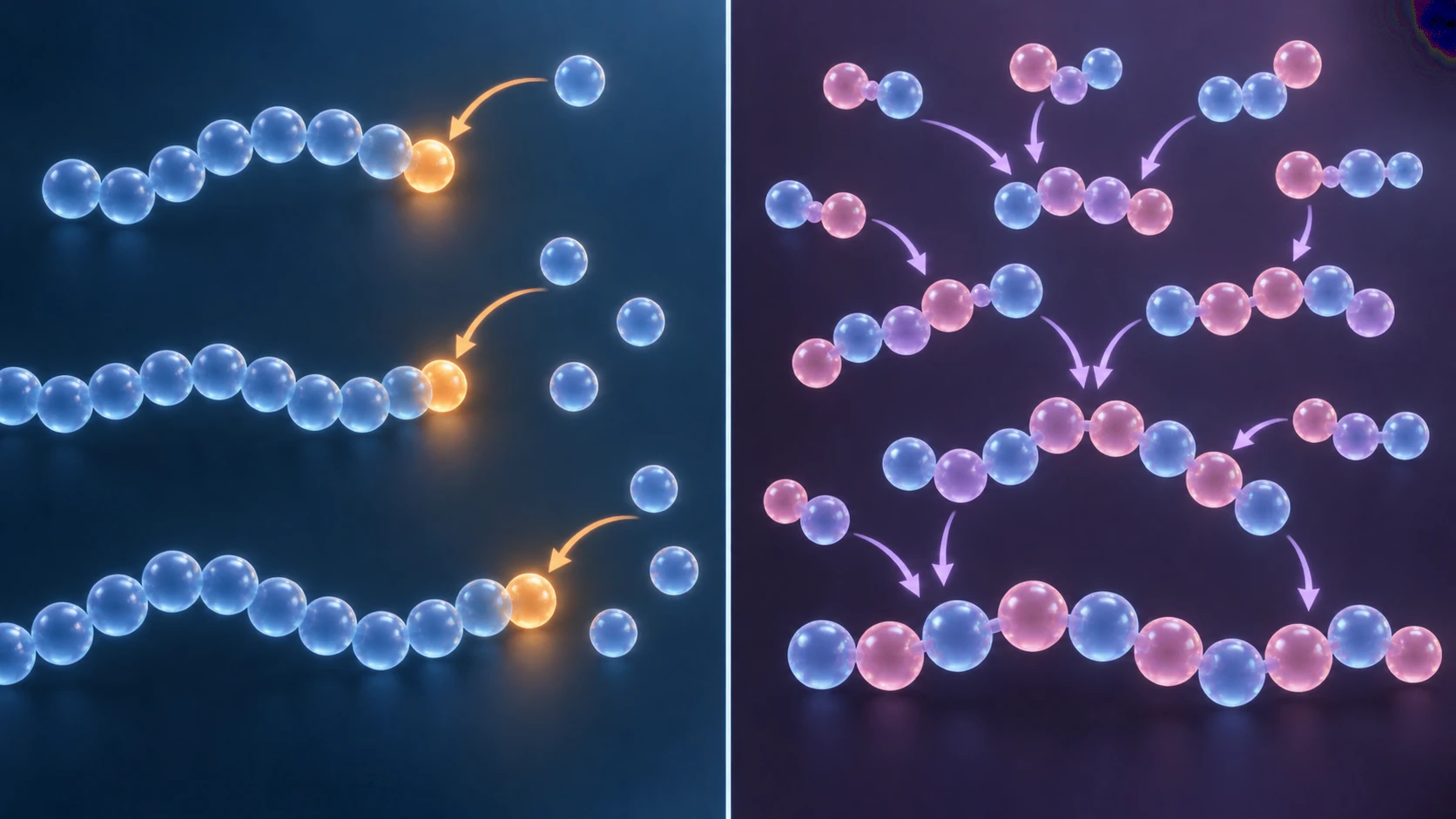
ImageGen conceptual illustration (not a real photograph or measurement). See the original diagram for exact values, names and structure.
Show original diagram with exact annotations and values
| Item | Chain-growth | Step-growth |
|---|---|---|
| How the chain grows | Monomers add one after another to an active chain end (a radical, an ion, a metal complex and so on). Once the reaction starts, a chain becomes long almost at once | Functional groups react with one another. Molecules of every size — monomer, dimer, trimer and so on — react with each other |
| When high molecular weight appears | High-molecular-weight chains form from early in the reaction. Conversion rises because the number of chains increases | The molecular weight does not become high until conversion is close to 100% (calculated in Section 3) |
| Typical examples | Polyethylene, polypropylene, polystyrene, vinyl chloride resin, acrylic resin | PET, nylon 66, polycarbonate, polyurethane (addition-type step-growth) |
| By-products | Normally none (an addition reaction) | Condensation types release small molecules such as water or alcohol. Unless they are removed, the molecular weight does not rise |
| Process key | Design of catalyst or initiator, removal of heat, control of molecular weight (chain transfer) | Monomer stoichiometry (balance), removal of by-products, high temperature and vacuum |
All of this is the textbook account of polymer chemistry (Sourced: Odian, Principles of Polymerization [Reference 3]). Some cases do not classify neatly: nylon 6 is made by ring-opening polymerisation and shows features of both chain-growth and step-growth (Commentary).
In chain-growth polymerisation, removing heat from the reactor and catalyst lifetime are at the centre of the design (Commentary). In step-growth polymerisation, the centre of the design is how to remove the by-product (water, ethylene glycol and so on): thin-film evaporation surfaces, vacuum, and stirring of a highly viscous melt (Commentary). This is why plants that "make a polymer" can look completely different.
In terms of metal smelting, chain-growth is "a chain reaction that, once the catalyst gets going, does not stop", while step-growth is "a reaction that only advances if you keep pushing the equilibrium" (our commentary).
3. Our calculation: why the reaction must reach almost 100% before the chains grow long
The equation that fixes chain length in step-growth polymerisation is the Carothers equation. Carothers published his discussion of polyfunctionality in the Transactions of the Faraday Society in 1936, and the relation is derived thereSourced. For a linear system with equal amounts of functional groups, the number-average degree of polymerisation is Xn = 1 / (1 − p), where p is the fraction of functional groups that have reacted (the standard statement in the textbook [Reference 3])Sourced.
Using the equation above to get a feel for orders of magnitudeOur calculation.
- Degree of polymerisation by conversion: p = 0.9 gives Xn = 10, p = 0.99 gives Xn = 100, and p = 0.999 gives Xn = 1,000
- A provisional target, using PET as the example: the repeat unit of PET is C₁₀H₈O₄ (about 192.2 g/mol), which equals two monomer residues. The average per residue is about 96.1 g/mol. Suppose the target is Mn = 20,000. Then Xn = 20,000 ÷ 96.1 = about 208, and p = 1 − 1/208 = about 0.9952 (99.5%)
- Effect of a stoichiometric imbalance: if the ratio of functional groups from the two monomers is r, the upper limit as p → 1 is Xn = (1 + r) / (1 − r). At r = 0.99 (a 1% imbalance), Xn ≤ 199; at r = 0.999, Xn ≤ 1,999
Assumptions and limits: this is the ideal case, with no side reactions, no cyclisation and no loss of end groups by volatilisation. Mn = 20,000 is a provisional value chosen for illustration, not a value for any particular PET grade. The expression for r is a well-known extension of Carothers and the standard form found in textbooks (Commentary).
Ordinarily "99% reacted" feels like nearly complete. In step-growth polymerisation, however, at 99% Xn is still only 100. For a material like PET, which needs a molecular weight in the tens of thousands, the real contest of polymerisation lies in the region beyond 99.5% (our commentary).
In this region, leaving even a trace of by-product restores the equilibrium and stops the chains growing. And a monomer imbalance of only 1% caps Xn below 200. This is the numerical basis for the strict purity and stoichiometry control of monomers in step-growth polymerisation (Commentary). It is also why PET uses solid-state polymerisation after melt polymerisation: to push through this "last region" by a different route. The series article on polyesters and PET covers this in detail.
4. Molecular weight and its distribution — an average is not enough
The chains in a polymer differ in length from one to the next, so molecular weight is not a single number but a distribution. There are two representative averages (Commentary).
- Number-average molecular weight, Mn: the average taken by the "number" of molecules. Sensitive to the count of short chains
- Weight-average molecular weight, Mw: the average weighted by the "mass" of the molecules. Sensitive to long chains
- Dispersity, Đ = Mw / Mn: expresses the breadth of the distribution. A 2009 IUPAC recommendation fixed the term "dispersity" for Mw/Mn, replacing the long-used "polydispersity index"Sourced
Đ is 1 if all chains have the same length and grows as the distribution broadens. The approximate value depends on how the polymer is made (the textbook account [Reference 3])Sourced.
| How it is made | Typical Đ | Reason (Commentary) |
|---|---|---|
| Step-growth (high conversion) | Approaches 2 | The "most probable distribution" derived by Flory in 1936. Mw/Mn = 1 + p, which becomes 2 as p → 1 [Reference 11] |
| Radical chain-growth | 1.5 to 2 | Ideal limits set by the mode of termination: 1.5 for termination by combination, 2 for termination by disproportionation [Reference 3]. In practice, chain transfer and branching broaden it further |
| Controlled polymerisation such as living polymerisation | Close to 1 | There is no termination or transfer of chains, and all chains grow at the same time |
| Coordination polymerisation (catalysed) | Depends on the catalyst | If the active sites are non-uniform the distribution is broad; a single-site catalyst narrows it (covered in the polyolefin article) |
The Đ values are textbook values for ideal cases. Real industrial grades differ with reactor configuration, blending and branching (Commentary).
How the distribution is measured
| Method | What it tells you | Standard and caveats |
|---|---|---|
| Size-exclusion chromatography (SEC / GPC) | Mn, Mw and the distribution itself | ISO 16014-1:2019 specifies the general principles for measuring average molecular weight and its distribution by SEC. A value obtained from a calibration curve of standard polymers is a value relative to the standard and is not necessarily absolute (combination with light-scattering detection is covered in another part of the same standard series)Sourced. Methods that dissolve the polymer at high temperature are specified separately as ISO 16014-4 (high-temperature method)Sourced |
| Dilute-solution viscosity | Viscosity number, limiting viscosity number, K-value (indices of molecular weight) | ISO 1628-1:2024 specifies the general conditions for dilute-solution viscosity with capillary viscometersSourced. This is not molecular weight itself but a relative index with the solvent and temperature fixed |
| Melt mass-flow rate (MFR) | Ease of flow in the melt (the higher the molecular weight, the lower the MFR) | ISO 1133-1:2022 specifies the method for fixed temperature and loadSourced. It is a measurement at a single condition and does not reveal the shape of the distribution (Commentary) |
Titles and scopes of the standards were checked on the ISO official pages [References 13, 14, 19, 20]. The text of the standards is paid, so the details of the conditions were not checked.
For ceramic powders, it is not only D50 (the median) but also the coarse and fine tails that govern sinterability and packing. The molecular weight distribution has exactly the same structure (our commentary).
- The high-molecular-weight tail: strongly affects melt viscosity and elasticity (melt tension). The red curve in Fig. 3 shows how, at the same Mw, a very small number of long chains makes the flow heavier
- The low-molecular-weight tail: lowers strength and tends to cause brittleness, stickiness, extraction and volatilisation. This is why "low-molecular-weight components" are a concern in food-contact and electronic materials
When a datasheet says only "Mw = 100,000", a material with Đ of 1.1 and one with Đ of 10 can both be "100,000" (Fig. 3 is drawn with Mw held equal). A buyer should check three things together: the "average", the "breadth of the distribution (Đ)" and the "measurement conditions (solvent, temperature, calibration)" (Commentary).
5. A materials engineer's view (1): how molecular weight sets properties
Molecular weight acts on both melt viscosity and strength and toughness, but in different ways (Commentary).
Melt viscosity: molecular weight to the power 3.4
Beyond a certain chain length, chains become entangled and can no longer move one at a time. The molecular weight at which this happens is called the critical molecular weight, Mc. Colby et al. (Macromolecules, 1987) measured the melt viscosity of polybutadiene with a narrow molecular weight distribution (molecular weight 1×10³ to 1.65×10⁷). They reported that the melt viscosity η0 of an entangled linear polymer is proportional to molecular weight M to the power 3.4 (η0 ∝ M^3.4), and that this power law holds up to M/Me of about 150 (Me being the entanglement molecular weight) and fails beyond about 200Sourced.
From this power law, the viscosity ratio for a change in molecular weightOur calculation.
- Molecular weight doubled: 2^3.4 = about 10.6 times
- Molecular weight multiplied by 10: 10^3.4 = about 2,500 times
- Molecular weight up 10%: 1.1^3.4 = about 1.38 times
Assumptions and limits: the result of Colby et al. is a measurement on linear polybutadiene with a narrow distribution. For branched resins, resins with a broad distribution, and conditions of high shear rate (actual moulding conditions), viscosity does not follow this simple power law. The calculation is only to give a sense of the orders of magnitude.
Strength and toughness: they rise to a point, then level off
While the chains are short, strength and toughness rise as molecular weight goes up. Once entanglement is well established, the gain becomes gradual (Commentary; specific values differ from resin to resin and are not given here). Melt viscosity, on the other hand, keeps rising. This creates the trade-off that "raising molecular weight improves performance but makes the resin impossible to process" (Commentary).
Material makers turn this dial for each application (our commentary).
- For injection moulding: to make the melt reach the corners of a thin-walled mould, molecular weight is lowered (MFR raised) so that it flows more easily
- For extrusion, pipe and film: to hold shape in the melt, molecular weight is raised (MFR lowered) to secure melt tension
- Ultra-high molecular weight (PE-UHMW): as the definition of an MFR below 0.1 g/10 min indicatesSourced, it barely flows and cannot be injection-moulded in the usual way. In exchange, it is used for wear resistance and toughness (Commentary)
In metals, the closest parallel is that grain size moves both strength and workability. The difference is that molecular weight is "a different number for each measurement condition", which makes it harder to handle than metal grain size (see also the summary in Fig. 5).
6. Crystalline and amorphous — the same chain becomes a different material
On cooling, long chains fold and line up regularly to form crystals (lamellae). But because the chains are long and entangled, the whole never becomes crystalline. The result is a "semicrystalline" state, in which crystalline and amorphous regions are mixed (Commentary). Polymers whose chains are arranged irregularly do not crystallise at all, and solidify as a wholly amorphous material.
- Regularity (tacticity) is the condition for crystallisation: Natta et al. reported in J. Am. Chem. Soc. in 1955 that polypropylene in which the methyl groups lie on the same side of the chain (isotactic) is crystallineSourced. Atactic polypropylene, in which the methyl groups are arranged randomly, crystallises poorly (the textbook account [Reference 3]). Even for the same monomer, how consistently the stereochemistry is aligned decides crystallinity
- Crystallinity changes with thermal history: even for the same resin, the cooling rate during moulding, drawing and heat treatment change the amount and size of the crystals (Commentary)
- How crystallinity is measured: the usual method is to measure the enthalpy of melting by differential scanning calorimetry (DSC) and estimate crystallinity from its ratio to the value for a perfect crystal. ISO 11357-3:2025 specifies the method for measuring the temperature and enthalpy of melting and crystallisation of crystalline or partly crystalline plasticsSourced. Note that the result changes with the value taken for the perfect crystal (Commentary)
How crystallinity links to properties
| Property | With more crystal | Reason (Commentary) |
|---|---|---|
| Stiffness and heat resistance | Rises (shape is kept up to the melting point) | In the crystalline regions the chains are packed densely and move with difficulty. A fully amorphous resin softens above the glass transition temperature (Tg) |
| Chemical resistance and barrier properties | Tends to rise | The crystalline regions are dense, and solvent and gas molecules find it hard to enter. Gases pass mainly through the amorphous regions |
| Transparency | Tends to fall (turns cloudy) | Crystalline and amorphous regions differ in density and refractive index, and crystals (spherulites) larger than the wavelength of visible light scatter light. Making the crystals finer brings the material closer to transparent |
| Shrinkage and warpage | Tend to be larger | Volume shrinks on crystallisation. Uneven cooling produces differences in crystallinity from place to place, which appear as warpage |
This is a general summary of polymer properties (Commentary). Values differ greatly by resin and grade. Haze (the degree of cloudiness) is measured as specified in ISO 14782:2021Sourced [Reference 18].
I wrote above that crystalline resins tend to turn cloudy. Yet PET beverage bottles and clear polypropylene containers are transparent. The reason is that the crystals are made smaller than the wavelength of visible light, or fewer in number (Commentary).
- Drawing and rapid cooling solidify the material before the crystals can grow large
- A nucleating agent (a clarifier) is added to create a great many crystal nuclei, and therefore many small crystals
In other words, transparency is not set by the type of resin alone but is a property designed through the cooling process and additives. The same resin can come out white or transparent when the moulding conditions change. This is why property values must be read together with how the test specimen was made (the conditions) (our commentary). Transparency values must be compared as values for a fixed measurement method and specimen thickness, such as haze under ISO 14782.
7. Polymer networks — tying chains together to make a material that does not melt
When chains are joined at crosslinks, all the chains become one giant molecule. This is a polymer network. It does not melt, does not dissolve in solvent, and does not flow when heated. The properties of thermosetting resins and rubbers come from this (Commentary; the difference from thermoplastics is covered in detail in the series article on thermoplastics and thermosets).
When does it become a network? The gel point
When monomers with three or more functional groups are mixed, a giant network suddenly forms at some point as the reaction proceeds, and the material loses its ability to flow. This is gelation. In his 1936 paper, Carothers gave an equation estimating the conversion at which gelation occurs from the average functionality f: p_c = 2 / f (the standard account in the textbook [References 3, 4])Sourced.
The gel point, and the effect of crosslink density on elastic modulusOur calculation.
- Example of a gel point: mix 2 mol of a trifunctional monomer with 3 mol of a bifunctional monomer, with the functional groups balanced. The average functionality is f = (2×3 + 3×2) / 5 = 2.4, so p_c = 2 / 2.4 = about 0.83
- Rubber elastic modulus: for an ideal network the shear modulus is G = ρRT / Mc (ρ: density, R: gas constant, T: temperature, Mc: molecular weight of the chain between crosslinks) [Reference 6]. With ρ = 1,000 kg/m³, T = 300 K and Mc = 10 kg/mol, G = 1,000 × 8.314 × 300 ÷ 10 ≈ 2.5×10⁵ Pa (about 0.25 MPa)
- If Mc is cut to one fifth (2 kg/mol), G becomes five times larger, about 1.25 MPa
Assumptions and limits: the gel-point equation is for the ideal case in which functional groups of the same kind are equally reactive and there is no cyclisation. The textbook explains that real gelation often occurs at a lower conversion than this equation predicts (Commentary). The rubber-elasticity equation is likewise an ideal-network equation that ignores entanglements, unreacted chains and fillers, and the elastic modulus of a real rubber differs.
Viewing the cure of a thermosetting resin only as "hardening" misses something (our commentary).
- Crosslink density is, directly, a design value for elastic modulus: as Fig. 6 shows, the density of the knots moves the modulus by orders of magnitude. That rubber is soft and epoxy is hard owes more to the fineness of the network than to the difference in chemistry
- The degree of cure is, directly, an index of quality: if unreacted functional groups remain, the network is coarse, Tg is low, and heat and chemical resistance fall. This is why control of cure is required, using DSC and similar methods
- A network, once formed, cannot be undone: as a later article on recycling thermosets discusses, this is the root difficulty of recycling
8. Building blocks — designing materials from combinations of functional groups
A report from the U.S. Department of Energy (DOE) defines building-block chemicals as "molecules with multiple functional groups that possess the potential to be transformed into new families of useful molecules"Sourced. Polymer design puts this idea into practice. Which functional groups the monomers carry decides the type of bond formed and the shape of the chain (Commentary).
| Combination of monomer functional groups | Bond formed | Typical polymer | Design points (Commentary) |
|---|---|---|---|
| Carbon–carbon double bond (vinyl group and so on) | Carbon chain (C–C) | Polyethylene, polypropylene, polystyrene | The main chain is hard to break. The type and arrangement of side groups set the properties |
| Dicarboxylic acid + diol | Ester | PET, PBT | Can react with water (hydrolysis). Aromatic rings make it rigid; aliphatic chains make it flexible |
| Dicarboxylic acid + diamine | Amide | Nylon 66 | Strong hydrogen bonding gives high heat resistance and strength. Absorbs water readily |
| Diol + diisocyanate | Urethane | Polyurethane | Soft segments and hard segments can be built into one chain |
| Epoxy group + amine (including three or more functional groups) | Three-dimensional network | Epoxy resin | The number of functional groups sets the crosslink density (Section 7) |
This is the textbook account of polymer chemistry (Commentary; the types of bond follow Odian [Reference 3]). Individual resins are covered in detail in the other articles in this series.
The minimum rules of polymer design are these three (our commentary).
- Monomers with only two functional groups give a linear chain. Mixing in monomers with three or more gives branching, and adding more gives a network (Section 7)
- Putting two or more kinds of monomer into one chain gives a copolymer. The arrangement (random, block, graft) makes it a different material. The soft and hard segments of polyurethane are a typical example of a block copolymer
- The type of bond fixes the conditions under which it can later be broken. Esters and amides are cleaved by hydrolysis, alcoholysis and the like, while carbon–carbon bonds are hard to cleave. This is the reason, in the later article on chemical recycling, why PET is easy to depolymerise and polyolefins are difficult
In short, choosing a material means choosing both "the reaction that makes it" and "the reaction that breaks it" at the same time. To an eye used to battery materials and ceramic precursors, the point that "chemical bonds decide both service and disposal" should look sharper here than in metals.
9. Smart polymers — shape memory and self-healing
Polymers that change shape or state in response to an external stimulus (heat, light, damage and so on) are collectively called smart polymers. From the standpoint of fundamentals, this article takes up shape memory and self-healing. Both apply what was covered in Sections 6 and 7: designing a network so that some parts move and some do not (our commentary).
Shape-memory polymers
In Science (2002), Lendlein and Langer reported biodegradable thermoplastic polymers that change shape when the temperature is raised. They showed uses such as inserting a bulky implant through a small incision so that it changes shape automatically inside the body, and smart suturesSourced. A review that Lendlein wrote with Kelch (Angew. Chem. Int. Ed., 2002) is titled "Shape-Memory Polymers" and sets out the idea behind how they workSourced. The idea is to build into one material two elements: "netpoints" that hold the permanent shape (crosslinks or crystals) and "switching segments" that soften or harden with temperature (Commentary).
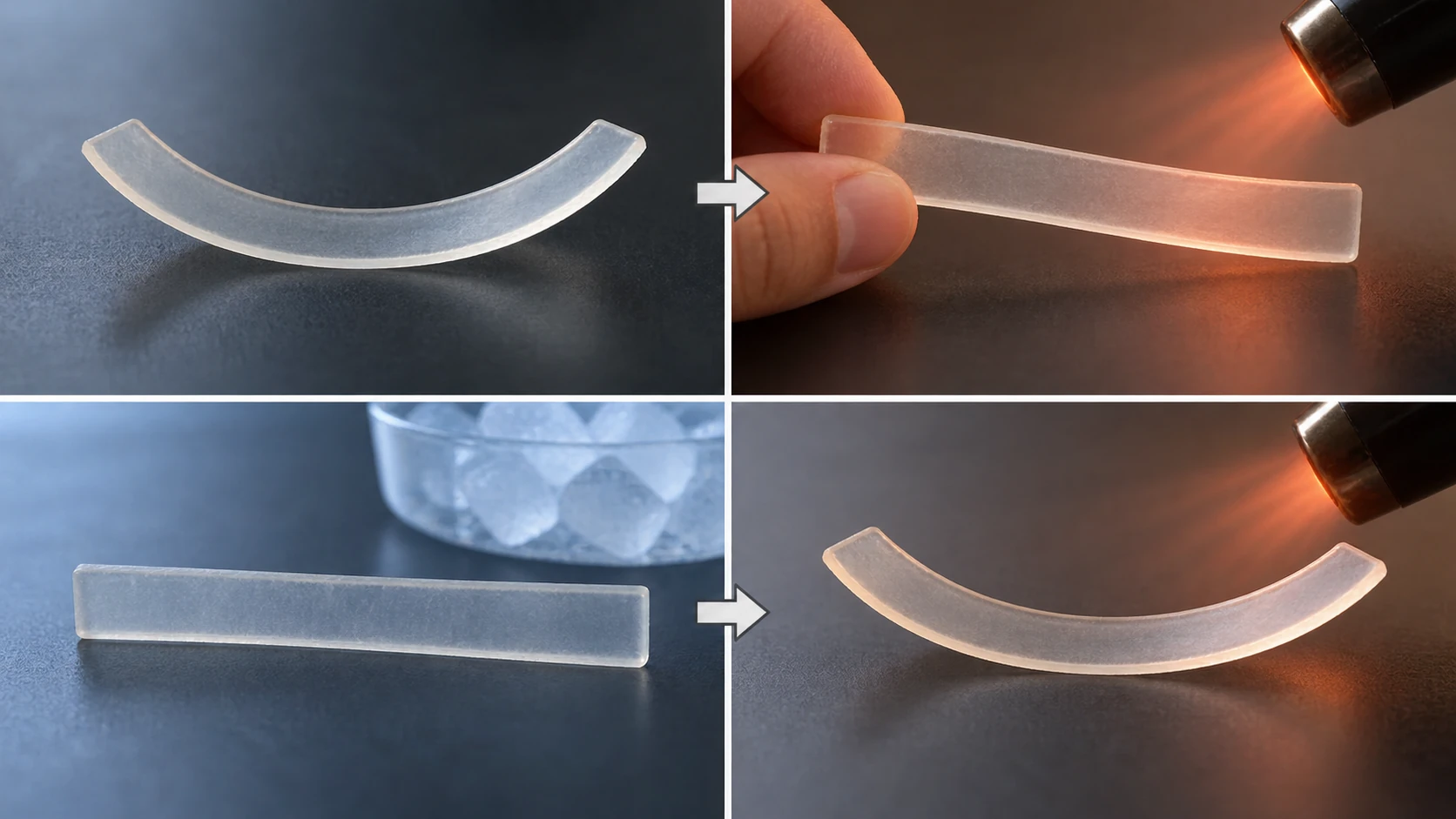
ImageGen conceptual illustration (not a real photograph or measurement). See the original diagram for exact values, names and structure.
Show original diagram with exact annotations and values
Self-healing materials
| Approach | Mechanism | Reported evidence | Caveats |
|---|---|---|---|
| Microcapsule type (extrinsic) | Tiny capsules filled with a healing agent are embedded in the material. When a crack forms, the capsules break and release the agent, which meets an embedded catalyst, polymerises and bonds the crack | White et al. (Nature, 2001). In fracture tests they reported recovery of up to 75% of toughnessSourced | The capsules are used up once. Not suited to repeated repair at the same place (Commentary) |
| Dynamic-bond type (intrinsic) | Reversible bonds (hydrogen bonds, dynamic covalent bonds and so on) are built into the network, and the bonds are rearranged by heating or similar | Montarnal et al. (Science, 2011). They reported that an epoxy network rearranges its topology by exchange reactions without depolymerising and can be processed while remaining insoluble. Unlike conventional polymers, whose viscosity changes abruptly at the glass transition, its viscosity changes gradually, like silica (Arrhenius-type)Sourced | Wider industrial adoption was not confirmed within the scope of this articleNot yet confirmed |
All of it is Sourced (White et al. [Reference 9], Montarnal et al. [Reference 10]). The caveats in the right-hand column are our commentary.
In Section 7 I wrote that "a network, once formed, cannot be undone". Montarnal et al. broke that premise. The epoxy network they designed has exchange reactions that swap the knots, so on heating only the "connectivity" of the network is rearranged. The number of knots does not change, so the material can change shape without melting or collapsingSourced.
The biggest reason thermosets are hard to recycle was that "the network cannot be undone". This idea points to a different route: reshaping while keeping the network intact (our commentary). However, the paper is a proof of concept, and durability and cost as a mass-produced material are separate questions. The series article on thermoplastics and thermosets also discusses this point.
10. A materials engineer's view (2): pitfalls when reading numbers on a datasheet
Here is what we have covered, condensed into a checklist for choosing materials (our summary).
| Number on the datasheet | What to check | Reason |
|---|---|---|
| Molecular weight (Mn, Mw) | Measurement method (SEC, light scattering, viscosity), solvent, temperature, calibration standard, Đ | A value relative to a standard is not necessarily absolute. With a different Đ, the same Mw is a different material (Section 4) |
| MFR | Temperature and load (for example 190 °C / 2.16 kg, 230 °C / 2.16 kg, 190 °C / 21.6 kg) | Numbers measured under different conditions cannot be compared (the PE example at the start) |
| Melting point and crystallinity | DSC heating rate, which heating run was measured (first or second), the value used for a perfect crystal | Thermal history changes the crystals. The first run shows the moulding history; the second shows the material itself (Commentary) |
| Tg | The method (DSC, DMA, TMA) and which point was taken | It can move by several to over ten degrees with method and conditions (covered in the article on glass transition and creep) |
| Transparency | The method for haze or total light transmittance (ISO 14782 and others) and the specimen thickness | Appearance changes with thickness (Section 6) |
| Property values in general | How the test specimen was made (injection moulding, compression moulding), moulding conditions, moisture state | ISO 294-1 (injection moulding of test specimens) and similar call for moulding conditions to be recorded. The same resin gives different crystals under different moulding conditions |
Titles and scopes of the standards were checked on the ISO official pages (only what could be confirmed is given). The selection of items to check is our own summary (Commentary).
11. Open issues, and what this article could not confirm
(1) The text of the IUPAC glossary
The existence of the 1996 IUPAC glossary (Pure Appl. Chem. 68, 2287) was confirmed on the publisher's page, but the PDF of the full text could not be accessed in the research environment for this article, so the wording of the definitions could not be checked directly. The classification of polymerisation in Sections 1 and 2 rests on the fact that the IUPAC glossary distinguishes chain-growth from step-growth polymerisation, and on the textbook account [Reference 3]. No definition is quoted verbatim.
(2) How far the textbook statements were checked
The existence of the textbook by Odian [Reference 3] and the book by Flory [Reference 6] was confirmed, but the text of the relevant pages was not checked directly in this article. The Carothers equation, the ideal values of dispersity and the rubber-elasticity equation are given as standard content found widely in textbooks, and the numbers were recalculated from the equations in this article.
(3) The range of the power law
The M^3.4 power law was established for linear polybutadiene with a narrow molecular weight distribution [Reference 5]. It cannot be applied as it stands to branched polyethylene or to resins with a broad distribution.
(4) Practical use of smart polymers
Research on shape memory, self-healing and dynamic networks is active, but this article only introduces representative papers from 2001 to 2011 and has not checked how they are used in industry today.
- In chain-growth polymerisation high molecular weight comes early; in step-growth polymerisation it is decided in the last 1%. Even at 99% conversion, Xn is 100Our calculation
- Molecular weight is a distribution. At the same Mw, a different Đ means a different material. IUPAC has recommended the definition of dispersitySourced
- Melt viscosity is proportional to molecular weight to about the power 3.4. Doubling the molecular weight gives about 10.6 times the viscositySourcedOur calculation
- Crystallinity moves stiffness, chemical resistance and transparency all at once. A transparent crystalline resin is one whose crystals have been made small (Commentary)
- Crosslinking both "stops melting" and "sets the elastic modulus". For an ideal network, G = ρRT/McOur calculation
- Choosing a material means choosing the reaction that makes it and the reaction that breaks it. The later articles stand on this foundation (Commentary)
12. Glossary
- Monomer
- A small molecule that polymerises to become the repeat unit of a polymer.
- Oligomer
- A molecule of intermediate size in which a few to a dozen or so monomers are joined.
- Chain-growth polymerisation
- Polymerisation in which monomers add one after another to an active chain end and the chain grows.
- Step-growth polymerisation
- Polymerisation in which reactions between functional groups proceed in stages and molecules of different sizes join to one another.
- Conversion p
- The fraction of functional groups (or monomer) that has reacted.
- Degree of polymerisation Xn
- The number of monomer units in one chain (number average).
- Mn / Mw
- Number-average / weight-average molecular weight. Sensitive to short chains / long chains respectively.
- Dispersity Đ
- Mw / Mn. An index of the breadth of the molecular weight distribution (the term recommended by IUPAC).
- SEC (GPC)
- Chromatography that separates molecules by size to measure the molecular weight distribution.
- MFR
- Melt mass-flow rate. The mass of molten resin that flows out in 10 minutes at a fixed temperature and load.
- Entanglement / critical molecular weight Mc
- The molecular weight at which chains begin to entangle. Above it, melt viscosity rises sharply.
- Semicrystalline
- A state in which crystalline and amorphous regions are mixed.
- Tacticity
- The regularity of the arrangement of side groups. Isotactic means they all lie on the same side.
- Crosslink
- A link tying chains together. The whole, joined at the crosslinks, is a network.
- Gelation
- The phenomenon in which the network connects throughout and the material loses its ability to flow.
- Building block
- A starting molecule that has multiple functional groups and can be converted into other molecules.
- Shape-memory polymer
- A polymer that returns from a fixed shape to its original shape on a stimulus such as temperature.
- Vitrimer
- A polymer network with exchange reactions that swap its knots, so it can be processed while remaining a network.
13. References (primary sources)
- IUPAC Jenkins, Kratochvíl, Stepto, Suter, "Glossary of basic terms in polymer science (IUPAC Recommendations 1996)", Pure Appl. Chem. 68, 2287–2311 — https://doi.org/10.1351/pac199668122287
- IUPAC Stepto, "Dispersity in polymer science (IUPAC Recommendations 2009)", Pure Appl. Chem. 81, 351–353 — https://doi.org/10.1351/PAC-REC-08-05-02
- Book G. Odian, Principles of Polymerization, 4th edition, Wiley, 2004 — https://doi.org/10.1002/047147875X
- W. H. Carothers "Polymers and polyfunctionality", Trans. Faraday Soc. 32, 39 (1936) — https://doi.org/10.1039/TF9363200039
- Colby, Fetters, Graessley "The melt viscosity-molecular weight relationship for linear polymers", Macromolecules 20, 2226–2237 (1987) — https://doi.org/10.1021/ma00175a030
- Book P. J. Flory, Principles of Polymer Chemistry, Cornell University Press, 1953 — https://openlibrary.org/works/OL4624216W
- Lendlein, Kelch "Shape-Memory Polymers", Angew. Chem. Int. Ed. 41, 2034 (2002) — https://doi.org/10.1002/1521-3773(20020617)41:12%3C2034::AID-ANIE2034%3E3.0.CO;2-M
- Lendlein, Langer "Biodegradable, elastic shape-memory polymers for potential biomedical applications", Science 296, 1673–1676 (2002) — https://doi.org/10.1126/science.1066102
- White et al. "Autonomic healing of polymer composites", Nature 409, 794–797 (2001) — https://doi.org/10.1038/35057232
- Montarnal et al. "Silica-like malleable materials from permanent organic networks", Science 334, 965–968 (2011) — https://doi.org/10.1126/science.1212648
- P. J. Flory "Molecular size distribution in linear condensation polymers", J. Am. Chem. Soc. 58, 1877–1885 (1936) — https://doi.org/10.1021/ja01301a016
- U.S. Department of Energy (DOE) Werpy, Petersen, "Top Value Added Chemicals from Biomass: Volume I", DOE/GO-102004-1992 (2004) — https://www.osti.gov/biblio/15008859
- ISO ISO 16014-1:2019 "Plastics — Determination of average molecular weight and molecular weight distribution of polymers using size-exclusion chromatography — Part 1: General principles" — https://www.iso.org/standard/74995.html
- ISO ISO 1628-1:2024 "Plastics — Determination of the viscosity of polymers in dilute solution using capillary viscometers — Part 1: General principles" — https://www.iso.org/standard/86451.html
- ISO ISO 21304-1:2019 "Plastics — Ultra-high-molecular-weight polyethylene (PE-UHMW) moulding and extrusion materials — Part 1: Designation system and basis for specifications" — https://www.iso.org/standard/70506.html
- LyondellBasell "HDPE 50 2053 NATURAL" product information (manufacturer's stated typical values) — https://www.lyondellbasell.com/en/polymers/p/HDPE-50-2053-NATURAL/773dd3f7-eedd-4282-b2ec-1b5c63fda5c8
- ISO ISO 11357-3:2025 "Plastics — Differential scanning calorimetry (DSC) — Part 3: Determination of temperature and enthalpy of melting and crystallization" — https://www.iso.org/standard/11357-3
- ISO ISO 14782:2021 "Plastics — Determination of haze for transparent materials" — https://www.iso.org/standard/81840.html
- ISO ISO 1133-1:2022 "Plastics — Determination of the melt mass-flow rate (MFR) and melt volume-flow rate (MVR) of thermoplastics — Part 1: Standard method" — https://www.iso.org/standard/83905.html
- ISO ISO 16014-4:2019 "Plastics — Determination of average molecular weight and molecular weight distribution of polymers using size-exclusion chromatography — Part 4: High-temperature method" — https://www.iso.org/standard/74998.html
- G. Natta et al. "Crystalline high polymers of α-olefins", J. Am. Chem. Soc. 77, 1708–1710 (1955) — https://doi.org/10.1021/ja01611a109
- ISO ISO 294-1:2017 "Plastics — Injection moulding of test specimens of thermoplastic materials — Part 1: General principles, and moulding of multipurpose and bar test specimens" — https://www.iso.org/standard/67036.html
14. Claim-to-source audit
| Claim in the text | Basis | Type |
|---|---|---|
| That the IUPAC glossary distinguishes chain-growth from step-growth polymerisation (the verbatim wording of the definitions was not checked) | Bibliographic details of the 1996 IUPAC glossary checked on the publisher's page. The full text could not be accessedReference 1 https://doi.org/10.1351/pac199668122287 | Sourced |
| That the IUPAC recommendation (2009) fixed "dispersity" as the term for Mw/Mn, replacing "polydispersity index" | Abstract of the recommendationReference 2 https://doi.org/10.1351/PAC-REC-08-05-02 | Sourced |
| The comparison table of chain-growth and step-growth polymerisation; the Carothers equation Xn = 1/(1 − p) and the expression with the stoichiometric ratio r; the ideal dispersity values for radical polymerisation (1.5 and 2); the gel point p_c = 2/f; the types of bond (ester, amide and so on); and that nylon 6 is made by ring-opening polymerisation | The standard account in a textbook of polymer chemistry. This article did not check the relevant pages of the book directlyReference 3 https://doi.org/10.1002/047147875X | Sourced |
| That Carothers discussed polyfunctionality and gelation in his 1936 Trans. Faraday Soc. paper "Polymers and polyfunctionality" | Bibliographic details checked (Crossref)Reference 4 https://doi.org/10.1039/TF9363200039 | Sourced |
| The most probable distribution in step-growth polymerisation, Mw/Mn = 1 + p (2 as p → 1) | Flory's 1936 paper (its title concerns molecular size distribution). The text of the equation was not checked; it is given as standard textbook contentReference 11 https://doi.org/10.1021/ja01301a016 | Sourced |
| That for linear polybutadiene with a narrow distribution (molecular weight 1×10³ to 1.65×10⁷), η0 ∝ M^3.4, holding up to M/Me of about 150 and failing beyond about 200 | Abstract of the paper by Colby et al.Reference 5 https://doi.org/10.1021/ma00175a030 | Sourced |
| The rubber elastic modulus of an ideal network, G = ρRT/Mc | The standard textbook equation based on Flory's theory of rubber elasticity. The relevant pages of the book were not checked directlyReference 6 https://openlibrary.org/works/OL4624216W | Sourced |
| The report of biodegradable thermoplastic polymers that change shape when the temperature is raised, and the example of smart sutures | Abstract of Lendlein and Langer (Science 2002)Reference 8 https://doi.org/10.1126/science.1066102 | Sourced |
| That a review of shape-memory polymers (Lendlein and Kelch) exists and is titled "Shape-Memory Polymers". The grouping into "netpoints" and "switching segments" is commentary on the standard thinking in the field | Bibliographic details checked (Crossref). The text of the review was not checkedReference 7 https://doi.org/10.1002/1521-3773(20020617)41:12%3C2034::AID-ANIE2034%3E3.0.CO;2-M | Sourced |
| That in fracture tests of a microcapsule-type self-healing material, up to 75% of toughness was recovered | Abstract of the paper by White et al.Reference 9 https://doi.org/10.1038/35057232 | Sourced |
| That an epoxy network rearranges its topology by exchange reactions without depolymerising, can be processed while insoluble, and shows a gradual, silica-like change of viscosity | Abstract of the paper by Montarnal et al.Reference 10 https://doi.org/10.1126/science.1212648 | Sourced |
| The definition of building-block chemicals (molecules with multiple functional groups that have the potential to be transformed into new families of useful molecules) | Abstract of the DOE report (OSTI)Reference 12 https://www.osti.gov/biblio/15008859 | Sourced |
| The general principles for measuring average molecular weight and its distribution by SEC (calibration curve of standard polymers; light scattering in another part) | Title and scope of ISO 16014-1:2019. The text is paid and was not checkedReference 13 https://www.iso.org/standard/74995.html | Sourced |
| That the high-temperature SEC method is specified in ISO 16014-4 | Title of ISO 16014-4:2019Reference 20 https://www.iso.org/standard/74998.html | Sourced |
| That the general conditions for dilute-solution viscosity (viscosity number, limiting viscosity number, K-value) are specified in ISO 1628-1:2024 | Title and scopeReference 14 https://www.iso.org/standard/86451.html | Sourced |
| That PE-UHMW is defined as polyethylene with an MFR below 0.1 g/10 min at 190 °C and 21.6 kg | Scope of ISO 21304-1:2019Reference 15 https://www.iso.org/standard/70506.html | Sourced |
| The manufacturer's stated typical values for HDPE 50 2053 NATURAL: MFR 20 g/10 min (190 °C / 2.16 kg) and density 0.952 g/cm³. No comparison of merit with other grades is made | LyondellBasell product information. The standard number of the test method was not checkedReference 16 https://www.lyondellbasell.com/en/polymers/p/HDPE-50-2053-NATURAL/773dd3f7-eedd-4282-b2ec-1b5c63fda5c8 | Sourced |
| That the DSC method for the temperature and enthalpy of melting and crystallisation of crystalline and partly crystalline plastics is specified in ISO 11357-3:2025 | Title and scopeReference 17 https://www.iso.org/standard/11357-3 | Sourced |
| That the method for measuring haze (forward scattering of 2.5 degrees or more) is specified in ISO 14782:2021 | Title and scopeReference 18 https://www.iso.org/standard/81840.html | Sourced |
| That MFR is measured under conditions with fixed temperature and load (ISO 1133-1:2022) | Title and scopeReference 19 https://www.iso.org/standard/83905.html | Sourced |
| That isotactic polypropylene is crystalline | The 1955 paper by Natta et al. (titled "Crystalline high polymers of α-olefins"). The text was not checkedReference 21 https://doi.org/10.1021/ja01611a109 | Sourced |
| That the standard for injection-moulded test specimens aims to unify the reporting of moulding conditions (ISO 294-1:2017) | Title and scopeReference 22 https://www.iso.org/standard/67036.html | Sourced |
| Xn = 100 (p = 0.99) and Xn = 1,000 (p = 0.999); the hypothetical PET case with p of about 0.9952; Xn ≤ 199 at r = 0.99; viscosity about 10.6 times for double the molecular weight, about 2,500 times for ten times and about 1.38 times for 1.1 times; a gel point of about 0.83; G of about 0.25 MPa (Mc = 10 kg/mol); and each value in Fig. 6 | Our calculation. Assumptions: an ideal system with equal amounts of functional groups; a PET repeat unit of 192.2 g/mol and Mn of 20,000 as provisional values; a power-law exponent of 3.4; an ideal network with ρ = 1,000 kg/m³ and T = 300 K | Our calculation |
| The distributions in Fig. 3 (Mw = 100,000, Đ of about 1.1, 2.0 and 10.0) and Mn | Our calculation. A schematic that assumes a log-normal distribution, with Mn obtained by numerical integration of the curves | Our calculation |
| The relation of crystallinity to stiffness, chemical resistance, transparency and shrinkage; that a transparent crystalline resin is made by making the crystals small; the checklist for datasheets; the three rules of polymer design; the summary that "you choose the reaction that makes and the reaction that breaks at the same time"; and the summary of molecular weight as a dial for processing and performance | Our commentary, based on the general summary of polymer science. These are not views expressed by any institution | Commentary |
| The reading that microcapsule types are not suited to repeated repair at the same place, and that the network rearrangement of Montarnal et al. points to another route to reshaping | Our commentary based on the abstracts of the papers | Commentary |
| How shape memory, self-healing and dynamic networks are used in industry | Not confirmed within the scope of this article | Not yet confirmed |
| That Figs. 1 to 7 are explanatory drawings, and that the hero image is an AI-generated image | Our note | Commentary |
Last updated 2 October 2026. Sources are limited to primary material (IUPAC recommendations, the titles and scopes of ISO standards, bibliographic details and abstracts of peer-reviewed papers, a U.S. Department of Energy report and manufacturer product information). The statements in the textbooks (Odian, Flory) were not checked against the text of the books and are given as standard content. The wording of the 1996 IUPAC glossary, the text of the original papers on the Carothers equation and the most probable distribution, and how smart polymers are used in industry today could not be confirmed and are therefore not stated. All figures are explanatory concept graphics or our own calculations. Figs. 1 to 7 are vector drawings and the hero image is AI-generated; none of them shows a real micrograph, measured data or a physical product.