TECHNOLOGY EXPLAINER
Thermoplastics and Thermosets
— whether a resin can be melted again decides moulding, performance and recycling
The most basic way to split resins in two is into thermoplastics and thermosets: resins that soften and flow when heated and set when cooled, and resins that react into a network and never melt again. This article, written from a materials engineer's standpoint, follows how that difference in molecular structure leads to the response to temperature, the moulding method, how to think about service temperature, and the difficulty of recycling. Individual resins (polyolefins, epoxy resins and others) are left to the other articles in this series.
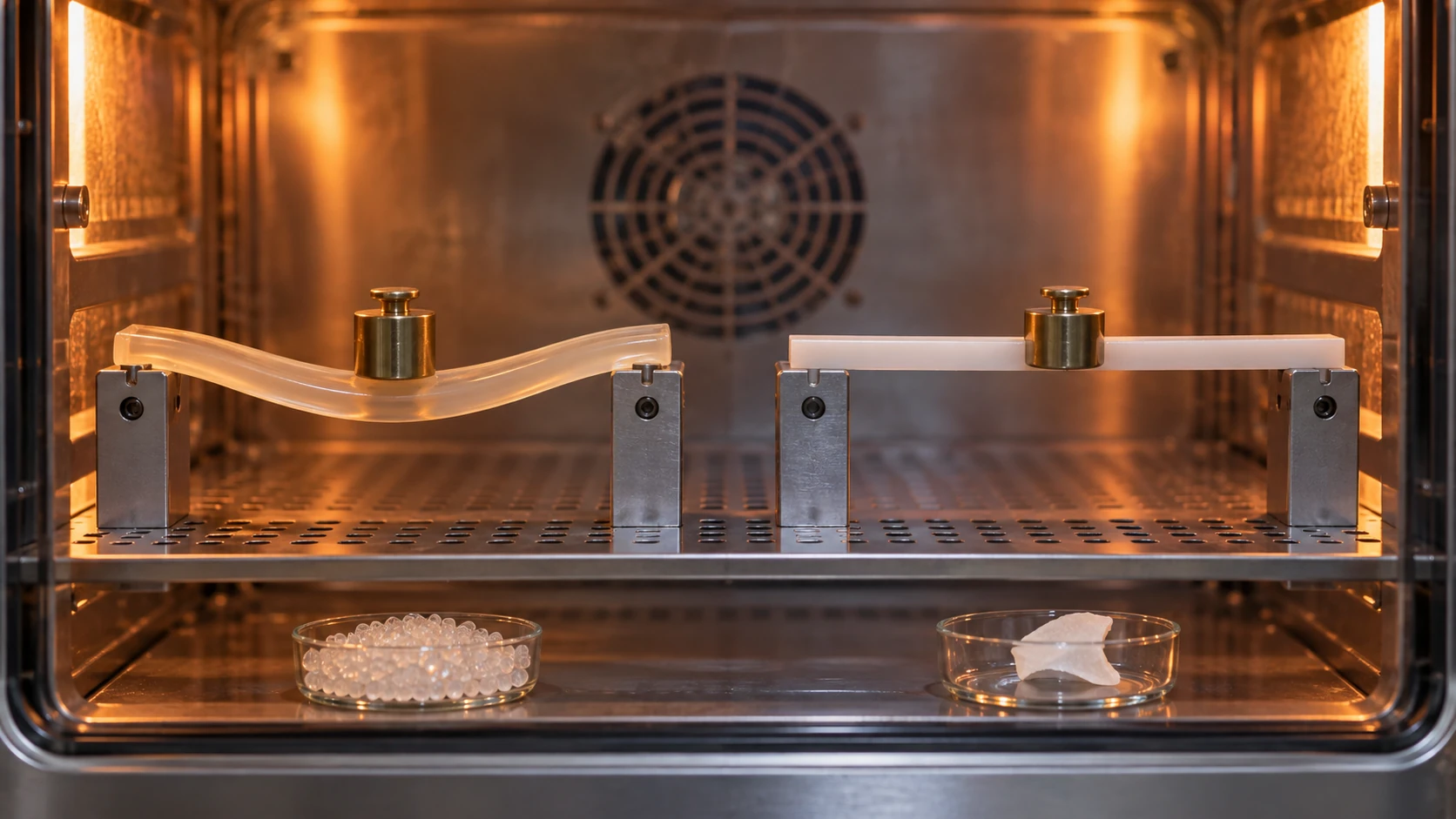
- What thermoplastics and thermosets are (the short version)
- How much is used — the production mix in Japan and worldwide
- A difference in molecules becomes a difference in response to temperature
- Two groups within thermoplastics — amorphous and crystalline
- A materials engineer's view (1): "heat deflection temperature" is not a service temperature
- Moulding methods — how do injection, extrusion and compression differ?
- Our calculation: if the cure temperature is low, the reaction stalls part-way
- A materials engineer's view (2): curing is not "setting" but "a reaction that progresses"
- Recycling compared — can the material be melted again?
- A materials engineer's view (3): why thermoset recycling is hard, and attempts to change it by design
- Rules of thumb for choosing
- Open issues, and what this article could not confirm
- Glossary / References / Claim-to-source audit
Sourced = content stated in published material, peer-reviewed papers or standards (link given)
Our calculation = a value this article derived from explicitly stated assumptions
Not yet confirmed = a plan, target or outlook with no confirmed track record
Textbook-style summaries of polymer science and readings for materials design are marked separately as Commentary. Property values are given together with the test method, conditions and origin.
1. What thermoplastics and thermosets are (the short version)
- Thermoplastic resins: they soften, melt and flow when heated, and set when cooled. The change is reversible and can in principle be repeated any number of times. Examples are polyethylene, polypropylene, PET and nylon (Commentary)
- Thermosetting resins: they are shaped while still liquid or powder, then set by heat (or a curing agent) through a chemical reaction that forms a three-dimensional network. The network, once formed, neither melts nor flows. Examples are epoxy resins, phenolic resins and unsaturated polyesters (Commentary; the idea of a network is covered in the series article on polymer basics)
- The heart of the difference: whether the chains are joined by covalent bonds or not. In a thermoplastic the chains are held together only by entanglement, intermolecular forces and crystals, and heat releases them. A thermoset is a covalent network, so heat does not release it and the only way is to cut bonds (Commentary)
The difference between thermoplastics and thermosets is not "the temperature at which they can be processed" but "whether the shape can be changed again after the first moulding". This property separates the moulding process (set by cooling / set by reaction), the upper limit of service temperature (fixed by the melting point or Tg / fixed by the heat resistance of the network) and the fate after disposal (can be remelted / cannot).
The boundary is not perfectly sharp, however. Crosslinked polyethylene is a thermoplastic material that is crosslinked after moulding to behave more like a thermoset, and ASTM D2765 specifies methods for measuring the gel content and swell ratio of crosslinked ethylene plasticsSourced. Conversely, in materials such as thermoplastic elastomers, crystals or hard domains act as physical "knots" (Commentary; covered in the series article on polyurethanes and elastomers).
2. How much is used — the production mix in Japan and worldwide
The Plastic Waste Management Institute (PWMI) in Japan publishes Japan's resin production in six categories: polyethylene, polypropylene, vinyl chloride resin, polystyrenes, other thermoplastic resins, and thermosetting resins. Resin production in 2024 was 8.53 million t, of which thermoplastic resins were 91.3% and thermosetting resins 0.74 million t (8.7%)Sourced. "Plastics" here does not include liquid resins such as synthetic rubber, synthetic fibres, paints and adhesivesSourced.
On the global side, Plastics Europe's "Plastics the Fast Facts 2025" puts world plastics production in 2024 at 430.9 Mt, with shares by type of polypropylene 19.0%, PE-LD and LLD 13.9%, PE-HD and MD 12.1%, PVC 12.8%, PET 6.2%, PS 5.1%, PUR 5.3%, other thermoplastics 7.1% and other thermosets 8.3%, among othersSourced. PUR is polyurethane as a whole and includes both thermosetting foams and elastomers and thermoplastic polyurethane, so it cannot be assigned to either thermoplastics or thermosets (Commentary).
By volume, thermosets are a minority of under one tenth. Even so, they are concentrated in the applications covered in this series — semiconductor encapsulants, printed circuit boards, battery binders and composite matrices — where dimensional stability at high temperature, electrical insulation and chemical resistance are required (our commentary). This is an area where judging importance from volume statistics alone would mislead.
From the disposal side, by contrast, thermosets have the problem that they hardly show up in the statistics. The Institute's breakdown of waste plastics is divided into polyethylene, polypropylene, vinyl chloride resin, polystyrenes and "other resins", and thermosets are included in "other"Sourced. The recovery and recycling rate for thermosets alone could not be read from the material consulted for this article.
3. A difference in molecules becomes a difference in response to temperature
Plotting how the elastic modulus changes with temperature shows the difference between the three kinds of material at a glance (Fig. 2).
- From glassy to rubbery: at low temperature every material is "glassy" and hard, with chain motion frozen. Above the glass transition temperature (Tg), the chains begin to move and the material softens sharply. The method of determining Tg by dynamic mechanical analysis (DMA) is specified in ISO 6721-11:2019. The standard treats Tg as an indicator of the transition from the hard, relatively brittle glassy state to a rubbery or viscous liquid state, and, because the temperature sensor does not touch the specimen, notes that the measured value can change with the heating rate and includes a procedure to correct for thermal lagSourced
- Amorphous thermoplastics: they soften above Tg and begin to flow as the temperature rises further. The upper limit of service temperature is effectively close to Tg (Commentary)
- Crystalline thermoplastics: even above Tg, as long as crystals remain, the crystals act as a framework and keep the shape. They flow all at once at the melting point (Tm) where the crystals melt. The shape is held to just below the melting point, but the modulus steps down once across the Tg range (Commentary)
- Thermosets: even above Tg, the covalent network means they do not flow and keep a flat rubbery region (the rubbery plateau). At still higher temperatures the network itself decomposes (Commentary). The modulus falls greatly above Tg, so "not flowing" and "staying hard" are different things
| Item | Thermoplastic | Thermoset |
|---|---|---|
| How the chains are joined | Entanglement, intermolecular forces, crystals (physical) | Three-dimensional covalent network (chemical) |
| When heated | Softens and melts, and flows | Does not flow. Decomposes at high temperature |
| Toward solvents | Dissolves (crystalline types dissolve with difficulty) | Swells but does not dissolve |
| Moulding | Sets on cooling (physical change) | Sets by the curing reaction (chemical change) |
| Reworking after moulding | Can be reshaped and welded | Cannot be reshaped |
| Storage of unused material | Stable (pellets keep for a long time) | The reaction progresses, so shelf life and pot life are limited |
| Offcuts and rejects | Can be ground and fed back | Cannot be reused |
This is a general summary of polymer science (Commentary). Only the definition and measurement of the glass transition temperature rest on the scope of ISO 6721-11:2019 [Reference 8].
4. Two groups within thermoplastics — amorphous and crystalline
Thermoplastics split further into two according to whether the chains crystallise (the conditions for crystallisation are in the series article on polymer basics). In use, this difference matters a great deal (Commentary).
| Item | Amorphous | Crystalline (semicrystalline) |
|---|---|---|
| Typical examples | Polystyrene, polycarbonate, acrylic resin, ABS resin | Polyethylene, polypropylene, polyamide, PET, polyacetal |
| Temperatures that matter | Tg | Tg and Tm (melting point) |
| How it melts | Softens gradually past Tg. Viscosity changes gently | Flows suddenly at Tm. The melt has low viscosity and fills thin walls easily |
| Transparency | Easy to make transparent | Crystals scatter light and tend to turn cloudy (can also be made transparent by nucleation, rapid cooling or drawing) |
| Mould shrinkage and warpage | Small | Shrinks more on crystallisation and warps readily |
| Chemical resistance | Tends to be sensitive to solvent cracking (environmental stress cracking) | The crystalline regions resist solvent, so chemical resistance is high |
This is a general summary of polymer properties (Commentary). Values for individual resins are covered, with test methods and conditions, in the other articles in this series.
5. A materials engineer's view (1): "heat deflection temperature" is not a service temperature
The deflection temperature under load (HDT) often listed in resin catalogues is measured by the method of ISO 75-1:2020. The standard describes the method as suitable for assessing the relative behaviour of different materials at elevated temperature under a constant heating rate, and states explicitly that the result does not necessarily represent the maximum service temperature, because in real use the time, loading conditions and surface stresses differ from the test conditionsSourced.
In other words, it is a mistake to read a material with an HDT of 150 °C as "usable up to 150 °C". Fig. 2 in Section 3 shows why (our commentary).
- In amorphous resins and thermosets, the modulus falls by orders of magnitude above Tg. The HDT test merely sees this drop, and deformation under long-term load (creep) must be assessed separately (creep is covered in the series article on glass transition and creep)
- In crystalline resins, the HDT appears somewhere between Tg and Tm. It moves greatly with the presence of fillers (such as glass-fibre reinforcement)
- In thermosets, Tg changes with the degree of cure (Section 7), so even the same formulation gives a different HDT under different cure conditions
The habit of thinking separately about "melting point", "recrystallisation temperature" and "creep temperature" in metals is needed for resins too. Short-term heat resistance (HDT), long-term heat resistance (heat ageing, creep) and momentary heat resistance (such as solder reflow) give different numbers in different tests.
6. Moulding methods — how do injection, extrusion and compression differ?
The names of moulding methods (injection, extrusion, compression) describe how a shape is made, not the kind of material. Under the same name, what happens inside the material is completely different for thermoplastics and thermosets (Fig. 3).
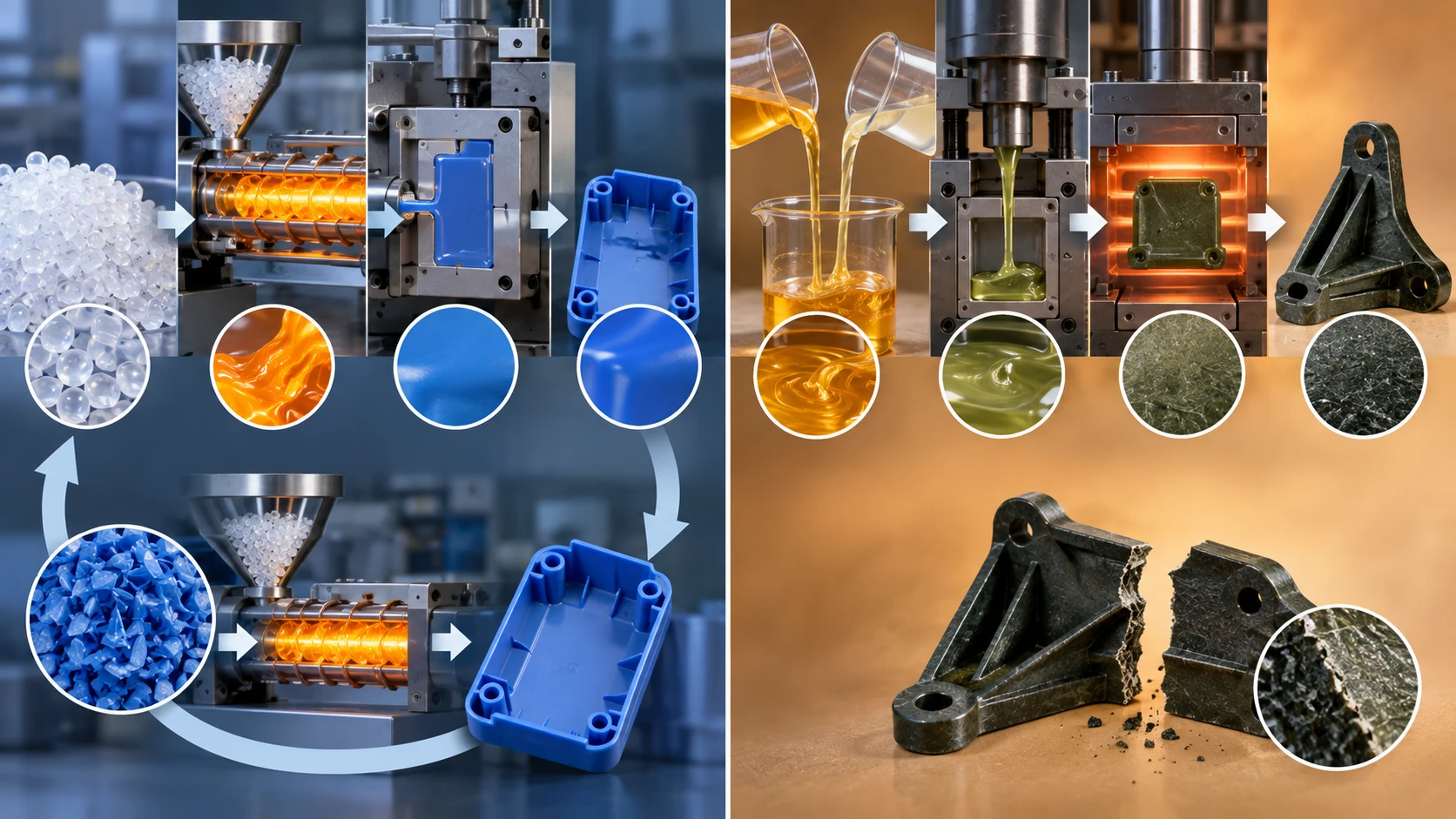
ImageGen conceptual illustration (not a real photograph or measurement). See the original diagram for exact values, names and structure.
Show original diagram with exact annotations and values
| Moulding method | In thermoplastics | In thermosets |
|---|---|---|
| Injection moulding | Molten resin is forced into a cold mould and removed once it has cooled and set. The cycle is short | Material before reaction is injected into a heated mould and cured in the mould. The mould is kept hot |
| Extrusion | Molten resin is pushed continuously through a die, cooled and taken off (pipe, film, sheet) | Continuous moulding is limited (pultrusion and the like). Normally the reaction is completed and set beyond the die |
| Compression moulding | Shaped by compression between heated platens, then cooled and removed (sheet, large mouldings) | Material in the mould is heated and pressed to cure (phenolic, SMC, epoxy moulding compounds and so on) |
The summary of moulding methods is general commentary. The conditions for preparing test specimens are laid down in standards (below).
The standards that define how test specimens are made show this difference well.
- ISO 294-1:2017 (injection moulding): sets the general principles for injection-moulding thermoplastic test specimens, with the aim of unifying how moulding conditions are reportedSourced
- ISO 293:2023 (compression moulding): for compression moulding of thermoplastic test specimens, it specifies eight cooling methods so as to obtain mouldings in a reproducible stateSourced
- ISO 295:2004 (compression moulding of thermosets): defines the procedure for making thermoset test specimens by heat and pressure from powder moulding materials of phenolic, aminoplastic, melamine/phenolic, epoxy and unsaturated polyesterSourced
ISO 293 provides as many as eight cooling methods because the cooling rate changes the amount and size of the crystals, and with them stiffness, transparency and shrinkage (Commentary). ISO 294-1 stresses the reporting of moulding conditions for the same reason.
- Thermoplastics: properties are set by "the material plus how it was cooled". If the cooling rate differs between the core and the surface of a thick wall, the crystallinity differs within the same moulding. This is why the property values of a test specimen cannot be applied directly to a product
- Thermosets: properties are set by "the material plus the cure temperature and time". With insufficient cure, the network is coarse, Tg is low, and heat and chemical resistance fall (calculated in the next section). The same formulation becomes a different material under different cure conditions
- A common pitfall: in both cases, the catalogue figures are values for a standard specimen made under standard conditions. If the moulding conditions of the actual product differ, the figures change
7. Our calculation: if the cure temperature is low, the reaction stalls part-way
As a thermosetting resin reacts, the network becomes denser and Tg rises. This holds a pitfall specific to thermosets: once Tg catches up with the cure temperature, the network can no longer move and the reaction slows. This phenomenon is called vitrification.
- Enns and Gillham measured, in isothermal cure of an amine-cured epoxy resin (Epon 828 / PACM-20), the time to gelation and the time to vitrification by dynamic viscoelastic measurement, infrared spectroscopy and gel-fraction experiments, and modelled the "time–temperature–transformation (TTT) cure diagram" theoretically. They state that the "S-shape" of the vitrification curve depends on the reaction kinetics and on the Tg of the uncured resin (Tg0), the Tg of the fully cured resin (Tg∞) and the Tg of the gelSourced
- Pascault and Williams show that the DiBenedetto equation is a convenient constitutive equation for the relation between Tg and conversion x, and that the Tg of a partially reacted resin can depend on thermal history and on the heating rate of the measurement, through enthalpy relaxationSourced
Using the DiBenedetto equation to calculate the conversion at which vitrification occursOur calculation.
- Equation: (Tg − Tg0) / (Tg∞ − Tg0) = λx / (1 − (1 − λ)x) (x: conversion)
- Assumptions (values for illustration): Tg0 = 0 °C, Tg∞ = 180 °C, λ = 0.6
- Guide to vitrification: the conversion at which Tg equals the cure temperature. Solving gives x = r / (λ + r(1 − λ)), with r = (T − Tg0) / (Tg∞ − Tg0)
- Cure temperature 80 °C → r = 0.444, x = about 0.57
- Cure temperature 120 °C → r = 0.667, x = about 0.77
- Cure temperature 160 °C → r = 0.889, x = about 0.93
Assumptions and limits: Tg0, Tg∞ and λ are this article's assumptions, not values for any particular resin. And "Tg = cure temperature" is only a guide to vitrification; in reality it is a transitional phenomenon in which the reaction rate gradually falls. Real cure also involves gelation, rising viscosity and exotherm, so it is organised with a TTT diagram.
Fig. 4 shows how to think about cure conditions (our commentary).
- Curing for a long time at low temperature does not reach Tg∞: when the cure temperature is low, the reaction nearly stops at the moment of vitrification. The network is not complete
- Why step cure is common: cure at low temperature → Tg rises → raise the temperature to melt away the vitrification → let the reaction advance, and repeat, and Tg∞ can be approached. This is the reason for post-cure in an oven after moulding
- The degree of cure can be measured: ISO 11357-5:2025 specifies how to find conversion from the heat of reaction by DSC (applicable to monomers, prepolymers and polymers, and the material may contain fillers)Sourced. To confirm the degree of cure of a product, this residual heat of reaction and Tg are used (Commentary)
- A pitfall in performance: an under-cured product, when exposed to high temperature in use, undergoes further cure, so its dimensions and properties change while in service. This is why the "Tg specification" of an encapsulant or substrate material is written together with its cure conditions
8. A materials engineer's view (2): curing is not "setting" but "a reaction that progresses"
Thermoplastic pellets are the same material however many years they sit in a warehouse. Thermosets are different (our commentary).
- Viscosity first falls, then rises: on heating, viscosity drops once and the material flows more easily; as the reaction proceeds, the molecular weight grows and viscosity rises, until flow is lost at the gel point. Enns and Gillham also describe the bulk viscosity of the reacting system before gelation and vitrificationSourced
- A race between flow and cure: to reach the corners of a mould, filling must finish before gelation. The thinner the wall and the longer the flow path, the more the slowness of the reaction is the key to the design
- Storage and pot life: for mixed two-part systems, prepregs and moulding compounds, storage temperature and shelf date decide quality
- The completeness of the network is the property: in thermoplastics it is "how it was cooled", in thermosets "how far it has reacted"
This nature is not only a drawback. Before the reaction the material is a low-viscosity liquid, so it can be made to soak deep into the gaps between fibres and among fillers. That thermosets are common in composites and encapsulants owes something to this property.
9. Recycling compared — can the material be melted again?
Thermoplastics: they can be melted again, but not without damage
Thermoplastics can be moulded again if they are ground and remelted. In Japanese statistics (PWMI, 2024), of total waste plastic discharge of 9.11 million t, 8.10 million t (an effective utilisation rate of 89%) was put to effective useSourced. But the content of this effective utilisation is material recycling 1.80 million t (20%), chemical recycling 0.23 million t (3%) and thermal recycling (energy recovery) 6.08 million t (67%)Sourced. The Institute counts under thermal recycling gasification (fuel use), solid fuel and cement raw material/fuel, incineration with power generation, and incineration with heat utilisation, so the "89% effective utilisation rate" includes a large share burned for energy recovery. It is not the share that "became resin again" (definition: effective utilisation rate = effective utilisation volume / total waste plastic discharge).
Remelting causes degradation. Schyns and Shaver summarise that for five major packaging plastics — PET, polyethylene, polypropylene, polystyrene and vinyl chloride resin — mechanical recycling is limited by cost, degradation of mechanical properties and non-uniform qualitySourced. Patel et al. report, for the reprocessing of high-density polyethylene, that main-chain scission (a fall in molecular weight) dominates at first, and long-chain branching dominates as oxygen increasesSourced.
Thermosets: they cannot be melted
The review by Post et al. states that the excellent performance of thermosets comes from the covalent network, but that this becomes, as it stands, the limit of recycling. It sorts commercial or near-commercial methods into mechanical, thermal and chemical treatments, and concludes that most require high energy and aim not at reuse of the thermoset matrix itself but at recovering high-value fibres, fillers or substratesSourced.
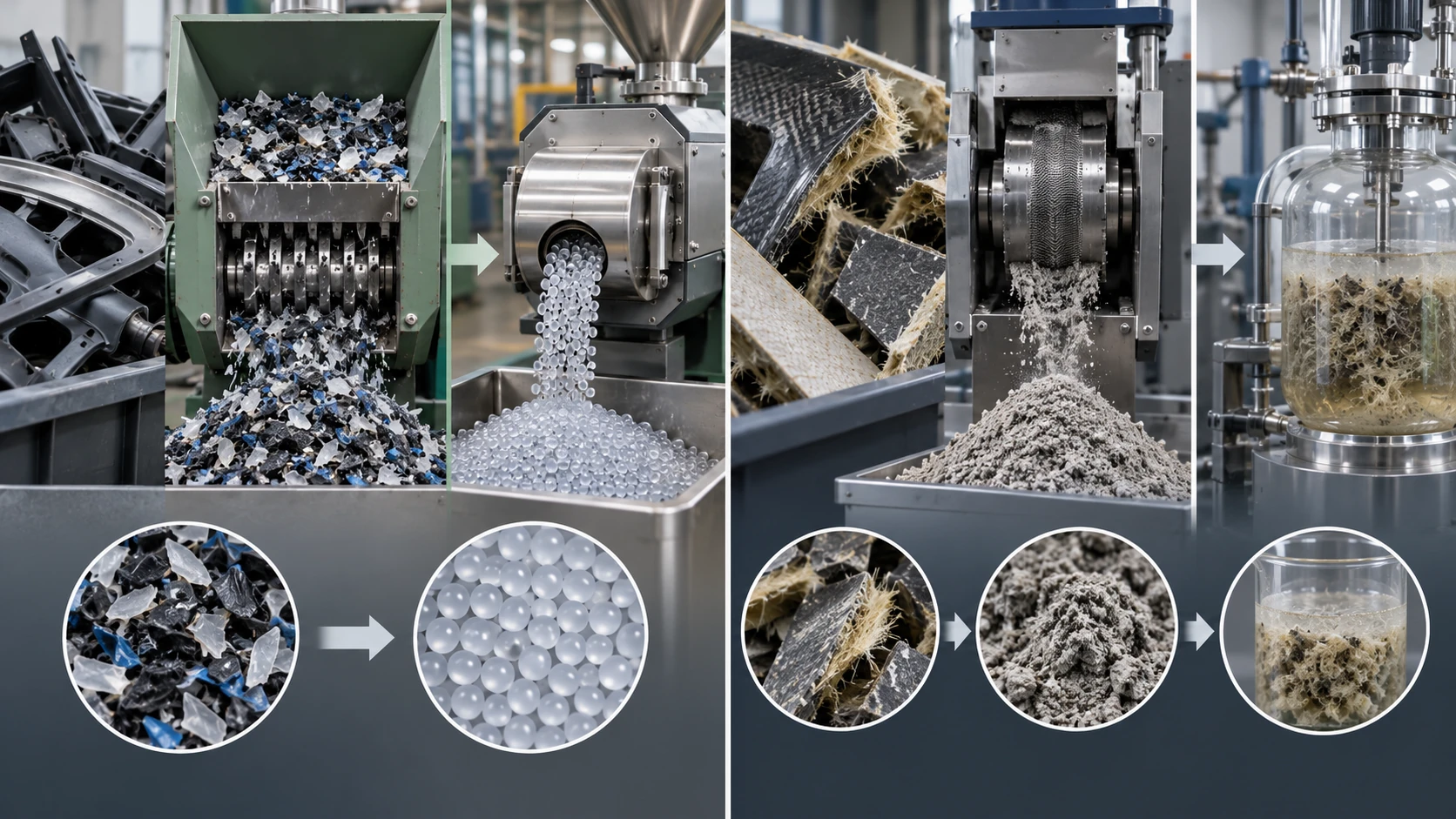
ImageGen conceptual illustration (not a real photograph or measurement). See the original diagram for exact values, names and structure.
Show original diagram with exact annotations and values
10. A materials engineer's view (3): why thermoset recycling is hard, and attempts to change it by design
Thermoset recycling is a problem in which the following three stand in the way at once (our commentary).
- The network does not melt: there is no remelting, the cheapest route. Thermoplastic offcuts can be ground and fed back, but thermoset moulding losses (runners, flash) cannot be used as they are either
- Cutting the network means cutting strong bonds: chemical or thermal decomposition needs high temperatures or strong chemicals to cut covalent bonds (Post et al. [Reference 15] summarise this as "high energy")
- It is a composite: thermosets are often used as composites with fibres or inorganic fillers, so even when you want to break down the matrix, a step to separate what is mixed is needed
As a result, the present routes are mainly those on the right of Fig. 5: use as a filler, send to energy recovery, or recover fibres by pyrolysis or solvolysis. In Japanese statistics too, cement raw material/fuel use and incineration with power generation are classed as "thermal recycling"Sourced.
Changing the design of the network: dynamic covalent bonds
The other route is to change, by design, the premise that "it cannot be melted". Kloxin and Bowman set out a new framework, "covalent adaptable networks" (CANs), in which the whole network carries chemical structures that rearrange reversibly under a stimulus (heat, light and so on) while still being a covalent network. Conventional thermosets generally cannot be reshaped, reprocessed or recycled, whereas a CAN can rearrange its structure persistently under stimulus, which is the essence of the ideaSourced. The epoxy network of Montarnal et al. (a vitrimer) is reported to rearrange its network topology by exchange reactions without depolymerising and to be processable while remaining insoluble (details in the series article on polymer basics)Sourced.
However, Post et al. judge that the great majority of academic research on recyclable thermosets has limited potential for industrial applicationSourced. Whether dynamic networks will be widely adopted in real products could not be confirmed within the scope of this articleNot yet confirmed.
The difficulty of recycling does not appear suddenly at the disposal stage; it is fixed when the material is chosen (our commentary).
- The route at disposal is fixed when the material is chosen: the moment a thermoset is chosen, the "remelting" route closes. Ask whether the reasons for choosing it anyway (heat resistance, dimensional stability) are worth the difficulty of recycling
- How offcuts arise also differs by material: thermoplastics can return offcuts within the process, while with thermosets runners and flash become waste as they are. Yield design matters
- Mixing makes both difficult: even for thermoplastics, mixing different resins or admitting fillers lowers the quality of the recycled product (as summarised by Schyns et al.)
11. Rules of thumb for choosing
| Requirement | Tendency | Reason (Commentary) |
|---|---|---|
| Dimensional stability and creep resistance at high temperature | Thermosets tend to be favoured | A covalent network does not flow even above Tg (Fig. 2) |
| Mass production and short cycles | Thermoplastics tend to be favoured | They simply set on cooling. There is no waiting for a reaction |
| Welding, reshaping, repair | Thermoplastics | They can be melted again |
| Ease of recycling | Thermoplastics tend to be favoured | There is a route through remelting (though with degradation) |
| Impregnating fibres and fillers, complex filling | Thermosets tend to be favoured | Low-viscosity liquid before reaction |
| High-temperature uses needing electrical insulation and chemical resistance | Thermosets are common | The network is not dissolved by solvent and does not flow with temperature |
These are tendencies, and this is an area with many exceptions (some thermoplastics, such as PEEK, have high heat resistance; see the series article on PEEK and super engineering plastics). Selection is done by the requirements of each application and by testing.
12. Open issues, and what this article could not confirm
(1) The text of ISO 472 (the vocabulary standard)
The existence of ISO 472:2013 as the vocabulary standard for plastics was confirmed, but the text is paid and the wording of the definitions of thermoplastic and thermoset was not checked. The definitions in this article are a general summary of polymer science (Commentary).
(2) Recycling rate of thermosets
Japan's waste plastic statistics group the breakdown by resin under "other resins", and the recovery and recycling rate for thermosets alone could not be read from the published material. Global statistics (Plastics Europe) do not give a recycling rate for thermosets either.
(3) Assumptions behind the calculation in Fig. 4
The parameters of the DiBenedetto equation are assumptions for illustration. No measured Tg–conversion curve for a specific resin was checked.
(4) Industrial adoption of dynamic networks
The industrial adoption of CANs and vitrimers was not checked.
- The heart of the difference is whether there is a covalent network. Of Japan's 8.53 Mt of resin production in 2024, thermoplastics were 91.3% and thermosets 8.7% (0.74 Mt)Sourced
- As temperature rises, thermoplastics flow and thermosets stay rubbery. HDT is not the maximum service temperatureSourced
- Thermoplastic properties are set by cooling history, thermoset properties by cure history. ISO 293 provides eight cooling methodsSourced
- If the cure temperature is low, the resin vitrifies part-way. In the assumed system, conversion is about 0.77 at 120 °C and about 0.57 at 80 °COur calculation
- Thermoplastics can be remelted, but with degradation. 67% of Japan's "89% effective utilisation rate" is energy recoverySourced
- Thermoset recycling is a choice of two: cut the network, or change the design of the network. Industrial adoption of the latter has not been confirmedNot yet confirmed
13. Glossary
- Thermoplastic resin
- A resin that softens and melts on heating and sets on cooling, a reversible change.
- Thermosetting resin
- A resin that reacts into a three-dimensional network and no longer melts.
- Glass transition temperature Tg
- The temperature at which a material passes from glassy to rubbery (or viscous liquid). The value moves with heating rate and other factors.
- Melting point Tm
- The temperature at which crystals melt, and at which a crystalline resin flows.
- Amorphous / crystalline (semicrystalline)
- Chains that do not crystallise / a mixture of crystalline and amorphous regions.
- Rubbery plateau
- The region above Tg where the elastic modulus is nearly flat. With a network it continues up to high temperature.
- Heat deflection temperature (HDT)
- The temperature at which a specimen deflects by a set amount under a fixed load and fixed heating rate. Not the maximum service temperature.
- DMA (dynamic mechanical analysis)
- A method of measuring modulus and loss while changing temperature, used to find Tg.
- Gelation
- The point at which the network connects throughout and flow is lost.
- Vitrification
- The phenomenon in which Tg catches up with the cure temperature during cure and the reaction slows.
- TTT diagram
- A diagram of the relation between the time to gelation or vitrification and temperature in isothermal cure.
- Post-cure
- Holding at high temperature after moulding to advance the remaining reaction and raise Tg.
- Covalent adaptable network (CAN)
- A covalent network given reversible rearrangement of its bonds.
- Vitrimer
- A network whose connectivity can be rearranged by exchange reactions.
- Material recycling
- Recycling in which waste plastic is made into recycled resin or recycled products.
- Thermal recycling
- In Japanese statistics, use that recovers heat energy by incineration, solid fuel production and the like.
14. References (primary sources)
- Plastic Waste Management Institute (PWMI, Japan) "Material flow diagram 2024: production, disposal, recycling and treatment of plastic products" (in Japanese), December 2025 (PDF) — https://www.pwmi.or.jp/pdf/panf2.pdf
- Plastics Europe "Plastics the Fast Facts 2025", October 2025 (provisional figures for 2024, PDF) — https://plasticseurope.org/wp-content/uploads/2025/09/PE_TheFacts_25_digital-1pager-scrollable.pdf
- ISO ISO 472:2013 "Plastics — Vocabulary" — https://www.iso.org/standard/44102.html
- ISO ISO 294-1:2017 "Plastics — Injection moulding of test specimens of thermoplastic materials — Part 1" — https://www.iso.org/standard/67036.html
- ISO ISO 293:2023 "Plastics — Compression moulding of test specimens of thermoplastic materials" — https://www.iso.org/standard/83779.html
- ISO ISO 295:2004 "Plastics — Compression moulding of test specimens of thermosetting materials" — https://www.iso.org/standard/28180.html
- ISO ISO 75-1:2020 "Plastics — Determination of temperature of deflection under load — Part 1: General test method" — https://www.iso.org/standard/77576.html
- ISO ISO 6721-11:2019 "Plastics — Determination of dynamic mechanical properties — Part 11: Glass transition temperature" — https://www.iso.org/standard/74988.html
- ISO ISO 11357-5:2025 "Plastics — Differential scanning calorimetry (DSC) — Part 5: Determination of characteristic reaction-curve temperatures and times, enthalpy of reaction and degree of conversion" — https://www.iso.org/standard/88107.html
- ASTM International ASTM D2765 "Standard Test Methods for Determination of Gel Content and Swell Ratio of Crosslinked Ethylene Plastics" — https://store.astm.org/d2765-16r24.html
- Schyns, Shaver "Mechanical recycling of packaging plastics: a review", Macromol. Rapid Commun. 42(3), 2000415 (published online 2020) — https://doi.org/10.1002/marc.202000415
- Enns, Gillham "Time–temperature–transformation (TTT) cure diagram: Modeling the cure behavior of thermosets", J. Appl. Polym. Sci. 28, 2567–2591 (1983) — https://doi.org/10.1002/app.1983.070280810
- Pascault, Williams "Glass transition temperature versus conversion relationships for thermosetting polymers", J. Polym. Sci. B 28, 85–95 (1990) — https://doi.org/10.1002/polb.1990.090280107
- DiBenedetto "Prediction of the glass transition temperature of polymers: A model based on the principle of corresponding states", J. Polym. Sci. B 25, 1949–1969 (1987) — https://doi.org/10.1002/polb.1987.090250914
- Post et al. "A review on the potential and limitations of recyclable thermosets for structural applications", Polym. Rev. 60(2), 359–388 (published online 2019) — https://doi.org/10.1080/15583724.2019.1673406
- Kloxin, Bowman "Covalent adaptable networks: smart, reconfigurable and responsive network systems", Chem. Soc. Rev. 42, 7161–7173 (2013) — https://doi.org/10.1039/c3cs60046g
- Montarnal et al. "Silica-like malleable materials from permanent organic networks", Science 334, 965–968 (2011) — https://doi.org/10.1126/science.1212648
- Patel et al. "Defining quality by quantifying degradation in the mechanical recycling of polyethylene", Nat. Commun. 15, 8733 (2024) — https://doi.org/10.1038/s41467-024-52856-8
15. Claim-to-source audit
| Claim in the text | Basis | Type |
|---|---|---|
| Japan's resin production in 2024 of 8.53 Mt. Thermoplastics 91.3%, thermosets 0.74 Mt (8.7%). Breakdown: polyethylene 1.94 Mt (22.7%), polypropylene 1.93 Mt (22.7%), other thermoplastics 1.55 Mt (18.1%), vinyl chloride resin 1.46 Mt (17.2%), polystyrenes 0.90 Mt (10.6%). "Plastics" does not include liquid resins such as synthetic rubber, synthetic fibres, paints and adhesives | PWMI material flow diagram 2024Reference 1 https://www.pwmi.or.jp/pdf/panf2.pdf | Sourced |
| Total waste plastic discharge of 9.11 Mt and effective utilisation of 8.10 Mt (effective utilisation rate 89%). Material recycling 1.80 Mt (20%), chemical recycling 0.23 Mt (3%), thermal recycling 6.08 Mt (67%). The scope of thermal recycling (gasification [fuel use], solid fuel and cement raw material/fuel, incineration with power generation, incineration with heat utilisation). The definition of the effective utilisation rate. That the breakdown of waste plastics by resin is in five categories including "other resins" | Same (the overview and breakdown pages of the Institute's document)Reference 1 https://www.pwmi.or.jp/pdf/panf2.pdf | Sourced |
| World plastics production of 430.9 Mt (2024). PP 19.0%, PE-LD and LLD 13.9%, PE-HD and MD 12.1%, PVC 12.8%, PET 6.2%, PS 5.1%, PUR 5.3%, other thermoplastics 7.1%, other thermosets 8.3%. That adhesives, paints and some fibres are excluded from the scope | Plastics Europe, "Plastics the Fast Facts 2025"Reference 2 https://plasticseurope.org/wp-content/uploads/2025/09/PE_TheFacts_25_digital-1pager-scrollable.pdf | Sourced |
| That ISO 472:2013 is the vocabulary standard for plastics (the wording of the definitions was not checked) | ISO bibliographic pageReference 3 https://www.iso.org/standard/44102.html | Sourced |
| That ISO 294-1:2017 sets the general principles for injection-moulded test specimens and unified reporting of moulding conditions | Title and scopeReference 4 https://www.iso.org/standard/67036.html | Sourced |
| That ISO 293:2023 specifies eight cooling methods for compression-moulded thermoplastic test specimens | Title and scopeReference 5 https://www.iso.org/standard/83779.html | Sourced |
| That ISO 295:2004 defines the procedure for making compression-moulded thermoset test specimens (powder moulding materials of phenolic, aminoplastic, melamine/phenolic, epoxy and unsaturated polyester) | Title and scopeReference 6 https://www.iso.org/standard/28180.html | Sourced |
| That the deflection temperature under load of ISO 75-1:2020 is suited to assessing relative behaviour and the result does not necessarily represent the maximum service temperature | Title and scopeReference 7 https://www.iso.org/standard/77576.html | Sourced |
| That ISO 6721-11:2019 specifies the DMA measurement of Tg, treats Tg as an indicator of the transition from glassy to rubbery/viscous liquid state, and includes a thermal-lag correction procedure because the value can change with heating rate | Title and scopeReference 8 https://www.iso.org/standard/74988.html | Sourced |
| That ISO 11357-5:2025 specifies how to find reaction temperatures, heat of reaction and conversion by DSC, applies to monomers, prepolymers and polymers, and allows fillers to be present | Title and scopeReference 9 https://www.iso.org/standard/88107.html | Sourced |
| That ASTM D2765 specifies methods for measuring the gel content and swell ratio of crosslinked ethylene plastics | Title and scopeReference 10 https://store.astm.org/d2765-16r24.html | Sourced |
| That mechanical recycling of the five major packaging plastics is limited by cost, degradation of mechanical properties and non-uniform quality | Abstract of the review by Schyns and ShaverReference 11 https://doi.org/10.1002/marc.202000415 | Sourced |
| That the times to gelation and vitrification were measured in an amine-cured epoxy resin and the TTT diagram modelled; that the S-shape of the vitrification curve depends on Tg0, Tg∞, the Tg of the gel and the reaction kinetics; and that the bulk viscosity of the reacting system before gelation and vitrification is also described | Abstract of Enns and GillhamReference 12 https://doi.org/10.1002/app.1983.070280810 | Sourced |
| That the DiBenedetto equation is presented as a constitutive equation for the Tg–conversion relation of thermosets, and that the Tg of a partially reacted resin can depend on thermal history and heating rate | Abstract of Pascault and WilliamsReference 13 https://doi.org/10.1002/polb.1990.090280107 | Sourced |
| That the DiBenedetto equation derives from a model for predicting Tg based on the principle of corresponding states (including an expression for the effect of crosslinking) | Abstract of DiBenedettoReference 14 https://doi.org/10.1002/polb.1987.090250914 | Sourced |
| That the performance and the limited recyclability of thermosets come from the same network; that commercial methods are mechanical, thermal and chemical, need high energy and aim to recover fibres, fillers and substrates rather than regenerate the resin; and that most academic research on recyclable thermosets has limited potential for industrial application | Abstract of the review by Post et al.Reference 15 https://doi.org/10.1080/15583724.2019.1673406 | Sourced |
| The CAN framework: conventional thermosets generally cannot be reshaped, reprocessed or recycled, whereas a CAN can rearrange its structure persistently under stimulus | Abstract of Kloxin and BowmanReference 16 https://doi.org/10.1039/c3cs60046g | Sourced |
| That an epoxy network rearranges its topology by exchange reactions without depolymerising and can be processed while insoluble | Abstract of Montarnal et al.Reference 17 https://doi.org/10.1126/science.1212648 | Sourced |
| That in reprocessing high-density polyethylene, main-chain scission dominates at first and long-chain branching dominates as oxygen increases | Abstract of Patel et al.Reference 18 https://doi.org/10.1038/s41467-024-52856-8 | Sourced |
| The conversions at vitrification (about 0.57, 0.77 and 0.93 at cure temperatures of 80, 120 and 160 °C). 7.79 Mt = 8.53 Mt − 0.74 Mt | Our calculation. Assumptions: Tg0 = 0 °C, Tg∞ = 180 °C, λ = 0.6 (assumptions for illustration), with Tg = cure temperature taken as the guide to vitrification | Our calculation |
| The general definitions and comparison table of thermoplastics and thermosets, the comparison tables of amorphous and crystalline resins and of moulding methods, and the summaries that "thermoplastics depend on cooling history and thermosets on cure history", that "cure is designed as a staircase", that "thermoset viscosity changes with time", that "the difficulty is three factors stacked together", the rules of thumb for choosing, that "thermosets are concentrated in demanding applications", that HDT should not be used as a service temperature, and that PUR cannot be assigned to thermoplastics or thermosets | Our commentary, based on the general summary of polymer science. These are not views expressed by any institution | Commentary |
| The recycling rate of thermosets alone. The wording of the definitions in ISO 472. The industrial adoption of dynamic networks (CANs and vitrimers) | Not confirmed within the scope of this article (thermosets fall under "other resins" in the statistics, the text of the standard is paid, and so on) | Not yet confirmed |
| That Figs. 1 to 5 are explanatory drawings, and that the hero image is an AI-generated image | Our note | Commentary |
Last updated 2 October 2026. Sources are limited to primary material (statistical publications of the Plastic Waste Management Institute and Plastics Europe, the titles and scopes of ISO and ASTM standards, and bibliographic details and abstracts of peer-reviewed papers). Because the article includes structural readings and materials-design interpretations, those are marked as Commentary and kept separate from sourced fact. The wording of the definitions in ISO 472, the recycling rate of thermosets alone and the industrial adoption of dynamic networks could not be confirmed and are therefore not stated. The calculation in Fig. 4 is an example based on assumptions for illustration. All figures are explanatory concept graphics, data charts or our own calculations. Figs. 1 to 5 are vector drawings and the hero image is AI-generated; none of them shows a real measured curve or a physical product.