COMPANY PROFILE / SEMICONDUCTOR BACK-END
Ajinomoto
The seasoning company that holds more than 95% of the world market for AI-chip insulation film
Food accounts for 77.5% of Ajinomoto's revenue. Yet an electronic materials business worth just 6.4% of the group commands an overwhelming share of ABF, the dielectric film used between the layers of an AI semiconductor package. This profile traces how a food company ended up in that position, and what it actually contributes to group profit, using only figures from the company's statutory filings and its own investor material.
- Ajinomoto in 30 seconds
- The logo and how the name is written
- What the company actually does: food dominates
- Scale: five years of revenue
- Company category and position in the back-end industry
- Sites and the countries where it manufactures
- Leading products and share in semiconductor back-end work
- Current investment plans
- Major corporate partners
- Where the company is heading in this field
- The risks this company carries
- Glossary, references and claim-to-source audit
1. Ajinomoto in 30 seconds
Code 2802120 group companies, 15 of them equity-method affiliates
(food and materials)In semiconductors a materials supplier: it makes neither equipment nor substrates
(Ajinomoto Build-up Film)The dielectric layer material in semiconductor package substrates
Ajinomoto's electronic materials business, which the company reports internally as Functional Materials, had FY2025 revenue of JPY 100.8bn. That is 6.4% of group revenue of JPY 1,583.7bn Our calculation. But the company itself says this business runs a margin "above 50%" Sourced, and working back from that figure, those 6.4 percentage points of revenue generate roughly 28% of group business profit Our calculation. Treating this as a minor sideline of a food company is right about revenue and wrong about profit.
2. The logo and how the name is written
The Ajinomoto logo and the name ABF (Ajinomoto Build-up Film) are registered trademarks of the company. Nothing here is an AI reconstruction of the mark: the frame above holds the official logo image taken from the company's own site.
A note on usage: the industry routinely says "ABF" or "ABF substrate", but ABF is the name of a material, a film, and not of the substrate itself. The precise description is "a package substrate that uses ABF as its dielectric layer".
Official site: https://www.ajinomoto.co.jp/company/jp/3. What the company actually does: food dominates, at 77.5% of revenue
Ajinomoto reports three segments. Measured by external revenue in FY2025, they break down as follows Sourced.
| Segment | Main products | Revenue (JPY m) | Share |
|---|---|---|---|
| Seasonings and Foods | AJI-NO-MOTO, HON-DASHI, Cook Do, Knorr and Blendy, among others | 936,926 | 59.2% |
| Frozen Foods | Gyoza dumplings, fried rice, karaage fried chicken and similar lines | 290,308 | 18.3% |
| Healthcare and Others | Amino acids for pharmaceutical and food use, contract manufacturing of biologics (CDMO), and electronic materials | 341,504 | 21.6% |
| Other businesses | Feed-use amino acids, supplements, personal care ingredients | 14,979 | 0.9% |
| Total | - | 1,583,719 | 100% |
Shares are our own arithmetic Our calculation.
Semiconductors sit inside the third segment, in a sub-category the company calls Functional Materials, which covers electronic materials and related lines. The company discloses revenue for that sub-category, and only at this level of detail Sourced.
| Inside Healthcare and Others | FY2024 (JPY m) | FY2025 (JPY m) | Change |
|---|---|---|---|
| Amino acids for pharmaceutical and food use | 58,342 | 63,195 | +8.3% |
| Bio-pharma services (CDMO) | 89,290 | 84,860 | -5.0% |
| Functional Materials (electronic materials and related) | 76,568 | 100,782 | +31.6% |
| Others | 104,195 | 92,665 | -11.1% |
| Sub-total | 328,397 | 341,504 | +4.0% |
Percentage changes are our own arithmetic Our calculation. The Healthcare and Others segment grew because, in substance, electronic materials grew.
The company attributes ABF's competitive strength to "proprietary materials technology rooted in AminoScience" and to "a rapid development system built on our knowledge of polymer chemistry, our molecular design capability and our formulation technology" Sourced. In other words, the edge here is not the invention of epoxy resin but the formulation design and the engineering of volume production around it. Exactly the same is true of designing a seasoning. The raw materials are not special; what becomes the barrier to entry is the accumulated knowledge of what to mix with what, in what ratio, and how to keep making it to the same specification year after year. For anyone working in materials development, that is the most instructive part of this story.
4. Scale: five years of revenue
| Fiscal year | Revenue (JPY m) | Business profit (JPY m) | Profit attributable to owners (JPY m) | Employees (consolidated) |
|---|---|---|---|---|
| FY2021 (Mar 2022) | 1,149,370 | 120,915 | 75,725 | 34,198 |
| FY2022 (Mar 2023) | 1,359,115 | 135,341 | 94,065 | 34,615 |
| FY2023 (Mar 2024) | 1,439,231 | 147,681 | 87,121 | 34,862 |
| FY2024 (Mar 2025) | 1,530,556 | 159,302 | 70,272 | 34,860 |
| FY2025 (Mar 2026) | 1,583,719 | 181,163 | 134,675 | 34,787 |
"Business profit" is a subtotal Ajinomoto defined for itself when it adopted IFRS: revenue less cost of sales, selling expenses, R&D expenses and general and administrative expenses, plus share of profit of equity-method associates. It excludes non-operating items.
Over these five years headcount barely moved, from 34,198 to 34,787, while revenue rose 37.8% and business profit 49.8% Our calculation. This is a company that grew profit without growing its payroll, and the electronic materials business discussed below sits at the centre of that.
5. Company category and position in the back-end industry
The category is manufacturer, specifically a materials supplier. Ajinomoto is not an OSAT, not an equipment maker and not a substrate maker. In the semiconductor supply chain it sits one step further upstream than all of those, selling materials to the companies that build package substrates.
| Position in the supply chain | What it does | Representative companies |
|---|---|---|
| Materials makers (Ajinomoto is here) | Supply dielectrics, encapsulants, adhesives and similar | Ajinomoto, Sumitomo Bakelite, Shin-Etsu Chemical and others |
| Package substrate makers | Use those materials to build the substrate itself | Ibiden, Unimicron, Samsung Electro-Mechanics and others |
| OSATs and foundries | Mount the die on the substrate, encapsulate and test | ASE Group, Amkor, TSMC and others |
| Chip design houses | Design the chip and contract out everything above | NVIDIA, AMD and others |
6. Sites and the countries where it manufactures
The electronic materials business is run by Ajinomoto Fine-Techno Co., Inc., a wholly owned subsidiary Sourced.
| Site | Country | Role | Status |
|---|---|---|---|
| Kawasaki (head office) plant | Japan (Kawasaki-ku, Kawasaki, Kanagawa) | Production site for electronic and related materials: varnish manufacture and coating | Operating |
| Gunma plant | Japan (Showa Village, Gunma) | The second production site | Operating |
| Taiwan | Taiwan | Shown as a site on the company's own investor material | Operating |
| Kani, the new plant | Japan (Kani, Gifu) | A third production site, intended both to add capacity and to support business continuity | Land acquired in May 2026 for about JPY 1.2bn. Construction from 2028, operation from 2032 |
This is the full extent of the electronic materials production footprint the company has published. Capacity by site, and the split by product, are not disclosed Not yet confirmed.
The press release for the Kani plant states the siting criterion plainly: a location that "satisfies business continuity requirements for stable supply by sitting a certain distance away from the head office plant and the Gunma plant" Sourced. Read that back and it says something striking. The dielectric used in the world's most advanced semiconductor packages is, in practice, concentrated in two plants in Japan, the company has recognised that as a risk, and it is doing something about it. But operation begins in 2032, so the present arrangement stands for another six years.
7. Leading products and share in semiconductor back-end work
What ABF is
ABF, or Ajinomoto Build-up Film, is the dielectric material between the layers of a semiconductor package substrate. The substrate an IC die sits on is made by stacking wiring layers and insulating layers alternately; ABF is the resin film that becomes the insulating layer. Since its launch in 1999 it spread first into substrates for PC processors and from there into everything else Sourced.
The company's own Ajinomoto Fact Book 2026 states ABF's market position explicitly: "No. 1, more than 95%" Sourced. It is worth being clear about what that is. This is the company reporting its own share, not a figure verified by an independent research house. Read it with that in mind. Estimates published by research firms are not used anywhere in this article Not yet confirmed.
The centre of gravity has moved from PCs to servers
Of FY2025 the company says it delivered "a large increase in both revenue and profit, on the back of strong full-year sales of ABF for high-performance substrates including AI, server and network applications" Sourced. Revenue rose 31.6% year on year.
The company attributes its improving profitability not to price increases but to a change in product mix: "the sustained rise in unit price in the ABF business has been achieved because, as product performance improved, higher-priced products came to account for a larger part of the mix" Sourced. On that basis the margin has gone from around 30% a decade ago to above 50%.
The mechanism that makes this work in a materials business is what the company calls its "rapid development system": development is done customer by customer, with performance and price negotiated together, and the company says outright that "performance and price are inseparable". Competition on material performance becomes, directly, the material of the price negotiation. As a revenue model for a materials business, that is worth dwelling on.
8. Current investment plans
On the Kani plant the company is explicit that this is "a new expansion investment aimed at demand growth beyond 2030, separate from the capacity investment towards 2030 that has totalled JPY 25bn since 2023" Sourced.
The section of the Annual Securities Report that lists planned additions and retirements of facilities contains not a single item related to electronic materials; what it lists is the head office move, frozen foods, seasonings and amino acids in the Americas Sourced. The total construction cost of the Kani plant, the amount of capacity it will add, and the capacity of the two existing plants are all unpublished Not yet confirmed. There is therefore no way to establish from primary sources how much ABF capacity will actually grow.
9. Major corporate partners
On partners in the ABF business, Ajinomoto names no individual company, neither in its statutory filings nor in its results briefing material. The formulations it uses are these Sourced.
| The company's wording | What it refers to | Names disclosed |
|---|---|---|
| "our direct customers, the package substrate manufacturers" | Who ABF is sold to: the companies that build substrates | None |
| "the end users beyond them" | The chip makers and design houses that use those substrates | None |
| "a close co-creation ecosystem with key players in the semiconductor value chain" | The framework for joint development with customers and related firms | None |
| "exploratory work in collaboration with external partners" | New fields such as bioelectronics, aimed at beyond 2030 | None |
The industry talks freely about Ajinomoto's ABF going to substrate makers such as Ibiden, Unimicron and Shinko, and ending up in products from Intel or NVIDIA. But none of those names appears anywhere in Ajinomoto's own primary material. This article therefore does not treat any of them as partners Not yet confirmed.
10. Where the company is heading in this field
What is established
| Fact | What it implies for the back end |
|---|---|
| Electronic materials revenue up 31.6% year on year, to JPY 100.8bn | AI demand is showing up in the actual numbers |
| Server and network use is 70% of volume, against 40% in FY2017 | The character of the business has shifted from PC component to data centre component |
| The margin has gone from around 30% to above 50% | Financial evidence of a position that is hard to substitute out of |
| Land acquired for a third site in Gifu, operation planned for 2032 | The company is planning on demand growth beyond 2030 |
| Development for optoelectronic fusion packaging is stated explicitly | The intent is to supply materials into the next generation of packages too |
| Expansion around ABF into magnetic materials, encapsulants and ABF-RCC, resin coated copper | The company is itself trying to reduce its dependence on a single material |
Outlook
Not yet confirmed Read plainly, those facts suggest ABF's position holds for the foreseeable future. A dielectric layer governs the reliability of the whole package, and switching material means redoing process conditions and quality qualification at both the substrate maker and the chip maker. That switching cost is the substance of what the company calls an insurmountable wall.
Not yet confirmed The counterweight is that Ajinomoto's influence over the back end as a whole is confined to this one material. It builds no substrates, no equipment and does no assembly, so there is no step outside ABF where Ajinomoto is part of the decision. Its push into magnetic materials, encapsulants and ABF-RCC reads as the company recognising that limit for itself.
11. The risks this company carries
| Risk | Substance | Supporting material |
|---|---|---|
| A substitute technology emerging | The company itself lists "the risk that, as countries diversify procurement or impose domestic-content requirements and as competitors innovate, substitute technologies for our materials spread, reducing adoption by customers and market share, and so reducing revenue" | "Business and other risks" in the Annual Securities Report Sourced |
| The flip side of a very high share | A share above 95% also means there is almost no room left to gain. Future growth has to come from volume and from unit price | Our reading of the share statement in Fact Book 2026 Our calculation |
| Concentration of production | The published production footprint is centred on two plants, Kawasaki and Gunma. The third site does not operate until 2032, so the concentration persists until then | Company press release Sourced |
| Exposure to the chip cycle | Electronic materials are 6.4% of group revenue but about 28% of business profit. If semiconductors enter a correction, the effect on profit is far larger than the revenue share suggests | Our own arithmetic Our calculation |
| Customers are not disclosed | Neither the names of the substrate makers it sells to nor the concentration of that business is published. Customer concentration cannot be assessed from outside | Not disclosed Not yet confirmed |
| Volatility in the core business | 93.6% of revenue is food, amino acids and contract pharmaceutical work. Those are exposed to raw material and energy prices, to currency (the FY2026 guidance assumes JPY 150 to the U.S. dollar) and to geopolitics | The assumptions behind the guidance in the results release Sourced |
Look at Ajinomoto's share price or its earnings as a food company and you will miss what electronic materials are doing. Look at it as a semiconductor materials company and you will miss the swings in the food business that is 94% of revenue. The line to follow quarter by quarter is the single Functional Materials row inside the Healthcare and Others segment. The company discloses that breakdown in the notes to its results release, under disaggregation of revenue, and in the results briefing material, so the number is refreshed at least twice a year.
12. Glossary
- ABF
- Ajinomoto Build-up Film. The resin film used as the dielectric between layers of a semiconductor package substrate. A registered trademark of Ajinomoto.
- Interlayer dielectric
- The material that sits between wiring layers of a substrate and insulates them electrically. It has to be thin and flat, survive via drilling, and not degrade with heat or humidity.
- Package substrate
- The small board an IC die is mounted on, connecting it to the outside circuit board. It is made by build-up processing, stacking wiring and insulating layers alternately.
- Build-up process
- Making a multilayer board by adding insulating and wiring layers one at a time. This is where the "Build-up" in ABF comes from.
- Functional Materials
- Ajinomoto's internal sub-segment covering electronic materials such as ABF together with functional materials such as adhesives and magnetic materials.
- ABF-RCC
- Resin Coated Copper. Insulating resin and copper foil combined into a single material, which Ajinomoto is developing as an adjacent line to ABF.
- Optoelectronic fusion
- Replacing part of the electrical wiring with optical links to cut power consumption and latency. Ajinomoto names it explicitly as a development target for next-generation packages.
- Business profit
- A subtotal Ajinomoto defined for itself on adopting IFRS: revenue less cost of sales, selling, R&D and administrative expenses, plus share of profit of equity-method associates.
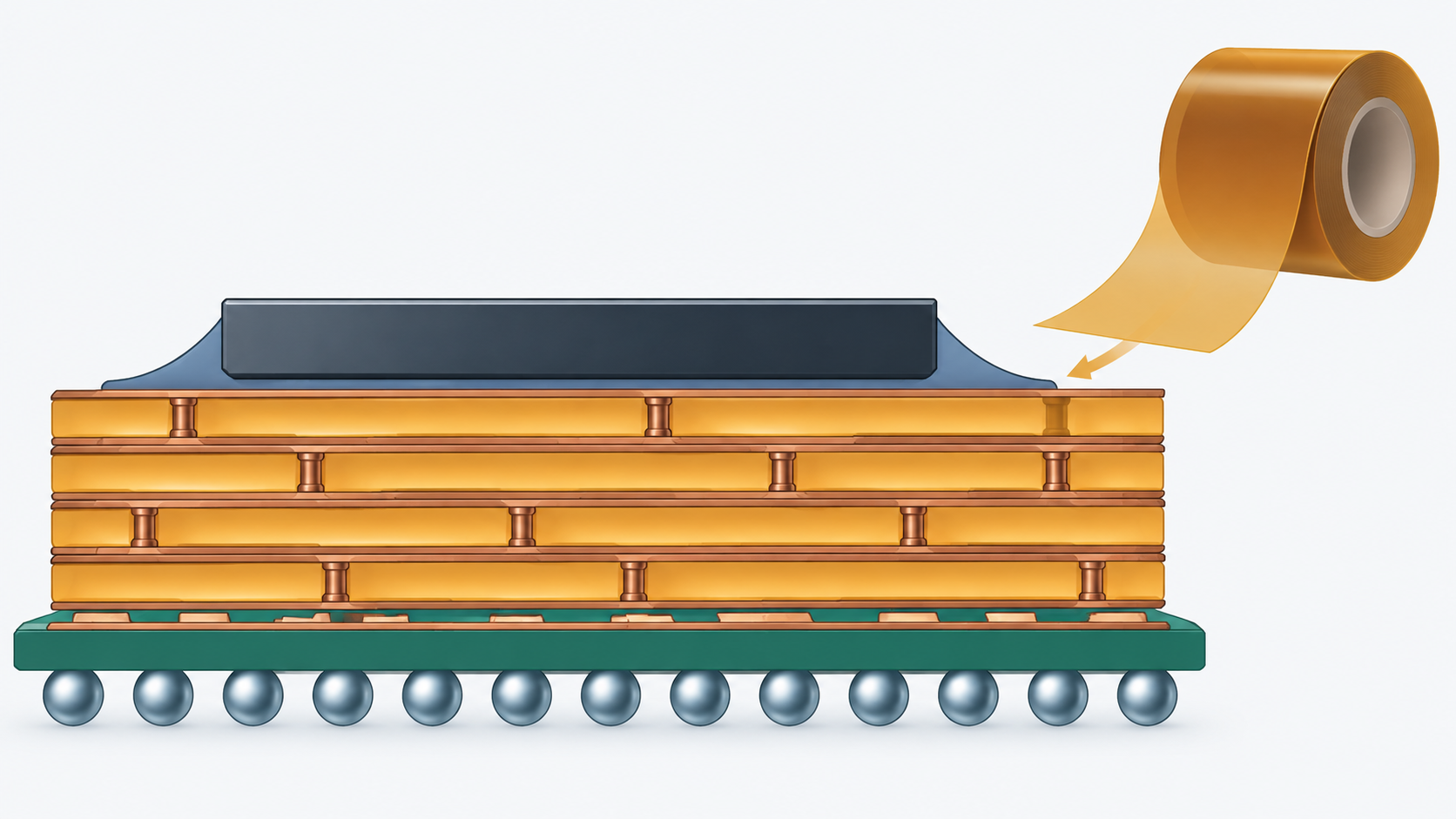 AI-generated concept
13. References
- Ajinomoto Co., Inc. Annual Securities Report for the 148th fiscal year, 1 April 2025 to 31 March 2026 (filed with the Director-General of the Kanto Local Finance Bureau on 12 June 2026). Five years of revenue, business profit and headcount; revenue by segment; disaggregation of revenue including Functional Materials; the breakdown of capital expenditure; R&D expense; the profile of Ajinomoto Fine-Techno; business and other risks; and the plan for new facilities. https://www.ajinomoto.co.jp/company/jp/ir/library/securities/main/06/teaserItems1/0/linkList/03/link/FY25Q4_annual Securities Report_J.pdf
- Ajinomoto Co., Inc. FY2025 consolidated results release under IFRS, 7 May 2026. Consolidated results, results by segment, and the guidance for the coming year together with its assumptions, including JPY 150 to the U.S. dollar. https://data.swcms.net/file/ajinomoto-ir/dam/jcr:6bedb9ff-8b48-4642-94eb-4f066a05fe11/140120260501516433.pdf
- Ajinomoto Co., Inc. FY2025 results briefing presentation, with the spoken script. The Functional Materials margin (from around 30% to above 50%), the ABF volume mix by application, the Kani plant and the JPY 25bn capacity investment, and the explanation of the rapid development system. https://www.ajinomoto.co.jp/company/jp/ir/event/presentation/main/011111116/teaserItems1/00/linkList/04/link/FY25Q4_Presentation_J_with script.pdf
- Ajinomoto Co., Inc. Ajinomoto Fact Book 2026. Corporate profile (year founded, paid-in capital, headcount, number of group companies) and the statement that ABF's market share is "No. 1, more than 95%". https://www.ajinomoto.co.jp/company/jp/ir/library/factbook/main/00/teaserItems1/00/linkList/0/link/Factbook 2026_J.pdf
- Ajinomoto Co., Inc. Press release: Ajinomoto and Ajinomoto Fine-Techno acquire land for a new plant, strengthening stable supply through an expanded production footprint (7 May 2026). Land acquisition of about JPY 1.2bn for the Kani plant, construction from 2028 and operation from 2032, its status as the third site, and the profile of Ajinomoto Fine-Techno (established 1942, 487 employees). https://news.ajinomoto.co.jp/2026/05/20260507-02.html
14. Claim-to-source audit
| Claim in the article | Category | Source |
|---|---|---|
| Legal name, head office, year founded (20 May 1909), listing venue, paid-in capital, number of group companies | Sourced | References 4 and 1 https://www.ajinomoto.co.jp/company/jp/ir/library/factbook/main/00/teaserItems1/00/linkList/0/link/Factbook%202026_J.pdf |
| FY2025 revenue of JPY 1,583.7bn and business profit of JPY 181.1bn | Sourced | References 2 and 1 https://data.swcms.net/file/ajinomoto-ir/dam/jcr:6bedb9ff-8b48-4642-94eb-4f066a05fe11/140120260501516433.pdf |
| Five years of revenue, business profit, net profit and headcount | Sourced | Reference 1, the five-year summary of key financial data https://www.ajinomoto.co.jp/company/jp/ir/library/securities/main/06/teaserItems1/0/linkList/03/link/FY25Q4_annual%20Securities%20Report_J.pdf |
| 34,787 consolidated employees, 3,705 at the parent, 8,445 temporary staff on average | Sourced | References 1 and 4 https://www.ajinomoto.co.jp/company/jp/ir/library/securities/main/06/teaserItems1/0/linkList/03/link/FY25Q4_annual%20Securities%20Report_J.pdf |
| Revenue by segment: Seasonings and Foods 936,926, Frozen Foods 290,308, Healthcare and Others 341,504, Other 14,979 (JPY m) | Sourced | Reference 1 https://www.ajinomoto.co.jp/company/jp/ir/library/securities/main/06/teaserItems1/0/linkList/03/link/FY25Q4_annual%20Securities%20Report_J.pdf |
| Functional Materials revenue rising from 76,568 to 100,782 JPY m | Sourced | Reference 1, disaggregation of revenue https://www.ajinomoto.co.jp/company/jp/ir/library/securities/main/06/teaserItems1/0/linkList/03/link/FY25Q4_annual%20Securities%20Report_J.pdf |
| The 6.4% share of group revenue, the +31.6% change, five-year growth of 37.8%, business profit growth of 49.8% and the segment shares | Our calculation | Derived from the figures in reference 1 https://www.ajinomoto.co.jp/company/jp/ir/library/securities/main/06/teaserItems1/0/linkList/03/link/FY25Q4_annual%20Securities%20Report_J.pdf |
| The electronic materials margin "above 50%", against around 30% a decade ago | Sourced | Reference 3, the chief executive's script https://www.ajinomoto.co.jp/company/jp/ir/event/presentation/main/011111116/teaserItems1/00/linkList/04/link/FY25Q4_Presentation_J_with%20script.pdf |
| Electronic materials business profit of JPY 50.4bn or more, at least 27.8% of the group total | Our calculation | Revenue of 100,782 JPY m multiplied by 50%. The company has not disclosed this amount |
| ABF market share of "No. 1, more than 95%" | Sourced (company's own claim) | Reference 4. Not a third-party verified figure https://www.ajinomoto.co.jp/company/jp/ir/library/factbook/main/00/teaserItems1/00/linkList/0/link/Factbook%202026_J.pdf |
| ABF launched in 1999, with more than 25 years of use since | Sourced | Reference 5 https://news.ajinomoto.co.jp/2026/05/20260507-02.html |
| ABF application mix: PC from 45% to 20%, server and network from 40% to 70% | Sourced | Reference 3. Read off the data labels on the chart in that document https://www.ajinomoto.co.jp/company/jp/ir/event/presentation/main/011111116/teaserItems1/00/linkList/04/link/FY25Q4_Presentation_J_with%20script.pdf |
| The outlook that server and network reach 75 to 85% by FY2030 | Not yet confirmed (company outlook) | Reference 3 https://www.ajinomoto.co.jp/company/jp/ir/event/presentation/main/011111116/teaserItems1/00/linkList/04/link/FY25Q4_Presentation_J_with%20script.pdf |
| The profile of Ajinomoto Fine-Techno: established 1942, wholly owned, 487 employees, paid-in capital JPY 315m | Sourced | References 5 and 1 https://news.ajinomoto.co.jp/2026/05/20260507-02.html |
| The production sites: Kawasaki, Gunma, Taiwan and Kani to come | Sourced | References 3 and 5 https://www.ajinomoto.co.jp/company/jp/ir/event/presentation/main/011111116/teaserItems1/00/linkList/04/link/FY25Q4_Presentation_J_with%20script.pdf |
| The Kani plant: land for about JPY 1.2bn, construction from 2028 and operation from 2032, a third site, for business continuity | Sourced | Reference 5 https://news.ajinomoto.co.jp/2026/05/20260507-02.html |
| Capacity investment towards 2030 totalling JPY 25bn since 2023 | Sourced | Reference 3 https://www.ajinomoto.co.jp/company/jp/ir/event/presentation/main/011111116/teaserItems1/00/linkList/04/link/FY25Q4_Presentation_J_with%20script.pdf |
| Group capital expenditure of JPY 103.2bn and R&D expense of JPY 32.1bn, with their breakdowns | Sourced | Reference 1 https://www.ajinomoto.co.jp/company/jp/ir/library/securities/main/06/teaserItems1/0/linkList/03/link/FY25Q4_annual%20Securities%20Report_J.pdf |
| The company naming "loss of share to substitute technologies" as a risk | Sourced | Reference 1, business and other risks https://www.ajinomoto.co.jp/company/jp/ir/library/securities/main/06/teaserItems1/0/linkList/03/link/FY25Q4_annual%20Securities%20Report_J.pdf |
| Customers described only as "package substrate manufacturers", with no names given | Sourced | References 3 and 1 https://www.ajinomoto.co.jp/company/jp/ir/event/presentation/main/011111116/teaserItems1/00/linkList/04/link/FY25Q4_Presentation_J_with%20script.pdf |
| Trading relationships with Ibiden, Unimicron, Shinko, Intel, NVIDIA and others | Not yet confirmed | Absent from Ajinomoto's own primary material, so this article does not treat them as partnerships |
| Total construction cost of the Kani plant, the capacity it adds, and the capacity of the existing plants | Not yet confirmed | None of it is disclosed, so this article states no figure |
| The absence of any electronic materials item in the facilities plan of the Annual Securities Report | Sourced | Reference 1 https://www.ajinomoto.co.jp/company/jp/ir/library/securities/main/06/teaserItems1/0/linkList/03/link/FY25Q4_annual%20Securities%20Report_J.pdf |
| The outlook in section 10 | Not yet confirmed | An interpretation by this article, drawn from the six items in the facts table |
Last updated 21 September 2026 / Troy Technical
Every figure in this article comes from statutory filings submitted by Ajinomoto Co., Inc. or from the company's own investor material. No research-firm estimates or press-based figures have been used.