COMPANY PROFILE / SEMICONDUCTOR BACK-END
Amkor Technology
The only large OSAT headquartered in America, and the US$7bn bet it is placing
Amkor is an OSAT: it takes on semiconductor back-end work and nothing else. By revenue it is the number two behind ASE Group, but it occupies a singular position, because it is effectively the only large OSAT with its head office in the United States. It is now using that position to build a US$7bn advanced packaging plant in Arizona. This profile follows why a back-end company is putting a plant in America, and how TSMC figures in it, using only figures from the statutory filings the company has made with the U.S. Securities and Exchange Commission.
- Amkor in 30 seconds
- The logo and how the name is written
- What the company actually does: the pure-play OSAT model
- Scale: five years of revenue
- Company category and position in the back-end industry
- Sites and the countries where it manufactures
- Leading products and share in semiconductor back-end work
- Current investment plans: the Arizona plant
- Major corporate partners
- Where the company is heading in this field
- The risks this company carries
- Glossary, references and claim-to-source audit
1. Amkor in 30 seconds
(pure-play OSAT)Back end only. No EMS and no front end
Amkor is a pure-play OSAT that does nothing but back-end work. Where ASE Group draws four tenths of its revenue from EMS, contract electronics manufacturing, all of Amkor's revenue is packaging and test, splitting 88% packaging and 12% test in the second quarter of 2026 Sourced. Amkor's revenue can therefore be read straight through as the size of a back-end business. That is why the figures in this article compare more cleanly than those in the ASE profile.
2. The logo and how the name is written

The Amkor logo is a registered trademark of the company. Nothing here is redrawn or generated; where the mark is shown it is the official file taken from the company's own website. An AI-drawn approximation of a logo is wrong both as trademark use and as fact.
A note on style: the Form 10-K states explicitly that Amkor, Amkor Technology, Micro LeadFrame, SWIFT and S-Connect are trademarks of the company Sourced. The registered name of its Japanese subsidiary could not be confirmed for this article Not yet confirmed. Where the company name came from, and how it relates to ANAM Industrial of South Korea, is covered in section 3.
Official site: https://amkor.com/3. What the company actually does: the pure-play OSAT model
Amkor's job is to take wafers entrusted to it by a customer and turn them into parts that can be used. These are the steps the Form 10-K lists Sourced.
| Step | What happens |
|---|---|
| Wafer bumping | Small solder bumps are formed on the pads across the wafer |
| Wafer probe | Each die is tested electrically while still in wafer form, before dicing |
| Wafer backgrinding | The wafer is thinned. A precondition for stacking and for thin packages |
| Package design | Substrate routing and package structure are designed around the customer's die |
| Packaging | The die is mounted on the substrate, connected and sealed in resin |
| Burn-in and final test | The part is run hot to weed out early failures, then tested as a finished unit |
| Drop shipment | Tested parts are shipped directly to wherever the customer designates |
The wafers are not Amkor's own. The Form 10-K states that silicon wafers are generally consigned by the customer, that Amkor does not take title to consigned wafers, and that title and risk of loss remain with the customer Sourced. The shape of the business, work performed on something held in trust and then returned, comes through plainly there.
Why an American company has its plants in Asia
Amkor was founded in Philadelphia in April 1968. By the company's own history, its founder was the son of the founder of ANAM Industrial of South Korea, which had started the country's first semiconductor business that March, and semiconductor production and export from South Korea began in 1970 Sourced. Amkor, in other words, began life with its head office in America and its plants in Korea. It then grew by taking over other companies' back-end plants: the Philippines in 1989, through an AMD plant; Japan from 2009 onwards, through plants inherited from Toshiba, Fujitsu and Renesas; and Portugal in 2017, through the acquisition of NANIUM.
Look at the history and most of Amkor's sites turn out not to have been built from scratch. They are back-end plants that IDMs, the semiconductor firms that both design and manufacture, let go of: AMD's plant in the Philippines, the Toshiba, Fujitsu and Renesas plants in Japan, and NANIUM in Portugal, which traces back to an Infineon fab. That carries a real implication for a materials supplier. An inherited plant often keeps the material specifications and qualified processes the original IDM built into it, so in places the materials are set by that plant's history rather than by any Amkor standard. Within the one company, the leading-edge line in Korea, the automotive line in Japan and the sensor line in Portugal can want quite different things of a mould compound or a substrate. Approaching this company site by site is the practical course.
4. Scale: five years of revenue
| Year | Revenue (US$m) | Operating income (US$m) | Net income (US$m) | R&D expense (US$m) | Capex (US$m) |
|---|---|---|---|---|---|
| 2021 | 6,138 | 763 | 643 | 166 | 780 |
| 2022 | 7,092 | 897 | 766 | 149 | 908 |
| 2023 | 6,503 | 470 | 360 | 177 | 749 |
| 2024 | 6,318 | 438 | 354 | 163 | 744 |
| 2025 | 6,708 | 467 | 374 | 167 | 905 |
R&D expense was 2.5% of revenue in 2025, less than half ASE Group's 5.1% Our calculation. The 2025 gross margin of 14.0% sits far below the 27.3% ASE's back-end business earned in the second quarter of 2026.
Something changed in 2026
Second-quarter 2026 revenue was US$1,898m, up 26% year on year. Gross margin improved from 12.0% to 16.8% and operating margin from 6.1% to 10.5% Sourced. The company called it its best second quarter ever and reported record quarterly revenue in both computing and automotive and industrial. A company that had been flat for five years has visibly started to move on advanced packaging for AI. That is where Amkor stands in 2026.
5. Company category and position in the back-end industry
The category is manufacturer, a pure-play OSAT. Lining up the back-end order of things using only primary figures gives the following.
The three figures are not defined the same way. TSMC's non-wafer envelope contains mask making, design services and royalties, so it is not a back-end number. ASE's ATM is packaging plus test, with EMS stripped out. Only for Amkor is company revenue the same thing as back-end revenue. Setting them together is still worth doing, because it gives the order of magnitude: the largest business living purely on contract back-end work is US$12.1bn, and the next one is US$6.7bn. That is a different size of industry altogether from a foundry selling tens of billions of dollars on its own.
Where Amkor differs decisively from the other two
| Aspect | Amkor | ASE Group |
|---|---|---|
| Head office | United States (Tempe, Arizona) | Taiwan (Kaohsiung) |
| Scope of business | Back end only | Back end plus EMS, EMS being about four tenths of revenue |
| Employees | 30,800 | 105,947 |
| Customer concentration | Largest customer at 29.8% of revenue, top ten at 72%. Names the customers, Apple and Qualcomm, outright | Top five at 46.5%. Customers not named |
| Product mix | Advanced products are 82.8% of revenue | No breakdown by method disclosed |
| Manufacturing in the U.S. | Under construction in Arizona, US$7bn | Its only U.S. site is a test facility |
What stands out is the customer concentration. In the Form 10-K, Amkor discloses by name that direct sales to Apple were 29.8% of revenue and direct sales to Qualcomm 11.1% Sourced. Naming customers is rare for a contract manufacturer in this industry; neither TSMC nor ASE gives more than a ratio. Read the other way, it also means Amkor's results track one company's product cycle closely.
6. Sites and the countries where it manufactures
Manufacturing and research sites are in eight countries, or nine once Arizona, still under construction, is counted Sourced.
| Country | Floor space (thousand sq. ft.) | Share of the total | Property, plant and equipment, net (US$m) |
|---|---|---|---|
| South Korea | 4,481 | 35.5% | 2,098 |
| Japan | 1,775 | 14.1% | 142 |
| Vietnam | 1,467 | 11.6% | 518 |
| China | 1,398 | 11.1% | 256 |
| Philippines | 1,322 | 10.5% | 187 |
| Taiwan | 1,173 | 9.3% | 353 |
| Portugal | 583 | 4.6% | 163 |
| Malaysia | 434 | 3.4% | 47 |
| United States | under construction | n/a | 106 |
Floor space totals 12,633 thousand sq. ft., of which 11,778 thousand is owned and 855 thousand leased. The percentages are ours Our calculation. Property, plant and equipment is the net figure as of 31 December 2025, totalling US$3,871m.
The most important line in that table is South Korea: 35.5% of floor space and 54.2% of property, plant and equipment Our calculation. Amkor is an American company, but more than half its assets sit in Korea. The investor day materials describe Korea as the core site for advanced packaging and the core site for research and development, and say the Korean footprint is being expanded by 20% across 2025 and 2026 Sourced.
The investor day materials set out a role for each site Sourced: Korea as the core of advanced packaging and R&D; Taiwan for flip chip, probe and final test close to the leading-edge foundries; Vietnam for volume SiP and memory at low cost; Portugal for continuity of automotive supply, advanced wafer-level work, sensors and power modules. If you are deciding where to sell a material, that allocation doubles as a map of which material goes where. A photosensitive dielectric for high-density redistribution belongs in Korea and Taiwan; a high-temperature die attach for automotive power belongs in Portugal. Even inside one company, the door you knock on is a different door.
7. Leading products and share in semiconductor back-end work
Products come in two classes: advanced and mainstream
Amkor discloses its products in two groups Sourced.
- Advanced Products
- Flip chip, memory and wafer-level processing, together with the associated test. Revenue of US$5,556m in 2025, or 82.8% of the total.
- Mainstream Products
- Wire-bonded packages, power device packages and their test. Revenue of US$1,152m in 2025, or 17.2%.
- HDFO
- High-Density Fan-Out. An interposer built from fine redistribution layers, or one with a silicon bridge embedded in resin. Amkor positions it alongside 2.5D as a lead platform.
- 2.5D
- A silicon interposer with through-silicon vias, integrating logic and HBM into one package. The same ground TSMC's CoWoS occupies.
- SiPh and CPO
- Silicon photonics, and placing optical devices inside the same package. Amkor offers these as a form of wafer-level packaging.
- FCBGA
- Flip Chip Ball Grid Array. A large package joined to the substrate by flip chip and mounted through solder balls underneath. Some versions support 2.5D.
On market share, plainly
Amkor puts no figure for its world market share in its statutory filings. What the Form 10-K contains is a self-assessment with the comparison set narrowed: that it is the largest OSAT headquartered in the United States Sourced. Numbers of the form "X per cent of the OSAT market" are estimates from research firms or the press, and this article does not use them Not yet confirmed. The company's investor day materials do carry market size and growth rates, but they are labelled there as Gartner and McKinsey estimates, so they are not used here either.
Three things can be said from primary sources.
- 2025 revenue was US$6.71bn, of which advanced products were 82.8% Sourced
- The number of advanced packaging engagements is disclosed: eleven customers on 2.5D, five on HDFO in its redistribution form, one on HDFO in its bridge form and three on CPO. Four engagements each on 2.5D and on redistribution HDFO enter volume production in 2026 Sourced
- Relationships of more than 30 years account for 80% of revenue, by the company's own account Sourced
8. Current investment plans: the Arizona plant
For Amkor, 2026 is in effect the year of the Arizona plant. Both the Form 10-K and the Form 10-Q state that 2026 capital expenditure is expected to be about US$2.5bn to US$3.0bn, and that the increase over 2025 comes chiefly from the Arizona construction Sourced. As of 30 June 2026, US$333.6m had been spent on building the Arizona plant, including US$5.4m of capitalised interest Sourced.
| Item | Phase one | Phase two |
|---|---|---|
| Status | Under construction. Ground broken September 2025 | Site preparation. Timing depends on customer commitments |
| Included in the company's financial targets | Yes | No |
| Revenue contribution at full run rate | About US$1bn | Not disclosed |
| Gross margin at full run rate | Over 30%, the company's target | Not disclosed |
| Floor space | About 1.8 million sq. ft., per the Form 10-K | Not disclosed |
The US$1bn revenue contribution and the gross margin above 30% at full run rate are targets the company set out at its investor day in May 2026. They are not results Not yet confirmed.
Where the money comes from
The company lists these sources of funding for phase one Sourced.
- Cash of US$3.0bn and credit facilities of US$1.1bn, as of 31 March 2026, on the assumption that the US$1.2bn of convertible notes issued on 5 May are included
- Government incentives: an investment tax credit of about US$2.0bn, about US$400m under the CHIPS Act, and a land grant and other items worth US$35m
- Co-investment from partners
- Operating cash flow and access to the capital markets
The striking thing is that the investment tax credit of about US$2.0bn is five times the size of the CHIPS Act direct funding of up to US$407m. What is actually moving back-end investment into the United States is the tax code rather than the grants, and you can read that straight off the company's own funding plan Our calculation.
Across both phases the Arizona plant will have 750,000 sq. ft. of cleanroom, about 70,000 square metres Sourced. Back-end cleanrooms do not need front-end levels of cleanliness, but wafer bumping and redistribution layers do require something close to front-end control. Given that Amkor describes this plant as full turnkey, covering bump, probe, assembly and test, the consequence is that photoresists, developers, plating chemistries and photosensitive dielectrics, the materials that belong to the front-end side of the back end, have to be sourceable inside the United States. The domestic supply chain for back-end mould compounds and underfills is less developed than the one for front-end chemicals. Getting ready for a 2028 start-up will mean building out materials supply in America as well. That reading is ours Not yet confirmed.
9. Major corporate partners
| Kind | Counterparty | Substance | Primary source |
|---|---|---|---|
| Business alliance | TSMC | A memorandum of understanding signed in October 2024. TSMC will source turnkey advanced packaging and test services from Amkor's plant in Peoria, Arizona, with the release stating that the two will define the applicable technologies, TSMC's InFO and CoWoS, together | TSMC press release Sourced |
| Customer | Apple | The largest customer, at 29.8% of 2025 revenue. Apple's COO is quoted in Amkor's investor day materials looking forward to Amkor packaging Apple silicon built nearby at TSMC's new plant | Form 10-K and the investor day materials Sourced |
| Customer | Qualcomm | The second largest customer, at 11.1% of 2025 revenue | Stated in the Form 10-K Sourced |
| Collaboration | NVIDIA | NVIDIA's EVP of operations is quoted in Amkor's investor day materials saying Amkor has supplied the advanced packaging technology behind the performance and reliability of NVIDIA's products. No transaction value or contract terms are disclosed | Investor day materials Sourced |
| Governments | U.S. Department of Commerce, the State of Arizona and the City of Peoria | CHIPS Act direct funding of up to US$407m, plus state and city incentives | Stated in the Form 10-K Sourced |
| Competitors | ASE Technology, JCET Group, Powertech Technology | The three named as competitors in the Form 10-K, which adds that competition with Chinese firms serving China's domestic supply chain has intensified amid geopolitical trade friction | Stated in the Form 10-K Sourced |
The TSMC profile said TSMC holds the supply of CoWoS. The ASE profile said ASE has been TSMC's preferred packaging supplier since 1997. For Amkor, TSMC itself states in a press release that it will source turnkey advanced packaging and test services from the Peoria plant, with InFO and CoWoS as the applicable technologies Sourced. TSMC's advanced packaging technology, in other words, can run outside TSMC's own plants. The OSATs are less a competitor to TSMC than the limbs through which TSMC extends its back-end reach geographically, and that reading fits the primary material of all three companies better.
10. Where the company is heading in this field
What is established
| Fact | What it implies for the back end |
|---|---|
| Second-quarter 2026 revenue up 26% year on year, gross margin from 12.0% to 16.8% | Five years of stagnation are over. Advanced packaging for AI is starting to tell |
| 2026 capital expenditure planned at US$2.5bn to US$3.0bn, about three times the prior year | The company is betting heavily on demand holding up |
| Ground broken in Arizona in September 2025, operations due in 2028 | The first advanced packaging plant of a major OSAT to be built in the United States |
| A memorandum with TSMC to source InFO and CoWoS turnkey from the Peoria plant | Sets the precedent of TSMC's advanced packaging running inside an OSAT's plant |
| A further 67 acres acquired in May 2026 for about US$33m | Room for phase two and beyond has been secured |
| Advanced products at 82.8% of revenue, against 77.4% in 2023 | Dependence on mainstream wire-bonded parts falls year by year |
The targets the company has set, which are not results
| Measure | 2025 actual | 2028 target | 2030 target |
|---|---|---|---|
| Revenue | US$6.7bn | US$9.0bn plus or minus US$0.5bn | over US$11bn |
| Gross margin | 14% | 17.5% plus or minus 1pt | over 22% |
| Earnings per share | US$1.50 | US$2.50 plus or minus 0.25 | over US$5.00 |
These are the long-term targets the company presented at its investor day on 21 May 2026. They are targets, not results, and nothing guarantees they will be met Not yet confirmed. The company assumes that 2027 and 2028 carry the Arizona start-up costs and that revenue growth accelerates in 2029 and 2030.
Outlook
Not yet confirmed Read plainly, the facts above point to Amkor's standing being decided by location rather than by size. There is no plan to catch ASE on scale; the company's own 2030 target is a little over US$11bn. But for the time being Amkor will be the only large OSAT with an advanced packaging plant in the United States. The only outside party able to finish, on American soil, the wafers TSMC builds in Arizona: if that position comes about, it will carry influence out of proportion to the revenue.
Not yet confirmed The risk sits in exactly the same place. The Arizona plant produces no revenue until 2028 while its costs and depreciation arrive first. The company says itself that start-up costs will squeeze profit through 2027 and 2028, and if the largest customer's orders wobble in the meantime, the whole plan turns into a burden. For anyone selling back-end materials or equipment, the workable posture is a two-track one: prepare on the assumption of a 2028 U.S. start-up, while the actual materials demand stays centred on Korea, Taiwan and Vietnam for the time being.
11. The risks this company carries
| Risk | Substance | Supporting figures |
|---|---|---|
| Customer concentration | One customer is 29.8% of revenue, the second 11.1% and the top ten 72%. The company lists as a risk factor that losing a significant customer, consolidation among customers, or reduced orders or prices could hurt it materially | Disclosed in the Form 10-K. The largest customer was 30.8% in 2024 |
| Executing Arizona | The company states that there is no assurance the actual scale, cost and benefits of the Vietnam and Arizona plants will match current expectations, and lists shortages and delays in construction materials as risks in their own right | Risk factors in the Form 10-K |
| Conditions on the funding | The CHIPS Act award of up to US$407m depends on construction and production milestones and can be reduced, terminated or clawed back. The Department of Commerce has audit rights | Stated in the Form 10-K |
| Thin margins | The 2025 gross margin was 14.0%, about half what ASE's back-end business earned in the second quarter of 2026, leaving little room to absorb a downturn | 938.6 divided by 6,708.0 equals 14.0% Our calculation |
| Assets concentrated in Korea | 54.2% of property, plant and equipment is in South Korea. For an American company, the geographic spread of productive assets has not gone far | US$2,098m in Korea out of US$3,871m Our calculation |
| Cyclicality | Revenue fell 8.3% in 2023 and has barely grown since 2022, which shows how directly the back end takes the business cycle | US$7,092m in 2022 against US$6,503m in 2023 Our calculation |
12. Glossary
- OSAT
- Outsourced Semiconductor Assembly and Test. A company that takes on semiconductor back-end work, meaning assembly and test, on contract and does nothing else. Amkor, ASE and SPIL are examples.
- Turnkey
- Taking on the whole back end in one contract, from bumping through final test and shipment, so the customer need not line up a separate supplier for each step.
- Wafer bumping
- Forming small solder or copper bumps on the pads across a wafer. The precondition for flip chip assembly.
- Consigned wafers
- Wafers an OSAT holds on the customer's behalf. Title and risk of loss stay with the customer, so they never appear in the OSAT's assets or inventory.
- InFO and CoWoS
- TSMC's advanced packaging technologies. InFO builds the package from redistribution layers; CoWoS places logic and HBM side by side on an interposer.
- Investment tax credit (ITC)
- A scheme that deducts part of a capital investment directly from corporate tax. For U.S. semiconductor investment it can be larger than direct grants.
- CHIPS Act
- The U.S. semiconductor support law enacted in 2022, providing direct grants, loans and tax credits for plant construction.
- Form 10-K
- The annual report a U.S. company files with the SEC. It is audited and carries legal liability for its contents.
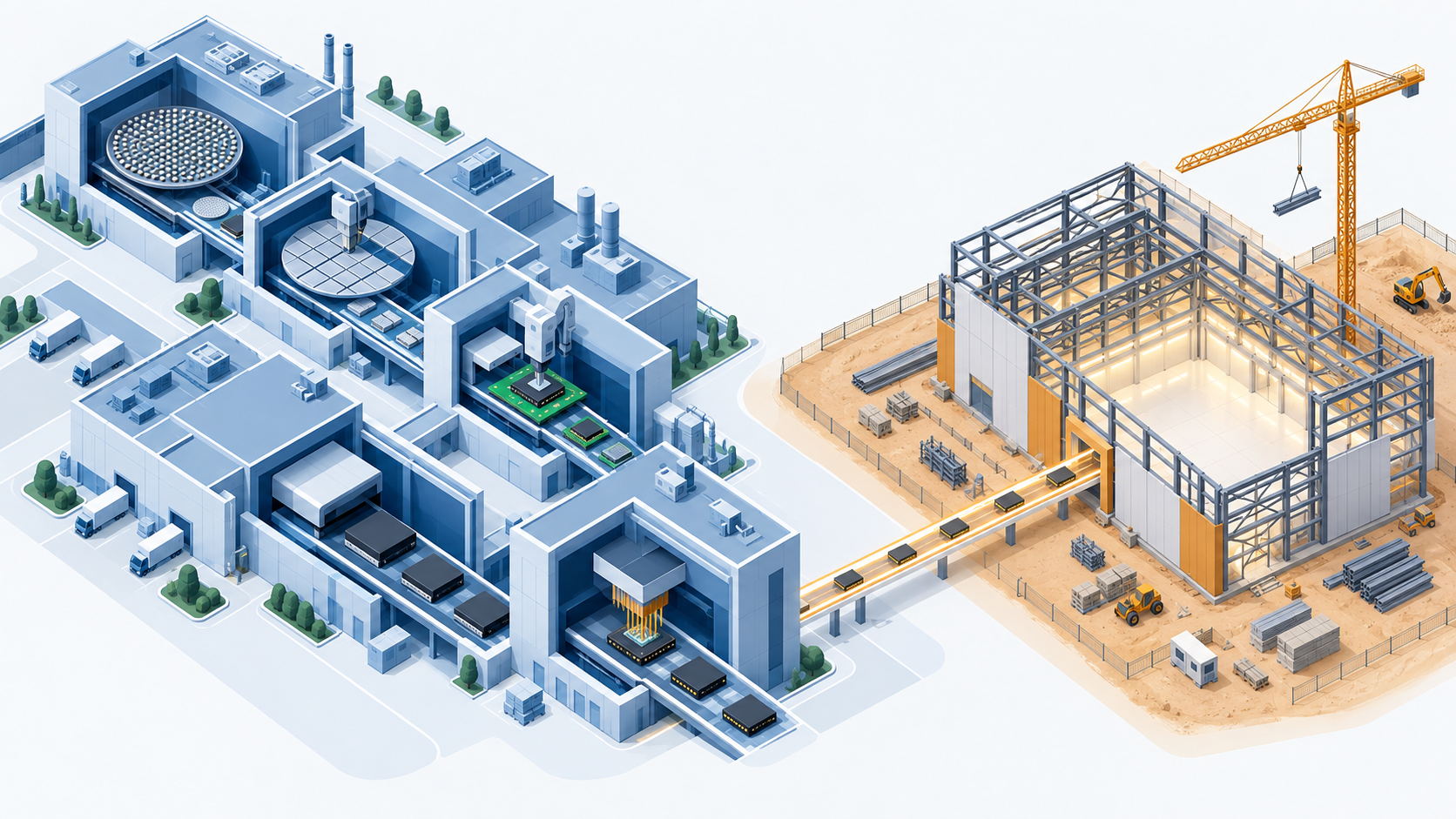 AI-generated concept
13. References
- Amkor Technology Form 10-K for the fiscal year ended December 31, 2025 (filed with the U.S. SEC on 20 February 2026). Legal name, head office address and listing, revenue, revenue by product, end market and region, customer concentration (Apple 29.8%, Qualcomm 11.1%), headcount, the plant list and floor space, property, plant and equipment by country, capital expenditure and the 2026 plan, the CHIPS Act award, the Arizona plant, named competitors and risk factors. https://www.sec.gov/Archives/edgar/data/1047127/000104712726000014/amkr-20251231.htm
- Amkor Technology Second quarter 2026 earnings release (Form 8-K, Exhibit 99.1, 27 July 2026). Quarterly revenue of US$1,898m and growth of 26%, gross margin of 16.8%, operating margin of 10.5%, the 88% packaging and 12% test split, and the 2026 capital expenditure plan of US$2.5bn to US$3.0bn. https://www.sec.gov/Archives/edgar/data/1047127/000104712726000043/amkr6302026erex-991.htm
- Amkor Technology 2026 Investor Day materials (Form 8-K, Exhibit 99.1, 21 May 2026). Long-term financial targets for 2028 and 2030, the US$7bn total Arizona investment and 750,000 sq. ft. of cleanroom, the phase one revenue and margin targets and funding sources, the role of each site, the count of advanced packaging engagements, and the quoted comments from Apple's COO and a TSMC executive. https://www.sec.gov/Archives/edgar/data/1047127/000104712726000036/ex-991amkorinvestorprese.htm
- Amkor Technology Form 10-Q for the quarterly period ended June 30, 2026. Arizona construction spending of US$333.6m, the additional 67 acres acquired for about US$33m, and first-half 2026 capital expenditure of US$688.4m. https://www.sec.gov/Archives/edgar/data/1047127/000104712726000046/amkr-20260630.htm
- U.S. SEC EDGAR XBRL company facts API (CIK 0001047127). Revenue, operating income, net income, R&D expense and capital expenditure for 2021 to 2025, as tagged in each year's Form 10-K. https://data.sec.gov/api/xbrl/companyfacts/CIK0001047127.json
- TSMC "Amkor and TSMC to Expand Partnership and Collaborate on Advanced Packaging in Arizona" (press release, 4 October 2024). Turnkey sourcing from the Peoria plant and the application of InFO and CoWoS. https://pr.tsmc.com/english/news/3174
- Amkor Technology Company History (official website). The founding in April 1968, the relationship with ANAM Industrial of South Korea, and the years the sites in the Philippines, Japan, Portugal, Vietnam and Arizona were acquired or established. https://amkor.com/company-history/
- ASE Technology Holding Form 20-F for the fiscal year ended December 31, 2025. The ASE figures used for comparison in sections 5 and 11: ATM revenue, headcount, customer concentration and gross margin. https://www.sec.gov/Archives/edgar/data/1122411/000119312526135585/d50802d20f.htm
- TSMC Form 20-F for the fiscal year ended December 31, 2025. The TSMC revenue figure used in Fig. 2 in section 5. https://www.sec.gov/Archives/edgar/data/1046179/000162828026025362/tsm-20251231.htm
- Amkor Technology Official website, used to check the corporate profile and the brand mark. https://amkor.com/
14. Claim-to-source audit
| Claim in the article | Category | Source |
|---|---|---|
| Legal name, head office in Tempe, Arizona, incorporation in Delaware, Nasdaq listing as AMKR | Sourced | Reference 1 https://www.sec.gov/Archives/edgar/data/1047127/000104712726000014/amkr-20251231.htm |
| Founded in Philadelphia in April 1968, the relationship with ANAM Industrial, and the year each site was acquired | Sourced | Reference 7, the company's own history page https://amkor.com/company-history/ |
| Revenue, operating income, net income, R&D expense and capital expenditure, 2021 to 2025 | Sourced | Reference 5 https://data.sec.gov/api/xbrl/companyfacts/CIK0001047127.json |
| Operating margins (12.4%, 12.7%, 7.2%, 6.9%, 7.0%), the 2025 gross margin of 14.0%, the 8.3% decline in 2023 and R&D at 2.5% of revenue | Our calculation | Derived from the figures in references 5 and 1 https://www.sec.gov/Archives/edgar/data/1047127/000104712726000014/amkr-20251231.htm |
| 30,800 employees, the regional split (Asia Pacific 95%, Europe 4%, United States 1%) across 12 countries | Sourced | Reference 1 https://www.sec.gov/Archives/edgar/data/1047127/000104712726000014/amkr-20251231.htm |
| Advanced products at 82.8% (US$5,556m) and mainstream at 17.2%, and the end market split (communications 46%, computing 20%, automotive and industrial 19%, consumer 15%) | Sourced | Reference 1 https://www.sec.gov/Archives/edgar/data/1047127/000104712726000014/amkr-20251231.htm |
| Apple as the largest customer at 29.8%, Qualcomm second at 11.1%, top ten at 72% | Sourced | Reference 1 https://www.sec.gov/Archives/edgar/data/1047127/000104712726000014/amkr-20251231.htm |
| Floor space by country, totalling 12,633 thousand sq. ft., and property, plant and equipment by country, with South Korea at US$2,098m | Sourced | Reference 1 https://www.sec.gov/Archives/edgar/data/1047127/000104712726000014/amkr-20251231.htm |
| South Korea at 35.5% of floor space and 54.2% of property, plant and equipment | Our calculation | Derived from the tables in reference 1 https://www.sec.gov/Archives/edgar/data/1047127/000104712726000014/amkr-20251231.htm |
| Second-quarter 2026 revenue of US$1,898m and growth of 26%, gross margin of 16.8%, and the 88% packaging, 12% test split | Sourced | Reference 2 https://www.sec.gov/Archives/edgar/data/1047127/000104712726000043/amkr6302026erex-991.htm |
| The 2026 capital expenditure plan of US$2.5bn to US$3.0bn against the 2025 actual of US$905m, which was 13.5% of revenue | Sourced | References 1 and 2 https://www.sec.gov/Archives/edgar/data/1047127/000104712726000014/amkr-20251231.htm |
| Arizona: ground broken September 2025, phase one at about 1.8 million sq. ft., operations due in the first half of 2028, CHIPS Act funding of up to US$407m | Sourced | Reference 1 https://www.sec.gov/Archives/edgar/data/1047127/000104712726000014/amkr-20251231.htm |
| Arizona construction spending of US$333.6m to the end of June 2026 and the additional 67 acres for about US$33m | Sourced | Reference 4 https://www.sec.gov/Archives/edgar/data/1047127/000104712726000046/amkr-20260630.htm |
| The US$7bn total Arizona investment, 750,000 sq. ft. of cleanroom, the role of each site, the count of advanced packaging engagements, 80% of revenue from relationships over 30 years, and the NVIDIA executive's comment | Sourced | Reference 3 https://www.sec.gov/Archives/edgar/data/1047127/000104712726000036/ex-991amkorinvestorprese.htm |
| The phase one revenue contribution of about US$1bn and gross margin above 30%, and the 2028 and 2030 financial targets | Not yet confirmed | Reference 3. These are company targets, not results https://www.sec.gov/Archives/edgar/data/1047127/000104712726000036/ex-991amkorinvestorprese.htm |
| The October 2024 memorandum under which TSMC sources InFO and CoWoS turnkey from the Peoria plant | Sourced | Reference 6, TSMC's own release https://pr.tsmc.com/english/news/3174 |
| ASE Technology, JCET Group and Powertech Technology named as competitors | Sourced | Reference 1 https://www.sec.gov/Archives/edgar/data/1047127/000104712726000014/amkr-20251231.htm |
| The three-company comparison in Fig. 2 (TSMC US$17.2bn, ASE US$12.1bn, Amkor US$6.7bn) | Our calculation | The disclosed figures in references 1, 8 and 9 set side by side https://www.sec.gov/Archives/edgar/data/1046179/000162828026025362/tsm-20251231.htm |
| Amkor's world market share and its advanced packaging capacity | Not yet confirmed | No primary source exists, so this article states no figure. The Form 10-K offers only the qualified self-assessment that it is the largest OSAT headquartered in the United States https://www.sec.gov/Archives/edgar/data/1047127/000104712726000014/amkr-20251231.htm |
| The name of the Japanese subsidiary, and the timing and scale of Arizona phase two | Not yet confirmed | Neither could be confirmed from primary sources. Phase two is described only as depending on customer commitments https://www.sec.gov/Archives/edgar/data/1047127/000104712726000036/ex-991amkorinvestorprese.htm |
| The market size and growth rates in the investor day materials | Not yet confirmed | Labelled there as Gartner and McKinsey estimates, so not used in this article https://www.sec.gov/Archives/edgar/data/1047127/000104712726000036/ex-991amkorinvestorprese.htm |
| The outlook in section 10, and the reading on materials supply inside the United States | Not yet confirmed | An interpretation by this article, drawn from the six items in the facts table https://www.sec.gov/Archives/edgar/data/1047127/000104712726000014/amkr-20251231.htm |
Last updated 21 September 2026 / Troy Technical
Every figure in this article comes from the statutory filings Amkor Technology has made with the U.S. Securities and Exchange Commission, from the company's own website, or from TSMC's official press release. No research-firm estimates or press-based figures have been used.