COMPANY PROFILE / SEMICONDUCTOR BACK-END
Kinsus
Taiwan's third package substrate maker, and how it is riding the AI wave
Kinsus is a Taiwanese maker of IC package substrates. In its own annual report the company writes that high-layer-count ABF substrates for servers are "increasingly concentrated in companies such as Ibiden, UMTC (Unimicron) and Kinsus", placing itself among the handful of participants in this field. It buys Ajinomoto Build-up Film and builds substrates with it, and it is not an OSAT, which mounts the die on the board. This profile places the company using only figures from its annual report, its monthly revenue announcements and its investor presentations.
- Kinsus in 30 seconds
- The logo and how the name is written
- What the company actually does: substrates and optics
- Scale: five years of revenue
- Company category and position in the back-end industry
- Sites and the countries where it manufactures
- Leading products and share in semiconductor back-end work
- Current investment plans
- Major corporate partners and the customers it discloses
- Where the company is heading in this field
- The risks this company carries
- Glossary, references and claim-to-source audit
1. Kinsus in 30 seconds
(39,351 NT$m)Up 28.9% year on year. Net profit NT$2.7bn (2,717 NT$m)
(IC package substrates)82.1% of revenue is substrates, 17.9% optics
Of the three companies in this group, Ibiden, Unimicron and Kinsus, Kinsus is the smallest and the most volatile. Revenue peaked before the AI boom, at NT$42.4bn in 2022, fell 36.8% to NT$26.8bn in 2023, and had recovered to NT$39.4bn by 2025 Our calculation. And in that 2025 recovery, revenue rose while gross margin fell from 28.4% to 21.1% Our calculation. So much for "AI demand means every substrate maker is doing well". The numbers here say otherwise, and sections 4 and 7 explain why.
2. The logo and how the name is written

The Kinsus logo is a registered trademark of the company. Nothing here is an AI reconstruction of the mark: the frame above holds the official logo image taken from the company's own site. A logo redrawn to look approximately right is wrong both as a trademark and as a fact.
A note on the name: the full corporate name is KINSUS INTERCONNECT TECHNOLOGY CORP., and in ordinary use simply Kinsus. Its filings in Taiwan carry a local-language legal name alongside the English one, but the English form is the one the company uses on its global site and in its investor material, and it is the form used throughout this article.
Official site: https://www.kinsus.com.tw/en3. What the company actually does: substrates and optics
The company splits 2025 consolidated revenue into just two divisions Sourced.
| Division | Revenue (NT$ thousand) | Share |
|---|---|---|
| Division of Substrates | 32,311,845 | 82.11% |
| Division of Optics | 7,039,251 | 17.89% |
| Total | 39,351,096 | 100.00% |
Semiconductors sit in the substrates division. The optics division is run by PegaVision, a subsidiary in Taoyuan, Taiwan, but what it actually makes could not be established from Kinsus's own primary material Not yet confirmed.
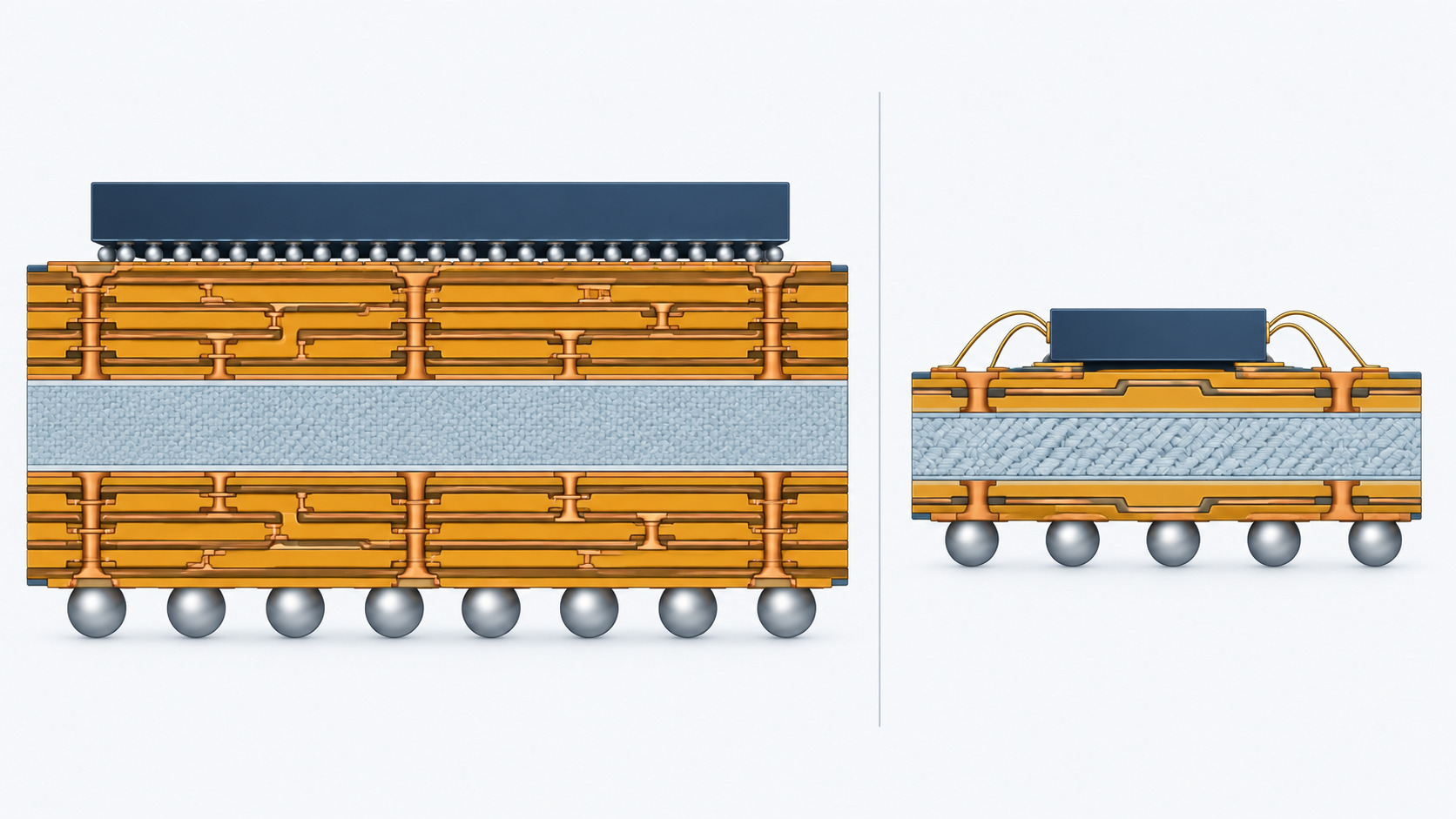
The substrates division makes IC package substrates of various kinds. Rendered in plain terms, the current products the annual report lists are these Sourced.
- PBGA and MCM-BGA
- Substrates for packages where the die sits on a resin board with solder balls arrayed on the underside. MCM means several dies on one board.
- FCBGA, the ABF substrate
- The die is flipped and bonded directly to the board. For large, high-power dies, with an ABF class material as the interlayer dielectric. This is the one that matters in AI servers.
- FCCSP and CSP
- Substrates for small packages roughly the size of the die itself. Used in smartphones and similar devices.
- Coreless substrate
- A thin substrate built without the rigid core at the centre of the board. For applications where thinness is required.
- Embedded component substrate
- Passive or active components buried inside the board itself, which frees up mounting area on the surface.
- COF (Chip on Flex)
- Mounting the die on a flexible board. Used for display driver ICs among other things.
Under competitive strengths the annual report says: "the company operates dedicated plants covering the entire process and can provide a one-stop solution for both ABF and BT substrates. It has also introduced AI-based process monitoring" Sourced.
ABF and BT are different families of interlayer dielectric, different materials with different process conditions. ABF is laminated as a film under vacuum; BT uses a glass-fibre prepreg. Running both through the same factory means carrying two sets of equipment and two quality systems. Presenting that as a strength says something: customers still choose between the two families by generation and by product, and from the materials side it means demand has not collapsed onto ABF alone.
4. Scale: five years of revenue
| Year | Revenue (NT$ thousand) | Gross profit (NT$ thousand) | Gross margin | Operating profit (NT$ thousand) | Net profit (NT$ thousand) |
|---|---|---|---|---|---|
| 2021 | 35,672,763 | 10,525,845 | 29.5% | 5,004,566 | 4,492,108 |
| 2022 | 42,441,054 | 15,711,556 | 37.0% | 9,576,339 | 7,933,470 |
| 2023 | 26,832,187 | 6,757,506 | 25.2% | 1,042,247 | 1,170,402 |
| 2024 | 30,534,979 | 8,667,725 | 28.4% | 1,095,419 | 1,331,050 |
| 2025 | 39,351,096 | 8,314,409 | 21.1% | 2,669,813 | 2,717,328 |
Gross margins are our own arithmetic Our calculation. In 2025 both revenue and profit rose, yet the margin is the lowest of the five years. Note also that net profit includes non-controlling interests, such as the optics subsidiary, so the amount attributable to owners of the parent is smaller.
Read it this way. Operating profit of NT$9,576m in 2022, a 22.6% operating margin, is what this company looks like at its best Our calculation. When smartphone and PC demand collapsed in 2023, operating profit fell to nearly a tenth of that, and although revenue has recovered a good deal by 2025, operating profit is still only NT$2,670m, or 6.8%.
2026 is running higher again. On the monthly announcements, January to August 2026 totalled NT$32,960m against NT$24,953m in the same months of 2025, up 32.1% Our calculation. August alone was NT$4,810m, up 40.6% on the same month a year earlier Sourced.
5. Company category and position in the back-end industry
The category is manufacturer, specifically a board maker. Kinsus's investor presentation carries a semiconductor supply chain diagram, and the order of the boxes in it is the answer Sourced.
| The company's own label | What it does | Representative companies |
|---|---|---|
| IC design (fabless) | Designs the chip. Owns no fab | NVIDIA, AMD and others |
| Foundry | Makes the wafer, the front end | TSMC, UMC and others |
| Substrate house (Kinsus is here) | Buys materials and builds the board the die sits on | Kinsus, Unimicron, Ibiden and others |
| OSAT | Mounts the die on the board, encapsulates it and tests it | ASE Group, Amkor and others |
In the company's diagram, wafers flow from the foundry and substrates flow from the substrate house, both into the OSAT, which then performs IC packaging.
An OSAT does not make boards. Its job is to put a die on a board it has bought. So if the board does not arrive, no amount of idle OSAT capacity finishes the package. In the annual report's own words, the package substrate is "a raw material, or a carrier component, for the semiconductor packaging industry", and Kinsus sells to "IC packaging houses, design houses and system houses at home and abroad" Sourced.
And the further AI substrates go towards larger sizes and more layers, the more process steps each board takes, and the fewer good boards a given set of equipment produces. Adding capacity starts with putting up a building, which takes years. Supply falls structurally behind the speed at which demand grows: that is the substance of "the substrate is the bottleneck".
6. Sites and the countries where it manufactures
Manufacturing is in two countries, Taiwan and China, with a sales subsidiary in California Sourced.
| Site | Country | Role |
|---|---|---|
| Shih-Lei plant | Taiwan (Xinwu District, Taoyuan) | Head office site. IC package substrates |
| Tsing-Hua plant | Taiwan (Xinwu District, Taoyuan) | IC package substrates |
| Xing-Feng plant | Taiwan (Xinfeng Township, Hsinchu County) | IC package substrates |
| Youth plant | Taiwan (Yangmei District, Taoyuan) | Acquired in 2021. Designated by the company as the site for high value-added products |
| Kinsus Suzhou | China (Suzhou, Jiangsu) | Manufacturing subsidiary inside the export processing zone |
| Piotek Computer (Suzhou) | China (Suzhou, Jiangsu) | Group company in the same export processing zone |
| Kinsus USA | United States (Santa Clara, California) | Sales and technical support. No manufacturing |
| PegaVision | Taiwan (Taoyuan) | The subsidiary that runs the optics business |
The investor presentation refers to the Taiwanese substrate plants as Plants 1 and 2 and Plants 5 and 6. Capacity by site is not published Not yet confirmed.
Kinsus keeps a subsidiary in Santa Clara, California. There is no plant there. The reason to hold a site anyway is that the design teams of its fabless customers are there. A package substrate cannot be settled unless the board-side constraints, layer count, line pitch, warpage, thermal expansion, are negotiated before the chip design is frozen. That is why sales into the United States are 24.7% of revenue, almost level with Taiwan at 25.6% Sourced. Seen from a materials supplier's side, it means the adoption decision can move first in a design office in the United States, not in a plant in Taiwan.
7. Leading products and share in semiconductor back-end work
The competitive structure, as the company itself describes it
On the package substrate market, Kinsus's annual report says the following Sourced.
"The world IC substrate market is held by Japan, Taiwan and Korea, split roughly evenly between the three. High-layer-count ABF substrates for servers are increasingly concentrated in companies such as Ibiden, UMTC (Unimicron) and Kinsus. In memory, SIMMTECH of Korea holds a high share with the support of its group company SK hynix. Worth noting is that low-end ABF substrates and BT substrates are currently in oversupply. For mid-range and lower substrate products, as some competitors exit the market, orders are gathering with the incumbents that have economies of scale."
This is the important part. The company is saying, in its own words, that high-layer-count ABF is concentrating while low-end ABF and BT are in oversupply. The same phrase, "package substrate", covers two markets in completely different conditions. It also explains why revenue grew 28.9% in 2025 while gross margin fell to 21.1% Our calculation.
On market share, stated plainly
Kinsus discloses no numerical market share of its own. The market figures in the annual report, the even three-way split between Japan, Taiwan and Korea and a compound growth rate of 10.9%, are all explicitly attributed to a report by the research firm Prismark, so they are not primary material. This article does not adopt them Not yet confirmed. What it does use is the description of competitive structure written as the company's own observation, in the box above, together with the actual revenue and profit figures.
Technologies under development
The development items named in the annual report and the chairman's message are these Sourced.
| Development item | Purpose |
|---|---|
| Expanding ABF FC-BGA substrate capability | Meeting higher layer counts and higher frequencies over the medium to long term. The company lists this first among its key production and sales policies |
| Glass core substrates and co-packaged optics (CPO) | Staying continuously involved in customer R&D, and building out the material systems and processes those need |
| Introducing base materials with ultra-low expansion, high Tg and high modulus | Handling the warpage and thermal stress that come with larger boards |
| Ultra-fine wiring under 8 microns, contact pitch under 30 microns | Keeping the board side in step with shrinking on the die side |
| Ultra-fine vias of 30 microns diameter or less, and via filling | Higher density in the layer-to-layer connections |
| High-layer-count coreless and embedded component substrates | Thinner boards and higher mounting density |
8. Current investment plans
The centre of the investment is the Youth plant. Under the effect of major capital expenditure, the annual report says: "the company acquired the Youth plant in 2021 and has progressively constructed buildings and purchased production equipment. This facility will be the production site for high value-added products over the next several years" Sourced.
On the funding side, the company carried out a cash issue of 70 million shares in March 2026. Paid-in capital rose from NT$4,569.26m to NT$5,269.26m Sourced. Shares issued went from 456,926 thousand to 526,926 thousand, an increase of 15.3% Our calculation.
Kinsus publishes neither the investment amount by plant nor how far the expansion multiplies capacity Not yet confirmed. On the use of proceeds from the March 2026 cash issue, the annual report refers readers to the Market Observation Post System (MOPS) for the execution status of the financing plan and gives nothing in the report itself Sourced. This article therefore does not assert that the proceeds are going into ABF substrate capacity.
9. Major corporate partners and the customers it discloses
Ownership: in substance the parent is the contract manufacturer Pegatron
Kinsus's three largest shareholders are all investment companies wholly owned within Pegatron Corporation Sourced.
| Shareholder | Shares held | Stake | Parent |
|---|---|---|---|
| Asus Investment Co., Ltd. | 67,037,104 | 12.72% | Pegatron group |
| Asustek Investment Co., Ltd. | 64,924,007 | 12.32% | Pegatron Corp. (100%) |
| Asuspower Investment Co., Ltd. | 61,939,567 | 11.76% | Pegatron Corp. (100%) |
| Total of the three | 193,900,678 | 36.80% | - |
As of 29 March 2026. The annual report states "Pegatron Corp. 100.00%" for Asustek Investment and Asuspower Investment. Asus Investment does not appear in that same table, so this article does not assert that it too is wholly owned by Pegatron Not yet confirmed. The combined stake is our own addition Our calculation. The chairman, Liao Sih-Jheng, is COO of Pegatron Corp., and other Pegatron executives sit on the board.
Customers: disclosed by letter
| Item | 2024 | 2025 |
|---|---|---|
| Largest customer | A, NT$3,273m (10.72%) | A, NT$7,677m (19.51%) |
| Second largest customer | B, NT$2,990m (9.79%) | B, NT$3,633m (9.23%) |
| Third largest customer | D, NT$1,759m (5.76%) | C, NT$2,051m (5.21%) |
| Largest supplier | A, NT$1,380m (12.76% of purchases) | A, NT$2,194m (14.23% of purchases) |
Customers and suppliers are not named. The letters may be reassigned from year to year, so primary material cannot even establish whether "A" in 2024 and "A" in 2025 are the same company Not yet confirmed.
Kinsus uses the term "ABF substrate" repeatedly in its annual report, but the name Ajinomoto appears nowhere in that report or in its investor material. Principal suppliers too are disclosed only by letter. How far the company goes on the record is that its key raw materials are gold (potassium gold cyanide), base materials, transparent film, copper foil and chemicals, and a risk statement that "once a material has been qualified it is unlikely to be changed, so we maintain only two or three suppliers" Sourced. This article therefore does not treat any individual materials maker as a trading relationship Not yet confirmed.
10. Where the company is heading in this field
Anything said here is a forecast, so the facts behind the judgement and the outlook drawn from them are kept apart.
What is established
| Fact | What it implies for the back end |
|---|---|
| 2025 revenue up 28.9%, and January to August 2026 up a further 32.1% | The recovery in demand has reached this company too |
| In that same 2025, gross margin fell from 28.4% to 21.1% | The added revenue is not all high-margin work. The mix problem remains |
| The company itself states that low-end ABF and BT are in oversupply | "Substrates" covers two markets in opposite conditions |
| The largest customer went from 10.7% to 19.5% of revenue, 2.3 times in value | The growth comes from a specific account, and concentration is rising |
| The Youth plant is designated as the site for high value-added products | There is an intent to move the centre of gravity up-market |
| A cash issue of 70 million shares in March 2026, raising the share count by 15.3% | Funding is coming from equity as well as debt |
Outlook
Not yet confirmed Read plainly, those facts put Kinsus at a genuine participant in AI substrates, but not yet a lead player. It has the technology and the record to place itself alongside Ibiden and Unimicron in high-layer-count ABF, and revenue has accelerated into 2026. But its scale is about 30% of Unimicron's, NT$39.4bn against NT$131.2bn Our calculation, and its margin has not returned to 2022 levels.
Not yet confirmed The pivot is whether it can move the product mix upward and make it stick. If low-end ABF and BT really are in oversupply, as the company says, margins will not recover for as long as it sits there. Whether ramping the Youth plant and growing the largest account delivers that move is the open question. Equally, because competitors are expanding into the upper market at the same time, a scenario where even high-layer-count ABF is in oversupply from 2028 cannot be ruled out. Neither can be settled from primary material.
11. The risks this company carries
What follows is drawn from the risk section of Kinsus's own annual report, narrowed to those that matter in a back-end context Sourced.
| Risk | Substance | Supporting figures |
|---|---|---|
| Concentrated supply of materials | The company states that "once a material has been qualified it is unlikely to be changed, so we maintain only two or three suppliers". The key raw materials are gold, base materials, transparent film, copper foil and chemicals | Risks relating to the purchase and sale of products, in the annual report |
| Raw material prices | Shortages of glass cloth and copper foil began to appear in the second half of 2025, and the chairman states that rising copper and gold prices will squeeze revenue growth and gross profit in 2026. The response is new suppliers and price revisions | The report to shareholders in the 2025 Annual Report |
| Falling margin | Revenue grew, yet gross margin fell to 21.1%, the lowest in five years. Cost of sales rose 41.9%, outpacing the 28.9% rise in revenue | Gross margin from 28.4% to 21.1% Our calculation |
| Customer concentration | The company writes that "IC package substrates are sold to leading IC design companies at home and abroad and have broad applications, so we are free of sales concentration risk", yet the largest customer went from 10.7% to 19.5% in a single year | Customer disclosure in the annual report Our calculation |
| Volatility of results | Between 2022 and 2023 revenue fell 36.8% and operating profit fell 89.1% | The five-year summary in the 2023 Annual Report Our calculation |
| Currency and interest rates | Exports are quoted in U.S. dollars, and long-term borrowings and the main imported inputs are also in U.S. dollars. In 2025 the foreign exchange gain was 0.10% of revenue and interest expense 12.68% of pre-tax profit | The risk assessment in the annual report |
The most informative thing to follow at Kinsus is monthly revenue paired with gross margin. Revenue is published every month, and the quarterly consolidated statements give the margin. A stretch where revenue is rising while gross margin falls is a stretch spent chasing volume in lower-tier products. That is exactly what 2025 was. When the margin starts rising instead, it is the signal that high value-added work from the Youth plant is beginning to bite.
On the materials side, the items the company itself names, base materials with ultra-low expansion, high Tg and high modulus, vias of 30 microns or less, contact pitch under 30 microns, are the direction of travel for the specification Sourced. And because it runs BT alongside ABF rather than ABF alone, two families of material are being evaluated inside the same company, which matters to anyone proposing into it.
12. Glossary
- IC package substrate
- The small multilayer board that carries a semiconductor die and connects it to the circuit board outside. The annual report calls it a raw material, or carrier component, for the packaging industry.
- FCBGA / ABF substrate
- A substrate where the die is flipped and bonded directly to the board. Because the interlayer dielectric is an Ajinomoto Build-up Film class material, the industry calls it an ABF substrate. For AI GPUs and server CPUs.
- BT substrate
- A substrate using bismaleimide triazine resin. For relatively small dies such as smartphone processors and memory.
- PBGA
- Plastic Ball Grid Array. A package with solder balls arrayed on the underside of a resin board, usually with the die wire-bonded to the board.
- Coreless substrate
- A thin substrate built without the rigid core at the centre of the board. Thinner, but harder to keep flat.
- Tg (glass transition temperature)
- The temperature at which a resin goes from rigid to soft. The higher it is, the better the material survives hot assembly steps.
- CPO
- Co-Packaged Optics. Putting the optical transmit and receive components in the same package as the chip, to cut the power and latency of the interconnect. Kinsus names it as a development item.
- MOPS
- The Market Observation Post System, Taiwan's statutory disclosure platform, where listed companies file annual reports, financial statements and the execution status of financing plans. Kinsus's annual report names it as the reference.
 AI-generated concept
13. References
- KINSUS INTERCONNECT TECHNOLOGY CORP. 2025 Annual Report (English summary edition, issued 22 April 2026). Report to shareholders (2025 consolidated revenue and net profit, material shortages and price rises), business description and revenue by division, current and planned products, the market share section, revenue by sales region, principal customers and suppliers (disclosed by letter), workforce composition, financial position and results, cash flow, capital expenditure, risk assessment, the history of share capital and major shareholders, and the plant list. The report states that the English edition is a summary translation and that the local-language edition is the official one.kinsus.com.tw/upload/media/ir/.../2025 Annual Report.pdf
- KINSUS INTERCONNECT TECHNOLOGY CORP. 2023 Annual Report (English summary edition). The condensed consolidated balance sheets and statements of comprehensive income for the past five fiscal years, covering revenue, gross profit, operating profit, net profit and earnings per share for 2019 to 2023.kinsus.com.tw/upload/media/ir/.../2023 Annual Report.pdf
- KINSUS INTERCONNECT TECHNOLOGY CORP. Monthly revenue announcements (official site). Monthly consolidated revenue and year-on-year change for 2024, 2025 and January to August 2026.https://www.kinsus.com.tw/en/annual/monthly_revenue
- KINSUS INTERCONNECT TECHNOLOGY CORP. Investor presentation (February 2026). The position of the substrate house in the semiconductor supply chain, corporate basics (founded September 2000, listed November 2004, share capital of NT$4.569bn, translated by the company as US$145m), the site list, the hierarchy of IC mounting, and explanations of advanced packaging and co-packaged optics.kinsus.com.tw/upload/media/ir/Investor/2026-02-investor-presentation.pdf
- KINSUS INTERCONNECT TECHNOLOGY CORP. Global Locations (official site). The addresses of the four plants in Taiwan, the two companies in Suzhou, China, and the subsidiary in Santa Clara.https://www.kinsus.com.tw/en/html/global_locations/index
- Taiwan Stock Exchange Market Observation Post System (MOPS). The platform Kinsus's annual report names as the reference for its statutory disclosures and for the execution status of its financing plan.https://mops.twse.com.tw/
- KINSUS INTERCONNECT TECHNOLOGY CORP. Official website, used to check the name and the brand mark.https://www.kinsus.com.tw/en
14. Claim-to-source audit
| Claim in the article | Category | Source |
|---|---|---|
| Legal name, head office, listing venue (Taiwan Stock Exchange 3189), 526,925,960 shares issued | Sourced | Reference 1kinsus.com.tw/.../2025 Annual Report.pdf |
| Founded September 2000, listed 1 November 2004, share capital of NT$4.569bn (translated by the company as US$145m) | Sourced | References 4 and 1kinsus.com.tw/.../2026-02-investor-presentation.pdf |
| 2025 revenue of 39,351,096 NT$ thousand (+28.87%), net profit of 2,717,328 NT$ thousand (+104.15%), parent-only revenue of 32,349,689 NT$ thousand | Sourced | Reference 1kinsus.com.tw/.../2025 Annual Report.pdf |
| Revenue, gross profit, operating profit and net profit for 2021 to 2023 | Sourced | Reference 2, the condensed five-year statement of comprehensive incomekinsus.com.tw/.../2023 Annual Report.pdf |
| Five years of gross margin (29.5%, 37.0%, 25.2%, 28.4% and 21.1%), the 36.8% revenue decline in 2023 and the 89.1% fall in operating profit | Our calculation | Derived from the amounts in references 1 and 2kinsus.com.tw/.../2023 Annual Report.pdf |
| Cumulative revenue of 32,959,684 NT$ thousand for January to August 2026, and 4,809,631 NT$ thousand in August alone (+40.58% year on year) | Sourced | Reference 3kinsus.com.tw/en/annual/monthly_revenue |
| January to August 2026 being 32.1% above the same months of 2025 | Our calculation | Our own sum and comparison of the monthly figures in reference 3kinsus.com.tw/en/annual/monthly_revenue |
| Revenue by division (substrates 32,311,845 NT$ thousand and 82.11%, optics 7,039,251 NT$ thousand and 17.89%) | Sourced | Reference 1kinsus.com.tw/.../2025 Annual Report.pdf |
| Revenue by sales region (Taiwan 25.63%, United States 24.74%, China 16.48%, Japan 12.63%, other 20.52%) | Sourced | Reference 1kinsus.com.tw/.../2025 Annual Report.pdf |
| The list of current products (PBGA, MCM-BGA, FCBGA, FCCSP, coreless, embedded component, COF and others) and the products planned | Sourced | Reference 1, business descriptionkinsus.com.tw/.../2025 Annual Report.pdf |
| The statements that high-layer-count ABF substrates for servers are concentrating in companies such as Ibiden, UMTC and Kinsus, and that low-end ABF and BT are in oversupply | Sourced | Reference 1, the market share sectionkinsus.com.tw/.../2025 Annual Report.pdf |
| The statement that the company can provide a one-stop solution for both ABF and BT substrates | Sourced | Reference 1, competitive strengthskinsus.com.tw/.../2025 Annual Report.pdf |
| The supply chain diagram (IC design, foundry, substrate house, OSAT) and the description of the substrate as a raw material or carrier component for the packaging industry | Sourced | References 4 and 1kinsus.com.tw/.../2026-02-investor-presentation.pdf |
| The site list (four plants in Taiwan, two companies in Suzhou, the Santa Clara subsidiary and PegaVision) and the Youth plant being acquired in 2021 as the site for high value-added products | Sourced | References 5, 1 and 4kinsus.com.tw/en/html/global_locations/index |
| 6,735 employees with the split by role and education, and an average age of 35 | Sourced | Reference 1kinsus.com.tw/.../2025 Annual Report.pdf |
| Property, plant and equipment of 41,936,711 NT$ thousand, prepayments for equipment of 8,000,746 NT$ thousand, investing cash flow of minus 7,868,506 NT$ thousand, and expected 2026 R&D spend of 1,914,000 NT$ thousand | Sourced | Reference 1kinsus.com.tw/.../2025 Annual Report.pdf |
| Investing cash flow being equal to 20.0% of revenue | Our calculation | Derived from the amounts in reference 1kinsus.com.tw/.../2025 Annual Report.pdf |
| The cash issue of 70 million shares in March 2026, with paid-in capital going from NT$4,569.26m to NT$5,269.26m | Sourced | Reference 1, the history of share capitalkinsus.com.tw/.../2025 Annual Report.pdf |
| The share count rising 15.3% | Our calculation | Derived from the share counts in reference 1kinsus.com.tw/.../2025 Annual Report.pdf |
| The holdings and stakes of the three largest shareholders, Asustek and Asuspower being wholly owned by Pegatron Corp., and the chairman's role at Pegatron | Sourced | Reference 1kinsus.com.tw/.../2025 Annual Report.pdf |
| The combined 36.80% held by the three | Our calculation | Our own addition of the stakes in reference 1kinsus.com.tw/.../2025 Annual Report.pdf |
| The amounts and shares by customer and by supplier, disclosed by letter | Sourced | Reference 1, principal customers and supplierskinsus.com.tw/.../2025 Annual Report.pdf |
| The largest customer A growing 2.3 times in value, and the top three going from 26.3% to 34.0% | Our calculation | Derived from the amounts disclosed in reference 1kinsus.com.tw/.../2025 Annual Report.pdf |
| The risks (two or three suppliers per material, shortages of glass cloth and copper foil, rising copper and gold prices, currency and interest rates, and the company's view on customer concentration) | Sourced | Reference 1, the report to shareholders and the risk assessmentkinsus.com.tw/.../2025 Annual Report.pdf |
| The comparison of scale between Kinsus and Unimicron (NT$39.4bn against NT$131.2bn, about 30%) | Our calculation | Our own comparison of the revenue in reference 1 with Unimicron's published revenue of 131,241 NT$m. Both are in NT$, so no currency conversion is involvedkinsus.com.tw/.../2025 Annual Report.pdf |
| IC substrate market size, market share and the market growth rate | Not yet confirmed | The annual report states them, but attributes them to estimates by the research firm Prismark, so this article does not adopt them |
| The identities of customers A and B and of the principal suppliers, and whether a letter means the same company from one year to the next | Not yet confirmed | Taiwanese annual reports disclose these by letter, and this article does not attempt to identify them |
| Trading relationships with individual materials makers, such as the supplier of Ajinomoto Build-up Film | Not yet confirmed | No company name appears in Kinsus's own primary material, so this article does not treat any as a supplier relationship |
| The investment amount for the Youth plant, the multiple by which the expansion raises capacity, and the use of the March 2026 proceeds | Not yet confirmed | None of it appears in the annual report itself, and this article offers no estimate |
| What the optics business (PegaVision) actually makes | Not yet confirmed | Kinsus's own primary material says only "Division of Optics", so this article asserts nothing further |
| The parent of Asus Investment Co., Ltd. | Not yet confirmed | It is absent from the institutional shareholder table in the annual report, so this article asserts nothing |
| The outlook in section 10 | Not yet confirmed | An interpretation by this article, drawn from the six items in the facts table |
Last updated 21 September 2026 / Troy Technical
Every figure in this article comes from the annual reports, monthly revenue announcements and investor presentations published by KINSUS INTERCONNECT TECHNOLOGY CORP. No research-firm estimates or press-based figures have been used. Amounts are in New Taiwan dollars (NT$) with no currency conversion applied, except for the U.S. dollar translation of share capital, which is the company's own published figure.