COMPANY PROFILE / SEMICONDUCTOR BACK-END
Lam Research
The company that drills holes and fills them with copper, standing at the entrance to TSV and RDL
Lam Research makes semiconductor production equipment for etch, deposition and clean. It is unmistakably a front-end company, yet it owns two tools the back end cannot do without: the etcher that drills the through-silicon vias and the plating system that fills those holes with copper and builds the bumps and redistribution layers. Before a chip can be stacked on another, a hole has to be opened and copper run through it, and that is this company's part of the job. This profile uses the SEC filings alone to sort out what is published and what is not.
- Lam Research in 30 seconds
- The logo and how the name is written
- What the company actually does: remove, deposit, clean
- Scale: five years of revenue
- Company category and position in the back-end industry
- Sites and the countries where it manufactures
- Leading products and share in semiconductor back-end work
- Current investment plans
- Major corporate partners
- Where the company is heading in this field
- The risks this company carries
- Glossary, references and claim-to-source audit
1. Lam Research in 30 seconds
Ticker LRCXSEC file number 000-12933
(semiconductor equipment)A single reporting segment: making and servicing wafer fabrication equipment
Lam Research has exactly one reporting segment Sourced: a single line reading "the manufacture and servicing of wafer fabrication equipment". Which means back-end revenue cannot be separated out even in principle Not yet confirmed. This article covers Lam anyway, because the Form 10-K states by name which of its product families serve TSV formation and the plating of RDL and bumps, the core steps of the back end. The revenue is invisible; the role in the process is written down plainly. That is the shape of this company's disclosure.
2. The logo and how the name is written

The Lam Research logo is a registered trademark of the company.
A note on style: the legal name is Lam Research Corporation, but in the company's own press releases every mention after the first is the single word Lam. Many product names carry the registered trademark symbol (®), among them SABRE, Syndion, Kiyo, ALTUS, VECTOR and Striker, and anyone quoting them should keep in mind that these are trademarks.
Official site: https://www.lamresearch.com/3. What the company actually does: remove, deposit, clean
Lam Research's tools cover four broad process areas Sourced. Organised straight from the product listing in the Form 10-K, they look like this.
| Process | Technology | Product family |
|---|---|---|
| Deposition (metal) | Electroplating (ECD, copper and others) / CVD and ALD (tungsten, molybdenum) | SABRE family / ALTUS family |
| Deposition (dielectric) | Plasma CVD (PECVD) / ALD | VECTOR family / Striker family |
| Etch | Conductor etch / dielectric etch / deep etch for TSVs / selective etch | Kiyo, Versys Metal, Akara / Flex, Vantex / Syndion / Argos, Prevos, Selis |
| Clean | Wet clean / dry plasma clean of the wafer bevel | EOS, DV-Prime, Da Vinci, SP series / Coronus family |
| Dry resist | Resist and pattern transfer for EUV and high-NA EUV lithography | Aether family |
Revenue splits into two characters Sourced. FY2026 was US$14,885.49m of systems revenue (64%) and US$8,347.20m of customer support related revenue (36%) Our calculation. The second figure covers maintenance service, spare parts, upgrades, and equipment for nodes that are not leading edge, sold under the Reliant product line.
On the back end, the subject of this article, the Form 10-K says the following Sourced.
"The company also addresses processes for back-end wafer-level packaging (WLP). WLP is an alternative to conventional wire bonding that can offer a smaller form factor, faster and higher-bandwidth interconnect, and lower power consumption."
"The company provides advanced packaging solutions that support fan-out panel-level packaging, a process in which chips and chiplets are singulated from large substrate sheets several times the size of a conventional silicon wafer, raising yield and reducing waste. It also provides solutions addressing the needs of 3D stacking for HBM (high bandwidth memory)."
In short, the company names three areas it serves: WLP, panel-level packaging and HBM stacking.
The technical reason Lam can reach into the back end is easy to state. The electroplating used for copper damascene interconnect, the front-end step that builds the copper wiring inside a chip, works as it stands for bumps, RDL and TSV fill. The Form 10-K says of the SABRE ECD family that it helped pioneer the transition to copper interconnect, and states that for advanced packaging the SABRE 3D family addresses conductive bump formation, redistribution layers, TSV fill and wafer-level bonding Sourced. On the materials side, that means the requirements on plating chemistry, the copper bath and its additives, extend continuously from the front end into the back end. The conditions are not identical, though. A TSV is a deep hole tens to a hundred micrometres deep, and filling it without voids calls for an additive package, accelerator, suppressor and leveller, quite unlike the one used for front-end wiring. It is worth holding on to the distinction: the same equipment maker covering the step does not mean the same chemistry will do.
4. Scale: five years of revenue
| Fiscal year (year end) | Revenue (US$k) | Operating income (US$k) | Net income (US$k) | R&D expense (US$k) |
|---|---|---|---|---|
| FY2022 (26 June 2022) | 17,227,039 | 5,381,822 | 4,605,286 | 1,604,248 |
| FY2023 (25 June 2023) | 17,428,516 | 5,174,860 | 4,510,931 | 1,727,162 |
| FY2024 (30 June 2024) | 14,905,386 | 4,263,913 | 3,827,772 | 1,902,444 |
| FY2025 (29 June 2025) | 18,435,591 | 5,900,968 | 5,358,217 | 2,096,387 |
| FY2026 (28 June 2026) | 23,232,690 | 8,199,795 | 7,265,396 | 2,375,873 |
FY2026 gross profit was US$11,725.31m, giving a gross margin of 50.5%, an operating margin of 35.3% and a net margin of 31.3% Our calculation. R&D expense was 10.2% of revenue. Capital spending appears in the consolidated cash flow statement as "capital expenditures and intangible assets": US$966.41m in FY2026, US$759.19m in FY2025 and US$396.67m in FY2024.
What marks this company out is that R&D spending does not stop when revenue falls. In the year revenue dropped 14% from FY2023 to FY2024, R&D still rose 10%, from US$1,727.16m to US$1,902.44m Our calculation. An equipment maker cannot pause development aimed at its customers' next generation, which is why margins deteriorate so quickly when revenue turns down.
How the 23,300 employees break down
| Dimension | Breakdown |
|---|---|
| Region | Asia about 56% / United States about 38% / Europe about 6% |
| Function | More than 26% work in research and development |
| As-of date | 4 August 2026, a date near the filing of the Form 10-K rather than the fiscal year end |
5. Company category and position in the back-end industry
The category is a manufacturer, of semiconductor production equipment. To understand the position, you have to take seriously what it means that there is only one reporting segment.
Lam Research's back-end revenue is not disclosed, and structurally cannot be Not yet confirmed. The company operates as a single reportable segment, "the manufacture and servicing of wafer fabrication equipment", and the profit measure management reviews is gross margin for that segment as a whole. The Form 10-K also states explicitly that other than goodwill, the company does not identify assets by operating segment Sourced. Neither revenue by product family nor revenue from back-end work is published.
The mix by end market is disclosed, however Sourced, and that is where a reader of the back end can get a purchase.
That memory accounts for 39% matters more than it looks. Stacking HBM means etching TSVs into the DRAM dies, filling them with copper and bonding them, and those are exactly the steps Lam names as areas it serves. But how much of that 39% is HBM-related is not published Not yet confirmed.
6. Sites and the countries where it manufactures
| Function | Locations, as the Form 10-K lists them |
|---|---|
| Headquarters and principal operating and R&D sites | Fremont and Livermore, California, and Tualatin, Oregon, in the United States; Yongin, Gyeonggi Province, Korea; Bengaluru, India; Salzburg and Villach, Austria |
| Manufacturing and warehouse facilities | The United States (California, Ohio and Oregon), Austria, Korea, Malaysia and Taiwan |
| Owned facilities | Most of Fremont, Livermore and Tualatin, plus the manufacturing sites in Sherwood, Oregon, in Ohio and in Malaysia |
| Service, technical support and sales | The United States, China, Europe, India, Japan, Korea, Southeast Asia and Taiwan |
Split revenue by where the customer's plant is, and the map looks like this Sourced.
Between FY2024 and FY2026, Taiwan grew 3.1 times and Korea 1.6 times Our calculation. China, by contrast, was flat, and the United States rose only 1.4 times. Lam's tools are etch and deposition, which is to say the kind you need more of when the process gains more steps. It is natural to read the Taiwanese growth as more steps in leading-edge logic and the Korean growth as more DRAM stacking for HBM, but the company gives no explanation of regional growth Not yet confirmed. From a materials standpoint, it is very likely that demand for etch gases and plating chemistries is rising together in those two regions, and the figures serve perfectly well as primary input to a supply plan.
7. Leading products and share in semiconductor back-end work
The two product families named for back-end work
| Product family | Technology | Role in the back end, as the Form 10-K states it |
|---|---|---|
| SABRE 3D | Electroplating (ECD) | For advanced packaging, it addresses conductive bump formation, redistribution layers (RDL), TSV fill and wafer-level bonding. Built on SABRE Electrofill technology, it is modular, combining several plating cells with pre- and post-treatment cells, and the company says it serves a range of packaging applications including HBM |
| Syndion | Deep silicon etch (deep RIE) | A process that cuts deep into silicon, used for deep trenches in CMOS image sensors, trenches in power devices, TSVs for packaging and other high-aspect-ratio structures. It supports both conventional single-step etch and an alternating process that limits damage while holding depth uniformity |
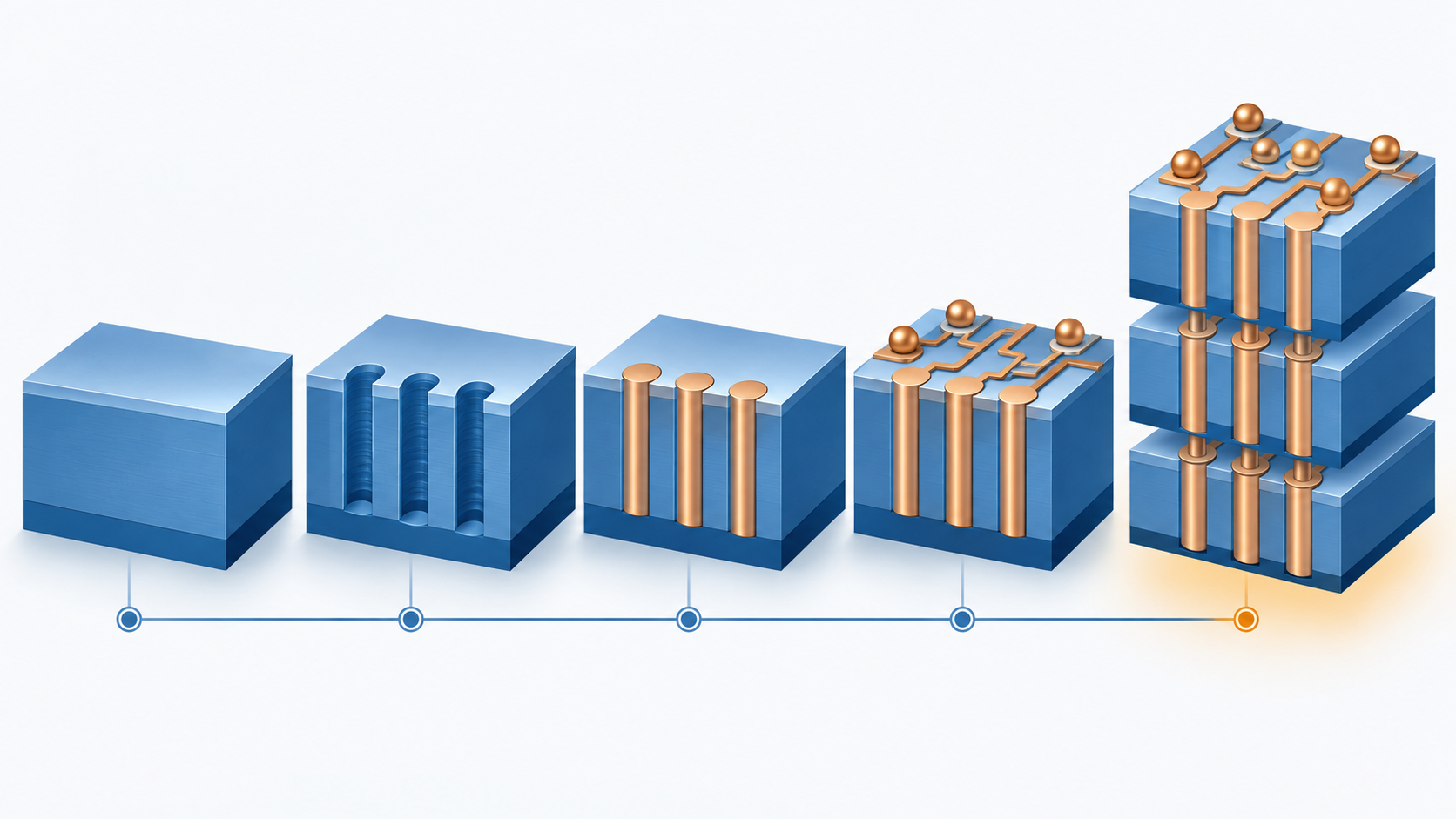
Put the two side by side and Lam's share of the back end falls out directly. Syndion drills the hole, SABRE 3D fills it with copper, and the same tool builds the bumps and the redistribution layers. These are the steps that lay the path the wiring takes when chips are stacked vertically.
The Form 10-K also names fan-out panel-level packaging and 3D stacking for HBM as areas the company serves (section 3) Sourced.
On market share, plainly
No primary source could be found for Lam Research's share of TSV etch or of plating Not yet confirmed. The company discloses no share of the etch market or the deposition market either. Figures of the form "number one in etch" or "X per cent of TSV plating" are research-firm estimates, and this article does not use them. Revenue by product family is not disclosed.
Three things can be stated from primary sources.
- SABRE 3D and Syndion are set out in the Form 10-K against named back-end steps: bumps, RDL, TSV fill and wafer-level bonding Sourced
- WLP, fan-out panel-level packaging and 3D stacking for HBM are all named as areas the company serves Sourced
- The company lists chip integration through advanced packaging among its long-term growth drivers — in the outlook discussion of the Form 10-K Sourced
8. Current investment plans
Lam's capital allocation policy is stated in the Form 10-K: it is focused on returning a portion of free cash flow to stockholders over time through dividends and share repurchases Sourced. The company has also signalled its intention to keep paying a quarterly dividend.
Lam Research has published no costed plan for a new plant or for the scale of any capacity expansion Not yet confirmed. The Form 10-K goes no further than saying that it believes its existing facilities are well maintained and in good operating condition. Nothing equivalent to Applied Materials' "US$500m new campus in Singapore" could be found in the primary sources this article checked.
9. Major corporate partners
Lam Research is not a company that lists joint-research partners in its Form 10-K either. It does, however, name its principal customers Sourced.
| Company | Relationship | What the primary source says |
|---|---|---|
| Micron Technology | Principal customer | Named outright in the Form 10-K as one of the company's most significant customers in FY2024, FY2025 and FY2026 |
| Samsung Electronics | Principal customer | As above |
| SK hynix | Principal customer | As above |
| TSMC | Principal customer | As above |
The company publishes the ratios without attaching them to names Sourced.
In FY2026, four customers accounted for about 16%, 15%, 12% and 12% of revenue. In FY2025 two customers were about 17% and 15%, and in FY2024 one was about 17%. On an accounts receivable basis, as of 28 June 2026 five customers were about 20%, 16%, 15%, 11% and 10%. Which company is which percentage is not published Not yet confirmed.
That three of the four named customers (Micron, Samsung and SK hynix) are memory makers is consistent with memory being 39% of revenue. All three HBM producers being principal customers is an important piece of primary evidence when reading this company from the back end.
10. Where the company is heading in this field
What is established
| Fact | What it implies for the back end |
|---|---|
| The Form 10-K states that SABRE 3D addresses TSV fill, bumps, RDL and wafer-level bonding | The company owns the tools for the wiring steps that join chips vertically |
| It states that Syndion addresses deep etch for packaging TSVs | The drilling side of the process is covered by the same company |
| WLP, fan-out panel-level packaging and HBM 3D stacking are all named as served areas | The company signals coverage of the main back-end approaches across the board |
| Micron, Samsung and SK hynix, all three HBM producers, sit among the principal customers | The company is tied directly to capital spending on HBM stacking |
| FY2026 revenue up 26.0%, with September 2026 quarter guidance of US$8.1bn plus or minus US$400m | The company is planning on growth accelerating |
| Chip integration through advanced packaging is named in the Form 10-K as a long-term growth driver | The back end is treated as structural, not as a passing tailwind |
Outlook
Not yet confirmed Read plainly, the facts above point towards Lam Research's presence in the back end strengthening. The reason lies in the nature of the process. The more that stacking chips vertically becomes the norm, the more TSVs and the more RDL layers there are, so the number of etch and plating steps itself goes up. For an equipment maker, more steps mean more tools.
Not yet confirmed Two structural weaknesses should not be overlooked. The first is dependence on China. Thirty-four per cent of revenue goes there, and the company writes into a risk-factor heading that its sales to customers in China are being affected and are likely to be materially and adversely affected by export licensing requirements, other regulatory changes, or government action on U.S.-China trade relations Sourced. The second is the shift to hybrid bonding. If joining copper surfaces directly, without bumps, becomes widespread, demand for bump plating itself may shrink. Lam's Form 10-K makes no mention of hybrid bonding Not yet confirmed.
11. The risks this company carries
| Risk | Substance | Supporting figures or wording |
|---|---|---|
| China dependence and export controls | A risk-factor heading states that sales to customers in China have been affected and are likely to be materially and adversely affected by export licensing requirements and the like. The U.S. government has introduced rules restricting advanced semiconductor manufacturing in China | China was about 34% of revenue in FY2026, about 34% in FY2025 and about 42% in FY2024 |
| Customer concentration | Four customers were about 55% of FY2026 revenue between them, and five were about 72% of accounts receivable | 16%, 15%, 12% and 12% of revenue; 20%, 16%, 15%, 11% and 10% of receivables Our calculation |
| Industry cyclicality | Revenue moves directly with customers' capital spending, and it did fall 14% in FY2024 | FY2023 US$17,428.52m to FY2024 US$14,905.39m Our calculation |
| Tariffs and supply chain costs | The company states that tariffs and inflation-driven supply chain costs are affecting margins, and notes that it may not succeed in passing those costs on to customers | Set out in the Form 10-K risk factors |
| PFAS regulation | The company states that tightening regulation of PFAS, the per- and polyfluoroalkyl substances used widely in the parts and materials built into its products, could adversely affect its supply chain, and that substitutes may not be available at comparable cost | Set out in the Form 10-K risk factors. An item that bears directly on materials suppliers |
| Coarse segment information | With a single reporting segment, an outsider cannot verify which parts of the business are growing and which are shrinking | Set out in note 19 of the Form 10-K Not yet confirmed |
Seeing PFAS named in the risk factors is a little unusual for an equipment maker. Semiconductor production tools use fluoropolymers heavily: chamber seals, O-rings, pipe liners, and the parts that face the plasma. The company writes that proposed regulations may require a transition away from products containing PFAS, which could adversely affect its business, operations, revenue, costs and competitive position Sourced. Read from the position of someone supplying back-end materials, this points to the possibility that regulation of the parts inside the tool arrives before regulation of the chemistries used in the process. Your own chemistry can be PFAS-free and the line can still stop, if the components carrying it are not. It is an easy blind spot when looking at a supply chain.
12. Glossary
- TSV
- Through-silicon via. A vertical interconnect passing through the chip. In a structure such as HBM, where several DRAM dies are stacked, these holes join the chips above and below.
- RDL
- Redistribution layer. A wiring layer that moves the chip's pad positions to somewhere the package can work with more easily.
- Bump
- The small solder or copper protrusion that joins the chip to the package substrate. The finest versions are called microbumps.
- ECD
- Electrochemical deposition, or electroplating. Metal is deposited electrically from a bath; filling a deep hole depends above all on the design of the additives.
- Etch
- Removing the material that is not wanted. Dry etch uses a plasma, wet etch a chemical bath.
- WLP
- Wafer level packaging. Building the package while the wafer is still whole. The Form 10-K positions it as an alternative to conventional wire bonding.
- Fan-out
- Building a package with wiring extended beyond the edge of the chip, so that terminals can be placed over an area larger than the die.
- Form 10-K
- The annual report a U.S.-listed company files with the Securities and Exchange Commission. It is audited and carries legal liability for its contents.
 AI-generated concept
13. References
- Lam Research Form 10-K for the fiscal year ended June 28, 2026 (filed with the U.S. SEC on 7 August 2026). Revenue, operating income, net income, R&D expense and capital expenditure; the systems and service split; the mix by end market; revenue by region; customer concentration and the names of the principal customers; headcount and its composition; the product family listing; the back-end roles of SABRE 3D and Syndion; the passages on WLP, panel-level packaging and HBM stacking; sites; capital allocation policy; and risk factors. https://www.sec.gov/Archives/edgar/data/707549/000070754926000037/lrcx-20260628.htm
- Lam Research Earnings release for the quarter ended June 28, 2026 (Form 8-K, Exhibit 99.1, 29 July 2026). Quarterly revenue of US$6,722.24m, gross margin of 51.7%, operating margin of 37.4%, diluted EPS of US$1.81, the regional mix, guidance for the September 2026 quarter of US$8.1bn plus or minus US$400m, and the chief executive's comments. https://www.sec.gov/Archives/edgar/data/707549/000070754926000033/lrcx_exhibitx991xq4x2026.htm
- Lam Research Form 10-K for the fiscal year ended June 29, 2025 (filed with the U.S. SEC on 11 August 2025). Revenue, operating income, net income and R&D expense for FY2025 and earlier years. https://www.sec.gov/Archives/edgar/data/707549/000070754925000075/lrcx-20250629.htm
- U.S. SEC EDGAR XBRL company facts API (CIK 0000707549). Revenue, operating income, net income and R&D expense for FY2022 to FY2026, as tagged in each year's Form 10-K. https://data.sec.gov/api/xbrl/companyfacts/CIK0000707549.json
14. Claim-to-source audit
| Claim in the article | Category | Source |
|---|---|---|
| Legal name, head office address, year founded (1980), Delaware incorporation, NASDAQ listing (LRCX) | Sourced | Reference 1 https://www.sec.gov/Archives/edgar/data/707549/000070754926000037/lrcx-20260628.htm |
| The fiscal year ends on the last Sunday in June; FY2026 ran 30 June 2025 to 28 June 2026 | Sourced | Reference 1 https://www.sec.gov/Archives/edgar/data/707549/000070754926000037/lrcx-20260628.htm |
| Revenue, operating income, net income and R&D expense for FY2022 to FY2026 | Sourced | References 4 and 3 https://data.sec.gov/api/xbrl/companyfacts/CIK0000707549.json |
| Year-on-year percentages, 50.5% gross margin, 35.3% operating margin, 31.3% net margin, R&D at 10.2% of revenue, the systems and service split, the regional shares and the totals of the customer ratios | Our calculation | Derived from the figures in references 1 and 4 https://data.sec.gov/api/xbrl/companyfacts/CIK0000707549.json |
| FY2026 gross profit of US$11,725.31m, systems revenue of US$14,885.49m, customer support revenue of US$8,347.20m, capex and intangibles of US$966.41m, operating cash flow of US$5,857.66m | Sourced | Reference 1 https://www.sec.gov/Archives/edgar/data/707549/000070754926000037/lrcx-20260628.htm |
| The single reporting segment, and that assets are not identified by segment | Sourced | Reference 1 https://www.sec.gov/Archives/edgar/data/707549/000070754926000037/lrcx-20260628.htm |
| The mix by end market (FY2026 foundry 54%, memory 39%, logic and IDM 7%) | Sourced | Reference 1 https://www.sec.gov/Archives/edgar/data/707549/000070754926000037/lrcx-20260628.htm |
| Revenue by region (China 7,860 / Taiwan 5,223 / Korea 4,505 and the rest, in US$ millions) | Sourced | Reference 1 https://www.sec.gov/Archives/edgar/data/707549/000070754926000037/lrcx-20260628.htm |
| About 23,300 employees, the regional split, and more than 26% in R&D | Sourced | Reference 1 https://www.sec.gov/Archives/edgar/data/707549/000070754926000037/lrcx-20260628.htm |
| The product family listing (SABRE, ALTUS, VECTOR, Striker, Kiyo, Syndion and others) | Sourced | Reference 1 https://www.sec.gov/Archives/edgar/data/707549/000070754926000037/lrcx-20260628.htm |
| SABRE 3D covering bumps, RDL, TSV fill and wafer-level bonding, and Syndion covering deep TSV etch | Sourced | Reference 1 https://www.sec.gov/Archives/edgar/data/707549/000070754926000037/lrcx-20260628.htm |
| The passages on WLP, fan-out panel-level packaging and 3D stacking for HBM | Sourced | Reference 1 https://www.sec.gov/Archives/edgar/data/707549/000070754926000037/lrcx-20260628.htm |
| The four named principal customers (Micron, Samsung Electronics, SK hynix, TSMC) and the customer ratios | Sourced | Reference 1 https://www.sec.gov/Archives/edgar/data/707549/000070754926000037/lrcx-20260628.htm |
| Site and manufacturing locations, the statement on the condition of facilities, and the capital allocation policy | Sourced | Reference 1 https://www.sec.gov/Archives/edgar/data/707549/000070754926000037/lrcx-20260628.htm |
| China at about 34% of FY2026 revenue and the export control risk wording, PFAS regulation, tariffs | Sourced | Reference 1 https://www.sec.gov/Archives/edgar/data/707549/000070754926000037/lrcx-20260628.htm |
| The results for the quarter ended June 2026, the guidance for the September 2026 quarter and the chief executive's comments | Sourced | Reference 2 https://www.sec.gov/Archives/edgar/data/707549/000070754926000033/lrcx_exhibitx991xq4x2026.htm |
| Revenue from back-end work (advanced packaging) | Not yet confirmed | Structurally not disclosed, because there is a single reporting segment, so this article states no figure |
| Revenue by product family | Not yet confirmed | Not disclosed, so this article states no figure |
| Share of the TSV etch, plating or etch markets | Not yet confirmed | No primary source exists, so this article states no figure |
| How much of the 39% memory revenue is HBM-related | Not yet confirmed | The split is not published, so this article states no figure |
| Which company corresponds to which customer ratio (16%, 15%, 12%, 12%) | Not yet confirmed | The company does not attach names to ratios, and this article does not guess |
| The reasons behind the regional movements (Taiwan up 3.1 times, Korea up 1.6 times) | Not yet confirmed | The company gives no explanation, and this article draws no firm conclusion |
| Plans for new plants and the scale of any capacity expansion | Not yet confirmed | No costed announcement could be confirmed for this article |
| The company's approach to hybrid bonding | Not yet confirmed | Absent from the FY2026 Form 10-K, and this article does not guess |
| The outlook in section 10 | Not yet confirmed | An interpretation by this article, drawn from the six items in the facts table |
Last updated 21 September 2026 / Troy Technical
Every figure in this article comes from Lam Research's statutory filings with the U.S. Securities and Exchange Commission or from the company's own announcements. No research-firm estimates or press-based figures have been used.