COMPANY PROFILE / SEMICONDUCTOR BACK-END
NVIDIA
The company that owns no back-end equipment yet sets the back end in motion
NVIDIA is the largest semiconductor design house in the world for AI silicon. It owns no factories, and its statutory filings say so in as many words: the company does not assemble, test or package its own products. It nevertheless appears in every account of semiconductor back-end work, for one reason: NVIDIA is the customer buying up back-end capacity. This profile follows that pattern, owning nothing while controlling a great deal, using only published figures.
- NVIDIA in 30 seconds
- The logo and how the name is written
- What the company actually does: the fabless model
- Scale: five years of revenue
- Company category and position in the back-end industry
- Sites and the countries where it manufactures
- Leading products and share in semiconductor back-end work
- Current investment plans
- Major corporate partners
- Where the company is heading in this field
- The risks this company carries
- Glossary, references and claim-to-source audit
1. NVIDIA in 30 seconds
(Nasdaq Global Select Market)Ticker NVDA. 24.3bn shares outstanding as of 20 February 2026
(US$215,938m)Up 65% year on year. The fiscal year closes in late January; this one ended 25 January 2026
(fabless semiconductor)Designs only; manufacturing and back-end work are entirely outsourced
NVIDIA's back-end revenue is zero. Packaging and test are both outsourced, so there is nothing to sell. The 10-K states that the company relies on foundries for wafer fabrication and that it does not assemble, test or package its own products, contracting instead with independent subcontractors Sourced. NVIDIA still appears more often than anyone else in back-end coverage because it is the party paying in advance to lock up back-end capacity. The company names CoWoS explicitly in its 10-K as the technology it uses for semiconductor packaging, and its supply and capacity commitments stood at US$279bn as of July 2026. That asymmetry, no revenue but payments running into the hundreds of billions, is the key to reading this company from the back-end side.
2. The logo and how the name is written

The NVIDIA logo, the green eye-like symbol together with the NVIDIA wordmark, is a registered trademark of the company. This article does not redraw it or generate an approximation; where it is shown, the genuine logo file taken from the official site is placed in the frame above. A logo drawn by an AI to look roughly right is wrong both as a trademark and as a matter of fact.
A note on style: the name is set in full capitals, NVIDIA, in statutory filings as well. Forms such as "Nvidia" or "nVidia" are not official.
Official site: https://www.nvidia.com/en-us/3. What the company actually does: the fabless model
NVIDIA only designs semiconductors. The section of the 10-K headed "Manufacturing" reads roughly as follows Sourced.
The company pursues a fabless and contract-manufacturing strategy, and works with leading suppliers for all phases of the manufacturing process, including wafer fabrication, assembly, test and packaging.
It uses CoWoS technology for semiconductor packaging, and it engages independent subcontractors and contract manufacturers such as Hon Hai Precision Industry, Wistron and Fabrinet to perform assembly, test and packaging of final products.
What NVIDIA does in house, then, is GPU and CPU architecture, software (CUDA and the surrounding libraries), system design and the customer relationship. Not one of the physical steps that touch silicon happens inside the company.
The business is reported in two segments Sourced.
| Segment | Contents | FY2026 revenue | Operating income |
|---|---|---|---|
| Compute & Networking | Data centre compute and networking platforms, AI software, automotive platforms | US$193,479m | US$130,141m |
| Graphics | GeForce GPUs for gaming and PCs, RTX GPUs for workstations | US$22,459m | US$9,156m |
| Total | - | US$215,938m | US$139,297m |
The sum of segment operating income (US$139,297m) does not match consolidated operating income (US$130,387m) because corporate-level costs are not allocated to the segments. The company notes this itself.
As a sales prospect for a materials maker, NVIDIA is not a customer. It buys not one gram of underfill, mould compound or ABF substrate. TSMC buys those, as do the OSATs and the substrate makers. NVIDIA still has to be followed, because it is NVIDIA that decides first which package structure will be used. The company wrote in its own 10-K that it uses CoWoS. That single sentence fixes a chain of materials requirements: a silicon interposer, the HBM that sits on it, the mould compound around the edge, and a substrate strong enough to carry a package that has grown enormous. The specification starts with the buyer, and the volume of materials demand is set by the buyer's production plan. So anyone selling back-end materials needs to watch NVIDIA's supply commitments as closely as TSMC's capacity plans.
4. Scale: five years of revenue
| Fiscal year | Revenue (US$m) | R&D expense (US$m) | Operating income (US$m) | Net income (US$m) |
|---|---|---|---|---|
| FY2022 | 26,914 | 5,268 | 10,041 | 9,752 |
| FY2023 | 26,974 | 7,339 | 4,224 | 4,368 |
| FY2024 | 60,922 | 8,675 | 32,972 | 29,760 |
| FY2025 | 130,497 | 12,914 | 81,453 | 72,880 |
| FY2026 | 215,938 | 18,497 | 130,387 | 120,067 |
The sharp drop in operating income in FY2023 was the year an inventory correction in gaming coincided with charges from an abandoned acquisition. Gross margin fell from 75.0% in FY2025 to 71.1% in FY2026, on the company's own figures.
Capital spending is remarkably small
Being fabless shows up directly on the balance sheet Sourced.
| Item | FY2026 | As a share of revenue |
|---|---|---|
| Revenue | US$215,938m | - |
| Capital spending (purchases of property, equipment and intangibles) | US$6,042m | 2.8% Our calculation |
| R&D expense | US$18,497m | 8.6% Our calculation |
| Property and equipment, net | US$10,383m | 4.8% Our calculation |
For comparison, TSMC's 2025 capital expenditure was 33.4% of revenue. Two companies both called semiconductor businesses use capital in entirely different ways.
What the 42,000 employees are doing
The composition of the headcount also says what this company is Sourced.
| Function | Headcount | Share |
|---|---|---|
| Research and development | About 31,000 | About 74% Our calculation |
| Sales, marketing, operations and administration | About 11,000 | About 26% Our calculation |
| Total | About 42,000 | Spread across 38 countries |
The company also discloses that more than 80% of employees hold technical roles, that over half hold a master's degree or higher, and that turnover in FY2026 was 3.7% Sourced. With not a single production operator on the payroll, revenue per employee comes to about US$5.14m Our calculation.
5. Company category and position in the back-end industry
The category is manufacturer, specifically a fabless semiconductor company. On the map of the back-end industry, NVIDIA stands not on the contractor's side but on the buyer's.
Profiles of TSMC or an OSAT have to say that back-end revenue is not broken out. NVIDIA is different. It sells no back-end service, so there is no such revenue line to begin with. The back-end cost sits inside cost of revenue. The 10-K describes that line as covering the cost of semiconductors including wafer fabrication, assembly, testing and packaging, plus board and device costs, manufacturing support costs, memory and component costs, tariffs and freight Sourced. In other words, packaging cost is inside cost of revenue but is never broken out Not yet confirmed.
6. Sites and the countries where it manufactures
There are no factories. The "Properties" section of the 10-K is remarkably short and says only this Sourced.
| Category | Contents |
|---|---|
| Headquarters | Santa Clara, California. About 3 million square feet of office and building space, owned and leased |
| Data centres | Leased data centre space within Santa Clara, used for the company's own research and development |
| Other sites | Owned or leased facilities in the United States and abroad for data centres, R&D and sales and administration. Outside the United States these are mainly in China, India, Israel and Taiwan |
| Manufacturing sites | None listed, because the company holds none |
Property and equipment by country, net of depreciation, shows where the weight of this company actually sits Sourced.
| Country | End of FY2026 (US$m) | End of FY2025 (US$m) | Share |
|---|---|---|---|
| United States | 5,125 | 3,626 | 49.4% Our calculation |
| Taiwan | 3,219 | 1,481 | 31.0% Our calculation |
| Israel | 1,471 | 840 | 14.2% Our calculation |
| Other | 568 | 336 | 5.5% Our calculation |
| Total | 10,383 | 6,283 | 100% |
A company that supposedly owns no factories holds 31% of its property and equipment, US$3.2bn, in Taiwan, and that figure rose 2.2 times in a single year Our calculation. The 10-K does not explain what those assets are, so the breakdown is unknown Not yet confirmed. Still, the company names dependence on consistent supply from Taiwan and Korea as a risk factor, and when a firm that owns no production tools builds up assets at a manufacturing location, the usual contents are test equipment, validation rigs and tooling placed on a supplier's premises. On that reading, capital is moving towards the back end and the test steps. For a materials supplier, a step where the buyer starts putting its own people and equipment on the ground is a step where specifications get decided faster, so it is worth watching.
7. Leading products and share in semiconductor back-end work
There are no products, only adoption decisions
This section has to be written differently from the other back-end profiles. NVIDIA sells neither a back-end product nor a back-end service, so it has no leading product and no share in the back end. What follows instead is what can be stated with confidence from primary sources.
- NVIDIA uses CoWoS for semiconductor packaging, stated in the "Manufacturing" section of the 10-K Sourced
- It does not perform assembly, test or packaging itself, stated among the risk factors in the 10-K Sourced
- Wafers come from TSMC and Samsung, memory from SK hynix, Micron and Samsung, all named in the 10-K Sourced
- Final assembly, test and packaging are contracted to Hon Hai Precision Industry, Wistron and Fabrinet, all named in the 10-K Sourced
- Supply and capacity commitments stood at US$279bn as of 26 July 2026, up by US$160bn in three months from US$119bn a quarter earlier Sourced
How much of the world's CoWoS capacity NVIDIA has secured cannot be established from primary sources. Figures of the form "NVIDIA has locked up X per cent of CoWoS capacity" or "reserved Y thousand wafers a month" are estimates from research firms or the press, and this article does not use them Not yet confirmed. Equally, how much of the US$279bn of commitments relates to packaging is not disclosed. The company says only that the commitments relate mainly to memory and manufacturing facilities Sourced.
Which products use CoWoS
According to the 10-K, most of FY2026 data centre revenue came from products built on the Blackwell architecture Sourced. Blackwell is described as a liquid-cooled design connecting 36 Grace CPUs and 72 Blackwell GPUs at data centre scale, and the 10-Q records that the next generation, Vera Rubin, entered volume shipment in the third quarter of FY2027 Sourced.
Both put a logic die and HBM, stacked wide-bandwidth memory, inside a single package. The volume of back-end materials and equipment demand is set by how many of those packages are built each month.
8. Current investment plans
NVIDIA has no plan to spend billions on a factory. What it has instead are commitments, that is, contracted balances. As of 26 July 2026 they stood as follows Sourced.
| Type of commitment | Total | Rest of FY2027 | FY2028 | FY2029 | FY2030 onwards |
|---|---|---|---|---|---|
| Supply and capacity | US$279bn | US$92bn | US$87bn | US$88bn | US$12bn |
| Cloud service agreements | US$29bn | US$3bn | US$8bn | US$7bn | US$11bn |
| Data centre leases not yet commenced | US$25bn | - | US$1bn | US$1bn | US$23bn |
| Investment commitments | US$25bn | US$18bn | US$3bn | US$2bn | US$2bn |
| Capital expenditure | US$8bn | US$7bn | US$1bn | - | - |
| Total | US$366bn | US$120bn | US$100bn | US$98bn | US$48bn |
This reproduces the table the company discloses in billions of dollars; rows do not always add exactly because of rounding. The "FY2030 onwards" column combines the company's three columns for FY2030, FY2031 and FY2032 and beyond Our calculation.
It is larger than the company's entire FY2026 revenue of US$215.9bn Our calculation. The company's own explanation is that it has partnered with a broad network to secure the supply and critical components needed to meet demand over the coming years, that supply commitments rose from US$119bn in the prior quarter to US$279bn, and that these relate to its data centre infrastructure systems, mainly memory and manufacturing facilities.
Seen from the back end, this is not a demand forecast but a contracted quantity. As a basis for planning capacity it is far harder evidence than any market projection from a research firm. The caveat, again, is that the packaging-related portion is not disclosed Not yet confirmed.
The company's own capital spending, on property, equipment and intangibles, was US$6,042m in FY2026. That is under 2% of total commitments, which shows that almost all of NVIDIA's "investment" is money paid to reserve someone else's equipment Our calculation.
9. Major corporate partners
Below are the counterparties named in the 10-K and 10-Q, sorted by the nature of the relationship. Every name here is one NVIDIA itself put into a statutory filing.
| Kind | Counterparty | Substance | Primary source |
|---|---|---|---|
| Wafer supply | TSMC, Samsung Electronics | Named as the foundries used to fabricate semiconductor wafers. Values and volumes are not disclosed | Stated in the 10-K Sourced |
| Memory supply | SK hynix, Micron Technology, Samsung Electronics | Named as the companies from which memory is purchased. Whether this refers to HBM is not specified | Stated in the 10-K Sourced |
| Packaging technology | None named, only the technology | The filing says the company uses CoWoS technology for semiconductor packaging, without naming who performs it | Stated in the 10-K Sourced |
| Final assembly and test | Hon Hai Precision Industry, Wistron, Fabrinet | Engaged as independent subcontractors and contract manufacturers to assemble, test and package final products | Stated in the 10-K Sourced |
| Investment | Groq | US$13bn recorded as a separate line in the FY2026 cash flow statement | Stated in the 10-K Sourced |
| Guarantee | An affiliate of SB Energy Corp. | In August 2026 the company provided credit support of up to US$105bn for land, power and building work serving a customer, an OpenAI-related entity | Stated in the 10-Q Sourced |
In a back-end context the OSATs (ASE Group, Amkor, SPIL and others), the substrate makers (Ibiden, Unimicron), Ajinomoto for ABF film and ASMPT or Besi for equipment are all routinely mentioned in the same breath as NVIDIA. Yet none of these names appears anywhere in NVIDIA's statutory filings. Since even the existence of a trading relationship cannot be confirmed from the company's own primary material, this article does not treat them as partnerships Not yet confirmed. The same applies to whether TSMC or someone else performs the CoWoS work: NVIDIA's filings name the technology and stop there.
10. Where the company is heading in this field
Anything said here is a forecast, so the established facts and the outlook drawn from them are kept apart.
What is established
| Fact | What it implies for the back end |
|---|---|
| Supply and capacity commitments rose from US$119bn to US$279bn in three months | The buyer has locked up capacity years ahead. Back-end utilisation will rest on those contracts for some time |
| Data centre revenue is 89.7% of the total | NVIDIA's production plan is, in effect, the production plan for advanced packaging |
| The 10-K states explicitly that CoWoS is used | The choice of package format has become a disclosure item for the buyer. Materials specifications are settled on the same side |
| Vera Rubin entered volume shipment in the third quarter of FY2027 | A generation change is under way, the moment when package dimensions and materials requirements are rewritten |
| The 10-Q says the company remains subject to certain supply constraints | Supply, not demand, is still what sets the ceiling |
| Property and equipment in Taiwan rose 2.2 times in a year, from US$1.48bn to US$3.22bn | The buyer has begun placing assets close to where manufacturing happens |
Outlook
Not yet confirmed Read plainly, the facts above point towards NVIDIA's weight in the back-end industry growing further for now. The reason is simple: the single company that does most to set demand for advanced packaging has contracted for several years of capacity. From a back-end company's point of view, NVIDIA is not a direct customer and yet determines how full the lines run.
Not yet confirmed Two developments could change that shape. One is NVIDIA moving into back-end work itself. It owns neither equipment nor staff for that today, and the 10-K contains no such plan, but the jump in property and equipment in Taiwan at least shows a move towards the manufacturing sites. The other is growth in customers' own silicon, the in-house accelerators built by cloud operators. NVIDIA itself flags this as a risk, noting that some customers have comparable internal development capability and could replace what the company offers with their own solutions Sourced. Even then, demand for advanced packaging would not fall; only the names on the purchase orders would spread out, and that distinction is worth holding onto.
11. The risks this company carries
What follows is drawn from the risk factors NVIDIA sets out in its own 10-K and 10-Q, narrowed to those that matter in a back-end context Sourced.
| Risk | Substance | Supporting figures |
|---|---|---|
| Customer concentration | In FY2026 one direct customer was 22% of revenue and another 14%, both in the Compute & Networking segment | The top three accounts receivable balances were 25%, 18% and 13% |
| Geographic concentration of supply | The company states that it depends on consistent supply from overseas partners in Taiwan and Korea. Manufacturing and final assembly are concentrated in Taiwan, Korea, China and Israel | Revenue to customers headquartered in Taiwan was US$42,345m, or 19.6% Our calculation |
| Commitments becoming fixed | Non-cancellable, non-returnable orders are placed further ahead than the traditional lead time. If demand undershoots, the result is inventory write-downs | Supply and capacity commitments of US$279bn. FY2026 inventory and related charges were US$7.2bn |
| Export controls | At the end of FY2026 the company stated that it was effectively excluded from the data centre compute market in China | Revenue to China including Hong Kong fell from US$25,048m to US$19,677m Our calculation |
| Margin erosion | Gross margin fell from 75.0% to 71.1%, attributed to the shift from HGX systems to full-scale data centre products and to US$4.5bn of charges related to H20 | The company's own figures. The fall is 3.9 percentage points |
| Swelling inventory | Inventories were US$21.4bn at the end of FY2026 and US$31.6bn at the end of July 2026, with work in progress growing fastest | The balance was US$10.1bn at the end of FY2025, a 3.1-fold rise in 18 months Our calculation |
For a materials supplier, NVIDIA's risk is not the risk of losing an account, because there is no account. What bites is volatility in volume. US$279bn of commitments is, read the other way, a set of contracts that can stop all at once if demand comes in below plan. NVIDIA did in fact take US$7.2bn of inventory and purchase-obligation charges in FY2026. When the buyer is writing down inventory, the packaging steps and the materials upstream of it see enquiries thin out first. One company revising its demand forecast propagates, amplified, all the way to the end of the supply chain. That is a different kind of volatility from the traditional materials business of selling into many scattered customers. On top of that, the changeover to the Vera Rubin generation shifts package dimensions and thermal design, which makes it the moment when a whole set of materials specifications is rewritten at once.
12. Glossary
- Fabless
- A semiconductor company that owns no fabrication plant and only designs. Manufacturing goes to a foundry and back-end work to an OSAT or similar.
- CoWoS
- Chip on Wafer on Substrate. An advanced packaging approach placing a logic die and HBM side by side on an intermediate substrate called an interposer. NVIDIA states in its 10-K that it uses this technology.
- HBM
- High Bandwidth Memory. DRAM stacked vertically to gain bandwidth, placed next to the logic die in CoWoS.
- OSAT
- Outsourced Semiconductor Assembly and Test. A company specialising in contract back-end assembly and inspection. No OSAT is named in NVIDIA's filings.
- Supply and capacity commitment
- The contracted balance of agreements that reserve future supply. It is not a liability in accounting terms, but cancelling it triggers a charge. NVIDIA discloses the figure each quarter.
- Fiscal year ending in January
- NVIDIA's year closes at the end of January. FY2026 in this article ran from 27 January 2025 to 25 January 2026, and so corresponds roughly to calendar 2025.
- Form 10-K and 10-Q
- The annual and quarterly reports a U.S. company files with the Securities and Exchange Commission. They are audited or reviewed and carry legal liability for their contents.
- Blackwell and Vera Rubin
- Generation names for NVIDIA's data centre architectures. Blackwell carried FY2026; Vera Rubin entered volume shipment in the third quarter of FY2027.
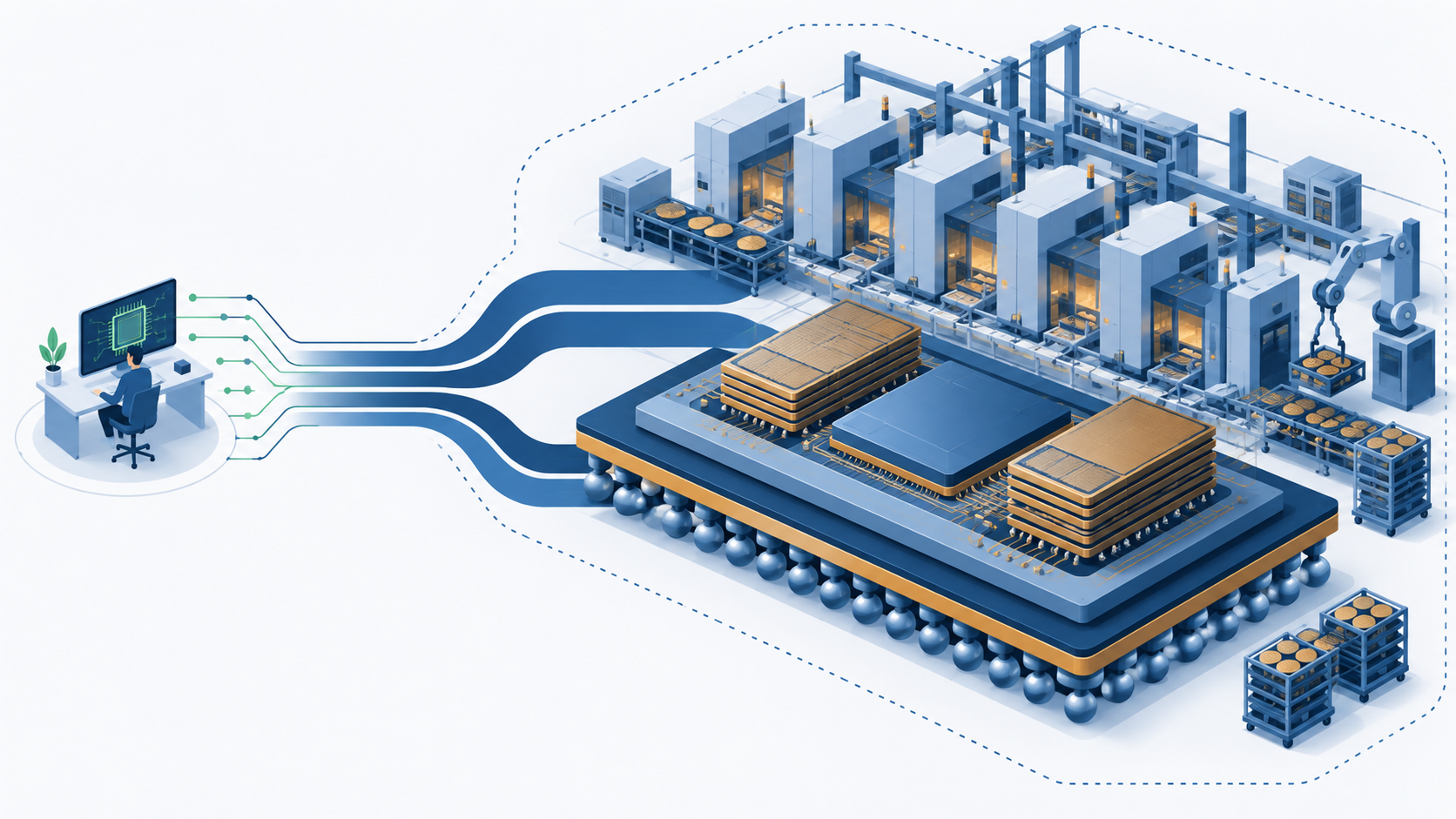 AI-generated concept
13. References
- NVIDIA Form 10-K for the fiscal year ended 25 January 2026 (filed with the U.S. SEC on 25 February 2026). Revenue, R&D expense, operating income, net income, revenue by segment, by end market and by region, headcount, customer concentration, named suppliers, the use of CoWoS, Properties, property and equipment by country, capital spending and risk factors. sec.gov/Archives/edgar/data/1045810/000104581026000021/nvda-20260125.htm
- NVIDIA Form 10-Q for the quarter ended 26 July 2026 (filed with the U.S. SEC on 26 August 2026). Quarterly revenue, the year-by-year breakdown of supply and capacity commitments and the US$279bn balance, the timing of Vera Rubin volume shipment, supply constraints, inventories and the guarantee relating to SB Energy Corp. sec.gov/Archives/edgar/data/1045810/000104581026000075/nvda-20260726.htm
- U.S. SEC EDGAR XBRL company facts API (CIK 0001045810). Revenue, R&D expense, operating income and net income for FY2022 to FY2026, as tagged in each year's Form 10-K. data.sec.gov/api/xbrl/companyfacts/CIK0001045810.json
- NVIDIA Official website, used to check how the name is written and the logo. https://www.nvidia.com/en-us/
14. Claim-to-source audit
| Claim in the article | Category | Source |
|---|---|---|
| Legal name, head office address, year founded (April 1993), listing (Nasdaq, NVDA), shares outstanding | Sourced | Reference 1 sec.gov/.../nvda-20260125.htm |
| FY2026 revenue of US$215,938m, up 65%, gross margin 71.1% | Sourced | Reference 1 sec.gov/.../nvda-20260125.htm |
| Revenue, R&D expense, operating income and net income for FY2022 to FY2025 | Sourced | Reference 3 data.sec.gov/.../CIK0001045810.json |
| The year-on-year figures in Fig. 1 (+61%, +0.2%, +126%, +114%, +65%) | Our calculation | Derived from the annual revenue in reference 3 data.sec.gov/.../CIK0001045810.json |
| About 42,000 employees in 38 countries, 31,000 in R&D, over 80% technical, turnover 3.7% | Sourced | Reference 1 sec.gov/.../nvda-20260125.htm |
| Revenue per employee of about US$5.14m and the 74% R&D share of headcount | Our calculation | Derived from the revenue and headcount in reference 1 sec.gov/.../nvda-20260125.htm |
| The statements that the company does not assemble, test or package its products and that it uses CoWoS | Sourced | Reference 1 sec.gov/.../nvda-20260125.htm |
| Named suppliers (TSMC, Samsung, SK hynix, Micron, Hon Hai, Wistron, Fabrinet) | Sourced | Reference 1 sec.gov/.../nvda-20260125.htm |
| Revenue by end market, including data centre revenue of US$193,737m | Sourced | Reference 1 sec.gov/.../nvda-20260125.htm |
| Data centre at 89.7% of revenue, capital spending at 2.8%, R&D at 8.6% | Our calculation | Derived from the amounts in reference 1 sec.gov/.../nvda-20260125.htm |
| Property and equipment by country (US 5,125, Taiwan 3,219, Israel 1,471, other 568, US$m) | Sourced | Reference 1 sec.gov/.../nvda-20260125.htm |
| The 2.2-fold rise in Taiwan property and equipment and its 31.0% share | Our calculation | Derived from the two years of amounts in reference 1 sec.gov/.../nvda-20260125.htm |
| Customer concentration (one direct customer 22%, another 14%, receivables 25/18/13%) | Sourced | Reference 1 sec.gov/.../nvda-20260125.htm |
| Revenue to China falling from US$25,048m to US$19,677m and the effective exclusion from that market | Sourced | Reference 1 sec.gov/.../nvda-20260125.htm |
| The commitments table (supply and capacity US$279bn, total US$366bn) and its year-by-year split | Sourced | Reference 2 sec.gov/.../nvda-20260726.htm |
| The "FY2030 onwards" column, being three of the company's columns added together | Our calculation | Added up by this article from the table in reference 2 sec.gov/.../nvda-20260726.htm |
| Vera Rubin volume shipment timing, supply constraints, inventories of US$31.6bn, the US$105bn SB Energy guarantee | Sourced | Reference 2 sec.gov/.../nvda-20260726.htm |
| CoWoS world share and the capacity NVIDIA has secured, in wafers or per cent | Not yet confirmed | No primary source exists, so this article states no figure |
| How much of the US$279bn relates to packaging | Not yet confirmed | Not disclosed. The company says only "mainly memory and manufacturing facilities", and this article does not estimate the split |
| The packaging cost NVIDIA bears | Not yet confirmed | Included in cost of revenue but never broken out, and this article does not estimate it |
| What the US$3.22bn of property and equipment in Taiwan actually consists of | Not yet confirmed | Reference 1 gives no breakdown, so this article asserts no use for it |
| Who performs the CoWoS work, and dealings with OSATs, substrate makers and materials suppliers | Not yet confirmed | Absent from NVIDIA's own primary material, so this article does not treat them as partnerships |
| The outlook in section 10 | Not yet confirmed | An interpretation by this article, drawn from the six items in the facts table |
Last updated 21 September 2026 / Troy Technical
Every figure in this article comes from NVIDIA's statutory filings with the U.S. Securities and Exchange Commission. No research-firm estimates or press-based figures have been used.