COMPANY PROFILE / SEMICONDUCTOR BACK-END
Onto Innovation
Born from a 2019 merger, it builds the eyes of the back end
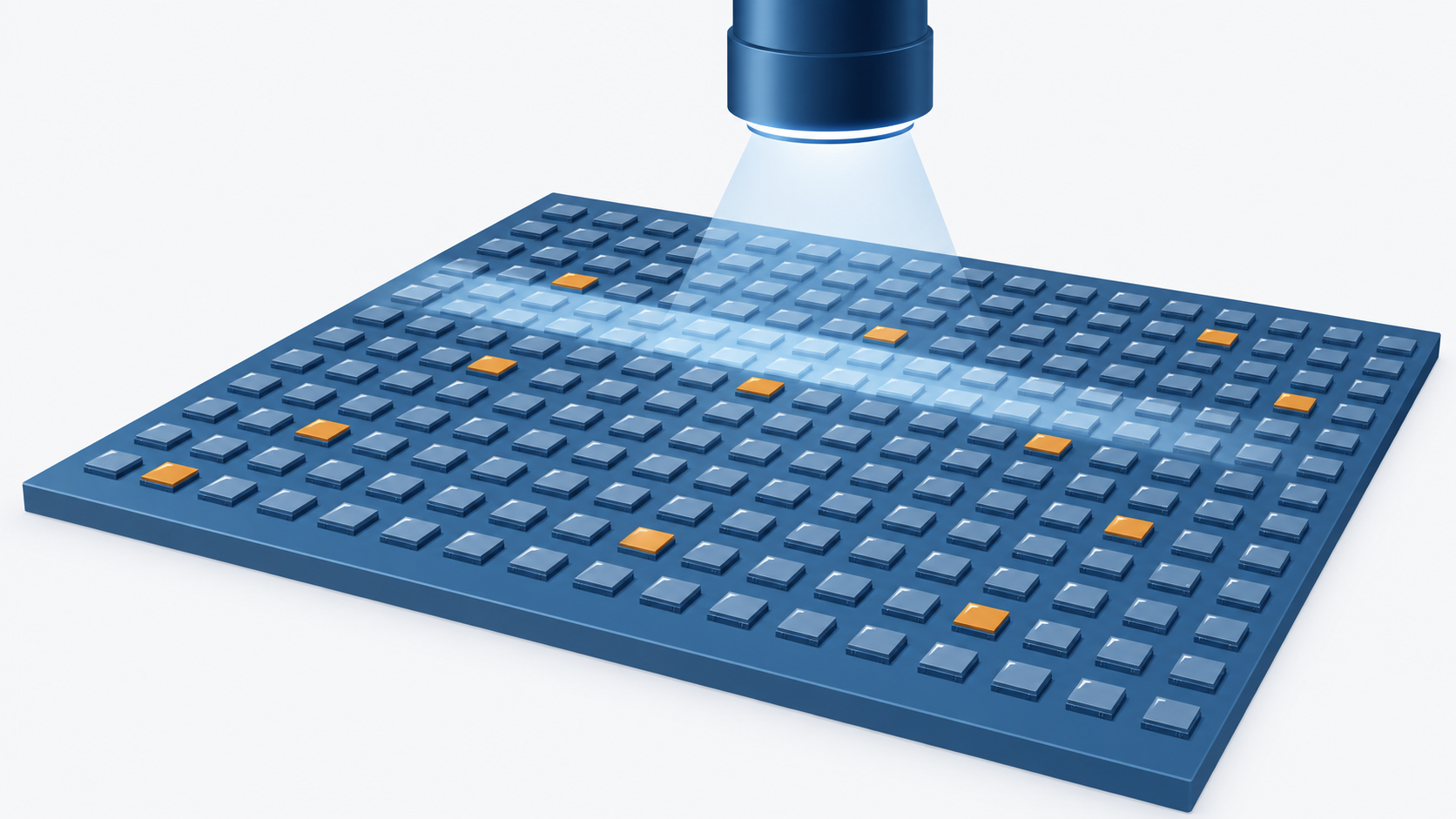
Onto Innovation makes the inspection and metrology tools that sit on a semiconductor production line. It builds neither chips nor packages. It sells the machines that look at what has been built and judge whether it came out right. The name appears in accounts of the back end because it is one of only a handful of suppliers whose tools can see the structures peculiar to the back end: bumps, redistribution layers and stacked assemblies. It is also the company that came out of the 2019 merger of Rudolph Technologies and Nanometrics.
- Onto Innovation in 30 seconds
- The logo and how the name is written
- What the company actually does, including how the merger came about
- Scale: five years of revenue
- Company category and position in the back-end industry
- Sites and the countries where it manufactures
- Leading products and share in semiconductor back-end work
- Current investment plans
- Major corporate partners
- Where the company is heading in this field
- The risks this company carries
- Glossary, references and claim-to-source audit
1. Onto Innovation in 30 seconds
(inspection and metrology)Builds neither chips nor packages. It sells tools and software
Revenue here is about US$1bn, two orders of magnitude below Applied Materials or ASML in the same equipment industry. It still comes up in every back-end conversation, because the tools are of an unusual kind. In the back end you have to look at bumps, the small metal protrusions that join chips, and at redistribution layers: structures of an entirely different size and shape from a front-end circuit pattern, inspected at very high speed and at close to 100% coverage. Looking for relatively large defects, over a wide area, quickly, is a different technology from front-end inspection, and by the company's own account the competition worldwide narrows to a handful of firms Sourced.
2. The logo and how the name is written

"Onto Innovation" and the product names (Dragonfly, Firefly, JetStep, Discover, NovusEdge, Element and others) are registered trademarks or trademarks of the company; the Form 10-K marks them with the appropriate symbols. This article does not generate an imitation of the logo. Where it is displayed, the frame above should hold the genuine logo file taken from the official site.
A note on style: the name is two words, with the second capitalised, and is not abbreviated in filings. Many people still remember the company by its predecessors, Nanometrics and Rudolph Technologies, and older material appears under those two names.
Official site: https://www.ontoinnovation.com/3. What the company actually does, including how the merger came about
First, the facts of the merger
The description "a company formed in 2019 by the merger of Rudolph Technologies and Nanometrics" can be checked against the SEC filings as follows Sourced.
| Date | Event | Primary source |
|---|---|---|
| 23 June 2019 | Nanometrics Incorporated, Rudolph Technologies, Inc. and PV Equipment Inc., a wholly owned subsidiary of Nanometrics, entered into an Agreement and Plan of Merger | Form 8-K filed 28 October 2019 |
| 24 October 2019 | A special meeting of Nanometrics stockholders approved the issue of shares to Rudolph stockholders and an increase in authorised shares from 47 million to 97 million | Form 8-K dated 24 October 2019 |
| 25 October 2019 | PV Equipment merged into Rudolph, which survived as a wholly owned subsidiary of Nanometrics. At the same moment Nanometrics changed its name to Onto Innovation Inc. | As above |
| 25 October 2019 | Each Rudolph share was exchanged for 0.8042 of an Onto Innovation share | As above |
| 28 October 2019 | The listing moved from NASDAQ to the New York Stock Exchange and the ticker changed from NANO to ONTO | As above |
People describe it as a merger of equals, but the entity that continued in law was Nanometrics. In the SEC's own company database the same registration, CIK 704532, is treated as a change of name from "NANOMETRICS INC" (8 September 1995 to 25 October 2019) to "ONTO INNOVATION INC." Sourced. Rudolph was the side absorbed, as a subsidiary. That is why the five years of results in this article connect continuously to the period before 2019.
The founding years of Nanometrics and of Rudolph individually could not be established from the primary sources consulted here Not yet confirmed.
The business today
The company describes itself as a worldwide leader in the design, development, manufacture and support of metrology and inspection tools for the semiconductor industry Sourced. What it sells falls into three parts.
| Revenue line | What it contains | FY2025 (US$k) | Share |
|---|---|---|---|
| Systems and software | Inspection tools, metrology tools, packaging lithography systems and yield management software | 847,835 | 84% |
| Parts | Sales of replacement parts | 84,200 | 8% |
| Services | Maintenance contracts, system upgrades and time-and-materials work | 73,228 | 8% |
| Total | n/a | 1,005,263 | 100% |
The customers are silicon wafer makers, integrated circuit manufacturers and advanced packaging manufacturers. The company states explicitly that its products are used in both the front end and the back end Sourced.
Front-end inspection means hunting for a minute defect buried in a circuit pattern a few nanometres across. Back-end inspection means looking at the height, position and shape of bumps tens of micrometres across, breaks in a redistribution layer, warpage and voids after moulding, misalignment in a stack. Three orders of magnitude apart. And in the back end several expensive chips sit in a single package, so one bad part wastes all of them. The company puts it this way: inspection rates through advanced packaging assembly are high, to avoid building a defective chip into an expensive package Sourced. From the materials side, the second half of that sentence is the important part. The company is saying that demand for back-end inspection tools tracks assembly volume, not the shrink cycle. In other words, the number of AI chips shipped translates straight into tool demand.
4. Scale: five years of revenue
| Fiscal year | Revenue (US$k) | Operating income (US$k) | Net income (US$k) | R&D expense (US$k) | Capex (US$k) |
|---|---|---|---|---|---|
| FY2021 | 788,899 | 156,407 | 142,349 | 96,118 | 12,039 |
| FY2022 | 1,005,183 | 236,714 | 223,334 | 111,953 | 18,405 |
| FY2023 | 815,868 | 116,078 | 121,159 | 104,442 | 22,573 |
| FY2024 | 987,321 | 187,103 | 201,670 | 116,767 | 31,903 |
| FY2025 | 1,005,263 | 132,927 | 136,759 | 131,978 | 28,513 |
FY2025 was a 53-week year. R&D expense rose 37.3% over the five years, taking it from 12.2% to 13.1% of revenue Our calculation.
What happened in FY2025
Revenue was essentially flat, up 1.8%, but net income fell 32.2%, from US$201.67m to US$136.76m Our calculation. The company gives three reasons Sourced.
- Gross margin fell from 52.2% to 49.7%, on write-downs of slow-moving and obsolete inventory, restructuring costs tied to an infrastructure transition, and start-up costs for outsourced manufacturing
- Operating expenses rose from US$328.21m to US$366.84m, on restructuring costs, transaction costs and intangible amortisation from the Semilab USA acquisition, R&D project costs and higher personnel costs
- A change in the revenue mix: NAND and OSAT business grew while foundry and DRAM business shrank
The shape of it is "advanced packaging for AI is booming, and profits fell". In fact the company attributes the decline in systems and software revenue in FY2025 to fewer shipments of the inspection product line that supports advanced packaging for AI chips Sourced. In the equipment business, years in which customers add capacity alternate with years in which they use up the capacity they added. Strong back-end demand and tools selling every year are two different statements.
Into 2026
| Measure | Q2 2025 | Q2 2026 | Q3 2026 guidance |
|---|---|---|---|
| Revenue (US$m) | 253.6 | 343.1 | 380 to 400 |
| Gross margin | 48.2% | 53.4% | 57.3 to 57.8% |
| Operating margin | 12.7% | 18.5% | 21.4 to 22.4% |
| Diluted EPS (US$) | 0.69 | 1.21 | 1.54 to 1.70 |
All figures on a GAAP basis. The third-quarter 2026 column is the company's guidance, not an actual result Not yet confirmed. Second-quarter 2026 revenue of US$343.1m was a quarterly record, and the six-month total was US$635.1m.
5. Company category and position in the back-end industry
The category is a manufacturer, of inspection and metrology equipment. It makes no chips, assembles no packages and supplies no materials. In the back-end supply chain it is the party that delivers tools into the plants of the OSATs and the memory makers.
To be a little more concrete, here is where in the process flow the company's tools sit.
6. Sites and the countries where it manufactures
The footprint has one very clear feature: all manufacturing is inside the United States, and the overseas sites do sales and service only Sourced. The Form 10-K states that substantially all of the company's long-lived assets are located in the United States.
| Site | Country | Use | Floor area (sq ft) |
|---|---|---|---|
| Wilmington, Massachusetts | United States | Headquarters, engineering, service | 77,500 |
| Milpitas, California | United States | Engineering, manufacturing, service, administration. The only owned property | 134,600 |
| Bloomington, Minnesota | United States | Engineering, manufacturing, service, administration | 98,700 |
| Tampa, Florida | United States | Engineering, manufacturing, service, administration | 52,800 |
| Budd Lake, New Jersey | United States | Engineering, service, administration | 48,900 |
| Tucson, Arizona | United States | Engineering, manufacturing, service | 18,900 |
| North Billerica, Massachusetts | United States | Engineering, manufacturing, service | 14,400 |
| Hillsboro and Snoqualmie | United States (Oregon and Washington) | Engineering, service | 17,100 / 20,300 |
| Taiwan | Taiwan | Sales, service | 38,600 |
| Korea | Korea | Sales, service | 37,000 |
| China | China | Sales, service, engineering | 28,600 |
| Japan | Japan | Sales, service | 12,400 |
| Singapore | Singapore | Sales, service | 11,300 |
From the principal facilities table of the Form 10-K, as of 3 January 2026. There are leased properties in Germany, the Netherlands, Malaysia and Vietnam as well. The longest lease runs to 30 November 2035.
Eighty-six per cent of revenue goes to Asia (Taiwan 32%, Korea 28%, Japan 10%, China 7% and Southeast Asia 6%), and every manufacturing site is inside the United States Our calculation. A tool is not finished when it ships: installation, recipe tuning and maintenance continue for years. So it makes sense that the overseas sites are sales and service, and that in the headcount breakdown sales, applications and service support come to 739 people, 46% of the 1,615 employees Our calculation. Put the other way round, this company's competitiveness rests not only on how good the tool is but to a large degree on the number and quality of the people who build the recipe inside the customer's plant. Because an inspection recipe has to be rebuilt every time a material or a process condition changes, this is also where a materials supplier ends up dealing with the equipment maker directly.
7. Leading products and share in semiconductor back-end work
The products that touch the back end
- Dragonfly G3
- The latest macro defect inspection system. It is installed in wafer fabs (front end) and packaging plants (back end) alike. It is fast, and recipes can be created without a wafer.
- Firefly
- A macro inspection system for panels. It performs high-resolution inspection and passes per-die defect location data to the lithography tool.
- JetStep X500
- A lithography system for advanced packaging. The technology came originally from the flat panel display market, and it builds redistribution layers on thin organic laminate panels.
- StepFAST
- The company's own process for handing the defect locations Firefly finds to JetStep, raising lithography throughput.
- Discover
- Yield management software. It classifies and analyses the large volumes of data inspection produces, and identifies the causes that bear directly on yield.
- ADC
- Automated defect classification. Full-wafer images taken simultaneously in bright field and dark field are compared with an ideal defect-free image, and the difference is decomposed into mathematical vectors and matched against a library of known defects.
Panels: a big story for this company
The passage in the Form 10-K that goes furthest on the back end concerns the move from round 300mm wafers to rectangular panels Sourced.
Advanced packaging plants are moving from 300mm wafers to large rectangular panels of up to 650mm by 650mm in order to lower cost of ownership and raise productivity. Free of the constraints of a round wafer, more devices can be processed per pass. Because JetStep X500 came out of the flat panel display market, it transfers to this use directly, and combined with Firefly the company says it can offer a path from wafer-based to panel-based production while holding capital spending down.
A round wafer wastes area at the edge; a rectangular panel can be tiled without gaps. The larger the AI chip package, the more that difference matters. But flatness, warpage and thermal expansion all become harder to control, so the need for inspection goes up, not down. That is why this company welcomes the shift to panels.
On market share, plainly
Onto Innovation officially discloses neither revenue from back-end tools nor market share. It reports as a single segment. Market descriptions such as "Advanced Nodes" and "Specialty Devices and Advanced Packaging" appear in the narrative of its earnings commentary, but no amounts are broken out Not yet confirmed. Figures of the form "X per cent share of advanced package inspection" come from research firms or the press, and this article does not use them.
What primary material does give is the list of competitors the company names itself Sourced. Note that the rival differs from market to market.
| Market | Principal competitors named by the company |
|---|---|
| Thin-film and OCD metrology (mainly front end) | KLA Corporation, Nova Ltd. |
| Advanced packaging inspection | KLA Corporation, Camtek Ltd. |
| Advanced packaging lithography | Ushio, Inc., Canon, Inc. |
| Panel market inspection | GigaVis Co. Ltd. |
The company also states that some competitors may have greater financial, research, manufacturing and marketing resources than it does.
Where the customers are concentrated
| Customers above 10% of revenue | FY2023 | FY2024 | FY2025 |
|---|---|---|---|
| Customer A | 14% | 23% | 20% |
| Customer B | 19% | 17% | 15% |
| Customer C | under 10% | 12% | 14% |
| Three combined | n/a | 52% | 49% |
The totals are this article's own arithmetic Our calculation. The company does not name its customers Not yet confirmed. As of 3 January 2026, one customer accounted for about 12% of accounts receivable.
8. Current investment plans
This is not a company that builds factories, so capital expenditure is small (US$28.51m in FY2025) and the spending that drives growth goes into research and development and acquisitions.
The Semilab USA acquisition, November 2025
In the fourth quarter of FY2025 the company acquired Semilab USA LLC, a subsidiary of Hungary's Semilab International Zrt., for a total of US$526.6m Sourced. Three product lines came with it.
| Product line | What it strengthens |
|---|---|
| FAaST | In-line wafer contamination monitoring |
| CnCV | Surface charge metrology, an area the company describes as proprietary |
| MBIR | Materials analysis by infrared reflectometry, for process control of high-aspect-ratio structures, films and epitaxial layers |
In the roughly six weeks from the acquisition date to the FY2025 year end on 3 January 2026, Semilab USA contributed US$8.6m of revenue and an operating loss of US$6.2m Sourced. The inventory step-up from the acquisition runs through cost of revenue as a non-recurring charge: US$4.0m was recognised in FY2025, and the remaining US$9.1m or so is expected to be recognised over the year after acquisition. Amortisation of the intangible assets brings with it a deferred tax liability of US$46.6m. The company itself states that the purchase price allocation is provisional and may change during the measurement period, which runs up to twelve months from the acquisition date Not yet confirmed.
This acquisition was not a back-end move. All three added product lines address wafers and materials, which reads as a sign that the company does not intend to rest on the back end alone.
9. Major corporate partners
Neither the FY2025 Form 10-K nor the second-quarter 2026 Form 10-Q names a single customer. Customers above 10% of revenue are disclosed anonymously, as Customer A, Customer B and Customer C. This article therefore records no relationship of the form "which company's plants hold Onto Innovation tools" Not yet confirmed.
The corporate relationships that primary sources do establish are these.
| Kind | Counterparty | Substance | Primary source |
|---|---|---|---|
| Merger (2019) | Rudolph Technologies, Inc. | Absorbed as a wholly owned subsidiary of Nanometrics at an exchange ratio of 0.8042, with Nanometrics renamed Onto Innovation at the same moment | Form 8-K of 28 October 2019 Sourced |
| Acquisition (2025) | Semilab USA LLC, a subsidiary of Semilab International Zrt. | Acquired for a total of US$526.6m, bringing the FAaST, CnCV and MBIR product lines | FY2025 Form 10-K, note 3 Sourced |
| Competitors | KLA, Nova, Camtek, Ushio, Canon, GigaVis | Named outright by the company, market by market (section 7) | FY2025 Form 10-K Sourced |
| Customers | Not disclosed (A 20% / B 15% / C 14%) | FY2025. The three together are 49% of revenue | FY2025 Form 10-K, note 15 Sourced |
10. Where the company is heading in this field
What is established
| Fact | What it implies for the back end |
|---|---|
| Backlog passed US$1bn at the end of June 2026, which the company calls a first in its history | It entered the second half of 2026 holding orders worth roughly a full year of revenue |
| Second-quarter 2026 revenue of US$343.1m was a quarterly record | Advanced nodes and advanced packaging are growing at the same time |
| The company says advanced package demand is supported by 2.5D logic, HBM and silicon photonics | All three are structurally complex in the back end, with many inspection steps |
| The company states that advanced package tool demand tracks assembly volume | Demand arrives without waiting for a shrink generation. But if volume stops, so does demand |
| The move from 300mm wafers to panels of up to 650mm square is under way | A direct tailwind for a company that owns JetStep X500 and Firefly |
| The Semilab USA acquisition added front-end and materials product lines | The company is deliberately reducing its dependence on the back end alone |
Outlook
Not yet confirmed Read plainly, the facts above point towards this company holding its place in back-end inspection and metrology for now. There are two reasons. One is that the competitors it names in advanced packaging inspection number just two, KLA and Camtek. The other is that the more complex a package becomes, the more inspection steps it needs, while an inspection tool, unlike a process tool, is not really a contest of how many wafers one machine can run, so rising volume translates fairly directly into more tools sold.
Not yet confirmed The weaknesses have to be held in view as well. At about US$1bn of revenue, this company is an order of magnitude smaller than KLA. R&D spending of US$131.98m a year is less than one division of a large rival. Strong in a specific domain, vulnerable to being outspent is exactly the structure the company itself writes into its risk factors, in the line about competitors that may have greater resources Sourced.
11. The risks this company carries
| Risk | Substance | Supporting figures |
|---|---|---|
| Customer concentration | The top three customers are 49% of revenue. One of them pausing its capital spending moves the results substantially | FY2025: A 20%, B 15%, C 14% Our calculation |
| Cyclicality of tool demand | FY2023 revenue fell 18.8% year on year, and operating income more than halved | FY2022 1,005,183 to FY2023 815,868 (US$k) Our calculation |
| Falling China business and export controls | China went from 17% of revenue in FY2023 to 7% in FY2025. The company states that tariffs and export controls have already adversely affected, and may continue to affect, its competitive position with customers in China and elsewhere | The Form 10-K risk factors and segment information |
| A gap in resources against competitors | The company itself states that some competitors may have greater financial, research, manufacturing and marketing resources | The Form 10-K risk factors |
| The barrier to switching tool vendors | The company lists as a risk that because switching equipment vendors is costly, it can be difficult to win new customers from competitors even when its tools are superior. The barrier to entry points at the company too | The Form 10-K risk factors |
| Integrating the acquisition | Semilab USA ran an operating loss of US$6.2m in its first six weeks. The purchase price allocation is provisional and may change within the twelve-month measurement period | FY2025 Form 10-K, note 3 |
| Inventory valuation and restructuring | In FY2025, write-downs of slow-moving and obsolete inventory and restructuring costs took 2.5 points off gross margin | 52.2% to 49.7% Our calculation |
Look at backlog before you look at revenue. A tool takes several quarters from order to acceptance, so revenue always reflects past demand. The company said in its second-quarter 2026 release that backlog had passed US$1bn for the first time, and that figure tells you about demand now Sourced. The second thing to watch is gross margin. It fell to 49.7% in FY2025, recovered to 53.4% in the second quarter of 2026, and is guided to the high 57s in the third quarter. Whether that recovery arrives is what will settle whether the FY2025 profit decline was a one-off Not yet confirmed.
12. Glossary
- Metrology
- Measuring dimensions, film thickness, shape or composition as numbers. It produces the value itself, rather than a pass or fail verdict.
- Inspection
- Finding out whether a defect is present. Most approaches compare images and look for the difference.
- Macro defect inspection
- Searching at high speed across a whole wafer or panel for relatively large defects, from microns to sub-millimetre. It matters particularly in the back end.
- OCD metrology
- Optical critical dimension. A non-destructive method that infers the cross-sectional shape and dimensions of a repeating pattern from the spectrum of reflected light.
- RDL
- Redistribution layer. A thin wiring layer that routes the chip's pads out to positions where they can connect to the package substrate.
- Panel level packaging
- Building packages on a large rectangular panel, up to 650mm by 650mm, rather than a round 300mm wafer. Area utilisation improves.
- Heterogeneous integration
- Joining dissimilar chips, logic and memory for instance, side by side and vertically with copper pillars and bumps, into one package.
- Backlog
- Orders received but not yet recognised as revenue. In the equipment industry it is read as a leading indicator of future sales.
 AI-generated concept
13. References
- Onto Innovation Form 10-K for the fiscal year ended January 3, 2026 (filed with the U.S. SEC on 24 February 2026). Revenue, operating income, net income, R&D expense and capital expenditure; the revenue split by line; revenue by region; customer concentration; headcount and its composition; the principal facilities table; the description of products and markets; the named competitors; the Semilab USA acquisition; and risk factors.https://www.sec.gov/Archives/edgar/data/704532/000119312526066937/onto-20260103.htm
- Onto Innovation Second quarter 2026 earnings release (Form 8-K, Exhibit 99.1, 6 August 2026). Second-quarter and six-month results, backlog above US$1bn, the trend in advanced nodes and advanced packaging, and third-quarter guidance.https://www.sec.gov/Archives/edgar/data/704532/000119312526337990/onto-ex99_1.htm
- Onto Innovation (then Nanometrics Incorporated) Form 8-K (filed with the U.S. SEC on 28 October 2019). Completion of the merger with Rudolph Technologies, the 0.8042 exchange ratio, the change of name to Onto Innovation Inc., and the move from NASDAQ to the NYSE with the change of ticker.https://www.sec.gov/Archives/edgar/data/704532/000119312519275593/d823487d8k.htm
- U.S. SEC EDGAR XBRL company facts API (CIK 0000704532). Revenue, operating income, net income, R&D expense and capital expenditure for FY2021 to FY2025, as tagged in each year's Form 10-K.https://data.sec.gov/api/xbrl/companyfacts/CIK0000704532.json
- U.S. SEC EDGAR submissions API (CIK 0000704532). The record of the former name "NANOMETRICS INC" (8 September 1995 to 25 October 2019), the listing venue (NYSE), the ticker (ONTO) and the head office address.https://data.sec.gov/submissions/CIK0000704532.json
- Onto Innovation (then Nanometrics Incorporated) Form 8-K (filed with the U.S. SEC on 24 October 2019). Approval of the merger proposals at the special meeting of stockholders, and the increase in authorised shares from 47 million to 97 million.https://www.sec.gov/Archives/edgar/data/704532/000119312519273698/d823625d8k.htm
14. Claim-to-source audit
| Claim in the article | Category | Source |
|---|---|---|
| Legal name, head office address (16 Jonspin Road, Wilmington, MA), listing venue (NYSE ONTO), shares outstanding | Sourced | References 1 and 5https://www.sec.gov/Archives/edgar/data/704532/000119312526066937/onto-20260103.htm |
| That the former name was Nanometrics Incorporated and that it changed on 25 October 2019 | Sourced | References 5 and 3https://data.sec.gov/submissions/CIK0000704532.json |
| The merger agreement of 23 June 2019, completion on 25 October 2019, the 0.8042 exchange ratio, and Rudolph surviving as a wholly owned subsidiary | Sourced | Reference 3https://www.sec.gov/Archives/edgar/data/704532/000119312519275593/d823487d8k.htm |
| The approval at the special meeting of 24 October 2019 and the increase in authorised shares | Sourced | Reference 6https://www.sec.gov/Archives/edgar/data/704532/000119312519273698/d823625d8k.htm |
| The move from NASDAQ to the NYSE and the ticker change from NANO to ONTO on 28 October 2019 | Sourced | Reference 3https://www.sec.gov/Archives/edgar/data/704532/000119312519275593/d823487d8k.htm |
| FY2025 revenue of US$1,005,263k, operating income of US$132,927k and net income of US$136,759k | Sourced | References 1 and 4https://www.sec.gov/Archives/edgar/data/704532/000119312526066937/onto-20260103.htm |
| Revenue, operating income, net income, R&D expense and capex for FY2021 to FY2024 | Sourced | Reference 4, from each year's Form 10-Khttps://data.sec.gov/api/xbrl/companyfacts/CIK0000704532.json |
| The 1.8% increase, the 32.2% fall in net income, R&D up 37.3% over five years and from 12.2% to 13.1% of revenue, and the 18.8% decline in FY2023 | Our calculation | Derived from the figures in references 1 and 4https://www.sec.gov/Archives/edgar/data/704532/000119312526066937/onto-20260103.htm |
| The reasons for the FY2025 profit decline (inventory write-downs, restructuring costs, acquisition costs, product mix) | Sourced | The MD&A of reference 1https://www.sec.gov/Archives/edgar/data/704532/000119312526066937/onto-20260103.htm |
| Gross margin of 49.7% (FY2025), 52.2% (FY2024) and 51.5% (FY2023) | Sourced | Reference 1https://www.sec.gov/Archives/edgar/data/704532/000119312526066937/onto-20260103.htm |
| The revenue split by line (systems and software 847,835 / parts 84,200 / services 73,228, US$k) | Sourced | Reference 1https://www.sec.gov/Archives/edgar/data/704532/000119312526066937/onto-20260103.htm |
| Revenue by region (Taiwan 318,770 / Korea 279,416 / United States 121,072 / Japan 95,428 / China 70,658 / Southeast Asia 64,344 / Europe 55,575, US$k) | Sourced | Reference 1https://www.sec.gov/Archives/edgar/data/704532/000119312526066937/onto-20260103.htm |
| The 86% total for Asia | Our calculation | The regional shares of reference 1, added togetherhttps://www.sec.gov/Archives/edgar/data/704532/000119312526066937/onto-20260103.htm |
| About 1,615 employees, the breakdown (R&D 419, operations 263, administration 194, sales, applications and service 739), and 55% United States, 40% Asia-Pacific, 5% Europe | Sourced | Reference 1https://www.sec.gov/Archives/edgar/data/704532/000119312526066937/onto-20260103.htm |
| Sales and service staff at 46% of the total | Our calculation | Derived from the headcount breakdown in reference 1https://www.sec.gov/Archives/edgar/data/704532/000119312526066937/onto-20260103.htm |
| The location, use and floor area of the principal facilities, Milpitas as the only owned site, and substantially all long-lived assets being in the United States | Sourced | Reference 1https://www.sec.gov/Archives/edgar/data/704532/000119312526066937/onto-20260103.htm |
| Customer concentration (FY2025 A 20% / B 15% / C 14%; FY2024 23 / 17 / 12%; FY2023 14 / 19 / under 10%) and one customer at 12% of receivables | Sourced | Reference 1, note 15https://www.sec.gov/Archives/edgar/data/704532/000119312526066937/onto-20260103.htm |
| The top three at 49% combined (FY2025) and 52% (FY2024) | Our calculation | The disclosed shares of reference 1, added togetherhttps://www.sec.gov/Archives/edgar/data/704532/000119312526066937/onto-20260103.htm |
| The product names (Dragonfly G3, Firefly, JetStep X500, Discover, NovusEdge, Element, MBIR and others) and their uses | Sourced | Reference 1https://www.sec.gov/Archives/edgar/data/704532/000119312526066937/onto-20260103.htm |
| The move from 300mm wafers to panels of up to 650mm by 650mm, and the description of StepFAST | Sourced | Reference 1https://www.sec.gov/Archives/edgar/data/704532/000119312526066937/onto-20260103.htm |
| The company's statement that advanced package tool demand tracks assembly volume | Sourced | Reference 1https://www.sec.gov/Archives/edgar/data/704532/000119312526066937/onto-20260103.htm |
| The named competitors (KLA, Nova, Camtek, Ushio, Canon, GigaVis) and which market each belongs to | Sourced | Reference 1https://www.sec.gov/Archives/edgar/data/704532/000119312526066937/onto-20260103.htm |
| The Semilab USA acquisition (US$526.6m purchase price, acquired 17 November 2025, FAaST / CnCV / MBIR, US$8.6m of contributed revenue and a US$6.2m operating loss, US$4.0m of inventory step-up with about US$9.1m remaining, a US$46.6m deferred tax liability) | Sourced | Reference 1, note 3https://www.sec.gov/Archives/edgar/data/704532/000119312526066937/onto-20260103.htm |
| That the purchase price allocation is provisional | Not yet confirmed (the company says so) | Reference 1, note 3https://www.sec.gov/Archives/edgar/data/704532/000119312526066937/onto-20260103.htm |
| The second-quarter 2026 results (revenue US$343.1m, gross margin 53.4%, operating margin 18.5%, EPS US$1.21) and the six-month total of US$635.1m | Sourced | Reference 2https://www.sec.gov/Archives/edgar/data/704532/000119312526337990/onto-ex99_1.htm |
| Backlog passing US$1bn at the end of June 2026, and cash on hand of US$1.88bn | Sourced | Reference 2https://www.sec.gov/Archives/edgar/data/704532/000119312526337990/onto-ex99_1.htm |
| The third-quarter 2026 guidance (revenue US$380m to US$400m, gross margin 57.3% to 57.8% and the rest) | Not yet confirmed (company guidance) | Reference 2https://www.sec.gov/Archives/edgar/data/704532/000119312526337990/onto-ex99_1.htm |
| The fall in China revenue (17% to 7%) and the export control risk wording | Sourced | Reference 1https://www.sec.gov/Archives/edgar/data/704532/000119312526066937/onto-20260103.htm |
| Revenue from back-end tools, and the amounts behind the market descriptions (Advanced Nodes, Advanced Packaging and so on) | Not yet confirmed | Not disclosed, because there is a single reporting segment, so this article states no figure |
| Market share in advanced packaging inspection | Not yet confirmed | No primary source exists, so this article states no figure |
| The names of Customers A, B and C | Not yet confirmed | Absent from references 1 and 2, and this article does not guesshttps://www.sec.gov/Archives/edgar/data/704532/000119312526066937/onto-20260103.htm |
| The founding years of Nanometrics and of Rudolph Technologies | Not yet confirmed | The primary sources this article consulted do not establish them |
| The outlook in section 10 | Not yet confirmed | An interpretation by this article, drawn from the six items in the facts table |
Last updated 21 September 2026 / Troy Technical
Every figure in this article comes from the statutory filings that Onto Innovation Inc., and Nanometrics Incorporated before the merger, submitted to the U.S. Securities and Exchange Commission. No research-firm estimates or press-based figures have been used.