COMPANY PROFILE / SEMICONDUCTOR BACK-END
Unimicron
How a printed circuit board company became Taiwan's largest maker of the base under an AI chip
Unimicron is a Taiwanese printed circuit board maker, and the largest in Taiwan in IC package substrates, the boards a single chip is mounted on. By the second quarter of 2026, 52% of its revenue came from "ABF substrates", the large boards built with Ajinomoto Build-up Film class dielectrics that carry AI GPUs. Unimicron buys materials and builds them into substrates; it is not an OSAT, which mounts the die on the board. This profile places the company using only figures from its annual report, its monthly revenue announcements and its investor presentations.
- Unimicron in 30 seconds
- The logo and how the name is written
- What the company actually does: PCBs and substrates are not the same thing
- Scale: five years of revenue
- Company category and position in the back-end industry
- Sites and the countries where it manufactures
- Leading products and share in semiconductor back-end work
- Current investment plans
- Major corporate partners and the customers it discloses
- Where the company is heading in this field
- The risks this company carries
- Glossary, references and claim-to-source audit
1. Unimicron in 30 seconds
(131,241 NT$m)Up 13.8% year on year. Net profit NT$7.6bn (7,550 NT$m)
(PCBs and IC package substrates)It makes no materials and assembles no chips. It builds the board itself
Between the end of 2024 and 2026, Unimicron's profit structure changed as if it had become a different company. Consolidated gross margin went from 11.6% in the fourth quarter of 2024 to 24.8% in the second quarter of 2026 Sourced. Quarterly revenue rose over the same stretch from NT$29.4bn to NT$42.9bn, but the doubling of the margin is the more telling number. Substrates are a capital-equipment business where capacity takes time to add, and when demand outruns supply it shows up immediately in price and product mix. This is what "substrates are the bottleneck in AI silicon" looks like on a set of accounts.
2. The logo and how the name is written

The Unimicron logo is a registered trademark of the company. Nothing here is an AI reconstruction of the mark: the frame above holds the official logo image taken from the company's own site. A logo redrawn to look approximately right is wrong both as a trademark and as a fact.
A note on the name: internationally the company is UNIMICRON TECHNOLOGY CORP., and in ordinary use simply Unimicron. Its filings in Taiwan carry a local-language legal name alongside the English one, but the English form is what the company itself uses on its global site and in its investor material.
Official site: https://www.unimicron.com/en/3. What the company actually does: PCBs and substrates are not the same thing
The annual report describes the business in a single line: the company's principal activity is "the development, manufacture, processing and sale of PCB, HDI, FPC, RF and IC carriers" Sourced. Of 2025 consolidated revenue, printed circuit board products were 99.07%, NT$130,023m, with everything else at 0.93%. In practice this is a single-business company.
It is worth pinning down the vocabulary, because these things are easily conflated.
- PCB (printed circuit board)
- The board inside a piece of equipment that components are soldered to, such as a PC motherboard. This is where Unimicron started.
- HDI
- High Density Interconnect. A PCB made smaller by finer wiring and finer vias. Used in smartphones and similar devices.
- IC carrier (package substrate)
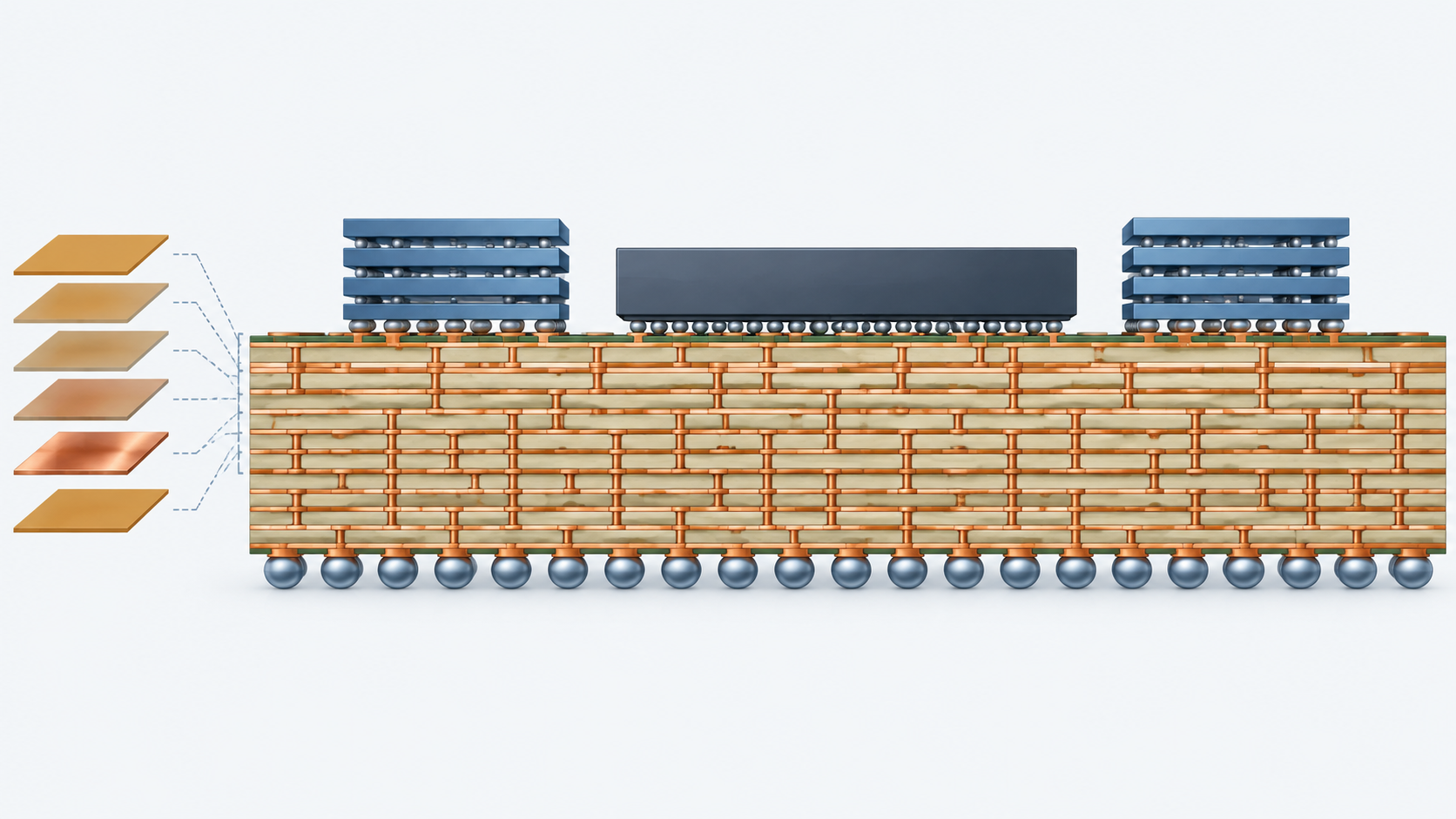
- The small multilayer board that carries one semiconductor die, fanning its fine electrodes out to terminals large enough to solder to a PCB. This is the one that matters in the back end.
- FPC
- Flexible Printed Circuit. A thin board that can bend, used to link components inside a device.
Internally the company runs three strategic business units: the PCB SBU (PCB and HDI), the Carrier SBU (IC carriers, meaning package substrates) and the IC Test SBU (IC test and burn-in) Sourced. The one that comes up in AI silicon is the second.
When Unimicron splits revenue by technology in its investor material, it uses two material names, "ABF" and "BT", as the category labels Sourced. ABF is Ajinomoto Build-up Film; BT is bismaleimide triazine resin. Both are families of dielectric used in the insulating layers of a substrate. The fact that a board maker classifies its own revenue by which dielectric it uses says a great deal about this industry. How well a substrate carries a chip is decided as much by the properties of the interlayer dielectric, its dielectric constant, its thermal expansion, how it behaves under laser drilling, as by how the wiring is built. When the choice of material becomes the name of the product category, the material's contribution is large indeed.
4. Scale: five years of revenue
| Year | Revenue (NT$m) | Change | Operating profit (NT$m) | Net profit (NT$m) |
|---|---|---|---|---|
| 2021 | 104,563 | +19.0% | - | - |
| 2022 | 140,489 | +34.4% | - | - |
| 2023 | 104,036 | -25.9% | - | - |
| 2024 | 115,373 | +10.9% | 5,117 | 5,556 |
| 2025 | 131,241 | +13.8% | 6,674 | 7,550 |
Revenue is the annual total of the monthly announcements and the year-on-year changes are our own arithmetic Our calculation. The 2025 Annual Report discloses operating and net profit for two years only, so the earlier cells are left blank Not yet confirmed.
The peaks and troughs are pronounced. NT$140.5bn in 2022 was the year smartphone and PC demand topped out, and 2023 fell 25.9% from there Our calculation. 2025 has still not returned to the 2022 level. And yet profit is growing, which is what the next chart shows.
Setting out the second quarter of 2026: revenue of NT$42,890m, a gross margin of 24.8%, and operating profit of NT$6,651m, which is 15.5% of revenue. That single quarter's operating profit is almost level with the whole of 2025, at NT$6,674m Our calculation. The monthly figures say the same thing: January to August 2026 totalled NT$114,335m against NT$85,224m in the same months of 2025, up 34.2% Our calculation.
5. Company category and position in the back-end industry
The category is manufacturer, specifically a board maker. In the supply chain diagram Unimicron prints in its own annual report, its position is labelled midstream Sourced.
| Tier in the annual report | What sits there | Relationship to Unimicron |
|---|---|---|
| Upstream | Copper foil, glass cloth, epoxy resin, polyimide resin, prepreg, dry film, plating chemistries, etchants, solder resist | What Unimicron buys |
| Midstream (Unimicron is here) | Multilayer boards, double-sided boards, flexible boards, IC substrates, semiconductor test and burn-in | Manufactures the board itself |
| Downstream | Computers and peripherals, communications equipment, industrial equipment, consumer electronics, precision instruments, aerospace, defence | The end products the board goes into |
In the right-hand column of the same diagram the IC flow runs from IC design, through photomasks and wafer materials, wafer fabrication and lead frames, to IC packaging, with IC substrates placed midstream, just ahead of it.
Both are called the back end, but they do different work. A board maker such as Unimicron or Ibiden builds the base the chip sits on. An OSAT such as ASE or Amkor puts the chip on that base, encapsulates it and tests it. The OSAT does not make the substrate; it buys it from a board maker. They are not competitors but neighbours, one upstream of the other.
Why is the substrate the bottleneck in AI silicon? Because of how long the process is and how slowly capacity can be added. A package substrate means building up more than ten alternating insulating and wiring layers; a single board takes weeks, and yield falls as layers are added. Meanwhile substrates for AI GPUs keep getting larger and more heavily layered, so the number of good boards a given floor area can produce keeps falling. However much assembly capacity an OSAT adds, no package is finished without the base. Unimicron's margin doubling in two years is that asymmetry showing up in price.
6. Sites and the countries where it manufactures
Manufacturing is in five countries: Taiwan, China, Germany, Japan and Thailand Sourced. The company's own framing is that the plants in China handle volume production while the plants in Taiwan supply the high value-added products.
| Country | Sites | Main products | Role |
|---|---|---|---|
| Taiwan | Taoyuan: Shanying, Shanying II, Hejiang, Hejiang II, Luzhu II, Luzhu III, Yangmei, Xinnong. Hsinchu County: Xinfeng, Renyi, Guangfu, Hukou I | PCB and HDI at seven sites, IC carriers at six | Head office and the centre of high value-added work. Every leading package substrate site is here |
| China | Suzhou, Kunshan (PCB), Kunshan (FPC), Shenzhen, Huangshi | PCB, HDI and FPC; IC carriers at Suzhou only | Volume production |
| Germany | Geldern | PCB and HDI | For European customers |
| Japan | Eniwa, Hokkaido | PCB and HDI | For Japanese customers |
| Thailand | Bang Pakong, Chachoengsao | PCB and HDI | - |
Site names and principal products come from the company's Global Service Network page and the plant list in the annual report. Capacity by site is not published Not yet confirmed.
The financials show the same tilt towards Taiwan. Segment revenue from external customers in 2025, split by where production sits, was Taiwan NT$86,946m (66.2%), China NT$41,412m (31.6%) and elsewhere NT$2,884m (2.2%) Our calculation. Split by where the customer sits, Taiwan is 36%, the rest of Asia 56% and the Americas 6% Sourced. Made in Taiwan, sold into Taiwan and the rest of Asia: the mirror image of AI chip assembly being concentrated in Taiwan.
What should not be missed in that table is that IC carriers, the package substrates, are made at only seven sites: six in Taiwan and Suzhou in China. The plants in Germany, Japan and Thailand are all PCB and HDI, not package substrates. Front-end fabs are dispersing to the United States, Japan and Germany, but the step that builds the base under an AI chip is still concentrated in Taiwan and China. For a materials supplier that means the delivery address, the technical support and the qualification work stay in those two places for the foreseeable future, and the geographic spreading of risk has not gone nearly as far here as in the front end.
7. Leading products and share in semiconductor back-end work
Half of revenue is now ABF substrates
"ABF substrate" is the industry term for a package substrate whose interlayer dielectric is an Ajinomoto Build-up Film class material, used for large, high-power dies such as AI GPUs and server CPUs. BT substrates, by contrast, go to smaller chips: smartphone application processors, memory and so on. Taken together the two make up 58% rising to 61%, a modest move, but the mix inside it shows BT giving way to ABF Sourced.
The same shift appears by application. From 2024 to 2025, computers went from 58% to 61%, communications from 25% to 21%, consumer and other stayed at 12% and automotive went from 5% to 6% Sourced. In its 2026 material the company renamed the top category "AI data centre", and in the second quarter of 2026 it was 61% of revenue Sourced.
On market share, stated plainly
The annual report does carry a figure, that consolidated revenue is about 4.9% of world PCB production value, but the report itself states that the denominator is an estimate taken from a report by the research firm Prismark, dated January 2026 Sourced. Because this article does not use research-firm estimates, that market share figure is not adopted here Not yet confirmed. For the same reason the annual report's statement that the world PCB market was about US$84.9bn in 2025, up 15% year on year, also comes from Prismark and is not used.
A share limited to package substrates, the IC carrier business, is not disclosed by Unimicron either. What primary material supports is only the scale: package substrate revenue of roughly NT$26bn a quarter, being 61% of the second quarter of 2026 Our calculation.
8. Current investment plans
Under principal capital expenditure the annual report gives the purposes as "construction and expansion of new plants, upgrading existing production technology, expanding high-end capacity, purchasing equipment, and building smart equipment for bottleneck processes" Sourced. The 2026 budget carries a note that it will be adjusted flexibly according to customer demand and market conditions.
Unimicron publishes neither the investment amount by plant nor how far the expansion multiplies capacity Not yet confirmed. All the annual report gives is a company-wide annual capital expenditure figure. The company also has a policy of not publishing financial forecasts, and the forward R&D column in the report gives only a ratio, 3.0 to 5.0% of revenue, with the amount marked as not applicable Sourced.
The funding picture changed sharply during 2026. Cash at the end of June 2026 was NT$93,096m, 1.7 times the NT$54,872m at the end of December 2025 Our calculation. Cash flow from financing in the second quarter of 2026 was positive NT$26,380m, of which "other" accounted for a large NT$33,943m, while borrowings were actually reduced by NT$7,563m Sourced.
9. Major corporate partners and the customers it discloses
Ownership: the largest shareholder is the foundry UMC
Unimicron's largest shareholder is the Taiwanese foundry United Microelectronics Corporation (UMC), with 13.00% as of 14 July 2025, and UMC holds the chair of the board as a corporate director Sourced. UMC's representative serves as chairman, and UMC executives including its CFO hold board seats.
| Relationship | Counterparty | Substance | Primary source |
|---|---|---|---|
| Largest shareholder and director | United Microelectronics Corporation (UMC) | 13.00% of the shares. Holds the chairmanship as a corporate entity, together with several board seats | Stated in the annual report Sourced |
| Shareholder relationships | Yann Yuan Investment | An investment company that appoints a Unimicron director. Its own shareholders include SPIL at 27.94%, UMC at 26.78%, KYEC at 14.55% and Unimicron itself at 11.64% | Stated in the annual report Sourced |
| Past M&A | Phoenix Precision Technology | Merged in December 2009, which expanded the package substrate business | Company history on the official site Sourced |
| Banks | Mega Bank, Bank of Taiwan, Taishin Bank, KGI Bank, E.SUN Bank and others | Counterparties to the long-term borrowings. Short plus long-term debt stood at NT$38,225m at the end of 2025 | Material contracts in the annual report Sourced |
Customers: named by letter, not by name
Taiwanese annual reports identify principal customers by a single letter. In Unimicron's case the largest customer in 2025 was "H", at NT$37,233m, or 28% of revenue Sourced. The year before, the same "H" was NT$18,475m and 16%, so the amount doubled in a year Our calculation.
| Item | 2024 | 2025 |
|---|---|---|
| Revenue from the largest customer, "H" | NT$18,475m (16%) | NT$37,233m (28%) |
| All other customers | NT$96,898m (84%) | NT$94,008m (72%) |
| Largest supplier | "K", NT$3,943m (8% of purchases) | "M", NT$5,705m (11% of purchases) |
The annual report does not name customers or suppliers, and who "H" is cannot be established from primary material Not yet confirmed. Note that the total for all other customers is roughly flat, so the entire revenue increase came from the growth in "H" Our calculation.
Unimicron uses a material family name, "ABF", as one of its own revenue categories, but the name Ajinomoto appears nowhere in its annual report, its financial statements or its investor material. Even the largest supplier is disclosed only as the letter "M". How far the company goes on the record is a risk statement that "certain special materials are procured from specific manufacturers only, so alongside maintaining good relationships we also need to develop alternative materials to reduce the production risk of a single supplier" Sourced. This article therefore does not treat any individual materials maker as a trading relationship Not yet confirmed.
10. Where the company is heading in this field
Anything said here is a forecast, so the facts behind the judgement and the outlook drawn from them are kept apart.
What is established
| Fact | What it implies for the back end |
|---|---|
| Gross margin from 11.6% (4Q24) to 24.8% (2Q26) | Demand running ahead of capacity, showing up in price and product mix |
| ABF substrates at 52% of revenue in 2Q26, against 46% a year earlier | The company's centre of gravity has moved to AI package substrates |
| The largest customer "H" at 28% of revenue, with the amount doubling in a year | Nearly all the revenue growth comes from one account. Concentration rose fast |
| A 2026 capital budget of NT$34.0bn, 32.7% above the 2025 actual | The company itself assumes demand continues |
| Package substrates are made at six sites in Taiwan plus Suzhou only | Geographic dispersal has not happened |
| Development items include glass core FCBGA, co-packaged optics and organic interposers | The intent is to hold the substrate side of the next generation of packages too |
Outlook
Not yet confirmed Read plainly, those facts point to Unimicron's presence in the back end strengthening for now. Only a handful of companies worldwide can build the large ABF substrates an AI accelerator needs in volume, and Unimicron has among the largest installed capacity of them. The rise in margin reads as direct evidence that demand is growing faster than capacity is being added.
Not yet confirmed The ways that picture breaks are equally clear. One is customer concentration: with 28% of revenue in one account and essentially all of the growth coming from it, a change in that customer's design generation or sourcing policy lands straight on results. The other is cyclicality. This company dropped 25.9% of revenue between 2022 and 2023. It says as much itself, listing among the risks of plant expansion that "if overall demand falls or technical specifications change, this could lead to lower utilisation or excess capacity" Sourced.
11. The risks this company carries
What follows is drawn from the risk assessment Unimicron sets out in its annual report, narrowed to those that matter in a back-end context Sourced.
| Risk | Substance | Supporting figures |
|---|---|---|
| Customer concentration | The company describes concentration on a single customer or region as being within a reasonable range, but the largest customer at 28% of revenue is a sharp move up from 16% a year earlier | Customer "H" at NT$37,233m, or 28% Our calculation |
| The other side of plant expansion | The company states that "if overall demand falls or technical specifications change, this could lead to lower utilisation or excess capacity" | The 2026 capital budget of NT$34.0bn |
| Interest rates | Short plus long-term debt was NT$38,225m at the end of 2025, all at floating rates. The company calculates that a one point rise in market rates adds NT$382m of cash outflow | Stated in the annual report |
| Currency | Sales are mainly in U.S. dollars while purchases are in NT dollars, renminbi, U.S. dollars, euros and yen. The company states that hedging loses effect when rates move sharply | Stated in the annual report |
| Concentrated supply of materials | The company states that "certain special materials are procured from specific manufacturers only", and that alternative materials need developing | Supply of principal raw materials, in the annual report |
| Technological change | The company states that "electronic technology and the industry change constantly, and technical advance and quality control grow more difficult by the day". The rising difficulty is itself a cost and a risk | Stated in the annual report |
The first things to look at in a Unimicron quarter are not revenue but gross margin and the ABF share of the technology mix. The two move together: as the ABF share rises, so does the margin. The second quarter of 2026 was ABF at 52% and a gross margin of 24.8%; a year earlier it was ABF at 46% and 13.1% Sourced. For a supplier of materials, a period when that ratio is rising is a period when customer specifications are moving towards the leading edge. When the BT substrate and HDI shares come back instead, requirements swing towards volume and cost. The monthly revenue announcement comes out every month, so the direction can be checked without waiting for the quarter.
12. Glossary
- IC carrier / package substrate
- The small multilayer board that carries a semiconductor die and connects it to the circuit board outside. Unimicron's annual report calls it an IC carrier or IC substrate.
- ABF substrate
- The common name for a package substrate using an Ajinomoto Build-up Film class interlayer dielectric. For large, high-power dies such as AI GPUs and server CPUs.
- BT substrate
- A package substrate using bismaleimide triazine resin. For relatively small dies such as smartphone processors and memory.
- FCBGA
- Flip Chip Ball Grid Array. The die is flipped and bonded directly to the substrate, with solder balls arrayed on the underside of the substrate. The archetypal use of an ABF substrate.
- HDI
- High Density Interconnect. A printed circuit board densified with fine vias and fine wiring. Used in smartphones and similar devices.
- Glass core FCBGA
- An FCBGA substrate whose core is glass rather than resin, to control the warpage that comes with larger boards. Unimicron lists it as a development item.
- Organic interposer
- An intermediate board that interconnects several dies, made from resin-based materials rather than silicon. One of Unimicron's development items.
- MOPS
- The Market Observation Post System, Taiwan's statutory disclosure platform, where listed companies file annual reports, financial statements and material information. Unimicron's annual report names it as the place to find its filings.
 AI-generated concept
13. References
- Unimicron Technology Corp. 2025 Annual Report (English summary edition, 24 February 2026). Business description and revenue breakdown, the industry supply chain diagram, products under development, R&D spend, revenue by sales region, principal customers and suppliers (disclosed by letter), workforce composition, financial position and results, capital expenditure actual and planned, risk assessment, share capital and shares issued, major shareholders, the plant list and material contracts. The report states that the English edition is a summary translation and that the local-language edition is the official one.unimicron.com/files/money/Shareholders_Meeting/annual-report-2025_en.pdf
- Unimicron Technology Corp. Fourth quarter 2025 consolidated financial statements (audited, English). Segment information (external revenue for Taiwan, China and elsewhere), information by region, principal customer information, and revenue by product and service.unimicron.com/files/money/Earnings/en/2025Q4-consolidated-statements_en.pdf
- Unimicron Technology Corp. Monthly sales revenue announcements (official site). Monthly consolidated revenue from 2017 to August 2026. The five years of annual revenue used here are the sums of those monthly figures.https://www.unimicron.com/en/money01.html
- Unimicron Technology Corp. Second quarter 2026 investor presentation (July 2026). Quarterly revenue and gross margin, the consolidated income statement, balance sheet and cash flow statement, and revenue mix by technology (ABF, BT, HDI, PCB, FPC and other) and by application.unimicron.com/files/money/Earnings/en/2026-Q2-consolidated-en.pdf
- Unimicron Technology Corp. Fourth quarter 2025 investor presentation. Revenue mix for 2024 and 2025 by technology (substrate, HDI, PCB, FPC and other) and by application (computers, communication, consumer and others, automotive), and the annual cash flow statement.unimicron.com/files/money/Earnings/en/2025-Q4-consolidated-en.pdf
- Unimicron Technology Corp. Global Service Network (official site). The locations and principal products of the manufacturing sites in Taiwan, China, Germany, Japan and Thailand.https://www.unimicron.com/en/about04.html
- Unimicron Technology Corp. Milestones (official site). Founding on 25 January 1990, over-the-counter trading from December 1998, listing on the Taiwan Stock Exchange in August 2002, and the December 2009 merger with Phoenix Precision Technology.https://www.unimicron.com/en/about01.html
- Taiwan Stock Exchange Market Observation Post System (MOPS). The platform Unimicron's annual report names as the place its statutory disclosures are published.https://mops.twse.com.tw/
- Unimicron Technology Corp. Official website, used to check the name and the brand mark.https://www.unimicron.com/en/
14. Claim-to-source audit
| Claim in the article | Category | Source |
|---|---|---|
| Legal name, head office, listing venue (Taiwan Stock Exchange 3037), share capital, 1,575,531,197 shares issued | Sourced | Reference 1unimicron.com/.../annual-report-2025_en.pdf |
| Founded 25 January 1990, OTC from December 1998, listed August 2002, merger with Phoenix Precision Technology in December 2009 | Sourced | Reference 7unimicron.com/en/about01.html |
| 2025 revenue of 131,241 NT$m (+13.8%), operating profit of 6,674 NT$m, net profit of 7,550 NT$m, and the 2024 equivalents | Sourced | Reference 1, financial position and resultsunimicron.com/.../annual-report-2025_en.pdf |
| Annual revenue for 2021 to 2023 (104,563, 140,489 and 104,036 NT$m) and the year-on-year changes | Our calculation | Our own sum of the monthly figures in reference 3, checked against the disclosed 2024 and 2025 values in reference 1unimicron.com/en/money01.html |
| Cumulative revenue of 114,335 NT$m for January to August 2026, up 34.2% year on year | Our calculation | Our own sum of the monthly figures in reference 3unimicron.com/en/money01.html |
| Quarterly revenue and gross margin from 3Q24 to 2Q26; 2Q26 operating profit of 6,651 NT$m, net profit of 13,342 NT$m and EPS of 8.45 | Sourced | Reference 4unimicron.com/.../2026-Q2-consolidated-en.pdf |
| Gross margin up by a factor of 2.1, revenue by 1.46, and 2Q26 operating profit being level with the whole of 2025 | Our calculation | Derived from the figures in references 4 and 1unimicron.com/.../2026-Q2-consolidated-en.pdf |
| Mix by technology (2Q25 ABF 46%, BT 12%, HDI 27%, PCB 11%; 2Q26 ABF 52%, BT 9%, HDI 27%, PCB 9%) | Sourced | Reference 4unimicron.com/.../2026-Q2-consolidated-en.pdf |
| Mix by application (2024 to 2025: computers 58 to 61%, communications 25 to 21% and so on) and "AI data centre" at 61% in 2026 | Sourced | References 5 and 4unimicron.com/.../2025-Q4-consolidated-en.pdf |
| The business description (PCB, HDI, FPC, RF and IC carriers), 99.07% of revenue from printed circuit board products, and the three SBUs | Sourced | References 1 and 6unimicron.com/.../annual-report-2025_en.pdf |
| The upstream, midstream and downstream tiers, with IC substrates placed midstream | Sourced | Reference 1, industry overviewunimicron.com/.../annual-report-2025_en.pdf |
| The manufacturing countries and site locations, the products of each, and IC carriers being made only at six sites in Taiwan plus Suzhou | Sourced | References 6 and 1unimicron.com/en/about04.html |
| Segment revenue by production location (Taiwan 86,946, China 41,412, other 2,884 NT$m) and the shares of 66.2%, 31.6% and 2.2% | Our calculation | Shares derived from the segment amounts in reference 2unimicron.com/.../2025Q4-consolidated-statements_en.pdf |
| Revenue by sales region (Taiwan 36%, Asia 56%, the Americas 6%, other 2%) | Sourced | References 1 and 2unimicron.com/.../2025Q4-consolidated-statements_en.pdf |
| 31,448 employees with the split by role and education, and an average age of 35.9 | Sourced | Reference 1unimicron.com/.../annual-report-2025_en.pdf |
| Capital expenditure (2024 26,128, 2025 25,617, 2026 budget 34,000, 2027 budget 4,900 NT$m) and R&D spend of 4,999 NT$m | Sourced | Reference 1unimicron.com/.../annual-report-2025_en.pdf |
| Capital expenditure at 19.5% of revenue, R&D at 3.8%, and the 2026 budget being 32.7% above the prior year | Our calculation | Derived from the amounts in reference 1unimicron.com/.../annual-report-2025_en.pdf |
| Cash of 93,096 NT$m at the end of June 2026, 1.7 times the end of December 2025, and the 2Q26 financing cash flow | Our calculation | Derived from the balance sheet and cash flow statement in reference 4unimicron.com/.../2026-Q2-consolidated-en.pdf |
| UMC's 13.00% holding and its chairmanship as a corporate director, and the shareholders of Yann Yuan Investment | Sourced | Reference 1unimicron.com/.../annual-report-2025_en.pdf |
| Revenue from the largest customer "H" (2024 18,475 NT$m and 16%, 2025 37,233 NT$m and 28%) and the largest supplier "M" at 11% | Sourced | References 1 and 2unimicron.com/.../annual-report-2025_en.pdf |
| The doubling of "H" in a year and the flatness of the total for all other customers | Our calculation | Derived from the amounts disclosed in reference 1unimicron.com/.../annual-report-2025_en.pdf |
| The risk assessment (the other side of plant expansion, interest rate sensitivity, currency, concentrated supply of materials, technological change) and debt of 38,225 NT$m | Sourced | Reference 1, risk assessmentunimicron.com/.../annual-report-2025_en.pdf |
| The development items (glass core FCBGA, co-packaged optics, organic interposers, ultra-fine-line substrates and others) | Sourced | Reference 1, products under developmentunimicron.com/.../annual-report-2025_en.pdf |
| World PCB market size and the 4.9% market share | Not yet confirmed | The company does state them, but the annual report itself says the source is an estimate by the research firm Prismark, so this article does not adopt them |
| A share or a capacity figure for package substrates alone | Not yet confirmed | Not disclosed by the company, and this article offers no estimate |
| The actual identity of the largest customer "H" and the largest supplier "M" | Not yet confirmed | Taiwanese annual reports disclose these by letter, and this article does not attempt to identify them |
| Trading relationships with individual materials makers, such as the supplier of Ajinomoto Build-up Film | Not yet confirmed | No company name appears in Unimicron's own primary material, so this article does not treat any as a supplier relationship |
| Investment amounts by plant, the multiple by which the expansion raises capacity, and earnings guidance | Not yet confirmed | None of it is disclosed. The company's policy is not to publish financial forecasts, and this article offers no estimate |
| Operating profit and net profit before 2023 | Not yet confirmed | The 2025 Annual Report discloses two years only, so this article leaves those cells blank |
| The outlook in section 10 | Not yet confirmed | An interpretation by this article, drawn from the six items in the facts table |
Last updated 21 September 2026 / Troy Technical
Every figure in this article comes from Unimicron Technology Corp.'s published annual report, financial statements, monthly revenue announcements and investor presentations. No research-firm estimates or press-based figures have been used. Amounts are in New Taiwan dollars (NT$) and no currency conversion has been applied.