COMPANY PROFILE / Solid-State Battery
Nissan Motor Company
— Rebuilding the company’s foundation without lowering its sights on ‘2028 fiscal year’, developing a full-solid-state battery at its Yokohama plant is an automotive manufacturer
It is mentioned that Nissan is developing a full-solid-state battery An automotive manufacturer that develops batteries and even builds a pilot plant at its Yokohama facilityfrom. The prospectus submitted in June 2026 states that ‘electric vehicles equipped with solid-state batteries are scheduled to be launched on the market in the fiscal year 2028’. On the other hand, in the business restructuring plan ‘Re:Nissan’ announced in May 2025 and the announcement materials of the long-term vision released in April 2026, solid-state batteries are not mentioned. This article discusses how the scale of the automotive business is minimized, What is being invested in solid-state batteries, who is being partnered with, and how they are handled in the business restructuring process? focuses on.
- Understand Nissan in 30 seconds and its position with solid-state batteries
- About the logo and company name
- Where is this company in the world of solid-state batteries
- Company size (automotive industry is concise)
- Resources invested in solid-state batteries
- Previous efforts
- Future plans
- What is this company aiming for with solid-state batteries?
- Mapping of collaborations in the field of all-solid-state batteries
- Techniques and methods adopted
- Risks faced by this company
- Glossary / References / Claims and Corresponding References Table
1. Understanding Nissan in 30 seconds and its position with full-solid-state batteries
(Developed batteries in-house)Not a battery specialist or startup
started operation from January 2025investment amount and production capacity are not disclosed
NEDO fundingJoint development of the cathode dry electrode process
Companies working on solid-state batteriesAutomotive manufacturers, battery manufacturers, and startupsof the three types. Nissan is one of theseAutomotive manufacturersand, moreover, buys batteries from outsidewith ‘in-house-developed all-solid-state battery’and has been writing this company since 2021 fact In 2022, it established a pilot plant at the Comprehensive Research Institute (Yokosuka City, Kanagawa Prefecture), and in January 2025, it placed a pilot plant at Yokohama Factory. It has taken charge of research from materials to mass production processes within the company.
Furthermore, there are unique points for NissanRelationship with business restructuringThe fiscal year 2025 (March 2026 period) saw a net loss of 533.1 billion yen for the current period, and R&D expenses decreased from 619 billion yen in the previous period to 562.5 billion yen. However, both the financial statements (submitted on June 22, 2026) and the materials submitted to NEDO (as of May 2026) still maintain the goal of ‘market introduction in fiscal year 2028’However, from the presentation materials of the business restructuring plan and the new long-term vision, the name of all-solid-state batteries has disappeared, and the treatment is becoming quiet as it shifts from ‘technologies under development in regulatory disclosures and subsidy programs’ tothe current status (Chapter 7 and Chapter 8).
2. Regarding logo and company name display

Nissan Motor’s logo is theregistered trademark
of the company. In this article, we will not recreate it using generated images and
images obtained from the official websiteare img/nissan_logo.svg displayed as
Note on notation: The company name is ‘Nissan Motor Co., Ltd.’ in Japanese and Nissan Motor Co., Ltd.in English. Financial reports‘The location of the main store’ is at 2-1, Honmachi, Kanagawa Ward, Yokohama Cityand the company overview lists the headquarters location as 1-1, Takashima, Nishi Ward, Yokohama City. There is a pilot plant for solid-state batteries.The Yokohama factory is also located in Kanagawa Ward, Honmachi.Additionally, it was established with trial production equipment in 2022.The Comprehensive Research Institute (Hikoshima, Yokosuka City)is located in the Harahama area, but will end vehicle production by the end of the fiscal year 2027.It is a separate organization from the Harahama Factoryand the company announced that it will continue its business at the Comprehensive Research Institute without any changes in the future.
Official website:https://www.nissan-global.com/JP/COMPANY/PROFILE/3. Among the world of all-solid-state batteries, where is this company located?
4. Company Size (Automotive Business is Briefly Covered)
The automotive business itself is not the main topic of this article, so we will only focus on its size. fact. All numbers are cited from the company’s financial reports.
| indicator | Fiscal Year Ending March 2025 | Fiscal Year 2026 March |
|---|---|---|
| Sales (million yen) | 12,633,214 | 12,007,888 |
| Operating profit (billion yen) | 698 | 580 |
| Net loss attributable to the parent company shareholders for the current period (million yen) | △670,898 | △533,095 |
| Research and development expenses (billion yen) | 6,190 | 5,625 |
| Employees (consolidated as of March 31, 2026) | Number of people |
|---|---|
| Japan | 58,723 |
| North America (including the United States 13,898) | 37,036 |
| Europe | 8,948 |
| Asia | 9,890 |
| Others | 5,482 |
| Total (previous year 132,790) | 120,079 |
The number above isfor the entire company.It does not represent the scale of business for solid-state batteries. Research and development expenses were 56.5 billion yen in one year, a decrease of approximately 9.1% Calculations in this article. The company states in its restructuring plan that ‘through the rationalization of global R&D resources, the labor cost per unit by the end of fiscal 2025 will be reduced by 18%’, but it is not clear how much this affected solid-state batteries.It is not disclosed Unconfirmed / Future. The amount directly related to solid-state batteries as reported in the fifth chapterThe total cost of NEDO’s subsidized project is approximately 15.3 billion yenThat’s all.
5. Resources invested in solid-state batteries
In the case of Nissan, the most specific figures are not found in the financial statements but rather in Nissan’s own submission to NEDO Green Innovation Fund titled ‘Business Strategy Vision’.This is a document submitted by the company’s CEO under their name and made public on NEDO’s official website. As of May 2026, the name of Ivan Espinosa, President and CEO, appears in this version. It details four points (people, money, investments to external parties, and collaboration with universities) and distinguishes between what was confirmed and what could not be confirmed.
| Resource types | The content that has been made public. | Classification |
|---|---|---|
| Personnel (Development Team) | Powertrain EV Technology Development Departmentis responsible for the practical duties of cell pack design (collaborating with the Comprehensive Research Institute)Powertrain EV Component Production Technology Development Departmentis responsible for production technologies under mass production conditionsBattery Next-Generation Technology Development Sectionis the research and development manager. Execution responsibility lies with the CTO (Research and Development) and Chief Manufacturing Officer (Production Technology) | fact |
| person (number of personnel) | number of full-time staff for solid-state batteries | Not disclosed |
| Gold (Grant Project) | NEDO Theme ‘Establishment of a High-Performance, Low-LCA Battery Production Process Using the ASSB Pilot Line’.Total Project Cost Approximately 15.3 Billion Yen, of Which Government Funding is Approximately 11.4 Billion Yen and Self-Burden is Approximately 3.9 Billion Yen(Incentive in Full Case). Project Period 2022-2026 Fiscal Year | fact |
| Kinyu (Businessization Investment) | As of April 2023, the document states thatAn investment of 10 billion yen is being implemented at ASSB for businessization.From the documents as of August 2024 and May 2026, this sentence has disappeared. | fact |
| Kinyu (Pilot Plant) | Investment amount and production capacity of Yokohama Factory’s pilot plant | Not disclosed |
| Investment in startups or joint ventures with external entities | No mention of investments in startups or joint ventures related to solid-state batteries is found in the company’s financial reports, official releases, or NEDO-submitted materials | Unconfirmed |
| Joint development with external parties | Partnership with LiCAP Co., Ltd. (USA)(August 20, 2025). Collaborate in the dry electrode process for cathodes, focusing on material development and performance evaluation. No mention of investment | fact |
| Collaboration with universities and research institutions | The text on the technology introduction page says ‘Joint research with global experts in various fields’, butThe name of the counterpart is not written. Public agencies that appear are NEDO, which is the funding agency, and those that collaborate in standardizationNITE (Product Evaluation Technology Foundation)andJARI (Japan Automotive Research Institute)only | Unconfirmed(University Name) |
At the unveiling of the prototype equipment in April 2022, many overseas media reported that ‘Nissan is jointly developing with NASA and the University of California, San Diego.’ However,On the same day, neither in Nissan’s official release (Japanese and English) nor on their technology introduction page, or in the NEDO submission materials, are these two names mentioned. factThere is a ‘Joint development with NASA (United States)’ item on Nissan’s long-term vision page, but this refers toMobility services (autonomous driving)is placed in the column, not in the column for all-solid-state batteries. This article does not cover the relationship with NASA or the university due to the lack of primary information from the company.We do not treat it as a partner for all-solid-state batteries。
Approximately 15.3 billion yen is the amount for research and development in building a pilot plant and perfecting the processis the amount for the research and development phase. Calculations in this article. The national budget is approximately 1.14 billion yen, so at this stage the funding isapproximately 75% covered by public subsidiesIt is a calculation (114÷153). On the other hand, the ‘1 trillion scale’ mentioned in the materials from April 2023 includes mass production plantsinvestment for commercializationIt can be read as having pointed out. The plan diagram for the 2023 edition includes a stage where ‘investment in production plants was implemented to expand the segment for large vehicles.’
The phrase ‘1 trillion scale’ thatMaterials from the August 2024 edition and later have been removed.This is a fact. fact. The reason is not written. Whether it was a reevaluation of the budget or simply a change in writing style cannot be judged from the outside, so in this articlethe scale of mass production investment is yet to be determined. Unconfirmed / Future。
6. Previous Efforts
| period | incident | Meaning |
|---|---|---|
| 2018 fiscal year | Business Plan ‘The Arc’ roadmap for solid-state batteriesResearch Phaseis considered the starting year | The company itself set the starting point for development |
| November 29, 2021 | Long-term Vision ‘Nissan Ambition 2030to announce. ‘Until the end of fiscal year 2028.’Self-developedthe full-solid-state battery-equipped EV to be launched into the market | from here, ‘2028 fiscal year’ becomes a consistent goal |
| April 8, 2022 | at the Comprehensive Research Institute (Nagato Island, Yokosuka City)fabrication equipment for pilot production of stacked laminate cellsIt was announced that a pilot line will be installed at the Yokohama Factory by the fiscal year 2024. Battery costs are expected to reach$75 per kWhand then afterwards$65was said to have the possibility of being lowered further | Materials, design, and process are finalized in a prototype facility and transferred to the pilot line in two stages |
| April 2022 | Selected for NEDO Green Innovation Fund ‘Development of Next-Generation Batteries and Next-Generation Motors’ (NEDO’s announcement was on April 19) | Government funding of approximately 1.14 billion yen begins |
| At the time of April 2023 | in the materials submitted by NEDOa pouch cell with a capacity of several tens of mAhwas demonstrated as a concept for 1000 Wh/L | Small-cell demonstration. Not car-sized. |
| March 25, 2024 | Presented roadmap in business plan ‘The Arc’: FY22 prototype production equipment → FY24 pilot line operation → FY26 test drive of prototype vehicle → FY28 New EV to be equipped | The timing of the public road test is indicated in this document |
| April 16, 2024 | Yokohama Factory (Kanagawa Ward, Yokohama City)The pilot production line under construction will be publicly unveiled for the first time | Location is announced. Scale and investment amount are not disclosed |
| November 2024 | The NEDO’s Technology and Social Implementation Promotion Committee conducted a stage gate review‘Continuation’ is judged | Passed the mid-term review of public funding |
| January 2025 | Start-up of the pilot plant(Equipment trials and development of on-board cells begin) | The engineering work inside the factory begins outside the research institute |
| May 13, 2025 | Reconstruction PlanRe:Nissanto announce. Announce materials · release onThere is no mention of all-solid-state batteries..”Temporarily halt the development of products for the fiscal year 2026 and beyond” and announced a cost reduction of 3,000 people. | It is not stated whether all-solid-state batteries are included in the list of targets for cessation. |
| July 15, 2025 | It was announced that the vehicle production at the Shiromaru Factory will end by the end of the fiscal year 2027.The Comprehensive Research Institute stated ‘We will continue our business without any changes in the future’ | The research institute with prototype production facilities is excluded from the reorganization |
| August 20, 2025 | United StatesLiCAP Co., Ltd. partnershipaiming to improve the production efficiency of the cathode dry electrode process | the first external partner to be announced with a company name in solid-state batteries |
| April 14, 2026 | announced a new long-term vision ‘Intelligence in Mobility for a New Daily Experience’. The BEV section isadvanced battery technologyand only written.All-solid-state batteries are not yet named | The pillar of the vision for 2021 |
| May 13, 2026 | In the 2025 fiscal year financial report, one of the achievements of Re:Nissan’s ‘Partnership Strengthening’ isthe partnership with LiCAP for solid-state batteriespublished | a few examples of touching on solid-state batteries in the context of corporate restructuring |
| At the end of May 2026 | in the materials submitted by NEDOExceeding 1000Wh/L in a single-layer cell、Confirming charge-discharge performance with stacked cells for vehicle use、Maintaining capacity retention superior to liquid lithium-ion batteries、Completion of the prototype module incorporating cells of car-sized dimensionsReported. Maintaining the goal of market entry for solid-state battery technology (FY28) | Advancing from small cells to modules of car-sized dimensions |
| June 22, 2026 | Submit the 127th Period Financial Report.It is planned to launch EVs equipped with solid-state batteries in fiscal year 2028.It is recorded | Maintain the fiscal year 2028 for mandatory disclosure |
7. Future Plans
then $65 per kWhRelease in April 2022. EVs at parity with gasoline cars at $65 per kWh
The direction of performance as shown in official documents is,energy density approximately doubled, significant reduction in charging time, and combination of cheaper materialsThe page for the long-term vision ‘Nissan Ambition 2030’ states that charging time will bereduced by one-thirdand written fact. As for the target market, NEDO’s materials include “a wide range of segments including pickup trucks,” as stated in their documentation. NEDO’s assistance program will conclude in fiscal 2026, and the company aims to start commercialization by fiscal 2028 after this project ends.out of pocketIt states ‘continuously engage in research and development and investment.’
When arranging the company’s primary data in chronological order, it will look like this fact。
(1) Re:Nissan (May 2025)The explanatory materials and releases do not mention solid-state batteries. It is stated that some of the early development will be temporarily halted, but the target is not specified.
(2) Partnership with LiCAP (August 2025)The release is written as ‘We are advancing the development with the aim of market introduction of EVs equipped with our own-developed all-solid-state batteries by the end of fiscal year 2028.’
(3) New Long-Term Vision (April 2026)The presentation materials for the new long-term vision do not mention solid-state batteries by name, and BEV is only referred to as ‘advanced battery technology’.
(4) 2025 Annual Financial Report (May 2026)The partnership with LiCAP is mentioned as a result of Re:Nissan’s achievements.
(5) NEDO submitted materials (as of May 2026)which states ‘market introduction of all-solid-state battery technology (FY28)’ and ‘market introduction of EVs equipped with our developed all-solid-state batteries (~2028 fiscal year)’.
(6) Financial Statements (June 2026)It states, ‘Scheduled for market release in the fiscal year 2028’.
In conclusion,The target of fiscal year 2028 has been maintained, and no primary information indicating postponement or cancellation was found.What has changed isthe presentationIn 2021, the pillar of the long-term vision, all-solid-state batteries, which were on the stage of the business plan for fiscal years 2025-2026, have been removed from the stage and continue to be reported in the legal disclosure and subsidy program reports.
Next, all of these are not recorded in the primary information Unconfirmed / Future。
solid-state batterylocation of the mass production factory/production capacity during mass production (GWh)/Vehicle model name to be equipped/The number to be released in fiscal year 2028/price range/ Production investment amount(The ‘1 trillion yen scale’ mentioned in the 2023 edition is not present in subsequent editions) / The Arc showsWhether the public road test was conducted in the fiscal year 2026/Solid electrolyte supplier. The numbers and statements such as ‘confirmed performance with a stack of 23 layers’ reported in April 2026, and ‘mass production will start from a small quantity in the fiscal year 2028’, which were mentioned in the news, are included.In the official release or legal disclosure of Nissan, it could not be confirmed.Therefore, this article does not adopt it. The scope of confirmation in this article is up to the statement ‘confirmed that the charge-discharge performance was confirmed for the stack cells used in vehicles’ in the NEDO materials.
8. What does this company aim to achieve with solid-state batteries?
This part includes information that the company has not directly stated.Inferred from primary sources within the scope of what can be read.Along with the basis, I will write it down.
| What can be read | primary information | Classification |
|---|---|---|
| The purpose is not to sell batteriesinstallation on our own EV | All official documents state ‘market launch of EVs equipped with our fully solid-state batteries’, and there is no mention of external sales | speculation |
| The focus islarge vehicles · pickup truckssuch as those that are difficult to electrify using liquid systems | The release covers a wide range of segments, including pickup trucks, as NEDO materials state ‘segments with high barriers to vehicle electrification such as large vehicles and commercial vehicles’ | fact |
| The ultimate goal is to reduce the price of EVs to that of gasoline cars | The release in April 2022 states that ‘electric vehicles will be at the same cost level as gasoline cars at $65 per kWh’ | fact |
| Nissan is more focused on the novelty of materialsMethod (dry electrode and low dew point environment) | Two out of the research items in NEDO’s materials are processes (dry electrode, dew point management), and the only external collaboration (LiCAP) is also a process technology company | speculation |
| The fiscal year 2028Limited number of unitshigh | mass production factory, production capacity, and vehicle models are all undisclosed except for the timing. The plan for 2023 shows ‘progressively expanding large vehicles’ with staged growth | speculation |
| in the process of corporate restructuring‘not to cut but not to highlight either’position | Nissan and the 2026 long-term vision presentation materials do not mention the name, while the financial statements and NEDO materials maintain 2028 | speculation |
| The funding for the research and development stage isheavily dependent on public subsidiesis doing | Of the total project cost of approximately 15.3 billion yen in NEDO projects, approximately 11.4 billion yen (about 75%) comes from government funding. | speculation |
The materials submitted to NEDO include three versions: the April 2023 edition, the August 2024 edition, and the May 2026 edition. The May 2026 edition was released when Re:Nissan announced a new long-term vision.andIt was presented under the name of the president of Espinosa. factThe version’s ‘Business Resources and Positioning’ page lists ‘Improvement of financial condition through the execution of the business reconstruction plan Re:Nissan in a difficult business environment’ as a response to its own weaknesses, and the same page’s ‘Direction of Efforts’ sectionstates ‘Market introduction of all-solid-state battery technology (FY28) and further enhancement of competitiveness through continuous technological development.’This means that the management is trying to balance business reconstruction and the market introduction of all-solid-state batteries in FY28.on the premise that both can be achieved within the same table.and explaining it to public agencies.
On the other hand, the version does not mention ‘investment of 10 billion yen’ and the self-assessment of success probability has increased from 50% to 60%. The interpretation that ‘the outlook for technology has improved but there is still no commitment on how much to invest in mass production’ best reflects Nissan’s current stance, according to this article. Unconfirmed / Future。
9. Mapping of solid-state battery collaborations
QuantumScape submitted a shareholder letter (Form 8-K filing) to the U.S. SEC in February 2026, which includes a photo description from its all-solid-state battery symposium held in Kyoto in 2025.「Kazuhiro Doi, Corporate Executive, Nissan」the name exists fact. However, this isThis is a record of attendance and participation, not an indication of contract or partnership.. Neither the primary information from Nissan nor QuantumScape contains any mention of the companies’ contract. Therefore, it is not included in Figure 2.
10. Technology Approach Used
Nissan does not explicitly state the electrolyte system in its official release, butThe document submitted to NEDO states that it is a sulfide-based material fact。
| Item | The content that has been made public. |
|---|---|
| solid electrolyte | sulfide-based. At the time points of April 2023 and August 2024, the documentation includes ‘Sulfide electrolyte + additive (additive)’ and ‘Sulfide-based solid electrolytes have high reactivity with water and solvents’. The reference material from May 2026 does not have the same page |
| Cell morphology | stacked laminate cell(released in April 2022). Confirmed the charge-discharge performance of a stacked cell for vehicle use as of May 2026 |
| Negative electrode | lithium metal anode (including anodeless structure)as a solution |
| Positive electrode | high-capacity electrode design free from rare metalsis mentioned. The specific composition is not disclosed |
| How to make electrodes | positive electrodeDry electrode process. Established production technology to control the generation of fibrous (fibrillated) binder, significantly reducing cell resistance and reported. Collaborated with LiCAP’s ‘Activated Dry Electrode’ technology |
| Manufacturing environment | Solid electrolyte compatibleMoisture management technology. For existing dry roomsApproximately 60% power reductionconfirmed and reported to have reached the target (50%) at lab level dry room |
| cell retention | during vehicle operationcell pressure retention mechanism (module)is listed as a development topic. Conducted drop, vibration, and impact tests on the initial module |
| milestone (company report) | single-layer cell1000Wh/L over、liquid lithium-ion batteries surpassingCapacity maintenance performance。All details of the comparison conditions and test conditions are not disclosed |
The positive electrode in liquid lithium-ion batteries consists of active material and binderdissolved in solvents such as NMP to form a slurry, which is then coated and driedis standard. However, sulfide systems solid electrolytes react easily with moisture or polar solvents, deteriorating or producing hydrogen sulfide. In all-solid-state batteries that mix solid electrolyte particles into the positive electrode,Using a solvent itself is a riskapproximately 4.9 years Unconfirmed / Future. Nissan wrote in NEDO materials that ‘to stabilize the quality of sulfide-based solid electrolytes, they established a dry process for the positive electrode without using water or solvents,’ which is exactly this reason fact。
In dry electrodes, PTFE-like binders are stretched with strong shearinto fine fibers (fibrils)and then the powder is wrapped around these fibers to form a sheet. If there are too few fibers, the sheet will tear; if there are too many, they will block the path for ions and electrons, increasing resistance. Nissan wrote that ‘they confirmed the possibility of achieving both low resistance and tensile strength,’ which is this balancing act. Another issue isCell pressure retention mechanismis a component that keeps the contact between solid objects by pressing the battery from the outside, and its weight and volume increase, which in turn affects how much of the 1000Wh/L generated by the cell remains in the pack Calculations in this article。
11. The risks this company faces
| Risks | Content | Classification |
|---|---|---|
| Restrictions on funds during the restructuring of operations | 2025 fiscal year and 2026 fiscal year, two consecutive periods of operating loss. Research and development expenses decreased from 619 billion yen to 562.5 billion yen, and the labor cost per unit of R&D also reduced by 18%. | fact |
| End of public funding | NEDO-assisted projects will end in the fiscal year 2026, and the company itself will continue to fund research and development and investments on its own after that. | fact |
| The scale of mass production investment is unclear. | The phrase ‘investment of a thousand billion yen scale’ in the 2023 edition does not appear in the materials from 2024 onwards. The location and capacity of the mass production factory are also not disclosed. | Unconfirmed / Future |
| The installation location is not specified | ‘2028 fiscal year’ ‘only broad segments’ have been announced, and the vehicle models and quantities are yet to be determined. Even in the reorganization announcement of Japan operations in September 2026, it is not written which factory will produce electric vehicles with full-solid-state batteries. | Unconfirmed / Future |
| Changes in demand for electric vehicles and policy | Nissan itself cites NEDO documents that the United States has set a national target of 40% EV share in new car sales by 2030 and has withdrawn tax incentives for EV buyers. There is a possibility that the demand for electric vehicles with full-solid-state batteries will decrease. | speculation |
| Manufacturing costs unique to sulfide-based materials | Sensitive to moisture, therefore a dry room with low dew point is required. Nissan reported that it reduced the power by about 60%, but this result is at the lab level and mass production scale verification is still ahead. | speculation |
| The supplier of materials is not disclosed. | It is not mentioned in the official documents who buys solid electrolytes or cathode materials. The NEDO Working Group report lists the cost competitiveness and stability assurance of sulfide-type solid electrolytes as issues for the entire industry. | Unconfirmed / Future |
| The news reports are ahead of primary information. | Many numbers mentioned in the reports, such as ’23-layer cell’ and ‘in small quantities,’ cannot be confirmed in Nissan’s official releases. There are limited means to verify progress from the outside. | speculation |
12. Glossary
- All-Solid-State Battery (ASSB)
- A battery with electrolyte in solid form instead of liquid. In Nissan’s materials, it is abbreviated as All-Solid-State Battery (ASSB).
- Sulfide-type solid electrolyte
- A solid electrolyte containing sulfur. It allows ions to move easily and is soft, but reacts easily with moisture and requires a dry environment.
- Dry electrode process
- A method of making electrodes by mixing powder directly without using solvents, then forming it into sheets. It does not require drying or solvent recovery processes.
- Fibrillated binder
- A bonding material stretched into thin fiber-like strands by shearing. Fibers entangle the powder and hold the electrode sheet together without using solvents.
- Dew point
- The temperature at which moisture in the air begins to condense. The lower the dew point, the drier the air and the more power is required to maintain it.
- Anodeless structure
- A structure where no active material is placed on the negative electrode during manufacturing, and lithium metal is deposited on the collector during charging.
- pilot plant
- A production facility with the same process as a mass production line but at a smaller capacity for testing. It is used to identify issues in the process.
- NEDO Green Innovation Fund
- A fund of 200 billion yen established by the government for NEDO. It supports research and development from enterprises to social implementation over a maximum period of 10 years.
- Financial Report
- A legal disclosure document that listed companies submit annually based on the Financial Instruments Trading Act. There are penalties for false statements.
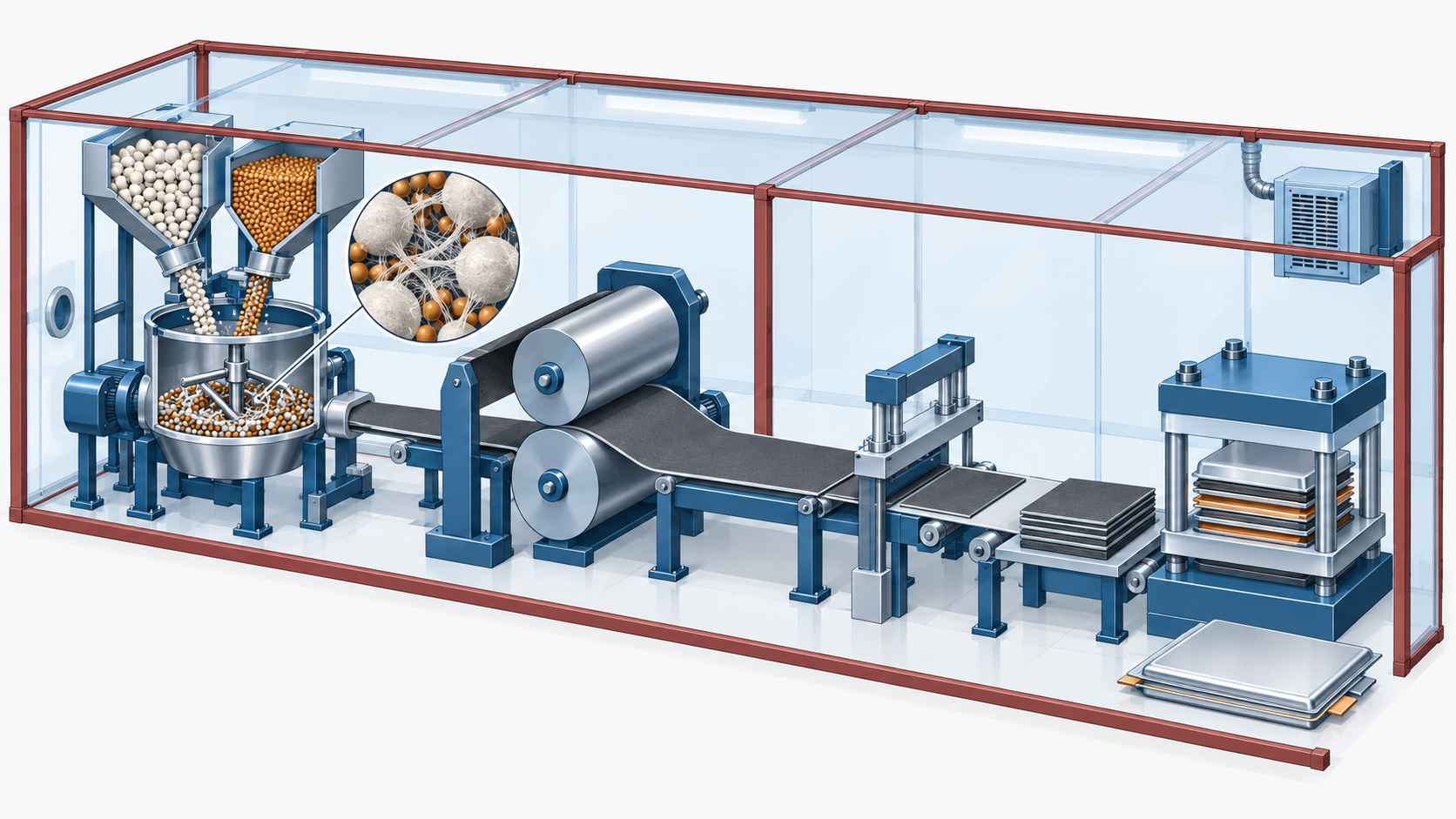 AI-generated conceptual diagram
13. Source
- Nissan Motor Company Annual Report of Financial Statements for the 127th Period (April 1, 2025 to March 31, 2026, submitted on June 22, 2026). Sales Revenue, Operating Profit, Net Loss for the Period, Research and Development Expenses: ¥56.25 billion, Number of Employees, Listed Market, Headquarters Location, Progress of Re:Nissan (R&D Labor Costs Reduced by 18%), ‘Solid-state batteries will be installed in EVs, which are scheduled to enter the market in fiscal year 2028’. https://www.nissan-global.com/JP/IR/FINANCIAL_RESULTS/ASSETS/FR/2025/PDF/fr2025.pdf
- Nissan Motor Company Annual Report of Financial Statements for the 126th Period (April 1, 2024 to March 31, 2025, submitted on June 23, 2025). Research and Development Expenses: ¥619 billion, Operating Profit: ¥6.98 billion, ‘Solid-state batteries will be installed in EVs, which are scheduled to enter the market in fiscal year 2028’. https://www.nissan-global.com/JP/IR/FINANCIAL_RESULTS/ASSETS/FR/2024/PDF/fr2024.pdf
- Nissan Motor Company Press Release ‘Nissan Motor Co., Ltd. to Open Trial Production Equipment for Solid-state Batteries’ (April 8, 2022). Pilot Line Installation Planned until the end of fiscal year 2024 at the Integrated Research Institute (Shimajima, Yokosuka City), Layered Laminate Cell Trial Production Equipment, ¥75/kWh and ¥65/kWh, Including Pickup Trucks in the Installed Segments. https://global.nissannews.com/ja-JP/releases/release-8aef385f4e3efd0619b175c665007f52-220408-01-j
- Nissan Motor Company Press Release ‘Nissan Motor Co., Ltd. to Open Pilot Production Line for Solid-state Batteries under Construction’ (April 16, 2024). Installation at Yokohama Plant (Yokohama City, Kanagawa District, Hontenmachi), Targeting Practical Use by fiscal year 2028. https://global.nissannews.com/ja-JP/releases/240416-01-j
- Nissan Motor Company News Release ‘Nissan Motor, Signs Partnership with LiCAP Co., Ltd. for the Development of Cathode Electrode Process Technology for Solid-State Batteries’ (August 20, 2025). Pilot Production Line to Start Operation in January 2025 under the NEDO Green Innovation Fund Assistance Program. https://global.nissannews.com/ja-JP/releases/250820-01-j
- Nissan Motor Company Technology Introduction Page ‘Solid-State Battery’ (Corporate Information Site). Technical Features, Practicalization Challenges, and Collaborative Research with Global Experts. https://www.nissan-global.com/JP/INNOVATION/TECHNOLOGY/ARCHIVE/ASSB/
- Nissan Motor Company Long-term Vision ‘Nissan Ambition 2030’ Page. Market Introduction of Self-developed Solid-State Battery EVs until the Fiscal Year 2028, Reducing Charging Time to One-Third, and NASA Joint Development Mentioned in the Mobility Services Section. https://www.nissan-global.com/JP/COMPANY/PLAN/AMBITION2030/
- Nissan Motor Company Business Plan ‘The Arc’ Presentation Materials (March 25, 2024). Roadmap for Solid-State Batteries (FY18 Research Phase / FY22 Pilot Production Line / FY24 Pilot Production Line Operation / FY26 Test Drive of Prototype Vehicles on Public Roads / FY28 to be Equipped in New EVs). https://www.nissan-global.com/JP/NEWS/ASSETS/PDF/240325-02-j_presentation.pdf
- Nissan Motor Company News Release ‘Nissan Motor Announces Re:Nissan Business Revitalization Plan’ (May 13, 2025). Temporary suspension of advanced development and the launch of products from fiscal year 2026 onwards, with an investment in cost reduction by 3,000 people. No mention of full-solid-state batteries. https://global.nissannews.com/ja-JP/releases/250513-02-j
- Nissan Motor Company Explanation Materials for Business Revitalization Plan ‘Re:Nissan’ (May 13, 2025). No mention of full-solid-state batteries. https://www.nissan-global.com/EN/COMPANY/PLAN/RENISSAN/ASSETS/PDF/ReNissan_Presentation_JP.pdf
- Nissan Motor Company Annual Report for the Fiscal Year 2025 (May 13, 2026). In the section ‘Strengthening Partnerships’ under Re:Nissan, the partnership with LiCAP full-solid-state battery (United States) is announced in August 2025. https://www.nissan-global.com/EN/COMPANY/PLAN/RENISSAN/ASSETS/PDF/FY25_Financial_Results_JP.pdf
- Nissan Motor Company News Release ‘Nissan Motor Announces Long-term Vision: ‘Intelligent Mobility for a New Daily Experience’ (April 14, 2026). Electrification policy. No mention of full-solid-state batteries. https://global.nissannews.com/ja-JP/releases/260414-01-j
- Nissan Motor Company Long-term Vision Presentation Material (April 14, 2026). The BEV section mentions ‘advanced battery technology’ and ‘energy management’, but solid-state batteries are not specifically mentioned. https://www.nissan-global.com/JP/IR/NEWS_EVENT/ASSETS/PDF/20260414_LTV.pdf
- Nissan Motor (NEDO Public) Green Innovation Fund Business Strategy Vision ‘Establishment of a high-performance, low-LCA battery production process using ASSB pilot plant’ (As of May 2026, President and CEO Ivan Espinosa). Development Structure, Funding Plan (Approx. 15.3 billion yen / Approx. 11.4 billion yen / Approx. 3.9 billion yen), KPIs (1000Wh/L, CO2 reduction by 50% at manufacturing time, below 75 dollars/kWh), Progress (Single-layer over 1000Wh/L, charge and discharge of stacked cells, capacity maintenance, module prototype, dry room power reduced by approximately 60%), FY28 market launch, withdrawal of U.S. EV policy, collaboration with JARI and NITE. https://green-innovation.nedo.go.jp/resources/pdf/next-generation-storage-batteries-motors/item-001-1/vision-nissan-004.pdf
- Nissan Motor (NEDO Public) Same Business Strategy Vision (As of August 2024). Mentions ‘Sulfide electrolyte + additive’. No mention of ‘Investment of 10 billion yen scale’. https://green-innovation.nedo.go.jp/resources/pdf/next-generation-storage-batteries-motors/item-001-1/vision-nissan-003.pdf
- Nissan Motor (NEDO Public) Same Business Strategy Vision (As of April 2023). ‘Investment of 10 billion yen scale in ASSB for commercialization’, relationship between sulfide solid electrolyte and dry process, proof-of-concept demonstration at 1000Wh/L with 10mAh pouch cells, lithium metal anode (including anodeless structure), staged deployment to large vehicles. https://green-innovation.nedo.go.jp/resources/pdf/next-generation-storage-batteries-motors/item-001-1/vision-nissan-002.pdf
- NEDO Green Innovation Fund Business / Development of Next-Generation Energy Storage and Next-Generation Motors 2026 Annual Working Group Report Material (May 15, 2026, Ministry of Economy, Trade and Industry, Industry Structure Advisory Committee, Material 6). Nissan’s business period is 2022 to 2026 fiscal years, stage gate in November 2024 ‘continue’, progress and committee advice, termination of Nissan’s other theme (direct recycling), supply chain issues with sulfide-type solid electrolyte. https://www.meti.go.jp/shingikai/sankoshin/green_innovation/industrial_restructuring/pdf/036_06_00.pdf
- NEDO News Release ‘Green Innovation Fund Project, Starting Development of Next-Generation Batteries and Next-Generation Motors’ (April 19, 2022). Budget Total 151 billion yen, Development Target for High-Capacity Batteries with Energy Density of Over 700 to 800 Wh/L. https://www.nedo.go.jp/news/press/AA5_101535.html
- Nissan Motor Company News Release ‘Nissan Motor, Integrate Vehicle Production at the Hamamatsu Plant to Nissan Motor Kyushu’ (July 15, 2025). Mention that other functions such as the Comprehensive Research Institute will continue without change. https://global.nissannews.com/ja-JP/releases/250715-01-j
- Nissan Motor Company News Release ‘Reconstructing Domestic Operations and Strengthening Global Competitive Power for Future Growth’ (September 10, 2026). No mention of solid-state batteries in domestic factories. https://global.nissannews.com/ja-JP/releases/260910-02-j
- Nissan Motor Company Company Overview (Corporate Information Site). Main Office Location, Headquarters Location, Establishment Date, Number of Consolidated Employees. https://www.nissan-global.com/JP/COMPANY/PROFILE/
- Nissan Motor Company Stock information (for investor site). Security code 7201. https://www.nissan-global.com/JP/IR/STOCK/INFORMATION/
- United States SEC EDGAR submissions API (NISSAN MOTOR CO LTD, CIK 0000800937). Confirmation of the absence of annual reports Form 20-F in the submission history. https://data.sec.gov/submissions/CIK0000800937.json
- QuantumScape Corporation Q4 Fiscal 2025 Letter to Shareholders (Form 8-K Exhibit 99.1, filed on February 11, 2026). The photo description for the 2025 Solid-State Battery Symposium (Kyoto) includes the name of Nissan’s Kazuhiro Doi. There is no mention of a contract. https://www.sec.gov/Archives/edgar/data/1811414/000119312526046623/qs-ex99_1.htm
14. Table of Correspondence between Claims and Sources
| Main Argument in the Body | Classification | Sources |
|---|---|---|
| Official name, main store location, listed market (Tokyo Stock Exchange Prime) | fact | Source 1 https://www.nissan-global.com/JP/IR/FINANCIAL_RESULTS/ASSETS/FR/2025/PDF/fr2025.pdf |
| Headquarters location (Yokohama City, Nishi Ward), establishment | fact | Source 21 https://www.nissan-global.com/JP/COMPANY/PROFILE/ |
| Stock code 7201 | fact | Source 22 https://www.nissan-global.com/JP/IR/STOCK/INFORMATION/ |
| Has not submitted an annual report (Form 20-F) to the U.S. SEC | fact | Source 23 https://data.sec.gov/submissions/CIK0000800937.json |
| Revenue and operating profit of 58 billion yen for the fiscal year ending March 2026, net loss for the period, research and development expenses of 56.25 billion yen, and 120,079 employees with regional breakdown | fact | Source 1 https://www.nissan-global.com/JP/IR/FINANCIAL_RESULTS/ASSETS/FR/2025/PDF/fr2025.pdf |
| Operating profit of 69.8 billion yen for the fiscal year ending March 2025, research and development expenses of 619 billion yen | fact | Source 2 https://www.nissan-global.com/JP/IR/FINANCIAL_RESULTS/ASSETS/FR/2024/PDF/fr2024.pdf |
| The reduction rate of research and development expenses is approximately 9.1%, and the ratio of government funding is about 75% | Calculations in this article | This article cites numerical data from references 1, 2, and 14 |
| A 18% reduction in R&D labor costs, progress on Nissan’s cost reduction | fact | Source 1 https://www.nissan-global.com/JP/IR/FINANCIAL_RESULTS/ASSETS/FR/2025/PDF/fr2025.pdf |
| The ‘full-solid-state battery-equipped EV is scheduled to be launched in the market in fiscal year 2028’ in the annual report of securities. | fact | Source 1 https://www.nissan-global.com/JP/IR/FINANCIAL_RESULTS/ASSETS/FR/2025/PDF/fr2025.pdf |
| The pilot production equipment at the comprehensive research institute (April 2022), including stacked laminate cells, at $75/kWh and $65/kWh, with a pickup segment. | fact | Source 3 https://global.nissannews.com/ja-JP/releases/release-8aef385f4e3efd0619b175c665007f52-220408-01-j |
| The first public unveiling of the pilot production line at Yokohama Factory (Kanagawa Ward, Honten) (April 2024). | fact | Source 4 https://global.nissannews.com/ja-JP/releases/240416-01-j |
| The pilot production line will start operation in January 2025, as part of a partnership with LiCAP (dry electrode), and it is supported by NEDO’s grant project | fact | Source 5 https://global.nissannews.com/ja-JP/releases/250820-01-j |
| Collaborative research with global experts in various fields | fact | Source 6 https://www.nissan-global.com/JP/INNOVATION/TECHNOLOGY/ARCHIVE/ASSB/ |
| Nissan Ambition 2030’s target for the fiscal year 2028, which aims to reduce charging time to one-third of its current duration, and it is mentioned under the Mobility Services section as a joint development with NASA | fact | Source 7 https://www.nissan-global.com/JP/COMPANY/PLAN/AMBITION2030/ |
| The Arc’s Roadmap (FY18 to FY28, FY26 Public Road Test) | fact | Source 8 https://www.nissan-global.com/JP/NEWS/ASSETS/PDF/240325-02-j_presentation.pdf |
| Re:Nissan’s release does not mention solid-state batteries and will temporarily halt some of its early development | fact | Source 9 https://global.nissannews.com/ja-JP/releases/250513-02-j |
| Re:Nissan explanation materials do not mention solid-state batteries | fact | Source 10 https://www.nissan-global.com/EN/COMPANY/PLAN/RENISSAN/ASSETS/PDF/ReNissan_Presentation_JP.pdf |
| Partnership with LiCAP for solid-state batteries was reported as Re:Nissan’s achievement in the 2025 financial report | fact | Source 11 https://www.nissan-global.com/EN/COMPANY/PLAN/RENISSAN/ASSETS/PDF/FY25_Financial_Results_JP.pdf |
| The release of the long-term vision for April 2026 does not mention solid-state batteries. | fact | Source 12 https://global.nissannews.com/ja-JP/releases/260414-01-j |
| The BEV section of the Long-Term Vision document only states ‘advanced battery technology’. | fact | Source 13 https://www.nissan-global.com/JP/IR/NEWS_EVENT/ASSETS/PDF/20260414_LTV.pdf |
| Development structure (responsible department/section), budget plan (approximately 15.3 billion yen/approximately 11.4 billion yen/approximately 3.9 billion yen), continuation of self-financing from 2026 onwards | fact | Source 14 https://green-innovation.nedo.go.jp/resources/pdf/next-generation-storage-batteries-motors/item-001-1/vision-nissan-004.pdf |
| KPI (1000Wh/L, 50% reduction in CO2 at manufacturing time, below 75 dollars/kWh) and progress (single-layer over 1000Wh/L, stack cell charge/discharge, capacity maintenance, module prototype, dry room power reduced by approximately 60%, fibril binder) | fact | Source 14 https://green-innovation.nedo.go.jp/resources/pdf/next-generation-storage-batteries-motors/item-001-1/vision-nissan-004.pdf |
| The data as of May 2026 indicates that ‘full-solid-state battery technology market introduction (FY28)’ is being maintained, and it is noted alongside Re:Nissan. The self-assessment of success probability is 60% | fact | Source 14 https://green-innovation.nedo.go.jp/resources/pdf/next-generation-storage-batteries-motors/item-001-1/vision-nissan-004.pdf |
| Collaboration with JARI battery subcommittee and NITE in standardization and evaluation, mention of the U.S.’s withdrawal from EV policy | fact | Source 14 https://green-innovation.nedo.go.jp/resources/pdf/next-generation-storage-batteries-motors/item-001-1/vision-nissan-004.pdf |
| Solid electrolytes are sulfide-based (Sulfide electrolyte + additive) as of August 2024. | fact | Reference 15 https://green-innovation.nedo.go.jp/resources/pdf/next-generation-storage-batteries-motors/item-001-1/vision-nissan-003.pdf |
| ‘Investment scale of 1 trillion yen’ as of April 2023, relationship between sulfide-based and dry process, demonstration at 1000 Wh/L with a cell capacity of several tens of mAh, lithium metal anode, success rate of 50%, staged deployment to large vehicles | fact | Reference 16 https://green-innovation.nedo.go.jp/resources/pdf/next-generation-storage-batteries-motors/item-001-1/vision-nissan-002.pdf |
| Stage gate in November 2024 ‘Continue’, business period from 2022 to 2026 fiscal year, termination of Nissan’s separate theme (direct recycling) within the theme, industry challenges with sulfide-type solid electrolytes | fact | Source 17 https://www.meti.go.jp/shingikai/sankoshin/green_innovation/industrial_restructuring/pdf/036_06_00.pdf |
| NEDO’s Next Generation Battery Project (¥15.1 billion, over 700-800 Wh/L) and commencement in April 2022 | fact | Source 18 https://www.nedo.go.jp/news/press/AA5_101535.html |
| The end of vehicle production at the Shiromaru Factory, and the Comprehensive Research Institute will continue without change | fact | Source 19 https://global.nissannews.com/ja-JP/releases/250715-01-j |
| The announcement of Japan’s reorganization in September 2026 does not mention solid-state batteries | fact | Source 20 https://global.nissannews.com/ja-JP/releases/260910-02-j |
| QuantumScape’s shareholder letter includes a photo caption with the name of Nissan’s Kazuhiro Doi (without contract details) | fact | Source 24 https://www.sec.gov/Archives/edgar/data/1811414/000119312526046623/qs-ex99_1.htm |
| Classification of three types of all-solid-state batteries (Automotive / Battery / Startup) | Calculations in this article | Arrangement by this article. Company names are exemplified from the 23 companies in this series |
| The number of full-solid-state battery specialists, pilot plant investment amount and production capacity | Unconfirmed / Future | All are not disclosed. This article does not estimate either. |
| Location of the mass production factory, production capacity, installed vehicle types, quantity, price range, mass production investment amount, source of solid electrolyte, implementation status of FY26 public road test | Unconfirmed / Future | References 1-24 do not contain this information. Do not adopt reported values https://global.nissannews.com/ja-JP/releases/250820-01-j |
| Investments in startups related to full-solid-state batteries and joint ventures with universities | Unconfirmed / Future | Reference 1 to 24 is not mentioned. This article does not assert that it does not exist. https://www.nissan-global.com/JP/INNOVATION/TECHNOLOGY/ARCHIVE/ASSB/ |
| Joint research with NASA and the University of California, San Diego on all-solid-state batteries, including data from a 23-layer cell reported in April 2026. | Unconfirmed / Future | Not mentioned in the primary information from Nissan. This article does not adopt it. https://global.nissannews.com/ja-JP/releases/release-8aef385f4e3efd0619b175c665007f52-220408-01-j |
| The purpose is to equip with EVs for internal use rather than for external sale. | speculation | Interpretation based on the description in official documents |
| Winning through the method of production (dry electrode, moisture management) rather than material selection | speculation | The interpretation of this article based on the research items in NEDO materials and the cooperation content with LiCAP |
| It is read that the fiscal year 2028 will start with a limited number of units | speculation | The interpretation based on the fact that mass production factories and vehicle models are not publicly announced and from the plan diagram in the 2023 edition |
| It is read that it is positioned as ‘not cutting but not showing either’ during the restructuring of operations | speculation | The interpretation based on the difference between the contents recorded in the business plan materials and the legally disclosed information and NEDO materials |
| The funding for the research and development stage is heavily dependent on public subsidies. | speculation | The interpretation of this article based on the budget plan of NEDO projects. |
| The reading that dry electrodes and sulfide systems are two sides of the same coin, and the pressure retention mechanism determines the energy density of the pack. | speculation | Explanation of this article based on the general properties of materials. |
| Risks such as EV demand and policy changes, manufacturing costs of sulfide systems, and difficulties in verification due to media reports | speculation | The interpretation of this paper is based on the descriptions in items 1, 14, and 17 |
Last Updated: September 23, 2026 / Troy Technical
The numerical data in this paper are all sourced from Nissan Motor Co.’s financial reports, official news releases, and explanations of its business plans, as well as its submitted and publicly disclosed business strategy vision to NEDO Green Innovation Fund. We have not used estimates or values based on media reports. The sections marked ‘estimation’ were interpreted from primary information by this paper and do not reflect the company’s public statements.