COMPANY PROFILE / Solid-State Battery
SK On
― Build a pilot plant, continue to write papers with university, ‘2029 team’
SK On is a subsidiary of SK Innovation and has supplied batteries to Hyundai/Kia, Mercedes-Benz, Volkswagen, and Fordbattery manufactureris. In solid-state batteries,The pilot plant in Oda is scheduled to be completed in September 2025and the commercialization targethas been advanced by one year from 2030 to 2029The company has announced this itself. The sulfur-based and polymer-oxide composite systemsDeveloping two types simultaneouslyand, the company has been publishing research papers one after another with Hankyong University, Yonsei University, and Seoul National University. On the other handNo customer for solid-state batteries has been announced。
- Understand SK On in 30 seconds and its position with solid-state batteries
- About the logo and company name
- Where is this company in the world of solid-state batteries
- Company size
- Resources invested in solid-state batteries
- Previous efforts
- Future plans
- What is this company aiming for with solid-state batteries?
- Mapping of collaborations in the field of all-solid-state batteries
- Techniques and methods adopted
- Risks faced by this company
- Glossary / References / Claims and Corresponding References Table
1. Understanding SK On in 30 seconds and its position with solid-state batteries
Chungno-gu51 Chungno 5-chome
Split from SK InnovationNon-listed. Reports are submitted to DART
Future Technology InstituteCompletion in September 2025, approximately 46,280 square meters
Polymer-oxide composite systemDeveloping two types simultaneously
Companies working on solid-state batteriesAutomotive manufacturers, battery manufacturers, and startupsare divided into three types. SK On isbattery manufacturer. fact. Our car does not have an outlet to connect with, so even solid-state batterieswill not generate sales unless adopted by automobile manufacturers。
However, SK On has two different situations compared to other companies. The first isNon-listed, SK Innovation holds 90.33% of the outstanding shares in its subsidiaryis the case fact. Another one is from November 2024 to November 2025 SK Trading International, SK Entarm, and SK Emu to successively absorb and mergeand now is a company that holds both the oil trading business and base oil and lubricant businesses. Thereforethe total sales of the company are not equal to the sales of batteries. This point will be illustrated with numbers in Chapter 4.
2. Regarding logo and company name display
Attention: The company name is “Eskaon Co., Ltd.” in English. SK ON CO., LTD.. The official site’s notation is SK on And, the ‘on’ part is lowercase. The subsidiary SK Innovation is a separate legal entity from the parent companyand there are also SK Energy, SK GeoCentric, and SK I-TECH within the same SK Group. In this article, we will not use just ‘SK’.
Official website:http://www.sk-on.com/3. Among the world of all-solid-state batteries, where is this company located?
4. Company Size
SK On isbattery manufacturerso that scale directly means strength, but with successive acquisitions,the company’s overall figures and battery business figures are significantly diverging,so attention is needed in this regard fact. The business report book is disclosing financial information by business department, so I will take it as is.
| (by business department, consolidated, million won) | Fiscal Year 2023 | Fiscal year ending December 2024 | Fiscal Year Ending December 2025 |
|---|---|---|---|
| Battery business sales revenue | 12,897,212 | 6,266,560 | 6,978,231 |
| Battery business operating income/loss | △581,824 | △1,127,040 | △931,381 |
| Oil business sales revenue | ― | 7,768,181 | 49,013,095 |
| Oil business operating profit | ― | 40,478 | 533,975 |
| Base oil and lubricants business sales | ― | ― | 756,286 |
| total research and development expenses | 300,686 | 277,020 | 312,175 |
| research and development expenses ÷ sales revenue | 2.33% | 1.97% | 0.55% |
A minus sign indicates a loss. The oil business is only included from November 2024, and the base oil and lubricants business is only included from November 2025 after the merger. The decline in the research and development expense ratio to 0.55% in 2025 was not due to a reduction in research and development expensesIt was because the denominator’s sales increased dramatically with the mergerIt is.
| First half of 2026 (January-June) | Amounts and numerical values | Remarks |
|---|---|---|
| Battery business sales revenue and other operating income | 481.61 trillion won | Based on the half-year report |
| Battery business operating income/loss | A 47.25 billion won profit | Had a 165 billion won loss for the full fiscal year ending in 2025 |
| Research and development expenses (first half) | 962 billion won | Total company sales ratio 0.21% |
| Battery production capacity | 94.3 GWh/year | As of June 30, 2026, consolidated entity basis |
| Average utilization rate | 36.4% | First half of 2026. In 2025 it was 48.7%, and in 2024 it was 43.8% |
| Number of Employees | 3,822 people | December 31, 2025 · South Korea |
| Major Shareholder | SK Innovation 90.33% | December 31, 2025 · common shares and first type convertible preferred shares |
The number above isBattery business in its entirety. It does not represent the scale of business for solid-state batteries. SK On is planning to sell, invest, and hire dedicated personnel for solid-state batteries.All of these have not been made public. Unconfirmed / FutureAlso regarding the pilot plant completed in September 2025.The area (approximately 4,628 square meters) has been announced, but the investment amount has not been disclosed。
FurthermoreOperational rate of 36.4%Please also be mindful of this number. It indicates that only one-third of the production equipment currently in use is operating. It appears that before discussing mass production facilities for all-solid-state batteries, the need to fill existing equipment will come first.
5. Resources invested in solid-state batteries
The amount and number are not disclosed, butWhat resources are being invested in?The specific details can be read from the business report and official press release. Below is a table.
| Resource types | Content | Classification |
|---|---|---|
| people (research organization) | is responsible for research and developmentFuture Technology Institute. Consists of six functions: material development, platform development, advanced process development, product development, system development, and future technology strategy. All-solid-state batteries are amongplatform developmentresearch topics | fact |
| person (number of personnel) | The number of personnel dedicated to solid-state batteries. The number of personnel at the Future Technology Agency is also not disclosed. | Not disclosed |
| Gold (total company research and development expenses) | 3,121 billion won for the fiscal year ending December 2025 and 962 billion won for the first half of 2026 | fact |
| Gold (Composition of all-solid-state batteries) | Research and development costs for all-solid-state batteries, investment in pilot plant | Not disclosed |
| equipment | At the Future Technology Institute in Futian District, Guangzhou CityAll-solid-state battery pilot plantCompleted in September 2025. Approximately 4,628 square meters (approximately 1,400 tatami). A facility to produce samples for customers and evaluate and verify quality and performance. Some lines also develop lithium metal batteries | fact |
| Investment in external ventures | In 2021, invested $30 million (approximately 4 billion won) in Solid Power, U.S.and announced an agreement to jointly develop next-generation all-solid-state batteries | fact |
| technology introduction | January 2024 at CES 2024Solid Power and technology transfer agreementwas signed. This allows Solid Power to use the company’s full-solid-state battery cell design and pilot line processes in its research and development, and Solid Power issupplying sulfide-based solid electrolytes to SK Ondo | fact |
| Collaboration with universities and research institutions | Konkuk University(2023 year, oxide-based new solid electrolyte),Hanyang University(2025 year, protective film for lithium metal anode),Yonsei University(2025 year, gel polymer electrolyte; 2026 year, binder for silicon anode)Seoul University(2026 year, single-crystal positive electrode material). All published for submission to international academic journals.UNISTis also in talent cultivation where collaboration | fact |
The most technically significant sentence in the announcement of the pilot plant completion is We applied the ‘WIP-free’ technology for the first time domesticallythis part fact。
solid-state batteries are, the particles of solidElectricity flows only where it is touched. Therefore, when making them, you need to apply strong pressure to make the particles adhere closely. WIP should be kept at 25 to 100°C environment for electrodes.from all directions uniformlyin the process of applying pressure, density and performance increase, as the company itself states it takes time to seal cells in bags, making it difficult to set up a continuous automated production line, resulting in low productivitythis difficulty exists.
SK On has a unique cell design andordinary pressing processand explained that it only retains the advantages of WIP. Specifically, they revised the mixing conditions for active materials and conductive additives and the electrode composition to reduce the internal resistance of the electrodes, and improved the interface resistance by enhancing the bonding between the electrodes and solid electrolytes. In other words, this companyworked on improving the materials side while eliminating the difficult processes on the equipment side.The success in mass production of all-solid-state batteries will come from such processes, which are not reflected only in the performance table of the cells. Unconfirmed / Future。
6. Previous Efforts
| period | incident | Meaning |
|---|---|---|
| 2005 year | Initiating commercialization of large-capacity lithium-ion batteries for EVs. Establishing research and development infrastructure at the Oda R&D Center and initial production facilities in Cheongju, South Jeolla Province. | The current pilot plant is located at the extension of this Daiko base. |
| October 1, 2021 | Divided from SK Innovation in terms of tangible assetsEstablish SK On | The battery business became an independent legal entity |
| 2021 year | Invested $30 million in Solid Power, U.S.And, we agreed on the joint development of next-generation all-solid-state batteries. | We secured a partner for materials and technology by investing in them. |
| 2023 year | The research team at Dankook University and, with high lithium-ion conductivityoxide-based new solid electrolytehas been developed. Patent applications have been filed both domestically and internationally | It is clear that they are also developing oxide-based systems in parallel with sulfide-based ones |
| January 10, 2024 | at CES 2024Solid Power and technology transfer agreement. Acquired technology for cell design and pilot line engineering, and will receive supply of sulfide-based solid electrolytes. Plans to build a pilot line in Ota by the end of 2025 were announced at this point | At this stage, the deadline for the equipment was explicitly stated as 2025 |
| May 6, 2025 | Collaborating with Hankyong University to form a protective film on the lithium metal anodeTo triple the lifespan of solid-state batteries based on sulfidesConfirming over 300 cycles of charge and discharge at room temperature (ACS Energy Letters). Unveiling the relationship between gel polymer electrolyte curing time and lifespan with Yonsei University in Angewandte Chemie | The announced timeline is ‘polymer-oxide composite system by 2028, sulfide system by 2030’ |
| September 16, 2025 | Completed the pilot plant for solid-state batteries in the Future Technology Institute of Jung-gu, Daegu Metropolitan City (approximately 4,628 square meters)With a target to commercializeFrom 2030 to 2029 forward. Energy density isFirst at 800Wh/L, long-term target 1000Wh/Lannounced. The president of Solid Power’s Korean branch also attended the groundbreaking ceremony | Equipment, timing, and numerical targets were announced simultaneously, this company’s most information-rich announcement |
| January 15, 2026 | with Yonsei Universityfor the conductive high-molecular binder PPMA for silicon anodewas developed (Nature Communications). It uses aqueous processes and can reduce the required pressure by more than 80%. On January 8th, it was announced with Seoul University.single-crystal positive electrode materialthe results are also published (Nature Energy) | The research collaboration with universities has become a system where multiple projects are launched each year |
7. Future Plans
Long-term goal: 1000Wh/LThe company’s target value
179 GWh/year and aboveThis number is not for all-solid-state batteries only
The 179 GWh figure refers tothe overall plan for the battery business, including liquid-based batteries that are currently soldand is not the mass production capacity of all-solid-state batteries. factFurthermore, in May 2026, the joint venture with Ford will end, and the joint venture company in Tennessee will become a single subsidiary of SK On (SK On Tennessee, LLC), while the first factory in Kentucky (3.1 GWh/year) will be sold.
Next, all of them are not recorded in the business report, interim report, or official press release. Unconfirmed / Future。
solid-state batterylocation of the mass production factory/Mass production capacity/investment amount/ Customer supply contract/Price/The vehicles that will be equipped. As described in the ‘test product to be supplied to customers’ expression in the pilot plant description, there may be a recipient for the test productIt is not disclosed whether the recipient’s company name or contract status has been announced.
8. What does this company aim to achieve with solid-state batteries?
This part includes information that the company has not directly stated.Inferred from primary sources within the scope of what can be read.Along with the basis, I will write it down.
| What can be read | primary information | Classification |
|---|---|---|
| Buy a part of the technology from outside and buy timeTaking a strategic approach | Invested in Solid Power (2021) and signed a technology transfer agreement (2024), acquiring cell design, process technology, and sulfide-based solid electrolytes externally | fact |
| Run two types simultaneously to prevent any omissionsDesign | Announced two commercialization targets: polymer-oxide composite system (2028) and sulfide system (2029) | speculation |
| Joint research with universitiesPublic relations aims to achieve patent and talent goals | Both results from Dankook University and Hanyang University have been filed for patents internationally, and UNIST is collaborating in talent cultivation | speculation |
| The target was moved back one yearbecause the equipment actually built | The announcement was made on the same day as the completion of the pilot plant, which was scheduled to be advanced to 2029. | speculation |
| FirstlyStrike with energy densityTurn into a product | A numerical target of 800Wh/L → 1000Wh/L was initially presented, and targets for cost or price have not been indicated yet | speculation |
The announcement in May 2025 stated that the company’s full-solid-state batteries are scheduled for ‘polymer-oxide composite system in 2028, sulfide system in 2030’and it was written fact. However, in the same year of September, the announcement was made that the pilot plant has been completed ‘Commercialization will be achieved by 2029. It is one year earlier than the previous target of 2030.’and changed fact. The external changes that occurred over the past four months arethe construction of a pilot plant in OtaThat’s all.
there aren’t many examples where the timing is advanced with solid-state batteries. If only the performance of materials has improved, the production timing will not change but if equipment that can handle the process becomes available, it will be possible to read the remaining processes until mass production. The same announcement also mentions WIP-free technologyEngineering side’s achievementstogether with the fact that this advancement is not due to progress in materialsbut rather due to the establishment of a clear approach for making themas the article states Unconfirmed / Future。
9. Mapping of solid-state battery collaborations
10. Technology Approach Used
SK On is a method of full-solid-state batteries2 systems have also been announced fact. It is also recorded in the research and development achievements table of the business report as ‘Development of solid-state batteries using sulfide systems, polymer/oxide composite systems’.
| Item | The content that has been made public. |
|---|---|
| Method 1: Sulfide system | Solid Power provides solid electrolytes and jointly develops them. The new line for the pilot plant is here. Commercialization target year 2029 |
| Method 2: Polymer-oxide composite system | A system using gel polymer electrolytes. The commercialization target as of May 2025 is 2028. |
| Negative electrode | Research on both lithium metal and silicon. Some lines in the pilot plantLithium metal batteryis also being developed |
| energy density | First800Wh/Lwith commercialization as a target, and for the long term1000Wh/Lto challenge |
| manufacturing process | WIP (Warm Isostatic Press) Free Technologywas applied for the first time in Japan. It improved productivity while retaining the advantages of WIP (Work In Progress) in cell design and conventional pressing processes, as explained |
| material-side efforts | Developing the mixing conditions for living materials and conductive materials and the electrode composition to reduce internal resistance of the electrodes. Improving the interface resistance by enhancing the bonding between the electrodes and solid electrolytes. |
Sulfide systems and polymer-oxide composite systems areThe types of difficult areas are completely different Unconfirmed / Future. The sulfide system moves ions quickly and is soft, so it adheres well to the electrode when pressurized; however, it releases harmful gases upon contact with moisture, making it a heavy burden to maintain a dry environment from production to transportation. On the other hand, the high-molecular oxide composite system is easier to handle but has slow ion movement at room temperature and must ensure performance by sandwiching gel-like polymers between layers.
Joint research with Yonsei UniversityThermal curing time of gel polymer electrolyteThey found that the capacity decreases by 9.1% if cured for 60 minutes and by about 34% if cured for 20 minutes, indicating that this company has gone as far as to consider actual manufacturing conditions.This shows that they are considering actual manufacturing conditionsThe curing time is the factory’s cycle time itself, so this is not a matter of academic interest but rather production design fact。
11. The risks this company faces
| Risks | Content | Classification |
|---|---|---|
| All-solid-state battery customers are zero | As a battery manufacturer, it will only become a business when adopted, but neither the supplier nor the supply contract has been disclosed | Unconfirmed / Future |
| The utilization rate of existing equipment is low. | The average utilization rate in the first half of 2026 was 36.4%. The actual operating capacity of 94.3GWh/year is less than what is stated. | fact |
| Actual customer defection occurred. | The joint venture with Ford ended in May 2026, and the Kentucky Plant No.1 (3.1GWh/year) was sold. The joint venture company in Tennessee became a standalone subsidiary. | fact |
| The battery business has been operating at a loss. | The operating profit of the battery business showed losses from 2023 to 2025 for three consecutive periods. It turned black in the first half of 2026 with a profit of 47.25 billion won. | fact |
| rely on external solid electrolytes | solid-state electrolytes of the sulfide system are supplied by Solid Power. The sustainability and mass production capabilities of the counterparty company will directly impact SK On’s constraints | speculation |
| burden of two parallel systems | the sulfide system and the polymer-oxide composite system require entirely different equipment and environmental management. It will necessitate splitting a limited research and development budget into two | speculation |
12. Glossary
- All-solid-state battery
- A battery with electrolyte in a solid state instead of liquid. It has a lower risk of fire and is expected to have high energy density.
- Sulfide-type solid electrolyte
- A solid electrolyte containing sulfur. Ions move easily and it is soft, but it is weak against moisture and difficult to handle.
- gel polymer electrolyte
- A polymer with an electrolyte embedded, forming a gel-like electrolyte. It is not a complete solid but it is less likely to leak.
- WIP
- Warm Isostatic Press. A forming process that applies uniform pressure from all directions at temperatures higher than room temperature.
- lithium metal negative electrode
- A configuration that uses lithium metal as the anode instead of graphite. The capacity is about ten times greater but dendrites are a problem.
- Dendrite
- The phenomenon where lithium metal grows in tree-like branches during charging. It can become the cause of short circuits if it progresses.
- Binder
- A material used to bond between the particles of an electrode and the current collector. Using too much of this material tends to increase resistance.
- Business Report
- A company in Korea that meets certain criteria submits its annual mandatory disclosure document to the Financial Supervisory Commission’s electronic disclosure system (DART).
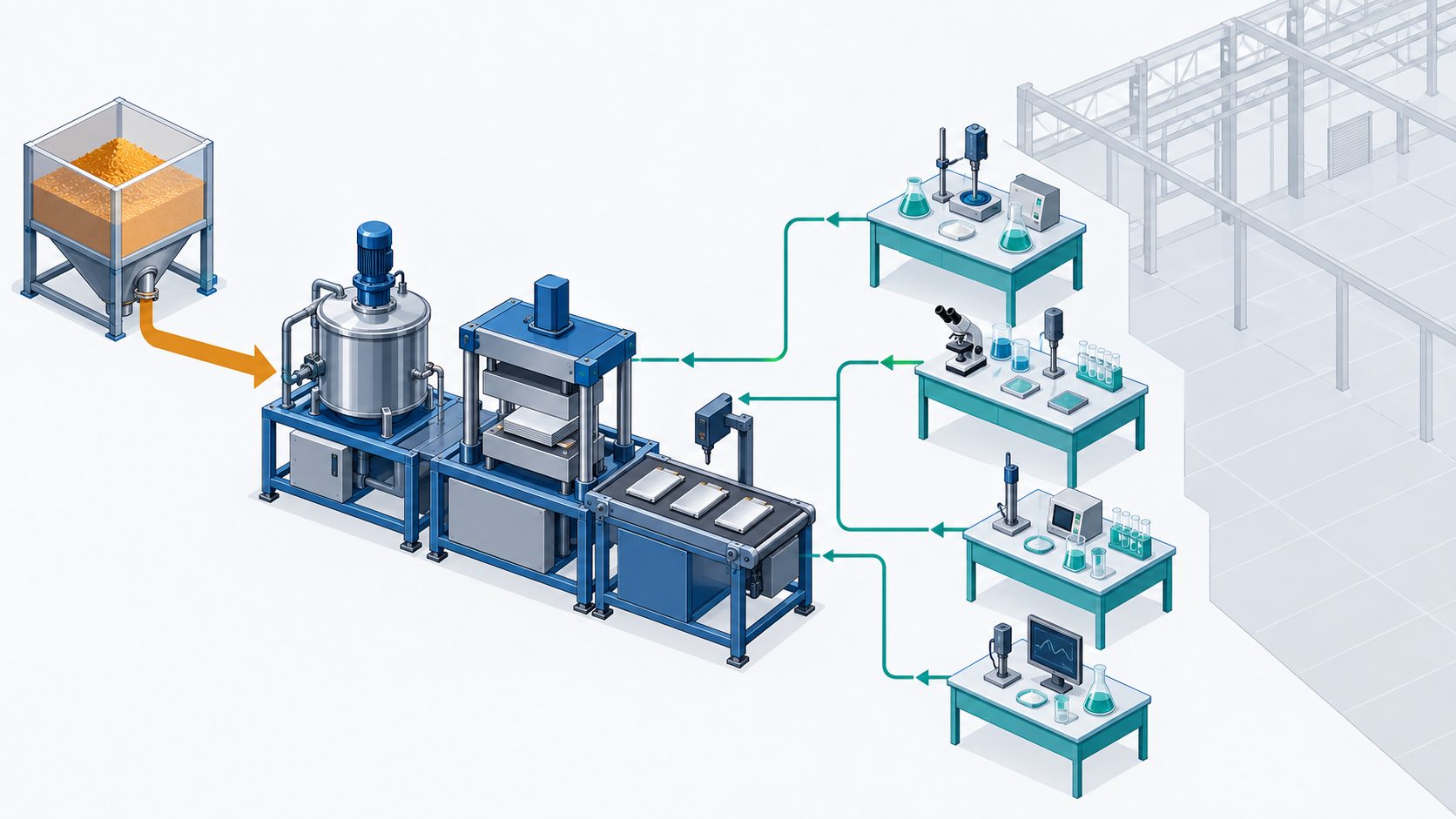 AI-generated conceptual diagram
13. Source
- SK On 2025 Fiscal Year Business Report (Submitted to Korea Financial Supervisory Service DART, March 16, 2026). Sales by business segment, operating income, research and development expenses, number of employees, history and mergers and acquisitions, major shareholder’s shareholding ratio, research and development organization (Future Technology Institute) and research and development achievements (development of sulfide-based solid-state batteries, polymer/oxide composite battery), key customers, production capacity plans. https://dart.fss.or.kr/dsaf001/main.do?rcpNo=20260316001423
- SK On 2026 Semiannual Report (Submitted to Korea Financial Supervisory Service DART, August 14, 2026). Sales by business segment for the first half of 2026, operating income, research and development expenses, annual production capacity of 94.3 GWh, average utilization rate of 36.4%, termination of joint venture with Ford and sale of Kentucky’s first factory, name change to SK On Tennessee, LLC. https://dart.fss.or.kr/dsaf001/main.do?rcpNo=20260814003034
- SK On Official Press Release ‘SK On, Pilots Solid-State Battery Plant Completed…Targeting Commercialization in 2029’ (September 16, 2025). Completion of the pilot plant in Jung-gu, Daegu City, Future Technology Institute, approximately 4,628 square meters, sulfide-based and lithium metal batteries, commercialization target 2029 (advanced from 2030), 800Wh/L and 1000Wh/L, WIP-free technology, achievements with Hanyang University. http://www.sk-on.com/company/press_view.asp?idx=242&page=1&schtxt=&CompanyCode=010
- SK On Official Press Release ‘SK On, Strengthens Collaboration with US Solid Power…Accelerates Development of Solid-State Batteries’ (January 17, 2024). Technical transfer agreement with Solid Power at CES 2024, supply of sulfide-based solid electrolytes, $30 million investment in 2021, plan to build a pilot line in Daegu by 2025, research on oxide-based solid electrolytes with Konkuk University.’ http://www.sk-on.com/company/press_view.asp?idx=134&page=1&schtxt=&CompanyCode=010
- SK On Official press release, “SK On Achieves Consecutive Breakthroughs in All-Solid-State Battery Technology… Technical Capabilities Recognized in International Academic Journals” (May 6, 2025). Lithium metal anode protective film developed with Hanyang University (lifespan tripled; over 300 cycles at room temperature; published in ACS Energy Letters); gel polymer electrolyte curing time and lifespan developed with Yonsei University (published in Angewandte Chemie); commercialization targets at the time (polymer–oxide composite system in 2028; sulfide-based system in 2030). http://www.sk-on.com/company/press_view.asp?idx=219&page=1&schtxt=&CompanyCode=010
- SK On Official Press Release ‘SK On, R&D Achievements Piling Up…Presentation of Solutions for Commercialization of Solid Silicon Anode and High-Performance Electrolyte’ (January 15, 2026). Collaboration with Yonsei University on binder PPMA (Nature Communications), water-based process with a 80% reduction in pressure, collaboration with Seoul National University on single-crystal positive electrode material (Nature Energy), reiteration of pilot plant and 2029 target. http://www.sk-on.com/company/press_view.asp?idx=247&page=1&schtxt=&CompanyCode=010
- SK Innovation 2025 fiscal year business report (filed with Korea’s Financial Supervisory Service DART on March 16, 2026). Disclosure by the parent company. To the best of our knowledge, there is no mention of solid-state batteries in this document, and it only discusses opportunities in the next-generation battery field. https://dart.fss.or.kr/dsaf001/main.do?rcpNo=20260316000827
14. Table of Correspondence between Claims and Sources
| Main Argument in the Body | Classification | Sources |
|---|---|---|
| Official Name · Establishment (On October 1, 2021, a physical division from SK Innovation) · Head Office Location | fact | Source 1 https://dart.fss.or.kr/dsaf001/main.do?rcpNo=20260316001423 |
| Absorption Mergers of SK Trading International · SK Entarm · SK Emu | fact | Source 1 https://dart.fss.or.kr/dsaf001/main.do?rcpNo=20260316001423 |
| Revenue, Operating Profit/Loss, and Research and Development Expenses by Business Segment for the Fiscal Period Ending December 2025 | fact | Source 1 https://dart.fss.or.kr/dsaf001/main.do?rcpNo=20260316001423 |
| SK Innovation holds a majority stake of 90.33% | fact | Source 1 https://dart.fss.or.kr/dsaf001/main.do?rcpNo=20260316001423 |
| Employee count: 3,822 (as of December 31, 2025, in South Korea) | fact | Source 1 https://dart.fss.or.kr/dsaf001/main.do?rcpNo=20260316001423 |
| The six functions of the Future Technology Institute and the development of full-solid-state batteries as a research topic for Platform development | fact | Source 1 https://dart.fss.or.kr/dsaf001/main.do?rcpNo=20260316001423 |
| The main customers are Hyundai/Kia, Mercedes-Benz, VW, and Ford (for the entire battery business) | fact | Source 1 https://dart.fss.or.kr/dsaf001/main.do?rcpNo=20260316001423 |
| A production capacity of over 179 GWh/year is planned by the end of 2026 | Unconfirmed / Future | The company plan as recorded in Reference 1 is not a record of achievements. https://dart.fss.or.kr/dsaf001/main.do?rcpNo=20260316001423 |
| 2026 first half battery business sales 48.161 trillion won, operating profit 472.5 billion won, research and development expenses 9.62 billion won | fact | Source 2 https://dart.fss.or.kr/dsaf001/main.do?rcpNo=20260814003034 |
| production capacity of 94.3 GWh/year and average utilization rate of 36.4% | fact | Source 2 https://dart.fss.or.kr/dsaf001/main.do?rcpNo=20260814003034 |
| Ford joint venture termination in May 2026, sale of the Kentucky first factory (3.1 GWh/year), company name change to SK On Tennessee, LLC | fact | Source 2 https://dart.fss.or.kr/dsaf001/main.do?rcpNo=20260814003034 |
| Ota Wards, Fukuoka City, Pilot Plant Completion at the Future Technology Institute (September 2025, approximately 46,280 square meters) | fact | Source 3 http://www.sk-on.com/company/press_view.asp?idx=242&page=1&schtxt=&CompanyCode=010 |
| Commercialization target is in 2029 (1 year ahead from 2030) | Unconfirmed / Future | This is a company plan as stated in reference 3 and not actual results http://www.sk-on.com/company/press_view.asp?idx=242&page=1&schtxt=&CompanyCode=010 |
| Energy density targets of 800Wh/L for short-term and 1000Wh/L for long-term, application of WIP-free technology | fact | Source 3 http://www.sk-on.com/company/press_view.asp?idx=242&page=1&schtxt=&CompanyCode=010 |
| Investment of $30 million in Solid Power (2021) and technology transfer agreement (January 2024), supply of sulfide-based solid electrolytes | fact | Source 4 http://www.sk-on.com/company/press_view.asp?idx=134&page=1&schtxt=&CompanyCode=010 |
| Development of a new solid oxide electrolyte with a university-industry partnership (Patent application pending as of 2023) | fact | Source 4 http://www.sk-on.com/company/press_view.asp?idx=134&page=1&schtxt=&CompanyCode=010 |
| Life expectancy tripled with Hankyong University, 300 times at room temperature with Kangnam University, and gel polymer electrolyte curing time and capacity degradation with Yonsei University | fact | Source 5 http://www.sk-on.com/company/press_view.asp?idx=219&page=1&schtxt=&CompanyCode=010 |
| Target as of May 2025 (polymer-oxide composite system by 2028, sulfide system by 2030) | Unconfirmed / Future | The company plan as recorded in reference 5 is not a record of achievements http://www.sk-on.com/company/press_view.asp?idx=219&page=1&schtxt=&CompanyCode=010 |
| PPMA binder with Yonsei University, single-crystal positive electrode material (January 2026) with Seoul University | fact | Source 6 http://www.sk-on.com/company/press_view.asp?idx=247&page=1&schtxt=&CompanyCode=010 |
| The report of the subsidiary SK Innovation does not mention any information about solid-state batteries. | fact | Source 7 https://dart.fss.or.kr/dsaf001/main.do?rcpNo=20260316000827 |
| Classification of three types of all-solid-state batteries (Automotive / Battery / Startup) | Calculations in this article | Arrangement by this article. Company names are exemplified from the 23 companies in this series |
| Sales, investment amounts, and number of dedicated personnel for solid-state batteries, as well as the investment amount for pilot plants | Unconfirmed / Future | All are not disclosed. This article does not estimate either. |
| All-solid-state battery customer supply contract mass production factory mass production capacity price vehicle models | Unconfirmed / Future | Not recorded in references 1-7. Do not adopt reported values based on news https://dart.fss.or.kr/dsaf001/main.do?rcpNo=20260316001423 |
| It is designed to prevent overlooking by running two types side by side | speculation | The interpretation of this article is based on the fact that two commercialization targets are mentioned |
| The joint research with universities is aimed at patents and human resources. | speculation | The interpretation based on the notation of a pending patent application and the collaboration in talent cultivation between UNIST and this manuscript. |
| The reason for advancing the target is that it is due to the completion of the equipment. | speculation | Observation of the manuscript where the advance announcement was made on the same day as the completion of the pilot plant. |
| The interpretation that the product will compete based on energy density first. | speculation | The interpretation of this paper is based on the fact that numerical targets are defined solely by density, while cost targets are not. |
| Explanation regarding the differences in difficult points between two systems. | speculation | Explanation from the general properties of solid electrolytes and the description in reference 5. |
| The external dependency of solid electrolytes and the risk associated with the burden of running two systems concurrently. | speculation | The interpretation of this paper is based on the structure of collaboration and the scale of research and development costs. |
Last Updated: September 23, 2026 / Troy Technical
The numbers in this article are all based on documents submitted by SK On to the Korea Financial Supervisory Commission’s electronic disclosure system (DART) and its official press releases. We have not used estimates from research firms or values derived from news reports. The ‘estimated’ sections are interpretations drawn from primary information within the article, not the company’s published content.