COMPANY PROFILE / SOLID-STATE BATTERIES
Toyota Motor Corporation
An automaker that makes its own batteries, betting on commercialisation in 2027 to 2028
Toyota is the name that comes up most often in solid-state battery coverage, and the reason is simple: it is a car company that develops the battery itself. Its annual filing with the U.S. SEC for the year to March 2026, the counterpart of its Japanese securities report, says in so many words that it has reduced the size of its all-solid-state batteries "by one-third compared with conventional batteries" and is "aiming for commercialization in 2027–2028". This profile keeps the car business to a minimum and concentrates on what Toyota is putting into solid-state batteries, who it is working with and what it is aiming for.
- Toyota in 30 seconds, and where it stands in solid-state batteries
- The logo and how the name is written
- Where the company sits in the solid-state battery field
- Scale (the car business in brief)
- Resources committed to solid-state batteries
- What it has done so far
- What comes next
- What the company is aiming for in solid-state batteries
- Map of solid-state battery partnerships
- The technical approach
- The risks this company carries
- Glossary, references and claim-to-source audit
1. Toyota in 30 seconds, and where it stands in solid-state batteries
NYSE: TMTraded in the U.S. as American Depositary Receipts
(makes its own batteries)Neither a dedicated battery maker nor a start-up
in 2027 to 2028The timing the company states in its 20-F
one thirdPerformance maintained. Stated in the June 2026 20-F
Sumitomo Metal MiningSolid electrolyte and cathode material
Companies working on solid-state batteries fall into three broad types: automakers, battery makers and start-ups. Toyota is an automaker, but unlike the others it has said plainly that it will not buy its batteries in: it develops the car and the battery together, in house Sourced. The 20-F describes an approach of "viewing batteries and vehicles as a set" as "the starting point for the development of BEVs", and says that developing "both batteries and vehicles in-house provides an advantage". For Toyota, then, the solid-state battery is its own product, not a purchased component. That puts it in a fundamentally different position from a start-up such as QuantumScape or a dedicated battery maker such as CATL.
2. The logo and how the name is written

A note on names: the legal entity is Toyota Motor Corporation. Its partner in solid-state battery development, Toyota Industries Corporation, is a separate company from Toyota Motor. The two names are easy to confuse in Japanese and English alike, so this article keeps them distinct.
Official site: https://global.toyota/en/3. Where the company sits in the solid-state battery field
4. Scale (the car business in brief)
The car business itself is not the subject here, so only its size is noted Sourced.
| Measure | Year to March 2024 | Year to March 2025 | Year to March 2026 |
|---|---|---|---|
| Sales revenues (¥ million) | 45,095,325 | 48,036,704 | 50,684,952 |
| R&D expenditure (incurred, ¥ million) | 1,202,373 | 1,326,496 | 1,522,881 |
| Employees (31 March 2026) | Headcount | By region | Headcount |
|---|---|---|---|
| Automotive | 343,952 | Japan | 207,137 |
| Financial services | 16,222 | North America | 65,411 |
| All other | 23,934 | Asia | 66,331 |
| Unallocated | 6,819 | Europe | 24,741 |
| Total | 390,927 | Other regions | 27,307 |
The figures above are for the company as a whole. They say nothing about the scale of the solid-state battery effort. Toyota publishes none of the relevant numbers: revenue, investment or dedicated headcount for solid-state batteries Not yet confirmed. Nor does it disclose how much of its ¥1,522.9 billion R&D budget goes to them. When reading about this field in a profile of an automaker, keep in mind that the size of the company and the size of its bet on this technology are two different things.
5. Resources committed to solid-state batteries
Amounts and headcount are not published, but the 20-F is quite specific about what kinds of resources are being committed.
| Type of resource | What it is | Category |
|---|---|---|
| Development within the group | All-solid-state batteries for BEVs are being co-developed with Toyota Industries. The popularisation and high-performance versions of the next-generation batteries are developed in the same set-up | Sourced |
| Battery company within the group | The performance version of the next-generation battery is developed with Prime Planet Energy & Solutions (a liquid-electrolyte battery, not a solid-state one) | Sourced |
| Partnerships with materials makers | Idemitsu Kosan (October 2023, mass production of solid electrolyte) and Sumitomo Metal Mining (October 2025, cathode material) | Sourced |
| Technology built up in house | About 30 years of battery production technology honed on HEVs, bipolar nickel-metal hydride battery technology, precision coating developed for FCEVs, and digital technologies | Sourced |
| Investment | Capital expenditure and R&D spending on solid-state batteries | Not disclosed |
| Dedicated staff | Number of people developing solid-state batteries | Not disclosed |
| Start-up investments | No investment in solid-state battery start-ups is mentioned in the 20-F | Not confirmed |
| University collaboration | No joint research with universities on solid-state batteries is mentioned in the 20-F | Not confirmed |
Of the in-house resources the 20-F lists, the two that matter most from the materials side are bipolar nickel-metal hydride battery technology and precision coating developed for FCEVs Sourced. The hardest part of making a solid-state battery is laying down solid powder over a large area, evenly, quickly and without defects, and that is a different requirement from coating electrodes for a liquid lithium-ion cell. Coating the catalyst layer of a fuel cell is a technique for applying material thinly and evenly while drying it; a bipolar structure means coating different materials on each side of a current collector and sealing every cell at once. Toyota has run both in volume production, and its argument is that the ingredients a solid-state battery needs are already in the company.
The flip side is that a company without them has to build its equipment and processes from scratch. That is part of the reason start-ups struggle when they move to mass production.
6. What it has done so far
| When | What happened | Why it matters |
|---|---|---|
| From about 30 years ago | Continuous mass production of batteries for HEVs (nickel-metal hydride, later lithium-ion) | The company describes this as the foundation of its solid-state manufacturing technology |
| - | Bipolar nickel-metal hydride batteries fitted to the Aqua and the Crown | A volume-production track record with bipolar construction, now being extended to BEVs |
| October 2023 | Partnership with Idemitsu Kosan, aiming at mass production of solid electrolyte for all-solid-state BEV batteries | Combines Idemitsu's materials manufacturing technology with Toyota's battery processing and assembly technology |
| February 2025 | Comprehensive partnership with the Shanghai municipal government; Lexus (Shanghai) New Energy established to develop and produce BEVs and batteries (production due to start in 2027) | Not specific to solid-state batteries, but adds a battery production site |
| October 2025 | Collaboration with Sumitomo Metal Mining: a new, highly durable cathode material suited to all-solid-state batteries, co-developed using the partner's powder synthesis technology | Toyota chose to split the work with a specialist rather than make the material itself |
| June 2026 | The 20-F states that the battery's size has been reduced by one-third while maintaining performance, and that Toyota has discovered a new technology that overcomes cracking caused by the solid electrolyte expanding and contracting | A public statement of technical progress. What the new technology is has not been disclosed |
7. What comes next
then mass productionWith Sumitomo Metal Mining. Timing and volume not disclosed
On solid-state batteries the company writes that it "continues to advance product development and the development of mass production methods" Sourced. In other words, it presents itself as past the research stage and working out how to make the product.
None of the following appears in the 20-F Not yet confirmed.
The production site, production capacity, vehicle models and price range for solid-state batteries; how many units will ship in 2027 to 2028; and capital expenditure on solid-state batteries. Figures of the form "Toyota will build X thousand units by year Y" mostly come from press reports, and this article does not use them.
8. What the company is aiming for in solid-state batteries
This section goes beyond what the company says directly. It sets out inferences that can be drawn from primary sources, each with its basis.
| What can be read | Primary evidence behind it | Category |
|---|---|---|
| The main purpose is fitting the batteries to Toyota's own BEVs, not selling them to others | The 20-F's language about "viewing batteries and vehicles as a set" and the advantage of developing both in house. External sales are not mentioned | Inference |
| Toyota is likely to start with high-value, low-volume applications | The solid-state battery is placed at the top of four battery configurations, and the 20-F assigns the low-cost LFP bipolar battery to the popularisation version | Inference |
| The policy is not to make the materials in house | Toyota works with Idemitsu Kosan on solid electrolyte and Sumitomo Metal Mining on cathode material. There is no mention of building its own materials plants | Inference |
| Solid-state is not the only pillar of the BEV strategy | It is described as one of four pillars, alongside the liquid-electrolyte next-generation batteries (performance, popularisation and high-performance bipolar versions) | Sourced |
| 2027 to 2028 marks the start of mass production, not widespread adoption | The company says "commercialization" and gives no unit target | Inference |
The 20-F describes its batteries in this order: next-generation performance version, popularisation version, high-performance bipolar version, all-solid-state battery. The performance version comes with numerical targets (a 1,000 km range and 20% lower cost than the bZ4X), as does the popularisation version (LFP chemistry and 40% lower cost). The solid-state battery has no range target and no cost target Sourced. The gap between liquid-electrolyte batteries that are far enough along to carry numbers and a solid-state battery that is not yet there shows up directly on the page. This article's reading is that 2027 to 2028 will most naturally begin with limited mass production Not yet confirmed.
9. Map of solid-state battery partnerships
10. The technical approach
Toyota does not say in its 20-F which type of solid electrolyte it uses (sulfide, oxide, halide or another) Not yet confirmed. What it has published is the problem, and the fact that it has solved it.
| Item | What the 20-F says |
|---|---|
| Advantages of all-solid-state batteries | A solid electrolyte allows faster movement of ions and tolerates high voltages and temperatures better. Higher power output, longer range and shorter charging times are expected |
| Trade-off | Battery life is thought to be shorter |
| Cause | The solid electrolyte expands and contracts with every charge and discharge, which can crack the electrodes and impede the movement of ions |
| Toyota's claim | It has discovered a new technology that overcomes this problem (the technology itself is not disclosed) |
| Where it has got to | Size reduced by one-third compared with conventional batteries while maintaining performance. Compact and lightweight, with short charging times and high durability |
Framing the problem as "the solid electrolyte expands and contracts, and cracks form" points to an issue common to any system in which electrode and electrolyte meet as solids, sulfides included Not yet confirmed. There are broadly three ways to solve it: (1) make the electrolyte soft enough to follow the movement, (2) suppress the volume change of the electrode itself, or (3) put a buffer layer at the interface. Toyota has not said which it chose. But because it states explicitly that it co-developed a "cathode material with superior durability" with Sumitomo Metal Mining, its approach can be read as including option (2), acting on the electrode side Not yet confirmed.
11. The risks this company carries
| Risk | Substance | Category |
|---|---|---|
| The target slipping | The commercialisation target is a range, "2027–2028", and no unit target is given | Sourced |
| Mass production methods not yet settled | The company itself says it is still developing mass production methods, in parallel with product development | Sourced |
| No way to verify from outside | Investment, staffing, production capacity and target vehicles are all undisclosed, so progress cannot be checked from outside | Not yet confirmed |
| Dependence on others for materials | Solid electrolyte comes from Idemitsu Kosan and cathode material from Sumitomo Metal Mining. How quickly those two ramp up becomes Toyota's constraint | Inference |
| Competition from better liquid batteries | The same 20-F promises 40% lower cost for the liquid popularisation version and a 1,000 km range for the performance version. Solid-state has to win its place even inside Toyota | Inference |
| Swings in BEV demand itself | The company qualifies its 3.5 million unit target for 2030, saying it will take a flexible approach in line with customer demand | Sourced |
12. Glossary
- All-solid-state battery
- A battery whose electrolyte is a solid rather than a liquid. It is considered less prone to catching fire and more tolerant of high voltages and temperatures.
- Solid electrolyte
- A solid material that conducts ions only. The main families are sulfide, oxide and halide.
- Bipolar structure
- A construction in which the cathode is coated on one side of a single current collector and the anode on the other. It needs a third as many parts.
- LFP
- Lithium iron phosphate. A low-cost cathode material that uses no nickel or cobalt.
- Cathode material
- The powder that makes up a battery's positive electrode. It has a large bearing on capacity and durability.
- BEV
- Battery Electric Vehicle. An electric car that runs on its battery alone.
- HEV
- Hybrid Electric Vehicle. A car that combines an engine with an electric motor.
- Form 20-F
- The annual report a foreign company listed in the United States files with the SEC. It is audited and carries legal liability for its contents.
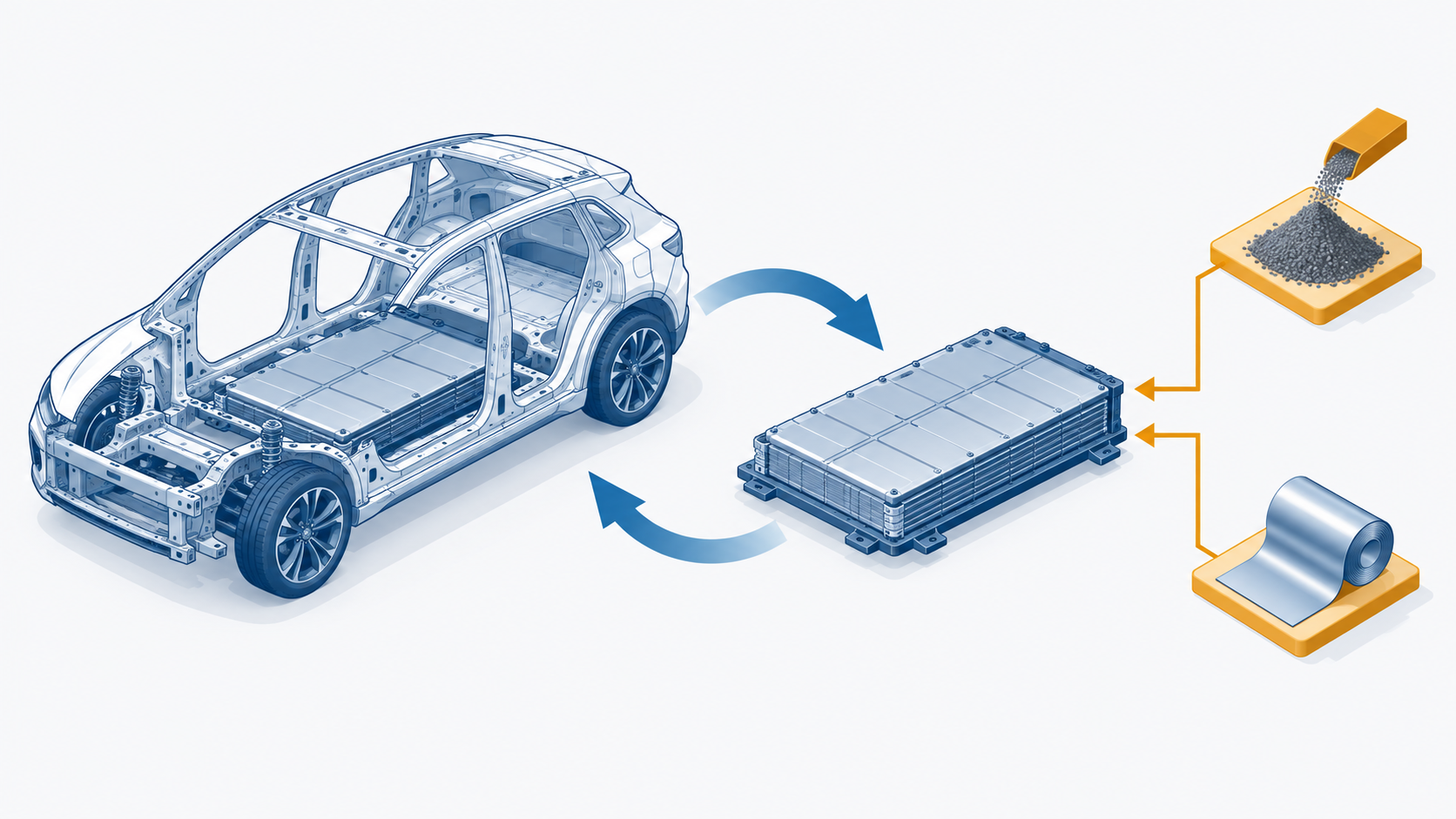 AI-generated concept
13. References
- Toyota Motor Corporation Form 20-F for the fiscal year ended March 31, 2026 (filed with the U.S. SEC on 10 June 2026). Solid-state battery development status and commercialisation target, the partnerships with Idemitsu Kosan and Sumitomo Metal Mining, co-development with Toyota Industries, the four next-generation battery types, sales revenues, R&D expenditure, headcount and the BEV sales target. https://www.sec.gov/Archives/edgar/data/1094517/000119312526264811/d101983d20f.htm
- U.S. SEC EDGAR XBRL company facts API (CIK 0001094517). Year-by-year R&D expenditure. https://data.sec.gov/api/xbrl/companyfacts/CIK0001094517.json
- Toyota Motor Corporation Official website, used to check the corporate profile. https://global.toyota/en/
14. Claim-to-source audit
| Claim in the article | Category | Source |
|---|---|---|
| Legal name, head office address, listing venues | Sourced | References 1 and 3 https://www.sec.gov/Archives/edgar/data/1094517/000119312526264811/d101983d20f.htm |
| Sales revenues (years to March 2024 to 2026), R&D expenditure, 390,927 employees and the breakdown | Sourced | Reference 1 https://www.sec.gov/Archives/edgar/data/1094517/000119312526264811/d101983d20f.htm |
| The commercialisation target for solid-state batteries is 2027 to 2028 | Sourced | Reference 1 https://www.sec.gov/Archives/edgar/data/1094517/000119312526264811/d101983d20f.htm |
| Size reduced by one-third compared with conventional batteries while maintaining performance | Sourced | Reference 1 https://www.sec.gov/Archives/edgar/data/1094517/000119312526264811/d101983d20f.htm |
| Cracking caused by expansion and contraction of the solid electrolyte is the problem, and a new technology to overcome it has been discovered | Sourced | Reference 1 https://www.sec.gov/Archives/edgar/data/1094517/000119312526264811/d101983d20f.htm |
| All-solid-state batteries for BEVs are being co-developed with Toyota Industries | Sourced | Reference 1 https://www.sec.gov/Archives/edgar/data/1094517/000119312526264811/d101983d20f.htm |
| Partnership with Idemitsu Kosan (October 2023, mass production of solid electrolyte) | Sourced | Reference 1 https://www.sec.gov/Archives/edgar/data/1094517/000119312526264811/d101983d20f.htm |
| Collaboration with Sumitomo Metal Mining (October 2025, co-development of cathode material) | Sourced | Reference 1 https://www.sec.gov/Archives/edgar/data/1094517/000119312526264811/d101983d20f.htm |
| Prime Planet Energy & Solutions handles the liquid-electrolyte performance version | Sourced | Reference 1 https://www.sec.gov/Archives/edgar/data/1094517/000119312526264811/d101983d20f.htm |
| Use of about 30 years of HEV battery production technology, bipolar Ni-MH technology and precision coating developed for FCEVs | Sourced | Reference 1 https://www.sec.gov/Archives/edgar/data/1094517/000119312526264811/d101983d20f.htm |
| The next-generation battery line-up has four types, one of which is the solid-state battery | Sourced | Reference 1 https://www.sec.gov/Archives/edgar/data/1094517/000119312526264811/d101983d20f.htm |
| Targets of a 1,000 km range and 20% lower cost for the liquid performance version, and LFP with 40% lower cost for the popularisation version | Sourced | Reference 1 https://www.sec.gov/Archives/edgar/data/1094517/000119312526264811/d101983d20f.htm |
| Global BEV sales of 3.5 million units (2030), with the caveat about a flexible approach | Sourced | Reference 1 https://www.sec.gov/Archives/edgar/data/1094517/000119312526264811/d101983d20f.htm |
| Establishment of Lexus (Shanghai) New Energy and production due to start in 2027 | Sourced | Reference 1 https://www.sec.gov/Archives/edgar/data/1094517/000119312526264811/d101983d20f.htm |
| The three types of solid-state battery company (automaker, battery maker, start-up) | Our calculation | Our own classification. Companies shown are examples from the 23 in this series |
| Solid-state battery revenue, investment and dedicated headcount | Not yet confirmed | None is disclosed, and this article makes no estimate |
| Production site, capacity, vehicle models, price range and first-year volume for solid-state batteries | Not yet confirmed | Not in reference 1. Figures from press reports are not used https://www.sec.gov/Archives/edgar/data/1094517/000119312526264811/d101983d20f.htm |
| The type of solid electrolyte used (sulfide or otherwise) | Not yet confirmed | Not in reference 1. This article does not guess https://www.sec.gov/Archives/edgar/data/1094517/000119312526264811/d101983d20f.htm |
| Investment in solid-state start-ups and joint research with universities | Not yet confirmed | Not in reference 1. This article does not conclude that none exists https://www.sec.gov/Archives/edgar/data/1094517/000119312526264811/d101983d20f.htm |
| The reading that the main purpose is Toyota's own BEVs, not external sales | Inference | This article's interpretation of statements such as "viewing batteries and vehicles as a set" |
| The reading that Toyota will start with high-value, low-volume applications | Inference | This article's observation that only the solid-state battery carries no numerical target |
| The reading that Toyota will not make the materials itself | Inference | This article's interpretation of the division of work with Idemitsu Kosan and Sumitomo Metal Mining |
| The reading that 2027 to 2028 marks the start of mass production, not widespread adoption | Inference | This article's interpretation of the absence of any unit target |
| The reading that durability is being addressed on the cathode side | Inference | This article's interpretation of the co-development work with Sumitomo Metal Mining |
| The risks of depending on others for materials and of competition from liquid batteries inside Toyota | Inference | This article's interpretation of the partnership structure and the four-battery line-up |
Last updated 23 September 2026 / Troy Technical
Every figure in this article comes from statutory filings Toyota Motor Corporation has made with the U.S. Securities and Exchange Commission. No research-firm estimates or press-based figures have been used. Passages marked "Inference" are this article's interpretation of primary sources, not statements made by the company.