TECHNOLOGY EXPLAINER
The Bipolar Stack
— a structure that only works once you give up the liquid
Put the cathode on one face of a current collector and the anode on the other, then stack. No wiring, no tabs, less resistance. It sounds like all upside, yet liquid cells could rarely use it. The reason is that liquid electrolyte creeps around the edge.

- What a bipolar stack is (the short version)
- Why liquid cells struggled with it — internal bridging
- With a solid electrolyte the problem disappears in principle
- Our calculation: twice the voltage, half the capacity, about the same energy
- A materials engineer's view (1): this is a structure for making voltage
- A real product — Maxell's example
- A materials engineer's view (2): the sealant changes job
- What you gain, and what is still hard
- Glossary / Primary sources / Claim-to-source audit
Sourced = a value stated in published material from a research institute or manufacturer (link given)
Our calculation = a figure this article derived, with the assumptions spelled out
Not yet confirmed = a plan or a target with no confirmed production record
Structural readings and materials-design interpretations are marked separately as Commentary.
1. What a bipolar stack is (the short version)
A bipolar structure means putting the cathode on one face of a single current collector and the anode on the other, then stacking those sheets so that the cells are connected in series.
- What it looks like: Toyota describes the bipolar type as a simple structure that gathers the positive and negative electrodes onto one electrode sheet and stacks themSourced
- What it buys you: the same company states that the conducting area between cells is enlarged and the resistance lowered, so high power can be deliveredSourced
- Why all-solid-state batteries revived it: in liquid cells, electrolyte creeping around the outside of the collector shorted neighbouring cells together — internal bridgingSourced. A solid electrolyte does not flow
Structural difference: monopolar and bipolar
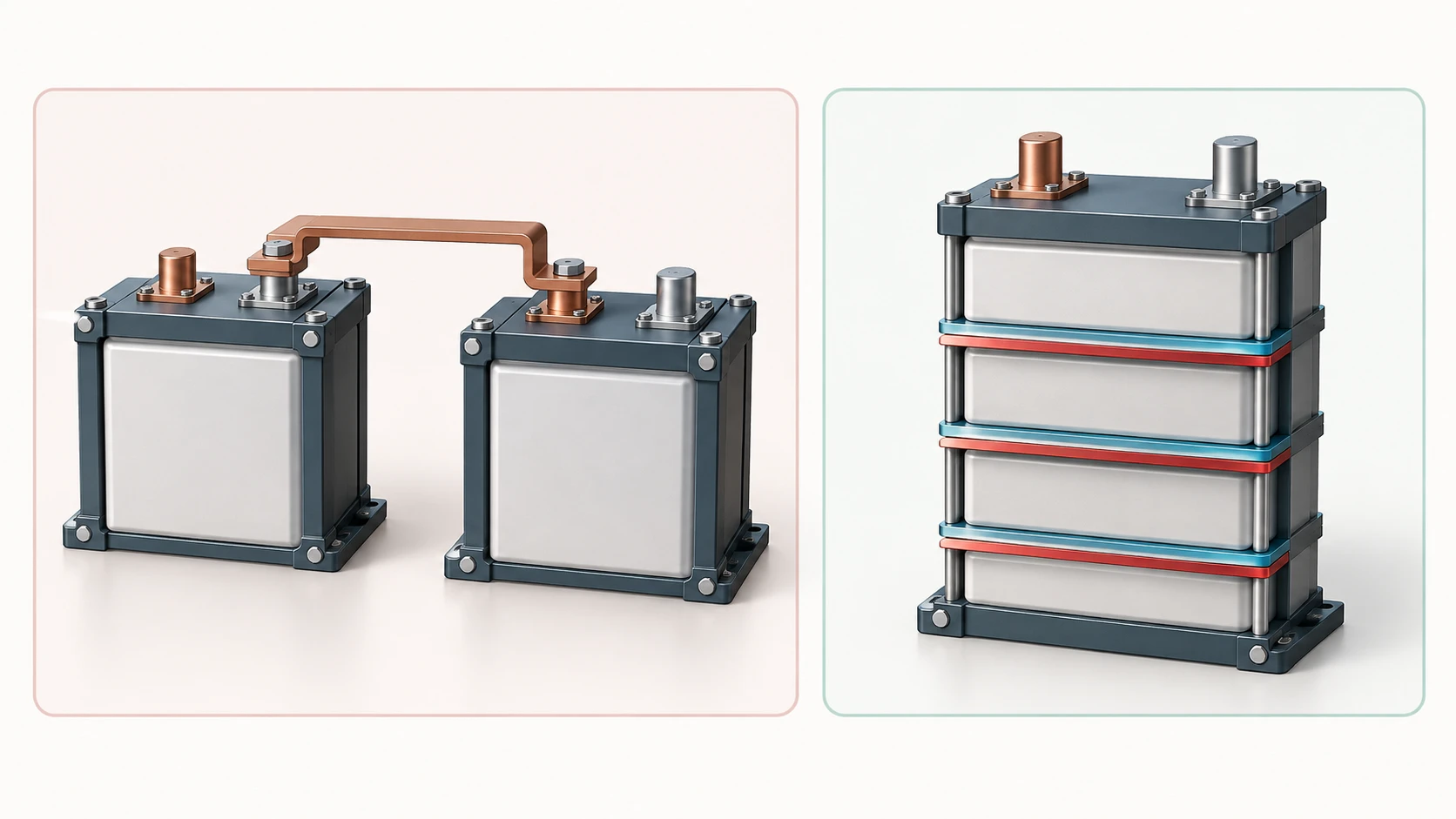
- Monopolar: each cell needs its own case, terminals and external interconnection
- Bipolar: each shared collector works on both faces and cells stack in series
The bipolar structure itself has been known for more than twenty years. It stayed out of mainstream liquid cells not because of performance, but because of a physical problem: liquid gets around things. The moment the electrolyte stops flowing, the structure becomes straightforward to use.
2. Why liquid cells struggled with it — internal bridging
In a bipolar stack the individual cells share a current collector and sit directly on top of one another. So what happens when liquid electrolyte works its way around the rim of that collector?
A Nissan patent publication (title: "Bipolar battery and assembled battery using the same", published 9 June 2005) gives the purpose of the insulating layer as preventing short circuits caused by liquid bridging through the electrolyte, by contact between adjacent current collectors inside the cell, or by slight misalignment at the edges of the stacked electrodesSourced (JP2005149891A)
Why liquid-electrolyte bipolar cells were difficult: internal bridging
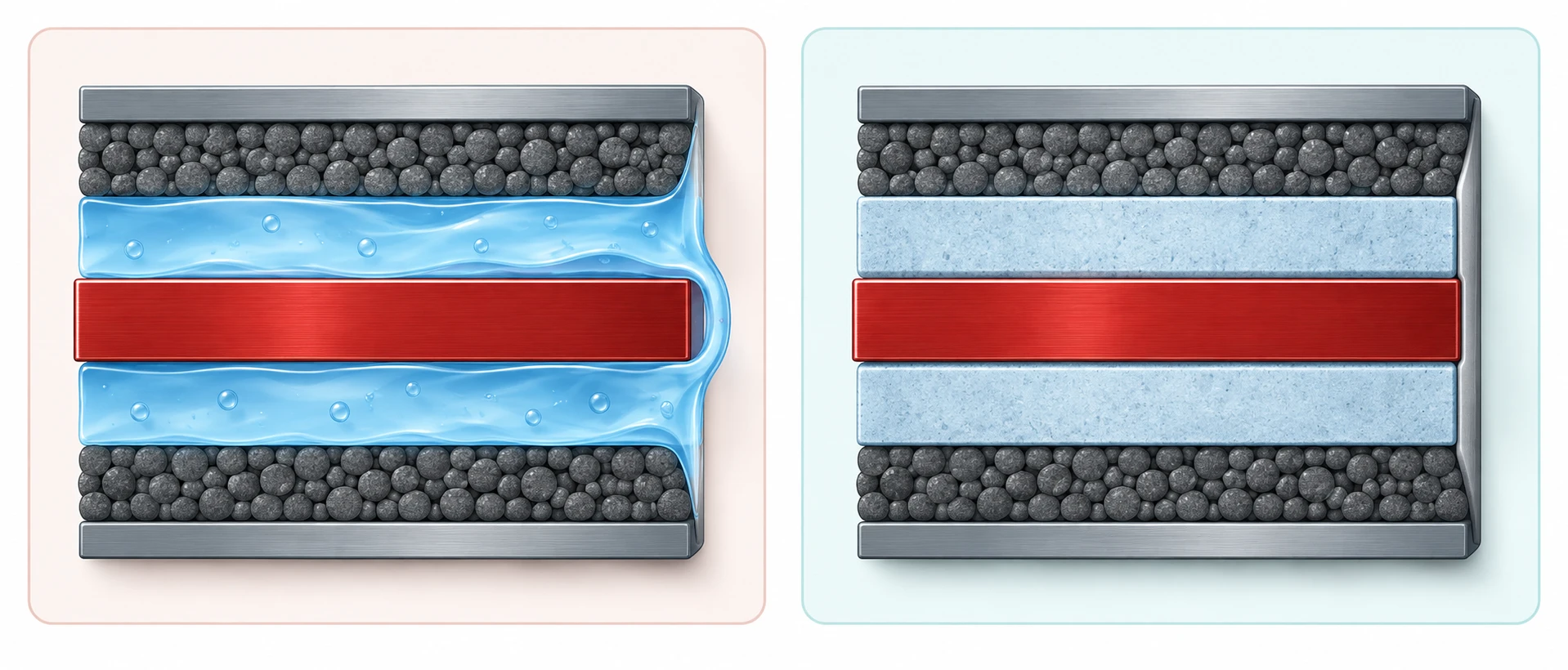
- Liquid: electrolyte can creep around the collector and connect adjacent cells, producing internal bridging and a short
- All-solid-state: the electrolyte does not flow, so the same path around the edge does not form
3. With a solid electrolyte the problem disappears in principle
The essence of internal bridging is that the electrolyte is a fluid. A fluid will find any gap, so the perimeter had to be sealed reliably.
Line up what that seal was asked to do:
- survive long exposure to organic solvent without degrading
- follow the expansion and contraction of charge and discharge
- work reliably at every single level of the stack
- and still take up as little volume as possible
The more levels you stack, the more seals there are to get right. One breach anywhere is one bridging path. You want more cells in series, and every cell you add costs yield — a structural dilemma (our commentary).
With a solid electrolyte the premise changes. What cannot flow cannot creep around. Sealing does not vanish altogether (moisture from outside still has to be kept out), but the job of holding a liquid in disappears (our commentary).
As the Argyrodite article in this series shows, sulfide materials react with water. The sealant's brief moves from "do not let anything out" to "do not let moisture in". Same word, opposite direction.
4. Our calculation: twice the voltage, half the capacity, about the same energy
What actually changes when a cell goes bipolar? Two Maxell products with identical external dimensions make it visible.
| Item | Coin type PSB920L (under development) | Bipolar type PSB920P (under development) |
|---|---|---|
| Diameter | 9.5 mm | 9.5 mm |
| Height | 1.95 mm | 1.95 mm |
| Nominal voltage | 2.3 V | 4.6 V (5.2 V maximum) |
| Rated capacity | 5.5 mAh | 2.5 mAh |
| Stated strengths | Long life, high power | High voltage, high power, fast charging |
All Sourced (Maxell specification page [Source 3]). Both are listed as under development.
- Nominal voltage: 4.6 V divided by 2.3 V = 2.0 times
- Rated capacity: 2.5 mAh divided by 5.5 mAh = about 0.45 times
- Energy (voltage times capacity): 2.3 × 5.5 = 12.65 mWh against 4.6 × 2.5 = 11.5 mWh, so about 0.91 times
Going bipolar did not add energy. The voltage doubled and the capacity roughly halved in exchangeOur calculation.
Assumptions and limits: energy here is the plain product of nominal voltage and rated capacity, not an integral of a real discharge curve. And why the two differ by about 9% could not be confirmed in the published material this article consulted. Both products are described as under development, so the specifications may change.
5. A materials engineer's view (1): this is a structure for making voltage
What the arithmetic says is that a bipolar structure is not an energy-density technologyOur calculation. The amount of active material that fits in a given volume has not changed, so in hindsight that is obvious.
What you do get is three things.
- Voltage: 4.6 V out of a single partSourced. No need to wire two 2.3 V cells in series
- Power: Toyota states that the conducting area between cells is enlarged and the resistance lowered, so high power can be deliveredSourced
- Part count: no inter-cell wiring, tabs or connectors
That is what the structure really means. The series wiring that used to live outside the battery has been pulled inside it.
From a materials standpoint, the cell maker has taken over part of the module design and moved it into the material and cell structure. Done outside, the same job brings holders, wiring, solder joints and contacts — assembly labour and contact resistance with them. The judgement is that building the voltage out of a stack of materials ends up smaller and lighter (our commentary).
Maxell also lists fast charging among the strengths of its bipolar typeSourced. With higher voltage and lower resistance, the same power flows at a smaller current. A smaller current means smaller losses at the interfaces. As the Interfacial resistance article in this series sets out, the voltage drop is set by current density times area-specific resistance (our commentary).
6. A real product — Maxell's example

Maxell says it has pursued several all-solid-state form factors, including ceramic-package, bipolar and cylindrical typesSourced. The company developed a coin-type all-solid-state battery in 2019 and states that in 2021 it developed a bipolar all-solid-state battery with the strengths of high voltage and high powerSourced.
On the product page, for an all-solid-state battery using a sulfide solid electrolyte, it publishes an operating temperature range of -50 °C to +125 °C and the figure that in an accelerated test at 60 °C storage, the number of days over which 90% of capacity is retained is 100 days for the all-solid-state battery against 10 days for the conventional productSourced.
On 16 December 2025 the company announced PSB2032, a coin-type all-solid-state battery (20 mm outside diameter, 3.2 mm high, 35 mAh)Sourced. Whether that product uses a bipolar structure could not be confirmed in the material this article consulted.
7. A materials engineer's view (2): the sealant changes job
Section 3 touched on this. Here it is in more concrete terms.
In a liquid bipolar battery the sealant was the part that stopped leakage from the inside out, exactly as the Nissan patent publication describes when it gives liquid bridging through the electrolyte as the reason for the insulating layerSourced.
In an all-solid-state bipolar battery the thing to be stopped is different. A sulfide solid electrolyte reacts with atmospheric moisture, generating hydrogen sulfide and losing ionic conductivity badlySourced. The sealant becomes the part that blocks moisture ingress from the outside in.
That flips the selection criteria.
- Liquid: solvent resistance first. No swelling or degradation under long exposure to organic solvent
- All-solid-state: water-vapour barrier first. How low can the transmission rate go
Solvent resistance and water-vapour barrier are not properties that any one material is obliged to combine. It is the same picture as the Adhesives and encapsulants article in this series: what a sealant is asked to do is decided by what is inside it (our commentary).
That Maxell develops a ceramic-package type in parallel, and that it describes PSB2032 as achieving the same high hermeticity as the ceramic-package typeSourced, reads as a sign that hermeticity sits at the centre of product design for all-solid-state batteries (our commentary).
8. What you gain, and what is still hard
(1) The quantitative effect of going bipolar can only be pinned down in part
All this article could compare is the specifications of two Maxell products of identical sizeSourced. How much power (in W) bipolar construction adds, how far it lowers internal resistance, and what fraction of space it saves could not be found in published primary sources within the scope of this article, so those numbers are not stated here.
(2) These are products under development
Both PSB920L and PSB920P, compared in Section 4, are marked under development on the specification pageSourced. At the time of writing (September 2026), no primary source confirming that volume production of a bipolar all-solid-state battery has begun could be foundNot yet confirmed.
(3) The automotive example is not all-solid-state
Toyota's bipolar product is a nickel-metal hydride battery, not an all-solid-state oneSourced. This article quotes the company only as a description of the bipolar structure itself. For automotive adoption of a bipolar structure in an all-solid-state battery, no primary source could be found within the scope of this article.
- A bipolar structure gathers the positive and negative electrodes onto one electrode sheet and stacks themSourced
- What made it awkward in liquid cells was liquid bridging through the electrolyteSourced
- A solid electrolyte does not flow, so that problem disappears in principle (our commentary)
- At the same size, voltage is 2.0 times, capacity about 0.45 times and energy about 0.91 times. Energy does not go upOur calculation
- The gains are voltage, power and a lower part count. A larger conducting area and lower resistance allow high powerSourced
- The sealant's job moves from keeping the contents in to keeping moisture out (our commentary)
9. Glossary
- Bipolar structure
- Stacking sheets that carry the cathode on one face of a current collector and the anode on the other.
- Monopolar structure
- The conventional arrangement: cells built individually and connected in series or parallel by external wiring.
- Current collector
- The metal foil or plate that carries current out of the electrode. A bipolar stack uses both of its faces.
- Internal bridging
- Cells becoming connected through the electrolyte and shorting to one another.
- Unit cell
- One set of cathode, electrolyte and anode. Stacking them in series raises the voltage.
- Series connection
- Connecting cells so their voltages add. Capacity does not increase.
- Nominal voltage
- The representative working voltage of a cell, as given in its specification.
- Rated capacity (mAh)
- The charge that can be drawn. Multiplied by voltage it gives energy in mWh.
- Sealant
- The material separating the inside of a cell from the outside. What it must stop depends on the contents.
- Water-vapour barrier
- Resistance to the passage of water vapour. Critical for sulfide-based all-solid-state cells.
- Conducting area
- The cross-section through which current flows. The wider it is, the lower the resistance.
- Tab
- The metal tongue that carries current from the electrode to the outside.
10. Primary sources
- Toyota Motor "AQUA: what is the difference between a bipolar nickel-metal hydride battery and a conventional battery?", FAQ (Japanese-language page) — toyota.jp
- Nissan Motor Patent publication JP2005149891A "Bipolar battery and assembled battery using the same", published 9 June 2005 (Japanese-language page) — patents.google.com
- Maxell "Coin-type all-solid-state battery and bipolar all-solid-state battery", specification page (Japanese-language page) — biz.maxell.com
- Maxell "All-solid-state batteries", product page (Japanese-language page) — biz.maxell.com
- Maxell "Development of PSB2032, a coin-type all-solid-state battery for use as the main power source in IoT devices", 16 December 2025 (Japanese-language release) — prtimes.jp
- H. Tsukasaki (Osaka Metropolitan University) "Elucidating the degradation mechanism of sulfide solid electrolytes in ambient atmosphere", Murata Science Foundation research report, 25 March 2024 (PDF, Japanese-language page) — corporate.murata.com
11. Claim-to-source audit
| Claim in the text | Basis | Label |
|---|---|---|
| That the bipolar type is a simple structure gathering the positive and negative electrodes onto one electrode sheet and stacking them; that the conducting area between cells is enlarged and the resistance lowered so high power can be delivered; that the conventional type has cathode and anode facing each other with a tab to draw current out; and that this example is a nickel-metal hydride battery | Toyota Motor FAQ[Source 1] https://toyota.jp/faq/show/6307.html | Sourced |
| That the stated purpose of the insulating layer is to prevent short circuits caused by liquid bridging through the electrolyte, by contact between adjacent current collectors inside the cell, or by slight misalignment at the edges of the stacked electrodes; and that the applicant is Nissan Motor, the title "Bipolar battery and assembled battery using the same", published 9 June 2005 | Patent publication JP2005149891A[Source 2] https://patents.google.com/patent/JP2005149891A/ja | Sourced |
| That coin-type PSB920L (under development) is 9.5 mm in diameter, 1.95 mm high, 2.3 V nominal, 5.5 mAh rated, charged over -20 to +105 °C and discharged over -50 to +125 °C, with long life and high power as its strengths; that bipolar-type PSB920P (under development) is 9.5 mm in diameter, 1.95 mm high, 5.2 V maximum, 4.6 V nominal and 2.5 mAh rated, with high voltage, high power and fast charging as its strengths; and that a bipolar all-solid-state battery with high voltage and high power was developed in 2021 | Maxell specification page[Source 3] https://biz.maxell.com/ja/rechargeable_batteries/assb-spec-coin.html | Sourced |
| That the performance is achieved by adopting a sulfide solid electrolyte of high ionic conductivity; that the operating temperature range is -50 °C to +125 °C; and that in an accelerated test at 60 °C storage the number of days over which 90% of capacity is retained is 100 days for the all-solid-state battery against 10 days for the conventional product | Maxell all-solid-state battery product page[Source 4] https://biz.maxell.com/ja/rechargeable_batteries/allsolidstate.html | Sourced |
| That PSB2032 is 20 mm in outside diameter, 3.2 mm high and 35 mAh, about four times the capacity of PSB401010H; that it achieves the same high hermeticity as the ceramic-package type; that since developing a coin-type all-solid-state battery in 2019 the company has pursued ceramic-package, bipolar, cylindrical and other form factors; and that the announcement date is 16 December 2025 | Maxell press release, 16 December 2025[Source 5] https://prtimes.jp/main/html/rd/p/000000231.000075608.html | Sourced |
| That a sulfide solid electrolyte exposed to air reacts with moisture to generate toxic hydrogen sulfide and loses ionic conductivity badly | Murata Science Foundation research report, 25 March 2024[Source 6] https://corporate.murata.com/-/media/corporate/group/zaidan/report/study/202406/2024-002.ashx?la=ja-jp&cvid=20240802012731000000 | Sourced |
| The nominal voltage ratio of 2.0 times, the rated capacity ratio of about 0.45 times, the energies of 12.65 mWh and 11.5 mWh, and their ratio of about 0.91 times | Our calculation. Energy is the plain product of nominal voltage and rated capacity, not an integral of a discharge curve. Both products compared are marked as under development and their specifications may change. Why the difference of about 9% arises could not be confirmed in the published material consulted | Our calculation |
| How much power (in W) bipolar construction adds, how far it lowers internal resistance, and what fraction of space it saves | Not found in published primary sources within the scope of this article, so not stated | Commentary |
| Whether PSB2032 uses a bipolar structure | Could not be confirmed in the material this article consulted, so not stated | Commentary |
| Automotive adoption of a bipolar structure in an all-solid-state battery, and the start of volume production of bipolar all-solid-state batteries | Neither could be confirmed in primary sources at the time of writing (September 2026) by this article. Toyota's bipolar product is a nickel-metal hydride battery, not an all-solid-state one | Not yet confirmed |
| The reading that a solid electrolyte cannot flow so bridging cannot arise in principle; the point that more levels mean more seals and lower yield; the reading that the sealant's job moves from keeping contents in to keeping moisture out; the point that solvent resistance and water-vapour barrier do not necessarily coexist; the framing that series wiring outside the battery has been pulled inside it; the readings that one local defect affects the whole and that cells cannot be replaced singly; and the two-column summary of gains and limits | Our summary and commentary based on published content. Not a view expressed by any of the companies | Commentary |
| That Figs. 1, 2, 3 and 5 are explanatory concepts rather than real observations or design drawings, and that the hero image and Figs. 1, 2 and 4 are AI-generated | Our note | Commentary |
Last updated 21 September 2026. Sources are limited to primary material (company websites, specification pages and news releases, patent publications, and research reports funded by public grants). Because the article includes structural readings and materials-design interpretations, those are marked as Commentary and kept separate from sourced fact. The quantitative effect of going bipolar on power, internal resistance and space saving, the structure of PSB2032, and automotive adoption or volume production of all-solid-state bipolar cells are not stated here, because no published primary source could be confirmed. Both products compared in Section 4 are marked as under development, and Toyota's bipolar product is a nickel-metal hydride battery, not an all-solid-state one. All figures are explanatory concept graphics. Figs. 3 and 5 are vector drawings; the hero image and Figs. 1, 2 and 4 are AI-generated images, and none of them shows a real cross-section, micrograph or physical product.