TECHNOLOGY EXPLAINER
What a Lithium Dendrite Is
— why the prediction that a hard electrolyte would stop it was wrong
On every charge, lithium grows out in branches, pierces the electrolyte and shorts the cell. Solid electrolytes were supposed to stop that. The theory said so too. Yet ceramics with a shear modulus above 30 GPa are being pierced by a metal that ought to be soft.

- What a dendrite is (the short version)
- Why anyone still wants to use lithium metal
- The prediction that a hard solid electrolyte would stop it
- The prediction failed — a 30 GPa material pierced by a soft metal
- What is actually happening — the trigger was a void
- Our calculation: why a void opens at the interface
- A materials engineer's view (1): for lithium, room temperature is hot working
- Two things learned in 2026
- How far the countermeasures have come
- A materials engineer's view (2): there is still no yardstick for comparison
- What is still hard / Glossary / Primary sources / Claim-to-source audit
Sourced = a value stated in published material from a research institute or manufacturer (link given)
Our calculation = a figure this article derived, with the assumptions spelled out
Not yet confirmed = a plan or a target with no confirmed production record
Structural readings and materials-design interpretations are marked separately as Commentary.
1. What a dendrite is (the short version)
A dendrite is lithium metal plating out in branches during charging. The word comes from the Greek for tree; in Japanese it is called tree-branch growth.
- What happens: a review by a Nagoya University group states that there would be no problem if Li plated smoothly onto the anode current collector or the Li surface, but in practice it grows as protrusions (dendrite growth)Sourced
- Why it is dangerous: the same review states that with repeated cycling the Li gradually grows towards the cathode, eventually touches it and causes a short circuit, and that once a short occurs, a large current flows between cathode and anode, generating Joule heatSourced
- Where that leaves things: Li metal anodes are at present used only in primary batteries — they are still not usable in a rechargeable cellSourced
Flat deposition versus local protrusions
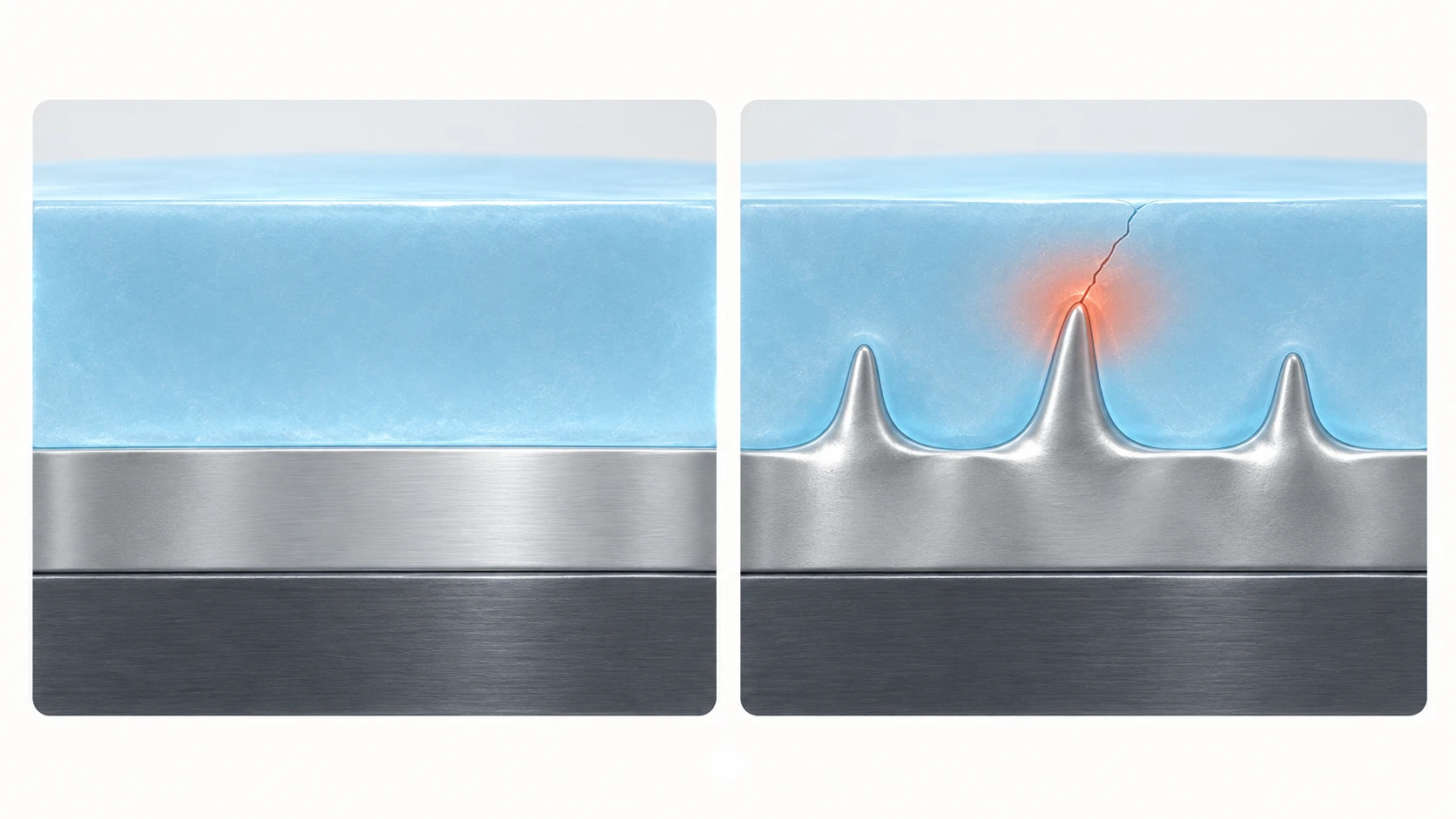
- Ideal: lithium deposits uniformly and the interface remains intact
- Risk: local protrusions concentrate current and stress and may lead to cracking or short circuit
The premise that a solid electrolyte is hard, so it can stop dendrites, is coming apart. A ceramic with more than seven times the shear modulus of Li still shorted. And in 2026, two reports arrived in quick succession: that the branches are not a soft metal but brittle needles, and that they start inside the electrolyte.
2. Why anyone still wants to use lithium metal
If it is that dangerous, why not simply avoid it? Because of energy density.
| Item | As the published material puts it |
|---|---|
| The ceiling for today's lithium-ion batteries | For a LIB combining lithium cobalt oxide with graphite, about 250 Wh kg⁻¹ is considered the ceiling |
| With a lithium metal anode | Using Li metal at the anode allows an energy density of 300 to 500 Wh kg⁻¹, beyond the LIB |
| Theoretical capacity | Li metal has a theoretical capacity an order of magnitude larger than graphite |
| Potential | The redox potential of Li is the most negative of any single element in the periodic table |
| Conclusion | Li metal can be called the ultimate anode active material |
All Sourced (review in Oyo Buturi vol. 89 no. 4 (2020) [Source 1]).
Put the two published numbers togetherOur calculation.
- 500 Wh/kg divided by 250 Wh/kg = 2.0 times
- 300 Wh/kg divided by 250 Wh/kg = 1.2 times
- Assumption: for an EV with a 500 km range, if the battery mass and everything else stay the same, that is 600 to 1,000 km
Assumptions and limits: the 250 Wh/kg is the ceiling for the LiCoO2 and graphite combination, and the 300 to 500 Wh/kg is what is described as expectedSourced. Neither is an achieved figure. And the conversion into range is a plain proportionality that holds efficiency, vehicle mass and everything outside the battery constant.
A graphite anode is a material that takes lithium ions in and out between the layers of its crystal. So the mass and volume of a container for holding the lithium are always needed.
With a lithium metal anode that container disappears. And in the design called anode-free, the cell is manufactured with no anode, with the anode created in place on the first charge. QuantumScape describes its own design as one in which the battery is manufactured anode free in a discharged state, and the anode forms in situ on the first chargeSourced.
The anode disappears from the bill of materials as a component. That is not a substitution of material but a change in the parts structure itself. The reason companies keep attacking a phenomenon as awkward as the dendrite is that the prize is that large (our commentary).
3. The prediction that a hard solid electrolyte would stop it
The hope placed in solid electrolytes was originally mechanical.
Because an inorganic solid electrolyte is a sufficiently hard material compared with a polymer or Li metal, it is expected to serve as a separator in its own right and to prevent the growth of Li.Sourced
And there was theoretical backing: on the basis of theoretical calculation, Monroe and Newman predicted that if the separator has a shear modulus more than about twice that of Li (about 4 GPa), dendrite growth of Li can be stopped.Sourced (Oyo Buturi vol. 89 no. 4 (2020))
| Material | Shear modulus | If the prediction held |
|---|---|---|
| Lithium metal | about 4 GPa | — |
| Threshold from theory | about 8 GPa (about twice Li) | Above this it should stop |
| Sulfide glass (Li2S-P2S5) | 6 to 8 GPa (sulfides are generally below 10 GPa) | Just short of it |
| LLZ (garnet-type oxide) | over 30 GPa | Should stop it comfortably |
All figures are Sourced (review [Source 1]). The right-hand column is this article's framing of what the prediction implies.
4. The prediction failed — a 30 GPa material pierced by a soft metal
Here is what happened.
On sulfides: when Nagao and co-workers plated Li on the surface of a Li2S-P2S5 sulfide glass electrolyte, they observed columnar Li penetrating the electrolyte and shorting it.Sourced
On LLZ: research in the last few years, in which Li is repeatedly plated and stripped at the Li/LLZ interface, has been reported by many researchers to short-circuit even LLZ, and it is coming to be recognised that the Monroe and Newman theory does not apply.Sourced
A shear modulus above 30 GPa is ordinary engineering-ceramic territory. Lithium is about 4 GPa. More than a sevenfold difference, and it is still piercedSourced.
What that says is that this is not a hardness contest between material A and material B. If it were, the ratio of hardnesses would settle the outcome.
The review itself lists this as an open problem: understanding is vague as to why a material with as high a shear modulus as LLZ is pierced by a metal as soft as LiSourced.
There are areas where laying out property values and designing from them simply does not work — and that is far from unusual in materials development. Bulk property values do not explain what happens locally (our commentary).
5. What is actually happening — the trigger was a void
So what does happen? The review sets out the process currently thought to be at work. It is presented as a hypothesis: the text says the process leading to a short circuit is thought to be as followsSourced.
A hypothesized path to short circuit
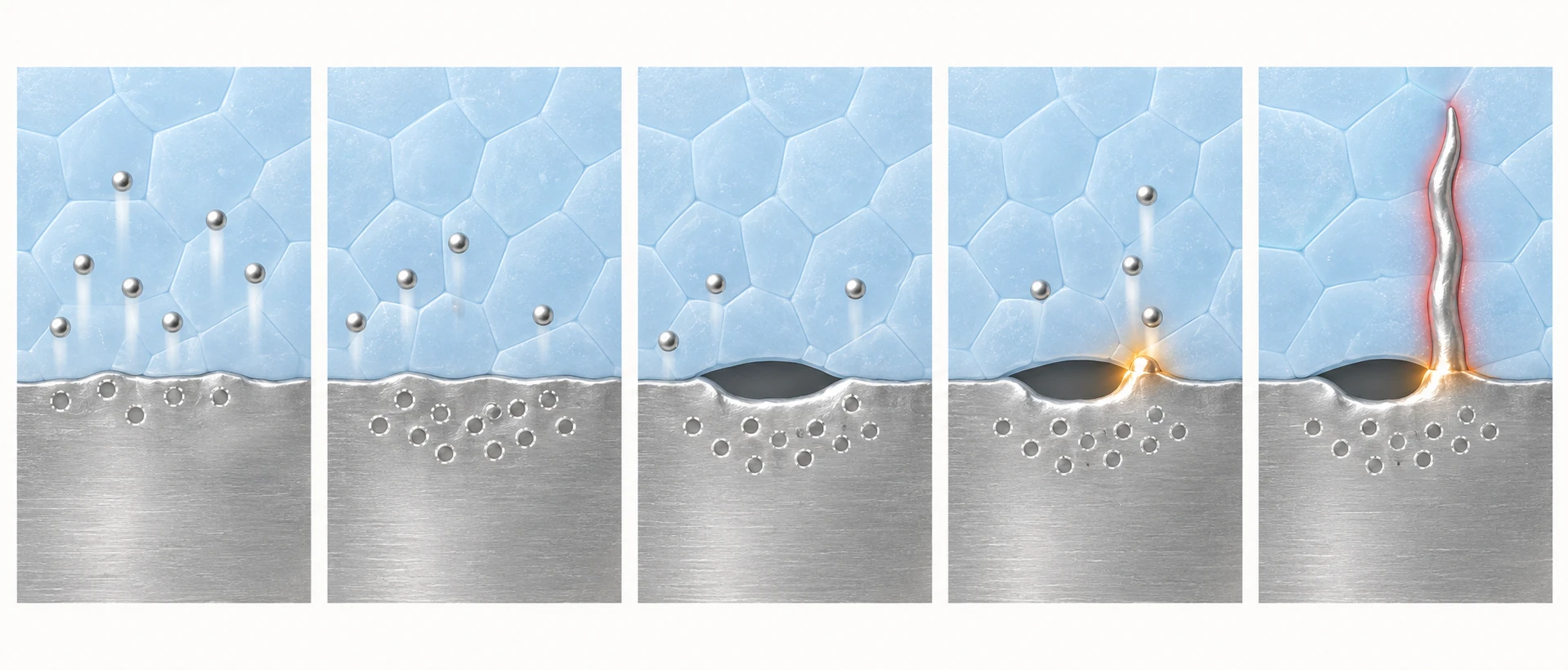
- Discharge: Li dissolves and leaves atomic vacancies
- Vacancies that cannot diffuse away accumulate near the interface
- An interfacial void opens and reduces effective contact area
- Current concentrates at the remaining contact and overvoltage rises
- On the next charge, plating focuses at one point and local stress can cause penetration and short circuit
Dendrites grow during charging. Yet the review places the trigger on the discharge side.
As Li dissolves, voids form and the effective interfacial area decreases, which locally increases the current density of the dissolution reaction — and the short circuit occurs, rather, in the plating immediately afterwardsSourced.
In other words: discharge punches holes in the interface, and the next charge concentrates current on the contact points that remain.
6. Our calculation: why a void opens at the interface
What does "vacancies pile up faster than they can escape" amount to? Use the figures given in the review to check the order of magnitude.
AssumptionsOur calculation
- The self-diffusion coefficient of lithium is 8×10⁻¹¹ cm²/s at room temperature (as given in the review)Sourced
- Take the guide to how far diffusion carries them as L = √(D t)
- Take the areal capacity of the electrode as 3 mAh/cm²
- Take the density of lithium as 0.534 g/cm³, its atomic mass as 6.94 and the Faraday constant as 96,485 C/mol
Working
- How far a vacancy can move in one hour (3,600 s): √(8×10⁻¹¹ × 3,600) = about 5.4×10⁻⁴ cm = about 5.4 µm
- In ten minutes (600 s): about 2.2×10⁻⁴ cm = about 2.2 µm
- The thickness lost when 3 mAh/cm² of lithium is stripped: 3 mAh = 10.8 C, so 10.8 divided by 96,485 = 1.12×10⁻⁴ mol, × 6.94 g/mol divided by 0.534 g/cm³ = 1.46×10⁻³ cm³, giving about 14.5 µm
An hour strips 14.5 µm while vacancies can move only 5.4 µm. The difference stays near the interface. That is thought to be the entrance to void formation.
Assumptions and limits: √(D t) is a guide to the order of magnitude of a diffusion distance; real vacancy behaviour depends strongly on the stress field, grain boundaries and surface condition. The areal capacity of 3 mAh/cm² is our own assumption. This calculation checks the direction of the mechanism; it does not predict the life or the critical current density of any particular cell.
7. A materials engineer's view (1): for lithium, room temperature is hot working
One sentence in the review is written almost in passing, and it is the key to how this material behaves.
The melting point of Li is 181 °C, so room temperature is already, in absolute terms, above half the melting point. At such temperatures, grain-boundary diffusion of atoms and motion of dislocations become active, and strain increases with time under a constant stress even below the yield stress (creep deformation).Sourced
In materials engineering, the ratio of temperature to melting point in absolute terms is called the homologous temperature. Work out lithium's, then find the temperature that gives the same ratio in another metalOur calculation.
- Assumption: room temperature 25 °C (298 K) and the melting point of lithium 181 °C (454 K), the melting point being the review's value
- 298 K divided by 454 K = about 0.66
- Assumption: the melting point of iron as 1,538 °C (1,811 K), a widely known property value taken as an assumption here with no source link
- 1,811 K × 0.66 = about 1,190 K = about 920 °C
Room temperature for lithium corresponds to iron glowing red at close to 1,000 °C.
Assumptions and limits: equal homologous temperature does not make creep behaviour identical between metals. This is a conversion for intuition, not a claim that iron and lithium behave alike.
For a metals engineer, creep belongs to high-temperature design: turbines, boilers, furnaces. Worrying about creep at room temperature almost never happens.
In a lithium metal anode, room temperature is already the creep regimeSourced. That carries two meanings.
- The bad side: a cell sitting on a shelf under stress keeps changing shape. The assumption that nothing happens in storage does not hold
- The good side: apply pressure and the lithium flows and fills the voids, with no heating at all
Indeed, the review states that raising cell pressure or temperature accelerates the deformation of Li and promotes the disappearance of voids, and several groups including the authors have reported that short circuits are suppressed as a resultSourced.
All-solid-state cells are designed around being clamped because they are using this property. Clamping is not only to keep things in contact but to keep creep working and the voids filled as they appear — read that way, the design requirements for the clamping mechanism change (our commentary).
8. Two things learned in 2026
(1) The branches start inside the electrolyte
In July 2026, SLAC National Accelerator Laboratory announced results from a paper published in NatureSourced. The team showed that dendrites form at internal defects within the electrolyte rather than at its surface, settling a long-running argument in the fieldSourced.
They also placed a shape-memory alloy ring around the solid electrolyte and heated it to 170 degrees Celsius so that it shrank down to compress the batterySourced. Under compression, dendrites still formed during charging, but they spread horizontally instead of verticallySourced.
(2) The branches were not soft. They were brittle needles
In March 2026, Rice University announced results from a paper published in ScienceSourced. Lithium dendrites exhibit unexpectedly high strength and brittle behavior under mechanical stress — they did not behave like bulk lithiumSourced.
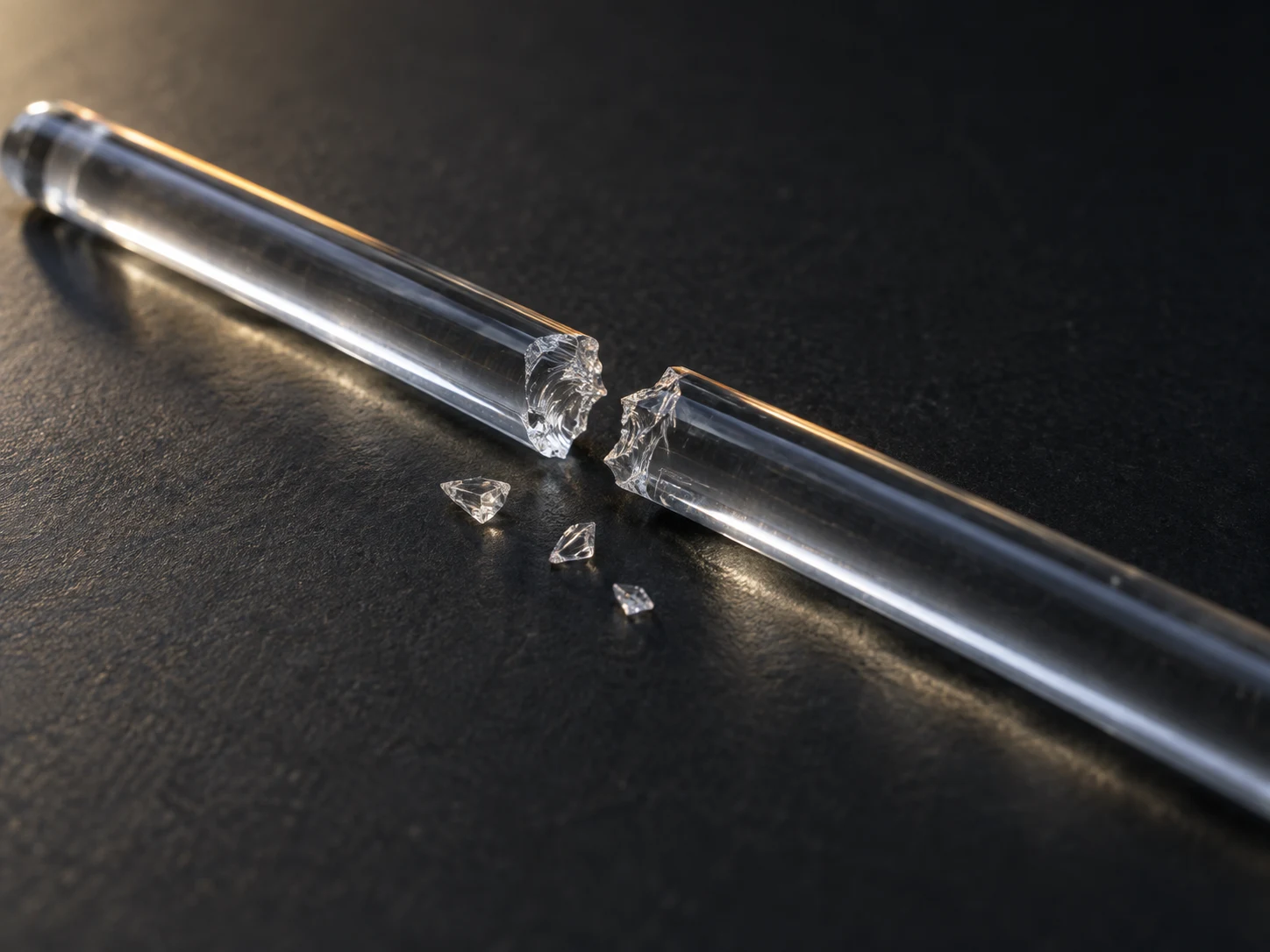
The cause given is the SEI (solid electrolyte interphase) shell. The very thin SEI covering the dendrite enhances their structural rigidity and prevents the dendrites' lithium core from deforming plasticallySourced. The University of Houston release puts it as having proven they are actually brittle and snap like glassSourced.
The Monroe and Newman theory in Section 3 rested on the premise that lithium is a soft metal. If something soft pushes something hard, the soft one gives way — hence, a hard electrolyte should stop it.
But the 2026 reports state that the mechanical properties of a dendrite differ from those of bulk lithiumSourced. The surface SEI becomes a shell and stops the core deforming plastically. Not a soft metal but a hard, brittle composite.
Anyone who works with composites knows the picture. Put a thin hard coating on a slender core and the apparent strength rises while ductility disappears. Something of exactly that kind had been growing inside the cell, unintended (our commentary).
Put that alongside SLAC's result that the starting point is a defect inside the electrolyte, and the target for countermeasures moves. However well you finish the surface, an internal defect starts it anyway. SLAC's announcement likewise gives as design directions electrolytes with fewer internal defects and designs that build in mechanical compression from the outsetSourced.
9. How far the countermeasures have come
| Approach | What it does | Published result | Source |
|---|---|---|---|
| An alloy layer at the interface | Deposit a thin film of a metal that alloys with Li on the LLZ surface to improve wetting | It works, but after hundreds or thousands of plating and stripping cycles it disappears from the interface into the bulk Li, so it cannot be an essential solution | Review (2020) |
| Removing the damaged layer | Remove the defect-rich damaged layer left by polishing, by immersion in aqueous hydrochloric acid | Wettability to molten Li improved and the cycling stability of the Li metal anode improved dramatically | Review (2020) |
| Heat and pressure | Raise cell pressure and temperature so that creep in the Li fills the voids | Several groups including the authors have reported that the disappearance of voids is promoted and short circuits suppressed | Review (2020) |
| Compression from outside | Place a shape-memory alloy ring around the electrolyte and heat it to 170 °C so that it shrinks and compresses | Dendrites still form, but they spread horizontally instead of vertically. The batteries still worked after thousands of charge cycles | SLAC National Accelerator Laboratory (August 2026) |
| Changing the electrolyte | Use monoclinic LiAlCl4 (a chloride) and form it by cold pressing alone | Relative density 94% with solid-to-solid resistance at 7.5% (against 63% and 99.9% for the garnet-type oxide). Stable cycling over 70 cycles | Nagoya Institute of Technology and others (June 2020) |
All Sourced (review [Source 1], SLAC [Source 4], Nagoya Institute of Technology [Source 3]).
What stands out in the Nagoya Institute of Technology announcement is reaching 94% relative density through a simple, low-environmental-impact process of cold pressing aloneSourced.
The garnet-type oxide given for comparison had a relative density of 63% with solid-to-solid resistance at 99.9% of the totalSourced. In other words, almost all of the resistance was between the grains.
Of the chloride ion, the announcement states that it has a low charge density and a weak Coulomb interaction with the lithium ion, and that since its polarisability is also high, the particles can be expected to deform under pressureSourced.
Not stopping it with hardness, but bringing things into contact through ease of deformation. That is the opposite direction from the "hard enough will stop it" thinking of Section 3. Sulfides, too, were chosen for softness. In this field, situations where deformability beats hardness keep recurring (our commentary).
10. A materials engineer's view (2): there is still no yardstick for comparison
Having lined up the countermeasures, there is in fact no way to compare how much each of them achieved. The review says so plainly.
There is no unified metric for evaluating the cycling characteristics of a Li metal anode. The magnitude of the critical current density that induces a short circuit, the number of cycles before a short, the charge passed in one cycle, the cumulative charge and so on all differ between papers, and these factors are all mutually dependent. The effect of each approach should therefore be discussed across several evaluation axes.Sourced
That sentence changes how published data should be read.
- "1,000 cycles achieved" — without how much lithium was moved each time, there is nothing to compare
- "Critical current density of X mA/cm²" — if the charge per cycle is small, the same current density shorts less readily
- These are explicitly stated to be all mutually dependentSourced
The table in Section 9 puts "70 cycles" and "thousands of cycles" side by side, but they cannot be set against each other as better or worse. The materials differ, the charge per cycle differs, the temperature and pressure differ.
In materials development this situation — competition starting before the metric settles — is not unusual. What works then is not chasing other companies' numbers but fixing your own evaluation conditions and varying one factor at a time (our commentary).
11. What is still hard
(1) Complete suppression has not been reached
The review states that every approach reported so far has shown some effect, but none has achieved complete suppression of short circuitsSourced. The two 2026 reports (internal defects as the origin, and brittle needles) advanced the understanding of the mechanism, but at the time of writing (September 2026) no primary source claiming complete suppression of dendrite-induced short circuits could be foundNot yet confirmed.
(2) It cannot even be found
The review explains why elucidating the mechanism has been so hard: the atomic number of Li is only 3, so finding and detecting Li that is threading its way through LLZ along some unknown, minute crack is difficult. Direct evidence for the above hypothesis is therefore hard to obtain, and that is the main factor making elucidation of the short-circuit mechanism so difficult.Sourced The 2026 reports improved that situation greatly, but the same observation cannot be made inside a production cell (our commentary).
(3) No data from production products is published
QuantumScape lists resistance to dendrite formation by its ceramic separator as a feature of its technology, and reports that a 24-layer A0 prototype cell achieved more than 95% energy retention over the equivalent of more than 1,000 charge-discharge cyclesSourced. Its commercial target for energy density is 800 to 1,000 Wh/LNot yet confirmed. But these are prototype results and targets, not a confirmed record for a production product. No quantitative data from production products showing dendrite suppression could be found in published primary sources for this article.
- The theory that a hard electrolyte would stop it did not hold in practice. Even LLZ, above 30 GPa, shortsSourced
- The trigger is thought to be the void left by the discharge before, not the charge itselfSourced
- An hour strips 14.5 µm while vacancies escape only 5.4 µm. The difference stays at the interfaceOur calculation
- For lithium, room temperature is the creep regime, equivalent to about 920 °C for ironOur calculation, so pressure makes it flow and fill voidsSourced
- In 2026, the starting point of the branches was reported to be defects inside the electrolyteSourced
- In the same year, the branches were reported to be brittle needles in an SEI shell rather than a soft metalSourced
- There is still no unified metric for comparisonSourced
12. Glossary
- Dendrite
- Lithium metal plating out in branches during charging, also called tree-branch growth.
- Short circuit
- Cathode and anode in contact. A large current flows and Joule heat is generated.
- Shear modulus
- A measure of stiffness against shear, in GPa. The quantity used in the theory of dendrite suppression.
- LLZ (LLZO)
- The garnet-type oxide solid electrolyte Li7La3Zr2O12, with a shear modulus above 30 GPa.
- Atomic vacancy
- A lattice site with its atom missing. Created when lithium dissolves.
- Void
- A gap at the interface. It reduces the effective contact area and concentrates current locally.
- Critical current density
- The current density above which a short is said to occur. Its value depends on the test conditions.
- Creep deformation
- Strain that grows with time under constant stress, even below the yield stress.
- Homologous temperature
- Temperature as a fraction of the melting point in absolute terms, used to compare high-temperature behaviour.
- SEI
- Solid electrolyte interphase. The thin layer formed by reaction between electrolyte and anode, which also becomes the shell of a dendrite.
- Anode-free
- Building the cell with no anode and forming one in place on the first charge.
- Relative density
- Actual density as a fraction of theoretical density, describing how tightly a compact is packed.
13. Primary sources
- Soshu Motoyama, Takayuki Yamamoto and Yasutoshi Iriyama (Nagoya University) "Elucidating the short-circuit mechanism of solid electrolytes towards higher performance in all-solid-state Li batteries", Oyo Buturi vol. 89 no. 4 (2020) 213-217 (PDF, Japanese-language page) — jstage.jst.go.jp
- QuantumScape "Solid State Battery Technology", technology page — quantumscape.com
- Nagoya Institute of Technology "A new material for safe, high-capacity all-solid-state lithium batteries: a new chloride solid electrolyte effective at suppressing lithium metal short circuits points the way to safe automotive cells", 23 June 2020 (Japanese-language release) — nitech.ac.jp
- SLAC National Accelerator Laboratory "Giving solid-state batteries a squeeze keeps them from short-circuiting", 28 August 2026 — slac.stanford.edu
- Rice University "Thorny issue plaguing lithium-ion batteries laid bare in new study", 12 March 2026 — news.rice.edu
- University of Houston "UH Research Reveals Lithium Dendrites Cause Battery Safety Risks", 8 April 2026 — uh.edu
- Tohoku University "Interface between lithium metal and a garnet-type oxide solid electrolyte formed at room temperature in a short time", 24 March 2026 (Japanese-language release) — tohoku.ac.jp
14. Claim-to-source audit
| Claim in the text | Basis | Label |
|---|---|---|
| That there would be no problem if Li plated smoothly but in practice it grows as protrusions (dendrite growth); that with repeated cycling the Li grows towards the cathode, eventually touches it and causes a short; that a short passes a large current and generates Joule heat; that Li metal anodes are at present used only in primary batteries; that the LIB ceiling is about 250 Wh kg⁻¹ and that 300 to 500 Wh kg⁻¹ can be expected with a Li metal anode; that Li metal has a theoretical capacity an order of magnitude larger than graphite, the most negative redox potential of any single element, and can be called the ultimate anode active material; that an inorganic solid electrolyte is hard enough to act as a separator and was expected to prevent Li growth; the Monroe and Newman prediction about twice the shear modulus of Li (about 4 GPa); the shear moduli of sulfide glass (6 to 8 GPa) and LLZ (over 30 GPa); the observation of columnar Li penetrating a Li2S-P2S5 glass electrolyte; that many researchers report even LLZ shorting and that the Monroe and Newman theory is coming to be seen as inapplicable; that understanding is vague as to why such a hard material is pierced by such a soft metal; the hypothesised process from dissolution to vacancies, voids, current concentration and piercing; the self-diffusion coefficient of 8×10⁻¹¹ cm²/s; the melting point of 181 °C and the account of creep; that raising cell pressure or temperature suppresses short circuits; the alloy layer and damaged-layer removal countermeasures; the statement that no approach has achieved complete suppression; the statement that there is no unified metric and that the factors are mutually dependent; and the difficulty of detecting Li because its atomic number is 3 | Review, Oyo Buturi vol. 89 no. 4 (2020)[Source 1] https://www.jstage.jst.go.jp/article/oubutsu/89/4/89_213/_pdf | Sourced |
| That the QuantumScape ceramic separator is described as meeting high conductivity, stability to lithium metal, resistance to dendrite formation and low interfacial impedance; that the design is anode-free, with the battery manufactured anode free in a discharged state and the anode forming in situ on the first charge; and that a 24-layer A0 prototype cell achieved more than 1,000 full charge-discharge cycle equivalents with more than 95% energy retention | QuantumScape technology page[Source 2] https://www.quantumscape.com/battery-technology/ | Sourced |
| That QuantumScape's commercial target for energy density is 800 to 1,000 Wh/L, this being a target rather than a production record | QuantumScape technology page (a value the company presents as a commercial target)[Source 2] https://www.quantumscape.com/battery-technology/ | Not yet confirmed |
| That with monoclinic LiAlCl4 a simple, low-environmental-impact process of cold pressing alone suppressed the short-circuit phenomenon that is the problem with lithium metal anodes; that it has a high relative density of 94% with an almost negligible (7.5%) solid-to-solid resistance, against 63% and 99.9% for the garnet-type oxide; that stable cycling was achieved over 70 cycles; that the chloride ion has a low charge density with weak Coulomb interaction with the lithium ion and high polarisability so that particles can be expected to deform under pressure; and the announcement date of 23 June 2020 with publication in ACS Materials Letters | Nagoya Institute of Technology press release, 23 June 2020[Source 3] https://www.nitech.ac.jp/news/press/2020/8406.html | Sourced |
| That dendrites form at internal defects within the electrolyte; that a shape-memory alloy ring heated to 170 degrees Celsius shrank down to compress the battery; that under compression dendrites still formed during charging but spread horizontally instead of vertically; that after thousands of charge cycles and the formation of many internal dendrites the batteries still worked; and that the paper appeared in Nature | SLAC National Accelerator Laboratory news, 28 August 2026[Source 4] https://www6.slac.stanford.edu/news/2026-08-28-giving-solid-state-batteries-squeeze-keeps-them-short-circuiting | Sourced |
| That lithium dendrites exhibit unexpectedly high strength and brittle behavior under mechanical stress; that the SEI coating enhances their structural rigidity and prevents the dendrites' lithium core from deforming plastically; that bulk lithium is soft and ductile; that snapping produces dead lithium; and that the paper appeared in Science on 12 March 2026 | Rice University news, 12 March 2026[Source 5] https://news.rice.edu/news/2026/thorny-issue-plaguing-lithium-ion-batteries-laid-bare-new-study | Sourced |
| That dendrites are unexpectedly strong and brittle and have been proven to be actually brittle and snap like glass; that operando SEM observed lithium dendrites actually snapping in real time within operating solid-state cells; and that they measure just hundreds of nanometers | University of Houston news, 8 April 2026[Source 6] https://www.uh.edu/news-events/stories/2026/april/04082026-lithium-battery-weakness.php | Sourced |
| That an insulating lithium carbonate layer (Li2CO3) forming on the LLZ surface is a cause of high interfacial resistance | Tohoku University press release, 24 March 2026[Source 7] https://www.tohoku.ac.jp/japanese/2026/03/press20260324-02-Lithium.html | Sourced |
| Putting 500 divided by 250 at 2.0 times and 300 divided by 250 at 1.2 times; converting a 500 km range into 600 to 1,000 km; putting the distance a vacancy moves in an hour at √(8×10⁻¹¹ × 3,600) = about 5.4 µm and in ten minutes at about 2.2 µm; putting the thickness of 3 mAh/cm² of lithium at about 14.5 µm; computing 298 K divided by 454 K = about 0.66 and 1,811 K × 0.66 = about 920 °C; and stating that LLZ has more than seven times the shear modulus of Li | Our calculation. The areal capacity of 3 mAh/cm², lithium density 0.534 g/cm³, atomic mass 6.94, Faraday constant 96,485 C/mol, room temperature 25 °C and melting point of iron 1,538 °C are all assumptions set by this article, being general property values and assumptions without source links | Our calculation |
| Specific values of strength or elastic modulus for the dendrites themselves | The qualitative statements of unexpectedly high strength and brittleness were confirmed, but no specific figures could be found in published primary sources within the scope of this article, so none are given | Commentary |
| Any result claiming complete suppression of dendrite-induced short circuits, and quantitative data on dendrite suppression in production products | Neither could be found in published primary sources at the time of writing (September 2026) by this article, so neither is stated. The QuantumScape figures are prototype results and targets | Not yet confirmed |
| Detailed conditions such as current density and temperature in the Nagoya Institute of Technology 70-cycle test | No specific charge-discharge conditions could be confirmed in the announcement, so no conditions are stated here | Commentary |
| Grouping the countermeasures into five; the reading that bulk property values do not explain what happens locally; the framing that the anode disappears from the bill of materials; the observation about designing for creep at room temperature and the reading that clamping also serves to keep the voids filled; reading the SEI shell as a composite of a slender core with a hard coating; the framing that deformability beats hardness in recurring situations; and the suggestion to fix the evaluation conditions and vary one factor at a time | Our summary and commentary based on published content. Not views expressed by the institutions | Commentary |
| That Figs. 1, 2, 3, 4, 6 and 7 are explanatory concepts rather than real observations or design drawings, and that the hero image and Figs. 1, 3 and 5 are AI-generated, Fig. 5 being a metaphor for brittle snapping rather than a dendrite itself | Our note | Commentary |
Last updated 21 September 2026. Sources are limited to primary material (a review in a peer-reviewed journal, official announcements from universities and national laboratories, and company technology pages). Because the article includes structural readings and materials-design interpretations, those are marked as Commentary and kept separate from sourced fact. Specific strength values for dendrites, any result achieving complete suppression of short circuits, and quantitative data from production products are not stated here because no published primary source could be confirmed. The process in Section 5 is a hypothesis that the source itself describes as what is thought to happen, not an established mechanism. All figures are explanatory concept graphics. Figs. 2, 4, 6 and 7 are vector drawings; the hero image and Figs. 1, 3 and 5 are AI-generated images, and none of them shows a real observation, micrograph or physical product.