TECHNOLOGY EXPLAINER
Dry Electrodes
— not that you choose to skip the solvent, but that you cannot use one
For decades electrodes have been made by mixing materials into a solvent, coating them and drying them. All-solid-state batteries break that. Sulfide solid electrolytes react with water. Solvents have to be guaranteed below 30 ppm of moisture, and drying ovens run 50 to 100 m long. So get rid of the solvent altogether — that is the dry electrode.
- What a dry electrode is (the short version)
- What the conventional wet process actually does
- Why solid-state cells go dry — sulfides and water
- Our calculation: what 30 ppm of water in the solvent means
- How a dry electrode takes shape — fibrillating PTFE
- A materials engineer's view (1): the binder stops being glue and becomes a skeleton
- What going dry buys you, and what remains hard
- A materials engineer's view (2): lose the drying oven and the factory changes shape
- What industry is doing, and what is still open
- Glossary / Primary sources / Claim-to-source audit
Sourced = a value stated in published material from a research institute or manufacturer (link given)
Our calculation = a figure this article derived, with the assumptions spelled out
Not yet confirmed = a plan or a target with no confirmed production record
Structural readings and materials-design interpretations are marked separately as Commentary.
1. What a dry electrode is (the short version)
A dry electrode is an electrode made by putting the materials onto metal foil as powder, with no solvent.
- What the method is: Toyota Central R&D Labs describes it as making the electrode by applying the materials to metal foil as powder, without using a solventSourced
- What was done before: according to Daikin Industries' technical column, the conventional route uses an organic solvent, NMP (N-methyl-2-pyrrolidone), and because the drying temperature is high, at 120-130 °C, the drying step consumes a lot of energySourced
- What you gain: the same column defines the dry process as a method that does not build the electrode by coating and uses no liquid, neither water nor organic solvent, so solvent drying and recovery both disappearSourced
Dry electrodes matter for all-solid-state batteries not because of decarbonisation or cost reduction first. Sulfide solid electrolytes react with water, release hydrogen sulfide and lose ionic conductivity badlySourced. That leaves an extremely narrow choice of solvent. It is less that you decline to use one than that you can barely use one. The environmental and cost benefits then follow as a consequence.
2. What the conventional wet process actually does
Wet process versus dry process
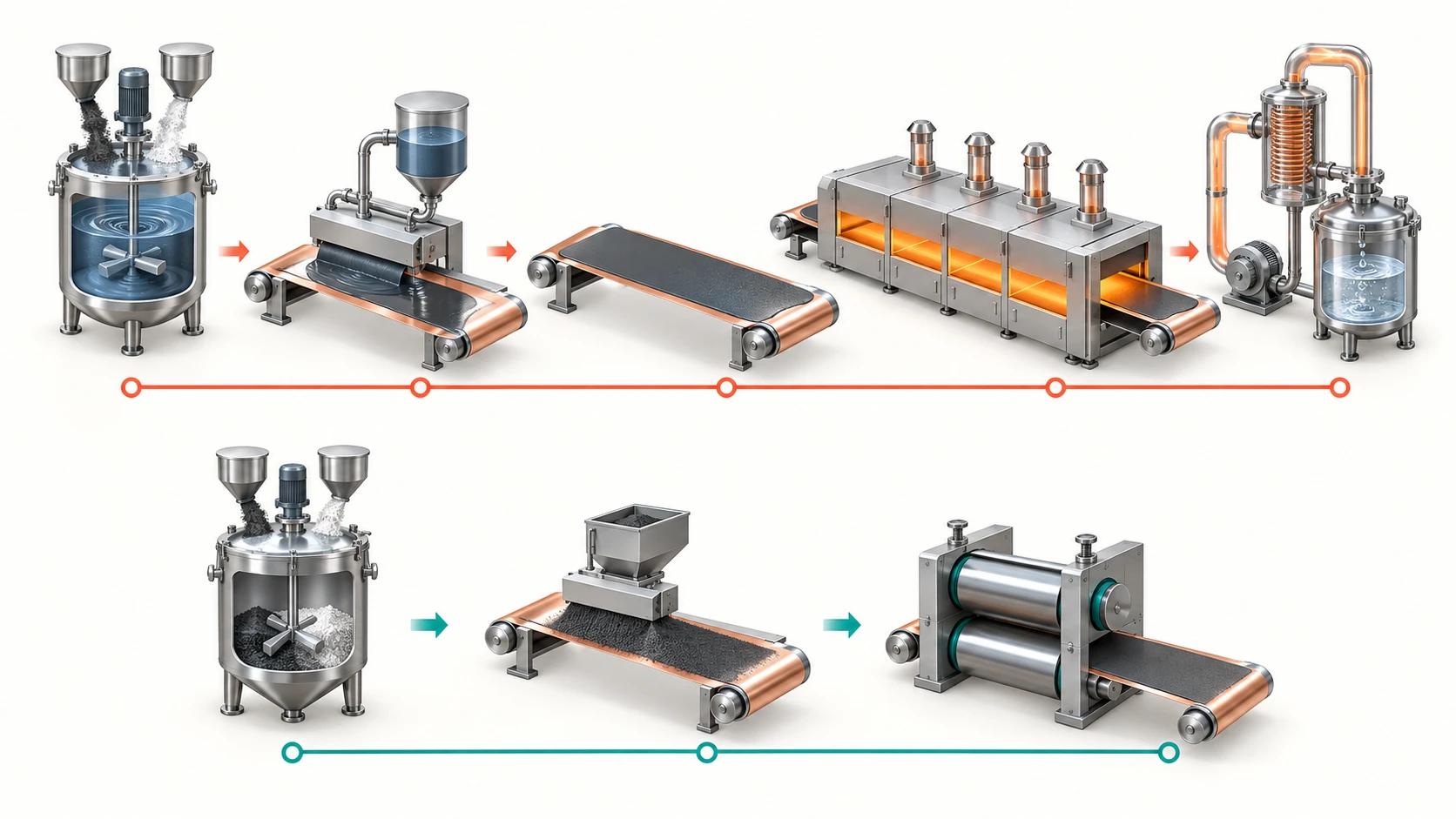
- Wet: a longer route including mixing, coating, drying and solvent recovery
- Dry: blend powder, form directly and compact; no drying or solvent recovery
| Item | As Daikin Industries' technical column puts it |
|---|---|
| Solvent used | Uses an organic solvent, NMP (N-methyl-2-pyrrolidone) (the binder being PVdF) |
| Drying temperature | Because the drying temperature is high, at 120-130 °C, the drying step consumes a lot of energy |
| Boiling point of NMP | A boiling point of 204 °C |
| Building requirement | NMP is flammable, so the factory building must be explosion-proof |
| Recovery equipment | NMP recovery equipment and recovery costs are required |
| Electrode thickness | The active material layer is 50 to 100 µm on one face |
| What the dry process is | A method that does not build the electrode by coating and uses no liquid, neither water nor organic solvent |
All Sourced (Daikin Industries technical column [Source 1]).
3. Why solid-state cells go dry — sulfides and water
This is the heart of the article. Dry electrodes for ordinary lithium-ion cells are usually discussed in terms of decarbonisation and cost, but in all-solid-state cells the reason is far more direct.
Sulfide solid electrolytes have a serious problem with stability in air. Exposed to the atmosphere they react with moisture to generate toxic hydrogen sulfide (H2S), and their ionic conductivity falls sharply. For this reason an inert, moisture-free atmosphere is essential for fabricating sulfide-type all-solid-state batteries, and this is a cause of increased process cost.Sourced
In other words, water as a solvent is off the table from the start. Would an organic solvent do? A second constraint appears here.
The company offers solvents for process development of sulfide-based all-solid-state batteries, listing low-moisture-guaranteed grades for coating-process workSourced. Every one of them is specified at 30 ppm of water or lessSourced.
| Solvent | Water content |
|---|---|
| n-Butyl n-butyrate | 30 ppm or less |
| Mesitylene | 30 ppm or less |
| Di-n-butyl ether | 30 ppm or less |
| Heptane (n-heptane) | 30 ppm or less |
All Sourced (Kishida Chemical [Source 4]).
4. Our calculation: what 30 ppm of water in the solvent means
30 ppm is a demanding specification by industrial standards. It is worth checking the order of magnitude of what it means for a sulfide system.
AssumptionsOur calculation
- Take the water in 1 kg of solvent as 30 ppm (= 30 mg), Kishida Chemical's guaranteed valueSourced
- Use the reaction given in the Osaka Metropolitan University report: Li6PS5Cl + 6H2O gives LiCl + Li3PO4 + 5H2S + 2LiOHSourced
- Take the molar mass of Li6PS5Cl as 268 g/mol, that of water as 18.0 g/mol, and the volume of one mole of gas as 22.4 L
Working
- 30 mg of water divided by 18.0 g/mol = 1.67×10⁻³ mol
- From the equation, 6 mol of H2O decomposes 1 mol of Li6PS5Cl, so 1.67×10⁻³ divided by 6 = 2.8×10⁻⁴ mol
- Solid electrolyte destroyed = 2.8×10⁻⁴ × 268 = about 75 mg
- Hydrogen sulfide produced = 1.67×10⁻³ × 5/6 = 1.39×10⁻³ mol, which at 22.4 L per mole is about 31 mL
Assumptions and limits: not all of the water necessarily reacts, and the report itself presents the reaction as a suggested possibilitySourced. These numbers are also not an assessment of hazard. They exist to give an order-of-magnitude sense of why a specification as tight as 30 ppm is sold as a product at all.
5. How a dry electrode takes shape — fibrillating PTFE
If you use no solvent, how does powder hold the shape of a film? The answer lies in how the binder is used.
PTFE fibrillates under shear, and the active material and conductive additive are caught up in those fine fibres to form a mass, which is then pressed into sheet formSourced (Daikin Industries technical column)
How a dry electrode takes shape
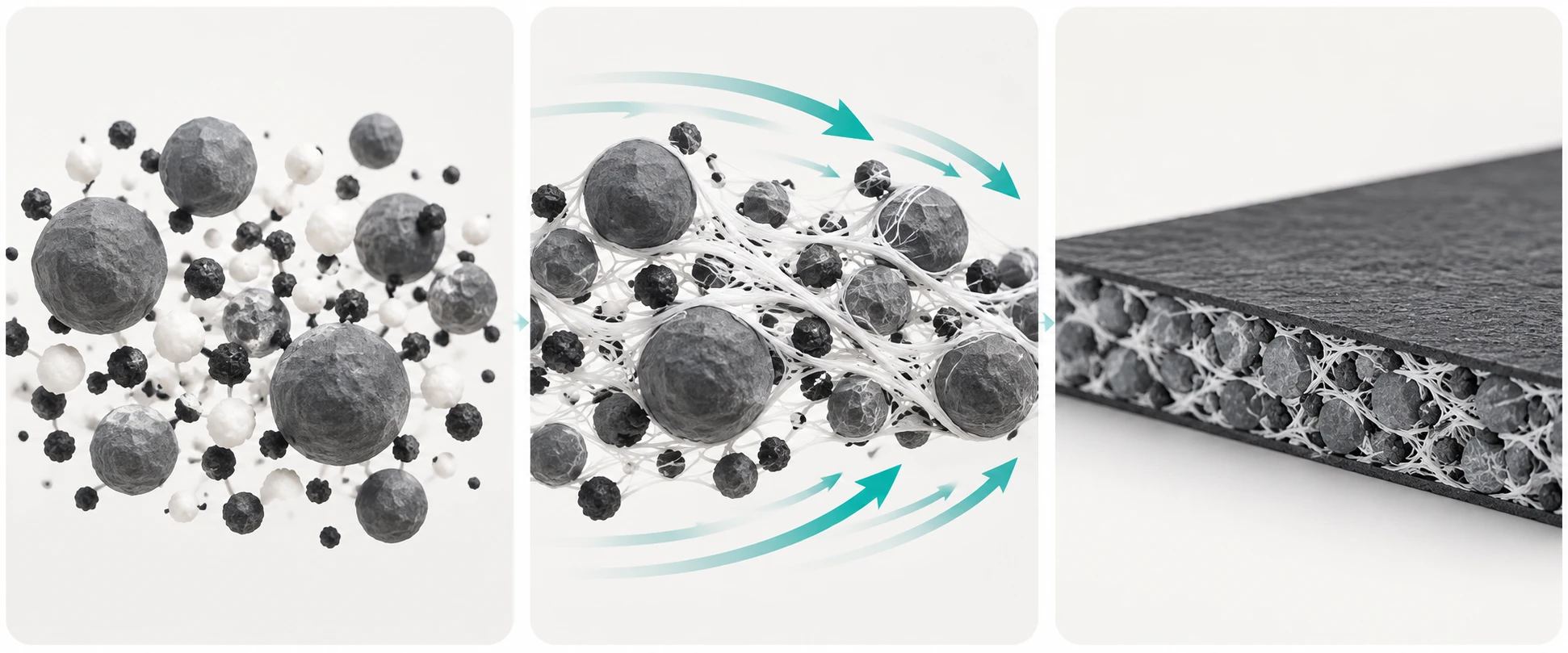
- Blend dry active material, conductive additive and PTFE powders
- Shear fibrillates PTFE into fine fibres that entangle the powders
- Press the bound mass into an electrode sheet without using solvent
6. A materials engineer's view (1): the binder stops being glue and becomes a skeleton
The wet-process binder (PVdF) dissolves in the solvent, spreads between the particles and sets as it dries. It works as glue.
The dry-process PTFE never dissolves. Shear draws it out into fibres, and those fibres entangle the powderSourced. That is not adhesion; it is restraint by a network.
In materials-design terms, the binder has moved from being an interface material to being a structural one.
- Wet: what counts is wetting and solubility — how it spreads over particle surfaces
- Dry: what counts is deformation behaviour under shear — how fine and how long it draws out
So binder development for dry electrodes is not a story about adhesion but about rheology and fibrillation. Mixer design, shear rate, temperature — the world of polymer processing (our commentary).
And in an all-solid-state cell there is one more condition. The electrode also contains solid electrolyte powder. What the fibres have to entangle is not just active material and conductive additive but solid electrolyte particles as well, and those particles only perform if they are compacted into close contact. The softness discussed in the Sulfide solid electrolyte article in this series pays off here too (our commentary).
7. What going dry buys you, and what remains hard
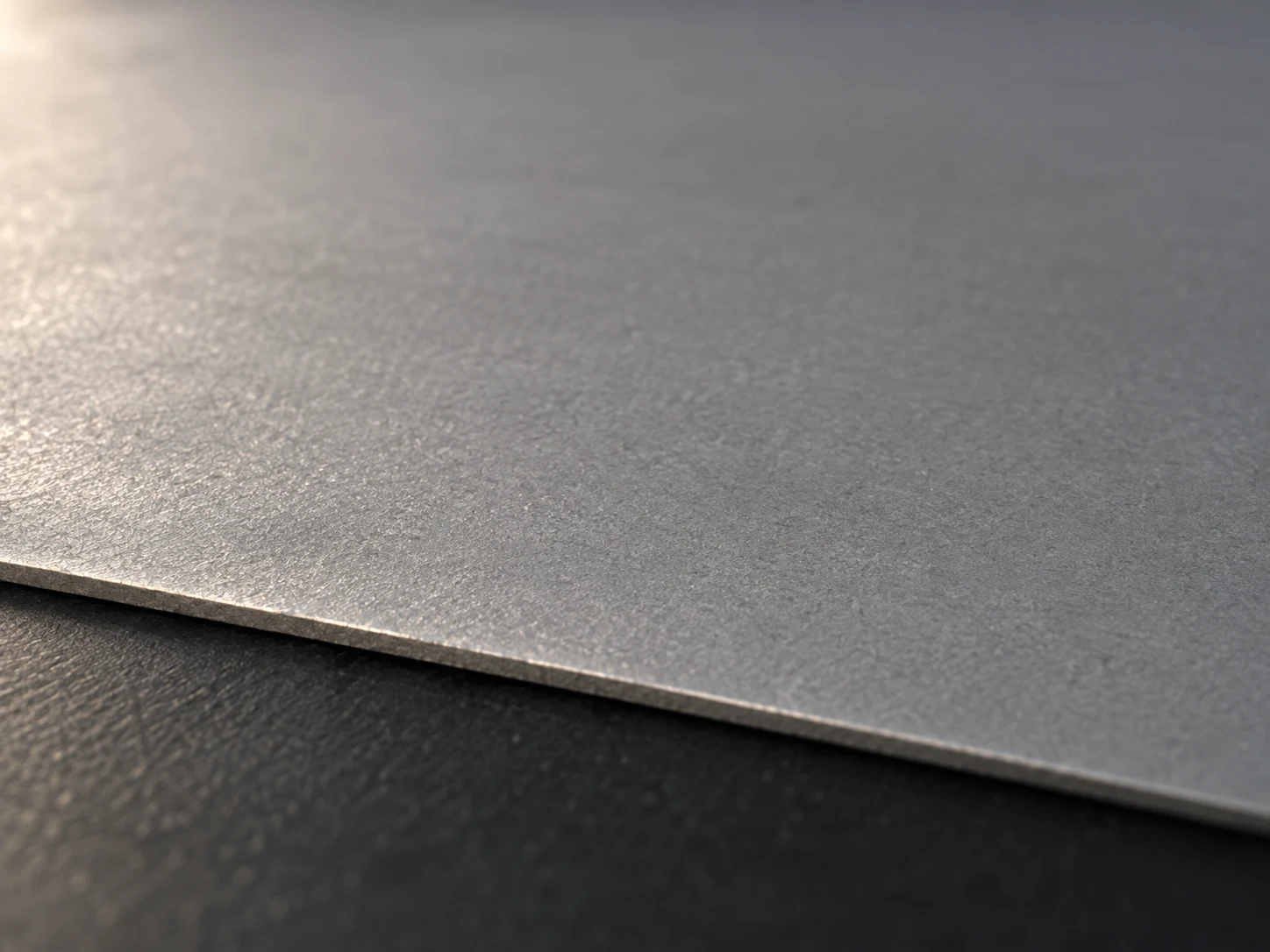
Of those open problems, the heaviest for a materials engineer is that thin electrode layers are hard to make. Having given the wet-process active material layer as 50 to 100 µm on one face, Daikin's column adds that sheeting active material down to that thinness is not straightforwardSourced.
8. A materials engineer's view (2): lose the drying oven and the factory changes shape
The benefit of a dry electrode is usually summarised as losing the drying step, but list what actually disappears and it becomes clear that this is about plant.
- The drying oven: equipment that drives off solvent continuously at 120-130 °CSourced
- The solvent recovery plant: equipment that recovers and reuses NMP, boiling point 204 °CSourced
- The explosion-proof building: required for handling flammable NMPSourced
Not one step on a line, but the specification of the building itself.
And for all-solid-state cells a second building requirement sits on top of it. As the Argyrodite article in this series shows, for sulfides an inert, moisture-free atmosphere is essential, and this is a cause of increased process costSourced.
So you need both an explosion-proof building and a dry one. Going dry offers the possibility of removing one of the two.
From a materials supplier's seat, that means the choice of binder decides the specification of the building. Choose PVdF with NMP and you need explosion protection; choose dry forming with PTFE and you do not. A material choice moves capital expenditure by an order of magnitude (our commentary).
One further remark from Toyota Central R&D Labs is suggestive. Dry film formation, it states, can create electrode structures different from those of conventional solvent-based methods, with the potential to raise cell performanceSourced. Going dry is not only about lowering cost; it changes the structure you end up with — and that may be the real argument.
9. What industry is doing, and what is still open
| Who | What was published | When |
|---|---|---|
| Toyota Central R&D Labs and Kyushu University | Announced that dry film formation, which makes the electrode by applying the materials to metal foil as powder without a solvent, can create electrode structures different from conventional solvent-based methods with the potential to raise cell performance, and that it contributes to establishing a new electrode film-forming process combining carbon neutrality with better cell performance (published in Journal of Power Sources) | 15 November 2023 |
| Nissan | Published a news release titled as an agreement on a partnership with LiCAP on process technology development for the cathode electrode of all-solid-state batteries | 19 August 2025 |
| Nissan | Expects roughly twice the energy density of conventional cells for its all-solid-state battery, and aims to bring an EV carrying its own all-solid-state battery to market by fiscal 2028Not yet confirmed | — |
| Kishida Chemical | Lists four low-polarity solvents guaranteed at 30 ppm of water or less for process development of sulfide-based all-solid-state batteries | — |
Toyota Central R&D Labs [Source 2], Nissan [Sources 5 and 6], Kishida Chemical [Source 4]. The body of the Nissan release is provided as a PDF that could not be read in this article's environment, so only its title and publication date are given.
(1) The quantitative effect of dry electrodes cannot be confirmed
Figures such as the percentage reduction in cost, in CO2 or in energy could not be found in the primary sources available within the scope of this article, so they are not stated. Daikin's technical column goes no further than the qualitative statement that CO2 emissions can be reducedSourced.
(2) Volume production with all-solid-state cells cannot be confirmed
At the time of writing (September 2026), no primary source confirming that volume production of all-solid-state batteries using dry electrodes has begun could be foundNot yet confirmed.
(3) "You go dry because you cannot use a solvent" is our own framing
Of the causal chain in Section 3, items 1 (sulfides are vulnerable to water) and 3 (a low-moisture, low-polarity solvent is needed) are sourced facts, but items 2 and 4 are drawn by this article and are not views stated by those institutions. Process development for wet coating with low-polarity solvents is in fact also under waySourced. Going dry is not the only answer; it is one of several.
- A dry electrode is made by putting the materials on as powder, with no solventSourced
- The conventional route used NMP, dried at 120-130 °C, and needed recovery equipment and an explosion-proof buildingSourced
- Sulfides react with water, so the choice of solvent is extremely narrow. Solvents are guaranteed at 30 ppm of water or lessSourced
- Even at 30 ppm, the arithmetic destroys about 75 mg of solid electrolyte per kilogram of solventOur calculation
- PTFE never dissolves; it fibrillates and entangles the powder. The binder turns from glue into skeletonSourced
- What disappears is plant, not a process step: the drying oven, the recovery equipment, the explosion-proof building (our commentary)
- Dry film formation may change the electrode structure itselfSourced
10. Glossary
- Dry electrode
- An electrode made by putting the materials onto metal foil as powder, with no solvent.
- Wet process
- The conventional route: disperse the materials in a solvent to make a slurry, coat it and dry it.
- NMP
- N-methyl-2-pyrrolidone. The organic solvent used in the wet process. Boiling point 204 °C.
- PVdF
- Polyvinylidene fluoride. The wet-process binder, used dissolved in NMP.
- PTFE
- Polytetrafluoroethylene. The dry-process binder, which fibrillates under shear.
- Fibrillation
- The drawing out of a polymer into fine fibres under shear.
- Binder
- The polymer that holds the particles of an electrode together.
- Conductive additive
- The material that creates paths for electrons inside the electrode, usually carbon-based.
- Slurry
- A mud-like mixture of powder dispersed in solvent, used for coating.
- ppm
- Parts per million. 30 ppm of water means 30 mg of water in 1 kg.
- Explosion-proof specification
- Plant and building specifications that eliminate ignition sources for handling flammable substances.
- Inert atmosphere
- An environment from which moisture and oxygen are excluded. Regarded as essential for sulfide processing.
11. Primary sources
- Daikin Industries "Battery materials column series: dry processes for lithium-ion batteries" (Japanese-language page) — daikinchemicals.com
- Toyota Central R&D Labs "Dry film formation for lithium-ion batteries combines better performance with decarbonisation", 15 November 2023 (Japanese-language release) — tytlabs.co.jp
- H. Tsukasaki (Osaka Metropolitan University) "Elucidating the degradation mechanism of sulfide solid electrolytes in ambient atmosphere", Murata Science Foundation research report, 25 March 2024 (PDF, Japanese-language page) — corporate.murata.com
- Kishida Chemical "Solvents for process development of sulfide-based all-solid-state batteries" (Japanese-language page) — kishida.co.jp
- Nissan "Nissan agrees a partnership with LiCAP on process technology development for the cathode electrode of all-solid-state batteries", 19 August 2025 (Japanese-language release) — global.nissannews.com
- Nissan "All-solid-state batteries", innovation and technology page (Japanese-language page) — nissan-global.com
12. Claim-to-source audit
| Claim in the text | Basis | Label |
|---|---|---|
| That the dry process does not build the electrode by coating and uses no liquid, neither water nor organic solvent; that the conventional route uses the organic solvent NMP (N-methyl-2-pyrrolidone) with PVdF as binder; that the drying temperature of 120-130 °C is high so the drying step consumes a lot of energy; that NMP has a boiling point of 204 °C; that NMP is flammable so the factory building must be explosion-proof; that NMP recovery equipment and recovery costs are required; that the active material layer is 50 to 100 µm on one face; that PTFE fibrillates under shear and the fine fibres entangle active material and conductive additive into a mass that is then sheeted; that sheeting active material down to that thinness is not straightforward; that solvent drying and recovery become unnecessary, NMP costs and disposal disappear and CO2 emissions can be reduced; and that equipment design and material compatibility remain open problems | Daikin Industries technical column[Source 1] https://www.daikinchemicals.com/jp/magazine/report-column-lithium-ion-battery-03.html | Sourced |
| That dry film formation makes the electrode by applying the materials to metal foil as powder without a solvent; that it can create electrode structures different from conventional solvent-based methods with the potential to raise cell performance; that it contributes to establishing a new electrode film-forming process combining carbon neutrality with better cell performance; and that the joint research partner is Kyushu University, the announcement dated 15 November 2023 and the paper published in Journal of Power Sources | Toyota Central R&D Labs news, 15 November 2023[Source 2] https://www.tytlabs.co.jp/ja/news/news20231115103099.html | Sourced |
| That sulfide solid electrolytes have a serious problem with stability in air, that exposure to the atmosphere makes them react with moisture to generate toxic hydrogen sulfide (H2S) with a sharp fall in ionic conductivity, that an inert moisture-free atmosphere is therefore essential for fabricating sulfide-type all-solid-state batteries and is a cause of increased process cost; and the hydrolysis equation Li6PS5Cl + 6H2O giving LiCl + Li3PO4 + 5H2S + 2LiOH, presented in the report as a suggested possibility | Murata Science Foundation research report, 25 March 2024[Source 3] https://corporate.murata.com/-/media/corporate/group/zaidan/report/study/202406/2024-002.ashx?la=ja-jp&cvid=20240802012731000000 | Sourced |
| That the company lists low-moisture-guaranteed solvents for coating-process work as solvents for process development of sulfide-based all-solid-state batteries, and that n-butyl n-butyrate, mesitylene, di-n-butyl ether and heptane (n-heptane) are each specified at 30 ppm of water or less | Kishida Chemical product listing[Source 4] https://www.kishida.co.jp/release/000813.html | Sourced |
| That Nissan published a news release dated 19 August 2025 titled as an agreement on a partnership with LiCAP on process technology development for the cathode electrode of all-solid-state batteries (title and date only) | Nissan newsroom. The body is provided as a PDF that could not be read in this article's environment, so nothing beyond the title and date has been used[Source 5] https://global.nissannews.com/ja-JP/releases/250820-01-j | Sourced |
| That Nissan expects roughly twice the energy density of conventional cells for its all-solid-state battery | Nissan all-solid-state battery page[Source 6] https://www.nissan-global.com/JP/INNOVATION/TECHNOLOGY/ARCHIVE/ASSB/ | Sourced |
| That Nissan aims to bring an EV carrying its own all-solid-state battery to market by fiscal 2028 | Nissan all-solid-state battery page (a company target, not a record of achievement)[Source 6] https://www.nissan-global.com/JP/INNOVATION/TECHNOLOGY/ARCHIVE/ASSB/ | Not yet confirmed |
| That 30 mg of water in 1 kg of solvent corresponds to 1.67×10⁻³ mol, that it decomposes about 75 mg of Li6PS5Cl and produces about 31 mL of hydrogen sulfide, and that 500 ppm of water would make this about 17 times larger | Our calculation. The molar mass of 268 g/mol for Li6PS5Cl, 18.0 g/mol for water, 22.4 L per mole of gas at standard conditions, complete reaction, and the 500 ppm used for comparison are all assumptions set by this article. The reaction equation is presented in the report as a suggested possibility, and the calculation is not an assessment of hazard | Our calculation |
| Specific figures for cost, CO2 or energy reduction from dry electrodes | No specific figures could be found in the primary sources available within the scope of this article, so none are stated. Daikin's technical column goes no further than a qualitative statement that CO2 emissions can be reduced | Commentary |
| The specific content of the Nissan and LiCAP partnership, and the name or mechanism of LiCAP's technology | The body is provided as a PDF that could not be read in this article's environment, so nothing is stated | Commentary |
| The start of volume production of all-solid-state batteries using dry electrodes | No primary source indicating the start of volume production could be confirmed at the time of writing (September 2026) by this article | Not yet confirmed |
| Items 2 (a water-based slurry is unusable) and 4 (so no solvent is used) in the causal chain of Section 3; the reading that the binder moves from glue to skeleton; the framing that dry electrode development is a matter of rheology and fibrillation; the framing that what disappears is plant rather than a process step (drying oven, recovery equipment, explosion-proof building); the point that a material choice decides the building specification; the division of wet and dry into five and three steps; and the two-column summary of gains and open problems | Our summary and commentary based on published content. Not views expressed by the institutions or companies. Process development for wet coating with low-polarity solvents is also under way [Source 4], so going dry is not the only answer | Commentary |
| That Figs. 1, 2, 3, 4 and 6 are explanatory concepts rather than real observations or design drawings, and that the hero image and Figs. 1, 4 and 5 are AI-generated | Our note | Commentary |
Last updated 21 September 2026. Sources are limited to primary material (company technical columns, product listings and news releases, official announcements from research institutes, and research reports funded by public grants). Because the article includes structural readings and materials-design interpretations, those are marked as Commentary and kept separate from sourced fact. The quantitative reduction achieved by dry electrodes, the content of the Nissan and LiCAP collaboration, and any production record are not stated here because no published primary source could be confirmed. Items 2 and 4 in the causal chain of Section 3 are this article's own framing, and wet coating with low-polarity solvents is also being pursued. All figures are explanatory concept graphics. Figs. 2, 3 and 6 are vector drawings; the hero image and Figs. 1, 4 and 5 are AI-generated images, and none of them shows a real cross-section, micrograph, production plant or physical product.