TECHNOLOGY EXPLAINER
Halide Solid Electrolytes
— no hydrogen sulfide, and you can mix them straight into the cathode
The third material family, built mainly on chlorides. It has two advantages: it works against high-voltage cathodes with no coating, and it releases no hydrogen sulfide on contact with water. But it does not survive at low potential, so on its own it cannot make a battery.
- What a halide solid electrolyte is (the short version)
- What changed in 2018
- The materials reported and their ionic conductivities
- A materials engineer's view (1): the point is the single charge
- The biggest advantage — no cathode coating needed
- The second advantage — no hydrogen sulfide
- The weakness — it does not survive at low potential
- Behaviour towards water differs from material to material
- A materials engineer's view (2): dissolving in water becomes a weapon
- Where industry stands, and what is still hard
- Glossary / Primary sources / Claim-to-source audit
Sourced = a value stated in published material from a research institute or manufacturer (link given)
Our calculation = a figure this article derived, with the assumptions spelled out
Not yet confirmed = a plan or a target with no confirmed production record
Structural readings and materials-design interpretations are marked separately as Commentary.
1. What a halide solid electrolyte is (the short version)
A halide solid electrolyte is a solid electrolyte built on a framework of halogens such as chlorine, bromine or iodine. In practice the centre of gravity is chlorides, with Li3YCl6, Li3InCl6 and Li2ZrCl6 among those reported.
- The main advantage: the review by Akira Miura and Kiyoharu Tadanaga of Hokkaido University states that with a sulfide solid electrolyte an oxide coating layer on the cathode is essential for stable cycling, whereas with a chloride solid electrolyte fast charge and discharge is possible with no coating layerSourced
- The second advantage: the same review states that halides are generally more stable than sulfide solid electrolytes, and produce no harmful hydrogen sulfide even on contact with moistureSourced
- The weakness: the calculated electrochemical window is roughly 1 to 4 V for chlorides (vs. Li/Li⁺). Because the low-potential end does not hold, a different electrolyte is needed on the anode sideSourced
Halides are not a replacement for sulfides. They are a material that removes two chores sulfides carry on the cathode side at once — the coating, and the hydrogen sulfide problem. Since the low-potential end does not hold, the reported arrangement is to leave the anode side to a sulfideSourced.
2. What changed in 2018
Halides themselves are not new materials. The review sets out the historySourced.
How halide-electrolyte research accelerated
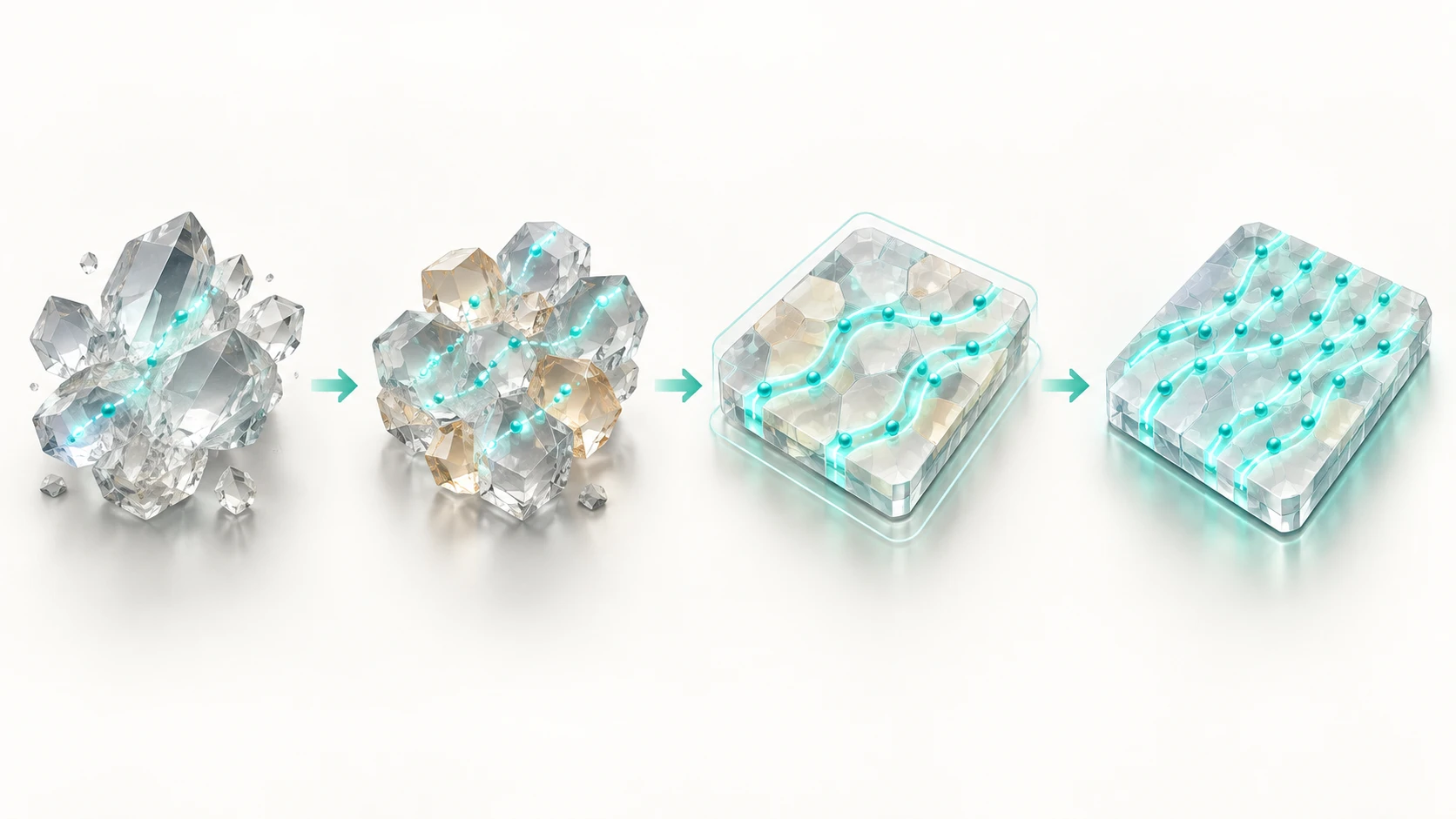
- 1930s: early chloride-ion conductors
- 1970s–80s: exploration of complex chlorides
- 2018: high conductivity and cathode compatibility draw attention
- From 2023: reports of still higher conductivity
Since it became clear in 2018 that Li3YCl6 and Li3YBr6 show ionic conductivities of 0.1 to 1 mS cm⁻¹, and that all-solid-state batteries made with them charge and discharge with no coating on the cathode material, research has accelerated both in Japan and abroad.Sourced (Akira Miura and Kiyoharu Tadanaga, "Halide solid electrolytes", 2023)
The conductivity reported in 2018 was 0.1 to 1 mS/cmSourced. Around the same time sulfides were in the range of 10⁻³ to 10⁻² S cm⁻¹ (that is, 1 to 10 mS/cm)Sourced. On numbers alone, halides were not winning.
Research accelerated anyway because of the other half of the same sentence — that they charge and discharge with no coating on the cathode materialSourced.
What was valued was not a performance figure but the disappearance of a process step. A case of a material being judged by manufacturing rather than by property values (our commentary).
3. The materials reported and their ionic conductivities
| Material | Ionic conductivity (mS/cm) | Crystal system (close packing) | Space group |
|---|---|---|---|
| Li3YCl6 (low crystallinity) | 0.51 | Trigonal (hcp) | P-3m1 |
| Li3YBr6 | 1.7 | Monoclinic (ccp) | C2/m |
| Li2ZrCl6 | 0.808 | Trigonal (hcp) | P-3m1 |
| Li3InCl6 | 2.02 | Monoclinic (ccp) | C2/m |
| Li3ScCl6 | 3 | Monoclinic (ccp) | C2/m |
| LiNbOCl4 (oxychloride) | over 10 | Not confirmed within the scope of this article | As left |
All Sourced (Table 1 of the Hokkaido University review [Source 1], and its text on LiNbOCl4). LiNbOCl4 is described as showing an ionic conductivity exceeding 10 mS cm⁻¹.
Conductivity alone does not show what the cell will do. Convert it into area-specific resistance (Ω cm²)Our calculation. For a layer of thickness t, the area resistance is R = t divided by σ.
- Assumption: take the electrolyte layer as 20 µm thick (= 2×10⁻³ cm)
- Li3YCl6 (0.51 mS/cm): 2×10⁻³ divided by 5.1×10⁻⁴ = about 3.9 Ω cm²
- Li3ScCl6 (3 mS/cm): 2×10⁻³ divided by 3×10⁻³ = about 0.67 Ω cm²
- LiNbOCl4 (taking 10 mS/cm): 2×10⁻³ divided by 1×10⁻² = about 0.2 Ω cm²
As the Interfacial resistance article in this series covers, interfacial resistances are reported across the range 1.5 to 225 Ω cm²Sourced. So even Li3YCl6, the least conductive of them, comes out below the interface once the layer is thin.
Assumptions and limits: the 20 µm thickness is our own assumption. This is also the resistance of the electrolyte layer alone; it excludes the distance ions travel inside the cathode composite and losses at grain boundaries. The interfacial resistance figures come from different experiments on different material systems under different measurement conditions, so this is not a strict like-for-like comparison.
4. A materials engineer's view (1): the point is the single charge
The chloride ion is almost the same size as the sulfide ion, and its charge is singly negative. Because the charge is smaller than that of sulfide, the activation energy for ionic conduction is lower.Sourced
Those two lines are where the halide family starts.
- Almost the same size: the same close-packed framework thinking as for sulfides can be used
- Half the charge: S²⁻ is doubly charged while Cl⁻ is singly charged, so it holds the lithium ion less strongly
The hill a lithium ion has to climb to move — the activation energy — is lower as a matter of principle. As materials design goes, that is unusually clear reasoning.
The same reasoning also creates a structural constraint. The review continues: to form the vacancies that are essential for high ionic conduction, part of the Li must be substituted by higher-valence ions (Zr⁴⁺, Al³⁺, rare-earth ions such as Sc³⁺, Y³⁺ and Ho³⁺) in order to maintain charge compensationSourced.
To open the gaps through which ions travel, you need high-valence metals. And the elements in that table — Y, Sc, In, Zr — are none of them cheaply available in the way iron or aluminium are. The principle of conduction turns directly into a raw-material cost constraint (our commentary).
Design guidance from first-principles calculation is given too: (1) a vacancy fraction of 40 to 60% of the lithium sites, (2) lower cation concentration and (3) greater separation between cations for a sparse distributionSourced. Keeping nearly half the lithium sites empty is a concrete target to design against.
5. The biggest advantage — no cathode coating needed
As the Interfacial resistance article in this series shows, using a sulfide solid electrolyte at the cathode normally means coating the cathode active material particles with LiNbO3 or similar, to prevent a chemical reaction layer forming at the interface.
With chlorides, that is not needed.
| Item | Sulfide | Chloride |
|---|---|---|
| Coating on the cathode | Essential for stable cycling | Fast cycling with none |
| Reaction with moisture | Releases harmful hydrogen sulfide | No hydrogen sulfide |
| Electrochemical window (calculated) | Not confirmed within the scope of this article | Roughly 1 to 4 V for chlorides, 1 to 3 V for bromides |
| Forming | High plasticity and easy to form | Can be pressed to shape |
| Solution coating of active material | Reported | Possible, depending on the material |
The chloride column is all Sourced (Hokkaido University review [Source 1]). The moisture reaction and the forming behaviour of sulfides follow the Osaka Metropolitan University research report [Source 3].
A working cell has been demonstrated as well. A cathode composite of the nickel-rich cathode LiNi0.8Mn0.1Co0.1O2 (NMC811) with the solid electrolyte Li2ZrCl6 at 75:25, with a sulfide (Li6PS5Cl) on the anode side, is reported to have delivered a stable capacity of about 150 mAh/g over 200 cycles at room temperatureSourced.
6. The second advantage — no hydrogen sulfide
As the Argyrodite article in this series shows, the biggest constraint on sulfides is the reaction with moisture. The Osaka Metropolitan University research report states that exposed to the atmosphere they react with moisture to generate toxic hydrogen sulfide (H2S), and their ionic conductivity falls sharply; for this reason an inert, moisture-free atmosphere is essential for fabricating sulfide-type all-solid-state batteries, and this is a cause of increased process costSourced.
Against that, the halide review says: generally more stable than sulfide solid electrolytes, and producing no harmful hydrogen sulfide even on contact with moistureSourced.
Producing no hydrogen sulfide means three things change at once.
- Manufacturing: the demand on the inert atmosphere falls (though not to zero — see below)
- Transport and storage: the handling classification may change
- When a product is damaged: the premise behind what the Osaka report calls safety measures for atmospheric exposure of the electrode body in a traffic accident or similar event changesSourced
The third matters most. An inert atmosphere only solves the problem inside the factory. Safety after shipment can only be solved in the material. On that one point, halides are structurally ahead (our commentary).
But producing no hydrogen sulfide is not the same as being resistant to water. As set out below, Li3YCl6 decomposes in waterSourced.
7. The weakness — it does not survive at low potential
The electrochemical window obtained by calculation is roughly 1 to 4 V (vs. Li/Li⁺) for chlorides. For bromides it is roughly 1 to 3 V, so the high-potential side of the window is narrower than for chlorides.Sourced
Experimentally, however, it reports that sweeping beyond 4 V to 4.22 V still allows stable operation cycling LiCoO2Sourced.
A high upper limit is an advantage, as the previous sections showed. The problem is the lower one.
A lithium metal anode sits at 0 V (vs. Li/Li⁺), and a graphite anode works at a potential close to it. A material whose lower limit is 1 V cannot go there.
Which is why the cell described in Section 5 was built the way it was: a sulfide solid electrolyte (Li6PS5Cl) was used on the anode side to avoid decomposition at low potentialSourced.
A halide alone does not make a battery. Halide on the cathode side and sulfide on the anode side — that division of labour is the premise.
From a materials-business point of view this is not a small thing. It is not a material that replaces sulfides but one that is used alongside them. And two electrolytes inside one cell means one more interface between them (our commentary). The review itself puts further widening of the electrochemical window at the top of its list of future tasksSourced.
8. Behaviour towards water differs from material to material
Producing no hydrogen sulfide does not mean water is irrelevant. The review shows that how a material gets along with water differs completely from one to anotherSourced.
9. A materials engineer's view (2): dissolving in water becomes a weapon
In the sulfide world, water is always the enemy. In the halide world, water becomes a tool.
Of Li3InCl6 the review states that after dissolving it in water or alcohol it can be coated onto the cathode material by drying, so coating the cathode material is straightforwardSourced.
That changes the character of the process.
- Not mixing powders but dissolving and coating
- It can be applied to particle surfaces thinly and evenly
- The hard problem from the Interfacial resistance article — putting a 10 nm layer evenly on every individual particle — becomes approachable with existing wet-coating technology
There is a synthesis-cost angle too. Li3YCl6 decomposes in water and is hard to recover by reheating, but it has been reported that Li3YCl6 can be synthesised by mixing LiCl, the hydrate YCl3·6H2O and NH4Cl and heating above 400 °C under nitrogen — and this method can lower the synthesis cost by using hydrates, which are cheaper than anhydrous materialsSourced.
Rather than paying to keep water out, you use a cheap hydrated raw material to bring the cost down. The whole mindset about handling the material is different from sulfides (our commentary).
A caution, though. Li3YCl6 and Li3InCl6 behave in opposite ways towards waterSourced. You cannot lump them together as halides that tolerate water. How each material gets along with water has to be checked individually (our commentary).
10. Where industry stands, and what is still hard
On the industrial side, Panasonic Holdings publishes material on halide solid electrolytes on its technology pagesSourced.
It says it has realised a proprietary solid electrolyte made of halides with high ionic conduction and improved ionic conduction at the cathode active material interface by a factor of ten over the conventional case, through high formability and oxidation resistance (the comparison being against a sulfide-based solid electrolyte)Sourced (Panasonic Holdings technology page)
(1) The tasks the review itself sets out
On future work the review states: further widening of the electrochemical window, appropriate methods of forming the interface, and improved conductivity will be needed. While these materials are known to take a variety of crystal structures, the basic knowledge of how to make one structure rather than another, and of which crystal structures achieve high ionic conduction, is not clearSourced.
(2) No production record can be confirmed
At the time of writing (September 2026), no primary source confirming that volume production of all-solid-state batteries using halide solid electrolytes has begun could be foundNot yet confirmed. Panasonic's statement is a report of technical development; no timing or scale of production could be confirmed on the page this article consulted.
(3) No figures for raw-material cost
As Section 4 noted, high-valence cations such as Y, Sc, In and Zr are said to be necessary for conductionSourced. But prices for those raw materials, and any cost estimate for the electrolyte, could not be found in published primary sources within the scope of this article and are not given. The review offers only the qualitative statement that using hydrates, which are cheaper than anhydrous materials, can lower the synthesis costSourced.
(4) The basis of Panasonic's factor of ten cannot be confirmed
For the statement about improving ionic conduction at the cathode active material interface by a factor of ten over the conventional caseSourced, the comparison conditions, the measurement method and the absolute values could not be confirmed on the page this article consulted, so no numerical conversion is made here.
- What lit the fuse was not conductivity but the fact that these materials cycle with no coatingSourced
- The point is that the chloride ion is almost the same size as the sulfide ion but carries a single chargeSourced
- Even Li3YCl6, the least conductive, gives about 3.9 Ω cm² in a 20 µm layer, below reported interfacial resistancesOur calculation
- Producing no hydrogen sulfide matters beyond the factory gate (our commentary)
- But the window bottoms out at 1 V. Another electrolyte is needed on the anode sideSourced
- Li3InCl6 can be dissolved in water and coated onto the cathode. Water becomes a tool rather than an enemySourced
- Conduction requires high-valence cations (Y, Sc, In, Zr). The principle itself becomes the cost constraint (our commentary)
11. Glossary
- Halide solid electrolyte
- A solid electrolyte built on chlorine, bromine or iodine. Chlorides are the main line.
- Electrochemical window
- The range of potential over which an electrolyte does not decompose. A higher upper limit allows a higher-voltage cathode.
- vs. Li/Li⁺
- A way of quoting potential against lithium metal. A lithium metal anode sits at 0 V.
- Cathode composite
- The layer of cathode active material mixed with solid electrolyte, carrying both ions and electrons.
- Coating layer
- A thin film on cathode active material particles. Essential with sulfides to prevent interface reactions.
- Close packing
- The densest ways of stacking spheres: cubic close packing (ccp) and hexagonal close packing (hcp).
- Octahedral site
- One of the gaps that arise within a close-packed structure, occupied by lithium or metal ions.
- Vacancy
- A site that could hold an ion but is empty. Necessary for ions to move.
- Charge compensation
- Keeping the charge balanced through substitution. Adding higher-valence ions creates vacancies.
- Activation energy
- The energy hill an ion must cross to make one hop. The lower it is, the more mobile the ion.
- Wet coating
- Dissolving a material, applying it and drying it into a film. Easy to apply thinly and evenly.
- Oxychloride
- A compound containing both oxygen and halogen. LiNbOCl4 is reported above 10 mS/cm.
12. Primary sources
- Akira Miura and Kiyoharu Tadanaga (Faculty of Engineering, Hokkaido University) "Part 3, Chapter 1, Section 3: Halide solid electrolytes", in "Development of post-lithium-ion secondary batteries: from component development to analysis and performance diagnosis", 25 July 2023 (Hokkaido University Collection of Scholarly and Academic Papers, HUSCAP, PDF, Japanese-language page) — eprints.lib.hokudai.ac.jp
- Panasonic Holdings "Environment and energy", technology page (Japanese-language page) — tech.panasonic.com
- H. Tsukasaki (Osaka Metropolitan University) "Elucidating the degradation mechanism of sulfide solid electrolytes in ambient atmosphere", Murata Science Foundation research report, 25 March 2024 (PDF, Japanese-language page) — corporate.murata.com
- Tohoku University "Interface between lithium metal and a garnet-type oxide solid electrolyte formed at room temperature in a short time", 24 March 2026 (Japanese-language release) — tohoku.ac.jp
13. Claim-to-source audit
| Claim in the text | Basis | Label |
|---|---|---|
| That rock-salt LiX (X = F, Cl, Br, I) was known in the 1930s to show conductivities of 10⁻⁷ S cm⁻¹ or less; that by the 1970s and 80s mixed chlorides such as LiCl-AlCl3 and LiCl-FeCl2 had been explored along with composites with insulators such as LiI-Al2O3; the statement that since it became clear in 2018 that Li3YCl6 and Li3YBr6 show 0.1 to 1 mS cm⁻¹ and that cells made with them cycle with no coating on the cathode material, research has accelerated in Japan and abroad; the values in Table 1 (Li3YCl6 low crystallinity 0.51, Li3YBr6 1.7, Li2ZrCl6 0.808, Li3InCl6 2.02, Li3ScCl6 3 mS cm⁻¹, with crystal systems and space groups); the statement that LiNbOCl4 shows a conductivity exceeding 10 mS cm⁻¹; the statement that the chloride ion is almost the same size as the sulfide ion with a single charge, giving lower activation energy; the statement that higher-valence ions are needed to form vacancies while maintaining charge compensation; the design guidance of 40 to 60% vacancy on lithium sites, lower cation concentration and greater cation separation; that an oxide coating is essential with sulfides but not with chlorides; that halides are generally more stable and produce no hydrogen sulfide on contact with moisture; the calculated windows of roughly 1 to 4 V for chlorides and 1 to 3 V for bromides, and stable operation on sweeping to 4.22 V with LiCoO2; the NMC811 and Li2ZrCl6 75:25 cathode composite with Li6PS5Cl on the anode side giving about 150 mAh/g stably over 200 cycles at room temperature; that Li3YCl6 decomposes in water and is hard to reprecipitate while Li3InCl6 only hydrates and can be reprecipitated and wet-coated; the synthesis of Li3YCl6 from LiCl, YCl3·6H2O and NH4Cl above 400 °C under nitrogen and the statement that hydrates lower the synthesis cost; and the list of future tasks | Hokkaido University review, 2023[Source 1] https://eprints.lib.hokudai.ac.jp/dspace/bitstream/2115/90346/1/20230725_3-1-3.pdf | Sourced |
| The statements about realising a proprietary solid electrolyte made of halides with high ionic conduction, and about improving ionic conduction at the cathode active material interface by a factor of ten over the conventional case through high formability and oxidation resistance, with the comparison being against a sulfide-based solid electrolyte | Panasonic Holdings technology page[Source 2] https://tech.panasonic.com/jp/td/technology/environment-energy.html | Sourced |
| That sulfide solid electrolytes exposed to the atmosphere react with moisture to generate toxic hydrogen sulfide (H2S) with a sharp fall in ionic conductivity; that an inert moisture-free atmosphere is therefore essential and raises process cost; that safety measures will be needed for atmospheric exposure of the electrode body in an accident if EV or PHEV installation is realised; and that sulfides conduct at 10⁻³ to 10⁻² S cm⁻¹ and are high in plasticity and easy to form | Murata Science Foundation research report, 25 March 2024[Source 3] https://corporate.murata.com/-/media/corporate/group/zaidan/report/study/202406/2024-002.ashx?la=ja-jp&cvid=20240802012731000000 | Sourced |
| That interfacial resistances of about 225 Ω cm² (ultrasonic bonding alone) and about 1.5 Ω cm² (with an Au layer) have been reported | Tohoku University press release, 24 March 2026[Source 4] https://www.tohoku.ac.jp/japanese/2026/03/press20260324-02-Lithium.html | Sourced |
| Putting the area resistance of a 20 µm layer at about 3.9 Ω cm² for Li3YCl6, about 2.5 for Li2ZrCl6, about 1.2 for Li3YBr6, about 1.0 for Li3InCl6, about 0.67 for Li3ScCl6 and about 0.2 Ω cm² for LiNbOCl4; and giving the window spans as 3 V for chlorides and 2 V for bromides | Our calculation. The 20 µm electrolyte layer thickness is an assumption set by this article. LiNbOCl4 is described as exceeding 10 mS/cm, so 10 mS/cm was used. These are resistances of the electrolyte layer alone and exclude paths inside the cathode composite and grain-boundary losses. The interfacial resistance figures come from different material systems and measurement conditions, so this is not a strict direct comparison | Our calculation |
| The crystal system and space group of LiNbOCl4 | These are not in Table 1 of the review this article consulted, which mentions the material only in its text, so the table records them as not confirmed | Commentary |
| The comparison conditions, measurement method and absolute values behind Panasonic's factor of ten | Not stated on the page this article consulted, so no numerical conversion has been made | Commentary |
| Prices for raw materials such as Y, Sc, In and Zr, and cost estimates for halide solid electrolytes | Not found in published primary sources within the scope of this article, so not stated. The review offers only the qualitative statement that hydrates, being cheaper than anhydrous materials, can lower the synthesis cost | Commentary |
| Numerical values for the electrochemical window of sulfide solid electrolytes | Could not be confirmed in the material this article consulted, so the comparison table records them as not confirmed | Commentary |
| The start of volume production of all-solid-state batteries using halide solid electrolytes | No primary source indicating the start of volume production could be confirmed at the time of writing (September 2026) by this article | Not yet confirmed |
| The reading that what lit the fuse was the disappearance of a process step rather than conductivity; the point that the principle of conduction becomes a raw-material cost constraint; the framing that producing no hydrogen sulfide matters beyond the factory gate; the point that, since a halide cannot make a cell alone and is used with a sulfide, one more interface appears; the reading that water becomes a tool rather than an enemy; the two-column sorting of strengths and weaknesses; and the comparison table with sulfides | Our summary and commentary based on published content. Not views expressed by the institutions or companies | Commentary |
| That Figs. 1, 2, 3, 4, 6 and 7 are explanatory drawings rather than real observations or measured data, and that the hero image and Fig. 5 are AI-generated images | Our note | Commentary |
Last updated 21 September 2026. Sources are limited to primary material (a review published in a university scholarly repository, company technology pages, and research reports funded by public grants). Because the article includes structural readings and materials-design interpretations, those are marked as Commentary and kept separate from sourced fact. Raw-material prices and cost estimates, the basis of Panasonic's factor of ten, and any production record are not stated here because no published primary source could be confirmed. The area resistances in Fig. 2 and the window spans in Fig. 4 are calculated by this article. All figures are explanatory concept graphics. Figs. 1, 2, 3, 4, 6 and 7 are vector drawings; the hero image and Fig. 5 are AI-generated images, and none of them shows a real cross-section, micrograph, measured data or physical product.